LTE Community Networks in Brazil:
Sustainable Modeling, Deployment and Maintenance
Towards New Networking Paradigms
Prof. Dr. Christian Esteve Rothenberg
Dr. Raphael Vicente Rosa
Department of Computer Engineering and Industrial Automation (DCA)
School of Electrical and Computer Engineering (FEEC)
University of Campinas (UNICAMP)
Workshop “Conectividade 5G na Amazônia”
https://www.lasse.ufpa.br/co5gam
25 de setembro de 2020
Agenda
1. Project description
2. An outlook of our activities
3. Insights about wireless community networks
2
Project Description
3
Introduction
➔ Report by the Internet Governance Committee in Brazil (CGI.br) in 2018:
➔ In terms of broadband Internet access in Brazil:
◆ There exists a wide inequality between economic classes A/B (higher) and D/E (lower),
◆ A fact evidenced in the analyzes between urban and rural areas
➔ Internet access: a catalyst for social, economic and technological development
➔ Community wireless networks have become a sustainable means of promoting affordable
Internet connectivity
➔ In the vast majority, community wireless networks adopt wifi technology
➔ Due to the development of free and low-cost technologies, the Long-Term Evolution (LTE)
has begun to be exploited for these purposes
4
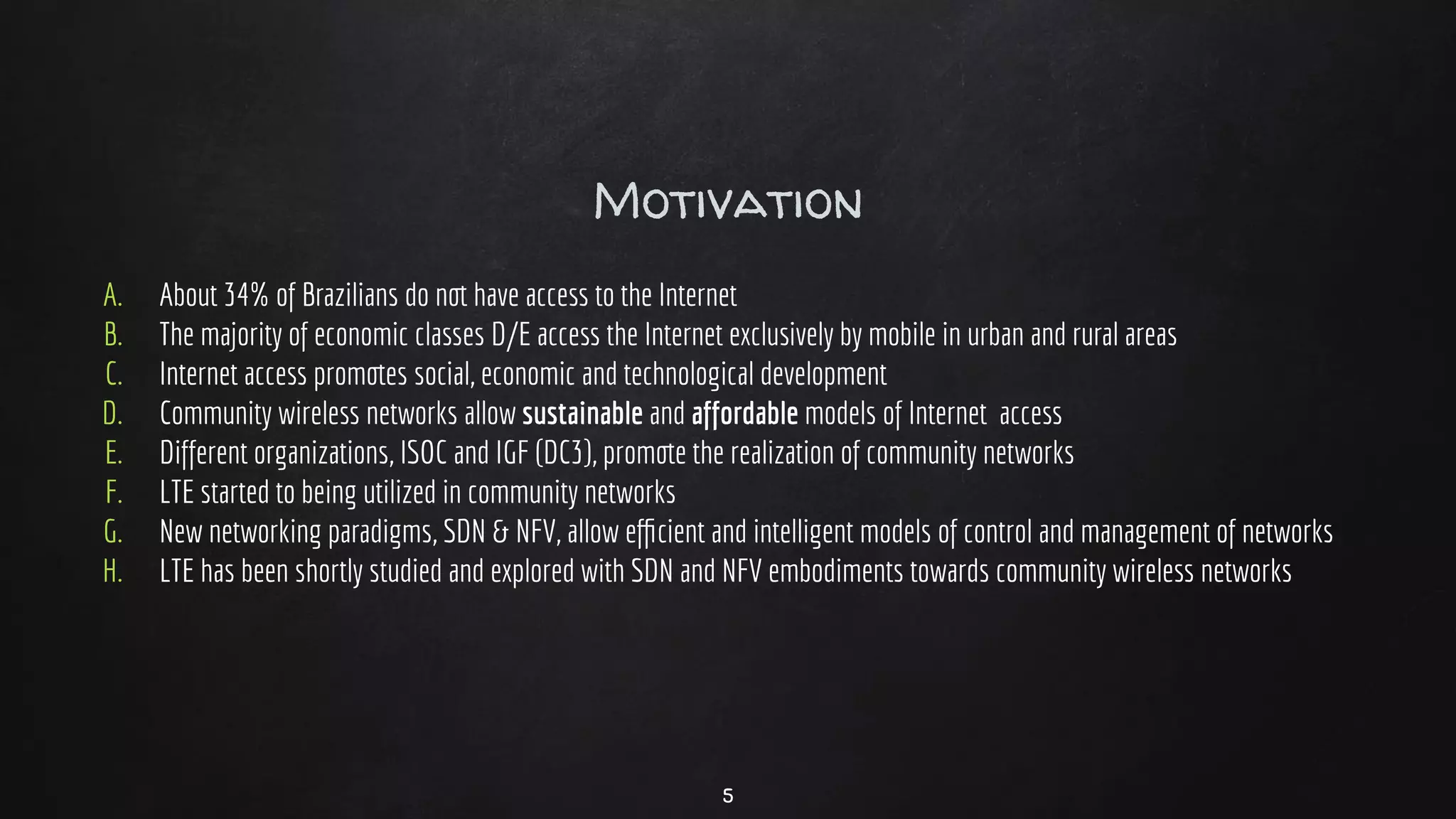
Motivation
A. About 34% of Brazilians do not have access to the Internet
B. The majority of economic classes D/E access the Internet exclusively by mobile in urban and rural areas
C. Internet access promotes social, economic and technological development
D. Community wireless networks allow sustainable and affordable models of Internet access
E. Different organizations, ISOC and IGF (DC3), promote the realization of community networks
F. LTE started to being utilized in community networks
G. New networking paradigms, SDN & NFV, allow efficient and intelligent models of control and management of networks
H. LTE has been shortly studied and explored with SDN and NFV embodiments towards community wireless networks
5
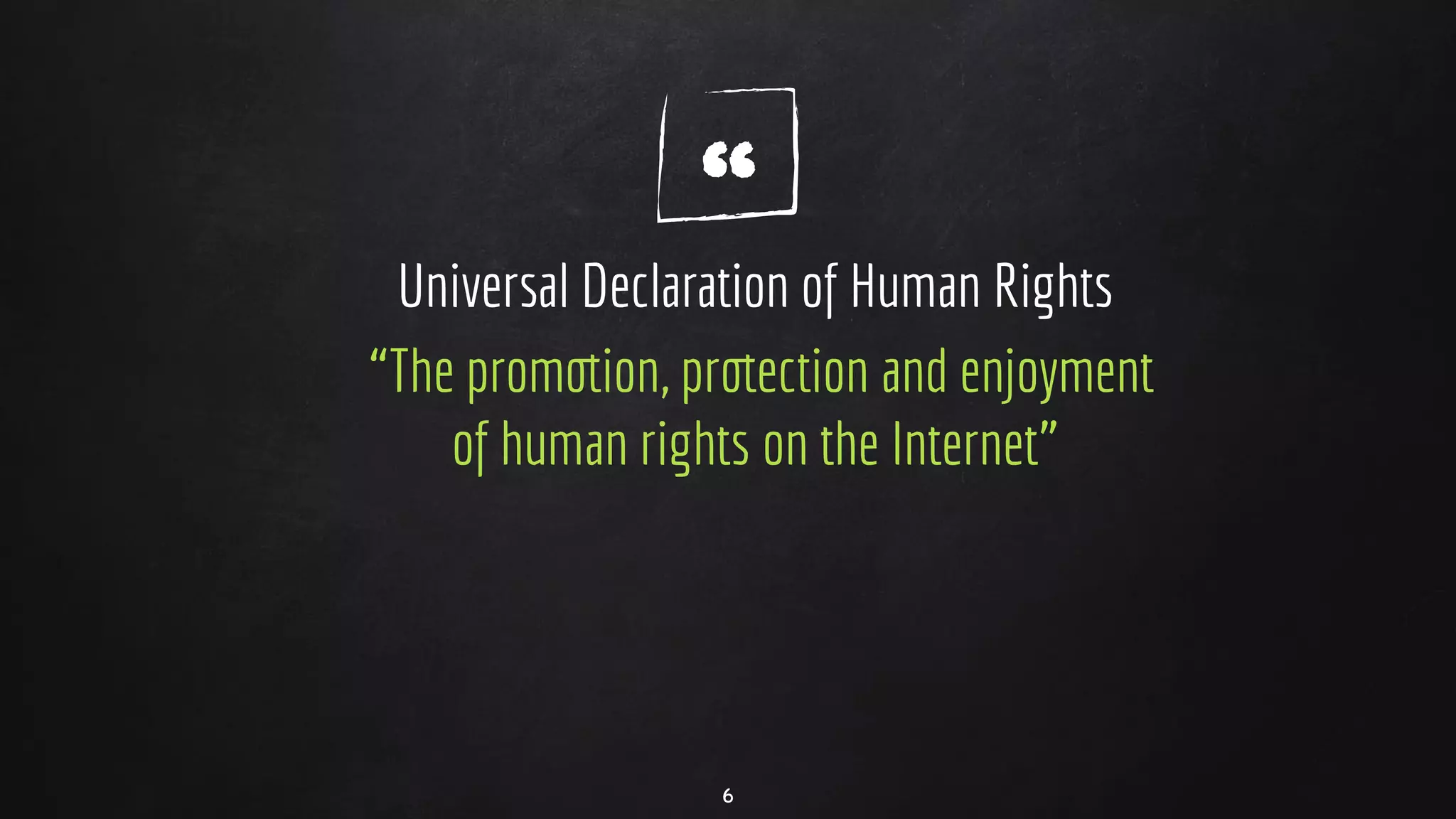
“Universal Declaration of Human Rights
“The promotion, protection and enjoyment
of human rights on the Internet”
6
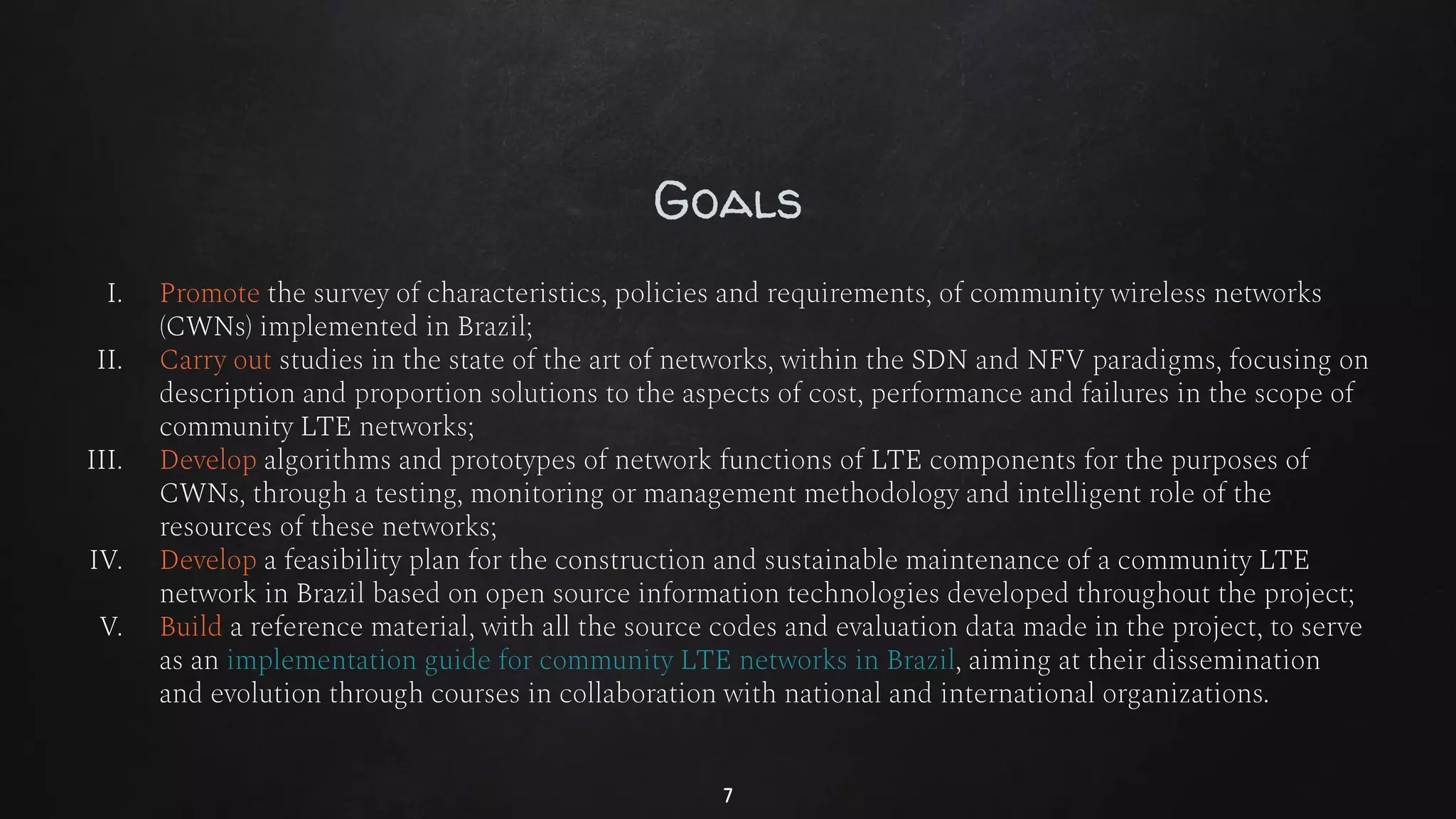
Goals
I. Promote the survey of characteristics, policies and requirements, of community wireless networks
(CWNs) implemented in Brazil;
II. Carry out studies in the state of the art of networks, within the SDN and NFV paradigms, focusing on
description and proportion solutions to the aspects of cost, performance and failures in the scope of
community LTE networks;
III. Develop algorithms and prototypes of network functions of LTE components for the purposes of
CWNs, through a testing, monitoring or management methodology and intelligent role of the
resources of these networks;
IV. Develop a feasibility plan for the construction and sustainable maintenance of a community LTE
network in Brazil based on open source information technologies developed throughout the project;
V. Build a reference material, with all the source codes and evaluation data made in the project, to serve
as an implementation guide for community LTE networks in Brazil, aiming at their dissemination
and evolution through courses in collaboration with national and international organizations.
7
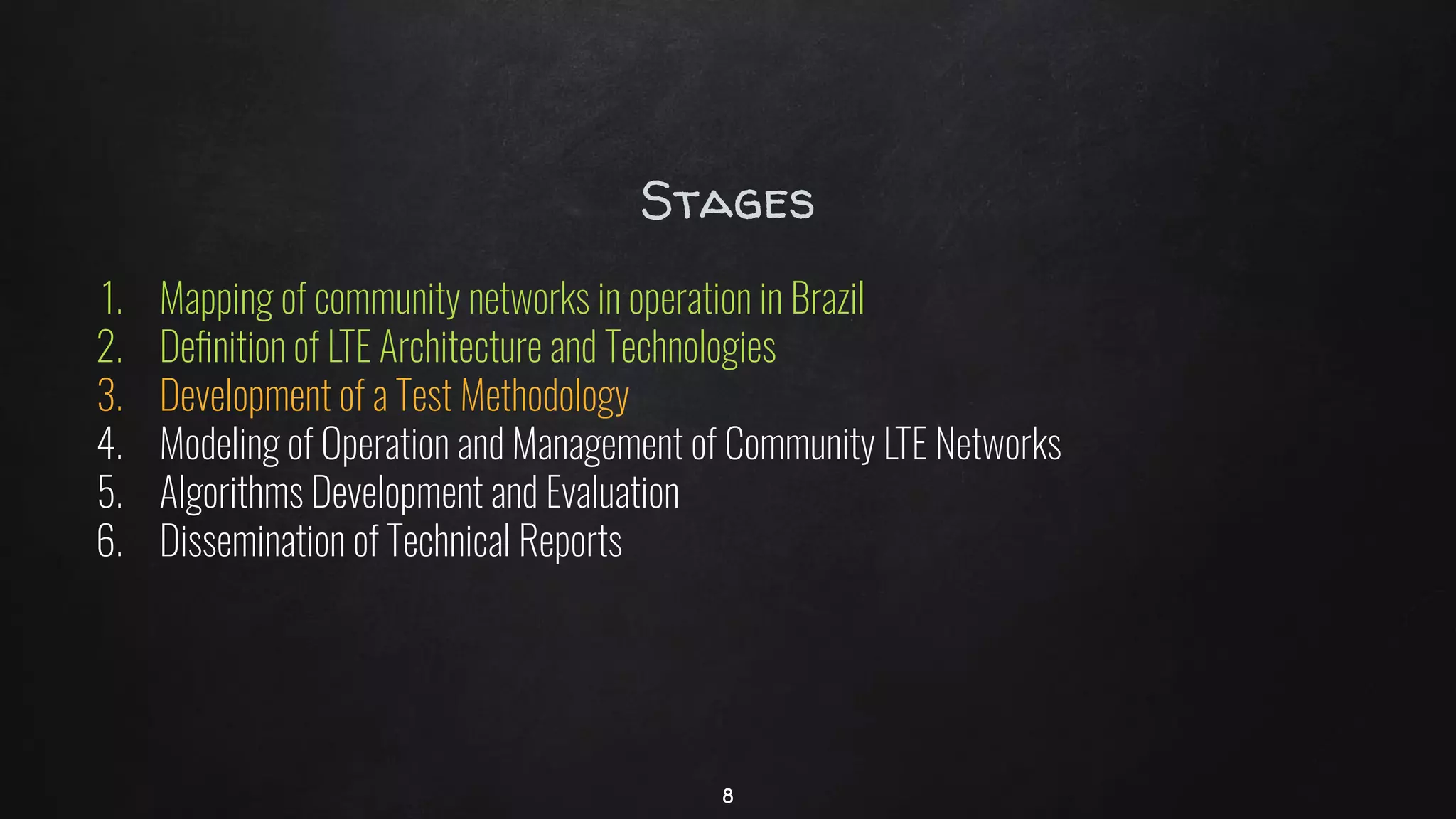
Stages
1. Mapping of community networks in operation in Brazil
2. Definition of LTE Architecture and Technologies
3. Development of a Test Methodology
4. Modeling of Operation and Management of Community LTE Networks
5. Algorithms Development and Evaluation
6. Dissemination of Technical Reports
8
An Outlook of Our Activities
9
Annual Reports of the UN IGF Dynamic Coalition on Community Connectivity
✘ 2016 - Community Connectivity: Building the Internet from Scratch
○ Defined an important milestone for Community Connectivity
○ Examples of community networks, legal issues, and a framework
✘ 2017 - Community Networks: the Internet by the People, for the People
○ Examples, key enablers, comparisons, policy gaps of community networks
✘ 2018 - The Community Internet: How to Build the Internet Yourself
○ How-to, technological aspects, LibreRouter, LTE case, guidelines for legal framework, scaling,
and even blockchain enhancements for community networks
10
Community Wireless Networks in Brazil
Goal: understand requirements/characteristics of
projects and networks
➔ NUPEF (1 project)
◆ https://nupef.org.br/RedesComunitarias
➔ COOLAB (7 projects)
◆ https://www.coolab.org/category/projeto/
➔ Methodology describes
◆ Projeto
◆ Local:
◆ Detalhes do local:
◆ Descrição do local:
◆ Dificuldades:
◆ Infraestrutura:
◆ Sustentabilidade:
◆ Financiamento:
◆ Fonte:
11
Feasible Open Source Projects
✘ Goal: understand [docs, features, APIs, DevOps]
✘ Define minimum set of features required in a 4G/5G community network
✘ Available projects:
○ OAI: Full set of projects and features for 4G/5G core/radio with CUPS
○ free5gc: Open source 5G core network based on 3GPP R15 (Go language)
○ open5gs: C-language Open Source implementation for 5G Core and 4G EPC
○ srsLTE: Open source SDR LTE software suite
○ magma: Mix of technologies (OAI, Ryu, OVS) for cloud 4G mobile core
○ OMEC (ONF): first full-featured, scalable, high performance open source EPC
○ COMAC (ONF): suite of ONF projects that brings convergence to Operators’ mobile and broadband access and core
networks
○ SD-RAN (ONF): open source components for the mobile RAN space (O-RAN compliant)
○ Aether (ONF): Enterprise 5G/LTE Edge-Cloud-as-a-Service platform
12
Project CoLTE
➢ First LTE Community Network - In operation in Indonesia - https://blog.colte.network/
➢ Built and deployed with OAI
➢ Custom setup and hardening [1] [2]
➢ Open source project: https://github.com/uw-ictd/colte
➢ Currently moving from OAI to open5gs
[1] https://www.internetsociety.org/blog/2018/09/building-a-community-lte-network-in-bokondini-indonesia/
[2] https://livros-e-revistas.vlex.com.br/vid/building-community-lte-networks-773142381
13
Insights about 4G/5G
Wireless Community Networks
14
eBPF and 4G/5G
➔ extensible Berkeley Packet Filter (eBPF) gives freedom for datapath
forwarding, encapsulation, filtering, mangling, monitoring and redirection
➔ JIT compiler loads eBPF in run-time (e.g., through tc and/or XDP)
➔ Smart NICs support for eBPF, i.e., processing packets right from the
hardware, with strict latency capabilities and high performance
➔ P4 compiler for eBPF and user-space BPF (uBPF)
➔ Ongoing related work: A Proof-of-Concept 5G Mobile Gateway with eBPF
15
The Role of O-RAN
➢ O-RAN decouples horizontally and vertically the mobile Radio Access Network
➢ Enables programmability in RAN (e.g., µONOS-RIC)
➢ Intelligent control over RAN (e.g., how spectrum is utilized and optimized)
➢ A telco operator in Japan, Rakuten, already proved it is feasible and (a lot) better
➢ Cut the clutter, keep only the needed features for 4G/5G community networks
➢ Different open source projects moving towards O-RAN (e.g., TIP and ONF)
16
Radio Spectrum Management
❖ Private 4G/5G networks need dynamic spectrum allocation
❖ Old command-control allocation of spectrum is doomed
❖ White spaces from analog spectrum TV available
❖ CBRS in USA seems like an interesting model for spectrum sharing
❖ In Brazil, different regions need custom spectrum management (rural vs. city)
17
Sustainable Governance
● Legal aspects must be taken into account in a community network
● A commons-oriented framework for management and operation
● More important than the means to build a community network are the means to
make it sustainable
● McKinsey & Company (2014) identified four major barriers to Internet adoption:
○ 1. Incentives to go online;
○ 2. Low incomes and affordability;
○ 3. User capability; and
○ 4. Infrastructure.
● A4AI - Meaningful Connectivity - https://a4ai.org/meaningful-connectivity/
● The Inclusive Internet Index - The Economist Intelligence Unit (FB)
● Technologies are a way of policy making
18
Social, Economic, Legal Aspects
❏ Centro de Estudos - Desigualdades do acesso à internet: muito além da
pandemia - 03/07/2020 [1]
❏ “Conectividade no campo é indispensável para dar um novo salto de
produtividade” [2]
❏ FUST [3]
❏ Decreto 10.402/20 (subavaliam os bens reversíveis da telefonia concedidos no
processo de privatização em 1998) [4]
❏ Escola de Governança da Internet (CGI.br/NIC.br) - https://egi.nic.br/
19
[1] https://www.youtube.com/watch?v=nJcl0e_ivvI
[2] https://economia.estadao.com.br/noticias/geral,conectividade-no-campo-e-indispensavel-para-o-brasil-dar-um-novo-salto-de-produtividade,70003227085
[3] https://direitosnarede.org.br/2020/05/20/fust-deve-subsidiar-acesso-a-internet-durante-pandemia-especialmente-os-estudantes/
[4] https://direitosnarede.org.br/2020/08/06/cdr-protocola-acao-civil-publica-contra-uniao-e-anatel-em-caso-dos-bens-reversiveis-da-telefonia-fixa/
Takeaways
20
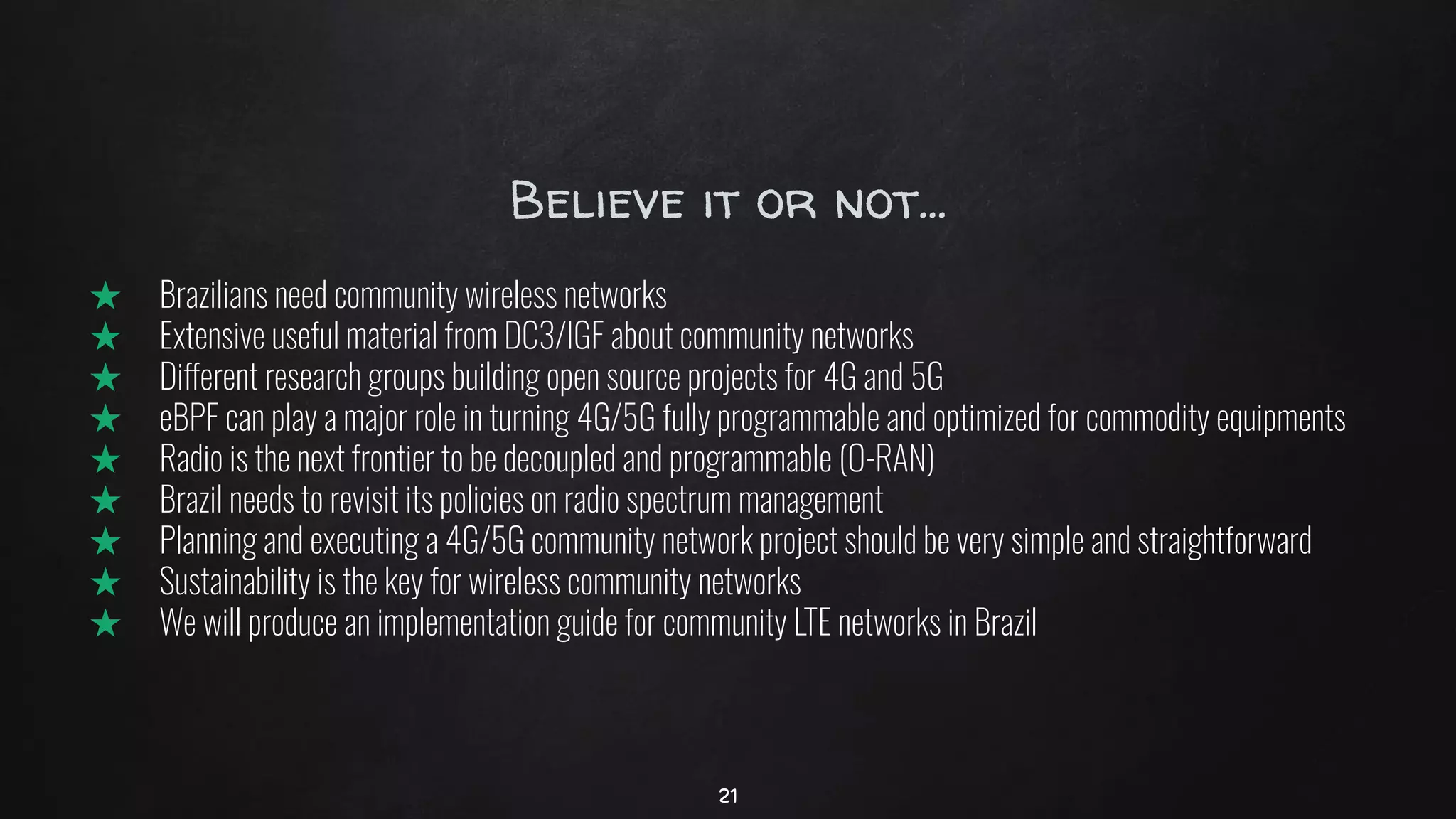
Believe it or not...
★ Brazilians need community wireless networks
★ Extensive useful material from DC3/IGF about community networks
★ Different research groups building open source projects for 4G and 5G
★ eBPF can play a major role in turning 4G/5G fully programmable and optimized for commodity equipments
★ Radio is the next frontier to be decoupled and programmable (O-RAN)
★ Brazil needs to revisit its policies on radio spectrum management
★ Planning and executing a 4G/5G community network project should be very simple and straightforward
★ Sustainability is the key for wireless community networks
★ We will produce an implementation guide for community LTE networks in Brazil
21
Acknowledgments
"As opiniões, hipóteses e conclusões ou recomendações expressas neste material são de responsabilidade
do(s) autor(es) e não necessariamente refletem a visão da FAPESP".
Grant #2018/23101-0, São Paulo Research Foundation (FAPESP)
Chamada de Propostas FAPESP / MCTIC – 2018 -
https://fapesp.br/11955/chamada-de-propostas-fapesp-mctic-2018
https://bv.fapesp.br/pt/auxilios/105575/redes-lte-comunitarias-no-brasil-modelamento-implantacao-e-
manutencao-sustentaveis-com-base-em-nov/
22
THanks!
Questions?
https://intrig.dca.fee.unicamp.br/
23

Lte community networks in brazil sustainable modeling, deployment and maintenance towards new networking paradigms (1)

  • 1.
    LTE Community Networksin Brazil: Sustainable Modeling, Deployment and Maintenance Towards New Networking Paradigms Prof. Dr. Christian Esteve Rothenberg Dr. Raphael Vicente Rosa Department of Computer Engineering and Industrial Automation (DCA) School of Electrical and Computer Engineering (FEEC) University of Campinas (UNICAMP) Workshop “Conectividade 5G na Amazônia” https://www.lasse.ufpa.br/co5gam 25 de setembro de 2020
  • 2.
    Agenda 1. Project description 2.An outlook of our activities 3. Insights about wireless community networks 2
  • 3.
  • 4.
    Introduction ➔ Report bythe Internet Governance Committee in Brazil (CGI.br) in 2018: ➔ In terms of broadband Internet access in Brazil: ◆ There exists a wide inequality between economic classes A/B (higher) and D/E (lower), ◆ A fact evidenced in the analyzes between urban and rural areas ➔ Internet access: a catalyst for social, economic and technological development ➔ Community wireless networks have become a sustainable means of promoting affordable Internet connectivity ➔ In the vast majority, community wireless networks adopt wifi technology ➔ Due to the development of free and low-cost technologies, the Long-Term Evolution (LTE) has begun to be exploited for these purposes 4
  • 5.
    Motivation A. About 34%of Brazilians do not have access to the Internet B. The majority of economic classes D/E access the Internet exclusively by mobile in urban and rural areas C. Internet access promotes social, economic and technological development D. Community wireless networks allow sustainable and affordable models of Internet access E. Different organizations, ISOC and IGF (DC3), promote the realization of community networks F. LTE started to being utilized in community networks G. New networking paradigms, SDN & NFV, allow efficient and intelligent models of control and management of networks H. LTE has been shortly studied and explored with SDN and NFV embodiments towards community wireless networks 5
  • 6.
    “Universal Declaration ofHuman Rights “The promotion, protection and enjoyment of human rights on the Internet” 6
  • 7.
    Goals I. Promote thesurvey of characteristics, policies and requirements, of community wireless networks (CWNs) implemented in Brazil; II. Carry out studies in the state of the art of networks, within the SDN and NFV paradigms, focusing on description and proportion solutions to the aspects of cost, performance and failures in the scope of community LTE networks; III. Develop algorithms and prototypes of network functions of LTE components for the purposes of CWNs, through a testing, monitoring or management methodology and intelligent role of the resources of these networks; IV. Develop a feasibility plan for the construction and sustainable maintenance of a community LTE network in Brazil based on open source information technologies developed throughout the project; V. Build a reference material, with all the source codes and evaluation data made in the project, to serve as an implementation guide for community LTE networks in Brazil, aiming at their dissemination and evolution through courses in collaboration with national and international organizations. 7
  • 8.
    Stages 1. Mapping ofcommunity networks in operation in Brazil 2. Definition of LTE Architecture and Technologies 3. Development of a Test Methodology 4. Modeling of Operation and Management of Community LTE Networks 5. Algorithms Development and Evaluation 6. Dissemination of Technical Reports 8
  • 9.
    An Outlook ofOur Activities 9
  • 10.
    Annual Reports ofthe UN IGF Dynamic Coalition on Community Connectivity ✘ 2016 - Community Connectivity: Building the Internet from Scratch ○ Defined an important milestone for Community Connectivity ○ Examples of community networks, legal issues, and a framework ✘ 2017 - Community Networks: the Internet by the People, for the People ○ Examples, key enablers, comparisons, policy gaps of community networks ✘ 2018 - The Community Internet: How to Build the Internet Yourself ○ How-to, technological aspects, LibreRouter, LTE case, guidelines for legal framework, scaling, and even blockchain enhancements for community networks 10
  • 11.
    Community Wireless Networksin Brazil Goal: understand requirements/characteristics of projects and networks ➔ NUPEF (1 project) ◆ https://nupef.org.br/RedesComunitarias ➔ COOLAB (7 projects) ◆ https://www.coolab.org/category/projeto/ ➔ Methodology describes ◆ Projeto ◆ Local: ◆ Detalhes do local: ◆ Descrição do local: ◆ Dificuldades: ◆ Infraestrutura: ◆ Sustentabilidade: ◆ Financiamento: ◆ Fonte: 11
  • 12.
    Feasible Open SourceProjects ✘ Goal: understand [docs, features, APIs, DevOps] ✘ Define minimum set of features required in a 4G/5G community network ✘ Available projects: ○ OAI: Full set of projects and features for 4G/5G core/radio with CUPS ○ free5gc: Open source 5G core network based on 3GPP R15 (Go language) ○ open5gs: C-language Open Source implementation for 5G Core and 4G EPC ○ srsLTE: Open source SDR LTE software suite ○ magma: Mix of technologies (OAI, Ryu, OVS) for cloud 4G mobile core ○ OMEC (ONF): first full-featured, scalable, high performance open source EPC ○ COMAC (ONF): suite of ONF projects that brings convergence to Operators’ mobile and broadband access and core networks ○ SD-RAN (ONF): open source components for the mobile RAN space (O-RAN compliant) ○ Aether (ONF): Enterprise 5G/LTE Edge-Cloud-as-a-Service platform 12
  • 13.
    Project CoLTE ➢ FirstLTE Community Network - In operation in Indonesia - https://blog.colte.network/ ➢ Built and deployed with OAI ➢ Custom setup and hardening [1] [2] ➢ Open source project: https://github.com/uw-ictd/colte ➢ Currently moving from OAI to open5gs [1] https://www.internetsociety.org/blog/2018/09/building-a-community-lte-network-in-bokondini-indonesia/ [2] https://livros-e-revistas.vlex.com.br/vid/building-community-lte-networks-773142381 13
  • 14.
    Insights about 4G/5G WirelessCommunity Networks 14
  • 15.
    eBPF and 4G/5G ➔extensible Berkeley Packet Filter (eBPF) gives freedom for datapath forwarding, encapsulation, filtering, mangling, monitoring and redirection ➔ JIT compiler loads eBPF in run-time (e.g., through tc and/or XDP) ➔ Smart NICs support for eBPF, i.e., processing packets right from the hardware, with strict latency capabilities and high performance ➔ P4 compiler for eBPF and user-space BPF (uBPF) ➔ Ongoing related work: A Proof-of-Concept 5G Mobile Gateway with eBPF 15
  • 16.
    The Role ofO-RAN ➢ O-RAN decouples horizontally and vertically the mobile Radio Access Network ➢ Enables programmability in RAN (e.g., µONOS-RIC) ➢ Intelligent control over RAN (e.g., how spectrum is utilized and optimized) ➢ A telco operator in Japan, Rakuten, already proved it is feasible and (a lot) better ➢ Cut the clutter, keep only the needed features for 4G/5G community networks ➢ Different open source projects moving towards O-RAN (e.g., TIP and ONF) 16
  • 17.
    Radio Spectrum Management ❖Private 4G/5G networks need dynamic spectrum allocation ❖ Old command-control allocation of spectrum is doomed ❖ White spaces from analog spectrum TV available ❖ CBRS in USA seems like an interesting model for spectrum sharing ❖ In Brazil, different regions need custom spectrum management (rural vs. city) 17
  • 18.
    Sustainable Governance ● Legalaspects must be taken into account in a community network ● A commons-oriented framework for management and operation ● More important than the means to build a community network are the means to make it sustainable ● McKinsey & Company (2014) identified four major barriers to Internet adoption: ○ 1. Incentives to go online; ○ 2. Low incomes and affordability; ○ 3. User capability; and ○ 4. Infrastructure. ● A4AI - Meaningful Connectivity - https://a4ai.org/meaningful-connectivity/ ● The Inclusive Internet Index - The Economist Intelligence Unit (FB) ● Technologies are a way of policy making 18
  • 19.
    Social, Economic, LegalAspects ❏ Centro de Estudos - Desigualdades do acesso à internet: muito além da pandemia - 03/07/2020 [1] ❏ “Conectividade no campo é indispensável para dar um novo salto de produtividade” [2] ❏ FUST [3] ❏ Decreto 10.402/20 (subavaliam os bens reversíveis da telefonia concedidos no processo de privatização em 1998) [4] ❏ Escola de Governança da Internet (CGI.br/NIC.br) - https://egi.nic.br/ 19 [1] https://www.youtube.com/watch?v=nJcl0e_ivvI [2] https://economia.estadao.com.br/noticias/geral,conectividade-no-campo-e-indispensavel-para-o-brasil-dar-um-novo-salto-de-produtividade,70003227085 [3] https://direitosnarede.org.br/2020/05/20/fust-deve-subsidiar-acesso-a-internet-durante-pandemia-especialmente-os-estudantes/ [4] https://direitosnarede.org.br/2020/08/06/cdr-protocola-acao-civil-publica-contra-uniao-e-anatel-em-caso-dos-bens-reversiveis-da-telefonia-fixa/
  • 20.
  • 21.
    Believe it ornot... ★ Brazilians need community wireless networks ★ Extensive useful material from DC3/IGF about community networks ★ Different research groups building open source projects for 4G and 5G ★ eBPF can play a major role in turning 4G/5G fully programmable and optimized for commodity equipments ★ Radio is the next frontier to be decoupled and programmable (O-RAN) ★ Brazil needs to revisit its policies on radio spectrum management ★ Planning and executing a 4G/5G community network project should be very simple and straightforward ★ Sustainability is the key for wireless community networks ★ We will produce an implementation guide for community LTE networks in Brazil 21
  • 22.
    Acknowledgments "As opiniões, hipótesese conclusões ou recomendações expressas neste material são de responsabilidade do(s) autor(es) e não necessariamente refletem a visão da FAPESP". Grant #2018/23101-0, São Paulo Research Foundation (FAPESP) Chamada de Propostas FAPESP / MCTIC – 2018 - https://fapesp.br/11955/chamada-de-propostas-fapesp-mctic-2018 https://bv.fapesp.br/pt/auxilios/105575/redes-lte-comunitarias-no-brasil-modelamento-implantacao-e- manutencao-sustentaveis-com-base-em-nov/ 22
  • 23.