1 1
The Next Generation
Network Connectivity Handbook
A Guide for Community Leaders
Seeking Affordable, Abundant Bandwidth
Vol 1.0
July 2015
Published in Association with the Benton Foundation
Blair Levin and Denise Linn
Gig.U: The Next Generation Network Innovation Project
2
3
This Handbook is dedicated to the hundreds of city and
university officials, particularly participants in Gig.U, who over
the last four years, as we explored many routes, helped guide
us to significant course corrections and created the map for
community-led broadband.
It is also dedicated to the thousands of citizens who attended
scores of meetings with us on community-led broadband, in
cities large and small, in every part of the country, and who
provided many insights we incorporated into our work and
into this Handbook. Many of their words were wise, but none
were wiser than those offered by a student at an event at the
University of Maine, who, after noting all the specific reasons
he was excited about having access to abundant bandwidth
then said, “But what is most exciting is what we don’t
yet know.”
It is further dedicated to the memory of Charles Benton, a
wonderful friend and coach to the Gig.U project and many
others seeking to improve the capacity of communications
networks to serve all. His energy and excitement about
discovering ‘what we don’t yet know’ served, and will continue
to serve, as the most important type of fuel for the work of
bringing affordable, abundant bandwidth to our communities.
Dedication
4
Contents
About this Handbook......................................... 5
Overview: The Underlying Equation................ 6
“Why Upgrade? Why Now?”............................. 9
The Economic Case for Faster Speeds................10
The Quality of Life Case for Faster Speeds...........10
Why Not Wait for Google Fiber?...........................10
The Bottom Line: If Not Now, When?...................11
“What’s Been Done?”.......................................12
Community-Led Gigabit Fiber Success Stories....13
What About Cable?..............................................17
City-Driven Wi-Fi Projects.....................................19
An Overview of Models........................................21
Emerging Map, Including Cities to Watch............ 22
Cautionary Tales for Cities Seeking
or Working with Private Partners..................... 25
Incumbent Push Back Against Cities
Aiming to Own and Operate a Network........... 26
State Laws Inhibiting Public Networks................. 27
“How Should My City Approach the
Challenge?”................................................... 28
High Level Local Strategy Framework................. 29
The Spectrum of Strategies from
Low to High Effort........................................... 29
“What are the Preliminary Steps?”.................31
Unite Diverse Local Actors on a
Common Mission............................................ 32
Take Inventory of Local Advantages, Strengths
and Barriers.................................................... 33
Tackle the “Low-Hanging Fruit”........................... 34
Understand the Economics: Orient First Steps
Around Lowering Costs and Risks.................. 36
Public Messaging Points: Better, Faster,
Cheaper Broadband........................................ 37
“What are the Key Issues in Developing a
Public-Private Partnership?”...................... 39
Negotiating with Partners.................................... 40
Where to Build......................................................41
How to Build....................................................... 42
Access to Infrastructure and
Rights-of-Way (ROW)...................................... 43
Permit Approvals................................................. 43
Personnel Commitments..................................... 44
Open Access...................................................... 44
Free Network Services for the City...................... 45
Revenue Sharing................................................. 46
Other Provisions.................................................. 46
“What are the Funding Issues and
Opportunities that Affect How the
City Proceeds?”............................................47
An Overview........................................................ 48
Key Considerations: Financing........................... 48
Funding Methods and Case Examples................ 49
Challenges to Expect Along the Way............ 52
Challenges during the Exploratory Phase............ 53
Challenges during the Decision Making Phase.... 54
Challenges during Implementation
and Build-Out................................................. 55
Top Ten Overall Lessons................................. 57
Conclusion – Eliminating Bandwidth
Constraints....................................................61
Appendix: Tools, Resources and Links
for Your Next Steps..................................... 62
Previous Reports from the Gig.U Project............. 62
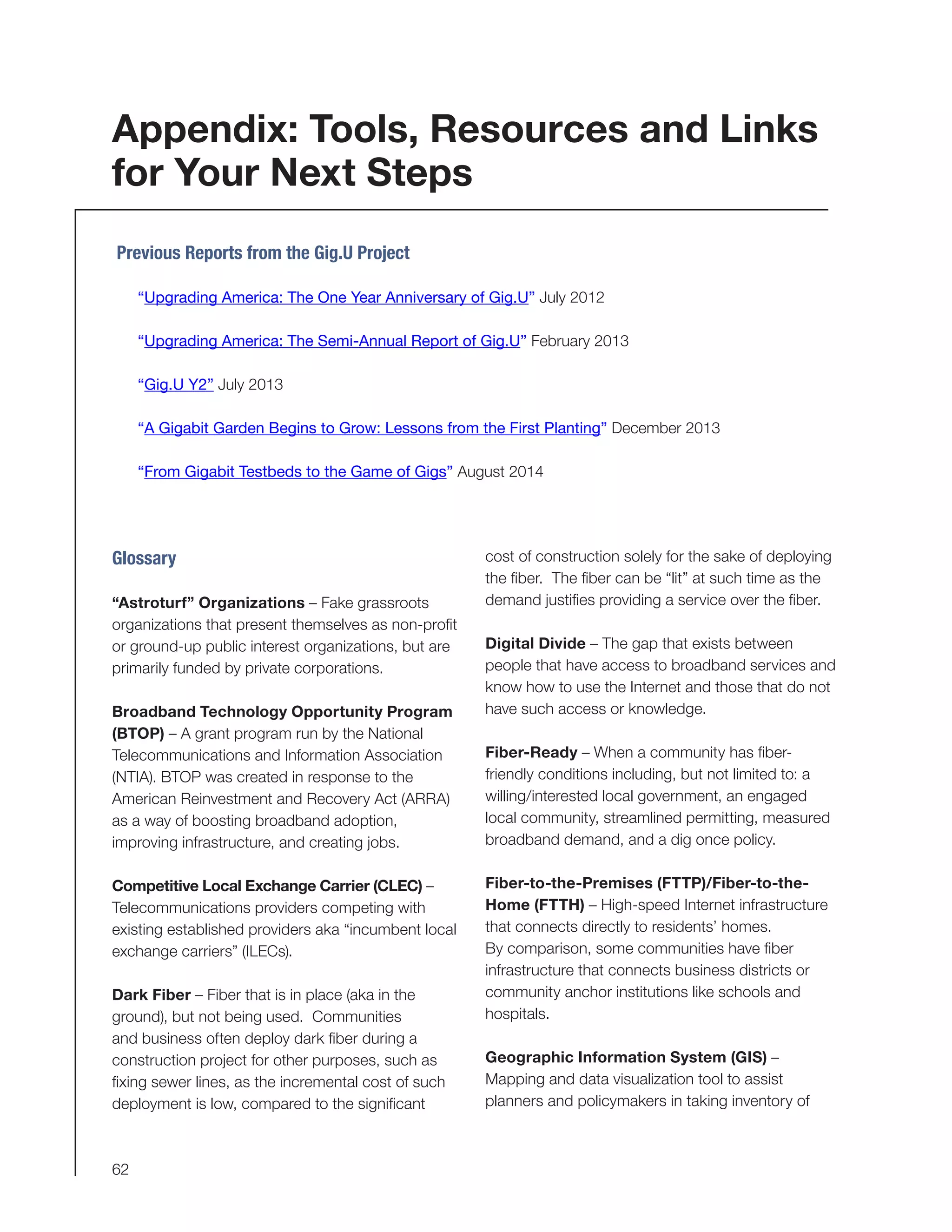
Glossary.............................................................. 62
Related Cases, Studies and Tools for
Gigabit Cities and Municipal Broadband......... 64
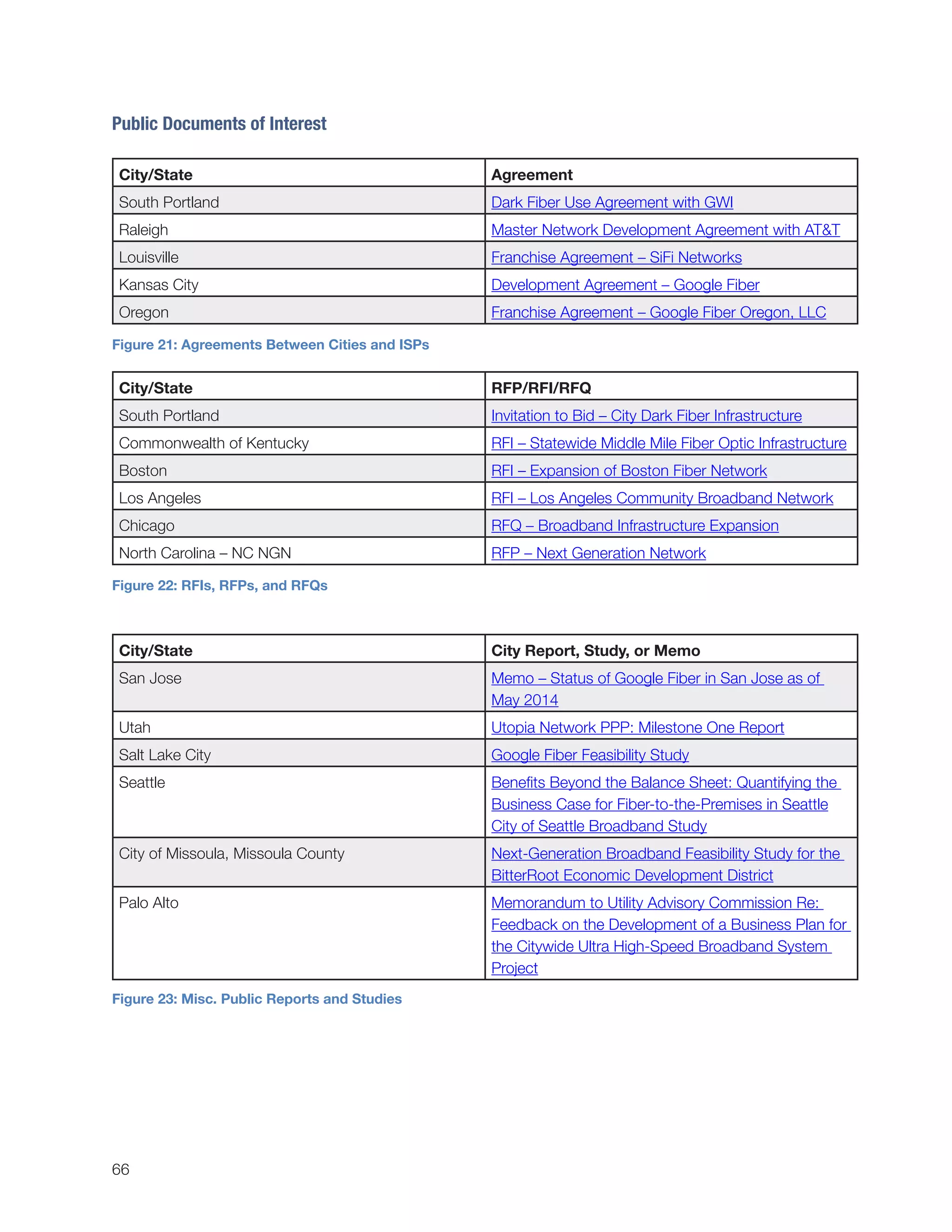
Public Documents of Interest............................... 66
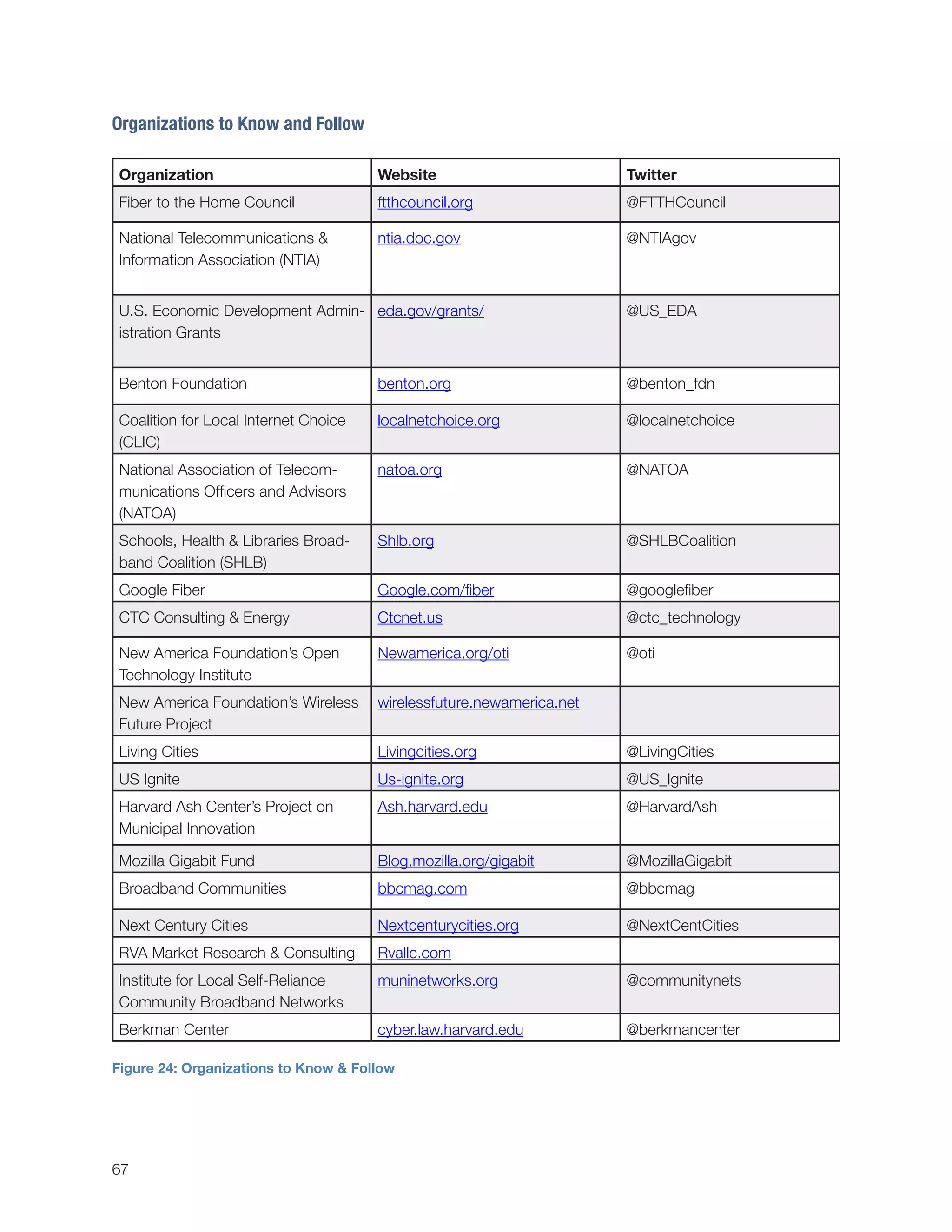
Organizations to Know and Follow...................... 67
List of State Laws Inhibiting Public Broadband.... 68
Acknowledgements............................................. 69
About the Authors................................................70
5
This is a handbook for city officials seeking the
affordable, abundant bandwidth their communities
will need to thrive in the decades ahead. Designed
for local decision makers, it reviews the current
landscape of broadband networks, including next
generation, gigabit capable networks, outlines best
practices, summarizes existing models, and pres-
ents a framework through which community leaders
might begin preliminary project steps given their
city’s specific strengths and circumstances. Our
purpose is to lower the initial, daunting information
barrier that exists between cities already immersed
in these Internet infrastructure issues and those just
beginning to navigate them.
The Handbook itself is an outgrowth of the many
discussions between Gig.U and others deeply
knowledgeable on municipal issues, in which it
became clear that cities would benefit from a guide
to stimulating new investments in 21st
century infor-
mation infrastructure. One of the key insights city
officials provided concerned the importance of the
many linkages between deploying such information
networks and other municipal policies, including
those affecting construction, transportation, housing
and economic development. As a result, at the
heart of the Handbook are two critical and related
tasks for the city: understanding how its practices
affect the economics of deploying and operating
next generation networks, and organizing its
assets, practices and people to improve its ability
to negotiate with third party providers or deploy a
network itself.
Given the pace of change, this edition of the Hand-
book provides a “snapshot” of information for city
leaders. We anticipate updating it in response to
new projects, evolving technology, new lessons, and
feedback from partners and readers. Our country is
still early in its journey to assure that all have access
to next generation bandwidth. While cities have led
in the efforts to date, most still have not yet started
down this path. As they do, we hope this Handbook
helps them, and in turn, that their collective experi-
ences will improve this resource, and ultimately bring
all closer to affordable, abundant bandwidth now
and for generations to come.
Gig.U
Gig.U is a coalition of research university communities seeking to accelerate
the deployment of next generation broadband networks to support economic
growth and educational innovation. Since Gig.U was formed in 2011, over
two-dozen Gig.U communities have started or participated in next-generation
network initiatives, in which over 50 additional cities have joined. Information
about the project, as well as links to resources in this handbook, can be found
at gig-u.org.
The Benton Foundation
The Benton Foundation works to ensure that media and telecommunications
serve the public interest and enhance our democracy. It pursues this mission
by: 1) seeking policy solutions that support the values of access, diversity
and equity; 2) demonstrating the value of media and telecommunications for
improving the quality of life for all; and 3) providing information resources to
policymakers and advocates to inform communications policy debates. For
more information, visit benton.org.
About this Handbook
6
Our conversations with city officials and community
leaders always begin with the same question, “Are
the broadband networks in your city good enough
for it to thrive ten years from now?”
The answer we always heard back was no. And
then the work would begin, with city staff asking
us a series of questions designed to figure out how
to accelerate the deployment of next generation
networks and turn that no into a yes.
This Handbook is organized along the lines of the
questions Gig.U heard most often as we worked
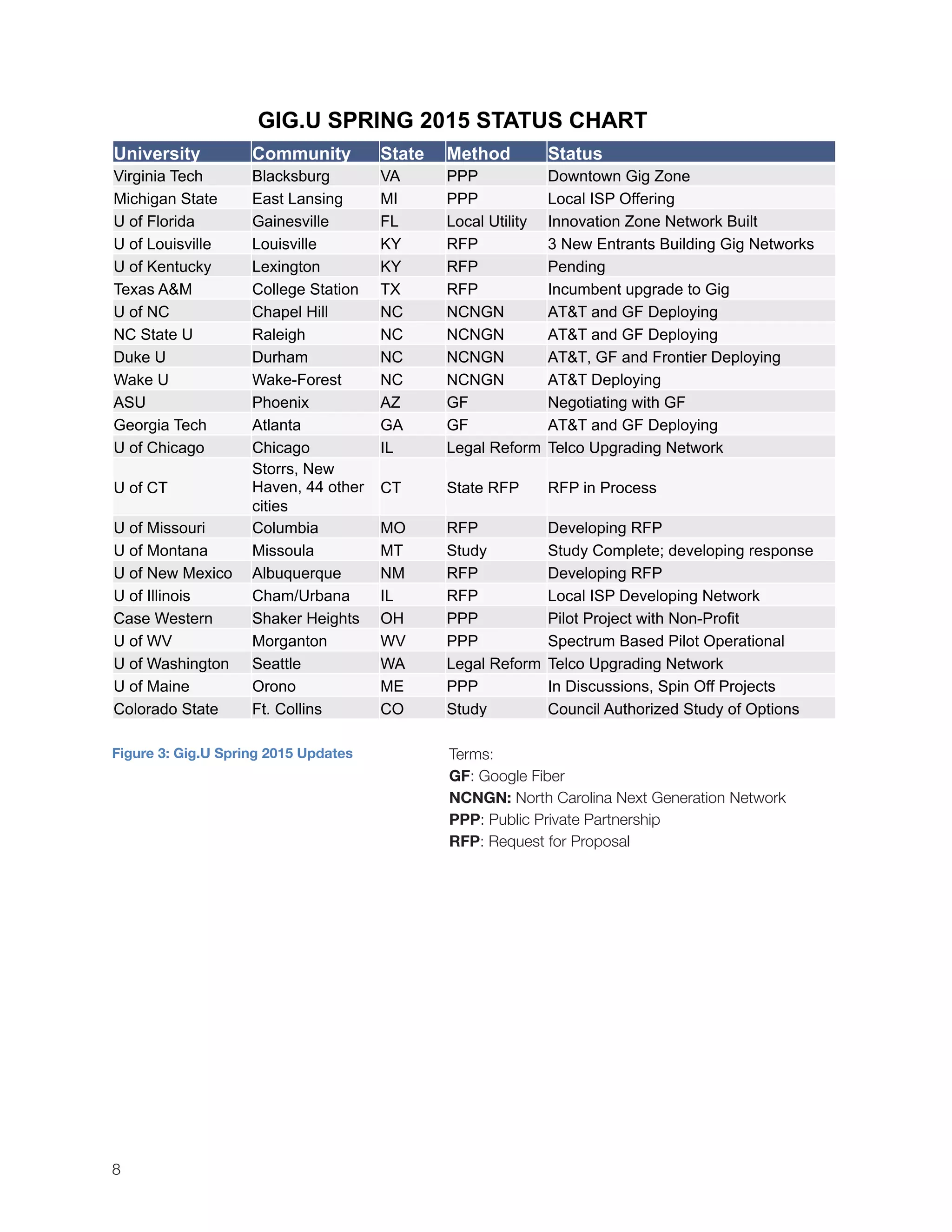
with over 75 communities on about two dozen
projects. (See the Gig.U communities Project Status
Chart on page 8.) Not everyone is interested in the
same questions. For example, city mayors might
be most interested in the sections on why cities
upgrade; their staff might focus on what’s been done
and first steps; and city lawyers might focus on the
issues involving public-private partnerships.
While we hope all communities can benefit, the
Handbook is primarily focused on community-led
broadband. Such efforts are generally achieved
though some kind of public-private partnership,
meaning, at its most basic, an arrangement by
which the city negotiates with a private party to
achieve some public purpose. In our case, the
purpose could include some or all of designing,
deploying, maintaining, operating and providing a
retail service on the network. The private party can
take many forms – including new entrants, incum-
bents and nonprofits – and the relationship between
the city and the private party can operate in many
different ways. We acknowledge that some cities
want to go it alone. While we describe some of
What is Community-Led
Broadband?
Many terms have been used to describe
efforts by communities to improve the options
their residents and enterprises have for
broadband services. One common term is
“municipal broadband,” though that generally
means the municipality deploying, operating
and offering a broadband service. We prefer
the phrase “community-led broadband” to
signify the community taking an active role
in accelerating the deployment of next-gen-
eration networks, and consciously making
choices about how those networks can best
serve the public good, as illustrated by the
many examples presented in this Handbook.
Overview: The Underlying Equation
these efforts, we acknowledge such efforts raise
questions beyond the scope of this guide.
Whatever the nature of the partnership, and what-
ever the job of the person reading this, all readers
should understand the underlying core question of
economics. Specifically, why are current market
forces not producing the affordable, abundant
bandwidth that communities seek and that next
generation networks can deliver?
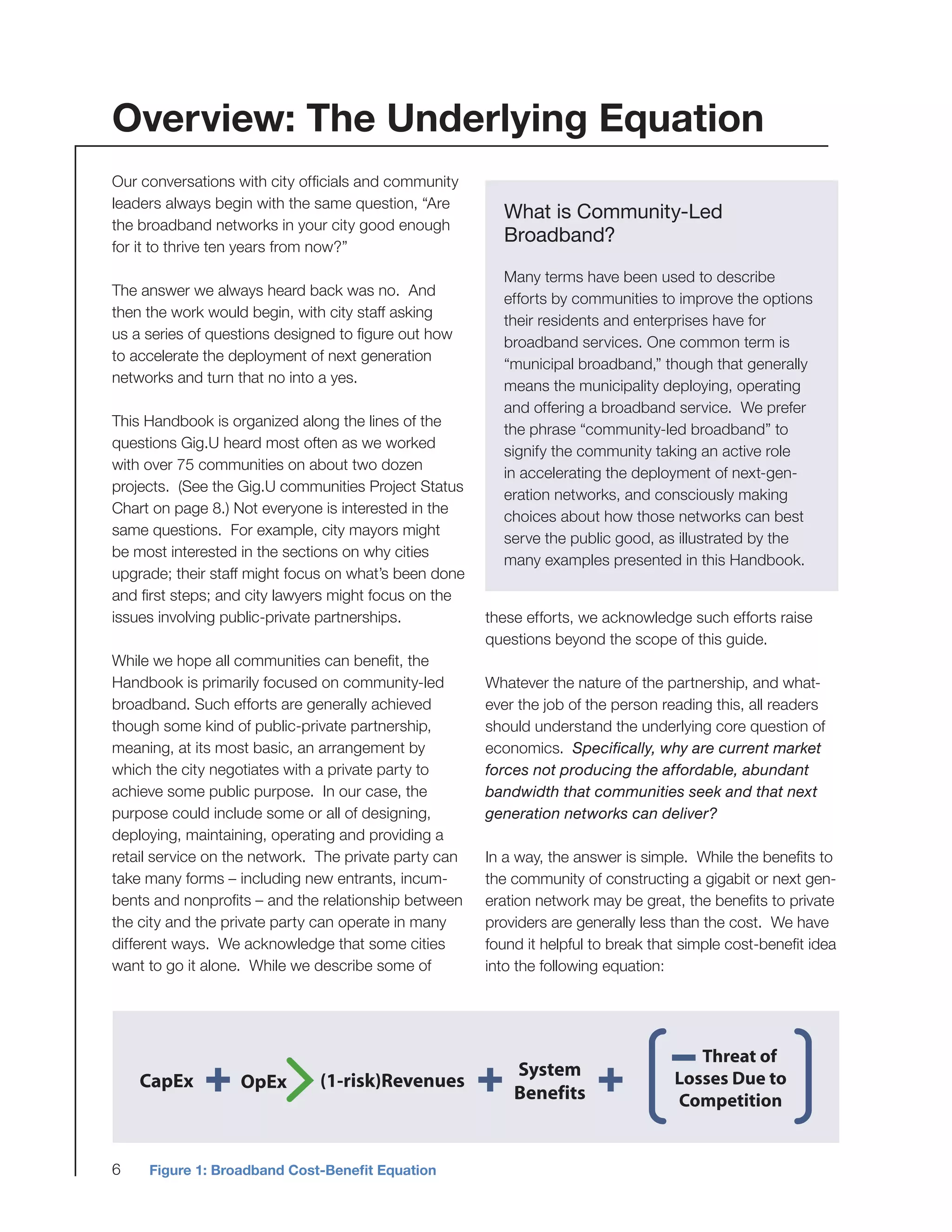
In a way, the answer is simple. While the benefits to
the community of constructing a gigabit or next gen-
eration network may be great, the benefits to private
providers are generally less than the cost. We have
found it helpful to break that simple cost-benefit idea
into the following equation:
Figure 1: Broadband Cost-Benefit Equation
CapEx
System
Benefits
(1-risk)RevenuesOpEx
7
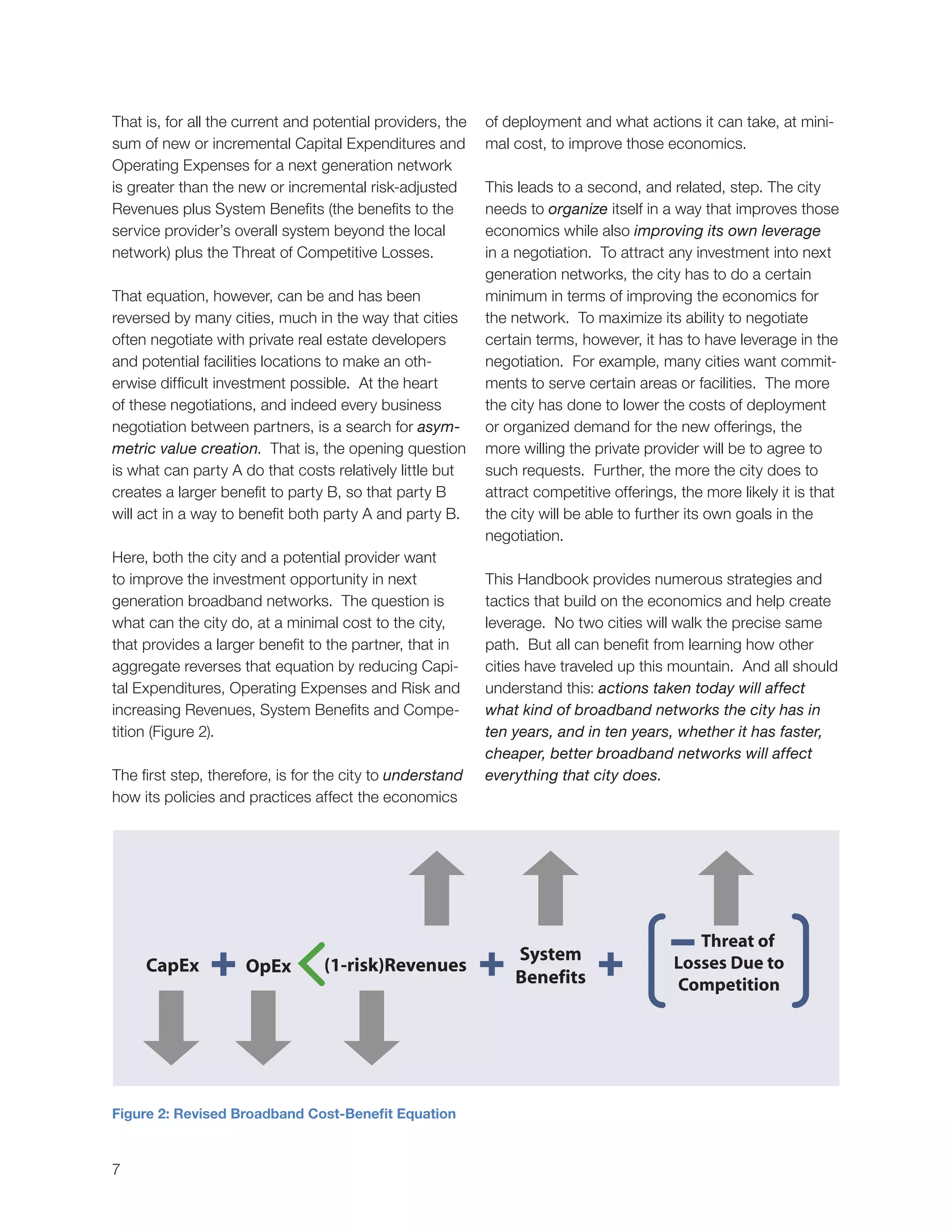
Figure 2: Revised Broadband Cost-Benefit Equation
CapEx
System
Benefits
(1-risk)RevenuesOpEx
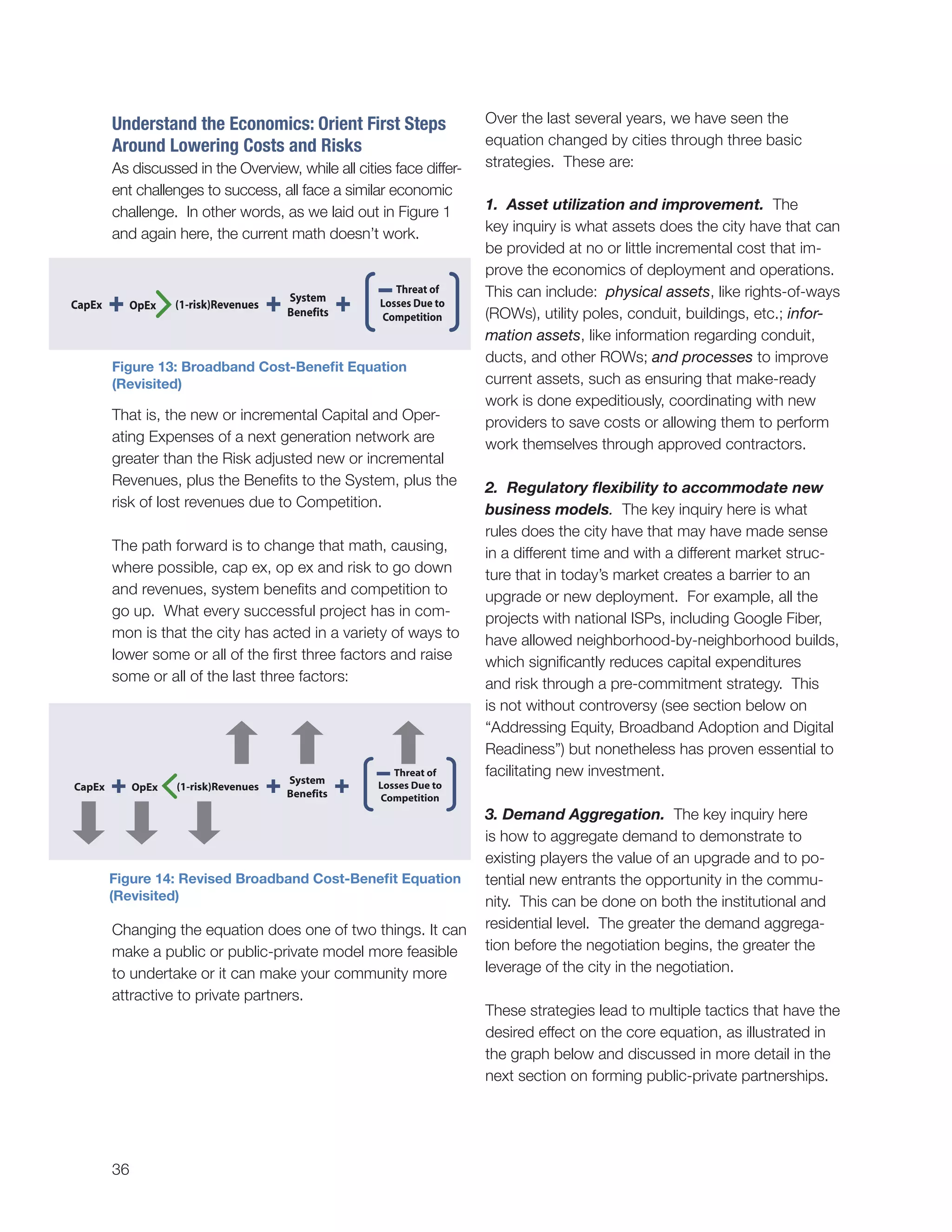
That is, for all the current and potential providers, the
sum of new or incremental Capital Expenditures and
Operating Expenses for a next generation network
is greater than the new or incremental risk-adjusted
Revenues plus System Benefits (the benefits to the
service provider’s overall system beyond the local
network) plus the Threat of Competitive Losses.
That equation, however, can be and has been
reversed by many cities, much in the way that cities
often negotiate with private real estate developers
and potential facilities locations to make an oth-
erwise difficult investment possible. At the heart
of these negotiations, and indeed every business
negotiation between partners, is a search for asym-
metric value creation. That is, the opening question
is what can party A do that costs relatively little but
creates a larger benefit to party B, so that party B
will act in a way to benefit both party A and party B.
Here, both the city and a potential provider want
to improve the investment opportunity in next
generation broadband networks. The question is
what can the city do, at a minimal cost to the city,
that provides a larger benefit to the partner, that in
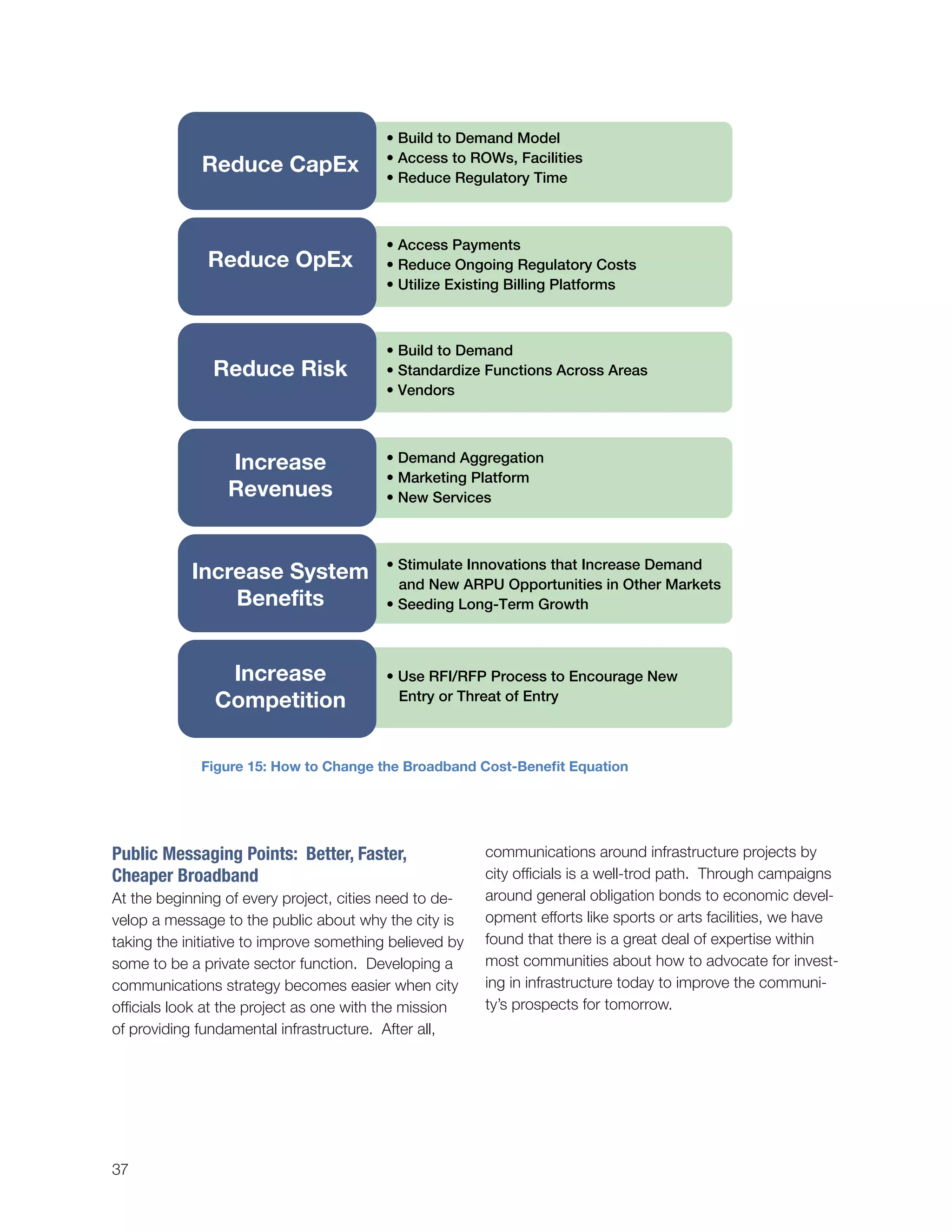
aggregate reverses that equation by reducing Capi-
tal Expenditures, Operating Expenses and Risk and
increasing Revenues, System Benefits and Compe-
tition (Figure 2).
The first step, therefore, is for the city to understand
how its policies and practices affect the economics
of deployment and what actions it can take, at mini-
mal cost, to improve those economics.
This leads to a second, and related, step. The city
needs to organize itself in a way that improves those
economics while also improving its own leverage
in a negotiation. To attract any investment into next
generation networks, the city has to do a certain
minimum in terms of improving the economics for
the network. To maximize its ability to negotiate
certain terms, however, it has to have leverage in the
negotiation. For example, many cities want commit-
ments to serve certain areas or facilities. The more
the city has done to lower the costs of deployment
or organized demand for the new offerings, the
more willing the private provider will be to agree to
such requests. Further, the more the city does to
attract competitive offerings, the more likely it is that
the city will be able to further its own goals in the
negotiation.
This Handbook provides numerous strategies and
tactics that build on the economics and help create
leverage. No two cities will walk the precise same
path. But all can benefit from learning how other
cities have traveled up this mountain. And all should
understand this: actions taken today will affect
what kind of broadband networks the city has in
ten years, and in ten years, whether it has faster,
cheaper, better broadband networks will affect
everything that city does.
8
Figure 3: Gig.U Spring 2015 Updates Terms: 	
GF: Google Fiber
NCNGN: North Carolina Next Generation Network
PPP: Public Private Partnership
RFP: Request for Proposal
GIG.U SPRING 2015 STATUS CHART
University Community State Method Status
Virginia Tech Blacksburg VA PPP Downtown Gig Zone
Michigan State East Lansing MI PPP Local ISP Offering
U of Florida Gainesville FL Local Utility Innovation Zone Network Built
U of Louisville Louisville KY RFP 3 New Entrants Building Gig Networks
U of Kentucky Lexington KY RFP Pending
Texas A&M College Station TX RFP Incumbent upgrade to Gig
U of NC Chapel Hill NC NCNGN AT&T and GF Deploying
NC State U Raleigh NC NCNGN AT&T and GF Deploying
Duke U Durham NC NCNGN AT&T, GF and Frontier Deploying
Wake U Wake-Forest NC NCNGN AT&T Deploying
ASU Phoenix AZ GF Negotiating with GF
Georgia Tech Atlanta GA GF AT&T and GF Deploying
U of Chicago Chicago IL Legal Reform Telco Upgrading Network
U of CT
Storrs, New
Haven, 44 other
cities
CT State RFP RFP in Process
U of Missouri Columbia MO RFP Developing RFP
U of Montana Missoula MT Study Study Complete; developing response
U of New Mexico Albuquerque NM RFP Developing RFP
U of Illinois Cham/Urbana IL RFP Local ISP Developing Network
Case Western Shaker Heights OH PPP Pilot Project with Non-Profit
U of WV Morganton WV PPP Spectrum Based Pilot Operational
U of Washington Seattle WA Legal Reform Telco Upgrading Network
U of Maine Orono ME PPP In Discussions, Spin Off Projects
Colorado State Ft. Collins CO Study Council Authorized Study of Options
9
2010, growing numbers of communities have
considered either investing in public networks or
negotiating with companies like Google Fiber, AT&T,
CenturyLink and many smaller players to achieve
desired high-speed access. Though these upgrades
are happening city by city and slowly (for now), each
new deployment pushes gigabit networks from
novelty to competitive necessity. How will your city
compete for or retain investment and human capital
alongside Chattanooga, Kansas City, Austin,
Leverett, Wilson, Nashville, Charlotte, Raleigh,
Provo, Atlanta and others with world-leading net-
works?
As noted earlier, the first question is always, “Does
your city have the broadband network it needs to
thrive ten years from now?”
If the answer is “Yes,” stop reading. If you think you
have everything you will need in the future, there is
no need to act.
If the answer is “No,” however, then the time to
begin thinking about faster speeds, more competi-
tion and better service is now. Network upgrades do
not happen overnight. Many decisions your city will
make over the next several years will affect what
kind of network -- and city -- you have a decade
hence.
When Google Fiber released its Request For
Information (RFI) in 2010, over 1,100 municipalities
stepped up and articulated their desire for next
generation networks. In doing so, leaders at the
local level started to think about how their communi-
ty’s infrastructure was a catalyst for economic,
educational and governmental innovation. Since
More Economic Studies on
Broadband
The Broadband Bonus: Accounting for
Broadband Internet’s Impact on U.S. GDP
Shane Greenstein and Ryan McDevitt
The Substantial Consumer Benefits of
Broadband Connectivity for U.S. Households
Mark Dutz, Jonathan Orszag and Robert Willig
Broadband Investment
US Telecom
Where the Jobs Are: The App Economy
TechNet
The Impact of High-Speed Broadband
Availability on Real Estate Values: Evidence
from the United States
Gabor Moinar, Scott Savage, Douglas Sicker
“Why Upgrade? Why Now?”
The reasons to upgrade overlap
multiple sectors and policy areas:
• Economic Development
• Public Safety
• Telemedicine
• Technology
• e-government
• Distance Learning and Education 		
• Job Training
• Improved Pricing and 			
Competition-Driven Innovations
10
The Economic Case for Faster Speeds
There have been a number of studies linking
broadband networks and new investments in such
networks to improved economic performance. In
September 2014, the Fiber to the Home Council
released a study demonstrating higher per capita
Gross Domestic Product (GDP) in communities
where gigabit Internet was available. Infrastructure
investment, job creation, entrepreneurship, and
companies relocating or expanding to your city are
all manifestations of this growth.
The Quality of Life Case for Faster Speeds
According to RVA Market Research & Consulting,
residents with fiber-to-the-home work an average
of 1.3 extra days at home each month and about
14% have home-based businesses resulting in over
$10,000 in extra income for the household. Given
that the average consumer spends over five hours
per day online at home and has multiple online
devices, this infrastructure is only growing more
valuable and more necessary. In fact, RVA found
that high speed Internet capacity was often one
of the highest or the highest consideration when
residents evaluated neighborhoods, households and
multi-dwelling units (MDUs).
Why Not Wait for Google Fiber?
As proponents for communities having affordable,
abundant broadband networks, we are happy for the
seven regions where Google has announced it will
be deploying fiber, and hopeful for the five regions
where Google has publically announced it is consid-
ering deployment. For the sake of other commu-
nities, we also hope that Google announces it will
expand its fiber footprint both for the new option and
the competitive response Google Fiber has stimu-
lated.
Hope, however, is not a strategy. We don’t know
(and we suspect Google does not know) how exten-
sive its deployment will be. It does not take inside
knowledge (and we have none) to look at Google’s
deployments to realize that it, like its competitors,
looks at a number of factors, including scale, region-
al growth rate, deployment costs, labor availability,
density, pole attachment opportunities and others,
to determine whether and where to expand. While
some have speculated on where Google goes next,
even those communities that believe they fit the pat-
tern, would, in our view, be making a mistake to rely
on a future Google decision that may not happen.
©iStock.com/bo1982
11
Further, nothing in a community-led broadband
effort is inconsistent with a future Google decision
to invest in your city. We admire Google’s transpar-
ency in telling communities how to make themselves
“fiber ready” both with a technical guide and a
check-list. Nothing in this Handbook is inconsistent
with the approaches of those guides and we have
relied, both in Gig.U efforts and in writing this Hand-
book, on insights the guides have provided. Indeed,
having a number of cities move ahead in the ways
detailed here probably increases the odds of Google
expanding as well as accelerating the competitive
response. So our advice plays off the Talmudic wis-
dom to “pray as if everything depends on God; act
as if everything depends on man.” Hope for Google
Fiber, but act as if your fate is in your own hands.
The Bottom Line: If Not Now, When?
The bottom line is this: ten years from now, many
critical things a city and its residents can do, and the
attractiveness of the city from many perspectives,
will be affected by the quality of its broadband net-
works. Every city will want the affordable, abundant
bandwidth that does not constrain innovation, eco-
nomic growth, or social progress.
It is also true that many things cities do today – in
terms of zoning, construction, permitting, rights of
way management and other traditional municipal ac-
tivities – will affect what kind of broadband networks
it will have in ten years. In this light, the time to begin
thinking about what a city can do to assure that all
its residents and enterprises will have affordable,
abundant bandwidth is now.
12
“What’s Been Done?”
The following section summarizes the most notable work and
trends in local next generation networks as of early 2015. The
first step to considering an upgrade for your city begins with a
general understanding of the best practices and wide variety
of successful methods that can be replicated. Although there
is no one-size-fits-all solution to attracting or deploying giga-
bit networks, becoming informed about the successes and
failures in similar locations can illuminate potential paths for
your city.
13
Community-Led Gigabit Fiber Success Stories
Google Fiber is an exciting narrative, but it is not
the only gigabit story holding promise for bandwidth
hungry communities. Many communities, rather than
wait for an Internet Service Provider (ISP) to provide
a solution, have become pro-active and succeeded
in stimulating new, largely private, investment into
broadband networks. The innovative, alternative
models for building and operating gigabit networks
are diverse in approach and strategy, but, as we’ve
learned, encounter similar issues along the way.
Models: Trading Off Risk and Control
Every network deployment involves a number of
components – design, constructing (which itself can
be broken down into many subparts), operating,
marketing and financing, to name the major ones.
And, while city efforts to date reflect elements unique
to specific circumstances, all nonetheless face a fun-
damental question: what roles should the city play in
the project?
As cities approach this question, the basic trade-off
involves risk and control. The greater the roles, the
greater the control, but also, generally, the greater
the risk. What we have seen in community-led ef-
forts are a variety of ways cities seek to balance the
two factors, often reflecting local history and prefer-
ences, as well as opportunity.
But what is generally true may not be true for a
specific city. For example, playing the primary role
of designing and building out a network may be
high-risk for some communities, but much lower
for those with municipally-owned and operated
electrical utilities, or where a federal grant paid for
an initial design and build. Similarly, some cities
that are highly attractive to private sector ISPs can
have a high level of control, even if they play none
of the roles, by using various governmental levers
in a competitive process, while others may have to
give up all control to attract a private entity willing to
deploy a gigabit network.
While we see a spectrum of how cities approach
the fundamental trade-off question, their “answers”
typically fall into one of three basic categories:
1. Primary: The city plays the primary role by using
public facilities to invest in telecommunications as
public infrastructure;
2. Partial: The city plays a partial role, but relies
heavily on a private partner, particularly for opera-
tions, marketing, and financing; and
3. Facilitator: The city uses governmental and other
levers to facilitate the ability by private sector part-
ners to play all the roles.
Within each of these basic categories, there are
other levels of common concern, the most significant
of which are:
• Partnerships: With whom should the city partner
– a local or national ISP or a nonprofit?
• Phasing: Should the city build-out incremental-
ly or have a plan to build throughout the whole
community from the beginning?
• Scale: Should the city scale the project on a
local, regional, or statewide basis?
We describe some of the initiatives below, orga-
nized by degree of “city role level” (Primary, Partial or
Facilitator.)
Primary: The City Plays the Primary Role by
Using Public Facilities to Invest in Telecommu-
nications as Public Infrastructure
Some cities, particularly those with a municipal utility
whose assets can be leveraged to build and operate
a network, choose to play a primary role in deploying
and offering broadband services.
Investing in the Entire Community:
Chattanooga, TN
In 2010, Chattanooga became the first city in the
U.S. to have a gigabit network available to its homes
and businesses. The city did so by building its own
14
fiber-to-the-premises network as part of a holistic
smart grid strategy. Chattanooga has had its net-
work, EPB, long enough that other cities can look
to it for evidence of the qualitative and quantitative
benefits of next generation speeds. Since service
began, both Volkswagen and Amazon have moved
into Chattanooga. Also, initiatives like GigTank have
developed to foster the city’s budding start-up com-
munity. In his 2012 New York Times op-ed “Obama’s
Moment,” columnist Tom Friedman pointed to Chat-
tanooga EPB’s innovative ripple effect: “That net-
work was fully completed thanks to $111 million in
stimulus money. Imagine that we get a grand bargain
in Washington that also includes a stimulus of just
$20 billion to bring the 200 biggest urban areas in
America up to Chattanooga’s standard. You’d see a
‘melt-up’ in the U.S. economy.”
Following Chattanooga’s lead, other cities have also
invested in a telecommunications utility model, such
as in Leverett, MA and Wilson, NC.
Investing Incrementally:
Gainesville, FL and Santa Monica, CA
Even if a city explores a public option for giga-
bit service, it doesn’t have to go all in right away.
Gainesville Regional Utilities (GRU) has connected
businesses, community anchor institutions and large
apartment complexes around the University of Flor-
ida to 1 gigabit, 100 Mbps, and 10 Mbps speeds.
Recently GRU extended its gigabit offering to all of
the student apartments (37 complexes – rough-
ly 6,000 ethernet ports) that it provides service to
throughout the Gainesville area.
Santa Monica’s City Net is another example of this
incremental approach. The city built-out a fiber net-
work without a municipal electric department (as was
used in Chattanooga) and without issuing debt. The
project started by connecting public facilities and
then slowly expanded through a citywide “dig once”
policy, meaning that as other construction or capital
projects occurred, the city would lay conduit and
fiber. According to City Net’s website, the network
now covers downtown Santa Monica as well as a
“majority of multiple tenant commercial buildings.”
More about Santa Monica’s fiber story can be found
at the Institute for Local Self-Reliance case here.
Partial: The City Plays a Partial Role but Relies
Heavily on a Private Partner, particularly for
Operations, Marketing and Financing
While all models carry some level of risk for all par-
ties, some cities have pioneered new ways of sharing
risk so that the city focuses on what it does well and
the private party takes on the risks and responsibili-
ties more consistent with its own skill set.
Developing, then Finding, a Partner:
Champaign-Urbana, IL and Westminster, MD
At the end of May 2014, UC2B – a nonprofit con-
sortium led by the university communities of Cham-
paign and Urbana and the University of Illinois
– announced a new model for gigabit connectivity
through a public-private partnership with a local ISP,
iTV-3. Several years earlier, UC2B leveraged various
federal and state grants and local matching funds to
construct a high speed fiber network – first build-
ing out in low-income and low-adoption areas. The
new public-private partnership means that iTV-3 will
now operate the existing UC2B network and extend
its service to even more residents, institutions, and
businesses. Although the cities will not have control
over the network or collect the revenue, the part-
nership succeeded in its goal of eliminating ongoing
operating risk to the cities.
Another example is in Westminster, Maryland, a rural
community about equidistant from Washington,
DC, and Baltimore, but not located on any major
highway that connects to those major metropolitan
areas. Years ago, the city identified a fiber broad-
band network as a key strategic initiative and last
year funded two fiber-to-the-premises pilots. Build-
ing on that experience, in 2015, the city adopted a
plan to install fiber that it will fund, own and main-
tain throughout the city. It has also entered into an
agreement with Ting, a small but innovative ISP, by
15
which Ting will pay to lease the fiber, bring in its own
equipment, and offer gigabit service to residents
and business. The city essentially treats the fiber as
it does roads and bridges—having the responsibility
for building and maintaining—while Ting focuses
on operations and customer service. The structure
reduces the city’s risk while increasing its control.
Serving as the Anchor Tenant and Limited
Partner: South Portland, ME
South Portland, Maine, held a competition in 2014,
in which it agreed to be an anchor tenant for a next
generation gigabit capable network, in exchange
for a private party agreeing to build, maintain and
operate the network throughout the city. Under the
agreement, the company would receive almost half
of the nearly $300,000 municipal investment in fiber
and associated equipment through a $150,000
up-front payment by the city for 20 years of service.
The city would also share about 5% of the revenues
of the network. South Portland awarded the con-
tract to GWI, a Maine ISP. As part of the contract,
GWI committed to an open access model. GWI is
working with other cities in Maine to build networks
with a similar financial structure.
Using a Nonprofit: Cleveland, OH
Cleveland benefits from the existence of OneCom-
munity, a nonprofit fiber network spanning 2,460
miles and connecting about 1,800 facilities. Start-
ed in 2003 and now run by former Case Western
University CIO Lev Gonick, OneCommunity services
the key anchor institutions in northeastern Ohio
(government offices, schools, universities, hospitals,
etc.) and collaborates with the local community on
broadband adoption projects and digital literacy
trainings. Currently, city officials in Shaker Heights
are considering a partnership with OneCommunity to
extend fiber into the city’s commercial districts and
attract more economic development. OneCommuni-
ty has also formed a for-profit subsidiary, Everstream,
which will provide high-speed Internet to businesses
– the revenue from which will be available to support
the organization’s nonprofit programming. In Novem-
ber 2014, OneCommunity announced plans to build
a gigabit network to connect a three-mile Health-
Tech Corridor in Cleveland. Other cities should note
that this expansion is partially supported by a U.S.
Economic Development Administration (EDA) Grant
– another federal resource that can be leveraged for
these kinds of projects.
Facilitator: The City Uses Governmental and
other Levers to Facilitate Interest by Private
Sector Partners to Play All Roles
Other cities choose to adjust their policies in ways
that change the economics of deployment, facilitat-
ing private actors who then undertake the deploy-
ment and operations of the network.
Adopting Best Practices that Assist Local ISPs:
East Lansing, MI
Uniting a diverse group of stakeholders under its
“Gigabit Ready” effort, Lansing created an attractive
environment for its existing ISPs to upgrade. The
Lansing Economic Area Partnership (LEAP), Mich-
igan State University, nonprofits, and commercial
property managers came together in 2012 to lower
barriers to high-speed broadband deployment.
To align incentives and capitalize on their unique
partnership with local development companies, the
Gigabit Ready Coalition created a Gigabit Certified
Building Program operating similarly to the well-
known LEED program. Now, local ISP Spartan-Net
and property manager DTN Management Co. have
partnered to bring gigabit speeds to residences and
apartment complexes in East Lansing.
Using the Competitive Process to Stimulate an
Upgrade in a City: Louisville, KY and College
Station, Texas
Initial demand for faster speeds was fostered and ar-
ticulated by Louisville’s residents, academics and the
business community. To translate those voices into
action, local advocates launched Louisville Fiber — a
web-based tool that allowed residents who wanted
a gigabit fiber network to input their address. The
resulting heat map was informative for policymakers
and also visualized demand for prospective vendors.
16
The city government released an RFI in November
2013 and received six responses. The RFI pushed
Louisville to confront its fiber-readiness. It made
adjustments to its plans in order to attract vendors,
such as increasing the proposed franchise peri-
od from 15 to 20 years and reducing the bonding
requirement, and issued an RFP. In July 2014,
Louisville approved three new 20-year franchise
agreements for fiber network build-outs — one with
Louisville-based BGN Networks, one with Lon-
don-based SiFi and another with New York-based
FiberTech.
Similarly, College Station, Texas, home of Texas
A&M, used a Request For Proposal (RFP) to test
the market. In this case, the process stimulated an
incumbent cable provider, Suddenlink, to respond
by announcing it would spend $250 million to up-
grade its company-wide network to make it gigabit
capable. College Station will be the first Suddenlink
market to see the upgrade, providing the community
with what it believes it needs to keep and attract
bandwidth hungry businesses and residents.
Using the Competitive Process to Stimulate an
Upgrade in a Region: North Carolina
The North Carolina Next Generation Network
(NCNGN) project is a collection of four universities
(Wake Forest, University of North Carolina-Chapel Hill,
Duke, and North Carolina State) and six municipalities
(Carrboro, Cary, Winston-Salem, Chapel Hill, Durham
and Raleigh) which shared knowledge and resourc-
es to release a single RFP. It articulated the region’s
objectives and sought vendors to build and operate
a gigabit fiber network. The RFP was released in
February 2013 and attracted eight responses. Since
then, several of the NCNGN cities have caught the
attention of major national providers. During the sum-
mer of 2014, Chapel Hill, Raleigh, Cary, Winston-Sa-
lem, Carrboro and Durham finalized agreements with
AT&T, which has begun to deploy. Further, Frontier
Communications has launched a gigabit network in
parts of Durham and a start-up, RST Fiber, has also
announced plans to enter with a fiber offering. In Jan-
uary 2015, Google announced it would deploy fiber to
the Research Triangle Park areas, which also prompt-
ed an announcement of additional hiring by AT&T to
compete with Google and Time Warner Cable tripling
its speeds.
Using the Competitive Process to Stimulate an
Upgrade in a State: Connecticut
Connecticut is just beginning its upgrade journey, but
the way it created a statewide conversation about
faster speeds makes it a case worth following. In
April 2014, the state hosted a conference on gigabit
networks for municipal leaders. Then, in September,
the mayors of West Hartford, New Haven and Stam-
ford announced the release of a joint RFQ (“Request
for Qualifications”), inviting other cities to likewise
express interest and share information. By December,
46 cities, constituting half the population of the state,
had joined in the effort. In January 2015, the RFQ
received 11 bids, which are now being reviewed. The
intentional interaction between state and city-level
officials is not only facilitating a conversation, it’s creat-
ing a powerful network of stakeholders with a shared
goal: that Connecticut be the first “gigabit state.”
©iStock.com/red_moon_rise
17
More to Come, and New Players Emerge
A few years ago, cities had limited, if any, models to
consider if they wished to accelerate a next gener-
ation broadband network deployment. Now, they
have many – and the age of experimentation is far
from over. We are already in discussions with vari-
ous communities who are considering tying together
elements of different models to best meet their own
needs.
Further, while Google Fiber and some large incum-
bent telephone companies are expanding their own
fiber efforts, a number of smaller players are also
experimenting with new ways to deploy next gener-
ation networks. As noted above, Ting, an innovative
ISP with roots in both mobile and Internet services,
is bringing gigabit networks to several smaller com-
munities, including Westminster, Maryland, through
a shared risk model, and Charlottesville, Virginia, by
buying an existing ISP and upgrading its network.
Sonic.net, an ISP based in California, has plans to
deploy gigabit capable networks to ten communities
in Northern California. C-Spire, a Mississippi-based
Competitive Local Exchange Carrier (CLEC), ran a
gigabit competition in that state and now is deploy-
ing to the six winners. Monkey Brains, an ISP in
San Francisco, uses an advanced wireless radio,
provided by a company named Siklu, to offer gigabit
connectivity to residents in San Francisco. Brooklyn
Fiber, a three-year-old startup, started rolling out a
gigabit broadband service in early 2015 in Industry
City, the Brooklyn complex of former warehouse
buildings.
While cities should follow developments of commu-
nity-led broadband, they should also note the private
efforts of companies big and small, as they can
provide insight into new technologies and business
models to best address a city’s future bandwidth
needs.
What About Cable?
Most of the examples of community-led broadband
in this Handbook involve the community working
with a new provider, such as Google Fiber, a smaller
ISP, or the incumbent telephone company. This rais-
es an obvious, and important question: what about
cable operators?
Cable provides a broadband service in all the com-
munities discussed in this Handbook and Gig.U’s
philosophy was always to be business model and
service provider agnostic. That is, we did not favor
a particular model or type of provider; we simply
wanted to create paths for communities to acceler-
ate achieving the affordable, abundant bandwidth
necessary to thrive. We approached all providers,
including cable operators, about working with our
communities to experiment with various paths for-
ward.
Early on, we thought cable might be the most
interested in such experiments as cable operators
generally had the advantage of both faster networks
and cheaper upgrade paths. In that light, we theo-
rized, cable might welcome efforts that accelerated
the demand for next generation bandwidth.
The theory proved to be wrong. Indeed, in a way
we found ironic for enterprises that marketed a
service based on the superior performance of its
bandwidth, cable operators were generally dismis-
sive of any need for more abundant bandwidth. For
example, in 2013, the Wall Street Journal reported
that the then Time Warner Cable CEO said having
fiber with gigabit speeds “ends up being more about
publicity and bragging.”
We don’t question the sincerity of those views as
stated at the time. But we also understood those
views to reflect cable’s comfort with a market struc-
18
ture in which it believed it had a clear advantage
over its wireline broadband competition and that that
advantage would allow cable to charge a premium
for the scarcity value of abundant bandwidth. Given
that comfort, we rethought our strategy to reflect
the likelihood that cable would not move forward
with deploying its own next generation networks
until it faced competitive forces compelling it to do
so. While we always welcomed cable’s participa-
tion with our efforts, we focused on finding ways to
either improve the position of the current bandwidth
runner-up or bring in a new provider.
Subsequent events have reinforced that course cor-
rection. While cable has never been the first mover
with a gigabit network, it has always responded to
community-led efforts with significant speed in-
creases. More recently, Comcast announced that it
would accelerate its efforts to deploy its next gener-
ation networks, saying it would deploy a two-gigabit
network in Atlanta, where both Google and AT&T
had previously announced plans to deploy gigabit
networks.
We welcome this announcement and believe it
confirms the fundamental equation and the role of
the threat of competitive losses in improving the
economics of next generation network deployments.
How Communities, Not Individuals,
Buy Broadband
The Comcast announcement also demonstrates
something else at the core of community-led broad-
band efforts: Broadband is bought as a commu-
nity. While individuals think they make a choice,
the choice is bounded by choices the community
makes.
To illustrate this, consider how at a Gig.U meeting
several years ago, a cable company representative
said the company could sell consumers in our com-
munities a gigabit service for $7,000 a month, with a
two year commitment. That company is now facing
potential competition that will sell a similar product
at $70 a month and what do you know? That cable
provider now has announced it will soon sell a giga-
bit product at that price point now too.
What caused the difference? Was it some new
technology or some other brilliant innovation by a
company engineer? No. Rather, the difference lay
in how a group of communities approached how
they bought bandwidth by improving the math
for the deployment of next generation networks.
By making it possible for cable’s competitors to
deploy and operate a network more economically,
it caused cable to respond, giving its residents
faster, better and cheaper options for broadband.
Individual consumers may make the ultimate buying
decision, but those choices are circumscribed by
decisions made at the community level. Consum-
ers in Durham, North Carolina, get the benefit of
Durham’s decision to participate in the NCNGN,
but those options are not available to consumers in
communities without such efforts.
That cable is now reacting to the efforts of Google
Fiber, AT&T Gigapower, Century Link, and others
with their own next-generation network offering
is a welcome dynamic, putting communities in a
stronger position to achieve affordable, abundant
bandwidth. Still, we suspect to take advantage of
that dynamic, communities will have to be proactive
in changing the status quo.
19
City-Driven Wi-Fi Projects
Despite some high-profile failures in citywide munic-
ipal Wi-Fi several years ago (such as in Seattle and
Philadelphia), recently several smaller-scale projects
have found their footing. Providing public Wi-Fi
hotspots is not in any way equivalent to rolling out
fiber-to-the-home gigabit service, but it can be part
of any city’s incremental connectivity plan – either as
a stepping-stone to future, more robust offerings or a
complementary service to other offerings.
Partnering with Neighboring Cities:
San Francisco and San Jose, CA
San Francisco and San Jose have partnered to
allow citizens to securely access each city’s public
Wi-Fi networks. They jointly facilitated access to this
seamless wireless access by using Hotspot 2.0 (also
referred to as Passpoint), a technology that allows
citizens to roam from one Wi-Fi hotspot to the other
the same way cell phone users do with their mobile
networks.
Leveraging City-Owned Fiber Assets:
Boston, MA
In 2014, Boston launched the “Wicked Free Wi-
Fi” project. The first site was the neighborhood
of Grove Hall because of its concentration of
low-income communities and its lack of Wi-Fi. The
network spans 1.5 miles and serves about 10,000
individual users per day. Designed to supplement
mobile use, rather than replace in-home broadband,
the project connects users to the Web via the city’s
own high-speed fiber-optic network.
Creating a Pilot Innovation Zone:
Blacksburg, VA
Blacksburg, home of the Virginia Tech Hokies, is
also home to a free gigabit Wi-Fi network that cov-
ers about 40% of the downtown area. Initial funding
to install the fiber at two locations was modest –
just about $90,000 – and was collected through a
crowdfunding campaign started by TechPad, a local
co-working and hacking community. The network
went live in the fall of 2013. The organizers intend
to use the first few years of the project to gauge lo-
cal demand for faster speeds and, with that knowl-
edge, to transition to a sustainable funding model.
Using Advertising to Support Widespread Wi-Fi
Deployments: New York, NY
In 2014, New York City announced an ambitious
plan to erect 10,000 free public Wi-Fi hotspots on
top of the city’s old network of payphones. The
LinkNYC kiosks will have free high-speed Wi-Fi, a
touch screen for advertisements and local informa-
tion, and outlets for device charging. The show-
cased advertisements are projected to subsidize
LinkNYC and bring in $500 million in revenue over
the next 12-15 years. The initiative is a partnership
between CityBridge and the Mayor’s Office of Tech-
nology and Innovation. If all goes according to plan,
the first kiosks will be up and running by the end of
2015. We expect other cities will follow with similar
projects as both the economic and quality of life ad-
vantages of such an approach appear compelling.
©iStock.com/frankreporter
20
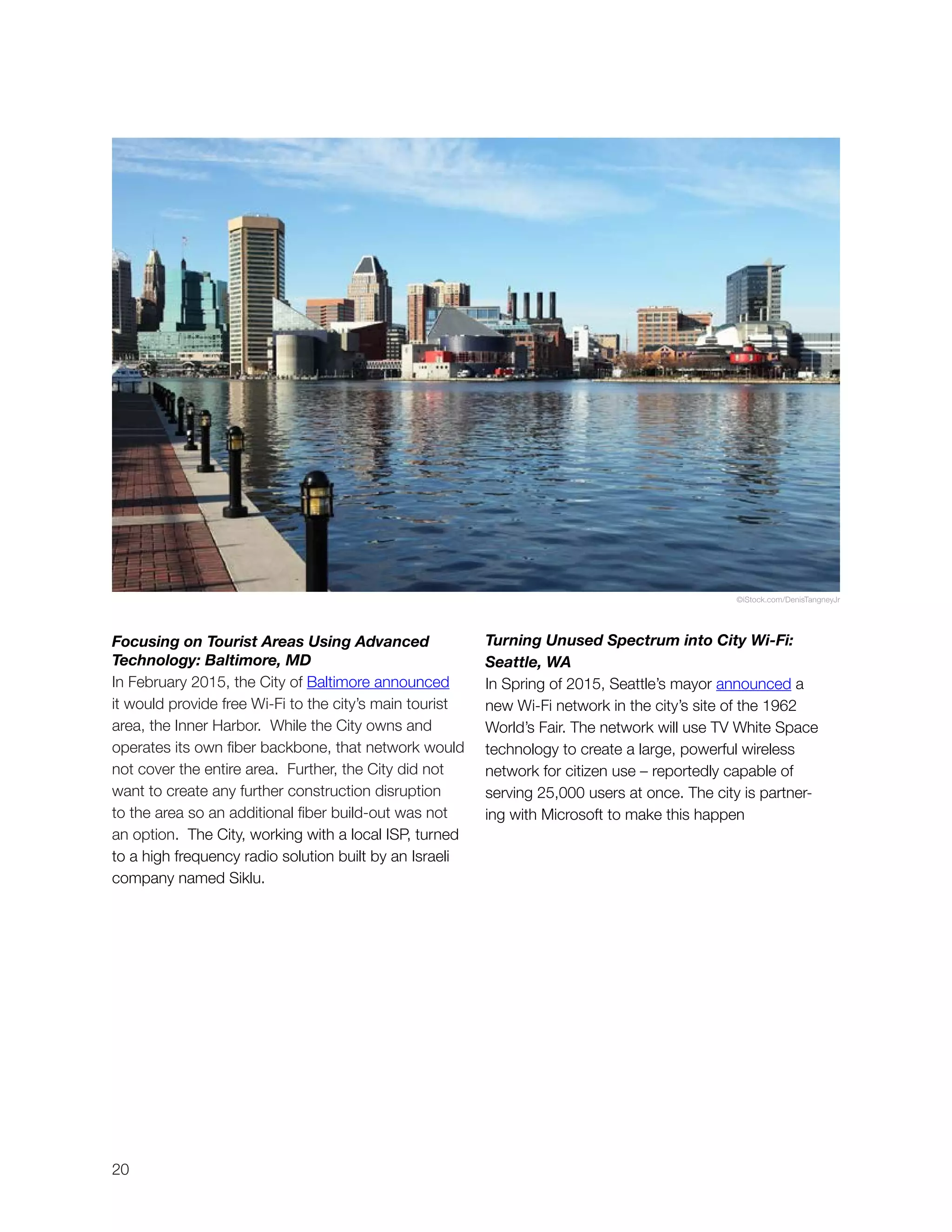
Focusing on Tourist Areas Using Advanced
Technology: Baltimore, MD
In February 2015, the City of Baltimore announced
it would provide free Wi-Fi to the city’s main tourist
area, the Inner Harbor. While the City owns and
operates its own fiber backbone, that network would
not cover the entire area. Further, the City did not
want to create any further construction disruption
to the area so an additional fiber build-out was not
an option. The City, working with a local ISP, turned
to a high frequency radio solution built by an Israeli
company named Siklu.
Turning Unused Spectrum into City Wi-Fi:
Seattle, WA
In Spring of 2015, Seattle’s mayor announced a
new Wi-Fi network in the city’s site of the 1962
World’s Fair. The network will use TV White Space
technology to create a large, powerful wireless
network for citizen use – reportedly capable of
serving 25,000 users at once. The city is partner-
ing with Microsoft to make this happen
©iStock.com/DenisTangneyJr
21
Category Model BENEFITS TO CITY RISKS TO CITY RELEVANT CASES
Primary 1.	Build and run a
public network
•	 Local control
•	 Universal coverage
•	 Customer service and
community account-
ability
•	 Financial return
•	 Operational sustainability
•	 Pushback from
incumbents
•	 Wilson, NC
•	 Chattanooga, TN
•	 Bristol, VA
•	 Leverett, MA
•	 Lafayette, LA
Partial 2.	Build and run a
public network
to businesses,
innovation districts
and/or community
anchor institutions
•	 Local control
•	 Leaves the door open
for future expansion
•	 Financial risks
•	 Operational sustainability
•	 Pushback from
incumbents
•	 Arlington, VA
•	 Washington, DC
•	 Gainesville, FL
•	 St. Louis, MO
Partial 3.	Build and lease out
public infrastructure
to the private sector
•	 Potential increased
competition
•	 Financial risks depending
on vendor interest and
city investment
•	 Mesa, AZ
•	 Santa Fe, NM
•	 Westminister, MD
Facilitator 4.	Facilitate a
public-private
partnership
•	 Little public
investment or risk
•	 Shared risk and
reward across sectors
and community
stakeholders
•	 Uneven coverage
•	 Lack of local control
•	 Partnership conflicts
going forward
•	 Kansas City, MO
•	 Raleigh, Cary,
Chapel Hill and
Durham, NC
(NCNGN)
•	 Champagne-
Urbana, IL
•	 Louisville, KY
•	 South Portland, ME
Facilitator 5.	Adopt one,
many or several
incremental
approaches to
gigabit fiber-
readiness
•	 Leaves options open
for city unwilling to
commit to public build-
out or still seeking a
private partner
•	 Little public
investment
•	 Incremental investment
can be risky and unwise
if it paves a path to
nowhere – ex: a future
private partner does not
invest and the city has
no plans to act alone
•	 Santa Monica, CA
•	 San Francisco, CA
•	 Boston, MA
•	 NYC, NY
•	 Los Angeles, CA
•	 Huntsville, AL
•	 Bozeman, MT
•	 Blacksburg, VA
•	 Baltimore, MD
Preserve
Status Quo
6.	 Do Nothing •	 Zero public investment
and financial risk
•	 Comparative disadvantage
in the long-run
•	 Too many to
count…
Figure 4: Overview of Network Models
An Overview of Models
There is no silver bullet model when it comes to improving the infrastructure of your city to meet the demands
of the Digital Age. Each approach comes with its own risks and rewards. What will work for your city?
22
Emerging Map, Including Cities to Watch
While the previous section summarized activities by
cities fairly far along with their efforts, this section
summarizes a variety of efforts that are at earlier
stages, with the thought that communities using this
Handbook can review the efforts of communities
whose characteristics most closely match their own
and benefit from learning how those efforts have
progressed. We have also mapped those efforts
with efforts already discussed to provide an overall
view of community-led broadband efforts.
The cities in blue, listed in the chart on page 23,
are just beginning their upgrade journey.
All are in the preliminary phase – whether seeking
a private vendor or planning to build their own
municipal broadband system. In the coming months
and years, it will be interesting to see the different
methods, models, and partnerships unfold.
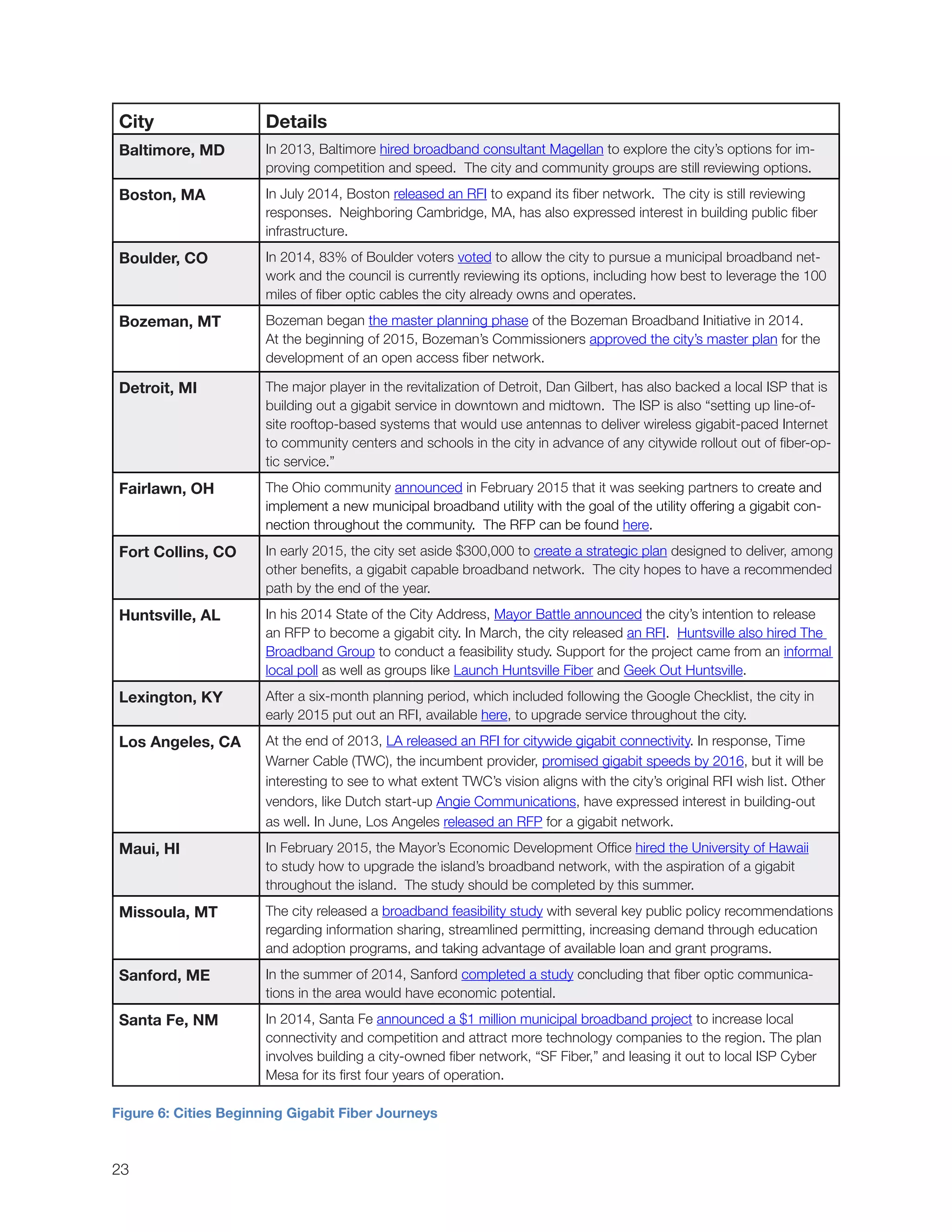
Figure 5: Map of Cities to Watch
– Cities Getting Started
– Cities On Their Way
23
City Details
Baltimore, MD In 2013, Baltimore hired broadband consultant Magellan to explore the city’s options for im-
proving competition and speed. The city and community groups are still reviewing options.
Boston, MA In July 2014, Boston released an RFI to expand its fiber network. The city is still reviewing
responses. Neighboring Cambridge, MA, has also expressed interest in building public fiber
infrastructure.
Boulder, CO In 2014, 83% of Boulder voters voted to allow the city to pursue a municipal broadband net-
work and the council is currently reviewing its options, including how best to leverage the 100
miles of fiber optic cables the city already owns and operates.
Bozeman, MT Bozeman began the master planning phase of the Bozeman Broadband Initiative in 2014.
At the beginning of 2015, Bozeman’s Commissioners approved the city’s master plan for the
development of an open access fiber network.
Detroit, MI The major player in the revitalization of Detroit, Dan Gilbert, has also backed a local ISP that is
building out a gigabit service in downtown and midtown. The ISP is also “setting up line-of-
site rooftop-based systems that would use antennas to deliver wireless gigabit-paced Internet
to community centers and schools in the city in advance of any citywide rollout out of fiber-op-
tic service.”
Fairlawn, OH The Ohio community announced in February 2015 that it was seeking partners to create and
implement a new municipal broadband utility with the goal of the utility offering a gigabit con-
nection throughout the community. The RFP can be found here.
Fort Collins, CO In early 2015, the city set aside $300,000 to create a strategic plan designed to deliver, among
other benefits, a gigabit capable broadband network. The city hopes to have a recommended
path by the end of the year.
Huntsville, AL In his 2014 State of the City Address, Mayor Battle announced the city’s intention to release
an RFP to become a gigabit city. In March, the city released an RFI. Huntsville also hired The
Broadband Group to conduct a feasibility study. Support for the project came from an informal
local poll as well as groups like Launch Huntsville Fiber and Geek Out Huntsville.
Lexington, KY After a six-month planning period, which included following the Google Checklist, the city in
early 2015 put out an RFI, available here, to upgrade service throughout the city.
Los Angeles, CA At the end of 2013, LA released an RFI for citywide gigabit connectivity. In response, Time
Warner Cable (TWC), the incumbent provider, promised gigabit speeds by 2016, but it will be
interesting to see to what extent TWC’s vision aligns with the city’s original RFI wish list. Other
vendors, like Dutch start-up Angie Communications, have expressed interest in building-out
as well. In June, Los Angeles released an RFP for a gigabit network.
Maui, HI In February 2015, the Mayor’s Economic Development Office hired the University of Hawaii
to study how to upgrade the island’s broadband network, with the aspiration of a gigabit
throughout the island. The study should be completed by this summer.
Missoula, MT The city released a broadband feasibility study with several key public policy recommendations
regarding information sharing, streamlined permitting, increasing demand through education
and adoption programs, and taking advantage of available loan and grant programs.
Sanford, ME In the summer of 2014, Sanford completed a study concluding that fiber optic communica-
tions in the area would have economic potential.
Santa Fe, NM In 2014, Santa Fe announced a $1 million municipal broadband project to increase local
connectivity and competition and attract more technology companies to the region. The plan
involves building a city-owned fiber network, “SF Fiber,” and leasing it out to local ISP Cyber
Mesa for its first four years of operation.
Figure 6: Cities Beginning Gigabit Fiber Journeys
24
The cities in red, on the map on page 22, are negotiating with more than one national ISP
Providers Overlapping Prospective Gigabit Metro Areas
AT&T & Google Fiber Austin, Kansas City, Raleigh-Durham, Charlotte, Nashville, Atlanta, San
Jose, San Antonio
AT&T & Time Warner Los Angeles
AT&T & CenturyLink Orlando
CenturyLink & Cox Las Vegas, Omaha
CenturyLink, Cox & Google
Fiber
Phoenix
CenturyLink & Google Fiber Salt Lake City, Portland
Figure 7: Cities Negotiating with More than One National ISP
Kansas City, Austin, Wilson, Provo, Lafayette and Chattanooga have already deployed (or are
deploying) residential gigabit service. With their residential service on or almost on (courtesy of Goo-
gle Fiber, EPB Fiber and LUS Fiber), all these cities are worth watching for how they identify and unlock the
potential of gigabit connectivity. Prospective gigabit cities can analyze how these cities’ economies expand,
how their city governments change or improve online services, how their anchor institutions leverage im-
proved connectivity and how broadband adoption changes.
©iStock.com/RudyBalasko
25
Public-Private Partnership Pushback in Utah
In 2014, Australia-based Macquaire Capital ex-
pressed interest in partnering with the partially built,
financially struggling fiber network in Utah, UTOPIA.
Macquarie is not a traditional ISP. Rather, it is a
financing company, interested in assuming UTO-
PIA’s existing operating deficit and then building out,
upgrading, and managing the whole network over
a 30-year term. Macquarie’s build-out would be
partially funded by a utility fee of about $18-20 per
household per month. The utility fee would cover the
cost of constructing, operating and maintaining the
network over the long-term. Payment of this utility
fee would entitle consumers access to a basic level
of connectivity, competitive with entry-level offerings
of current providers. The deal also includes waivers
in cases where customers cannot afford to pay the
fee.
This effort is still progressing, but is in the midst of
complications. Five of UTOPIA’s eleven member cit-
ies voted not to continue to participate in the project,
making it uncertain whether the utility fees will have
to increase because of higher per capita project
costs. Underlying this difficulty in securing regional
buy-in is the ambitious nature of the per-household
utility fee model – especially in a market where
Cautionary Tales for Cities Seeking or Working
with Private Partners
Gigabit Squared in Chicago and Seattle
In 2011, a new entrant, Gigabit Squared, reached
agreements with Chicago and Seattle to build out
gigabit networks. The company failed to do so and
that failure suggests many lessons. The most import-
ant is that partnering with unproven new entrants
is risky – especially when there is no existing stake
in the local community. The importance of having
“skin in the game” cannot be overestimated. When
an additional incentive to deliver in that community,
beyond the specific gigabit project, exists, then there
is higher probability for the city that a partnership
will be productive. This is why smaller but already
operating ISPs in cities like Cleveland and Cham-
paign-Urbana have proven successful so far, despite
the fact that they were not large or had never pro-
vided gigabit service on the proposed scale before.
Both OneCommunity and iTV-3 had preexisting rela-
tionships with the community (Cleveland and Cham-
paign-Urbana respectively). They had a stake in the
success of the communities in which they pledged
to build. For established national providers like AT&T
and Google, that extra assurance comes in the form
of both their secure funding and their interest in
promoting the brand. To these established compa-
nies, the cost of not meeting their obligations to the
city, and thereby creating problems for their existing
business lines, is greater than for new entrants.
Bottom Line? While new entrants always carry risk,
it would also be a mistake to discount them com-
pletely. Instead, communities should be aware of the
additional risks and protect themselves accordingly
at the beginning of any agreement. Indeed, both Se-
attle and Chicago, prior to entering into agreements
with Gigabit Squared, did due diligence and includ-
ed contract provisions to minimize the communities’
risk. As a result, the financial losses to each were
relatively circumscribed, with the biggest loss being
one of staff time and lost time to having a next gen-
eration network.
©iStock.com/espiegle
26
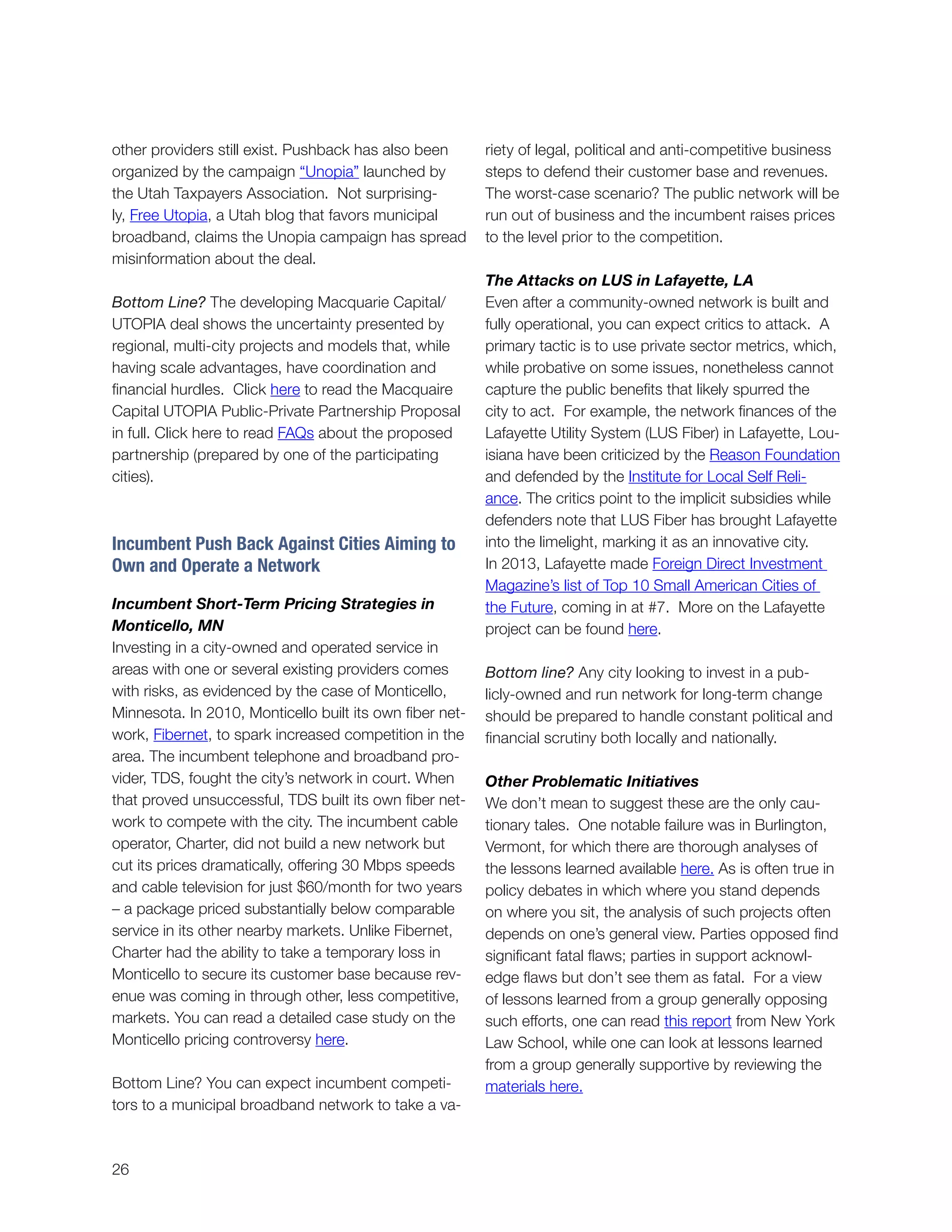
other providers still exist. Pushback has also been
organized by the campaign “Unopia” launched by
the Utah Taxpayers Association. Not surprising-
ly, Free Utopia, a Utah blog that favors municipal
broadband, claims the Unopia campaign has spread
misinformation about the deal.
Bottom Line? The developing Macquarie Capital/
UTOPIA deal shows the uncertainty presented by
regional, multi-city projects and models that, while
having scale advantages, have coordination and
financial hurdles. Click here to read the Macquaire
Capital UTOPIA Public-Private Partnership Proposal
in full. Click here to read FAQs about the proposed
partnership (prepared by one of the participating
cities).
Incumbent Push Back Against Cities Aiming to
Own and Operate a Network
Incumbent Short-Term Pricing Strategies in
Monticello, MN
Investing in a city-owned and operated service in
areas with one or several existing providers comes
with risks, as evidenced by the case of Monticello,
Minnesota. In 2010, Monticello built its own fiber net-
work, Fibernet, to spark increased competition in the
area. The incumbent telephone and broadband pro-
vider, TDS, fought the city’s network in court. When
that proved unsuccessful, TDS built its own fiber net-
work to compete with the city. The incumbent cable
operator, Charter, did not build a new network but
cut its prices dramatically, offering 30 Mbps speeds
and cable television for just $60/month for two years
– a package priced substantially below comparable
service in its other nearby markets. Unlike Fibernet,
Charter had the ability to take a temporary loss in
Monticello to secure its customer base because rev-
enue was coming in through other, less competitive,
markets. You can read a detailed case study on the
Monticello pricing controversy here.
Bottom Line? You can expect incumbent competi-
tors to a municipal broadband network to take a va-
riety of legal, political and anti-competitive business
steps to defend their customer base and revenues.
The worst-case scenario? The public network will be
run out of business and the incumbent raises prices
to the level prior to the competition.
The Attacks on LUS in Lafayette, LA
Even after a community-owned network is built and
fully operational, you can expect critics to attack. A
primary tactic is to use private sector metrics, which,
while probative on some issues, nonetheless cannot
capture the public benefits that likely spurred the
city to act. For example, the network finances of the
Lafayette Utility System (LUS Fiber) in Lafayette, Lou-
isiana have been criticized by the Reason Foundation
and defended by the Institute for Local Self Reli-
ance. The critics point to the implicit subsidies while
defenders note that LUS Fiber has brought Lafayette
into the limelight, marking it as an innovative city.
In 2013, Lafayette made Foreign Direct Investment
Magazine’s list of Top 10 Small American Cities of
the Future, coming in at #7. More on the Lafayette
project can be found here.
Bottom line? Any city looking to invest in a pub-
licly-owned and run network for long-term change
should be prepared to handle constant political and
financial scrutiny both locally and nationally.
Other Problematic Initiatives
We don’t mean to suggest these are the only cau-
tionary tales. One notable failure was in Burlington,
Vermont, for which there are thorough analyses of
the lessons learned available here. As is often true in
policy debates in which where you stand depends
on where you sit, the analysis of such projects often
depends on one’s general view. Parties opposed find
significant fatal flaws; parties in support acknowl-
edge flaws but don’t see them as fatal. For a view
of lessons learned from a group generally opposing
such efforts, one can read this report from New York
Law School, while one can look at lessons learned
from a group generally supportive by reviewing the
materials here.
27
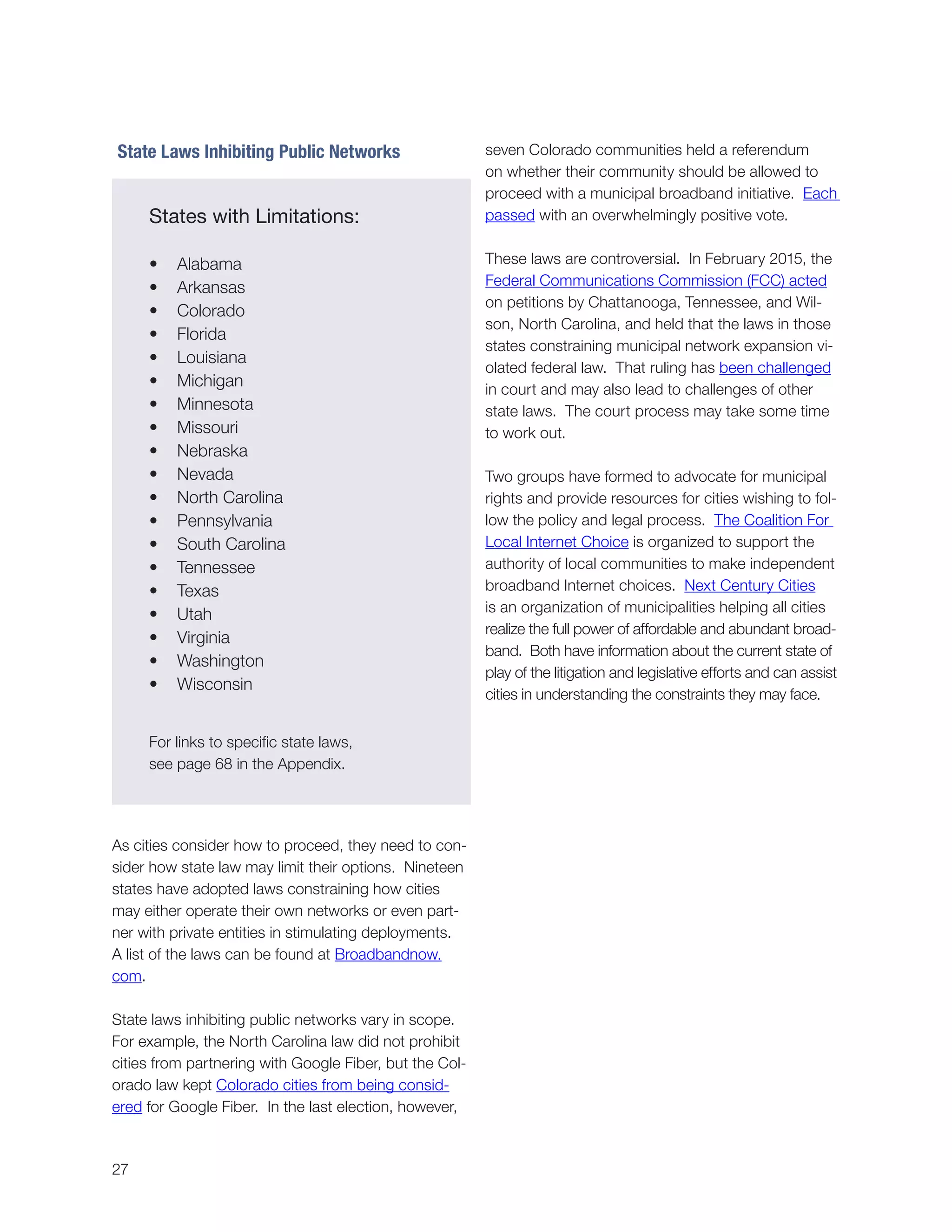
State Laws Inhibiting Public Networks
States with Limitations:
•	 Alabama
•	 Arkansas
•	 Colorado
•	 Florida
•	 Louisiana
•	 Michigan
•	 Minnesota
•	 Missouri
•	 Nebraska
•	 Nevada
•	 North Carolina
•	 Pennsylvania
•	 South Carolina
•	 Tennessee
•	 Texas
•	 Utah
•	 Virginia
•	 Washington
•	 Wisconsin
For links to specific state laws,
see page 68 in the Appendix.
As cities consider how to proceed, they need to con-
sider how state law may limit their options. Nineteen
states have adopted laws constraining how cities
may either operate their own networks or even part-
ner with private entities in stimulating deployments.
A list of the laws can be found at Broadbandnow.
com.
State laws inhibiting public networks vary in scope.
For example, the North Carolina law did not prohibit
cities from partnering with Google Fiber, but the Col-
orado law kept Colorado cities from being consid-
ered for Google Fiber. In the last election, however,
seven Colorado communities held a referendum
on whether their community should be allowed to
proceed with a municipal broadband initiative. Each
passed with an overwhelmingly positive vote.
These laws are controversial. In February 2015, the
Federal Communications Commission (FCC) acted
on petitions by Chattanooga, Tennessee, and Wil-
son, North Carolina, and held that the laws in those
states constraining municipal network expansion vi-
olated federal law. That ruling has been challenged
in court and may also lead to challenges of other
state laws. The court process may take some time
to work out.
Two groups have formed to advocate for municipal
rights and provide resources for cities wishing to fol-
low the policy and legal process. The Coalition For
Local Internet Choice is organized to support the
authority of local communities to make independent
broadband Internet choices. Next Century Cities
is an organization of municipalities helping all cities
realize the full power of affordable and abundant broad-
band. Both have information about the current state of
play of the litigation and legislative efforts and can assist
cities in understanding the constraints they may face.
28
“How Should My City Approach the
Challenge?”
The previous section provided numerous examples of how
other cities have been able to accelerate the deployment of
a next generation broadband network. The section after this
one details tactics that cities can use to begin the process. In
between, however, we have found that it is helpful for cities to
think about a general approach, and then course-correct as the
process unfolds. The following section offers several tools and
frameworks that cities can use when they begin forming their
upgrade strategy. As mentioned before, there is no one-size-fits-
all solution for next generation networks. What has worked for
others might not work well in your city. It is important to consider
the level of commitment city officials and community leaders are
willing to undertake and define your city’s short- and long-term
goals in light of those levels of commitment.
29
High Level Local Strategy Framework
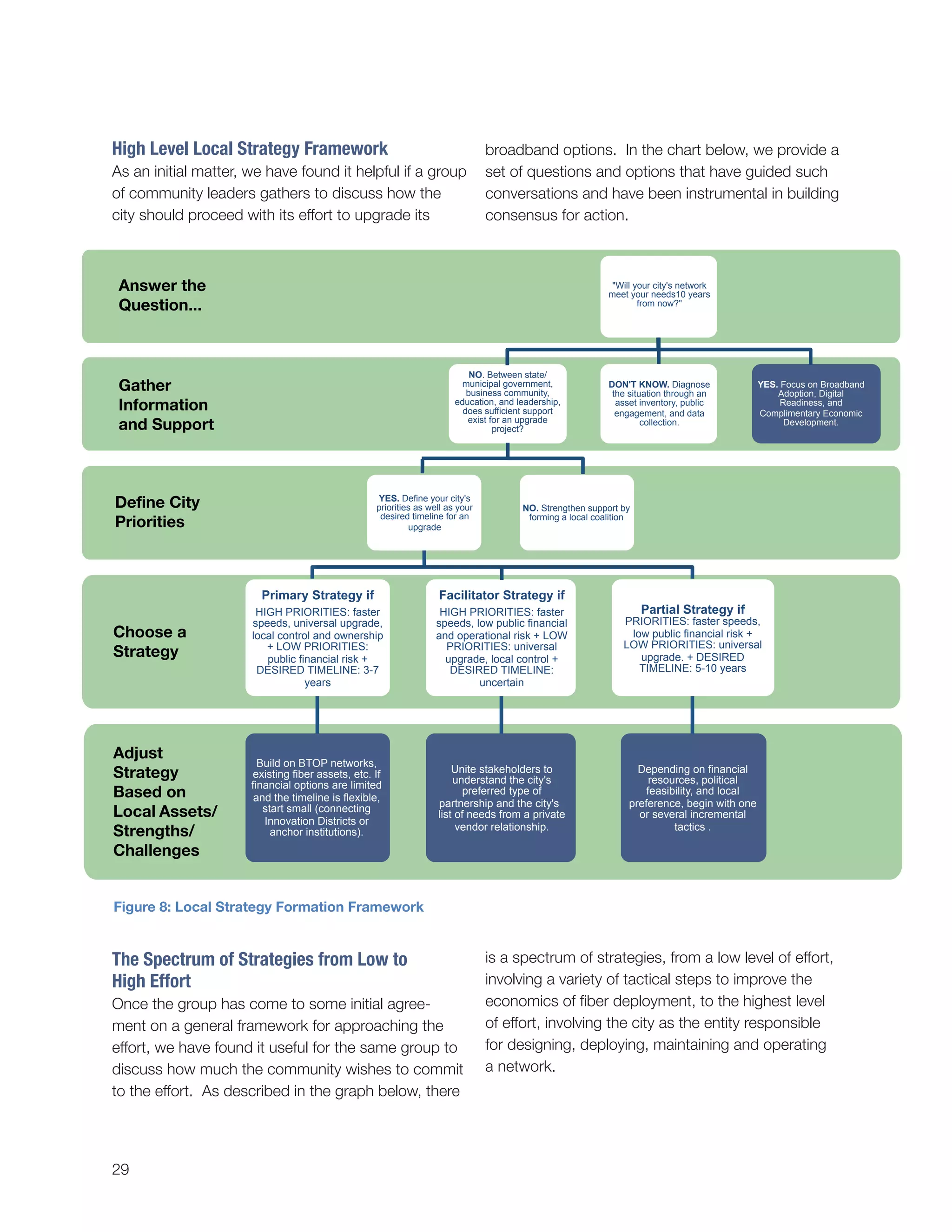
As an initial matter, we have found it helpful if a group
of community leaders gathers to discuss how the
city should proceed with its effort to upgrade its
Adjust
Strategy
Based on
Local Assets/
Strengths/
Challenges
Choose a
Strategy
Define City
Priorities
Gather
Information
and Support
Answer the
Question...
"Will your city's network
meet your needs10 years
from now?"
NO. Between state/
municipal government,
business community,
education, and leadership,
does sufficient support
exist for an upgrade
project?
YES. Define your city's
priorities as well as your
desired timeline for an
upgrade
Primary Strategy if
HIGH PRIORITIES: faster
speeds, universal upgrade,
local control and ownership
+ LOW PRIORITIES:
public financial risk +
DESIRED TIMELINE: 3-7
years
Build on BTOP networks,
existing fiber assets, etc. If
financial options are limited
and the timeline is flexible,
start small (connecting
Innovation Districts or
anchor institutions).
Facilitator Strategy if
HIGH PRIORITIES: faster
speeds, low public financial
and operational risk + LOW
PRIORITIES: universal
upgrade, local control +
DESIRED TIMELINE:
uncertain
Unite stakeholders to
understand the city's
preferred type of
partnership and the city's
list of needs from a private
vendor relationship.
Partial Strategy if
PRIORITIES: faster speeds,
low public financial risk +
LOW PRIORITIES: universal
upgrade. + DESIRED
TIMELINE: 5-10 years
Depending on financial
resources, political
feasibility, and local
preference, begin with one
or several incremental
tactics .
NO. Strengthen support by
forming a local coalition
DON'T KNOW. Diagnose
the situation through an
asset inventory, public
engagement, and data
collection.
YES. Focus on Broadband
Adoption, Digital
Readiness, and
Complimentary Economic
Development.
The Spectrum of Strategies from Low to
High Effort
Once the group has come to some initial agree-
ment on a general framework for approaching the
effort, we have found it useful for the same group to
discuss how much the community wishes to commit
to the effort. As described in the graph below, there
broadband options. In the chart below, we provide a
set of questions and options that have guided such
conversations and have been instrumental in building
consensus for action.
is a spectrum of strategies, from a low level of effort,
involving a variety of tactical steps to improve the
economics of fiber deployment, to the highest level
of effort, involving the city as the entity responsible
for designing, deploying, maintaining and operating
a network.
Figure 8: Local Strategy Formation Framework
30
Figure 9: Strategies from Low to High Effort
Once the community leadership has developed a
rough consensus on the framework and the level of
effort for how it wishes to proceed, there are a series
of incremental steps to be taken consistent with that
general strategy. Again, as illustrated below, these
steps represent a spectrum of efforts, from relatively
simple and with minimal costs, such as having a
committee or outside expert provide recommenda-
tions, to more difficult but with a significant return on
investment, such as instituting a dark fiber strategy,
in which the city installs unlit fiber whenever it en-
gages in certain kinds of construction projects, such
as those digging up streets, parking lots, or other
activities in which the incremental cost to the project
Adopt one.
many or
several
incremental
approaches
to gigabit
fiber-
readiness
Seek out and
cooperate
with a private
upgrader
Form a
public-private
partnership or
similar hybrid
model
Build a
network and
lease out use
to the private
sector
Build and run
a public
network to
businesses
and anchor
institutions
Build and run
a public
network
Exploratory
research and
expert
consultation
Institute an open
data/information
sharing policy
Institute fiber-
friendly policies,
such as “dig-
once” for the city
Publish an RFP/
RFI to outline a
city or regional
fiber plan and
attract
necessary
partners
Adopt a dark
fiber strategy
of laying the fiber is very low. This creates a valuable
asset that can then be lit by putting electronics at
the edges and then used to provide a service, either
by the city or an entity to which the city leases the
fiber. Some cities, such as Seattle, have used this
approach for decades and over time have built out
networks reaching a significant portion of the city,
dramatically improving the economics of deploying a
next generation network.
With these initial discussions, and with a consensus
that hopefully develops from them, the city is ready
to proceed with preliminary steps as discussed in the
next section.
Figure 10: Incremental Tactics from Low to High Effort
31
This section provides information about the preliminary
organization of stakeholders and the process – who to rally
within and outside of city government, ways to achieve quick
wins and the low-risk “low hanging fruit” that can be tackled
first when setting the foundation for a larger scale upgrade
project – no matter the model.
“What are the Preliminary Steps?”
32
illustrated in Figure 11 below.
The next job is organizing the public to adopt the
same mission. One important document that lays
out how to do this is The Kansas City Playbook
(published by the Mayors’ Bi-state Innovation Team).
An outgrowth of the cities’ desire to take advantage
of the Google Fiber network, it details plans for max-
imizing the opportunities by outlining pilot projects
and strategies touching on digital inclusion, educa-
tion, universal coverage, Wi-Fi hotspots, healthcare,
arts & culture, and local government. While it was
written after Google had committed to building a
network, the Playbook provides a great blueprint for
how to organize and excite the community about the
opportunities such a network creates. Excitement
in a community is also useful in creating leverage in
negotiations with potential providers while providing
community leadership with input into what commu-
nity members believe would be the critical elements
in any negotiation.
Unite Diverse Local Actors on a Common Mission
One of the hurdles that has arisen in nearly every
project we have worked with is that the tradition-
al organization of the city, as an enterprise, is not
designed to take on the challenge of accelerating a
next generation deployment. While there is often a
department that works with the cable franchisee, ca-
ble regulation is not designed to facilitate competition
or construction. While there is always a group that
manages rights-of-way and construction permitting,
the nature of citywide network construction is differ-
ent than construction in discrete areas. While there
is usually a group designated to do public outreach,
the nature of this kind of project is quite different than
the typical public outreach involving well-defined,
ongoing constituency groups. Thus, the first job is
organizing city officials to understand and adopt their
role in the mission of accelerating the next gener-
ation network deployment. This involves uniting a
number of different players within the city’s organi-
zation to work together for the common mission, as
The Information Role: What should
city workers/administrators do?
• Coordinate between offices to centralize data,
mapping, and information on current fiber
assets.
• Research plans that similar cities have adopted
and gather best practices.
• Start an educational campaign to engage the
average citizen on the city's gigabit strategy or
plan.
• Work with the city council or governing body to
identify and fix regulatory roadblocks or
inefficiencies standing in the way of private
build-out.
The Engineering Role: What should
city engineers do?
• Perform preparatory work on city utility poles
for new telecommunications entrants.
• Assist other city workers in performing a local
mapping and fiber asset inventory.
• If applicable, work with the city council or
governing body to implement an informed dig-
once strategy.
• If applicable, work with the city council or
governing body to craft the technical aspects of
a development agreement with a private
partner.
The Legal Role: What should a city
council or governing authority do?
• Institute fiber friendly policies, such as "dig-
once."
• Institute regulatory reforms to simplify
permitting, pole attachments and environmental
review processes for new telecommunications
entrants.
• If working with a private partner, create a
detailed development agreement to protect city
interests and meet shared goals.
• If it seems advantageous for your city, pursue a
regional strategy by engaging with the county
or neighboring municipalities.
The Community Role: What should
local political groups, community
members and nonprofits do?
• Create, publicize and provide broadband
adoption and digital literacy resources for
residents.
• Assist in measuring and increasing
neighborhood demand through multiple efforts
including going door-to-door.
• Build relationships among the diverse pool of
stakeholders in the community that would
contribute to and benefit from a gigabit
connection: schools, universities, hospitals,
businesses, etc.
Figure 11: Uniting City Officials on a
Common Mission
33
Take Inventory of Local Advantages, Strengths
and Barriers
A first step in evaluating how to proceed is to take
an inventory of relevant assets. Gig.U has prepared
A Community Assessment Worksheet, primarily de-
signed for city administrators, that provides a com-
prehensive list of assets and opportunities for cities
to improve the conditions for investment in networks.
The full worksheet can be found here and we have
condensed some of the tasks in the graphic below.
Figure 12: Inventory of Strengths, Weaknesses & Assets
Build Local
Support from...
• Research Universities
• Hospitals
• Major Foundations
• Start-up Communities
• Corporations
• Local ISPs
• Incumbent ISPs
• Complimentary policy
organizations or local
advocates in education,
energy, etc.
• Public Utility System or
Company
• Developers
• Surrounding
municipalities (for a
regional approach, if
applicable)
Centralize
Information on
Existing Fiber
Assets from...
• Public Safety
• Hospitals
• Research Universities
• Transportation
Authorities
• Other parts of the city
government with maps
of fiber holdings
Be Aware of
History...
• Has there been previous
Broadband Technology
Opporuntity Program
Funding in your area -
either through adoption
or infrastructure work?
• What does connectivity
look like in your city?
What is the nature of
your digital divide?
• Have there been
previous successful
connectivity projects?
• Have there been
previous failed
connectivity projects?
• Has your state passed
legislation banning or
limiting new public or
partially public
networks?
Leverage External
Resources...
• CLIC - The Coalition for
Local Internet Choice
• Next Century Cities
• U.S. Economic
Development
Administration
• National
Telecommunications &
Information Association
• Fiber to the Home
Council
• State-level political
champions
• State Broadband
Initiative (SBI)
• Federal connectivity
grants (e.g. NTIA,
Department of
Agriculture's Rural
Utilities Service)
• Private grant programs
(e.g. One Community's
Big Gig Challenge)
34
Tackle the “Low-Hanging Fruit”
If a gigabit connection is in the long-term strategic
plan for your city, there are steps to take now to align
you with private investment, public build-out, or the
myriad of models in between.
Exploratory Research and Information
Gathering
Look to cities that have succeeded or stumbled –
especially cities of a similar size, geography and po-
litical structure. Factors such as population density,
existing competition, the cooperation of incumbents,
politics and the presence of local ISPs will also help
determine which lessons are relevant to your city.
It is important to remember that, though cases can
be informative, no two cities are the same. At the
same time, as noted in the Overview at the top of
this Handbook and discussed further in the next
section, the fundamental economics for all cities are
the same.
Regulatory Reform
If you are looking to attract private investment from
a local ISP, a nonprofit provider, or a new project like
Google Fiber, improving and streamlining regulato-
ry processes will make your city a more attractive
place to build. Specific changes can be found in the
Google checklist; others may come to light during an
RFI process.
Information Sharing
Any existing mapping and data on the city’s current
fiber holdings can be either published online for any-
one to view or shared with a private partner to ease
the planning process and avoid creating duplicative
infrastructure. As noted in the section below on
challenges, there are security concerns that should
be addressed before public dissemination of infor-
mation.
Strategic Partnerships that Play to Local
Strengths
Does your city have one or several large research
institutions with their own networks? Does your city
have existing broadband adoption/access nonprofits
or projects that can be leveraged to increase public
awareness and demand for faster speeds? Are there
businesses or start-ups in the area that would benefit
from gigabit speeds? Strengthening these key rela-
tionships and building trust between these institu-
tions will maximize the city’s leverage in negotiations
with potential providers.
Be Firm in Declaring Your City’s Interest in
being on the Gigabit Map
Napoleon famously advised, “If you start to take
Vienna, take Vienna.” That is, don’t undertake such
a project with a half-hearted commitment. A state-
ment of strong intent will both wake up the incum-
bent providers as well as attract non-incumbents.
Be both loud and clear in your announcement to
the world that you are interested in an upgrade, that
there is demand in your area, and you are willing to
work with those who can make it happen. All the
cities that have used RFPs have depended on sig-
nificant publicity to attract potential vendors. Further,
every city that we have worked with has attracted
new concessions by incumbents upon announc-
ing their intent to consider new alternatives. In the
case of College Park Station in Texas, for example,
releasing an RFP led the incumbent cable provider to
suddenly announce it would upgrade its old plant to
make it gigabit capable.
Spotlight: Regulatory Reforms
Louisville lowered its bonding requirements
and extended its franchise agreement period.
North Carolina cities involved with the
NCNGN project agreed to allow ISPs to e-file
their construction-related documents.
South Portland made it easier for
telecommunications entrants to install
utility cabinets along city sidewalks.
35
Cases: Different Approaches to “Dig Once” Policies
Brentwood, CA - Brentwood’s Municipal Code contains provisions requiring all “utility distribution
facilities,” including communications systems, to be installed underground (waivers are permitted
under extraordinary circumstances). Among these provisions, under the title “Advanced Technology
Systems,” is the following: “The developer shall design, install, test and dedicate to the city two ad-
vanced technology system conduits… within the public right-of-way.” One of the conduits contains
a fiber optic system for use by the city or one of its franchisees. The other conduit is to remain emp-
ty and available for future franchisees who prefer to run their own cables instead of using the city’s.
Under this policy, the city expands its own network incrementally while extra capacity is installed to
facilitate future fiber deployments by private providers.
Santa Monica, CA - Santa Monica adds an important feature to its “dig once” policy - requiring all
utility operators to submit maps of all “antennas, pipelines, conduits, cables, vaults, pedestals, and
all other associated facilities” located in public rights-of-way. These maps must be submitted on
a yearly basis, unless no changes have occurred. This reporting activity streamlines future uses of
these Rights-of-Way (ROW) assets that in turn lower costs for future network builders.
Mount Vernon, WA - The city of Mount Vernon in Washington State has implemented a “dig once”
conduit policy that specifically applies to “the construction of improvements such as buildings,
homes, subdivisions, streets, and utilities.” All such projects are required to “construct and install
telecommunications conduit on all streets that are affected, disturbed, constructed and/or improved
by development unless otherwise approved, pending a review by the city engineer.” By spelling out
a range of “improvements” covered, this policy appears to specify a highly incremental fashion for
installing conduit which can help reduce overall costs in the long run.
Poulsbo, WA - Poulsbo, Washington, adopted a policy that applies to all road construction,
whether done by the city or any other entity. Poulsbo’s policy further distinguishes between different
types of roadways, requiring higher capacity conduit along “all new collector or arterial public streets
serving or abutting residential development, and in all new public streets serving or abutting nonres-
idential development.” This tailoring of conduit capacity to roadway capacity can lower overall “dig
once” costs by allowing lower capacity conduit to be installed where appropriate.
Seattle, WA - Seattle has a similar “dig once” policy, but in contrast to all the others listed here, it
specifies that the city will cover the incremental cost of the extra conduit. One can speculate this
generous policy is due to the larger resources of a city the size of Seattle and a high prioritization by
the city to ensure its conduit policy achieves its objective.
36
Understand the Economics: Orient First Steps
Around Lowering Costs and Risks
As discussed in the Overview, while all cities face differ-
ent challenges to success, all face a similar economic
challenge. In other words, as we laid out in Figure 1
and again here, the current math doesn’t work.
That is, the new or incremental Capital and Oper-
ating Expenses of a next generation network are
greater than the Risk adjusted new or incremental
Revenues, plus the Benefits to the System, plus the
risk of lost revenues due to Competition.
The path forward is to change that math, causing,
where possible, cap ex, op ex and risk to go down
and revenues, system benefits and competition to
go up. What every successful project has in com-
mon is that the city has acted in a variety of ways to
lower some or all of the first three factors and raise
some or all of the last three factors:
Changing the equation does one of two things. It can
make a public or public-private model more feasible
to undertake or it can make your community more
attractive to private partners.
Over the last several years, we have seen the
equation changed by cities through three basic
strategies. These are:
1. Asset utilization and improvement. The
key inquiry is what assets does the city have that can
be provided at no or little incremental cost that im-
prove the economics of deployment and operations.
This can include: physical assets, like rights-of-ways
(ROWs), utility poles, conduit, buildings, etc.; infor-
mation assets, like information regarding conduit,
ducts, and other ROWs; and processes to improve
current assets, such as ensuring that make-ready
work is done expeditiously, coordinating with new
providers to save costs or allowing them to perform
work themselves through approved contractors.
2. Regulatory flexibility to accommodate new
business models. The key inquiry here is what
rules does the city have that may have made sense
in a different time and with a different market struc-
ture that in today’s market creates a barrier to an
upgrade or new deployment. For example, all the
projects with national ISPs, including Google Fiber,
have allowed neighborhood-by-neighborhood builds,
which significantly reduces capital expenditures
and risk through a pre-commitment strategy. This
is not without controversy (see section below on
“Addressing Equity, Broadband Adoption and Digital
Readiness”) but nonetheless has proven essential to
facilitating new investment.
3. Demand Aggregation. The key inquiry here
is how to aggregate demand to demonstrate to
existing players the value of an upgrade and to po-
tential new entrants the opportunity in the commu-
nity. This can be done on both the institutional and
residential level. The greater the demand aggrega-
tion before the negotiation begins, the greater the
leverage of the city in the negotiation.
These strategies lead to multiple tactics that have the
desired effect on the core equation, as illustrated in
the graph below and discussed in more detail in the
next section on forming public-private partnerships.
CapEx
System
Benefits
(1-risk)RevenuesOpEx
CapEx
System
Benefits
(1-risk)RevenuesOpEx
Figure 13: Broadband Cost-Benefit Equation
(Revisited)
Figure 14: Revised Broadband Cost-Benefit Equation
(Revisited)
37
Public Messaging Points: Better, Faster,
Cheaper Broadband
At the beginning of every project, cities need to de-
velop a message to the public about why the city is
taking the initiative to improve something believed by
some to be a private sector function. Developing a
communications strategy becomes easier when city
officials look at the project as one with the mission
of providing fundamental infrastructure. After all,
communications around infrastructure projects by
city officials is a well-trod path. Through campaigns
around general obligation bonds to economic devel-
opment efforts like sports or arts facilities, we have
found that there is a great deal of expertise within
most communities about how to advocate for invest-
ing in infrastructure today to improve the communi-
ty’s prospects for tomorrow.
Reduce CapEx
Reduce OpEx
Reduce Risk
Increase
Revenues
Increase System
Benefits
Increase
Competition
• Build to Demand Model
• Access to ROWs, Facilities
• Reduce Regulatory Time
• Access Payments
• Reduce Ongoing Regulatory Costs
• Utilize Existing Billing Platforms
• Build to Demand
• Standardize Functions Across Areas
• Vendors
• Demand Aggregation
• Marketing Platform
• New Services
• Stimulate Innovations that Increase Demand
and New ARPU Opportunities in Other Markets
• Seeding Long-Term Growth
• Use RFI/RFP Process to Encourage New
Entry or Threat of Entry
Figure 15: How to Change the Broadband Cost-Benefit Equation
38
Several years ago, the novelty of gigabit networks
made the task more difficult for broadband projects.
Now, we have found (and the record of popular ref-
erendum on the issue confirms) that the necessary
messages already have significant wind in the sails.
While all politics is local and the precise messaging
should reflect local context and concerns, in our ex-
perience, there are three, primary, public messaging
points that support the initiative for city broadband
adoption that will resonate with the public. These
are:
A world-leading broadband network is nec-
essary for a community to thrive in the future.
No matter what the community’s major economic
forces or demographics, we have found a broad and
deep understanding that better broadband has both
specific benefits for economic sectors and broad
benefits for all. McKinsey, in a paper on “Making the
Consumer Case for Major Infrastructure”, urges lead-
ers to think big by focusing on the “catalytic” benefits
to the economy. That message applies here. As
noted in the earlier section on “The Economic Case
for Faster Speeds,” there is substantial evidence
supporting the argument that faster broadband
leads to economic gains throughout the community.
Moreover, the public, having experienced the impact
of broadband in their own lives, is predisposed to
understand the value of next generation broadband
in their lives and throughout the community.
The broadband status quo is unacceptable.
We have visited many communities in the last four
years but have yet to find one satisfied with its
broadband choices. This is confirmed by consumer
feedback. The University of Michigan Consumer
Satisfaction Index ranks Time Warner Cable and
Comcast as the lowest ranking companies in their
survey. Telephone broadband providers do better
but are far from loved. One can argue about wheth-
er the companies deserve those rankings, but from
a message perspective, advocating for the city to
ensure its citizens have faster, better and cheaper
broadband has proven consistently attractive.
Our community needs to have the kind of
broadband that other communities have.
Several years ago, many communities seemed
resigned to a static fate of incumbents providing
broadband over existing networks, built decades
earlier for voice and video services, without a hope
of a world-leading network. That has begun to
change. With each new announcement from Google
Fiber, AT&T Gigapower, Century Link and others,
support for efforts to bring one’s own community into
the club of gigabit cities has grown and is likely to
grow even more. Of course, no public policy debate
moves in a straight line. There are likely to be mo-
ments where the movement hits some setbacks, but
the overall trend is likely to be that such networks will
go from novelty, to “good to have” to “must have.”
Potential Pushback
Two issues generally prove more complicated in
terms of communications. One is, what is the role
of the city in the project? As noted in the sections
on models, cities can play a number of roles or limit
their roles and risk. From a message perspective,
the greater the role, particularly in terms of financial
liability, the greater the controversy and the more
important it will be to tailor messages that justify the
city’s effort.
The second is the issue of whether the project will
deepen the digital divide. That issue is discussed
in greater detail in a later section of this handbook:
“Addressing Equity, Broadband Adoption and Digital
Readiness.” The bottom line, however, is that such
concerns have never derailed a project; every city
we have evaluated has worked out a path to accom-
modate the interested parties, by, for example, ne-
gotiating for free or low-cost connections to relevant
anchor institutions.
39
“What are the Key Issues in Developing
a Public-Private Partnership?”
For cities that have chosen a public-private-partnership model,
this section provides an introduction to the diverse issues
that are likely to arise in network negotiations. Gig.U has also
prepared links to public documents, RFPs, RFIs, development
agreements and feasibility studies that can be found in the
Appendix. This summary is not exhaustive, as every munic-
ipality will have unique challenges to sort through, but much
can be gained by knowing how others have approached these
arrangements.
Cities have offered to… This can be seen in…
Be an “anchor tenant” of the service Los Angeles RFI
Provide space and power Google Fiber in Kansas City, Los Angeles RFI, NCNGN
RFP
Provide their partner with data and asset
inventory
Los Angeles RFI, NCNGN RFP
House fiber huts on city property San Antonio-AT&T Lease Agreement, San Antonio-Google
Fiber Lease Agreement
40
Negotiating with Partners
The Kansas City/Google Fiber negotiations created
a new model for how cities can facilitate an upgrade
to next generation networks -- a model that has now
been advanced by further Google Fiber negotiations
as well as by negotiations involving other cities and
providers. These negotiations can become very
complex, with provisions affecting city operations,
personnel, property, and, most importantly, financ-
es. The key to these negotiations is for the parties
to recognize the relative costs and values of trade-
offs, for the cities to maximize the asymmetric value
creation discussed in the Overview, and for the cities
to build on that recognition to obtain greater lever-
age in the negotiation. There are assets and levers
city officials can use at little or no cost to improve
network construction economics for the provider.
Understanding these negotiating positions helps
parties reach win-win positions more efficiently.
In this section, we discuss how different cities have
approached some of the key negotiating points.
But first, we provide below a chart with examples of
these levers and requests can be found in the agree-
ments noted further below:
Cities have requested from ISPs… This can be seen in…
Universal coverage Los Angeles RFI
Open access, wholesale network Macquarie-UTOPIA, iTV3-UC2B, Los Angeles RFI
Connected anchor institutions Los Angeles RFI
A free tier of basic service Los Angeles RFI, Google Fiber in Kansas City, Macqua-
rie-UTOPIA, NCNGN RFP, Portland-Google Franchise
Agreement
Free public Wi-Fi hotspots Portland-Google Franchise Agreement, Los Angeles RFI
Subsidized connections to public housing Austin, TX
Ownership of the network Macquarie-UTOPIA, SiFi-Louisville Franchise Agreement
A designated franchise fee Portland-Google Franchise Agreement
Funding/program support for digital literacy Google Fiber in Kansas City
Geographic priorities/schedules for build-out NCNGN RFP
A flexible menu of service options NCNGN RFP
Figure 16: Key Development Agreement Negotiating Points 1
41
Cities have offered to… This can be seen in…
Provide a single point of contact (SPOC) Google Fiber in Kansas City, NCNGN RFP
Streamline communication/permitting Google Fiber in Kansas City, Los Angeles RFI, NCNGN
RFP
Give the partner access to city dark fiber
and/or conduit
Los Angeles RFI
Designate a team within the local government
to work specifically with the partner
Google Fiber in Kansas City
Conduct a consumer outreach/marketing
campaign
Google Fiber in Kansas City
Provide funding through a utility fee Macquarie-UTOPIA
Give the partner sole discretion over build out
plan and schedule
Google Fiber in Kansas City, Portland-Google Franchise
Agreement
Where to Build
One primary concern of all
parties when planning a
network deployment is what
geographic areas the
network will cover. The
competing factors are
construction costs and risk
of recouping those costs for
the network builder against
economic development and
spillovers for the community.
The builder will naturally lean
towards deploying first (or
exclusively if the municipality
will allow that) to areas where risk of recovering
upfront costs is lowest (and potential for profitability
is highest). The municipality likely will want to bring
access to as many residents and businesses as
possible, perhaps even prioritizing certain areas
where the city believes the economic and social
benefits to the entire city are the greatest.  The
parties can resolve these divergent interests in a
number of ways as discussed below.
Mutual Consultation
Google and Kansas City dealt with this issue by
leaving the question of initial build sites open to
continuing negotiation, with Google retaining the
Where to Build:
Key Considerations
• Are there areas of the city we insist on
connecting to the new network and, if so,
on what timetable?
• Are there public facilities we insist on
connecting to the new network? How
many and on what timetable?
• Is there a minimum coverage area that
a provider must commit to as part of the
agreement?
right to base future
build locations on purely
economic calculations.
As a matter of practice,
Google agrees to
build-out in the entire
city but the actual
construction obligation
only kicks in when a
certain percentage
of a “fiberhood” (with
the boundaries of the
fiberhood and the
minimum percentage
set at Google’s sole
discretion) signs up for the service. This approach
can be viewed as a win-win from the perspective
that the city has a voice in negotiating initial build
locations and the ISP retains control over expansion
locations thereafter. However, if the city falls short
of getting agreement on its planned network sites
during initial negotiations, turning over control of
expansion planning to the ISP can end up resulting
in a build-out to fewer areas than the city may have
wished.
Need-based Quotas
In contrast to the negotiation model above, Raleigh
agreed upfront to let AT&T base its build locations
Figure 17: Key Development Agreement Negotiating Points 2
42
purely on cost-recovery calculations in return for
a quota of additional locations that the city could
choose based on need. The trade-off here is that the
city may not get the network to reach all of its need-
based sites initially, but it can ensure the network
eventually expands to cover some of its highest
priority areas.
Competitive Response
In addressing this issue of where to build, the city
should consider the likely response from competitive
network providers.  So long as the new network
reaches a critical mass of the city, it is likely to drive a
competitive response.  For example, the deployment
of fiber by the incumbent telco or a new entrant with
significant resources, like Google, will likely compel
responses by the cable provider.  The cable upgrade
will be done system by system, rather than the
fiber build-out neighborhood by neighborhood.  In
that way, facilitating an upgrade or new entrant can
result in a broader geographic upgrade through third
party providers who are not involved in the initial
agreement. Further, as pricing is generally consistent
throughout the entire jurisdiction, the competitive
response will likely mean that all residents receive
the benefits of price competition, even if the new
network does not extend to every area.
How to Build
Network construction methods are largely stan-
dardized, so the primary decision is whether to build
above or below ground (or whether to use a com-
bination of both approaches). Making this determi-
nation can involve considerable cost calculations
and complex policy issues, such as pole attachment
rights and equipment placement.
Above-ground vs. Underground Construction
Above-ground network construction tends to be less
expensive from a labor and equipment cost perspec-
tive, so it is most commonly used. Above-ground
construction also minimizes digging up roadways
and the consequent impact on traffic.
On the other hand, the main benefit of underground
construction is weatherproofing the network, pro-
tecting it from wind and ice, which are known to top-
ple utility lines and poles. So it is in the city’s interest
to assess these costs and risks while planning and
negotiating a network construction partnership.
Pole Attachment Access and Costs
Labor and equipment costs are not the only costs
to consider when deciding between above- and
below-ground construction. Pole attachment costs
can potentially dominate the calculation. For munic-
ipalities that lack a public utility or other means for
easily accessing poles, the costs of negotiating and
accessing privately-owned poles can quickly make
above-ground construction more costly than running
fiber underground. This was the situation with Cham-
paign-Urbana, which decided to build completely
underground to avoid pole attachment costs and
headaches.  
This issue was addressed in part through the FCC’s
recent order on the classification of broadband. The
Commission held that ISPs should be entitled to fair
access to poles and conduits under Section 224 of
the federal communications law. The long-term val-
ue of that decision depends, in part, on how court
challenges and potential congressional legislation
plays out. Another way of addressing this issue
is having a single pole administrator. Connecticut
recently implemented a single administrator through
state legislation.  Google addressed the issue in its
first project by initially going to Kansas City, Kansas,
which had a municipal electric company, and then
leveraging the public reaction to strike a deal with
private pole providers in Kansas City, Missouri, who
did not want to be seen as obstacles to Google
Fiber expansion in their city.
How to Build: Key Considerations
• If there is no municipal pole ownership, are
the private pole owners supportive of the
project?
• How many different parties must your city
negotiate with to gain access to the pole
space needed for this project? Does the city
have a history of negotiating with them?
43
Permit Approvals
Any network builder will need to obtain permits for
construction tasks as the project progresses (which
can take months and even years). Cities should work
with network partners to ensure these permits are
processed as efficiently and quickly as possible to
reduce construction costs and time.
Setting Timelines
While permitting approval timelines benefit the net-
work builder by providing certainty and expediency,
the city should retain flexibility so it is not on the hook
for every permitting delay. For example, the AT&T/Ra-
leigh contract reads:
Access to Infrastructure and Rights-of-Way
(ROW)
Infrastructure and ROW access is a big lever for a
city during negotiations. Great care and diplomacy,
however, must be used in order to not scare poten-
tial partners away. While cities have the economic
leverage to charge fees beyond their costs for the
use of the ROWs as well as existing ducting or con-
duit, the value of such fees must be compared to the
value of the economic benefits that a next generation
network is likely to bring.  Again, there are multiple
ways to address this issue.
Use a Fee Schedule
Google’s contract with Kansas City includes a sep-
arate “Fee Schedule” detailing which infrastructure
and ROW activities require a fee. The activities that
do not require a fee include: collocation space, office
space, pole attachments (in utility/power space),
conduit use, existing fiber, access to Geographic
Information Systems (GIS) data, access to comput-
er tools, permit processing and inspections. The
activities that do require a fee are: pole attachments
(in telecom space), traffic control, and access to
city rights-of-way for construction and installation
of outdoor network equipment. While the city has
considerable discretion to impose, or forbear from
imposing, a fee, the key consideration is whether
the reduction in fees can lead to a network that will
increase the economic activity within, and attractive-
ness of, the city. Further the city should distinguish
between those fees that reflect an incremental cost
to the city and those that reflect the ability of the city
to charge a fee for use of the rights of way or other
municipal assets, which by their nature are both
scarce and essential to certain kinds of projects.
Ensure Equal Treatment of All Providers
AT&T’s contract with Raleigh contains language
that generally ensures AT&T is treated like any other
third party seeking access to such infrastructure and
rights-of-way. It states: “Such access will be pro-
vided in accordance with all applicable regulations
and ordinances and the City’s standard processes
and practices generally made available to all third
parties. . . .” In addition, the contract contains a
“Most Favored Nation” (“MFN”) clause providing that
“the City will… license AT&T to utilize such space for
those purposes at rates or fees and other terms no
less favorable than those granted to any other similar
commercial service provider.” Such MFN clauses
are frequently requested by incumbents and new
entrants alike to guarantee a level playing field on
fees and rates.
Permit Approvals:
Key Considerations
• Has your city internally reviewed its
permitting process?
• Can the city’s permitting be improved or
streamlined through digital processing?
Infrastructure and ROW Access:
Key Considerations
• What parts of the fees reflect actual costs
to the city and what parts reflect an implicit
charge for scarcity value of the use?
• What is the impact on prior agreements
with others of changing the fee schedule for
one provider?
44
“The City will provide diligent and expeditious
review and determinations of all applications for
permits submitted by AT&T and will attempt…to
approve or respond within one week from the date
of the submission of the request.”
Similarly, Google’s contract in Kansas City called for
“quick, diligent review of all applications for permits”
followed by “a commitment to review and respond to
any subsequent modifications or similar documents
that may require approval by City within five (5) work-
ing days of submission by Google.”
Waiving Permit Fees
Another way to streamline the permitting process is
to waive fees, although the obvious financial impli-
cations of this tactic should not be overlooked.  The
Google contract reflects this approach, as seen in the
Fee Schedule that sets a fee of “None” for “Permits.”
Before adopting this approach, city officials should
review internally how its payment processing affects
permit process timing. If the effect is negligible, so too
will be the benefit.
Personnel Commitments
Another way to streamline the permitting process and
network deployment more generally, is identifying spe-
cific city personnel who can focus partially or primarily
on network related issues. Having such a dedicated
team will speed up not only permit processing, but
also the resolution of the numerous diverse issues that
inevitably come up throughout long and complex con-
struction projects. The level of specificity in personnel
provisions can vary.
The contract between AT&T and Raleigh uses general
language:
“The City shall designate staff that will facilitate
communications between AT&T and City staff and
officials, and will coordinate between municipal
departments…City will designate inspectors and
supervisors with the collective authority to inspect
all construction for the Network, maintenance, and
related work in connection with each applicable
permit to be issued by the City to AT&T.”
In contrast, Google’s contract with Kansas City spells
out personnel requirements in more detail, going as
far as creating new job roles. For example, Google’s
contract requires the creation of an “Executive Spon-
sor for the Project at the most senior level of City” and
a “Single Point of Contact (SPOC)... responsible for ad-
dressing all issues related to the Project.” The Google
contract further requires “a City team dedicated to the
Project…the full cooperation of all City departments…
[the City] participate in regular status meetings (at least
weekly)... a dedicated inspection team as part of the
City Project team… [and] consulting assistance to
Google on planning and build of the Project.”
Open Access
The term “open access” refers to a network manage-
ment policy by which multiple service providers can
offer services over the same physical network. This
objective is reached by requiring the network owner
to offer access to its physical network on non-dis-
criminatory terms to any requesting service provider
who can plug their own equipment into the network
and begin offering services to customers. Stockholm,
Sweden, is the most notable example of an open
access fiber network. The South Portland, Maine,
and Champaign-Urbana, Illinois, efforts include open
access requirements.
Open Access:
Key Considerations
• Does the city want to try an open access
model?
• Have ISPs expressed initial interest in
working with the city to implement an open
access network policy?
Personnel Commitments:
Key Consideration
• How will dedicating such a team affect city
resources and other high priority construc-
tion processes?
45
From the city’s perspective, an open access policy
has the advantage of promoting competition at the
service level because it prevents the owner of the
physical network from dominating the market for
network services.   From the network builder/owner’s
perspective, open access may reduce profits be-
cause competition will likely lower market prices for
network services. This means it will take the network
owner longer to recover its costs and turn a profit,
which could mean no new build-out ever occurs.
But if a party is willing to invest in a next generation
network even with an open access requirement,
such a policy could, in the long run, result in more
innovative services, lower prices and greater access
for residents and businesses.
When Google announced its Kansas City fiber
deployment, it initially suggested the network would
be open access.  Later, however, it reversed its po-
sition, saying that as the company had studied the
economics of deployment and consumer behavior,
the advantages of open access were not suffi-
cient to justify the increased costs and risks of that
business model.  Google has talked about how the
costs of obtaining traditional programming pack-
ages, and the need to offer a multi-channel video
package, make an open access model non-viable
from an economic perspective.  In contrast, Cham-
paign-Urbana’s fiber network embraces the open
access ideal. This distinction stems from the fact
that Champaign-Urbana’s network originated under
a federal BTOP grant that came with an open ac-
cess requirement. As the network operator evolved
into a nonprofit (UC2B) and then a partnership
between UC2B and private service provider iTV-3,
open access remained a core principle throughout.
The BTOP grant made open access a precondition
to negotiation with private ISPs when UC2B went
looking for an expansion partner.
While still untested, one potential compromise is
to allow the network builder a limited grace period
during which it can be the sole service provider,
allowing it to recoup upfront costs more quickly,
followed by an open access policy thereafter. This
grace period can be negotiated as a number of
years or pegged directly to cost recoupment. Cur-
rently a theoretical approach, some cities have de-
bated whether to try to obtain such a commitment.
Free Network Services for the City
All the contracts we analyzed contain provisions by
which the ISP provides some form of free service for
the city and/or other public facilities. This is often an
important negotiating point for city officials because
free network services can add up to major cost
savings for the city or can otherwise serve some
other policy objective. City officials should examine
their existing IT costs and either try to minimize
them by procuring as many free services as possible
through the negotiations, as discussed below in the
Kansas City and Raleigh cases, or leverage them to
stimulate the build-out of the network, as was done
in South Portland, Maine, also addressed here.
Google’s contract with Kansas City allots free
Internet connection service, of the same kind
offered to the general public, through a quota of 130
locations within the city including city facilities, public
utility sites, and school districts. One caveat is that
such free service facilities will only be connected
as they are passed by the natural progression of
the network’s construction. Another caveat is that
Google will cover the cost of connection, but only if
it is “commercially reasonable.” Otherwise, “Google
and Kansas City will discuss options to address that
issue.” Most importantly, following such connection,
these locations will receive Internet connection
services free of charge.
AT&T’s contract with Raleigh similarly uses a quota
to provide “Community Broadband Service” to
“public or non-profit facilities that provide access
and services directly to citizens.” The agreement
specifies that 100 sites can be chosen, collectively
across all six municipalities that form the North
Carolina Next Generation Network. The agreement
also stipulates that the relevant city must pay for the
cost of connection (estimated in the contract to be
$300-$500) and that schools and libraries would not
be included unless they qualify for funding through
E-rate, the federal program administered by the
46
FCC, which subsidizes broadband connections for
low-income schools and libraries.
Another type of free service which can be negotiated,
particularly in the case of a dark fiber network such
as GWI is providing in South Portland (ME), is a an
Internet point of presence. Without this, the city
could still end up paying a significant sum of money
to connect its facilities to the Internet despite having
high-speed fiber connections internally. GWI’s
contract stipulates that it will provide an Internet
connection at a termination point designated by the
city, capable of at least 100Mb/sec symmetrical,
free of charge for the remainder of the contract
term.  Thus, while the South Portland model does
not focus on free services, it does enable the city to
enjoy lower costs over time while accelerating the
deployment of a next generation network.
Revenue Sharing
Depending on the financial model or models under
consideration, revenue sharing is another topic worth
exploring during negotiations. Some network models
do not make room for such provisions (e.g., Google/
Kansas City; AT&T/Raleigh). Other models make
revenue sharing a central provision, such as the
deal between South Portland and GWI. In return for
becoming an anchor tenant of the new network and
paying for 20 years of service upfront (approximately
$150,000), South Portland is entitled to a share of
revenues generated from retail services provided by
GWI.
The important note here is how to define the profits
from which to calculate the city’s share, because the
network provider must account for numerous costs.
Accordingly, the GWI contract starts by defining “Retail
Revenues” as “revenues received by GWI from retail
business or residential customers for Internet and
data transport services connected directly to the Fiber
Optic Cable Network, exclusive of any applicable taxes
or surcharges.” From there, the contract specifically
defines the “Connection Costs” which must be
recouped by GWI from each retail customer’s revenue
stream before the city begins to receive a 5% share of
all future revenues from that customer.
Other Provisions
Not surprisingly, there are a number of other topics
that have been the subject of negotiations. A quick
summary includes:
• Make-ready Work: The network builder will want
the city to commit to doing most or all of the make-
ready work on city facilities (such as on poles) in order
to lower the cost of the build-out.
• Access to City Facilities for Network Node
Equipment: The network builder will want access
to city facilities for locating network equipment. This
is particularly valuable in areas where appropriate
facilities are scarce.
• Services to City, Schools and other Anchor
Institutions: In both the Kansas City Google Fiber
and the North Carolina AT&T agreements, the cities
were able to negotiate for fiber connections to certain
public facilities.
• Service to Low-Income Housing: Cities can ask
for a minimum number of connections to low-income
housing facilities.
• Serving Small/Medium Business: In the same
way, cities can ask for a minimum number of
connections or geographic coverage in areas with
small and medium-sized businesses.
• Public Wi-Fi: The fiber build-out also improves the
economics for deploying a robust, cost-effective Wi-
Fi network. Cities can negotiate for some of the Wi-Fi
hotspots to be available for public consumption,
instead of just for service providers.
• Education/Marketing: Service providers have
asked for certain kinds of assistance in making
educational and marketing materials available to
relevant segments of the public.
• Digital Literacy: Cities have asked for assistance
with digital literacy efforts.
• Interconnections: Service providers have
requested settlement-free interconnections with
anchor institutions within cities that have existing fiber
connections.
• Smart Grid Support: Cities have asked service
providers to make efforts to ensure that the new
network supports the city’s “Smart Grid” program.
Additional provisions might request that the parties
negotiate an agreement in which the city agrees
to reinvest any resulting cost savings back into the
network.
47
“What are the Funding Issues and
Opportunities that Affect How the City
Proceeds?”
This section summarizes funding issues and
resources for cities seeking private partnerships or
public funding.
48
An Overview
If a city obtains a national partner like Google, AT&T,
CenturyLink or Cox, it does not have to “worry”
significantly about funding issues. In the deals to
date, these kinds of large private parties have carried
the financial risk. If, at the opposite end of the
spectrum, cities decide to proceed without a private
partner, there are a myriad of financing issues beyond
the scope of this Handbook. For cities pursuing some
type of public-private model with more public control
and more public risk, they should consider a number
of financial questions addressed here.
Like traditional municipal projects, there are numerous
financing options available for a public broadband
initiative. However, it’s best to recognize upfront that
this is not a conventional publicly funded endeavor,
nor one that a municipality and its traditional lending
partners will be familiar with or experienced in
utilizing. Nonetheless, as demonstrated in successful
community-led broadband projects, there are
numerous funding models available to support
various network deployment strategies.
Whichever path a municipality chooses to pursue, it is
imperative to ensure the financial inputs and outputs
are fully understood and properly presented to any
potential private partner and/or source of financing.
As financing methods are considered, municipalities
must have an understanding of, and answers to, the
questions and financial return metrics any sources of
financing will consider when evaluating the project.
There are both financial and legal mechanics that can
be designed to protect everyone involved and that, if
properly presented, could generate significant interest
from investment sources.
The technical design, construction and operating
complexities of the telecommunications business
must be fully grasped by any municipality pursuing
sources of funds. It is often the case that a traditional
lending institution, while acknowledging the intangible
economic development benefits of a community
broadband network, will likely focus on how funds
will specifically be used, how they flow and how debt
will be serviced, while ultimately testing the metrics
to ensure returns. In that light, here are some key
questions cities and their partners must evaluate.
Key Considerations: Financing
Who will ultimately take the risk when financing
the network?
There are a number of different risks to consider, such
as the risk that deployment costs will be greater than
anticipated, or revenues will be less than expected.
In many community-led broadband projects, the
municipality has moved all financial risk to the private
party (as is true in the Google Fiber and fiber by
incumbent projects), but that generally leads to less
control by the municipality on a number of issues,
such as the extent of the build-out. This raises a
host of related questions, including: What does
the current competitive landscape look like? What
is the anticipated reaction from incumbents? Will
this present a formidable hurdle related to network
returns? Again, while the answers cannot be known
with certainty, the question of who bears the risk has
to be addressed before any actual deployment can
proceed.
Would the municipality support the network
with other internal sources of revenue, such as
legacy utility service fees, or existing or new
taxes? Will this be purely a stand-alone revenue
pledge?
Any public or private proposal
must have a credible strategy that
addresses standard questions:
• Return on Investment (ROI)?
• Internal Rate of Return (IRR)?
• Point of Breakeven?
• Point of Profitability?
• Point of Positive Cash Flow?
• Is this a 5 year lifespan? 10 year? 30 year?
• Preferred funding source – public or
private? Debt or equity? Corporate or
municipal?
49
In short, a firm grasp of the initiatives’ financial
inputs will go hand-in-hand with the development
of a defined network architecture and management
planning for the project. A thorough understanding
of the financial inputs and outcomes demonstrates
a foundational understanding and coordination
between the financing, technology and operational
imperatives paramount to the long-term success of
any community-led broadband project.
Funding Methods and Case Examples
There are a wide variety of funding approaches that
communities have adopted to support the phases
of network deployment – whether exploratory
work (writing a request for information, taking an
asset inventory, measuring demand, etc.), capital
expenditures (the cost of actually building the
network), or ongoing operating expenses (the
cost of maintaining service overtime). See below for
common and sometimes creative takes on funding.
Note that these methods are not mutually exclusive.
For example, the original network in Champaign-
Urbana was built using a NTIA Broadband
Technology Opportunity Program infrastructure
grant. It will now be expanded through a public-
private agreement between the cities of Urbana and
Champaign and local ISP iTV-3.
These questions are always core to the analysis if
the city intends to operate the network, but they may
also be relevant if the city wishes to control certain
outcomes as well, as we saw in the South Portland
and Westminster examples.
Is the municipality willing to pledge resources or
collateral or offer concessions to mitigate risks
for a funding partner?
Again, the city can, as we’re seeing in Utah with the
Macquarie initiative, facilitate both a build-out and a
preferred business model for the operation.
What are the long-term costs/benefits of
pursuing a public broadband network in
deference to future or alternative uses of funds
and resources?
If city officials wish to participate, they will have to
justify expenses with projections demonstrating
benefits like cost savings (such as in Santa Monica
and South Portland), or new economic growth (such
as the Westminster project).
What are the legal requirements, limits or
barriers to entry in pursuing a public broadband
network?
As noted in an earlier section in this Handbook,
many states have constraints on cities participating in
broadband networks, particularly in terms of financial
support.
©iStock.com/toddtaulman
50
Funding Methods Objectives Examples
Federal Grants To partially off-set costs of a network
or lay middle mile or dark fiber for
future expansion (either public or
private).
Chattanooga, TN
Georgia
State Grants To partially off-set costs of a network
or lay middle mile or dark fiber for
future expansion (either public or
private).
Minnesota
Illinois
Municipal Bonds For full-scale, ambitious city-wide
deployment where there is projected
revenue from a public model or there
are private parties interested in leas-
ing the project infrastructure.
Lafayette, LA
Private Funding For full-scale, ambitious city-wide
deployment.
Cities with Google Fiber, AT&T
Gigapower, CenturyLink and
other such efforts.
Cooperative Funding Model When residential service is demand-
ed, but there is little to no private
investment interest.
Sibley County, MN
Crowdfunding For incremental, scalable projects
with visible effects for civic investors
(public Wi-Fi, Innovation Zones/
Districts); or for exploratory costs in
cases of widespread citizen demand
and slow government action.
Blacksburg, VA
Utility Fee For full-scale citywide deployment
funded publicly or through a partner-
ship in an area without competition.
Caveat: given the sensitivity of public
funding, high levels of political and
public support are needed.
Macquarie in Utah
Infrastructure Financing Districts
(IFD) or Tax Incremental Financing
Districts (TIF)
In states where such districts are set
up or politically supported and where
projected future gains/value from
infrastructure projects are reliable.
Wabash County, Indiana
California
Figure 18: Financing Methods
51
Innovative Financing: Westfield, Indiana
This section does not exhaust the innovative ways
cities and private parties can work together to meet
both their needs and provide the capital necessary
to deploy a new network. The opportunities vary
according to state law but one of the best examples
of an innovative way to finance a network was that
employed by Westfield, Indiana. The city employed
an innovative form of Tax Increment Financing
(TIF) in its effort to have a private ISP bring gigabit
broadband to town. TIF is a public financing model
which aims to capture future gains in property taxes
from a specified “tax district” to subsidize current
improvements, improvements which the city and
bondholders expect to be the main cause of the
subsequent tax gains. Because Indiana state law
allows TIFs to be defined narrowly, Westfield is able
to offer a TIF bond based on specific assets as
opposed to an entire geographic area.
With Indiana’s unique TIF flexibility, Westfield was
able to offer a private provider, Metronet, a TIF bond
based solely on the network assets to be built. This
bond effectively acts as a 25-year tax abatement
instrument, where state law would normally limit tax
abatement plans at 10 years.
Here’s how it works. Westfield offers TIF bonds
that cover the very assets Metronet plans to install
for its Westfield fiber-to-the-premises network.
Metronet then purchases those bonds from the
city, which entitles Metronet to the future property
taxes that will be assessed on its network assets
going forward. Westfield then releases the bond
sale proceeds back to Metronet to build out the
network. As a result, Metronet has effectively abated
its property taxes due on the new network in a way
that does not affect the pre-existing tax base of the
city. It’s a true win-win: Westfield gets a new high-
speed fiber network and Metronet gets long-term
tax abatement without impacting Westfield’s existing
tax base.
Most states have a different law on tax abatements
and TIF financings but we believe there are similar
opportunities in most states for the parties to share
the upside of the benefits such networks bring and
thereby improve the economics of deployment.
52
Challenges to Expect Along the Way
In this section, we outline the expected roadblocks, trade-offs
and criticisms a city will likely encounter, both during the pre-
liminary decision-making process and after it has chosen and
begun to pursue a specific upgrade strategy.
53
Challenges During the Exploratory Phase
Assessing a City’s Current Status and Demand
for Next Generation Speeds
Depending on the city, taking an inventory of existing
local fiber assets can be a complicated undertaking
involving coordination on many fronts. Does your
city have a public safety network? Between private
industry, public entities, universities and hospitals,
what does the existing fiber infrastructure look like?
To the extent possible, information about existing
fiber assets should be centralized by a single local
government agency charged with freeing this
information from silos and then mapping it.
Measuring local demand for higher speeds is
another challenge. Do you have anecdotal or
quantitative information about dissatisfaction with
current service offerings in your community? Do
you have the resources to survey residents, schools
and businesses to capture and express this level of
demand? A number of resources are available to
capture community demand, including this Demand
Identification Website created by Gig.U. These
tools are designed to assist those in charge of local
outreach efforts by making it easy to assess interest
in upgraded networks.
Finding Champions, Creating Accountability
Ensuring “better, faster, cheaper” broadband is not
explicitly written in anyone’s job description. As a
result, many of the successful or developing cases
have come about because local leaders took the
initiative to step out of their traditional or expected
duties to adopt this cause. The need for champions
creates a local governance challenge. Who in City
Hall is accountable? Who is in charge? Who is
pushing the project ahead? The answer depends on
the particulars of each city, but if the answer is, “We
don’t know,” the project is unlikely to succeed.
Pushback from Incumbents
If an incumbent ISP is not involved in the local
gigabit project as a partner, it could become a major
obstacle – even before the network has been built.
If a local broadband plan threatens existing revenue
streams, as it inevitably will, incumbent companies
will react to protect the status quo. They might use
a combination of political, public relations and legal
tools to challenge any action they believe hurts their
interests. Pushback could come in the form of
misinformation campaigns, “astroturf” organizations,
legal barriers and lobbying on the city or state level.
Almost all of these tactics were used to try to block
the Longmont, Colorado, network, so it provides a
comprehensive case study for city officials.
While all the communities discussed in this
Handbook have experienced some form of
pushback, to a remarkable degree that pushback
has been muted by the desire of communities for
improved broadband. What we have found is that
if communities run an open process, with a clear
statement of goals, and gain the support of key
community and economic interests early on, the
incumbents generally decide that overt opposition
hurts their brand. They instead focus on improving
their product and price, which benefits the
community and its citizens.
54
Challenges during the Decision Making Phase
Understanding the Trade-Offs
As your city moves forward with its gigabit strategy,
there are important trade-offs that need to be
understood and addressed in choosing the most
appropriate network model. Is it more important for
the city to have a quick roll out to certain locations,
like business districts, innovation zones and
anchor institutions, or a slower but potentially more
comprehensive roll-out? Is it more important to have
as broad a coverage as economically viable or to
have less coverage but potentially lower prices that
may trigger a competitive response by incumbents?
Is the aggregated demand and scale of a regional
approach worth the extra time and coordination?
Embracing a private partner means reducing financial
burdens for the city, but it also means sacrificing
future operational control. An incremental approach
means less immediate risk, but also likely means
a longer wait for the benefits from widespread
availability of gigabit speeds. Some of the key
trade-offs are illustrated in the figure below.
A
Universal
Network
The Scale
of a
Regional
Approach
Quick
Decision
Making
Ensuring
ROI
City Control/
Accountability
over Network
An Open
Access,
Wholesale
Network
Attracting
National
Private
Partners
Operational
Responsibility
Figure 19: Trade-Offs
55
issues, Dr. John Horrigan, calls “Digital Readiness,”
which measures how skilled and prepared new
adopters are for next generation applications and
online services.
While broadband adoption or digital readiness is a
problem most cities share, those pursuing gigabit
upgrades will have added pressure to address
and correct them. In 2014, a Wall Street Journal
article surveyed how some argue that gigabit
efforts contribute to the digital divide. On further
examination, however, most of those arguments
fall apart, as can be seen in a report by Aaron
Deacon, one of the community leaders involved
with the Kansas City gigabit deployments, providing
six arguments for how Google Fiber has narrowed
the digital divide in Kansas City. Wired also ran
this piece providing a further discussion of how
digital divide based attacks on next generation
deployments are factually and logically flawed.
Recognizing that a Good Network is Only Part
of a Successful Digital City
Asking, “How do we get a gigabit network in my
city?” is not the same as asking, “How do we
become a gigabit city?”
While a gigabit network is the starting point for
many innovative possibilities, it is important to keep
in mind that it is just that – a starting point. For
example, Mayor Andy Berke of Chattanooga leads a
city with gigabit connectivity, but is also still seeking
ways to unlock the potential of those high speeds.
Recently, Mayor Berke was at the Brookings Institute
discussing ways to foster the creation of Innovation
Districts, geographic areas described by Brookings
urban experts as “where leading-edge anchor
institutions and companies cluster and connect with
start-ups, business incubators and accelerators.
They are also physically compact, transit-accessible,
and technically-wired and offer mixed-use
housing, office, and retail. Such areas have the
unique potential to spur productive, inclusive and
sustainable economic development.” Such areas
also depend on robust broadband networks.
Challenges during Implementation and Build-Out
Managing Community Expectations
While educating the community on the project will
be a challenge, so will managing expectations.
This will be important to do in regard to the project’s
timing and construction – especially since this is an
investment with mostly long-term benefits. To retain
momentum, cities must create and meet public
milestones (sign-up deadlines, announcements of
institutional support, etc.) that translate into quick
wins.
Addressing Equity, Broadband Adoption and
Digital Readiness
The economic and educational benefits of higher
speeds are undeniable, but they do not solve the
“Digital Divide.” While the rewards of a gigabit
network might cause multiplier effects in the city
and possibly impact the lives of those not directly
connected, many residents will not directly benefit
from gigabit connectivity without complimentary
community adoption, digital literacy programs
and access to hardware. The challenge for any
prospective gigabit city will be to understand the
nature of the local digital divide and to create
tailored, targeted solutions to roll out alongside
the gigabit upgrade. For instance, future gigabit
city Austin, Texas, just announced that Google
Fiber would be connecting residents of the 18
HACA properties (public properties operated by the
Housing Authority of the City of Austin) with free
5 Mpbs service for a $10 pre-registration fee.
Getting over barriers to adoption – whether those of
access, cost or relevance – is arguably just the start.
Achieving a certain threshold of digital and technical
know-how is becoming a de facto requirement as
more job applications, government services and
informational resources shift exclusively online.
Cities can no longer be thinking of broadband
adoption as a binary question of whether someone
is online or not. There is a compelling case that
the new framework should be what Pew Research
Center researcher and leading expert on these
56
In addition, initiatives like US Ignite and the Mozilla
Gigabit Community Fund have encouraged the
development of applications and projects for next
generation, high-speed networks. Even cities that
lack the infrastructure right now are taking steps
to bolster civic technology and e-government. The
Boston Mayor’s Office of New Urban Mechanics
is a model government project when it comes to
leveraging technological tools and city data to make
citizen services more efficient. As noted earlier, The
Kansas City Playbook (published by the Mayors’
Bi-state Innovation Team) details the cities’ plans for
maximizing the opportunities created by their gigabit
network. It outlines pilot projects and strategies
touching on digital inclusion, education, universal
coverage, Wi-Fi hotspots, healthcare, arts & culture
and local government.
©iStock.com/Davel5957
57
Top Ten Overall Lessons
Throughout this Handbook, we have identified the most important
considerations for cities seeking to accelerate the deployment of next
generation networks in their communities. This section distills these
even further to a “Top Ten” list that provides lessons for all communi-
ties—regardless of size, density or demographics—pursuing improved
bandwidth for their businesses and residents.
58
an eye toward lowering the cost of next generation
broadband facilities, the future cost of such a
network increases.
Lesson 4: Incumbents only respond to a
potential change in the status quo. Inaction by
a city leads to inertia in the market.
In every community we have worked with, action by
the city has always led to a response by incumbent
providers. Generally, that response is in the nature
of an incremental bandwidth increase or some other
kind of improvement designed to forestall a broader,
community-led broadband upgrade. This is not
to criticize the incumbents; it is simply to suggest
that when it comes to cities and their broadband
networks, the old saying, “The squeaky wheel gets
the grease,” turns out to be true. For example,
without its RFP, it is doubtful that Los Angeles would
have received a proposal by Time Warner Cable to
accelerate its upgrade throughout the city. Similarly,
Time Warner Cable’s upgrade in North Carolina
only occurred after the community-led efforts in that
state.
Lesson 5: Cities who act will have to choose
between the quick, short-term win and the
harder, longer-term win.
When cities become “the squeaky wheel,” they
often have an opportunity to obtain some quick
concessions from incumbents in exchange for
stopping a process that opens the door to new
providers. There is no general rule for responding.
Some cities may best be served by taking what is in
front of them, while others have the potential for far
greater gains. What is certain is that cities should be
prepared to analyze the short-term and long-term
risks and opportunities so as not to be pressured
into making a decision based solely on a desire for
a “quick win.” Rather, they should be looking toward
the “art of the possible” by maximizing the long-term
prospects for broadband abundance.
Lesson 1: Organizing community resources and
stakeholders is essential for making gigabit
projects economically viable.
While different cities have different demographics,
construction costs and other variable factors that
affect the feasibility of a gigabit capable network,
communities that have moved forward share
one driving force: a commitment to improving
broadband availability. Any community has the ability
to organize its resources and regulatory processes
to lower capital expenditures, operating expenditures
and risk, and raise revenues – the key to making
gigabit projects economically viable. Also, any
community with a vibrant tech or start-up community
can leverage that energy to produce project support.
These stakeholders are first adopters and already
understand the “why” of gigabit speeds.
Lesson 2: Start with a clear understanding
of how your city’s rules and assets affect
deployment costs.
The organizing effort starts with a detailed
understanding of how communities’ policies
and assets affect the economics of network
deployments. Gig.U, the Fiber to the Home Council
and others have developed tools for this exercise
and public documents from the Google Fiber project
also provide a roadmap for how cities should
think about the impact of their rules and assets on
network economics.
Lesson 3: Because it takes a long time to plan
and deploy a network – and it always takes
longer than you think – the right time to start
thinking about how to improve the economics
is today.
Every day, cities make decisions that can affect the
cost of deployment. Every time a street is dug up,
every time an area is developed or redeveloped,
there is an opportunity to lower the cost of future
deployment. Every time such actions occur without
59
Lesson 8: Experiments don’t always work
the first time.That’s why they are called
experiments. Make sure the community
leadership understands this and that there
is a path for “lessons learned” to improve
performance in successive iterations.
Pioneers don’t have the advantage of a clear and
certain map. In each of the efforts to date, mistakes
were made. The key is not to let the mistake
determine the fate of the project, but rather to
figure out how to correct the error and continue to
move forward. A good example of the right way
to approach the long-term objective is the work
of the Seattle Citizens Telecommunications and
Technology Advisory Board. As a letter from the
organization notes, the disappointment in the inability
of Gigabit Squared to deliver on its promises did
not diminish the centrality of world-class broadband
to the economic future of the city, nor the citizens’
interest in accelerating the deployment of a gigabit
network. Indeed, as the Board stated, “Though we
are disappointed in light of recent news that the
Gigabit Squared initiative with Seattle no longer
seems viable, the Citizens Telecommunications and
Technology Advisory Board (CTTAB) wants to be clear
in reaffirming our earlier position on broadband for the
City… the Board (CTTAB) urges the Mayor and the
Council to move forward without further delay to bring
a Fiber-to-the-Premise network to Seattle… State-
of-the-art Internet access is essential to Seattle’s
ability to compete and lead in the 21st Century global
economy.” The City continues to explore other
options, with a recent study that provides a thorough
review of the costs of deploying a next generation
network.
Lesson 9: Scale matters.
As these projects are not cookie-cutters, there are
significant start-up costs. In that light, scale is an
advantage. The larger the ultimate addressable
market, the more a provider is willing to risk those
start-up costs. It is unlikely, for example, the eight
respondents to the NCNGN project would have
Lesson 6:While success depends upon broad
support, it also depends on nimble decision-
making.
One reason Google chose Kansas City as its initial
project site was that the existing unified government
structure gave Google confidence it would receive
decisive responses on a variety of issues as the
project proceeded. Other projects have not gone
as smoothly because decision-making was diffuse
across a number of constituencies. For a project
to be successful, there must be a broad coalition
of interests supporting it. At the same time, that
coalition must have confidence that local leadership
will act quickly on behalf of all. Otherwise, there
will be delays that ultimately raise costs and could
injure the project’s long-term prospects. Further, it
is often difficult, within the existing local government
structure, to find a high-level executive to “own” the
project and assure its completion. Empowering
such a person, and making sure the project is not an
orphan, has been critical to the success of projects
to date.
Lesson 7:There is no one-size-fits-all solution.
There are multiple solutions to multiple
community needs with multiple trade-offs. But
all efforts improve the situation relative to the
status quo.
As evidenced by the multiple ways in which Gig.U
communities have approached the opportunities,
there are many different ways to accelerate the
deployment of a next generation network. Each has
advantages and disadvantages. What is common
to all, however, is that the cost to the community
of such efforts is negligible and the benefits are
significant. There is no cost to asking questions.
Indeed, simply asking the right questions can cause
incumbent providers to become more interested
in how the city is thinking and more responsive
to future needs. Competition – even the threat of
competition – tends to improve the performance and
the offerings of incumbents.
60
been willing to respond to six different RFPs. While
the regional approach appears to be working there,
it is important to remember the prior rule that quick
decision-making also matters. So leaders of multi-
community efforts must make sure the desire for scale
does not result in complicated and lengthy decision-
making.
Lesson 10:Above all, local leadership is the
single most important ingredient for success. If
there are local leaders who put this at the top of
their agenda, it can happen. If not, it won’t.
Gig.U is proud of how it created a national platform for
communities to help each other chart a path whereby
every member community benefits from the efforts of
others. But the single most critical variable for success
is not in Gig.U or any national organization. It has
been, and always will be, local leadership. In every
community where an effort has moved forward, there
has been strong local political, business and civic
leadership that has made it a priority.
61
speed is pushed further from “exception” to “norm”
through 2015 and 2016, the U.S. will see even more
cities step up to publicly announce their interest in
a network upgrade to stay competitive in the global
information economy.
We began this Handbook by suggesting that all
communities should want the kind of affordable,
abundant bandwidth that insures that bandwidth
is never a constraint on innovation, economic
growth or social progress. When we began sev-
eral years ago, companies suggested they could
provide abundant bandwidth, but at prices few, if
any, could afford. Further, because of the huge
incremental cost of building new, or upgrading old
networks, there was no pricing pressure on offerings
of abundant bandwidth. What we have begun to
see, however, is that if two or more providers deploy
networks where the marginal cost of additional
bandwidth is basically zero, the price for next gen-
eration services drops dramatically and bandwidth
constraints become a thing of the past.
In that light, we encourage all prospective gigabit cit-
ies to take advantage of the variety of tools, resourc-
es and institutions at their disposal (see Appendix)
and to think creatively about how best to accelerate
the deployment of a gigabit capable network. Smart
experimentation benefits your own city and the
lessons learned will benefit others. In the long run,
this will improve how all communities can best take
advantage of affordable, abundant bandwidth.
Each city brings its own set of challenges and ad-
vantages to this issue, but all cities serve to benefit
from the presence of future-proof, next generation
connections and the multiplier effects that come with
them – distance learning, innovation districts, tele-
medicine opportunities and a tech-friendly environ-
ment for business development (to name a few).
As costs, business models, norms, average speeds
and prices evolve, this handbook will evolve with
them. The fundamental idea of Gig.U, as well as
this Handbook, is to create a roadmap of differ-
ent approaches, so that all cities can benefit from
what those communities, and others, have done.
As Nassim Nicholas Taleb reminds us in his book,
Antifragile, “Like Britain in the Industrial Revolution,
America’s asset is, simply, risk-taking and the use
of optionality, this remarkable ability to engage in
rational forms of trial and error, with no compara-
tive shame in failing, starting again, and repeating
failure.” At its core, this Handbook is a recounting of
the many ways communities have capitalized on that
asset to engage in thoughtful risk-taking and trial
and error for the sake of developing new models for
creating bandwidth abundance.
With the accelerated momentum in 2014, we are
optimistic that the next edition of this Handbook will
showcase additional best practices and new inno-
vative models, as well as more cautionary tales in
the wake of new roll-outs and major market chang-
es. Our prediction? More companies will announce
city projects and more cities will experiment with
community-led, innovative models. Then, as gigabit
Conclusion – Eliminating Bandwidth
Constraints
62
Appendix: Tools, Resources and Links
for Your Next Steps
Previous Reports from the Gig.U Project
“Upgrading America: The One Year Anniversary of Gig.U” July 2012
“Upgrading America: The Semi-Annual Report of Gig.U” February 2013
“Gig.U Y2” July 2013
“A Gigabit Garden Begins to Grow: Lessons from the First Planting” December 2013
“From Gigabit Testbeds to the Game of Gigs” August 2014
Glossary
“Astroturf” Organizations – Fake grassroots
organizations that present themselves as non-profit
or ground-up public interest organizations, but are
primarily funded by private corporations.
Broadband Technology Opportunity Program
(BTOP) – A grant program run by the National
Telecommunications and Information Association
(NTIA). BTOP was created in response to the
American Reinvestment and Recovery Act (ARRA)
as a way of boosting broadband adoption,
improving infrastructure, and creating jobs.
Competitive Local Exchange Carrier (CLEC) –
Telecommunications providers competing with
existing established providers aka “incumbent local
exchange carriers” (ILECs).
Dark Fiber – Fiber that is in place (aka in the
ground), but not being used. Communities
and business often deploy dark fiber during a
construction project for other purposes, such as
fixing sewer lines, as the incremental cost of such
deployment is low, compared to the significant
cost of construction solely for the sake of deploying
the fiber. The fiber can be “lit” at such time as the
demand justifies providing a service over the fiber.
Digital Divide – The gap that exists between
people that have access to broadband services and
know how to use the Internet and those that do not
have such access or knowledge.
Fiber-Ready – When a community has fiber-
friendly conditions including, but not limited to: a
willing/interested local government, an engaged
local community, streamlined permitting, measured
broadband demand, and a dig once policy.
Fiber-to-the-Premises (FTTP)/Fiber-to-the-
Home (FTTH) – High-speed Internet infrastructure
that connects directly to residents’ homes.
By comparison, some communities have fiber
infrastructure that connects business districts or
community anchor institutions like schools and
hospitals.
Geographic Information System (GIS) –
Mapping and data visualization tool to assist
planners and policymakers in taking inventory of
63
infrastructure assets, including assets essential
to broadband deployment, and analyzing local
demographics – among other things.
Gigabit - Gigabit speeds are roughly 100x faster
than average residential Internet download speeds
in the U.S. today (approximately 10 Mpbs).
Google Fiber – Google’s recent gigabit-capable
Internet service business first launched in Kansas
City, Provo, and Austin. Google Fiber is now
expanding into Nashville, Atlanta, Charlotte, and
the Research Triangle Park communities in North
Carolina.
Infrastructure Financing District – A local policy
lever allowing cities to use property tax increment
financing in a district to support public infrastructure
projects.
Innovation Zones/Districts – An innovation zone
or district is a designated area in a city for start-ups,
economic development, and/or civic technology.
They can come about through bottom-up business
activity or through top-down policies from the
city governments to incentivize investment, new
research, or new industries in a neighborhood.
Middle Mile – The wire line infrastructure that
runs between the Internet service provider central
office and Internet point of presence. Middle mile
infrastructure connects places or communities to
infrastructure, but doesn’t connect individual homes
or buildings.
Open Access Network – When the Internet
service provision and infrastructure functions
of a telecommunications network can operate
separately. In other words – the company (or
companies) who provide the Internet service do not
own the infrastructure. Instead, the infrastructure
can be used on a wholesale basis amongst several
providers.
Point of Presence – A physical location that serves
as an access point to the Internet. The location will
usually have servers and routers.
Public-Private Partnership (PPP) – A term
referring to any agreement or project jointly pursued
by a public entity (ex: a city government) and a
private entity.
Request for Information (RFI) – A public
information gathering process – usually preceding
an RFP. The purpose of an RFI is to collect
information about the capabilities of potential project
vendors/suppliers.
Request for Proposal (RFP) – A public bidding
mechanism. When funding is available for a project,
an RFP document is released to specify project
goals. Then, vendors put forth bids in response to
the RFP and one vendor is ultimately chosen to get
the funding and complete the project.
Request for Qualifications (RFQ) – A public
information gathering process similar to an RFI –
usually preceding an RFP.
Right-of-Way – This term refers to the legal right
that telecommunications providers need to set up
their infrastructure. Rights of way can refer to the
right for infrastructure to be connected to publically
owned utility poles or cabinets.
Single Point of Contact – A consistent liaison
between the public and private partners in a project.
For instance, this means that, if the private company
needs to know something quickly from a partnered
city government, they can always count on the same
person or office to contact.
Smart Grid – An updated electrical grid that
has a capability – either through analog or digital
communications – to gather data and respond to it
for cost saving or efficiency purposes.
Tax Incremental Financing Districts (TIF) –
A public financing method that allows a city or
county to use future gains in taxes projected from
an improvement project to fund that improvement
project.
64
Title Summary
Google Fiber City Checklist A collection of best practices to assist cities and fiber pro-
viders – whether they are future Google cities or not.
CTC Technology & Energy Gigabit
Communities Report
“Technical Strategies for Facilitating Public or Private
Broadband Construction in Your Community.”
CTC Technology & Energy Broadband
Strategies Checklist
A resource outlining preparatory work for communities
pursuing gigabit strategies.
Berkman Center Case Studies: Leverett, MA,
Washington D.C., San Francisco, CA and
Seattle, WA
Detailed narratives of successes, challenges, and lessons
learned from each fiber project.
The Art of the Possible: Overview of Public
Broadband Options
An overview of different network ownership and gover-
nance models, and broadband technologies to help poten-
tial stakeholders understand the advantages and disadvan-
tages of each technology.
Facilitating Broadband Construction A guide to fiber readiness.
Broadband at the Speed of Light Case studies of Chattanooga, Lafayette and Bristol.
Playing to Win in America’s Digital Cross-
roads
A publication by Kansas City, KS and Kansas City, MO
about capitalizing on their newly-acquired next generation
speeds.
NTIA Broadband Adoption Toolkit 2013 Best practices and lessons learned from the Broadband
Technology Opportunities Program.
State Broadband Initiative A list of SBI-funded projects and studies by state.
RFP Templates for different network models Downloadable, generic templates provided by Gig.U and
the Fiber to the Home Council.
Asset Inventory Worksheet Downloadable Excel Workbook assisting with initial com-
munity assessment, provided by Gig.U and the Fiber to the
Home Council.
FTTH Council Glossary A useful reference for non-expert decision-makers seeking
to understand the policies behind fiber upgrades.
FTTH Council Federal Resource Listing A centralized list of federal grants, agencies and programs
that might assist a community’s upgrade.
FTTH Council State Resource Listing A centralized list of state grants, agencies and programs
that might assist a community’s upgrade.
Gigabit Nation An online radio show hosted by Craig Settles featuring
municipal broadband projects and community leaders.
MuniNetworks.org A website with articles, reports, podcasts, maps and other
resources to assist communities seeking to build public
broadband networks.
Related Cases, Studies and Tools for Gigabit Cities and Municipal Broadband
continued on next page
65
Title Summary
What Fiber can Do for Your Community -
2013
From the 2013 Broadband Summit, a great report answer-
ing the “why?” of gigabit fiber networks.
Early Evidence Suggests Gigabit Broadband
Drives GDP
A study released by the FTTH Council found that gigabit
cities had per capita GDPs 1.1 % higher than non-adopt-
ers.
The Philadelphia Story: Learning from a Mu-
nicipal Wireless Pioneer
A case study on Philadelphia’s wireless network – how it
was developed and the lessons to glean.
Community Connectivity Toolkit An overview of steps and tools for communities interested
in pursuing a publicly built and run network.
NTIA’s BTOP Map This map shows Broadband Technology Opportunity
Project funded middle mile networks that communities can
leverage or expand.
NTIA’s Broadband USA: An Introduction
to Effective Public-Private Partnerships in
Broadband Investments
A summary of cases and lessons gleaned from BTOP infra-
structure grantees.
NTIA BroadbandUSA More tools, information and news on broadband access
and federal support.
City Accelerator Guide for Embedding Inno-
vation in Local Government (by Living Cities)
A centralized, practical guide for fostering innovation in
local government workers, projects and services.
Dark Fiber Lease Considerations An overview of dark fiber pricing, pricing models and cus-
tomer identification.
Building Broadband Commons A resource for local network planners – includes both U.S.
and international cases.
Figure 20: Cases, Studies, and Tools
66
Public Documents of Interest
City/State Agreement
South Portland Dark Fiber Use Agreement with GWI
Raleigh Master Network Development Agreement with AT&T
Louisville Franchise Agreement – SiFi Networks
Kansas City Development Agreement – Google Fiber
Oregon Franchise Agreement – Google Fiber Oregon, LLC
Figure 21: Agreements Between Cities and ISPs
City/State RFP/RFI/RFQ
South Portland Invitation to Bid – City Dark Fiber Infrastructure
Commonwealth of Kentucky RFI – Statewide Middle Mile Fiber Optic Infrastructure
Boston RFI – Expansion of Boston Fiber Network
Los Angeles RFI – Los Angeles Community Broadband Network
Chicago RFQ – Broadband Infrastructure Expansion
North Carolina – NC NGN RFP – Next Generation Network
Figure 22: RFIs, RFPs, and RFQs
City/State City Report, Study, or Memo
San Jose Memo – Status of Google Fiber in San Jose as of
May 2014
Utah Utopia Network PPP: Milestone One Report
Salt Lake City Google Fiber Feasibility Study
Seattle Benefits Beyond the Balance Sheet: Quantifying the
Business Case for Fiber-to-the-Premises in Seattle
City of Seattle Broadband Study
City of Missoula, Missoula County Next-Generation Broadband Feasibility Study for the
BitterRoot Economic Development District
Palo Alto Memorandum to Utility Advisory Commission Re:
Feedback on the Development of a Business Plan for
the Citywide Ultra High-Speed Broadband System
Project
Figure 23: Misc. Public Reports and Studies
67
Organizations to Know and Follow
Organization Website Twitter
Fiber to the Home Council ftthcouncil.org @FTTHCouncil
National Telecommunications &
Information Association (NTIA)
ntia.doc.gov @NTIAgov
U.S. Economic Development Admin-
istration Grants
eda.gov/grants/ @US_EDA
Benton Foundation benton.org @benton_fdn
Coalition for Local Internet Choice
(CLIC)
localnetchoice.org @localnetchoice
National Association of Telecom-
munications Officers and Advisors
(NATOA)
natoa.org @NATOA
Schools, Health & Libraries Broad-
band Coalition (SHLB)
Shlb.org @SHLBCoalition
Google Fiber Google.com/fiber @googlefiber
CTC Consulting & Energy Ctcnet.us @ctc_technology
New America Foundation’s Open
Technology Institute
Newamerica.org/oti @oti
New America Foundation’s Wireless
Future Project
wirelessfuture.newamerica.net
Living Cities Livingcities.org @LivingCities
US Ignite Us-ignite.org @US_Ignite
Harvard Ash Center’s Project on
Municipal Innovation
Ash.harvard.edu @HarvardAsh
Mozilla Gigabit Fund Blog.mozilla.org/gigabit @MozillaGigabit
Broadband Communities bbcmag.com @bbcmag
Next Century Cities Nextcenturycities.org @NextCentCities
RVA Market Research & Consulting Rvallc.com
Institute for Local Self-Reliance
Community Broadband Networks
muninetworks.org @communitynets
Berkman Center cyber.law.harvard.edu @berkmancenter
Figure 24: Organizations to Know & Follow
68
List of State Laws Inhibiting Public Broadband
State Law(s)
Arkansas Ark. Code § 23-17-409
Colorado Colorado Revised Statutes Annotated 29-27-103
Florida Florida Statutes § 350.81
Louisiana Louisiana Revised Statutes Annotated § 45:884.41 et
seq.
Michigan Michigan Compiled Laws Annotated § 484.2252
Minnesota Minnesota Statutes Annotated § 237.19
Missouri Missouri Revised Statutes § 392.410 
Nebraska Nebraska Revised Statute 86-575 and Nebraska
Revised Statute 86-594
Nevada Nevada Statutes §  268.086 and Nevada Statutes
§  710.147
North Carolina NC Statutes Chapter 160A, Article 16A
Pennsylvania 66 Pa. Cons. Stat. Ann. § 3014(h)
South Carolina S.C. Code Ann. § 58-9-2600 et seq.
Tennessee Tennessee Code Annotated § 7-52-601 et seq
Texas Texas Utilities Code, § 54.201
Utah Utah Code Annotated § 10-18-201
Virginia VA Code § 15.2-2108.6 and VA Code § 56-
265.4:456-484.7:1 and VA Code § 56-484.7:1
Washington Washington Revised Code Annotated § 54.16.330
Wisconsin Wisconsin Statute Annotated § 66.0422
Figure 25: State Laws Inhibiting Public Broadband
69
Acknowledgements
Many thanks should be given to the Handbook’s supporters and second readers:
Ellen Satterwhite and Elise Kohn, former Gig.U staffers, who continue to assist in a myriad of ways,
including with this handbook. Elise, who left Gig.U to run the North Carolina Next Generation Network (NC
NGN), successfully created the most competitive environment for next generation networks in the country,
something all communities should look to. Ellen now works with the Glen Echo Group.
Assistant Secretary for Communications and Information, and Administrator, National
Telecommunications and Information Administration, Larry Strickling, and all our many friends and
collaborators at the National Telecommunications and Information Association.
Mark Del Bianco, private telecommunications attorney, who has provided expert second opinions on a
number of Gig.U projects and extensively reviewed this handbook.
David Collado, law student, who put together the spreadsheet and summary comparing the deal terms of
different approaches by cities and private providers.
Eric Garr, extraordinary colleague from the National Broadband Plan, who helped launch Gig.U and
provided insight into the opportunity and economics.
Kevin Taglang of the Benton Foundation, whose Headlines, a daily digest of communications news, kept
Gig.U up to date and who also lent his expertise to reviewing this Handbook.
The Glen Echo Group, who provided pro bono services to Gig.U and helped us understand how to get
others to understand what we were trying to do, in addition to their work with many private and nonprofit
entities working toward similar goals.
Joanne Hovis of CTC Technology & Energy, who among many things, was an outside consultant on some
of the most important municipal next generation network projects and wrote the definitive technical work on
how cities can prepare to be fiber ready.
Jeff Reiman and our friends at The Broadband Group, who reviewed this handbook and particularly
helped with the financing section.
Our friends at the service providers, including Google Fiber, AT&T Gigapower, CenturyLink, Ting,
C-Spire, GWI and others who helped us understand where the asymmetric value creation could occur.
Deb Socia, Sam Gill, and the Next Century Cities Project, an organization of Mayors with a vision similar
to Gig.U, and doing work that will take Gig.U’s work to the next level.
Our friends at the Aspen Institute Communications and Society Program, who provided a platform for
Gig.U to incubate and grow.
Our friends at the Brookings Metropolitan Policy Program, who share our interest in making sure cities
have the resources they need to thrive in the 21st
century information economy.
Design by Gale Petersen.
70
About the Authors
Blair Levin is the Executive Director of Gig.U. He also serves as a Non-resident Senior Fellow of the
Metropolitan Policy Project of the Brookings Institute. From 2009-2010, Mr. Levin oversaw the development
of the FCC’s National Broadband Plan. FCC Chairman Tom Wheeler cited Mr. Levin’s work, noting “no one’s
done more to advance broadband expansion and competition through the vision of the National Broadband
Plan and Gig.U.” Prior to his work on the National Broadband Plan, Mr. Levin worked as an analyst at
Legg Mason and Stifel Nicolaus. Barron’s Magazine noted that in his work, he “has always been on top of
developing trends and policy shifts in media and telecommunications … and has proved visionary in getting
out in front of many of today’s headline-making events.” From 1993-1997, Levin served as Chief of Staff to
FCC Chairman Reed Hundt. Previously, Mr. Levin had practiced law in North Carolina, where he represented
new communications ventures, as well as local governments. He is a graduate of Yale College and Yale Law
School.
Denise Linn is a Program Analyst for the Smart Chicago Collaborative and a recent graduate of the Harvard
Kennedy School. Her professional experience, thus far, has revolved around closing the digital divide,
increasing broadband competition, and implementing city-level Internet access projects. Throughout 2014
as an Ash Fellow with the Gig.U project and as a member of the Berkman Center Fiber Team, she assisted
local leaders seeking to build or extend next generation fiber-optic networks to spur economic development.
Before graduate school, she was an Economics Research Assistant for the Auctions and Spectrum Access
Division of the FCC. She is also an alumna of the AmeriCorps VISTA program and spent a year of service
working on broadband access and digital literacy projects with One Economy in North Carolina. She is a
graduate of the University of Virginia.

Next Generation Connectivity Handbook

  • 1.
    1 1 The NextGeneration Network Connectivity Handbook A Guide for Community Leaders Seeking Affordable, Abundant Bandwidth Vol 1.0 July 2015 Published in Association with the Benton Foundation Blair Levin and Denise Linn Gig.U: The Next Generation Network Innovation Project
  • 2.
  • 3.
    3 This Handbook isdedicated to the hundreds of city and university officials, particularly participants in Gig.U, who over the last four years, as we explored many routes, helped guide us to significant course corrections and created the map for community-led broadband. It is also dedicated to the thousands of citizens who attended scores of meetings with us on community-led broadband, in cities large and small, in every part of the country, and who provided many insights we incorporated into our work and into this Handbook. Many of their words were wise, but none were wiser than those offered by a student at an event at the University of Maine, who, after noting all the specific reasons he was excited about having access to abundant bandwidth then said, “But what is most exciting is what we don’t yet know.” It is further dedicated to the memory of Charles Benton, a wonderful friend and coach to the Gig.U project and many others seeking to improve the capacity of communications networks to serve all. His energy and excitement about discovering ‘what we don’t yet know’ served, and will continue to serve, as the most important type of fuel for the work of bringing affordable, abundant bandwidth to our communities. Dedication
  • 4.
    4 Contents About this Handbook.........................................5 Overview: The Underlying Equation................ 6 “Why Upgrade? Why Now?”............................. 9 The Economic Case for Faster Speeds................10 The Quality of Life Case for Faster Speeds...........10 Why Not Wait for Google Fiber?...........................10 The Bottom Line: If Not Now, When?...................11 “What’s Been Done?”.......................................12 Community-Led Gigabit Fiber Success Stories....13 What About Cable?..............................................17 City-Driven Wi-Fi Projects.....................................19 An Overview of Models........................................21 Emerging Map, Including Cities to Watch............ 22 Cautionary Tales for Cities Seeking or Working with Private Partners..................... 25 Incumbent Push Back Against Cities Aiming to Own and Operate a Network........... 26 State Laws Inhibiting Public Networks................. 27 “How Should My City Approach the Challenge?”................................................... 28 High Level Local Strategy Framework................. 29 The Spectrum of Strategies from Low to High Effort........................................... 29 “What are the Preliminary Steps?”.................31 Unite Diverse Local Actors on a Common Mission............................................ 32 Take Inventory of Local Advantages, Strengths and Barriers.................................................... 33 Tackle the “Low-Hanging Fruit”........................... 34 Understand the Economics: Orient First Steps Around Lowering Costs and Risks.................. 36 Public Messaging Points: Better, Faster, Cheaper Broadband........................................ 37 “What are the Key Issues in Developing a Public-Private Partnership?”...................... 39 Negotiating with Partners.................................... 40 Where to Build......................................................41 How to Build....................................................... 42 Access to Infrastructure and Rights-of-Way (ROW)...................................... 43 Permit Approvals................................................. 43 Personnel Commitments..................................... 44 Open Access...................................................... 44 Free Network Services for the City...................... 45 Revenue Sharing................................................. 46 Other Provisions.................................................. 46 “What are the Funding Issues and Opportunities that Affect How the City Proceeds?”............................................47 An Overview........................................................ 48 Key Considerations: Financing........................... 48 Funding Methods and Case Examples................ 49 Challenges to Expect Along the Way............ 52 Challenges during the Exploratory Phase............ 53 Challenges during the Decision Making Phase.... 54 Challenges during Implementation and Build-Out................................................. 55 Top Ten Overall Lessons................................. 57 Conclusion – Eliminating Bandwidth Constraints....................................................61 Appendix: Tools, Resources and Links for Your Next Steps..................................... 62 Previous Reports from the Gig.U Project............. 62 Glossary.............................................................. 62 Related Cases, Studies and Tools for Gigabit Cities and Municipal Broadband......... 64 Public Documents of Interest............................... 66 Organizations to Know and Follow...................... 67 List of State Laws Inhibiting Public Broadband.... 68 Acknowledgements............................................. 69 About the Authors................................................70
  • 5.
    5 This is ahandbook for city officials seeking the affordable, abundant bandwidth their communities will need to thrive in the decades ahead. Designed for local decision makers, it reviews the current landscape of broadband networks, including next generation, gigabit capable networks, outlines best practices, summarizes existing models, and pres- ents a framework through which community leaders might begin preliminary project steps given their city’s specific strengths and circumstances. Our purpose is to lower the initial, daunting information barrier that exists between cities already immersed in these Internet infrastructure issues and those just beginning to navigate them. The Handbook itself is an outgrowth of the many discussions between Gig.U and others deeply knowledgeable on municipal issues, in which it became clear that cities would benefit from a guide to stimulating new investments in 21st century infor- mation infrastructure. One of the key insights city officials provided concerned the importance of the many linkages between deploying such information networks and other municipal policies, including those affecting construction, transportation, housing and economic development. As a result, at the heart of the Handbook are two critical and related tasks for the city: understanding how its practices affect the economics of deploying and operating next generation networks, and organizing its assets, practices and people to improve its ability to negotiate with third party providers or deploy a network itself. Given the pace of change, this edition of the Hand- book provides a “snapshot” of information for city leaders. We anticipate updating it in response to new projects, evolving technology, new lessons, and feedback from partners and readers. Our country is still early in its journey to assure that all have access to next generation bandwidth. While cities have led in the efforts to date, most still have not yet started down this path. As they do, we hope this Handbook helps them, and in turn, that their collective experi- ences will improve this resource, and ultimately bring all closer to affordable, abundant bandwidth now and for generations to come. Gig.U Gig.U is a coalition of research university communities seeking to accelerate the deployment of next generation broadband networks to support economic growth and educational innovation. Since Gig.U was formed in 2011, over two-dozen Gig.U communities have started or participated in next-generation network initiatives, in which over 50 additional cities have joined. Information about the project, as well as links to resources in this handbook, can be found at gig-u.org. The Benton Foundation The Benton Foundation works to ensure that media and telecommunications serve the public interest and enhance our democracy. It pursues this mission by: 1) seeking policy solutions that support the values of access, diversity and equity; 2) demonstrating the value of media and telecommunications for improving the quality of life for all; and 3) providing information resources to policymakers and advocates to inform communications policy debates. For more information, visit benton.org. About this Handbook
  • 6.
    6 Our conversations withcity officials and community leaders always begin with the same question, “Are the broadband networks in your city good enough for it to thrive ten years from now?” The answer we always heard back was no. And then the work would begin, with city staff asking us a series of questions designed to figure out how to accelerate the deployment of next generation networks and turn that no into a yes. This Handbook is organized along the lines of the questions Gig.U heard most often as we worked with over 75 communities on about two dozen projects. (See the Gig.U communities Project Status Chart on page 8.) Not everyone is interested in the same questions. For example, city mayors might be most interested in the sections on why cities upgrade; their staff might focus on what’s been done and first steps; and city lawyers might focus on the issues involving public-private partnerships. While we hope all communities can benefit, the Handbook is primarily focused on community-led broadband. Such efforts are generally achieved though some kind of public-private partnership, meaning, at its most basic, an arrangement by which the city negotiates with a private party to achieve some public purpose. In our case, the purpose could include some or all of designing, deploying, maintaining, operating and providing a retail service on the network. The private party can take many forms – including new entrants, incum- bents and nonprofits – and the relationship between the city and the private party can operate in many different ways. We acknowledge that some cities want to go it alone. While we describe some of What is Community-Led Broadband? Many terms have been used to describe efforts by communities to improve the options their residents and enterprises have for broadband services. One common term is “municipal broadband,” though that generally means the municipality deploying, operating and offering a broadband service. We prefer the phrase “community-led broadband” to signify the community taking an active role in accelerating the deployment of next-gen- eration networks, and consciously making choices about how those networks can best serve the public good, as illustrated by the many examples presented in this Handbook. Overview: The Underlying Equation these efforts, we acknowledge such efforts raise questions beyond the scope of this guide. Whatever the nature of the partnership, and what- ever the job of the person reading this, all readers should understand the underlying core question of economics. Specifically, why are current market forces not producing the affordable, abundant bandwidth that communities seek and that next generation networks can deliver? In a way, the answer is simple. While the benefits to the community of constructing a gigabit or next gen- eration network may be great, the benefits to private providers are generally less than the cost. We have found it helpful to break that simple cost-benefit idea into the following equation: Figure 1: Broadband Cost-Benefit Equation CapEx System Benefits (1-risk)RevenuesOpEx
  • 7.
    7 Figure 2: RevisedBroadband Cost-Benefit Equation CapEx System Benefits (1-risk)RevenuesOpEx That is, for all the current and potential providers, the sum of new or incremental Capital Expenditures and Operating Expenses for a next generation network is greater than the new or incremental risk-adjusted Revenues plus System Benefits (the benefits to the service provider’s overall system beyond the local network) plus the Threat of Competitive Losses. That equation, however, can be and has been reversed by many cities, much in the way that cities often negotiate with private real estate developers and potential facilities locations to make an oth- erwise difficult investment possible. At the heart of these negotiations, and indeed every business negotiation between partners, is a search for asym- metric value creation. That is, the opening question is what can party A do that costs relatively little but creates a larger benefit to party B, so that party B will act in a way to benefit both party A and party B. Here, both the city and a potential provider want to improve the investment opportunity in next generation broadband networks. The question is what can the city do, at a minimal cost to the city, that provides a larger benefit to the partner, that in aggregate reverses that equation by reducing Capi- tal Expenditures, Operating Expenses and Risk and increasing Revenues, System Benefits and Compe- tition (Figure 2). The first step, therefore, is for the city to understand how its policies and practices affect the economics of deployment and what actions it can take, at mini- mal cost, to improve those economics. This leads to a second, and related, step. The city needs to organize itself in a way that improves those economics while also improving its own leverage in a negotiation. To attract any investment into next generation networks, the city has to do a certain minimum in terms of improving the economics for the network. To maximize its ability to negotiate certain terms, however, it has to have leverage in the negotiation. For example, many cities want commit- ments to serve certain areas or facilities. The more the city has done to lower the costs of deployment or organized demand for the new offerings, the more willing the private provider will be to agree to such requests. Further, the more the city does to attract competitive offerings, the more likely it is that the city will be able to further its own goals in the negotiation. This Handbook provides numerous strategies and tactics that build on the economics and help create leverage. No two cities will walk the precise same path. But all can benefit from learning how other cities have traveled up this mountain. And all should understand this: actions taken today will affect what kind of broadband networks the city has in ten years, and in ten years, whether it has faster, cheaper, better broadband networks will affect everything that city does.
  • 8.
    8 Figure 3: Gig.USpring 2015 Updates Terms: GF: Google Fiber NCNGN: North Carolina Next Generation Network PPP: Public Private Partnership RFP: Request for Proposal GIG.U SPRING 2015 STATUS CHART University Community State Method Status Virginia Tech Blacksburg VA PPP Downtown Gig Zone Michigan State East Lansing MI PPP Local ISP Offering U of Florida Gainesville FL Local Utility Innovation Zone Network Built U of Louisville Louisville KY RFP 3 New Entrants Building Gig Networks U of Kentucky Lexington KY RFP Pending Texas A&M College Station TX RFP Incumbent upgrade to Gig U of NC Chapel Hill NC NCNGN AT&T and GF Deploying NC State U Raleigh NC NCNGN AT&T and GF Deploying Duke U Durham NC NCNGN AT&T, GF and Frontier Deploying Wake U Wake-Forest NC NCNGN AT&T Deploying ASU Phoenix AZ GF Negotiating with GF Georgia Tech Atlanta GA GF AT&T and GF Deploying U of Chicago Chicago IL Legal Reform Telco Upgrading Network U of CT Storrs, New Haven, 44 other cities CT State RFP RFP in Process U of Missouri Columbia MO RFP Developing RFP U of Montana Missoula MT Study Study Complete; developing response U of New Mexico Albuquerque NM RFP Developing RFP U of Illinois Cham/Urbana IL RFP Local ISP Developing Network Case Western Shaker Heights OH PPP Pilot Project with Non-Profit U of WV Morganton WV PPP Spectrum Based Pilot Operational U of Washington Seattle WA Legal Reform Telco Upgrading Network U of Maine Orono ME PPP In Discussions, Spin Off Projects Colorado State Ft. Collins CO Study Council Authorized Study of Options
  • 9.
    9 2010, growing numbersof communities have considered either investing in public networks or negotiating with companies like Google Fiber, AT&T, CenturyLink and many smaller players to achieve desired high-speed access. Though these upgrades are happening city by city and slowly (for now), each new deployment pushes gigabit networks from novelty to competitive necessity. How will your city compete for or retain investment and human capital alongside Chattanooga, Kansas City, Austin, Leverett, Wilson, Nashville, Charlotte, Raleigh, Provo, Atlanta and others with world-leading net- works? As noted earlier, the first question is always, “Does your city have the broadband network it needs to thrive ten years from now?” If the answer is “Yes,” stop reading. If you think you have everything you will need in the future, there is no need to act. If the answer is “No,” however, then the time to begin thinking about faster speeds, more competi- tion and better service is now. Network upgrades do not happen overnight. Many decisions your city will make over the next several years will affect what kind of network -- and city -- you have a decade hence. When Google Fiber released its Request For Information (RFI) in 2010, over 1,100 municipalities stepped up and articulated their desire for next generation networks. In doing so, leaders at the local level started to think about how their communi- ty’s infrastructure was a catalyst for economic, educational and governmental innovation. Since More Economic Studies on Broadband The Broadband Bonus: Accounting for Broadband Internet’s Impact on U.S. GDP Shane Greenstein and Ryan McDevitt The Substantial Consumer Benefits of Broadband Connectivity for U.S. Households Mark Dutz, Jonathan Orszag and Robert Willig Broadband Investment US Telecom Where the Jobs Are: The App Economy TechNet The Impact of High-Speed Broadband Availability on Real Estate Values: Evidence from the United States Gabor Moinar, Scott Savage, Douglas Sicker “Why Upgrade? Why Now?” The reasons to upgrade overlap multiple sectors and policy areas: • Economic Development • Public Safety • Telemedicine • Technology • e-government • Distance Learning and Education • Job Training • Improved Pricing and Competition-Driven Innovations
  • 10.
    10 The Economic Casefor Faster Speeds There have been a number of studies linking broadband networks and new investments in such networks to improved economic performance. In September 2014, the Fiber to the Home Council released a study demonstrating higher per capita Gross Domestic Product (GDP) in communities where gigabit Internet was available. Infrastructure investment, job creation, entrepreneurship, and companies relocating or expanding to your city are all manifestations of this growth. The Quality of Life Case for Faster Speeds According to RVA Market Research & Consulting, residents with fiber-to-the-home work an average of 1.3 extra days at home each month and about 14% have home-based businesses resulting in over $10,000 in extra income for the household. Given that the average consumer spends over five hours per day online at home and has multiple online devices, this infrastructure is only growing more valuable and more necessary. In fact, RVA found that high speed Internet capacity was often one of the highest or the highest consideration when residents evaluated neighborhoods, households and multi-dwelling units (MDUs). Why Not Wait for Google Fiber? As proponents for communities having affordable, abundant broadband networks, we are happy for the seven regions where Google has announced it will be deploying fiber, and hopeful for the five regions where Google has publically announced it is consid- ering deployment. For the sake of other commu- nities, we also hope that Google announces it will expand its fiber footprint both for the new option and the competitive response Google Fiber has stimu- lated. Hope, however, is not a strategy. We don’t know (and we suspect Google does not know) how exten- sive its deployment will be. It does not take inside knowledge (and we have none) to look at Google’s deployments to realize that it, like its competitors, looks at a number of factors, including scale, region- al growth rate, deployment costs, labor availability, density, pole attachment opportunities and others, to determine whether and where to expand. While some have speculated on where Google goes next, even those communities that believe they fit the pat- tern, would, in our view, be making a mistake to rely on a future Google decision that may not happen. ©iStock.com/bo1982
  • 11.
    11 Further, nothing ina community-led broadband effort is inconsistent with a future Google decision to invest in your city. We admire Google’s transpar- ency in telling communities how to make themselves “fiber ready” both with a technical guide and a check-list. Nothing in this Handbook is inconsistent with the approaches of those guides and we have relied, both in Gig.U efforts and in writing this Hand- book, on insights the guides have provided. Indeed, having a number of cities move ahead in the ways detailed here probably increases the odds of Google expanding as well as accelerating the competitive response. So our advice plays off the Talmudic wis- dom to “pray as if everything depends on God; act as if everything depends on man.” Hope for Google Fiber, but act as if your fate is in your own hands. The Bottom Line: If Not Now, When? The bottom line is this: ten years from now, many critical things a city and its residents can do, and the attractiveness of the city from many perspectives, will be affected by the quality of its broadband net- works. Every city will want the affordable, abundant bandwidth that does not constrain innovation, eco- nomic growth, or social progress. It is also true that many things cities do today – in terms of zoning, construction, permitting, rights of way management and other traditional municipal ac- tivities – will affect what kind of broadband networks it will have in ten years. In this light, the time to begin thinking about what a city can do to assure that all its residents and enterprises will have affordable, abundant bandwidth is now.
  • 12.
    12 “What’s Been Done?” Thefollowing section summarizes the most notable work and trends in local next generation networks as of early 2015. The first step to considering an upgrade for your city begins with a general understanding of the best practices and wide variety of successful methods that can be replicated. Although there is no one-size-fits-all solution to attracting or deploying giga- bit networks, becoming informed about the successes and failures in similar locations can illuminate potential paths for your city.
  • 13.
    13 Community-Led Gigabit FiberSuccess Stories Google Fiber is an exciting narrative, but it is not the only gigabit story holding promise for bandwidth hungry communities. Many communities, rather than wait for an Internet Service Provider (ISP) to provide a solution, have become pro-active and succeeded in stimulating new, largely private, investment into broadband networks. The innovative, alternative models for building and operating gigabit networks are diverse in approach and strategy, but, as we’ve learned, encounter similar issues along the way. Models: Trading Off Risk and Control Every network deployment involves a number of components – design, constructing (which itself can be broken down into many subparts), operating, marketing and financing, to name the major ones. And, while city efforts to date reflect elements unique to specific circumstances, all nonetheless face a fun- damental question: what roles should the city play in the project? As cities approach this question, the basic trade-off involves risk and control. The greater the roles, the greater the control, but also, generally, the greater the risk. What we have seen in community-led ef- forts are a variety of ways cities seek to balance the two factors, often reflecting local history and prefer- ences, as well as opportunity. But what is generally true may not be true for a specific city. For example, playing the primary role of designing and building out a network may be high-risk for some communities, but much lower for those with municipally-owned and operated electrical utilities, or where a federal grant paid for an initial design and build. Similarly, some cities that are highly attractive to private sector ISPs can have a high level of control, even if they play none of the roles, by using various governmental levers in a competitive process, while others may have to give up all control to attract a private entity willing to deploy a gigabit network. While we see a spectrum of how cities approach the fundamental trade-off question, their “answers” typically fall into one of three basic categories: 1. Primary: The city plays the primary role by using public facilities to invest in telecommunications as public infrastructure; 2. Partial: The city plays a partial role, but relies heavily on a private partner, particularly for opera- tions, marketing, and financing; and 3. Facilitator: The city uses governmental and other levers to facilitate the ability by private sector part- ners to play all the roles. Within each of these basic categories, there are other levels of common concern, the most significant of which are: • Partnerships: With whom should the city partner – a local or national ISP or a nonprofit? • Phasing: Should the city build-out incremental- ly or have a plan to build throughout the whole community from the beginning? • Scale: Should the city scale the project on a local, regional, or statewide basis? We describe some of the initiatives below, orga- nized by degree of “city role level” (Primary, Partial or Facilitator.) Primary: The City Plays the Primary Role by Using Public Facilities to Invest in Telecommu- nications as Public Infrastructure Some cities, particularly those with a municipal utility whose assets can be leveraged to build and operate a network, choose to play a primary role in deploying and offering broadband services. Investing in the Entire Community: Chattanooga, TN In 2010, Chattanooga became the first city in the U.S. to have a gigabit network available to its homes and businesses. The city did so by building its own
  • 14.
    14 fiber-to-the-premises network aspart of a holistic smart grid strategy. Chattanooga has had its net- work, EPB, long enough that other cities can look to it for evidence of the qualitative and quantitative benefits of next generation speeds. Since service began, both Volkswagen and Amazon have moved into Chattanooga. Also, initiatives like GigTank have developed to foster the city’s budding start-up com- munity. In his 2012 New York Times op-ed “Obama’s Moment,” columnist Tom Friedman pointed to Chat- tanooga EPB’s innovative ripple effect: “That net- work was fully completed thanks to $111 million in stimulus money. Imagine that we get a grand bargain in Washington that also includes a stimulus of just $20 billion to bring the 200 biggest urban areas in America up to Chattanooga’s standard. You’d see a ‘melt-up’ in the U.S. economy.” Following Chattanooga’s lead, other cities have also invested in a telecommunications utility model, such as in Leverett, MA and Wilson, NC. Investing Incrementally: Gainesville, FL and Santa Monica, CA Even if a city explores a public option for giga- bit service, it doesn’t have to go all in right away. Gainesville Regional Utilities (GRU) has connected businesses, community anchor institutions and large apartment complexes around the University of Flor- ida to 1 gigabit, 100 Mbps, and 10 Mbps speeds. Recently GRU extended its gigabit offering to all of the student apartments (37 complexes – rough- ly 6,000 ethernet ports) that it provides service to throughout the Gainesville area. Santa Monica’s City Net is another example of this incremental approach. The city built-out a fiber net- work without a municipal electric department (as was used in Chattanooga) and without issuing debt. The project started by connecting public facilities and then slowly expanded through a citywide “dig once” policy, meaning that as other construction or capital projects occurred, the city would lay conduit and fiber. According to City Net’s website, the network now covers downtown Santa Monica as well as a “majority of multiple tenant commercial buildings.” More about Santa Monica’s fiber story can be found at the Institute for Local Self-Reliance case here. Partial: The City Plays a Partial Role but Relies Heavily on a Private Partner, particularly for Operations, Marketing and Financing While all models carry some level of risk for all par- ties, some cities have pioneered new ways of sharing risk so that the city focuses on what it does well and the private party takes on the risks and responsibili- ties more consistent with its own skill set. Developing, then Finding, a Partner: Champaign-Urbana, IL and Westminster, MD At the end of May 2014, UC2B – a nonprofit con- sortium led by the university communities of Cham- paign and Urbana and the University of Illinois – announced a new model for gigabit connectivity through a public-private partnership with a local ISP, iTV-3. Several years earlier, UC2B leveraged various federal and state grants and local matching funds to construct a high speed fiber network – first build- ing out in low-income and low-adoption areas. The new public-private partnership means that iTV-3 will now operate the existing UC2B network and extend its service to even more residents, institutions, and businesses. Although the cities will not have control over the network or collect the revenue, the part- nership succeeded in its goal of eliminating ongoing operating risk to the cities. Another example is in Westminster, Maryland, a rural community about equidistant from Washington, DC, and Baltimore, but not located on any major highway that connects to those major metropolitan areas. Years ago, the city identified a fiber broad- band network as a key strategic initiative and last year funded two fiber-to-the-premises pilots. Build- ing on that experience, in 2015, the city adopted a plan to install fiber that it will fund, own and main- tain throughout the city. It has also entered into an agreement with Ting, a small but innovative ISP, by
  • 15.
    15 which Ting willpay to lease the fiber, bring in its own equipment, and offer gigabit service to residents and business. The city essentially treats the fiber as it does roads and bridges—having the responsibility for building and maintaining—while Ting focuses on operations and customer service. The structure reduces the city’s risk while increasing its control. Serving as the Anchor Tenant and Limited Partner: South Portland, ME South Portland, Maine, held a competition in 2014, in which it agreed to be an anchor tenant for a next generation gigabit capable network, in exchange for a private party agreeing to build, maintain and operate the network throughout the city. Under the agreement, the company would receive almost half of the nearly $300,000 municipal investment in fiber and associated equipment through a $150,000 up-front payment by the city for 20 years of service. The city would also share about 5% of the revenues of the network. South Portland awarded the con- tract to GWI, a Maine ISP. As part of the contract, GWI committed to an open access model. GWI is working with other cities in Maine to build networks with a similar financial structure. Using a Nonprofit: Cleveland, OH Cleveland benefits from the existence of OneCom- munity, a nonprofit fiber network spanning 2,460 miles and connecting about 1,800 facilities. Start- ed in 2003 and now run by former Case Western University CIO Lev Gonick, OneCommunity services the key anchor institutions in northeastern Ohio (government offices, schools, universities, hospitals, etc.) and collaborates with the local community on broadband adoption projects and digital literacy trainings. Currently, city officials in Shaker Heights are considering a partnership with OneCommunity to extend fiber into the city’s commercial districts and attract more economic development. OneCommuni- ty has also formed a for-profit subsidiary, Everstream, which will provide high-speed Internet to businesses – the revenue from which will be available to support the organization’s nonprofit programming. In Novem- ber 2014, OneCommunity announced plans to build a gigabit network to connect a three-mile Health- Tech Corridor in Cleveland. Other cities should note that this expansion is partially supported by a U.S. Economic Development Administration (EDA) Grant – another federal resource that can be leveraged for these kinds of projects. Facilitator: The City Uses Governmental and other Levers to Facilitate Interest by Private Sector Partners to Play All Roles Other cities choose to adjust their policies in ways that change the economics of deployment, facilitat- ing private actors who then undertake the deploy- ment and operations of the network. Adopting Best Practices that Assist Local ISPs: East Lansing, MI Uniting a diverse group of stakeholders under its “Gigabit Ready” effort, Lansing created an attractive environment for its existing ISPs to upgrade. The Lansing Economic Area Partnership (LEAP), Mich- igan State University, nonprofits, and commercial property managers came together in 2012 to lower barriers to high-speed broadband deployment. To align incentives and capitalize on their unique partnership with local development companies, the Gigabit Ready Coalition created a Gigabit Certified Building Program operating similarly to the well- known LEED program. Now, local ISP Spartan-Net and property manager DTN Management Co. have partnered to bring gigabit speeds to residences and apartment complexes in East Lansing. Using the Competitive Process to Stimulate an Upgrade in a City: Louisville, KY and College Station, Texas Initial demand for faster speeds was fostered and ar- ticulated by Louisville’s residents, academics and the business community. To translate those voices into action, local advocates launched Louisville Fiber — a web-based tool that allowed residents who wanted a gigabit fiber network to input their address. The resulting heat map was informative for policymakers and also visualized demand for prospective vendors.
  • 16.
    16 The city governmentreleased an RFI in November 2013 and received six responses. The RFI pushed Louisville to confront its fiber-readiness. It made adjustments to its plans in order to attract vendors, such as increasing the proposed franchise peri- od from 15 to 20 years and reducing the bonding requirement, and issued an RFP. In July 2014, Louisville approved three new 20-year franchise agreements for fiber network build-outs — one with Louisville-based BGN Networks, one with Lon- don-based SiFi and another with New York-based FiberTech. Similarly, College Station, Texas, home of Texas A&M, used a Request For Proposal (RFP) to test the market. In this case, the process stimulated an incumbent cable provider, Suddenlink, to respond by announcing it would spend $250 million to up- grade its company-wide network to make it gigabit capable. College Station will be the first Suddenlink market to see the upgrade, providing the community with what it believes it needs to keep and attract bandwidth hungry businesses and residents. Using the Competitive Process to Stimulate an Upgrade in a Region: North Carolina The North Carolina Next Generation Network (NCNGN) project is a collection of four universities (Wake Forest, University of North Carolina-Chapel Hill, Duke, and North Carolina State) and six municipalities (Carrboro, Cary, Winston-Salem, Chapel Hill, Durham and Raleigh) which shared knowledge and resourc- es to release a single RFP. It articulated the region’s objectives and sought vendors to build and operate a gigabit fiber network. The RFP was released in February 2013 and attracted eight responses. Since then, several of the NCNGN cities have caught the attention of major national providers. During the sum- mer of 2014, Chapel Hill, Raleigh, Cary, Winston-Sa- lem, Carrboro and Durham finalized agreements with AT&T, which has begun to deploy. Further, Frontier Communications has launched a gigabit network in parts of Durham and a start-up, RST Fiber, has also announced plans to enter with a fiber offering. In Jan- uary 2015, Google announced it would deploy fiber to the Research Triangle Park areas, which also prompt- ed an announcement of additional hiring by AT&T to compete with Google and Time Warner Cable tripling its speeds. Using the Competitive Process to Stimulate an Upgrade in a State: Connecticut Connecticut is just beginning its upgrade journey, but the way it created a statewide conversation about faster speeds makes it a case worth following. In April 2014, the state hosted a conference on gigabit networks for municipal leaders. Then, in September, the mayors of West Hartford, New Haven and Stam- ford announced the release of a joint RFQ (“Request for Qualifications”), inviting other cities to likewise express interest and share information. By December, 46 cities, constituting half the population of the state, had joined in the effort. In January 2015, the RFQ received 11 bids, which are now being reviewed. The intentional interaction between state and city-level officials is not only facilitating a conversation, it’s creat- ing a powerful network of stakeholders with a shared goal: that Connecticut be the first “gigabit state.” ©iStock.com/red_moon_rise
  • 17.
    17 More to Come,and New Players Emerge A few years ago, cities had limited, if any, models to consider if they wished to accelerate a next gener- ation broadband network deployment. Now, they have many – and the age of experimentation is far from over. We are already in discussions with vari- ous communities who are considering tying together elements of different models to best meet their own needs. Further, while Google Fiber and some large incum- bent telephone companies are expanding their own fiber efforts, a number of smaller players are also experimenting with new ways to deploy next gener- ation networks. As noted above, Ting, an innovative ISP with roots in both mobile and Internet services, is bringing gigabit networks to several smaller com- munities, including Westminster, Maryland, through a shared risk model, and Charlottesville, Virginia, by buying an existing ISP and upgrading its network. Sonic.net, an ISP based in California, has plans to deploy gigabit capable networks to ten communities in Northern California. C-Spire, a Mississippi-based Competitive Local Exchange Carrier (CLEC), ran a gigabit competition in that state and now is deploy- ing to the six winners. Monkey Brains, an ISP in San Francisco, uses an advanced wireless radio, provided by a company named Siklu, to offer gigabit connectivity to residents in San Francisco. Brooklyn Fiber, a three-year-old startup, started rolling out a gigabit broadband service in early 2015 in Industry City, the Brooklyn complex of former warehouse buildings. While cities should follow developments of commu- nity-led broadband, they should also note the private efforts of companies big and small, as they can provide insight into new technologies and business models to best address a city’s future bandwidth needs. What About Cable? Most of the examples of community-led broadband in this Handbook involve the community working with a new provider, such as Google Fiber, a smaller ISP, or the incumbent telephone company. This rais- es an obvious, and important question: what about cable operators? Cable provides a broadband service in all the com- munities discussed in this Handbook and Gig.U’s philosophy was always to be business model and service provider agnostic. That is, we did not favor a particular model or type of provider; we simply wanted to create paths for communities to acceler- ate achieving the affordable, abundant bandwidth necessary to thrive. We approached all providers, including cable operators, about working with our communities to experiment with various paths for- ward. Early on, we thought cable might be the most interested in such experiments as cable operators generally had the advantage of both faster networks and cheaper upgrade paths. In that light, we theo- rized, cable might welcome efforts that accelerated the demand for next generation bandwidth. The theory proved to be wrong. Indeed, in a way we found ironic for enterprises that marketed a service based on the superior performance of its bandwidth, cable operators were generally dismis- sive of any need for more abundant bandwidth. For example, in 2013, the Wall Street Journal reported that the then Time Warner Cable CEO said having fiber with gigabit speeds “ends up being more about publicity and bragging.” We don’t question the sincerity of those views as stated at the time. But we also understood those views to reflect cable’s comfort with a market struc-
  • 18.
    18 ture in whichit believed it had a clear advantage over its wireline broadband competition and that that advantage would allow cable to charge a premium for the scarcity value of abundant bandwidth. Given that comfort, we rethought our strategy to reflect the likelihood that cable would not move forward with deploying its own next generation networks until it faced competitive forces compelling it to do so. While we always welcomed cable’s participa- tion with our efforts, we focused on finding ways to either improve the position of the current bandwidth runner-up or bring in a new provider. Subsequent events have reinforced that course cor- rection. While cable has never been the first mover with a gigabit network, it has always responded to community-led efforts with significant speed in- creases. More recently, Comcast announced that it would accelerate its efforts to deploy its next gener- ation networks, saying it would deploy a two-gigabit network in Atlanta, where both Google and AT&T had previously announced plans to deploy gigabit networks. We welcome this announcement and believe it confirms the fundamental equation and the role of the threat of competitive losses in improving the economics of next generation network deployments. How Communities, Not Individuals, Buy Broadband The Comcast announcement also demonstrates something else at the core of community-led broad- band efforts: Broadband is bought as a commu- nity. While individuals think they make a choice, the choice is bounded by choices the community makes. To illustrate this, consider how at a Gig.U meeting several years ago, a cable company representative said the company could sell consumers in our com- munities a gigabit service for $7,000 a month, with a two year commitment. That company is now facing potential competition that will sell a similar product at $70 a month and what do you know? That cable provider now has announced it will soon sell a giga- bit product at that price point now too. What caused the difference? Was it some new technology or some other brilliant innovation by a company engineer? No. Rather, the difference lay in how a group of communities approached how they bought bandwidth by improving the math for the deployment of next generation networks. By making it possible for cable’s competitors to deploy and operate a network more economically, it caused cable to respond, giving its residents faster, better and cheaper options for broadband. Individual consumers may make the ultimate buying decision, but those choices are circumscribed by decisions made at the community level. Consum- ers in Durham, North Carolina, get the benefit of Durham’s decision to participate in the NCNGN, but those options are not available to consumers in communities without such efforts. That cable is now reacting to the efforts of Google Fiber, AT&T Gigapower, Century Link, and others with their own next-generation network offering is a welcome dynamic, putting communities in a stronger position to achieve affordable, abundant bandwidth. Still, we suspect to take advantage of that dynamic, communities will have to be proactive in changing the status quo.
  • 19.
    19 City-Driven Wi-Fi Projects Despitesome high-profile failures in citywide munic- ipal Wi-Fi several years ago (such as in Seattle and Philadelphia), recently several smaller-scale projects have found their footing. Providing public Wi-Fi hotspots is not in any way equivalent to rolling out fiber-to-the-home gigabit service, but it can be part of any city’s incremental connectivity plan – either as a stepping-stone to future, more robust offerings or a complementary service to other offerings. Partnering with Neighboring Cities: San Francisco and San Jose, CA San Francisco and San Jose have partnered to allow citizens to securely access each city’s public Wi-Fi networks. They jointly facilitated access to this seamless wireless access by using Hotspot 2.0 (also referred to as Passpoint), a technology that allows citizens to roam from one Wi-Fi hotspot to the other the same way cell phone users do with their mobile networks. Leveraging City-Owned Fiber Assets: Boston, MA In 2014, Boston launched the “Wicked Free Wi- Fi” project. The first site was the neighborhood of Grove Hall because of its concentration of low-income communities and its lack of Wi-Fi. The network spans 1.5 miles and serves about 10,000 individual users per day. Designed to supplement mobile use, rather than replace in-home broadband, the project connects users to the Web via the city’s own high-speed fiber-optic network. Creating a Pilot Innovation Zone: Blacksburg, VA Blacksburg, home of the Virginia Tech Hokies, is also home to a free gigabit Wi-Fi network that cov- ers about 40% of the downtown area. Initial funding to install the fiber at two locations was modest – just about $90,000 – and was collected through a crowdfunding campaign started by TechPad, a local co-working and hacking community. The network went live in the fall of 2013. The organizers intend to use the first few years of the project to gauge lo- cal demand for faster speeds and, with that knowl- edge, to transition to a sustainable funding model. Using Advertising to Support Widespread Wi-Fi Deployments: New York, NY In 2014, New York City announced an ambitious plan to erect 10,000 free public Wi-Fi hotspots on top of the city’s old network of payphones. The LinkNYC kiosks will have free high-speed Wi-Fi, a touch screen for advertisements and local informa- tion, and outlets for device charging. The show- cased advertisements are projected to subsidize LinkNYC and bring in $500 million in revenue over the next 12-15 years. The initiative is a partnership between CityBridge and the Mayor’s Office of Tech- nology and Innovation. If all goes according to plan, the first kiosks will be up and running by the end of 2015. We expect other cities will follow with similar projects as both the economic and quality of life ad- vantages of such an approach appear compelling. ©iStock.com/frankreporter
  • 20.
    20 Focusing on TouristAreas Using Advanced Technology: Baltimore, MD In February 2015, the City of Baltimore announced it would provide free Wi-Fi to the city’s main tourist area, the Inner Harbor. While the City owns and operates its own fiber backbone, that network would not cover the entire area. Further, the City did not want to create any further construction disruption to the area so an additional fiber build-out was not an option. The City, working with a local ISP, turned to a high frequency radio solution built by an Israeli company named Siklu. Turning Unused Spectrum into City Wi-Fi: Seattle, WA In Spring of 2015, Seattle’s mayor announced a new Wi-Fi network in the city’s site of the 1962 World’s Fair. The network will use TV White Space technology to create a large, powerful wireless network for citizen use – reportedly capable of serving 25,000 users at once. The city is partner- ing with Microsoft to make this happen ©iStock.com/DenisTangneyJr
  • 21.
    21 Category Model BENEFITSTO CITY RISKS TO CITY RELEVANT CASES Primary 1. Build and run a public network • Local control • Universal coverage • Customer service and community account- ability • Financial return • Operational sustainability • Pushback from incumbents • Wilson, NC • Chattanooga, TN • Bristol, VA • Leverett, MA • Lafayette, LA Partial 2. Build and run a public network to businesses, innovation districts and/or community anchor institutions • Local control • Leaves the door open for future expansion • Financial risks • Operational sustainability • Pushback from incumbents • Arlington, VA • Washington, DC • Gainesville, FL • St. Louis, MO Partial 3. Build and lease out public infrastructure to the private sector • Potential increased competition • Financial risks depending on vendor interest and city investment • Mesa, AZ • Santa Fe, NM • Westminister, MD Facilitator 4. Facilitate a public-private partnership • Little public investment or risk • Shared risk and reward across sectors and community stakeholders • Uneven coverage • Lack of local control • Partnership conflicts going forward • Kansas City, MO • Raleigh, Cary, Chapel Hill and Durham, NC (NCNGN) • Champagne- Urbana, IL • Louisville, KY • South Portland, ME Facilitator 5. Adopt one, many or several incremental approaches to gigabit fiber- readiness • Leaves options open for city unwilling to commit to public build- out or still seeking a private partner • Little public investment • Incremental investment can be risky and unwise if it paves a path to nowhere – ex: a future private partner does not invest and the city has no plans to act alone • Santa Monica, CA • San Francisco, CA • Boston, MA • NYC, NY • Los Angeles, CA • Huntsville, AL • Bozeman, MT • Blacksburg, VA • Baltimore, MD Preserve Status Quo 6. Do Nothing • Zero public investment and financial risk • Comparative disadvantage in the long-run • Too many to count… Figure 4: Overview of Network Models An Overview of Models There is no silver bullet model when it comes to improving the infrastructure of your city to meet the demands of the Digital Age. Each approach comes with its own risks and rewards. What will work for your city?
  • 22.
    22 Emerging Map, IncludingCities to Watch While the previous section summarized activities by cities fairly far along with their efforts, this section summarizes a variety of efforts that are at earlier stages, with the thought that communities using this Handbook can review the efforts of communities whose characteristics most closely match their own and benefit from learning how those efforts have progressed. We have also mapped those efforts with efforts already discussed to provide an overall view of community-led broadband efforts. The cities in blue, listed in the chart on page 23, are just beginning their upgrade journey. All are in the preliminary phase – whether seeking a private vendor or planning to build their own municipal broadband system. In the coming months and years, it will be interesting to see the different methods, models, and partnerships unfold. Figure 5: Map of Cities to Watch – Cities Getting Started – Cities On Their Way
  • 23.
    23 City Details Baltimore, MDIn 2013, Baltimore hired broadband consultant Magellan to explore the city’s options for im- proving competition and speed. The city and community groups are still reviewing options. Boston, MA In July 2014, Boston released an RFI to expand its fiber network. The city is still reviewing responses. Neighboring Cambridge, MA, has also expressed interest in building public fiber infrastructure. Boulder, CO In 2014, 83% of Boulder voters voted to allow the city to pursue a municipal broadband net- work and the council is currently reviewing its options, including how best to leverage the 100 miles of fiber optic cables the city already owns and operates. Bozeman, MT Bozeman began the master planning phase of the Bozeman Broadband Initiative in 2014. At the beginning of 2015, Bozeman’s Commissioners approved the city’s master plan for the development of an open access fiber network. Detroit, MI The major player in the revitalization of Detroit, Dan Gilbert, has also backed a local ISP that is building out a gigabit service in downtown and midtown. The ISP is also “setting up line-of- site rooftop-based systems that would use antennas to deliver wireless gigabit-paced Internet to community centers and schools in the city in advance of any citywide rollout out of fiber-op- tic service.” Fairlawn, OH The Ohio community announced in February 2015 that it was seeking partners to create and implement a new municipal broadband utility with the goal of the utility offering a gigabit con- nection throughout the community. The RFP can be found here. Fort Collins, CO In early 2015, the city set aside $300,000 to create a strategic plan designed to deliver, among other benefits, a gigabit capable broadband network. The city hopes to have a recommended path by the end of the year. Huntsville, AL In his 2014 State of the City Address, Mayor Battle announced the city’s intention to release an RFP to become a gigabit city. In March, the city released an RFI. Huntsville also hired The Broadband Group to conduct a feasibility study. Support for the project came from an informal local poll as well as groups like Launch Huntsville Fiber and Geek Out Huntsville. Lexington, KY After a six-month planning period, which included following the Google Checklist, the city in early 2015 put out an RFI, available here, to upgrade service throughout the city. Los Angeles, CA At the end of 2013, LA released an RFI for citywide gigabit connectivity. In response, Time Warner Cable (TWC), the incumbent provider, promised gigabit speeds by 2016, but it will be interesting to see to what extent TWC’s vision aligns with the city’s original RFI wish list. Other vendors, like Dutch start-up Angie Communications, have expressed interest in building-out as well. In June, Los Angeles released an RFP for a gigabit network. Maui, HI In February 2015, the Mayor’s Economic Development Office hired the University of Hawaii to study how to upgrade the island’s broadband network, with the aspiration of a gigabit throughout the island. The study should be completed by this summer. Missoula, MT The city released a broadband feasibility study with several key public policy recommendations regarding information sharing, streamlined permitting, increasing demand through education and adoption programs, and taking advantage of available loan and grant programs. Sanford, ME In the summer of 2014, Sanford completed a study concluding that fiber optic communica- tions in the area would have economic potential. Santa Fe, NM In 2014, Santa Fe announced a $1 million municipal broadband project to increase local connectivity and competition and attract more technology companies to the region. The plan involves building a city-owned fiber network, “SF Fiber,” and leasing it out to local ISP Cyber Mesa for its first four years of operation. Figure 6: Cities Beginning Gigabit Fiber Journeys
  • 24.
    24 The cities inred, on the map on page 22, are negotiating with more than one national ISP Providers Overlapping Prospective Gigabit Metro Areas AT&T & Google Fiber Austin, Kansas City, Raleigh-Durham, Charlotte, Nashville, Atlanta, San Jose, San Antonio AT&T & Time Warner Los Angeles AT&T & CenturyLink Orlando CenturyLink & Cox Las Vegas, Omaha CenturyLink, Cox & Google Fiber Phoenix CenturyLink & Google Fiber Salt Lake City, Portland Figure 7: Cities Negotiating with More than One National ISP Kansas City, Austin, Wilson, Provo, Lafayette and Chattanooga have already deployed (or are deploying) residential gigabit service. With their residential service on or almost on (courtesy of Goo- gle Fiber, EPB Fiber and LUS Fiber), all these cities are worth watching for how they identify and unlock the potential of gigabit connectivity. Prospective gigabit cities can analyze how these cities’ economies expand, how their city governments change or improve online services, how their anchor institutions leverage im- proved connectivity and how broadband adoption changes. ©iStock.com/RudyBalasko
  • 25.
    25 Public-Private Partnership Pushbackin Utah In 2014, Australia-based Macquaire Capital ex- pressed interest in partnering with the partially built, financially struggling fiber network in Utah, UTOPIA. Macquarie is not a traditional ISP. Rather, it is a financing company, interested in assuming UTO- PIA’s existing operating deficit and then building out, upgrading, and managing the whole network over a 30-year term. Macquarie’s build-out would be partially funded by a utility fee of about $18-20 per household per month. The utility fee would cover the cost of constructing, operating and maintaining the network over the long-term. Payment of this utility fee would entitle consumers access to a basic level of connectivity, competitive with entry-level offerings of current providers. The deal also includes waivers in cases where customers cannot afford to pay the fee. This effort is still progressing, but is in the midst of complications. Five of UTOPIA’s eleven member cit- ies voted not to continue to participate in the project, making it uncertain whether the utility fees will have to increase because of higher per capita project costs. Underlying this difficulty in securing regional buy-in is the ambitious nature of the per-household utility fee model – especially in a market where Cautionary Tales for Cities Seeking or Working with Private Partners Gigabit Squared in Chicago and Seattle In 2011, a new entrant, Gigabit Squared, reached agreements with Chicago and Seattle to build out gigabit networks. The company failed to do so and that failure suggests many lessons. The most import- ant is that partnering with unproven new entrants is risky – especially when there is no existing stake in the local community. The importance of having “skin in the game” cannot be overestimated. When an additional incentive to deliver in that community, beyond the specific gigabit project, exists, then there is higher probability for the city that a partnership will be productive. This is why smaller but already operating ISPs in cities like Cleveland and Cham- paign-Urbana have proven successful so far, despite the fact that they were not large or had never pro- vided gigabit service on the proposed scale before. Both OneCommunity and iTV-3 had preexisting rela- tionships with the community (Cleveland and Cham- paign-Urbana respectively). They had a stake in the success of the communities in which they pledged to build. For established national providers like AT&T and Google, that extra assurance comes in the form of both their secure funding and their interest in promoting the brand. To these established compa- nies, the cost of not meeting their obligations to the city, and thereby creating problems for their existing business lines, is greater than for new entrants. Bottom Line? While new entrants always carry risk, it would also be a mistake to discount them com- pletely. Instead, communities should be aware of the additional risks and protect themselves accordingly at the beginning of any agreement. Indeed, both Se- attle and Chicago, prior to entering into agreements with Gigabit Squared, did due diligence and includ- ed contract provisions to minimize the communities’ risk. As a result, the financial losses to each were relatively circumscribed, with the biggest loss being one of staff time and lost time to having a next gen- eration network. ©iStock.com/espiegle
  • 26.
    26 other providers stillexist. Pushback has also been organized by the campaign “Unopia” launched by the Utah Taxpayers Association. Not surprising- ly, Free Utopia, a Utah blog that favors municipal broadband, claims the Unopia campaign has spread misinformation about the deal. Bottom Line? The developing Macquarie Capital/ UTOPIA deal shows the uncertainty presented by regional, multi-city projects and models that, while having scale advantages, have coordination and financial hurdles. Click here to read the Macquaire Capital UTOPIA Public-Private Partnership Proposal in full. Click here to read FAQs about the proposed partnership (prepared by one of the participating cities). Incumbent Push Back Against Cities Aiming to Own and Operate a Network Incumbent Short-Term Pricing Strategies in Monticello, MN Investing in a city-owned and operated service in areas with one or several existing providers comes with risks, as evidenced by the case of Monticello, Minnesota. In 2010, Monticello built its own fiber net- work, Fibernet, to spark increased competition in the area. The incumbent telephone and broadband pro- vider, TDS, fought the city’s network in court. When that proved unsuccessful, TDS built its own fiber net- work to compete with the city. The incumbent cable operator, Charter, did not build a new network but cut its prices dramatically, offering 30 Mbps speeds and cable television for just $60/month for two years – a package priced substantially below comparable service in its other nearby markets. Unlike Fibernet, Charter had the ability to take a temporary loss in Monticello to secure its customer base because rev- enue was coming in through other, less competitive, markets. You can read a detailed case study on the Monticello pricing controversy here. Bottom Line? You can expect incumbent competi- tors to a municipal broadband network to take a va- riety of legal, political and anti-competitive business steps to defend their customer base and revenues. The worst-case scenario? The public network will be run out of business and the incumbent raises prices to the level prior to the competition. The Attacks on LUS in Lafayette, LA Even after a community-owned network is built and fully operational, you can expect critics to attack. A primary tactic is to use private sector metrics, which, while probative on some issues, nonetheless cannot capture the public benefits that likely spurred the city to act. For example, the network finances of the Lafayette Utility System (LUS Fiber) in Lafayette, Lou- isiana have been criticized by the Reason Foundation and defended by the Institute for Local Self Reli- ance. The critics point to the implicit subsidies while defenders note that LUS Fiber has brought Lafayette into the limelight, marking it as an innovative city. In 2013, Lafayette made Foreign Direct Investment Magazine’s list of Top 10 Small American Cities of the Future, coming in at #7. More on the Lafayette project can be found here. Bottom line? Any city looking to invest in a pub- licly-owned and run network for long-term change should be prepared to handle constant political and financial scrutiny both locally and nationally. Other Problematic Initiatives We don’t mean to suggest these are the only cau- tionary tales. One notable failure was in Burlington, Vermont, for which there are thorough analyses of the lessons learned available here. As is often true in policy debates in which where you stand depends on where you sit, the analysis of such projects often depends on one’s general view. Parties opposed find significant fatal flaws; parties in support acknowl- edge flaws but don’t see them as fatal. For a view of lessons learned from a group generally opposing such efforts, one can read this report from New York Law School, while one can look at lessons learned from a group generally supportive by reviewing the materials here.
  • 27.
    27 State Laws InhibitingPublic Networks States with Limitations: • Alabama • Arkansas • Colorado • Florida • Louisiana • Michigan • Minnesota • Missouri • Nebraska • Nevada • North Carolina • Pennsylvania • South Carolina • Tennessee • Texas • Utah • Virginia • Washington • Wisconsin For links to specific state laws, see page 68 in the Appendix. As cities consider how to proceed, they need to con- sider how state law may limit their options. Nineteen states have adopted laws constraining how cities may either operate their own networks or even part- ner with private entities in stimulating deployments. A list of the laws can be found at Broadbandnow. com. State laws inhibiting public networks vary in scope. For example, the North Carolina law did not prohibit cities from partnering with Google Fiber, but the Col- orado law kept Colorado cities from being consid- ered for Google Fiber. In the last election, however, seven Colorado communities held a referendum on whether their community should be allowed to proceed with a municipal broadband initiative. Each passed with an overwhelmingly positive vote. These laws are controversial. In February 2015, the Federal Communications Commission (FCC) acted on petitions by Chattanooga, Tennessee, and Wil- son, North Carolina, and held that the laws in those states constraining municipal network expansion vi- olated federal law. That ruling has been challenged in court and may also lead to challenges of other state laws. The court process may take some time to work out. Two groups have formed to advocate for municipal rights and provide resources for cities wishing to fol- low the policy and legal process. The Coalition For Local Internet Choice is organized to support the authority of local communities to make independent broadband Internet choices. Next Century Cities is an organization of municipalities helping all cities realize the full power of affordable and abundant broad- band. Both have information about the current state of play of the litigation and legislative efforts and can assist cities in understanding the constraints they may face.
  • 28.
    28 “How Should MyCity Approach the Challenge?” The previous section provided numerous examples of how other cities have been able to accelerate the deployment of a next generation broadband network. The section after this one details tactics that cities can use to begin the process. In between, however, we have found that it is helpful for cities to think about a general approach, and then course-correct as the process unfolds. The following section offers several tools and frameworks that cities can use when they begin forming their upgrade strategy. As mentioned before, there is no one-size-fits- all solution for next generation networks. What has worked for others might not work well in your city. It is important to consider the level of commitment city officials and community leaders are willing to undertake and define your city’s short- and long-term goals in light of those levels of commitment.
  • 29.
    29 High Level LocalStrategy Framework As an initial matter, we have found it helpful if a group of community leaders gathers to discuss how the city should proceed with its effort to upgrade its Adjust Strategy Based on Local Assets/ Strengths/ Challenges Choose a Strategy Define City Priorities Gather Information and Support Answer the Question... "Will your city's network meet your needs10 years from now?" NO. Between state/ municipal government, business community, education, and leadership, does sufficient support exist for an upgrade project? YES. Define your city's priorities as well as your desired timeline for an upgrade Primary Strategy if HIGH PRIORITIES: faster speeds, universal upgrade, local control and ownership + LOW PRIORITIES: public financial risk + DESIRED TIMELINE: 3-7 years Build on BTOP networks, existing fiber assets, etc. If financial options are limited and the timeline is flexible, start small (connecting Innovation Districts or anchor institutions). Facilitator Strategy if HIGH PRIORITIES: faster speeds, low public financial and operational risk + LOW PRIORITIES: universal upgrade, local control + DESIRED TIMELINE: uncertain Unite stakeholders to understand the city's preferred type of partnership and the city's list of needs from a private vendor relationship. Partial Strategy if PRIORITIES: faster speeds, low public financial risk + LOW PRIORITIES: universal upgrade. + DESIRED TIMELINE: 5-10 years Depending on financial resources, political feasibility, and local preference, begin with one or several incremental tactics . NO. Strengthen support by forming a local coalition DON'T KNOW. Diagnose the situation through an asset inventory, public engagement, and data collection. YES. Focus on Broadband Adoption, Digital Readiness, and Complimentary Economic Development. The Spectrum of Strategies from Low to High Effort Once the group has come to some initial agree- ment on a general framework for approaching the effort, we have found it useful for the same group to discuss how much the community wishes to commit to the effort. As described in the graph below, there broadband options. In the chart below, we provide a set of questions and options that have guided such conversations and have been instrumental in building consensus for action. is a spectrum of strategies, from a low level of effort, involving a variety of tactical steps to improve the economics of fiber deployment, to the highest level of effort, involving the city as the entity responsible for designing, deploying, maintaining and operating a network. Figure 8: Local Strategy Formation Framework
  • 30.
    30 Figure 9: Strategiesfrom Low to High Effort Once the community leadership has developed a rough consensus on the framework and the level of effort for how it wishes to proceed, there are a series of incremental steps to be taken consistent with that general strategy. Again, as illustrated below, these steps represent a spectrum of efforts, from relatively simple and with minimal costs, such as having a committee or outside expert provide recommenda- tions, to more difficult but with a significant return on investment, such as instituting a dark fiber strategy, in which the city installs unlit fiber whenever it en- gages in certain kinds of construction projects, such as those digging up streets, parking lots, or other activities in which the incremental cost to the project Adopt one. many or several incremental approaches to gigabit fiber- readiness Seek out and cooperate with a private upgrader Form a public-private partnership or similar hybrid model Build a network and lease out use to the private sector Build and run a public network to businesses and anchor institutions Build and run a public network Exploratory research and expert consultation Institute an open data/information sharing policy Institute fiber- friendly policies, such as “dig- once” for the city Publish an RFP/ RFI to outline a city or regional fiber plan and attract necessary partners Adopt a dark fiber strategy of laying the fiber is very low. This creates a valuable asset that can then be lit by putting electronics at the edges and then used to provide a service, either by the city or an entity to which the city leases the fiber. Some cities, such as Seattle, have used this approach for decades and over time have built out networks reaching a significant portion of the city, dramatically improving the economics of deploying a next generation network. With these initial discussions, and with a consensus that hopefully develops from them, the city is ready to proceed with preliminary steps as discussed in the next section. Figure 10: Incremental Tactics from Low to High Effort
  • 31.
    31 This section providesinformation about the preliminary organization of stakeholders and the process – who to rally within and outside of city government, ways to achieve quick wins and the low-risk “low hanging fruit” that can be tackled first when setting the foundation for a larger scale upgrade project – no matter the model. “What are the Preliminary Steps?”
  • 32.
    32 illustrated in Figure11 below. The next job is organizing the public to adopt the same mission. One important document that lays out how to do this is The Kansas City Playbook (published by the Mayors’ Bi-state Innovation Team). An outgrowth of the cities’ desire to take advantage of the Google Fiber network, it details plans for max- imizing the opportunities by outlining pilot projects and strategies touching on digital inclusion, educa- tion, universal coverage, Wi-Fi hotspots, healthcare, arts & culture, and local government. While it was written after Google had committed to building a network, the Playbook provides a great blueprint for how to organize and excite the community about the opportunities such a network creates. Excitement in a community is also useful in creating leverage in negotiations with potential providers while providing community leadership with input into what commu- nity members believe would be the critical elements in any negotiation. Unite Diverse Local Actors on a Common Mission One of the hurdles that has arisen in nearly every project we have worked with is that the tradition- al organization of the city, as an enterprise, is not designed to take on the challenge of accelerating a next generation deployment. While there is often a department that works with the cable franchisee, ca- ble regulation is not designed to facilitate competition or construction. While there is always a group that manages rights-of-way and construction permitting, the nature of citywide network construction is differ- ent than construction in discrete areas. While there is usually a group designated to do public outreach, the nature of this kind of project is quite different than the typical public outreach involving well-defined, ongoing constituency groups. Thus, the first job is organizing city officials to understand and adopt their role in the mission of accelerating the next gener- ation network deployment. This involves uniting a number of different players within the city’s organi- zation to work together for the common mission, as The Information Role: What should city workers/administrators do? • Coordinate between offices to centralize data, mapping, and information on current fiber assets. • Research plans that similar cities have adopted and gather best practices. • Start an educational campaign to engage the average citizen on the city's gigabit strategy or plan. • Work with the city council or governing body to identify and fix regulatory roadblocks or inefficiencies standing in the way of private build-out. The Engineering Role: What should city engineers do? • Perform preparatory work on city utility poles for new telecommunications entrants. • Assist other city workers in performing a local mapping and fiber asset inventory. • If applicable, work with the city council or governing body to implement an informed dig- once strategy. • If applicable, work with the city council or governing body to craft the technical aspects of a development agreement with a private partner. The Legal Role: What should a city council or governing authority do? • Institute fiber friendly policies, such as "dig- once." • Institute regulatory reforms to simplify permitting, pole attachments and environmental review processes for new telecommunications entrants. • If working with a private partner, create a detailed development agreement to protect city interests and meet shared goals. • If it seems advantageous for your city, pursue a regional strategy by engaging with the county or neighboring municipalities. The Community Role: What should local political groups, community members and nonprofits do? • Create, publicize and provide broadband adoption and digital literacy resources for residents. • Assist in measuring and increasing neighborhood demand through multiple efforts including going door-to-door. • Build relationships among the diverse pool of stakeholders in the community that would contribute to and benefit from a gigabit connection: schools, universities, hospitals, businesses, etc. Figure 11: Uniting City Officials on a Common Mission
  • 33.
    33 Take Inventory ofLocal Advantages, Strengths and Barriers A first step in evaluating how to proceed is to take an inventory of relevant assets. Gig.U has prepared A Community Assessment Worksheet, primarily de- signed for city administrators, that provides a com- prehensive list of assets and opportunities for cities to improve the conditions for investment in networks. The full worksheet can be found here and we have condensed some of the tasks in the graphic below. Figure 12: Inventory of Strengths, Weaknesses & Assets Build Local Support from... • Research Universities • Hospitals • Major Foundations • Start-up Communities • Corporations • Local ISPs • Incumbent ISPs • Complimentary policy organizations or local advocates in education, energy, etc. • Public Utility System or Company • Developers • Surrounding municipalities (for a regional approach, if applicable) Centralize Information on Existing Fiber Assets from... • Public Safety • Hospitals • Research Universities • Transportation Authorities • Other parts of the city government with maps of fiber holdings Be Aware of History... • Has there been previous Broadband Technology Opporuntity Program Funding in your area - either through adoption or infrastructure work? • What does connectivity look like in your city? What is the nature of your digital divide? • Have there been previous successful connectivity projects? • Have there been previous failed connectivity projects? • Has your state passed legislation banning or limiting new public or partially public networks? Leverage External Resources... • CLIC - The Coalition for Local Internet Choice • Next Century Cities • U.S. Economic Development Administration • National Telecommunications & Information Association • Fiber to the Home Council • State-level political champions • State Broadband Initiative (SBI) • Federal connectivity grants (e.g. NTIA, Department of Agriculture's Rural Utilities Service) • Private grant programs (e.g. One Community's Big Gig Challenge)
  • 34.
    34 Tackle the “Low-HangingFruit” If a gigabit connection is in the long-term strategic plan for your city, there are steps to take now to align you with private investment, public build-out, or the myriad of models in between. Exploratory Research and Information Gathering Look to cities that have succeeded or stumbled – especially cities of a similar size, geography and po- litical structure. Factors such as population density, existing competition, the cooperation of incumbents, politics and the presence of local ISPs will also help determine which lessons are relevant to your city. It is important to remember that, though cases can be informative, no two cities are the same. At the same time, as noted in the Overview at the top of this Handbook and discussed further in the next section, the fundamental economics for all cities are the same. Regulatory Reform If you are looking to attract private investment from a local ISP, a nonprofit provider, or a new project like Google Fiber, improving and streamlining regulato- ry processes will make your city a more attractive place to build. Specific changes can be found in the Google checklist; others may come to light during an RFI process. Information Sharing Any existing mapping and data on the city’s current fiber holdings can be either published online for any- one to view or shared with a private partner to ease the planning process and avoid creating duplicative infrastructure. As noted in the section below on challenges, there are security concerns that should be addressed before public dissemination of infor- mation. Strategic Partnerships that Play to Local Strengths Does your city have one or several large research institutions with their own networks? Does your city have existing broadband adoption/access nonprofits or projects that can be leveraged to increase public awareness and demand for faster speeds? Are there businesses or start-ups in the area that would benefit from gigabit speeds? Strengthening these key rela- tionships and building trust between these institu- tions will maximize the city’s leverage in negotiations with potential providers. Be Firm in Declaring Your City’s Interest in being on the Gigabit Map Napoleon famously advised, “If you start to take Vienna, take Vienna.” That is, don’t undertake such a project with a half-hearted commitment. A state- ment of strong intent will both wake up the incum- bent providers as well as attract non-incumbents. Be both loud and clear in your announcement to the world that you are interested in an upgrade, that there is demand in your area, and you are willing to work with those who can make it happen. All the cities that have used RFPs have depended on sig- nificant publicity to attract potential vendors. Further, every city that we have worked with has attracted new concessions by incumbents upon announc- ing their intent to consider new alternatives. In the case of College Park Station in Texas, for example, releasing an RFP led the incumbent cable provider to suddenly announce it would upgrade its old plant to make it gigabit capable. Spotlight: Regulatory Reforms Louisville lowered its bonding requirements and extended its franchise agreement period. North Carolina cities involved with the NCNGN project agreed to allow ISPs to e-file their construction-related documents. South Portland made it easier for telecommunications entrants to install utility cabinets along city sidewalks.
  • 35.
    35 Cases: Different Approachesto “Dig Once” Policies Brentwood, CA - Brentwood’s Municipal Code contains provisions requiring all “utility distribution facilities,” including communications systems, to be installed underground (waivers are permitted under extraordinary circumstances). Among these provisions, under the title “Advanced Technology Systems,” is the following: “The developer shall design, install, test and dedicate to the city two ad- vanced technology system conduits… within the public right-of-way.” One of the conduits contains a fiber optic system for use by the city or one of its franchisees. The other conduit is to remain emp- ty and available for future franchisees who prefer to run their own cables instead of using the city’s. Under this policy, the city expands its own network incrementally while extra capacity is installed to facilitate future fiber deployments by private providers. Santa Monica, CA - Santa Monica adds an important feature to its “dig once” policy - requiring all utility operators to submit maps of all “antennas, pipelines, conduits, cables, vaults, pedestals, and all other associated facilities” located in public rights-of-way. These maps must be submitted on a yearly basis, unless no changes have occurred. This reporting activity streamlines future uses of these Rights-of-Way (ROW) assets that in turn lower costs for future network builders. Mount Vernon, WA - The city of Mount Vernon in Washington State has implemented a “dig once” conduit policy that specifically applies to “the construction of improvements such as buildings, homes, subdivisions, streets, and utilities.” All such projects are required to “construct and install telecommunications conduit on all streets that are affected, disturbed, constructed and/or improved by development unless otherwise approved, pending a review by the city engineer.” By spelling out a range of “improvements” covered, this policy appears to specify a highly incremental fashion for installing conduit which can help reduce overall costs in the long run. Poulsbo, WA - Poulsbo, Washington, adopted a policy that applies to all road construction, whether done by the city or any other entity. Poulsbo’s policy further distinguishes between different types of roadways, requiring higher capacity conduit along “all new collector or arterial public streets serving or abutting residential development, and in all new public streets serving or abutting nonres- idential development.” This tailoring of conduit capacity to roadway capacity can lower overall “dig once” costs by allowing lower capacity conduit to be installed where appropriate. Seattle, WA - Seattle has a similar “dig once” policy, but in contrast to all the others listed here, it specifies that the city will cover the incremental cost of the extra conduit. One can speculate this generous policy is due to the larger resources of a city the size of Seattle and a high prioritization by the city to ensure its conduit policy achieves its objective.
  • 36.
    36 Understand the Economics:Orient First Steps Around Lowering Costs and Risks As discussed in the Overview, while all cities face differ- ent challenges to success, all face a similar economic challenge. In other words, as we laid out in Figure 1 and again here, the current math doesn’t work. That is, the new or incremental Capital and Oper- ating Expenses of a next generation network are greater than the Risk adjusted new or incremental Revenues, plus the Benefits to the System, plus the risk of lost revenues due to Competition. The path forward is to change that math, causing, where possible, cap ex, op ex and risk to go down and revenues, system benefits and competition to go up. What every successful project has in com- mon is that the city has acted in a variety of ways to lower some or all of the first three factors and raise some or all of the last three factors: Changing the equation does one of two things. It can make a public or public-private model more feasible to undertake or it can make your community more attractive to private partners. Over the last several years, we have seen the equation changed by cities through three basic strategies. These are: 1. Asset utilization and improvement. The key inquiry is what assets does the city have that can be provided at no or little incremental cost that im- prove the economics of deployment and operations. This can include: physical assets, like rights-of-ways (ROWs), utility poles, conduit, buildings, etc.; infor- mation assets, like information regarding conduit, ducts, and other ROWs; and processes to improve current assets, such as ensuring that make-ready work is done expeditiously, coordinating with new providers to save costs or allowing them to perform work themselves through approved contractors. 2. Regulatory flexibility to accommodate new business models. The key inquiry here is what rules does the city have that may have made sense in a different time and with a different market struc- ture that in today’s market creates a barrier to an upgrade or new deployment. For example, all the projects with national ISPs, including Google Fiber, have allowed neighborhood-by-neighborhood builds, which significantly reduces capital expenditures and risk through a pre-commitment strategy. This is not without controversy (see section below on “Addressing Equity, Broadband Adoption and Digital Readiness”) but nonetheless has proven essential to facilitating new investment. 3. Demand Aggregation. The key inquiry here is how to aggregate demand to demonstrate to existing players the value of an upgrade and to po- tential new entrants the opportunity in the commu- nity. This can be done on both the institutional and residential level. The greater the demand aggrega- tion before the negotiation begins, the greater the leverage of the city in the negotiation. These strategies lead to multiple tactics that have the desired effect on the core equation, as illustrated in the graph below and discussed in more detail in the next section on forming public-private partnerships. CapEx System Benefits (1-risk)RevenuesOpEx CapEx System Benefits (1-risk)RevenuesOpEx Figure 13: Broadband Cost-Benefit Equation (Revisited) Figure 14: Revised Broadband Cost-Benefit Equation (Revisited)
  • 37.
    37 Public Messaging Points:Better, Faster, Cheaper Broadband At the beginning of every project, cities need to de- velop a message to the public about why the city is taking the initiative to improve something believed by some to be a private sector function. Developing a communications strategy becomes easier when city officials look at the project as one with the mission of providing fundamental infrastructure. After all, communications around infrastructure projects by city officials is a well-trod path. Through campaigns around general obligation bonds to economic devel- opment efforts like sports or arts facilities, we have found that there is a great deal of expertise within most communities about how to advocate for invest- ing in infrastructure today to improve the communi- ty’s prospects for tomorrow. Reduce CapEx Reduce OpEx Reduce Risk Increase Revenues Increase System Benefits Increase Competition • Build to Demand Model • Access to ROWs, Facilities • Reduce Regulatory Time • Access Payments • Reduce Ongoing Regulatory Costs • Utilize Existing Billing Platforms • Build to Demand • Standardize Functions Across Areas • Vendors • Demand Aggregation • Marketing Platform • New Services • Stimulate Innovations that Increase Demand and New ARPU Opportunities in Other Markets • Seeding Long-Term Growth • Use RFI/RFP Process to Encourage New Entry or Threat of Entry Figure 15: How to Change the Broadband Cost-Benefit Equation
  • 38.
    38 Several years ago,the novelty of gigabit networks made the task more difficult for broadband projects. Now, we have found (and the record of popular ref- erendum on the issue confirms) that the necessary messages already have significant wind in the sails. While all politics is local and the precise messaging should reflect local context and concerns, in our ex- perience, there are three, primary, public messaging points that support the initiative for city broadband adoption that will resonate with the public. These are: A world-leading broadband network is nec- essary for a community to thrive in the future. No matter what the community’s major economic forces or demographics, we have found a broad and deep understanding that better broadband has both specific benefits for economic sectors and broad benefits for all. McKinsey, in a paper on “Making the Consumer Case for Major Infrastructure”, urges lead- ers to think big by focusing on the “catalytic” benefits to the economy. That message applies here. As noted in the earlier section on “The Economic Case for Faster Speeds,” there is substantial evidence supporting the argument that faster broadband leads to economic gains throughout the community. Moreover, the public, having experienced the impact of broadband in their own lives, is predisposed to understand the value of next generation broadband in their lives and throughout the community. The broadband status quo is unacceptable. We have visited many communities in the last four years but have yet to find one satisfied with its broadband choices. This is confirmed by consumer feedback. The University of Michigan Consumer Satisfaction Index ranks Time Warner Cable and Comcast as the lowest ranking companies in their survey. Telephone broadband providers do better but are far from loved. One can argue about wheth- er the companies deserve those rankings, but from a message perspective, advocating for the city to ensure its citizens have faster, better and cheaper broadband has proven consistently attractive. Our community needs to have the kind of broadband that other communities have. Several years ago, many communities seemed resigned to a static fate of incumbents providing broadband over existing networks, built decades earlier for voice and video services, without a hope of a world-leading network. That has begun to change. With each new announcement from Google Fiber, AT&T Gigapower, Century Link and others, support for efforts to bring one’s own community into the club of gigabit cities has grown and is likely to grow even more. Of course, no public policy debate moves in a straight line. There are likely to be mo- ments where the movement hits some setbacks, but the overall trend is likely to be that such networks will go from novelty, to “good to have” to “must have.” Potential Pushback Two issues generally prove more complicated in terms of communications. One is, what is the role of the city in the project? As noted in the sections on models, cities can play a number of roles or limit their roles and risk. From a message perspective, the greater the role, particularly in terms of financial liability, the greater the controversy and the more important it will be to tailor messages that justify the city’s effort. The second is the issue of whether the project will deepen the digital divide. That issue is discussed in greater detail in a later section of this handbook: “Addressing Equity, Broadband Adoption and Digital Readiness.” The bottom line, however, is that such concerns have never derailed a project; every city we have evaluated has worked out a path to accom- modate the interested parties, by, for example, ne- gotiating for free or low-cost connections to relevant anchor institutions.
  • 39.
    39 “What are theKey Issues in Developing a Public-Private Partnership?” For cities that have chosen a public-private-partnership model, this section provides an introduction to the diverse issues that are likely to arise in network negotiations. Gig.U has also prepared links to public documents, RFPs, RFIs, development agreements and feasibility studies that can be found in the Appendix. This summary is not exhaustive, as every munic- ipality will have unique challenges to sort through, but much can be gained by knowing how others have approached these arrangements.
  • 40.
    Cities have offeredto… This can be seen in… Be an “anchor tenant” of the service Los Angeles RFI Provide space and power Google Fiber in Kansas City, Los Angeles RFI, NCNGN RFP Provide their partner with data and asset inventory Los Angeles RFI, NCNGN RFP House fiber huts on city property San Antonio-AT&T Lease Agreement, San Antonio-Google Fiber Lease Agreement 40 Negotiating with Partners The Kansas City/Google Fiber negotiations created a new model for how cities can facilitate an upgrade to next generation networks -- a model that has now been advanced by further Google Fiber negotiations as well as by negotiations involving other cities and providers. These negotiations can become very complex, with provisions affecting city operations, personnel, property, and, most importantly, financ- es. The key to these negotiations is for the parties to recognize the relative costs and values of trade- offs, for the cities to maximize the asymmetric value creation discussed in the Overview, and for the cities to build on that recognition to obtain greater lever- age in the negotiation. There are assets and levers city officials can use at little or no cost to improve network construction economics for the provider. Understanding these negotiating positions helps parties reach win-win positions more efficiently. In this section, we discuss how different cities have approached some of the key negotiating points. But first, we provide below a chart with examples of these levers and requests can be found in the agree- ments noted further below: Cities have requested from ISPs… This can be seen in… Universal coverage Los Angeles RFI Open access, wholesale network Macquarie-UTOPIA, iTV3-UC2B, Los Angeles RFI Connected anchor institutions Los Angeles RFI A free tier of basic service Los Angeles RFI, Google Fiber in Kansas City, Macqua- rie-UTOPIA, NCNGN RFP, Portland-Google Franchise Agreement Free public Wi-Fi hotspots Portland-Google Franchise Agreement, Los Angeles RFI Subsidized connections to public housing Austin, TX Ownership of the network Macquarie-UTOPIA, SiFi-Louisville Franchise Agreement A designated franchise fee Portland-Google Franchise Agreement Funding/program support for digital literacy Google Fiber in Kansas City Geographic priorities/schedules for build-out NCNGN RFP A flexible menu of service options NCNGN RFP Figure 16: Key Development Agreement Negotiating Points 1
  • 41.
    41 Cities have offeredto… This can be seen in… Provide a single point of contact (SPOC) Google Fiber in Kansas City, NCNGN RFP Streamline communication/permitting Google Fiber in Kansas City, Los Angeles RFI, NCNGN RFP Give the partner access to city dark fiber and/or conduit Los Angeles RFI Designate a team within the local government to work specifically with the partner Google Fiber in Kansas City Conduct a consumer outreach/marketing campaign Google Fiber in Kansas City Provide funding through a utility fee Macquarie-UTOPIA Give the partner sole discretion over build out plan and schedule Google Fiber in Kansas City, Portland-Google Franchise Agreement Where to Build One primary concern of all parties when planning a network deployment is what geographic areas the network will cover. The competing factors are construction costs and risk of recouping those costs for the network builder against economic development and spillovers for the community. The builder will naturally lean towards deploying first (or exclusively if the municipality will allow that) to areas where risk of recovering upfront costs is lowest (and potential for profitability is highest). The municipality likely will want to bring access to as many residents and businesses as possible, perhaps even prioritizing certain areas where the city believes the economic and social benefits to the entire city are the greatest.  The parties can resolve these divergent interests in a number of ways as discussed below. Mutual Consultation Google and Kansas City dealt with this issue by leaving the question of initial build sites open to continuing negotiation, with Google retaining the Where to Build: Key Considerations • Are there areas of the city we insist on connecting to the new network and, if so, on what timetable? • Are there public facilities we insist on connecting to the new network? How many and on what timetable? • Is there a minimum coverage area that a provider must commit to as part of the agreement? right to base future build locations on purely economic calculations. As a matter of practice, Google agrees to build-out in the entire city but the actual construction obligation only kicks in when a certain percentage of a “fiberhood” (with the boundaries of the fiberhood and the minimum percentage set at Google’s sole discretion) signs up for the service. This approach can be viewed as a win-win from the perspective that the city has a voice in negotiating initial build locations and the ISP retains control over expansion locations thereafter. However, if the city falls short of getting agreement on its planned network sites during initial negotiations, turning over control of expansion planning to the ISP can end up resulting in a build-out to fewer areas than the city may have wished. Need-based Quotas In contrast to the negotiation model above, Raleigh agreed upfront to let AT&T base its build locations Figure 17: Key Development Agreement Negotiating Points 2
  • 42.
    42 purely on cost-recoverycalculations in return for a quota of additional locations that the city could choose based on need. The trade-off here is that the city may not get the network to reach all of its need- based sites initially, but it can ensure the network eventually expands to cover some of its highest priority areas. Competitive Response In addressing this issue of where to build, the city should consider the likely response from competitive network providers.  So long as the new network reaches a critical mass of the city, it is likely to drive a competitive response.  For example, the deployment of fiber by the incumbent telco or a new entrant with significant resources, like Google, will likely compel responses by the cable provider.  The cable upgrade will be done system by system, rather than the fiber build-out neighborhood by neighborhood.  In that way, facilitating an upgrade or new entrant can result in a broader geographic upgrade through third party providers who are not involved in the initial agreement. Further, as pricing is generally consistent throughout the entire jurisdiction, the competitive response will likely mean that all residents receive the benefits of price competition, even if the new network does not extend to every area. How to Build Network construction methods are largely stan- dardized, so the primary decision is whether to build above or below ground (or whether to use a com- bination of both approaches). Making this determi- nation can involve considerable cost calculations and complex policy issues, such as pole attachment rights and equipment placement. Above-ground vs. Underground Construction Above-ground network construction tends to be less expensive from a labor and equipment cost perspec- tive, so it is most commonly used. Above-ground construction also minimizes digging up roadways and the consequent impact on traffic. On the other hand, the main benefit of underground construction is weatherproofing the network, pro- tecting it from wind and ice, which are known to top- ple utility lines and poles. So it is in the city’s interest to assess these costs and risks while planning and negotiating a network construction partnership. Pole Attachment Access and Costs Labor and equipment costs are not the only costs to consider when deciding between above- and below-ground construction. Pole attachment costs can potentially dominate the calculation. For munic- ipalities that lack a public utility or other means for easily accessing poles, the costs of negotiating and accessing privately-owned poles can quickly make above-ground construction more costly than running fiber underground. This was the situation with Cham- paign-Urbana, which decided to build completely underground to avoid pole attachment costs and headaches.   This issue was addressed in part through the FCC’s recent order on the classification of broadband. The Commission held that ISPs should be entitled to fair access to poles and conduits under Section 224 of the federal communications law. The long-term val- ue of that decision depends, in part, on how court challenges and potential congressional legislation plays out. Another way of addressing this issue is having a single pole administrator. Connecticut recently implemented a single administrator through state legislation.  Google addressed the issue in its first project by initially going to Kansas City, Kansas, which had a municipal electric company, and then leveraging the public reaction to strike a deal with private pole providers in Kansas City, Missouri, who did not want to be seen as obstacles to Google Fiber expansion in their city. How to Build: Key Considerations • If there is no municipal pole ownership, are the private pole owners supportive of the project? • How many different parties must your city negotiate with to gain access to the pole space needed for this project? Does the city have a history of negotiating with them?
  • 43.
    43 Permit Approvals Any networkbuilder will need to obtain permits for construction tasks as the project progresses (which can take months and even years). Cities should work with network partners to ensure these permits are processed as efficiently and quickly as possible to reduce construction costs and time. Setting Timelines While permitting approval timelines benefit the net- work builder by providing certainty and expediency, the city should retain flexibility so it is not on the hook for every permitting delay. For example, the AT&T/Ra- leigh contract reads: Access to Infrastructure and Rights-of-Way (ROW) Infrastructure and ROW access is a big lever for a city during negotiations. Great care and diplomacy, however, must be used in order to not scare poten- tial partners away. While cities have the economic leverage to charge fees beyond their costs for the use of the ROWs as well as existing ducting or con- duit, the value of such fees must be compared to the value of the economic benefits that a next generation network is likely to bring.  Again, there are multiple ways to address this issue. Use a Fee Schedule Google’s contract with Kansas City includes a sep- arate “Fee Schedule” detailing which infrastructure and ROW activities require a fee. The activities that do not require a fee include: collocation space, office space, pole attachments (in utility/power space), conduit use, existing fiber, access to Geographic Information Systems (GIS) data, access to comput- er tools, permit processing and inspections. The activities that do require a fee are: pole attachments (in telecom space), traffic control, and access to city rights-of-way for construction and installation of outdoor network equipment. While the city has considerable discretion to impose, or forbear from imposing, a fee, the key consideration is whether the reduction in fees can lead to a network that will increase the economic activity within, and attractive- ness of, the city. Further the city should distinguish between those fees that reflect an incremental cost to the city and those that reflect the ability of the city to charge a fee for use of the rights of way or other municipal assets, which by their nature are both scarce and essential to certain kinds of projects. Ensure Equal Treatment of All Providers AT&T’s contract with Raleigh contains language that generally ensures AT&T is treated like any other third party seeking access to such infrastructure and rights-of-way. It states: “Such access will be pro- vided in accordance with all applicable regulations and ordinances and the City’s standard processes and practices generally made available to all third parties. . . .” In addition, the contract contains a “Most Favored Nation” (“MFN”) clause providing that “the City will… license AT&T to utilize such space for those purposes at rates or fees and other terms no less favorable than those granted to any other similar commercial service provider.” Such MFN clauses are frequently requested by incumbents and new entrants alike to guarantee a level playing field on fees and rates. Permit Approvals: Key Considerations • Has your city internally reviewed its permitting process? • Can the city’s permitting be improved or streamlined through digital processing? Infrastructure and ROW Access: Key Considerations • What parts of the fees reflect actual costs to the city and what parts reflect an implicit charge for scarcity value of the use? • What is the impact on prior agreements with others of changing the fee schedule for one provider?
  • 44.
    44 “The City willprovide diligent and expeditious review and determinations of all applications for permits submitted by AT&T and will attempt…to approve or respond within one week from the date of the submission of the request.” Similarly, Google’s contract in Kansas City called for “quick, diligent review of all applications for permits” followed by “a commitment to review and respond to any subsequent modifications or similar documents that may require approval by City within five (5) work- ing days of submission by Google.” Waiving Permit Fees Another way to streamline the permitting process is to waive fees, although the obvious financial impli- cations of this tactic should not be overlooked.  The Google contract reflects this approach, as seen in the Fee Schedule that sets a fee of “None” for “Permits.” Before adopting this approach, city officials should review internally how its payment processing affects permit process timing. If the effect is negligible, so too will be the benefit. Personnel Commitments Another way to streamline the permitting process and network deployment more generally, is identifying spe- cific city personnel who can focus partially or primarily on network related issues. Having such a dedicated team will speed up not only permit processing, but also the resolution of the numerous diverse issues that inevitably come up throughout long and complex con- struction projects. The level of specificity in personnel provisions can vary. The contract between AT&T and Raleigh uses general language: “The City shall designate staff that will facilitate communications between AT&T and City staff and officials, and will coordinate between municipal departments…City will designate inspectors and supervisors with the collective authority to inspect all construction for the Network, maintenance, and related work in connection with each applicable permit to be issued by the City to AT&T.” In contrast, Google’s contract with Kansas City spells out personnel requirements in more detail, going as far as creating new job roles. For example, Google’s contract requires the creation of an “Executive Spon- sor for the Project at the most senior level of City” and a “Single Point of Contact (SPOC)... responsible for ad- dressing all issues related to the Project.” The Google contract further requires “a City team dedicated to the Project…the full cooperation of all City departments… [the City] participate in regular status meetings (at least weekly)... a dedicated inspection team as part of the City Project team… [and] consulting assistance to Google on planning and build of the Project.” Open Access The term “open access” refers to a network manage- ment policy by which multiple service providers can offer services over the same physical network. This objective is reached by requiring the network owner to offer access to its physical network on non-dis- criminatory terms to any requesting service provider who can plug their own equipment into the network and begin offering services to customers. Stockholm, Sweden, is the most notable example of an open access fiber network. The South Portland, Maine, and Champaign-Urbana, Illinois, efforts include open access requirements. Open Access: Key Considerations • Does the city want to try an open access model? • Have ISPs expressed initial interest in working with the city to implement an open access network policy? Personnel Commitments: Key Consideration • How will dedicating such a team affect city resources and other high priority construc- tion processes?
  • 45.
    45 From the city’sperspective, an open access policy has the advantage of promoting competition at the service level because it prevents the owner of the physical network from dominating the market for network services.   From the network builder/owner’s perspective, open access may reduce profits be- cause competition will likely lower market prices for network services. This means it will take the network owner longer to recover its costs and turn a profit, which could mean no new build-out ever occurs. But if a party is willing to invest in a next generation network even with an open access requirement, such a policy could, in the long run, result in more innovative services, lower prices and greater access for residents and businesses. When Google announced its Kansas City fiber deployment, it initially suggested the network would be open access.  Later, however, it reversed its po- sition, saying that as the company had studied the economics of deployment and consumer behavior, the advantages of open access were not suffi- cient to justify the increased costs and risks of that business model.  Google has talked about how the costs of obtaining traditional programming pack- ages, and the need to offer a multi-channel video package, make an open access model non-viable from an economic perspective.  In contrast, Cham- paign-Urbana’s fiber network embraces the open access ideal. This distinction stems from the fact that Champaign-Urbana’s network originated under a federal BTOP grant that came with an open ac- cess requirement. As the network operator evolved into a nonprofit (UC2B) and then a partnership between UC2B and private service provider iTV-3, open access remained a core principle throughout. The BTOP grant made open access a precondition to negotiation with private ISPs when UC2B went looking for an expansion partner. While still untested, one potential compromise is to allow the network builder a limited grace period during which it can be the sole service provider, allowing it to recoup upfront costs more quickly, followed by an open access policy thereafter. This grace period can be negotiated as a number of years or pegged directly to cost recoupment. Cur- rently a theoretical approach, some cities have de- bated whether to try to obtain such a commitment. Free Network Services for the City All the contracts we analyzed contain provisions by which the ISP provides some form of free service for the city and/or other public facilities. This is often an important negotiating point for city officials because free network services can add up to major cost savings for the city or can otherwise serve some other policy objective. City officials should examine their existing IT costs and either try to minimize them by procuring as many free services as possible through the negotiations, as discussed below in the Kansas City and Raleigh cases, or leverage them to stimulate the build-out of the network, as was done in South Portland, Maine, also addressed here. Google’s contract with Kansas City allots free Internet connection service, of the same kind offered to the general public, through a quota of 130 locations within the city including city facilities, public utility sites, and school districts. One caveat is that such free service facilities will only be connected as they are passed by the natural progression of the network’s construction. Another caveat is that Google will cover the cost of connection, but only if it is “commercially reasonable.” Otherwise, “Google and Kansas City will discuss options to address that issue.” Most importantly, following such connection, these locations will receive Internet connection services free of charge. AT&T’s contract with Raleigh similarly uses a quota to provide “Community Broadband Service” to “public or non-profit facilities that provide access and services directly to citizens.” The agreement specifies that 100 sites can be chosen, collectively across all six municipalities that form the North Carolina Next Generation Network. The agreement also stipulates that the relevant city must pay for the cost of connection (estimated in the contract to be $300-$500) and that schools and libraries would not be included unless they qualify for funding through E-rate, the federal program administered by the
  • 46.
    46 FCC, which subsidizesbroadband connections for low-income schools and libraries. Another type of free service which can be negotiated, particularly in the case of a dark fiber network such as GWI is providing in South Portland (ME), is a an Internet point of presence. Without this, the city could still end up paying a significant sum of money to connect its facilities to the Internet despite having high-speed fiber connections internally. GWI’s contract stipulates that it will provide an Internet connection at a termination point designated by the city, capable of at least 100Mb/sec symmetrical, free of charge for the remainder of the contract term.  Thus, while the South Portland model does not focus on free services, it does enable the city to enjoy lower costs over time while accelerating the deployment of a next generation network. Revenue Sharing Depending on the financial model or models under consideration, revenue sharing is another topic worth exploring during negotiations. Some network models do not make room for such provisions (e.g., Google/ Kansas City; AT&T/Raleigh). Other models make revenue sharing a central provision, such as the deal between South Portland and GWI. In return for becoming an anchor tenant of the new network and paying for 20 years of service upfront (approximately $150,000), South Portland is entitled to a share of revenues generated from retail services provided by GWI. The important note here is how to define the profits from which to calculate the city’s share, because the network provider must account for numerous costs. Accordingly, the GWI contract starts by defining “Retail Revenues” as “revenues received by GWI from retail business or residential customers for Internet and data transport services connected directly to the Fiber Optic Cable Network, exclusive of any applicable taxes or surcharges.” From there, the contract specifically defines the “Connection Costs” which must be recouped by GWI from each retail customer’s revenue stream before the city begins to receive a 5% share of all future revenues from that customer. Other Provisions Not surprisingly, there are a number of other topics that have been the subject of negotiations. A quick summary includes: • Make-ready Work: The network builder will want the city to commit to doing most or all of the make- ready work on city facilities (such as on poles) in order to lower the cost of the build-out. • Access to City Facilities for Network Node Equipment: The network builder will want access to city facilities for locating network equipment. This is particularly valuable in areas where appropriate facilities are scarce. • Services to City, Schools and other Anchor Institutions: In both the Kansas City Google Fiber and the North Carolina AT&T agreements, the cities were able to negotiate for fiber connections to certain public facilities. • Service to Low-Income Housing: Cities can ask for a minimum number of connections to low-income housing facilities. • Serving Small/Medium Business: In the same way, cities can ask for a minimum number of connections or geographic coverage in areas with small and medium-sized businesses. • Public Wi-Fi: The fiber build-out also improves the economics for deploying a robust, cost-effective Wi- Fi network. Cities can negotiate for some of the Wi-Fi hotspots to be available for public consumption, instead of just for service providers. • Education/Marketing: Service providers have asked for certain kinds of assistance in making educational and marketing materials available to relevant segments of the public. • Digital Literacy: Cities have asked for assistance with digital literacy efforts. • Interconnections: Service providers have requested settlement-free interconnections with anchor institutions within cities that have existing fiber connections. • Smart Grid Support: Cities have asked service providers to make efforts to ensure that the new network supports the city’s “Smart Grid” program. Additional provisions might request that the parties negotiate an agreement in which the city agrees to reinvest any resulting cost savings back into the network.
  • 47.
    47 “What are theFunding Issues and Opportunities that Affect How the City Proceeds?” This section summarizes funding issues and resources for cities seeking private partnerships or public funding.
  • 48.
    48 An Overview If acity obtains a national partner like Google, AT&T, CenturyLink or Cox, it does not have to “worry” significantly about funding issues. In the deals to date, these kinds of large private parties have carried the financial risk. If, at the opposite end of the spectrum, cities decide to proceed without a private partner, there are a myriad of financing issues beyond the scope of this Handbook. For cities pursuing some type of public-private model with more public control and more public risk, they should consider a number of financial questions addressed here. Like traditional municipal projects, there are numerous financing options available for a public broadband initiative. However, it’s best to recognize upfront that this is not a conventional publicly funded endeavor, nor one that a municipality and its traditional lending partners will be familiar with or experienced in utilizing. Nonetheless, as demonstrated in successful community-led broadband projects, there are numerous funding models available to support various network deployment strategies. Whichever path a municipality chooses to pursue, it is imperative to ensure the financial inputs and outputs are fully understood and properly presented to any potential private partner and/or source of financing. As financing methods are considered, municipalities must have an understanding of, and answers to, the questions and financial return metrics any sources of financing will consider when evaluating the project. There are both financial and legal mechanics that can be designed to protect everyone involved and that, if properly presented, could generate significant interest from investment sources. The technical design, construction and operating complexities of the telecommunications business must be fully grasped by any municipality pursuing sources of funds. It is often the case that a traditional lending institution, while acknowledging the intangible economic development benefits of a community broadband network, will likely focus on how funds will specifically be used, how they flow and how debt will be serviced, while ultimately testing the metrics to ensure returns. In that light, here are some key questions cities and their partners must evaluate. Key Considerations: Financing Who will ultimately take the risk when financing the network? There are a number of different risks to consider, such as the risk that deployment costs will be greater than anticipated, or revenues will be less than expected. In many community-led broadband projects, the municipality has moved all financial risk to the private party (as is true in the Google Fiber and fiber by incumbent projects), but that generally leads to less control by the municipality on a number of issues, such as the extent of the build-out. This raises a host of related questions, including: What does the current competitive landscape look like? What is the anticipated reaction from incumbents? Will this present a formidable hurdle related to network returns? Again, while the answers cannot be known with certainty, the question of who bears the risk has to be addressed before any actual deployment can proceed. Would the municipality support the network with other internal sources of revenue, such as legacy utility service fees, or existing or new taxes? Will this be purely a stand-alone revenue pledge? Any public or private proposal must have a credible strategy that addresses standard questions: • Return on Investment (ROI)? • Internal Rate of Return (IRR)? • Point of Breakeven? • Point of Profitability? • Point of Positive Cash Flow? • Is this a 5 year lifespan? 10 year? 30 year? • Preferred funding source – public or private? Debt or equity? Corporate or municipal?
  • 49.
    49 In short, afirm grasp of the initiatives’ financial inputs will go hand-in-hand with the development of a defined network architecture and management planning for the project. A thorough understanding of the financial inputs and outcomes demonstrates a foundational understanding and coordination between the financing, technology and operational imperatives paramount to the long-term success of any community-led broadband project. Funding Methods and Case Examples There are a wide variety of funding approaches that communities have adopted to support the phases of network deployment – whether exploratory work (writing a request for information, taking an asset inventory, measuring demand, etc.), capital expenditures (the cost of actually building the network), or ongoing operating expenses (the cost of maintaining service overtime). See below for common and sometimes creative takes on funding. Note that these methods are not mutually exclusive. For example, the original network in Champaign- Urbana was built using a NTIA Broadband Technology Opportunity Program infrastructure grant. It will now be expanded through a public- private agreement between the cities of Urbana and Champaign and local ISP iTV-3. These questions are always core to the analysis if the city intends to operate the network, but they may also be relevant if the city wishes to control certain outcomes as well, as we saw in the South Portland and Westminster examples. Is the municipality willing to pledge resources or collateral or offer concessions to mitigate risks for a funding partner? Again, the city can, as we’re seeing in Utah with the Macquarie initiative, facilitate both a build-out and a preferred business model for the operation. What are the long-term costs/benefits of pursuing a public broadband network in deference to future or alternative uses of funds and resources? If city officials wish to participate, they will have to justify expenses with projections demonstrating benefits like cost savings (such as in Santa Monica and South Portland), or new economic growth (such as the Westminster project). What are the legal requirements, limits or barriers to entry in pursuing a public broadband network? As noted in an earlier section in this Handbook, many states have constraints on cities participating in broadband networks, particularly in terms of financial support. ©iStock.com/toddtaulman
  • 50.
    50 Funding Methods ObjectivesExamples Federal Grants To partially off-set costs of a network or lay middle mile or dark fiber for future expansion (either public or private). Chattanooga, TN Georgia State Grants To partially off-set costs of a network or lay middle mile or dark fiber for future expansion (either public or private). Minnesota Illinois Municipal Bonds For full-scale, ambitious city-wide deployment where there is projected revenue from a public model or there are private parties interested in leas- ing the project infrastructure. Lafayette, LA Private Funding For full-scale, ambitious city-wide deployment. Cities with Google Fiber, AT&T Gigapower, CenturyLink and other such efforts. Cooperative Funding Model When residential service is demand- ed, but there is little to no private investment interest. Sibley County, MN Crowdfunding For incremental, scalable projects with visible effects for civic investors (public Wi-Fi, Innovation Zones/ Districts); or for exploratory costs in cases of widespread citizen demand and slow government action. Blacksburg, VA Utility Fee For full-scale citywide deployment funded publicly or through a partner- ship in an area without competition. Caveat: given the sensitivity of public funding, high levels of political and public support are needed. Macquarie in Utah Infrastructure Financing Districts (IFD) or Tax Incremental Financing Districts (TIF) In states where such districts are set up or politically supported and where projected future gains/value from infrastructure projects are reliable. Wabash County, Indiana California Figure 18: Financing Methods
  • 51.
    51 Innovative Financing: Westfield,Indiana This section does not exhaust the innovative ways cities and private parties can work together to meet both their needs and provide the capital necessary to deploy a new network. The opportunities vary according to state law but one of the best examples of an innovative way to finance a network was that employed by Westfield, Indiana. The city employed an innovative form of Tax Increment Financing (TIF) in its effort to have a private ISP bring gigabit broadband to town. TIF is a public financing model which aims to capture future gains in property taxes from a specified “tax district” to subsidize current improvements, improvements which the city and bondholders expect to be the main cause of the subsequent tax gains. Because Indiana state law allows TIFs to be defined narrowly, Westfield is able to offer a TIF bond based on specific assets as opposed to an entire geographic area. With Indiana’s unique TIF flexibility, Westfield was able to offer a private provider, Metronet, a TIF bond based solely on the network assets to be built. This bond effectively acts as a 25-year tax abatement instrument, where state law would normally limit tax abatement plans at 10 years. Here’s how it works. Westfield offers TIF bonds that cover the very assets Metronet plans to install for its Westfield fiber-to-the-premises network. Metronet then purchases those bonds from the city, which entitles Metronet to the future property taxes that will be assessed on its network assets going forward. Westfield then releases the bond sale proceeds back to Metronet to build out the network. As a result, Metronet has effectively abated its property taxes due on the new network in a way that does not affect the pre-existing tax base of the city. It’s a true win-win: Westfield gets a new high- speed fiber network and Metronet gets long-term tax abatement without impacting Westfield’s existing tax base. Most states have a different law on tax abatements and TIF financings but we believe there are similar opportunities in most states for the parties to share the upside of the benefits such networks bring and thereby improve the economics of deployment.
  • 52.
    52 Challenges to ExpectAlong the Way In this section, we outline the expected roadblocks, trade-offs and criticisms a city will likely encounter, both during the pre- liminary decision-making process and after it has chosen and begun to pursue a specific upgrade strategy.
  • 53.
    53 Challenges During theExploratory Phase Assessing a City’s Current Status and Demand for Next Generation Speeds Depending on the city, taking an inventory of existing local fiber assets can be a complicated undertaking involving coordination on many fronts. Does your city have a public safety network? Between private industry, public entities, universities and hospitals, what does the existing fiber infrastructure look like? To the extent possible, information about existing fiber assets should be centralized by a single local government agency charged with freeing this information from silos and then mapping it. Measuring local demand for higher speeds is another challenge. Do you have anecdotal or quantitative information about dissatisfaction with current service offerings in your community? Do you have the resources to survey residents, schools and businesses to capture and express this level of demand? A number of resources are available to capture community demand, including this Demand Identification Website created by Gig.U. These tools are designed to assist those in charge of local outreach efforts by making it easy to assess interest in upgraded networks. Finding Champions, Creating Accountability Ensuring “better, faster, cheaper” broadband is not explicitly written in anyone’s job description. As a result, many of the successful or developing cases have come about because local leaders took the initiative to step out of their traditional or expected duties to adopt this cause. The need for champions creates a local governance challenge. Who in City Hall is accountable? Who is in charge? Who is pushing the project ahead? The answer depends on the particulars of each city, but if the answer is, “We don’t know,” the project is unlikely to succeed. Pushback from Incumbents If an incumbent ISP is not involved in the local gigabit project as a partner, it could become a major obstacle – even before the network has been built. If a local broadband plan threatens existing revenue streams, as it inevitably will, incumbent companies will react to protect the status quo. They might use a combination of political, public relations and legal tools to challenge any action they believe hurts their interests. Pushback could come in the form of misinformation campaigns, “astroturf” organizations, legal barriers and lobbying on the city or state level. Almost all of these tactics were used to try to block the Longmont, Colorado, network, so it provides a comprehensive case study for city officials. While all the communities discussed in this Handbook have experienced some form of pushback, to a remarkable degree that pushback has been muted by the desire of communities for improved broadband. What we have found is that if communities run an open process, with a clear statement of goals, and gain the support of key community and economic interests early on, the incumbents generally decide that overt opposition hurts their brand. They instead focus on improving their product and price, which benefits the community and its citizens.
  • 54.
    54 Challenges during theDecision Making Phase Understanding the Trade-Offs As your city moves forward with its gigabit strategy, there are important trade-offs that need to be understood and addressed in choosing the most appropriate network model. Is it more important for the city to have a quick roll out to certain locations, like business districts, innovation zones and anchor institutions, or a slower but potentially more comprehensive roll-out? Is it more important to have as broad a coverage as economically viable or to have less coverage but potentially lower prices that may trigger a competitive response by incumbents? Is the aggregated demand and scale of a regional approach worth the extra time and coordination? Embracing a private partner means reducing financial burdens for the city, but it also means sacrificing future operational control. An incremental approach means less immediate risk, but also likely means a longer wait for the benefits from widespread availability of gigabit speeds. Some of the key trade-offs are illustrated in the figure below. A Universal Network The Scale of a Regional Approach Quick Decision Making Ensuring ROI City Control/ Accountability over Network An Open Access, Wholesale Network Attracting National Private Partners Operational Responsibility Figure 19: Trade-Offs
  • 55.
    55 issues, Dr. JohnHorrigan, calls “Digital Readiness,” which measures how skilled and prepared new adopters are for next generation applications and online services. While broadband adoption or digital readiness is a problem most cities share, those pursuing gigabit upgrades will have added pressure to address and correct them. In 2014, a Wall Street Journal article surveyed how some argue that gigabit efforts contribute to the digital divide. On further examination, however, most of those arguments fall apart, as can be seen in a report by Aaron Deacon, one of the community leaders involved with the Kansas City gigabit deployments, providing six arguments for how Google Fiber has narrowed the digital divide in Kansas City. Wired also ran this piece providing a further discussion of how digital divide based attacks on next generation deployments are factually and logically flawed. Recognizing that a Good Network is Only Part of a Successful Digital City Asking, “How do we get a gigabit network in my city?” is not the same as asking, “How do we become a gigabit city?” While a gigabit network is the starting point for many innovative possibilities, it is important to keep in mind that it is just that – a starting point. For example, Mayor Andy Berke of Chattanooga leads a city with gigabit connectivity, but is also still seeking ways to unlock the potential of those high speeds. Recently, Mayor Berke was at the Brookings Institute discussing ways to foster the creation of Innovation Districts, geographic areas described by Brookings urban experts as “where leading-edge anchor institutions and companies cluster and connect with start-ups, business incubators and accelerators. They are also physically compact, transit-accessible, and technically-wired and offer mixed-use housing, office, and retail. Such areas have the unique potential to spur productive, inclusive and sustainable economic development.” Such areas also depend on robust broadband networks. Challenges during Implementation and Build-Out Managing Community Expectations While educating the community on the project will be a challenge, so will managing expectations. This will be important to do in regard to the project’s timing and construction – especially since this is an investment with mostly long-term benefits. To retain momentum, cities must create and meet public milestones (sign-up deadlines, announcements of institutional support, etc.) that translate into quick wins. Addressing Equity, Broadband Adoption and Digital Readiness The economic and educational benefits of higher speeds are undeniable, but they do not solve the “Digital Divide.” While the rewards of a gigabit network might cause multiplier effects in the city and possibly impact the lives of those not directly connected, many residents will not directly benefit from gigabit connectivity without complimentary community adoption, digital literacy programs and access to hardware. The challenge for any prospective gigabit city will be to understand the nature of the local digital divide and to create tailored, targeted solutions to roll out alongside the gigabit upgrade. For instance, future gigabit city Austin, Texas, just announced that Google Fiber would be connecting residents of the 18 HACA properties (public properties operated by the Housing Authority of the City of Austin) with free 5 Mpbs service for a $10 pre-registration fee. Getting over barriers to adoption – whether those of access, cost or relevance – is arguably just the start. Achieving a certain threshold of digital and technical know-how is becoming a de facto requirement as more job applications, government services and informational resources shift exclusively online. Cities can no longer be thinking of broadband adoption as a binary question of whether someone is online or not. There is a compelling case that the new framework should be what Pew Research Center researcher and leading expert on these
  • 56.
    56 In addition, initiativeslike US Ignite and the Mozilla Gigabit Community Fund have encouraged the development of applications and projects for next generation, high-speed networks. Even cities that lack the infrastructure right now are taking steps to bolster civic technology and e-government. The Boston Mayor’s Office of New Urban Mechanics is a model government project when it comes to leveraging technological tools and city data to make citizen services more efficient. As noted earlier, The Kansas City Playbook (published by the Mayors’ Bi-state Innovation Team) details the cities’ plans for maximizing the opportunities created by their gigabit network. It outlines pilot projects and strategies touching on digital inclusion, education, universal coverage, Wi-Fi hotspots, healthcare, arts & culture and local government. ©iStock.com/Davel5957
  • 57.
    57 Top Ten OverallLessons Throughout this Handbook, we have identified the most important considerations for cities seeking to accelerate the deployment of next generation networks in their communities. This section distills these even further to a “Top Ten” list that provides lessons for all communi- ties—regardless of size, density or demographics—pursuing improved bandwidth for their businesses and residents.
  • 58.
    58 an eye towardlowering the cost of next generation broadband facilities, the future cost of such a network increases. Lesson 4: Incumbents only respond to a potential change in the status quo. Inaction by a city leads to inertia in the market. In every community we have worked with, action by the city has always led to a response by incumbent providers. Generally, that response is in the nature of an incremental bandwidth increase or some other kind of improvement designed to forestall a broader, community-led broadband upgrade. This is not to criticize the incumbents; it is simply to suggest that when it comes to cities and their broadband networks, the old saying, “The squeaky wheel gets the grease,” turns out to be true. For example, without its RFP, it is doubtful that Los Angeles would have received a proposal by Time Warner Cable to accelerate its upgrade throughout the city. Similarly, Time Warner Cable’s upgrade in North Carolina only occurred after the community-led efforts in that state. Lesson 5: Cities who act will have to choose between the quick, short-term win and the harder, longer-term win. When cities become “the squeaky wheel,” they often have an opportunity to obtain some quick concessions from incumbents in exchange for stopping a process that opens the door to new providers. There is no general rule for responding. Some cities may best be served by taking what is in front of them, while others have the potential for far greater gains. What is certain is that cities should be prepared to analyze the short-term and long-term risks and opportunities so as not to be pressured into making a decision based solely on a desire for a “quick win.” Rather, they should be looking toward the “art of the possible” by maximizing the long-term prospects for broadband abundance. Lesson 1: Organizing community resources and stakeholders is essential for making gigabit projects economically viable. While different cities have different demographics, construction costs and other variable factors that affect the feasibility of a gigabit capable network, communities that have moved forward share one driving force: a commitment to improving broadband availability. Any community has the ability to organize its resources and regulatory processes to lower capital expenditures, operating expenditures and risk, and raise revenues – the key to making gigabit projects economically viable. Also, any community with a vibrant tech or start-up community can leverage that energy to produce project support. These stakeholders are first adopters and already understand the “why” of gigabit speeds. Lesson 2: Start with a clear understanding of how your city’s rules and assets affect deployment costs. The organizing effort starts with a detailed understanding of how communities’ policies and assets affect the economics of network deployments. Gig.U, the Fiber to the Home Council and others have developed tools for this exercise and public documents from the Google Fiber project also provide a roadmap for how cities should think about the impact of their rules and assets on network economics. Lesson 3: Because it takes a long time to plan and deploy a network – and it always takes longer than you think – the right time to start thinking about how to improve the economics is today. Every day, cities make decisions that can affect the cost of deployment. Every time a street is dug up, every time an area is developed or redeveloped, there is an opportunity to lower the cost of future deployment. Every time such actions occur without
  • 59.
    59 Lesson 8: Experimentsdon’t always work the first time.That’s why they are called experiments. Make sure the community leadership understands this and that there is a path for “lessons learned” to improve performance in successive iterations. Pioneers don’t have the advantage of a clear and certain map. In each of the efforts to date, mistakes were made. The key is not to let the mistake determine the fate of the project, but rather to figure out how to correct the error and continue to move forward. A good example of the right way to approach the long-term objective is the work of the Seattle Citizens Telecommunications and Technology Advisory Board. As a letter from the organization notes, the disappointment in the inability of Gigabit Squared to deliver on its promises did not diminish the centrality of world-class broadband to the economic future of the city, nor the citizens’ interest in accelerating the deployment of a gigabit network. Indeed, as the Board stated, “Though we are disappointed in light of recent news that the Gigabit Squared initiative with Seattle no longer seems viable, the Citizens Telecommunications and Technology Advisory Board (CTTAB) wants to be clear in reaffirming our earlier position on broadband for the City… the Board (CTTAB) urges the Mayor and the Council to move forward without further delay to bring a Fiber-to-the-Premise network to Seattle… State- of-the-art Internet access is essential to Seattle’s ability to compete and lead in the 21st Century global economy.” The City continues to explore other options, with a recent study that provides a thorough review of the costs of deploying a next generation network. Lesson 9: Scale matters. As these projects are not cookie-cutters, there are significant start-up costs. In that light, scale is an advantage. The larger the ultimate addressable market, the more a provider is willing to risk those start-up costs. It is unlikely, for example, the eight respondents to the NCNGN project would have Lesson 6:While success depends upon broad support, it also depends on nimble decision- making. One reason Google chose Kansas City as its initial project site was that the existing unified government structure gave Google confidence it would receive decisive responses on a variety of issues as the project proceeded. Other projects have not gone as smoothly because decision-making was diffuse across a number of constituencies. For a project to be successful, there must be a broad coalition of interests supporting it. At the same time, that coalition must have confidence that local leadership will act quickly on behalf of all. Otherwise, there will be delays that ultimately raise costs and could injure the project’s long-term prospects. Further, it is often difficult, within the existing local government structure, to find a high-level executive to “own” the project and assure its completion. Empowering such a person, and making sure the project is not an orphan, has been critical to the success of projects to date. Lesson 7:There is no one-size-fits-all solution. There are multiple solutions to multiple community needs with multiple trade-offs. But all efforts improve the situation relative to the status quo. As evidenced by the multiple ways in which Gig.U communities have approached the opportunities, there are many different ways to accelerate the deployment of a next generation network. Each has advantages and disadvantages. What is common to all, however, is that the cost to the community of such efforts is negligible and the benefits are significant. There is no cost to asking questions. Indeed, simply asking the right questions can cause incumbent providers to become more interested in how the city is thinking and more responsive to future needs. Competition – even the threat of competition – tends to improve the performance and the offerings of incumbents.
  • 60.
    60 been willing torespond to six different RFPs. While the regional approach appears to be working there, it is important to remember the prior rule that quick decision-making also matters. So leaders of multi- community efforts must make sure the desire for scale does not result in complicated and lengthy decision- making. Lesson 10:Above all, local leadership is the single most important ingredient for success. If there are local leaders who put this at the top of their agenda, it can happen. If not, it won’t. Gig.U is proud of how it created a national platform for communities to help each other chart a path whereby every member community benefits from the efforts of others. But the single most critical variable for success is not in Gig.U or any national organization. It has been, and always will be, local leadership. In every community where an effort has moved forward, there has been strong local political, business and civic leadership that has made it a priority.
  • 61.
    61 speed is pushedfurther from “exception” to “norm” through 2015 and 2016, the U.S. will see even more cities step up to publicly announce their interest in a network upgrade to stay competitive in the global information economy. We began this Handbook by suggesting that all communities should want the kind of affordable, abundant bandwidth that insures that bandwidth is never a constraint on innovation, economic growth or social progress. When we began sev- eral years ago, companies suggested they could provide abundant bandwidth, but at prices few, if any, could afford. Further, because of the huge incremental cost of building new, or upgrading old networks, there was no pricing pressure on offerings of abundant bandwidth. What we have begun to see, however, is that if two or more providers deploy networks where the marginal cost of additional bandwidth is basically zero, the price for next gen- eration services drops dramatically and bandwidth constraints become a thing of the past. In that light, we encourage all prospective gigabit cit- ies to take advantage of the variety of tools, resourc- es and institutions at their disposal (see Appendix) and to think creatively about how best to accelerate the deployment of a gigabit capable network. Smart experimentation benefits your own city and the lessons learned will benefit others. In the long run, this will improve how all communities can best take advantage of affordable, abundant bandwidth. Each city brings its own set of challenges and ad- vantages to this issue, but all cities serve to benefit from the presence of future-proof, next generation connections and the multiplier effects that come with them – distance learning, innovation districts, tele- medicine opportunities and a tech-friendly environ- ment for business development (to name a few). As costs, business models, norms, average speeds and prices evolve, this handbook will evolve with them. The fundamental idea of Gig.U, as well as this Handbook, is to create a roadmap of differ- ent approaches, so that all cities can benefit from what those communities, and others, have done. As Nassim Nicholas Taleb reminds us in his book, Antifragile, “Like Britain in the Industrial Revolution, America’s asset is, simply, risk-taking and the use of optionality, this remarkable ability to engage in rational forms of trial and error, with no compara- tive shame in failing, starting again, and repeating failure.” At its core, this Handbook is a recounting of the many ways communities have capitalized on that asset to engage in thoughtful risk-taking and trial and error for the sake of developing new models for creating bandwidth abundance. With the accelerated momentum in 2014, we are optimistic that the next edition of this Handbook will showcase additional best practices and new inno- vative models, as well as more cautionary tales in the wake of new roll-outs and major market chang- es. Our prediction? More companies will announce city projects and more cities will experiment with community-led, innovative models. Then, as gigabit Conclusion – Eliminating Bandwidth Constraints
  • 62.
    62 Appendix: Tools, Resourcesand Links for Your Next Steps Previous Reports from the Gig.U Project “Upgrading America: The One Year Anniversary of Gig.U” July 2012 “Upgrading America: The Semi-Annual Report of Gig.U” February 2013 “Gig.U Y2” July 2013 “A Gigabit Garden Begins to Grow: Lessons from the First Planting” December 2013 “From Gigabit Testbeds to the Game of Gigs” August 2014 Glossary “Astroturf” Organizations – Fake grassroots organizations that present themselves as non-profit or ground-up public interest organizations, but are primarily funded by private corporations. Broadband Technology Opportunity Program (BTOP) – A grant program run by the National Telecommunications and Information Association (NTIA). BTOP was created in response to the American Reinvestment and Recovery Act (ARRA) as a way of boosting broadband adoption, improving infrastructure, and creating jobs. Competitive Local Exchange Carrier (CLEC) – Telecommunications providers competing with existing established providers aka “incumbent local exchange carriers” (ILECs). Dark Fiber – Fiber that is in place (aka in the ground), but not being used. Communities and business often deploy dark fiber during a construction project for other purposes, such as fixing sewer lines, as the incremental cost of such deployment is low, compared to the significant cost of construction solely for the sake of deploying the fiber. The fiber can be “lit” at such time as the demand justifies providing a service over the fiber. Digital Divide – The gap that exists between people that have access to broadband services and know how to use the Internet and those that do not have such access or knowledge. Fiber-Ready – When a community has fiber- friendly conditions including, but not limited to: a willing/interested local government, an engaged local community, streamlined permitting, measured broadband demand, and a dig once policy. Fiber-to-the-Premises (FTTP)/Fiber-to-the- Home (FTTH) – High-speed Internet infrastructure that connects directly to residents’ homes. By comparison, some communities have fiber infrastructure that connects business districts or community anchor institutions like schools and hospitals. Geographic Information System (GIS) – Mapping and data visualization tool to assist planners and policymakers in taking inventory of
  • 63.
    63 infrastructure assets, includingassets essential to broadband deployment, and analyzing local demographics – among other things. Gigabit - Gigabit speeds are roughly 100x faster than average residential Internet download speeds in the U.S. today (approximately 10 Mpbs). Google Fiber – Google’s recent gigabit-capable Internet service business first launched in Kansas City, Provo, and Austin. Google Fiber is now expanding into Nashville, Atlanta, Charlotte, and the Research Triangle Park communities in North Carolina. Infrastructure Financing District – A local policy lever allowing cities to use property tax increment financing in a district to support public infrastructure projects. Innovation Zones/Districts – An innovation zone or district is a designated area in a city for start-ups, economic development, and/or civic technology. They can come about through bottom-up business activity or through top-down policies from the city governments to incentivize investment, new research, or new industries in a neighborhood. Middle Mile – The wire line infrastructure that runs between the Internet service provider central office and Internet point of presence. Middle mile infrastructure connects places or communities to infrastructure, but doesn’t connect individual homes or buildings. Open Access Network – When the Internet service provision and infrastructure functions of a telecommunications network can operate separately. In other words – the company (or companies) who provide the Internet service do not own the infrastructure. Instead, the infrastructure can be used on a wholesale basis amongst several providers. Point of Presence – A physical location that serves as an access point to the Internet. The location will usually have servers and routers. Public-Private Partnership (PPP) – A term referring to any agreement or project jointly pursued by a public entity (ex: a city government) and a private entity. Request for Information (RFI) – A public information gathering process – usually preceding an RFP. The purpose of an RFI is to collect information about the capabilities of potential project vendors/suppliers. Request for Proposal (RFP) – A public bidding mechanism. When funding is available for a project, an RFP document is released to specify project goals. Then, vendors put forth bids in response to the RFP and one vendor is ultimately chosen to get the funding and complete the project. Request for Qualifications (RFQ) – A public information gathering process similar to an RFI – usually preceding an RFP. Right-of-Way – This term refers to the legal right that telecommunications providers need to set up their infrastructure. Rights of way can refer to the right for infrastructure to be connected to publically owned utility poles or cabinets. Single Point of Contact – A consistent liaison between the public and private partners in a project. For instance, this means that, if the private company needs to know something quickly from a partnered city government, they can always count on the same person or office to contact. Smart Grid – An updated electrical grid that has a capability – either through analog or digital communications – to gather data and respond to it for cost saving or efficiency purposes. Tax Incremental Financing Districts (TIF) – A public financing method that allows a city or county to use future gains in taxes projected from an improvement project to fund that improvement project.
  • 64.
    64 Title Summary Google FiberCity Checklist A collection of best practices to assist cities and fiber pro- viders – whether they are future Google cities or not. CTC Technology & Energy Gigabit Communities Report “Technical Strategies for Facilitating Public or Private Broadband Construction in Your Community.” CTC Technology & Energy Broadband Strategies Checklist A resource outlining preparatory work for communities pursuing gigabit strategies. Berkman Center Case Studies: Leverett, MA, Washington D.C., San Francisco, CA and Seattle, WA Detailed narratives of successes, challenges, and lessons learned from each fiber project. The Art of the Possible: Overview of Public Broadband Options An overview of different network ownership and gover- nance models, and broadband technologies to help poten- tial stakeholders understand the advantages and disadvan- tages of each technology. Facilitating Broadband Construction A guide to fiber readiness. Broadband at the Speed of Light Case studies of Chattanooga, Lafayette and Bristol. Playing to Win in America’s Digital Cross- roads A publication by Kansas City, KS and Kansas City, MO about capitalizing on their newly-acquired next generation speeds. NTIA Broadband Adoption Toolkit 2013 Best practices and lessons learned from the Broadband Technology Opportunities Program. State Broadband Initiative A list of SBI-funded projects and studies by state. RFP Templates for different network models Downloadable, generic templates provided by Gig.U and the Fiber to the Home Council. Asset Inventory Worksheet Downloadable Excel Workbook assisting with initial com- munity assessment, provided by Gig.U and the Fiber to the Home Council. FTTH Council Glossary A useful reference for non-expert decision-makers seeking to understand the policies behind fiber upgrades. FTTH Council Federal Resource Listing A centralized list of federal grants, agencies and programs that might assist a community’s upgrade. FTTH Council State Resource Listing A centralized list of state grants, agencies and programs that might assist a community’s upgrade. Gigabit Nation An online radio show hosted by Craig Settles featuring municipal broadband projects and community leaders. MuniNetworks.org A website with articles, reports, podcasts, maps and other resources to assist communities seeking to build public broadband networks. Related Cases, Studies and Tools for Gigabit Cities and Municipal Broadband continued on next page
  • 65.
    65 Title Summary What Fibercan Do for Your Community - 2013 From the 2013 Broadband Summit, a great report answer- ing the “why?” of gigabit fiber networks. Early Evidence Suggests Gigabit Broadband Drives GDP A study released by the FTTH Council found that gigabit cities had per capita GDPs 1.1 % higher than non-adopt- ers. The Philadelphia Story: Learning from a Mu- nicipal Wireless Pioneer A case study on Philadelphia’s wireless network – how it was developed and the lessons to glean. Community Connectivity Toolkit An overview of steps and tools for communities interested in pursuing a publicly built and run network. NTIA’s BTOP Map This map shows Broadband Technology Opportunity Project funded middle mile networks that communities can leverage or expand. NTIA’s Broadband USA: An Introduction to Effective Public-Private Partnerships in Broadband Investments A summary of cases and lessons gleaned from BTOP infra- structure grantees. NTIA BroadbandUSA More tools, information and news on broadband access and federal support. City Accelerator Guide for Embedding Inno- vation in Local Government (by Living Cities) A centralized, practical guide for fostering innovation in local government workers, projects and services. Dark Fiber Lease Considerations An overview of dark fiber pricing, pricing models and cus- tomer identification. Building Broadband Commons A resource for local network planners – includes both U.S. and international cases. Figure 20: Cases, Studies, and Tools
  • 66.
    66 Public Documents ofInterest City/State Agreement South Portland Dark Fiber Use Agreement with GWI Raleigh Master Network Development Agreement with AT&T Louisville Franchise Agreement – SiFi Networks Kansas City Development Agreement – Google Fiber Oregon Franchise Agreement – Google Fiber Oregon, LLC Figure 21: Agreements Between Cities and ISPs City/State RFP/RFI/RFQ South Portland Invitation to Bid – City Dark Fiber Infrastructure Commonwealth of Kentucky RFI – Statewide Middle Mile Fiber Optic Infrastructure Boston RFI – Expansion of Boston Fiber Network Los Angeles RFI – Los Angeles Community Broadband Network Chicago RFQ – Broadband Infrastructure Expansion North Carolina – NC NGN RFP – Next Generation Network Figure 22: RFIs, RFPs, and RFQs City/State City Report, Study, or Memo San Jose Memo – Status of Google Fiber in San Jose as of May 2014 Utah Utopia Network PPP: Milestone One Report Salt Lake City Google Fiber Feasibility Study Seattle Benefits Beyond the Balance Sheet: Quantifying the Business Case for Fiber-to-the-Premises in Seattle City of Seattle Broadband Study City of Missoula, Missoula County Next-Generation Broadband Feasibility Study for the BitterRoot Economic Development District Palo Alto Memorandum to Utility Advisory Commission Re: Feedback on the Development of a Business Plan for the Citywide Ultra High-Speed Broadband System Project Figure 23: Misc. Public Reports and Studies
  • 67.
    67 Organizations to Knowand Follow Organization Website Twitter Fiber to the Home Council ftthcouncil.org @FTTHCouncil National Telecommunications & Information Association (NTIA) ntia.doc.gov @NTIAgov U.S. Economic Development Admin- istration Grants eda.gov/grants/ @US_EDA Benton Foundation benton.org @benton_fdn Coalition for Local Internet Choice (CLIC) localnetchoice.org @localnetchoice National Association of Telecom- munications Officers and Advisors (NATOA) natoa.org @NATOA Schools, Health & Libraries Broad- band Coalition (SHLB) Shlb.org @SHLBCoalition Google Fiber Google.com/fiber @googlefiber CTC Consulting & Energy Ctcnet.us @ctc_technology New America Foundation’s Open Technology Institute Newamerica.org/oti @oti New America Foundation’s Wireless Future Project wirelessfuture.newamerica.net Living Cities Livingcities.org @LivingCities US Ignite Us-ignite.org @US_Ignite Harvard Ash Center’s Project on Municipal Innovation Ash.harvard.edu @HarvardAsh Mozilla Gigabit Fund Blog.mozilla.org/gigabit @MozillaGigabit Broadband Communities bbcmag.com @bbcmag Next Century Cities Nextcenturycities.org @NextCentCities RVA Market Research & Consulting Rvallc.com Institute for Local Self-Reliance Community Broadband Networks muninetworks.org @communitynets Berkman Center cyber.law.harvard.edu @berkmancenter Figure 24: Organizations to Know & Follow
  • 68.
    68 List of StateLaws Inhibiting Public Broadband State Law(s) Arkansas Ark. Code § 23-17-409 Colorado Colorado Revised Statutes Annotated 29-27-103 Florida Florida Statutes § 350.81 Louisiana Louisiana Revised Statutes Annotated § 45:884.41 et seq. Michigan Michigan Compiled Laws Annotated § 484.2252 Minnesota Minnesota Statutes Annotated § 237.19 Missouri Missouri Revised Statutes § 392.410  Nebraska Nebraska Revised Statute 86-575 and Nebraska Revised Statute 86-594 Nevada Nevada Statutes §  268.086 and Nevada Statutes §  710.147 North Carolina NC Statutes Chapter 160A, Article 16A Pennsylvania 66 Pa. Cons. Stat. Ann. § 3014(h) South Carolina S.C. Code Ann. § 58-9-2600 et seq. Tennessee Tennessee Code Annotated § 7-52-601 et seq Texas Texas Utilities Code, § 54.201 Utah Utah Code Annotated § 10-18-201 Virginia VA Code § 15.2-2108.6 and VA Code § 56- 265.4:456-484.7:1 and VA Code § 56-484.7:1 Washington Washington Revised Code Annotated § 54.16.330 Wisconsin Wisconsin Statute Annotated § 66.0422 Figure 25: State Laws Inhibiting Public Broadband
  • 69.
    69 Acknowledgements Many thanks shouldbe given to the Handbook’s supporters and second readers: Ellen Satterwhite and Elise Kohn, former Gig.U staffers, who continue to assist in a myriad of ways, including with this handbook. Elise, who left Gig.U to run the North Carolina Next Generation Network (NC NGN), successfully created the most competitive environment for next generation networks in the country, something all communities should look to. Ellen now works with the Glen Echo Group. Assistant Secretary for Communications and Information, and Administrator, National Telecommunications and Information Administration, Larry Strickling, and all our many friends and collaborators at the National Telecommunications and Information Association. Mark Del Bianco, private telecommunications attorney, who has provided expert second opinions on a number of Gig.U projects and extensively reviewed this handbook. David Collado, law student, who put together the spreadsheet and summary comparing the deal terms of different approaches by cities and private providers. Eric Garr, extraordinary colleague from the National Broadband Plan, who helped launch Gig.U and provided insight into the opportunity and economics. Kevin Taglang of the Benton Foundation, whose Headlines, a daily digest of communications news, kept Gig.U up to date and who also lent his expertise to reviewing this Handbook. The Glen Echo Group, who provided pro bono services to Gig.U and helped us understand how to get others to understand what we were trying to do, in addition to their work with many private and nonprofit entities working toward similar goals. Joanne Hovis of CTC Technology & Energy, who among many things, was an outside consultant on some of the most important municipal next generation network projects and wrote the definitive technical work on how cities can prepare to be fiber ready. Jeff Reiman and our friends at The Broadband Group, who reviewed this handbook and particularly helped with the financing section. Our friends at the service providers, including Google Fiber, AT&T Gigapower, CenturyLink, Ting, C-Spire, GWI and others who helped us understand where the asymmetric value creation could occur. Deb Socia, Sam Gill, and the Next Century Cities Project, an organization of Mayors with a vision similar to Gig.U, and doing work that will take Gig.U’s work to the next level. Our friends at the Aspen Institute Communications and Society Program, who provided a platform for Gig.U to incubate and grow. Our friends at the Brookings Metropolitan Policy Program, who share our interest in making sure cities have the resources they need to thrive in the 21st century information economy. Design by Gale Petersen.
  • 70.
    70 About the Authors BlairLevin is the Executive Director of Gig.U. He also serves as a Non-resident Senior Fellow of the Metropolitan Policy Project of the Brookings Institute. From 2009-2010, Mr. Levin oversaw the development of the FCC’s National Broadband Plan. FCC Chairman Tom Wheeler cited Mr. Levin’s work, noting “no one’s done more to advance broadband expansion and competition through the vision of the National Broadband Plan and Gig.U.” Prior to his work on the National Broadband Plan, Mr. Levin worked as an analyst at Legg Mason and Stifel Nicolaus. Barron’s Magazine noted that in his work, he “has always been on top of developing trends and policy shifts in media and telecommunications … and has proved visionary in getting out in front of many of today’s headline-making events.” From 1993-1997, Levin served as Chief of Staff to FCC Chairman Reed Hundt. Previously, Mr. Levin had practiced law in North Carolina, where he represented new communications ventures, as well as local governments. He is a graduate of Yale College and Yale Law School. Denise Linn is a Program Analyst for the Smart Chicago Collaborative and a recent graduate of the Harvard Kennedy School. Her professional experience, thus far, has revolved around closing the digital divide, increasing broadband competition, and implementing city-level Internet access projects. Throughout 2014 as an Ash Fellow with the Gig.U project and as a member of the Berkman Center Fiber Team, she assisted local leaders seeking to build or extend next generation fiber-optic networks to spur economic development. Before graduate school, she was an Economics Research Assistant for the Auctions and Spectrum Access Division of the FCC. She is also an alumna of the AmeriCorps VISTA program and spent a year of service working on broadband access and digital literacy projects with One Economy in North Carolina. She is a graduate of the University of Virginia.