Workshop 3:
Managing and sharing information
Hello again!
#SADLw3
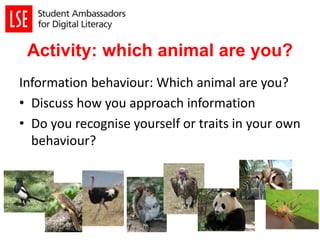
Activity: which animal are you?
Information behaviour: Which animal are you?
• Discuss how you approach information
• Do you recognise yourself or traits in your own
behaviour?
Today: managing and sharing
information
• Student Ambassador role discussion:
opportunity to raise questions.
• Keeping up to date
• Managing (organising information)
• Using (quoting, citing)
• And sharing (if you want!) …
Student Ambassador role
• What is a student ambassador for digital
literacy?
– Is the role clear to you?
– What support do you need?
– How can you support fellow students?
– How much time should it take?
– What might be the benefits and challenges?
– Are the workshops enough? The right content?
Activity: discussion
How do you…
• Get alerts for new information
• Manage or organise your information
• Store or archive your information
• Cite your information, create your bibliographies
Feedback to group?
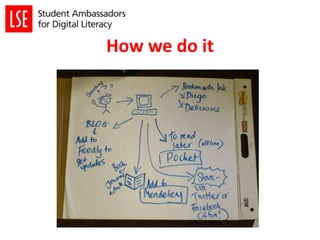
How we do it
Activity: Tools for managing
work/information
In your groups try out the app that you have been allocated
to see how you would use it to prepare a group presentation.
What activities might you need in order to prepare your group
presentation? Does it allow you to:
– Share content
– Store files
– Write collaboratively
– Manage/allocate tasks
What features do you like about the app?
What tasks does the app not allow you to do?
Consider the process – what do you need for the task?
Recommended tools
• Evernote
• Dropbox/ Google Drive
• Trello
• Wunderlist
• Mendeley
• RSS Feed readers, e.g. Feedly, NewsBlur,
Netvibes, Flipboard
Evernote
• You can incorporate images, audio, video and URLs to your notes to give notes
more context.
• You can create checklists to sort out your activities and priorities, making
Evernote useful for personal and academic use.
• Evernote automatically archives your notes and has a search function, making
it easier to search through your notes for key concepts than having to look
through notebooks.
• You can share notes via email, Twitter, messaging and even send important
emails to your Evernote account, so that you can search for them through
Evernote, rather than through constantly changing email accounts. You can
also add reminder notes through Evernote to remind you to take action for
certain emails.
• Access across platforms – you can use Evernote on laptops, smartphones and
tablets, and access notes you’ve made on any of these devices on all of them
by syncing your notes to your Evernote account.
Trello
• Trello is way of organising with boards, lists and cards.
• You can add comments, upload file attachments, create
checklists, add labels and due dates
• You can invite as many people to your board as you want
(for free) everyone sees the same board all at once
• You can drag and drop people to cards to divvy up tasks
• You can start a discussion with comments and
attachments – if you mention a member in a comment
they get notified
Wunderlist
• Good if you are list maker.
• Create and organise tasks in categories – home,
work, different projects
• Ability to share lists with others – good if
working in groups. Can assign tasks to others.
View shared tasks.
• Make notes about each tasks
• Attach files about a task – works with Dropbox
Dropbox and Google Drive
• Dropbox and Google Drive let you store and access your files
anywhere and whenever, from your computers, phones, or
tablets.
• They’re easy to set up and use.
• You can change a file on the web, on your computer, or on
your mobile device and it updates on every device where
you’ve installed Google Drive. In Dropbox you can also edit
documents, automatically add photos and show videos.
• You can share, collaborate, or work alone.
• You can store the first 15 GBs for free across Google Drive,
Gmail, and Google+ Photos. Dropbox offers 2 GBs of free
space with the potential to earn more.
Social Bookmarking
• You can access your weblinks from any computer – they
are stored online not on computer or in a browser
• You can organise your bookmarks using tags and they are
searchable - no folders where the weblinks get lost
• You can add notes to web pages you bookmark (these
appear on screen in Diigo)
• You can share some / all of your bookmarks
• You can see popular web links people are bookmarking
and through tagging see weblinks on topics that interest
you.
Mendeley
• Easy to set up and start using
• Access anywhere + desktop version on multiple
PCs/laptops and syncing simple
• Easy to add references + documents: pdfs /
journal resources/ form the web as you research
• Sharing readings between colleagues working
with you
• Inserting citations as you write
Flipboard/RSS
• RSS feed readers including Flipboard are easy to set up. It is then
very easy to add new feeds to the reader, particularly in the case
of Flipboard.
• The information comes to you rather than you having to check
lots of sites meaning that they are great for sites/information
that is updated often
• It is designed for use on tablets and phones and there is an app
available for iPad, iPhone, Android, Kindle Fire & NOOK.
• Flipboard (and some other RSS readers) have a great display and
are very attractive to read – like a magazine
• Good for reading on the go – can download some stories and
then read them wherever (e.g. on the tube)
..and finally, let’s find out how
much you know about academic
integrity!!
Is it plagiarism if you…
Copy a paragraph from a
text and put it in your
essay without putting it
in quotation marks and
referencing the source?
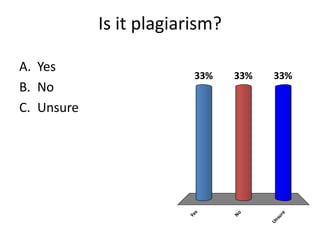
Is it plagiarism?
A. Yes
B. No
C. Unsure
Yes
No
Unsure
33% 33%33%
Is it plagiarism if you…
Copy a paragraph from a
text and put it in your
essay without putting it
in quotation marks and
referencing the source?
This is probably the most
well known example of
plagiarism. If you copy
exact words, you must
enclose them in
quotation marks and
acknowledge your
source in your
bibliography.
Is it plagiarism if you…
Include some paragraphs
from a previous submitted
essay that you have
written into the one you
are currently submitting?
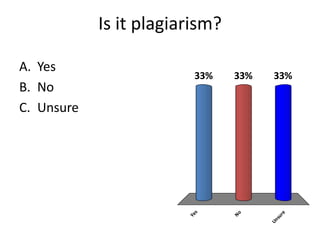
Is it plagiarism?
A. Yes
B. No
C. Unsure
Yes
No
Unsure
33% 33%33%
Is it plagiarism if you…
Include some paragraphs
from a previous submitted
essay that you have
written into the one you
are currently submitting?
There is such a thing as
self-plagiarism. Using your
previous work in your
current work is actually
plagiarism and is not
permitted.
Is it plagiarism if you…
Incorporate text from
another source,
changing one or two
words and providing a
citation?
Is it plagiarism?
A. Yes
B. No
C. Unsure
Yes
No
Unsure
33% 33%33%
Is it plagiarism if you…
Incorporate text from
another source,
changing one or two
words and providing a
citation?
If you do not intend to
quote directly from the
source, you must write
about it in your own
words. Using too many
words from the original
source is plagiarism,
even if you provide a
reference.
Is it plagiarism if you…
Copy a diagram or data
table from a website,
providing a reference for
the source underneath?
Is it plagiarism?
A. Yes
B. No
C. Unsure
Yes
No
Unsure
33% 33%33%
Is it plagiarism if you…
Copy a diagram or data
table from a website,
providing a reference for
the source underneath?
This isn’t plagiarism. You
can include tables,
diagrams or images from
another source as long as
you provide a reference.
Is it plagiarism if you…
Talk about the ideas of
another author, written in
your own words and
without referring to the
original author?
Adaptedfrom“Isitplagiarismquiz”(https://ilrb.cf.ac.uk/plagiarism)
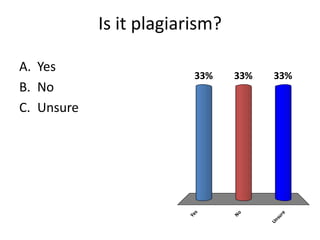
Is it plagiarism?
A. Yes
B. No
C. Unsure
Yes
No
Unsure
33% 33%33%
Is it plagiarism if you…
Talk about the ideas of
another author, written in
your own words and
without referring to the
original author?
Even if you haven’t
directly copied their
words, you must provide a
reference when talking
about their ideas.
Adaptedfrom“Isitplagiarismquiz”(https://ilrb.cf.ac.uk/plagiarism)
Plagiarism is….
• Cutting and pasting from other documents.
• Quoting without quotation marks or references.
• Paraphrasing without referencing.
• Summarising without referencing.
• Using an image, source and/or diagram without
referencing.
• Taking another student’s ideas and passing them off as
your own.
• Re-cycling your own work which has been submitted for
assessment elsewhere.
• Collaborating on what should be individual work.
• Translating a document from another language.
Academic writing is
about …
• Posing a question, dilemma, debate that has not been
posed in quite the same way before …
• Answering that question, with an answer that has not
been constructed in quite the same way before …
• Bringing together your ideas with those of others,
making connections between things that have not
been connected in quite that way before …
• Using the work/ideas of others is a crucial element,
but must be appropriately acknowledged.
LSE Teaching and Learning Centre
Why do we need to
cite?
 To acknowledge the work of other writers
 To demonstrate the body of knowledge on which you have based
your work
 To enable other researchers to trace your sources and lead them
on to further information
 A standard system of citing ensures an easier system of tracing
knowledge more efficiently
 If you cite correctly, you don’t need to worry about plagiarism
 You are upholding and contributing to academic standards and
integrity
Wrap up and feedback
• Workshop 4: Your digital identity - 17 February
2-3.30pm & 19 February 10 – 11.30am
• End of project event – Wed 11 March 3-5pm
– Group presentations for final event – your Senior
Ambassadors will contact you next week.
Acknowledgements
• All images are licensed under Creative Commons
from http://commons.wikimedia.org
• The animal typology based on work by Borg, M. &
Stretton, E. 2009. 'My students and other animals. Or
a vulture, an orb weaver spider, a giant panda and
900 undergraduate business students...' Journal of
Information Literacy. 3(1), pp. 19-30.
• Plagiarism quiz adapted from “Is it plagiarism quiz”
(https://ilrb.cf.ac.uk/plagiarism)

LSE SADL workshop 3 2015

  • 1.
    Workshop 3: Managing andsharing information
  • 2.
  • 3.
    Activity: which animalare you? Information behaviour: Which animal are you? • Discuss how you approach information • Do you recognise yourself or traits in your own behaviour?
  • 4.
    Today: managing andsharing information • Student Ambassador role discussion: opportunity to raise questions. • Keeping up to date • Managing (organising information) • Using (quoting, citing) • And sharing (if you want!) …
  • 5.
    Student Ambassador role •What is a student ambassador for digital literacy? – Is the role clear to you? – What support do you need? – How can you support fellow students? – How much time should it take? – What might be the benefits and challenges? – Are the workshops enough? The right content?
  • 6.
    Activity: discussion How doyou… • Get alerts for new information • Manage or organise your information • Store or archive your information • Cite your information, create your bibliographies
  • 7.
  • 8.
  • 9.
    Activity: Tools formanaging work/information In your groups try out the app that you have been allocated to see how you would use it to prepare a group presentation. What activities might you need in order to prepare your group presentation? Does it allow you to: – Share content – Store files – Write collaboratively – Manage/allocate tasks What features do you like about the app? What tasks does the app not allow you to do? Consider the process – what do you need for the task?
  • 10.
    Recommended tools • Evernote •Dropbox/ Google Drive • Trello • Wunderlist • Mendeley • RSS Feed readers, e.g. Feedly, NewsBlur, Netvibes, Flipboard
  • 11.
    Evernote • You canincorporate images, audio, video and URLs to your notes to give notes more context. • You can create checklists to sort out your activities and priorities, making Evernote useful for personal and academic use. • Evernote automatically archives your notes and has a search function, making it easier to search through your notes for key concepts than having to look through notebooks. • You can share notes via email, Twitter, messaging and even send important emails to your Evernote account, so that you can search for them through Evernote, rather than through constantly changing email accounts. You can also add reminder notes through Evernote to remind you to take action for certain emails. • Access across platforms – you can use Evernote on laptops, smartphones and tablets, and access notes you’ve made on any of these devices on all of them by syncing your notes to your Evernote account.
  • 12.
    Trello • Trello isway of organising with boards, lists and cards. • You can add comments, upload file attachments, create checklists, add labels and due dates • You can invite as many people to your board as you want (for free) everyone sees the same board all at once • You can drag and drop people to cards to divvy up tasks • You can start a discussion with comments and attachments – if you mention a member in a comment they get notified
  • 13.
    Wunderlist • Good ifyou are list maker. • Create and organise tasks in categories – home, work, different projects • Ability to share lists with others – good if working in groups. Can assign tasks to others. View shared tasks. • Make notes about each tasks • Attach files about a task – works with Dropbox
  • 14.
    Dropbox and GoogleDrive • Dropbox and Google Drive let you store and access your files anywhere and whenever, from your computers, phones, or tablets. • They’re easy to set up and use. • You can change a file on the web, on your computer, or on your mobile device and it updates on every device where you’ve installed Google Drive. In Dropbox you can also edit documents, automatically add photos and show videos. • You can share, collaborate, or work alone. • You can store the first 15 GBs for free across Google Drive, Gmail, and Google+ Photos. Dropbox offers 2 GBs of free space with the potential to earn more.
  • 15.
    Social Bookmarking • Youcan access your weblinks from any computer – they are stored online not on computer or in a browser • You can organise your bookmarks using tags and they are searchable - no folders where the weblinks get lost • You can add notes to web pages you bookmark (these appear on screen in Diigo) • You can share some / all of your bookmarks • You can see popular web links people are bookmarking and through tagging see weblinks on topics that interest you.
  • 16.
    Mendeley • Easy toset up and start using • Access anywhere + desktop version on multiple PCs/laptops and syncing simple • Easy to add references + documents: pdfs / journal resources/ form the web as you research • Sharing readings between colleagues working with you • Inserting citations as you write
  • 17.
    Flipboard/RSS • RSS feedreaders including Flipboard are easy to set up. It is then very easy to add new feeds to the reader, particularly in the case of Flipboard. • The information comes to you rather than you having to check lots of sites meaning that they are great for sites/information that is updated often • It is designed for use on tablets and phones and there is an app available for iPad, iPhone, Android, Kindle Fire & NOOK. • Flipboard (and some other RSS readers) have a great display and are very attractive to read – like a magazine • Good for reading on the go – can download some stories and then read them wherever (e.g. on the tube)
  • 18.
    ..and finally, let’sfind out how much you know about academic integrity!!
  • 19.
    Is it plagiarismif you… Copy a paragraph from a text and put it in your essay without putting it in quotation marks and referencing the source?
  • 20.
    Is it plagiarism? A.Yes B. No C. Unsure Yes No Unsure 33% 33%33%
  • 21.
    Is it plagiarismif you… Copy a paragraph from a text and put it in your essay without putting it in quotation marks and referencing the source? This is probably the most well known example of plagiarism. If you copy exact words, you must enclose them in quotation marks and acknowledge your source in your bibliography.
  • 22.
    Is it plagiarismif you… Include some paragraphs from a previous submitted essay that you have written into the one you are currently submitting?
  • 23.
    Is it plagiarism? A.Yes B. No C. Unsure Yes No Unsure 33% 33%33%
  • 24.
    Is it plagiarismif you… Include some paragraphs from a previous submitted essay that you have written into the one you are currently submitting? There is such a thing as self-plagiarism. Using your previous work in your current work is actually plagiarism and is not permitted.
  • 25.
    Is it plagiarismif you… Incorporate text from another source, changing one or two words and providing a citation?
  • 26.
    Is it plagiarism? A.Yes B. No C. Unsure Yes No Unsure 33% 33%33%
  • 27.
    Is it plagiarismif you… Incorporate text from another source, changing one or two words and providing a citation? If you do not intend to quote directly from the source, you must write about it in your own words. Using too many words from the original source is plagiarism, even if you provide a reference.
  • 28.
    Is it plagiarismif you… Copy a diagram or data table from a website, providing a reference for the source underneath?
  • 29.
    Is it plagiarism? A.Yes B. No C. Unsure Yes No Unsure 33% 33%33%
  • 30.
    Is it plagiarismif you… Copy a diagram or data table from a website, providing a reference for the source underneath? This isn’t plagiarism. You can include tables, diagrams or images from another source as long as you provide a reference.
  • 31.
    Is it plagiarismif you… Talk about the ideas of another author, written in your own words and without referring to the original author? Adaptedfrom“Isitplagiarismquiz”(https://ilrb.cf.ac.uk/plagiarism)
  • 32.
    Is it plagiarism? A.Yes B. No C. Unsure Yes No Unsure 33% 33%33%
  • 33.
    Is it plagiarismif you… Talk about the ideas of another author, written in your own words and without referring to the original author? Even if you haven’t directly copied their words, you must provide a reference when talking about their ideas. Adaptedfrom“Isitplagiarismquiz”(https://ilrb.cf.ac.uk/plagiarism)
  • 34.
    Plagiarism is…. • Cuttingand pasting from other documents. • Quoting without quotation marks or references. • Paraphrasing without referencing. • Summarising without referencing. • Using an image, source and/or diagram without referencing. • Taking another student’s ideas and passing them off as your own. • Re-cycling your own work which has been submitted for assessment elsewhere. • Collaborating on what should be individual work. • Translating a document from another language.
  • 35.
    Academic writing is about… • Posing a question, dilemma, debate that has not been posed in quite the same way before … • Answering that question, with an answer that has not been constructed in quite the same way before … • Bringing together your ideas with those of others, making connections between things that have not been connected in quite that way before … • Using the work/ideas of others is a crucial element, but must be appropriately acknowledged. LSE Teaching and Learning Centre
  • 36.
    Why do weneed to cite?  To acknowledge the work of other writers  To demonstrate the body of knowledge on which you have based your work  To enable other researchers to trace your sources and lead them on to further information  A standard system of citing ensures an easier system of tracing knowledge more efficiently  If you cite correctly, you don’t need to worry about plagiarism  You are upholding and contributing to academic standards and integrity
  • 37.
    Wrap up andfeedback • Workshop 4: Your digital identity - 17 February 2-3.30pm & 19 February 10 – 11.30am • End of project event – Wed 11 March 3-5pm – Group presentations for final event – your Senior Ambassadors will contact you next week.
  • 38.
    Acknowledgements • All imagesare licensed under Creative Commons from http://commons.wikimedia.org • The animal typology based on work by Borg, M. & Stretton, E. 2009. 'My students and other animals. Or a vulture, an orb weaver spider, a giant panda and 900 undergraduate business students...' Journal of Information Literacy. 3(1), pp. 19-30. • Plagiarism quiz adapted from “Is it plagiarism quiz” (https://ilrb.cf.ac.uk/plagiarism)