Lüscher Color Test
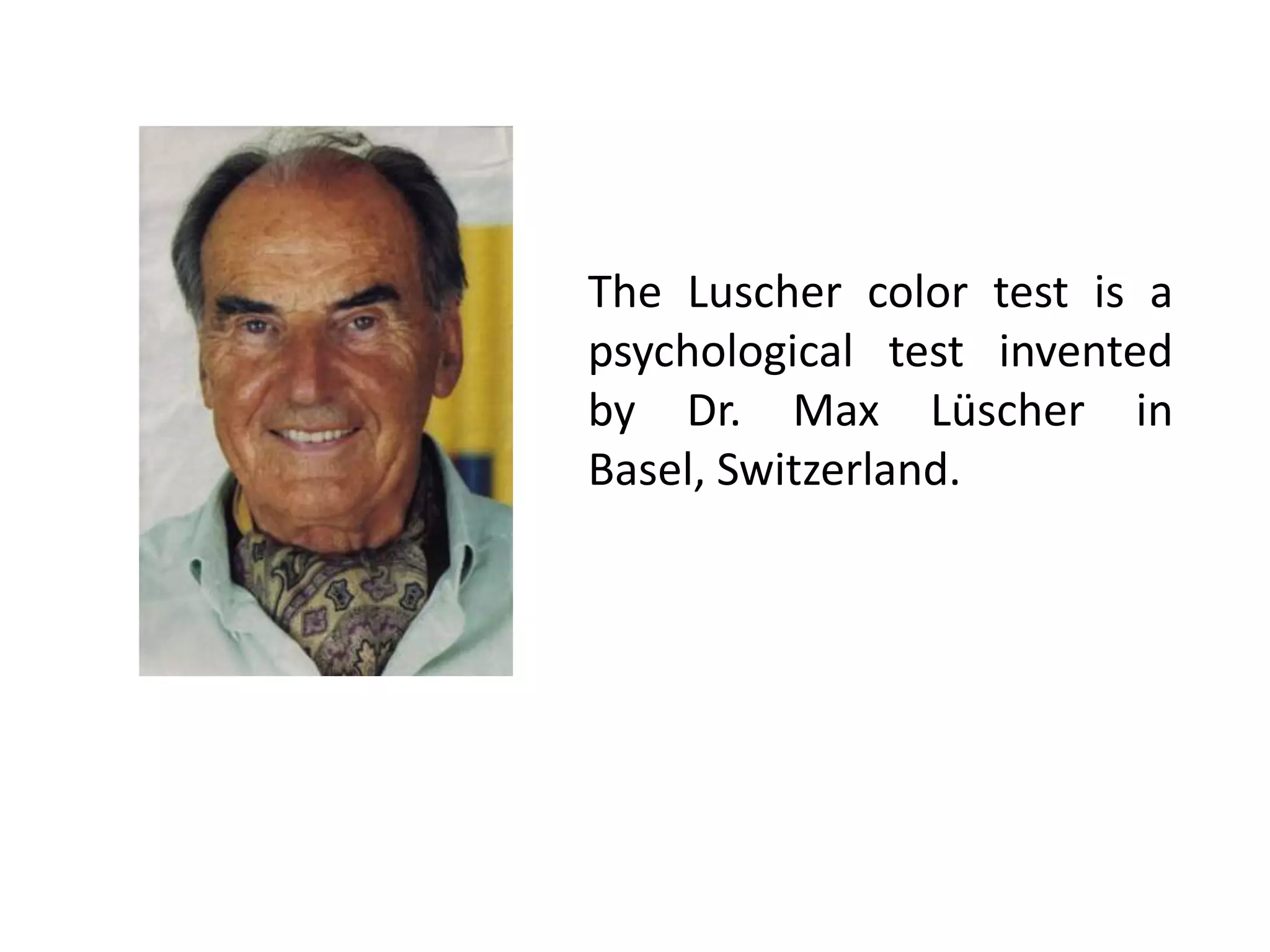
The Luscher color test is a
psychological test invented
by Dr. Max Lüscher in Basel,
Switzerland.
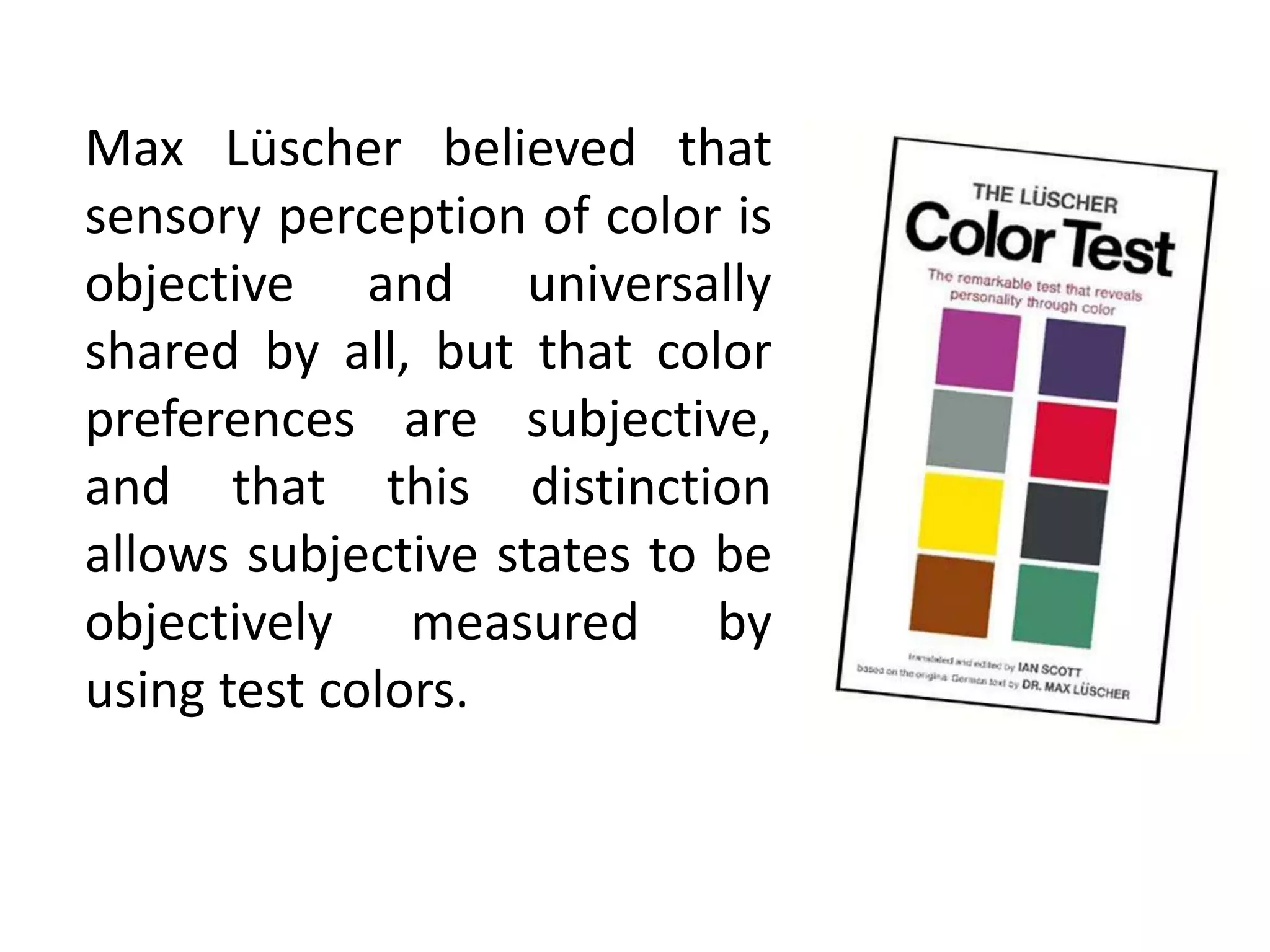
Max Lüscher believed that
sensory perception of color is
objective and universally
shared by all, but that color
preferences are subjective,
and that this distinction
allows subjective states to be
objectively measured by
using test colors.
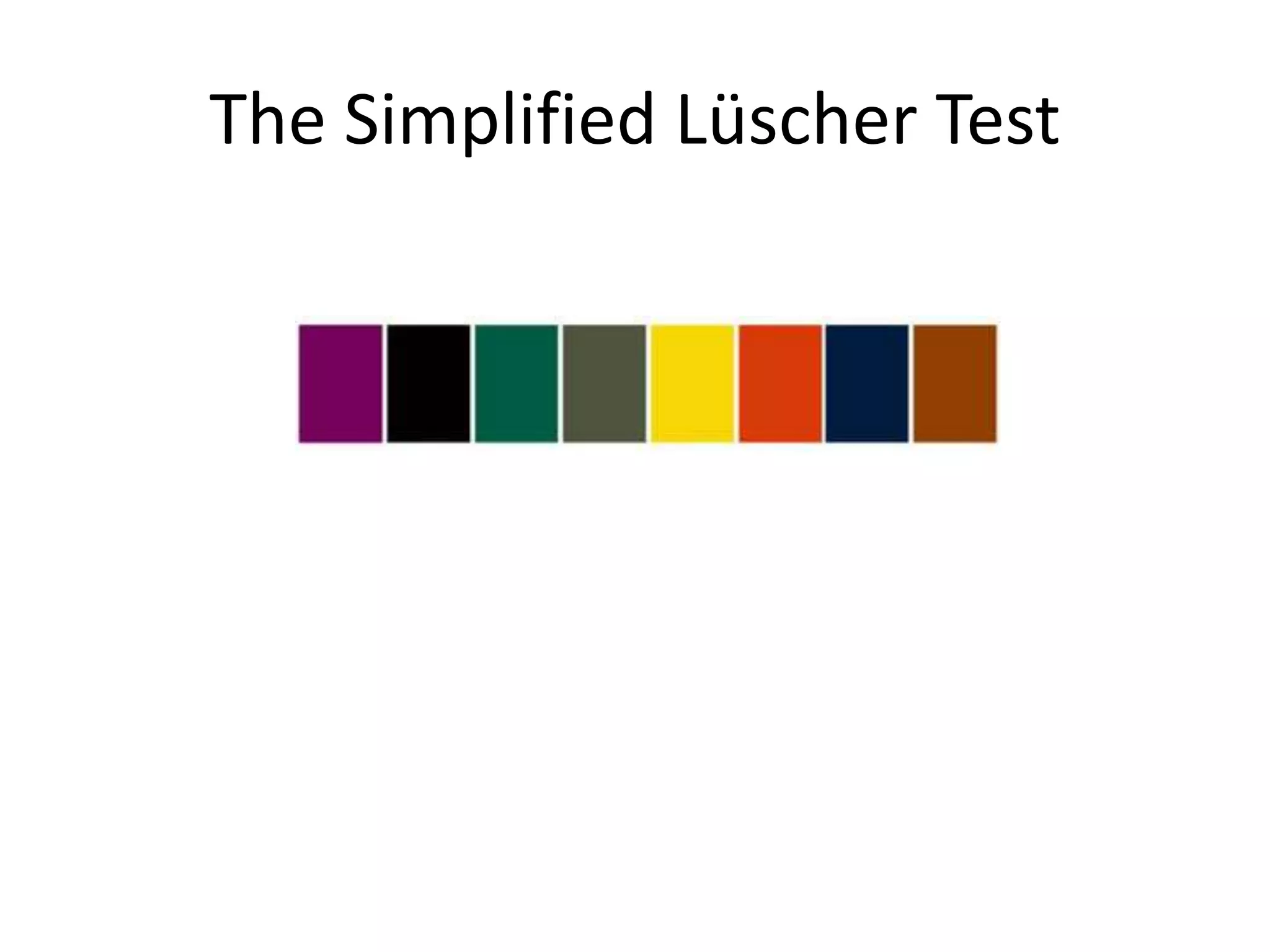
The Simplified Lüscher Test
THE TEST
After subjects placed the cards in
order from most liked to least liked,
they were asked to evaluate the extent
to which their personalities matched
the descriptive statements formed by
Lüscher of each color.
1st Position
This is the most-liked color;
it is your personal brand. It shows
the essential method of the person
choosing it, the means which he
adopts to achieve his objective.
2nd Position
This also shows an important subject,
commonly representing what the
person really is, even when
he/she are not aware of it.
3rd and 4th Position
These two show the “actual state of
affairs”, the situation in which he
actually feels himself to be, or the
manner in which his existing
circumstances require him to act.
5th and 6th Position
Being the 'indifference' color choices,
these show that their characteristics
are not being rejected, but simply set
aside and not currently in use; they
could be brought into use at
any time if need to be.
7th and 8th Position
These colors represent a “turning
away from”. These are the colors that
are most disliked and "represent a
need which is suppressed out of
necessity“.
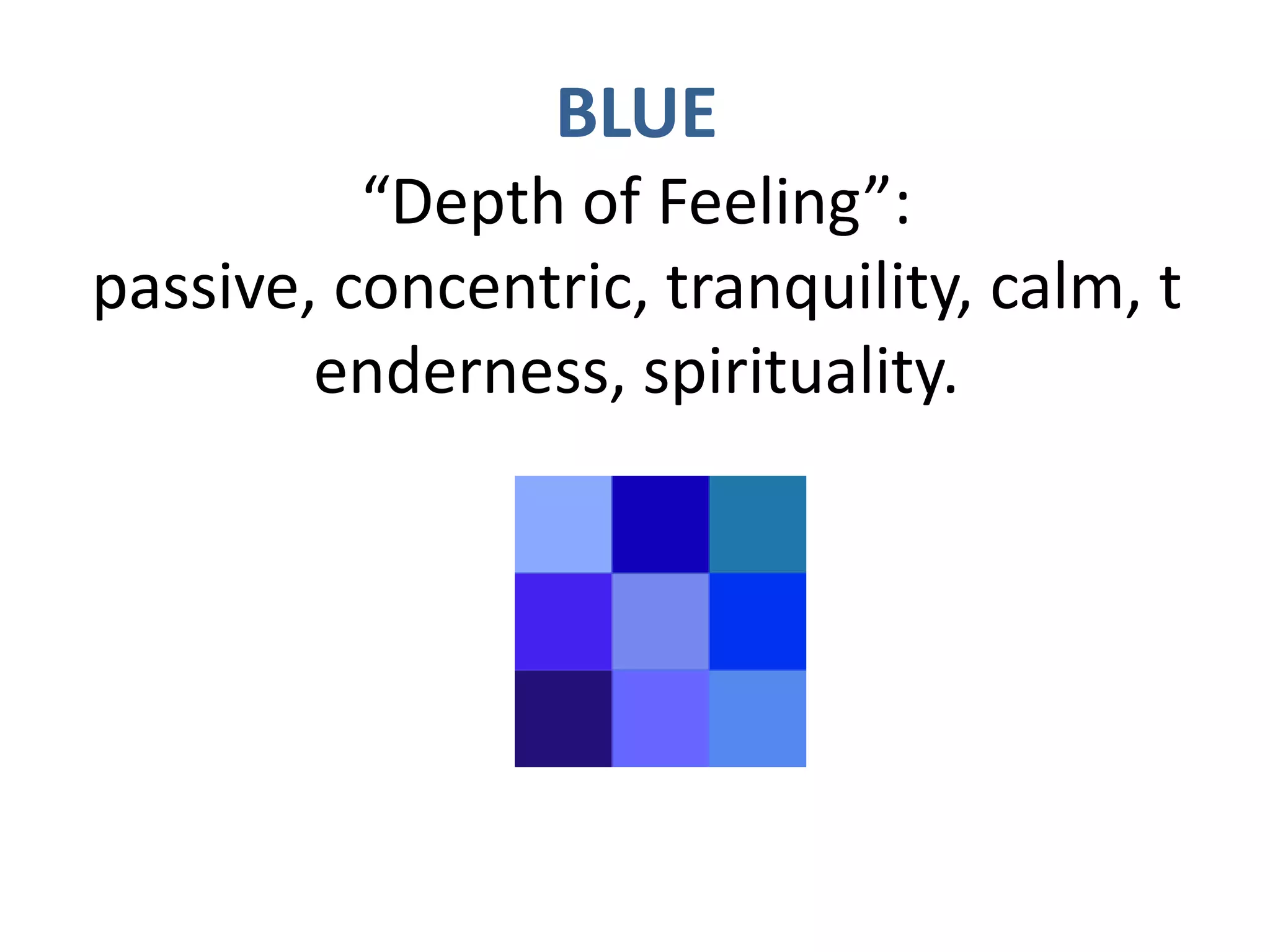
BLUE
Communication: Blue relates to one-to-one verbal
communication and self expression.
Peace and calm: The color blue induces calm and peace
within us, particularly the deeper shades.
Honesty: Blue is the colour of truth.
Spirituality: Blue is the colour of devotion and religious
study.
Wisdom: Blue enhances the wisdom of the intellect.
BLUE
In our language, blue has meanings of both good and bad.
Blue blood refers to being part of a special lineage. Blue
ribbons are the standard for achieving the first prize on a
competition. A true blue friend is a description of a very
loyal person. But on the negative side, feeling blue usually
means we are sad and blue movies is an expression for
pornography.
BLUE
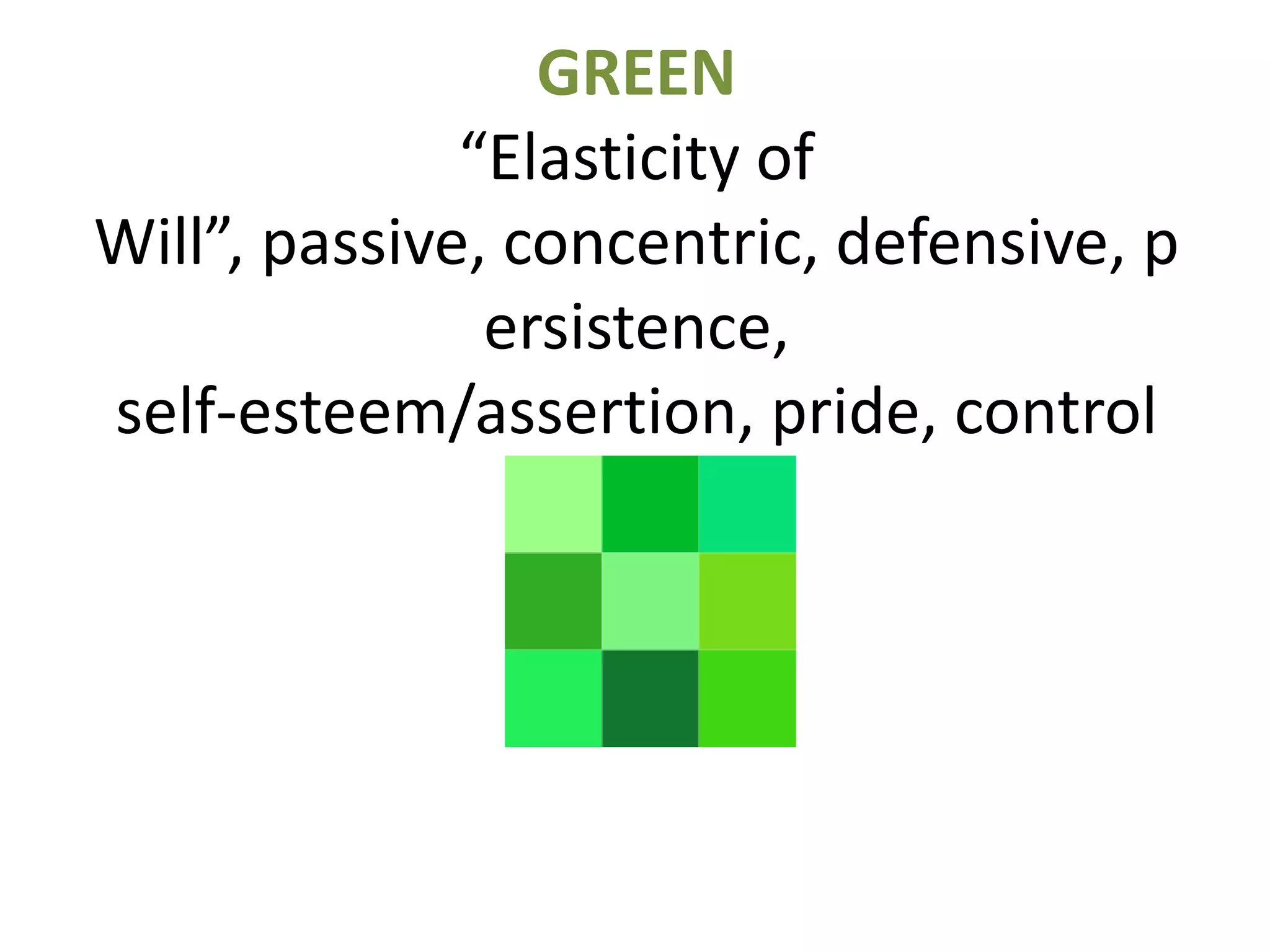
GREEN
Harmony and balance: Green is the great balancer of
our mental, emotional and physical energies which is
why there is so much green on our planet.
Healing: Green is the heart centre of the body.
Growth: As in nature, green leaves are an indication the
plant is still growing.
Hope: Green is the anticipation of things to come.
GREEN
Green is believed to be the most relaxing color and also
the color most responsible for healing, commonly used in
hospitals. On the negative side, green is associated with
mold and decay. Being "green with envy" describes the
belief that envious emotions can cause one to be
destroyed from the inside by harboring such feelings.
GREEN
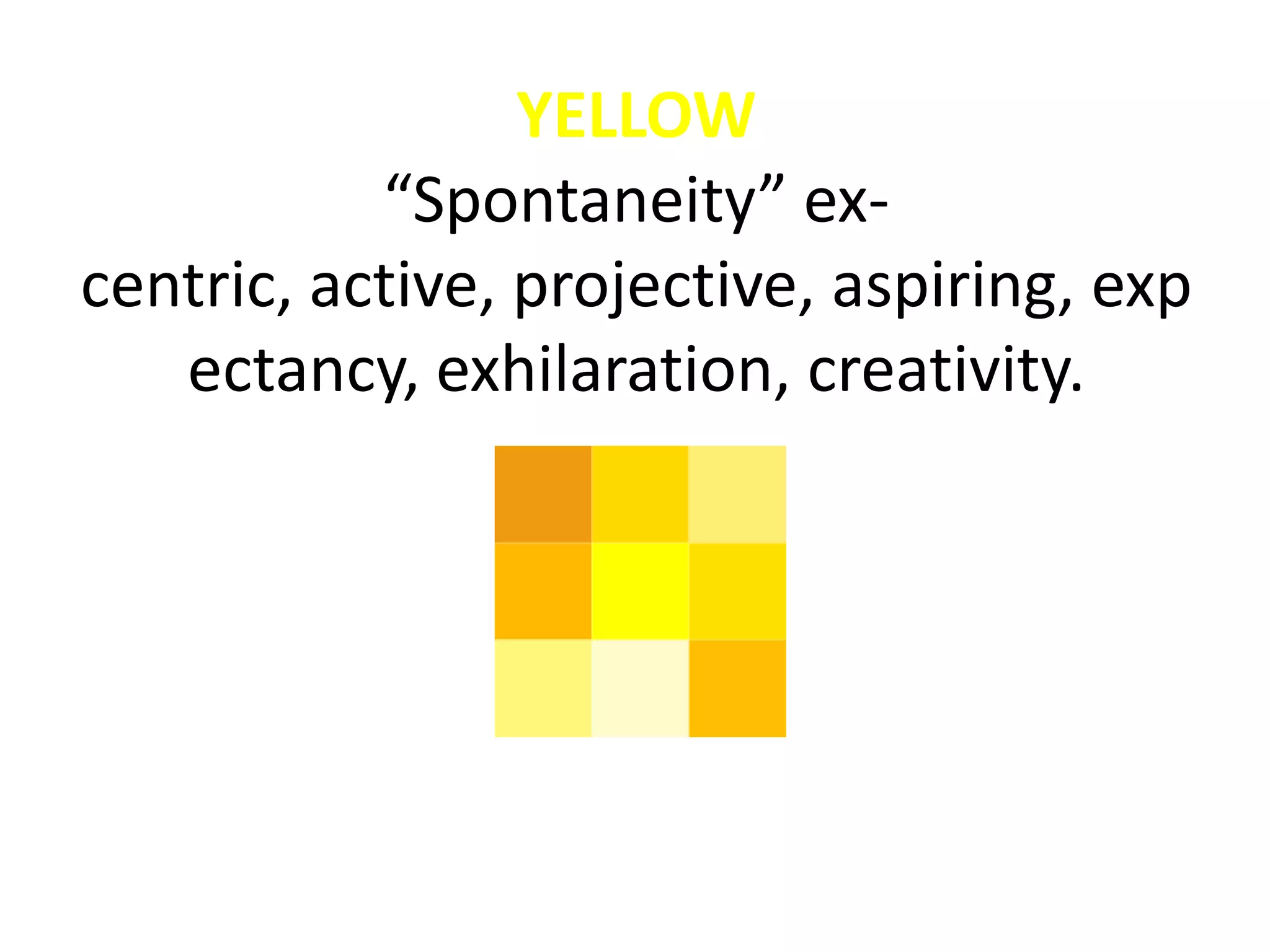
YELLOW
.
Mind and intellect: From a color psychology
perspective, yellow stimulates our mental faculties; it
activates the left or analytical brain.
Happiness and fun: Yellow is uplifting to the spirits;
yellow helps create enthusiasm for life and can awaken
greater confidence and optimism.
Communication of New Ideas: Yellow is related to the
expression and integration of new ideas and thoughts.
.
YELLOW
Yellow is the most highly visible of all colors which is
why it is used for pedestrian crossings. In our language,
yellow is related to be coward as in the expressions
yellow-bellied or yellow streak. And yellow journalism,
based on an early comic strip character named the
Yellow Kid, is that which is sensational and/or biased.
YELLOW
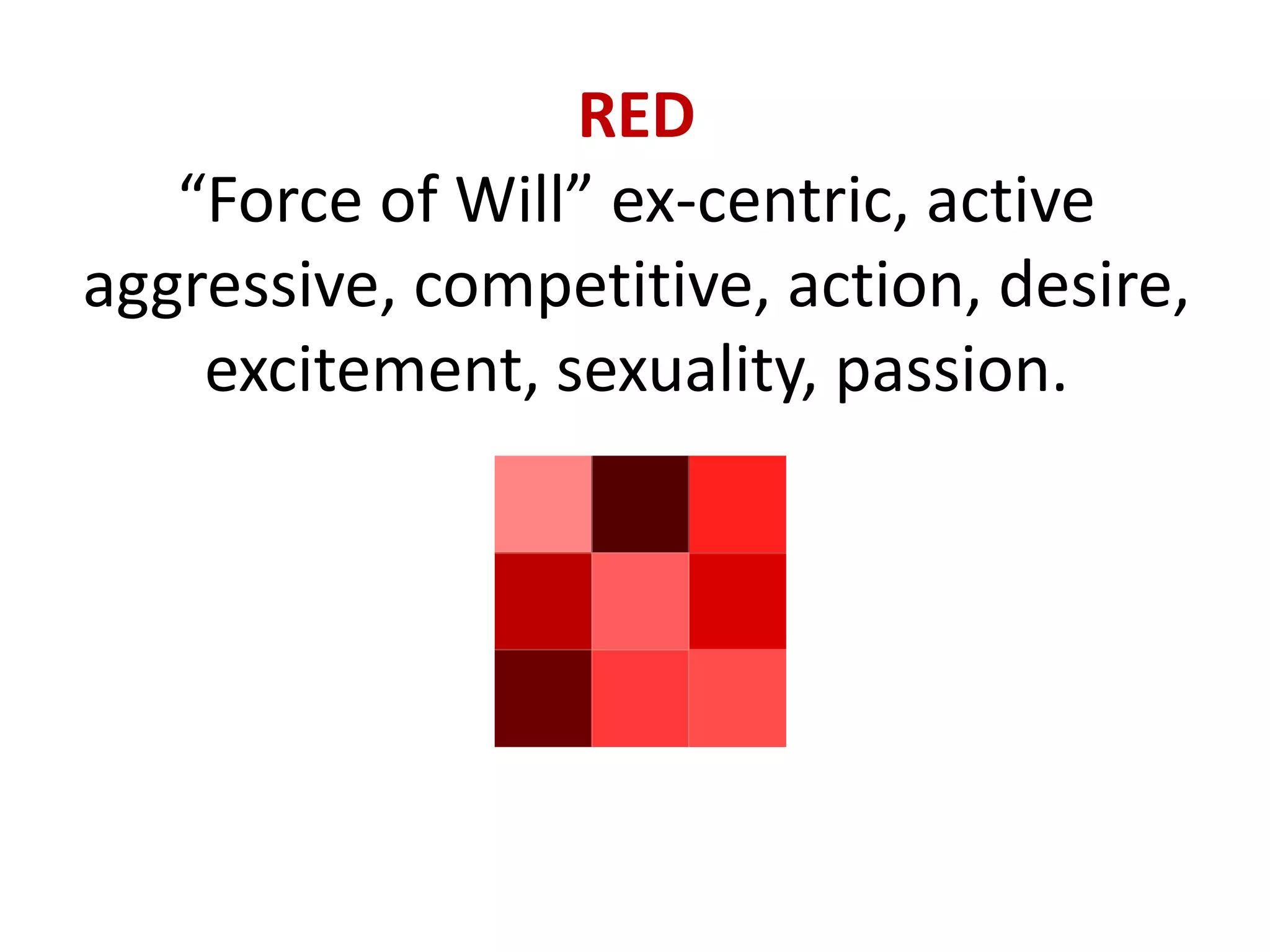
RED
Energy: it boosts our physical energy levels, increases our
heart rate and blood pressure and prompts the release of
adrenalin.
Action: it is fast moving and promotes a need for action
and movement.
Desire: it relates to physical desire in all its forms- sexual,
appetite, cravings.
Passion: it means a passionate belief in an issue or
undertaking, including passionate love or passionate hate.
Anger is negative passion.
RED
If we are angry we see red; if we are in financial danger
(debt) we are in the red; if we are caught doing something
bad we say we have been caught red handed; prostitutes
typically inhabit a red light zone. But red can also signify
status and dignitaries are welcomed with a red carpet.
RED
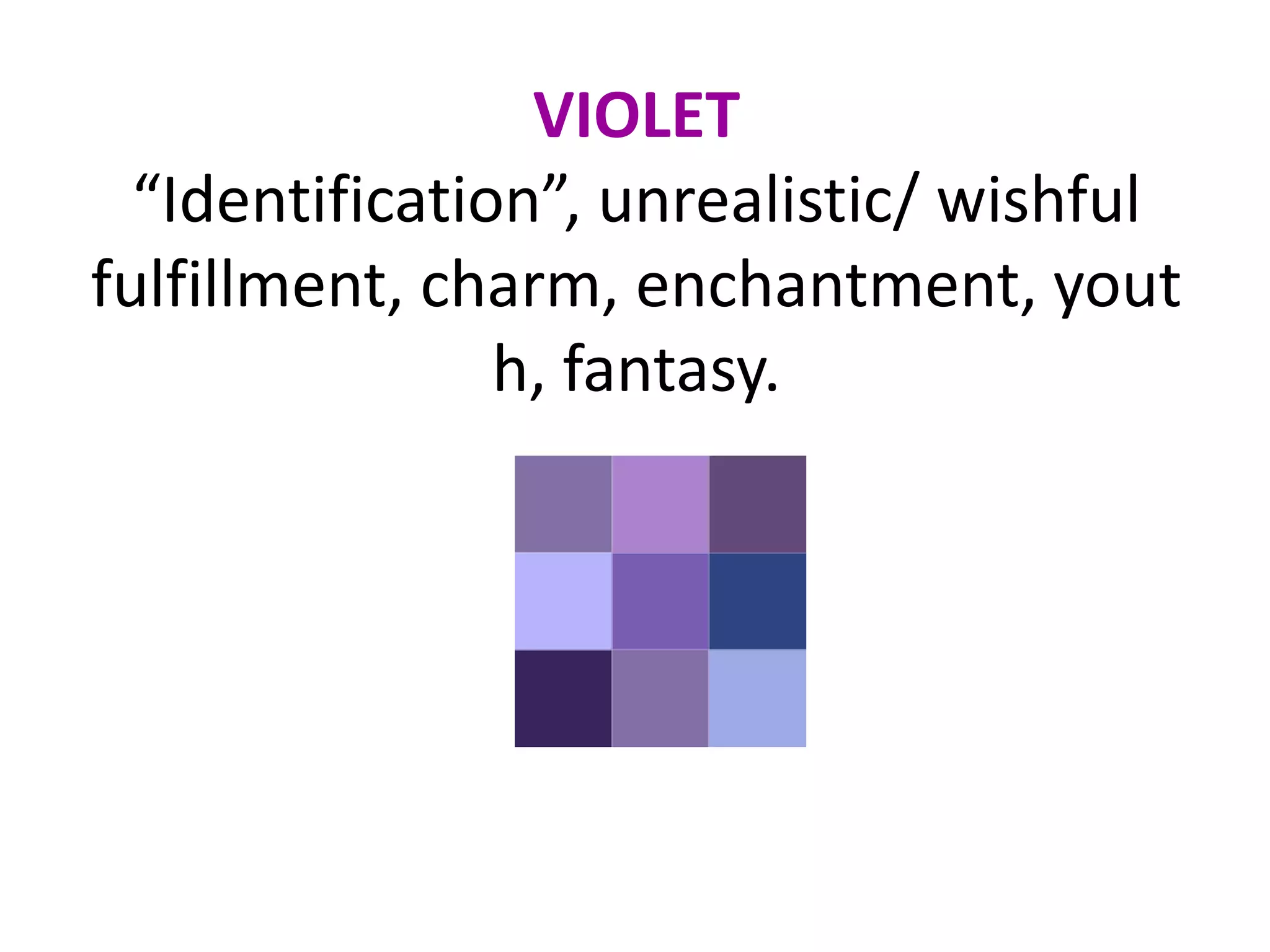
VIOLET
Inspiration: Original and sound ideas are created with
violet - use it when looking for inspiration during
brainstorming sessions.
Imagination: Violet inspires creativity with intellect - it
is also stimulating to dream activity.
Individuality: Violet is unconventional, individual and
original. It hates to copy anyone else and likes to do its
own thing.
Transcendence: Violet assists us during prayer and
meditation, helping us to get in touch with our deeper
subconscious thoughts.
VIOLET
In our language, shrinking violet is a very shy person.
The color purple, because materials for dying fabric in
that color were rare and therefore expensive, was
reserved for royalty or the wealthy in western cultures
and still has an association with nobility. This
association resulted in another idiom, “born to the
purple,” meaning “someone born to royalty during their
reign” and, by extension, referring to children of
prominent people.
VIOLET
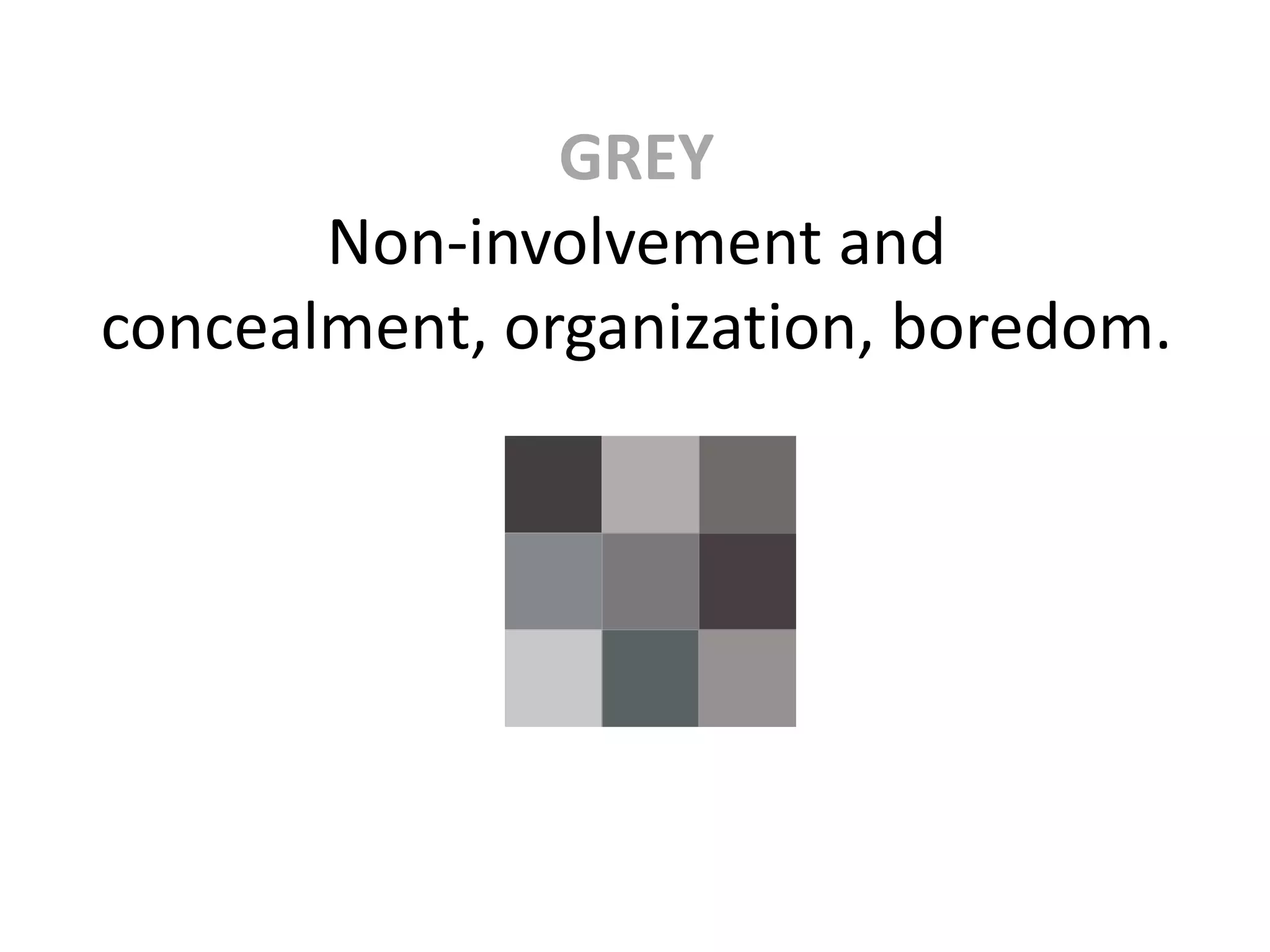
GRAY
Neutrality: gray is impartial and dispassionate, it
doesn't take sides.
Compromise: it is the transition between two non-
colors, neither black nor white. It takes the middle
ground, neither one way nor the other.
Control: gray is reserved, quiet and conservative. It has
a steadying effect on other colors around it.
GRAY
Most people are indifferent to gray- it relates to the
corporate worker in the gray suit - conservative,
reliable, formal and independent and maybe boring.
In language, a gray area (or grey area) is something
without a clear rule or answer. Gray matter refers to our
brains or to our intelligence.
GRAY
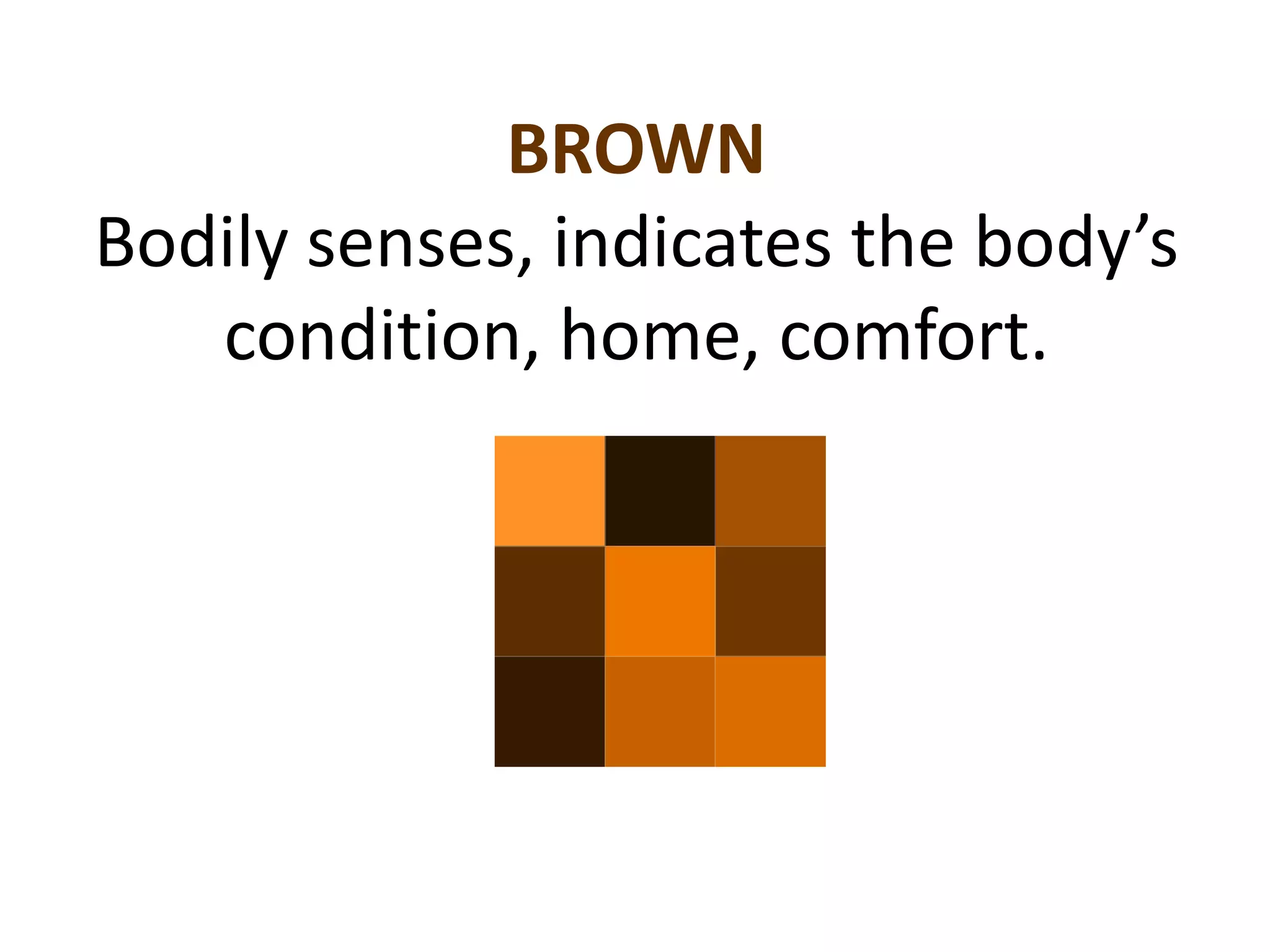
BROWN
Stability: Reassuring and comforting, earthy and
contained.
Structure: It encourages orderliness and organization.
Security: Safe and protective - a refuge from the chaos
of the outside world and a sense of belonging.
Natural and wholesome: related to the earth, nutrition,
health and goodness.
BROWN
Brown-nose means to try too hard to please
someone, especially someone in a position of
authority, in a way that other people find
unpleasant. Brown power is an expression
associated with energy
that is derived from traditional, non-
renewable resources, such as coal, oil, and gas, whi
ch are seen by many asenvironmentally unfriendly
BROWN
BLACK
Mystery: Black is the unknown. It is secretive, keeping a
lot buried inside, unwilling to show its real feelings.
Power and Control: Black is power and control of the
self and others. It creates fear and intimidation.
Intimidation: It can be unfriendly and unapproachable
because of the power it exudes.
BLACK
To be in a black mood means to be irritable, angry or
even depressed. If you black out, you lose
consciousness. To say that a person or organization is in
the black means that they have a positive balance on
their account and that they owe no money. To give
someone a black look means to look at someone in a
disapproving way.
BLACK
REFERENCES
http://www.empower-yourself-with-color-psychology.com/color-purple.html
http://www.luscher-color.com
http://www.dandebat.dk/eng-person7.htm

Lüscher color test

  • 1.
  • 2.
    The Luscher colortest is a psychological test invented by Dr. Max Lüscher in Basel, Switzerland.
  • 3.
    Max Lüscher believedthat sensory perception of color is objective and universally shared by all, but that color preferences are subjective, and that this distinction allows subjective states to be objectively measured by using test colors.
  • 4.
  • 5.
    THE TEST After subjectsplaced the cards in order from most liked to least liked, they were asked to evaluate the extent to which their personalities matched the descriptive statements formed by Lüscher of each color.
  • 6.
    1st Position This isthe most-liked color; it is your personal brand. It shows the essential method of the person choosing it, the means which he adopts to achieve his objective.
  • 7.
    2nd Position This alsoshows an important subject, commonly representing what the person really is, even when he/she are not aware of it.
  • 8.
    3rd and 4thPosition These two show the “actual state of affairs”, the situation in which he actually feels himself to be, or the manner in which his existing circumstances require him to act.
  • 9.
    5th and 6thPosition Being the 'indifference' color choices, these show that their characteristics are not being rejected, but simply set aside and not currently in use; they could be brought into use at any time if need to be.
  • 10.
    7th and 8thPosition These colors represent a “turning away from”. These are the colors that are most disliked and "represent a need which is suppressed out of necessity“.
  • 11.
  • 12.
    Communication: Blue relatesto one-to-one verbal communication and self expression. Peace and calm: The color blue induces calm and peace within us, particularly the deeper shades. Honesty: Blue is the colour of truth. Spirituality: Blue is the colour of devotion and religious study. Wisdom: Blue enhances the wisdom of the intellect. BLUE
  • 13.
    In our language,blue has meanings of both good and bad. Blue blood refers to being part of a special lineage. Blue ribbons are the standard for achieving the first prize on a competition. A true blue friend is a description of a very loyal person. But on the negative side, feeling blue usually means we are sad and blue movies is an expression for pornography. BLUE
  • 14.
  • 15.
    Harmony and balance:Green is the great balancer of our mental, emotional and physical energies which is why there is so much green on our planet. Healing: Green is the heart centre of the body. Growth: As in nature, green leaves are an indication the plant is still growing. Hope: Green is the anticipation of things to come. GREEN
  • 16.
    Green is believedto be the most relaxing color and also the color most responsible for healing, commonly used in hospitals. On the negative side, green is associated with mold and decay. Being "green with envy" describes the belief that envious emotions can cause one to be destroyed from the inside by harboring such feelings. GREEN
  • 17.
  • 18.
    Mind and intellect:From a color psychology perspective, yellow stimulates our mental faculties; it activates the left or analytical brain. Happiness and fun: Yellow is uplifting to the spirits; yellow helps create enthusiasm for life and can awaken greater confidence and optimism. Communication of New Ideas: Yellow is related to the expression and integration of new ideas and thoughts. . YELLOW
  • 19.
    Yellow is themost highly visible of all colors which is why it is used for pedestrian crossings. In our language, yellow is related to be coward as in the expressions yellow-bellied or yellow streak. And yellow journalism, based on an early comic strip character named the Yellow Kid, is that which is sensational and/or biased. YELLOW
  • 20.
  • 21.
    Energy: it boostsour physical energy levels, increases our heart rate and blood pressure and prompts the release of adrenalin. Action: it is fast moving and promotes a need for action and movement. Desire: it relates to physical desire in all its forms- sexual, appetite, cravings. Passion: it means a passionate belief in an issue or undertaking, including passionate love or passionate hate. Anger is negative passion. RED
  • 22.
    If we areangry we see red; if we are in financial danger (debt) we are in the red; if we are caught doing something bad we say we have been caught red handed; prostitutes typically inhabit a red light zone. But red can also signify status and dignitaries are welcomed with a red carpet. RED
  • 23.
  • 24.
    Inspiration: Original andsound ideas are created with violet - use it when looking for inspiration during brainstorming sessions. Imagination: Violet inspires creativity with intellect - it is also stimulating to dream activity. Individuality: Violet is unconventional, individual and original. It hates to copy anyone else and likes to do its own thing. Transcendence: Violet assists us during prayer and meditation, helping us to get in touch with our deeper subconscious thoughts. VIOLET
  • 25.
    In our language,shrinking violet is a very shy person. The color purple, because materials for dying fabric in that color were rare and therefore expensive, was reserved for royalty or the wealthy in western cultures and still has an association with nobility. This association resulted in another idiom, “born to the purple,” meaning “someone born to royalty during their reign” and, by extension, referring to children of prominent people. VIOLET
  • 26.
  • 27.
    Neutrality: gray isimpartial and dispassionate, it doesn't take sides. Compromise: it is the transition between two non- colors, neither black nor white. It takes the middle ground, neither one way nor the other. Control: gray is reserved, quiet and conservative. It has a steadying effect on other colors around it. GRAY
  • 28.
    Most people areindifferent to gray- it relates to the corporate worker in the gray suit - conservative, reliable, formal and independent and maybe boring. In language, a gray area (or grey area) is something without a clear rule or answer. Gray matter refers to our brains or to our intelligence. GRAY
  • 29.
  • 30.
    Stability: Reassuring andcomforting, earthy and contained. Structure: It encourages orderliness and organization. Security: Safe and protective - a refuge from the chaos of the outside world and a sense of belonging. Natural and wholesome: related to the earth, nutrition, health and goodness. BROWN
  • 31.
    Brown-nose means totry too hard to please someone, especially someone in a position of authority, in a way that other people find unpleasant. Brown power is an expression associated with energy that is derived from traditional, non- renewable resources, such as coal, oil, and gas, whi ch are seen by many asenvironmentally unfriendly BROWN
  • 32.
  • 33.
    Mystery: Black isthe unknown. It is secretive, keeping a lot buried inside, unwilling to show its real feelings. Power and Control: Black is power and control of the self and others. It creates fear and intimidation. Intimidation: It can be unfriendly and unapproachable because of the power it exudes. BLACK
  • 34.
    To be ina black mood means to be irritable, angry or even depressed. If you black out, you lose consciousness. To say that a person or organization is in the black means that they have a positive balance on their account and that they owe no money. To give someone a black look means to look at someone in a disapproving way. BLACK
  • 35.