1 | P a g e Esolnet Hellas
B2 Grammar Syllabus
and Exercises
Revised
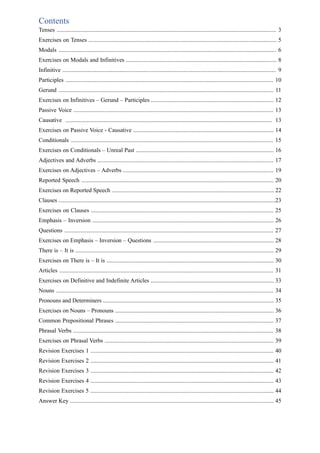
Contents
Tenses ..................................................................................................................................................... 3
Exercises on Tenses ................................................................................................................................ 5
Modals .................................................................................................................................................... 6
Exercises on Modals and Infinitives ....................................................................................................... 8
Infinitive .................................................................................................................................................. 9
Participles .............................................................................................................................................. 10
Gerund .................................................................................................................................................. 11
Exercises on Infinitives – Gerund – Participles .................................................................................... 12
Passive Voice ........................................................................................................................................ 13
Causative .............................................................................................................................................. 13
Exercises on Passive Voice - Causative ................................................................................................ 14
Conditionals .......................................................................................................................................... 15
Exercises on Conditionals – Unreal Past .............................................................................................. 16
Adjectives and Adverbs ........................................................................................................................ 17
Exercises on Adjectives – Adverbs ....................................................................................................... 19
Reported Speech ................................................................................................................................... 20
Exercises on Reported Speech ............................................................................................................... 22
Clauses ....................................................................................................................................................23
Exercises on Clauses ............................................................................................................................. 25
Emphasis – Inversion ............................................................................................................................ 26
Questions .............................................................................................................................................. 27
Exercises on Emphasis – Inversion – Questions ................................................................................... 28
There is – It is ....................................................................................................................................... 29
Exercises on There is – It is .................................................................................................................. 30
Articles .................................................................................................................................................. 31
Exercises on Definitive and Indefinite Articles .................................................................................... 33
Nouns .................................................................................................................................................... 34
Pronouns and Determiners ..................................................................................................................... 35
Exercises on Nouns – Pronouns ............................................................................................................. 36
Common Prepositional Phrases ............................................................................................................ 37
Phrasal Verbs ........................................................................................................................................ 38
Exercises on Phrasal Verbs .................................................................................................................... 39
Revision Exercises 1 ............................................................................................................................. 40
Revision Exercises 2 ............................................................................................................................. 41
Revision Exercises 3 ............................................................................................................................. 42
Revision Exercises 4 ............................................................................................................................. 43
Revision Exercises 5 ............................................................................................................................. 44
Answer Key .......................................................................................................................................... 45
Grammar Syllabus and Exercises B2
3 | P a g e Esolnet Hellas
TENSES
Simple Present
They always watch a film.
He works as a teacher.
The sun rises in the east.
If I see him, I will tell him.
In case more guests come, I will cook more.
When he finishes work, he will go out.
The bus leaves at 10 tomorrow.
Present Continuous
They are taking a test now.
They are flying tomorrow.
He is working hard these days.
He is getting taller and taller.
Simple Past
He called me yesterday/two days ago etc.
She cooked, cleaned the house and washed the
dishes.
How long ago did he leave?
They always went out on Saturday night.
It is time he left.
I wish I had more free time.
If he had more money, he’d buy a car.
He has been here since he graduated.
While he was watching TV, the phone rang.
He told me that he worked as a teacher.
As soon as he came in, I told him the news.
Used to do
She used to go the gym, but now she prefers to
go jogging.
be used to doing
I was used to waking up early.
Past Continuous
She was working when I called.
He was working while she was having fun.
They were studying from 4 till 6 yesterday.
He was having dinner at 8 o’clock yesterday.
She was getting better and better.
Was going to do
I was going to drive to the town.
Present Perfect
He has disappeared.
He has already / just left.
She has always/never wanted a bicycle.
Has she ever visited Paris?
He has done two exercises so far/up to now.
He has been here since 2010.
He has been here since he graduated.
She has worked in London for ten years.
It is/has been ten years since I (last) saw him.
How long is it/has it been since he left?
How long has he studied English?
I have seen him recently/lately.
She has called him several times this week.
This is the first time he has (ever) travelled.
This is the best film he has (ever) seen.
He has never seen such a good film before.
He hasn’t finished his work yet.
Have you cooked yet?
He still hasn’t done his homework.
I have been to Italy before.
I have been in Italy for ten years.
He has gone to Italy.
Present Perfect Continuous
He has been talking on the phone for 3 hours.
She has been living in London since 2010.
She has been living in London since she
finished college.
He looks tired. He has been working hard.
How long have you been reading this book?
Simple Future
I think/believe/assume/expect/doubt/ hope that
he will find a job.
One day, she will travel to Africa.
I’m sure that she will pass.
It is likely/possible that she will retire.
Maybe/Perhaps, she will be on time.
When she grows up, she will become a doctor.
Grammar Syllabus and Exercises B2
4 | P a g e Esolnet Hellas
In case more people come, I will cook more.
If she studies a lot, she will pass.
“There’s no bread.” “I will go to the bakery.”
Don’t talk loudly or she will hear you.
If you do this again, I will tell your parents.
It will be cold tomorrow.
Shall we go out?
Let’s watch a film, shall we?
Let me clean your car, will you/won’t you?
Get good marks and I will buy you a phone.
Will you drive me to the centre?
am going to do
He is going to do his homework tonight.
Other forms to express the future
He is about to leave.
She is on the point of starting her own business.
Future Continuous
He will be studying for ten hours tomorrow.
At this time tomorrow, he will be swimming.
Will you be working tomorrow?
Future Perfect
She will have done all the work by 7 tomorrow.
By the time/ When he comes, I will have
finished.
She will have prepared dinner before the guests
arrive.
Future Perfect Continuous
By next year, he will have been playing tennis
for 10 years.
By the time mum comes, she will have been
doing the housework for 4 hours.
Past Perfect
She had met him before she went to college.
After she had retired, she travelled a lot.
By lunchtime yesterday, he had finished
painting the house.
By the time I called, he had left.
This was the best book I had (ever) read.
I had never seen such a bad film before.
It was the first time he had lied to me.
He said that she had seen him a month before.
I wish she had told me the truth.
If she had had time, she’d have visited me.
She talked to me as if she had known me.
Past Perfect Continuous
She had been talking on the phone for an hour
before I came in.
After she had been driving around for an hour,
she found the hotel.
By lunchtime yesterday, he had been painting
the room for three hours.
By the time I arrived home, he had been
working in the garden for three hours.
He told me that she had been studying all night.
I wish he had been paying more attention during
yesterday’s lesson.
If he had been paying attention to the lesson, he
would have understood it.
Stative Verbs: No continuous tenses
hear, feel, see, taste, smell, sound, desire, like,
dislike, hate, need, want, wish, belong, have,
own, possess, contain, cost, measure, weigh,
look, believe, understand, think that, consider,
regard as, doubt, expect that, forget, remember,
imagine, know, prefer, realise, recognise, guess,
suppose, suspect, appear, seem, consist, depend,
deserve, fit, matter, mean, owe, trust, be
But
She is not feeling well today.
The soup tastes/smells nice.
She is seeing her friends tonight.
She is having a great time.
She is measuring the table.
He is weighing the potatoes.
She is looking at him.
He is thinking of moving.
She is considering buying a car.
I am expecting an answer.
He is appearing on a television show.
She is depending on him to help her.
He is fitting new cupboards.
Grammar Syllabus and Exercises B2
5 | P a g e Esolnet Hellas
Practice Exercises Tenses
1. Let’s rash. The cinema ………. at 9 o’clock.
A. is beginning
B. begins
C. will have begun
2. She ………. an expensive car.
A. owns
B. is owning
C. is owned
3. She ………. all the wedding arrangements by
tomorrow.
A. will make
B. is making
C. will have made
4. Her cousin ………. at her house this week.
A. had stayed
B. stays
C. is staying
5. Nowadays living in a city ………. more and
more dangerous.
A. becomes
B. is becoming
C. was becoming
6. Can you turn down the music? Your mother
………. her students’ papers.
A. is correcting
B. has corrected
C. was about to correct
7. She ………. the piano for two hours now.
A. has been playing
B. is playing
C. has played
8. She hasn’t bought a newspaper since she
………. a computer.
A. was given
B. has given
C. was giving
9. Her roommate moved into her flat just a week
ago so she hasn’t been used ……….
responsibilities yet.
A. to share
B. sharing
C. to sharing
10. At 9 o’clock yesterday, they ………. ready for
their trip.
A. got
B. were getting
C. have already got
11. The twins ………. on television shows since
they were 10.
A. are appearing
B. appeared
C. have been appearing
12. After the baby ………. asleep, she turned off the
light.
A. had fallen
B. was falling
C. would have fallen
13. He ………. such an attractive woman before.
A. didn’t meet
B. hasn’t met
C. wasn’t meeting
14. Where ………. at this time tomorrow?
A. will you swim
B. do you swim
C. will you be swimming
15. It is the first time she ………. a horse.
A. has ridden
B. is riding
C. rides
16. Although they have travelled a lot, they haven’t
ever been ………. Rome before.
A. to
B. in
C. at
17. I am about ………. so I can’t help you.
A. to leave
B. to leaving
C. to have left
18. By the time her dad arrived home, she ……….
for four hours.
A. had studied
B. was studying
C. had been studying
19. Don’t be so noisy or she ………. you to leave
the room.
A. will ask
B. has asked
C. asks
20. As soon as he ………. the flowers, he’ll take the
dog for a walk.
A. had watered
B. will water
C. waters
Grammar Syllabus and Exercises B2
6 | P a g e Esolnet Hellas
MODALS
Ability
She can speak two foreign languages.
She is able to run fast.
She has got the ability to draw portraits.
She can help me tomorrow.
She will be able to finish the project soon.
When he was young, he could run fast.
When he was young, he had the ability to run
fast.
Assumption
She must be tired.
She must be making a lot of money.
She must have been upset.
He must have been working hard.
He can’t be tired.
He can’t be telling you the truth.
He can’t / couldn’t have seen her.
She can’t/couldn’t have been studying.
I (don’t) suppose/ think/ believe / assume he
left.
I am (not) sure he left.
Criticism
You should/ought to have prepared for the test.
You should / ought to have been listening to
him.
It would have been better to follow/ if you had
followed her advice.
Why didn’t you do what he wanted?
Possibility
She may/might/could come later.
She may be sleeping now.
She may have lied yesterday.
She may have been working since morning.
There may be a problem.
There may have been problems.
She may have been deceived.
Perhaps/maybe, she will come later.
It is possible/likely that she will come later.
She is likely to come later.
There is a /every / no / possibility / likelihood /
chance that she will come later.
Advice
You should work harder.
You ought to revise your notes.
You had better drive slowly.
It would be better (for you) to take the train.
It would be better if you went to the dentist.
It is time for you to rest.
It is time you relaxed.
It would be a good idea for you to smoke less.
It would be a good idea if you bought a bike.
If I were you, I would join the sports club.
Why don’t you read a book?
Necessity
You (don’t) need to find a job
It’s (not) necessary to talk about it.
You (don’t) have to help him.
There is no need to hurry.
You needn’t answer the phone.
Need he come for an interview?
Obligation
They must obey the rules.
I must stop smoking.
He has to do a lot of homework.
She is/was supposed to write an essay.
He had to save money for the trip.
Suggestions
Shall we watch a film?
Let’s watch a film.
What/how about watching a film?
Why don’t we watch a film?
I suggest watching/we watch a film.
Grammar Syllabus and Exercises B2
7 | P a g e Esolnet Hellas
Offers
Can I carry the suitcase for you?
Shall I carry the suitcase for you?
I will carry the suitcase for you.
Prohibition
You mustn’t talk loudly.
It’s forbidden/prohibited / not allowed to park
here.
It’s against the law/the rules to exceed the limit.
Smoking in public places is
forbidden/prohibited/ not allowed.
Permission /Concession
Can/May/Could/Might I turn up the radio?
Do you mind if I turn on the radio?
Would you mind if I turned on the radio?
I was wondering if I could turn on the radio.
Yes, you may/can/could do it.
No, you may/can/could not do it.
Requests
Can/Could/ Will/Would open the door?
Open the door.
Grammar Syllabus and Exercises B2
8 | P a g e Esolnet Hellas
Practice Exercises Modals – Infinitives
1. I’m not sure if I can make it for dinner. I ……….
have to work late this evening.
A. should
B. may
C. must
2. Her son …... say the alphabet before he started school.
A. might
B. was able
C. could
3. My friend couldn’t talk to me when I called; she
………. doing her homework.
A. should be
B. must be C.
C. might have been
4. The lights are on. They ………. have come back
from their holidays.
A. should
B. must
C. would
5. I’m afraid I ………. lend you my car today. I need
it to go to the supermarket.
A. can’t
B. mustn’t
C. might not
6. She must ………. in the park now.
A. be jogging
B. have jogged
C. have been jogging
7. She doesn’t feel much pain anymore. She ……….
have taken a pain killer.
A. should
B. had to
C. must
8. You should see the interior of their house. It must
………. by an interior designer.
A. had decorated
B. be decorating
C. have been decorated
9. She ………. stop eating junk food; otherwise
she’ll gain weight.
A. will
B. should
C. might
10. She hasn’t found a job yet. It is likely that she
………. apply for a job abroad.
A. will
B. must
C. shall
11. She has been working since morning. She ……….
exhausted.
A. should be
B. must be
C. could have been
12. If you want my advice, you ………. take the train.
It’s more reliable.
A. had better
B. would be better
C. should better
13. He went to the party. He ………. have been ill.
A. shouldn’t
B. mustn’t
C. can’t
14. ‘It’s a nice day. ………. we take the kids to the
zoo?’ ‘Great idea.’
A. Must
B. Shall
C. Would
15. You ………. eat in the classroom. It’s not allowed.
A. couldn’t
B. mustn’t
C. ought not
16. I suggest ………. a pizza.
A. to order
B. us to order
C. ordering
17. ………. you mind if I invited some friends over?
A. Will
B. Do
C. Would
18. ‘I’m very hungry.’ ‘………. I make you a
sandwich?
A. Will
B. Must
C. Shall
19. After he had had several driving lessons, he
………. pass the driving test.
A. was able to
B. could
C. might
20. There will be only a few people coming to dinner
so you ………. cook a lot.
A. don’t need
B. needn’t to
C. needn’t
Grammar Syllabus and Exercises B2
9 | P a g e Esolnet Hellas
INFINITIVE
Active Voice
(to) do
(to) be doing
(to) have done
(to) have been doing
Passive Voice
(to) be done
(to) have been done
Verbs + Infinitive
He agreed to help me.
He needed to work.
She attempted to jump.
She can’t afford to buy a car.
She has decided to move.
He demanded to know the questions.
She expected to get a job.
He offered to drive me to work.
She is planning to go on holidays.
She pretends to be innocent.
She promised to come on time.
She refused to lend her car to him.
She hopes to succeed.
She remembered to lock the door.
She forgot to lock the door.
She intends to travel abroad.
She seems/appears to be upset.
She is learning to drive.
She used to be an athlete.
She managed to climb up the mountain.
She didn’t mean to hurt you.
He wanted to retire.
He wishes to see the manager.
She threatened to expel them.
I am sorry to tell you that you are not hired.
On the way home, he stopped to buy bread.
She advised him to practise more.
She allowed/permitted him to go out.
She asked him to cook.
He begged her to forgive her.
The teacher ordered them to sit down.
She encouraged him to keep trying.
She forbade them to leave the building.
She warned him not to drive in the storm.
She invited them to come to dinner.
He ordered them to be quiet.
She reminded him to post the letter.
She urged them to revise the notes.
She wanted them to wear warm clothes.
She prefers to stay home.
She would like/love/hate/prefer to go out.
She was made to wash the car.
They were seen to enter the building.
She was heard to call his name.
She got him to redo the exercise.
Adjectives + infinitive
I am afraid to walk alone at night.
He was happy/delighted to meet them.
She was glad to participate in the project.
She was pleased to hear that she passed.
The exercise was difficult/easy to solve.
He was proud to be a good student.
She was willing to help out.
She was surprised to hear the news.
He was fortunate/lucky to have a good job.
She felt ready to live on her own.
He was satisfied to have applied for the job.
He was prepared to fight for his rights.
She will be disappointed to hear you’re leaving.
She was amazed to hear he had won.
He was the first/last to leave the party.
She is likely to resign soon.
She was sad to turn 60.
He is able/unable to drive.
Bare Infinitive
He may/could/should do his homework.
I saw her open your bag.
I heard him call your name.
She made them stay after class.
He watched her open the door.
Grammar Syllabus and Exercises B2
10 | P a g e Esolnet Hellas
He had them tidy up their room.
She let them leave the room.
She would rather go to the theatre.
They had better eat at home.
Why not play computer games?
They only thing he can do is (to) complain.
The only thing to do is (to) complain.
What he can do is (to) complain.
It is Adjective to do
It is nice to see you.
It is dangerous to talk to strangers.
Adjective/Adverb enough to do
Enough Noun to do
She is old enough to travel on her own.
She speaks loudly enough to hear her.
She’s got enough patience to be a teacher.
Too adjective / adverb to do
He is too young to drive.
She talks too fast to understand her.
Question words to do
He doesn’t know what to do.
She didn’t know where to go.
To tell you the truth, I didn’t go to work today.
To cut a long story short, she disappeared.
To be honest, I can’t reveal her secret.
It Noun to do
It was a pleasure to be with you.
It was my honour to work with you.
PARTICIPLES
Active Voice
All the students taking the test are nervous.
She saw a child crossing the road.
He heard a woman calling for help.
She smelled something burning.
He came home running.
She caught him cheating.
She found him crying in his room.
She left/kept him waiting outside.
She is busy doing her housework.
They spend their free time reading books.
He wasted his time watching television.
Did you feel the house shaking?
Grammar Syllabus and Exercises B2
11 | P a g e Esolnet Hellas
GERUND
Active Voice
Doing
Having done
Passive Voice
Being done
Having been done
Verbs + doing
She likes/loves/enjoys painting.
He hates/dislikes washing the dishes.
She resisted being arrested.
He admitted cheating.
She accused him of stealing her money.
She doesn’t mind working late.
He avoided talking to her.
She misses going to parties.
He can’t help laughing.
It is (not) worth/It’s no use/It’s no good/There
is no point in crying.
She doesn’t feel like going out.
She practised playing the piano.
He postponed/put off meeting with her.
She denied bullying her classmates.
He is considering changing jobs.
She remembers locking the door.
She forgot putting out her cigarette.
He finished cooking.
She proposed/suggested/recommend travelling
by plane.
Verbs + doing
She will stop drinking.
I was/got used to living in a flat.
He was in favour of going to the cinema.
She has difficulty (in) talking to people.
His job means working long hours.
He fancies listening to rock music.
Can you imagine living alone?
He never mentioned being fired.
He kept trying despite the problems.
She reported being bullied.
She looks forward to having a summer holiday.
She regrets telling him her secrets.
He went on talking about his trip for hours.
She tried eating fish for the first time.
I am sorry for having made you wait.
My hair needs cutting/to be cut.
She continued explaining the problem.
She started/began to complain/complaining.
She can’t stand/bear listening/to listen to loud
music
Gerunds as nouns
Drinking alcohol is bad for you.
Driving in the snow is dangerous.
Prepositions + gerunds
He is keen on playing football.
She confessed/admitted to cheating.
Apart from/Besides/In addition to/As well as
singing, he dances.
Grammar Syllabus and Exercises B2
12 | P a g e Esolnet Hellas
Practice Exercises Infinitives – Gerunds – Participles
1. He pretends ………. friendly. Don’t trust him.
A. being
B. to be
C. himself to be
2. Since she demanded ………. where he was, I gave
in and told her.
A. knowing
B. to know
C. having known
3. I can’t imagine ………. anywhere else but in the
city.
A. to live
B. to be living
C. living
4. They would rather ………. than watch television.
A. to sleep
B. sleep
C. sleeping
5. He’s really ………. going on bike rides with his
friends.
A. missed
B. refused
C. decided
6. She ………. looking at him when he entered the
room.
A. expected
B. avoided
C. intended
7. The headmaster threatened ………. him if he
continued misbehaving.
A. expelling
B. to expel
C. he will expel
8. The director made all the employees ……….
overtime.
A. working
B. to work
C. work
9. They don’t make much so they can’t ………. to
buy a bigger house.
A. afford
B. suggest
C. allow
10. One of the students saw a stranger ………. the
school lab.
A. to enter
B. enter
C. that he entered
11. He’s ………. lazy to do anything around the
house.
A. so
B. too
C. enough
12. She was really happy ………. that she was
admitted to college.
A. hearing
B. to hearing
C. to hear
13. His grandmother ………. him to clean the garden
for her.
A. had
B. let
C. got
14. He is likely ………. by an older student yesterday.
A. to be bullied
B. being bullied
C. to have been bullied
15. There’s no point ………. so hard.
A. working
B. to work
C. in working
16. ………. talking during the test, he copied the
answers from another student.
A. Apart from
B. Beside
C. As well
17. My next door neighbour was the first ………. me
on my promotion.
A. congratulating
B. in congratulating
C. to congratulate
18. How do you ………. to get by without a full-time
job?
A. manage
B. deny
C. advise
19. Despite having difficulty ………. to her new
school, she is optimistic.
A. in adjusting
B. to adjust
C. to adjusting
20. He must remember ………. his dentist and cancel
his appointment.
A. to call
B. calling
C. that he calls
Grammar Syllabus and Exercises B2
13 | P a g e Esolnet Hellas
PASSIVE VOICE
Transitive Verbs (all tenses and infinitives)
The police arrested the thief.
The thief was/got arrested (by the police).
He is going to/may fix the car.
The car is going to/may be fixed by him.
What did they steal?
What was stolen?
Everybody talked about the film.
The film was talked about (by everyone).
Snow covered the garden.
The garden was covered with snow.
He used glass to make this statue.
The statue was made of glass.
Impersonal/Personal Structures
They say/It is said that she has/will have her
own business.
She is said to have her own business.
They say/It is said that he is working hard.
He is said to be working hard.
They say/It is said that she disappeared
yesterday.
She is said to have disappeared yesterday.
They say/It is said that they were fighting.
They are said to have been fighting.
See, hear, let, help
I saw her leave/leaving.
She was seen to leave/leaving.
He heard her shout/shouting.
She was heard to shout/shouting.
She let them play in the room.
They were allowed to play in the room
She helped me (to) carry my shopping.
I was helped to carry my shopping.
need
The car needs fixing.
The car needs to be fixed.
There
There is something to do/to be done.
CAUSATIVE
Have sm do / get sm to do
He had them redo the exercises.
He got them to redo the exercises.
She may have him cut the grass.
Have/get sth done
He had/got the car washed.
Grammar Syllabus and Exercises B2
14 | P a g e Esolnet Hellas
Practice Exercises Passive Voice – Causative
1. It is said that two men ………. last weekend.
A. were disappeared
B. disappeared
C. were disappearing
2. Robots may soon ………. for all household
chores.
A. be using
B. be used
C. have been used
3. She hates it ………. lies so you’d better admit to
what you have done.
A. when she is told
B. to be told
C. telling
4. They were last seen ………. in the park.
A. cycle
B. being cycling
C. cycling
5. The cake is made ………. dark chocolate so it
doesn’t have a lot of calories.
A. by
B. with
C. from
6. He hasn’t had his car ………. since he bought it.
A. servicing
B. serviced
C. being serviced
7. Who was this picture ………. by?
A. taking
B. be taken
C. taken
8. She ………. a professional organise her wedding
reception.
A. had
B. got
C. asked
9. Don’t worry. All the emails ………. by noon.
A. will be sent
B. have been sent
C. will have been sent
10. The guest star ………. at the beginning of the
second scene.
A. had appeared
B. was appeared
C. appeared
11. The thief is said ………. outside his house last
night.
A. he was arrested
B. that was arrested
C. to have been arrested
12. They ………. the accident happened because of
the storm.
A. are believed
B. are believing
C. believe
13. The children ………. to watch some television
before dinnertime.
A. are allowed
B. are let
C. are used
14. There were a lot of mistakes in her book. She
should ………. it edited by a professional editor.
A. get
B. have had
C. be made
15. The car engine is making a weird noise. It needs
………. .
A. be checked
B. checking
C. to having checked
16. She was heard …. while she was preparing breakfast.
A. to singing
B. singing
C. she was singing
17. There’s nothing more for you ………. in the
office. You may leave.
A. to be done
B. doing
C. to do
18. The old lady was helped ………. the street.
A. to cross
B. for crossing
C. cross
19. The soil here isn’t good enough ………. tomatoes.
A. to be grown
B. to grow
C. growing
20. She was being bullied ………. some of her
classmates during the break.
A. of
B. from
C. by
Grammar Syllabus and Exercises B2
15 | P a g e Esolnet Hellas
CONDITIONALS
Zero Conditional
If you heat water at 100 degrees, it boils.
1st Conditional
If she works hard, she will/may/can be
promoted.
If he calls, tell him to meet me at 7.
As/So long as he studies, he will pass.
Provided/Providing he finds a job, he’ll buy a
new car.
Suppose/Supposing he has enough money, he’ll
go on holidays.
Suppose/What if /Imagine you win the lottery,
what will you do?
On condition you hand in your paper in time,
you’ll pass the course.
Unless she studies, she won’t pass.
She will pass only if she studies.
Even if he apologises, I won’t forgive him.
2nd Conditional
If she worked hard, she
would/could/might/should be promoted.
.As/So long as he studied, he would pass.
Provided/Providing he found a job, he’d buy a
new car.
Suppose/Supposing he had enough money, he’d
go on holidays.
Suppose/What if /Imagine you won the lottery,
what would you do?
On condition you handed in your paper in time,
you’d pass the course.
Unless she studied, she wouldn’t pass.
She would pass only if she studied.
Even if he apologised, I wouldn’t forgive him.
3rd Conditional
If she had worked hard, she would/
might/could/should have been promoted.
Provided/Providing he had found a job, he’d
have bought a new car.
Suppose/Supposing he had had enough money,
he’d have gone on holidays.
Suppose/What if /Imagine you had won the
lottery, what would you have done?
She would have passed only if she had studied.
Even if he had apologised, I wouldn’t have
forgiven him.
Other if- structures
I was wondering if/whether you could help me.
(asking sm to do sth)
I don’t know/doubt/wonder if/whether he is
coming. (uncertainty)
If you would like to call me, please do so.
(desire)
He asked me if/whether he would leave.
(reported speech)
Unreal Past
Present
I wish he were here today.
*I wish he would stop talking. (complaint)
She treats me as if/though I were her son.
If I had more money, I would travel.
It is time for him to find a job=It’s time he
found a job.
Past
I wish she had come to my party yesterday.
She treated me as if/though I had been her son.
If I had had more money, I would have
travelled.
Grammar Syllabus and Exercises B2
16 | P a g e Esolnet Hellas
Practice Exercises Conditionals – Unreal Past
1. Provided she rents a studio, her expenses
………. .
A. will be reduced
B. may reduce
C. would have reduced
2. Unless she ………. a private tutor, she would
have difficulty understanding the lessons.
A. didn’t hire
B. hired
C. couldn’t hire
3. Suppose he fired you, what ……….?
A. will you do
B. you could do
C. would you do
4. ………. you eat healthy food and exercise, you
won’t gain weight.
A. Unless
B. So long as
C. In case of
5. On ………. you talk on the phone less, I’ll buy
you a new mobile phone.
A. situation
B. the circumstance
C. condition
6. She wouldn’t have solved any of the problems if
he ………. .her.
A. didn’t help
B. hadn’t helped
C. wouldn’t have helped
7. You can use dad’s car ………. you promise to
drive carefully.
A. in case
B. until
C. only if
8. Some of her relatives treat her as if she ……….
a stranger.
A. is
B. were
C. has been
9. Do you sometimes wish you ………. the only
child?
A. were
B. are
C. will be
10. It is time for them ………. responsible.
A. to become
B. becoming
C. that they became
11. I was wondering if you ………. me a lift back
home.
A. could give
B. gave
C. have given
12. ………. he won the lottery, would you marry
him?
A. Unless
B. Imagine
C. Supposed
13. Even if he calls to apologise, ………. him I
don’t want to talk to him.
A. you’re telling
B. you’d have told
C. tell
14. Providing she had had more courage, she
………. to reach the top.
A. would try
B. didn’t try
C. would have tried
15. He wishes he ………. all the doors last night.
A. had locked
B. locked
C. would lock
16. The music is too loud. I wish he ………. it
down.
A. will turn
B. would turn
C. has turned
17. They treated her as though she ………. a slave.
A. were
B. was
C. had been
18. I don’t have his number, but if I did, I ………. it
to you.
A. will give
B. may give
C. would give
19. I don’t like the area where I live. I wish I
………. to a bigger town.
A. have moved
B. am moving
C. could move
20. If her brother had a job, he ………. on his own.
A. will live
B. would live
C. must live
Grammar Syllabus and Exercises B2
17 | P a g e Esolnet Hellas
ADJECTIVES AND ADVERBS
Order
Adjectives + noun
He is a smart girl.
Verb + adverb
He talked loudly.
Linking verbs + adjective
They are naughty.
He became angry.
She remained calm.
She appears/seems/looks friendly.
The song sounds familiar.
The food tastes/smells good.
Her hair feels soft.
He got disappointed.
He grew tall.
Adverbs of degree + Adj/Adv
She is completely crazy.
He is extremely intelligent.
He studies very hard.
He is quite a good player.
He dances quite well.
Verbs +Manner –Place- Time
He spoke to me rudely in class yesterday.
Yesterday, he spoke to me rudely in class.
Verbs of movement +Place-Manner-Time
He came into class quickly yesterday.
Frequency Adverbs + verb
He never yells at me.
He doesn’t always do his homework.
*He is always late to class.
He will never be satisfied.
Adverbs +Sentence
Fortunately, /Apparently, he won.
Comparisons/Adjectives and Adverbs
He is taller than I am.
He is the tallest of all/in class.
It is hotter today than yesterday.
It is the hottest season of the year.
He is busier today than yesterday.
He is the busiest employee in the office.
He got up earlier than yesterday.
He wakes up the earliest of all.
She ran more quickly than they did.
He drives faster than I do.
He drives the fastest of all.
His new book is more interesting than his
other books.
His new book is the most interesting of all
his books.
He drives more carefully than I do.
He drives the most carefully of all.
Her house is as big as mine.
Her house isn’t as/so big as mine.
He is becoming taller and taller.
He plays as well as the others.
He doesn’t play so/as well as the others.
The film was getting more and more boring.
She is much/far/a bit/ a little/a lot taller than
I am.
The older he gets, the wiser he becomes.
This is the most difficult exercise I have
ever done
I haven’t done such a difficult exercise
before.
It wasn’t such a difficult exercise as I
thought.
His interests are the same as mine.
He is twice as tall as I am.
He paid twice as much as I did.
Grammar Syllabus and Exercises B2
18 | P a g e Esolnet Hellas
Order (continued)
Adjective only after linking verbs
She became ill.
She fell asleep.
He looked embarrassed.
She is alive.
He is pleased.
She is glad.
Adjectives only before nouns
The only reason
The upper classes
The indoor/outdoor court
As
He works as a teacher.
He is known as a creative person.
She is regarded as a patient teacher.
She is described as a friendly employee.
He did things as usual.
He accepted me as a friend.
She treats me as an enemy.
He plays the guitar and sings as well.
Like
He works like a dog.
She looks/is like her father.
He has a car like mine.
What is your city like?
Please, don’t talk about him like that.
I don’t feel like going out.
It smells like burnt food.
I can’t tell what it tastes like.
Like/Unlike me, she loves walking.
Order of Adjectives
Opinion size age shape colour origin material use Noun
nice small old round black English wooden dining tables
Adjectives –ing
It was an exciting film.
I had a frightening experience.
Adjectives –ed
The excited children cheered.
The frightened dog ran away.
Irregular adjectives
good better best
bad worse worst
many more most
much more most
little less least
Irregular adverbs
well better best
badly worse worst
much more most
far farther/further furthest/farthest
little less least
Grammar Syllabus and Exercises B2
19 | P a g e Esolnet Hellas
Practice Exercises Adjectives – Adverbs
1. The teacher requested that they should all remain
………. during the lecture.
A. silently
B. silent
C. at silence
2. If they hadn’t behaved so ………., they wouldn’t
have been punished.
A. bad
B. worst
C. badly
3. She bought a ………. table.
A. wooden small brown
B. small brown wooden
C. brown small wooden
4. That was ………. concert I had ever been to.
A. the better
B. one of the best
C. the best
5. It is ………. to travel by train than it is by plane.
A. more cheaper
B. much cheaper
C. much more cheaper
6. If the food doesn’t taste as ………. as it should, you
don’t have to eat it.
A. well
B. better
C. good
7. The more she complained, ………. he became.
A. the most angry
B. too angry
C. the angrier
8. If you could run ………., you might get to the
station in time.
A. quicklier
B. quicker
C. more quickly
9. Unfortunately, he finds history ………. interesting
lesson of all.
A. the least
B. the less
C. a little
10.This box is ………. heavy as that one over there.
A. as
B. too
C. such
11.She has been taking her medicines and she is
getting ………. .
A. more better
B. better and better
C. the best
12.She hasn’t had ………. hair before.
A. so long a
B. such long
C. a very long
13.Her friend studies twice ………. she does.
A. as hard as
B. such hard as
C. so hardly as
14.Tell me ………. their house is like.
A. how
B. what
C. which
15.She looked quite ………. when she addressed the
audience.
A. embarrassing
B. embarrassed
C. an embarrassment
16.She felt jealous and bought shoes that looked
………. mine.
A. alike
B. so as
C. like
17.When the children fell ………., she turned off the
lights.
A. asleep
B. sleeping
C. slept
18.Although he is ………. than his brother, he won’t
join the basketball team.
A. more tall
B. much taller
C. very taller
19.She is described ………. a very talented singer.
A. like
B. unlike
C. as
20.You can contact the agency for ……….
information.
A. farther
B. more far
C. further
Grammar Syllabus and Exercises B2
20 | P a g e Esolnet Hellas
REPORTED SPEECH
Direct Speech
Statements
“She plays well,” he said (to me)
“She is playing well,” he said.
“She will play well,” he said.
“She will be playing well,” he said.
“She played well,” he said.
“She has played well,” he said.
“She has been playing well,” he said.
“She had played well,” he said.
“She had been playing well,” he said.
“She will have played well,” he said.
“She will have been playing well,” he said.
“She may/can/must play well,” he said.
Yes/No Questions
“Did she play well?” he asked (me).
Wh-Questions
“How did she play?” he asked.
Imperatives
“Play well,” he said (to me).
“Don’t play,” he said.
Indirect Speech
Statements
He said/told me that she played well.
He said that she was playing well.
He said that she would play well.
He said that she would be playing well.
He said that she had played well.
He said that she had been playing well.
He said that she had played well.
He said that she had been playing well.
He said that she would have played well.
He said that she would have been playing well.
He said that she might/could/had to play well.
Yes/No Questions
He asked (me) if/whether he played well.
Wh-Questions
He asked (me) how he had played.
Imperatives
He told me/asked me to play well.
He told me/asked me not to play.
Time + Place Expressions, Pronouns
now  then, at that time
today  that day
tonight  that night
last year  the previous year/the year before
here  there
this  that/it
these  those
I  me, he/she  him/her
my  his/her, mine  his/hers
yesterday  the day before/the previous day
tomorrow  the following day/the next day/the
day after
next week  the following week/the next
week/the week after
a year ago  a year before/the previous
year/year earlier/the year before
Grammar Syllabus and Exercises B2
21 | P a g e Esolnet Hellas
Reported Speech - Some other introductory verbs
He offered to help me.
He agreed to come early.
He demanded to know where she was.
She promised to come /that she would come on time.
She refused to answer the question.
He threatened to expel him.
She claimed to be/that she was innocent.
She advised them to study more.
He allowed /permitted/forbade him to leave.
He asked them to clean the room.
She begged him to help her.
He commanded/ordered them to sit down.
She encouraged them to go on.
She instructed him to follow/how to follow the rules.
She invited him to attend the lecture.
She reminded him to mail the letter.
She warned him not to go out.
She accused him of cheating.
She blamed him for (causing) the accident
She denied cheating/that she had cheated.
She admitted (to) cheating/that she had cheated.
She apologised to him for coming late.
He insisted on paying the bills.
He suggested/proposed/recommended taking the bus.
He exclaimed that it was a fantastic view.
She explained to him that he had to do it/how he should do it.
She informed them that the meeting was cancelled.
She wondered if/whether /how they were coming.
She urged them not to panic.
She complained to the manager about the food/that the food was bad.
Grammar Syllabus and Exercises B2
22 | P a g e Esolnet Hellas
Practice Exercises Reported Speech
1. He told me that he ………. the following week.
A. had returned
B. would return
C. will be returning
2. She asked me who ………. the night before.
A. I visited
B. did I visit
C. I had visited
3. He said that he ………. for more than 5 hours.
A. will be studying
B. had been studying
C. has been studying
4. She ………. that they might go on holiday.
A. said
B. told
C. wondered
5. Her mum asked her how much ………. on her
new dress.
A. has she spent
B. she can spend
C. she had spent
6. It was freezing cold so she ……… them not to
go for a walk.
A. suggested
B. refused
C. warned
7. The customers found the service slow and they
………. to the manager.
A. accused
B. blamed
C. complained
8. She told her friend that she ………. anything for
her party yet.
A. didn’t plan
B. hadn’t planned
C. wasn’t planning
9. The coach ………. all the players to try harder.
A. urged
B. insisted
C. made
10. Some tourists asked him where ………. .
A. was the museum
B. the museum was
C. would the museum be
11. The child begged his parents ………. him a new
bicycle.
A. that they bought
B. to buy
C. for buying
12. The mayor informed them that the bridge
………. by the end of the following year.
A. is going to finish
B. might be finished
C. would have finished
13. The policeman ordered him ………. his
motorbike from the pavement.
A. that he moves
B. moving
C. to move
14. The chef ………. finding the recipe on the Internet.
A. denied
B. agreed
C. claimed
15. Her neighbour said that he had seen her talking
to a man an hour ………. .
A. before
B. ago
C. after
16. The driver ………. going above the speed limit.
A. threatened
B. admitted
C. reminded
17. Despite the cold, the boy refused ………. a
warm jacket.
A. wearing
B. to wear
C. that he wore
18. It was quite late and his parents ………. him to
go to the cinema.
A. instructed
B. explained
C. forbade
19. The teacher told us that we ………. finish the
project in one day.
A. can
B. might have
C. had to
20. He said that he ………. the answers to all the
questions.
A. knew
B. is thinking of
C. may find
Grammar Syllabus and Exercises B2
23 | P a g e Esolnet Hellas
CLAUSES
Relative Clauses
This is the man who/that threatened me.
This is the cat which/that scratched me.
This is the man whose car was stolen.
This is the dog whose owners left it here.
This is the man whom/who/that I met.
This is the book which/that I bought.
The woman to whom I talked is a doctor.
The woman who/that I talked to is a doctor.
The woman I talked to is a doctor.
The hotel at which we stayed was big.
The hotel which/that we stayed at was big.
The hotel where we stayed was big.
The hour at which the show begins is 10.
The hour which/that the show begins at is 10.
The hour when the show begins is 10.
The reason for which he left is unknown.
The reason which he left for is unknown.
The reason why he left is unknown.
The reason for his leaving is unknown.
My father, who is a teacher, is strict.
My house, whose garden is big, has got three
rooms.
My dog, which is a puppy, is cute.
He helped me, which was nice of him.
She’s got a lot of friends, some/none/all of
whom have the same interests as her.
He visited many countries, two/several of which
are in South America.
The man who is sitting there is my teacher.
The man sitting there is my teacher.
Concession Clauses
Although/Even though/Though he works hard,
he doesn’t make much.
Despite the fact that he works hard, he doesn’t
make much money.
Despite/In spite of working hard, he doesn’t
make much money.
Despite/In spite of his hard work, he doesn’t
make much.
Despite/In spite of what he does, his boss
doesn’t appreciate him.
No matter how hard he works, he doesn’t
make much.
He works hard. However, he doesn’t make
much.
He works hard. He doesn’t make much,
however/though.
He likes the cinema while/whereas she likes
the theatre.
Clauses of Reason
Since/As/Because he was late, his mum got
angry.
Due to/Because of /Owing to the storm, we
drove slowly.
The reason why she lost her job was that she
was always late.
The reason for losing her job was that she was
always late.
Exclamations
What a nice dress this is!
What good kids they are!
What bad weather this is!
How polite he is!
How well he talks!
Clauses of purpose
She woke up early to catch the bus.
She was quiet so as not to wake up the baby.
He studied hard in order to pass.
He talked loudly so that everybody could hear
him.
Take more money in case you need it.
Grammar Syllabus and Exercises B2
24 | P a g e Esolnet Hellas
Clauses of Result
It was such an interesting film that I saw it
twice.
The film was so interesting that I saw it twice.
It was such bad weather that we stayed in.
They were such heavy boxes that I couldn’t lift
them.
There was such a lot of noise that he was
extremely annoyed.
There were so many people that I couldn’t
breathe.
There were so few people that the room looked
empty.
There was so little time left that we panicked.
He had so much free time that he could do
anything he wanted.
The book was too boring to read.
He hadn’t studied and as a result, he failed.
He has got a big family and therefore, he needs
to work harder.
So tired was he that he didn’t want to go out.
Such a nice film was it that he would like to see
it again.
Time Clauses
Wherever he goes, I will find him.
When he is angry, he yells.
When he arrives, tell him what happened.
The moment/The minute/As soon as she
finishes, she will call her friend.
By the time he comes, I will have eaten.
By the time he comes, I will have been
studying for three hours.
By the time he came, I had left.
When he saw me, he started laughing.
After he had eaten, he studied.
While/As he was working, she visited him.
While he was working, she was playing.
Whenever he came, he brought flowers.
Noun Clauses
It pleased me that she visited me.
What he did surprised me.
I was surprised by what he did.
Grammar Syllabus and Exercises B2
25 | P a g e Esolnet Hellas
Practice Exercises Clauses
1. It was ………. luggage that she had him carry it.
A. such a heavy
B. too heavy
C. such heavy
2. This is the village ………. I used to live in when
I was a child.
A. where
B. at which
C. which
3. Wherever she ………. the letter, I will find it.
A. will hide
B. hides
C. must have hidden
4. The people ………. she depends on are her
parents.
A. whose
B. to whom
C. who
5. There were ………. unfamiliar people at the
party that she felt uncomfortable.
A. such many
B. so a lot of
C. so many
6. Despite ………. no experience, she is very good
at her work.
A. having
B. of her being
C. the fact of having
7. There were a lot of mistakes in her essay.
………., her teacher asked her to rewrite it.
A. Though
B. After
C. As a result
8. ………. she has a lot of qualifications, she can’t
find a well-paid job.
A. However
B. In spite the fact
C. Although
9. They both worked overtime ………. money for
their summer holiday.
A. so as they saved
B. in order to save
C. so that they have saved
10. It surprised me ………. to her party.
A. of them coming
B. that they came
C. what they have come
11. How ………. she plays the violin!
A. good
B. well
C. very better
12. The reason ………. he was given a ticket was
that he exceeded the speed limit.
A. because
B. why
C. which
13. The Acropolis, ………. is the most famous
landmark in Greece, is visited by a lot of
tourists.
A. which
B. that
C. where
14. He insulted me in front of everybody, ……….
was very mean of him.
A. that
B. which
C. it
15. ………. the fog, they could hardly see the road
signs.
A. Since
B. Even though
C. Due to
16. No matter ………., they went out for a walk.
A. if it was cold
B. whether was it cold
C. how cold it was
17. The problem was ………. to solve.
A. so difficult
B. such a difficult one
C. too difficult
18. My neighbour, ………. dog disappeared two
days ago, is very sad.
A. whose
B. who’s
C. whose his
19. She ran to school ………. she wouldn’t be late.
A. in case
B. so as
C. so that
20. There are a lot of paintings in their living room,
………. are by famous artists.
A. some of them
B. all of which
C. which they
Grammar Syllabus and Exercises B2
26 | P a g e Esolnet Hellas
EMPHASIS INVERSION
Emphasis
I do/did like the film.
Why she said that is a mystery.
It’s a mystery why she said that.
What she wants is to study abroad.
What she did was stupid.
It’s Mary who kissed him.
It is her bag that he stole.
.
He was not interested in her at all.
You don’t mean George, do you?
Inversion
Never have I seen him before.
Rarely do I go out.
Under no circumstances should she drive in the
storm.
So polite is he that she really likes him.
Such a nice present was it that she felt touched.
She likes meat and so does her brother.
She won’t go out and neither will he.
Grammar Syllabus and Exercises B2
27 | P a g e Esolnet Hellas
QUESTIONS
Question Tags
He likes exercising, doesn’t he?
She didn’t love him, did she?
She hardly ever studies, does she?
I am pretty, aren’t I?
Let’s watch a film, shall we?
Let me play, will you/won’t you?
Turn down the radio, will you/won’t you?
Don’t touch this cable, will you?
There’s a problem, isn’t there?
There weren’t any problems, were there?
He has a big car, hasn’t he/doesn’t he?
He has got two children, hasn’t he?
She used to go to the gym, didn’t she?
He would prefer to leave, wouldn’t he?
She can ride a bike, can’t she?
Wh-Questions
Who did you invite to dinner?
Who was invited to dinner?
Who invited you to dinner?
To whom were you talking?
Who were you talking to?
Whose bag was stolen?
Which car will you buy?
Which of you knows him?
What country are you from?
What does he look like?
What is he like?
What books do you like reading?
What happened?
Where will you go?
To which restaurant will you go?
Which restaurant will you go to?
Indirect Questions
Do you know where he went?
I have no idea what she likes.
I don’t know what time it is.
I am wondering how he did it.
I can’t tell you why she is angry.
Grammar Syllabus and Exercises B2
28 | P a g e Esolnet Hellas
Practice Exercises Emphasis – Inversion – Questions
1. She ………. sound a little bit worried about
the exams.
A. did
B. not
C. always
2. I have no idea ………. she yelled at me.
A. because
B. why
C. so
3. ………. she said to her friend was quite
shocking.
A. Which
B. What
C. So much
4. He went to Paris on a business trip, ……….?
A. went he not
B. he didn’t go
C. didn’t he
5. She ………. enjoy the play at all.
A. may enjoy
B. didn’t
C. will
6. ………. was Tom who left you a message.
A. He
B. There
C. It
7. This is the shortest way back home, ……….?
A. won’t it be
B. is it
C. isn’t it
8. Rarely ………. computer games alone. They
prefer to play with friends.
A. they don’t play
B. do they play
C. don’t they play
9. She doesn’t have to go to work very early and
………. .
A. so does he
B. he doesn’t, too
C. neither does he
10. So delicious ……… that she couldn’t resist
eating another piece.
A. was the cake
B. it was the cake
C. the cake was
11. Never before ………. so much pain.
A. he experienced
B. did he experienced
C. has he experienced
12. Such ………. that everybody trusts him.
A. honest is he
B. an honest man he is
C. an honest man is he
13. You thought I was shy, ….?
A. arent’I
B. did you
C. didn’t you
14. Her dad works as a doctor and ………. her
mum.
A. so is
B. as well
C. so does
15. They hardly talk to each other anymore,
……….?
A. don’t they
B. do they
C. they don’t
16. ‘Who ………. to go to the cinema?’ ‘Mum
did.’
A. did allow you
B. did you allow
C. allowed you
17. Stop outside the bank, ……….?
A. don’t you
B. will you
C. can you
18. ………. does this bag belong to?
A. For whom
B. Whose
C. Who
19. Do you know what time ……….?
A. the film begins
B. does the film begin
C. will the film begin
20. You look upset. What ……….?
A. did it happen
B. was happened
C. happened
Grammar Syllabus and Exercises B2
29 | P a g e Esolnet Hellas
THERE IS – IT IS
There is – There are
There is something wrong.
There is nothing interesting to watch.
There is nothing to do/to be done.
There is something that annoys me.
There is someone at the door.
There is time for him to do the project.
There are/were two strangers outside.
It is – They are -It
Who is it? It’s John.
What is it/this? It/This is an interesting story.
Who are they/these/those? They/These/Those
are my friends.
This is Tom’s car. It’s a fast car.
It’s ten to nine/It’s raining. /It’s cold.
It’s time she made a decision.
It is likely that she found a job.
It is said that he wrote many books.
It appears/seems that she is busy.
It is a long time since I saw him.
How long is it since you stopped smoking?
It is dangerous to walk at night.
It takes two hours to drive to London.
It’s a good idea to dine out.
I find it difficult to concentrate.
She always makes it difficult for me to choose.
It looks/sounds strange.
Grammar Syllabus and Exercises B2
30 | P a g e Esolnet Hellas
Practice Exercises There is – It is
1. The trip is so boring. There is nothing exciting
………. .
A. to do
B. doing
C. in doing
2. ………. anyone who objected to my proposal?
A. Were they
B. Was it
C. Was there
3. He says that ………. two years since he last had
his paintings exhibited.
A. there is
B. it’ll be
C. it is
4. I suppose ………. a lot of people waiting to get
tickets.
A. that are
B. there were
C. they are
5. Somebody was asking for you but I don’t know
who ………. .
A. was it
B. they were
C. it was
6. He told me that ………. a problem with the
computer.
A. this is
B. there was
C. it was
7. No matter how easy the test questions are,
………. some students who can’t answer them.
A. They are
B. there are
C. these are
8. All the roads are covered with snow because
………. all day.
A. there was snowing
B. it is snowing
C. it has been snowing
9. ………. that the accident happened due to the
storm.
A. There is said
B. It is said
C. They told
10. Can you ask her how long ………. to make a
pizza?
A. was there
B. it takes
C. is it
11. ‘What ………. that troubles you so much?
A. is it
B. you have
C. are there
12. It is very dangerous ………. on slippery roads.
A. driving
B. that you drive
C. to drive
13. ………. is it since he last paid you a visit?
A. How much
B. When
C. How long
14. They seem ………. themselves during their
holiday.
A. to have enjoyed
B. that they enjoyed
C. there was enjoyment
15. ………. a good idea if we bought her a book for
her birthday.
A. There is
B. It would be
C. It is
16. ………. was his sister who helped him with his
homework.
A. She
B. There
C. It
17. ………. appears that he spends a lot of money
on clothes.
A. He
B. There
C. It
18. ‘What’s that box on your bed?’ ‘………. is a
present from my boyfriend.’
A. There
B. It
C. What
19. ‘Who is at the door? ‘………. is John.’
A. He
B. There
C. It
20. ………. a lot of things you need to take into
consideration before changing jobs.
A. They are
B. Those are
C. There are
Grammar Syllabus and Exercises B2
31 | P a g e Esolnet Hellas
ARTICLES
The Definite Article
When it is used
The Nile River is very long.
The Atlantic Ocean is very deep.
It gets very hot in The Sahara Desert.
They flew over the Alps.
She’s read a lot of stories about the Titanic.
The Statue of Liberty is in New York.
A lot of people visit the Acropolis.
Don’t sit in the sun for long.
He is studying the moon and the stars.
Is there life on the moon?
The sea is calm today.
The earth faces a lot of dangers.
He plays the guitar.
Greece is a member of the European Union.
The British enjoy drinking tea.
The lion is a wild animal.
She travelled to the United States of America.
The Browns live next door.
The young have a lot of dreams.
The English language is not very difficult.
The news was shocking.
They joined the army/the Navy.
They are going to Italy in (the) summer.
There is a thriller on (the) TV.
The last time I saw him was in March.
It is the first time she has ever been abroad.
People didn’t travel as much in the past.
Things will be better in the future.
What is life like in the present?
The book on the table is mine.
The man who visited me is an old friend.
The more you try, the better you will do.
He is the smartest in class.
His mum went to the school to see his teacher.
The lawyer went to the prison to see his client.
Who are these people outside the church?
They are at the library.
The police are chasing the criminals.
The Definite Article
When it is omitted
A lot of people tried to climb Mount Everest.
We are going to Rhodes.
When is breakfast/lunch/supper/dinner served?
Her favourite colour is red.
He plays basketball/tennis/baseball.
She is learning Spanish.
Where do lions live?
Young people have a lot of dreams.
There are a lot of shops on Oxford Street.
The plane landed at Gatwick Airport.
He took a picture of London Bridge.
British Airways travels to a lot of countries.
Is there life on Mars?
Doctor Brown will examine him.
Mr. /Mrs. Brown will arrive soon.
She went to school by bus.
He is at home/at work.
What time do you go to bed?
He has been in prison for two years now.
He goes to church every Sunday.
Uncle George gave me a present.
They prefer to travel by car/plane/train/boat.
She went to work on foot.
She has already read Chapter ten.
They are waiting at gate two.
Grammar Syllabus and Exercises B2
32 | P a g e Esolnet Hellas
The Indefinite Article
When it is used
She is a teacher.
She doesn’t have an umbrella.
He has got a bike.
There is a dog in the garden.
The speed is 40 kilometres an hour.
The potatoes are one pound a kilo.
She sees her friends twice a week.
It was such a nice day that we went out.
What a nice day!
The Indefinite Article
When it is not used
She gave me advice.
He bought new furniture.
There was serious damage to the car.
She doesn’t eat meat.
She likes drinking milk.
Teenagers want freedom.
Life nowadays is hard.
She left at noon/midnight.
They arrived on time/in time.
Grammar Syllabus and Exercises B2
33 | P a g e Esolnet Hellas
Practice Exercises Definite and Indefinite Articles
1. There is ………. in grandma’s living room.
A. an antique furniture
B. no antique furniture
C. some antique furnitures
2. People didn’t have so many technological
devices ………. .
A. past times
B. during past
C. in the past
3. We loaded up the camels and off we went into
………. Desert.
A. the Sahara
B. Sahara
C. a Sahara
4. Doctors say that we shouldn’t sit ………. for
a long time.
A. in the sun
B. below sun
C. on sun
5. It is said there is ………. in this castle.
A. the ghost
B. a ghost
C. ghosts
6. It wasn’t a clear night so we couldn’t see
………. in the sky.
A. the stars
B. much stars
C. all stars
7. ………. bottles are used to store liquids such
as water or soft drinks.
A. Plastic
B. The plastic
C. Much plastic
8. It is healthy to have ………. two hours before
you go to bed.
A. dinner
B. the dinner
C. a dinner
9. It is not convenient to go to the city centre by
………. .
A. the car
B. a car
C. car
10. His parents went to ………. to visit a friend
of theirs.
A. hospital
B. any hospital
C. the hospital
11. ………. isn’t spoken as it is written down.
A. English language
B. The English
C. English
12. Their mother turned off the TV and asked
them to go ………. .
A. in the bed
B. to bed
C. at their bed
13. I was surprised to see ………. wearing dirty
clothes.
A. the Uncle Tom
B. the Tom’s uncle
C. Uncle Tom
14. Make sure you get to the airport ………. or
else you will miss the plane.
A. in time
B. at the time
C. on the time
15. As soon as she heard ………., she shouted
with joy.
A. both good news
B. a good news
C. the good news
16. They go to the cinema at least twice ………. .
A. a month
B. the month
C. in month
17. She doesn’t like drinking ………. late in the
evening.
A. a coffee
B. the coffee
C. coffee
18. Keeping ………. as pets is bad for both
humans and animals.
A. the wild animals
B. wild animals
C. a wild animal
19. It’s good exercise to go to work ………. .
A. on feet
B. on the foot
C. on foot
20. One of the things young people should learn
is to respect ………. .
A. an old people
B. the old people
C. the old
Grammar Syllabus and Exercises B2
34 | P a g e Esolnet Hellas
NOUNS
Countable Nouns/ Plurals
There is a great number of products.
I don’t want these books, but the other ones.
How many pets have you got?
Both are beautiful.
None of the students has done their homework.
Neither of the two books is interesting.
Either of the two books will be fine.
Which cities have you visited?
There are some/a few/ few/a lot
of/enough/some/ no boxes in the kitchen.
There aren’t any/.many potatoes.
Those/These boxes are light.
All the roofs are red.
Do you agree with their beliefs?
The Eskimos are used to cold weather.
There are three discos/pianos/photos/
stereos/studios/videos.
I bought two kilos of tomatoes.
He’s got two pairs of scissors/glasses/
trousers/shorts.
She bought two pieces of furniture.
Can I have two slices of bread?
We need two cartons of milk and three bottles
of wine.
Can you put all the jars of jam on the table?
The police are looking for the robbers.
The media influence public opinion.
She paid for all the car damages.
She likes wearing earrings.
Some goods are expensive.
There is more green in the outskirts.
The surroundings are magnificent.
I saw him on the stairs.
Some men believe women are sensitive.
Not all people have hobbies.
The children are looking at the fish.
My feet hurt.
Look at the dog’s teeth.
Mice like cheese.
There were geese and deer at the zoo.
Uncountable Nouns
This/That furniture is old.
She wanted some advice.
All the information was useful.
No luggage is allowed on the plane.
Have you got any baggage?
She puts a lot of/a little/little/enough/
some/ no sugar in her coffee.
Not all of the rubbish has been collected.
How much money have you spent?
There isn’t any/much bread left.
It was such bad weather that we stayed in.
Her hair is soft.
She doesn’t like meat/milk/cheese/butter/
wine at all.
There is a great amount/deal of traffic.
Show respect to the old.
Their behaviour was terrible.
The lab equipment is modern.
Is there any evidence for his guilt?
I ate some fruit.
They are making great progress.
Has all the research been done?
I am done with all my shopping.
Physics/Mathematics is a difficult subject.
The news is bad.
Is the measles contagious?
Possessive form of Nouns
Here is George’s office.
The girl’s dog is cute.
The boys’ bags are over there.
Men’s and women’s rights should be respected.
John and Mary’s father is a doctor.
John’s and Mary’s parents are teachers.
Paris is the capital of France.
The roof of the house is red.
Mum has gone to the florist’s.
Chris’s answer was right.
A friend of John’s sent me an email.
Grammar Syllabus and Exercises B2
35 | P a g e Esolnet Hellas
PRONOUNS AND DETERMINERS
Pronouns
She likes him.
Theirs is a bigger house.
He cut himself.
Who called you?
Who does this book belong to?
What did you do?
Which did you buy?
What else can I say?
Whose is this?
I don’t want this. I want the other one.
Is there anyone at home?
There is no one/nobody at home.
Anyone can solve this exercise.
Someone/Somebody asked for you.
Something went wrong.
Is there anything you want?
There is nothing interesting on television.
Anything you do is against your beliefs.
Something is wrong.
Everyone/Everybody was present at the
meeting.
Everything he wrote was wrong.
These notes aren’t mine. They are somebody
else’s.
Each was given advice.
They have been sending messages to each
other/one another.
They looked into each other’s/one another’s
eyes.
The man who hit me was arrested.
The man whose car is parked outside is my
teacher.
The film which/that we saw was boring.
Some like coffee bitter. Others like it sweet.
Whoever is this man?
Do whatever you want.
Choose whichever you like.
Determiners
Her friends are my friends, too.
Which book did you buy?
Whose pen is this?
What country do you come from?
I want this/that car.
These/Those pens are mine.
Some people believe in ghosts, but other people
don’t.
She hasn’t got any/much money.
He has no free time at all.
He hasn’t got any free time at all.
Have you got any good ideas?
Any child can play this game.
There are many people waiting.
A few/Very few students answered this
question.
Only a few people attended the lecture.
He spent a little/very little money on clothes.
All the customers were pleased.
They all/All of them like skiing.
Both drivers were given a fine.
They both/Both of them are lawyers.
None/Not one of the employees was happy.
Neither of the two girls wants to play.
Either play is fine.
Either of the plays/them is fine.
Each student was given a copy of the test.
Each one of the students/them was given a
copy.
Every member of the family was present at the
celebration.
Buses run every thirty minutes.
The whole story was unbelievable.
She visits her parents every other day.
I met him the other day.
Have you got another pen I can use?
Choose whichever/whatever brand you like.
Grammar Syllabus and Exercises B2
36 | P a g e Esolnet Hellas
Practice Exercises Nouns – Pronouns
1. They haven’t talked to ………. since they
quarrelled.
A. other one
B. each other
C. one the another
2. None of his relatives ………. to his
graduation party.
A. has invited
B. was invited
C. have been invited
3. ………. they watched were thrillers.
A. Both of the films
B. Each of the films
C. Either of the films
4. This shirt doesn’t suit you. Try ………. .
A. other
B. the other one
C. the an other
5. There was a great ………. of people
interested in applying for the manager’s
position.
A. amount
B. number
C. a lot of
6. The ………. have cost her quite a lot.
A. boys’ shoes
B. boys’s shoes
C. boys shoes
7. The train to the centre of the city runs ……. .
A. at an hour
B. every other hour
C. before an hour
8. Mary and Kate are sisters. ……….. house has
got a pool.
A. Mary and Kate’s
B. Mary’s and Kate’s
C. Theirs
9. She will always go to ………. in the
neighbourhood for fresh vegetables.
A. a greengrocers
B. the greengrocer’s
C. greengrocer
10. Teenagers tend not to follow ………. .
A. parents advice
B. an advice of parents
C. their parents’ advice
11. ………. visited her the other day and brought
her cookies.
A. A friend of her
B. The friend’s of her
C. A friend of hers
12. If you want to keep cooked ………. fresh for
several days, put them in the refrigerator.
A. potatos
B. potatoes
C. the potatoes
13. She spent………. doing the household chores.
A. whole day
B. the whole day
C. the all day
14. Do you always travel with ……….?
A. so much luggage
B. a lot of luggages
C. a big luggage
15. ‘………. your room?’ ‘George did.’
A. Who did paint
B. Who painted
C. Who did you paint
16. Do you mind turning off the television? All
the news ………. depressing.
A. is
B. are
C. have been
17. More than 6 ………. are killed by hunters in
the USA.
A. millions deers
B. million deer
C. millions of deers
18. Some people believe that technology has
made our lives better; ………., however,
disagree.
A. the others people
B. others
C. an other people
19. The local people gave her ………. about the
traditions of their area.
A. many informations
B. much information
C. few information
20. She participates in several activities, .……….
is physical, though.
A. none of which
B. neither of them
C. both of whose
Grammar Syllabus and Exercises B2
37 | P a g e Esolnet Hellas
COMMON PREPOSITIONAL PHRASES
Prepositions of Time
at 8 o’clock
at Christmas/Easter
at noon/midnight/night
at sunrise
at breakfast/lunch
at dinnertime
at bedtime
at the weekend
at the moment
at present
at the same time
on Monday
on 10th
of May
on Monday morning
on a cold/hot day
on Christmas Eve/New Year’s
Day
on my birthday
in March
in the 21st
century
in the 1990’s
in the next century
in 2015
in spring/summer/fall/winter
in the morning/afternoon/
evening
in an hour
in the future/the past/present
by 10 o’clock tomorrow
by 10 0’clock yesterday
by noon/midnight
until 8 o’clock
during lunch
during the lesson
(from 10) till/until 12
Prepositions of Place
at the cinema
at home
at work
at the top/bottom of the
mountain
at the corner
at the end of the street
(sit) at the table
in the corner
in Oxford Street
at 30 Oxford Street
on the chair
on the wall
on the first floor
on page 10
on a farm
on the island
on the bus/train/plane/ship/
bike/horse
on the radio/television
on the internet
on the left/right
over the houses
above the bed
in the box
in a car/taxi
in the armchair
in Athens
in England
in the newspaper
in the sky
in the picture
in the world
inside the house
outside the store
under the table
below the knee
near the school
next to the market
between me and him
among all the books
beside the desk
by the fireplace
in front of the house
behind the tree
opposite the sofa
across from the bus stop
Prepositions of Movement
go up the mountain
go down the mountain
go to the cinema
put the clothes onto the bed
come into the house
get into the car/taxi
get out of the car/taxi
come home from school
walk/run to school
walk/run/go towards him
jump over the wall
go round the corner
walk/run along the river
walk/run across the street
fall off the bicycle
walk/run/go past her
walk/drive/cycle through the
city
walk/run away from them
walk/run/go back to school
Other Important
prepositions
a letter from
a page of a book
a play by Shakespeare
on foot
on horseback
travel by
car/train/bus/boat/plane
get on the bus/train/boat/plane
get off the bus/train/boat/plane
get in the car/taxi
get out of the car/taxi
at the age of
talk about sth
Grammar Syllabus and Exercises B2
38 | P a g e Esolnet Hellas
PHRASAL VERBS
He asked her out to dinner.
I asked around but nobody saw my book.
My brothers always back me up.
After the crash, the car blew up.
He blew up 20 balloons.
The car broke down and I called the Road Service.
A burglar broke into our house last night.
She broke up with her boyfriend.
The prisoner broke out of jail.
He was brought up by his grandparents.
I called my friend back.
Calm down before you talk to her.
He really doesn’t care for her.
She ran fast to catch up with her friend.
When they checked in at the hotel, they got their
keys.
They checked out of the hotel before 12.
Their boss checks out all the employees.
Check out/Look at this crazy haircut!
He brought me sweets to cheer me up.
They cleaned up their room before going out.
He came across these old photographs.
She came down with the flu.
Please, cross out this piece of information.
You should cut down on smoking.
We shouldn’t cut down trees.
They cut off our phone because we hadn’t paid it.
I cut this picture out of a magazine.
They dressed up to go to the wedding.
My friends dropped by to see me.
He likes eating out.
The poster fell down.
My money fell out of my pocket.
Fill in your name in this box.
He couldn’t find out where she lives.
He doesn’t get along with his sister.
We were lucky to get away for the weekend.
They got back from their holidays yesterday.
She got on/off the bus.
She got in/out of the car.
It is difficult for him to get over his problems.
Let’s get together tonight.
He always gets up early.
The children got up and gave their seat to the old
couple.
I gave away my old clothes.
The teacher gave out the tests.
She gave up all her bad habits.
The police went after the thieves.
You should go after your dreams.
Go ahead and eat anything you want.
Are you going out for lunch?
Go over your answers before giving your test to the
teacher.
When he grows up, he’ll become a teacher.
My friends usually hang out at the café.
He hung up without saying goodbye.
Hold on. I’ll be with you in a second.
She kept on talking for hours.
She is looking after her little sister.
I’ve been looking for my keys.
I looked up the meaning of this word on the Internet.
Look out! There is a car coming.
He likes making up stories.
I always mix up their names.
He will pay me back in a month.
I picked out a nice present for him.
Please, put down your bag.
They put off their trip to London.
Put on a warm coat.
Our teacher can’t put up with noise.
Their son ran away from home.
We have run out of petrol.
They set up their own business.
We have run out of petrol.
They set up their own business.
Our teacher can’t put up with noise.
Their son ran away from home.
We have run out of petrol.
They set up their own business.
Can you switch/turn on/off the light?
The plane takes off in an hour.
Can you take off your shoes?
He took me out for dinner.
We are thinking of buying a new car.
We threw away all our old furniture.
He turned down the job because he didn’t like it.
Can you turn up/down the music?
She woke up late this morning.
They work out at the gym three days a week.
Can you work out this problem?
Grammar Syllabus and Exercises B2
39 | P a g e Esolnet Hellas
Practice Exercises Phrasal Verbs
1. Their house was ………. last night, but
nothing valuable was stolen.
A. broken down
B. broken up
C. broken into
2. Can you please ……… the music? I’m
studying.
A. turn down
B. put up
C. switch on
3. Most teenagers want to be treated like
adults while they are ………. .
A. coming up
B. growing up
C. bringing up
4. I would never live near a petrol station; I’d
be afraid that it might ………. .
A. blow up
B. check out
C. cut off
5. They didn’t have much in common and they
soon ………. .
A. got along
B. broke up
C. gave out
6. You must ………. all your personal
information in the application form.
A. give in
B. fill in
C. check in
7. She doesn’t like any unexpected visitors
……… as her house might be in a mess.
A. coming to
B. dropping by
C. falling out
8. She ………. smoking and started exercising
regularly.
A. gave up
B. got over
C. went over
9. He jogged a little faster and ………. his
friends who had already reached the park.
A. went after
B. found out
C. caught up with
10. They have had such a busy week that they
want to ………. for a few days.
A. get away
B. fall down
C. get up
11. If he had ………. her, he would never have
hurt her feelings.
A. got along
B. gone out
C. cared for
12. All passengers must switch off their phones
while the plane is ………. .
A. turning up
B. taking off
C. putting up
13. Despite his efforts to ………., she didn’t
stop crying.
A. cheer her up
B. wake her up
C. turn her down
14. He ……… the meaning of all the unknown
words in the dictionary.
A. set up
B. looked up
C. dealt with
15. It’s quite dark in here. Can you ………. the
light, please?
A. bring up
B. take out
C. turn on
16. Unless she ………. her personal problems,
she won’t be able to concentrate on her work.
A. looks after
B. takes off
C. gets over
17. She ………. an old school friend of hers at
the restaurant the other day.
A. ran across
B. picked out
C. made up
18. She had her parents ………. her pets while
she was on holiday.
A. look at
B. look for
C. look after
19. The policewoman ………. the thief and
caught him before he got in his car.
A. went after
B. handed out
C. held on
20. Besides eating healthily, you should also
………. at the gym.
A. try on
B. work out
C. give out
Grammar Syllabus and Exercises B2
40 | P a g e Esolnet Hellas
Practice Exercises Revision Exercises 1
1. The company usually ………. its products
on the Internet.
A. advertises
B. is advertised
C. is advertising
2. While she ………. the dishes, she heard a
strange noise upstairs.
A. has been doing
B. was doing
C. did
3. It is time she ………. them how she feels.
A. is telling
B. tells
C. told
4. I had no idea she ………. a house in the
countryside.
A. was owning
B. has been owned
C. owned
5. Do you know who ………. tonight?
A. she is meeting
B. will she meet
C. is she going to meet
6. She said that they ………. him a very
appealing job offer the previous week.
A. have made
B. made
C. had made
7. If she ………. a bike, she’d use it to go to
work.
A. would have
B. had had
C. had
8. Can you turn down the music? I ………. an
essay for my English class.
A. write
B. was about to write
C. am writing
9. Unless he ………. well, he’ll feel tired.
A. won’t sleep
B. may sleep
C. sleeps
10. ………. is it since you started composing
music?
A. When
B. How long ago
C. How long
11. He will do all his homework today in case
his friends ………. to drop by on Saturday.
A. will decide
B. decide
C. decided
12. He wishes he ………. his help when his
friend needed it.
A. had offered
B. offered
C. would offer
13. When she ………. him cheating, she called
his parents.
A. had caught
B. would catch
C. caught
14. At this time tomorrow, he ………. his first
job interview.
A. will have
B. is about to have
C. will be having
15. By next year, they ………. for this
company for twenty years.
A. will be working
B. will work
C. will have been working
16. As soon as she ………. 18 years old, she
will learn how to drive.
A. becomes
B. will become
C. is becoming
17. Mother used to have all her household
chores ………. by a cleaning lady.
A. doing
B. to be done
C. done
18. She wasn’t careful enough and she burnt
………. while she was trying to light the
fire.
A. her
B. hers fingers
C. herself
19. She informed her boss that she ………. to
resign the following week.
A. was going to
B. had had
C. will resign
20. All the students were ………. to try their
best no matter how difficult the questions
were.
A. offered
B. encouraged
C. suggested
Grammar Syllabus and Exercises B2
41 | P a g e Esolnet Hellas
Practice Exercises Revision Exercises 2
1. Can you ask her whether ………. time off
her work next week?
A. does she take
B. is she taking
C. she will take
2. Final exams are to begin tomorrow and all
of the students are ………. .
A. a bit worrying
B. much worries
C. very worried
3. ………. David and Mary are working as
teachers at the local school.
A. Neither
B. Either
C. Both
4. With ………. luck, we should be able to
find tickets for the concert.
A. a little
B. a few
C. any
5. She’s a bit tired so she’d ………. not iron
her clothes today.
A. prefer
B. would be better
C. rather
6. Stop treating them as if they ……….
babies. They are grownups.
A. had been
B. are
C. were
7. They don’t have ………. to travel by plane.
A. so many money
B. enough money
C. such lot of money
8. He cooks ………. that he could be very
successful as a chef.
A. such good
B. too well
C. so well
9. They always exchange presents ……….
Christmas Day.
A. in the
B. at
C. on
10. ………. a lot of rubbish on the streets due to
the strike.
A. There is
B. It is
C. They are
11. The florist’s ……….. she went sells exotic
flowers.
A. which
B. where
C. at which
12. She hasn’t been in touch with me for long
and ………. .
A. nor her husband has
B. neither has her husband
C. her husband hasn’t, too
13. Only Ted, ………. mother is a
mathematician, was able to solve the
exercises.
A. whose his
B. whose
C. who’s
14. ………. of living in a village, he is involved
in a lot of activities.
A. Despite
B. In case
C. In spite
15. Who was the food prepared ……….?
A. by
B. from
C. of
16. She ………. very busy and that’s why she
didn’t answer the phone.
A. should be
B. must have been
C. couldn’t be
17. By the time he finished reading the kids a
bedtime story, she ………. all the dishes.
A. washed
B. had washed
C. was washing
18. I wish his dog ………. barking. I can’t
sleep.
A. stops
B. has stopped
C. would stop
19. She’s my best friend so she ………. you my
secrets.
A. can’t have told
B. ought not tell
C. shouldn’t be told
20. He regretted ………. so many people to his
party.
A. to invite
B. inviting
C. to have invited
Grammar Syllabus and Exercises B2
42 | P a g e Esolnet Hellas
Practice Exercises Revision Exercises 3
1. They are likely ………. dance lessons when
they were children.
A. that they took
B. to be taking
C. to have taken
2. Suppose they turned you down, what
……….?
A. will you do
B. may you do
C. would you do
3. He will rent this flat ………. the owner has
someone paint it.
A. on condition
B. so far as
C. in case
4. The old lady’s money ………. before she
got on the bus.
A. was being stolen
B. had been stolen
C. was being stolen
5. He is believed ………. his graduation party
for days now.
A. he is organising
B. he has organised
C. to have been organising
6. This is the first time he ………. camping
with his friends.
A. is going
B. went
C. has gone
7. ………. his car hadn’t been fixed yet, he
took a taxi to work.
A. Due to
B. Although
C. Since
8. So ……….. that she shouted at both of
them.
A. angry she was
B. anger did she feel
C. angry was she
9. Even though he saw them ……… his
money, he didn’t report it to the police.
A. to take
B. on taking
C. take
10. I bought this second-hand refrigerator at a
very low price, but it needs ……… .
A. fixing
B. being fixed
C. to have fixed it
11. The older he got, ………. responsible he
became.
A. the more
B. much more
C. too
12. Under no circumstances ………. part in
such a violent game.
A. you can take
B. should you take
C. you are allowed to take
13. I haven’t had much time to cook lately and
I’ve missed ………. home-made food.
A. to eat
B. to have eaten
C. eating
14. She has been forgetful recently. You’d
………. remind her of her appointment.
A. better
B. rather
C. prefer
15. They often ………. their mother to make
chocolate cookies.
A. get
B. have
C. make
16. She said that she ………. her father’s car
two days before.
A. would drive
B. was driving
C. had driven
17. I asked him twice to tidy up his room, but
he ………. to do it.
A. denied
B. accepted
C. refused
18. There was hardly any traffic so they arrived
………. than we had expected.
A. much more earlier
B. more early
C. earlier
19. Some teachers aren’t ………. they should
be when explaining things.
A. as more patient as
B. the less patient as
C. so patient as
20. He always calls me late at night, which I
find ………. .
A. much annoyed
B. very annoying
C. annoyance
Grammar Syllabus and Exercises B2
43 | P a g e Esolnet Hellas
Practice Exercises Revision Exercises 4
1. She didn’t think it was ………. he could do
and she kept encouraging him.
A. the best
B. even better
C. very better than
2. Despite the fact that the puzzle was
difficult, the little girl ………. do it.
A. could
B. succeeded
C. was able to
3. I’m late for work. ……… you give me a
ride to the office?
A. Shall
B. Must
C. Could
4. Why don’t you send all your emails before
……….the office?
A. do you leave
B. you will leave
C. you leave
5. The film starts in half an hour. Hurry up,
……….?
A. will you
B. may you
C. don’t you
6. At 9 o’clock yesterday morning, she
………. a meeting with her boss.
A. had had
B. was having
C. might have
7. When he was a college student, he ……….
to work full-time.
A. wasn’t used
B. didn’t use
C. didn’t used
8. They were ………. uncomfortable shoes
that she gave them away.
A. so
B. such
C. enough
9. ………. since you discovered the truth?
A. When was it
B. How is it
C. How long is it
10. He looks pleased. The news he heard
………. good.
A. were
B. must have been
C. should be
11. The test has been put off so we ………
revise anything today.
A. don’t have
B. couldn’t
C. needn’t
12. I’m so happy that the weather is getting
………. .
A. more warmer
B. the warmest
C. warmer and warmer
13. Although he isn’t a native speaker, he
speaks French ……… .
A. very fluent
B. fluently
C. more fluent
14. ………. point in telling him what has really
happened.
A. It is not a
B. There is no
C. It is no
15. She doesn’t mind ………. up early. She is
used to it.
A. to wake
B. to waking
C. waking
16. She doesn’t have any bad habits.
……….her, however, her friends do.
A. Unlike
B. Opposite
C. While
17. Do you know who ………. by?
A. wrote this essay
B. was this essay written
C. did write this essay
18. This book is said ………. into several
languages.
A. is translated
B. it was translated
C. to have been translated
19. If the pain had continued, they ………. a
doctor.
A. would call
B. must have called
C. would have called
20. She wishes she ………. more free time so
she can go out with her friends.
A. will have
B. has had
C. had
Grammar Syllabus and Exercises B2
44 | P a g e Esolnet Hellas
Practice Exercises Revision Exercises 5
1. Dad hasn’t returned yet. He ………. have
been caught in traffic.
A. can
B. should
C. might
2. They’ve got a big house, ………..?
A. don’t they
B. have they
C. haven’t they
3. Don’t worry. ………. some money left to
do our shopping.
A. It is
B. There is
C. These are
4. There must have been an earthquake. I felt
the bed ………. .
A. shaking
B. that it shook
C. to shake
5. Buy her a red dress. ………. is her favourite
colour.
A. The red
B. Red colour
C. Red
6. All the passengers waiting ……… were told
that their flight would be cancelled.
A. to the fifth gate
B. at gate five
C. in the gate five
7. ………. of the twins likes ice-cream.
A. None
B. Neither
C. All
8. He has got ………. friends so he often feels
lonely.
A. a little
B. any
C. few
9. The pair of glasses she bought ……….
expensive.
A. was
B. were
C. will be
10. They haven’t informed anyone of the
changes ………. .
A. already
B. as far
C. yet
11. It was the first time she ………. her hair
done at the hairdresser’s.
A. was having
B. would have
C. had had
12. We are lost. ………. for directions back to
the hotel, shall we?
A. Let’s ask
B. Ought we ask
C. Aren’t we asking
13. They were ………. to find a room in such a
popular resort.
A. too lucky
B. lucky enough
C. such lucky
14. ………. buying new furniture for the living
room, they also redecorated their bedroom.
A. Except for
B. As well as
C. In addition
15. So ………. that he was given the highest
possible mark.
A. fluently he spoke
B. fluent he was
C. fluently did he speak
16. The restaurant was crowded. ………., we
couldn’t find a table.
A. As a result
B. On condition
C. Of that
17. She is studying hard ………. the university
exams.
A. for passing
B. so as to pass
C. since she passes
18. She prefers cars ………. her sister prefers
motorcycles.
A. besides
B. whereas
C. however
19. What was his reason ………. school?
A. for quitting
B. to quit
C. because he quit
20. She said that she ………. him yet.
A. hadn’t seen
B. hasn’t seen
C. didn’t see
Grammar Syllabus and Exercises B2
ANSWER KEY
Tenses Modals -
Infinitives
Infinitives –
Gerunds -
Participles
Passive Voice –
Causative
Conditionals –
Unreal Past
1. B
2. A
3. C
4. C
5. B
6. A
7. A
8. A
9. C
10. B
11. C
12. A
13. B
14. C
15. A
16. A
17. A
18. C
19. A
20. C
1. B
2. C
3. C
4. B
5. A
6. A
7. C
8. C
9. B
10. A
11. B
12. A
13. C
14. B
15. B
16. C
17. C
18. C
19. A
20. C
1. B
2. B
3. C
4. B
5. A
6. B
7. B
8. C
9. A
10. B
11. B
12. C
13. C
14. C
15. C
16. A
17. C
18. A
19. A
20. A
1. B
2. B
3. A
4. C
5. B
6. B
7. C
8. A
9. C
10. C
11. C
12. C
13. A
14. B
15. B
16. B
17. C
18. A
19. B
20. C
1. A
2. B
3. C
4. B
5. C
6. B
7. C
8. B
9. A
10. A
11. A
12. B
13. C
14. C
15. A
16. B
17. C
18. C
19. C
20. B
Adjectives –
Adverbs
Reported Speech Clauses Emphasis –
Inversion -
Questions
There is - It is
1. B
2. C
3. B
4. C
5. B
6. C
7. C
8. C
9. A
10. A
11. B
12. B
13. A
14. B
15. B
16. C
17. A
18. B
19. C
20. C
1. B
2. C
3. B
4. A
5. C
6. C
7. C
8. B
9. A
10. B
11. B
12. C
13. C
14. A
15. A
16. B
17. B
18. C
19. C
20. A
1. C
2. C
3. B
4. C
5. C
6. A
7. C
8. C
9. B
10. B
11. B
12. B
13. A
14. B
15. C
16. C
17. C
18. A
19. C
20. B
1. A
2. B
3. B
4. C
5. B
6. C
7. C
8. B
9. C
10. A
11. C
12. C
13. C
14. C
15. B
16. C
17. B
18. C
19. A
20. C
1. A
2. C
3. C
4. B
5. C
6. B
7. B
8. C
9. B
10. B
11. A
12. C
13. C
14. A
15. B
16. C
17. C
18. B
19. C
20. C
Grammar Syllabus and Exercises B2
Definite and
Indefinite Articles
Nouns - Pronouns Phrasal Verbs Revision Exercises
1
Revision Exercises
2
1. B
2. C
3. A
4. A
5. B
6. A
7. A
8. A
9. C
10. C
11. C
12. B
13. C
14. A
15. C
16. A
17. C
18. B
19. C
20. C
1. B
2. B
3. A
4. B
5. B
6. A
7. B
8. A
9. B
10. C
11. C
12. B
13. B
14. A
15. B
16. A
17. B
18. B
19. B
20. A
1. C
2. A
3. B
4. A
5. B
6. B
7. B
8. A
9. C
10. A
11. C
12. B
13. A
14. B
15. C
16. C
17. A
18. C
19. A
20. B
1. A
2. B
3. C
4. C
5. A
6. C
7. C
8. C
9. C
10. C
11. B
12. A
13. C
14. C
15. C
16. A
17. C
18. C
19. A
20. B
1. C
2. C
3. C
4. A
5. C
6. C
7. B
8. C
9. C
10. A
11. B
12. B
13. B
14. C
15. A
16. B
17. B
18. C
19. A
20. B
Revision Exercises
3
Revision Exercises
4
Revision Exercises
5
1. C
2. C
3. A
4. B
5. C
6. C
7. C
8. C
9. C
10. A
11. A
12. B
13. C
14. A
15. A
16. C
17. C
18. C
19. C
20. B
1. A
2. C
3. C
4. C
5. A
6. B
7. B
8. B
9. C
10. B
11. C
12. C
13. B
14. B
15. C
16. A
17. B
18. C
19. C
20. C
1. C
2. C
3. B
4. A
5. C
6. B
7. B
8. C
9. A
10. C
11. C
12. A
13. B
14. B
15. C
16. A
17. B
18. B
19. A
20. A
lrn exercises.pdf

lrn exercises.pdf

  • 1.
    1 | Pa g e Esolnet Hellas B2 Grammar Syllabus and Exercises Revised
  • 2.
    Contents Tenses ..................................................................................................................................................... 3 Exerciseson Tenses ................................................................................................................................ 5 Modals .................................................................................................................................................... 6 Exercises on Modals and Infinitives ....................................................................................................... 8 Infinitive .................................................................................................................................................. 9 Participles .............................................................................................................................................. 10 Gerund .................................................................................................................................................. 11 Exercises on Infinitives – Gerund – Participles .................................................................................... 12 Passive Voice ........................................................................................................................................ 13 Causative .............................................................................................................................................. 13 Exercises on Passive Voice - Causative ................................................................................................ 14 Conditionals .......................................................................................................................................... 15 Exercises on Conditionals – Unreal Past .............................................................................................. 16 Adjectives and Adverbs ........................................................................................................................ 17 Exercises on Adjectives – Adverbs ....................................................................................................... 19 Reported Speech ................................................................................................................................... 20 Exercises on Reported Speech ............................................................................................................... 22 Clauses ....................................................................................................................................................23 Exercises on Clauses ............................................................................................................................. 25 Emphasis – Inversion ............................................................................................................................ 26 Questions .............................................................................................................................................. 27 Exercises on Emphasis – Inversion – Questions ................................................................................... 28 There is – It is ....................................................................................................................................... 29 Exercises on There is – It is .................................................................................................................. 30 Articles .................................................................................................................................................. 31 Exercises on Definitive and Indefinite Articles .................................................................................... 33 Nouns .................................................................................................................................................... 34 Pronouns and Determiners ..................................................................................................................... 35 Exercises on Nouns – Pronouns ............................................................................................................. 36 Common Prepositional Phrases ............................................................................................................ 37 Phrasal Verbs ........................................................................................................................................ 38 Exercises on Phrasal Verbs .................................................................................................................... 39 Revision Exercises 1 ............................................................................................................................. 40 Revision Exercises 2 ............................................................................................................................. 41 Revision Exercises 3 ............................................................................................................................. 42 Revision Exercises 4 ............................................................................................................................. 43 Revision Exercises 5 ............................................................................................................................. 44 Answer Key .......................................................................................................................................... 45
  • 3.
    Grammar Syllabus andExercises B2 3 | P a g e Esolnet Hellas TENSES Simple Present They always watch a film. He works as a teacher. The sun rises in the east. If I see him, I will tell him. In case more guests come, I will cook more. When he finishes work, he will go out. The bus leaves at 10 tomorrow. Present Continuous They are taking a test now. They are flying tomorrow. He is working hard these days. He is getting taller and taller. Simple Past He called me yesterday/two days ago etc. She cooked, cleaned the house and washed the dishes. How long ago did he leave? They always went out on Saturday night. It is time he left. I wish I had more free time. If he had more money, he’d buy a car. He has been here since he graduated. While he was watching TV, the phone rang. He told me that he worked as a teacher. As soon as he came in, I told him the news. Used to do She used to go the gym, but now she prefers to go jogging. be used to doing I was used to waking up early. Past Continuous She was working when I called. He was working while she was having fun. They were studying from 4 till 6 yesterday. He was having dinner at 8 o’clock yesterday. She was getting better and better. Was going to do I was going to drive to the town. Present Perfect He has disappeared. He has already / just left. She has always/never wanted a bicycle. Has she ever visited Paris? He has done two exercises so far/up to now. He has been here since 2010. He has been here since he graduated. She has worked in London for ten years. It is/has been ten years since I (last) saw him. How long is it/has it been since he left? How long has he studied English? I have seen him recently/lately. She has called him several times this week. This is the first time he has (ever) travelled. This is the best film he has (ever) seen. He has never seen such a good film before. He hasn’t finished his work yet. Have you cooked yet? He still hasn’t done his homework. I have been to Italy before. I have been in Italy for ten years. He has gone to Italy. Present Perfect Continuous He has been talking on the phone for 3 hours. She has been living in London since 2010. She has been living in London since she finished college. He looks tired. He has been working hard. How long have you been reading this book? Simple Future I think/believe/assume/expect/doubt/ hope that he will find a job. One day, she will travel to Africa. I’m sure that she will pass. It is likely/possible that she will retire. Maybe/Perhaps, she will be on time. When she grows up, she will become a doctor.
  • 4.
    Grammar Syllabus andExercises B2 4 | P a g e Esolnet Hellas In case more people come, I will cook more. If she studies a lot, she will pass. “There’s no bread.” “I will go to the bakery.” Don’t talk loudly or she will hear you. If you do this again, I will tell your parents. It will be cold tomorrow. Shall we go out? Let’s watch a film, shall we? Let me clean your car, will you/won’t you? Get good marks and I will buy you a phone. Will you drive me to the centre? am going to do He is going to do his homework tonight. Other forms to express the future He is about to leave. She is on the point of starting her own business. Future Continuous He will be studying for ten hours tomorrow. At this time tomorrow, he will be swimming. Will you be working tomorrow? Future Perfect She will have done all the work by 7 tomorrow. By the time/ When he comes, I will have finished. She will have prepared dinner before the guests arrive. Future Perfect Continuous By next year, he will have been playing tennis for 10 years. By the time mum comes, she will have been doing the housework for 4 hours. Past Perfect She had met him before she went to college. After she had retired, she travelled a lot. By lunchtime yesterday, he had finished painting the house. By the time I called, he had left. This was the best book I had (ever) read. I had never seen such a bad film before. It was the first time he had lied to me. He said that she had seen him a month before. I wish she had told me the truth. If she had had time, she’d have visited me. She talked to me as if she had known me. Past Perfect Continuous She had been talking on the phone for an hour before I came in. After she had been driving around for an hour, she found the hotel. By lunchtime yesterday, he had been painting the room for three hours. By the time I arrived home, he had been working in the garden for three hours. He told me that she had been studying all night. I wish he had been paying more attention during yesterday’s lesson. If he had been paying attention to the lesson, he would have understood it. Stative Verbs: No continuous tenses hear, feel, see, taste, smell, sound, desire, like, dislike, hate, need, want, wish, belong, have, own, possess, contain, cost, measure, weigh, look, believe, understand, think that, consider, regard as, doubt, expect that, forget, remember, imagine, know, prefer, realise, recognise, guess, suppose, suspect, appear, seem, consist, depend, deserve, fit, matter, mean, owe, trust, be But She is not feeling well today. The soup tastes/smells nice. She is seeing her friends tonight. She is having a great time. She is measuring the table. He is weighing the potatoes. She is looking at him. He is thinking of moving. She is considering buying a car. I am expecting an answer. He is appearing on a television show. She is depending on him to help her. He is fitting new cupboards.
  • 5.
    Grammar Syllabus andExercises B2 5 | P a g e Esolnet Hellas Practice Exercises Tenses 1. Let’s rash. The cinema ………. at 9 o’clock. A. is beginning B. begins C. will have begun 2. She ………. an expensive car. A. owns B. is owning C. is owned 3. She ………. all the wedding arrangements by tomorrow. A. will make B. is making C. will have made 4. Her cousin ………. at her house this week. A. had stayed B. stays C. is staying 5. Nowadays living in a city ………. more and more dangerous. A. becomes B. is becoming C. was becoming 6. Can you turn down the music? Your mother ………. her students’ papers. A. is correcting B. has corrected C. was about to correct 7. She ………. the piano for two hours now. A. has been playing B. is playing C. has played 8. She hasn’t bought a newspaper since she ………. a computer. A. was given B. has given C. was giving 9. Her roommate moved into her flat just a week ago so she hasn’t been used ………. responsibilities yet. A. to share B. sharing C. to sharing 10. At 9 o’clock yesterday, they ………. ready for their trip. A. got B. were getting C. have already got 11. The twins ………. on television shows since they were 10. A. are appearing B. appeared C. have been appearing 12. After the baby ………. asleep, she turned off the light. A. had fallen B. was falling C. would have fallen 13. He ………. such an attractive woman before. A. didn’t meet B. hasn’t met C. wasn’t meeting 14. Where ………. at this time tomorrow? A. will you swim B. do you swim C. will you be swimming 15. It is the first time she ………. a horse. A. has ridden B. is riding C. rides 16. Although they have travelled a lot, they haven’t ever been ………. Rome before. A. to B. in C. at 17. I am about ………. so I can’t help you. A. to leave B. to leaving C. to have left 18. By the time her dad arrived home, she ………. for four hours. A. had studied B. was studying C. had been studying 19. Don’t be so noisy or she ………. you to leave the room. A. will ask B. has asked C. asks 20. As soon as he ………. the flowers, he’ll take the dog for a walk. A. had watered B. will water C. waters
  • 6.
    Grammar Syllabus andExercises B2 6 | P a g e Esolnet Hellas MODALS Ability She can speak two foreign languages. She is able to run fast. She has got the ability to draw portraits. She can help me tomorrow. She will be able to finish the project soon. When he was young, he could run fast. When he was young, he had the ability to run fast. Assumption She must be tired. She must be making a lot of money. She must have been upset. He must have been working hard. He can’t be tired. He can’t be telling you the truth. He can’t / couldn’t have seen her. She can’t/couldn’t have been studying. I (don’t) suppose/ think/ believe / assume he left. I am (not) sure he left. Criticism You should/ought to have prepared for the test. You should / ought to have been listening to him. It would have been better to follow/ if you had followed her advice. Why didn’t you do what he wanted? Possibility She may/might/could come later. She may be sleeping now. She may have lied yesterday. She may have been working since morning. There may be a problem. There may have been problems. She may have been deceived. Perhaps/maybe, she will come later. It is possible/likely that she will come later. She is likely to come later. There is a /every / no / possibility / likelihood / chance that she will come later. Advice You should work harder. You ought to revise your notes. You had better drive slowly. It would be better (for you) to take the train. It would be better if you went to the dentist. It is time for you to rest. It is time you relaxed. It would be a good idea for you to smoke less. It would be a good idea if you bought a bike. If I were you, I would join the sports club. Why don’t you read a book? Necessity You (don’t) need to find a job It’s (not) necessary to talk about it. You (don’t) have to help him. There is no need to hurry. You needn’t answer the phone. Need he come for an interview? Obligation They must obey the rules. I must stop smoking. He has to do a lot of homework. She is/was supposed to write an essay. He had to save money for the trip. Suggestions Shall we watch a film? Let’s watch a film. What/how about watching a film? Why don’t we watch a film? I suggest watching/we watch a film.
  • 7.
    Grammar Syllabus andExercises B2 7 | P a g e Esolnet Hellas Offers Can I carry the suitcase for you? Shall I carry the suitcase for you? I will carry the suitcase for you. Prohibition You mustn’t talk loudly. It’s forbidden/prohibited / not allowed to park here. It’s against the law/the rules to exceed the limit. Smoking in public places is forbidden/prohibited/ not allowed. Permission /Concession Can/May/Could/Might I turn up the radio? Do you mind if I turn on the radio? Would you mind if I turned on the radio? I was wondering if I could turn on the radio. Yes, you may/can/could do it. No, you may/can/could not do it. Requests Can/Could/ Will/Would open the door? Open the door.
  • 8.
    Grammar Syllabus andExercises B2 8 | P a g e Esolnet Hellas Practice Exercises Modals – Infinitives 1. I’m not sure if I can make it for dinner. I ………. have to work late this evening. A. should B. may C. must 2. Her son …... say the alphabet before he started school. A. might B. was able C. could 3. My friend couldn’t talk to me when I called; she ………. doing her homework. A. should be B. must be C. C. might have been 4. The lights are on. They ………. have come back from their holidays. A. should B. must C. would 5. I’m afraid I ………. lend you my car today. I need it to go to the supermarket. A. can’t B. mustn’t C. might not 6. She must ………. in the park now. A. be jogging B. have jogged C. have been jogging 7. She doesn’t feel much pain anymore. She ………. have taken a pain killer. A. should B. had to C. must 8. You should see the interior of their house. It must ………. by an interior designer. A. had decorated B. be decorating C. have been decorated 9. She ………. stop eating junk food; otherwise she’ll gain weight. A. will B. should C. might 10. She hasn’t found a job yet. It is likely that she ………. apply for a job abroad. A. will B. must C. shall 11. She has been working since morning. She ………. exhausted. A. should be B. must be C. could have been 12. If you want my advice, you ………. take the train. It’s more reliable. A. had better B. would be better C. should better 13. He went to the party. He ………. have been ill. A. shouldn’t B. mustn’t C. can’t 14. ‘It’s a nice day. ………. we take the kids to the zoo?’ ‘Great idea.’ A. Must B. Shall C. Would 15. You ………. eat in the classroom. It’s not allowed. A. couldn’t B. mustn’t C. ought not 16. I suggest ………. a pizza. A. to order B. us to order C. ordering 17. ………. you mind if I invited some friends over? A. Will B. Do C. Would 18. ‘I’m very hungry.’ ‘………. I make you a sandwich? A. Will B. Must C. Shall 19. After he had had several driving lessons, he ………. pass the driving test. A. was able to B. could C. might 20. There will be only a few people coming to dinner so you ………. cook a lot. A. don’t need B. needn’t to C. needn’t
  • 9.
    Grammar Syllabus andExercises B2 9 | P a g e Esolnet Hellas INFINITIVE Active Voice (to) do (to) be doing (to) have done (to) have been doing Passive Voice (to) be done (to) have been done Verbs + Infinitive He agreed to help me. He needed to work. She attempted to jump. She can’t afford to buy a car. She has decided to move. He demanded to know the questions. She expected to get a job. He offered to drive me to work. She is planning to go on holidays. She pretends to be innocent. She promised to come on time. She refused to lend her car to him. She hopes to succeed. She remembered to lock the door. She forgot to lock the door. She intends to travel abroad. She seems/appears to be upset. She is learning to drive. She used to be an athlete. She managed to climb up the mountain. She didn’t mean to hurt you. He wanted to retire. He wishes to see the manager. She threatened to expel them. I am sorry to tell you that you are not hired. On the way home, he stopped to buy bread. She advised him to practise more. She allowed/permitted him to go out. She asked him to cook. He begged her to forgive her. The teacher ordered them to sit down. She encouraged him to keep trying. She forbade them to leave the building. She warned him not to drive in the storm. She invited them to come to dinner. He ordered them to be quiet. She reminded him to post the letter. She urged them to revise the notes. She wanted them to wear warm clothes. She prefers to stay home. She would like/love/hate/prefer to go out. She was made to wash the car. They were seen to enter the building. She was heard to call his name. She got him to redo the exercise. Adjectives + infinitive I am afraid to walk alone at night. He was happy/delighted to meet them. She was glad to participate in the project. She was pleased to hear that she passed. The exercise was difficult/easy to solve. He was proud to be a good student. She was willing to help out. She was surprised to hear the news. He was fortunate/lucky to have a good job. She felt ready to live on her own. He was satisfied to have applied for the job. He was prepared to fight for his rights. She will be disappointed to hear you’re leaving. She was amazed to hear he had won. He was the first/last to leave the party. She is likely to resign soon. She was sad to turn 60. He is able/unable to drive. Bare Infinitive He may/could/should do his homework. I saw her open your bag. I heard him call your name. She made them stay after class. He watched her open the door.
  • 10.
    Grammar Syllabus andExercises B2 10 | P a g e Esolnet Hellas He had them tidy up their room. She let them leave the room. She would rather go to the theatre. They had better eat at home. Why not play computer games? They only thing he can do is (to) complain. The only thing to do is (to) complain. What he can do is (to) complain. It is Adjective to do It is nice to see you. It is dangerous to talk to strangers. Adjective/Adverb enough to do Enough Noun to do She is old enough to travel on her own. She speaks loudly enough to hear her. She’s got enough patience to be a teacher. Too adjective / adverb to do He is too young to drive. She talks too fast to understand her. Question words to do He doesn’t know what to do. She didn’t know where to go. To tell you the truth, I didn’t go to work today. To cut a long story short, she disappeared. To be honest, I can’t reveal her secret. It Noun to do It was a pleasure to be with you. It was my honour to work with you. PARTICIPLES Active Voice All the students taking the test are nervous. She saw a child crossing the road. He heard a woman calling for help. She smelled something burning. He came home running. She caught him cheating. She found him crying in his room. She left/kept him waiting outside. She is busy doing her housework. They spend their free time reading books. He wasted his time watching television. Did you feel the house shaking?
  • 11.
    Grammar Syllabus andExercises B2 11 | P a g e Esolnet Hellas GERUND Active Voice Doing Having done Passive Voice Being done Having been done Verbs + doing She likes/loves/enjoys painting. He hates/dislikes washing the dishes. She resisted being arrested. He admitted cheating. She accused him of stealing her money. She doesn’t mind working late. He avoided talking to her. She misses going to parties. He can’t help laughing. It is (not) worth/It’s no use/It’s no good/There is no point in crying. She doesn’t feel like going out. She practised playing the piano. He postponed/put off meeting with her. She denied bullying her classmates. He is considering changing jobs. She remembers locking the door. She forgot putting out her cigarette. He finished cooking. She proposed/suggested/recommend travelling by plane. Verbs + doing She will stop drinking. I was/got used to living in a flat. He was in favour of going to the cinema. She has difficulty (in) talking to people. His job means working long hours. He fancies listening to rock music. Can you imagine living alone? He never mentioned being fired. He kept trying despite the problems. She reported being bullied. She looks forward to having a summer holiday. She regrets telling him her secrets. He went on talking about his trip for hours. She tried eating fish for the first time. I am sorry for having made you wait. My hair needs cutting/to be cut. She continued explaining the problem. She started/began to complain/complaining. She can’t stand/bear listening/to listen to loud music Gerunds as nouns Drinking alcohol is bad for you. Driving in the snow is dangerous. Prepositions + gerunds He is keen on playing football. She confessed/admitted to cheating. Apart from/Besides/In addition to/As well as singing, he dances.
  • 12.
    Grammar Syllabus andExercises B2 12 | P a g e Esolnet Hellas Practice Exercises Infinitives – Gerunds – Participles 1. He pretends ………. friendly. Don’t trust him. A. being B. to be C. himself to be 2. Since she demanded ………. where he was, I gave in and told her. A. knowing B. to know C. having known 3. I can’t imagine ………. anywhere else but in the city. A. to live B. to be living C. living 4. They would rather ………. than watch television. A. to sleep B. sleep C. sleeping 5. He’s really ………. going on bike rides with his friends. A. missed B. refused C. decided 6. She ………. looking at him when he entered the room. A. expected B. avoided C. intended 7. The headmaster threatened ………. him if he continued misbehaving. A. expelling B. to expel C. he will expel 8. The director made all the employees ………. overtime. A. working B. to work C. work 9. They don’t make much so they can’t ………. to buy a bigger house. A. afford B. suggest C. allow 10. One of the students saw a stranger ………. the school lab. A. to enter B. enter C. that he entered 11. He’s ………. lazy to do anything around the house. A. so B. too C. enough 12. She was really happy ………. that she was admitted to college. A. hearing B. to hearing C. to hear 13. His grandmother ………. him to clean the garden for her. A. had B. let C. got 14. He is likely ………. by an older student yesterday. A. to be bullied B. being bullied C. to have been bullied 15. There’s no point ………. so hard. A. working B. to work C. in working 16. ………. talking during the test, he copied the answers from another student. A. Apart from B. Beside C. As well 17. My next door neighbour was the first ………. me on my promotion. A. congratulating B. in congratulating C. to congratulate 18. How do you ………. to get by without a full-time job? A. manage B. deny C. advise 19. Despite having difficulty ………. to her new school, she is optimistic. A. in adjusting B. to adjust C. to adjusting 20. He must remember ………. his dentist and cancel his appointment. A. to call B. calling C. that he calls
  • 13.
    Grammar Syllabus andExercises B2 13 | P a g e Esolnet Hellas PASSIVE VOICE Transitive Verbs (all tenses and infinitives) The police arrested the thief. The thief was/got arrested (by the police). He is going to/may fix the car. The car is going to/may be fixed by him. What did they steal? What was stolen? Everybody talked about the film. The film was talked about (by everyone). Snow covered the garden. The garden was covered with snow. He used glass to make this statue. The statue was made of glass. Impersonal/Personal Structures They say/It is said that she has/will have her own business. She is said to have her own business. They say/It is said that he is working hard. He is said to be working hard. They say/It is said that she disappeared yesterday. She is said to have disappeared yesterday. They say/It is said that they were fighting. They are said to have been fighting. See, hear, let, help I saw her leave/leaving. She was seen to leave/leaving. He heard her shout/shouting. She was heard to shout/shouting. She let them play in the room. They were allowed to play in the room She helped me (to) carry my shopping. I was helped to carry my shopping. need The car needs fixing. The car needs to be fixed. There There is something to do/to be done. CAUSATIVE Have sm do / get sm to do He had them redo the exercises. He got them to redo the exercises. She may have him cut the grass. Have/get sth done He had/got the car washed.
  • 14.
    Grammar Syllabus andExercises B2 14 | P a g e Esolnet Hellas Practice Exercises Passive Voice – Causative 1. It is said that two men ………. last weekend. A. were disappeared B. disappeared C. were disappearing 2. Robots may soon ………. for all household chores. A. be using B. be used C. have been used 3. She hates it ………. lies so you’d better admit to what you have done. A. when she is told B. to be told C. telling 4. They were last seen ………. in the park. A. cycle B. being cycling C. cycling 5. The cake is made ………. dark chocolate so it doesn’t have a lot of calories. A. by B. with C. from 6. He hasn’t had his car ………. since he bought it. A. servicing B. serviced C. being serviced 7. Who was this picture ………. by? A. taking B. be taken C. taken 8. She ………. a professional organise her wedding reception. A. had B. got C. asked 9. Don’t worry. All the emails ………. by noon. A. will be sent B. have been sent C. will have been sent 10. The guest star ………. at the beginning of the second scene. A. had appeared B. was appeared C. appeared 11. The thief is said ………. outside his house last night. A. he was arrested B. that was arrested C. to have been arrested 12. They ………. the accident happened because of the storm. A. are believed B. are believing C. believe 13. The children ………. to watch some television before dinnertime. A. are allowed B. are let C. are used 14. There were a lot of mistakes in her book. She should ………. it edited by a professional editor. A. get B. have had C. be made 15. The car engine is making a weird noise. It needs ………. . A. be checked B. checking C. to having checked 16. She was heard …. while she was preparing breakfast. A. to singing B. singing C. she was singing 17. There’s nothing more for you ………. in the office. You may leave. A. to be done B. doing C. to do 18. The old lady was helped ………. the street. A. to cross B. for crossing C. cross 19. The soil here isn’t good enough ………. tomatoes. A. to be grown B. to grow C. growing 20. She was being bullied ………. some of her classmates during the break. A. of B. from C. by
  • 15.
    Grammar Syllabus andExercises B2 15 | P a g e Esolnet Hellas CONDITIONALS Zero Conditional If you heat water at 100 degrees, it boils. 1st Conditional If she works hard, she will/may/can be promoted. If he calls, tell him to meet me at 7. As/So long as he studies, he will pass. Provided/Providing he finds a job, he’ll buy a new car. Suppose/Supposing he has enough money, he’ll go on holidays. Suppose/What if /Imagine you win the lottery, what will you do? On condition you hand in your paper in time, you’ll pass the course. Unless she studies, she won’t pass. She will pass only if she studies. Even if he apologises, I won’t forgive him. 2nd Conditional If she worked hard, she would/could/might/should be promoted. .As/So long as he studied, he would pass. Provided/Providing he found a job, he’d buy a new car. Suppose/Supposing he had enough money, he’d go on holidays. Suppose/What if /Imagine you won the lottery, what would you do? On condition you handed in your paper in time, you’d pass the course. Unless she studied, she wouldn’t pass. She would pass only if she studied. Even if he apologised, I wouldn’t forgive him. 3rd Conditional If she had worked hard, she would/ might/could/should have been promoted. Provided/Providing he had found a job, he’d have bought a new car. Suppose/Supposing he had had enough money, he’d have gone on holidays. Suppose/What if /Imagine you had won the lottery, what would you have done? She would have passed only if she had studied. Even if he had apologised, I wouldn’t have forgiven him. Other if- structures I was wondering if/whether you could help me. (asking sm to do sth) I don’t know/doubt/wonder if/whether he is coming. (uncertainty) If you would like to call me, please do so. (desire) He asked me if/whether he would leave. (reported speech) Unreal Past Present I wish he were here today. *I wish he would stop talking. (complaint) She treats me as if/though I were her son. If I had more money, I would travel. It is time for him to find a job=It’s time he found a job. Past I wish she had come to my party yesterday. She treated me as if/though I had been her son. If I had had more money, I would have travelled.
  • 16.
    Grammar Syllabus andExercises B2 16 | P a g e Esolnet Hellas Practice Exercises Conditionals – Unreal Past 1. Provided she rents a studio, her expenses ………. . A. will be reduced B. may reduce C. would have reduced 2. Unless she ………. a private tutor, she would have difficulty understanding the lessons. A. didn’t hire B. hired C. couldn’t hire 3. Suppose he fired you, what ……….? A. will you do B. you could do C. would you do 4. ………. you eat healthy food and exercise, you won’t gain weight. A. Unless B. So long as C. In case of 5. On ………. you talk on the phone less, I’ll buy you a new mobile phone. A. situation B. the circumstance C. condition 6. She wouldn’t have solved any of the problems if he ………. .her. A. didn’t help B. hadn’t helped C. wouldn’t have helped 7. You can use dad’s car ………. you promise to drive carefully. A. in case B. until C. only if 8. Some of her relatives treat her as if she ………. a stranger. A. is B. were C. has been 9. Do you sometimes wish you ………. the only child? A. were B. are C. will be 10. It is time for them ………. responsible. A. to become B. becoming C. that they became 11. I was wondering if you ………. me a lift back home. A. could give B. gave C. have given 12. ………. he won the lottery, would you marry him? A. Unless B. Imagine C. Supposed 13. Even if he calls to apologise, ………. him I don’t want to talk to him. A. you’re telling B. you’d have told C. tell 14. Providing she had had more courage, she ………. to reach the top. A. would try B. didn’t try C. would have tried 15. He wishes he ………. all the doors last night. A. had locked B. locked C. would lock 16. The music is too loud. I wish he ………. it down. A. will turn B. would turn C. has turned 17. They treated her as though she ………. a slave. A. were B. was C. had been 18. I don’t have his number, but if I did, I ………. it to you. A. will give B. may give C. would give 19. I don’t like the area where I live. I wish I ………. to a bigger town. A. have moved B. am moving C. could move 20. If her brother had a job, he ………. on his own. A. will live B. would live C. must live
  • 17.
    Grammar Syllabus andExercises B2 17 | P a g e Esolnet Hellas ADJECTIVES AND ADVERBS Order Adjectives + noun He is a smart girl. Verb + adverb He talked loudly. Linking verbs + adjective They are naughty. He became angry. She remained calm. She appears/seems/looks friendly. The song sounds familiar. The food tastes/smells good. Her hair feels soft. He got disappointed. He grew tall. Adverbs of degree + Adj/Adv She is completely crazy. He is extremely intelligent. He studies very hard. He is quite a good player. He dances quite well. Verbs +Manner –Place- Time He spoke to me rudely in class yesterday. Yesterday, he spoke to me rudely in class. Verbs of movement +Place-Manner-Time He came into class quickly yesterday. Frequency Adverbs + verb He never yells at me. He doesn’t always do his homework. *He is always late to class. He will never be satisfied. Adverbs +Sentence Fortunately, /Apparently, he won. Comparisons/Adjectives and Adverbs He is taller than I am. He is the tallest of all/in class. It is hotter today than yesterday. It is the hottest season of the year. He is busier today than yesterday. He is the busiest employee in the office. He got up earlier than yesterday. He wakes up the earliest of all. She ran more quickly than they did. He drives faster than I do. He drives the fastest of all. His new book is more interesting than his other books. His new book is the most interesting of all his books. He drives more carefully than I do. He drives the most carefully of all. Her house is as big as mine. Her house isn’t as/so big as mine. He is becoming taller and taller. He plays as well as the others. He doesn’t play so/as well as the others. The film was getting more and more boring. She is much/far/a bit/ a little/a lot taller than I am. The older he gets, the wiser he becomes. This is the most difficult exercise I have ever done I haven’t done such a difficult exercise before. It wasn’t such a difficult exercise as I thought. His interests are the same as mine. He is twice as tall as I am. He paid twice as much as I did.
  • 18.
    Grammar Syllabus andExercises B2 18 | P a g e Esolnet Hellas Order (continued) Adjective only after linking verbs She became ill. She fell asleep. He looked embarrassed. She is alive. He is pleased. She is glad. Adjectives only before nouns The only reason The upper classes The indoor/outdoor court As He works as a teacher. He is known as a creative person. She is regarded as a patient teacher. She is described as a friendly employee. He did things as usual. He accepted me as a friend. She treats me as an enemy. He plays the guitar and sings as well. Like He works like a dog. She looks/is like her father. He has a car like mine. What is your city like? Please, don’t talk about him like that. I don’t feel like going out. It smells like burnt food. I can’t tell what it tastes like. Like/Unlike me, she loves walking. Order of Adjectives Opinion size age shape colour origin material use Noun nice small old round black English wooden dining tables Adjectives –ing It was an exciting film. I had a frightening experience. Adjectives –ed The excited children cheered. The frightened dog ran away. Irregular adjectives good better best bad worse worst many more most much more most little less least Irregular adverbs well better best badly worse worst much more most far farther/further furthest/farthest little less least
  • 19.
    Grammar Syllabus andExercises B2 19 | P a g e Esolnet Hellas Practice Exercises Adjectives – Adverbs 1. The teacher requested that they should all remain ………. during the lecture. A. silently B. silent C. at silence 2. If they hadn’t behaved so ………., they wouldn’t have been punished. A. bad B. worst C. badly 3. She bought a ………. table. A. wooden small brown B. small brown wooden C. brown small wooden 4. That was ………. concert I had ever been to. A. the better B. one of the best C. the best 5. It is ………. to travel by train than it is by plane. A. more cheaper B. much cheaper C. much more cheaper 6. If the food doesn’t taste as ………. as it should, you don’t have to eat it. A. well B. better C. good 7. The more she complained, ………. he became. A. the most angry B. too angry C. the angrier 8. If you could run ………., you might get to the station in time. A. quicklier B. quicker C. more quickly 9. Unfortunately, he finds history ………. interesting lesson of all. A. the least B. the less C. a little 10.This box is ………. heavy as that one over there. A. as B. too C. such 11.She has been taking her medicines and she is getting ………. . A. more better B. better and better C. the best 12.She hasn’t had ………. hair before. A. so long a B. such long C. a very long 13.Her friend studies twice ………. she does. A. as hard as B. such hard as C. so hardly as 14.Tell me ………. their house is like. A. how B. what C. which 15.She looked quite ………. when she addressed the audience. A. embarrassing B. embarrassed C. an embarrassment 16.She felt jealous and bought shoes that looked ………. mine. A. alike B. so as C. like 17.When the children fell ………., she turned off the lights. A. asleep B. sleeping C. slept 18.Although he is ………. than his brother, he won’t join the basketball team. A. more tall B. much taller C. very taller 19.She is described ………. a very talented singer. A. like B. unlike C. as 20.You can contact the agency for ………. information. A. farther B. more far C. further
  • 20.
    Grammar Syllabus andExercises B2 20 | P a g e Esolnet Hellas REPORTED SPEECH Direct Speech Statements “She plays well,” he said (to me) “She is playing well,” he said. “She will play well,” he said. “She will be playing well,” he said. “She played well,” he said. “She has played well,” he said. “She has been playing well,” he said. “She had played well,” he said. “She had been playing well,” he said. “She will have played well,” he said. “She will have been playing well,” he said. “She may/can/must play well,” he said. Yes/No Questions “Did she play well?” he asked (me). Wh-Questions “How did she play?” he asked. Imperatives “Play well,” he said (to me). “Don’t play,” he said. Indirect Speech Statements He said/told me that she played well. He said that she was playing well. He said that she would play well. He said that she would be playing well. He said that she had played well. He said that she had played well. He said that she had been playing well. He said that she had played well. He said that she had been playing well. He said that she would have played well. He said that she would have been playing well. He said that she might/could/had to play well. Yes/No Questions He asked (me) if/whether he played well. Wh-Questions He asked (me) how he had played. Imperatives He told me/asked me to play well. He told me/asked me not to play. Time + Place Expressions, Pronouns now  then, at that time today  that day tonight  that night last year  the previous year/the year before here  there this  that/it these  those I  me, he/she  him/her my  his/her, mine  his/hers yesterday  the day before/the previous day tomorrow  the following day/the next day/the day after next week  the following week/the next week/the week after a year ago  a year before/the previous year/year earlier/the year before
  • 21.
    Grammar Syllabus andExercises B2 21 | P a g e Esolnet Hellas Reported Speech - Some other introductory verbs He offered to help me. He agreed to come early. He demanded to know where she was. She promised to come /that she would come on time. She refused to answer the question. He threatened to expel him. She claimed to be/that she was innocent. She advised them to study more. He allowed /permitted/forbade him to leave. He asked them to clean the room. She begged him to help her. He commanded/ordered them to sit down. She encouraged them to go on. She instructed him to follow/how to follow the rules. She invited him to attend the lecture. She reminded him to mail the letter. She warned him not to go out. She accused him of cheating. She blamed him for (causing) the accident She denied cheating/that she had cheated. She admitted (to) cheating/that she had cheated. She apologised to him for coming late. He insisted on paying the bills. He suggested/proposed/recommended taking the bus. He exclaimed that it was a fantastic view. She explained to him that he had to do it/how he should do it. She informed them that the meeting was cancelled. She wondered if/whether /how they were coming. She urged them not to panic. She complained to the manager about the food/that the food was bad.
  • 22.
    Grammar Syllabus andExercises B2 22 | P a g e Esolnet Hellas Practice Exercises Reported Speech 1. He told me that he ………. the following week. A. had returned B. would return C. will be returning 2. She asked me who ………. the night before. A. I visited B. did I visit C. I had visited 3. He said that he ………. for more than 5 hours. A. will be studying B. had been studying C. has been studying 4. She ………. that they might go on holiday. A. said B. told C. wondered 5. Her mum asked her how much ………. on her new dress. A. has she spent B. she can spend C. she had spent 6. It was freezing cold so she ……… them not to go for a walk. A. suggested B. refused C. warned 7. The customers found the service slow and they ………. to the manager. A. accused B. blamed C. complained 8. She told her friend that she ………. anything for her party yet. A. didn’t plan B. hadn’t planned C. wasn’t planning 9. The coach ………. all the players to try harder. A. urged B. insisted C. made 10. Some tourists asked him where ………. . A. was the museum B. the museum was C. would the museum be 11. The child begged his parents ………. him a new bicycle. A. that they bought B. to buy C. for buying 12. The mayor informed them that the bridge ………. by the end of the following year. A. is going to finish B. might be finished C. would have finished 13. The policeman ordered him ………. his motorbike from the pavement. A. that he moves B. moving C. to move 14. The chef ………. finding the recipe on the Internet. A. denied B. agreed C. claimed 15. Her neighbour said that he had seen her talking to a man an hour ………. . A. before B. ago C. after 16. The driver ………. going above the speed limit. A. threatened B. admitted C. reminded 17. Despite the cold, the boy refused ………. a warm jacket. A. wearing B. to wear C. that he wore 18. It was quite late and his parents ………. him to go to the cinema. A. instructed B. explained C. forbade 19. The teacher told us that we ………. finish the project in one day. A. can B. might have C. had to 20. He said that he ………. the answers to all the questions. A. knew B. is thinking of C. may find
  • 23.
    Grammar Syllabus andExercises B2 23 | P a g e Esolnet Hellas CLAUSES Relative Clauses This is the man who/that threatened me. This is the cat which/that scratched me. This is the man whose car was stolen. This is the dog whose owners left it here. This is the man whom/who/that I met. This is the book which/that I bought. The woman to whom I talked is a doctor. The woman who/that I talked to is a doctor. The woman I talked to is a doctor. The hotel at which we stayed was big. The hotel which/that we stayed at was big. The hotel where we stayed was big. The hour at which the show begins is 10. The hour which/that the show begins at is 10. The hour when the show begins is 10. The reason for which he left is unknown. The reason which he left for is unknown. The reason why he left is unknown. The reason for his leaving is unknown. My father, who is a teacher, is strict. My house, whose garden is big, has got three rooms. My dog, which is a puppy, is cute. He helped me, which was nice of him. She’s got a lot of friends, some/none/all of whom have the same interests as her. He visited many countries, two/several of which are in South America. The man who is sitting there is my teacher. The man sitting there is my teacher. Concession Clauses Although/Even though/Though he works hard, he doesn’t make much. Despite the fact that he works hard, he doesn’t make much money. Despite/In spite of working hard, he doesn’t make much money. Despite/In spite of his hard work, he doesn’t make much. Despite/In spite of what he does, his boss doesn’t appreciate him. No matter how hard he works, he doesn’t make much. He works hard. However, he doesn’t make much. He works hard. He doesn’t make much, however/though. He likes the cinema while/whereas she likes the theatre. Clauses of Reason Since/As/Because he was late, his mum got angry. Due to/Because of /Owing to the storm, we drove slowly. The reason why she lost her job was that she was always late. The reason for losing her job was that she was always late. Exclamations What a nice dress this is! What good kids they are! What bad weather this is! How polite he is! How well he talks! Clauses of purpose She woke up early to catch the bus. She was quiet so as not to wake up the baby. He studied hard in order to pass. He talked loudly so that everybody could hear him. Take more money in case you need it.
  • 24.
    Grammar Syllabus andExercises B2 24 | P a g e Esolnet Hellas Clauses of Result It was such an interesting film that I saw it twice. The film was so interesting that I saw it twice. It was such bad weather that we stayed in. They were such heavy boxes that I couldn’t lift them. There was such a lot of noise that he was extremely annoyed. There were so many people that I couldn’t breathe. There were so few people that the room looked empty. There was so little time left that we panicked. He had so much free time that he could do anything he wanted. The book was too boring to read. He hadn’t studied and as a result, he failed. He has got a big family and therefore, he needs to work harder. So tired was he that he didn’t want to go out. Such a nice film was it that he would like to see it again. Time Clauses Wherever he goes, I will find him. When he is angry, he yells. When he arrives, tell him what happened. The moment/The minute/As soon as she finishes, she will call her friend. By the time he comes, I will have eaten. By the time he comes, I will have been studying for three hours. By the time he came, I had left. When he saw me, he started laughing. After he had eaten, he studied. While/As he was working, she visited him. While he was working, she was playing. Whenever he came, he brought flowers. Noun Clauses It pleased me that she visited me. What he did surprised me. I was surprised by what he did.
  • 25.
    Grammar Syllabus andExercises B2 25 | P a g e Esolnet Hellas Practice Exercises Clauses 1. It was ………. luggage that she had him carry it. A. such a heavy B. too heavy C. such heavy 2. This is the village ………. I used to live in when I was a child. A. where B. at which C. which 3. Wherever she ………. the letter, I will find it. A. will hide B. hides C. must have hidden 4. The people ………. she depends on are her parents. A. whose B. to whom C. who 5. There were ………. unfamiliar people at the party that she felt uncomfortable. A. such many B. so a lot of C. so many 6. Despite ………. no experience, she is very good at her work. A. having B. of her being C. the fact of having 7. There were a lot of mistakes in her essay. ………., her teacher asked her to rewrite it. A. Though B. After C. As a result 8. ………. she has a lot of qualifications, she can’t find a well-paid job. A. However B. In spite the fact C. Although 9. They both worked overtime ………. money for their summer holiday. A. so as they saved B. in order to save C. so that they have saved 10. It surprised me ………. to her party. A. of them coming B. that they came C. what they have come 11. How ………. she plays the violin! A. good B. well C. very better 12. The reason ………. he was given a ticket was that he exceeded the speed limit. A. because B. why C. which 13. The Acropolis, ………. is the most famous landmark in Greece, is visited by a lot of tourists. A. which B. that C. where 14. He insulted me in front of everybody, ………. was very mean of him. A. that B. which C. it 15. ………. the fog, they could hardly see the road signs. A. Since B. Even though C. Due to 16. No matter ………., they went out for a walk. A. if it was cold B. whether was it cold C. how cold it was 17. The problem was ………. to solve. A. so difficult B. such a difficult one C. too difficult 18. My neighbour, ………. dog disappeared two days ago, is very sad. A. whose B. who’s C. whose his 19. She ran to school ………. she wouldn’t be late. A. in case B. so as C. so that 20. There are a lot of paintings in their living room, ………. are by famous artists. A. some of them B. all of which C. which they
  • 26.
    Grammar Syllabus andExercises B2 26 | P a g e Esolnet Hellas EMPHASIS INVERSION Emphasis I do/did like the film. Why she said that is a mystery. It’s a mystery why she said that. What she wants is to study abroad. What she did was stupid. It’s Mary who kissed him. It is her bag that he stole. . He was not interested in her at all. You don’t mean George, do you? Inversion Never have I seen him before. Rarely do I go out. Under no circumstances should she drive in the storm. So polite is he that she really likes him. Such a nice present was it that she felt touched. She likes meat and so does her brother. She won’t go out and neither will he.
  • 27.
    Grammar Syllabus andExercises B2 27 | P a g e Esolnet Hellas QUESTIONS Question Tags He likes exercising, doesn’t he? She didn’t love him, did she? She hardly ever studies, does she? I am pretty, aren’t I? Let’s watch a film, shall we? Let me play, will you/won’t you? Turn down the radio, will you/won’t you? Don’t touch this cable, will you? There’s a problem, isn’t there? There weren’t any problems, were there? He has a big car, hasn’t he/doesn’t he? He has got two children, hasn’t he? She used to go to the gym, didn’t she? He would prefer to leave, wouldn’t he? She can ride a bike, can’t she? Wh-Questions Who did you invite to dinner? Who was invited to dinner? Who invited you to dinner? To whom were you talking? Who were you talking to? Whose bag was stolen? Which car will you buy? Which of you knows him? What country are you from? What does he look like? What is he like? What books do you like reading? What happened? Where will you go? To which restaurant will you go? Which restaurant will you go to? Indirect Questions Do you know where he went? I have no idea what she likes. I don’t know what time it is. I am wondering how he did it. I can’t tell you why she is angry.
  • 28.
    Grammar Syllabus andExercises B2 28 | P a g e Esolnet Hellas Practice Exercises Emphasis – Inversion – Questions 1. She ………. sound a little bit worried about the exams. A. did B. not C. always 2. I have no idea ………. she yelled at me. A. because B. why C. so 3. ………. she said to her friend was quite shocking. A. Which B. What C. So much 4. He went to Paris on a business trip, ……….? A. went he not B. he didn’t go C. didn’t he 5. She ………. enjoy the play at all. A. may enjoy B. didn’t C. will 6. ………. was Tom who left you a message. A. He B. There C. It 7. This is the shortest way back home, ……….? A. won’t it be B. is it C. isn’t it 8. Rarely ………. computer games alone. They prefer to play with friends. A. they don’t play B. do they play C. don’t they play 9. She doesn’t have to go to work very early and ………. . A. so does he B. he doesn’t, too C. neither does he 10. So delicious ……… that she couldn’t resist eating another piece. A. was the cake B. it was the cake C. the cake was 11. Never before ………. so much pain. A. he experienced B. did he experienced C. has he experienced 12. Such ………. that everybody trusts him. A. honest is he B. an honest man he is C. an honest man is he 13. You thought I was shy, ….? A. arent’I B. did you C. didn’t you 14. Her dad works as a doctor and ………. her mum. A. so is B. as well C. so does 15. They hardly talk to each other anymore, ……….? A. don’t they B. do they C. they don’t 16. ‘Who ………. to go to the cinema?’ ‘Mum did.’ A. did allow you B. did you allow C. allowed you 17. Stop outside the bank, ……….? A. don’t you B. will you C. can you 18. ………. does this bag belong to? A. For whom B. Whose C. Who 19. Do you know what time ……….? A. the film begins B. does the film begin C. will the film begin 20. You look upset. What ……….? A. did it happen B. was happened C. happened
  • 29.
    Grammar Syllabus andExercises B2 29 | P a g e Esolnet Hellas THERE IS – IT IS There is – There are There is something wrong. There is nothing interesting to watch. There is nothing to do/to be done. There is something that annoys me. There is someone at the door. There is time for him to do the project. There are/were two strangers outside. It is – They are -It Who is it? It’s John. What is it/this? It/This is an interesting story. Who are they/these/those? They/These/Those are my friends. This is Tom’s car. It’s a fast car. It’s ten to nine/It’s raining. /It’s cold. It’s time she made a decision. It is likely that she found a job. It is said that he wrote many books. It appears/seems that she is busy. It is a long time since I saw him. How long is it since you stopped smoking? It is dangerous to walk at night. It takes two hours to drive to London. It’s a good idea to dine out. I find it difficult to concentrate. She always makes it difficult for me to choose. It looks/sounds strange.
  • 30.
    Grammar Syllabus andExercises B2 30 | P a g e Esolnet Hellas Practice Exercises There is – It is 1. The trip is so boring. There is nothing exciting ………. . A. to do B. doing C. in doing 2. ………. anyone who objected to my proposal? A. Were they B. Was it C. Was there 3. He says that ………. two years since he last had his paintings exhibited. A. there is B. it’ll be C. it is 4. I suppose ………. a lot of people waiting to get tickets. A. that are B. there were C. they are 5. Somebody was asking for you but I don’t know who ………. . A. was it B. they were C. it was 6. He told me that ………. a problem with the computer. A. this is B. there was C. it was 7. No matter how easy the test questions are, ………. some students who can’t answer them. A. They are B. there are C. these are 8. All the roads are covered with snow because ………. all day. A. there was snowing B. it is snowing C. it has been snowing 9. ………. that the accident happened due to the storm. A. There is said B. It is said C. They told 10. Can you ask her how long ………. to make a pizza? A. was there B. it takes C. is it 11. ‘What ………. that troubles you so much? A. is it B. you have C. are there 12. It is very dangerous ………. on slippery roads. A. driving B. that you drive C. to drive 13. ………. is it since he last paid you a visit? A. How much B. When C. How long 14. They seem ………. themselves during their holiday. A. to have enjoyed B. that they enjoyed C. there was enjoyment 15. ………. a good idea if we bought her a book for her birthday. A. There is B. It would be C. It is 16. ………. was his sister who helped him with his homework. A. She B. There C. It 17. ………. appears that he spends a lot of money on clothes. A. He B. There C. It 18. ‘What’s that box on your bed?’ ‘………. is a present from my boyfriend.’ A. There B. It C. What 19. ‘Who is at the door? ‘………. is John.’ A. He B. There C. It 20. ………. a lot of things you need to take into consideration before changing jobs. A. They are B. Those are C. There are
  • 31.
    Grammar Syllabus andExercises B2 31 | P a g e Esolnet Hellas ARTICLES The Definite Article When it is used The Nile River is very long. The Atlantic Ocean is very deep. It gets very hot in The Sahara Desert. They flew over the Alps. She’s read a lot of stories about the Titanic. The Statue of Liberty is in New York. A lot of people visit the Acropolis. Don’t sit in the sun for long. He is studying the moon and the stars. Is there life on the moon? The sea is calm today. The earth faces a lot of dangers. He plays the guitar. Greece is a member of the European Union. The British enjoy drinking tea. The lion is a wild animal. She travelled to the United States of America. The Browns live next door. The young have a lot of dreams. The English language is not very difficult. The news was shocking. They joined the army/the Navy. They are going to Italy in (the) summer. There is a thriller on (the) TV. The last time I saw him was in March. It is the first time she has ever been abroad. People didn’t travel as much in the past. Things will be better in the future. What is life like in the present? The book on the table is mine. The man who visited me is an old friend. The more you try, the better you will do. He is the smartest in class. His mum went to the school to see his teacher. The lawyer went to the prison to see his client. Who are these people outside the church? They are at the library. The police are chasing the criminals. The Definite Article When it is omitted A lot of people tried to climb Mount Everest. We are going to Rhodes. When is breakfast/lunch/supper/dinner served? Her favourite colour is red. He plays basketball/tennis/baseball. She is learning Spanish. Where do lions live? Young people have a lot of dreams. There are a lot of shops on Oxford Street. The plane landed at Gatwick Airport. He took a picture of London Bridge. British Airways travels to a lot of countries. Is there life on Mars? Doctor Brown will examine him. Mr. /Mrs. Brown will arrive soon. She went to school by bus. He is at home/at work. What time do you go to bed? He has been in prison for two years now. He goes to church every Sunday. Uncle George gave me a present. They prefer to travel by car/plane/train/boat. She went to work on foot. She has already read Chapter ten. They are waiting at gate two.
  • 32.
    Grammar Syllabus andExercises B2 32 | P a g e Esolnet Hellas The Indefinite Article When it is used She is a teacher. She doesn’t have an umbrella. He has got a bike. There is a dog in the garden. The speed is 40 kilometres an hour. The potatoes are one pound a kilo. She sees her friends twice a week. It was such a nice day that we went out. What a nice day! The Indefinite Article When it is not used She gave me advice. He bought new furniture. There was serious damage to the car. She doesn’t eat meat. She likes drinking milk. Teenagers want freedom. Life nowadays is hard. She left at noon/midnight. They arrived on time/in time.
  • 33.
    Grammar Syllabus andExercises B2 33 | P a g e Esolnet Hellas Practice Exercises Definite and Indefinite Articles 1. There is ………. in grandma’s living room. A. an antique furniture B. no antique furniture C. some antique furnitures 2. People didn’t have so many technological devices ………. . A. past times B. during past C. in the past 3. We loaded up the camels and off we went into ………. Desert. A. the Sahara B. Sahara C. a Sahara 4. Doctors say that we shouldn’t sit ………. for a long time. A. in the sun B. below sun C. on sun 5. It is said there is ………. in this castle. A. the ghost B. a ghost C. ghosts 6. It wasn’t a clear night so we couldn’t see ………. in the sky. A. the stars B. much stars C. all stars 7. ………. bottles are used to store liquids such as water or soft drinks. A. Plastic B. The plastic C. Much plastic 8. It is healthy to have ………. two hours before you go to bed. A. dinner B. the dinner C. a dinner 9. It is not convenient to go to the city centre by ………. . A. the car B. a car C. car 10. His parents went to ………. to visit a friend of theirs. A. hospital B. any hospital C. the hospital 11. ………. isn’t spoken as it is written down. A. English language B. The English C. English 12. Their mother turned off the TV and asked them to go ………. . A. in the bed B. to bed C. at their bed 13. I was surprised to see ………. wearing dirty clothes. A. the Uncle Tom B. the Tom’s uncle C. Uncle Tom 14. Make sure you get to the airport ………. or else you will miss the plane. A. in time B. at the time C. on the time 15. As soon as she heard ………., she shouted with joy. A. both good news B. a good news C. the good news 16. They go to the cinema at least twice ………. . A. a month B. the month C. in month 17. She doesn’t like drinking ………. late in the evening. A. a coffee B. the coffee C. coffee 18. Keeping ………. as pets is bad for both humans and animals. A. the wild animals B. wild animals C. a wild animal 19. It’s good exercise to go to work ………. . A. on feet B. on the foot C. on foot 20. One of the things young people should learn is to respect ………. . A. an old people B. the old people C. the old
  • 34.
    Grammar Syllabus andExercises B2 34 | P a g e Esolnet Hellas NOUNS Countable Nouns/ Plurals There is a great number of products. I don’t want these books, but the other ones. How many pets have you got? Both are beautiful. None of the students has done their homework. Neither of the two books is interesting. Either of the two books will be fine. Which cities have you visited? There are some/a few/ few/a lot of/enough/some/ no boxes in the kitchen. There aren’t any/.many potatoes. Those/These boxes are light. All the roofs are red. Do you agree with their beliefs? The Eskimos are used to cold weather. There are three discos/pianos/photos/ stereos/studios/videos. I bought two kilos of tomatoes. He’s got two pairs of scissors/glasses/ trousers/shorts. She bought two pieces of furniture. Can I have two slices of bread? We need two cartons of milk and three bottles of wine. Can you put all the jars of jam on the table? The police are looking for the robbers. The media influence public opinion. She paid for all the car damages. She likes wearing earrings. Some goods are expensive. There is more green in the outskirts. The surroundings are magnificent. I saw him on the stairs. Some men believe women are sensitive. Not all people have hobbies. The children are looking at the fish. My feet hurt. Look at the dog’s teeth. Mice like cheese. There were geese and deer at the zoo. Uncountable Nouns This/That furniture is old. She wanted some advice. All the information was useful. No luggage is allowed on the plane. Have you got any baggage? She puts a lot of/a little/little/enough/ some/ no sugar in her coffee. Not all of the rubbish has been collected. How much money have you spent? There isn’t any/much bread left. It was such bad weather that we stayed in. Her hair is soft. She doesn’t like meat/milk/cheese/butter/ wine at all. There is a great amount/deal of traffic. Show respect to the old. Their behaviour was terrible. The lab equipment is modern. Is there any evidence for his guilt? I ate some fruit. They are making great progress. Has all the research been done? I am done with all my shopping. Physics/Mathematics is a difficult subject. The news is bad. Is the measles contagious? Possessive form of Nouns Here is George’s office. The girl’s dog is cute. The boys’ bags are over there. Men’s and women’s rights should be respected. John and Mary’s father is a doctor. John’s and Mary’s parents are teachers. Paris is the capital of France. The roof of the house is red. Mum has gone to the florist’s. Chris’s answer was right. A friend of John’s sent me an email.
  • 35.
    Grammar Syllabus andExercises B2 35 | P a g e Esolnet Hellas PRONOUNS AND DETERMINERS Pronouns She likes him. Theirs is a bigger house. He cut himself. Who called you? Who does this book belong to? What did you do? Which did you buy? What else can I say? Whose is this? I don’t want this. I want the other one. Is there anyone at home? There is no one/nobody at home. Anyone can solve this exercise. Someone/Somebody asked for you. Something went wrong. Is there anything you want? There is nothing interesting on television. Anything you do is against your beliefs. Something is wrong. Everyone/Everybody was present at the meeting. Everything he wrote was wrong. These notes aren’t mine. They are somebody else’s. Each was given advice. They have been sending messages to each other/one another. They looked into each other’s/one another’s eyes. The man who hit me was arrested. The man whose car is parked outside is my teacher. The film which/that we saw was boring. Some like coffee bitter. Others like it sweet. Whoever is this man? Do whatever you want. Choose whichever you like. Determiners Her friends are my friends, too. Which book did you buy? Whose pen is this? What country do you come from? I want this/that car. These/Those pens are mine. Some people believe in ghosts, but other people don’t. She hasn’t got any/much money. He has no free time at all. He hasn’t got any free time at all. Have you got any good ideas? Any child can play this game. There are many people waiting. A few/Very few students answered this question. Only a few people attended the lecture. He spent a little/very little money on clothes. All the customers were pleased. They all/All of them like skiing. Both drivers were given a fine. They both/Both of them are lawyers. None/Not one of the employees was happy. Neither of the two girls wants to play. Either play is fine. Either of the plays/them is fine. Each student was given a copy of the test. Each one of the students/them was given a copy. Every member of the family was present at the celebration. Buses run every thirty minutes. The whole story was unbelievable. She visits her parents every other day. I met him the other day. Have you got another pen I can use? Choose whichever/whatever brand you like.
  • 36.
    Grammar Syllabus andExercises B2 36 | P a g e Esolnet Hellas Practice Exercises Nouns – Pronouns 1. They haven’t talked to ………. since they quarrelled. A. other one B. each other C. one the another 2. None of his relatives ………. to his graduation party. A. has invited B. was invited C. have been invited 3. ………. they watched were thrillers. A. Both of the films B. Each of the films C. Either of the films 4. This shirt doesn’t suit you. Try ………. . A. other B. the other one C. the an other 5. There was a great ………. of people interested in applying for the manager’s position. A. amount B. number C. a lot of 6. The ………. have cost her quite a lot. A. boys’ shoes B. boys’s shoes C. boys shoes 7. The train to the centre of the city runs ……. . A. at an hour B. every other hour C. before an hour 8. Mary and Kate are sisters. ……….. house has got a pool. A. Mary and Kate’s B. Mary’s and Kate’s C. Theirs 9. She will always go to ………. in the neighbourhood for fresh vegetables. A. a greengrocers B. the greengrocer’s C. greengrocer 10. Teenagers tend not to follow ………. . A. parents advice B. an advice of parents C. their parents’ advice 11. ………. visited her the other day and brought her cookies. A. A friend of her B. The friend’s of her C. A friend of hers 12. If you want to keep cooked ………. fresh for several days, put them in the refrigerator. A. potatos B. potatoes C. the potatoes 13. She spent………. doing the household chores. A. whole day B. the whole day C. the all day 14. Do you always travel with ……….? A. so much luggage B. a lot of luggages C. a big luggage 15. ‘………. your room?’ ‘George did.’ A. Who did paint B. Who painted C. Who did you paint 16. Do you mind turning off the television? All the news ………. depressing. A. is B. are C. have been 17. More than 6 ………. are killed by hunters in the USA. A. millions deers B. million deer C. millions of deers 18. Some people believe that technology has made our lives better; ………., however, disagree. A. the others people B. others C. an other people 19. The local people gave her ………. about the traditions of their area. A. many informations B. much information C. few information 20. She participates in several activities, .………. is physical, though. A. none of which B. neither of them C. both of whose
  • 37.
    Grammar Syllabus andExercises B2 37 | P a g e Esolnet Hellas COMMON PREPOSITIONAL PHRASES Prepositions of Time at 8 o’clock at Christmas/Easter at noon/midnight/night at sunrise at breakfast/lunch at dinnertime at bedtime at the weekend at the moment at present at the same time on Monday on 10th of May on Monday morning on a cold/hot day on Christmas Eve/New Year’s Day on my birthday in March in the 21st century in the 1990’s in the next century in 2015 in spring/summer/fall/winter in the morning/afternoon/ evening in an hour in the future/the past/present by 10 o’clock tomorrow by 10 0’clock yesterday by noon/midnight until 8 o’clock during lunch during the lesson (from 10) till/until 12 Prepositions of Place at the cinema at home at work at the top/bottom of the mountain at the corner at the end of the street (sit) at the table in the corner in Oxford Street at 30 Oxford Street on the chair on the wall on the first floor on page 10 on a farm on the island on the bus/train/plane/ship/ bike/horse on the radio/television on the internet on the left/right over the houses above the bed in the box in a car/taxi in the armchair in Athens in England in the newspaper in the sky in the picture in the world inside the house outside the store under the table below the knee near the school next to the market between me and him among all the books beside the desk by the fireplace in front of the house behind the tree opposite the sofa across from the bus stop Prepositions of Movement go up the mountain go down the mountain go to the cinema put the clothes onto the bed come into the house get into the car/taxi get out of the car/taxi come home from school walk/run to school walk/run/go towards him jump over the wall go round the corner walk/run along the river walk/run across the street fall off the bicycle walk/run/go past her walk/drive/cycle through the city walk/run away from them walk/run/go back to school Other Important prepositions a letter from a page of a book a play by Shakespeare on foot on horseback travel by car/train/bus/boat/plane get on the bus/train/boat/plane get off the bus/train/boat/plane get in the car/taxi get out of the car/taxi at the age of talk about sth
  • 38.
    Grammar Syllabus andExercises B2 38 | P a g e Esolnet Hellas PHRASAL VERBS He asked her out to dinner. I asked around but nobody saw my book. My brothers always back me up. After the crash, the car blew up. He blew up 20 balloons. The car broke down and I called the Road Service. A burglar broke into our house last night. She broke up with her boyfriend. The prisoner broke out of jail. He was brought up by his grandparents. I called my friend back. Calm down before you talk to her. He really doesn’t care for her. She ran fast to catch up with her friend. When they checked in at the hotel, they got their keys. They checked out of the hotel before 12. Their boss checks out all the employees. Check out/Look at this crazy haircut! He brought me sweets to cheer me up. They cleaned up their room before going out. He came across these old photographs. She came down with the flu. Please, cross out this piece of information. You should cut down on smoking. We shouldn’t cut down trees. They cut off our phone because we hadn’t paid it. I cut this picture out of a magazine. They dressed up to go to the wedding. My friends dropped by to see me. He likes eating out. The poster fell down. My money fell out of my pocket. Fill in your name in this box. He couldn’t find out where she lives. He doesn’t get along with his sister. We were lucky to get away for the weekend. They got back from their holidays yesterday. She got on/off the bus. She got in/out of the car. It is difficult for him to get over his problems. Let’s get together tonight. He always gets up early. The children got up and gave their seat to the old couple. I gave away my old clothes. The teacher gave out the tests. She gave up all her bad habits. The police went after the thieves. You should go after your dreams. Go ahead and eat anything you want. Are you going out for lunch? Go over your answers before giving your test to the teacher. When he grows up, he’ll become a teacher. My friends usually hang out at the café. He hung up without saying goodbye. Hold on. I’ll be with you in a second. She kept on talking for hours. She is looking after her little sister. I’ve been looking for my keys. I looked up the meaning of this word on the Internet. Look out! There is a car coming. He likes making up stories. I always mix up their names. He will pay me back in a month. I picked out a nice present for him. Please, put down your bag. They put off their trip to London. Put on a warm coat. Our teacher can’t put up with noise. Their son ran away from home. We have run out of petrol. They set up their own business. We have run out of petrol. They set up their own business. Our teacher can’t put up with noise. Their son ran away from home. We have run out of petrol. They set up their own business. Can you switch/turn on/off the light? The plane takes off in an hour. Can you take off your shoes? He took me out for dinner. We are thinking of buying a new car. We threw away all our old furniture. He turned down the job because he didn’t like it. Can you turn up/down the music? She woke up late this morning. They work out at the gym three days a week. Can you work out this problem?
  • 39.
    Grammar Syllabus andExercises B2 39 | P a g e Esolnet Hellas Practice Exercises Phrasal Verbs 1. Their house was ………. last night, but nothing valuable was stolen. A. broken down B. broken up C. broken into 2. Can you please ……… the music? I’m studying. A. turn down B. put up C. switch on 3. Most teenagers want to be treated like adults while they are ………. . A. coming up B. growing up C. bringing up 4. I would never live near a petrol station; I’d be afraid that it might ………. . A. blow up B. check out C. cut off 5. They didn’t have much in common and they soon ………. . A. got along B. broke up C. gave out 6. You must ………. all your personal information in the application form. A. give in B. fill in C. check in 7. She doesn’t like any unexpected visitors ……… as her house might be in a mess. A. coming to B. dropping by C. falling out 8. She ………. smoking and started exercising regularly. A. gave up B. got over C. went over 9. He jogged a little faster and ………. his friends who had already reached the park. A. went after B. found out C. caught up with 10. They have had such a busy week that they want to ………. for a few days. A. get away B. fall down C. get up 11. If he had ………. her, he would never have hurt her feelings. A. got along B. gone out C. cared for 12. All passengers must switch off their phones while the plane is ………. . A. turning up B. taking off C. putting up 13. Despite his efforts to ………., she didn’t stop crying. A. cheer her up B. wake her up C. turn her down 14. He ……… the meaning of all the unknown words in the dictionary. A. set up B. looked up C. dealt with 15. It’s quite dark in here. Can you ………. the light, please? A. bring up B. take out C. turn on 16. Unless she ………. her personal problems, she won’t be able to concentrate on her work. A. looks after B. takes off C. gets over 17. She ………. an old school friend of hers at the restaurant the other day. A. ran across B. picked out C. made up 18. She had her parents ………. her pets while she was on holiday. A. look at B. look for C. look after 19. The policewoman ………. the thief and caught him before he got in his car. A. went after B. handed out C. held on 20. Besides eating healthily, you should also ………. at the gym. A. try on B. work out C. give out
  • 40.
    Grammar Syllabus andExercises B2 40 | P a g e Esolnet Hellas Practice Exercises Revision Exercises 1 1. The company usually ………. its products on the Internet. A. advertises B. is advertised C. is advertising 2. While she ………. the dishes, she heard a strange noise upstairs. A. has been doing B. was doing C. did 3. It is time she ………. them how she feels. A. is telling B. tells C. told 4. I had no idea she ………. a house in the countryside. A. was owning B. has been owned C. owned 5. Do you know who ………. tonight? A. she is meeting B. will she meet C. is she going to meet 6. She said that they ………. him a very appealing job offer the previous week. A. have made B. made C. had made 7. If she ………. a bike, she’d use it to go to work. A. would have B. had had C. had 8. Can you turn down the music? I ………. an essay for my English class. A. write B. was about to write C. am writing 9. Unless he ………. well, he’ll feel tired. A. won’t sleep B. may sleep C. sleeps 10. ………. is it since you started composing music? A. When B. How long ago C. How long 11. He will do all his homework today in case his friends ………. to drop by on Saturday. A. will decide B. decide C. decided 12. He wishes he ………. his help when his friend needed it. A. had offered B. offered C. would offer 13. When she ………. him cheating, she called his parents. A. had caught B. would catch C. caught 14. At this time tomorrow, he ………. his first job interview. A. will have B. is about to have C. will be having 15. By next year, they ………. for this company for twenty years. A. will be working B. will work C. will have been working 16. As soon as she ………. 18 years old, she will learn how to drive. A. becomes B. will become C. is becoming 17. Mother used to have all her household chores ………. by a cleaning lady. A. doing B. to be done C. done 18. She wasn’t careful enough and she burnt ………. while she was trying to light the fire. A. her B. hers fingers C. herself 19. She informed her boss that she ………. to resign the following week. A. was going to B. had had C. will resign 20. All the students were ………. to try their best no matter how difficult the questions were. A. offered B. encouraged C. suggested
  • 41.
    Grammar Syllabus andExercises B2 41 | P a g e Esolnet Hellas Practice Exercises Revision Exercises 2 1. Can you ask her whether ………. time off her work next week? A. does she take B. is she taking C. she will take 2. Final exams are to begin tomorrow and all of the students are ………. . A. a bit worrying B. much worries C. very worried 3. ………. David and Mary are working as teachers at the local school. A. Neither B. Either C. Both 4. With ………. luck, we should be able to find tickets for the concert. A. a little B. a few C. any 5. She’s a bit tired so she’d ………. not iron her clothes today. A. prefer B. would be better C. rather 6. Stop treating them as if they ………. babies. They are grownups. A. had been B. are C. were 7. They don’t have ………. to travel by plane. A. so many money B. enough money C. such lot of money 8. He cooks ………. that he could be very successful as a chef. A. such good B. too well C. so well 9. They always exchange presents ………. Christmas Day. A. in the B. at C. on 10. ………. a lot of rubbish on the streets due to the strike. A. There is B. It is C. They are 11. The florist’s ……….. she went sells exotic flowers. A. which B. where C. at which 12. She hasn’t been in touch with me for long and ………. . A. nor her husband has B. neither has her husband C. her husband hasn’t, too 13. Only Ted, ………. mother is a mathematician, was able to solve the exercises. A. whose his B. whose C. who’s 14. ………. of living in a village, he is involved in a lot of activities. A. Despite B. In case C. In spite 15. Who was the food prepared ……….? A. by B. from C. of 16. She ………. very busy and that’s why she didn’t answer the phone. A. should be B. must have been C. couldn’t be 17. By the time he finished reading the kids a bedtime story, she ………. all the dishes. A. washed B. had washed C. was washing 18. I wish his dog ………. barking. I can’t sleep. A. stops B. has stopped C. would stop 19. She’s my best friend so she ………. you my secrets. A. can’t have told B. ought not tell C. shouldn’t be told 20. He regretted ………. so many people to his party. A. to invite B. inviting C. to have invited
  • 42.
    Grammar Syllabus andExercises B2 42 | P a g e Esolnet Hellas Practice Exercises Revision Exercises 3 1. They are likely ………. dance lessons when they were children. A. that they took B. to be taking C. to have taken 2. Suppose they turned you down, what ……….? A. will you do B. may you do C. would you do 3. He will rent this flat ………. the owner has someone paint it. A. on condition B. so far as C. in case 4. The old lady’s money ………. before she got on the bus. A. was being stolen B. had been stolen C. was being stolen 5. He is believed ………. his graduation party for days now. A. he is organising B. he has organised C. to have been organising 6. This is the first time he ………. camping with his friends. A. is going B. went C. has gone 7. ………. his car hadn’t been fixed yet, he took a taxi to work. A. Due to B. Although C. Since 8. So ……….. that she shouted at both of them. A. angry she was B. anger did she feel C. angry was she 9. Even though he saw them ……… his money, he didn’t report it to the police. A. to take B. on taking C. take 10. I bought this second-hand refrigerator at a very low price, but it needs ……… . A. fixing B. being fixed C. to have fixed it 11. The older he got, ………. responsible he became. A. the more B. much more C. too 12. Under no circumstances ………. part in such a violent game. A. you can take B. should you take C. you are allowed to take 13. I haven’t had much time to cook lately and I’ve missed ………. home-made food. A. to eat B. to have eaten C. eating 14. She has been forgetful recently. You’d ………. remind her of her appointment. A. better B. rather C. prefer 15. They often ………. their mother to make chocolate cookies. A. get B. have C. make 16. She said that she ………. her father’s car two days before. A. would drive B. was driving C. had driven 17. I asked him twice to tidy up his room, but he ………. to do it. A. denied B. accepted C. refused 18. There was hardly any traffic so they arrived ………. than we had expected. A. much more earlier B. more early C. earlier 19. Some teachers aren’t ………. they should be when explaining things. A. as more patient as B. the less patient as C. so patient as 20. He always calls me late at night, which I find ………. . A. much annoyed B. very annoying C. annoyance
  • 43.
    Grammar Syllabus andExercises B2 43 | P a g e Esolnet Hellas Practice Exercises Revision Exercises 4 1. She didn’t think it was ………. he could do and she kept encouraging him. A. the best B. even better C. very better than 2. Despite the fact that the puzzle was difficult, the little girl ………. do it. A. could B. succeeded C. was able to 3. I’m late for work. ……… you give me a ride to the office? A. Shall B. Must C. Could 4. Why don’t you send all your emails before ……….the office? A. do you leave B. you will leave C. you leave 5. The film starts in half an hour. Hurry up, ……….? A. will you B. may you C. don’t you 6. At 9 o’clock yesterday morning, she ………. a meeting with her boss. A. had had B. was having C. might have 7. When he was a college student, he ………. to work full-time. A. wasn’t used B. didn’t use C. didn’t used 8. They were ………. uncomfortable shoes that she gave them away. A. so B. such C. enough 9. ………. since you discovered the truth? A. When was it B. How is it C. How long is it 10. He looks pleased. The news he heard ………. good. A. were B. must have been C. should be 11. The test has been put off so we ……… revise anything today. A. don’t have B. couldn’t C. needn’t 12. I’m so happy that the weather is getting ………. . A. more warmer B. the warmest C. warmer and warmer 13. Although he isn’t a native speaker, he speaks French ……… . A. very fluent B. fluently C. more fluent 14. ………. point in telling him what has really happened. A. It is not a B. There is no C. It is no 15. She doesn’t mind ………. up early. She is used to it. A. to wake B. to waking C. waking 16. She doesn’t have any bad habits. ……….her, however, her friends do. A. Unlike B. Opposite C. While 17. Do you know who ………. by? A. wrote this essay B. was this essay written C. did write this essay 18. This book is said ………. into several languages. A. is translated B. it was translated C. to have been translated 19. If the pain had continued, they ………. a doctor. A. would call B. must have called C. would have called 20. She wishes she ………. more free time so she can go out with her friends. A. will have B. has had C. had
  • 44.
    Grammar Syllabus andExercises B2 44 | P a g e Esolnet Hellas Practice Exercises Revision Exercises 5 1. Dad hasn’t returned yet. He ………. have been caught in traffic. A. can B. should C. might 2. They’ve got a big house, ………..? A. don’t they B. have they C. haven’t they 3. Don’t worry. ………. some money left to do our shopping. A. It is B. There is C. These are 4. There must have been an earthquake. I felt the bed ………. . A. shaking B. that it shook C. to shake 5. Buy her a red dress. ………. is her favourite colour. A. The red B. Red colour C. Red 6. All the passengers waiting ……… were told that their flight would be cancelled. A. to the fifth gate B. at gate five C. in the gate five 7. ………. of the twins likes ice-cream. A. None B. Neither C. All 8. He has got ………. friends so he often feels lonely. A. a little B. any C. few 9. The pair of glasses she bought ………. expensive. A. was B. were C. will be 10. They haven’t informed anyone of the changes ………. . A. already B. as far C. yet 11. It was the first time she ………. her hair done at the hairdresser’s. A. was having B. would have C. had had 12. We are lost. ………. for directions back to the hotel, shall we? A. Let’s ask B. Ought we ask C. Aren’t we asking 13. They were ………. to find a room in such a popular resort. A. too lucky B. lucky enough C. such lucky 14. ………. buying new furniture for the living room, they also redecorated their bedroom. A. Except for B. As well as C. In addition 15. So ………. that he was given the highest possible mark. A. fluently he spoke B. fluent he was C. fluently did he speak 16. The restaurant was crowded. ………., we couldn’t find a table. A. As a result B. On condition C. Of that 17. She is studying hard ………. the university exams. A. for passing B. so as to pass C. since she passes 18. She prefers cars ………. her sister prefers motorcycles. A. besides B. whereas C. however 19. What was his reason ………. school? A. for quitting B. to quit C. because he quit 20. She said that she ………. him yet. A. hadn’t seen B. hasn’t seen C. didn’t see
  • 45.
    Grammar Syllabus andExercises B2 ANSWER KEY Tenses Modals - Infinitives Infinitives – Gerunds - Participles Passive Voice – Causative Conditionals – Unreal Past 1. B 2. A 3. C 4. C 5. B 6. A 7. A 8. A 9. C 10. B 11. C 12. A 13. B 14. C 15. A 16. A 17. A 18. C 19. A 20. C 1. B 2. C 3. C 4. B 5. A 6. A 7. C 8. C 9. B 10. A 11. B 12. A 13. C 14. B 15. B 16. C 17. C 18. C 19. A 20. C 1. B 2. B 3. C 4. B 5. A 6. B 7. B 8. C 9. A 10. B 11. B 12. C 13. C 14. C 15. C 16. A 17. C 18. A 19. A 20. A 1. B 2. B 3. A 4. C 5. B 6. B 7. C 8. A 9. C 10. C 11. C 12. C 13. A 14. B 15. B 16. B 17. C 18. A 19. B 20. C 1. A 2. B 3. C 4. B 5. C 6. B 7. C 8. B 9. A 10. A 11. A 12. B 13. C 14. C 15. A 16. B 17. C 18. C 19. C 20. B Adjectives – Adverbs Reported Speech Clauses Emphasis – Inversion - Questions There is - It is 1. B 2. C 3. B 4. C 5. B 6. C 7. C 8. C 9. A 10. A 11. B 12. B 13. A 14. B 15. B 16. C 17. A 18. B 19. C 20. C 1. B 2. C 3. B 4. A 5. C 6. C 7. C 8. B 9. A 10. B 11. B 12. C 13. C 14. A 15. A 16. B 17. B 18. C 19. C 20. A 1. C 2. C 3. B 4. C 5. C 6. A 7. C 8. C 9. B 10. B 11. B 12. B 13. A 14. B 15. C 16. C 17. C 18. A 19. C 20. B 1. A 2. B 3. B 4. C 5. B 6. C 7. C 8. B 9. C 10. A 11. C 12. C 13. C 14. C 15. B 16. C 17. B 18. C 19. A 20. C 1. A 2. C 3. C 4. B 5. C 6. B 7. B 8. C 9. B 10. B 11. A 12. C 13. C 14. A 15. B 16. C 17. C 18. B 19. C 20. C
  • 46.
    Grammar Syllabus andExercises B2 Definite and Indefinite Articles Nouns - Pronouns Phrasal Verbs Revision Exercises 1 Revision Exercises 2 1. B 2. C 3. A 4. A 5. B 6. A 7. A 8. A 9. C 10. C 11. C 12. B 13. C 14. A 15. C 16. A 17. C 18. B 19. C 20. C 1. B 2. B 3. A 4. B 5. B 6. A 7. B 8. A 9. B 10. C 11. C 12. B 13. B 14. A 15. B 16. A 17. B 18. B 19. B 20. A 1. C 2. A 3. B 4. A 5. B 6. B 7. B 8. A 9. C 10. A 11. C 12. B 13. A 14. B 15. C 16. C 17. A 18. C 19. A 20. B 1. A 2. B 3. C 4. C 5. A 6. C 7. C 8. C 9. C 10. C 11. B 12. A 13. C 14. C 15. C 16. A 17. C 18. C 19. A 20. B 1. C 2. C 3. C 4. A 5. C 6. C 7. B 8. C 9. C 10. A 11. B 12. B 13. B 14. C 15. A 16. B 17. B 18. C 19. A 20. B Revision Exercises 3 Revision Exercises 4 Revision Exercises 5 1. C 2. C 3. A 4. B 5. C 6. C 7. C 8. C 9. C 10. A 11. A 12. B 13. C 14. A 15. A 16. C 17. C 18. C 19. C 20. B 1. A 2. C 3. C 4. C 5. A 6. B 7. B 8. B 9. C 10. B 11. C 12. C 13. B 14. B 15. C 16. A 17. B 18. C 19. C 20. C 1. C 2. C 3. B 4. A 5. C 6. B 7. B 8. C 9. A 10. C 11. C 12. A 13. B 14. B 15. C 16. A 17. B 18. B 19. A 20. A