IoTSSC –
Low Power
Wide Area
Networks
(LPWAN)
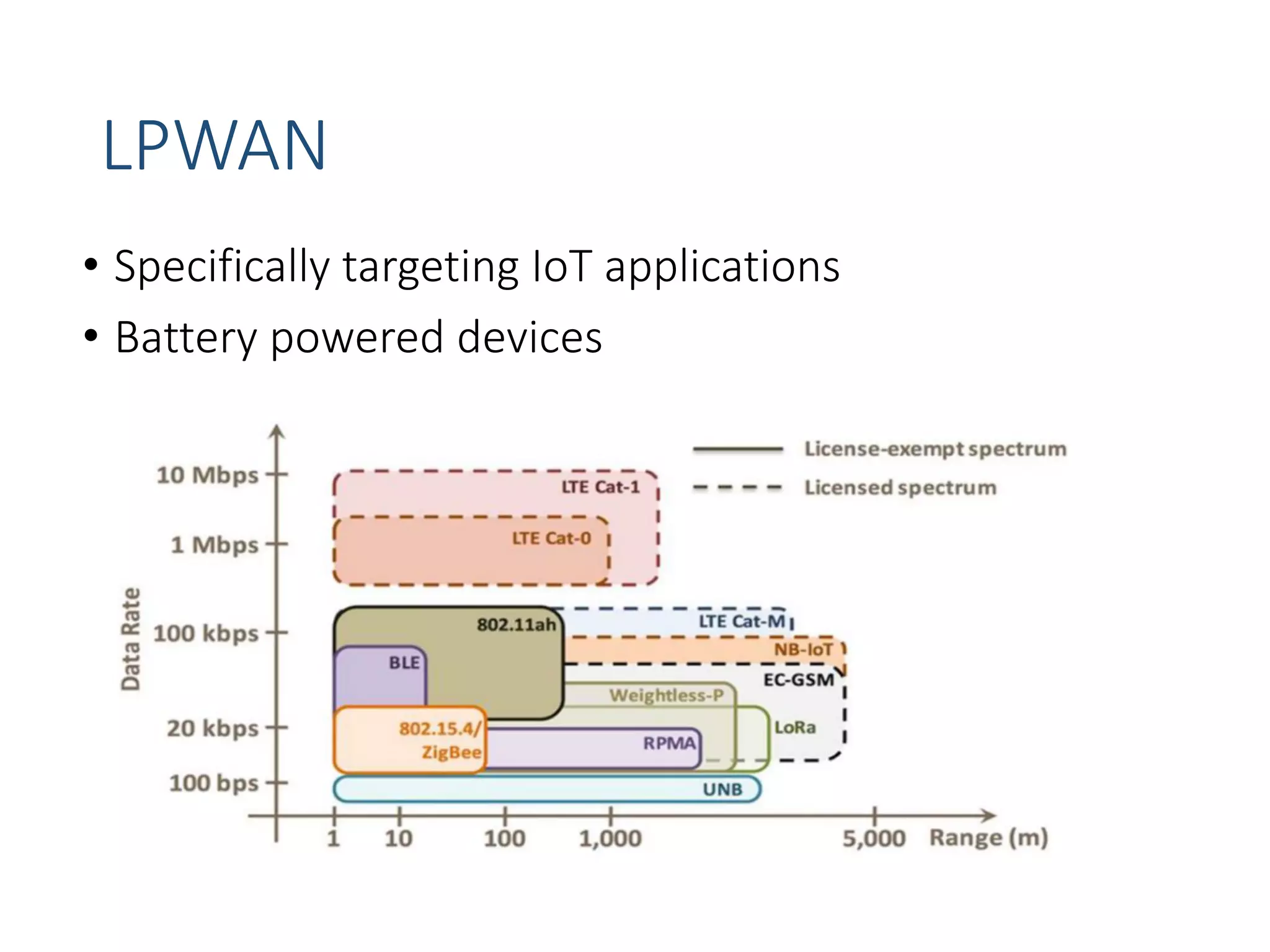
LPWAN
• Specifically targeting IoT applications
• Battery powered devices
LPWAN
• Coverage (lower frequency) vs bandwidth/throughput
(WLAN/ WPAN)?
• Licensed vs unlicensed spectrum?
• Centralised vs decentralized access?
• Compatibility with cellular systems?
• Mobility support?
• Latency constraints?
• Security
LoRaWAN
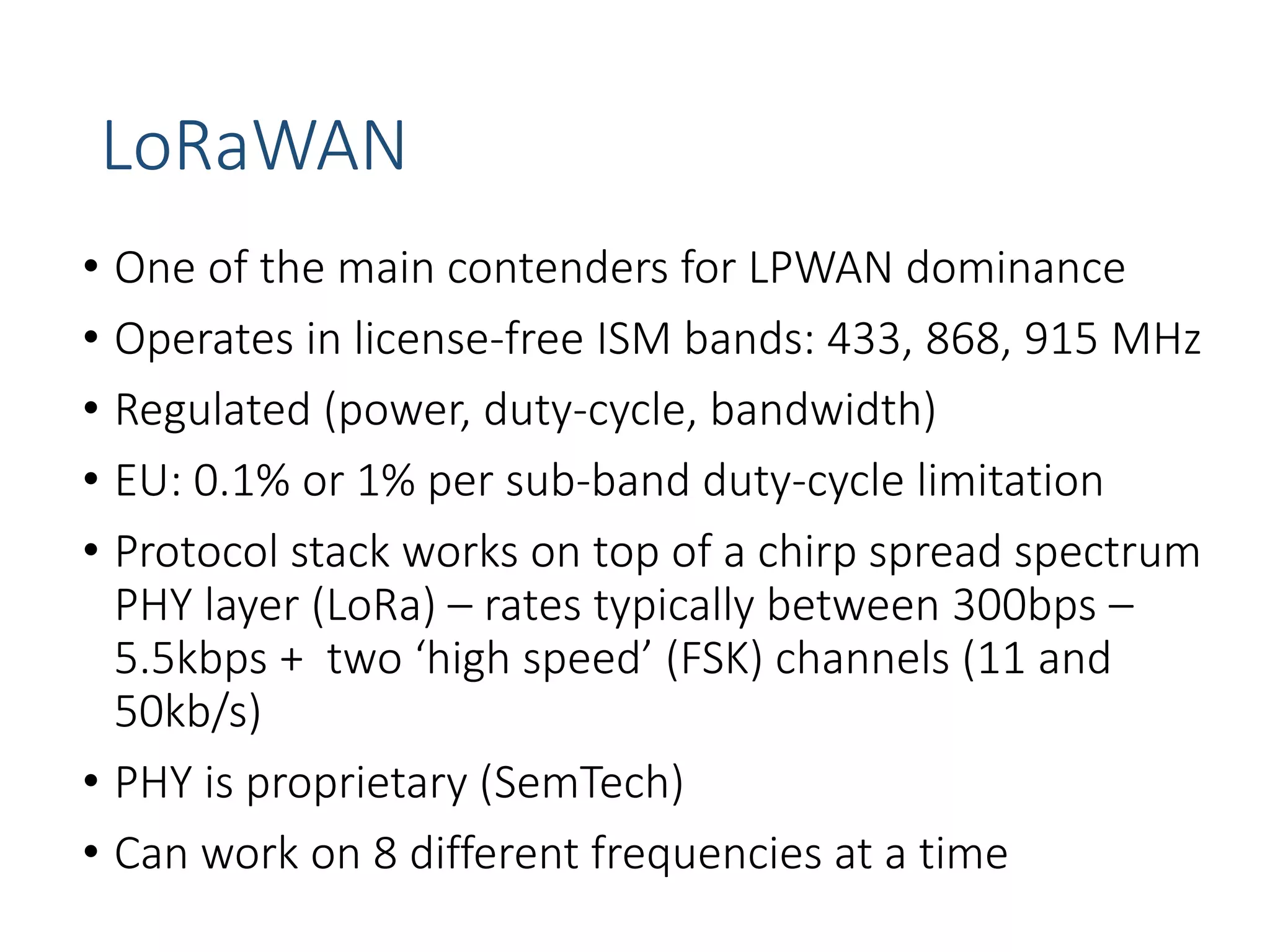
• One of the main contenders for LPWAN dominance
• Operates in license-free ISM bands: 433, 868, 915 MHz
• Regulated (power, duty-cycle, bandwidth)
• EU: 0.1% or 1% per sub-band duty-cycle limitation
• Protocol stack works on top of a chirp spread spectrum
PHY layer (LoRa) – rates typically between 300bps –
5.5kbps + two ‘high speed’ (FSK) channels (11 and
50kb/s)
• PHY is proprietary (SemTech)
• Can work on 8 different frequencies at a time
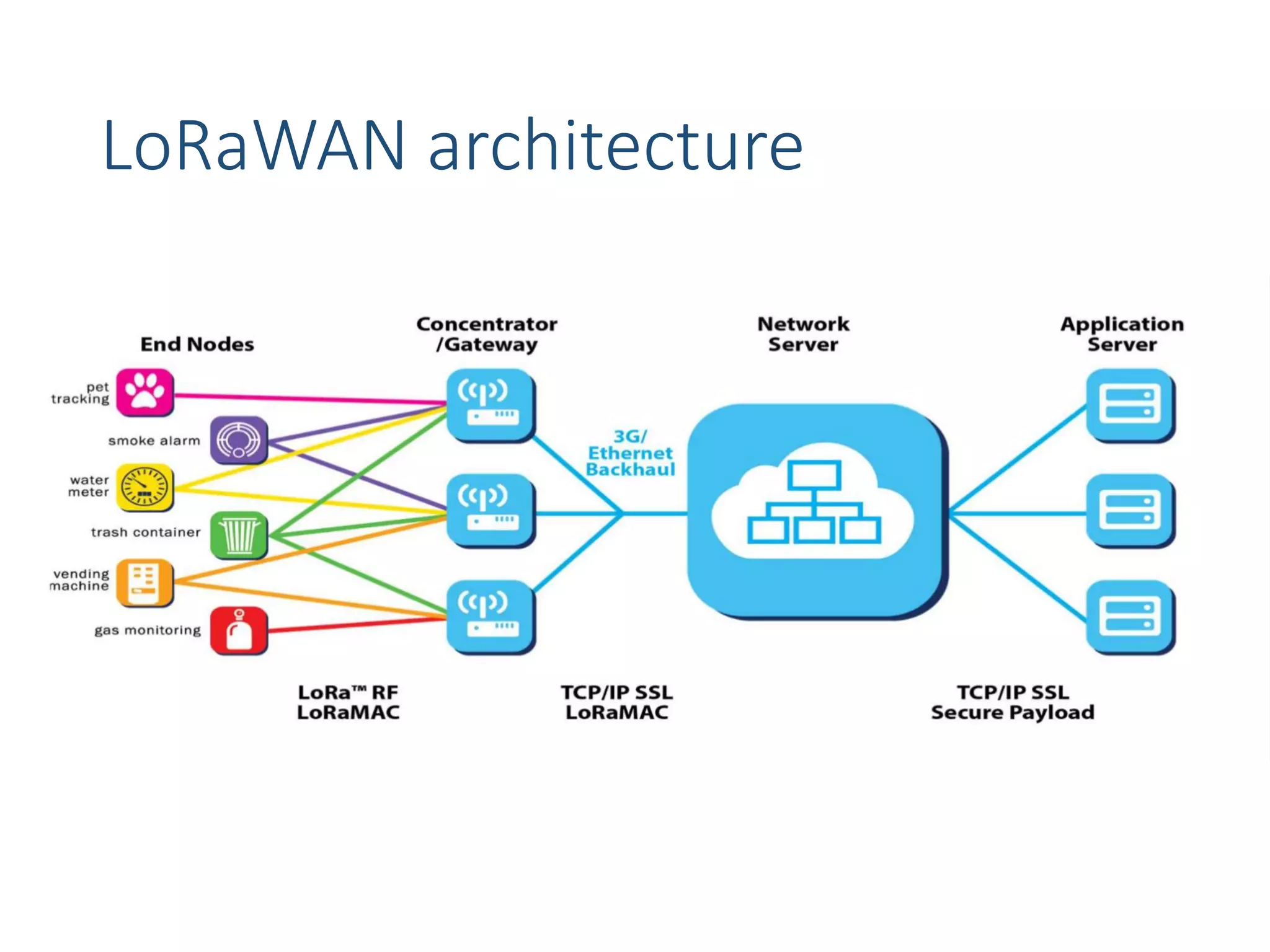
LoRaWAN architecture
LoRa modulation
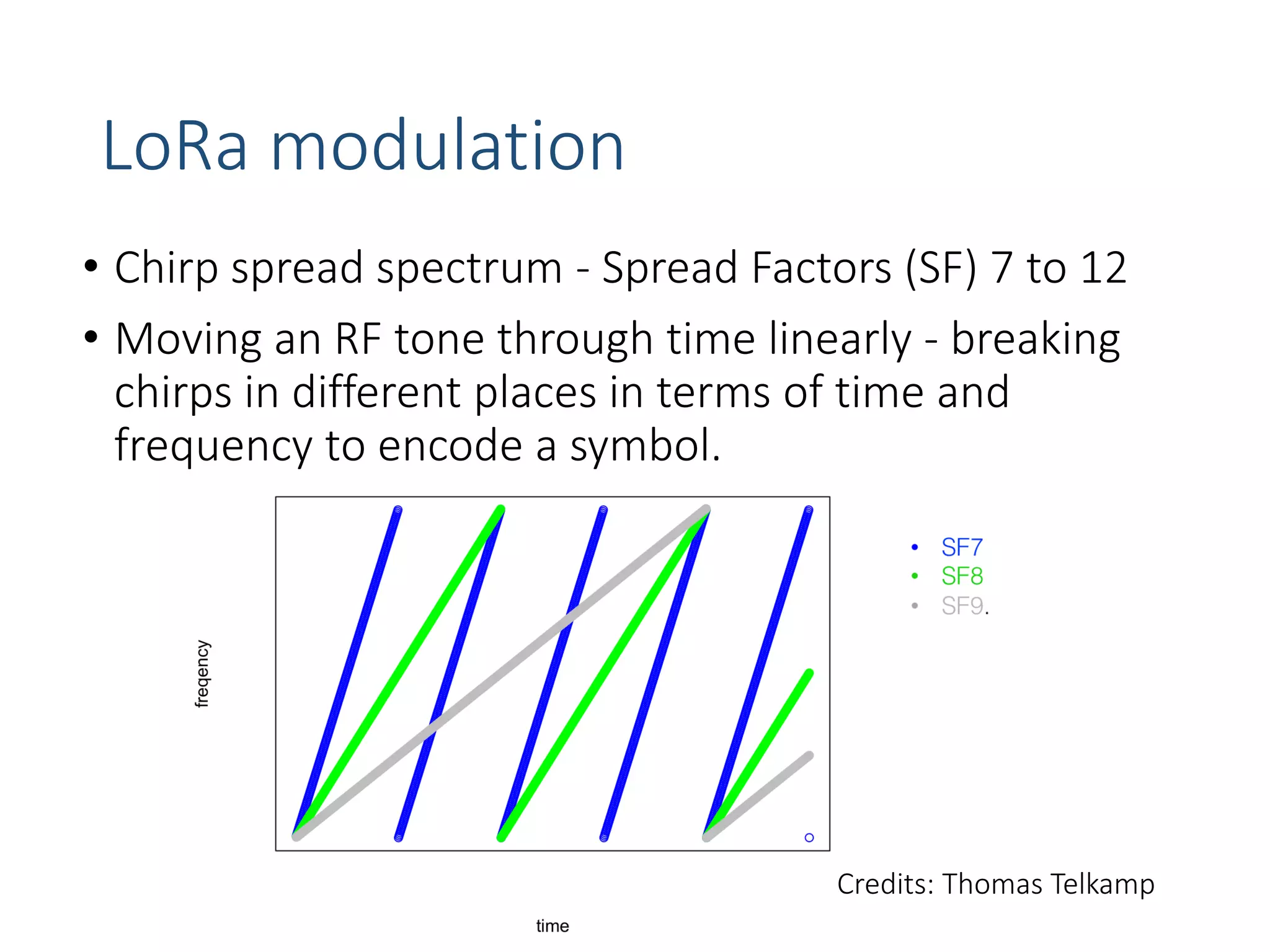
• Chirp spread spectrum - Spread Factors (SF) 7 to 12
• Moving an RF tone through time linearly - breaking
chirps in different places in terms of time and
frequency to encode a symbol.
Credits: Thomas Telkamp
LoRa modulation
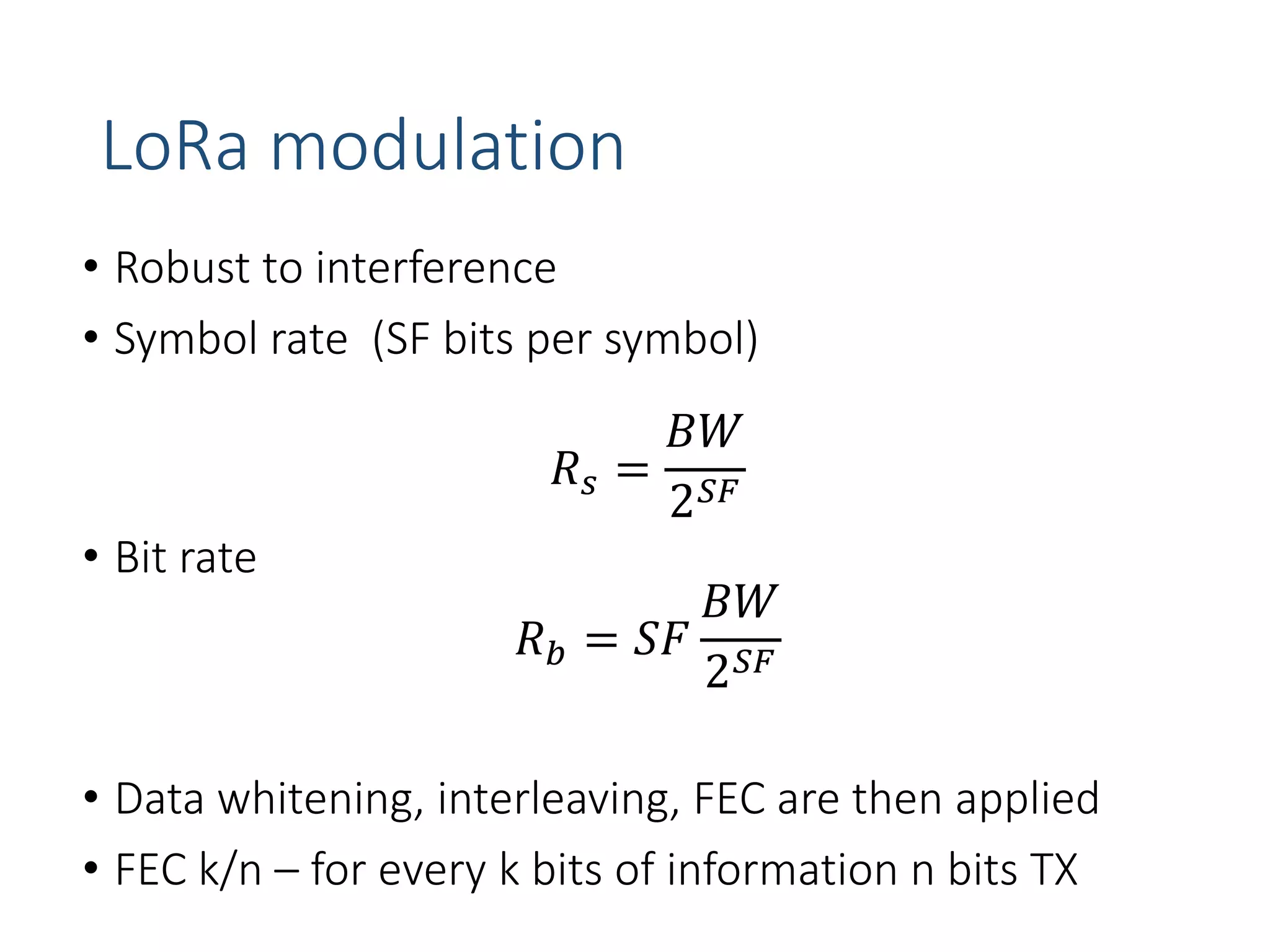
• Robust to interference
• Symbol rate (SF bits per symbol)
𝑅𝑠 =
𝐵𝑊
2𝑆𝐹
• Bit rate
𝑅𝑏 = 𝑆𝐹
𝐵𝑊
2𝑆𝐹
• Data whitening, interleaving, FEC are then applied
• FEC k/n – for every k bits of information n bits TX
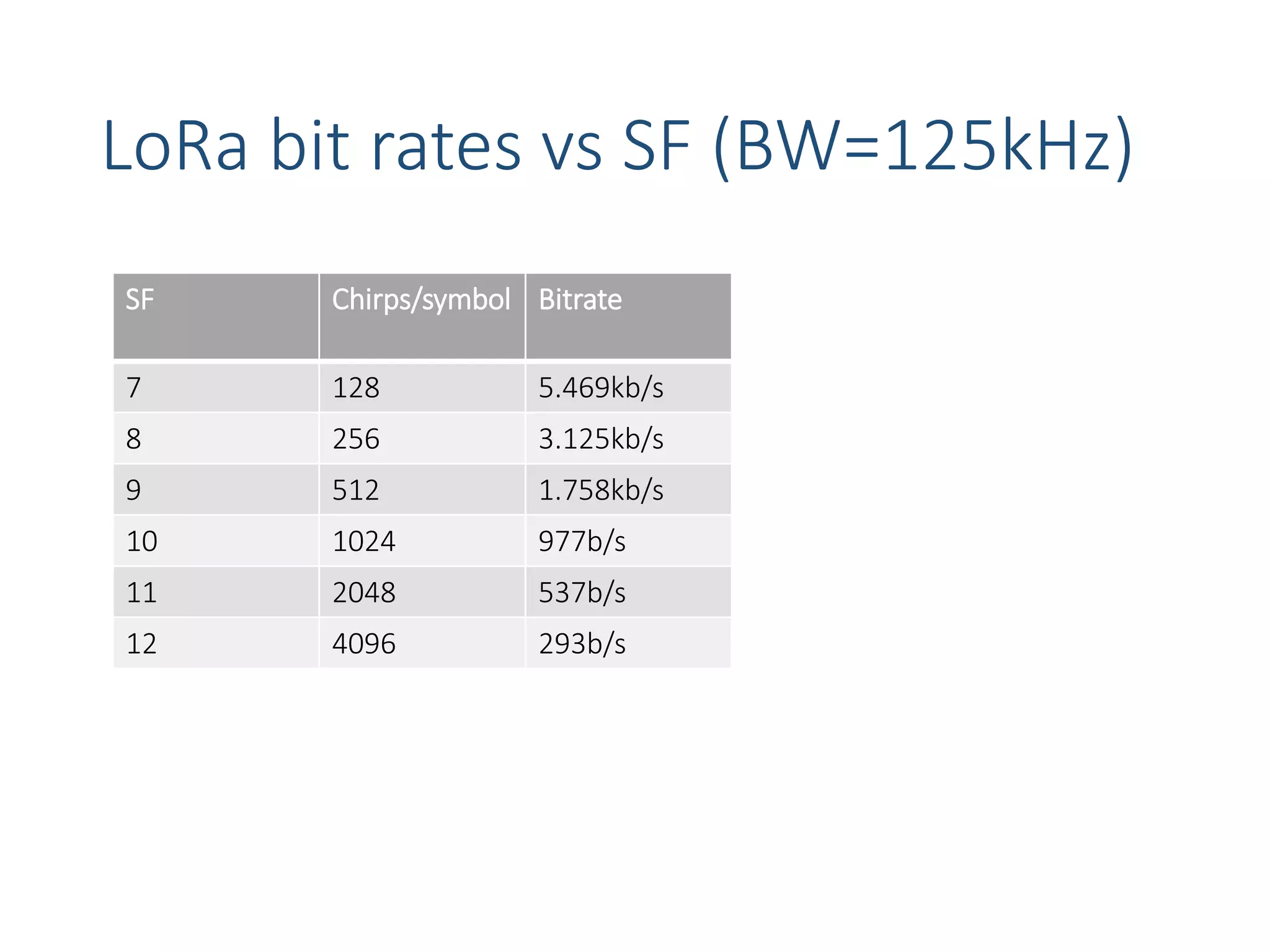
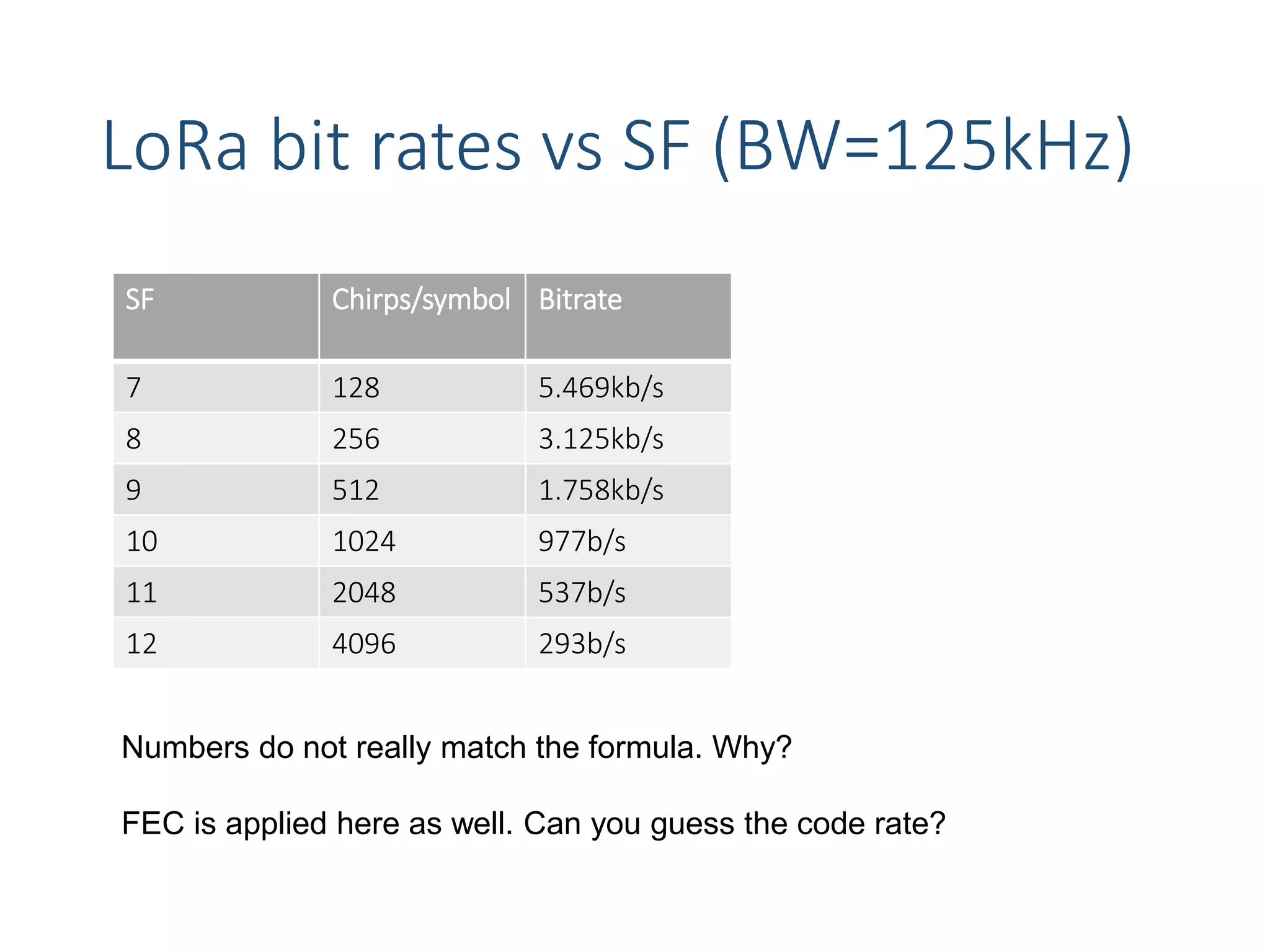
LoRa bit rates vs SF (BW=125kHz)
SF Chirps/symbol Bitrate
7 128 5.469kb/s
8 256 3.125kb/s
9 512 1.758kb/s
10 1024 977b/s
11 2048 537b/s
12 4096 293b/s
LoRa bit rates vs SF (BW=125kHz)
SF Chirps/symbol Bitrate
7 128 5.469kb/s
8 256 3.125kb/s
9 512 1.758kb/s
10 1024 977b/s
11 2048 537b/s
12 4096 293b/s
Numbers do not really match the formula. Why?
LoRa bit rates vs SF (BW=125kHz)
SF Chirps/symbol Bitrate
7 128 5.469kb/s
8 256 3.125kb/s
9 512 1.758kb/s
10 1024 977b/s
11 2048 537b/s
12 4096 293b/s
Numbers do not really match the formula. Why?
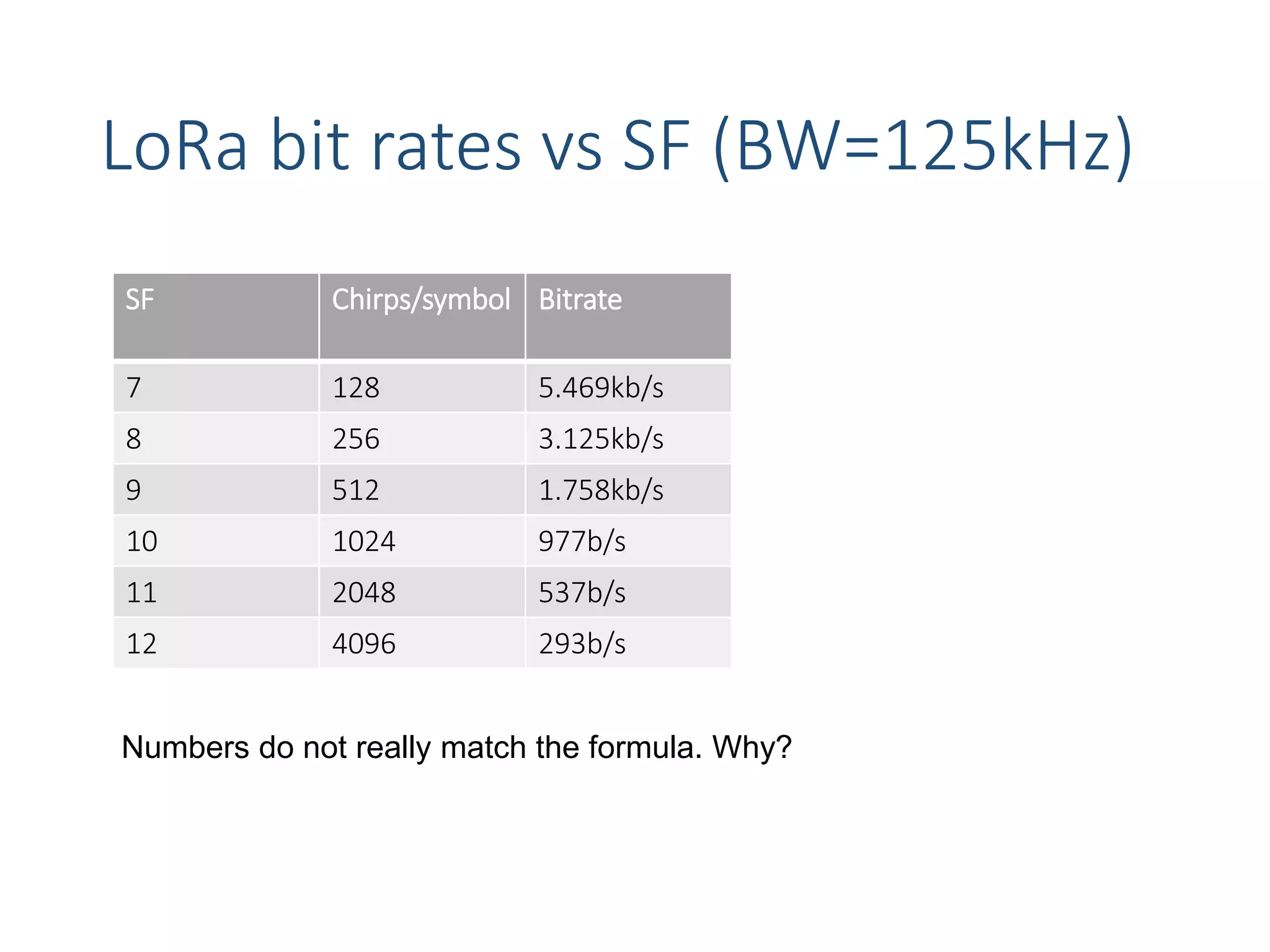
FEC is applied here as well. Can you guess the code rate?
LoRa bit rates vs SF (BW=125kHz)
SF Chirps/symbol Bitrate
7 128 5.469kb/s
8 256 3.125kb/s
9 512 1.758kb/s
10 1024 977b/s
11 2048 537b/s
12 4096 293b/s
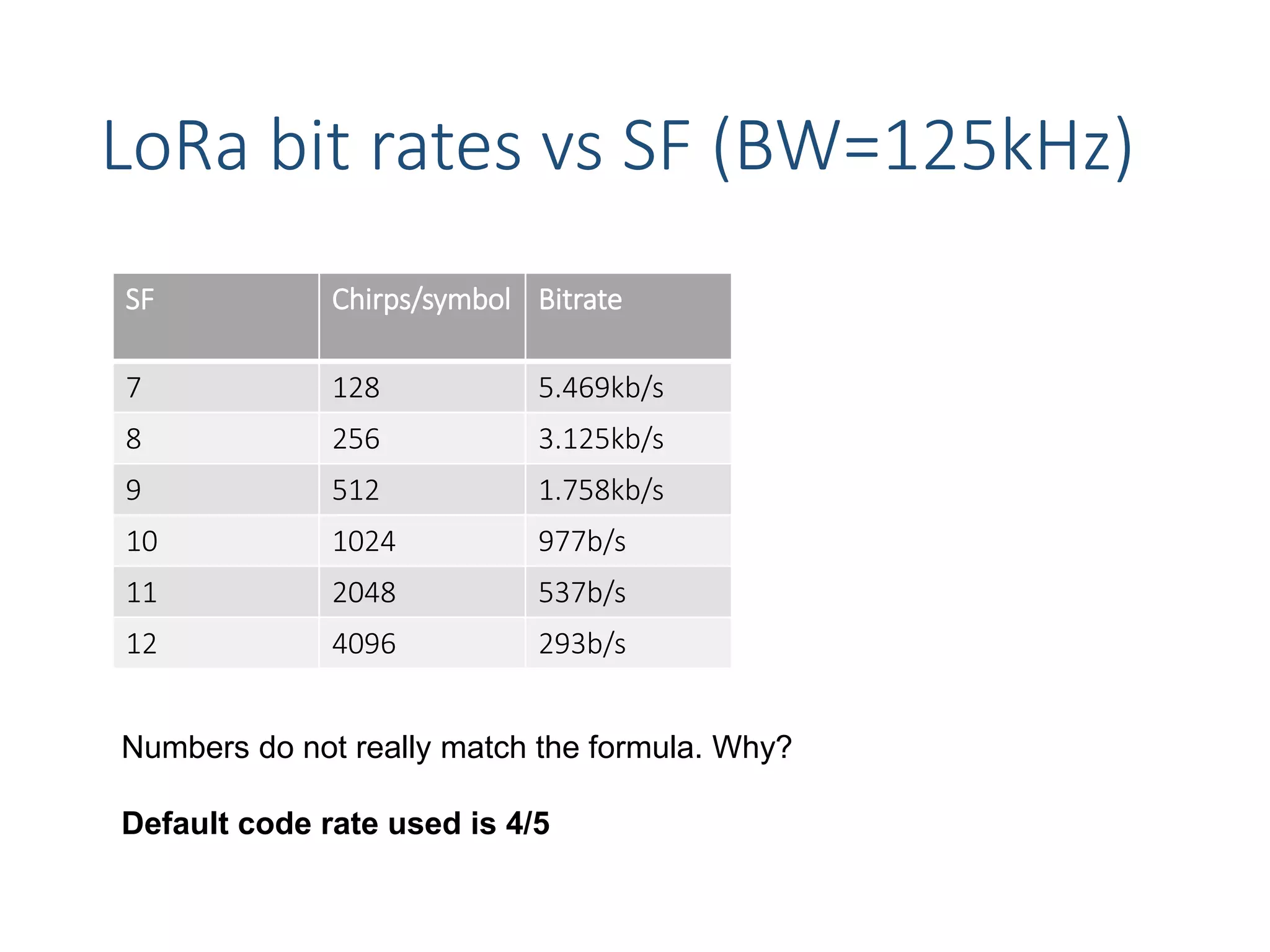
Numbers do not really match the formula. Why?
Default code rate used is 4/5
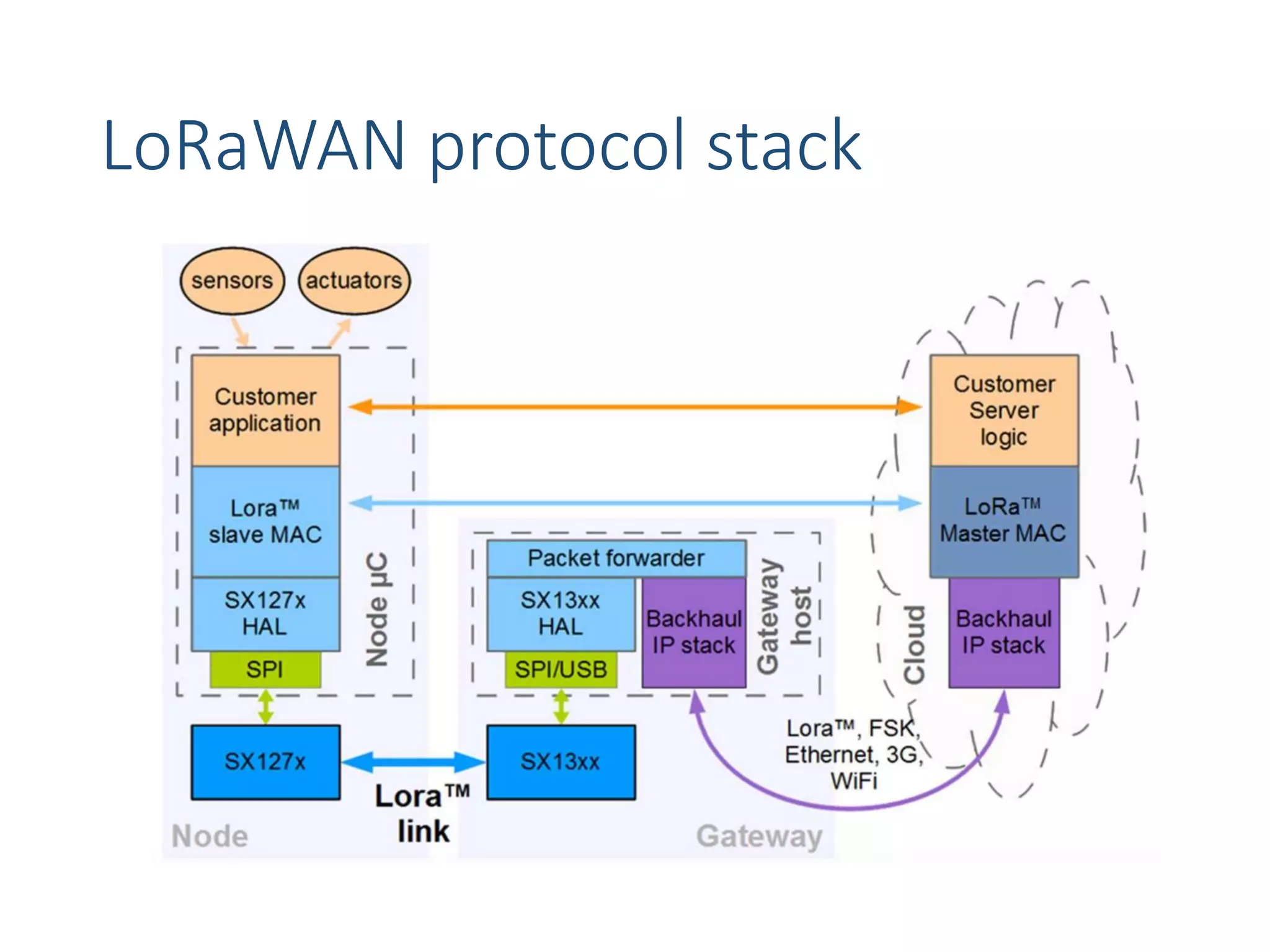
LoRaWAN protocol stack
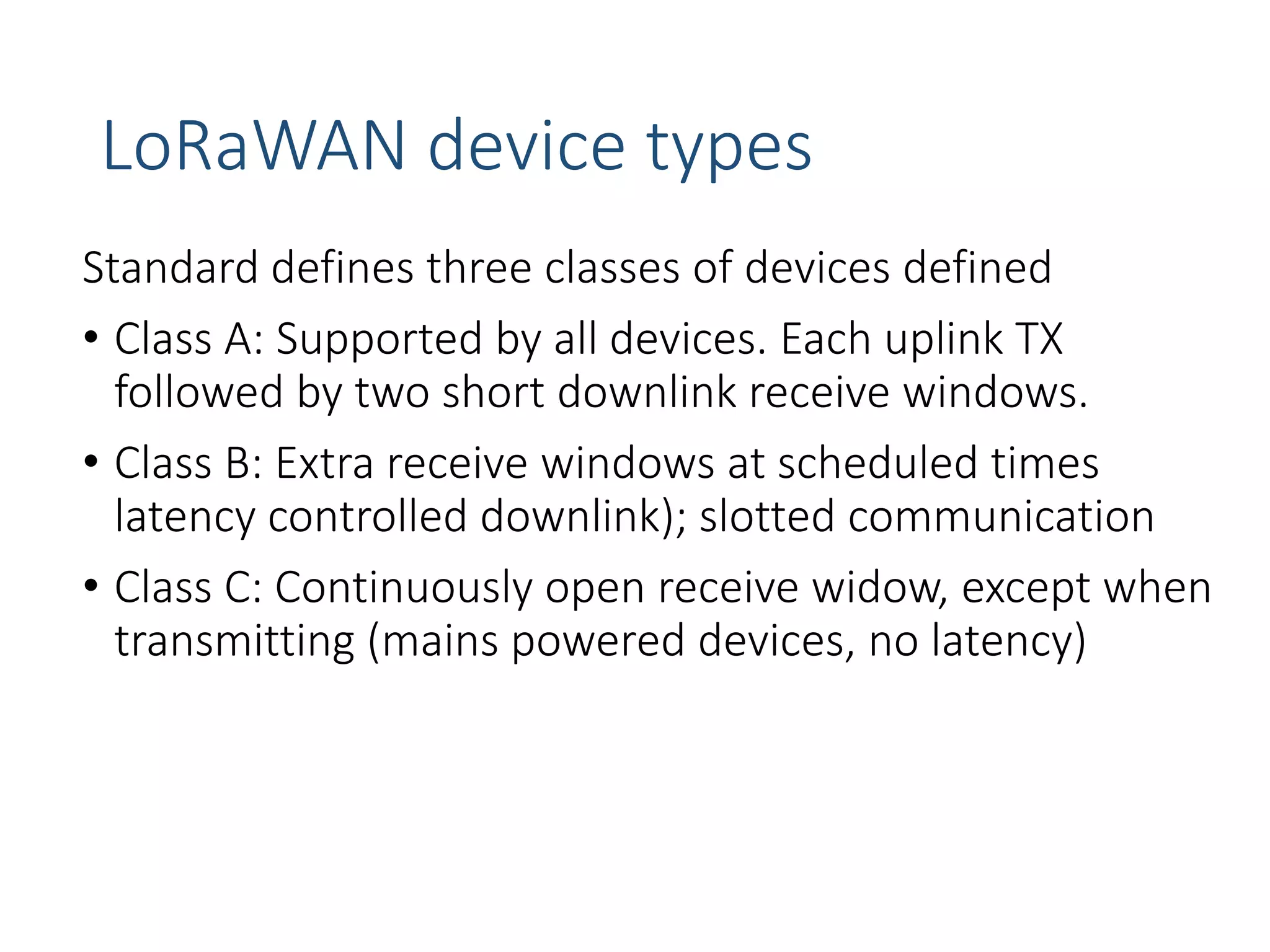
LoRaWAN device types
Standard defines three classes of devices defined
• Class A: Supported by all devices. Each uplink TX
followed by two short downlink receive windows.
• Class B: Extra receive windows at scheduled times
latency controlled downlink); slotted communication
• Class C: Continuously open receive widow, except when
transmitting (mains powered devices, no latency)
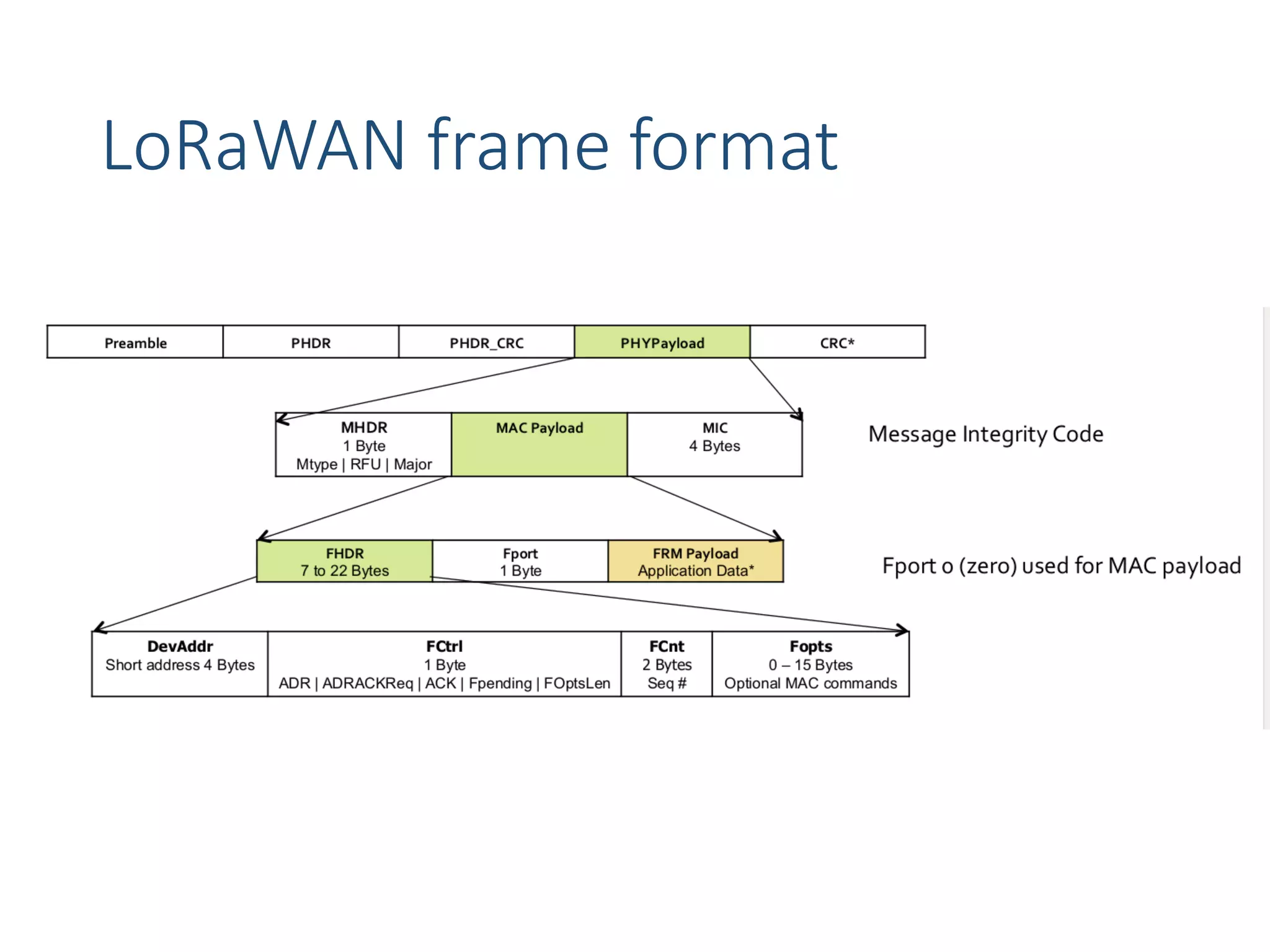
LoRaWAN frame format
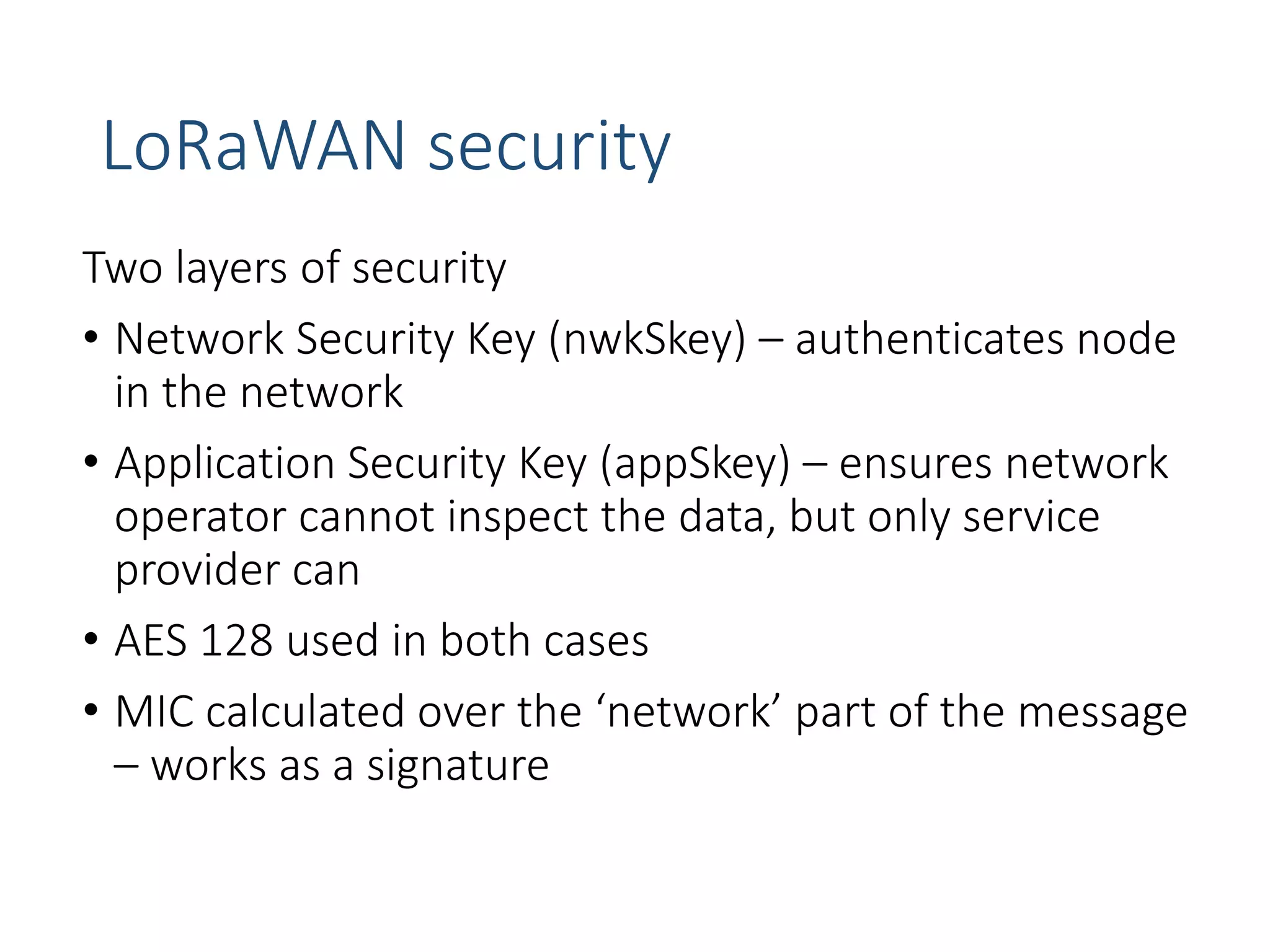
LoRaWAN security
Two layers of security
• Network Security Key (nwkSkey) – authenticates node
in the network
• Application Security Key (appSkey) – ensures network
operator cannot inspect the data, but only service
provider can
• AES 128 used in both cases
• MIC calculated over the ‘network’ part of the message
– works as a signature
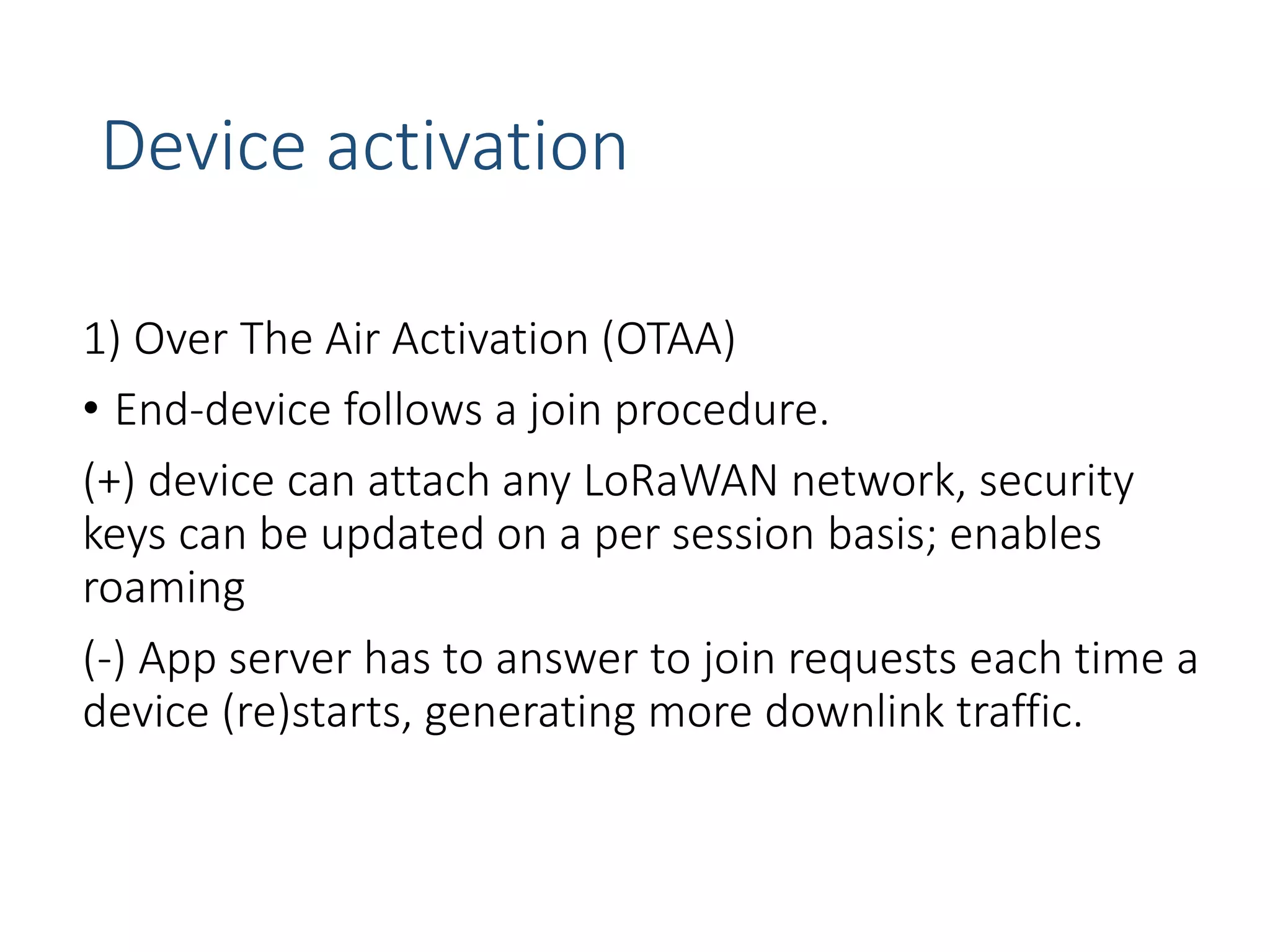
Device activation
1) Over The Air Activation (OTAA)
• End-device follows a join procedure.
(+) device can attach any LoRaWAN network, security
keys can be updated on a per session basis; enables
roaming
(-) App server has to answer to join requests each time a
device (re)starts, generating more downlink traffic.
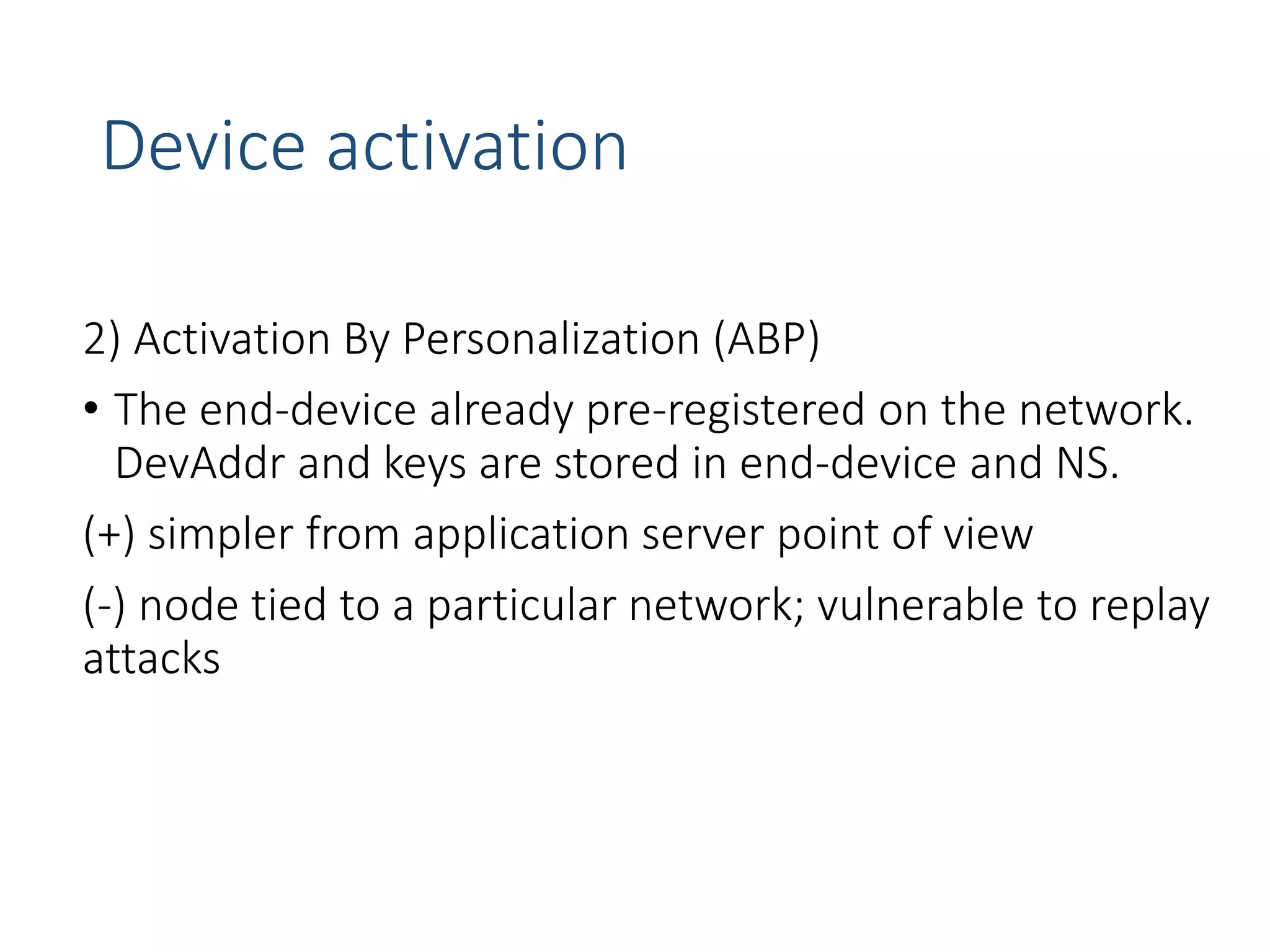
Device activation
2) Activation By Personalization (ABP)
• The end-device already pre-registered on the network.
DevAddr and keys are stored in end-device and NS.
(+) simpler from application server point of view
(-) node tied to a particular network; vulnerable to replay
attacks
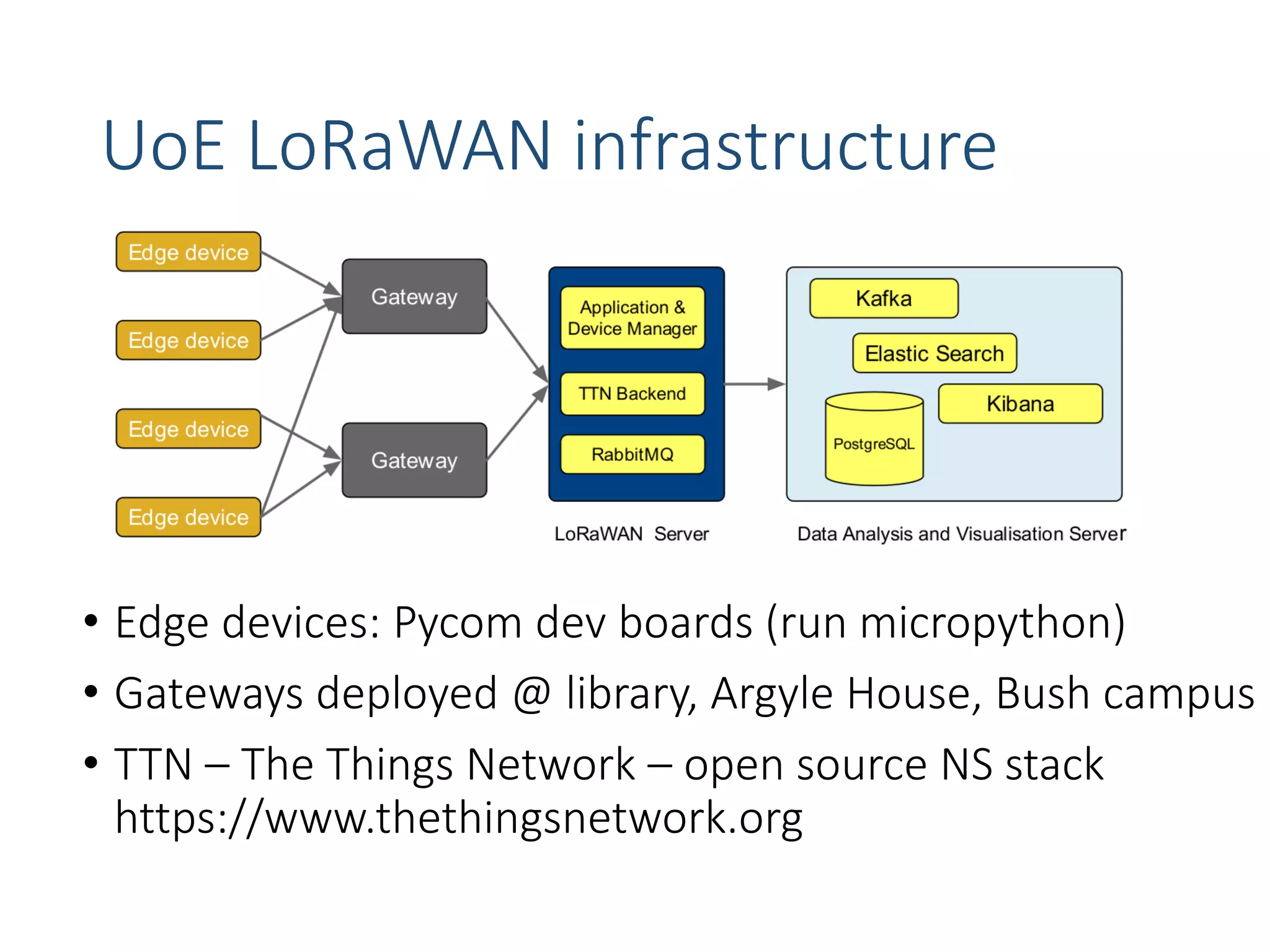
UoE LoRaWAN infrastructure
• Edge devices: Pycom dev boards (run micropython)
• Gateways deployed @ library, Argyle House, Bush campus
• TTN – The Things Network – open source NS stack
https://www.thethingsnetwork.org
Narrow Band IoT
(NB-IoT)
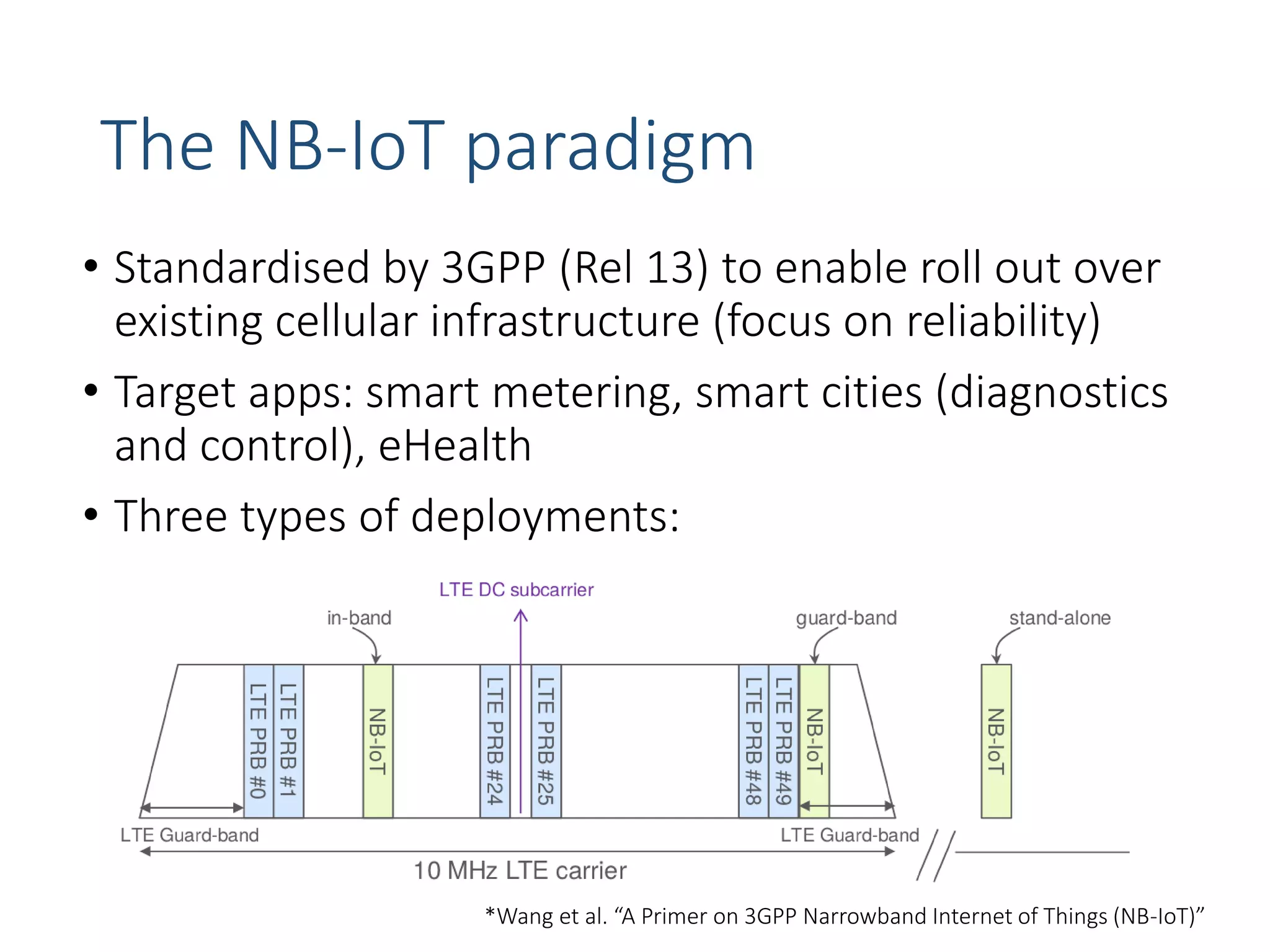
The NB-IoT paradigm
• Standardised by 3GPP (Rel 13) to enable roll out over
existing cellular infrastructure (focus on reliability)
• Target apps: smart metering, smart cities (diagnostics
and control), eHealth
• Three types of deployments:
*Wang et al. “A Primer on 3GPP Narrowband Internet of Things (NB-IoT)”
The NB-IoT paradigm
• Bandwidth: 180kHz (low throughput)
• Data rates: 25kb/s (downlink) and 64kb/s (uplink,
multi-tone)
• Latency <10ms
• Hybrid ARQ scheme (reliability)
• Power saving modes (base station can dictate power
control through signalling)
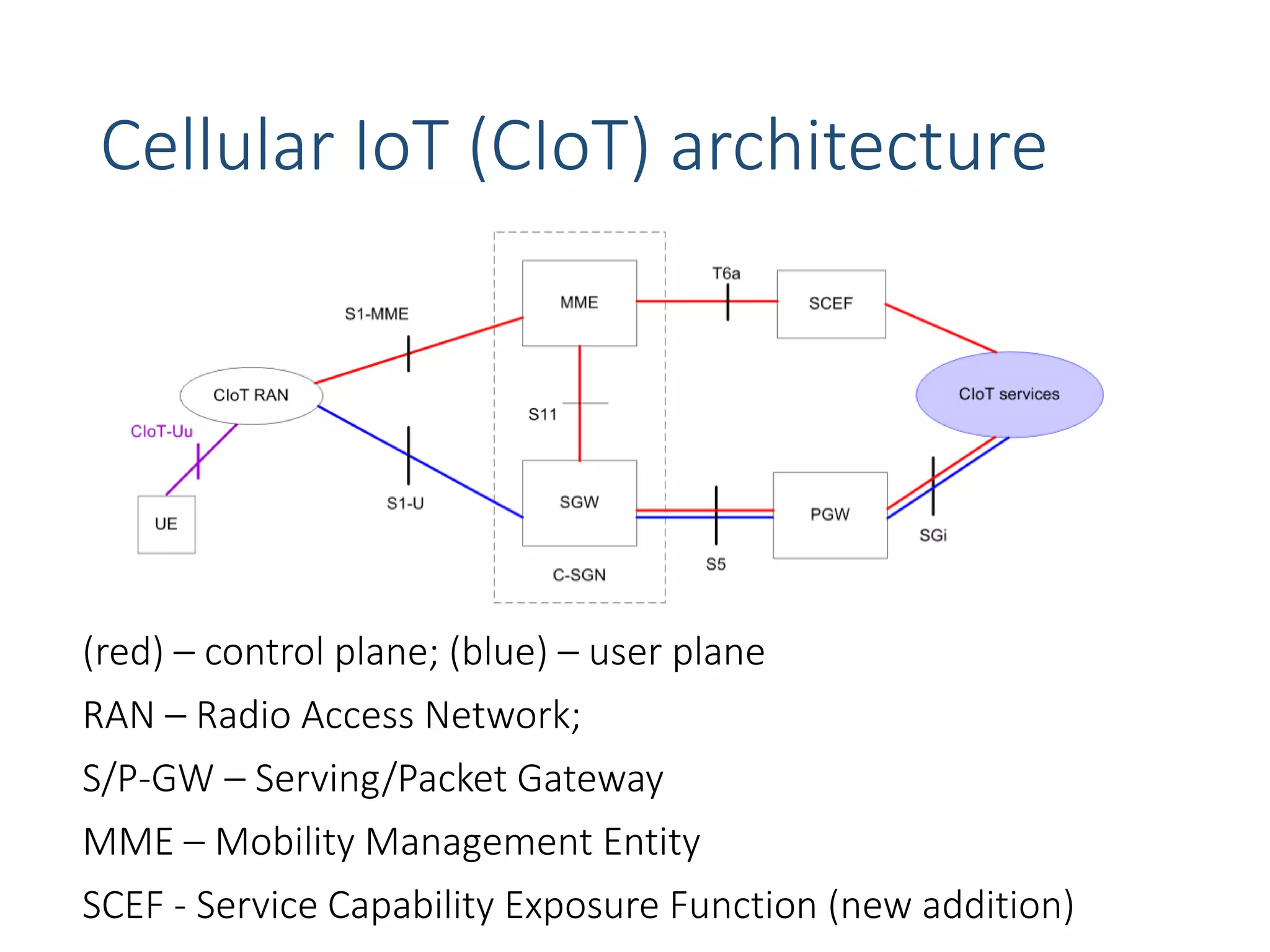
Cellular IoT (CIoT) architecture
(red) – control plane; (blue) – user plane
RAN – Radio Access Network;
S/P-GW – Serving/Packet Gateway
MME – Mobility Management Entity
SCEF - Service Capability Exposure Function (new addition)
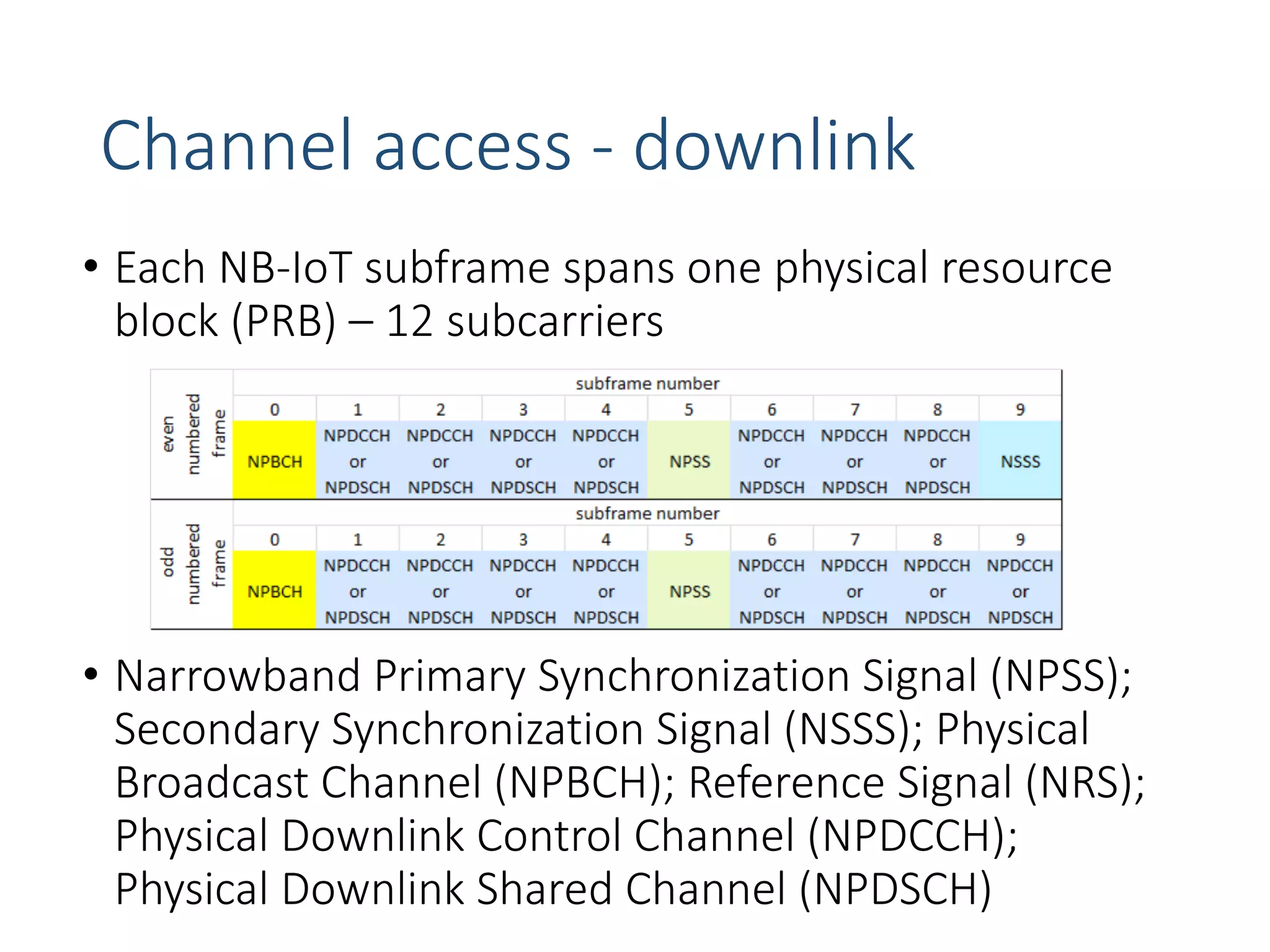
Channel access - downlink
• Each NB-IoT subframe spans one physical resource
block (PRB) – 12 subcarriers
• Narrowband Primary Synchronization Signal (NPSS);
Secondary Synchronization Signal (NSSS); Physical
Broadcast Channel (NPBCH); Reference Signal (NRS);
Physical Downlink Control Channel (NPDCCH);
Physical Downlink Shared Channel (NPDSCH)
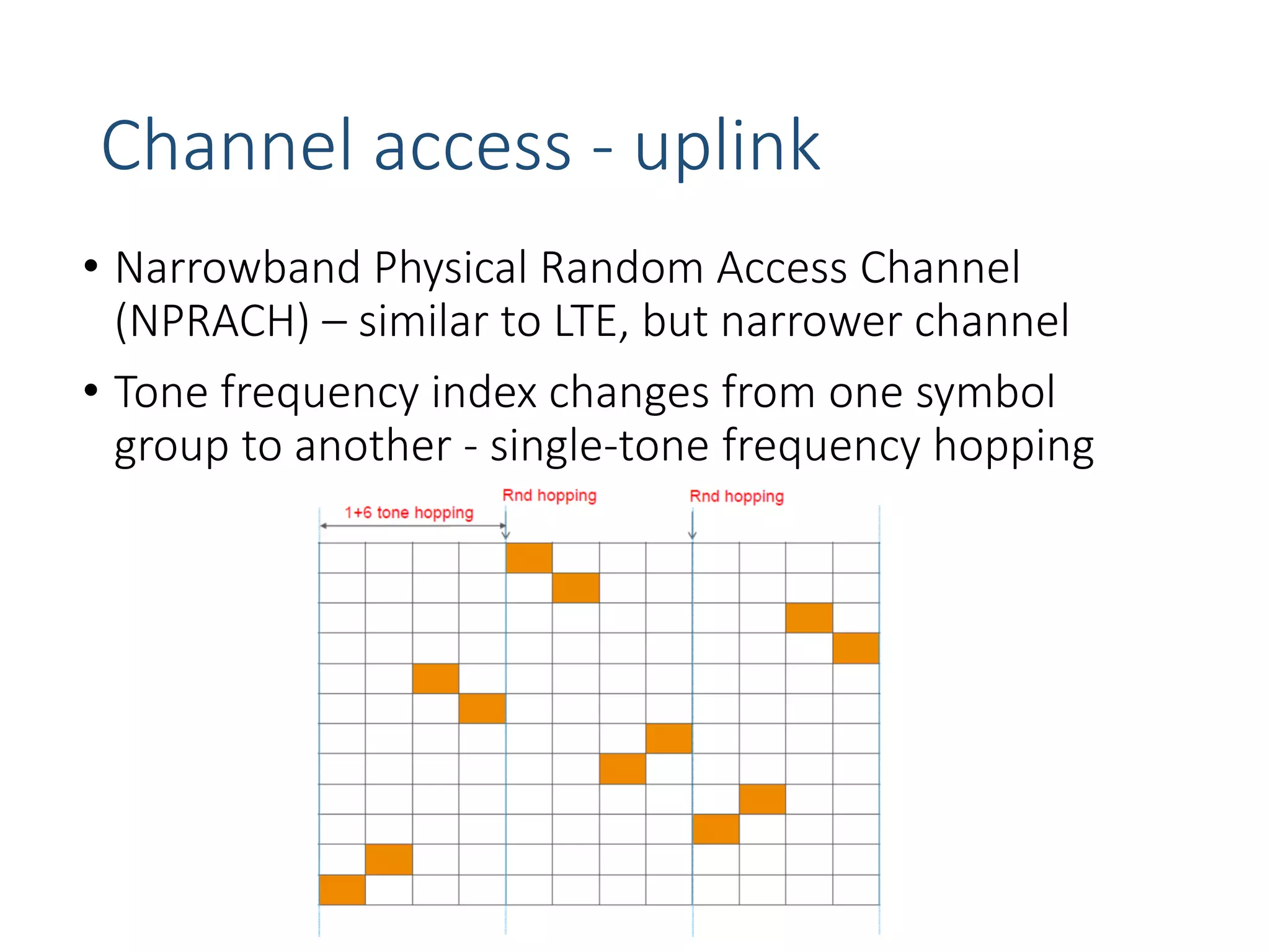
Channel access - uplink
• Narrowband Physical Random Access Channel
(NPRACH) – similar to LTE, but narrower channel
• Tone frequency index changes from one symbol
group to another - single-tone frequency hopping
Questions?

LPWAN.pdf

  • 1.
    IoTSSC – Low Power WideArea Networks (LPWAN)
  • 2.
    LPWAN • Specifically targetingIoT applications • Battery powered devices
  • 3.
    LPWAN • Coverage (lowerfrequency) vs bandwidth/throughput (WLAN/ WPAN)? • Licensed vs unlicensed spectrum? • Centralised vs decentralized access? • Compatibility with cellular systems? • Mobility support? • Latency constraints? • Security
  • 4.
    LoRaWAN • One ofthe main contenders for LPWAN dominance • Operates in license-free ISM bands: 433, 868, 915 MHz • Regulated (power, duty-cycle, bandwidth) • EU: 0.1% or 1% per sub-band duty-cycle limitation • Protocol stack works on top of a chirp spread spectrum PHY layer (LoRa) – rates typically between 300bps – 5.5kbps + two ‘high speed’ (FSK) channels (11 and 50kb/s) • PHY is proprietary (SemTech) • Can work on 8 different frequencies at a time
  • 5.
  • 6.
    LoRa modulation • Chirpspread spectrum - Spread Factors (SF) 7 to 12 • Moving an RF tone through time linearly - breaking chirps in different places in terms of time and frequency to encode a symbol. Credits: Thomas Telkamp
  • 7.
    LoRa modulation • Robustto interference • Symbol rate (SF bits per symbol) 𝑅𝑠 = 𝐵𝑊 2𝑆𝐹 • Bit rate 𝑅𝑏 = 𝑆𝐹 𝐵𝑊 2𝑆𝐹 • Data whitening, interleaving, FEC are then applied • FEC k/n – for every k bits of information n bits TX
  • 8.
    LoRa bit ratesvs SF (BW=125kHz) SF Chirps/symbol Bitrate 7 128 5.469kb/s 8 256 3.125kb/s 9 512 1.758kb/s 10 1024 977b/s 11 2048 537b/s 12 4096 293b/s
  • 9.
    LoRa bit ratesvs SF (BW=125kHz) SF Chirps/symbol Bitrate 7 128 5.469kb/s 8 256 3.125kb/s 9 512 1.758kb/s 10 1024 977b/s 11 2048 537b/s 12 4096 293b/s Numbers do not really match the formula. Why?
  • 10.
    LoRa bit ratesvs SF (BW=125kHz) SF Chirps/symbol Bitrate 7 128 5.469kb/s 8 256 3.125kb/s 9 512 1.758kb/s 10 1024 977b/s 11 2048 537b/s 12 4096 293b/s Numbers do not really match the formula. Why? FEC is applied here as well. Can you guess the code rate?
  • 11.
    LoRa bit ratesvs SF (BW=125kHz) SF Chirps/symbol Bitrate 7 128 5.469kb/s 8 256 3.125kb/s 9 512 1.758kb/s 10 1024 977b/s 11 2048 537b/s 12 4096 293b/s Numbers do not really match the formula. Why? Default code rate used is 4/5
  • 12.
  • 13.
    LoRaWAN device types Standarddefines three classes of devices defined • Class A: Supported by all devices. Each uplink TX followed by two short downlink receive windows. • Class B: Extra receive windows at scheduled times latency controlled downlink); slotted communication • Class C: Continuously open receive widow, except when transmitting (mains powered devices, no latency)
  • 14.
  • 15.
    LoRaWAN security Two layersof security • Network Security Key (nwkSkey) – authenticates node in the network • Application Security Key (appSkey) – ensures network operator cannot inspect the data, but only service provider can • AES 128 used in both cases • MIC calculated over the ‘network’ part of the message – works as a signature
  • 16.
    Device activation 1) OverThe Air Activation (OTAA) • End-device follows a join procedure. (+) device can attach any LoRaWAN network, security keys can be updated on a per session basis; enables roaming (-) App server has to answer to join requests each time a device (re)starts, generating more downlink traffic.
  • 17.
    Device activation 2) ActivationBy Personalization (ABP) • The end-device already pre-registered on the network. DevAddr and keys are stored in end-device and NS. (+) simpler from application server point of view (-) node tied to a particular network; vulnerable to replay attacks
  • 18.
    UoE LoRaWAN infrastructure •Edge devices: Pycom dev boards (run micropython) • Gateways deployed @ library, Argyle House, Bush campus • TTN – The Things Network – open source NS stack https://www.thethingsnetwork.org
  • 19.
  • 20.
    The NB-IoT paradigm •Standardised by 3GPP (Rel 13) to enable roll out over existing cellular infrastructure (focus on reliability) • Target apps: smart metering, smart cities (diagnostics and control), eHealth • Three types of deployments: *Wang et al. “A Primer on 3GPP Narrowband Internet of Things (NB-IoT)”
  • 21.
    The NB-IoT paradigm •Bandwidth: 180kHz (low throughput) • Data rates: 25kb/s (downlink) and 64kb/s (uplink, multi-tone) • Latency <10ms • Hybrid ARQ scheme (reliability) • Power saving modes (base station can dictate power control through signalling)
  • 22.
    Cellular IoT (CIoT)architecture (red) – control plane; (blue) – user plane RAN – Radio Access Network; S/P-GW – Serving/Packet Gateway MME – Mobility Management Entity SCEF - Service Capability Exposure Function (new addition)
  • 23.
    Channel access -downlink • Each NB-IoT subframe spans one physical resource block (PRB) – 12 subcarriers • Narrowband Primary Synchronization Signal (NPSS); Secondary Synchronization Signal (NSSS); Physical Broadcast Channel (NPBCH); Reference Signal (NRS); Physical Downlink Control Channel (NPDCCH); Physical Downlink Shared Channel (NPDSCH)
  • 24.
    Channel access -uplink • Narrowband Physical Random Access Channel (NPRACH) – similar to LTE, but narrower channel • Tone frequency index changes from one symbol group to another - single-tone frequency hopping
  • 25.