The Role of Mathematical Models in Operations
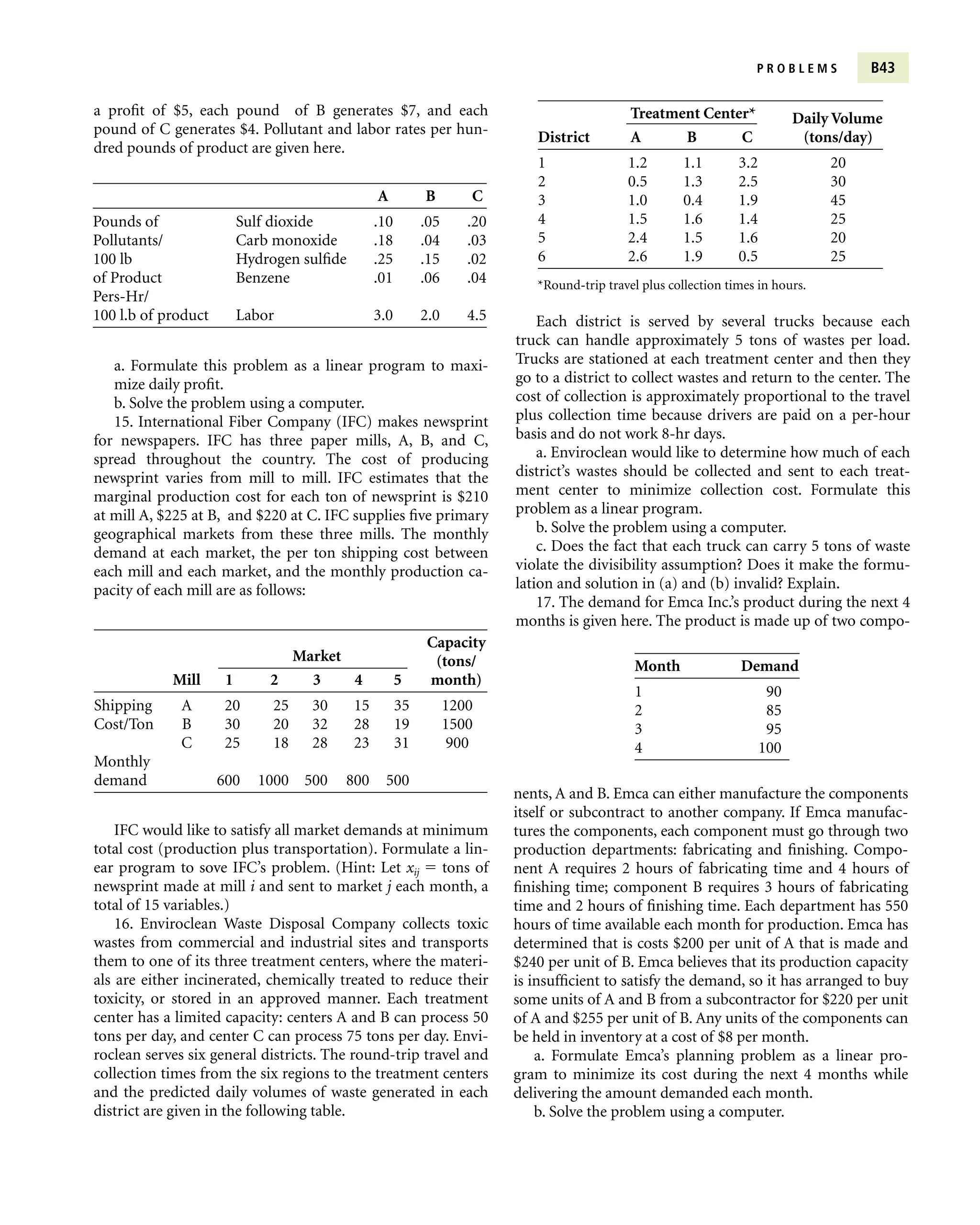
Decision Making B2
Constrained Optimization Models B2
Advantages and Disadvantages of Using Optimiza-
tion Models B5
Assumptions of Linear Programming Models B6
Formulating Linear Programs B7
The Geometry of Linear Programs B14
The Graphical Solution Approach B15
The Simplex Algorithm B17
Using Artificial Variables B26
Computer Solutions of Linear Programs B29
Using Linear Programming Models for Decision
Making B32
Before studying this supplement you should know or, if necessary, review
1. Competitive priorities, Chapter 2
2. Capacity management concepts, Chapter 9
3. Aggregate planning, Chapter 13
4. Developing a master schedule, Chapter 14
Linear Programming
S U P P L E M E N T
B
LEARNING OBJECTIVES
After studying this supplement, you should be able to
Describe the role of mathematical models in
operations decision making.
Describe constrained optimization models.
Understand the advantages and disadvantages of
using optimization models.
Describe the assumptions of linear program-
ming.
Formulate linear programs.
Describe the geometry of linear programs.
Describe the graphical solution approach.
Use the simplex algorithm.
Use artificial variables.
Describe computer solutions of linear programs.
Use linear programming models for decision
making.

1

2

3

4

5

6

7

8

9

10

11
Adapted with permission from Joseph S. Martinich, Production and Operations Management: An Applied Modern Approach, Wiley, New York, 1997.
SUPPLEMENT OUTLINE
Advances in business and engineering research and computer technology have ex-
panded managers’ use of mathematical models. A model represents the essential fea-
tures of an object, system, or problem without unimportant details. The models in
this supplement have the important aspects represented in mathematical form using
variables, parameters, and functions. Analyzing and manipulating the model gives in-
sight into how the real system behaves under various conditions. From this we deter-
mine the best system design or action to take.
Mathematical models are cheaper, faster, and safer than constructing and ma-
nipulating real systems. Suppose we want to find the mixture of recycled scrap paper
to use when producing a type of paperboard that minimizes cost. A company could
try several different combinations, check the quality, and calculate the cost. Since all
possible combinations are not tried, the optimum combination will probably not be
found. Alternatively, using a mathematical model, we evaluate all possible combina-
tions to find the one that satisfies product specifications at the lowest price. Mathe-
matical modeling is quicker and less expensive than using the trial-and-error ap-
proach.
Facility location, vehicle routing and scheduling, personnel, machine and job
scheduling, product mixes, and inventory management problems are formulated as
constrained optimization models. Constrained optimization models are mathemati-
cal models that find the best solution with respect to some evaluation criterion from a
set of alternative solutions. These solutions are defined by a set of mathematical con-
straints—mathematical inequalities or equalities.
B2 S U P P L E M E N T B L I N E A R P R O G R A M M I N G
THE ROLE OF MATHEMATICAL MODELS IN OPERATIONS DECISION MAKING
CONSTRAINED OPTIMIZATION MODELS
Constrained optimization models have three major components: decision variables,
objective function, and constraints.
1. Decision variables are physical quantities controlled by the decision maker
and represented by mathematical symbols. For example, the decision variable
xj can represent the number of pounds of product j that a company will pro-
duce during some month. Decision variables take on any of a set of possible
values.
2. Objective function defines the criterion for evaluating the solution. It is a
mathematical function of the decision variables that converts a solution into
a numerical evaluation of that solution. For example, the objective function
may measure the profit or cost that occurs as a function of the amounts of
various products produced. The objective function also specifies a direction
of optimization, either to maximize or minimize. An optimal solution for the
model is the best solution as measured by that criterion.
3. Constraints are a set of functional equalities or inequalities that represent
physical, economic, technological, legal, ethical, or other restrictions on what
numerical values can be assigned to the decision variables. For example, con-
straints might ensure that no more input is used than is available. Con-
straints can be definitional, defining the number of employees at the start of
a period t  1 as equal to the number of employees at the start of period t,
plus those added during period t minus those leaving the organization dur-
ing period t. In constrained optimization models we find values for the
 A model represents the es-
sential features of an object,
system, or problem without
unimportant details.
 Constrained optimization
models
Math models that find the
best solution with respect to
some evaluation criterion.
 Decision variables
Physical quantities controlled
by the decision maker.
 Objective function
Evaluation criterion.
 Constraints
Physical, economic, techno-
logical, legal, ethical, or other
limits on what numerical val-
ues can be assigned to the de-
cision variables.
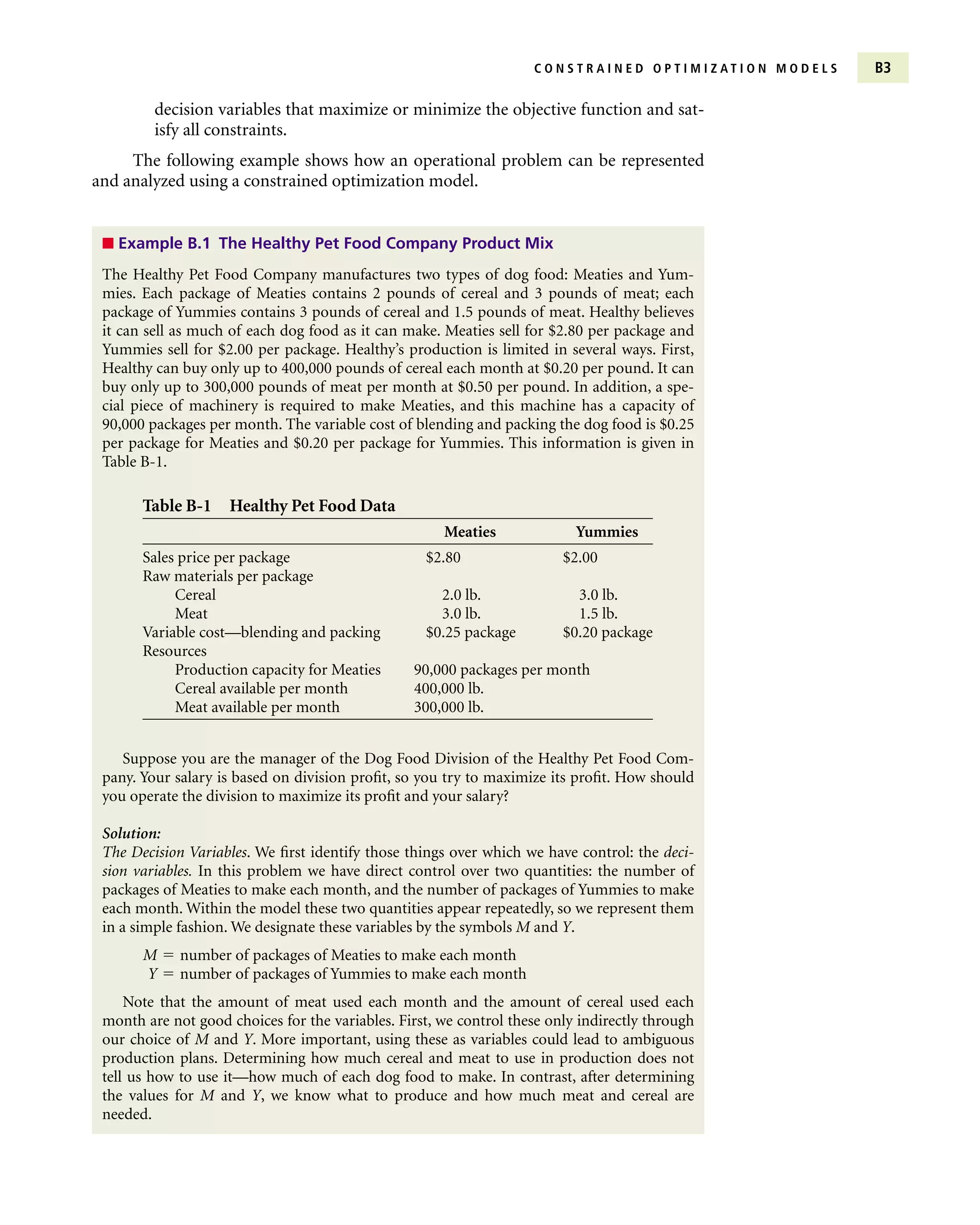
The Healthy Pet Food Company manufactures two types of dog food: Meaties and Yum-
mies. Each package of Meaties contains 2 pounds of cereal and 3 pounds of meat; each
package of Yummies contains 3 pounds of cereal and 1.5 pounds of meat. Healthy believes
it can sell as much of each dog food as it can make. Meaties sell for $2.80 per package and
Yummies sell for $2.00 per package. Healthy’s production is limited in several ways. First,
Healthy can buy only up to 400,000 pounds of cereal each month at $0.20 per pound. It can
buy only up to 300,000 pounds of meat per month at $0.50 per pound. In addition, a spe-
cial piece of machinery is required to make Meaties, and this machine has a capacity of
90,000 packages per month. The variable cost of blending and packing the dog food is $0.25
per package for Meaties and $0.20 per package for Yummies. This information is given in
Table B-1.
C O N S T R A I N E D O P T I M I Z A T I O N M O D E L S B3
decision variables that maximize or minimize the objective function and sat-
isfy all constraints.
The following example shows how an operational problem can be represented
and analyzed using a constrained optimization model.
■ Example B.1 The Healthy Pet Food Company Product Mix
Table B-1 Healthy Pet Food Data
Meaties Yummies
Sales price per package $2.80 $2.00
Raw materials per package
Cereal 2.0 lb. 3.0 lb.
Meat 3.0 lb. 1.5 lb.
Variable cost—blending and packing $0.25 package $0.20 package
Resources
Production capacity for Meaties 90,000 packages per month
Cereal available per month 400,000 lb.
Meat available per month 300,000 lb.
Suppose you are the manager of the Dog Food Division of the Healthy Pet Food Com-
pany. Your salary is based on division profit, so you try to maximize its profit. How should
you operate the division to maximize its profit and your salary?
Solution:
The Decision Variables. We first identify those things over which we have control: the deci-
sion variables. In this problem we have direct control over two quantities: the number of
packages of Meaties to make each month, and the number of packages of Yummies to make
each month. Within the model these two quantities appear repeatedly, so we represent them
in a simple fashion. We designate these variables by the symbols M and Y.
M  number of packages of Meaties to make each month
Y  number of packages of Yummies to make each month
Note that the amount of meat used each month and the amount of cereal used each
month are not good choices for the variables. First, we control these only indirectly through
our choice of M and Y. More important, using these as variables could lead to ambiguous
production plans. Determining how much cereal and meat to use in production does not
tell us how to use it—how much of each dog food to make. In contrast, after determining
the values for M and Y, we know what to produce and how much meat and cereal are
needed.
Objective function. Any pair of numerical values for the variables M and Y is a produc-
tion plan. For example, M  10,000 and Y  20,000 means we make 10,000 packages of
Meaties and 20,000 packages of Yummies each month. But how do we know whether this is
a good production plan? We need to specify a criterion for evaluation—an objective func-
tion. The most appropriate objective function is to maximize monthly profit. (Actually, this
is the contribution to profit: fixed costs are ignored because any plan that maximizes rev-
enue minus variable costs maximizes profit as well.) The profit earned by Healthy is a direct
function of the amount of each dog food made and sold, the decision variables. Monthly
profit, designated as z, is written as follows:
z  (profit per package of Meaties)  (number of packages of Meaties made and
sold monthly)  (profit per package of Yummies)  (number of packages of
Yummies made and sold monthly)
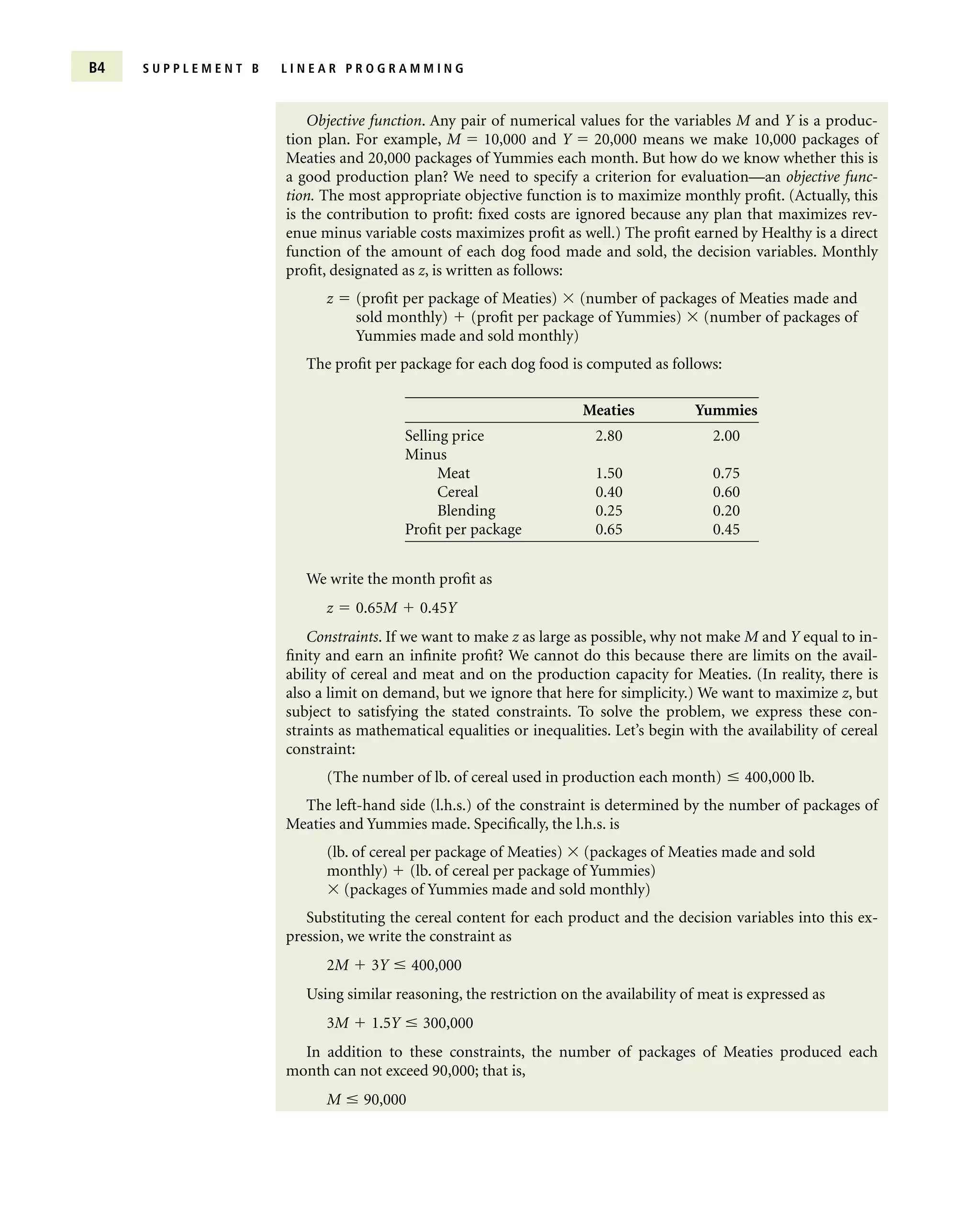
The profit per package for each dog food is computed as follows:
B4 S U P P L E M E N T B L I N E A R P R O G R A M M I N G
Meaties Yummies
Selling price 2.80 2.00
Minus
Meat 1.50 0.75
Cereal 0.40 0.60
Blending 0.25 0.20
Profit per package 0.65 0.45
We write the month profit as
z  0.65M  0.45Y
Constraints. If we want to make z as large as possible, why not make M and Y equal to in-
finity and earn an infinite profit? We cannot do this because there are limits on the avail-
ability of cereal and meat and on the production capacity for Meaties. (In reality, there is
also a limit on demand, but we ignore that here for simplicity.) We want to maximize z, but
subject to satisfying the stated constraints. To solve the problem, we express these con-
straints as mathematical equalities or inequalities. Let’s begin with the availability of cereal
constraint:
(The number of lb. of cereal used in production each month)  400,000 lb.
The left-hand side (l.h.s.) of the constraint is determined by the number of packages of
Meaties and Yummies made. Specifically, the l.h.s. is
(lb. of cereal per package of Meaties)  (packages of Meaties made and sold
monthly)  (lb. of cereal per package of Yummies)
 (packages of Yummies made and sold monthly)
Substituting the cereal content for each product and the decision variables into this ex-
pression, we write the constraint as
2M  3Y  400,000
Using similar reasoning, the restriction on the availability of meat is expressed as
3M  1.5Y  300,000
In addition to these constraints, the number of packages of Meaties produced each
month can not exceed 90,000; that is,
M  90,000
The main benefit of optimization models is the ability to evaluate possible solutions
in a quick, safe, and inexpensive way without actually constructing and experiment-
ing with them. Other benefits are as follows.
1. Structures the thought process. Constructing an optimization model of a
problem forces a decision maker to think through the problem in a concise,
organized fashion. The decision maker determines what factors he or she
controls; that is, what the decision variables are. The decision maker specifies
how the solution will be evaluated (the objective function). Finally, the deci-
sion maker describes the decision environment (the constraints). Modeling
acts as a way of organizing and clarifying the problem.
2. Increases objectivity. Mathematical models are more objective since all as-
sumptions and criteria are clearly specified. Although models reflect the ex-
periences and biases of those who construct them, these biases can be identi-
fied by outside observers. By using a model as a point of reference, the parties
can focus their discussion and disagreements on its assumptions and compo-
nents. Once the model is agreed on, people tend to live by the results.
3. Makes complex problems more tractable. Many problems in managing an
organization are large and complex and deal with subtle, but significant, in-
terrelationships among organizational units. For example, in determining the
optimal amounts of various products to ship from geographically dispersed
warehouses to geographically dispersed customers and the routes that should
be taken, the human mind cannot make the billions of simultaneous trade-
offs that are necessary. In these cases, the decision maker often uses simple
rules of thumb, which can result in less than optimal solutions. Optimization
models make it easier to solve complex organization-wide problems.
4. Make problems amenable to mathematical and computer solution. By rep-
resenting a real problem as a mathematical model, we use mathematical so-
lution and analysis techniques and computers in a way that is not otherwise
possible.
A D V A N T A G E S A N D D I S A D V A N T A G E S O F U S I N G O P T I M I Z A T I O N M O D E L S B5
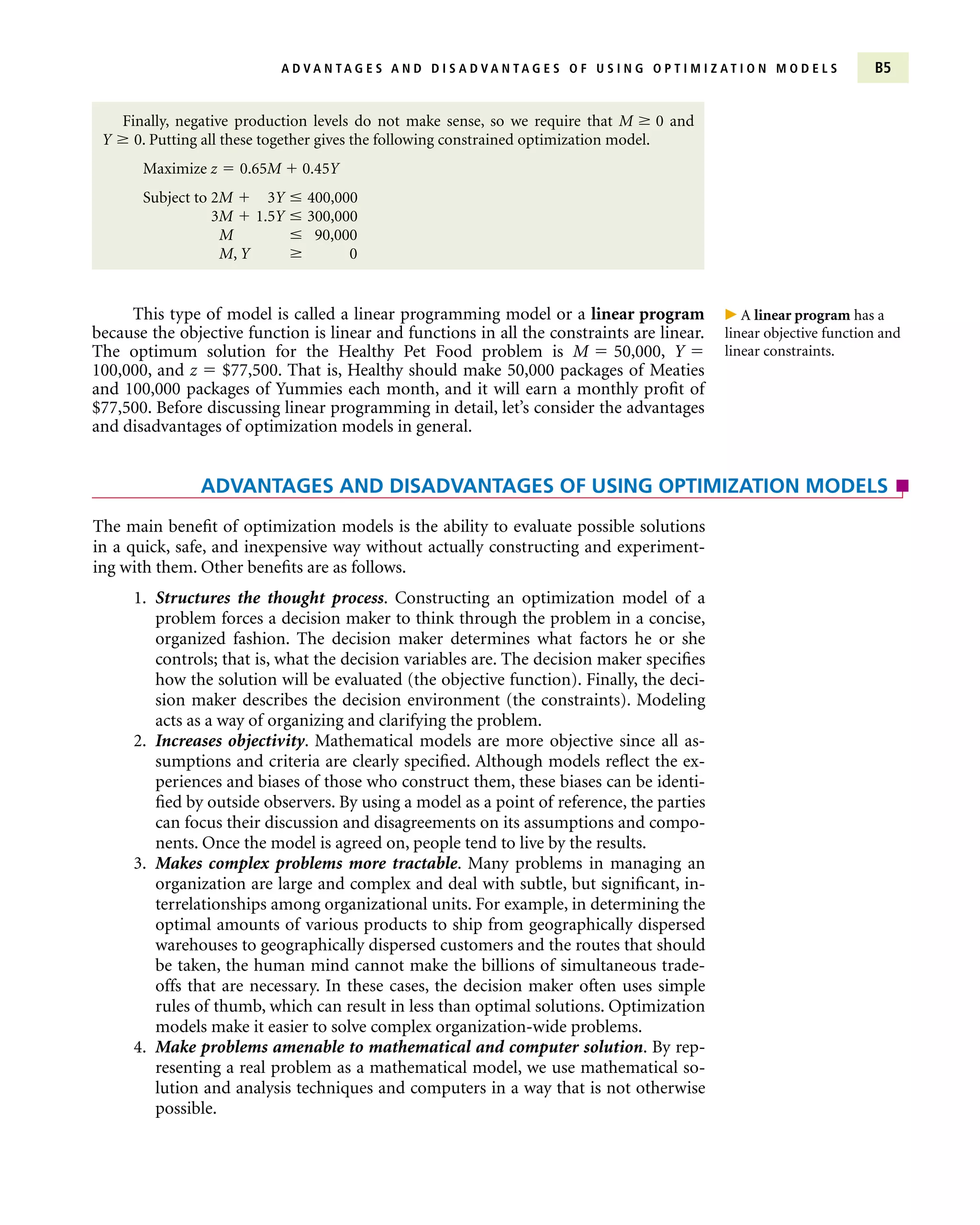
Finally, negative production levels do not make sense, so we require that M  0 and
Y  0. Putting all these together gives the following constrained optimization model.
Maximize z  0.65M  0.45Y
Subject to 2M  3Y  400,000
3M  1.5Y  300,000
M  90,000
M, Y  0
ADVANTAGES AND DISADVANTAGES OF USING OPTIMIZATION MODELS
This type of model is called a linear programming model or a linear program
because the objective function is linear and functions in all the constraints are linear.
The optimum solution for the Healthy Pet Food problem is M  50,000, Y 
100,000, and z  $77,500. That is, Healthy should make 50,000 packages of Meaties
and 100,000 packages of Yummies each month, and it will earn a monthly profit of
$77,500. Before discussing linear programming in detail, let’s consider the advantages
and disadvantages of optimization models in general.
 A linear program has a
linear objective function and
linear constraints.
5. Facilitates “what if” analysis. Mathematical models make it relatively easy
to find the optimal solution for a specific model and scenario. They also
make “what if” analysis easy. With “what if” analysis, we recognize that the
prices, demands, and product availabilities assumed in constructing the
model are simply estimates and may differ in practice. Therefore, we want to
know how the optimal solution changes as the value of these parameters vary
from the original estimates. That is, we want to know how sensitive the opti-
mal solution is to the assumptions of the model. “What if” analysis is also
called sensitivity or parametric analysis.
Although mathematical modeling has many advantages, there are also disadvan-
tages. The actual formulation or construction of the model is the most crucial step in
mathematical modeling. Since the problems tend to be very complex, it is possible to
mismodel the real problem. Important decision variables or relationships may be
omitted or the model may be inappropriate for the situation. The optimal solution to
the wrong problem is of no value.
A second disadvantage is not understanding the role of modeling in the deci-
sion-making process. The optimal solution for a model is not necessarily the optimal
solution for the real problem. Mathematical models are tools to help us make good
decisions. However, they are not the only factor that should go into the final decision.
Sometimes the model only evaluates solutions with regard to quantitative criteria. In
these cases qualitative factors must also be considered when making the final decision.
The bottom line for evaluating a model is whether or not it helps a decision
maker identify and implement better solutions. The model should increase the deci-
sion maker’s confidence in the decision and the willingness to implement it.
B6 S U P P L E M E N T B L I N E A R P R O G R A M M I N G
Linear programs are constrained optimization models that satisfy three requirements.
1. The decision variables must be continuous; they can take on any value
within some restricted range.
2. The objective function must be a linear function.
3. The left-hand sides of the constraints must be linear functions.
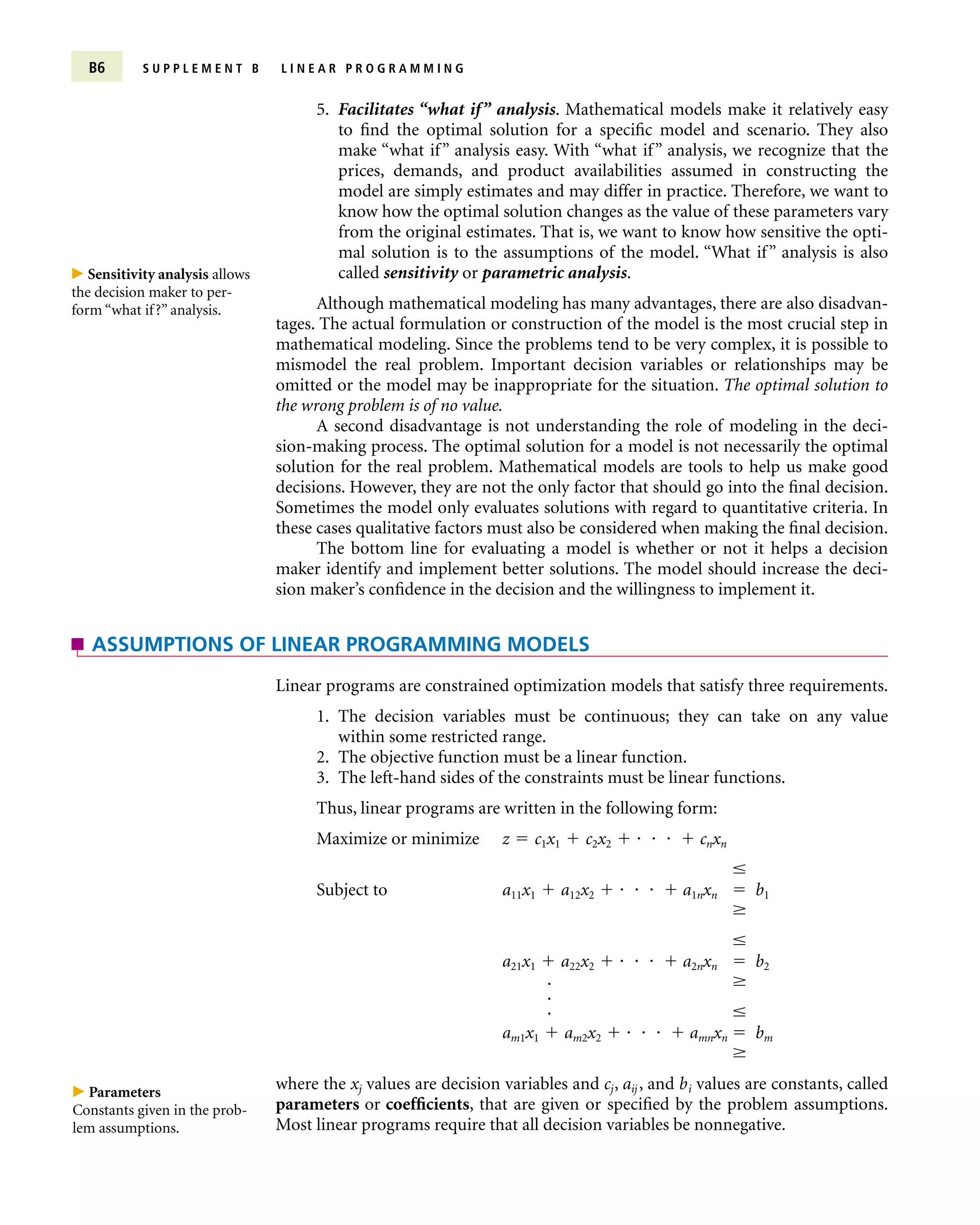
Thus, linear programs are written in the following form:
Maximize or minimize z  c1x1  c2x2      cnxn

Subject to a11x1  a12x2      a1nxn  b1


a21x1  a22x2      a2nxn  b2


am1x1  am2x2      amnxn  bm

where the xj values are decision variables and cj, aij , and bi values are constants, called
parameters or coefficients, that are given or specified by the problem assumptions.
Most linear programs require that all decision variables be nonnegative.
ASSUMPTIONS OF LINEAR PROGRAMMING MODELS
 Sensitivity analysis allows
the decision maker to per-
form “what if?” analysis.
 Parameters
Constants given in the prob-
lem assumptions.
Linear programs make the following implicit assumptions.
1. Proportionality. With linear programs, we assume that the contribution of
individual variables in the objective function and constraints is proportional
to their value. That is, if we double the value of a variable, we double the
contribution of that variable to the objective function and each constraint in
which the variable appears. The contribution per unit of the variable is con-
stant. For example, suppose the variable xj is the number of units of product
j produced and cj is the cost per unit to produce product j. If doubling the
amount of product j produced doubles its cost, the per unit cost is constant
and the proportionality assumption is satisfied.
2. Additivity. Additivity means that the total value of the objective function
and each constraint function is obtained by adding up the individual contri-
butions from each variable.
3. Divisibility. The decision variables are allowed to take on any real numerical
values within some range specified by the constraints. That is, the variables
are not restricted to integer values. When fractional values do not make a
sensible solution, such as the number of flights an airline should have each
day between two cities, the problem should be formulated and solved as an
integer program.
4. Certainty. We assume that the parameter values in the model are known
with certainty or are at least treated that way. The optimal solution obtained
is optimal for the specific problem formulated. If the parameter values are
wrong, then the resulting solution is of little value.
In practice, the assumptions of proportionality and additivity need the greatest
care and are most likely to be violated by the modeler. With experience, we recognize
when integer solutions are needed and the variables must be modeled explicitly.
F O R M U L A T I N G L I N E A R P R O G R A M S B7
This section presents simple examples of real managerial problems that can be for-
mulated as linear programs. Each example has a name describing the type of prob-
lem. In real life, problems are seldom as pure and clean as these examples. Do not try
to memorize and match the problems illustrated here with real problems you may en-
counter. In practice, problems may contain a mixture of features from several of the
categories illustrated here. You should focus on why and how various physical rela-
tionships are best represented in model form.
Model formulation is the most important and the most difficult aspect of solv-
ing a real problem. Solving a model that does not accurately represent the real prob-
lem is useless. There is no simple way to formulate optimization problems, but the
following suggestions may help.
Steps in Problem Formulation
1. Identify and define the decision variables for the problem. Define the vari-
ables completely and precisely. All units of measure need to be stated explic-
itly, including time units if appropriate. For example, if the variables repre-
sent quantities of a product produced, these should be defined in terms of
tons per hour, units per day, barrels per month, or some other appropriate
units.
FORMULATING LINEAR PROGRAMS
 Proportionality means
that the contribution of indi-
vidual variables in the objec-
tive function is proportional
to their value.
 Additivity means the total
value of the objective func-
tion and each constraint is
the sum of the individual
contributions from each vari-
able.
 Divisibility means the de-
cision variables can take on
any real numerical values
within a specified range.
 Certainty means the para-
meters are known.
2. Define the objective function. Determine the criterion for evaluating alterna-
tive solutions. The objective function will normally be the sum of terms
made up of a variable multiplied by some appropriate coefficient (parame-
ter). For example, the coefficients might be profit per unit of production, dis-
tance travel per unit transported, or cost per person hired.
3. Identify and express mathematically all of the relevant constraints. It is
often easier to express each constraint in words before putting it into math-
ematical form. The written constraint is decomposed into its fundamental
components. Then substitute the appropriate numerical coefficients and
variable names for the written terms. A common mistake is using variables
that have not been defined in the problem, which is not valid. This mistake
is frequently caused by not defining the original variables precisely. The for-
mulation process is iterative, and sometimes additional variables must be
defined or existing variables redefined. For example, if one of the variables
is the total production of the company and five other variables represent
the production at the company’s five plants, then there must be a constant
that forces total production to equal the sum of the production at the
plants.
Let’s look at the formulation process for typical operations problems.
Feed Mix or Diet Problem
One of the first problems solved using linear programming is the feed mix problem,
which is illustrated in Example B.2.
B8 S U P P L E M E N T B L I N E A R P R O G R A M M I N G
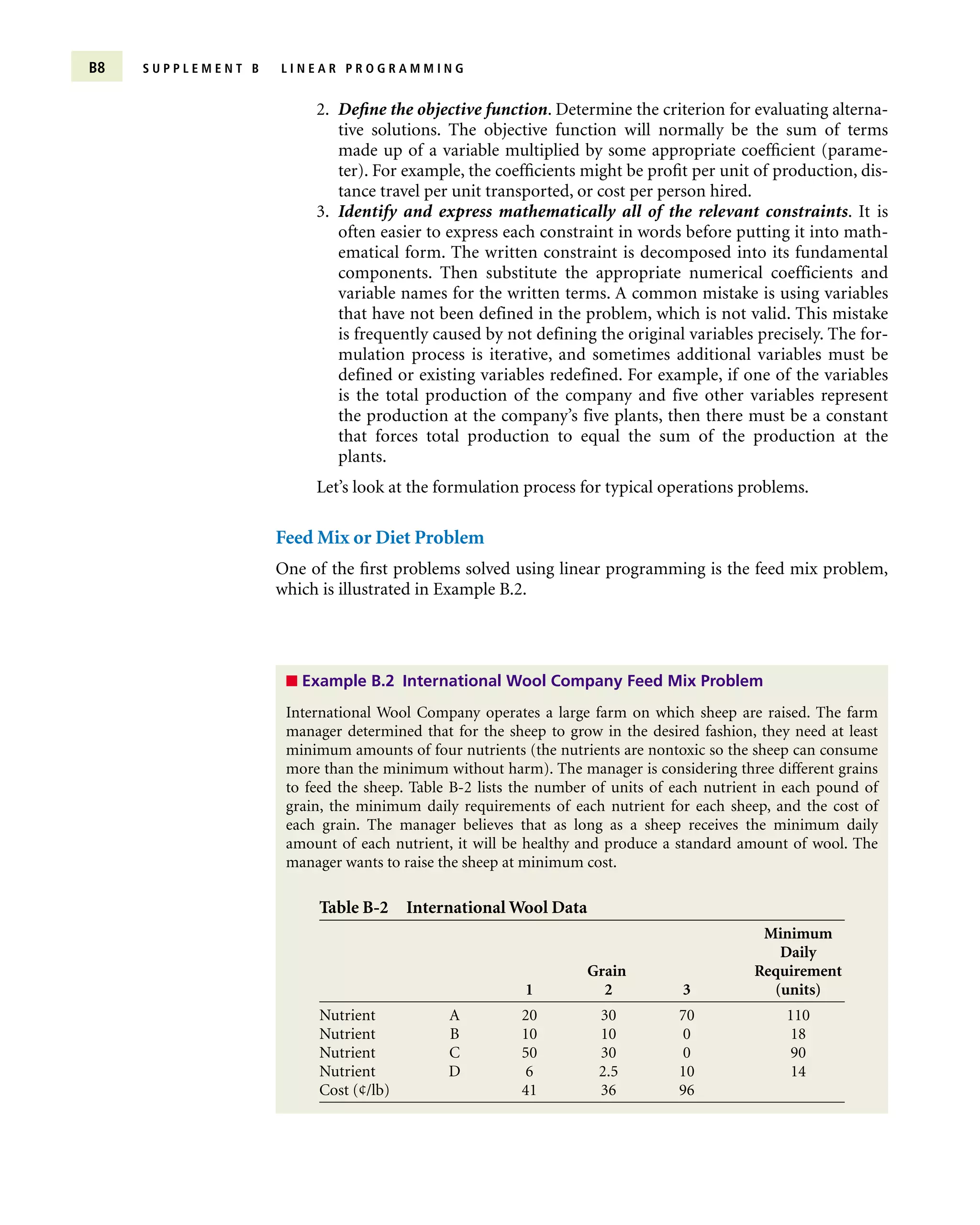
■ Example B.2 International Wool Company Feed Mix Problem
Table B-2 International Wool Data
Minimum
Daily
Grain Requirement
1 2 3 (units)
Nutrient A 20 30 70 110
Nutrient B 10 10 0 18
Nutrient C 50 30 0 90
Nutrient D 6 2.5 10 14
Cost (¢/lb) 41 36 96
International Wool Company operates a large farm on which sheep are raised. The farm
manager determined that for the sheep to grow in the desired fashion, they need at least
minimum amounts of four nutrients (the nutrients are nontoxic so the sheep can consume
more than the minimum without harm). The manager is considering three different grains
to feed the sheep. Table B-2 lists the number of units of each nutrient in each pound of
grain, the minimum daily requirements of each nutrient for each sheep, and the cost of
each grain. The manager believes that as long as a sheep receives the minimum daily
amount of each nutrient, it will be healthy and produce a standard amount of wool. The
manager wants to raise the sheep at minimum cost.
F O R M U L A T I N G L I N E A R P R O G R A M S B9
Solution
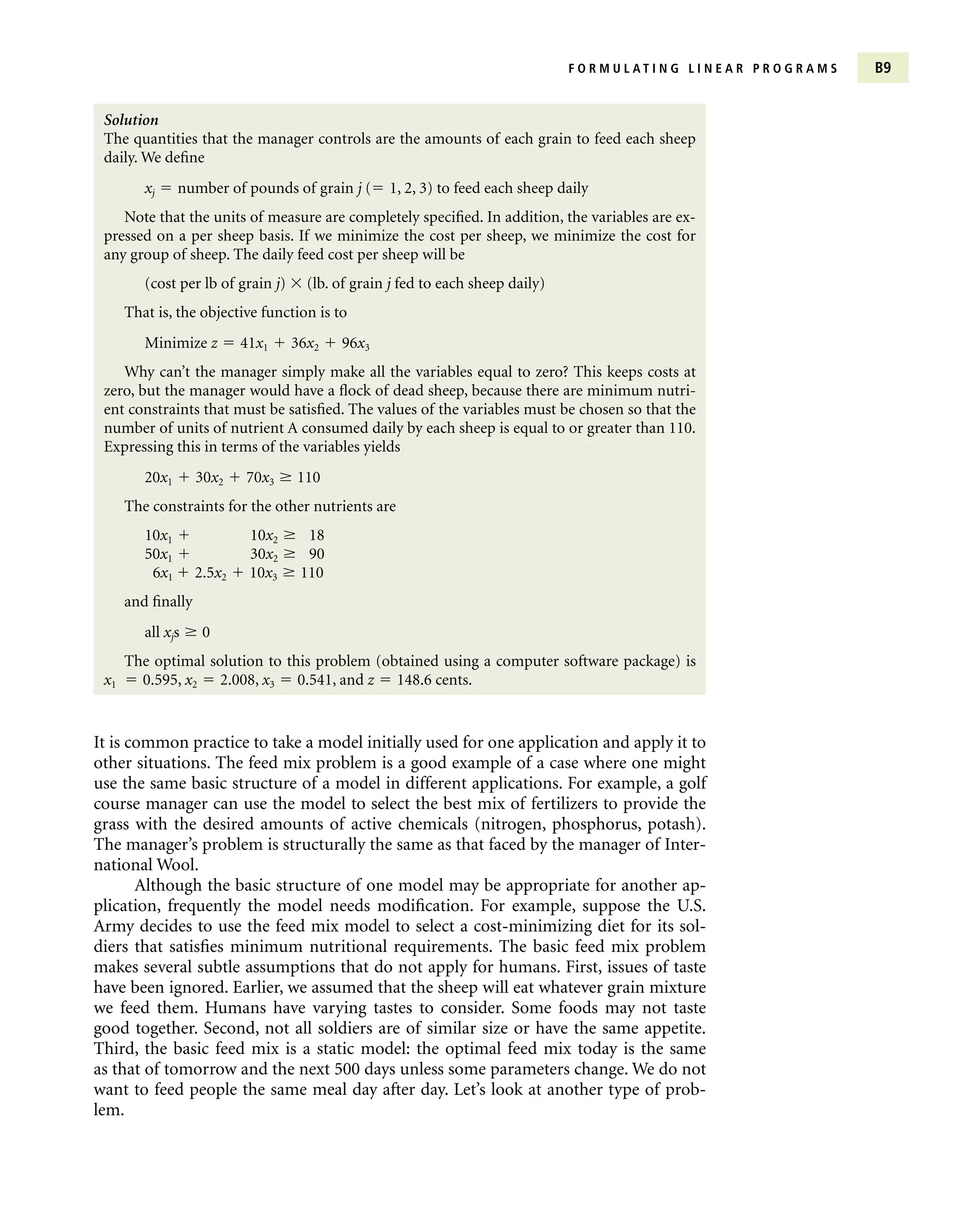
The quantities that the manager controls are the amounts of each grain to feed each sheep
daily. We define
xj  number of pounds of grain j ( 1, 2, 3) to feed each sheep daily
Note that the units of measure are completely specified. In addition, the variables are ex-
pressed on a per sheep basis. If we minimize the cost per sheep, we minimize the cost for
any group of sheep. The daily feed cost per sheep will be
(cost per lb of grain j)  (lb. of grain j fed to each sheep daily)
That is, the objective function is to
Minimize z  41x1  36x2  96x3
Why can’t the manager simply make all the variables equal to zero? This keeps costs at
zero, but the manager would have a flock of dead sheep, because there are minimum nutri-
ent constraints that must be satisfied. The values of the variables must be chosen so that the
number of units of nutrient A consumed daily by each sheep is equal to or greater than 110.
Expressing this in terms of the variables yields
20x1  30x2  70x3  110
The constraints for the other nutrients are
10x1  10x2  18
50x1  30x2  90
6x1  2.5x2  10x3  110
and finally
all xjs  0
The optimal solution to this problem (obtained using a computer software package) is
x1  0.595, x2  2.008, x3  0.541, and z  148.6 cents.
It is common practice to take a model initially used for one application and apply it to
other situations. The feed mix problem is a good example of a case where one might
use the same basic structure of a model in different applications. For example, a golf
course manager can use the model to select the best mix of fertilizers to provide the
grass with the desired amounts of active chemicals (nitrogen, phosphorus, potash).
The manager’s problem is structurally the same as that faced by the manager of Inter-
national Wool.
Although the basic structure of one model may be appropriate for another ap-
plication, frequently the model needs modification. For example, suppose the U.S.
Army decides to use the feed mix model to select a cost-minimizing diet for its sol-
diers that satisfies minimum nutritional requirements. The basic feed mix problem
makes several subtle assumptions that do not apply for humans. First, issues of taste
have been ignored. Earlier, we assumed that the sheep will eat whatever grain mixture
we feed them. Humans have varying tastes to consider. Some foods may not taste
good together. Second, not all soldiers are of similar size or have the same appetite.
Third, the basic feed mix is a static model: the optimal feed mix today is the same
as that of tomorrow and the next 500 days unless some parameters change. We do not
want to feed people the same meal day after day. Let’s look at another type of prob-
lem.
Blending Problem
In the Healthy Pet Food example, a product mix problem, the company determines
how much of various products to make. The mixture of inputs used in each product
is fixed. In many industries such as the oil, chemical, paper, metals, and food process-
ing industries, a company controls how much of a product to make and the mix of in-
puts to use in making it. This is called a blending problem.
B10 S U P P L E M E N T B L I N E A R P R O G R A M M I N G
■ Example B.3 Solar Oil Company Blending Problem
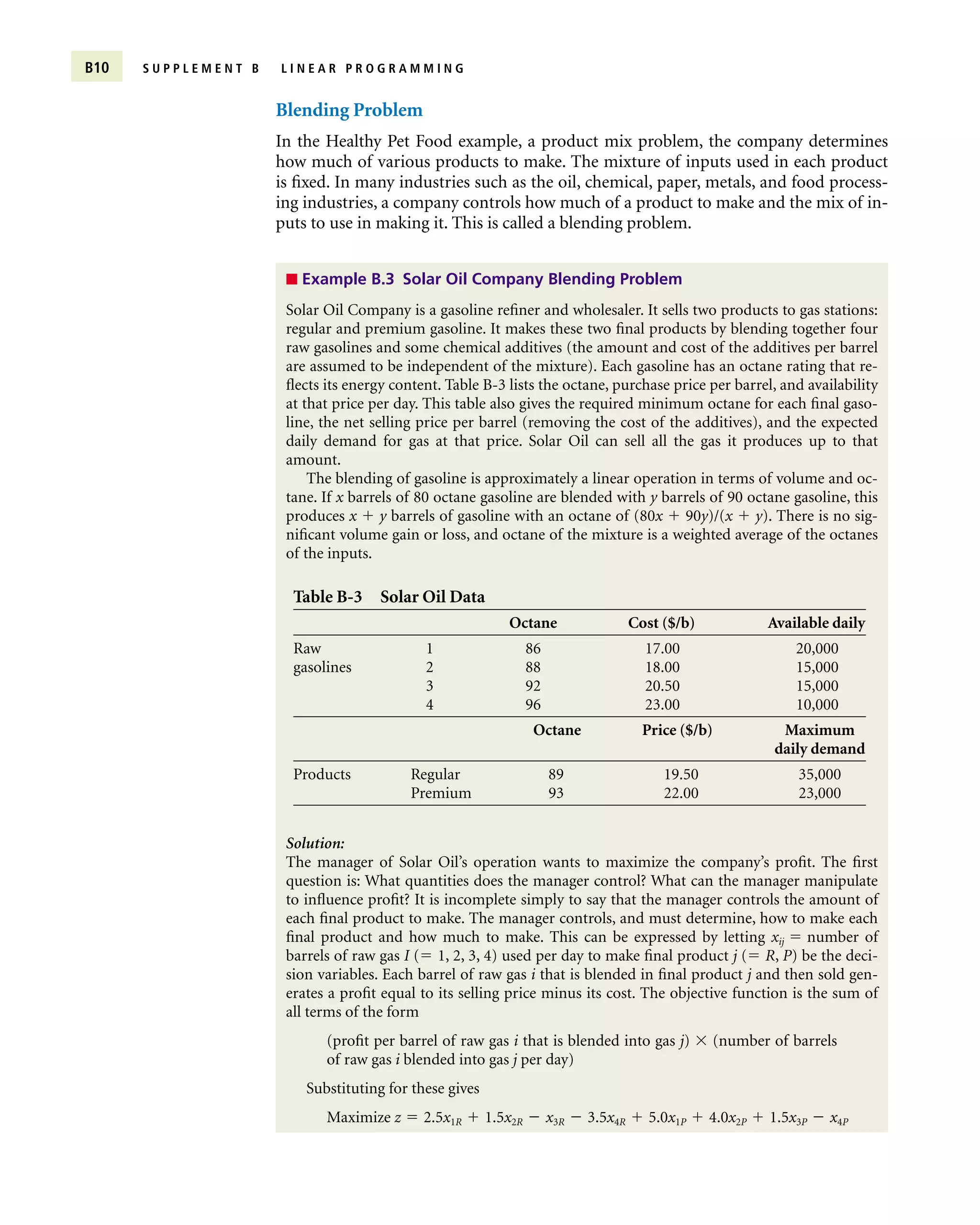
Table B-3 Solar Oil Data
Octane Cost ($/b) Available daily
Raw 1 86 17.00 20,000
gasolines 2 88 18.00 15,000
3 92 20.50 15,000
4 96 23.00 10,000
Octane Price ($/b) Maximum
daily demand
Products Regular 89 19.50 35,000
Premium 93 22.00 23,000
Solar Oil Company is a gasoline refiner and wholesaler. It sells two products to gas stations:
regular and premium gasoline. It makes these two final products by blending together four
raw gasolines and some chemical additives (the amount and cost of the additives per barrel
are assumed to be independent of the mixture). Each gasoline has an octane rating that re-
flects its energy content. Table B-3 lists the octane, purchase price per barrel, and availability
at that price per day. This table also gives the required minimum octane for each final gaso-
line, the net selling price per barrel (removing the cost of the additives), and the expected
daily demand for gas at that price. Solar Oil can sell all the gas it produces up to that
amount.
The blending of gasoline is approximately a linear operation in terms of volume and oc-
tane. If x barrels of 80 octane gasoline are blended with y barrels of 90 octane gasoline, this
produces x  y barrels of gasoline with an octane of (80x  90y)/(x  y). There is no sig-
nificant volume gain or loss, and octane of the mixture is a weighted average of the octanes
of the inputs.
Solution:
The manager of Solar Oil’s operation wants to maximize the company’s profit. The first
question is: What quantities does the manager control? What can the manager manipulate
to influence profit? It is incomplete simply to say that the manager controls the amount of
each final product to make. The manager controls, and must determine, how to make each
final product and how much to make. This can be expressed by letting xij  number of
barrels of raw gas I ( 1, 2, 3, 4) used per day to make final product j ( R, P) be the deci-
sion variables. Each barrel of raw gas i that is blended in final product j and then sold gen-
erates a profit equal to its selling price minus its cost. The objective function is the sum of
all terms of the form
(profit per barrel of raw gas i that is blended into gas j)  (number of barrels
of raw gas i blended into gas j per day)
Substituting for these gives
Maximize z  2.5x1R  1.5x2R  x3R  3.5x4R  5.0x1P  4.0x2P  1.5x3P  x4P
F O R M U L A T I N G L I N E A R P R O G R A M S B11
Note that the coefficients for some variables are negative. For example, Solar loses $1.00
on each barrel of raw gas 4 that is blended into premium. Does this imply that the optimal
value for these variables must be zero and that they can be dropped from the problem? No!
In blending operations, it is common for some low-cost materials to be combined with
high-cost materials. Although it appears that we are losing money on the high-cost materi-
als, they make the low-cost materials more valuable, and often the final product cannot be
made without them. For example, tungsten steel combines low-cost iron ore or scrap (worth
$100/ton) with tungsten (costing thousands of dollars per ton) to make steel that might sell
for $500 per ton. The manufacturer loses money on the tungsten (on a per ton basis) but is
more than compensated by the enhanced value of the iron ore. Therefore, we do not omit
variables from the problem unless we can prove that their optimum value is zero.
The next step is to identify the constraints. The availability constraint for each raw gaso-
line is
barrels of raw gas i used per day  barrels of gas i available per day
The number of barrels of raw gas i used each day is the amount used to make regular
gasoline xiR plus the amount used each day to make premium gasoline xiP. The availability
constraints can be written as
x1R  x1P  20,000
x2R  x2P  15,000
x3R  x3P  15,000
x4R  x4P  10,000
The demand constraints put an upper limit on how much regular and premium gasoline
can be sold. The total amount made of each is the sum of the raw gasolines allocated to
making each gasoline each day. In other words,
x1R  x2R  x3R  x4R  35,000
x1P  x2P  x3P  x4P  23,000
If the model formulation is left at this stage, the optimal solution is to mix the lowest-
cost gasolines into the final products, regardless of octane. Therefore, we need to include
constraints that guarantee the variables will take on values that produce final gasolines with
at least the minimum specified octane ratings. The octane rating of the regular gasoline that
is produced will be a weighted average of the octanes of the raw gasolines used; that is,
octane of regular  [86 (barrels of raw gas 1 used/day to make regular) 
88 (barrels of raw gas 2 used/day to make regular)      96 (barrels of raw
gas 4 used/day to make regular)]/[total barrels of raw gases blended into regular
gasoline]
which should be at least 89. Substituting the appropriate variable names for these quantities
produces the constraint
[86x1R  88x2R  92x3R  96x4R]/[x1R  x2R  x3R  x4R]  89
Multiplying both sides by (x1R  x2R  x3R  x4R) and then gathering terms so that
variables appear only once and all are on the left-hand side yields
3x1R  x2R  x3R  7x4R  0
Using the same approach to guarantee an octane of 93 for premium gas produces the
constraint
7x1R  5x2R  x3R  3x4R  0
Finally, all variables should be nonnegative in value. The optimal solution to this linear
program is x1R  11,428.57, x2R  9107.14, x3R  14,464.29, x4R  0, x1P  0, x2P 
5892.86, x3P  535.71, x4P  10,000, and z  $42,142.86 daily.
B12 S U P P L E M E N T B L I N E A R P R O G R A M M I N G
In this example, fractional amounts of raw gasoline input are perfectly reasonable.
Fluids can be finely measured and the solution represents a flow rate. However, even
for a simple problem of this sort, the optimal solution is far from obvious. With linear
programming the daily profit might be 3 to 5% better than that achieved using an in-
telligent seat-of-the-pants approach. A 3% savings represents approximately $350,000
to $400,000 per year. Not bad, for using a simple model. As raw material prices
change, the optimal blend and output levels are quickly revised.
Multiperiod Planning Problem
Linear programming is used extensively for planning and scheduling of operations.
One form of planning is called aggregate planning, which concentrates on scheduling
production, personnel, and inventory levels during intermediate-term planning hori-
zons. The following example is a simple version of aggregate planning.
■ Example B.4 Basel Tool and Die Company Multiperiod Planning Problem
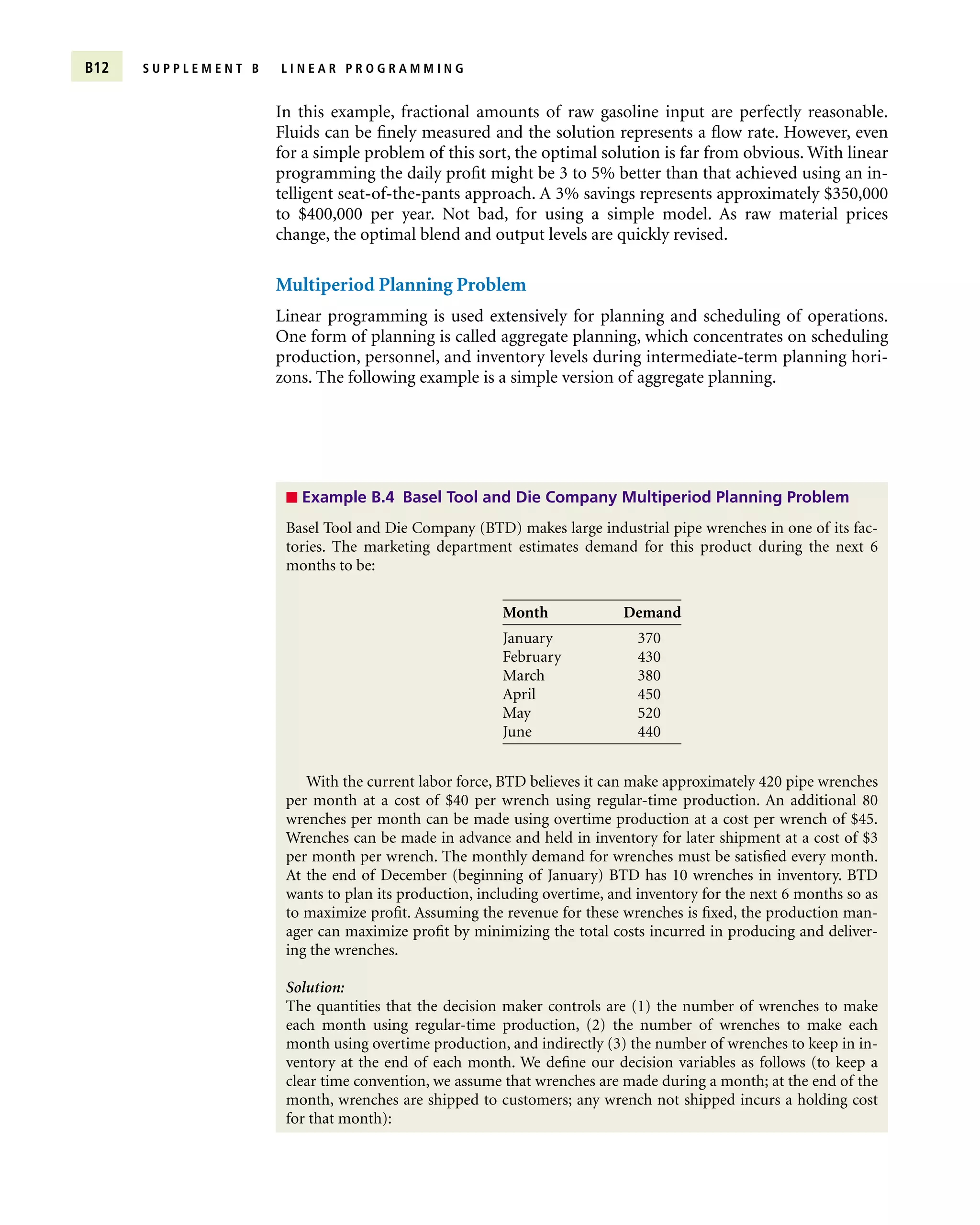
Month Demand
January 370
February 430
March 380
April 450
May 520
June 440
Basel Tool and Die Company (BTD) makes large industrial pipe wrenches in one of its fac-
tories. The marketing department estimates demand for this product during the next 6
months to be:
With the current labor force, BTD believes it can make approximately 420 pipe wrenches
per month at a cost of $40 per wrench using regular-time production. An additional 80
wrenches per month can be made using overtime production at a cost per wrench of $45.
Wrenches can be made in advance and held in inventory for later shipment at a cost of $3
per month per wrench. The monthly demand for wrenches must be satisfied every month.
At the end of December (beginning of January) BTD has 10 wrenches in inventory. BTD
wants to plan its production, including overtime, and inventory for the next 6 months so as
to maximize profit. Assuming the revenue for these wrenches is fixed, the production man-
ager can maximize profit by minimizing the total costs incurred in producing and deliver-
ing the wrenches.
Solution:
The quantities that the decision maker controls are (1) the number of wrenches to make
each month using regular-time production, (2) the number of wrenches to make each
month using overtime production, and indirectly (3) the number of wrenches to keep in in-
ventory at the end of each month. We define our decision variables as follows (to keep a
clear time convention, we assume that wrenches are made during a month; at the end of the
month, wrenches are shipped to customers; any wrench not shipped incurs a holding cost
for that month):
F O R M U L A T I N G L I N E A R P R O G R A M S B13
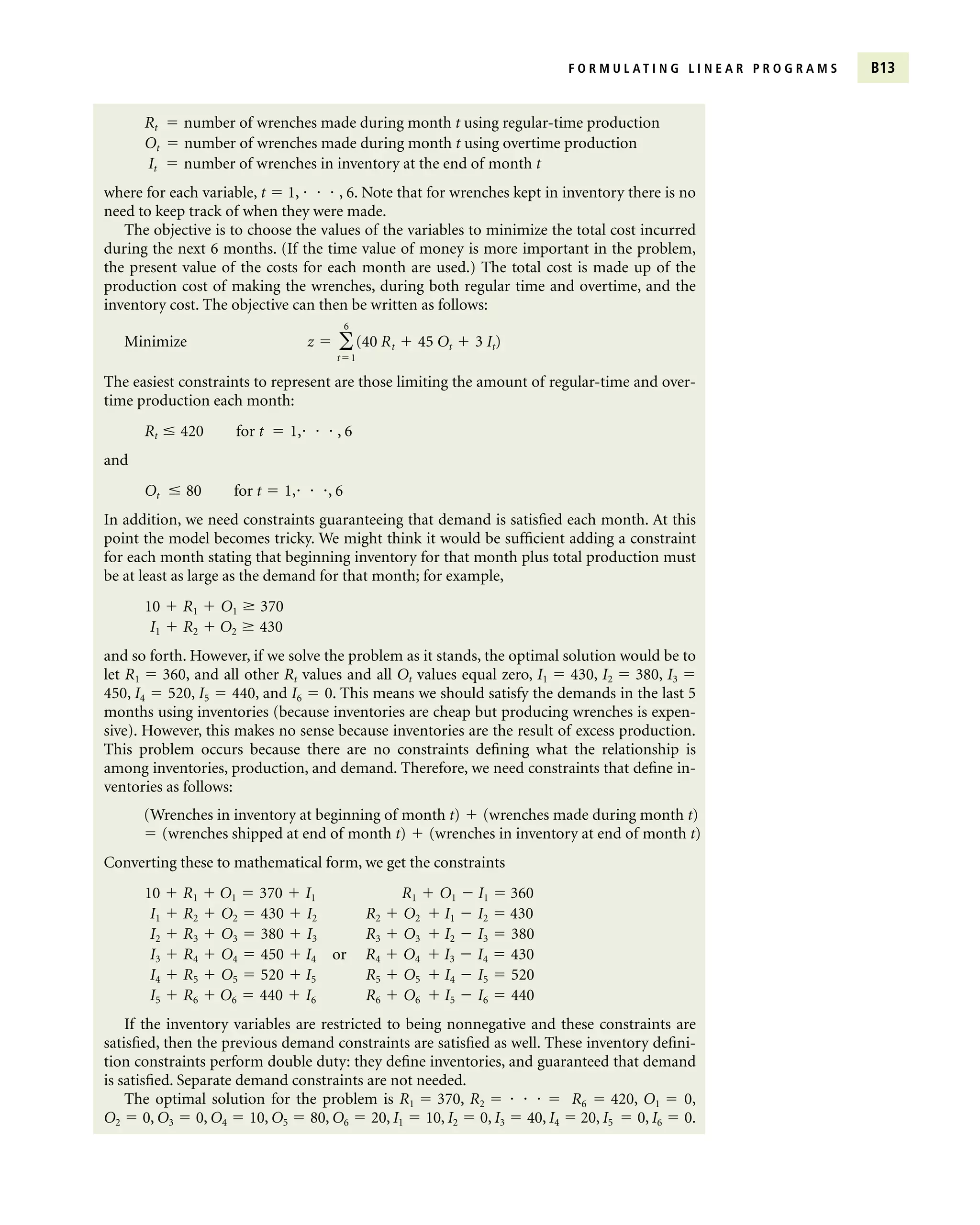
Rt  number of wrenches made during month t using regular-time production
Ot  number of wrenches made during month t using overtime production
It  number of wrenches in inventory at the end of month t
where for each variable, t  1,    , 6. Note that for wrenches kept in inventory there is no
need to keep track of when they were made.
The objective is to choose the values of the variables to minimize the total cost incurred
during the next 6 months. (If the time value of money is more important in the problem,
the present value of the costs for each month are used.) The total cost is made up of the
production cost of making the wrenches, during both regular time and overtime, and the
inventory cost. The objective can then be written as follows:
Minimize
The easiest constraints to represent are those limiting the amount of regular-time and over-
time production each month:
Rt  420 for t  1,   , 6
and
Ot  80 for t  1,  , 6
In addition, we need constraints guaranteeing that demand is satisfied each month. At this
point the model becomes tricky. We might think it would be sufficient adding a constraint
for each month stating that beginning inventory for that month plus total production must
be at least as large as the demand for that month; for example,
10  R1  O1  370
I1  R2  O2  430
and so forth. However, if we solve the problem as it stands, the optimal solution would be to
let R1  360, and all other Rt values and all Ot values equal zero, I1  430, I2  380, I3 
450, I4  520, I5  440, and I6  0. This means we should satisfy the demands in the last 5
months using inventories (because inventories are cheap but producing wrenches is expen-
sive). However, this makes no sense because inventories are the result of excess production.
This problem occurs because there are no constraints defining what the relationship is
among inventories, production, and demand. Therefore, we need constraints that define in-
ventories as follows:
(Wrenches in inventory at beginning of month t)  (wrenches made during month t)
 (wrenches shipped at end of month t)  (wrenches in inventory at end of month t)
Converting these to mathematical form, we get the constraints
10  R1  O1  370  I1 R1  O1  I1  360
I1  R2  O2  430  I2 R2  O2  I1  I2  430
I2  R3  O3  380  I3 R3  O3  I2  I3  380
I3  R4  O4  450  I4 or R4  O4  I3  I4  430
I4  R5  O5  520  I5 R5  O5  I4  I5  520
I5  R6  O6  440  I6 R6  O6  I5  I6  440
If the inventory variables are restricted to being nonnegative and these constraints are
satisfied, then the previous demand constraints are satisfied as well. These inventory defini-
tion constraints perform double duty: they define inventories, and guaranteed that demand
is satisfied. Separate demand constraints are not needed.
The optimal solution for the problem is R1  370, R2      R6  420, O1  0,
O2  0, O3  0, O4  10, O5  80, O6  20, I1  10, I2  0, I3  40, I4  20, I5  0, I6  0.
z  
6
t1
(40 Rt  45 Ot  3 It)
B14 S U P P L E M E N T B L I N E A R P R O G R A M M I N G
The characteristic that makes linear programs easy to solve is their simple geometric
structure. Let’s define some terminology. A solution for a linear program is any set of
numerical values for the variables. These values need not be the best values and do not
even have to satisfy the constraints or make sense. For example, in the Healthy Pet Food
problem, M  25 and Y  800 is a solution, but it does not satisfy the constraints,
nor does it make physical sense. A feasible solution is a solution that satisfies all of the
constraints. The feasible set or feasible region is the set of all feasible solutions. Finally,
an optimal solution is the feasible solution that produces the best objective function
value possible. Figure B-1 shows the relationships among these types of solutions.
Let’s use the Healthy Pet Food example to show the geometry of linear pro-
grams and to show how two-variable problems can be solved graphically. The linear
programming formulation for the Healthy Pet Food problem is:
Maximize z  0.65M  0.45Y
Subject to 2M  3Y  400,000
3M  1.5Y  300,000
M  90,000
M, Y  0
THE GEOMETRY OF LINEAR PROGRAMS
Optimal solutions
Feasible solutions
All solutions
Figure B-1
Relationship among solutions
50
0 100
Packages of Meaties/mo (000)
Packages
of
Yummies/mo
(000)
90 150 200
50
100
M
=
90,000
150
3
M
+
1
.
5
Y
=
3
0
0
,
0
0
0
2 M
+ 3 Y = 400,000
133.33
200
Feasible
set
Y
M
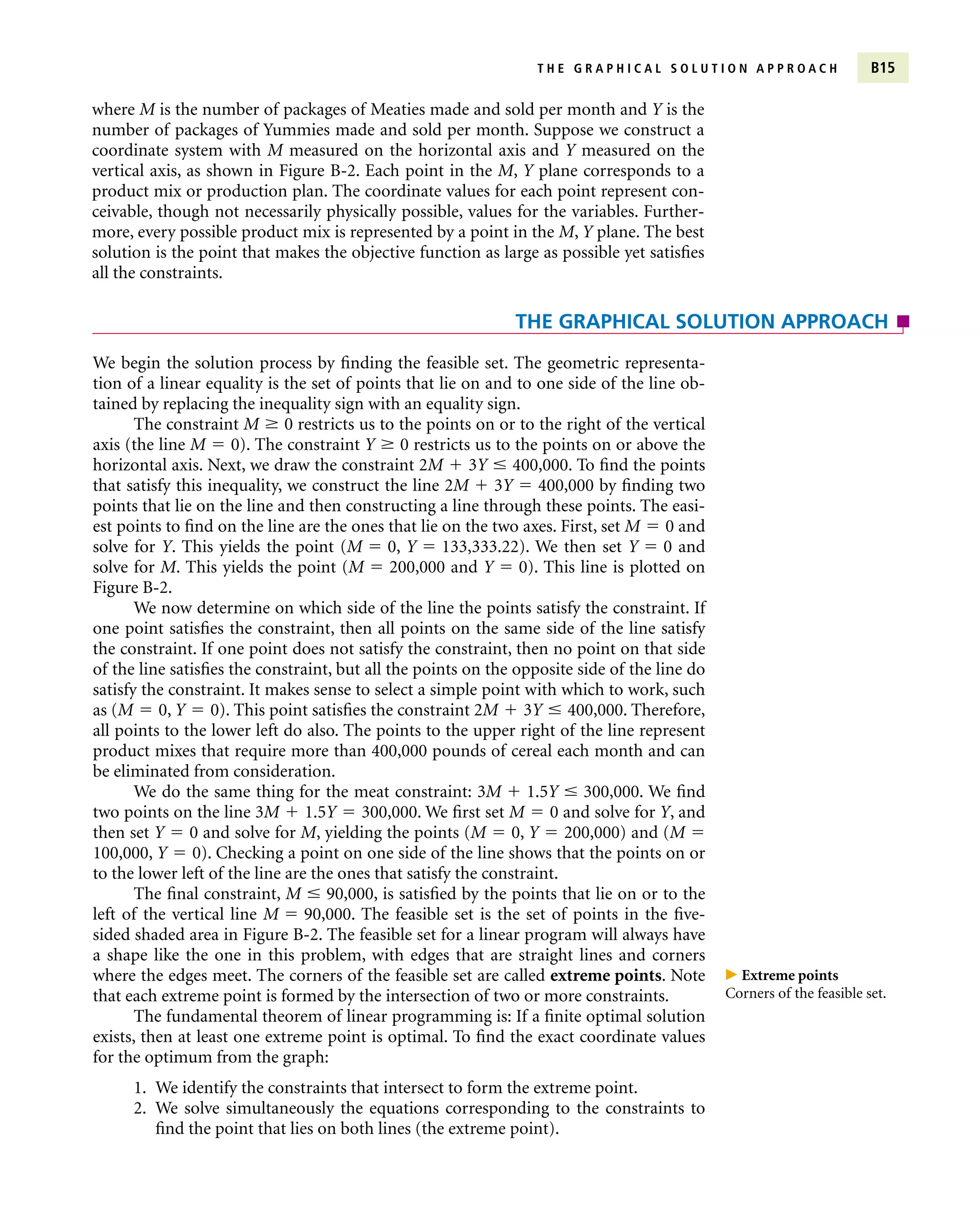
Figure B-2.
Graphical representation of the
Healthy Pet Food problem
 A feasible solution satisfies
all of the constraints.
 Feasible set
Set containing all of the feasi-
ble solutions.
 Optimal solution
Feasible solution that pro-
duces the best objective func-
tion value.
T H E G R A P H I C A L S O L U T I O N A P P R O A C H B15
We begin the solution process by finding the feasible set. The geometric representa-
tion of a linear equality is the set of points that lie on and to one side of the line ob-
tained by replacing the inequality sign with an equality sign.
The constraint M  0 restricts us to the points on or to the right of the vertical
axis (the line M  0). The constraint Y  0 restricts us to the points on or above the
horizontal axis. Next, we draw the constraint 2M  3Y  400,000. To find the points
that satisfy this inequality, we construct the line 2M  3Y  400,000 by finding two
points that lie on the line and then constructing a line through these points. The easi-
est points to find on the line are the ones that lie on the two axes. First, set M  0 and
solve for Y. This yields the point (M  0, Y  133,333.22). We then set Y  0 and
solve for M. This yields the point (M  200,000 and Y  0). This line is plotted on
Figure B-2.
We now determine on which side of the line the points satisfy the constraint. If
one point satisfies the constraint, then all points on the same side of the line satisfy
the constraint. If one point does not satisfy the constraint, then no point on that side
of the line satisfies the constraint, but all the points on the opposite side of the line do
satisfy the constraint. It makes sense to select a simple point with which to work, such
as (M  0, Y  0). This point satisfies the constraint 2M  3Y  400,000. Therefore,
all points to the lower left do also. The points to the upper right of the line represent
product mixes that require more than 400,000 pounds of cereal each month and can
be eliminated from consideration.
We do the same thing for the meat constraint: 3M  1.5Y  300,000. We find
two points on the line 3M  1.5Y  300,000. We first set M  0 and solve for Y, and
then set Y  0 and solve for M, yielding the points (M  0, Y  200,000) and (M 
100,000, Y  0). Checking a point on one side of the line shows that the points on or
to the lower left of the line are the ones that satisfy the constraint.
The final constraint, M  90,000, is satisfied by the points that lie on or to the
left of the vertical line M  90,000. The feasible set is the set of points in the five-
sided shaded area in Figure B-2. The feasible set for a linear program will always have
a shape like the one in this problem, with edges that are straight lines and corners
where the edges meet. The corners of the feasible set are called extreme points. Note
that each extreme point is formed by the intersection of two or more constraints.
The fundamental theorem of linear programming is: If a finite optimal solution
exists, then at least one extreme point is optimal. To find the exact coordinate values
for the optimum from the graph:
1. We identify the constraints that intersect to form the extreme point.
2. We solve simultaneously the equations corresponding to the constraints to
find the point that lies on both lines (the extreme point).
THE GRAPHICAL SOLUTION APPROACH
where M is the number of packages of Meaties made and sold per month and Y is the
number of packages of Yummies made and sold per month. Suppose we construct a
coordinate system with M measured on the horizontal axis and Y measured on the
vertical axis, as shown in Figure B-2. Each point in the M, Y plane corresponds to a
product mix or production plan. The coordinate values for each point represent con-
ceivable, though not necessarily physically possible, values for the variables. Further-
more, every possible product mix is represented by a point in the M, Y plane. The best
solution is the point that makes the objective function as large as possible yet satisfies
all the constraints.
 Extreme points
Corners of the feasible set.
B16 S U P P L E M E N T B L I N E A R P R O G R A M M I N G
In this example, the optimal extreme point is formed by the intersection of the
lines 2M  3Y  400,000 and 3M  1.5Y  300,000.
To solve equations simultaneously, we use the following property. We can either
(1) multiply any constraint by a nonzero constant or (2) add or subtract a multiple of
any equation to or from any other equation, without changing the set of solutions
that the equations have simultaneously.
Therefore, to solve simultaneously the equations
2M  3Y  400,000
3M  1.5Y  300,000
we can subtract two times the second equation from the first equation, leaving
4M  200,000
3M  1.5Y  300,000
The first equation is easily solved: M  50,000. Substituting this value into the second
equation gives 3(50,000)  1.5Y  300,000, or Y  100,000. This method can be used
for any set of linear equations as long as the number of variables and equations is equal.
Multiple Optima, Infeasible Problems, and Unbounded Problems
Three conditions or qualifications should be noted in the fundamental theorem of
linear programming. First, the theorem does not say that only extreme points can be
optimal. Second, it applies only if a feasible solution exists. Third, the optimum must
be finite.
Multiple Optima If a finite optimum exists for the problem, there is an extreme
point that is optimal, but it may not be unique. Two or more adjacent extreme points
(they share a common edge) may tie for the best solution. In this case not only are ex-
treme points optimal, but all points on the edge connecting them are optimal. This
would occur in the Healthy Pet Food example if the objective function is to maximize
z  0.30M  0.45Y. Extreme points (M  0, Y  133,333.33) and (M  50,000,
Y  100,000) both yield a $60,000 profit. Every product mix on the line segment
connecting these extreme points is optimal, such as M  20,000, Y  120,000.
Infeasible Problem In real life, we often face situations in which it is impossible to
satisfy all the restrictions confronting us. For example, suppose Healthy Pet Food
wanted to supply at least 160,000 packages of dog food each month; that is M  Y 
160,000. No points satisfy the original constraints and M  Y  160,000 simultane-
ously. Identifying this situation is useful because we can then identify which con-
straints might be relaxed to obtain a feasible solution and what the consequences of
relaxing the constraints will be.
Unbounded Problem Sometimes a linear program has an unbounded solution. In
this situation the objective function can achieve a value of positive infinity for a maxi-
mization problem or negative infinity for a minimization problem. For example, con-
sider the problem
Maximize z  A  2B
Subject to A  10
2A  B  5
A, B  0
As long as A is kept less than or equal to 10, B can be increased without limit
and the objective function increases without limit. There is no finite optimum. Note
that unboundedness refers to the objective function value, not the constraint set. It is
true that for the objective function to be unbounded the feasible region must be un-
bounded in some direction. However, an unbounded feasible set does not imply that
there is no finite optimum. To see this, we simply have to change the objective of the
preceding example to minimize A  2B. The feasible set is unaffected, and therefore
still unbounded in some direction. However, the optimal solution is (A  2.5, B  0,
z  2.5).
Although infeasible problems can occur in practice, an unbounded problem
generally indicates the modeler forgot or misrepresented one or more constraints,
such as a limit on demand for a product or the supply of a resource. When an un-
bounded problem is encountered, the modeler should study the situation to see what
limitations exist that are not being explicitly stated in the constraints.
T H E S I M P L E X A L G O R I T H M B17
THE SIMPLEX ALGORITHM
In 1949, George Dantzig developed an efficient procedure for solving linear programs
called the simplex method or simplex algorithm. This is the most widely used
method in instructional and commercial computer packages. A method developed by
Narendra Karmarkar in 1984 is gaining popularity, but since it requires more sophis-
ticated mathematics, it is not presented here.
The fundamental theorem of linear programming reduces to a finite value the
number of feasible solutions that need to be evaluated. One solution strategy might
be to identify the coordinates of every extreme point and then evaluate the objective
function at each. The one that produces the best objective function value is the opti-
mum. In practice, this approach is not efficient because the number of extreme points
can be very large for real problems with hundreds or thousands of variables and con-
straints.
The simplex algorithm begins by identifying an initial extreme point of the
feasible set. The algorithm then looks along each edge intersecting at the extreme
point and computes the net effect on the objective function if we were to move
along the edge. If the objective function value does not improve by moving along at
least one of these edges, it can be proved that the extreme point is optimal. If move-
ment along one or more of the edges improves the objective function value, we
move along one of these edges until we reach a new extreme point. We repeat the
previous steps: checking along each edge intersecting at the extreme point, and then
either stopping or sliding along another edge that improves the objective function
value.
This algorithm has many desirable features in practice.
1. It only moves from one extreme point to a better or equally good extreme
point, thereby skipping large numbers of suboptimal extreme points without
explicitly identifying them. Thus it usually only has to check a small subset of
the extreme points to find an optimum.
2. When it finds an optimum, it identifies this fact and stops.
3. The algorithm detects whether the problem is infeasible, is unbounded, or
has multiple optima.
4. The algorithm uses very simple mathematics that are easy to implement on a
computer.
 Simplex method
Efficient method for solving
linear programs.
Preparing the Problem for Solution
To use the simplex algorithm, we write the problem in canonical form. Four condi-
tions must be satisfied for the problem to be in canonical form.
1. The right-hand sides of all functional constraints (the constraints other than
nonnegativity of the variables) must be nonnegative. Zero is an acceptable
right-hand-side value.
2. All constraints must be written as equalities.
3. All variables must have a  0 restriction.
4. Every functional constraint must contain a variable that appears only in that
constraint and not in any other constraint. That is, the variable has a zero co-
efficient in all other functional constraints. It must have a 1 coefficient in
the constraint in which it appears.
The following shows how to convert a linear program into canonical form.
Nonnegative Right-Hand Sides. Suppose a constraint has a negative right-hand
side, such as
3x1  4x2  2x3  6
The right-hand side can be made nonnegative by multiplying through the entire
constraint by 1, so the constraint becomes
3x1  4x2  2x3  6
Note that the direction of the inequality reverses when the constraint is multi-
plied by a negative constant.
All Constraints Must Be Equalities. Any inequality constraint can be rewritten as
an equivalent equality by introducing a nonnegative variable called a slack variable.
Let’s look at  constraints first.
3x1  4x2  12
If we define a new variable, s1, as s1  12  (3x1  4x2), then this constraint
can be written as
3x1  4x2  s1  12
For any solution, the variable s1 measures the “slack” that exists in the con-
straint. That is, s1 measures by how much a solution satisfies a constraint.
We use a similar approach to convert ≥ constraints into equalities. For example,
consider
2x1  4x2  10
If we define a new variable, s2, so that s2  (2x1  4x2)  10, then we can
rewrite the constraint as
2x1  4x2  s2  10
s2  0
In summary, for  constraints, we add a nonnegative slack variable to the left-
hand side of the constraint, and for  constraints we subtract a nonnegative slack
variable from the left-hand side of the constraint.
B18 S U P P L E M E N T B L I N E A R P R O G R A M M I N G
 Canonical form is needed
to use the simplex method.
Slack variables have physical meaning. For example, slack variables may mea-
sure how much of an available resource is not used for a given solution or how much
of a nutrient an animal receives above some minimum required amount. The slack
variables in each constraint measure something different. Therefore, each one should
have a different designation. A standard convention uses si for a slack variable that has
been incorporated into constraint i.
All Variables Must Be Nonnegative. Most linear programming computer packages
automatically convert right-hand-side constants into nonnegative values and change
constraints into equalities. They assume all variables are nonnegative. If they are not,
the problem must be rewritten so that all variables are nonnegative.
Each Constraint Must Have a Unique Variable with a  1 Coefficient. Using
the Healthy Pet Food problem, we perform the needed steps, giving us the following:
Maximize z  0.65M  0.45Y
Subject to 2M  3Y  s1  400,000
3M  1.5Y  s2  300,000
M  s3  90,000
All variables  0
We check to see whether each constraint has a variable that appears only in that
constraint and has a coefficient of 1. In the first constraint, s1 satisfies this require-
ment; in the second constraint, s2 satisfies it; and in the third constraint, s3 satisfies it.
This problem is in canonical form and ready to solve.
The Algebraic Foundations of the Algorithm
In the initial formulation the number of constraints may exceed the number of vari-
ables. Once the problem is in canonical form, the number of variables k should always
be at least as large as the number of functional constraints m. In the Healthy Pet Food
problem, k  5 and m  3. Because the number of variables exceeds the number of
constraints, there are an infinite number of solutions that satisfy these equations. We
find a solution to these equations by setting the values of k  m of the variables (5 
3  2 in this case) equal to zero and then solving the m equations simultaneously to
obtain the values of the remaining m (three) variables. Any solution obtained using
this procedure is called a basic solution. In a basic solution the k  m variables set
equal to zero are called the nonbasic variables for that solution. The remaining m
variables, the values that are obtained by solving the m equations, are called the basic
variables. Note that basic variables can equal zero. Nonbasic variables must equal
zero. The set of basic variables for a basic solution is called the basis for that solution.
The basic variables are said to be “in the basis” and the nonbasic variables are “not in
the basis.”
Suppose that after we put the Healthy Pet Food problem into canonical form,
we choose M and Y as our nonbasic variables and set them equal to zero. The func-
tion constraints reduce to
s1  400,000
s2  300,000
s3  90,000
T H E S I M P L E X A L G O R I T H M B19
 Nonbasic variables
Variables set equal to zero.
 Basic variables have values
obtained by solving the m
equations.
 Basic solution
Current set of basic variables.
This system of equations is trivial to solve. Once the problem is in canonical
form, a basic solution jumps out at us. The unique variable in each constraint that has
a coefficient of 1 will be the basic variable for that constraint. Not only are there ex-
actly m basic variables, but there is also a one-to-one correspondence between each
constraint and the basic variables. Any variable that is not basic is nonbasic and is set
equal to zero. This reduces the m equations to a form in which each equation has only
one basic variable in it. Therefore, that variable must equal the value on the right-
hand side.
Basic solutions represent the points where constraints intersect. Not all basic so-
lutions are feasible. When a basic solution is feasible, it is called a basic feasible solu-
tion. Basic feasible solutions are the algebraic representation of extreme points. We
know from the fundamental theorem of linear programming that if a finite optimum
exists, an extreme point will be optimal.
The basic feasible solution (M  0, Y  0, s1  400,000, s2  300,000, s3 
90,000) has an objective function value of 0. We want to determine whether this is an
optimal solution. We look along each constraint that intersects at this extreme point.
If the objective function improves by moving along one of the edges, the current solu-
tion is not optimal. If there is no edge along which the objective function improves,
the current solution is optimal.
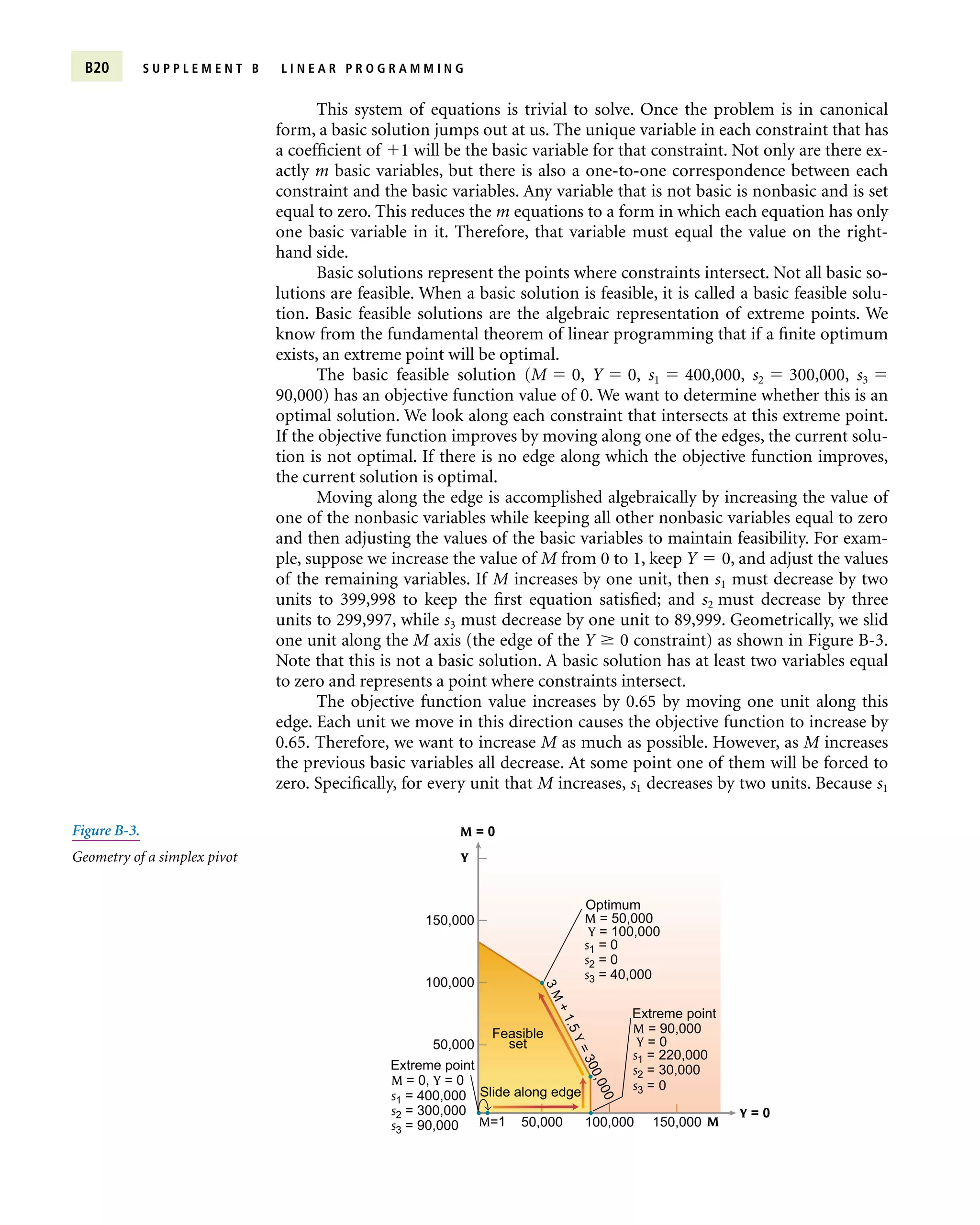
Moving along the edge is accomplished algebraically by increasing the value of
one of the nonbasic variables while keeping all other nonbasic variables equal to zero
and then adjusting the values of the basic variables to maintain feasibility. For exam-
ple, suppose we increase the value of M from 0 to 1, keep Y  0, and adjust the values
of the remaining variables. If M increases by one unit, then s1 must decrease by two
units to 399,998 to keep the first equation satisfied; and s2 must decrease by three
units to 299,997, while s3 must decrease by one unit to 89,999. Geometrically, we slid
one unit along the M axis (the edge of the Y  0 constraint) as shown in Figure B-3.
Note that this is not a basic solution. A basic solution has at least two variables equal
to zero and represents a point where constraints intersect.
The objective function value increases by 0.65 by moving one unit along this
edge. Each unit we move in this direction causes the objective function to increase by
0.65. Therefore, we want to increase M as much as possible. However, as M increases
the previous basic variables all decrease. At some point one of them will be forced to
zero. Specifically, for every unit that M increases, s1 decreases by two units. Because s1
B20 S U P P L E M E N T B L I N E A R P R O G R A M M I N G
50,000 100,000
M = 50,000
Y = 100,000
s1 = 0
s2 = 0
s3 = 40,000
M
150,000
50,000
100,000
150,000
Feasible
set
Optimum
Slide along edge
Y = 0
Y
M = 0
M = 90,000
M=1
Y = 0
s1 = 220,000
s2 = 30,000
s3 = 0
Extreme point
M = 0, Y = 0
s1 = 400,000
s2 = 300,000
s3 = 90,000
Extreme point
3
M
+
1
.
5
Y
=
3
0
0
,
0
0
0
Figure B-3.
Geometry of a simplex pivot
begins at 400,000, M can increase by 200,000 units before s1 hits zero. Similarly, M can
increase by 100,000 units before s2 is forced to zero, and M can increase by 90,000 be-
fore s3 reaches zero. Therefore, the most we can increase M before one of the basic
variables is forced to zero is 90,000 units. If M increases beyond this point, s3 becomes
negative and the solution is infeasible.
By increasing M to 90,000, keeping Y  0, and adjusting the other variables, we
obtain a new (adjacent) basic feasible solution: M  90,000, Y  0, s1  220,000,
s2  30,000, and s3  0, where Y and s3 are the nonbasic variables.
The Initial Simplex Tableau
To use the simplex algorithm, we write the problem in a more efficient form using
simplex tableaus. In a simplex tableau we omit the variable names and work only
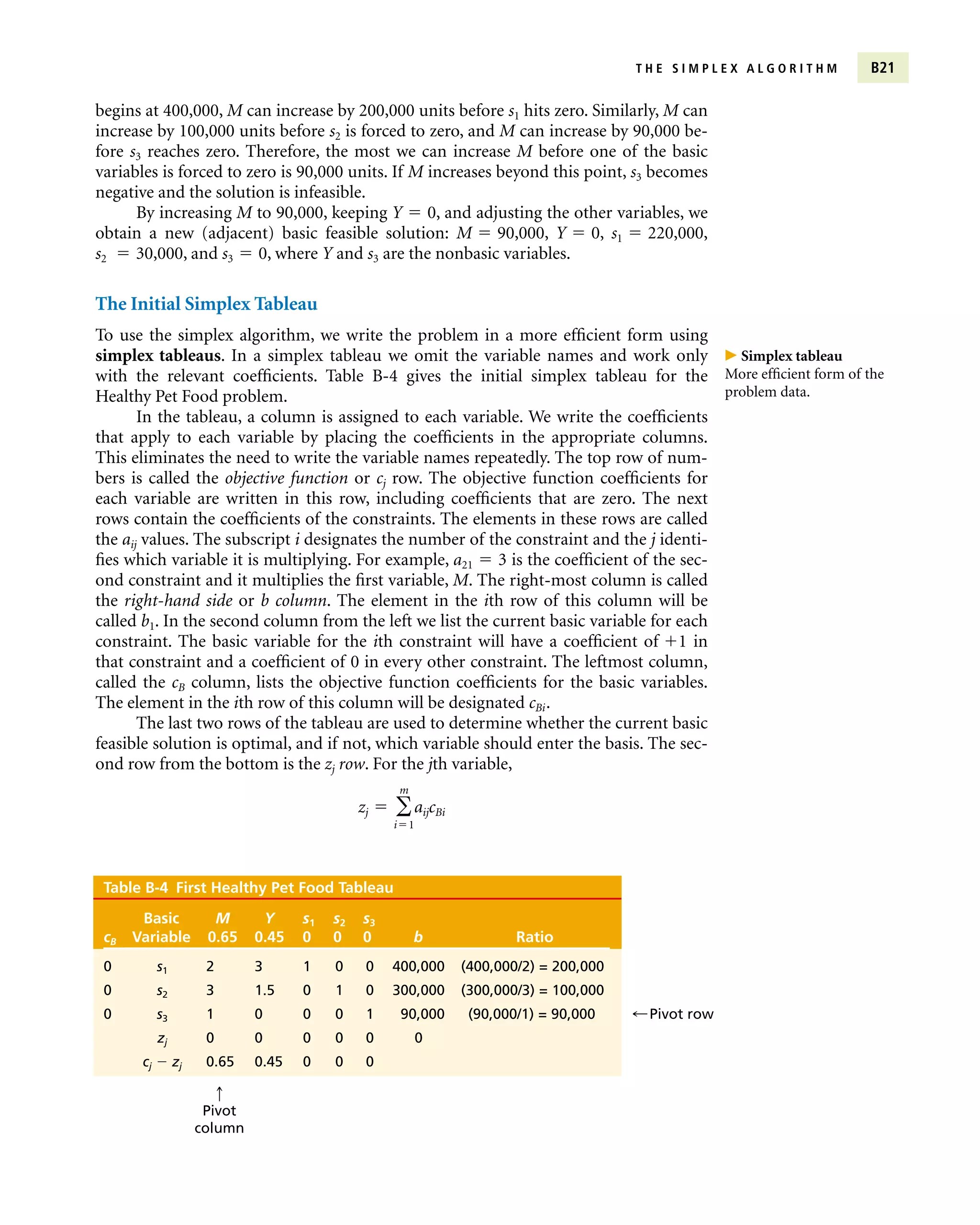
with the relevant coefficients. Table B-4 gives the initial simplex tableau for the
Healthy Pet Food problem.
In the tableau, a column is assigned to each variable. We write the coefficients
that apply to each variable by placing the coefficients in the appropriate columns.
This eliminates the need to write the variable names repeatedly. The top row of num-
bers is called the objective function or cj row. The objective function coefficients for
each variable are written in this row, including coefficients that are zero. The next
rows contain the coefficients of the constraints. The elements in these rows are called
the aij values. The subscript i designates the number of the constraint and the j identi-
fies which variable it is multiplying. For example, a21  3 is the coefficient of the sec-
ond constraint and it multiplies the first variable, M. The right-most column is called
the right-hand side or b column. The element in the ith row of this column will be
called b1. In the second column from the left we list the current basic variable for each
constraint. The basic variable for the ith constraint will have a coefficient of 1 in
that constraint and a coefficient of 0 in every other constraint. The leftmost column,
called the cB column, lists the objective function coefficients for the basic variables.
The element in the ith row of this column will be designated cBi.
The last two rows of the tableau are used to determine whether the current basic
feasible solution is optimal, and if not, which variable should enter the basis. The sec-
ond row from the bottom is the zj row. For the jth variable,
zj  
m
i1
aijcBi
T H E S I M P L E X A L G O R I T H M B21
Table B-4 First Healthy Pet Food Tableau
Basic M Y s1 s2 s3
cB Variable 0.65 0.45 0 0 0 b Ratio
0 s1 2 3 1 0 0 400,000 (400,000/2) = 200,000
0 s2 3 1.5 0 1 0 300,000 (300,000/3) = 100,000
0 s3 1 0 0 0 1 90,000 (90,000/1) = 90,000
zj 0 0 0 0 0 0
cj  zj 0.65 0.45 0 0 0
;Pivot row
q
Pivot
column
 Simplex tableau
More efficient form of the
problem data.
Thus to compute zj for the jth variable, we go down the jth variable column and the cB
column, performing pairwise multiplication and then summing the terms. For exam-
ple, in Table B-4, z1  (2  0)  (3  0)  (1  0)  0. We perform this operation
for every variable and for the right-hand side values: (400,000  0)  (300,000  0)
 (90,000  0)  0. The zj in the b column is the objective value for the basic solu-
tion in the tableau. We explain the physical meaning of the zj values shortly.
The bottom row is called the cj  zj row. It represents exactly that: we subtract
the zj row from the cj row. There is no value in the b column because there is no b col-
umn value in the cj row.
Meaning of zj and cj  zj The algorithm moves from one basic solution to an-
other by
1. Increasing the value of a nonbasic variable
2. Keeping the other nonbasic variables equal to zero
3. Adjusting the values of the basic variables to satisfy the functional
constraints
When this is done, two forces affect the objective function value. There is the di-
rect effect of the nonbasic variable that is being increased in value. The per unit or
marginal effect of increasing the jth variable is the objective function coefficient for
this variable, cj. When the basic variables are adjusted to maintain feasibility, however,
this adjustment affects the objective function as well. This adjustment effect, often
called the opportunity cost, is measured by zj. The opportunity cost is the penalty re-
sulting from adjusting these basic variables. The net marginal effect on the objective
function is cj  zj . If the cj  zj for some nonbasic variable is positive in sign, increas-
ing that variable (and adjusting the other variables to remain feasible) results in a net
increase in the objective function value.
The Simplex Pivot and the Second Tableau
Once the problem is set up in the initial tableau, the algorithm uses the following
four-step procedure.
1. Check the current basic solution for optimality. For a maximization problem, if
all the cj  zj values are zero or negative, increasing the value of any variable
will not increase the objective function value. Therefore the current solution
is optimal. For a minimization problem, we stop when all of the cj  zj values
are zero or positive. This means that increasing the value of any variable will
not decrease the objective function value. Note that the cj  zj values for the
basic variables in a tableau always equal zero.
2. Select the entering variable. In Table B-4, the cj  zj values for both M and Y
are strictly positive. This means that bringing either of these variables into
the basis increases the value of the objective function. There is no way to
know in advance which variable will lead us to the optimum the quickest. A
simple rule that works well is to select the variable that has the most positive
cj  zj if we are maximizing, or the most negative cj  zj if we are minimiz-
ing. In our example, we select M to enter the basis. This is called the entering
variable. The M column is called the pivot column.
3. Identify the leaving variable. As shown above, as we increase the value of M
while keeping Y fixed at zero, the other basic variables must change in value
to satisfy the constraints. As M increases, s1, s2, and s3 all decrease in value.
Variable s3 reaches zero first and leaves the basis. The leaving variable can be
 The pivot column has the
most positive cj  zj value if
we are maximizing or the
most negative cj  zj value if
we are minimizing.
B22 S U P P L E M E N T B L I N E A R P R O G R A M M I N G
determined by using a ratio test. For every constraint row i we compute the
ratio bi/ais, if ais 0, where column s is the pivot column. That is, we divide
the right-hand side of each constraint by the element in the pivot column of
the same row, but only if the denominator ais is strictly positive in value. This
ratio computes how much the entering variable can increase in value before
the basic variable in that constraint is forced down to zero. That leaves the
basic variable in the row with the smallest ratio. This row is called the pivot
row. In Table B-4 the ratios for the three constraints are [400,000/2] 
200,000, [300,000/3]  100,000, and [90,000/1]  90,000. The smallest ratio
is for the third constraint, so M enters the basis as the variable for the third
constraint and forces s3 out of the basis.
4. Perform pivot operations to obtain the new canonical form. The intersection of
the pivot row and pivot column is called the pivot element. We need to
rewrite the constraints so that they are mathematically equivalent and make
sure that the new basic variable, M, appears in only the third constraint and
has a coefficient of 1. In other words, we want the M column to contain
1 in the pivot element and 0 in every other constraint row. We do this with
row operations. The problem does not change if we multiply any equation by
a nonzero constant, or add or subtract a multiple of any equation to or from
any other equation. We divide the entire pivot row by the value of the pivot
element. In Table B-4, the pivot element is already equal to 1, so the pivot
row does not change. It is just rewritten in Table B-5. If the pivot element
had been 4, we would divide the entire pivot row (except the two leftmost
columns) by 4. The new form of the pivot row is always a multiple of the
current pivot row, so a multiple of this new form of the pivot row can be
added to or subtracted from the other rows.
To obtain a zero in the M column of the first constraint, we multiply the pivot
row (third row) by 2 and subtract from the first constraint row:
[2 3 1 0 0 400,000]
2  [1 0 0 0 1 90,000]  [0 3 1 0 2 220,000]
The new form of the first constraint in shown in Table B-5. To obtain a zero in the M
column of the second constraint, multiply the pivot row by 3 and subtract from the
second constraint row:
[3 1.5 0 1 0 300,000]
3  [1 0 0 0 1 90,000]  [0 1.5 0 1 3 30,000]
T H E S I M P L E X A L G O R I T H M B23
 The ratio test is used to
determine the leaving vari-
able.
 Pivot row
The row with smallest ratio.
 Pivot element
Intersection of the pivot row
and the pivot column.
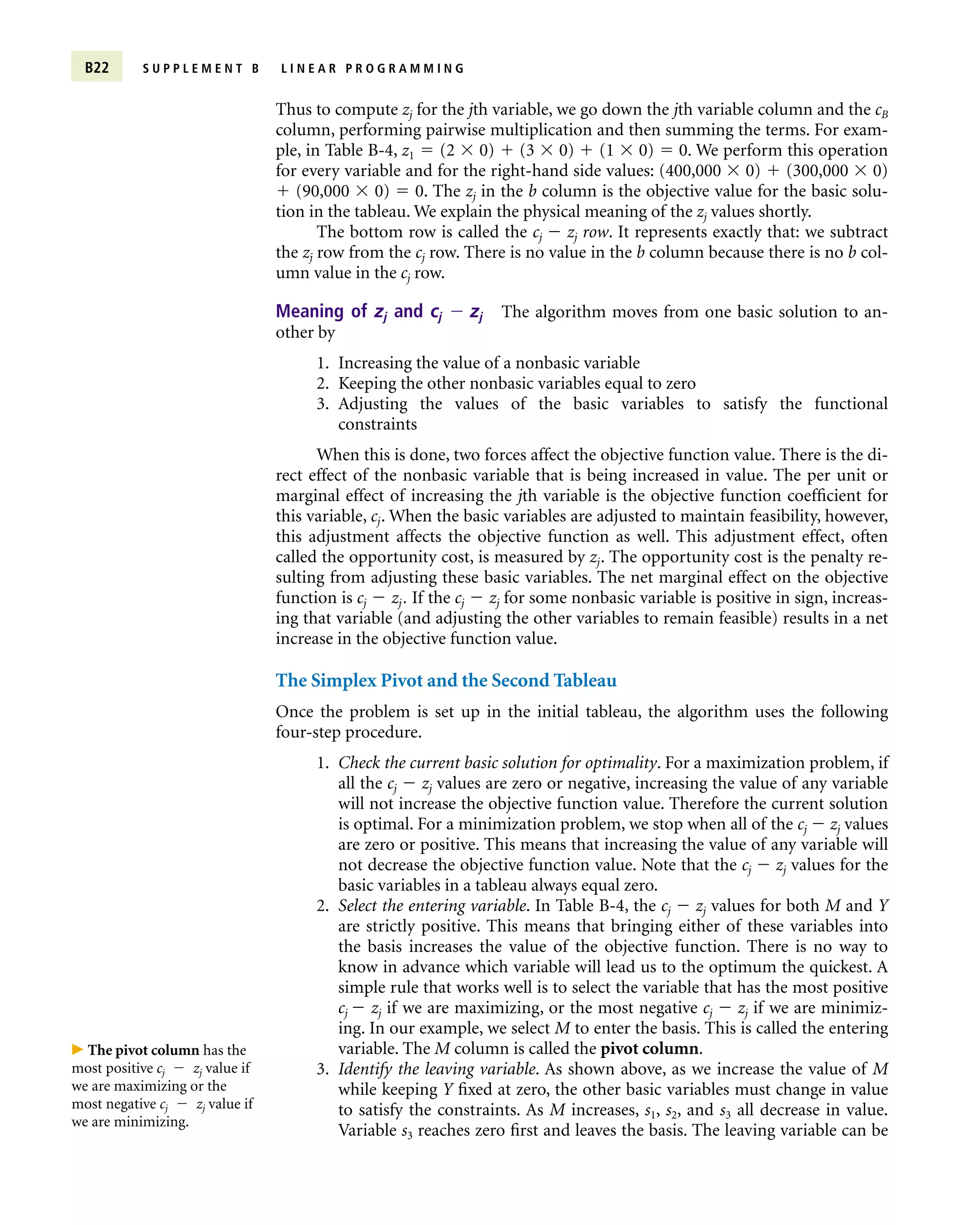
Table B-5 Second Healthy Pet Food Tableau
Basic M Y s1 s2 s3
cB Variable 0.65 0.45 0 0 0 b Ratio
0 s1 0 3 1 0 2 220,000 (220,000/3)  73,333
0 s2 0 1.5 0 1 3 30,000 (30,000/1.5)  20,000
0.65 M 1 0 0 0 1 90,000 no ratio
zj 0.65 0 0 0 0.65 58,500
cj  zj 0 0.45 0 0 0.65
;Pivot row
q
Pivot
column
The result is shown in Table B-5. Note that we always use the pivot row to operate on
the other rows. If we add or subtract multiples of a row other than the pivot row to or
from a row, the columns for the other basic variables can become messed up. Also
note that because the new form of the pivot row always has a 1 in the pivot element,
we create a 0 in pivot column for any other constraint just by multiplying the new
form of the pivot row by the element in the pivot column of the other row and sub-
tracting the result from that row.
At this point, we determine the basic solution for the tableau in Table B-5. Y and
s3 are not in the basis, so they are set equal to zero. Then, s1  220,000, s2  30,000,
and M  90,000. We compute zj and cj  zj elements for each column. For example,
z2  (3  0)  (1.5  0)  (0  0.65)  0. Note that the zj on the right-hand side
equals the objective function value, 58,500. We will call this term z from now on.
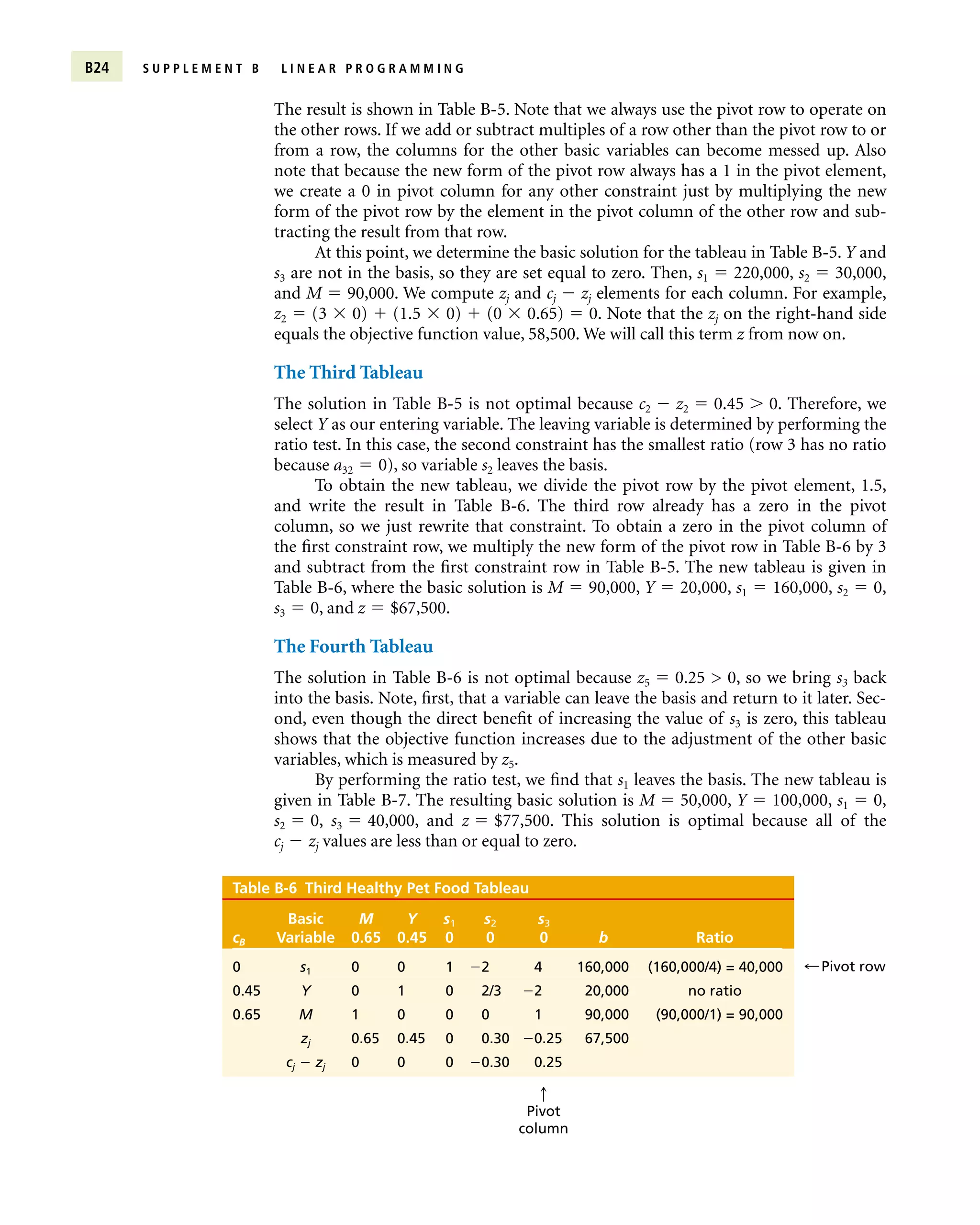
The Third Tableau
The solution in Table B-5 is not optimal because c2  z2  0.45 0. Therefore, we
select Y as our entering variable. The leaving variable is determined by performing the
ratio test. In this case, the second constraint has the smallest ratio (row 3 has no ratio
because a32  0), so variable s2 leaves the basis.
To obtain the new tableau, we divide the pivot row by the pivot element, 1.5,
and write the result in Table B-6. The third row already has a zero in the pivot
column, so we just rewrite that constraint. To obtain a zero in the pivot column of
the first constraint row, we multiply the new form of the pivot row in Table B-6 by 3
and subtract from the first constraint row in Table B-5. The new tableau is given in
Table B-6, where the basic solution is M  90,000, Y  20,000, s1  160,000, s2  0,
s3  0, and z  $67,500.
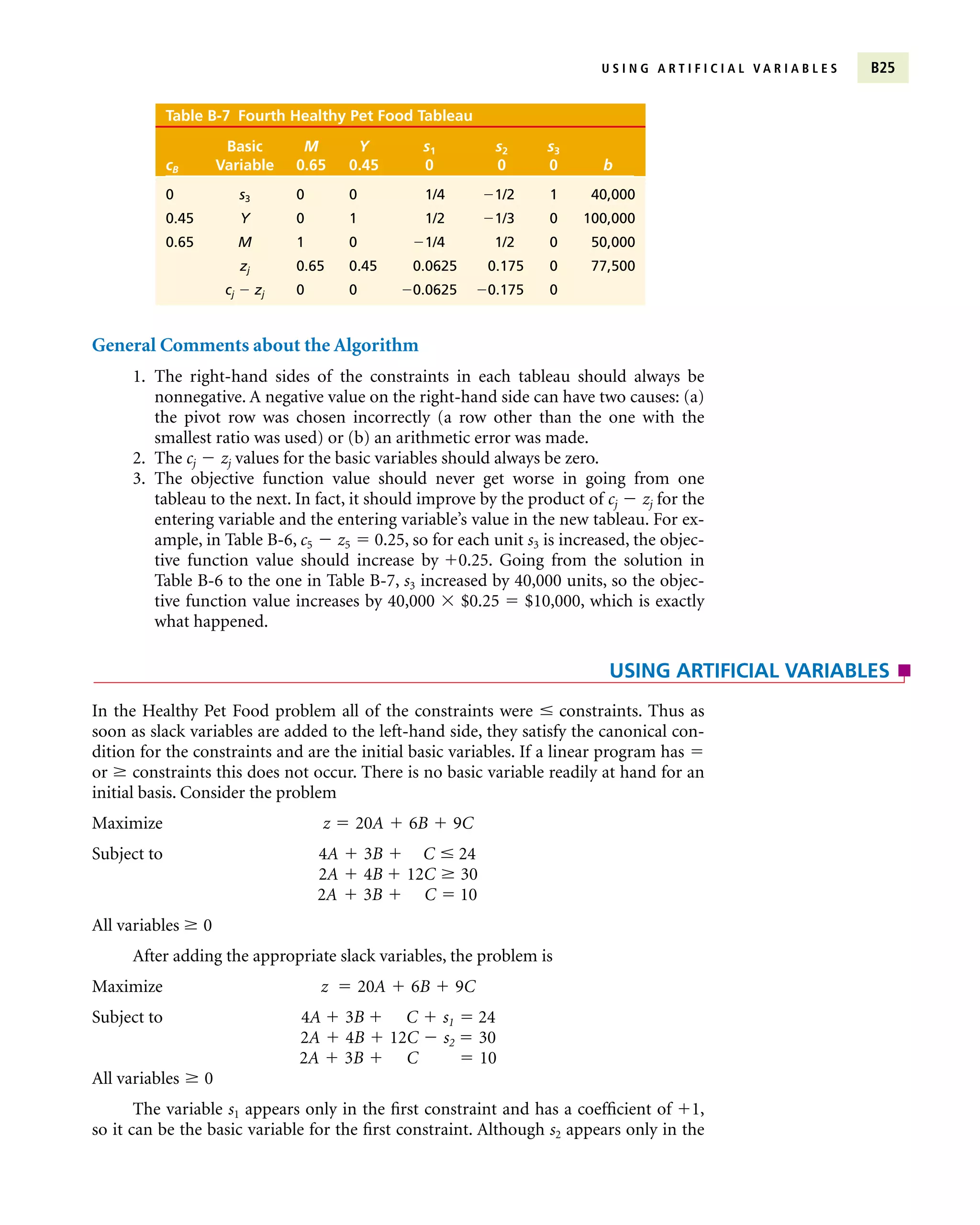
The Fourth Tableau
The solution in Table B-6 is not optimal because z5  0.25  0, so we bring s3 back
into the basis. Note, first, that a variable can leave the basis and return to it later. Sec-
ond, even though the direct benefit of increasing the value of s3 is zero, this tableau
shows that the objective function increases due to the adjustment of the other basic
variables, which is measured by z5.
By performing the ratio test, we find that s1 leaves the basis. The new tableau is
given in Table B-7. The resulting basic solution is M  50,000, Y  100,000, s1  0,
s2  0, s3  40,000, and z  $77,500. This solution is optimal because all of the
cj  zj values are less than or equal to zero.
B24 S U P P L E M E N T B L I N E A R P R O G R A M M I N G
Table B-6 Third Healthy Pet Food Tableau
Basic M Y s1 s2 s3
cB Variable 0.65 0.45 0 0 0 b Ratio
0 s1 0 0 1 2 4 160,000 (160,000/4) = 40,000
0.45 Y 0 1 0 2/3 2 20,000 no ratio
0.65 M 1 0 0 0 1 90,000 (90,000/1) = 90,000
zj 0.65 0.45 0 0.30 0.25 67,500
cj  zj 0 0 0 0.30 0.25
;Pivot row
q
Pivot
column
U S I N G A R T I F I C I A L V A R I A B L E S B25
General Comments about the Algorithm
1. The right-hand sides of the constraints in each tableau should always be
nonnegative. A negative value on the right-hand side can have two causes: (a)
the pivot row was chosen incorrectly (a row other than the one with the
smallest ratio was used) or (b) an arithmetic error was made.
2. The cj  zj values for the basic variables should always be zero.
3. The objective function value should never get worse in going from one
tableau to the next. In fact, it should improve by the product of cj  zj for the
entering variable and the entering variable’s value in the new tableau. For ex-
ample, in Table B-6, c5  z5  0.25, so for each unit s3 is increased, the objec-
tive function value should increase by 0.25. Going from the solution in
Table B-6 to the one in Table B-7, s3 increased by 40,000 units, so the objec-
tive function value increases by 40,000  $0.25  $10,000, which is exactly
what happened.
In the Healthy Pet Food problem all of the constraints were  constraints. Thus as
soon as slack variables are added to the left-hand side, they satisfy the canonical con-
dition for the constraints and are the initial basic variables. If a linear program has 
or  constraints this does not occur. There is no basic variable readily at hand for an
initial basis. Consider the problem
Maximize z  20A  6B  9C
Subject to 4A  3B  C  24
2A  4B  12C  30
2A  3B  C  10
All variables  0
After adding the appropriate slack variables, the problem is
Maximize z  20A  6B  9C
Subject to 4A  3B  C  s1  24
2A  4B  12C  s2  30
2A  3B  C  10
All variables  0
The variable s1 appears only in the first constraint and has a coefficient of 1,
so it can be the basic variable for the first constraint. Although s2 appears only in the
Table B-7 Fourth Healthy Pet Food Tableau
Basic M Y s1 s2 s3
cB Variable 0.65 0.45 0 0 0 b
0 s3 0 0 1/4 1/2 1 40,000
0.45 Y 0 1 1/2 1/3 0 100,000
0.65 M 1 0 1/4 1/2 0 50,000
zj 0.65 0.45 0.0625 0.175 0 77,500
cj  zj 0 0 0.0625 0.175 0
USING ARTIFICIAL VARIABLES
B26 S U P P L E M E N T B L I N E A R P R O G R A M M I N G
second constraint, it has a coefficient of 1; therefore, there is no variable in the sec-
ond constraint that can act as a basis variable (multiplying the second constraint by
1 makes the right-hand-side coefficient negative). The third constraint also has no
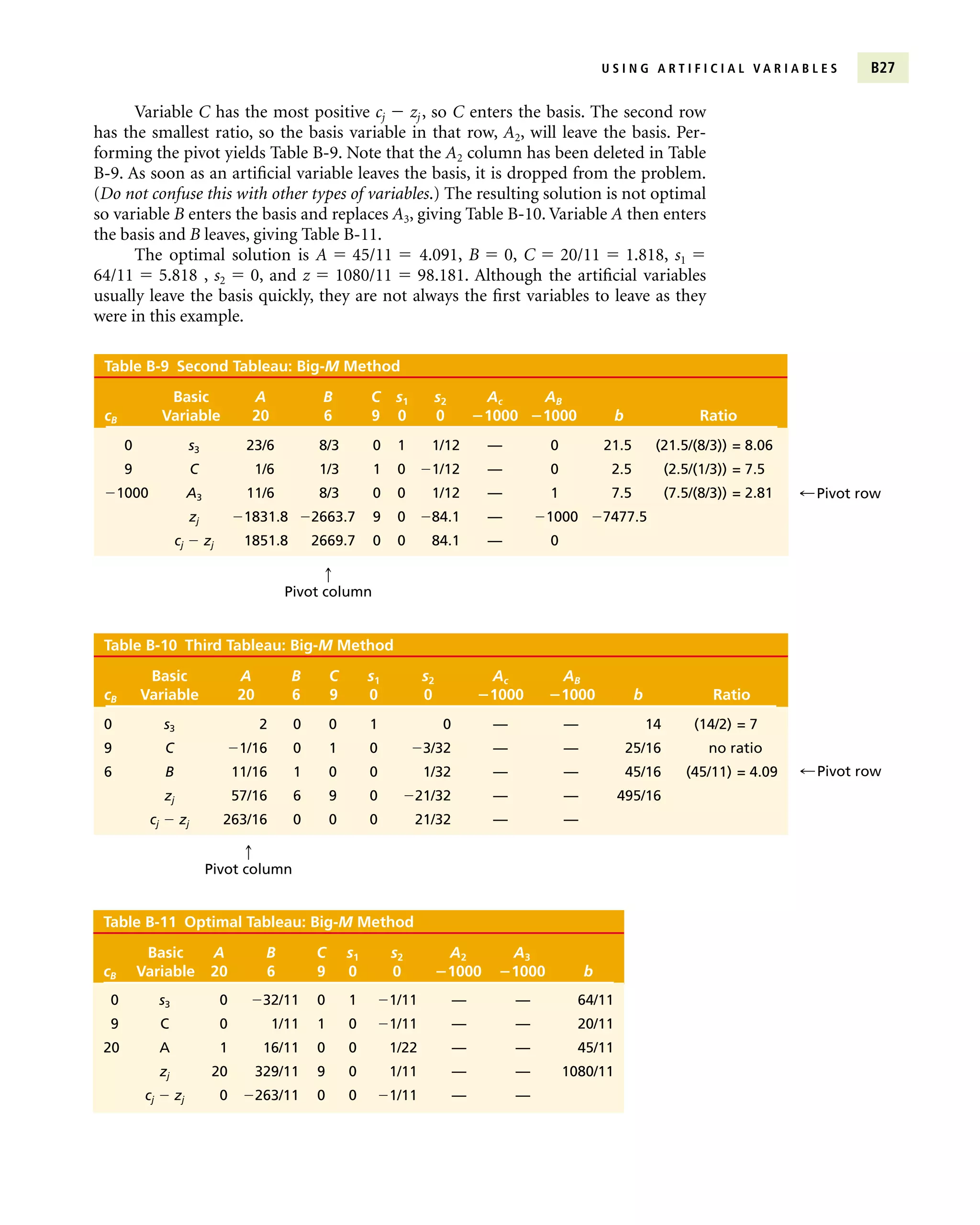
unique variable ready to be basic. In this case we create a basic but infeasible solution
by adding two new nonnegative variables, A2 A3, to the left-hand side for the second
and third constraints. These are called artificial variables. (We use the notation Ai
where it is added to the ith constraint.) This gives the new form of the problem,
which is in canonical form.
Maximize z  20A  6B  9C
Subject to 4A  3B  C  s1  24
2A  4B  12C  s2  A2  30
2A  3B  C  A3  10
All variables  0
The artificial variables are put into the problem for only one purpose: to act as
basic variables to the algorithm started. If an artificial variable is in the problem, it
must be a basic variable. In the current canonical form the basic variables are s1, A2,
and A3, and the corresponding basic solution is A  B  C  s2  0, s1  24, A2 
30, and A3  10. This is a basic solution that occurs at the intersection of the con-
straint boundaries: A  0, B  0, C  0. However, this solution is infeasible because
these lines intersect outside the feasible set.
By modifying the objective function to “encourage” the artificial variables to
leave the basis, we use the simplex algorithm to move from an infeasible to a feasible
basic solution. The algorithm then proceeds exactly as in the previous section. There
are two ways to modify the problem. The first, called the Big-M method, is intuitively
simple and is demonstrated here.
The Big-M Method
In the Big-M method, we make the objective function coefficients for the artificial
variables either infinity for maximization problems or infinity for minimization
problems. The name comes from the fact that the letter M represents some large
number that replaces infinity. This method encourages the algorithm to drive the arti-
ficial variables to zero by kicking them out of the basis. Rather than use infinity, in
our example M  1000. The first tableau is in Table B-8.
 Artificial variables are
needed when  or  con-
straints appear in the prob-
lem.
Table B-8 First Tableau: Big-M Method
Basic A B C s1 s2 Ac AB
cB Variable 20 6 9 0 0 1000 1000 b Ratio
0 s3 4 3 1 1 0 0 0 24 (24/1) = 24
1,000 A2 2 4 12 0 1 1 0 30 (30/12) = 2.5
1,000 A3 2 3 1 0 0 0 1 10 (10/1) = 10
zj 4,000 7,000 13,000 0 1,000 1,000 1,000 4,000
cj  zj 4,020 7,006 13,009 0 1,000 0 0
 Big-M method uses objec-
tive function coefficients for
the artificial variables of
infinity for maximization
problems or infinity for
minimization problems.
;Pivot row
q
Pivot column
Variable C has the most positive cj  zj , so C enters the basis. The second row
has the smallest ratio, so the basis variable in that row, A2, will leave the basis. Per-
forming the pivot yields Table B-9. Note that the A2 column has been deleted in Table
B-9. As soon as an artificial variable leaves the basis, it is dropped from the problem.
(Do not confuse this with other types of variables.) The resulting solution is not optimal
so variable B enters the basis and replaces A3, giving Table B-10. Variable A then enters
the basis and B leaves, giving Table B-11.
The optimal solution is A  45/11  4.091, B  0, C  20/11  1.818, s1 
64/11  5.818 , s2  0, and z  1080/11  98.181. Although the artificial variables
usually leave the basis quickly, they are not always the first variables to leave as they
were in this example.
U S I N G A R T I F I C I A L V A R I A B L E S B27
Table B-9 Second Tableau: Big-M Method
Basic A B C s1 s2 Ac AB
cB Variable 20 6 9 0 0 1000 1000 b Ratio
0 s3 23/6 8/3 0 1 1/12 — 0 21.5 (21.5/(8/3)) = 8.06
9 C 1/6 1/3 1 0 1/12 — 0 2.5 (2.5/(1/3)) = 7.5
1000 A3 11/6 8/3 0 0 1/12 — 1 7.5 (7.5/(8/3)) = 2.81
zj 1831.8 2663.7 9 0 84.1 — 1000 7477.5
cj  zj 1851.8 2669.7 0 0 84.1 — 0
;Pivot row
q
Pivot column
Table B-10 Third Tableau: Big-M Method
Basic A B C s1 s2 Ac AB
cB Variable 20 6 9 0 0 1000 1000 b Ratio
0 s3 2 0 0 1 0 — — 14 (14/2) = 7
9 C 1/16 0 1 0 3/32 — — 25/16 no ratio
6 B 11/16 1 0 0 1/32 — — 45/16 (45/11) = 4.09
zj 57/16 6 9 0 21/32 — — 495/16
cj  zj 263/16 0 0 0 21/32 — —
Table B-11 Optimal Tableau: Big-M Method
Basic A B C s1 s2 A2 A3
cB Variable 20 6 9 0 0 1000 1000 b
0 s3 0 32/11 0 1 1/11 — — 64/11
9 C 0 1/11 1 0 1/11 — — 20/11
20 A 1 16/11 0 0 1/22 — — 45/11
zj 20 329/11 9 0 1/11 — — 1080/11
cj  zj 0 263/11 0 0 1/11 — —
;Pivot row
q
Pivot column
B28 S U P P L E M E N T B L I N E A R P R O G R A M M I N G
The Two-Phase Method
For the Big-M method to work well, the value of M must be several orders of magni-
tude larger than the other objective function coefficients. This large difference in co-
efficient magnitude can cause numerical instability and roundoff problems in com-
puter programs. An alternative used more widely in practice, the two-phase method,
accomplishes the same thing but is numerically more stable. The two-phase method
divides the solution process into two phases. In phase 1, we want to move from the
initial basic infeasible solution to some basic feasible solution. In phase 2, we want
to move to the best basic feasible solution. The goal of phase 1 is accomplished by
replacing the original objective function with the objectives of minimizing the sum
of the artificial variables. In other words, the cj values for all variables are 0 except
for the artificial variables, which have cj values of 1. This is the phase 1 objective
function regardless of whether the original objective is to maximize or minimize.
This objective function causes the artificial variables to go to zero by leaving the ba-
sis. As soon as all the artificial variables are out of the basis, phase 2 begins. In phase
2, the original objective function for the problem is used, and the solution proceeds
as before.
Infeasible Problems, Multiple Optima, Unboundedness, and Degeneracy
and the Simplex Algorithm
One feature of the simplex algorithm is that it identifies infeasible problems, multiple
optima, and unboundedness if they exist.
Infeasible Problem If for some tableau the cj  zj values satisfy the optimality
conditions but at least one artificial variable is still positive (in the basis), then the
problem has no feasible solution.
Multiple Optima If the problem has more than one optimum, this is signaled by
the final tableau. In the optimal tableau, if cj  zj for a nonbasic variable is zero, that
variable entering into the basis does not change the objective function value, so the
new solution is also optimal.
Unbounded Problem If for any tableau cj  zj indicates that a nonbasic variable
should enter the basis, but no ratios can be computed for the constraints because
every constraint coefficient in the pivot column is either zero or negative, the problem
is unbounded. Increasing the value of the entering variable improves the objective
function without limit.
Degeneracy The right-hand sides of a tableau should never be negative, but they
can be zero. When a right-hand side is zero, a basic variable equals zero; this is a
degenerate solution. You treat the zero just like any other number. It can be used as
the numerator in the ratio test. Degeneracy simply means that the extreme point rep-
resented by the basic solution is formed by the intersection of more constraints than
are needed. Therefore, the same extreme point can be expressed algebraically by sev-
eral basic solutions.
 The two-phase method
starts with an initial infeasible
solution and moves to the
best basic feasible solution in
phase two.
 A degenerate solution
occurs when a basic variable
equals zero.
C O M P U T E R S O L U T I O N S O F L I N E A R P R O G R A M S B29
Once a linear program is formulated, it is solved using a computer-based solution
method. Most commercial and instructional linear programming computer packages
use methods based on the simplex algorithm. Many computer packages are available
for personal computers. Although each package is slightly different, the input infor-
mation required and the output provided by typical instructional packages are
similar.
Problem Input
Most linear programming packages use the following information to set up the prob-
lem:
1. Whether the user wants to enter a new problem, read an existing problem,
modify the current problem in memory, or solve a problem
2. An identifying name for the problem so that it can be stored and reused or
modified at a future time
3. Whether the problem involves maximization or minimization
4. The number of variables in the problem
5. The names of the variables or whether the user wants to use default names,
usually X1, X2, and so on
6. The number of constraints in the problem (excluding nonnegativity con-
straints on the variables)
7. The objective function and constraint coefficients. These can be entered as a
data matrix, or a problem template of the objective function constraints is
displayed with variables listed and spaces provided for the user to enter the
coefficients.
Computer Output
Most packages offer several output options: to display the optimum, the optimum
with sensitivity analysis, the initial simplex tableau and the optimum, and so forth. A
computer output for the Healthy Pet Food problem is shown in Figure B-4. Part (a) of
the figure lists the optimal values for the variables in the column labeled “solution”:
M  50,000, Y  100,000, S1  0, S2  0, and W3  40,000. The slack variables are
added to the problem automatically by the computer package, and their optimal val-
ues are listed. At the bottom of Figure B-4 is the objective function value: $77,500.
Sensitivity Analysis
An important use of linear programs is in determining how sensitive the optimal so-
lution is to parameter values in the problem. For example, how will the optimum
change if a price of availability of a resource is changed? This is called sensitivity
analysis or parametric analysis. Let’s look at the sensitivity analysis information pro-
vided by linear programming computer packages.
Changes in Objective Function Coefficients If an objective function coeffi-
cient is changed, this does not affect the feasible set of solutions for the problem. Fig-
ure B-4 (b), labeled “Sensitivity Analysis for Objective Function Coefficients,” lists the
COMPUTER SOLUTIONS OF LINEAR PROGRAMS
range over which each objective function coefficient can vary without the optimal val-
ues for the variables changing.
The notation C(j) refers to the objective function coefficient for the jth variable.
The values in the column labeled “Original” are the original objective function coeffi-
cients in the problem: 0.65 for M and 0.45 for Y. In the M row, the values 0.30 in the
“Min C(j)” column and 0.90 in the “Max C(j)” column mean that as long as all the
other data in the problem are held constant, the solution M  50,000 and Y 
100,000 is optimal for any value of C(1) from a minimum of 0.30 to a maximum of
0.90. For example, suppose the profit per package of Meaties changes from $0.65 to
$0.85. The information in Figure B-4 (b) implies that M  50,000 and Y  100,000 is
still the optimal solution. However, the optimal amount of profit changes to $87,500.
One limitation of this analysis is that the range of coefficient values for which
the solution remains optimal is valid only when one coefficient is modified. If two or
more coefficients are changed simultaneously, the ranges given in Figure B-4 (b) do
not tell us what happens. In this case, we change the coefficient values and re-solve the
problem.
Dual Prices and Changes in the Right-Hand-Side Coefficients
Suppose the right-hand side of a constraint is changed. For example, in the Healthy Pet
Food problem, suppose Healthy can buy up to 400,001 pounds of cereal each month
(at $0.20 per pound) instead of 400,000 pounds. Will this change the optimal solution,
and if so, how? The information in Figure B-4(c) partially answers this question. For
each constraint there is a shadow price or dual price. The dual price for constraint 1 is
0.0625, and the dual prices for constraints 2 and 3 are 0.1750 and 0, respectively.
Each constraint has a dual price. The dual price for a constraint is the marginal
change in the optimal objective function value that occurs if the right-hand side of
B30 S U P P L E M E N T B L I N E A R P R O G R A M M I N G
(a) Final Solution for Healthy
M
Y
S1
S2
S3
+50000.00
+100000.00
0
0
+40000.00
Solution
Variable
Maximum Objective Function Value = 77500
Iterations = 3
CPU time = 0.4215
Opportunity
Cost
0
0
+0.0625
+0.1725
0
(b) Sensitivity Analysis for Objective Function Coefficients
Variable
M
Y
+0.3000
+0.3250
Min C(j) Original
+0.6500
+0.4500
Max C(j)
+0.9000
+0.9750
(c) Sensitivity Analysis for Right-hand-side Coefficients
Constraint
1
2
3
+240000
+200000
+ 50000
Min B(i) Original
+400000
+300000
+ 90000
Max B(i)
+600000
+380000
+ Infinity
Shadow Price
+0.0625
+0.1750
0
Figure B-4.
Computer solution for Healthy
Pet Food
 Shadow price
The marginal change in the
optimal objective function
value that occurs if the right-
hand side of a constraint is
changed.
that constraint is altered. For example, dual price 0.0625 for constraint 1 implies that
if one addition pound of cereal is available (at $0.20 per pound), the optimum pro-
duction plan can be modified to produce $0.0625 more profit. Similarly, the dual
price of $0.175 means that if an additional pound is available (at $0.50 per pound),
the optimum can be modified to produce $0.175 more profit. It must be emphasized
that these dual prices are valid only if one right-hand side is modified. If two or more
changes are made simultaneously, these prices may not be valid.
Figure B-4(c) also gives the range of right-hand-side values over which the dual
prices will be valid. For example, B(1) is the right-hand-side coefficient of the first
constraint. The table says that keeping everything else the same, each additional
pound of cereal increases profit by $0.0625 until the right-hand side equals 600,000
(shown in the “Max B (I)” column. Similarly, a reduction in cereal reduces the profit
by $0.0625 per pound until the right-hand side reaches 240,000 pounds (“Min B
(i)”). If the amount of available cereal is changed enough to be outside these limits,
new dual prices apply. This analysis is sometimes called right-hand-side ranging.
U S I N G L I N E A R P R O G R A M M I N G M O D E L S F O R D E C I S I O N M A K I N G B31
USING LINEAR PROGRAMMING MODELS FOR DECISION MAKING
The formulations earlier in the supplement give the impression that using linear pro-
gramming is a clean, simple process. We recognize a problem that fits the linear pro-
gramming framework, model it, solve it, and then we are done. In practice, using lin-
ear programming and other optimization models is not so straightforward, nor is it
static. Specifically, our goal in using models is to obtain usable solutions that are bet-
ter than those we would have obtained without the models, to use the models to re-
vise and update our decisions in a timely fashion, and to increase our confidence in
our decisions. Let’s look at the Healthy Pet Food problem to see how we might use his
model in practice and to see what benefits we can gain.
Healthy Pet Food Revisited
The Healthy Pet Food example was presented as if every aspect of the problem were
known with certainty, and a number of simplifying assumptions were made. Let’s re-
consider the situation to show more completely how linear programming models can
be used. Refer to Table B.1 for the original problem data.
The linear programming formulation for this problem is:
Maximize z  0.65M  0.45Y
Subject to 2M  3Y  s1  400,000 (cereal constraint)
3M  1.5Y  s2  300,000 (meat constraint)
M  s3  90,000 (Meaties capacity)
All variables  0
and the optimal solution is M  50,000, Y  100,000, and z  $77,500 per month.
This solution causes Healthy to use all 400,000 pounds of cereal and all 300,000
pounds of meat available each month at $0.20 and $0.50 per pound, respectively.
Uncertainty Regarding Price and Cost Data We assumed that the data given
in Table B-1 were known with certainty. In fact, there is considerable uncertainty
about the price and cost estimates. Suppose that after seeing the preceding solution,
the vice president of marketing says, “If we’re only going to produce 50,000 packages
of Meaties each month, we can charge $3.00 a package; demand for Meaties would
still be at least 50,000 per month at that price.” If we increase the price of Meaties by
$0.20 to $3.00 per package, how does this change the optimal production plan and
Healthy’s profits?
The only thing that changes is the profit per package for Meaties, which increases
from $0.65 to $0.85, so we want to
Maximize z  $0.85 M  $0.45 Y
Using the objective function sensitivity analysis information in Figure B-4 or re-
solving the problem with the new objective function, we determine that the optimal
production plan is still M  50,000, Y  100,000, but the month profit increases to
$87,500. Thus with the available resources, the change in the relative profit margins
for the two dog foods is not enough to change the optimal product mix, but the profit
does increase. The same type of analysis would apply if we believe that the previously
assumed material or packaging costs are not correct.
This analysis can be performed using a variety of scenarios for product and raw
material prices. It shows us if, and how, the optimal product mix changes depending
on the actual values of the parameters.
Pricing Additional Resources Returning to the original problem, suppose
someone offered to sell additional cereal or meat, but at a higher price than Healthy is
currently paying. The obvious questions are these:
1. What should Healthy be willing to pay for the additional resources?
2. How much of each resource should Healthy buy at various prices?
3. How should the additional resources be used?
We answer these questions using the dual prices discussed in the previous sec-
tion. The dual price for the cereal constraint is $0.0625. This means that Healthy can
buy another pound of cereal at the original price of $0.20 per pound and then, by re-
vising its production could earn another $0.0625. Therefore, Healthy is willing to pay
up to $0.20  $0.0625  $0.2625 per pound for additional cereal. Thus Healthy
should buy at least one additional pound of cereal as long as its price is less than
$0.2625 per pound. Should it buy more? The upper limit on B(1) in Figure B-5(c) is
600,000, so the answer is that Healthy should buy up to an additional 200,000 pounds
of cereal (with no additional meat). Once it buys 200,000 additional pounds of cereal,
its optimum production plan is to make 200,000 packages of Yummies and no
Meaties. Additional cereal, even at $0.01 per pound, will not help Healthy unless it is
able to obtain additional meat as well.
When only one resource is changed at a time, the dual price and right-hand-side
ranging information for the original model can be used to determine what price to pay
for an additional resource and how much to buy. The new optimum solution, however, is
not immediately clear and requires some additional arithmetic. If two or more resources
are changed simultaneously, the model usually needs to be changed and the problem re-
solved. With existing computer packages, such modifying and resolving are easy.
Evaluating the Effects of Additional Constraints Optimization models are
also used to evaluate the consequences of constraints. Consider the original Healthy
Pet Food problem again. Suppose a shortage of transportation vehicles has developed,
and Healthy’s shipper has informed Healthy that it can only ship 135,000 packages of
dog food each month (a 10% reduction from Healthy’s current optimum level). What
should Healthy do, and how much does this restriction cost Healthy each month?
B32 S U P P L E M E N T B L I N E A R P R O G R A M M I N G
A typical response is to reduce production of all products by 10%—that is,
make 45,000 packages of Meaties and 90,000 packages of Yummies. This generates a
monthly profit of $69,750, a 10% reduction, and is not the appropriate response. By
adding the constraint M  Y  135,000 to the original model and solving, we get the
solution that M  65,000, Y  70,000, and z  $73,750. Thus even though total pro-
duction must be cut by 10%, it is best to increase the production of Meaties. The total
profit decreases by less than 5%. This suggests that Healthy should only be willing to
pay up to $3750 per month for additional monthly shipping capacity of 15,000 pack-
ages, not $7750. This result is counterintuitive for many decision makers, but we can
see that the difference in profit between the optimum plan and the across-the-board
reduction is substantial.
Incorporating Product Demand Functions into the Model Linear pro-
grams dealing with product mix and resource allocation decisions typically assume
that prices are fixed by some outside force and that the company’s decision will not
influence these prices. In some cases, however, companies control the prices of their
outputs and inputs through the amount they produce or purchase. For example, if the
company lowers the price of its product, it believes that it can sell more. In these
cases, the company is interested in determining its optimal production or resource al-
location strategy and in determining the optimal price(s) for some product(s). When
the underlying demand functions, which describe the relationship between product
price and demand, exhibit the right properties, linear programming models are used
to solve the price and volume problems simultaneously.
Suppose Healthy believes the amount of each dog food it can sell depends
on the price it sets. To keep things simple, we assume that over reasonable ranges or
production the demand functions for Meaties and Yummies can be described by
Table B-12.
One way to solve the problem is to construct nine models, one for each combina-
tion of product prices. Each model has objective function coefficients based on the as-
sumed product prices, and the upper limits on product demand vary with the price. Af-
ter solving all nine problems, we find the optimum solution is to set the price of
Meaties at $3.10 per package and the price of Yummies at $2.00 per package, producing
35,000 packages of Meaties and 100,000 packages of Yummies each month. This gener-
ates a monthly profit of $78,250. (Solve these problems yourself to verify the result.)
U S I N G L I N E A R P R O G R A M M I N G M O D E L S F O R D E C I S I O N M A K I N G B33
Table B-12 Healthy Pet Food Demand Function
Meaties
If price per package is Market demand per month is
$3.10 35,000
$2.80 60,000
$2.60 100,000
If price per package is Market demand per month is
$2.25 50,000
$2.00 100,000
$1.75 140,000
Yummies
B34 S U P P L E M E N T B L I N E A R P R O G R A M M I N G
SUPPLEMENT HIGHLIGHTS
A mathematical model represents the essential features
of an object, system, or problem without unimportant
details. Analyzing and manipulating the model gives in-
sight into how the real system behaves under various
conditions. From this we determine the best system de-
sign or action to take.
Constrained optimization models have three major
components: decision variables, objective function, and
constraints. Decision variables are physical quantities
controlled by the decision maker and represented by
mathematical symbols. The objective function defines
the criterion for evaluating the solution. The constraints
are a set of functional equalities or inequalities that rep-
resent physical, economic, technological, legal, ethical, or
other restrictions on what numerical values can be as-
signed to the decision variables.
The main benefit of optimization models is the ability to
evaluate possible solutions in a quick, safe, and inexpen-
sive way without actually constructing and experiment-
ing with them. Other benefits include the following: they
structure the thought process, increase objectivity, make
complex problems more tractable, make problems
amenable to mathematical and computer solution, and
facilitate “what if” analysis.
Linear programs are constrained optimization models
that satisfy three requirements. The decision variables
must be continuous; they can take on any value within
some restricted range. The objective function must be a
linear function. The left-hand sides of the constraints
must be linear functions.
Model formulation is the most important and the most
difficult aspect of solving a real problem. Solving a
model that does not accurately represent the real prob-
lem is useless. Model formulation includes identifying
and defining the decision variables for the problem,
defining the objective function, and identifying and ex-
pressing mathematically all of the relevant constraints.
The characteristic that makes linear programs easy to
solve is their simple geometric structure. A solution for a
linear program is any set of numerical values for the
variables. A feasible solution is a solution that satisfies all
of the constraints. The feasible set or feasible region is
the set of all feasible solutions. Finally, an optimal solu-
tion is the feasible solution that produces the best objec-
tive function value possible.
We can graphically solve an LP problem by using the
fundamental theorem of linear programming: If a finite
optimal solution exists, then at least one extreme point is
optimal. To find the exact coordinate values for the opti-
mum from the graphs, we identify the constraints that
intersect to form the extreme point. We solve simultane-
ously the equations corresponding to the constraints to
find the point that lies on both lines (the extreme point).
The simplex algorithm has many desirable features in
practice. It only moves from one extreme point to a bet-
ter or equally good extreme point, thereby skipping large
numbers of suboptimal extreme points without explic-
itly identifying them. When it finds an optimum, it iden-
tifies this fact and stops. The algorithm detects whether
the problem is infeasible, is unbounded, or has multiple
optima. The algorithm uses very simple mathematics
that are easy to implement on a computer.
In the Big-M method, we make the objective function
coefficients for the artificial variables either infinity for
maximization problems or infinity for minimization
problems. The name comes from the fact that the letter
M represents some large number that replaces infinity.
This method encourages the algorithm to drive the arti-
ficial variables to zero by kicking them out of the basis.
Most packages offer several output options: to display
the optimum, the optimum with sensitivity analysis, the
initial simplex tableau and the optimum, and so forth.
The formulations earlier in the supplement give the im-
pression that using linear programming is a clean, sim-
ple process. In practice, using linear programming and
other optimization models is not so straightforward, nor
is it static. Specifically, our goal in using models is to ob-
tain usable solutions that are better than those we would
have obtained without the models, to use the models to
revise and update our decisions in a timely fashion, and
to increase our confidence in our decisions.

1

2

3

4

5

6

7

8

9

10

11
K E Y T E R M S B35
KEY TERMS
model B2
constrained optimization model B2
decision variables B2
objective function B2
constraints B2
linear program B5
sensitivity analysis B6
parameters B6
coefficients B6
proportionality B7
additivity B7
divisibility B7
certainty B7
feasible solution B14
feasible region B14
feasible set B14
optimal solution B14
extreme points B16
simplex method B17
simplex algorithm B17
canonical form B18
nonbasic variables B20
basic variables B20
basic solution B20
simplex tableau B21
pivot column B23
ratio test B23
pivot row B23
pivot element B23
artificial variables B26
Big-M method B27
two-phase method B28
degenerate solution B28
dual price B31
shadow price B31
B36 S U P P L E M E N T B L I N E A R P R O G R A M M I N G
SOLVED PROBLEMS
■ Solved Problem 1
Suppose a company manufactures two products, A and B,
using three inputs, labor, material R, and materials S. To
make one unit of product A requires 6 pounds of R, 7.5
pounds of S, and 9 person-hours of labor; to make one unit
of product B requires 12 pounds of R, 4.5 pounds of S, and
6 person-hours of labor. The demands for the products are
such that the company can sell as much of each product as
it can produce and earn a profit of $3 per unit of A and $4
per unit of B. However, only 900 pounds of R, 675 pounds
of S, and 1200 person-hours of labor are available to the
company each day.
a. Formulate the company’s problem as a linear program to
maximize profit.
b. Graph the feasible region for this problem.
c. Solve the problem graphically by finding the best ex-
treme point.
Solution:
a. The decision maker controls the amount of each product
to make each day. Thus we can define the decision variables
as
xj  No. of units of product j ( A, B) to make each day.
The company’s objective is to maximize the profit per day.
We want to express “profit per day” as a function of the de-
cision variables so that no matter what numerical values the
decision variables take on, the function will compute the
daily profit. Total profit per day is equal to
(profit/unit of A made)  (units of A made/day)
 (profit/unit of B made)  (units of B made/day)
Substituting the appropriate numerical values and variables
for these quantities gives an objective function:
Maximize z  3xA  4xB
The firm wants to maximize this objective function but
subject to satisfying constraints on the availability of the in-
puts. The first restriction is that
No. of person-hours used per day  1200
The number of person-hours used per day is equal to
(person-hours used/unit of A)  (units of A made/day)
 (person-hours used/unit of B)  (units of B made/day)
Substituting in the appropriate coefficients and variable
names yields the constraint
9xA  6xB  1200
Repeating this for the raw material restrictions yields the
constraints
6xA  12xB  900
7.5xA  4.5xB  675
Finally the variables must be nonnegative:
xA, xB  0
Putting all of this together gives the linear progamming
model:
Maximize z  3xA  4xB
Subject to 9xA  6xB  1200
6xA  12xB  900
7.5xA  4.5xB  675
xA, xB  0
b. The nonnegativity constraints, xA  0 and xB  0, re-
strict the feasible solutions to the upper right-hand quad-
rant of Figure B-6. We then plot the inequality 9xA  6xB 
xA = 64.29
xA
xB
xB = 42.86
z = 364.31
20
40
60
80
100
120
140
160
180
200
Feasible
set
Optimum
20 40 60 80 100 120 140
6 xA + 12 xB = 900
7
.
5
x
A
+
4
.
5
x
B
=
6
7
5
Contour
3
xA +
4
xB =
120
9
x
A
+
6
x
B
=
1
2
0
0
Figure B-5
Graphical solution of Solved Problem B-1
S O L V E D P R O B L E M S B37

1200 by graphing its boundary line, 9xA  6xB  1200, and
finding the side that satisfies the constraint. We first set xA
 0 and solve for xB, which gives xB  200, and then set xB
 0 and solve for xA, which gives xA  133.33. The point xA
 0, xB  0 satisfies the inequality, so all the points on the
same side of the line satisfy this inequality. Repeating this
procedure for the other constraints gives the feasible set in
Figure B-5. Note that the first constraint is redundant; that
is , it does not eliminate any solutions that are not already
eliminated by the other constraints. It can be eliminated
from the problem without changing the feasible set. The
feasible set is the four-sided shaded region.
■ Solved Problem 2
Chip Green is the head groundskeeper at Birdie Valley Golf
Club. For the mix of grass for the golf course, Chip has de-
cided that the best fertilizer would be a 10-8-12 mixture.
(Fertilizer is defined by three values—a, b and c—where a is
the percentage of nitrogen, b is the percentage of phospho-
rus, and c is the percentage of potash in the fertilizer. The
remaining material is inert matter.) Chip can buy a 10-8-12
mix of fertilizer for $21.75 per 100 pounds, but there are
other fertilizers on the market at a variety of prices. The
chemical content and prices are given below. Chip would
like to determine whether or not he could buy several fertil-
izers and mix them together to obtain a 10-8-12 mixture at
a lower cost than $21.75 per 100 pounds. Recognizing that
it might be impossible to obtain an exact 10-8-12 mix from
the fertilizers, Chip is willing to accept chemical percentages
of at least the target amounts, but no more than 0.5% above
them (so the nitrogen level should be between 10% and
10.5%).
a. Formulate Chip’s problem as a linear program.
b. Solve this problem using a computer package.
Solution:
a. Chip is interested in the mix of fertilizers to use, so we
can define the variables
xj  lb of fertilizer j in each lb of mixture
The objective is to minimize the cost per pound of fertilizer:
Minimize z  0.2175 x1  0.2350 x2  0.2200 x3
 0.1950 x4  0.1850 x5
The main constraints are those that ensure the desired per-
centage of nitrogen, phosphorus, and potash.
10x1  8x2  12x3  10x4  15x5  10
10x1  8x2  12x3  10x4  15x5  10.5
8x1  11x2  7x3  10x4  10x5  8
8x1  11x2  7x3  10x4  10x5  8.5
12x1  15x2  12x3  10x4  6x5  12
12x1  15x2  12x3  10x4  6x5  12.5
Because the variables are defined as the amount of each
type of fertilizer in 1 pound of mixture, we need a con-
straint that ensures that the mixture adds up to exactly 1
pound:
x1  x2  x3  x4  x5  1
Also, all variables must be nonnegative.
b. The optimal solution for this problem is x1  0.225, x2 
0.15, x3  0.40, x4  0.225, x5  0, and z  $0.21605. By
mixing the 10-8-12 fertilizer with three other fertilizers,
Chip can reduce the cost. The actual mixture has a chemical
content of 10.5-8.5-12.
Fertilizer %Ni %Ph %Po Cost/100 lb
1 10-8-12 $21.75
2 8-11-15 $23.50
3 12-7-12 $22.00
4 10-10-10 $19.50
5 15-10-6 $18.50
c. Figure B-5 shows objective function contours graphed
for various profit levels (dotted lines). The contour with the
highest value intersects the extreme point formed by the in-
tersection of the second and third constraints. To obtain the
coordinates of this point, we solve the two constraint equa-
tions simultaneously:
6xA  12xB  900
: xA  64.29 xB  42.86
7.5xA  4.5xB  675
The objective function value for the highest contour is then
z  3(64.29)  4(42.86)  364.31.
B38 S U P P L E M E N T B L I N E A R P R O G R A M M I N G
1 coefficient), so we add an artificial variable, A3, to con-
straint 3.
We now construct the tableau shown in Table B-13. Be-
cause we are minimizing, we assign the artificial variable
A3 a large positive objective function coefficient—say,
1000. For the initial solution we compute the zj and
cj  zj values for each column. Because we are minimizing
the objective function, we select the variable with the most
negative cj  zj value to enter the basis; this is variable x1.
We now perform the ratio test by dividing each of the right-
hand-side constants by the corresponding values in the
pivot column (the x1 column). The row with the smallest
ratio is the one for constraint 3, so x1 will enter the basis
and A3 will leave the basis.
We now perform the pivoting operations. We divide
constraint 3 by the pivot element, 8. We take 2 times the
new form of constraint 3 and subtract it from constraint 1
to give a zero value in the pivot column of constraint 1.
Similarly, we subtract 1 times the new form of constraint 3
from constraint 2. The resulting tableau is given in Table
B-14. In this table the cj  zj value for x2 is most negative (it
Table B-14 Second Tableau: Solved Problem 3
x1 x2 s1 s2 s3 A3
Basic
CB Variable 30 10 0 0 0 1,000 b Ratio
0 s1 0 5/2 1 0 1/2 — 50 (50/2.5) = 20
0 s2 0 1/4 0 1 1/8 — 10 (10/0.25) = 40
30 x1 1 3/4 0 0 1/8 — 15 (15/0.75) = 20
zj 30 90/4 0 0 30/8 — 450
cj  zj 0 50/4 0 0 30/8 —
;Pivot row
q
Pivot
column
Table B-13 First Tableau: Solved Problem 3
x1 x2 s s2 s3 A3
Basic
CB Variable 30 10 0 0 0 1,000 i Ratio
0 s1 2 4 1 0 0 0 80 (80/2) = 40
0 s2 1 1 0 1 0 0 25 (25/1) = 25
1,000 A3 8 6 0 0 1 1 120 (120/8) = 15
zj 8,000 6,000 0 0 1,000 1,000 120,000
cj  zj 7,970 5,990 0 0 1,000 0
;Pivot row
q
Pivot
column
Solution:
We first must put the problem in canonical form. All the
right-hand sides are nonnegative. To change the constraints
into equalities, we (1) add a slack variable s1 to the first con-
straint,(2) add a slack variable s2 to the second constraint,
and (3) subtract a slack variable s3 from the third constraint.
Variable s1 and s2 will be the initial basic variables for con-
straints 1 and 2, but constraint 3 does not have a basic
variable (one that appears only in constraint 3 and with a
■ Solved Problem 3
Solve the following linear program using the simplex
method.
Minimize z  30x1  10x2
Subject to 2x1  4x2  80
x1  x2  25
8x1  6x2  120
x1, x2  0
P R O B L E M S B39
Table B-15 Third Tableau: Solved Problem 3
x1 x2 s1 s2 s3 A3
Basic
CB Variable 30 10 0 0 0 1,000 b
10 x2 0 1 2/5 0 1/10 — 20
0 s2 0 0 1/10 1 1/10 — 5
30 x1 1 0 3/10 0 2/10 — 0
zj 30 10 25 0 25 — 200
cj  zj 0 0 5 0 5 —
is the only one that is negative), so we bring x2 into the ba-
sis. Constraints 1 and 3 tie for the lowest ratio, so we arbi-
trarily select constraint 1 as the pivot row (actually, there are
tie-breaking rules, but they are beyond the scope of this
book). Performing the pivot operations gives the tableau in
Table B-15. No cj  zj value is positive in this table, so the
solution there is optimal. To get the solution, we set the
nonbasic variables, s1 and s3, equal to zero and the basic
variables equal to the values in the “b” column: x1  0, x2 
20, and s2  5, and the objective function value is z  200.
(Notice that this is a degenerate solution because a basic
variable equals zero.)
DISCUSSION QUESTIONS
1. What are the three primary components of a constrained
optimization model?
2. Explain the difference between a parameter and a deci-
sion variable.
3. What are the primary assumptions underlying linear pro-
gramming models?
4. If most parameters represent estimates that are not
known with certainty, how can constrained optimization
models be of any value for decision making?
5. What does it mean when a problem has an unbounded
solution? If you formulated a real problem and the solu-
tion? If you formulated a real problem and the solution
was unbounded, what does this imply about your model?
6. What does it mean to perform sensitivity or “what if”
analysis?
7. Explain the meaning of dual prices. Why would one want
to know the value of a dual price, and how might it be
used?
1. Deutchlander Machine Company (DMC) makes two
types of printing presses: a four-color litho and a two-color
litho. Demand for both products is booming and exceeds
DMC’s ability to satisfy it. Most raw materials are plentiful,
but production is limited by three factors: a shortage of steel
rollers, gear cutting capacity, and roller polishing capacity.
Each four-color press requires 16 rollers, and each two-color
press requires 8 rollers. The four-color presses require 30
hours of gear cutting and 8 hours of polishing time, and the
two-color presses require 12 hours of gear cutting and 3
hours of polishing time. DMC is able to buy 100 rollers per
week, and it has 160 hours of gear cutting time and 40 hours
of polishing time available per week.
To avoid harming long-term sales, DMC does not want to
raise prices. At current prices DMC will earn a profit of
DM24,000 on each four-color press made and DM10,000 on
each two-color press made. So as not to abandon either
product market, DMC also wants to produce at least two
units of each press each week.
a. Formulate DMC’s problem as a linear program to max-
imize its profit.
b. Solve the problem (either graphically, using the simplex
method, or using a computer) and explain in words DMC’s
optimal solution.
2. Robertville Furniture Company (RFC) makes two
types of dressers: the Classic and the Modern. RFC sells the
Classic for $310 and the Modern for $350. At these prices
RFC believes it can sell up to 20 Classic and 25 Modern
dressers per week. Each type of dresser is made of oak and
covered with a pecan veneer. The wood requirements for
each dresser are given in the table. Oak costs $1.50 per board
foot, and pecan veneer costs $2 per square foot. The dressers
must go through two manufacturing departments: cutting
and veneering. The machine hours required for each dresser
are also given below. RFC has only 40 hours of production
PROBLEMS
Oak/ Pecan/ Cutting Veneering
Dresser Dresser Time Time
(board ft) (sq/ft) (hr/dresser) (hr/dresser)
Classic 90 50 1.20 1.00
Modern 100 60 0.90 1.20
B40 S U P P L E M E N T B L I N E A R P R O G R A M M I N G
Paper Grade Strength Color Texture Cost/Ton
1 8 9 8 $150
2 6 7 5 $110
3 5 5 6 $ 90
4 3 4 5 $ 50
time available each week in each department, and it can ob-
tain up to 2000 board feet of oak and 1500 square feet of
pecan veneer each week. The cost of operating each manu-
facturing department is essentially fixed, so RFC would like
to maximize its contribution to overhead (revenue minus
variable costs).
a. Formulate RFC’s problem as a linear program, defin-
ing your variables clearly.
b. Solve the problem (graphically, using the simplex
method, or using a computer) and state what RFC should do
(i.e., explain RFC’s optimal solution in words).
c. What resource is limiting RFC’s production?
3. Western Pulp (WP) produces recycled paperboard for
box manufacturers by combining four grades of recycled pa-
per stock. Each grade of stock has a different strength, color,
and texture. The strength, color, and texture of the paper-
board are approximately a weighted average of those charac-
teristics of the paper inputs. The table gives the characteris-
tics of the paper stocks and their cost per ton. WP has
received an order for 500 tons of paperboard with a strength
rating of at least 7, a color of at least 5, and texture of at least
6. WP would like to determine the least costly mix required
to produce this paperboard.
a. Formulate the problem as a linear program.
b. Solve this problem on a computer and explain the op-
timal solution.
4. Volcano Potato Company (VPC) grows potatoes,
processes them, and then sells three potato products: fresh
potatoes, frozen french fried potatoes, and frozen hash ball
potatoes (shredded and then reconstituted balls of potatoes
with a soft consistency). During the next two months, VPC
expects to harvest 8 million pounds of potatoes. VPC would
like to determine how much of each product should be made
from the potatoes. Potatoes are graded according to quality
on a 0–5 scale. VPC divides its potatoes into three grades: A,
B, and C. Grade A potatoes have an average quality rating of
4.5; grade B potatoes have an average quality rating of 2.5,
and grade C potatoes have a quality rating below 1 and are
not used for any products. From historical data and esti-
mates based on the current growing season’s weather, VPC
believes the distribution of potato quality will be:
Fresh potatoes earn a profit of $0.40 per pound after
processing costs, but only grade A potatoes can be sold as
fresh potatoes. Frozen french fried potatoes earn $0.32 per
pound after processing costs, but the potatoes used must
have an average quality rating of at least 3.5. Hash balls earn
$0.25 per pound after processing costs, but the potatoes used
must have an average quality rating of at least 3.0. Assume
that these ratings are linear in the sense that the quality rat-
ing of a mixture equals the weighted average of the inputs.
VPC believes it can sell as much french fried and hash ball
potatoes as it can make, but it believes the total demand for
its fresh potatoes during the next two months is 2.5 million
pounds.
a. Formulate a linear programming model to determine
the best use for the potatoes so as to maximize VPC’s
profit.
b. Solve the problem using a computer and explain the
answer in words.
c. Suppose VPC could buy additional grade A potatoes at
$0.35 per pound; how much should it buy? Explain.
5. Manfred Leaks manages a large discount store. His
biggest problem has been scheduling cashiers so that he has
an adequate number without having too many. The store is
open from 9 A.M. to 9 P.M. every day of the week. Based on
historical data, he found that the customer patterns for
Monday to Thursday are essentially the same, but those
for Friday, Saturday, and Sunday are all different. He
divided the day into three 4-hour segments and esti-
mated how many cashiers were needed for each time period
for each day of the week. These are given in the following
table.
Day of Week Mon–Thur Fri Sat Sun
9 A.M.–1 P.M. 6 3 10 4
1 P.M.–5 P.M. 5 8 14 12
5 P.M.–9 A.M. 8 4 7 6
Grade A B C
% of Harvest 50 40 10
Employees must work continuous 8-hour shifts begin-
ning at 9 A.M. or 1 P.M., and their weekly schedules must be
made up of 5 consecutive days of work with 2 consecutive
days off (and they work the same hours each workday).
Manfred would like to devise weekly schedules that will min-
imize the total number of cashiers needed, but the schedules
must be such that the minimum cashier requirements in the
table are satisfied.
a. Formulate Manfred’s problem as a linear program; be
sure to define the variables precisely. (Hint: There are 14
possible schedules; there will be one variable correspond-
ing to each schedule.)
b. Solve the problem using a computer.
c. Is the assumption of divisibility satisfied? Will your an-
swer to this question be true in general? Explain.
P R O B L E M S B41
6. Checker Credit Service provides credit information to
its customers throughout the country 24 hours a day. Ros-
alind Hanks is the manager of phone services. She supervises
credit reps who answer customers’ calls. From historical data
she has estimated that the following number of credit reps
are needed during various times of the day.
sales. To maintain a reasonable presence in each market,
however, each district must be assigned at least one sales rep,
and at least $50,000 must be spent on advertising in each
market.
a. Formulate a linear programming model to help Mr.
Stimpson solve his problem.
b. Solve the problem using a computer.
8. Great Plains Advertising Company (GPAC) has a
$150,000 advertising budget to advertise an automobile firm.
GPAC is considering advertising in newspapers and on tele-
vision. The more GPAC advertises in a particular medium,
the less effective additional ads are in reaching new cus-
tomers. The following table lists the number of new cus-
Time Period No. of Reps Needed
Midnight–4 A.M. 3
4 A.M.–8 A.M. 6
8 A.M.–noon 13
Noon–4 P.M. 15
4 P.M.–8 P.M. 12
8 P.M.–midnight 9
Employees work shifts of 8 consecutive hours, and shifts
can start at the beginning of any of the six periods shown in
the table. Ms. Hanks has complete freedom in deciding the
number of days each employee works each week, so she is in-
terested only in knowing how many employees should start
work at the beginning of each time period to minimize the
total number of employees needed each day.
a. Formulate her problem as a linear program. (Hint:
There will be six decision variables.)
b. Solve the problem using a computer.
c. Is the divisibility assumption satisified?
d. Suppose full-time employees were paid $8 per hour,
and suppose part-time employees could be hired to work
4-hour shifts for $5 per hour. But part-time employees
are only half as efficient as full-time employees are only
half as efficient as full-time employees (i.e., Checker
needs two part-time employees to do the work of one
full-time employee). Formulate and solve the new prob-
lem.
7. Ronald Stimpson is regional sales manager for an in-
dustrial products company. His region contains four sales
districts. He supervises 10 sales representatives and controls
an advertising budget of $800,000 per year. Mr. Stimpson be-
lieves that sales in a district are related to the amount of ad-
vertising and the number of sales reps assigned to the dis-
trict. Based on historical data, his estimates of incremental
annual sales per dollar of advertising and sales per sales rep
for each district are given in the following table. Mr. Stimp-
son would like to determine how to allocate sales reps and
the advertising budget among the four districts to maximize
No. of Ads New Customers/Ad
Newspaper 1–10 900
11–20 600
21–30 300
Television 1–5 10,000
6–10 5,000
11–15 2,000
tomers reached by each ad. Each newspaper ad costs $1500,
and each television ad costs $10,000. At most 30 newspaper
ads and 15 television ads can be placed. Also, GPAC would
like to use at least as many newspaper ads as television ads.
Formulate a linear program that will maximize the number
of new customers contacted subject to the previous restric-
tions. (Hint: You need six variables, not two.)
9. The demand for a company’s product during the next
four months is given here. It costs the company $9 per unit
Month Demand
1 450
2 575
3 490
4 530
to produce the product using regular-time labor and $12 per
unit to produce the product using overtime labor. A maxi-
mum of 500 units can be made each month using regular-
time labor. There is no limit on overtime productin. Excess
units produced can be stored at a costs of $2 per unit per
month.
a. Formulate this company’s problem as a linear program
to minimize its total production and storage costs during
the next four months and to satisfy demand (there are no
initial inventories).
b. Solve the problem using a computer.
District 1 2 3 4
$ sales/$ advertising 7 12 10 11
$ sales (0000)/sales rep 38 25 36 41
B42 S U P P L E M E N T B L I N E A R P R O G R A M M I N G
Mfg. Wholesaler
Plant 1 2 3 4 Capacity
Transport A 7 10 16 5 300
cost per unit B 10 4 8 12 400
shipped C 11 8 10 9 500
Demand 150 300 350 250
Bushels/ Water Person-Hours
Acre Required Labor
Crop Produced (gal/acre/week) Required/Acre
Corn 300 200 35
Soybeans 200 150 40
Wheat 80 125 30
Alloy A Alloy B
At least 40% copper No more than 35% copper
At least 10% nickel At least 40% nickel
No more than 25% nickel
Aluminum content must
be exactly twice that
of nickel No more than 30% aluminum
Mar Apr May June July Aug Sept
40 60 70 80 90 100 80
10. Tavisbond Manufacturing Company makes high-
grade pipe for the oil and chemical industries. Tavisbond
must plan its production for the next 7 months, March to
September. The forecast demands (in thousands of feet) for
its pipe are as follows:
Tavisbond can make 75,000 feet of pipe per month using
regular-time production at a cost of $1.25 per foot. Tavis-
bond can make an additional 15,000 feet of pipe each month
using overtime production at a cost of $1.50 per foot. Any
pipe made in one month and sold in a subsequent month in-
curs an inventory holding cost of $0.15 per foot per month.
Tavisbond expects to end February with 5000 feet of pipe in
inventory and would like to end September with 10,000 feet
of pipe in inventory.
a. Formulate Tavisbond’s problem as a linear program to
minimize its total cost during the next 7 months and to
ensure that it delivers the predicted amounts of pipe on
time.
b. Solve the problem using a computer.
11. Metallica Manufacturing Company has seen the de-
mand for two new types of metal alloys explode in recent
months. The alloys, which are made by mixing copper,
nickel, and aluminum, do not require an exact formulation
of components but must satisfy the following general specifi-
cations: Copper costs $2 per pound, nickel $3 per pound,
and aluminum $1.50 per pound. Metallica has a limit of
2000 pounds of copper, 3000 pounds of nickel, and 4000
pounds of aluminum available each day. Assume that the
company can sell as much of each alloy as it makes at a price
of $5 per pound for alloy A and $6 per pound for alloy B.
demanded by each wholesaler are also listed, along with the
production capacity at each manufacturing plant. The com-
pany wishes to satisfy the demands of each wholesaler at
minimum total cost (production plus shipping). However,
no plant should be operating at less than 60% of its capacity.
a. Formulate a linear program to solve the company’s
problem.
b. Solve the problem using a computer.
14. AMCHEM Chemical Company produces three prod-
ucts: A, B, and C. Each product requires labor to produce it,
and production of each product creates pollutants. By law
the firm is not allowed to produce more than the following
pollutants per day: 200 pounds of sulfur dioxide, 300 pounds
of carbon monoxide, 150 pounds of hydrogen sulfide, and 50
pounds of benzene. The total number of person-hours of la-
bor available per day is 6000. In addition, the total output
per day of products A and B combined cannot be more than
the output of product C. Each pound of product A generates
growing season he will only have 8000 person-hours of labor
available. The expected profit per bushel of each crop is
$1.00 for corn, $1.60 for soybeans, and $3.00 for wheat. The
owner can use any mix of crops (i.e., he can plant the same
crop on all 200 acres or he can plant all three crops in differ-
ent proportions).
a. Formulate the problem as a linear program to find the
profit-maximizing planting strategy.
b. Solve the problem using a computer.
13. A manufacturing company has three manufacturing
plants located throughout the country. The company sup-
plies four major wholesalers distributed throughout the
country with a product made at these three plants. The man-
ufacturing cost is $12 per unit at plant A, $10 per unit at
plant B, and $11 per unit at plant C. The shipping cost be-
tween each plant and each wholesaler is given here. The units
a. Formulate the company’s problem as a linear program
to maximize profit.
b. Solve the problem using a computer.
12. Wilson Creek Farm has 200 acres of land available for
planting. The owner is considering planting three crops:
corn, soybeans, and wheat. The production yield, water re-
quirements, and labor requirements for a salable crop are
given here. The owner expects to have only 35,000 gallons of
water available per week to use for the crops, and during the
Treatment Center* Daily Volume
District A B C (tons/day)
1 1.2 1.1 3.2 20
2 0.5 1.3 2.5 30
3 1.0 0.4 1.9 45
4 1.5 1.6 1.4 25
5 2.4 1.5 1.6 20
6 2.6 1.9 0.5 25
P R O B L E M S B43
A B C
Pounds of Sulf dioxide .10 .05 .20
Pollutants/ Carb monoxide .18 .04 .03
100 lb Hydrogen sulfide .25 .15 .02
of Product Benzene .01 .06 .04
Pers-Hr/
100 l.b of product Labor 3.0 2.0 4.5
a. Formulate this problem as a linear program to maxi-
mize daily profit.
b. Solve the problem using a computer.
15. International Fiber Company (IFC) makes newsprint
for newspapers. IFC has three paper mills, A, B, and C,
spread throughout the country. The cost of producing
newsprint varies from mill to mill. IFC estimates that the
marginal production cost for each ton of newsprint is $210
at mill A, $225 at B, and $220 at C. IFC supplies five primary
geographical markets from these three mills. The monthly
demand at each market, the per ton shipping cost between
each mill and each market, and the monthly production ca-
pacity of each mill are as follows:
a profit of $5, each pound of B generates $7, and each
pound of C generates $4. Pollutant and labor rates per hun-
dred pounds of product are given here.
IFC would like to satisfy all market demands at minimum
total cost (production plus transportation). Formulate a lin-
ear program to sove IFC’s problem. (Hint: Let xij  tons of
newsprint made at mill i and sent to market j each month, a
total of 15 variables.)
16. Enviroclean Waste Disposal Company collects toxic
wastes from commercial and industrial sites and transports
them to one of its three treatment centers, where the materi-
als are either incinerated, chemically treated to reduce their
toxicity, or stored in an approved manner. Each treatment
center has a limited capacity: centers A and B can process 50
tons per day, and center C can process 75 tons per day. Envi-
roclean serves six general districts. The round-trip travel and
collection times from the six regions to the treatment centers
and the predicted daily volumes of waste generated in each
district are given in the following table.
Each district is served by several trucks because each
truck can handle approximately 5 tons of wastes per load.
Trucks are stationed at each treatment center and then they
go to a district to collect wastes and return to the center. The
cost of collection is approximately proportional to the travel
plus collection time because drivers are paid on a per-hour
basis and do not work 8-hr days.
a. Enviroclean would like to determine how much of each
district’s wastes should be collected and sent to each treat-
ment center to minimize collection cost. Formulate this
problem as a linear program.
b. Solve the problem using a computer.
c. Does the fact that each truck can carry 5 tons of waste
violate the divisibility assumption? Does it make the formu-
lation and solution in (a) and (b) invalid? Explain.
17. The demand for Emca Inc.’s product during the next 4
months is given here. The product is made up of two compo-
Capacity
Market (tons/
Mill 1 2 3 4 5 month)
Shipping A 20 25 30 15 35 1200
Cost/Ton B 30 20 32 28 19 1500
C 25 18 28 23 31 900
Monthly
demand 600 1000 500 800 500
*Round-trip travel plus collection times in hours.
Month Demand
1 90
2 85
3 95
4 100
nents, A and B. Emca can either manufacture the components
itself or subcontract to another company. If Emca manufac-
tures the components, each component must go through two
production departments: fabricating and finishing. Compo-
nent A requires 2 hours of fabricating time and 4 hours of
finishing time; component B requires 3 hours of fabricating
time and 2 hours of finishing time. Each department has 550
hours of time available each month for production. Emca has
determined that is costs $200 per unit of A that is made and
$240 per unit of B. Emca believes that its production capacity
is insufficient to satisfy the demand, so it has arranged to buy
some units of A and B from a subcontractor for $220 per unit
of A and $255 per unit of B. Any units of the components can
be held in inventory at a cost of $8 per month.
a. Formulate Emca’s planning problem as a linear pro-
gram to minimize its cost during the next 4 months while
delivering the amount demanded each month.
b. Solve the problem using a computer.
B44 S U P P L E M E N T B L I N E A R P R O G R A M M I N G
18. (The previous problems all dealt with the issues faced
by private firms. The following is a simplified version of an
actual public sector problem.) The Appleville School District
has two high schools, each of which has a capacity of 4000
students. Approximately one-third of the high school students
in the district are members of racial minorities. The district
can be divided into four distinct communities. The number
of students in each community expected to attend a public
high school next year and the distance from the center of each
community to each high school are listed in Table B-16.
Table B-16 Appleville School District Data
No. of No. of Miles Miles
Majority Minority to to
Community Students Students H.S A H.S B
1 1900 250 3.4 1.5
2 1700 400 2.4 2.2
3 800 650 1.1 2.9
4 550 1250 1.7 2.8
Total 4950 2550
Historically the two high schools have been racially un-
balanced, with school A having a disproportionately high en-
rollment of minority students and school B having a dispro-
portionately high enrollment of majority students. To satisfy
a court agreement to achieve better racial balance between
the schools, each high school must have at least 24% and no
more than 44% of its enrollment made up of minority stu-
dents (the overall minority enrollment in the district is
34%). The school district would like to determine how many
students of each type (majority and minority) should be sent
from each community to each high school to minimize total
student bus miles traveled.
a. Formulate this problem as a linear program. (Hint: let
xij  number of majority students from community i
assigned to H.S. j
yij  number of minority students from community i
assigned to H.S. j
where i  1, 2, 3, 4 and j  A, B.)
b. Solve this problem using a computer.
19. Solve the following linear program graphically:
Minimize z  10A  7.5B
Subject to 4A  2B  10
3A  2B  3
A  B  3
A, B  3
20. Solve the following linear program graphically.
Maximize z  x1  2x2
Subject to 6x1  3x2  15
2x1  x2  4
x1, x2  0
21. Solve the following linear program graphically.
Minimize z  4A  B
Subject to 3A  2B  12
2A  6B  18
A  B  2
A, B  0
22. Solve the following linear program using the simplex
algorithm.
Maximize z  2A  4B  3C
Subject to 3A  4B  2C  60
2A  B  2C  40
A  3B  2C  80
A, B, C  0
23. Solve the following linear program using the simplex
algorithm.
Maximize z  5.0X  8.0Y
Subject to 2.5X  5.0Y  50
2.0X  1.0Y  20
7.5X  2.0Y  60
X, Y  0
24. Solve the following linear program using the simplex
algorithm.
Maximize z  15x1  25x2  10x3
Subject to 6x2  3x3  12
x1  4x2  2x3  10
All xjs  0
25. Solve the following linear program using the simplex
algorithm.
Minimize z  3A  4B  C
Subject to 2A  B  C  20
A  B  5C  15
A, B, C  0
26. Solve the following linear program using the simplex
algorithm.
Maximize z  4x1  2x2  2x3
Subject to 3x1  6x2  3x3  90
3x1  x2  x3  180
x1  x2  x3  60
All xj s  0
B I B L I O G R A P H Y B45
BIBLIOGRAPHY
Eppen, G. D., F. J. Gould, and C. P. Schmidt. Introductory
Management Science, 4th ed., Upper Saddle River, N.J.:
Prentice-Hall, 1993.
Hillier, Frederick S., and Gerald J. Leberman. Introduction to
Operations Research, 4th ed., Oakland, Calif.: Holden-
Day, 1986.
Markland, Robert. Topics in Management Science, 3rd ed.,
New York: Wiley, 1989.
Ravindran, A., Don. T. Philips, and James J. Solberg. Opera-
tions Research: Principles and Practice, 2nd ed., New York:
Wiley, 1986.
Winston, Wayne L. Operations Research: Applications and Al-
gorithms, 2nd ed., Boston: PWS-Kent, 1991.

LP examples.pdf

  • 1.
    The Role ofMathematical Models in Operations Decision Making B2 Constrained Optimization Models B2 Advantages and Disadvantages of Using Optimiza- tion Models B5 Assumptions of Linear Programming Models B6 Formulating Linear Programs B7 The Geometry of Linear Programs B14 The Graphical Solution Approach B15 The Simplex Algorithm B17 Using Artificial Variables B26 Computer Solutions of Linear Programs B29 Using Linear Programming Models for Decision Making B32 Before studying this supplement you should know or, if necessary, review 1. Competitive priorities, Chapter 2 2. Capacity management concepts, Chapter 9 3. Aggregate planning, Chapter 13 4. Developing a master schedule, Chapter 14 Linear Programming S U P P L E M E N T B LEARNING OBJECTIVES After studying this supplement, you should be able to Describe the role of mathematical models in operations decision making. Describe constrained optimization models. Understand the advantages and disadvantages of using optimization models. Describe the assumptions of linear program- ming. Formulate linear programs. Describe the geometry of linear programs. Describe the graphical solution approach. Use the simplex algorithm. Use artificial variables. Describe computer solutions of linear programs. Use linear programming models for decision making. 1 2 3 4 5 6 7 8 9 10 11 Adapted with permission from Joseph S. Martinich, Production and Operations Management: An Applied Modern Approach, Wiley, New York, 1997. SUPPLEMENT OUTLINE
  • 2.
    Advances in businessand engineering research and computer technology have ex- panded managers’ use of mathematical models. A model represents the essential fea- tures of an object, system, or problem without unimportant details. The models in this supplement have the important aspects represented in mathematical form using variables, parameters, and functions. Analyzing and manipulating the model gives in- sight into how the real system behaves under various conditions. From this we deter- mine the best system design or action to take. Mathematical models are cheaper, faster, and safer than constructing and ma- nipulating real systems. Suppose we want to find the mixture of recycled scrap paper to use when producing a type of paperboard that minimizes cost. A company could try several different combinations, check the quality, and calculate the cost. Since all possible combinations are not tried, the optimum combination will probably not be found. Alternatively, using a mathematical model, we evaluate all possible combina- tions to find the one that satisfies product specifications at the lowest price. Mathe- matical modeling is quicker and less expensive than using the trial-and-error ap- proach. Facility location, vehicle routing and scheduling, personnel, machine and job scheduling, product mixes, and inventory management problems are formulated as constrained optimization models. Constrained optimization models are mathemati- cal models that find the best solution with respect to some evaluation criterion from a set of alternative solutions. These solutions are defined by a set of mathematical con- straints—mathematical inequalities or equalities. B2 S U P P L E M E N T B L I N E A R P R O G R A M M I N G THE ROLE OF MATHEMATICAL MODELS IN OPERATIONS DECISION MAKING CONSTRAINED OPTIMIZATION MODELS Constrained optimization models have three major components: decision variables, objective function, and constraints. 1. Decision variables are physical quantities controlled by the decision maker and represented by mathematical symbols. For example, the decision variable xj can represent the number of pounds of product j that a company will pro- duce during some month. Decision variables take on any of a set of possible values. 2. Objective function defines the criterion for evaluating the solution. It is a mathematical function of the decision variables that converts a solution into a numerical evaluation of that solution. For example, the objective function may measure the profit or cost that occurs as a function of the amounts of various products produced. The objective function also specifies a direction of optimization, either to maximize or minimize. An optimal solution for the model is the best solution as measured by that criterion. 3. Constraints are a set of functional equalities or inequalities that represent physical, economic, technological, legal, ethical, or other restrictions on what numerical values can be assigned to the decision variables. For example, con- straints might ensure that no more input is used than is available. Con- straints can be definitional, defining the number of employees at the start of a period t 1 as equal to the number of employees at the start of period t, plus those added during period t minus those leaving the organization dur- ing period t. In constrained optimization models we find values for the A model represents the es- sential features of an object, system, or problem without unimportant details. Constrained optimization models Math models that find the best solution with respect to some evaluation criterion. Decision variables Physical quantities controlled by the decision maker. Objective function Evaluation criterion. Constraints Physical, economic, techno- logical, legal, ethical, or other limits on what numerical val- ues can be assigned to the de- cision variables.
  • 3.
    The Healthy PetFood Company manufactures two types of dog food: Meaties and Yum- mies. Each package of Meaties contains 2 pounds of cereal and 3 pounds of meat; each package of Yummies contains 3 pounds of cereal and 1.5 pounds of meat. Healthy believes it can sell as much of each dog food as it can make. Meaties sell for $2.80 per package and Yummies sell for $2.00 per package. Healthy’s production is limited in several ways. First, Healthy can buy only up to 400,000 pounds of cereal each month at $0.20 per pound. It can buy only up to 300,000 pounds of meat per month at $0.50 per pound. In addition, a spe- cial piece of machinery is required to make Meaties, and this machine has a capacity of 90,000 packages per month. The variable cost of blending and packing the dog food is $0.25 per package for Meaties and $0.20 per package for Yummies. This information is given in Table B-1. C O N S T R A I N E D O P T I M I Z A T I O N M O D E L S B3 decision variables that maximize or minimize the objective function and sat- isfy all constraints. The following example shows how an operational problem can be represented and analyzed using a constrained optimization model. ■ Example B.1 The Healthy Pet Food Company Product Mix Table B-1 Healthy Pet Food Data Meaties Yummies Sales price per package $2.80 $2.00 Raw materials per package Cereal 2.0 lb. 3.0 lb. Meat 3.0 lb. 1.5 lb. Variable cost—blending and packing $0.25 package $0.20 package Resources Production capacity for Meaties 90,000 packages per month Cereal available per month 400,000 lb. Meat available per month 300,000 lb. Suppose you are the manager of the Dog Food Division of the Healthy Pet Food Com- pany. Your salary is based on division profit, so you try to maximize its profit. How should you operate the division to maximize its profit and your salary? Solution: The Decision Variables. We first identify those things over which we have control: the deci- sion variables. In this problem we have direct control over two quantities: the number of packages of Meaties to make each month, and the number of packages of Yummies to make each month. Within the model these two quantities appear repeatedly, so we represent them in a simple fashion. We designate these variables by the symbols M and Y. M number of packages of Meaties to make each month Y number of packages of Yummies to make each month Note that the amount of meat used each month and the amount of cereal used each month are not good choices for the variables. First, we control these only indirectly through our choice of M and Y. More important, using these as variables could lead to ambiguous production plans. Determining how much cereal and meat to use in production does not tell us how to use it—how much of each dog food to make. In contrast, after determining the values for M and Y, we know what to produce and how much meat and cereal are needed.
  • 4.
    Objective function. Anypair of numerical values for the variables M and Y is a produc- tion plan. For example, M 10,000 and Y 20,000 means we make 10,000 packages of Meaties and 20,000 packages of Yummies each month. But how do we know whether this is a good production plan? We need to specify a criterion for evaluation—an objective func- tion. The most appropriate objective function is to maximize monthly profit. (Actually, this is the contribution to profit: fixed costs are ignored because any plan that maximizes rev- enue minus variable costs maximizes profit as well.) The profit earned by Healthy is a direct function of the amount of each dog food made and sold, the decision variables. Monthly profit, designated as z, is written as follows: z (profit per package of Meaties) (number of packages of Meaties made and sold monthly) (profit per package of Yummies) (number of packages of Yummies made and sold monthly) The profit per package for each dog food is computed as follows: B4 S U P P L E M E N T B L I N E A R P R O G R A M M I N G Meaties Yummies Selling price 2.80 2.00 Minus Meat 1.50 0.75 Cereal 0.40 0.60 Blending 0.25 0.20 Profit per package 0.65 0.45 We write the month profit as z 0.65M 0.45Y Constraints. If we want to make z as large as possible, why not make M and Y equal to in- finity and earn an infinite profit? We cannot do this because there are limits on the avail- ability of cereal and meat and on the production capacity for Meaties. (In reality, there is also a limit on demand, but we ignore that here for simplicity.) We want to maximize z, but subject to satisfying the stated constraints. To solve the problem, we express these con- straints as mathematical equalities or inequalities. Let’s begin with the availability of cereal constraint: (The number of lb. of cereal used in production each month) 400,000 lb. The left-hand side (l.h.s.) of the constraint is determined by the number of packages of Meaties and Yummies made. Specifically, the l.h.s. is (lb. of cereal per package of Meaties) (packages of Meaties made and sold monthly) (lb. of cereal per package of Yummies) (packages of Yummies made and sold monthly) Substituting the cereal content for each product and the decision variables into this ex- pression, we write the constraint as 2M 3Y 400,000 Using similar reasoning, the restriction on the availability of meat is expressed as 3M 1.5Y 300,000 In addition to these constraints, the number of packages of Meaties produced each month can not exceed 90,000; that is, M 90,000
  • 5.
    The main benefitof optimization models is the ability to evaluate possible solutions in a quick, safe, and inexpensive way without actually constructing and experiment- ing with them. Other benefits are as follows. 1. Structures the thought process. Constructing an optimization model of a problem forces a decision maker to think through the problem in a concise, organized fashion. The decision maker determines what factors he or she controls; that is, what the decision variables are. The decision maker specifies how the solution will be evaluated (the objective function). Finally, the deci- sion maker describes the decision environment (the constraints). Modeling acts as a way of organizing and clarifying the problem. 2. Increases objectivity. Mathematical models are more objective since all as- sumptions and criteria are clearly specified. Although models reflect the ex- periences and biases of those who construct them, these biases can be identi- fied by outside observers. By using a model as a point of reference, the parties can focus their discussion and disagreements on its assumptions and compo- nents. Once the model is agreed on, people tend to live by the results. 3. Makes complex problems more tractable. Many problems in managing an organization are large and complex and deal with subtle, but significant, in- terrelationships among organizational units. For example, in determining the optimal amounts of various products to ship from geographically dispersed warehouses to geographically dispersed customers and the routes that should be taken, the human mind cannot make the billions of simultaneous trade- offs that are necessary. In these cases, the decision maker often uses simple rules of thumb, which can result in less than optimal solutions. Optimization models make it easier to solve complex organization-wide problems. 4. Make problems amenable to mathematical and computer solution. By rep- resenting a real problem as a mathematical model, we use mathematical so- lution and analysis techniques and computers in a way that is not otherwise possible. A D V A N T A G E S A N D D I S A D V A N T A G E S O F U S I N G O P T I M I Z A T I O N M O D E L S B5 Finally, negative production levels do not make sense, so we require that M 0 and Y 0. Putting all these together gives the following constrained optimization model. Maximize z 0.65M 0.45Y Subject to 2M 3Y 400,000 3M 1.5Y 300,000 M 90,000 M, Y 0 ADVANTAGES AND DISADVANTAGES OF USING OPTIMIZATION MODELS This type of model is called a linear programming model or a linear program because the objective function is linear and functions in all the constraints are linear. The optimum solution for the Healthy Pet Food problem is M 50,000, Y 100,000, and z $77,500. That is, Healthy should make 50,000 packages of Meaties and 100,000 packages of Yummies each month, and it will earn a monthly profit of $77,500. Before discussing linear programming in detail, let’s consider the advantages and disadvantages of optimization models in general. A linear program has a linear objective function and linear constraints.
  • 6.
    5. Facilitates “whatif” analysis. Mathematical models make it relatively easy to find the optimal solution for a specific model and scenario. They also make “what if” analysis easy. With “what if” analysis, we recognize that the prices, demands, and product availabilities assumed in constructing the model are simply estimates and may differ in practice. Therefore, we want to know how the optimal solution changes as the value of these parameters vary from the original estimates. That is, we want to know how sensitive the opti- mal solution is to the assumptions of the model. “What if” analysis is also called sensitivity or parametric analysis. Although mathematical modeling has many advantages, there are also disadvan- tages. The actual formulation or construction of the model is the most crucial step in mathematical modeling. Since the problems tend to be very complex, it is possible to mismodel the real problem. Important decision variables or relationships may be omitted or the model may be inappropriate for the situation. The optimal solution to the wrong problem is of no value. A second disadvantage is not understanding the role of modeling in the deci- sion-making process. The optimal solution for a model is not necessarily the optimal solution for the real problem. Mathematical models are tools to help us make good decisions. However, they are not the only factor that should go into the final decision. Sometimes the model only evaluates solutions with regard to quantitative criteria. In these cases qualitative factors must also be considered when making the final decision. The bottom line for evaluating a model is whether or not it helps a decision maker identify and implement better solutions. The model should increase the deci- sion maker’s confidence in the decision and the willingness to implement it. B6 S U P P L E M E N T B L I N E A R P R O G R A M M I N G Linear programs are constrained optimization models that satisfy three requirements. 1. The decision variables must be continuous; they can take on any value within some restricted range. 2. The objective function must be a linear function. 3. The left-hand sides of the constraints must be linear functions. Thus, linear programs are written in the following form: Maximize or minimize z c1x1 c2x2 cnxn Subject to a11x1 a12x2 a1nxn b1 a21x1 a22x2 a2nxn b2 am1x1 am2x2 amnxn bm where the xj values are decision variables and cj, aij , and bi values are constants, called parameters or coefficients, that are given or specified by the problem assumptions. Most linear programs require that all decision variables be nonnegative. ASSUMPTIONS OF LINEAR PROGRAMMING MODELS Sensitivity analysis allows the decision maker to per- form “what if?” analysis. Parameters Constants given in the prob- lem assumptions.
  • 7.
    Linear programs makethe following implicit assumptions. 1. Proportionality. With linear programs, we assume that the contribution of individual variables in the objective function and constraints is proportional to their value. That is, if we double the value of a variable, we double the contribution of that variable to the objective function and each constraint in which the variable appears. The contribution per unit of the variable is con- stant. For example, suppose the variable xj is the number of units of product j produced and cj is the cost per unit to produce product j. If doubling the amount of product j produced doubles its cost, the per unit cost is constant and the proportionality assumption is satisfied. 2. Additivity. Additivity means that the total value of the objective function and each constraint function is obtained by adding up the individual contri- butions from each variable. 3. Divisibility. The decision variables are allowed to take on any real numerical values within some range specified by the constraints. That is, the variables are not restricted to integer values. When fractional values do not make a sensible solution, such as the number of flights an airline should have each day between two cities, the problem should be formulated and solved as an integer program. 4. Certainty. We assume that the parameter values in the model are known with certainty or are at least treated that way. The optimal solution obtained is optimal for the specific problem formulated. If the parameter values are wrong, then the resulting solution is of little value. In practice, the assumptions of proportionality and additivity need the greatest care and are most likely to be violated by the modeler. With experience, we recognize when integer solutions are needed and the variables must be modeled explicitly. F O R M U L A T I N G L I N E A R P R O G R A M S B7 This section presents simple examples of real managerial problems that can be for- mulated as linear programs. Each example has a name describing the type of prob- lem. In real life, problems are seldom as pure and clean as these examples. Do not try to memorize and match the problems illustrated here with real problems you may en- counter. In practice, problems may contain a mixture of features from several of the categories illustrated here. You should focus on why and how various physical rela- tionships are best represented in model form. Model formulation is the most important and the most difficult aspect of solv- ing a real problem. Solving a model that does not accurately represent the real prob- lem is useless. There is no simple way to formulate optimization problems, but the following suggestions may help. Steps in Problem Formulation 1. Identify and define the decision variables for the problem. Define the vari- ables completely and precisely. All units of measure need to be stated explic- itly, including time units if appropriate. For example, if the variables repre- sent quantities of a product produced, these should be defined in terms of tons per hour, units per day, barrels per month, or some other appropriate units. FORMULATING LINEAR PROGRAMS Proportionality means that the contribution of indi- vidual variables in the objec- tive function is proportional to their value. Additivity means the total value of the objective func- tion and each constraint is the sum of the individual contributions from each vari- able. Divisibility means the de- cision variables can take on any real numerical values within a specified range. Certainty means the para- meters are known.
  • 8.
    2. Define theobjective function. Determine the criterion for evaluating alterna- tive solutions. The objective function will normally be the sum of terms made up of a variable multiplied by some appropriate coefficient (parame- ter). For example, the coefficients might be profit per unit of production, dis- tance travel per unit transported, or cost per person hired. 3. Identify and express mathematically all of the relevant constraints. It is often easier to express each constraint in words before putting it into math- ematical form. The written constraint is decomposed into its fundamental components. Then substitute the appropriate numerical coefficients and variable names for the written terms. A common mistake is using variables that have not been defined in the problem, which is not valid. This mistake is frequently caused by not defining the original variables precisely. The for- mulation process is iterative, and sometimes additional variables must be defined or existing variables redefined. For example, if one of the variables is the total production of the company and five other variables represent the production at the company’s five plants, then there must be a constant that forces total production to equal the sum of the production at the plants. Let’s look at the formulation process for typical operations problems. Feed Mix or Diet Problem One of the first problems solved using linear programming is the feed mix problem, which is illustrated in Example B.2. B8 S U P P L E M E N T B L I N E A R P R O G R A M M I N G ■ Example B.2 International Wool Company Feed Mix Problem Table B-2 International Wool Data Minimum Daily Grain Requirement 1 2 3 (units) Nutrient A 20 30 70 110 Nutrient B 10 10 0 18 Nutrient C 50 30 0 90 Nutrient D 6 2.5 10 14 Cost (¢/lb) 41 36 96 International Wool Company operates a large farm on which sheep are raised. The farm manager determined that for the sheep to grow in the desired fashion, they need at least minimum amounts of four nutrients (the nutrients are nontoxic so the sheep can consume more than the minimum without harm). The manager is considering three different grains to feed the sheep. Table B-2 lists the number of units of each nutrient in each pound of grain, the minimum daily requirements of each nutrient for each sheep, and the cost of each grain. The manager believes that as long as a sheep receives the minimum daily amount of each nutrient, it will be healthy and produce a standard amount of wool. The manager wants to raise the sheep at minimum cost.
  • 9.
    F O RM U L A T I N G L I N E A R P R O G R A M S B9 Solution The quantities that the manager controls are the amounts of each grain to feed each sheep daily. We define xj number of pounds of grain j ( 1, 2, 3) to feed each sheep daily Note that the units of measure are completely specified. In addition, the variables are ex- pressed on a per sheep basis. If we minimize the cost per sheep, we minimize the cost for any group of sheep. The daily feed cost per sheep will be (cost per lb of grain j) (lb. of grain j fed to each sheep daily) That is, the objective function is to Minimize z 41x1 36x2 96x3 Why can’t the manager simply make all the variables equal to zero? This keeps costs at zero, but the manager would have a flock of dead sheep, because there are minimum nutri- ent constraints that must be satisfied. The values of the variables must be chosen so that the number of units of nutrient A consumed daily by each sheep is equal to or greater than 110. Expressing this in terms of the variables yields 20x1 30x2 70x3 110 The constraints for the other nutrients are 10x1 10x2 18 50x1 30x2 90 6x1 2.5x2 10x3 110 and finally all xjs 0 The optimal solution to this problem (obtained using a computer software package) is x1 0.595, x2 2.008, x3 0.541, and z 148.6 cents. It is common practice to take a model initially used for one application and apply it to other situations. The feed mix problem is a good example of a case where one might use the same basic structure of a model in different applications. For example, a golf course manager can use the model to select the best mix of fertilizers to provide the grass with the desired amounts of active chemicals (nitrogen, phosphorus, potash). The manager’s problem is structurally the same as that faced by the manager of Inter- national Wool. Although the basic structure of one model may be appropriate for another ap- plication, frequently the model needs modification. For example, suppose the U.S. Army decides to use the feed mix model to select a cost-minimizing diet for its sol- diers that satisfies minimum nutritional requirements. The basic feed mix problem makes several subtle assumptions that do not apply for humans. First, issues of taste have been ignored. Earlier, we assumed that the sheep will eat whatever grain mixture we feed them. Humans have varying tastes to consider. Some foods may not taste good together. Second, not all soldiers are of similar size or have the same appetite. Third, the basic feed mix is a static model: the optimal feed mix today is the same as that of tomorrow and the next 500 days unless some parameters change. We do not want to feed people the same meal day after day. Let’s look at another type of prob- lem.
  • 10.
    Blending Problem In theHealthy Pet Food example, a product mix problem, the company determines how much of various products to make. The mixture of inputs used in each product is fixed. In many industries such as the oil, chemical, paper, metals, and food process- ing industries, a company controls how much of a product to make and the mix of in- puts to use in making it. This is called a blending problem. B10 S U P P L E M E N T B L I N E A R P R O G R A M M I N G ■ Example B.3 Solar Oil Company Blending Problem Table B-3 Solar Oil Data Octane Cost ($/b) Available daily Raw 1 86 17.00 20,000 gasolines 2 88 18.00 15,000 3 92 20.50 15,000 4 96 23.00 10,000 Octane Price ($/b) Maximum daily demand Products Regular 89 19.50 35,000 Premium 93 22.00 23,000 Solar Oil Company is a gasoline refiner and wholesaler. It sells two products to gas stations: regular and premium gasoline. It makes these two final products by blending together four raw gasolines and some chemical additives (the amount and cost of the additives per barrel are assumed to be independent of the mixture). Each gasoline has an octane rating that re- flects its energy content. Table B-3 lists the octane, purchase price per barrel, and availability at that price per day. This table also gives the required minimum octane for each final gaso- line, the net selling price per barrel (removing the cost of the additives), and the expected daily demand for gas at that price. Solar Oil can sell all the gas it produces up to that amount. The blending of gasoline is approximately a linear operation in terms of volume and oc- tane. If x barrels of 80 octane gasoline are blended with y barrels of 90 octane gasoline, this produces x y barrels of gasoline with an octane of (80x 90y)/(x y). There is no sig- nificant volume gain or loss, and octane of the mixture is a weighted average of the octanes of the inputs. Solution: The manager of Solar Oil’s operation wants to maximize the company’s profit. The first question is: What quantities does the manager control? What can the manager manipulate to influence profit? It is incomplete simply to say that the manager controls the amount of each final product to make. The manager controls, and must determine, how to make each final product and how much to make. This can be expressed by letting xij number of barrels of raw gas I ( 1, 2, 3, 4) used per day to make final product j ( R, P) be the deci- sion variables. Each barrel of raw gas i that is blended in final product j and then sold gen- erates a profit equal to its selling price minus its cost. The objective function is the sum of all terms of the form (profit per barrel of raw gas i that is blended into gas j) (number of barrels of raw gas i blended into gas j per day) Substituting for these gives Maximize z 2.5x1R 1.5x2R x3R 3.5x4R 5.0x1P 4.0x2P 1.5x3P x4P
  • 11.
    F O RM U L A T I N G L I N E A R P R O G R A M S B11 Note that the coefficients for some variables are negative. For example, Solar loses $1.00 on each barrel of raw gas 4 that is blended into premium. Does this imply that the optimal value for these variables must be zero and that they can be dropped from the problem? No! In blending operations, it is common for some low-cost materials to be combined with high-cost materials. Although it appears that we are losing money on the high-cost materi- als, they make the low-cost materials more valuable, and often the final product cannot be made without them. For example, tungsten steel combines low-cost iron ore or scrap (worth $100/ton) with tungsten (costing thousands of dollars per ton) to make steel that might sell for $500 per ton. The manufacturer loses money on the tungsten (on a per ton basis) but is more than compensated by the enhanced value of the iron ore. Therefore, we do not omit variables from the problem unless we can prove that their optimum value is zero. The next step is to identify the constraints. The availability constraint for each raw gaso- line is barrels of raw gas i used per day barrels of gas i available per day The number of barrels of raw gas i used each day is the amount used to make regular gasoline xiR plus the amount used each day to make premium gasoline xiP. The availability constraints can be written as x1R x1P 20,000 x2R x2P 15,000 x3R x3P 15,000 x4R x4P 10,000 The demand constraints put an upper limit on how much regular and premium gasoline can be sold. The total amount made of each is the sum of the raw gasolines allocated to making each gasoline each day. In other words, x1R x2R x3R x4R 35,000 x1P x2P x3P x4P 23,000 If the model formulation is left at this stage, the optimal solution is to mix the lowest- cost gasolines into the final products, regardless of octane. Therefore, we need to include constraints that guarantee the variables will take on values that produce final gasolines with at least the minimum specified octane ratings. The octane rating of the regular gasoline that is produced will be a weighted average of the octanes of the raw gasolines used; that is, octane of regular [86 (barrels of raw gas 1 used/day to make regular) 88 (barrels of raw gas 2 used/day to make regular) 96 (barrels of raw gas 4 used/day to make regular)]/[total barrels of raw gases blended into regular gasoline] which should be at least 89. Substituting the appropriate variable names for these quantities produces the constraint [86x1R 88x2R 92x3R 96x4R]/[x1R x2R x3R x4R] 89 Multiplying both sides by (x1R x2R x3R x4R) and then gathering terms so that variables appear only once and all are on the left-hand side yields 3x1R x2R x3R 7x4R 0 Using the same approach to guarantee an octane of 93 for premium gas produces the constraint 7x1R 5x2R x3R 3x4R 0 Finally, all variables should be nonnegative in value. The optimal solution to this linear program is x1R 11,428.57, x2R 9107.14, x3R 14,464.29, x4R 0, x1P 0, x2P 5892.86, x3P 535.71, x4P 10,000, and z $42,142.86 daily.
  • 12.
    B12 S UP P L E M E N T B L I N E A R P R O G R A M M I N G In this example, fractional amounts of raw gasoline input are perfectly reasonable. Fluids can be finely measured and the solution represents a flow rate. However, even for a simple problem of this sort, the optimal solution is far from obvious. With linear programming the daily profit might be 3 to 5% better than that achieved using an in- telligent seat-of-the-pants approach. A 3% savings represents approximately $350,000 to $400,000 per year. Not bad, for using a simple model. As raw material prices change, the optimal blend and output levels are quickly revised. Multiperiod Planning Problem Linear programming is used extensively for planning and scheduling of operations. One form of planning is called aggregate planning, which concentrates on scheduling production, personnel, and inventory levels during intermediate-term planning hori- zons. The following example is a simple version of aggregate planning. ■ Example B.4 Basel Tool and Die Company Multiperiod Planning Problem Month Demand January 370 February 430 March 380 April 450 May 520 June 440 Basel Tool and Die Company (BTD) makes large industrial pipe wrenches in one of its fac- tories. The marketing department estimates demand for this product during the next 6 months to be: With the current labor force, BTD believes it can make approximately 420 pipe wrenches per month at a cost of $40 per wrench using regular-time production. An additional 80 wrenches per month can be made using overtime production at a cost per wrench of $45. Wrenches can be made in advance and held in inventory for later shipment at a cost of $3 per month per wrench. The monthly demand for wrenches must be satisfied every month. At the end of December (beginning of January) BTD has 10 wrenches in inventory. BTD wants to plan its production, including overtime, and inventory for the next 6 months so as to maximize profit. Assuming the revenue for these wrenches is fixed, the production man- ager can maximize profit by minimizing the total costs incurred in producing and deliver- ing the wrenches. Solution: The quantities that the decision maker controls are (1) the number of wrenches to make each month using regular-time production, (2) the number of wrenches to make each month using overtime production, and indirectly (3) the number of wrenches to keep in in- ventory at the end of each month. We define our decision variables as follows (to keep a clear time convention, we assume that wrenches are made during a month; at the end of the month, wrenches are shipped to customers; any wrench not shipped incurs a holding cost for that month):
  • 13.
    F O RM U L A T I N G L I N E A R P R O G R A M S B13 Rt number of wrenches made during month t using regular-time production Ot number of wrenches made during month t using overtime production It number of wrenches in inventory at the end of month t where for each variable, t 1, , 6. Note that for wrenches kept in inventory there is no need to keep track of when they were made. The objective is to choose the values of the variables to minimize the total cost incurred during the next 6 months. (If the time value of money is more important in the problem, the present value of the costs for each month are used.) The total cost is made up of the production cost of making the wrenches, during both regular time and overtime, and the inventory cost. The objective can then be written as follows: Minimize The easiest constraints to represent are those limiting the amount of regular-time and over- time production each month: Rt 420 for t 1, , 6 and Ot 80 for t 1, , 6 In addition, we need constraints guaranteeing that demand is satisfied each month. At this point the model becomes tricky. We might think it would be sufficient adding a constraint for each month stating that beginning inventory for that month plus total production must be at least as large as the demand for that month; for example, 10 R1 O1 370 I1 R2 O2 430 and so forth. However, if we solve the problem as it stands, the optimal solution would be to let R1 360, and all other Rt values and all Ot values equal zero, I1 430, I2 380, I3 450, I4 520, I5 440, and I6 0. This means we should satisfy the demands in the last 5 months using inventories (because inventories are cheap but producing wrenches is expen- sive). However, this makes no sense because inventories are the result of excess production. This problem occurs because there are no constraints defining what the relationship is among inventories, production, and demand. Therefore, we need constraints that define in- ventories as follows: (Wrenches in inventory at beginning of month t) (wrenches made during month t) (wrenches shipped at end of month t) (wrenches in inventory at end of month t) Converting these to mathematical form, we get the constraints 10 R1 O1 370 I1 R1 O1 I1 360 I1 R2 O2 430 I2 R2 O2 I1 I2 430 I2 R3 O3 380 I3 R3 O3 I2 I3 380 I3 R4 O4 450 I4 or R4 O4 I3 I4 430 I4 R5 O5 520 I5 R5 O5 I4 I5 520 I5 R6 O6 440 I6 R6 O6 I5 I6 440 If the inventory variables are restricted to being nonnegative and these constraints are satisfied, then the previous demand constraints are satisfied as well. These inventory defini- tion constraints perform double duty: they define inventories, and guaranteed that demand is satisfied. Separate demand constraints are not needed. The optimal solution for the problem is R1 370, R2 R6 420, O1 0, O2 0, O3 0, O4 10, O5 80, O6 20, I1 10, I2 0, I3 40, I4 20, I5 0, I6 0. z 6 t1 (40 Rt 45 Ot 3 It)
  • 14.
    B14 S UP P L E M E N T B L I N E A R P R O G R A M M I N G The characteristic that makes linear programs easy to solve is their simple geometric structure. Let’s define some terminology. A solution for a linear program is any set of numerical values for the variables. These values need not be the best values and do not even have to satisfy the constraints or make sense. For example, in the Healthy Pet Food problem, M 25 and Y 800 is a solution, but it does not satisfy the constraints, nor does it make physical sense. A feasible solution is a solution that satisfies all of the constraints. The feasible set or feasible region is the set of all feasible solutions. Finally, an optimal solution is the feasible solution that produces the best objective function value possible. Figure B-1 shows the relationships among these types of solutions. Let’s use the Healthy Pet Food example to show the geometry of linear pro- grams and to show how two-variable problems can be solved graphically. The linear programming formulation for the Healthy Pet Food problem is: Maximize z 0.65M 0.45Y Subject to 2M 3Y 400,000 3M 1.5Y 300,000 M 90,000 M, Y 0 THE GEOMETRY OF LINEAR PROGRAMS Optimal solutions Feasible solutions All solutions Figure B-1 Relationship among solutions 50 0 100 Packages of Meaties/mo (000) Packages of Yummies/mo (000) 90 150 200 50 100 M = 90,000 150 3 M + 1 . 5 Y = 3 0 0 , 0 0 0 2 M + 3 Y = 400,000 133.33 200 Feasible set Y M Figure B-2. Graphical representation of the Healthy Pet Food problem A feasible solution satisfies all of the constraints. Feasible set Set containing all of the feasi- ble solutions. Optimal solution Feasible solution that pro- duces the best objective func- tion value.
  • 15.
    T H EG R A P H I C A L S O L U T I O N A P P R O A C H B15 We begin the solution process by finding the feasible set. The geometric representa- tion of a linear equality is the set of points that lie on and to one side of the line ob- tained by replacing the inequality sign with an equality sign. The constraint M 0 restricts us to the points on or to the right of the vertical axis (the line M 0). The constraint Y 0 restricts us to the points on or above the horizontal axis. Next, we draw the constraint 2M 3Y 400,000. To find the points that satisfy this inequality, we construct the line 2M 3Y 400,000 by finding two points that lie on the line and then constructing a line through these points. The easi- est points to find on the line are the ones that lie on the two axes. First, set M 0 and solve for Y. This yields the point (M 0, Y 133,333.22). We then set Y 0 and solve for M. This yields the point (M 200,000 and Y 0). This line is plotted on Figure B-2. We now determine on which side of the line the points satisfy the constraint. If one point satisfies the constraint, then all points on the same side of the line satisfy the constraint. If one point does not satisfy the constraint, then no point on that side of the line satisfies the constraint, but all the points on the opposite side of the line do satisfy the constraint. It makes sense to select a simple point with which to work, such as (M 0, Y 0). This point satisfies the constraint 2M 3Y 400,000. Therefore, all points to the lower left do also. The points to the upper right of the line represent product mixes that require more than 400,000 pounds of cereal each month and can be eliminated from consideration. We do the same thing for the meat constraint: 3M 1.5Y 300,000. We find two points on the line 3M 1.5Y 300,000. We first set M 0 and solve for Y, and then set Y 0 and solve for M, yielding the points (M 0, Y 200,000) and (M 100,000, Y 0). Checking a point on one side of the line shows that the points on or to the lower left of the line are the ones that satisfy the constraint. The final constraint, M 90,000, is satisfied by the points that lie on or to the left of the vertical line M 90,000. The feasible set is the set of points in the five- sided shaded area in Figure B-2. The feasible set for a linear program will always have a shape like the one in this problem, with edges that are straight lines and corners where the edges meet. The corners of the feasible set are called extreme points. Note that each extreme point is formed by the intersection of two or more constraints. The fundamental theorem of linear programming is: If a finite optimal solution exists, then at least one extreme point is optimal. To find the exact coordinate values for the optimum from the graph: 1. We identify the constraints that intersect to form the extreme point. 2. We solve simultaneously the equations corresponding to the constraints to find the point that lies on both lines (the extreme point). THE GRAPHICAL SOLUTION APPROACH where M is the number of packages of Meaties made and sold per month and Y is the number of packages of Yummies made and sold per month. Suppose we construct a coordinate system with M measured on the horizontal axis and Y measured on the vertical axis, as shown in Figure B-2. Each point in the M, Y plane corresponds to a product mix or production plan. The coordinate values for each point represent con- ceivable, though not necessarily physically possible, values for the variables. Further- more, every possible product mix is represented by a point in the M, Y plane. The best solution is the point that makes the objective function as large as possible yet satisfies all the constraints. Extreme points Corners of the feasible set.
  • 16.
    B16 S UP P L E M E N T B L I N E A R P R O G R A M M I N G In this example, the optimal extreme point is formed by the intersection of the lines 2M 3Y 400,000 and 3M 1.5Y 300,000. To solve equations simultaneously, we use the following property. We can either (1) multiply any constraint by a nonzero constant or (2) add or subtract a multiple of any equation to or from any other equation, without changing the set of solutions that the equations have simultaneously. Therefore, to solve simultaneously the equations 2M 3Y 400,000 3M 1.5Y 300,000 we can subtract two times the second equation from the first equation, leaving 4M 200,000 3M 1.5Y 300,000 The first equation is easily solved: M 50,000. Substituting this value into the second equation gives 3(50,000) 1.5Y 300,000, or Y 100,000. This method can be used for any set of linear equations as long as the number of variables and equations is equal. Multiple Optima, Infeasible Problems, and Unbounded Problems Three conditions or qualifications should be noted in the fundamental theorem of linear programming. First, the theorem does not say that only extreme points can be optimal. Second, it applies only if a feasible solution exists. Third, the optimum must be finite. Multiple Optima If a finite optimum exists for the problem, there is an extreme point that is optimal, but it may not be unique. Two or more adjacent extreme points (they share a common edge) may tie for the best solution. In this case not only are ex- treme points optimal, but all points on the edge connecting them are optimal. This would occur in the Healthy Pet Food example if the objective function is to maximize z 0.30M 0.45Y. Extreme points (M 0, Y 133,333.33) and (M 50,000, Y 100,000) both yield a $60,000 profit. Every product mix on the line segment connecting these extreme points is optimal, such as M 20,000, Y 120,000. Infeasible Problem In real life, we often face situations in which it is impossible to satisfy all the restrictions confronting us. For example, suppose Healthy Pet Food wanted to supply at least 160,000 packages of dog food each month; that is M Y 160,000. No points satisfy the original constraints and M Y 160,000 simultane- ously. Identifying this situation is useful because we can then identify which con- straints might be relaxed to obtain a feasible solution and what the consequences of relaxing the constraints will be. Unbounded Problem Sometimes a linear program has an unbounded solution. In this situation the objective function can achieve a value of positive infinity for a maxi- mization problem or negative infinity for a minimization problem. For example, con- sider the problem Maximize z A 2B Subject to A 10 2A B 5 A, B 0
  • 17.
    As long asA is kept less than or equal to 10, B can be increased without limit and the objective function increases without limit. There is no finite optimum. Note that unboundedness refers to the objective function value, not the constraint set. It is true that for the objective function to be unbounded the feasible region must be un- bounded in some direction. However, an unbounded feasible set does not imply that there is no finite optimum. To see this, we simply have to change the objective of the preceding example to minimize A 2B. The feasible set is unaffected, and therefore still unbounded in some direction. However, the optimal solution is (A 2.5, B 0, z 2.5). Although infeasible problems can occur in practice, an unbounded problem generally indicates the modeler forgot or misrepresented one or more constraints, such as a limit on demand for a product or the supply of a resource. When an un- bounded problem is encountered, the modeler should study the situation to see what limitations exist that are not being explicitly stated in the constraints. T H E S I M P L E X A L G O R I T H M B17 THE SIMPLEX ALGORITHM In 1949, George Dantzig developed an efficient procedure for solving linear programs called the simplex method or simplex algorithm. This is the most widely used method in instructional and commercial computer packages. A method developed by Narendra Karmarkar in 1984 is gaining popularity, but since it requires more sophis- ticated mathematics, it is not presented here. The fundamental theorem of linear programming reduces to a finite value the number of feasible solutions that need to be evaluated. One solution strategy might be to identify the coordinates of every extreme point and then evaluate the objective function at each. The one that produces the best objective function value is the opti- mum. In practice, this approach is not efficient because the number of extreme points can be very large for real problems with hundreds or thousands of variables and con- straints. The simplex algorithm begins by identifying an initial extreme point of the feasible set. The algorithm then looks along each edge intersecting at the extreme point and computes the net effect on the objective function if we were to move along the edge. If the objective function value does not improve by moving along at least one of these edges, it can be proved that the extreme point is optimal. If move- ment along one or more of the edges improves the objective function value, we move along one of these edges until we reach a new extreme point. We repeat the previous steps: checking along each edge intersecting at the extreme point, and then either stopping or sliding along another edge that improves the objective function value. This algorithm has many desirable features in practice. 1. It only moves from one extreme point to a better or equally good extreme point, thereby skipping large numbers of suboptimal extreme points without explicitly identifying them. Thus it usually only has to check a small subset of the extreme points to find an optimum. 2. When it finds an optimum, it identifies this fact and stops. 3. The algorithm detects whether the problem is infeasible, is unbounded, or has multiple optima. 4. The algorithm uses very simple mathematics that are easy to implement on a computer. Simplex method Efficient method for solving linear programs.
  • 18.
    Preparing the Problemfor Solution To use the simplex algorithm, we write the problem in canonical form. Four condi- tions must be satisfied for the problem to be in canonical form. 1. The right-hand sides of all functional constraints (the constraints other than nonnegativity of the variables) must be nonnegative. Zero is an acceptable right-hand-side value. 2. All constraints must be written as equalities. 3. All variables must have a 0 restriction. 4. Every functional constraint must contain a variable that appears only in that constraint and not in any other constraint. That is, the variable has a zero co- efficient in all other functional constraints. It must have a 1 coefficient in the constraint in which it appears. The following shows how to convert a linear program into canonical form. Nonnegative Right-Hand Sides. Suppose a constraint has a negative right-hand side, such as 3x1 4x2 2x3 6 The right-hand side can be made nonnegative by multiplying through the entire constraint by 1, so the constraint becomes 3x1 4x2 2x3 6 Note that the direction of the inequality reverses when the constraint is multi- plied by a negative constant. All Constraints Must Be Equalities. Any inequality constraint can be rewritten as an equivalent equality by introducing a nonnegative variable called a slack variable. Let’s look at constraints first. 3x1 4x2 12 If we define a new variable, s1, as s1 12 (3x1 4x2), then this constraint can be written as 3x1 4x2 s1 12 For any solution, the variable s1 measures the “slack” that exists in the con- straint. That is, s1 measures by how much a solution satisfies a constraint. We use a similar approach to convert ≥ constraints into equalities. For example, consider 2x1 4x2 10 If we define a new variable, s2, so that s2 (2x1 4x2) 10, then we can rewrite the constraint as 2x1 4x2 s2 10 s2 0 In summary, for constraints, we add a nonnegative slack variable to the left- hand side of the constraint, and for constraints we subtract a nonnegative slack variable from the left-hand side of the constraint. B18 S U P P L E M E N T B L I N E A R P R O G R A M M I N G Canonical form is needed to use the simplex method.
  • 19.
    Slack variables havephysical meaning. For example, slack variables may mea- sure how much of an available resource is not used for a given solution or how much of a nutrient an animal receives above some minimum required amount. The slack variables in each constraint measure something different. Therefore, each one should have a different designation. A standard convention uses si for a slack variable that has been incorporated into constraint i. All Variables Must Be Nonnegative. Most linear programming computer packages automatically convert right-hand-side constants into nonnegative values and change constraints into equalities. They assume all variables are nonnegative. If they are not, the problem must be rewritten so that all variables are nonnegative. Each Constraint Must Have a Unique Variable with a 1 Coefficient. Using the Healthy Pet Food problem, we perform the needed steps, giving us the following: Maximize z 0.65M 0.45Y Subject to 2M 3Y s1 400,000 3M 1.5Y s2 300,000 M s3 90,000 All variables 0 We check to see whether each constraint has a variable that appears only in that constraint and has a coefficient of 1. In the first constraint, s1 satisfies this require- ment; in the second constraint, s2 satisfies it; and in the third constraint, s3 satisfies it. This problem is in canonical form and ready to solve. The Algebraic Foundations of the Algorithm In the initial formulation the number of constraints may exceed the number of vari- ables. Once the problem is in canonical form, the number of variables k should always be at least as large as the number of functional constraints m. In the Healthy Pet Food problem, k 5 and m 3. Because the number of variables exceeds the number of constraints, there are an infinite number of solutions that satisfy these equations. We find a solution to these equations by setting the values of k m of the variables (5 3 2 in this case) equal to zero and then solving the m equations simultaneously to obtain the values of the remaining m (three) variables. Any solution obtained using this procedure is called a basic solution. In a basic solution the k m variables set equal to zero are called the nonbasic variables for that solution. The remaining m variables, the values that are obtained by solving the m equations, are called the basic variables. Note that basic variables can equal zero. Nonbasic variables must equal zero. The set of basic variables for a basic solution is called the basis for that solution. The basic variables are said to be “in the basis” and the nonbasic variables are “not in the basis.” Suppose that after we put the Healthy Pet Food problem into canonical form, we choose M and Y as our nonbasic variables and set them equal to zero. The func- tion constraints reduce to s1 400,000 s2 300,000 s3 90,000 T H E S I M P L E X A L G O R I T H M B19 Nonbasic variables Variables set equal to zero. Basic variables have values obtained by solving the m equations. Basic solution Current set of basic variables.
  • 20.
    This system ofequations is trivial to solve. Once the problem is in canonical form, a basic solution jumps out at us. The unique variable in each constraint that has a coefficient of 1 will be the basic variable for that constraint. Not only are there ex- actly m basic variables, but there is also a one-to-one correspondence between each constraint and the basic variables. Any variable that is not basic is nonbasic and is set equal to zero. This reduces the m equations to a form in which each equation has only one basic variable in it. Therefore, that variable must equal the value on the right- hand side. Basic solutions represent the points where constraints intersect. Not all basic so- lutions are feasible. When a basic solution is feasible, it is called a basic feasible solu- tion. Basic feasible solutions are the algebraic representation of extreme points. We know from the fundamental theorem of linear programming that if a finite optimum exists, an extreme point will be optimal. The basic feasible solution (M 0, Y 0, s1 400,000, s2 300,000, s3 90,000) has an objective function value of 0. We want to determine whether this is an optimal solution. We look along each constraint that intersects at this extreme point. If the objective function improves by moving along one of the edges, the current solu- tion is not optimal. If there is no edge along which the objective function improves, the current solution is optimal. Moving along the edge is accomplished algebraically by increasing the value of one of the nonbasic variables while keeping all other nonbasic variables equal to zero and then adjusting the values of the basic variables to maintain feasibility. For exam- ple, suppose we increase the value of M from 0 to 1, keep Y 0, and adjust the values of the remaining variables. If M increases by one unit, then s1 must decrease by two units to 399,998 to keep the first equation satisfied; and s2 must decrease by three units to 299,997, while s3 must decrease by one unit to 89,999. Geometrically, we slid one unit along the M axis (the edge of the Y 0 constraint) as shown in Figure B-3. Note that this is not a basic solution. A basic solution has at least two variables equal to zero and represents a point where constraints intersect. The objective function value increases by 0.65 by moving one unit along this edge. Each unit we move in this direction causes the objective function to increase by 0.65. Therefore, we want to increase M as much as possible. However, as M increases the previous basic variables all decrease. At some point one of them will be forced to zero. Specifically, for every unit that M increases, s1 decreases by two units. Because s1 B20 S U P P L E M E N T B L I N E A R P R O G R A M M I N G 50,000 100,000 M = 50,000 Y = 100,000 s1 = 0 s2 = 0 s3 = 40,000 M 150,000 50,000 100,000 150,000 Feasible set Optimum Slide along edge Y = 0 Y M = 0 M = 90,000 M=1 Y = 0 s1 = 220,000 s2 = 30,000 s3 = 0 Extreme point M = 0, Y = 0 s1 = 400,000 s2 = 300,000 s3 = 90,000 Extreme point 3 M + 1 . 5 Y = 3 0 0 , 0 0 0 Figure B-3. Geometry of a simplex pivot
  • 21.
    begins at 400,000,M can increase by 200,000 units before s1 hits zero. Similarly, M can increase by 100,000 units before s2 is forced to zero, and M can increase by 90,000 be- fore s3 reaches zero. Therefore, the most we can increase M before one of the basic variables is forced to zero is 90,000 units. If M increases beyond this point, s3 becomes negative and the solution is infeasible. By increasing M to 90,000, keeping Y 0, and adjusting the other variables, we obtain a new (adjacent) basic feasible solution: M 90,000, Y 0, s1 220,000, s2 30,000, and s3 0, where Y and s3 are the nonbasic variables. The Initial Simplex Tableau To use the simplex algorithm, we write the problem in a more efficient form using simplex tableaus. In a simplex tableau we omit the variable names and work only with the relevant coefficients. Table B-4 gives the initial simplex tableau for the Healthy Pet Food problem. In the tableau, a column is assigned to each variable. We write the coefficients that apply to each variable by placing the coefficients in the appropriate columns. This eliminates the need to write the variable names repeatedly. The top row of num- bers is called the objective function or cj row. The objective function coefficients for each variable are written in this row, including coefficients that are zero. The next rows contain the coefficients of the constraints. The elements in these rows are called the aij values. The subscript i designates the number of the constraint and the j identi- fies which variable it is multiplying. For example, a21 3 is the coefficient of the sec- ond constraint and it multiplies the first variable, M. The right-most column is called the right-hand side or b column. The element in the ith row of this column will be called b1. In the second column from the left we list the current basic variable for each constraint. The basic variable for the ith constraint will have a coefficient of 1 in that constraint and a coefficient of 0 in every other constraint. The leftmost column, called the cB column, lists the objective function coefficients for the basic variables. The element in the ith row of this column will be designated cBi. The last two rows of the tableau are used to determine whether the current basic feasible solution is optimal, and if not, which variable should enter the basis. The sec- ond row from the bottom is the zj row. For the jth variable, zj m i1 aijcBi T H E S I M P L E X A L G O R I T H M B21 Table B-4 First Healthy Pet Food Tableau Basic M Y s1 s2 s3 cB Variable 0.65 0.45 0 0 0 b Ratio 0 s1 2 3 1 0 0 400,000 (400,000/2) = 200,000 0 s2 3 1.5 0 1 0 300,000 (300,000/3) = 100,000 0 s3 1 0 0 0 1 90,000 (90,000/1) = 90,000 zj 0 0 0 0 0 0 cj zj 0.65 0.45 0 0 0 ;Pivot row q Pivot column Simplex tableau More efficient form of the problem data.
  • 22.
    Thus to computezj for the jth variable, we go down the jth variable column and the cB column, performing pairwise multiplication and then summing the terms. For exam- ple, in Table B-4, z1 (2 0) (3 0) (1 0) 0. We perform this operation for every variable and for the right-hand side values: (400,000 0) (300,000 0) (90,000 0) 0. The zj in the b column is the objective value for the basic solu- tion in the tableau. We explain the physical meaning of the zj values shortly. The bottom row is called the cj zj row. It represents exactly that: we subtract the zj row from the cj row. There is no value in the b column because there is no b col- umn value in the cj row. Meaning of zj and cj zj The algorithm moves from one basic solution to an- other by 1. Increasing the value of a nonbasic variable 2. Keeping the other nonbasic variables equal to zero 3. Adjusting the values of the basic variables to satisfy the functional constraints When this is done, two forces affect the objective function value. There is the di- rect effect of the nonbasic variable that is being increased in value. The per unit or marginal effect of increasing the jth variable is the objective function coefficient for this variable, cj. When the basic variables are adjusted to maintain feasibility, however, this adjustment affects the objective function as well. This adjustment effect, often called the opportunity cost, is measured by zj. The opportunity cost is the penalty re- sulting from adjusting these basic variables. The net marginal effect on the objective function is cj zj . If the cj zj for some nonbasic variable is positive in sign, increas- ing that variable (and adjusting the other variables to remain feasible) results in a net increase in the objective function value. The Simplex Pivot and the Second Tableau Once the problem is set up in the initial tableau, the algorithm uses the following four-step procedure. 1. Check the current basic solution for optimality. For a maximization problem, if all the cj zj values are zero or negative, increasing the value of any variable will not increase the objective function value. Therefore the current solution is optimal. For a minimization problem, we stop when all of the cj zj values are zero or positive. This means that increasing the value of any variable will not decrease the objective function value. Note that the cj zj values for the basic variables in a tableau always equal zero. 2. Select the entering variable. In Table B-4, the cj zj values for both M and Y are strictly positive. This means that bringing either of these variables into the basis increases the value of the objective function. There is no way to know in advance which variable will lead us to the optimum the quickest. A simple rule that works well is to select the variable that has the most positive cj zj if we are maximizing, or the most negative cj zj if we are minimiz- ing. In our example, we select M to enter the basis. This is called the entering variable. The M column is called the pivot column. 3. Identify the leaving variable. As shown above, as we increase the value of M while keeping Y fixed at zero, the other basic variables must change in value to satisfy the constraints. As M increases, s1, s2, and s3 all decrease in value. Variable s3 reaches zero first and leaves the basis. The leaving variable can be The pivot column has the most positive cj zj value if we are maximizing or the most negative cj zj value if we are minimizing. B22 S U P P L E M E N T B L I N E A R P R O G R A M M I N G
  • 23.
    determined by usinga ratio test. For every constraint row i we compute the ratio bi/ais, if ais 0, where column s is the pivot column. That is, we divide the right-hand side of each constraint by the element in the pivot column of the same row, but only if the denominator ais is strictly positive in value. This ratio computes how much the entering variable can increase in value before the basic variable in that constraint is forced down to zero. That leaves the basic variable in the row with the smallest ratio. This row is called the pivot row. In Table B-4 the ratios for the three constraints are [400,000/2] 200,000, [300,000/3] 100,000, and [90,000/1] 90,000. The smallest ratio is for the third constraint, so M enters the basis as the variable for the third constraint and forces s3 out of the basis. 4. Perform pivot operations to obtain the new canonical form. The intersection of the pivot row and pivot column is called the pivot element. We need to rewrite the constraints so that they are mathematically equivalent and make sure that the new basic variable, M, appears in only the third constraint and has a coefficient of 1. In other words, we want the M column to contain 1 in the pivot element and 0 in every other constraint row. We do this with row operations. The problem does not change if we multiply any equation by a nonzero constant, or add or subtract a multiple of any equation to or from any other equation. We divide the entire pivot row by the value of the pivot element. In Table B-4, the pivot element is already equal to 1, so the pivot row does not change. It is just rewritten in Table B-5. If the pivot element had been 4, we would divide the entire pivot row (except the two leftmost columns) by 4. The new form of the pivot row is always a multiple of the current pivot row, so a multiple of this new form of the pivot row can be added to or subtracted from the other rows. To obtain a zero in the M column of the first constraint, we multiply the pivot row (third row) by 2 and subtract from the first constraint row: [2 3 1 0 0 400,000] 2 [1 0 0 0 1 90,000] [0 3 1 0 2 220,000] The new form of the first constraint in shown in Table B-5. To obtain a zero in the M column of the second constraint, multiply the pivot row by 3 and subtract from the second constraint row: [3 1.5 0 1 0 300,000] 3 [1 0 0 0 1 90,000] [0 1.5 0 1 3 30,000] T H E S I M P L E X A L G O R I T H M B23 The ratio test is used to determine the leaving vari- able. Pivot row The row with smallest ratio. Pivot element Intersection of the pivot row and the pivot column. Table B-5 Second Healthy Pet Food Tableau Basic M Y s1 s2 s3 cB Variable 0.65 0.45 0 0 0 b Ratio 0 s1 0 3 1 0 2 220,000 (220,000/3) 73,333 0 s2 0 1.5 0 1 3 30,000 (30,000/1.5) 20,000 0.65 M 1 0 0 0 1 90,000 no ratio zj 0.65 0 0 0 0.65 58,500 cj zj 0 0.45 0 0 0.65 ;Pivot row q Pivot column
  • 24.
    The result isshown in Table B-5. Note that we always use the pivot row to operate on the other rows. If we add or subtract multiples of a row other than the pivot row to or from a row, the columns for the other basic variables can become messed up. Also note that because the new form of the pivot row always has a 1 in the pivot element, we create a 0 in pivot column for any other constraint just by multiplying the new form of the pivot row by the element in the pivot column of the other row and sub- tracting the result from that row. At this point, we determine the basic solution for the tableau in Table B-5. Y and s3 are not in the basis, so they are set equal to zero. Then, s1 220,000, s2 30,000, and M 90,000. We compute zj and cj zj elements for each column. For example, z2 (3 0) (1.5 0) (0 0.65) 0. Note that the zj on the right-hand side equals the objective function value, 58,500. We will call this term z from now on. The Third Tableau The solution in Table B-5 is not optimal because c2 z2 0.45 0. Therefore, we select Y as our entering variable. The leaving variable is determined by performing the ratio test. In this case, the second constraint has the smallest ratio (row 3 has no ratio because a32 0), so variable s2 leaves the basis. To obtain the new tableau, we divide the pivot row by the pivot element, 1.5, and write the result in Table B-6. The third row already has a zero in the pivot column, so we just rewrite that constraint. To obtain a zero in the pivot column of the first constraint row, we multiply the new form of the pivot row in Table B-6 by 3 and subtract from the first constraint row in Table B-5. The new tableau is given in Table B-6, where the basic solution is M 90,000, Y 20,000, s1 160,000, s2 0, s3 0, and z $67,500. The Fourth Tableau The solution in Table B-6 is not optimal because z5 0.25 0, so we bring s3 back into the basis. Note, first, that a variable can leave the basis and return to it later. Sec- ond, even though the direct benefit of increasing the value of s3 is zero, this tableau shows that the objective function increases due to the adjustment of the other basic variables, which is measured by z5. By performing the ratio test, we find that s1 leaves the basis. The new tableau is given in Table B-7. The resulting basic solution is M 50,000, Y 100,000, s1 0, s2 0, s3 40,000, and z $77,500. This solution is optimal because all of the cj zj values are less than or equal to zero. B24 S U P P L E M E N T B L I N E A R P R O G R A M M I N G Table B-6 Third Healthy Pet Food Tableau Basic M Y s1 s2 s3 cB Variable 0.65 0.45 0 0 0 b Ratio 0 s1 0 0 1 2 4 160,000 (160,000/4) = 40,000 0.45 Y 0 1 0 2/3 2 20,000 no ratio 0.65 M 1 0 0 0 1 90,000 (90,000/1) = 90,000 zj 0.65 0.45 0 0.30 0.25 67,500 cj zj 0 0 0 0.30 0.25 ;Pivot row q Pivot column
  • 25.
    U S IN G A R T I F I C I A L V A R I A B L E S B25 General Comments about the Algorithm 1. The right-hand sides of the constraints in each tableau should always be nonnegative. A negative value on the right-hand side can have two causes: (a) the pivot row was chosen incorrectly (a row other than the one with the smallest ratio was used) or (b) an arithmetic error was made. 2. The cj zj values for the basic variables should always be zero. 3. The objective function value should never get worse in going from one tableau to the next. In fact, it should improve by the product of cj zj for the entering variable and the entering variable’s value in the new tableau. For ex- ample, in Table B-6, c5 z5 0.25, so for each unit s3 is increased, the objec- tive function value should increase by 0.25. Going from the solution in Table B-6 to the one in Table B-7, s3 increased by 40,000 units, so the objec- tive function value increases by 40,000 $0.25 $10,000, which is exactly what happened. In the Healthy Pet Food problem all of the constraints were constraints. Thus as soon as slack variables are added to the left-hand side, they satisfy the canonical con- dition for the constraints and are the initial basic variables. If a linear program has or constraints this does not occur. There is no basic variable readily at hand for an initial basis. Consider the problem Maximize z 20A 6B 9C Subject to 4A 3B C 24 2A 4B 12C 30 2A 3B C 10 All variables 0 After adding the appropriate slack variables, the problem is Maximize z 20A 6B 9C Subject to 4A 3B C s1 24 2A 4B 12C s2 30 2A 3B C 10 All variables 0 The variable s1 appears only in the first constraint and has a coefficient of 1, so it can be the basic variable for the first constraint. Although s2 appears only in the Table B-7 Fourth Healthy Pet Food Tableau Basic M Y s1 s2 s3 cB Variable 0.65 0.45 0 0 0 b 0 s3 0 0 1/4 1/2 1 40,000 0.45 Y 0 1 1/2 1/3 0 100,000 0.65 M 1 0 1/4 1/2 0 50,000 zj 0.65 0.45 0.0625 0.175 0 77,500 cj zj 0 0 0.0625 0.175 0 USING ARTIFICIAL VARIABLES
  • 26.
    B26 S UP P L E M E N T B L I N E A R P R O G R A M M I N G second constraint, it has a coefficient of 1; therefore, there is no variable in the sec- ond constraint that can act as a basis variable (multiplying the second constraint by 1 makes the right-hand-side coefficient negative). The third constraint also has no unique variable ready to be basic. In this case we create a basic but infeasible solution by adding two new nonnegative variables, A2 A3, to the left-hand side for the second and third constraints. These are called artificial variables. (We use the notation Ai where it is added to the ith constraint.) This gives the new form of the problem, which is in canonical form. Maximize z 20A 6B 9C Subject to 4A 3B C s1 24 2A 4B 12C s2 A2 30 2A 3B C A3 10 All variables 0 The artificial variables are put into the problem for only one purpose: to act as basic variables to the algorithm started. If an artificial variable is in the problem, it must be a basic variable. In the current canonical form the basic variables are s1, A2, and A3, and the corresponding basic solution is A B C s2 0, s1 24, A2 30, and A3 10. This is a basic solution that occurs at the intersection of the con- straint boundaries: A 0, B 0, C 0. However, this solution is infeasible because these lines intersect outside the feasible set. By modifying the objective function to “encourage” the artificial variables to leave the basis, we use the simplex algorithm to move from an infeasible to a feasible basic solution. The algorithm then proceeds exactly as in the previous section. There are two ways to modify the problem. The first, called the Big-M method, is intuitively simple and is demonstrated here. The Big-M Method In the Big-M method, we make the objective function coefficients for the artificial variables either infinity for maximization problems or infinity for minimization problems. The name comes from the fact that the letter M represents some large number that replaces infinity. This method encourages the algorithm to drive the arti- ficial variables to zero by kicking them out of the basis. Rather than use infinity, in our example M 1000. The first tableau is in Table B-8. Artificial variables are needed when or con- straints appear in the prob- lem. Table B-8 First Tableau: Big-M Method Basic A B C s1 s2 Ac AB cB Variable 20 6 9 0 0 1000 1000 b Ratio 0 s3 4 3 1 1 0 0 0 24 (24/1) = 24 1,000 A2 2 4 12 0 1 1 0 30 (30/12) = 2.5 1,000 A3 2 3 1 0 0 0 1 10 (10/1) = 10 zj 4,000 7,000 13,000 0 1,000 1,000 1,000 4,000 cj zj 4,020 7,006 13,009 0 1,000 0 0 Big-M method uses objec- tive function coefficients for the artificial variables of infinity for maximization problems or infinity for minimization problems. ;Pivot row q Pivot column
  • 27.
    Variable C hasthe most positive cj zj , so C enters the basis. The second row has the smallest ratio, so the basis variable in that row, A2, will leave the basis. Per- forming the pivot yields Table B-9. Note that the A2 column has been deleted in Table B-9. As soon as an artificial variable leaves the basis, it is dropped from the problem. (Do not confuse this with other types of variables.) The resulting solution is not optimal so variable B enters the basis and replaces A3, giving Table B-10. Variable A then enters the basis and B leaves, giving Table B-11. The optimal solution is A 45/11 4.091, B 0, C 20/11 1.818, s1 64/11 5.818 , s2 0, and z 1080/11 98.181. Although the artificial variables usually leave the basis quickly, they are not always the first variables to leave as they were in this example. U S I N G A R T I F I C I A L V A R I A B L E S B27 Table B-9 Second Tableau: Big-M Method Basic A B C s1 s2 Ac AB cB Variable 20 6 9 0 0 1000 1000 b Ratio 0 s3 23/6 8/3 0 1 1/12 — 0 21.5 (21.5/(8/3)) = 8.06 9 C 1/6 1/3 1 0 1/12 — 0 2.5 (2.5/(1/3)) = 7.5 1000 A3 11/6 8/3 0 0 1/12 — 1 7.5 (7.5/(8/3)) = 2.81 zj 1831.8 2663.7 9 0 84.1 — 1000 7477.5 cj zj 1851.8 2669.7 0 0 84.1 — 0 ;Pivot row q Pivot column Table B-10 Third Tableau: Big-M Method Basic A B C s1 s2 Ac AB cB Variable 20 6 9 0 0 1000 1000 b Ratio 0 s3 2 0 0 1 0 — — 14 (14/2) = 7 9 C 1/16 0 1 0 3/32 — — 25/16 no ratio 6 B 11/16 1 0 0 1/32 — — 45/16 (45/11) = 4.09 zj 57/16 6 9 0 21/32 — — 495/16 cj zj 263/16 0 0 0 21/32 — — Table B-11 Optimal Tableau: Big-M Method Basic A B C s1 s2 A2 A3 cB Variable 20 6 9 0 0 1000 1000 b 0 s3 0 32/11 0 1 1/11 — — 64/11 9 C 0 1/11 1 0 1/11 — — 20/11 20 A 1 16/11 0 0 1/22 — — 45/11 zj 20 329/11 9 0 1/11 — — 1080/11 cj zj 0 263/11 0 0 1/11 — — ;Pivot row q Pivot column
  • 28.
    B28 S UP P L E M E N T B L I N E A R P R O G R A M M I N G The Two-Phase Method For the Big-M method to work well, the value of M must be several orders of magni- tude larger than the other objective function coefficients. This large difference in co- efficient magnitude can cause numerical instability and roundoff problems in com- puter programs. An alternative used more widely in practice, the two-phase method, accomplishes the same thing but is numerically more stable. The two-phase method divides the solution process into two phases. In phase 1, we want to move from the initial basic infeasible solution to some basic feasible solution. In phase 2, we want to move to the best basic feasible solution. The goal of phase 1 is accomplished by replacing the original objective function with the objectives of minimizing the sum of the artificial variables. In other words, the cj values for all variables are 0 except for the artificial variables, which have cj values of 1. This is the phase 1 objective function regardless of whether the original objective is to maximize or minimize. This objective function causes the artificial variables to go to zero by leaving the ba- sis. As soon as all the artificial variables are out of the basis, phase 2 begins. In phase 2, the original objective function for the problem is used, and the solution proceeds as before. Infeasible Problems, Multiple Optima, Unboundedness, and Degeneracy and the Simplex Algorithm One feature of the simplex algorithm is that it identifies infeasible problems, multiple optima, and unboundedness if they exist. Infeasible Problem If for some tableau the cj zj values satisfy the optimality conditions but at least one artificial variable is still positive (in the basis), then the problem has no feasible solution. Multiple Optima If the problem has more than one optimum, this is signaled by the final tableau. In the optimal tableau, if cj zj for a nonbasic variable is zero, that variable entering into the basis does not change the objective function value, so the new solution is also optimal. Unbounded Problem If for any tableau cj zj indicates that a nonbasic variable should enter the basis, but no ratios can be computed for the constraints because every constraint coefficient in the pivot column is either zero or negative, the problem is unbounded. Increasing the value of the entering variable improves the objective function without limit. Degeneracy The right-hand sides of a tableau should never be negative, but they can be zero. When a right-hand side is zero, a basic variable equals zero; this is a degenerate solution. You treat the zero just like any other number. It can be used as the numerator in the ratio test. Degeneracy simply means that the extreme point rep- resented by the basic solution is formed by the intersection of more constraints than are needed. Therefore, the same extreme point can be expressed algebraically by sev- eral basic solutions. The two-phase method starts with an initial infeasible solution and moves to the best basic feasible solution in phase two. A degenerate solution occurs when a basic variable equals zero.
  • 29.
    C O MP U T E R S O L U T I O N S O F L I N E A R P R O G R A M S B29 Once a linear program is formulated, it is solved using a computer-based solution method. Most commercial and instructional linear programming computer packages use methods based on the simplex algorithm. Many computer packages are available for personal computers. Although each package is slightly different, the input infor- mation required and the output provided by typical instructional packages are similar. Problem Input Most linear programming packages use the following information to set up the prob- lem: 1. Whether the user wants to enter a new problem, read an existing problem, modify the current problem in memory, or solve a problem 2. An identifying name for the problem so that it can be stored and reused or modified at a future time 3. Whether the problem involves maximization or minimization 4. The number of variables in the problem 5. The names of the variables or whether the user wants to use default names, usually X1, X2, and so on 6. The number of constraints in the problem (excluding nonnegativity con- straints on the variables) 7. The objective function and constraint coefficients. These can be entered as a data matrix, or a problem template of the objective function constraints is displayed with variables listed and spaces provided for the user to enter the coefficients. Computer Output Most packages offer several output options: to display the optimum, the optimum with sensitivity analysis, the initial simplex tableau and the optimum, and so forth. A computer output for the Healthy Pet Food problem is shown in Figure B-4. Part (a) of the figure lists the optimal values for the variables in the column labeled “solution”: M 50,000, Y 100,000, S1 0, S2 0, and W3 40,000. The slack variables are added to the problem automatically by the computer package, and their optimal val- ues are listed. At the bottom of Figure B-4 is the objective function value: $77,500. Sensitivity Analysis An important use of linear programs is in determining how sensitive the optimal so- lution is to parameter values in the problem. For example, how will the optimum change if a price of availability of a resource is changed? This is called sensitivity analysis or parametric analysis. Let’s look at the sensitivity analysis information pro- vided by linear programming computer packages. Changes in Objective Function Coefficients If an objective function coeffi- cient is changed, this does not affect the feasible set of solutions for the problem. Fig- ure B-4 (b), labeled “Sensitivity Analysis for Objective Function Coefficients,” lists the COMPUTER SOLUTIONS OF LINEAR PROGRAMS
  • 30.
    range over whicheach objective function coefficient can vary without the optimal val- ues for the variables changing. The notation C(j) refers to the objective function coefficient for the jth variable. The values in the column labeled “Original” are the original objective function coeffi- cients in the problem: 0.65 for M and 0.45 for Y. In the M row, the values 0.30 in the “Min C(j)” column and 0.90 in the “Max C(j)” column mean that as long as all the other data in the problem are held constant, the solution M 50,000 and Y 100,000 is optimal for any value of C(1) from a minimum of 0.30 to a maximum of 0.90. For example, suppose the profit per package of Meaties changes from $0.65 to $0.85. The information in Figure B-4 (b) implies that M 50,000 and Y 100,000 is still the optimal solution. However, the optimal amount of profit changes to $87,500. One limitation of this analysis is that the range of coefficient values for which the solution remains optimal is valid only when one coefficient is modified. If two or more coefficients are changed simultaneously, the ranges given in Figure B-4 (b) do not tell us what happens. In this case, we change the coefficient values and re-solve the problem. Dual Prices and Changes in the Right-Hand-Side Coefficients Suppose the right-hand side of a constraint is changed. For example, in the Healthy Pet Food problem, suppose Healthy can buy up to 400,001 pounds of cereal each month (at $0.20 per pound) instead of 400,000 pounds. Will this change the optimal solution, and if so, how? The information in Figure B-4(c) partially answers this question. For each constraint there is a shadow price or dual price. The dual price for constraint 1 is 0.0625, and the dual prices for constraints 2 and 3 are 0.1750 and 0, respectively. Each constraint has a dual price. The dual price for a constraint is the marginal change in the optimal objective function value that occurs if the right-hand side of B30 S U P P L E M E N T B L I N E A R P R O G R A M M I N G (a) Final Solution for Healthy M Y S1 S2 S3 +50000.00 +100000.00 0 0 +40000.00 Solution Variable Maximum Objective Function Value = 77500 Iterations = 3 CPU time = 0.4215 Opportunity Cost 0 0 +0.0625 +0.1725 0 (b) Sensitivity Analysis for Objective Function Coefficients Variable M Y +0.3000 +0.3250 Min C(j) Original +0.6500 +0.4500 Max C(j) +0.9000 +0.9750 (c) Sensitivity Analysis for Right-hand-side Coefficients Constraint 1 2 3 +240000 +200000 + 50000 Min B(i) Original +400000 +300000 + 90000 Max B(i) +600000 +380000 + Infinity Shadow Price +0.0625 +0.1750 0 Figure B-4. Computer solution for Healthy Pet Food Shadow price The marginal change in the optimal objective function value that occurs if the right- hand side of a constraint is changed.
  • 31.
    that constraint isaltered. For example, dual price 0.0625 for constraint 1 implies that if one addition pound of cereal is available (at $0.20 per pound), the optimum pro- duction plan can be modified to produce $0.0625 more profit. Similarly, the dual price of $0.175 means that if an additional pound is available (at $0.50 per pound), the optimum can be modified to produce $0.175 more profit. It must be emphasized that these dual prices are valid only if one right-hand side is modified. If two or more changes are made simultaneously, these prices may not be valid. Figure B-4(c) also gives the range of right-hand-side values over which the dual prices will be valid. For example, B(1) is the right-hand-side coefficient of the first constraint. The table says that keeping everything else the same, each additional pound of cereal increases profit by $0.0625 until the right-hand side equals 600,000 (shown in the “Max B (I)” column. Similarly, a reduction in cereal reduces the profit by $0.0625 per pound until the right-hand side reaches 240,000 pounds (“Min B (i)”). If the amount of available cereal is changed enough to be outside these limits, new dual prices apply. This analysis is sometimes called right-hand-side ranging. U S I N G L I N E A R P R O G R A M M I N G M O D E L S F O R D E C I S I O N M A K I N G B31 USING LINEAR PROGRAMMING MODELS FOR DECISION MAKING The formulations earlier in the supplement give the impression that using linear pro- gramming is a clean, simple process. We recognize a problem that fits the linear pro- gramming framework, model it, solve it, and then we are done. In practice, using lin- ear programming and other optimization models is not so straightforward, nor is it static. Specifically, our goal in using models is to obtain usable solutions that are bet- ter than those we would have obtained without the models, to use the models to re- vise and update our decisions in a timely fashion, and to increase our confidence in our decisions. Let’s look at the Healthy Pet Food problem to see how we might use his model in practice and to see what benefits we can gain. Healthy Pet Food Revisited The Healthy Pet Food example was presented as if every aspect of the problem were known with certainty, and a number of simplifying assumptions were made. Let’s re- consider the situation to show more completely how linear programming models can be used. Refer to Table B.1 for the original problem data. The linear programming formulation for this problem is: Maximize z 0.65M 0.45Y Subject to 2M 3Y s1 400,000 (cereal constraint) 3M 1.5Y s2 300,000 (meat constraint) M s3 90,000 (Meaties capacity) All variables 0 and the optimal solution is M 50,000, Y 100,000, and z $77,500 per month. This solution causes Healthy to use all 400,000 pounds of cereal and all 300,000 pounds of meat available each month at $0.20 and $0.50 per pound, respectively. Uncertainty Regarding Price and Cost Data We assumed that the data given in Table B-1 were known with certainty. In fact, there is considerable uncertainty about the price and cost estimates. Suppose that after seeing the preceding solution, the vice president of marketing says, “If we’re only going to produce 50,000 packages
  • 32.
    of Meaties eachmonth, we can charge $3.00 a package; demand for Meaties would still be at least 50,000 per month at that price.” If we increase the price of Meaties by $0.20 to $3.00 per package, how does this change the optimal production plan and Healthy’s profits? The only thing that changes is the profit per package for Meaties, which increases from $0.65 to $0.85, so we want to Maximize z $0.85 M $0.45 Y Using the objective function sensitivity analysis information in Figure B-4 or re- solving the problem with the new objective function, we determine that the optimal production plan is still M 50,000, Y 100,000, but the month profit increases to $87,500. Thus with the available resources, the change in the relative profit margins for the two dog foods is not enough to change the optimal product mix, but the profit does increase. The same type of analysis would apply if we believe that the previously assumed material or packaging costs are not correct. This analysis can be performed using a variety of scenarios for product and raw material prices. It shows us if, and how, the optimal product mix changes depending on the actual values of the parameters. Pricing Additional Resources Returning to the original problem, suppose someone offered to sell additional cereal or meat, but at a higher price than Healthy is currently paying. The obvious questions are these: 1. What should Healthy be willing to pay for the additional resources? 2. How much of each resource should Healthy buy at various prices? 3. How should the additional resources be used? We answer these questions using the dual prices discussed in the previous sec- tion. The dual price for the cereal constraint is $0.0625. This means that Healthy can buy another pound of cereal at the original price of $0.20 per pound and then, by re- vising its production could earn another $0.0625. Therefore, Healthy is willing to pay up to $0.20 $0.0625 $0.2625 per pound for additional cereal. Thus Healthy should buy at least one additional pound of cereal as long as its price is less than $0.2625 per pound. Should it buy more? The upper limit on B(1) in Figure B-5(c) is 600,000, so the answer is that Healthy should buy up to an additional 200,000 pounds of cereal (with no additional meat). Once it buys 200,000 additional pounds of cereal, its optimum production plan is to make 200,000 packages of Yummies and no Meaties. Additional cereal, even at $0.01 per pound, will not help Healthy unless it is able to obtain additional meat as well. When only one resource is changed at a time, the dual price and right-hand-side ranging information for the original model can be used to determine what price to pay for an additional resource and how much to buy. The new optimum solution, however, is not immediately clear and requires some additional arithmetic. If two or more resources are changed simultaneously, the model usually needs to be changed and the problem re- solved. With existing computer packages, such modifying and resolving are easy. Evaluating the Effects of Additional Constraints Optimization models are also used to evaluate the consequences of constraints. Consider the original Healthy Pet Food problem again. Suppose a shortage of transportation vehicles has developed, and Healthy’s shipper has informed Healthy that it can only ship 135,000 packages of dog food each month (a 10% reduction from Healthy’s current optimum level). What should Healthy do, and how much does this restriction cost Healthy each month? B32 S U P P L E M E N T B L I N E A R P R O G R A M M I N G
  • 33.
    A typical responseis to reduce production of all products by 10%—that is, make 45,000 packages of Meaties and 90,000 packages of Yummies. This generates a monthly profit of $69,750, a 10% reduction, and is not the appropriate response. By adding the constraint M Y 135,000 to the original model and solving, we get the solution that M 65,000, Y 70,000, and z $73,750. Thus even though total pro- duction must be cut by 10%, it is best to increase the production of Meaties. The total profit decreases by less than 5%. This suggests that Healthy should only be willing to pay up to $3750 per month for additional monthly shipping capacity of 15,000 pack- ages, not $7750. This result is counterintuitive for many decision makers, but we can see that the difference in profit between the optimum plan and the across-the-board reduction is substantial. Incorporating Product Demand Functions into the Model Linear pro- grams dealing with product mix and resource allocation decisions typically assume that prices are fixed by some outside force and that the company’s decision will not influence these prices. In some cases, however, companies control the prices of their outputs and inputs through the amount they produce or purchase. For example, if the company lowers the price of its product, it believes that it can sell more. In these cases, the company is interested in determining its optimal production or resource al- location strategy and in determining the optimal price(s) for some product(s). When the underlying demand functions, which describe the relationship between product price and demand, exhibit the right properties, linear programming models are used to solve the price and volume problems simultaneously. Suppose Healthy believes the amount of each dog food it can sell depends on the price it sets. To keep things simple, we assume that over reasonable ranges or production the demand functions for Meaties and Yummies can be described by Table B-12. One way to solve the problem is to construct nine models, one for each combina- tion of product prices. Each model has objective function coefficients based on the as- sumed product prices, and the upper limits on product demand vary with the price. Af- ter solving all nine problems, we find the optimum solution is to set the price of Meaties at $3.10 per package and the price of Yummies at $2.00 per package, producing 35,000 packages of Meaties and 100,000 packages of Yummies each month. This gener- ates a monthly profit of $78,250. (Solve these problems yourself to verify the result.) U S I N G L I N E A R P R O G R A M M I N G M O D E L S F O R D E C I S I O N M A K I N G B33 Table B-12 Healthy Pet Food Demand Function Meaties If price per package is Market demand per month is $3.10 35,000 $2.80 60,000 $2.60 100,000 If price per package is Market demand per month is $2.25 50,000 $2.00 100,000 $1.75 140,000 Yummies
  • 34.
    B34 S UP P L E M E N T B L I N E A R P R O G R A M M I N G SUPPLEMENT HIGHLIGHTS A mathematical model represents the essential features of an object, system, or problem without unimportant details. Analyzing and manipulating the model gives in- sight into how the real system behaves under various conditions. From this we determine the best system de- sign or action to take. Constrained optimization models have three major components: decision variables, objective function, and constraints. Decision variables are physical quantities controlled by the decision maker and represented by mathematical symbols. The objective function defines the criterion for evaluating the solution. The constraints are a set of functional equalities or inequalities that rep- resent physical, economic, technological, legal, ethical, or other restrictions on what numerical values can be as- signed to the decision variables. The main benefit of optimization models is the ability to evaluate possible solutions in a quick, safe, and inexpen- sive way without actually constructing and experiment- ing with them. Other benefits include the following: they structure the thought process, increase objectivity, make complex problems more tractable, make problems amenable to mathematical and computer solution, and facilitate “what if” analysis. Linear programs are constrained optimization models that satisfy three requirements. The decision variables must be continuous; they can take on any value within some restricted range. The objective function must be a linear function. The left-hand sides of the constraints must be linear functions. Model formulation is the most important and the most difficult aspect of solving a real problem. Solving a model that does not accurately represent the real prob- lem is useless. Model formulation includes identifying and defining the decision variables for the problem, defining the objective function, and identifying and ex- pressing mathematically all of the relevant constraints. The characteristic that makes linear programs easy to solve is their simple geometric structure. A solution for a linear program is any set of numerical values for the variables. A feasible solution is a solution that satisfies all of the constraints. The feasible set or feasible region is the set of all feasible solutions. Finally, an optimal solu- tion is the feasible solution that produces the best objec- tive function value possible. We can graphically solve an LP problem by using the fundamental theorem of linear programming: If a finite optimal solution exists, then at least one extreme point is optimal. To find the exact coordinate values for the opti- mum from the graphs, we identify the constraints that intersect to form the extreme point. We solve simultane- ously the equations corresponding to the constraints to find the point that lies on both lines (the extreme point). The simplex algorithm has many desirable features in practice. It only moves from one extreme point to a bet- ter or equally good extreme point, thereby skipping large numbers of suboptimal extreme points without explic- itly identifying them. When it finds an optimum, it iden- tifies this fact and stops. The algorithm detects whether the problem is infeasible, is unbounded, or has multiple optima. The algorithm uses very simple mathematics that are easy to implement on a computer. In the Big-M method, we make the objective function coefficients for the artificial variables either infinity for maximization problems or infinity for minimization problems. The name comes from the fact that the letter M represents some large number that replaces infinity. This method encourages the algorithm to drive the arti- ficial variables to zero by kicking them out of the basis. Most packages offer several output options: to display the optimum, the optimum with sensitivity analysis, the initial simplex tableau and the optimum, and so forth. The formulations earlier in the supplement give the im- pression that using linear programming is a clean, sim- ple process. In practice, using linear programming and other optimization models is not so straightforward, nor is it static. Specifically, our goal in using models is to ob- tain usable solutions that are better than those we would have obtained without the models, to use the models to revise and update our decisions in a timely fashion, and to increase our confidence in our decisions. 1 2 3 4 5 6 7 8 9 10 11
  • 35.
    K E YT E R M S B35 KEY TERMS model B2 constrained optimization model B2 decision variables B2 objective function B2 constraints B2 linear program B5 sensitivity analysis B6 parameters B6 coefficients B6 proportionality B7 additivity B7 divisibility B7 certainty B7 feasible solution B14 feasible region B14 feasible set B14 optimal solution B14 extreme points B16 simplex method B17 simplex algorithm B17 canonical form B18 nonbasic variables B20 basic variables B20 basic solution B20 simplex tableau B21 pivot column B23 ratio test B23 pivot row B23 pivot element B23 artificial variables B26 Big-M method B27 two-phase method B28 degenerate solution B28 dual price B31 shadow price B31
  • 36.
    B36 S UP P L E M E N T B L I N E A R P R O G R A M M I N G SOLVED PROBLEMS ■ Solved Problem 1 Suppose a company manufactures two products, A and B, using three inputs, labor, material R, and materials S. To make one unit of product A requires 6 pounds of R, 7.5 pounds of S, and 9 person-hours of labor; to make one unit of product B requires 12 pounds of R, 4.5 pounds of S, and 6 person-hours of labor. The demands for the products are such that the company can sell as much of each product as it can produce and earn a profit of $3 per unit of A and $4 per unit of B. However, only 900 pounds of R, 675 pounds of S, and 1200 person-hours of labor are available to the company each day. a. Formulate the company’s problem as a linear program to maximize profit. b. Graph the feasible region for this problem. c. Solve the problem graphically by finding the best ex- treme point. Solution: a. The decision maker controls the amount of each product to make each day. Thus we can define the decision variables as xj No. of units of product j ( A, B) to make each day. The company’s objective is to maximize the profit per day. We want to express “profit per day” as a function of the de- cision variables so that no matter what numerical values the decision variables take on, the function will compute the daily profit. Total profit per day is equal to (profit/unit of A made) (units of A made/day) (profit/unit of B made) (units of B made/day) Substituting the appropriate numerical values and variables for these quantities gives an objective function: Maximize z 3xA 4xB The firm wants to maximize this objective function but subject to satisfying constraints on the availability of the in- puts. The first restriction is that No. of person-hours used per day 1200 The number of person-hours used per day is equal to (person-hours used/unit of A) (units of A made/day) (person-hours used/unit of B) (units of B made/day) Substituting in the appropriate coefficients and variable names yields the constraint 9xA 6xB 1200 Repeating this for the raw material restrictions yields the constraints 6xA 12xB 900 7.5xA 4.5xB 675 Finally the variables must be nonnegative: xA, xB 0 Putting all of this together gives the linear progamming model: Maximize z 3xA 4xB Subject to 9xA 6xB 1200 6xA 12xB 900 7.5xA 4.5xB 675 xA, xB 0 b. The nonnegativity constraints, xA 0 and xB 0, re- strict the feasible solutions to the upper right-hand quad- rant of Figure B-6. We then plot the inequality 9xA 6xB xA = 64.29 xA xB xB = 42.86 z = 364.31 20 40 60 80 100 120 140 160 180 200 Feasible set Optimum 20 40 60 80 100 120 140 6 xA + 12 xB = 900 7 . 5 x A + 4 . 5 x B = 6 7 5 Contour 3 xA + 4 xB = 120 9 x A + 6 x B = 1 2 0 0 Figure B-5 Graphical solution of Solved Problem B-1
  • 37.
    S O LV E D P R O B L E M S B37 1200 by graphing its boundary line, 9xA 6xB 1200, and finding the side that satisfies the constraint. We first set xA 0 and solve for xB, which gives xB 200, and then set xB 0 and solve for xA, which gives xA 133.33. The point xA 0, xB 0 satisfies the inequality, so all the points on the same side of the line satisfy this inequality. Repeating this procedure for the other constraints gives the feasible set in Figure B-5. Note that the first constraint is redundant; that is , it does not eliminate any solutions that are not already eliminated by the other constraints. It can be eliminated from the problem without changing the feasible set. The feasible set is the four-sided shaded region. ■ Solved Problem 2 Chip Green is the head groundskeeper at Birdie Valley Golf Club. For the mix of grass for the golf course, Chip has de- cided that the best fertilizer would be a 10-8-12 mixture. (Fertilizer is defined by three values—a, b and c—where a is the percentage of nitrogen, b is the percentage of phospho- rus, and c is the percentage of potash in the fertilizer. The remaining material is inert matter.) Chip can buy a 10-8-12 mix of fertilizer for $21.75 per 100 pounds, but there are other fertilizers on the market at a variety of prices. The chemical content and prices are given below. Chip would like to determine whether or not he could buy several fertil- izers and mix them together to obtain a 10-8-12 mixture at a lower cost than $21.75 per 100 pounds. Recognizing that it might be impossible to obtain an exact 10-8-12 mix from the fertilizers, Chip is willing to accept chemical percentages of at least the target amounts, but no more than 0.5% above them (so the nitrogen level should be between 10% and 10.5%). a. Formulate Chip’s problem as a linear program. b. Solve this problem using a computer package. Solution: a. Chip is interested in the mix of fertilizers to use, so we can define the variables xj lb of fertilizer j in each lb of mixture The objective is to minimize the cost per pound of fertilizer: Minimize z 0.2175 x1 0.2350 x2 0.2200 x3 0.1950 x4 0.1850 x5 The main constraints are those that ensure the desired per- centage of nitrogen, phosphorus, and potash. 10x1 8x2 12x3 10x4 15x5 10 10x1 8x2 12x3 10x4 15x5 10.5 8x1 11x2 7x3 10x4 10x5 8 8x1 11x2 7x3 10x4 10x5 8.5 12x1 15x2 12x3 10x4 6x5 12 12x1 15x2 12x3 10x4 6x5 12.5 Because the variables are defined as the amount of each type of fertilizer in 1 pound of mixture, we need a con- straint that ensures that the mixture adds up to exactly 1 pound: x1 x2 x3 x4 x5 1 Also, all variables must be nonnegative. b. The optimal solution for this problem is x1 0.225, x2 0.15, x3 0.40, x4 0.225, x5 0, and z $0.21605. By mixing the 10-8-12 fertilizer with three other fertilizers, Chip can reduce the cost. The actual mixture has a chemical content of 10.5-8.5-12. Fertilizer %Ni %Ph %Po Cost/100 lb 1 10-8-12 $21.75 2 8-11-15 $23.50 3 12-7-12 $22.00 4 10-10-10 $19.50 5 15-10-6 $18.50 c. Figure B-5 shows objective function contours graphed for various profit levels (dotted lines). The contour with the highest value intersects the extreme point formed by the in- tersection of the second and third constraints. To obtain the coordinates of this point, we solve the two constraint equa- tions simultaneously: 6xA 12xB 900 : xA 64.29 xB 42.86 7.5xA 4.5xB 675 The objective function value for the highest contour is then z 3(64.29) 4(42.86) 364.31.
  • 38.
    B38 S UP P L E M E N T B L I N E A R P R O G R A M M I N G 1 coefficient), so we add an artificial variable, A3, to con- straint 3. We now construct the tableau shown in Table B-13. Be- cause we are minimizing, we assign the artificial variable A3 a large positive objective function coefficient—say, 1000. For the initial solution we compute the zj and cj zj values for each column. Because we are minimizing the objective function, we select the variable with the most negative cj zj value to enter the basis; this is variable x1. We now perform the ratio test by dividing each of the right- hand-side constants by the corresponding values in the pivot column (the x1 column). The row with the smallest ratio is the one for constraint 3, so x1 will enter the basis and A3 will leave the basis. We now perform the pivoting operations. We divide constraint 3 by the pivot element, 8. We take 2 times the new form of constraint 3 and subtract it from constraint 1 to give a zero value in the pivot column of constraint 1. Similarly, we subtract 1 times the new form of constraint 3 from constraint 2. The resulting tableau is given in Table B-14. In this table the cj zj value for x2 is most negative (it Table B-14 Second Tableau: Solved Problem 3 x1 x2 s1 s2 s3 A3 Basic CB Variable 30 10 0 0 0 1,000 b Ratio 0 s1 0 5/2 1 0 1/2 — 50 (50/2.5) = 20 0 s2 0 1/4 0 1 1/8 — 10 (10/0.25) = 40 30 x1 1 3/4 0 0 1/8 — 15 (15/0.75) = 20 zj 30 90/4 0 0 30/8 — 450 cj zj 0 50/4 0 0 30/8 — ;Pivot row q Pivot column Table B-13 First Tableau: Solved Problem 3 x1 x2 s s2 s3 A3 Basic CB Variable 30 10 0 0 0 1,000 i Ratio 0 s1 2 4 1 0 0 0 80 (80/2) = 40 0 s2 1 1 0 1 0 0 25 (25/1) = 25 1,000 A3 8 6 0 0 1 1 120 (120/8) = 15 zj 8,000 6,000 0 0 1,000 1,000 120,000 cj zj 7,970 5,990 0 0 1,000 0 ;Pivot row q Pivot column Solution: We first must put the problem in canonical form. All the right-hand sides are nonnegative. To change the constraints into equalities, we (1) add a slack variable s1 to the first con- straint,(2) add a slack variable s2 to the second constraint, and (3) subtract a slack variable s3 from the third constraint. Variable s1 and s2 will be the initial basic variables for con- straints 1 and 2, but constraint 3 does not have a basic variable (one that appears only in constraint 3 and with a ■ Solved Problem 3 Solve the following linear program using the simplex method. Minimize z 30x1 10x2 Subject to 2x1 4x2 80 x1 x2 25 8x1 6x2 120 x1, x2 0
  • 39.
    P R OB L E M S B39 Table B-15 Third Tableau: Solved Problem 3 x1 x2 s1 s2 s3 A3 Basic CB Variable 30 10 0 0 0 1,000 b 10 x2 0 1 2/5 0 1/10 — 20 0 s2 0 0 1/10 1 1/10 — 5 30 x1 1 0 3/10 0 2/10 — 0 zj 30 10 25 0 25 — 200 cj zj 0 0 5 0 5 — is the only one that is negative), so we bring x2 into the ba- sis. Constraints 1 and 3 tie for the lowest ratio, so we arbi- trarily select constraint 1 as the pivot row (actually, there are tie-breaking rules, but they are beyond the scope of this book). Performing the pivot operations gives the tableau in Table B-15. No cj zj value is positive in this table, so the solution there is optimal. To get the solution, we set the nonbasic variables, s1 and s3, equal to zero and the basic variables equal to the values in the “b” column: x1 0, x2 20, and s2 5, and the objective function value is z 200. (Notice that this is a degenerate solution because a basic variable equals zero.) DISCUSSION QUESTIONS 1. What are the three primary components of a constrained optimization model? 2. Explain the difference between a parameter and a deci- sion variable. 3. What are the primary assumptions underlying linear pro- gramming models? 4. If most parameters represent estimates that are not known with certainty, how can constrained optimization models be of any value for decision making? 5. What does it mean when a problem has an unbounded solution? If you formulated a real problem and the solu- tion? If you formulated a real problem and the solution was unbounded, what does this imply about your model? 6. What does it mean to perform sensitivity or “what if” analysis? 7. Explain the meaning of dual prices. Why would one want to know the value of a dual price, and how might it be used? 1. Deutchlander Machine Company (DMC) makes two types of printing presses: a four-color litho and a two-color litho. Demand for both products is booming and exceeds DMC’s ability to satisfy it. Most raw materials are plentiful, but production is limited by three factors: a shortage of steel rollers, gear cutting capacity, and roller polishing capacity. Each four-color press requires 16 rollers, and each two-color press requires 8 rollers. The four-color presses require 30 hours of gear cutting and 8 hours of polishing time, and the two-color presses require 12 hours of gear cutting and 3 hours of polishing time. DMC is able to buy 100 rollers per week, and it has 160 hours of gear cutting time and 40 hours of polishing time available per week. To avoid harming long-term sales, DMC does not want to raise prices. At current prices DMC will earn a profit of DM24,000 on each four-color press made and DM10,000 on each two-color press made. So as not to abandon either product market, DMC also wants to produce at least two units of each press each week. a. Formulate DMC’s problem as a linear program to max- imize its profit. b. Solve the problem (either graphically, using the simplex method, or using a computer) and explain in words DMC’s optimal solution. 2. Robertville Furniture Company (RFC) makes two types of dressers: the Classic and the Modern. RFC sells the Classic for $310 and the Modern for $350. At these prices RFC believes it can sell up to 20 Classic and 25 Modern dressers per week. Each type of dresser is made of oak and covered with a pecan veneer. The wood requirements for each dresser are given in the table. Oak costs $1.50 per board foot, and pecan veneer costs $2 per square foot. The dressers must go through two manufacturing departments: cutting and veneering. The machine hours required for each dresser are also given below. RFC has only 40 hours of production PROBLEMS Oak/ Pecan/ Cutting Veneering Dresser Dresser Time Time (board ft) (sq/ft) (hr/dresser) (hr/dresser) Classic 90 50 1.20 1.00 Modern 100 60 0.90 1.20
  • 40.
    B40 S UP P L E M E N T B L I N E A R P R O G R A M M I N G Paper Grade Strength Color Texture Cost/Ton 1 8 9 8 $150 2 6 7 5 $110 3 5 5 6 $ 90 4 3 4 5 $ 50 time available each week in each department, and it can ob- tain up to 2000 board feet of oak and 1500 square feet of pecan veneer each week. The cost of operating each manu- facturing department is essentially fixed, so RFC would like to maximize its contribution to overhead (revenue minus variable costs). a. Formulate RFC’s problem as a linear program, defin- ing your variables clearly. b. Solve the problem (graphically, using the simplex method, or using a computer) and state what RFC should do (i.e., explain RFC’s optimal solution in words). c. What resource is limiting RFC’s production? 3. Western Pulp (WP) produces recycled paperboard for box manufacturers by combining four grades of recycled pa- per stock. Each grade of stock has a different strength, color, and texture. The strength, color, and texture of the paper- board are approximately a weighted average of those charac- teristics of the paper inputs. The table gives the characteris- tics of the paper stocks and their cost per ton. WP has received an order for 500 tons of paperboard with a strength rating of at least 7, a color of at least 5, and texture of at least 6. WP would like to determine the least costly mix required to produce this paperboard. a. Formulate the problem as a linear program. b. Solve this problem on a computer and explain the op- timal solution. 4. Volcano Potato Company (VPC) grows potatoes, processes them, and then sells three potato products: fresh potatoes, frozen french fried potatoes, and frozen hash ball potatoes (shredded and then reconstituted balls of potatoes with a soft consistency). During the next two months, VPC expects to harvest 8 million pounds of potatoes. VPC would like to determine how much of each product should be made from the potatoes. Potatoes are graded according to quality on a 0–5 scale. VPC divides its potatoes into three grades: A, B, and C. Grade A potatoes have an average quality rating of 4.5; grade B potatoes have an average quality rating of 2.5, and grade C potatoes have a quality rating below 1 and are not used for any products. From historical data and esti- mates based on the current growing season’s weather, VPC believes the distribution of potato quality will be: Fresh potatoes earn a profit of $0.40 per pound after processing costs, but only grade A potatoes can be sold as fresh potatoes. Frozen french fried potatoes earn $0.32 per pound after processing costs, but the potatoes used must have an average quality rating of at least 3.5. Hash balls earn $0.25 per pound after processing costs, but the potatoes used must have an average quality rating of at least 3.0. Assume that these ratings are linear in the sense that the quality rat- ing of a mixture equals the weighted average of the inputs. VPC believes it can sell as much french fried and hash ball potatoes as it can make, but it believes the total demand for its fresh potatoes during the next two months is 2.5 million pounds. a. Formulate a linear programming model to determine the best use for the potatoes so as to maximize VPC’s profit. b. Solve the problem using a computer and explain the answer in words. c. Suppose VPC could buy additional grade A potatoes at $0.35 per pound; how much should it buy? Explain. 5. Manfred Leaks manages a large discount store. His biggest problem has been scheduling cashiers so that he has an adequate number without having too many. The store is open from 9 A.M. to 9 P.M. every day of the week. Based on historical data, he found that the customer patterns for Monday to Thursday are essentially the same, but those for Friday, Saturday, and Sunday are all different. He divided the day into three 4-hour segments and esti- mated how many cashiers were needed for each time period for each day of the week. These are given in the following table. Day of Week Mon–Thur Fri Sat Sun 9 A.M.–1 P.M. 6 3 10 4 1 P.M.–5 P.M. 5 8 14 12 5 P.M.–9 A.M. 8 4 7 6 Grade A B C % of Harvest 50 40 10 Employees must work continuous 8-hour shifts begin- ning at 9 A.M. or 1 P.M., and their weekly schedules must be made up of 5 consecutive days of work with 2 consecutive days off (and they work the same hours each workday). Manfred would like to devise weekly schedules that will min- imize the total number of cashiers needed, but the schedules must be such that the minimum cashier requirements in the table are satisfied. a. Formulate Manfred’s problem as a linear program; be sure to define the variables precisely. (Hint: There are 14 possible schedules; there will be one variable correspond- ing to each schedule.) b. Solve the problem using a computer. c. Is the assumption of divisibility satisfied? Will your an- swer to this question be true in general? Explain.
  • 41.
    P R OB L E M S B41 6. Checker Credit Service provides credit information to its customers throughout the country 24 hours a day. Ros- alind Hanks is the manager of phone services. She supervises credit reps who answer customers’ calls. From historical data she has estimated that the following number of credit reps are needed during various times of the day. sales. To maintain a reasonable presence in each market, however, each district must be assigned at least one sales rep, and at least $50,000 must be spent on advertising in each market. a. Formulate a linear programming model to help Mr. Stimpson solve his problem. b. Solve the problem using a computer. 8. Great Plains Advertising Company (GPAC) has a $150,000 advertising budget to advertise an automobile firm. GPAC is considering advertising in newspapers and on tele- vision. The more GPAC advertises in a particular medium, the less effective additional ads are in reaching new cus- tomers. The following table lists the number of new cus- Time Period No. of Reps Needed Midnight–4 A.M. 3 4 A.M.–8 A.M. 6 8 A.M.–noon 13 Noon–4 P.M. 15 4 P.M.–8 P.M. 12 8 P.M.–midnight 9 Employees work shifts of 8 consecutive hours, and shifts can start at the beginning of any of the six periods shown in the table. Ms. Hanks has complete freedom in deciding the number of days each employee works each week, so she is in- terested only in knowing how many employees should start work at the beginning of each time period to minimize the total number of employees needed each day. a. Formulate her problem as a linear program. (Hint: There will be six decision variables.) b. Solve the problem using a computer. c. Is the divisibility assumption satisified? d. Suppose full-time employees were paid $8 per hour, and suppose part-time employees could be hired to work 4-hour shifts for $5 per hour. But part-time employees are only half as efficient as full-time employees are only half as efficient as full-time employees (i.e., Checker needs two part-time employees to do the work of one full-time employee). Formulate and solve the new prob- lem. 7. Ronald Stimpson is regional sales manager for an in- dustrial products company. His region contains four sales districts. He supervises 10 sales representatives and controls an advertising budget of $800,000 per year. Mr. Stimpson be- lieves that sales in a district are related to the amount of ad- vertising and the number of sales reps assigned to the dis- trict. Based on historical data, his estimates of incremental annual sales per dollar of advertising and sales per sales rep for each district are given in the following table. Mr. Stimp- son would like to determine how to allocate sales reps and the advertising budget among the four districts to maximize No. of Ads New Customers/Ad Newspaper 1–10 900 11–20 600 21–30 300 Television 1–5 10,000 6–10 5,000 11–15 2,000 tomers reached by each ad. Each newspaper ad costs $1500, and each television ad costs $10,000. At most 30 newspaper ads and 15 television ads can be placed. Also, GPAC would like to use at least as many newspaper ads as television ads. Formulate a linear program that will maximize the number of new customers contacted subject to the previous restric- tions. (Hint: You need six variables, not two.) 9. The demand for a company’s product during the next four months is given here. It costs the company $9 per unit Month Demand 1 450 2 575 3 490 4 530 to produce the product using regular-time labor and $12 per unit to produce the product using overtime labor. A maxi- mum of 500 units can be made each month using regular- time labor. There is no limit on overtime productin. Excess units produced can be stored at a costs of $2 per unit per month. a. Formulate this company’s problem as a linear program to minimize its total production and storage costs during the next four months and to satisfy demand (there are no initial inventories). b. Solve the problem using a computer. District 1 2 3 4 $ sales/$ advertising 7 12 10 11 $ sales (0000)/sales rep 38 25 36 41
  • 42.
    B42 S UP P L E M E N T B L I N E A R P R O G R A M M I N G Mfg. Wholesaler Plant 1 2 3 4 Capacity Transport A 7 10 16 5 300 cost per unit B 10 4 8 12 400 shipped C 11 8 10 9 500 Demand 150 300 350 250 Bushels/ Water Person-Hours Acre Required Labor Crop Produced (gal/acre/week) Required/Acre Corn 300 200 35 Soybeans 200 150 40 Wheat 80 125 30 Alloy A Alloy B At least 40% copper No more than 35% copper At least 10% nickel At least 40% nickel No more than 25% nickel Aluminum content must be exactly twice that of nickel No more than 30% aluminum Mar Apr May June July Aug Sept 40 60 70 80 90 100 80 10. Tavisbond Manufacturing Company makes high- grade pipe for the oil and chemical industries. Tavisbond must plan its production for the next 7 months, March to September. The forecast demands (in thousands of feet) for its pipe are as follows: Tavisbond can make 75,000 feet of pipe per month using regular-time production at a cost of $1.25 per foot. Tavis- bond can make an additional 15,000 feet of pipe each month using overtime production at a cost of $1.50 per foot. Any pipe made in one month and sold in a subsequent month in- curs an inventory holding cost of $0.15 per foot per month. Tavisbond expects to end February with 5000 feet of pipe in inventory and would like to end September with 10,000 feet of pipe in inventory. a. Formulate Tavisbond’s problem as a linear program to minimize its total cost during the next 7 months and to ensure that it delivers the predicted amounts of pipe on time. b. Solve the problem using a computer. 11. Metallica Manufacturing Company has seen the de- mand for two new types of metal alloys explode in recent months. The alloys, which are made by mixing copper, nickel, and aluminum, do not require an exact formulation of components but must satisfy the following general specifi- cations: Copper costs $2 per pound, nickel $3 per pound, and aluminum $1.50 per pound. Metallica has a limit of 2000 pounds of copper, 3000 pounds of nickel, and 4000 pounds of aluminum available each day. Assume that the company can sell as much of each alloy as it makes at a price of $5 per pound for alloy A and $6 per pound for alloy B. demanded by each wholesaler are also listed, along with the production capacity at each manufacturing plant. The com- pany wishes to satisfy the demands of each wholesaler at minimum total cost (production plus shipping). However, no plant should be operating at less than 60% of its capacity. a. Formulate a linear program to solve the company’s problem. b. Solve the problem using a computer. 14. AMCHEM Chemical Company produces three prod- ucts: A, B, and C. Each product requires labor to produce it, and production of each product creates pollutants. By law the firm is not allowed to produce more than the following pollutants per day: 200 pounds of sulfur dioxide, 300 pounds of carbon monoxide, 150 pounds of hydrogen sulfide, and 50 pounds of benzene. The total number of person-hours of la- bor available per day is 6000. In addition, the total output per day of products A and B combined cannot be more than the output of product C. Each pound of product A generates growing season he will only have 8000 person-hours of labor available. The expected profit per bushel of each crop is $1.00 for corn, $1.60 for soybeans, and $3.00 for wheat. The owner can use any mix of crops (i.e., he can plant the same crop on all 200 acres or he can plant all three crops in differ- ent proportions). a. Formulate the problem as a linear program to find the profit-maximizing planting strategy. b. Solve the problem using a computer. 13. A manufacturing company has three manufacturing plants located throughout the country. The company sup- plies four major wholesalers distributed throughout the country with a product made at these three plants. The man- ufacturing cost is $12 per unit at plant A, $10 per unit at plant B, and $11 per unit at plant C. The shipping cost be- tween each plant and each wholesaler is given here. The units a. Formulate the company’s problem as a linear program to maximize profit. b. Solve the problem using a computer. 12. Wilson Creek Farm has 200 acres of land available for planting. The owner is considering planting three crops: corn, soybeans, and wheat. The production yield, water re- quirements, and labor requirements for a salable crop are given here. The owner expects to have only 35,000 gallons of water available per week to use for the crops, and during the
  • 43.
    Treatment Center* DailyVolume District A B C (tons/day) 1 1.2 1.1 3.2 20 2 0.5 1.3 2.5 30 3 1.0 0.4 1.9 45 4 1.5 1.6 1.4 25 5 2.4 1.5 1.6 20 6 2.6 1.9 0.5 25 P R O B L E M S B43 A B C Pounds of Sulf dioxide .10 .05 .20 Pollutants/ Carb monoxide .18 .04 .03 100 lb Hydrogen sulfide .25 .15 .02 of Product Benzene .01 .06 .04 Pers-Hr/ 100 l.b of product Labor 3.0 2.0 4.5 a. Formulate this problem as a linear program to maxi- mize daily profit. b. Solve the problem using a computer. 15. International Fiber Company (IFC) makes newsprint for newspapers. IFC has three paper mills, A, B, and C, spread throughout the country. The cost of producing newsprint varies from mill to mill. IFC estimates that the marginal production cost for each ton of newsprint is $210 at mill A, $225 at B, and $220 at C. IFC supplies five primary geographical markets from these three mills. The monthly demand at each market, the per ton shipping cost between each mill and each market, and the monthly production ca- pacity of each mill are as follows: a profit of $5, each pound of B generates $7, and each pound of C generates $4. Pollutant and labor rates per hun- dred pounds of product are given here. IFC would like to satisfy all market demands at minimum total cost (production plus transportation). Formulate a lin- ear program to sove IFC’s problem. (Hint: Let xij tons of newsprint made at mill i and sent to market j each month, a total of 15 variables.) 16. Enviroclean Waste Disposal Company collects toxic wastes from commercial and industrial sites and transports them to one of its three treatment centers, where the materi- als are either incinerated, chemically treated to reduce their toxicity, or stored in an approved manner. Each treatment center has a limited capacity: centers A and B can process 50 tons per day, and center C can process 75 tons per day. Envi- roclean serves six general districts. The round-trip travel and collection times from the six regions to the treatment centers and the predicted daily volumes of waste generated in each district are given in the following table. Each district is served by several trucks because each truck can handle approximately 5 tons of wastes per load. Trucks are stationed at each treatment center and then they go to a district to collect wastes and return to the center. The cost of collection is approximately proportional to the travel plus collection time because drivers are paid on a per-hour basis and do not work 8-hr days. a. Enviroclean would like to determine how much of each district’s wastes should be collected and sent to each treat- ment center to minimize collection cost. Formulate this problem as a linear program. b. Solve the problem using a computer. c. Does the fact that each truck can carry 5 tons of waste violate the divisibility assumption? Does it make the formu- lation and solution in (a) and (b) invalid? Explain. 17. The demand for Emca Inc.’s product during the next 4 months is given here. The product is made up of two compo- Capacity Market (tons/ Mill 1 2 3 4 5 month) Shipping A 20 25 30 15 35 1200 Cost/Ton B 30 20 32 28 19 1500 C 25 18 28 23 31 900 Monthly demand 600 1000 500 800 500 *Round-trip travel plus collection times in hours. Month Demand 1 90 2 85 3 95 4 100 nents, A and B. Emca can either manufacture the components itself or subcontract to another company. If Emca manufac- tures the components, each component must go through two production departments: fabricating and finishing. Compo- nent A requires 2 hours of fabricating time and 4 hours of finishing time; component B requires 3 hours of fabricating time and 2 hours of finishing time. Each department has 550 hours of time available each month for production. Emca has determined that is costs $200 per unit of A that is made and $240 per unit of B. Emca believes that its production capacity is insufficient to satisfy the demand, so it has arranged to buy some units of A and B from a subcontractor for $220 per unit of A and $255 per unit of B. Any units of the components can be held in inventory at a cost of $8 per month. a. Formulate Emca’s planning problem as a linear pro- gram to minimize its cost during the next 4 months while delivering the amount demanded each month. b. Solve the problem using a computer.
  • 44.
    B44 S UP P L E M E N T B L I N E A R P R O G R A M M I N G 18. (The previous problems all dealt with the issues faced by private firms. The following is a simplified version of an actual public sector problem.) The Appleville School District has two high schools, each of which has a capacity of 4000 students. Approximately one-third of the high school students in the district are members of racial minorities. The district can be divided into four distinct communities. The number of students in each community expected to attend a public high school next year and the distance from the center of each community to each high school are listed in Table B-16. Table B-16 Appleville School District Data No. of No. of Miles Miles Majority Minority to to Community Students Students H.S A H.S B 1 1900 250 3.4 1.5 2 1700 400 2.4 2.2 3 800 650 1.1 2.9 4 550 1250 1.7 2.8 Total 4950 2550 Historically the two high schools have been racially un- balanced, with school A having a disproportionately high en- rollment of minority students and school B having a dispro- portionately high enrollment of majority students. To satisfy a court agreement to achieve better racial balance between the schools, each high school must have at least 24% and no more than 44% of its enrollment made up of minority stu- dents (the overall minority enrollment in the district is 34%). The school district would like to determine how many students of each type (majority and minority) should be sent from each community to each high school to minimize total student bus miles traveled. a. Formulate this problem as a linear program. (Hint: let xij number of majority students from community i assigned to H.S. j yij number of minority students from community i assigned to H.S. j where i 1, 2, 3, 4 and j A, B.) b. Solve this problem using a computer. 19. Solve the following linear program graphically: Minimize z 10A 7.5B Subject to 4A 2B 10 3A 2B 3 A B 3 A, B 3 20. Solve the following linear program graphically. Maximize z x1 2x2 Subject to 6x1 3x2 15 2x1 x2 4 x1, x2 0 21. Solve the following linear program graphically. Minimize z 4A B Subject to 3A 2B 12 2A 6B 18 A B 2 A, B 0 22. Solve the following linear program using the simplex algorithm. Maximize z 2A 4B 3C Subject to 3A 4B 2C 60 2A B 2C 40 A 3B 2C 80 A, B, C 0 23. Solve the following linear program using the simplex algorithm. Maximize z 5.0X 8.0Y Subject to 2.5X 5.0Y 50 2.0X 1.0Y 20 7.5X 2.0Y 60 X, Y 0 24. Solve the following linear program using the simplex algorithm. Maximize z 15x1 25x2 10x3 Subject to 6x2 3x3 12 x1 4x2 2x3 10 All xjs 0 25. Solve the following linear program using the simplex algorithm. Minimize z 3A 4B C Subject to 2A B C 20 A B 5C 15 A, B, C 0 26. Solve the following linear program using the simplex algorithm. Maximize z 4x1 2x2 2x3 Subject to 3x1 6x2 3x3 90 3x1 x2 x3 180 x1 x2 x3 60 All xj s 0
  • 45.
    B I BL I O G R A P H Y B45 BIBLIOGRAPHY Eppen, G. D., F. J. Gould, and C. P. Schmidt. Introductory Management Science, 4th ed., Upper Saddle River, N.J.: Prentice-Hall, 1993. Hillier, Frederick S., and Gerald J. Leberman. Introduction to Operations Research, 4th ed., Oakland, Calif.: Holden- Day, 1986. Markland, Robert. Topics in Management Science, 3rd ed., New York: Wiley, 1989. Ravindran, A., Don. T. Philips, and James J. Solberg. Opera- tions Research: Principles and Practice, 2nd ed., New York: Wiley, 1986. Winston, Wayne L. Operations Research: Applications and Al- gorithms, 2nd ed., Boston: PWS-Kent, 1991.