Looking back, I think I’ve developed and covered most weakness I original had when I filmed
for the prelim task.
First would be realistic and relevant sound. In the prelim task one “We need to Talk” I added
diegetic, heavy rain to give a noir type of vibe. I also made sure the rain sounded lowered
when he opened the door then quieter when it was shut again. However, the sound of the
rain felt very unrealistic and I didn’t want to repeat this in my final product. I set out to
make sure that any diegetic sound added to a shot was completely original so I recorded
sound with a proper shotgun mike to get the best result.
The shot above is an example of when I added the diegetic sound.
For my final product to be worthy of a typical drama sequence I needed to make sure every
shot was relevant to the aim/goal I was intending. I was going for a calm thoughtful morning
and to do this I needed to carry out smooth shots so that the audience had enough time to
take in all the information/environment.
This shot within my sequence moves
very smoothly and controlled from the
left to the right. Continuing the flow
and keeping a well-balanced, steady
shot so the viewer has nothing but the
environment to think of. Exactly what I
was going for.
With my final prelim there were plenty of jumps and jolts that would take the viewer out of
the emersion with is the opposite of what I wanted. The shot below is an example of when a
jolted shot accrued.
I never really thought about mise –en scene in my final prelim. In the shot above the
framing seems open and large however this is wrong because the feeling and aim of the
short film was to create the feeling of entrapment because the character to the right is
about to be kicked out of school and there’s nothing he can do about it. I’m never really that
fused about mise-en scene because I believe that the shot is only right if it feels right.
However, without mise-en scene I wouldn’t of added small details. Example. When the
character puts his hands together.
Putting his hands together was a reference to this character being religious and deep
minded. This was to give a little more detail to the character as we don’t see or hear much
about him.
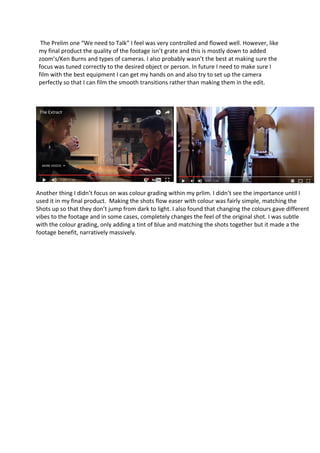
The Prelim one “We need to Talk” I feel was very controlled and flowed well. However, like
my final product the quality of the footage isn’t grate and this is mostly down to added
zoom’s/Ken Burns and types of cameras. I also probably wasn’t the best at making sure the
focus was tuned correctly to the desired object or person. In future I need to make sure I
film with the best equipment I can get my hands on and also try to set up the camera
perfectly so that I can film the smooth transitions rather than making them in the edit.
Another thing I didn’t focus on was colour grading within my prlim. I didn’t see the importance until I
used it in my final product. Making the shots flow easer with colour was fairly simple, matching the
Shots up so that they don’t jump from dark to light. I also found that changing the colours gave different
vibes to the footage and in some cases, completely changes the feel of the original shot. I was subtle
with the colour grading, only adding a tint of blue and matching the shots together but it made a the
footage benefit, narratively massively.

Looking back

  • 1.
    Looking back, Ithink I’ve developed and covered most weakness I original had when I filmed for the prelim task. First would be realistic and relevant sound. In the prelim task one “We need to Talk” I added diegetic, heavy rain to give a noir type of vibe. I also made sure the rain sounded lowered when he opened the door then quieter when it was shut again. However, the sound of the rain felt very unrealistic and I didn’t want to repeat this in my final product. I set out to make sure that any diegetic sound added to a shot was completely original so I recorded sound with a proper shotgun mike to get the best result. The shot above is an example of when I added the diegetic sound. For my final product to be worthy of a typical drama sequence I needed to make sure every shot was relevant to the aim/goal I was intending. I was going for a calm thoughtful morning and to do this I needed to carry out smooth shots so that the audience had enough time to take in all the information/environment. This shot within my sequence moves very smoothly and controlled from the left to the right. Continuing the flow and keeping a well-balanced, steady shot so the viewer has nothing but the environment to think of. Exactly what I was going for.
  • 2.
    With my finalprelim there were plenty of jumps and jolts that would take the viewer out of the emersion with is the opposite of what I wanted. The shot below is an example of when a jolted shot accrued. I never really thought about mise –en scene in my final prelim. In the shot above the framing seems open and large however this is wrong because the feeling and aim of the short film was to create the feeling of entrapment because the character to the right is about to be kicked out of school and there’s nothing he can do about it. I’m never really that fused about mise-en scene because I believe that the shot is only right if it feels right. However, without mise-en scene I wouldn’t of added small details. Example. When the character puts his hands together. Putting his hands together was a reference to this character being religious and deep minded. This was to give a little more detail to the character as we don’t see or hear much about him.
  • 3.
    The Prelim one“We need to Talk” I feel was very controlled and flowed well. However, like my final product the quality of the footage isn’t grate and this is mostly down to added zoom’s/Ken Burns and types of cameras. I also probably wasn’t the best at making sure the focus was tuned correctly to the desired object or person. In future I need to make sure I film with the best equipment I can get my hands on and also try to set up the camera perfectly so that I can film the smooth transitions rather than making them in the edit. Another thing I didn’t focus on was colour grading within my prlim. I didn’t see the importance until I used it in my final product. Making the shots flow easer with colour was fairly simple, matching the Shots up so that they don’t jump from dark to light. I also found that changing the colours gave different vibes to the footage and in some cases, completely changes the feel of the original shot. I was subtle with the colour grading, only adding a tint of blue and matching the shots together but it made a the footage benefit, narratively massively.