Testing site-specific parameterizations
of longwave radiation integrated in a
GIS-based hydrological model
Giuseppe Formetta1, Marialaura Bancheri2, Olaf David3 and
Riccardo Rigon2 !!
!1Dept. of Civil and Environmental Engineering, University of Calabria,Rende (CS),Italy
2Dept. of Civil and Environmental Engineering, University of Trento, 77 Mesiano St., 38123 Trento, Italy
3Department of Civil and Environmental Engineering, Colorado State University, Fort Collins, Colorado, USA
Outline
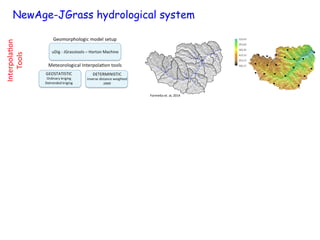
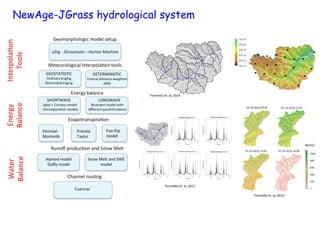
•  NewAge-JGrass hydrological system
•  NewAge-LWRB package
•  Models Applications (LWRB; SWRB+LWRB+SWE)
Interpola+on!
Tools!
Energy!
Balance!
Water!
Balance!
Automa+c!
Calibra+on!NewAge-JGrass hydrological system
Forme;a!et.!al,!2014!
Interpola+on!
Tools!
Energy!
Balance!
Water!
Balance!
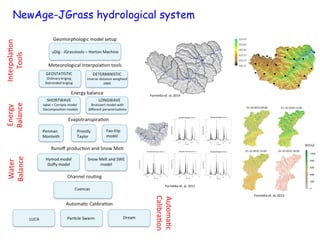
Automa+c!
Calibra+on!
Forme;a!et.!al,!2014!
Forme;a!et.!al,!2013!
W/m2!
NewAge-JGrass hydrological system
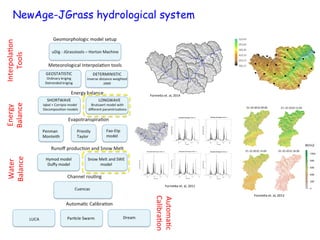
Interpola+on!
Tools!
Energy!
Balance!
Water!
Balance!
Automa+c!
Calibra+on!
Forme;a!et.!al,!2011!
Forme;a!et.!al,!2014!
Forme;a!et.!al,!2013!
W/m2!
NewAge-JGrass hydrological system
Interpola+on!
Tools!
Energy!
Balance!
Water!
Balance!
Automa+c!
Calibra+on!
Forme;a!et.!al,!2011!
Forme;a!et.!al,!2014!
Forme;a!et.!al,!2013!
W/m2!
NewAge-JGrass hydrological system
Interpola+on!
Tools!
Energy!
Balance!
Water!
Balance!
NewAge-JGrass hydrological system
Automa+c!
Calibra+on!
Forme;a!et.!al,!2011!
Forme;a!et.!al,!2014!
Forme;a!et.!al,!2013!
W/m2!
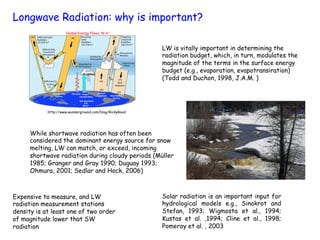
Longwave Radiation: why is important?
LW is vitally important in determining the
radiation budget, which, in turn, modulates the
magnitude of the terms in the surface energy
budget (e.g., evaporation, evapotransiration)
(Todd and Duchon, 1998, J.A.M. )
!
Solar radiation is an important input for
hydrological models e.g., Sinokrot and
Stefan, 1993; Wigmosta et al., 1994;
Kustas et al. ,1994; Cline et al., 1998;
Pomeroy et al. , 2003
While shortwave radiation has often been
considered the dominant energy source for snow
melting, LW can match, or exceed, incoming
shortwave radiation during cloudy periods (Müller
1985; Granger and Gray 1990; Duguay 1993;
Ohmura, 2001; Sedlar and Hock, 2006)
http://www.wunderground.com/blog/RickyRood
Expensive to measure, and LW
radiation measurement stations
density is at least one of two order
of magnitude lower that SW
radiation
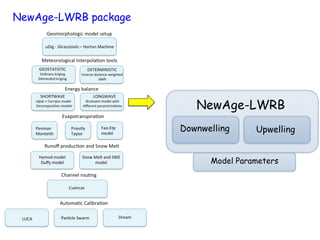
NewAge-LWRB package
Downwelling Upwelling
NewAge-LWRB
Model Parameters
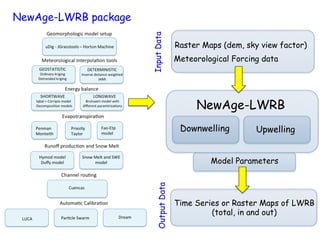
NewAge-LWRB package
Downwelling Upwelling
NewAge-LWRB
Model ParametersInputData
Raster Maps (dem, sky view factor)
Meteorological Forcing data
!!!!!!!!!!
Time Series or Raster Maps of LWRB
(total, in and out)
OutputData
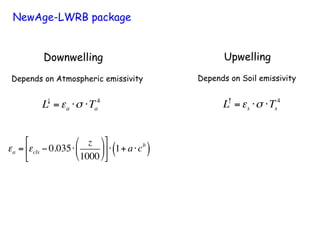
NewAge-LWRB package
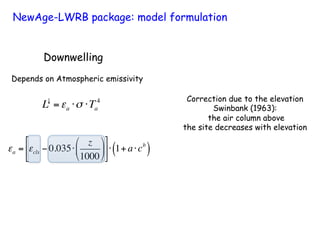
Downwelling
Depends on Atmospheric emissivity
L↓
=εa ⋅σ ⋅Ta
4
εa = εcls − 0.035⋅
z
1000
#
$
%
&
'
(
)
*
+
,
-
.⋅ 1+ a⋅cb
( )
Upwelling
Depends on Soil emissivity
L↑
=εs ⋅σ ⋅Ts
4
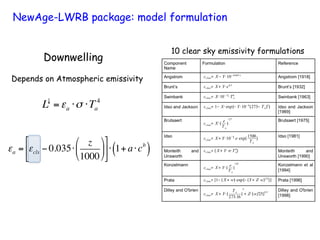
NewAge-LWRB package: model formulation
Downwelling
Depends on Atmospheric emissivity
L↓
=εa ⋅σ ⋅Ta
4
εa = εcls − 0.035⋅
z
1000
#
$
%
&
'
(
)
*
+
,
-
.⋅ 1+ a⋅cb
( )
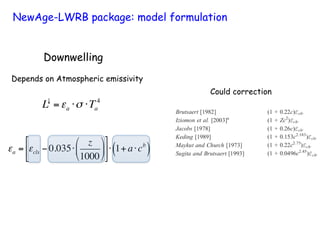
10 clear sky emissivity formulations
Downwelling
Depends on Atmospheric emissivity
L↓
=εa ⋅σ ⋅Ta
4
εa = εcls − 0.035⋅
z
1000
#
$
%
&
'
(
)
*
+
,
-
.⋅ 1+ a⋅cb
( )
Correction due to the elevation
Swinbank (1963):
the air column above
the site decreases with elevation
NewAge-LWRB package: model formulation
Downwelling
Depends on Atmospheric emissivity
L↓
=εa ⋅σ ⋅Ta
4
εa = εcls − 0.035⋅
z
1000
#
$
%
&
'
(
)
*
+
,
-
.⋅ 1+ a⋅cb
( )
Could correction
NewAge-LWRB package: model formulation
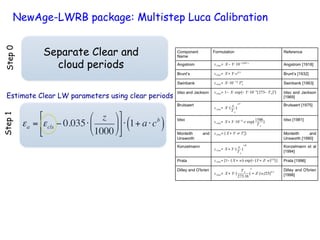
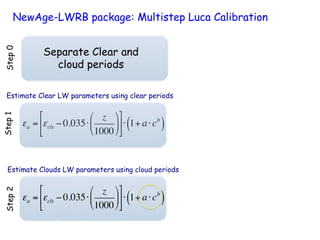
NewAge-LWRB package: Multistep Luca Calibration
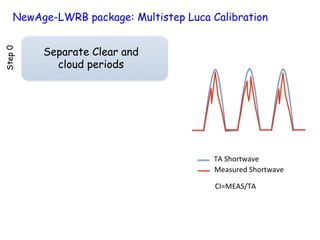
Step0
Separate Clear and
cloud periods
TA!Shortwave!
Measured!Shortwave!
CI=MEAS/TA!
NewAge-LWRB package: Multistep Luca Calibration
Step1
εa = εcls − 0.035⋅
z
1000
#
$
%
&
'
(
)
*
+
,
-
.⋅ 1+ a⋅cb
( )
Step0
Separate Clear and
cloud periods
Estimate Clear LW parameters using clear periods
NewAge-LWRB package: Multistep Luca Calibration
Step1Step2
εa = εcls − 0.035⋅
z
1000
#
$
%
&
'
(
)
*
+
,
-
.⋅ 1+ a⋅cb
( )
Step0
εa = εcls − 0.035⋅
z
1000
#
$
%
&
'
(
)
*
+
,
-
.⋅ 1+ a⋅cb
( )
Separate Clear and
cloud periods
Estimate Clear LW parameters using clear periods
Estimate Clouds LW parameters using cloud periods
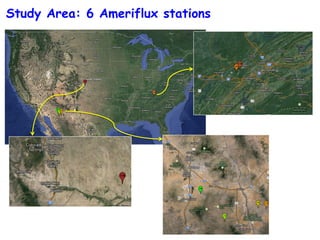
Study Area: 6 Ameriflux stations
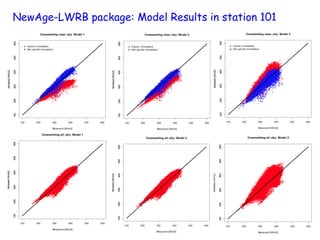
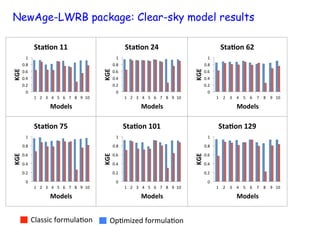
NewAge-LWRB package: Model Results in station 101
0!
0.2!
0.4!
0.6!
0.8!
1!
1! 2! 3! 4! 5! 6! 7! 8! 9! 10!
KGE$
Models$
Sta.on$11$
0!
0.2!
0.4!
0.6!
0.8!
1!
1! 2! 3! 4! 5! 6! 7! 8! 9! 10!
KGE$ Models$
Sta.on$24$
0!
0.2!
0.4!
0.6!
0.8!
1!
1! 2! 3! 4! 5! 6! 7! 8! 9! 10!
KGE$
Models$
Sta.on$62$
0!
0.2!
0.4!
0.6!
0.8!
1!
1! 2! 3! 4! 5! 6! 7! 8! 9! 10!
KGE$
Models$
Sta.on$75$
0!
0.2!
0.4!
0.6!
0.8!
1!
1! 2! 3! 4! 5! 6! 7! 8! 9! 10!
KGE$
Models$
Sta.on$101$
0!
0.2!
0.4!
0.6!
0.8!
1!
1! 2! 3! 4! 5! 6! 7! 8! 9! 10!
KGE$ Models$
Sta.on$129$
Classic!formula+on! Op+mized!formula+on!
NewAge-LWRB package: Clear-sky model results
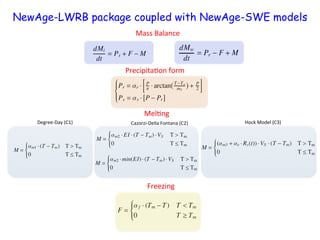
Mass!Balance!
Precipita+on!form!
Mel+ng!
Freezing!
DegreeUDay!(C1)! CazorziUDella!Fontana!(C2)! Hock!Model!(C3)!
NewAge-LWRB package coupled with NewAge-SWE models
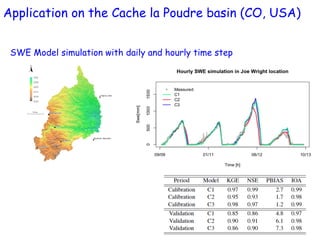
SWE Model simulation with daily and hourly time step
Application on the Cache la Poudre basin (CO, USA)
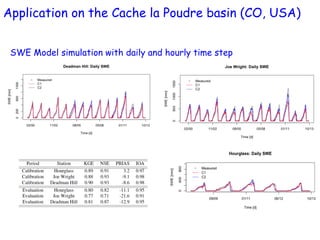
SWE Model simulation with daily and hourly time step
Application on the Cache la Poudre basin (CO, USA)
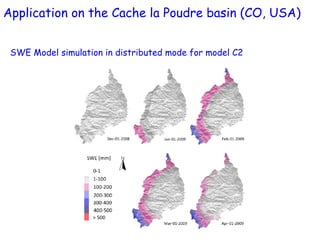
SWE Model simulation in distributed mode for model C2
Application on the Cache la Poudre basin (CO, USA)
We are not providing “The Hydrological Model”, we are
offering a strategy to choose, link and test different
hydrological models built by components
•  Compare, on the same platform different model structures to simulate the
same physical process (LWRB, SWE)
•  Investigate the model structure error using different model for a given
calibration algorithm
• Parameter optimization, using the same platform, for different hydrological
processes
Conclusions
Thanks for your
attention

Long wave radiation parameterisations