


CLUSTERING
CLUSTERING
CLUSTERING
CLUSTERING
CLUSTERING
CLUSTERING
CLUSTERING
CLUSTERING
CLUSTERING
CLUSTERING
1
INTRODUCTION
LogicalDOC is a platform that enables users to efficiently
handle file search, entry, and retrieval.
With keywords and parameters, users with access can find
the files they need and access them simultaneously.
Whether Enterprise, Business,
Community, or Cloud,
LogicalDOC has products that
meet the needs of
specific groups of users.
LogicalDOC’s system is designed
to ensure the availability of and
easy access to files across
organizations without disruptions. While we have many
products to achieve this, clusters are one of the ways
we at LogicalDOC ensure the efficiency of
organizational systems.
2
WHAT IS A CLUSTER
A LogicalDOC Cluster is a number of computers
working together to ensure a document management
system is available and performing efficiently.
The computers in the network exist independently but are
connected to maximize the performance of the system.
3
Why Is Clustering Relevant ?
A node in the cluster is a server with an instance of
LogicalDOC installed, where cables and software
connect the clustered nodes.
Once a particular node fails, another node instantly
begins to provide the service. Since the nodes are
connected one to the other, service disruptions
can be mitigated.
“The use of clustering architecture ensures
that failure at one node does not lead
to a failure of the entire system.”
4
LogicalDOC Implements Clustering
With Three Clustering Architectures
LogicalDOC approaches Clustering in three different ways.
Each clustering architecture supported by LogicalDOC
is designed to meet specific use cases and needs.
These architectures are namely:
1. Best Performance
2. High Availability
3. Disaster Recovery
5
“Best performance architecture exists to allow
for the best performance by distributing
the RAM and CPU loads among
the nodes in the cluster”
Best
Performance
Architecture
This clustering architecture is best suited for systems
where a large document repository to index exists along
with many users accessing these documents concurrently.
If a single node is used to implement such a system,
performance will be slow, and failures will be likely
even if improvements are made on the node.
This allows each node to perform optimally without bearing
too much load. However, there must be a hardware balancer
to distribute requests evenly among the nodes and at least
two LogicalDOC instances on separate nodes in the cluster.
This architecture ensures that the response time when requests
are made is minimized
6
Implementing Best Performance Cluster
With a Local File System
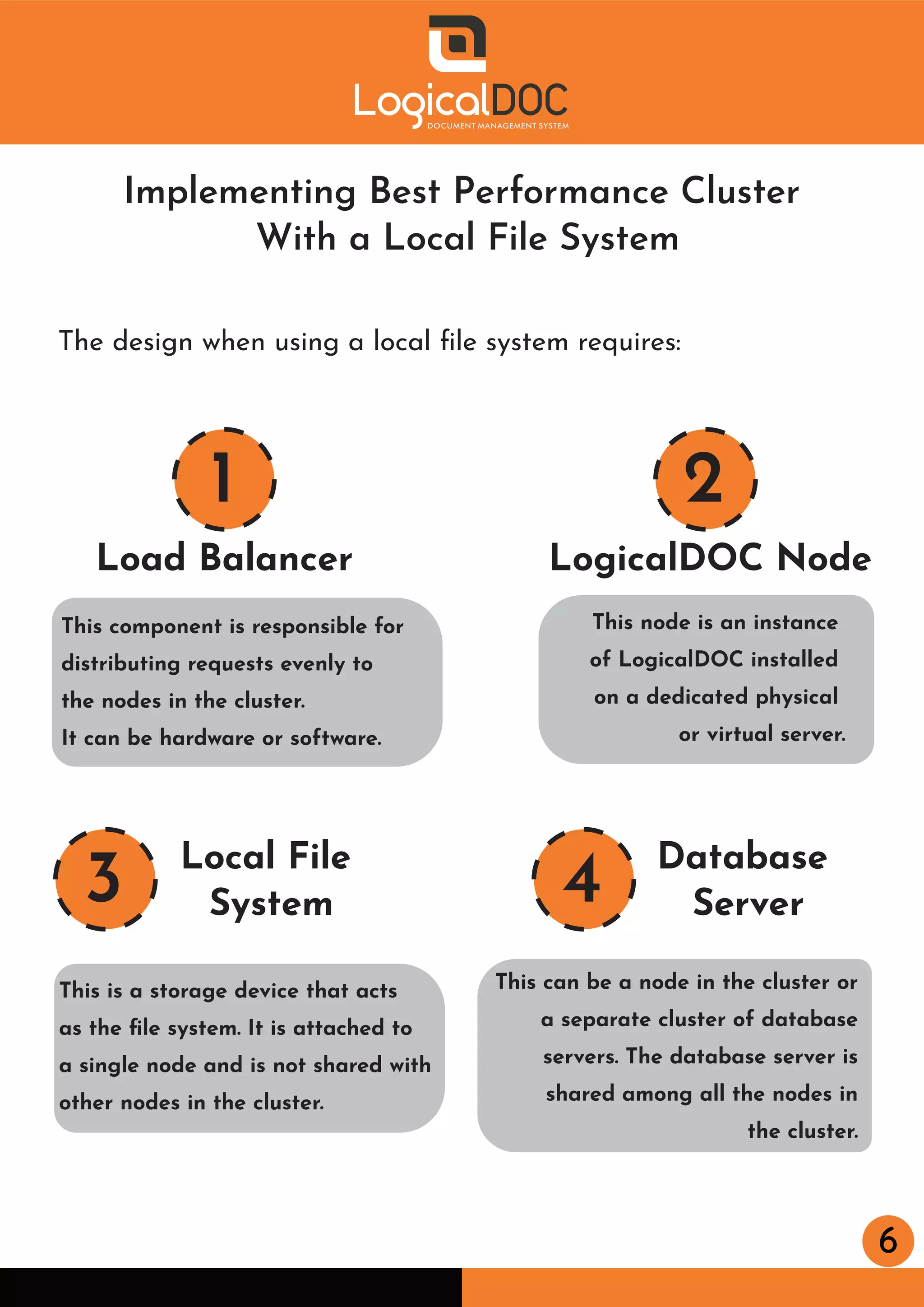
The design when using a local file system requires:
Load Balancer
Local File
System
LogicalDOC Node
1
3 Database
Server
4
2
This component is responsible for
distributing requests evenly to
the nodes in the cluster.
It can be hardware or software.
This is a storage device that acts
as the file system. It is attached to
a single node and is not shared with
other nodes in the cluster.
This node is an instance
of LogicalDOC installed
on a dedicated physical
or virtual server.
This can be a node in the cluster or
a separate cluster of database
servers. The database server is
shared among all the nodes in
the cluster.
7
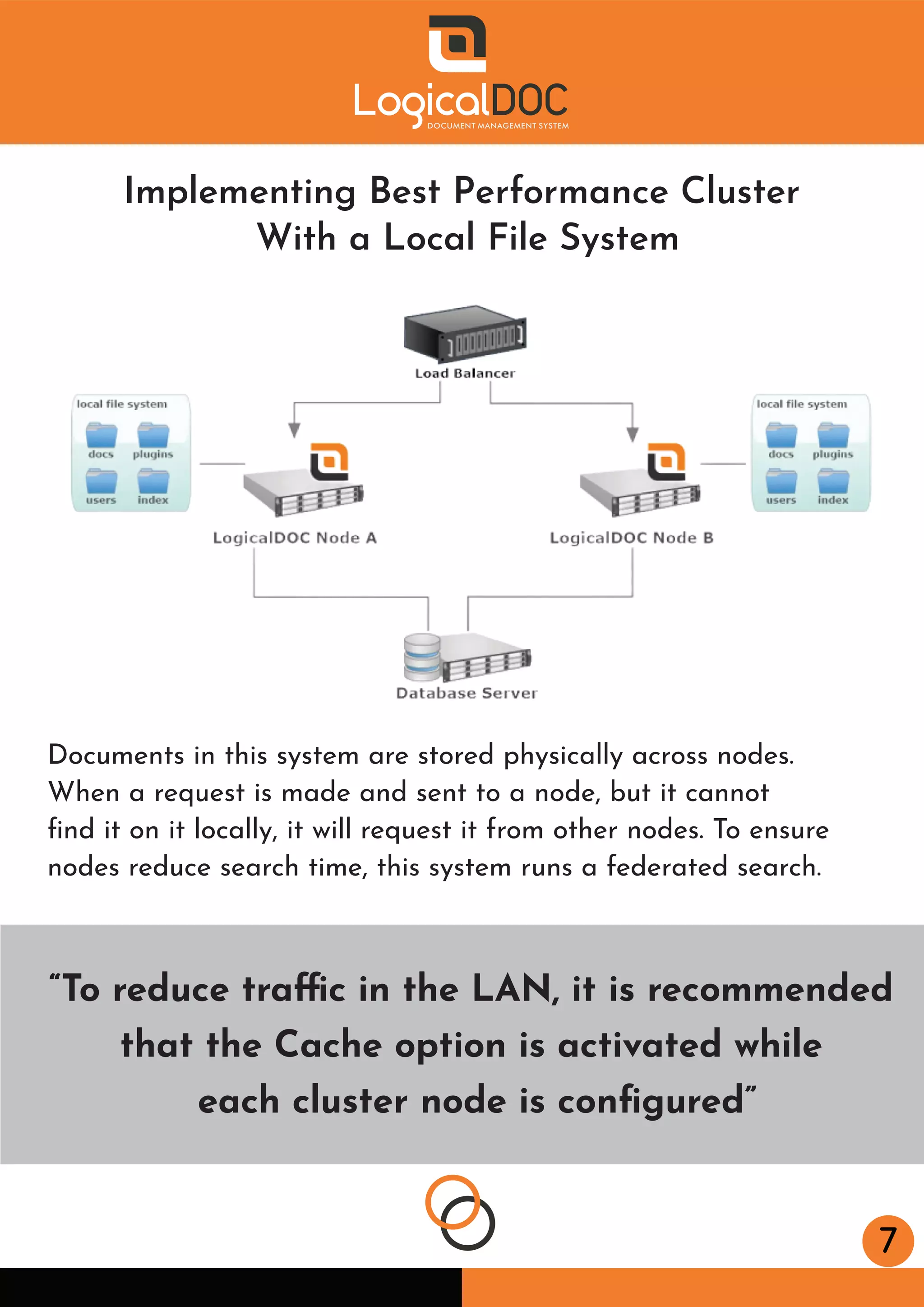
“To reduce traffic in the LAN, it is recommended
that the Cache option is activated while
each cluster node is configured”
Implementing Best Performance Cluster
With a Local File System
Documents in this system are stored physically across nodes.
When a request is made and sent to a node, but it cannot
find it on it locally, it will request it from other nodes. To ensure
nodes reduce search time, this system runs a federated search.
8
Implementing Best Performance Cluster
With a Shared File System
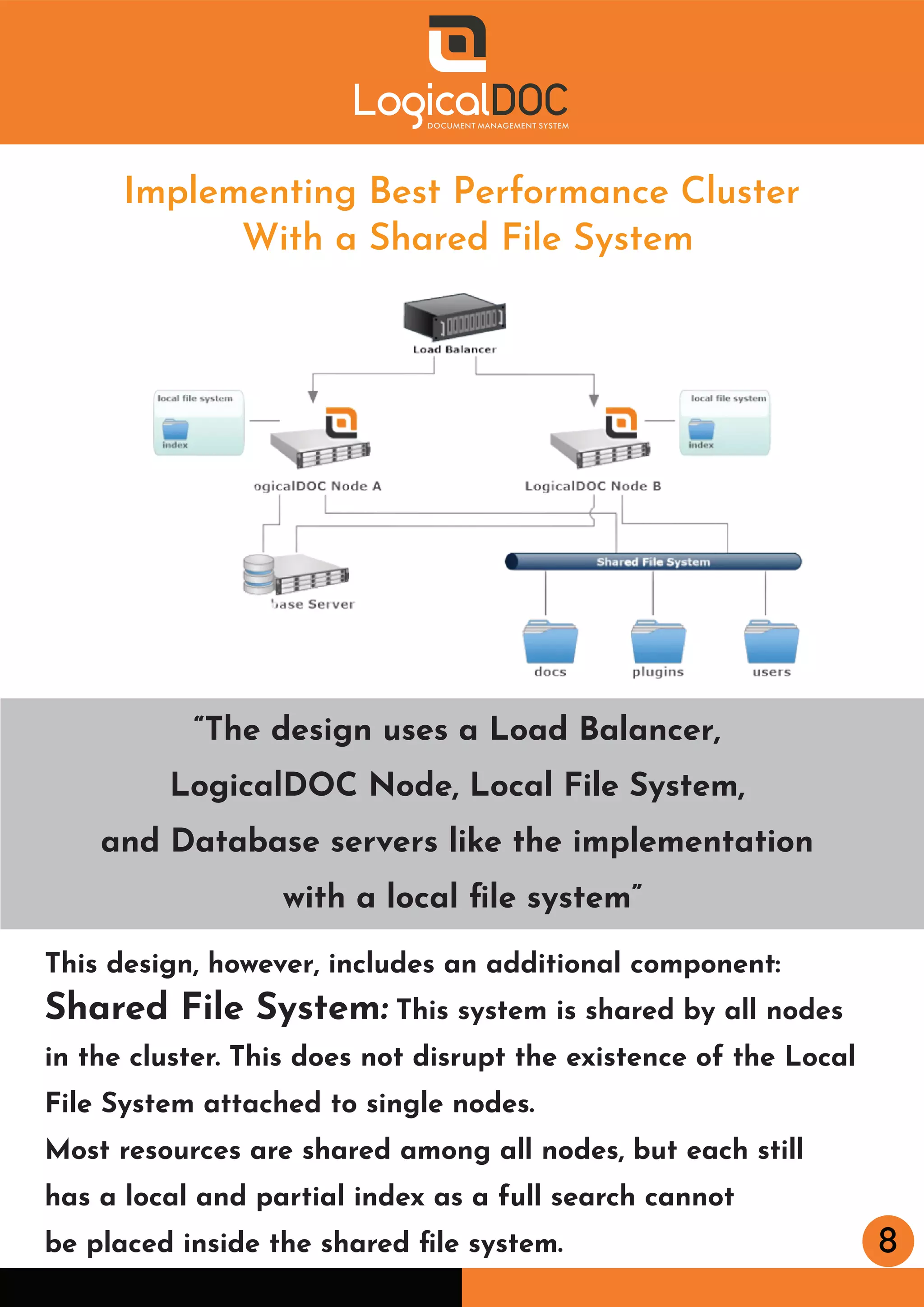
“The design uses a Load Balancer,
LogicalDOC Node, Local File System,
and Database servers like the implementation
with a local file system”
This design, however, includes an additional component:
Shared File System: This system is shared by all nodes
in the cluster. This does not disrupt the existence of the Local
File System attached to single nodes.
Most resources are shared among all nodes, but each still
has a local and partial index as a full search cannot
be placed inside the shared file system.
9
HIGH
AVAILABILITY
ARCHITECTURE
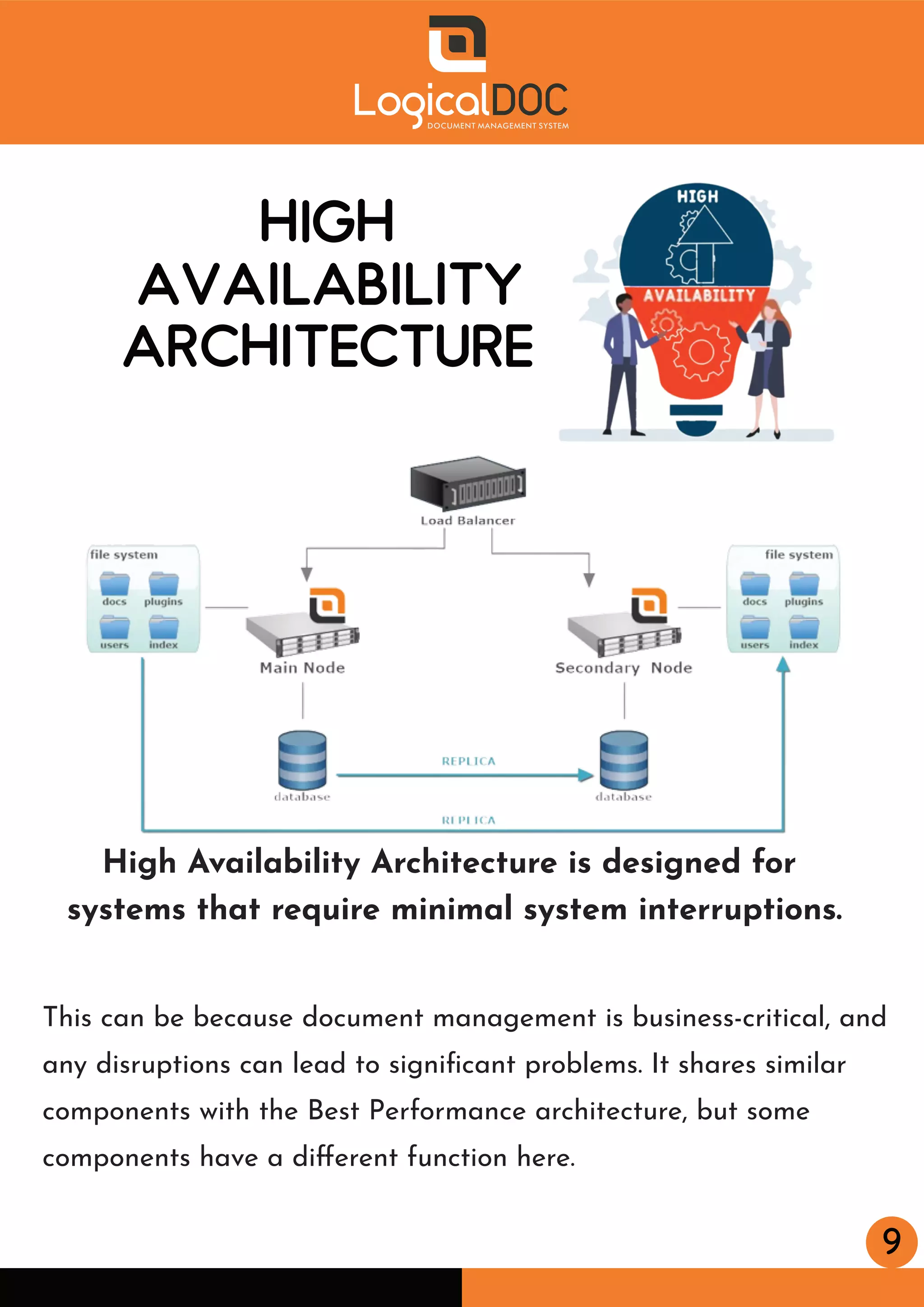
High Availability Architecture is designed for
systems that require minimal system interruptions.
This can be because document management is business-critical, and
any disruptions can lead to significant problems. It shares similar
components with the Best Performance architecture, but some
components have a different function here.
10
Load Balancer
1
Secondary
Node
3
This hardware or software component
notes when the main node is down
and directs traffic to the
secondary node.
Main Node
2
This instance of LogicalDOC
on a server is the active
recipient of traffic.
It can either be a single node
or a Best Performance Cluster.
This node is on hand to handle
traffic in the event that the
main node is out of service.
Both nodes are in the same LAN.
The Local File System and Database Server work like they do in
the Best Performance Cluster. Although each node has a separate
database and storage, they are both populated from the main node.
This ensures that the system keeps running normally
if the main node is out of service.
11
DISASTER
RECOVERY
ARCHITECTURE
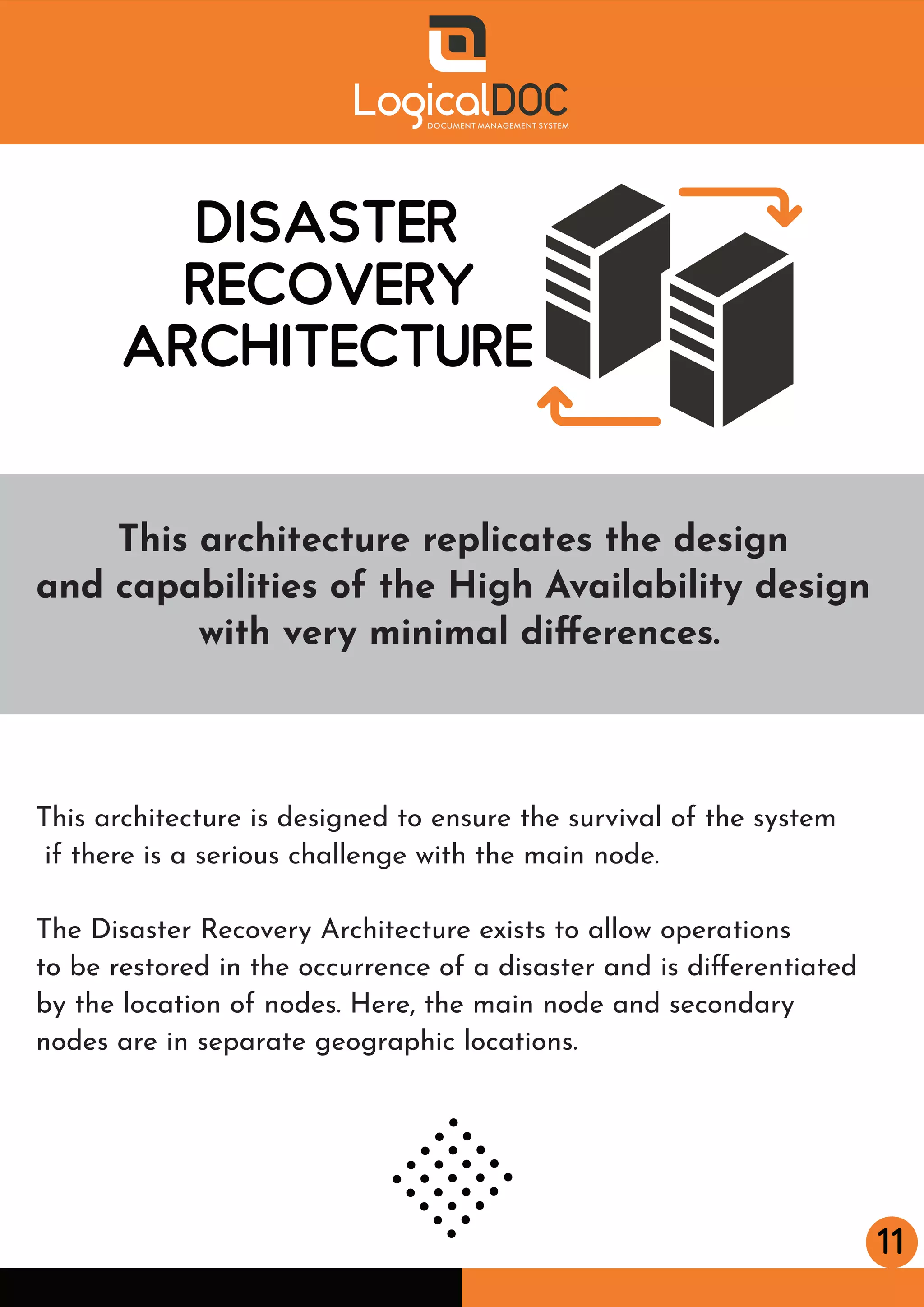
This architecture is designed to ensure the survival of the system
if there is a serious challenge with the main node.
The Disaster Recovery Architecture exists to allow operations
to be restored in the occurrence of a disaster and is differentiated
by the location of nodes. Here, the main node and secondary
nodes are in separate geographic locations.
This architecture replicates the design
and capabilities of the High Availability design
with very minimal differences.
12
Benefits of Clustering Architectures
Efficient document access
and management
1
Smooth business
operations
3
Since documents are stored across
nodes, they are faster to retrieve
and concurrently accesse.
Reduced search time
2
Due to its distributed nature,
indexing files is faster since
the search is federated.
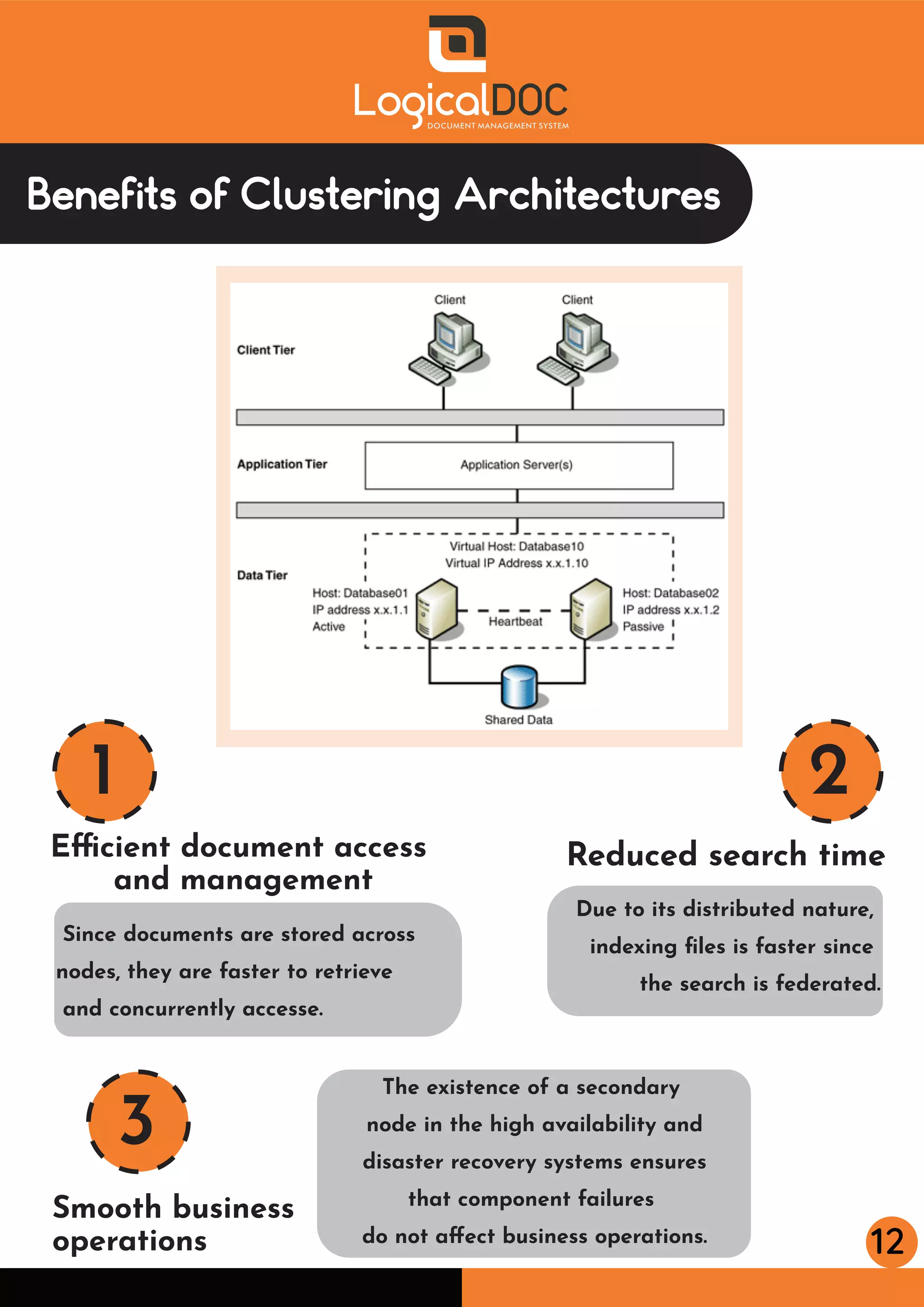
The existence of a secondary
node in the high availability and
disaster recovery systems ensures
that component failures
do not affect business operations.
CONTACT US
US Quarters
Head Quarters
German Quarters
LogicalDOC
14-25 Plaza Road
Suite N-3-5
Fair Lawn, NJ 07410
USA
+1 (800) 654 2827
sales@logicaldoc.com
INDUS-VBS GmbH
Bitzenhofer Weg. 3b
86453 Dasing
Germany
+49 8205 969992
Germany and Austria
LogicalDOC Srl
via Aldo Moro intema, 3 41012,
Carpi Italy
+39 059 5970906
+39 059 640508
info@logicaldoc.com

LogicalDOC Clustering

  • 1.
  • 2.
    1 INTRODUCTION LogicalDOC is aplatform that enables users to efficiently handle file search, entry, and retrieval. With keywords and parameters, users with access can find the files they need and access them simultaneously. Whether Enterprise, Business, Community, or Cloud, LogicalDOC has products that meet the needs of specific groups of users. LogicalDOC’s system is designed to ensure the availability of and easy access to files across organizations without disruptions. While we have many products to achieve this, clusters are one of the ways we at LogicalDOC ensure the efficiency of organizational systems.
  • 3.
    2 WHAT IS ACLUSTER A LogicalDOC Cluster is a number of computers working together to ensure a document management system is available and performing efficiently. The computers in the network exist independently but are connected to maximize the performance of the system.
  • 4.
    3 Why Is ClusteringRelevant ? A node in the cluster is a server with an instance of LogicalDOC installed, where cables and software connect the clustered nodes. Once a particular node fails, another node instantly begins to provide the service. Since the nodes are connected one to the other, service disruptions can be mitigated. “The use of clustering architecture ensures that failure at one node does not lead to a failure of the entire system.”
  • 5.
    4 LogicalDOC Implements Clustering WithThree Clustering Architectures LogicalDOC approaches Clustering in three different ways. Each clustering architecture supported by LogicalDOC is designed to meet specific use cases and needs. These architectures are namely: 1. Best Performance 2. High Availability 3. Disaster Recovery
  • 6.
    5 “Best performance architectureexists to allow for the best performance by distributing the RAM and CPU loads among the nodes in the cluster” Best Performance Architecture This clustering architecture is best suited for systems where a large document repository to index exists along with many users accessing these documents concurrently. If a single node is used to implement such a system, performance will be slow, and failures will be likely even if improvements are made on the node. This allows each node to perform optimally without bearing too much load. However, there must be a hardware balancer to distribute requests evenly among the nodes and at least two LogicalDOC instances on separate nodes in the cluster. This architecture ensures that the response time when requests are made is minimized
  • 7.
    6 Implementing Best PerformanceCluster With a Local File System The design when using a local file system requires: Load Balancer Local File System LogicalDOC Node 1 3 Database Server 4 2 This component is responsible for distributing requests evenly to the nodes in the cluster. It can be hardware or software. This is a storage device that acts as the file system. It is attached to a single node and is not shared with other nodes in the cluster. This node is an instance of LogicalDOC installed on a dedicated physical or virtual server. This can be a node in the cluster or a separate cluster of database servers. The database server is shared among all the nodes in the cluster.
  • 8.
    7 “To reduce trafficin the LAN, it is recommended that the Cache option is activated while each cluster node is configured” Implementing Best Performance Cluster With a Local File System Documents in this system are stored physically across nodes. When a request is made and sent to a node, but it cannot find it on it locally, it will request it from other nodes. To ensure nodes reduce search time, this system runs a federated search.
  • 9.
    8 Implementing Best PerformanceCluster With a Shared File System “The design uses a Load Balancer, LogicalDOC Node, Local File System, and Database servers like the implementation with a local file system” This design, however, includes an additional component: Shared File System: This system is shared by all nodes in the cluster. This does not disrupt the existence of the Local File System attached to single nodes. Most resources are shared among all nodes, but each still has a local and partial index as a full search cannot be placed inside the shared file system.
  • 10.
    9 HIGH AVAILABILITY ARCHITECTURE High Availability Architectureis designed for systems that require minimal system interruptions. This can be because document management is business-critical, and any disruptions can lead to significant problems. It shares similar components with the Best Performance architecture, but some components have a different function here.
  • 11.
    10 Load Balancer 1 Secondary Node 3 This hardwareor software component notes when the main node is down and directs traffic to the secondary node. Main Node 2 This instance of LogicalDOC on a server is the active recipient of traffic. It can either be a single node or a Best Performance Cluster. This node is on hand to handle traffic in the event that the main node is out of service. Both nodes are in the same LAN. The Local File System and Database Server work like they do in the Best Performance Cluster. Although each node has a separate database and storage, they are both populated from the main node. This ensures that the system keeps running normally if the main node is out of service.
  • 12.
    11 DISASTER RECOVERY ARCHITECTURE This architecture isdesigned to ensure the survival of the system if there is a serious challenge with the main node. The Disaster Recovery Architecture exists to allow operations to be restored in the occurrence of a disaster and is differentiated by the location of nodes. Here, the main node and secondary nodes are in separate geographic locations. This architecture replicates the design and capabilities of the High Availability design with very minimal differences.
  • 13.
    12 Benefits of ClusteringArchitectures Efficient document access and management 1 Smooth business operations 3 Since documents are stored across nodes, they are faster to retrieve and concurrently accesse. Reduced search time 2 Due to its distributed nature, indexing files is faster since the search is federated. The existence of a secondary node in the high availability and disaster recovery systems ensures that component failures do not affect business operations.
  • 14.
    CONTACT US US Quarters HeadQuarters German Quarters LogicalDOC 14-25 Plaza Road Suite N-3-5 Fair Lawn, NJ 07410 USA +1 (800) 654 2827 sales@logicaldoc.com INDUS-VBS GmbH Bitzenhofer Weg. 3b 86453 Dasing Germany +49 8205 969992 Germany and Austria LogicalDOC Srl via Aldo Moro intema, 3 41012, Carpi Italy +39 059 5970906 +39 059 640508 info@logicaldoc.com