101:
MAPPING YOUR
IMPACT
Brandi Olson Consulting
Authentic impact doesn’t happen just
because you have good intentions. You
have to know where you are going to get
there—and not get lost along the way.
Logic Models
Logic Models
o Make it easy to collaborate
(a visual picture of your program)
Logic Models
o Make it easy to collaborate
(a visual picture of your program)
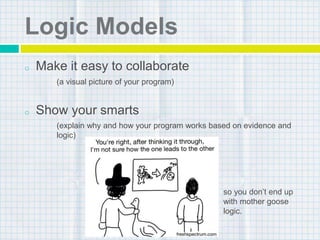
o Show your smarts
(explain why and how your program works based on evidence and
logic)
so you don’t end up
with mother goose
logic.
Logic Models
o Make it easy to collaborate
(a visual picture of your program)
o Show your smarts
(explain why and how your program works based on evidence and
logic)
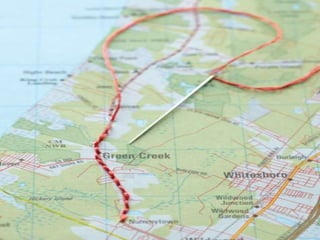
o Keep you from getting lost
(a map to let you know when you are on track or veering off
course)
Logic Models
o Make it easy to collaborate
(a visual picture of your program)
o Show your smarts
(explain why and how your program works based on evidence and
logic)
o Keep you from getting lost
(a map to let you know when you are on track or veering off
course)
o Convince stakeholders to be part of your story
(more money, committed volunteers, stronger relationships with
participants)
Invent A Logic model
o Share your name + organization
o Unpack Lingo Cards
o Organize cards into a logical progression
o Identify the starting point + use arrows to guide
us through the map
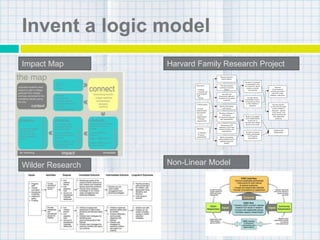
Invent a logic model
Family Involvement Project (FIP) Logic Model
Inputs Activities Short-Term Outcomes Long-Term Outcomes
see ip
positions
Establish FIP
sustainability
Increase parents’
levels of involvement
in their children’s
education – parents
work closely with
school systems and
k leadersh
Increase
involvement of
parents associated
with FIP in their
children’s education
Increase awareness
of and commitment
to FIP and its
sustainability
Build or strengthen
local collaborations
at each site to
promote and sustain
parent involvement
Increase parent
knowledge on how
to become involved
in their children’s
education
Increase # of parents
in communities who
are trained by parent
leaders on parent
involvement
Build relationships
with potential local or
national long-term
funders
Disseminate FIP
materials to local and
national funders and
organizations
Develop coalitions of
local parent
involvement programs
and organizations
Build relationships
with schools
Develop and
disseminate materials
on parent involvement
to parents
Provide technical
assistance to parent
leaders
Recruit and train
parent leaders
Planning:
•Evaluation
•Program
sustainability
Collaborations:
•School
administrators
and teachers
•Local
organizations
•National
organizations
Resources:
•Funding
•National and
local program
staff
•Parents
Wilder Research
Impact Map Harvard Family Research Project
Non-Linear Model
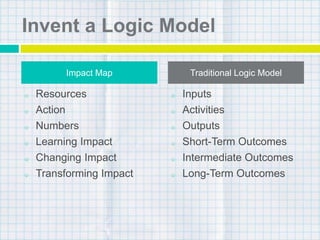
Invent a Logic Model
o Inputs
o Activities
o Outputs
o Short-Term Outcomes
o Intermediate Outcomes
o Long-Term Outcomes
Impact Map Traditional Logic Model
o Resources
o Action
o Numbers
o Learning Impact
o Changing Impact
o Transforming Impact
Map It out
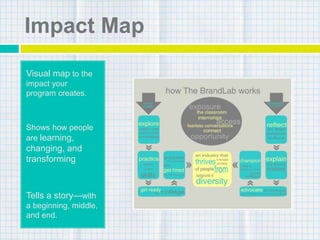
Impact Map
Visual map to the
impact your
program creates.
Shows how people
are learning,
changing, and
transforming
Tells a story—with
a beginning, middle,
and end.
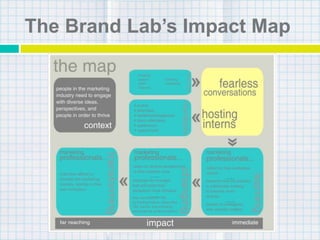
The Brand Lab’s Impact Map
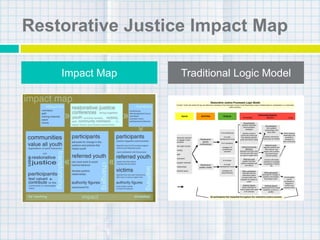
Restorative Justice Impact Map
Impact Map Traditional Logic Model
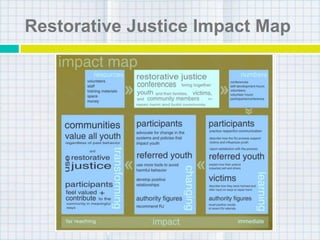
Restorative Justice Impact Map
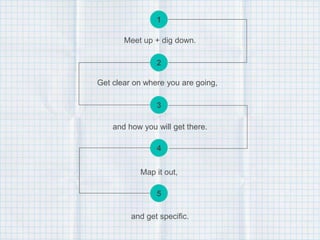
Drawing your Map
1
Meet up + dig down.
2
Get clear on where you are going,
3
and how you will get there.
4
Map it out,
5
and get specific.
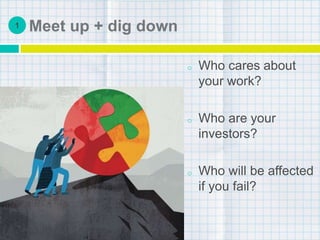
Meet up + dig down
o Who cares about
your work?
o Who are your
investors?
o Who will be affected
if you fail?
1
Meet up + dig down
o Who cares about
your work?
o Who are your
investors?
o Who will be affected
if you fail?
1
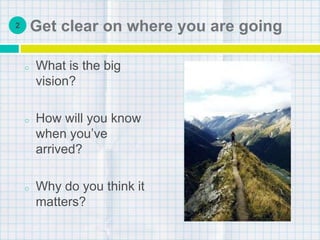
Get clear on where you are going
o What is the big
vision?
o How will you know
when you’ve
arrived?
o Why do you think it
matters?
2
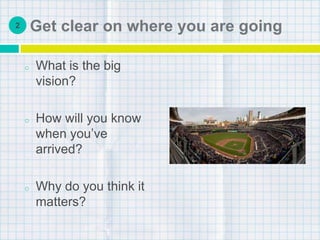
Get clear on where you are going
o What is the big
vision?
o How will you know
when you’ve
arrived?
o Why do you think it
matters?
2
And how you will get there.
o Start at the
beginning.
But, why?
o Work backwards
from the end.
But, how?
3
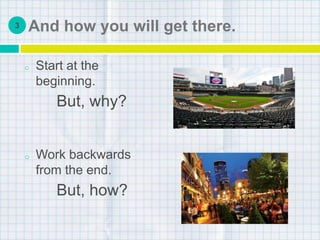
And how you will get there.
o Start at the
beginning.
But, why?
o Work backwards
from the end.
But, how?
3
Map it out
What resources are
needed to make this
happen?
What numbers should
we track to understand
our reach?
What changes can we
expect?
4
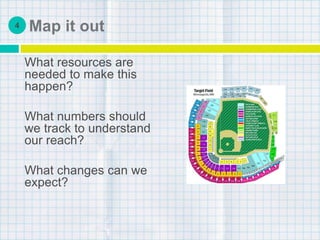
Map it out
What resources are
needed to make this
happen?
What numbers should
we track to understand
our reach?
What changes can we
expect?
4
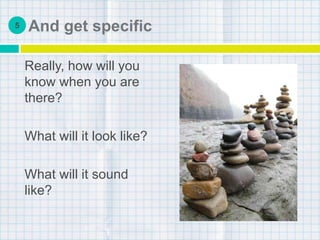
And get specific
Really, how will you
know when you are
there?
What will it look like?
What will it sound
like?
5
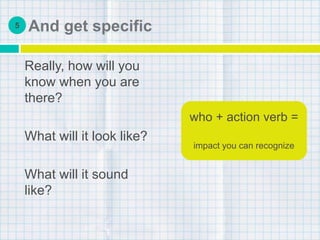
And get specific
Really, how will you
know when you are
there?
What will it look like?
What will it sound
like?
5
who + action verb =
impact you can recognize
Resources
www.brandiolsonconsulting.com
o Wilder Research
o Community Toolbox
YIPA Training:
Making Data Work For You
Tuesdays, 11:00-12:30pm
October 7-November 4
hello@brandiolsonconsulting.com
www.brandiolsonconsulting.com

Logic Models and Impact Maps 101

  • 1.
    101: MAPPING YOUR IMPACT Brandi OlsonConsulting Authentic impact doesn’t happen just because you have good intentions. You have to know where you are going to get there—and not get lost along the way.
  • 7.
  • 8.
    Logic Models o Makeit easy to collaborate (a visual picture of your program)
  • 9.
    Logic Models o Makeit easy to collaborate (a visual picture of your program) o Show your smarts (explain why and how your program works based on evidence and logic) so you don’t end up with mother goose logic.
  • 10.
    Logic Models o Makeit easy to collaborate (a visual picture of your program) o Show your smarts (explain why and how your program works based on evidence and logic) o Keep you from getting lost (a map to let you know when you are on track or veering off course)
  • 11.
    Logic Models o Makeit easy to collaborate (a visual picture of your program) o Show your smarts (explain why and how your program works based on evidence and logic) o Keep you from getting lost (a map to let you know when you are on track or veering off course) o Convince stakeholders to be part of your story (more money, committed volunteers, stronger relationships with participants)
  • 12.
    Invent A Logicmodel o Share your name + organization o Unpack Lingo Cards o Organize cards into a logical progression o Identify the starting point + use arrows to guide us through the map
  • 13.
    Invent a logicmodel Family Involvement Project (FIP) Logic Model Inputs Activities Short-Term Outcomes Long-Term Outcomes see ip positions Establish FIP sustainability Increase parents’ levels of involvement in their children’s education – parents work closely with school systems and k leadersh Increase involvement of parents associated with FIP in their children’s education Increase awareness of and commitment to FIP and its sustainability Build or strengthen local collaborations at each site to promote and sustain parent involvement Increase parent knowledge on how to become involved in their children’s education Increase # of parents in communities who are trained by parent leaders on parent involvement Build relationships with potential local or national long-term funders Disseminate FIP materials to local and national funders and organizations Develop coalitions of local parent involvement programs and organizations Build relationships with schools Develop and disseminate materials on parent involvement to parents Provide technical assistance to parent leaders Recruit and train parent leaders Planning: •Evaluation •Program sustainability Collaborations: •School administrators and teachers •Local organizations •National organizations Resources: •Funding •National and local program staff •Parents Wilder Research Impact Map Harvard Family Research Project Non-Linear Model
  • 14.
    Invent a LogicModel o Inputs o Activities o Outputs o Short-Term Outcomes o Intermediate Outcomes o Long-Term Outcomes Impact Map Traditional Logic Model o Resources o Action o Numbers o Learning Impact o Changing Impact o Transforming Impact
  • 15.
  • 16.
    Impact Map Visual mapto the impact your program creates. Shows how people are learning, changing, and transforming Tells a story—with a beginning, middle, and end.
  • 17.
  • 18.
    Restorative Justice ImpactMap Impact Map Traditional Logic Model
  • 19.
  • 20.
  • 21.
    1 Meet up +dig down. 2 Get clear on where you are going, 3 and how you will get there. 4 Map it out, 5 and get specific.
  • 22.
    Meet up +dig down o Who cares about your work? o Who are your investors? o Who will be affected if you fail? 1
  • 23.
    Meet up +dig down o Who cares about your work? o Who are your investors? o Who will be affected if you fail? 1
  • 24.
    Get clear onwhere you are going o What is the big vision? o How will you know when you’ve arrived? o Why do you think it matters? 2
  • 25.
    Get clear onwhere you are going o What is the big vision? o How will you know when you’ve arrived? o Why do you think it matters? 2
  • 26.
    And how youwill get there. o Start at the beginning. But, why? o Work backwards from the end. But, how? 3
  • 27.
    And how youwill get there. o Start at the beginning. But, why? o Work backwards from the end. But, how? 3
  • 28.
    Map it out Whatresources are needed to make this happen? What numbers should we track to understand our reach? What changes can we expect? 4
  • 29.
    Map it out Whatresources are needed to make this happen? What numbers should we track to understand our reach? What changes can we expect? 4
  • 30.
    And get specific Really,how will you know when you are there? What will it look like? What will it sound like? 5
  • 31.
    And get specific Really,how will you know when you are there? What will it look like? What will it sound like? 5 who + action verb = impact you can recognize
  • 32.
    Resources www.brandiolsonconsulting.com o Wilder Research oCommunity Toolbox YIPA Training: Making Data Work For You Tuesdays, 11:00-12:30pm October 7-November 4
  • 33.

Editor's Notes

  • #2 I am Brandi Olson, and I empower organizations to measure, adjust, and grow their impact using good data. I help organizations make sense of data, so they can use it in tandem with their instincts and knowledge to make better decisions along the way, when they can make the most difference. The good you do is too important to navigate without a map—which is why I believe logic models are an essential tool for an impact driven organization.
  • #3 Looking to make your logic model more practical and useful.
  • #4 You got in too deep and can’t figure out to get out.
  • #5 It’s too big to be useful
  • #6 Your skeptical. Someone else is demanding you create a logic model, but you doubt that it will have any value.
  • #7 Wherever you are starting, this session aims to help you find a roadmap out of the chaos and into a clear path forward.
  • #13 There is no magic way to create a logic model. So, I want you to get up, get to know a few people and invent your own logic model in the process. Groups of 3-5, grab a lingo deck. 10 minutes Have each group share briefly. What do you notice about the different models?
  • #14 Logic Models are a picture of how and why your program works. There is no right way to do it. They can be linear, circular, or any other shape. They all show movement
  • #15 An impact map is your program visualized, and it tells a story: beginning, middle, and end. It tells the story of how your participants and stakeholders are learning, changing, and transforming along the way to your destination.
  • #17 TBL aims to diversify the marketing industry by creating opportunities and access for youth from diverse backgrounds. This is a big picture overview map of how they do it.
  • #18 Focus on context, addresses the impact to a group of stakeholders—marketing professionals—investors and volunteers. Talk about context, resources, and numbers
  • #19 The same process, but in a different format. What do you notice about the two models? Who is being impacted? What types of impact are occurring?
  • #20 Focuses on how a single program component—restorative justice conferences can lead to transformed communities by impacting everyone involved from volunteers, to police to youth and victims. Talk about immediate and far-reaching impacts. And now, this organization knows what to measure…they can leverage their time and energy by measuring only the most important things. Measurement is the compass.
  • #22 I am a teacher at heart, and I really care that you get this, so I am going to share a process for how to map out your own impact.
  • #23 You can’t do this well sitting at a desk by yourself in a cubicle. You need to assemble the troops for a lively conversation! A more beautiful question. Here are some questions to guide your process.
  • #24 Let’s make an impact map together. Our organization is the Minnesota Twins, and our core action is building Target Field. Let’s map out the impact they hope to have achieved from building the new stadium. Perhaps we will discover something useful the Vikings could learn from. Write out the answers to questions on big post-its.
  • #25 This is your organizations mission, vision, reason for existence. How are you changing the world?
  • #26 What is the end goal? Whose goal is it? What is at stake?
  • #27 This is where you fully develop your program theory—why does what you do work? What evidence is there to support your program action? What is the logical link between your program and impact? Has it worked in the past? Why are you engaging in this specific type of activity and not something else?
  • #28 You can start at the beginning—with your core actions, and ask, BUT WHY? Keep asking that question until you reach your end goal. Or, you can start at the end. How do you think you are changing the world? BUT HOW? Keep asking that until you reach concrete actions your organization is involved in. Pay attention to the leaps in logic—these points along the way might need to be reconsidered. Is it really the best path? Think about the assumptions that go into your program theory. Be aware of your assumptions and consider if they are valid.
  • #29 Put it on paper. I like to do this step with note cards on a table or a sticky wall. Put a single idea on each piece of paper. Lay it out in a visual way, and then move it around until the sequence/trail makes sense.
  • #31 This is what separates a functional map from an outdated logic model. One of the challenges that exist when hiking in the upper peninsula is that some of the maps are over 80 years old!