LogicLogic is a word that means many things to different people. Many words such as logic and logical could be replaced by expressions such as rational behavior and reasonable.For instance, you may say that “Nicole acted quite logically in locking her door”, meaning that Nicole had good, well thought-out reasons for doing what she did.
LogicDefinitionLOGIC deals with meanings in a language system, not with actual behavior of any sort. Logic deals most centrally with PROPOSITIONS. The term ‘logic’ and ‘logical’ do not apply directly to UTTERANCES (which are instances of behavior)A proposition is the meaning of an utterance of a declarative sentence which describes some state of affairs.
LogicExerciceBased on the definition of the term logic, what can you say about the following statements? In other words, do they satisfy the narrow sense of logic?It’s not logical to want to kill herself          yes/noHarry is so illogical: first he says he doesn’t want to come, and then he changes his mind. Yes/noThe truth that Socrates is mortal follows logically from the fact that Socrates is a man and the fact that all men are mortal. Yes/noAli is not coming is logically, the negation of Ali is coming. Yes/no
LogicThere is an important connection between logic  and rational action. But it is wrong to equate the two. Logic is just one contributing factor in rational behavior. Rational behavior involves:GoalsAssumptions and knowledge about existing states of affairsCalculations, based on these assumptions and knowledge, leading to ways of achieving the goals.
LogicExample:Goal: To alleviate hungerAssumptions and Knowledge:Hunger is alleviated by eating food
Cheese is food
There is a piece of cheese in front of me.
I am able to eat this piece of cheese.
Calculations:LogicIf hunger is alleviated by eating food and cheese is food, then hunger is alleviated by eating cheese.If then hunger is alleviated by eating cheese, then my  own hunger would be alleviated by eating this piece of cheese in front of me, andEating this piece of cheese would alleviate my hunger, and my goal is to alleviate my hunger, so therefore eating this piece of cheese would achieve my goal.
LogicRational action: eating the cheeseHOWEVER,If the word cheese is replaced by chalk, would the calculations lead to the conclusion that I should eat a piece of chalk?Yes, the calculations would lead to the same conclusion, because logic provides rules for calculations regardless whether we think it is irrational to eat a piece of chalk.

Logic 1

  • 1.
    LogicLogic is aword that means many things to different people. Many words such as logic and logical could be replaced by expressions such as rational behavior and reasonable.For instance, you may say that “Nicole acted quite logically in locking her door”, meaning that Nicole had good, well thought-out reasons for doing what she did.
  • 2.
    LogicDefinitionLOGIC deals withmeanings in a language system, not with actual behavior of any sort. Logic deals most centrally with PROPOSITIONS. The term ‘logic’ and ‘logical’ do not apply directly to UTTERANCES (which are instances of behavior)A proposition is the meaning of an utterance of a declarative sentence which describes some state of affairs.
  • 3.
    LogicExerciceBased on thedefinition of the term logic, what can you say about the following statements? In other words, do they satisfy the narrow sense of logic?It’s not logical to want to kill herself yes/noHarry is so illogical: first he says he doesn’t want to come, and then he changes his mind. Yes/noThe truth that Socrates is mortal follows logically from the fact that Socrates is a man and the fact that all men are mortal. Yes/noAli is not coming is logically, the negation of Ali is coming. Yes/no
  • 4.
    LogicThere is animportant connection between logic and rational action. But it is wrong to equate the two. Logic is just one contributing factor in rational behavior. Rational behavior involves:GoalsAssumptions and knowledge about existing states of affairsCalculations, based on these assumptions and knowledge, leading to ways of achieving the goals.
  • 5.
    LogicExample:Goal: To alleviatehungerAssumptions and Knowledge:Hunger is alleviated by eating food
  • 6.
  • 7.
    There is apiece of cheese in front of me.
  • 8.
    I am ableto eat this piece of cheese.
  • 9.
    Calculations:LogicIf hunger isalleviated by eating food and cheese is food, then hunger is alleviated by eating cheese.If then hunger is alleviated by eating cheese, then my own hunger would be alleviated by eating this piece of cheese in front of me, andEating this piece of cheese would alleviate my hunger, and my goal is to alleviate my hunger, so therefore eating this piece of cheese would achieve my goal.
  • 10.
    LogicRational action: eatingthe cheeseHOWEVER,If the word cheese is replaced by chalk, would the calculations lead to the conclusion that I should eat a piece of chalk?Yes, the calculations would lead to the same conclusion, because logic provides rules for calculations regardless whether we think it is irrational to eat a piece of chalk.
  • 11.
    LogicAnalytical sentence andLogical contradictionAnalytical sentencesAre those expressing necessary truths of logicEx. Either John is here or John is not here.Logical contradictiona. John is here and John is not hereb. If someone is here, then no one is here.
  • 12.
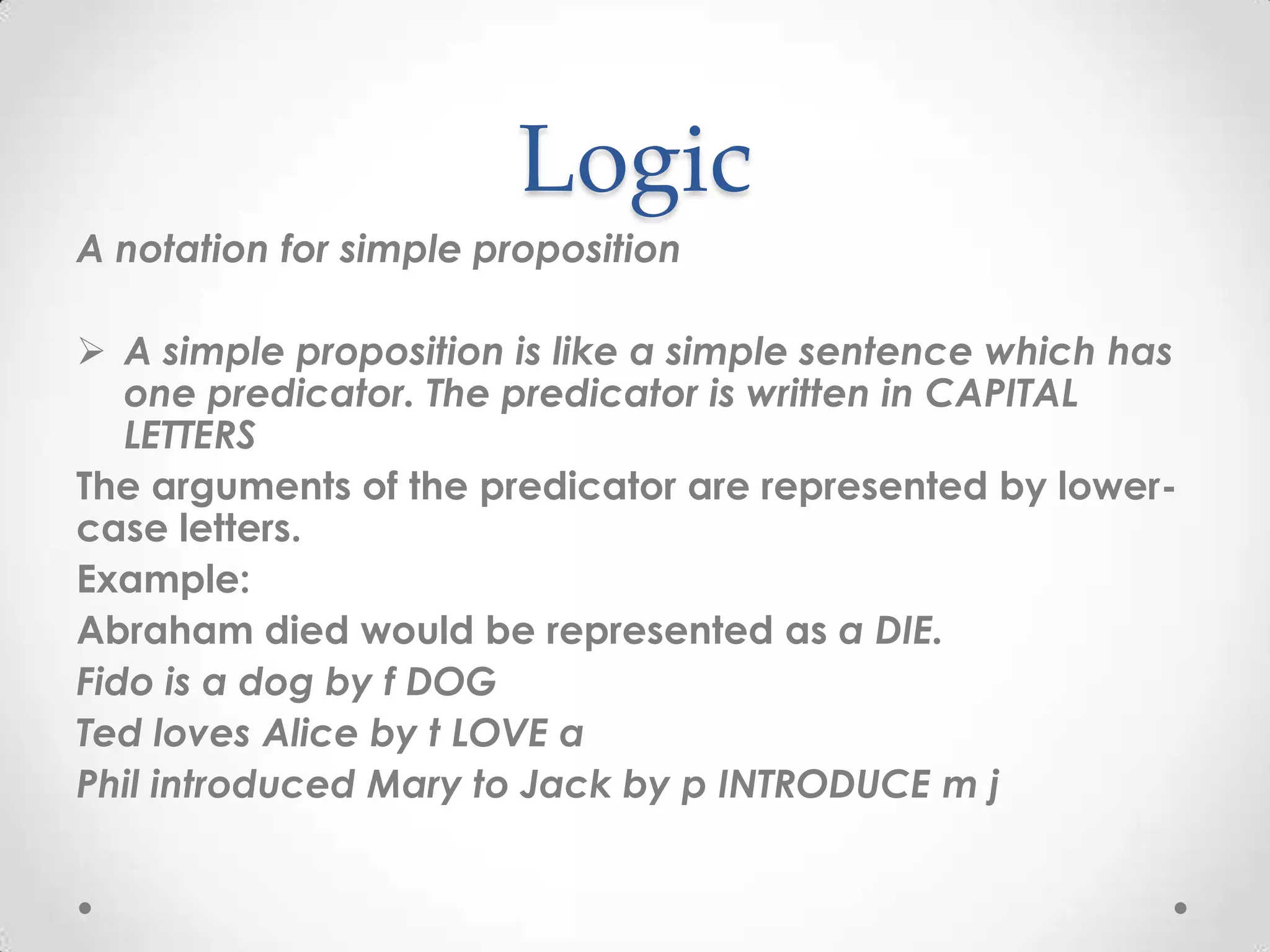
    LogicA notation forsimple propositionA simple proposition is like a simple sentence which has one predicator. The predicator is written in CAPITAL LETTERSThe arguments of the predicator are represented by lower-case letters.Example:Abraham died would be represented as a DIE.Fido is a dog by f DOGTed loves Alice by t LOVE aPhil introduced Mary to Jack by p INTRODUCE m j
  • 13.
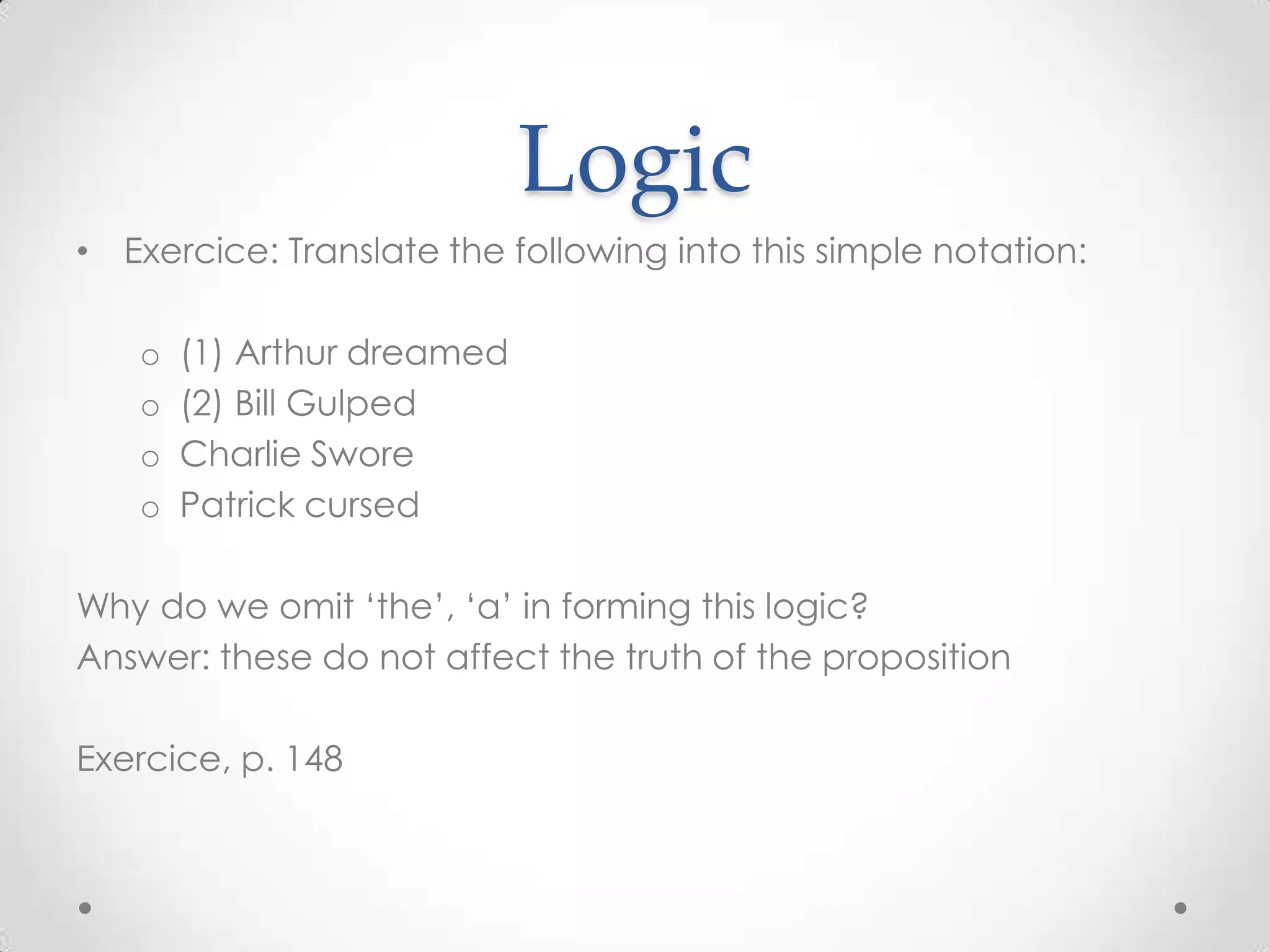
    LogicExercice: Translate thefollowing into this simple notation:(1) Arthur dreamed(2) Bill GulpedCharlie SworePatrick cursedWhy do we omit ‘the’, ‘a’ in forming this logic?Answer: these do not affect the truth of the propositionExercice, p. 148