Downloaded 11 times
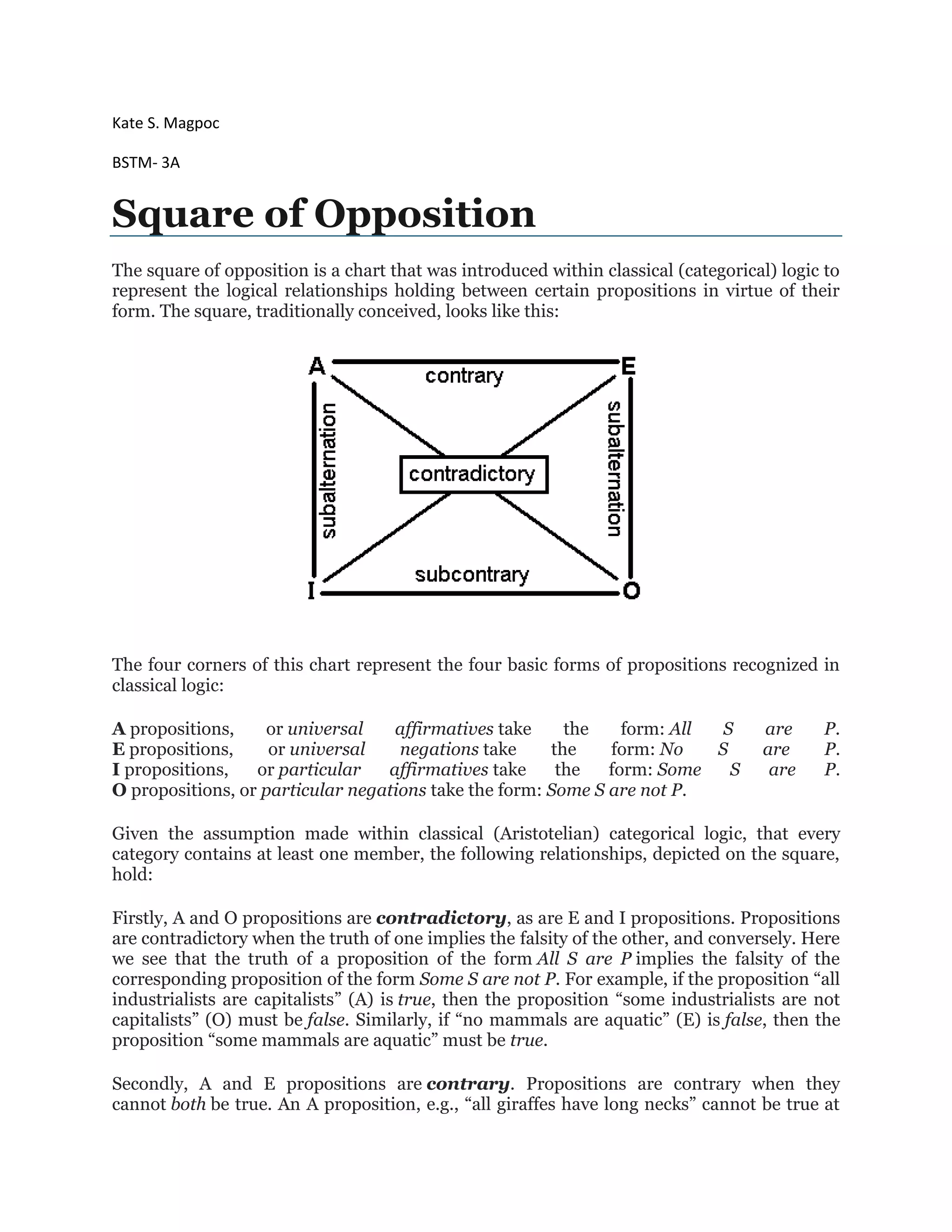


The document discusses the square of opposition, a diagram used in classical logic to represent relationships between types of propositions. It outlines the four basic proposition forms - A (universal affirmative), E (universal negative), I (particular affirmative), O (particular negative) - and the logical relationships between them. Specifically, A and O are contradictory, as are E and I. A and E are contrary, I and O are subcontrary, and A propositions are subaltern to I propositions. However, modern logic rejects the assumption that all categories have members, so the square of opposition is updated to show only contradictory relationships.


