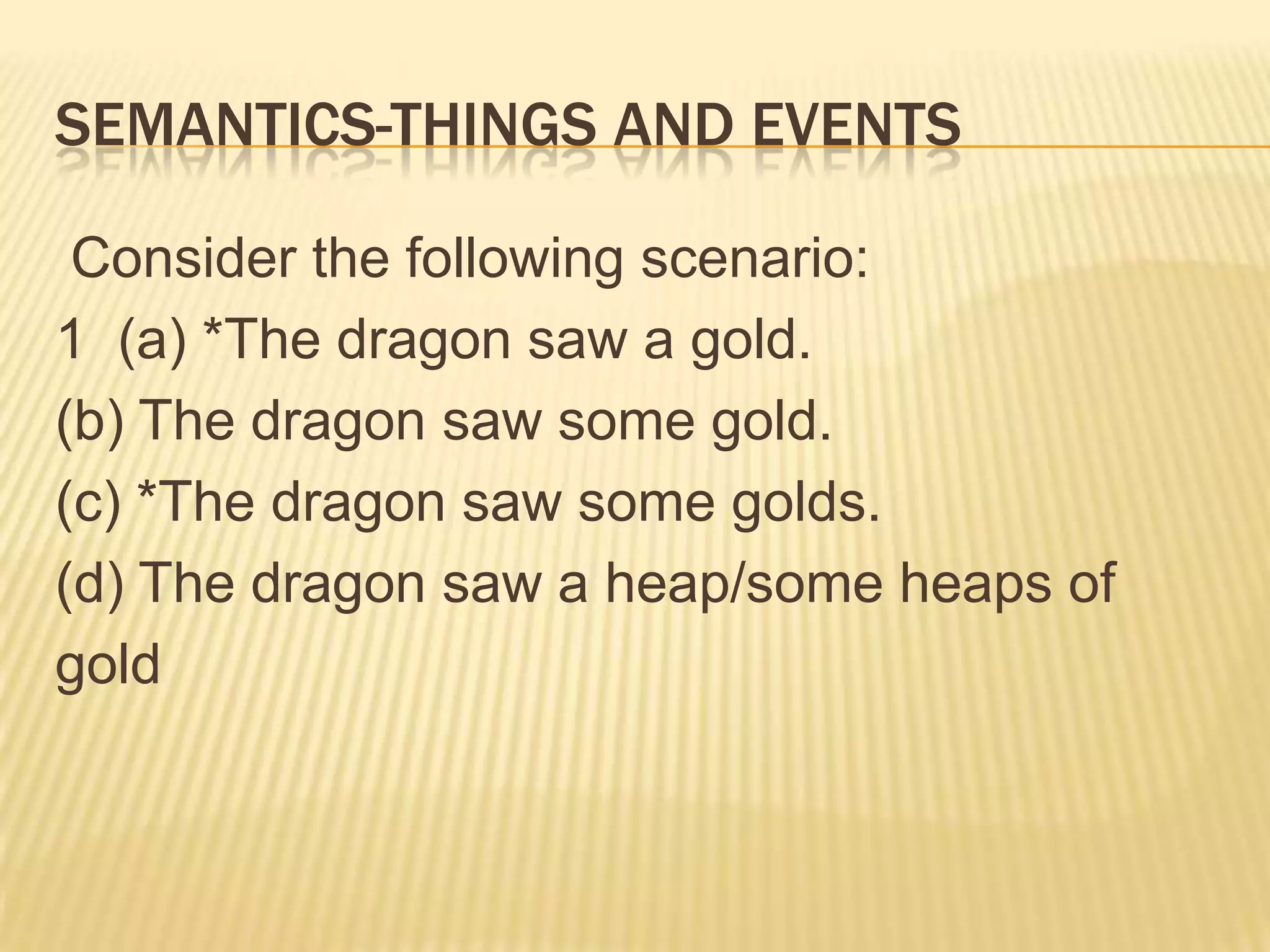
Semantics-Things and Events  Consider the following scenario:  1  (a) *The dragon saw a gold. (b) The dragon saw some gold. (c) *The dragon saw some golds. (d) The dragon saw a heap/some heaps of   gold
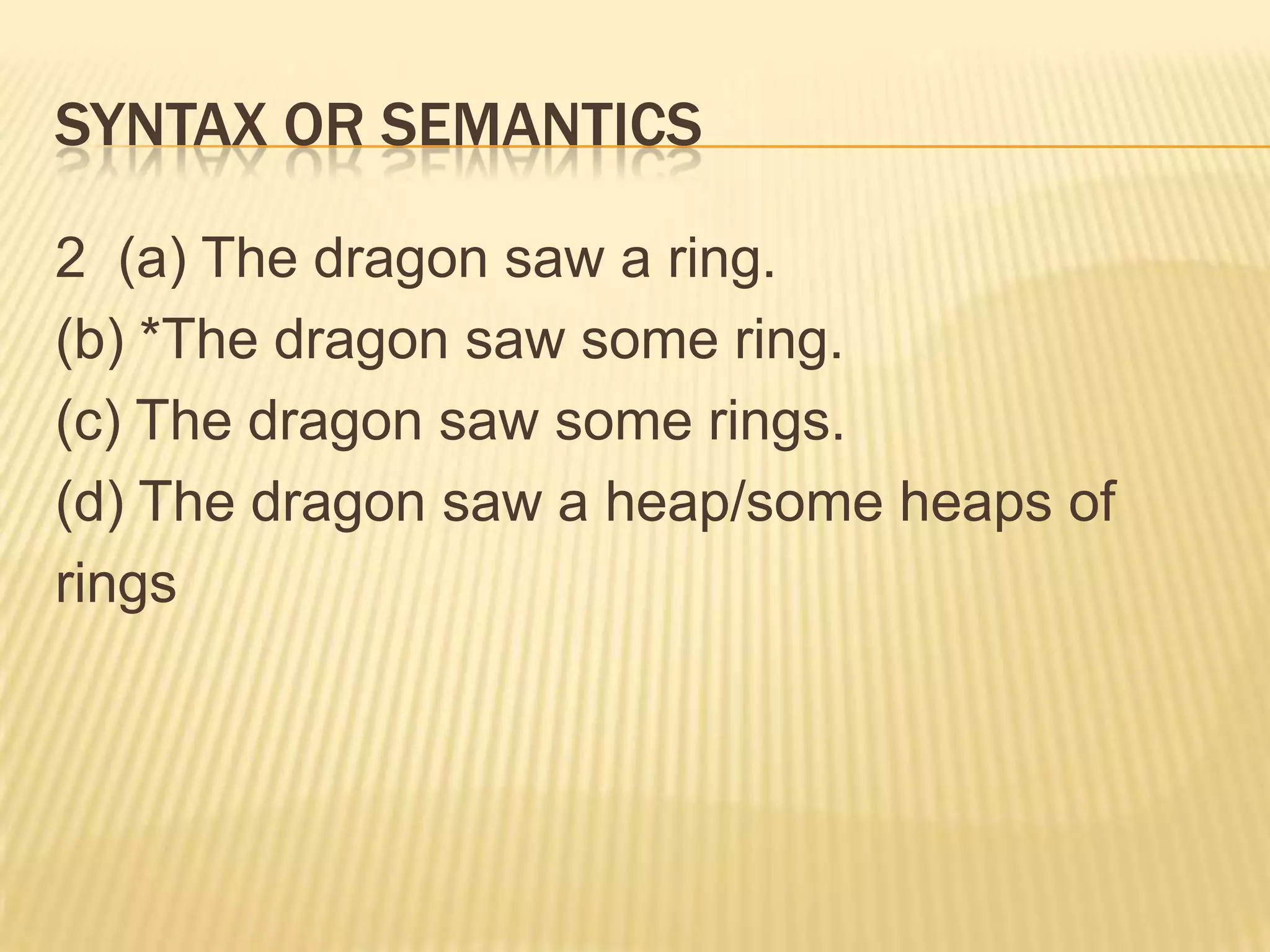
SYNTAX OR SEMANTICS2  (a) The dragon saw a ring. (b) *The dragon saw some ring.(c) The dragon saw some rings. (d) The dragon saw a heap/some heaps of rings
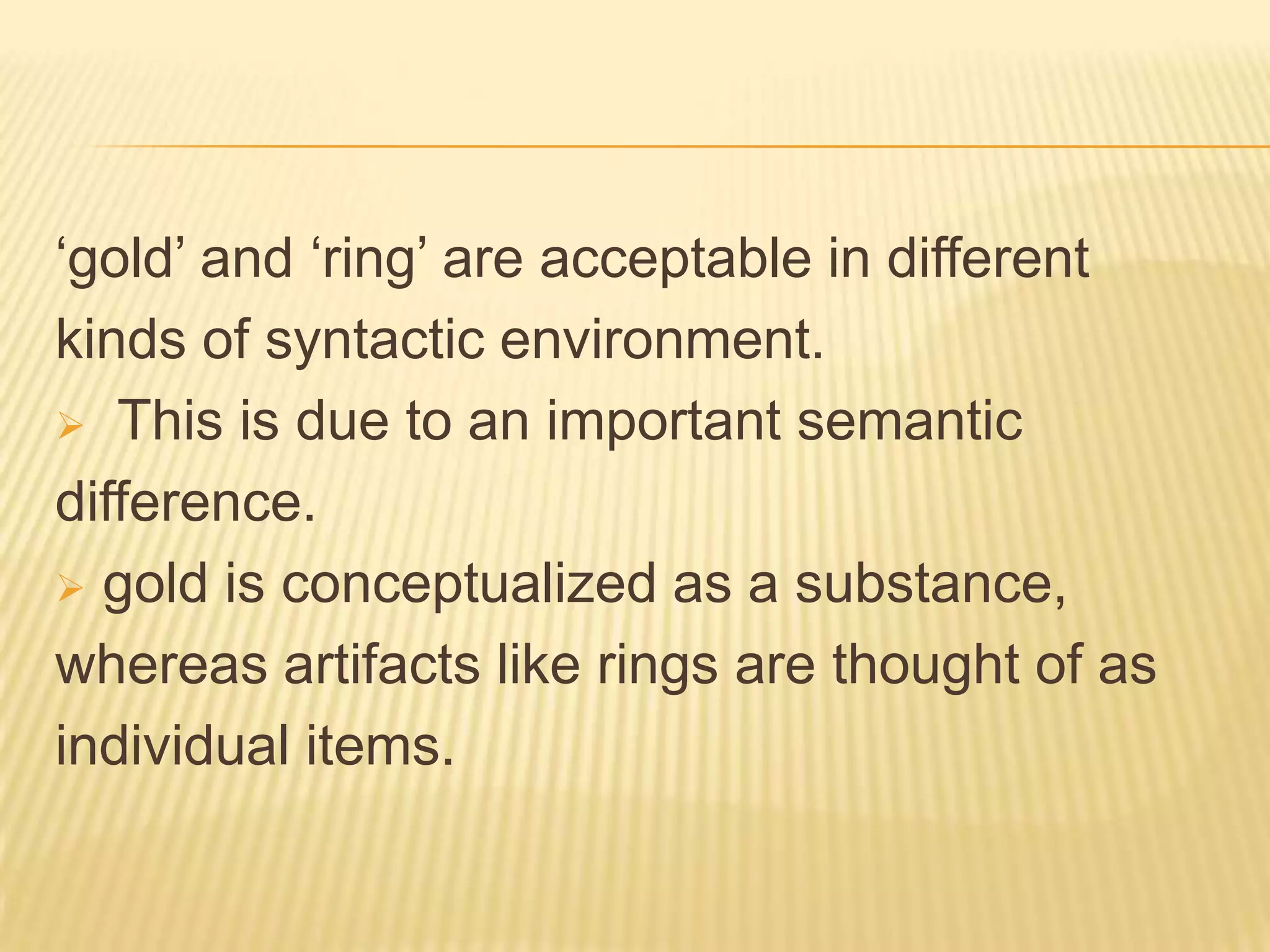
‘gold’ and ‘ring’ are acceptable in different kinds of syntactic environment. This is due to an important semantic difference. gold is conceptualized as a substance, whereas artifacts like rings are thought of as individual items.
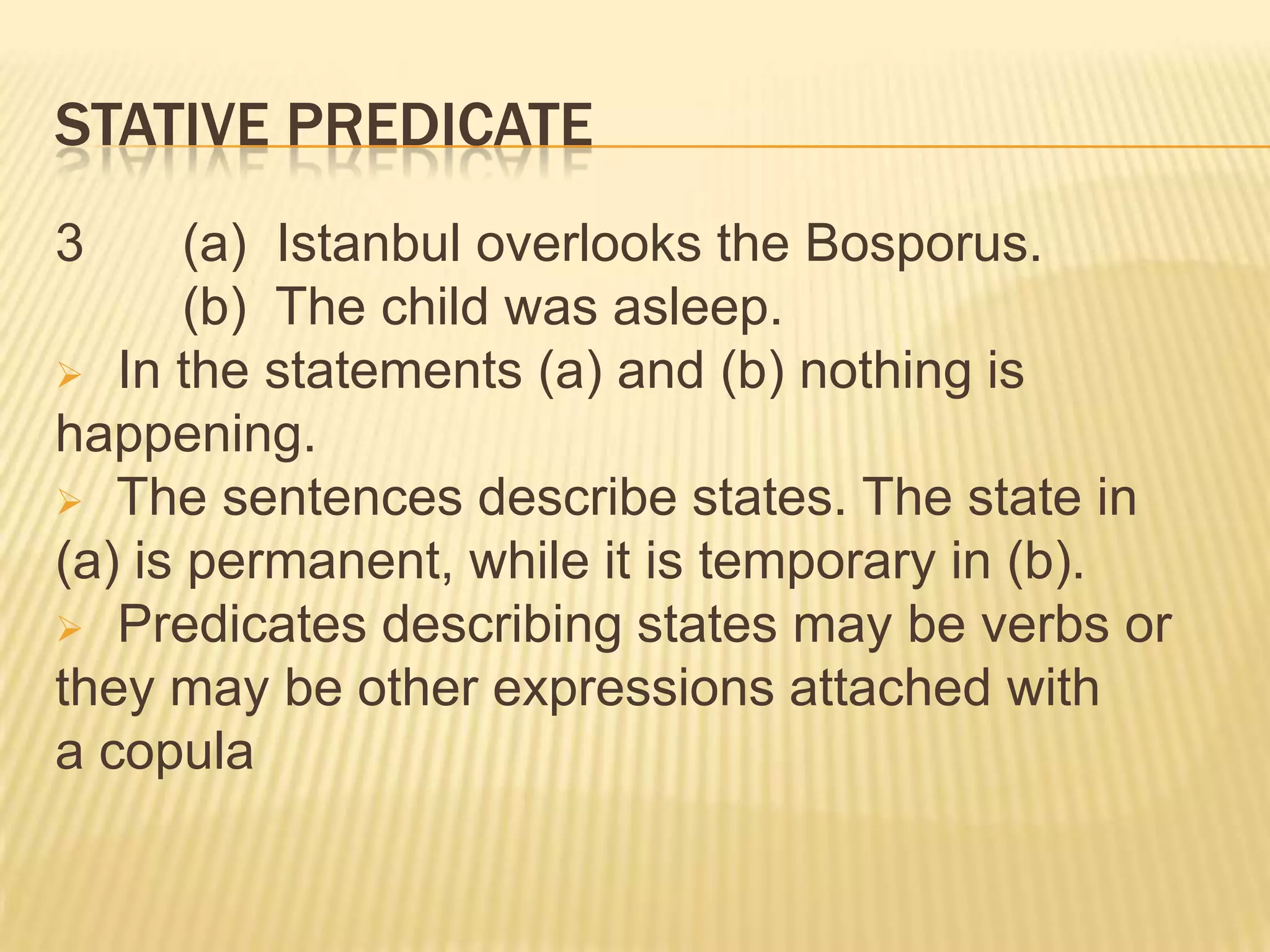
STATIVE PREDICATE3  	(a)  Istanbul overlooks the Bosporus. 	(b)  The child was asleep. In the statements (a) and (b) nothing is happening. The sentences describe states. The state in (a) is permanent, while it is temporary in (b). Predicates describing states may be verbs or they may be other expressions attached with a copula
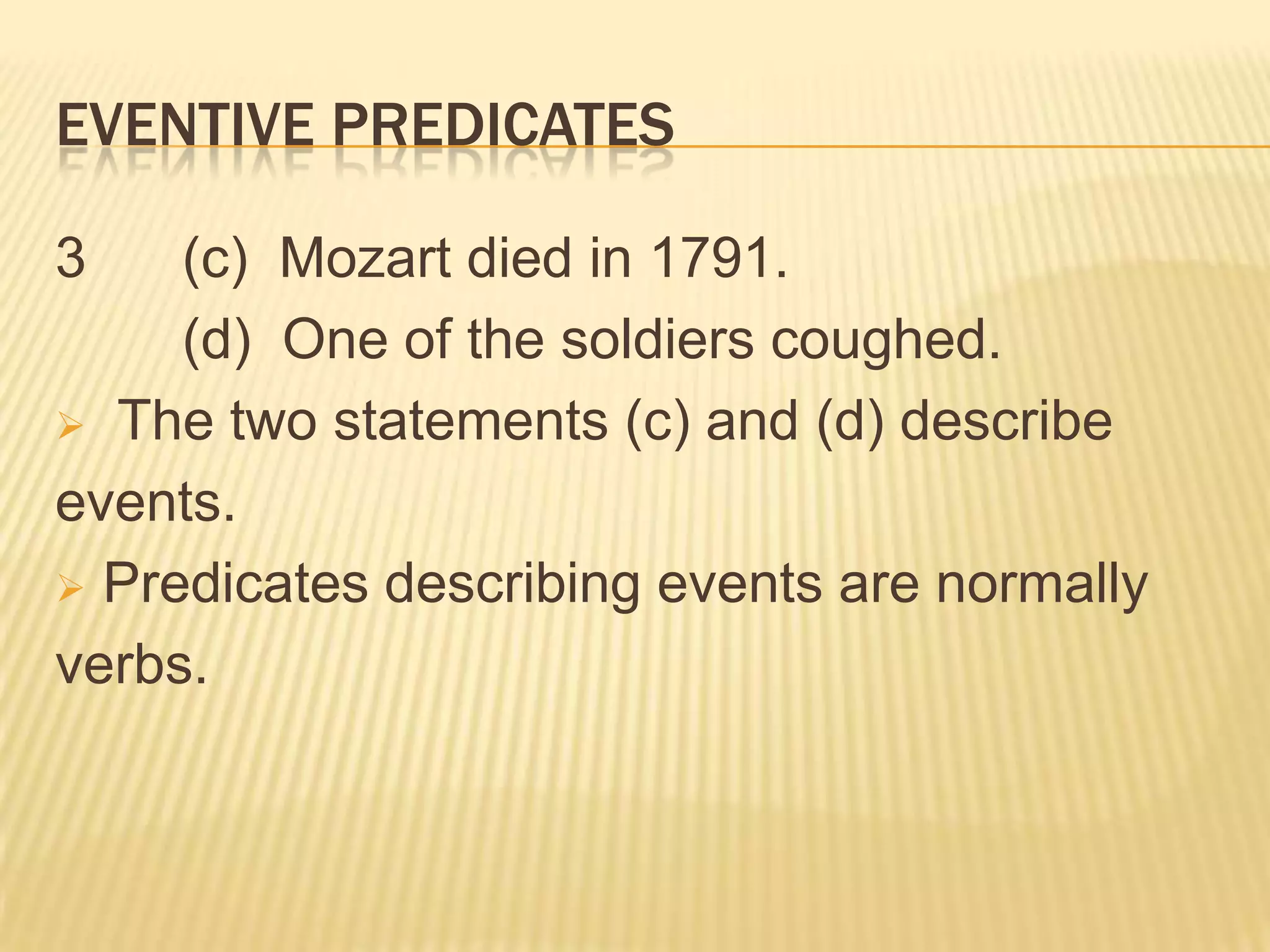
EVENTIVE PREDICATES3  	(c)  Mozart died in 1791. 	(d)  One of the soldiers coughed.The two statements (c) and (d) describe events. Predicates describing events are normally verbs.
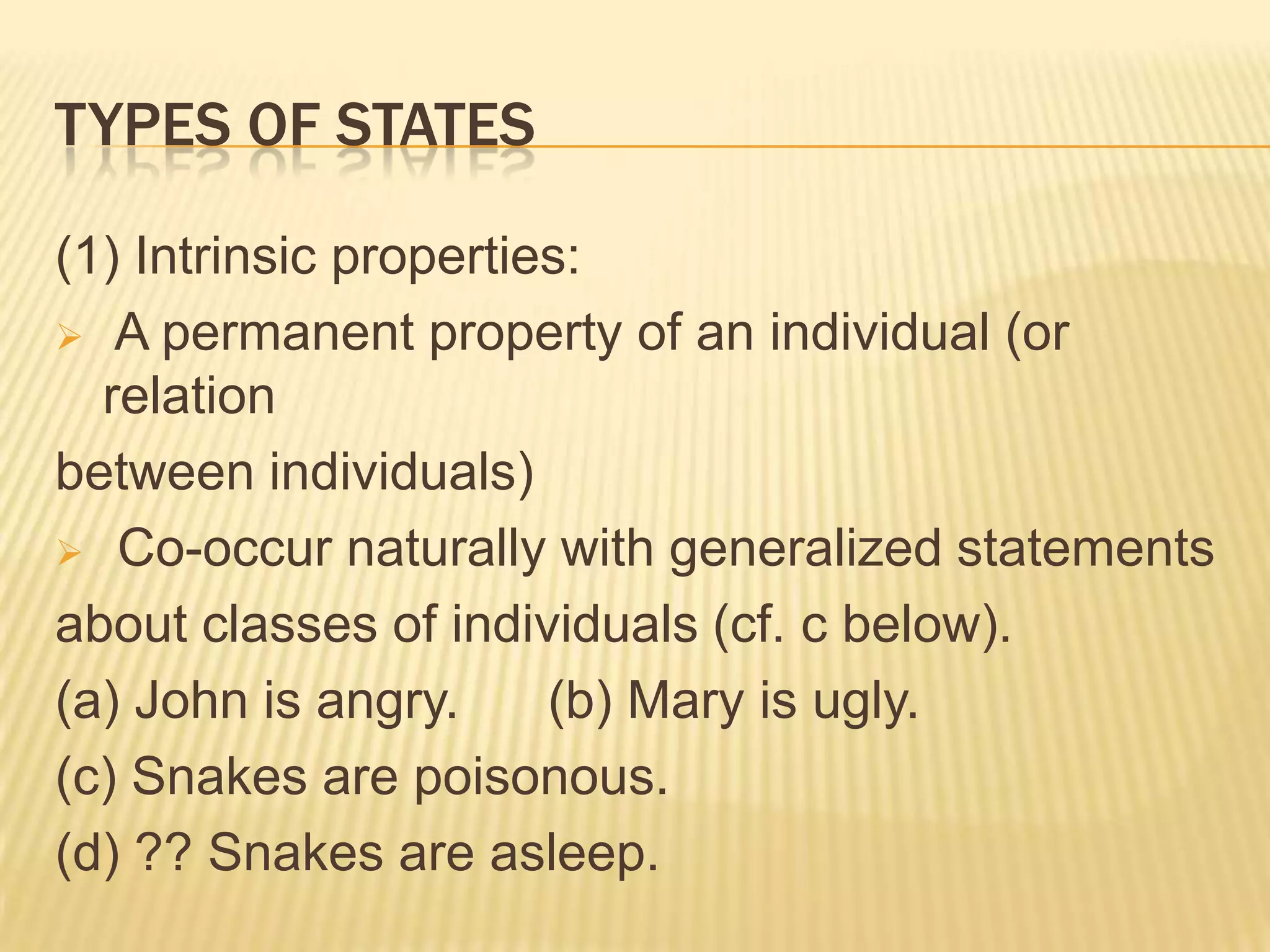
TYPES OF STATES (1) Intrinsic properties: A permanent property of an individual (or relation between individuals) Co-occur naturally with generalized statements about classes of individuals (cf. c below).   (a) John is angry.      (b) Mary is ugly.(c) Snakes are poisonous. (d) ?? Snakes are asleep.
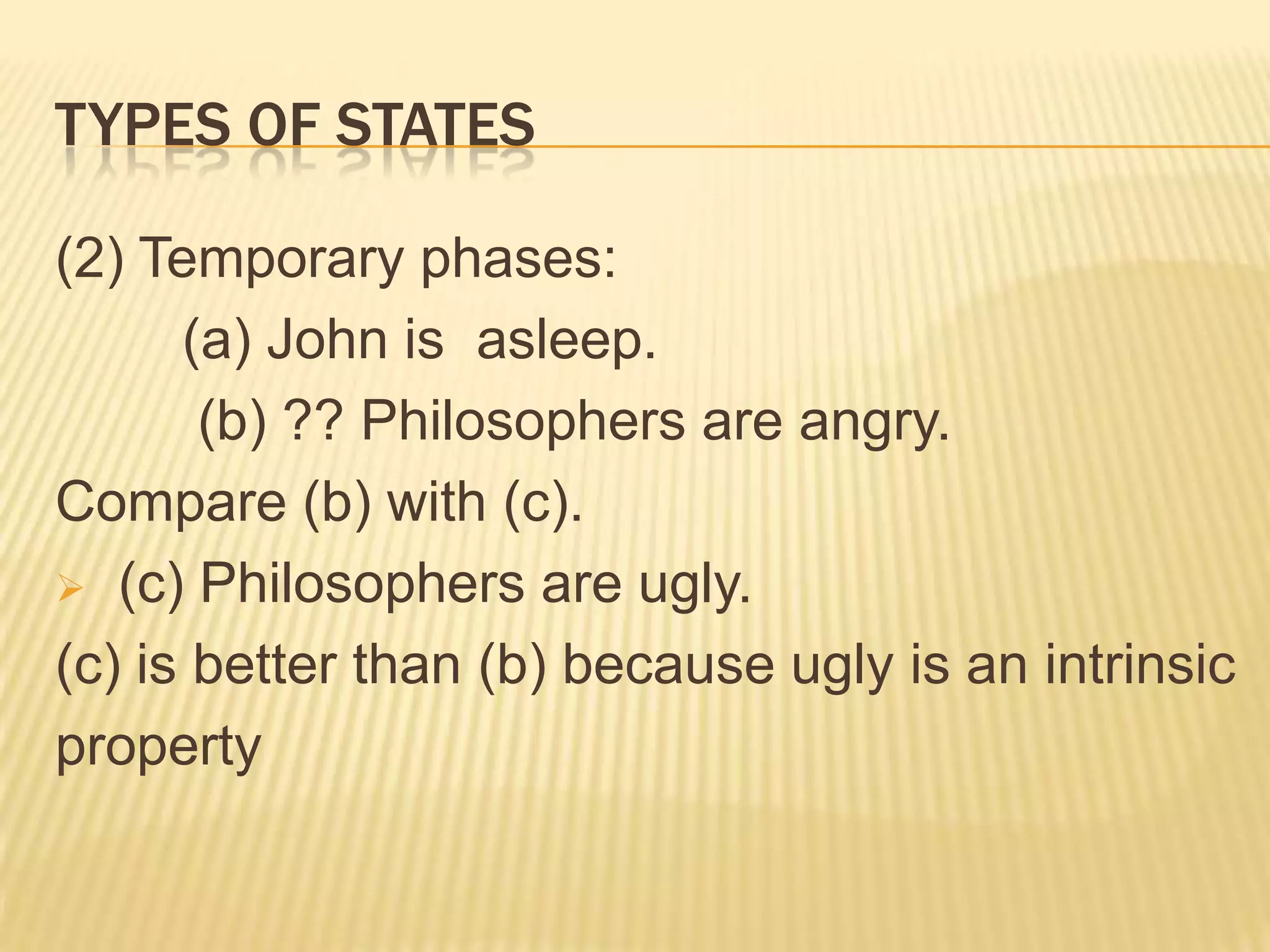
TYPES OF STATES(2) Temporary phases:	(a) John is  asleep. (b) ?? Philosophers are angry.Compare (b) with (c). (c) Philosophers are ugly. (c) is better than (b) because ugly is an intrinsic property
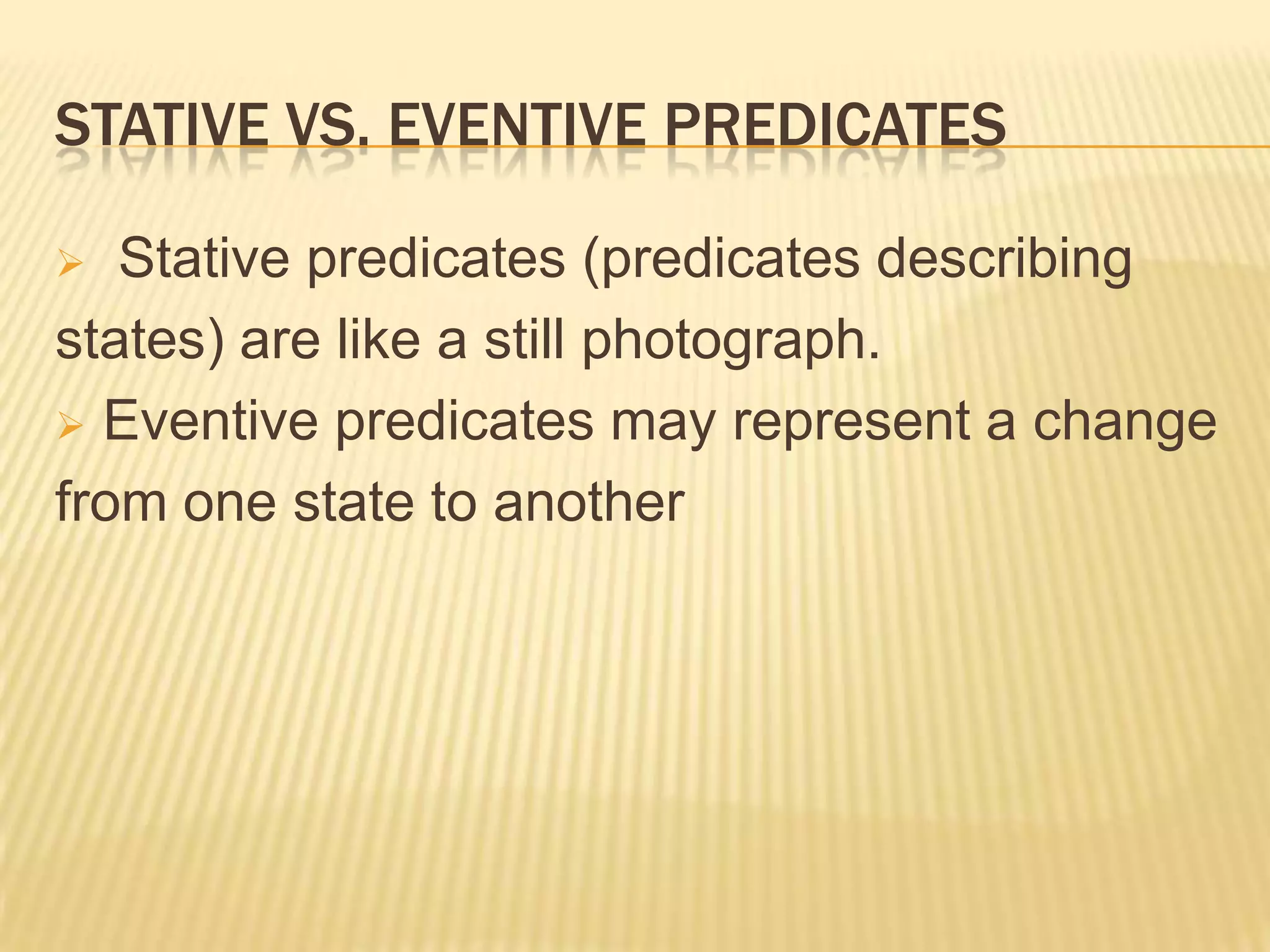
STATIVE VS. EVENTIVE PREDICATESStative predicates (predicates describing states) are like a still photograph. Eventivepredicates may represent a change from one state to another

Semantics things and events -week 10(part 1))

  • 1.
    Semantics-Things and Events Consider the following scenario: 1 (a) *The dragon saw a gold. (b) The dragon saw some gold. (c) *The dragon saw some golds. (d) The dragon saw a heap/some heaps of gold
  • 2.
    SYNTAX OR SEMANTICS2 (a) The dragon saw a ring. (b) *The dragon saw some ring.(c) The dragon saw some rings. (d) The dragon saw a heap/some heaps of rings
  • 3.
    ‘gold’ and ‘ring’are acceptable in different kinds of syntactic environment. This is due to an important semantic difference. gold is conceptualized as a substance, whereas artifacts like rings are thought of as individual items.
  • 4.
    STATIVE PREDICATE3 (a) Istanbul overlooks the Bosporus. (b) The child was asleep. In the statements (a) and (b) nothing is happening. The sentences describe states. The state in (a) is permanent, while it is temporary in (b). Predicates describing states may be verbs or they may be other expressions attached with a copula
  • 5.
    EVENTIVE PREDICATES3 (c) Mozart died in 1791. (d) One of the soldiers coughed.The two statements (c) and (d) describe events. Predicates describing events are normally verbs.
  • 6.
    TYPES OF STATES(1) Intrinsic properties: A permanent property of an individual (or relation between individuals) Co-occur naturally with generalized statements about classes of individuals (cf. c below). (a) John is angry. (b) Mary is ugly.(c) Snakes are poisonous. (d) ?? Snakes are asleep.
  • 7.
    TYPES OF STATES(2)Temporary phases: (a) John is asleep. (b) ?? Philosophers are angry.Compare (b) with (c). (c) Philosophers are ugly. (c) is better than (b) because ugly is an intrinsic property
  • 8.
    STATIVE VS. EVENTIVEPREDICATESStative predicates (predicates describing states) are like a still photograph. Eventivepredicates may represent a change from one state to another