PREVIOUS CLASSPredicates: Denote relations between individuals
 Lexical relations don’t make very informative statements about the world. Quantifiers:  Like lexical relations claiming a relation between two sets.
Not statements about the meaning of words but claims about the situation in the world.
NUMERALSThe same thing can be said about numerals. ‘Five planets are visible to the naked eye’.This statement indicates that there are five objects which both are planets and are visible to the naked eye.Put differently, the set of planets and the set of things which are visible to the naked eye have an intersection, and that intersectioncontains exactly five elements.
NumeralsThe denotation of the numeral five is a relation between sets. that is, all the ordered pairs of sets whose intersection has five elements.  The set of planets and the set of visible objects is one such pair. Another pair: ‘Five students passed the course’
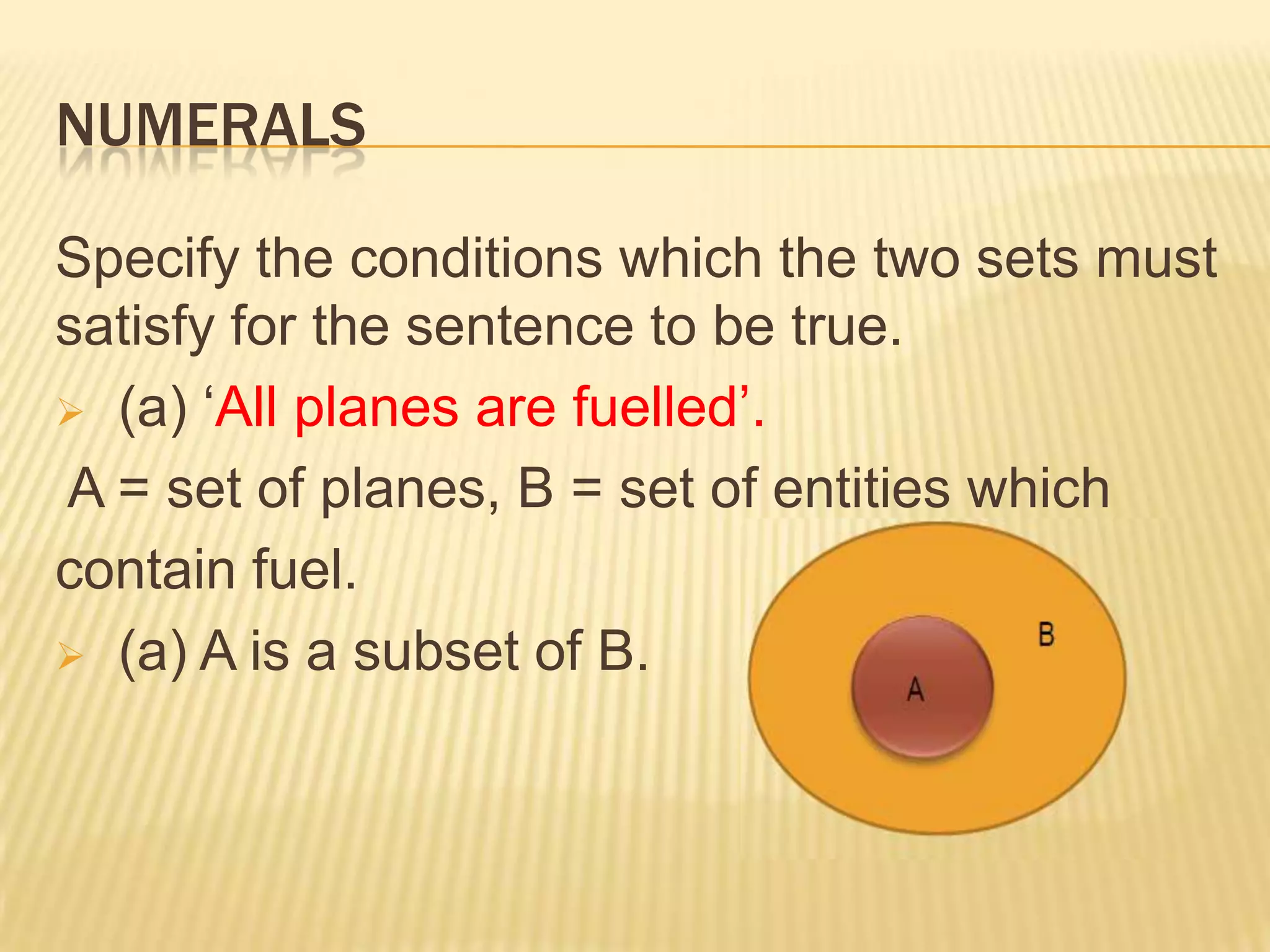
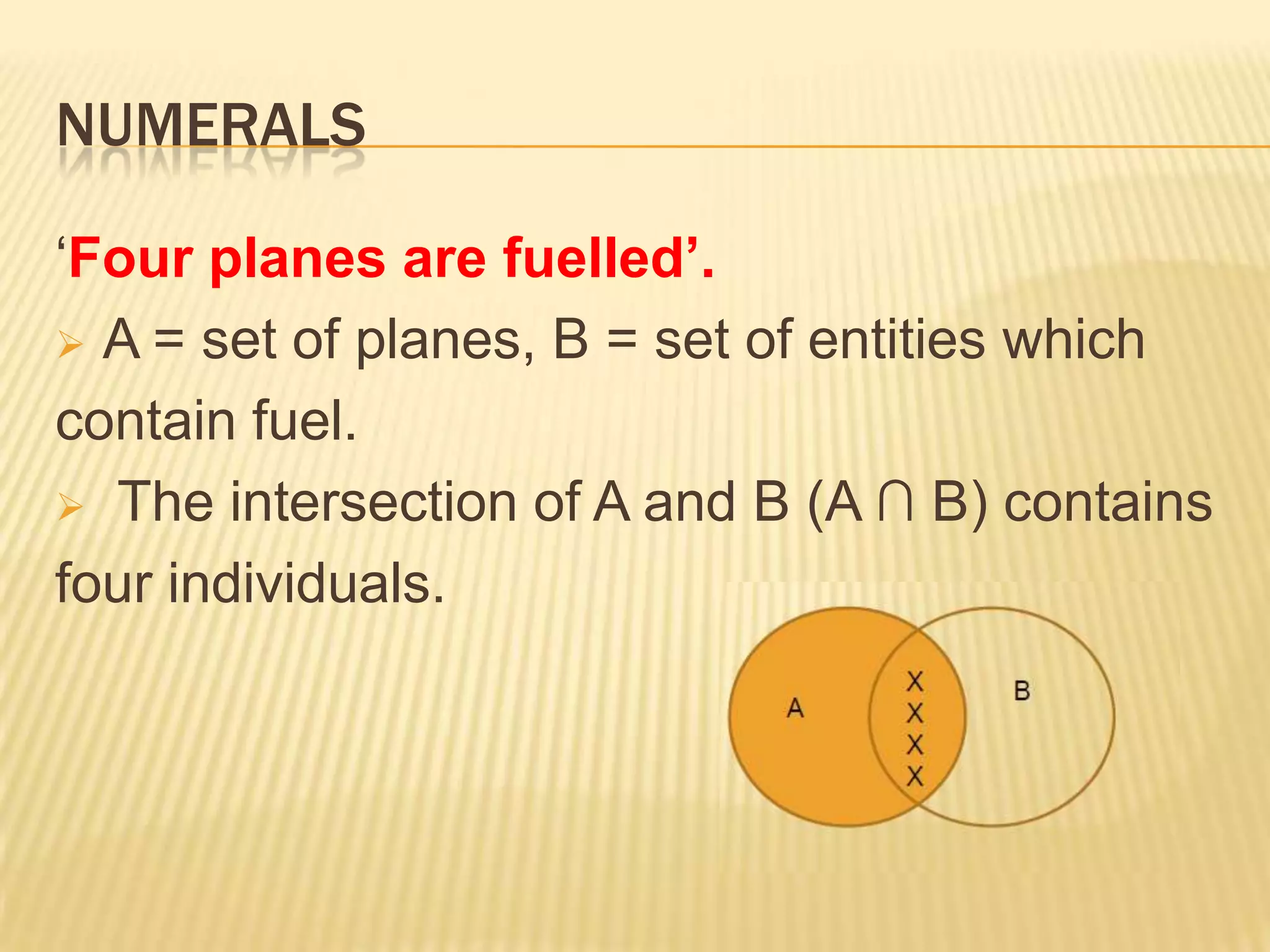
NUMERALSSpecify the conditions which the two sets must satisfy for the sentence to be true.  (a) ‘All planes are fuelled’.  A = set of planes, B = set of entities which contain fuel.  (a) A is a subset of B.NUMERALS‘Four planes are fuelled’.A = set of planes, B = set of entities which contain fuel.  The intersection of A and B (A ∩ B) contains four individuals.
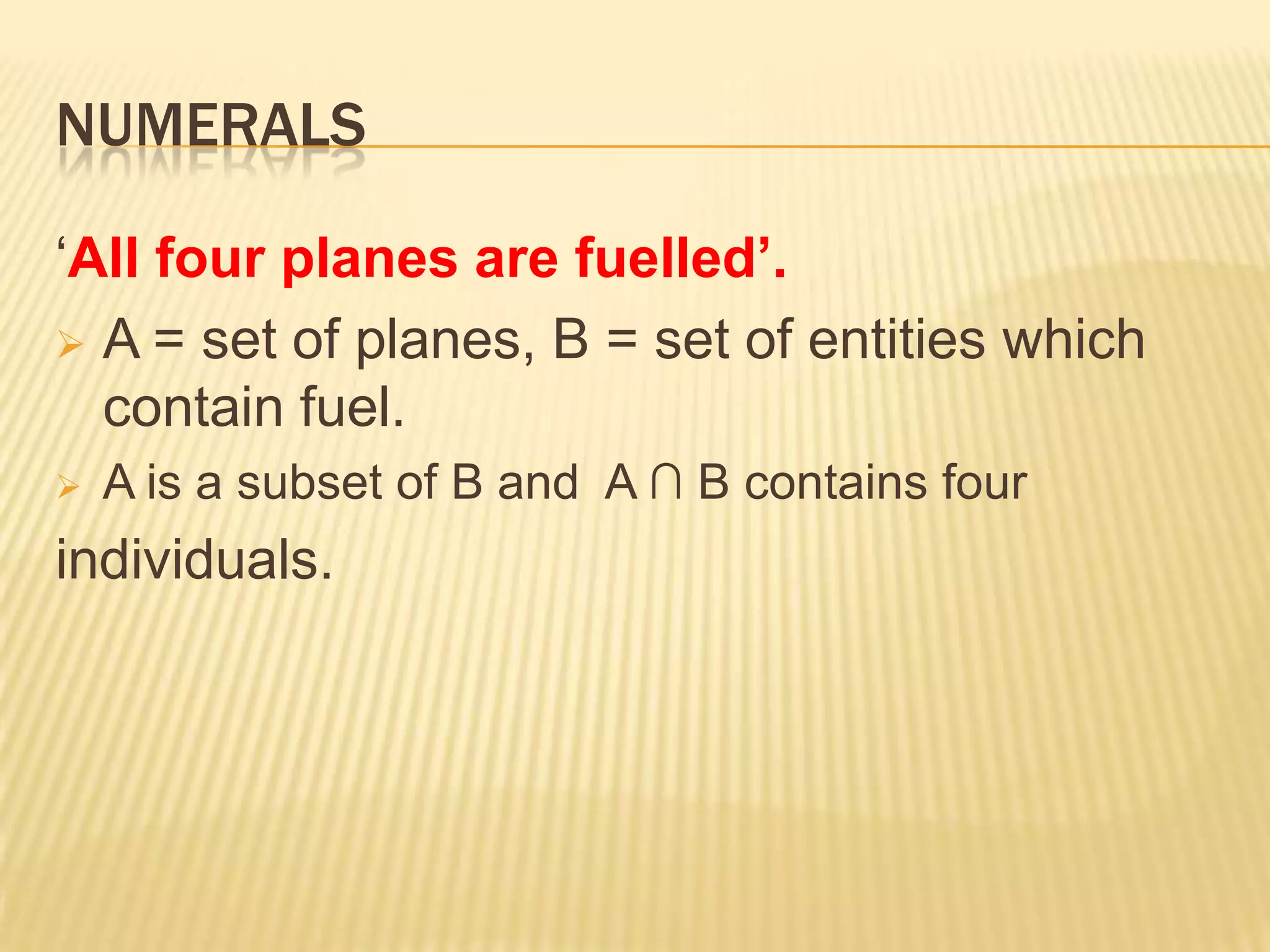
Numerals‘All four planes are fuelled’. A = set of planes, B = set of entities which contain fuel.
A is a subset of B and  A ∩ B contains four individuals.
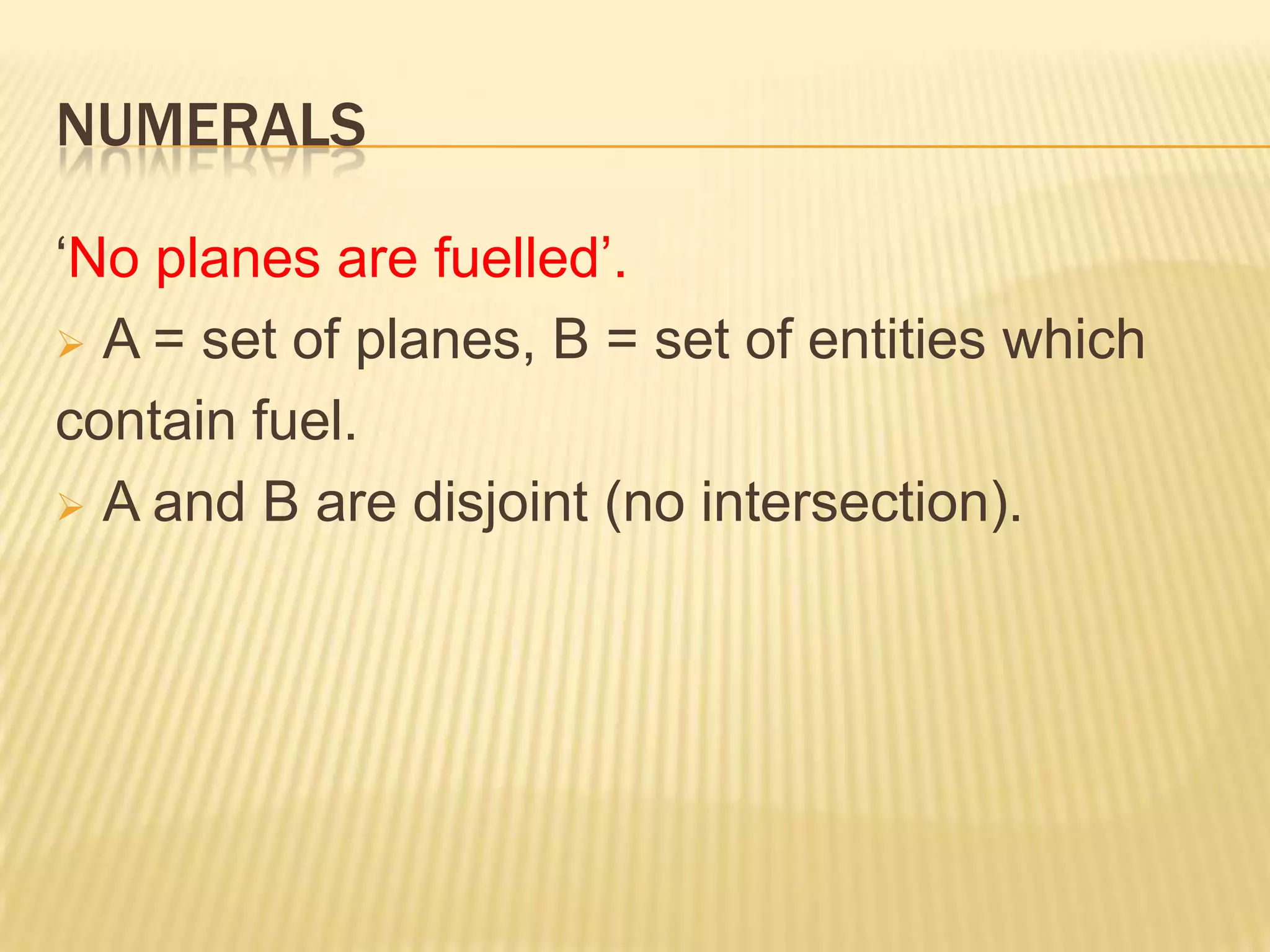
NUMERALS‘No planes are fuelled’.A = set of planes, B = set of entities which contain fuel. A and B are disjoint (no intersection).RESTRICTION AND SCOPE(a) All students were tired.
 (b) Some students were thirsty.
(c) No students were revising. Which students are being talked about inthese sentences?
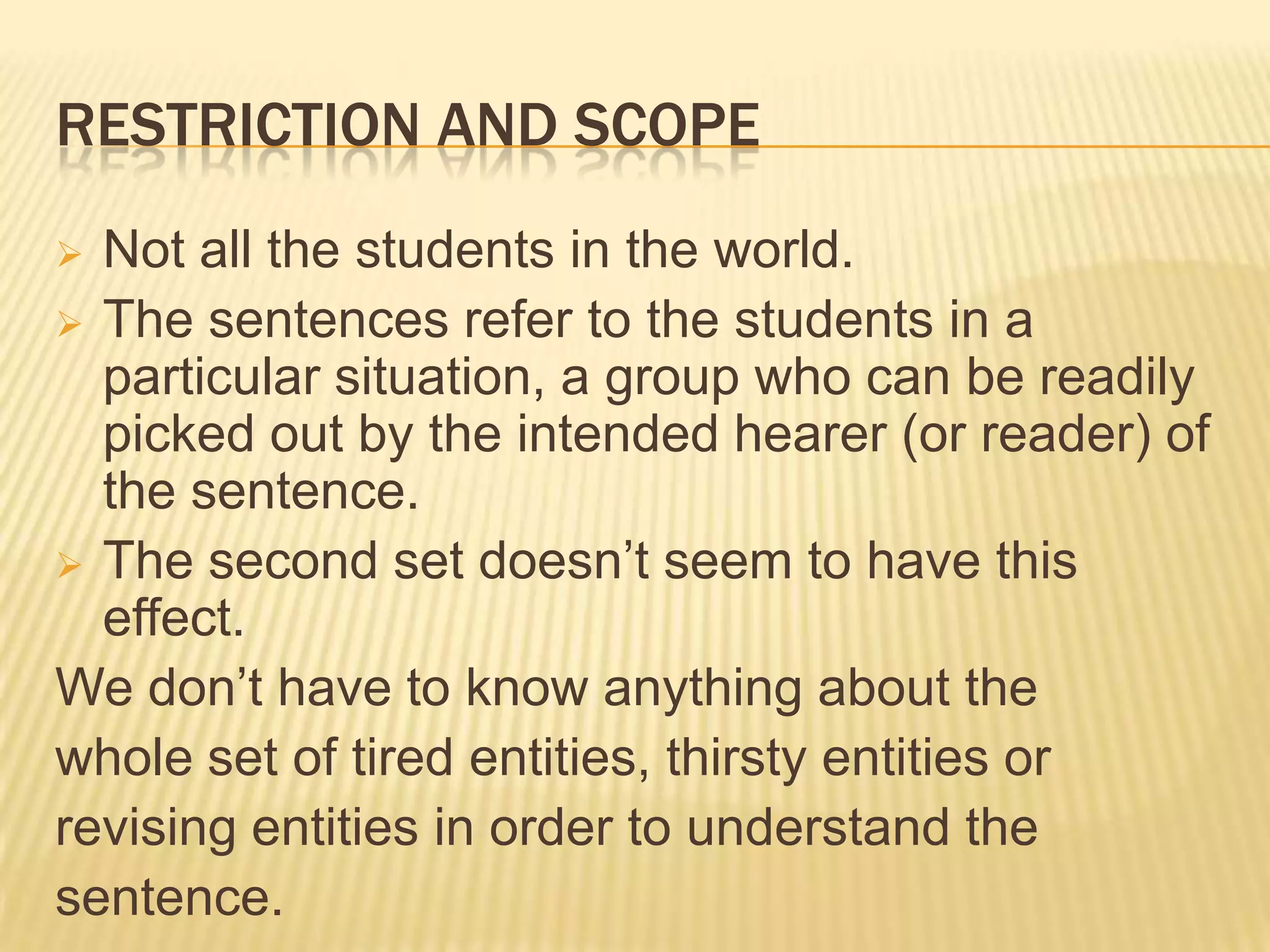
Restriction and scopeNot all the students in the world.
The sentences refer to the students in a particular situation, a group who can be readily picked out by the intended hearer (or reader) of the sentence.
The second set doesn’t seem to have this effect. We don’t have to know anything about the whole set of tired entities, thirsty entities or revising entities in order to understand the sentence.

Quantifier part 2

  • 1.
    PREVIOUS CLASSPredicates: Denoterelations between individuals
  • 2.
    Lexical relationsdon’t make very informative statements about the world. Quantifiers: Like lexical relations claiming a relation between two sets.
  • 3.
    Not statements aboutthe meaning of words but claims about the situation in the world.
  • 4.
    NUMERALSThe same thingcan be said about numerals. ‘Five planets are visible to the naked eye’.This statement indicates that there are five objects which both are planets and are visible to the naked eye.Put differently, the set of planets and the set of things which are visible to the naked eye have an intersection, and that intersectioncontains exactly five elements.
  • 5.
    NumeralsThe denotation ofthe numeral five is a relation between sets. that is, all the ordered pairs of sets whose intersection has five elements. The set of planets and the set of visible objects is one such pair. Another pair: ‘Five students passed the course’
  • 6.
    NUMERALSSpecify the conditionswhich the two sets must satisfy for the sentence to be true. (a) ‘All planes are fuelled’. A = set of planes, B = set of entities which contain fuel. (a) A is a subset of B.NUMERALS‘Four planes are fuelled’.A = set of planes, B = set of entities which contain fuel. The intersection of A and B (A ∩ B) contains four individuals.
  • 7.
    Numerals‘All four planesare fuelled’. A = set of planes, B = set of entities which contain fuel.
  • 8.
    A is asubset of B and A ∩ B contains four individuals.
  • 9.
    NUMERALS‘No planes arefuelled’.A = set of planes, B = set of entities which contain fuel. A and B are disjoint (no intersection).RESTRICTION AND SCOPE(a) All students were tired.
  • 10.
    (b) Somestudents were thirsty.
  • 11.
    (c) No studentswere revising. Which students are being talked about inthese sentences?
  • 12.
    Restriction and scopeNotall the students in the world.
  • 13.
    The sentences referto the students in a particular situation, a group who can be readily picked out by the intended hearer (or reader) of the sentence.
  • 14.
    The second setdoesn’t seem to have this effect. We don’t have to know anything about the whole set of tired entities, thirsty entities or revising entities in order to understand the sentence.
  • 15.
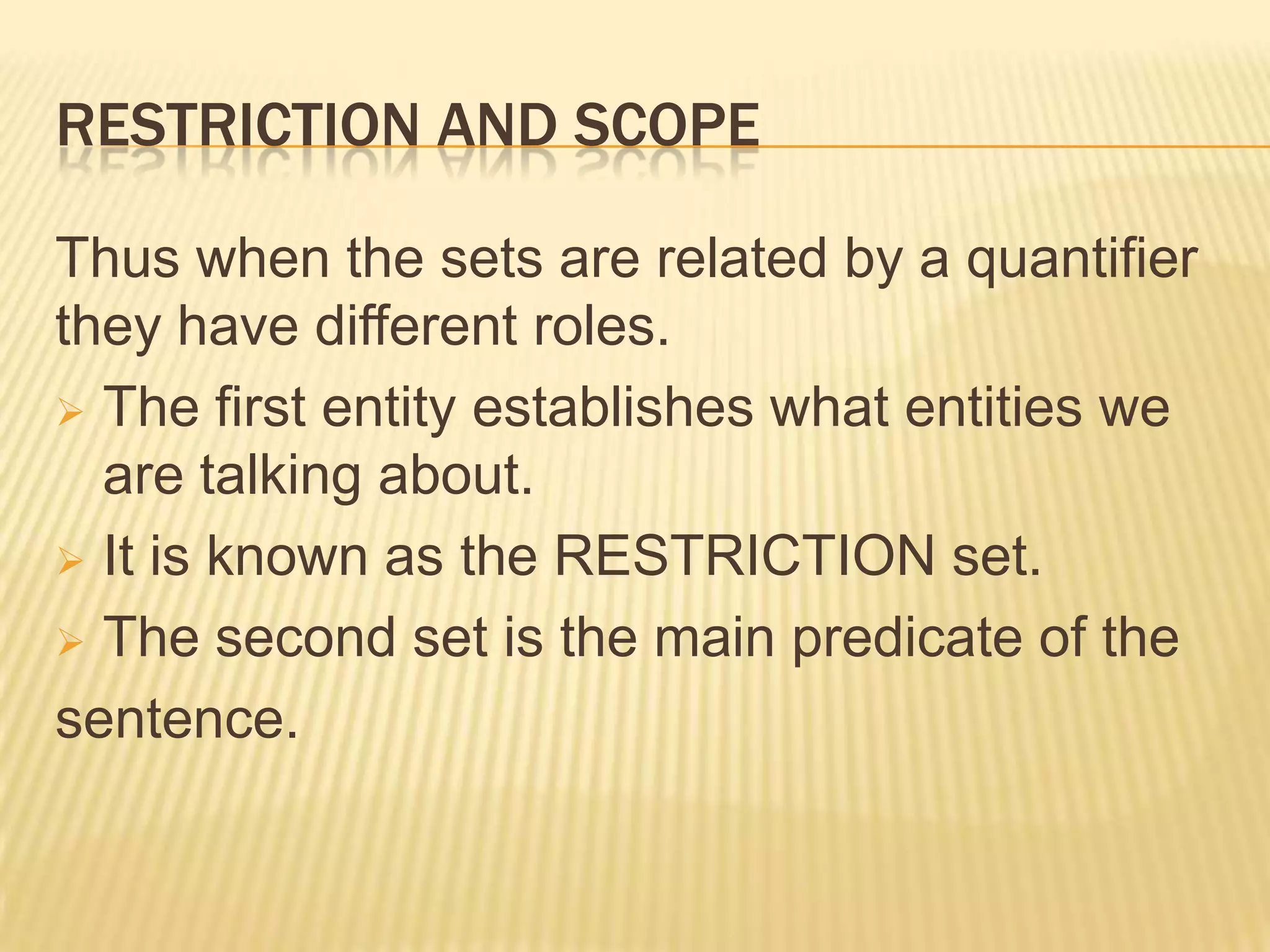
    RESTRICTION AND SCOPEThuswhen the sets are related by a quantifier they have different roles. The first entity establishes what entities we are talking about.
  • 16.
    It is knownas the RESTRICTION set.
  • 17.
    The second setis the main predicate of the sentence.
  • 18.
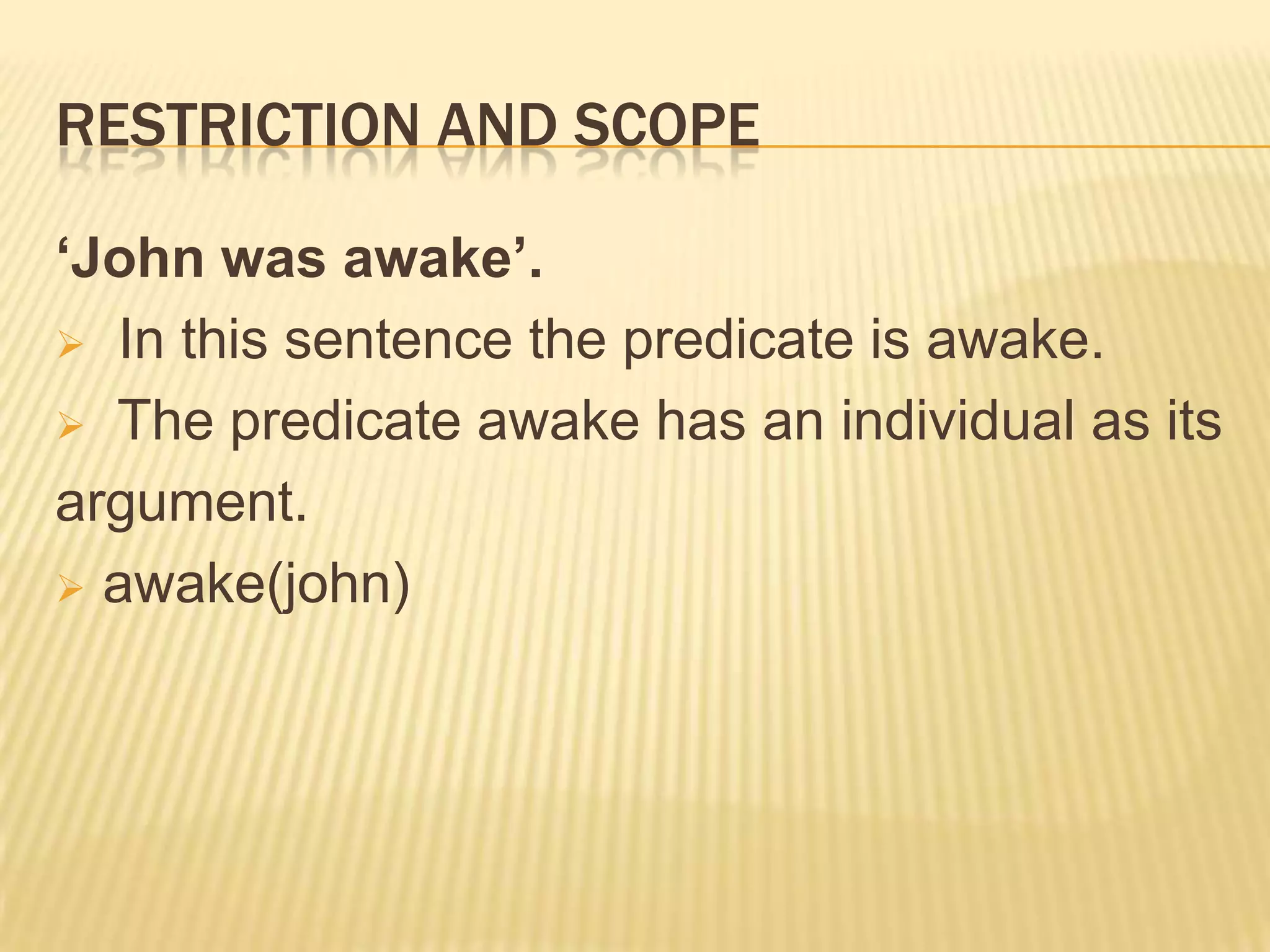
    RESTRICTION AND SCOPE‘Johnwas awake’. In this sentence the predicate is awake.
  • 19.
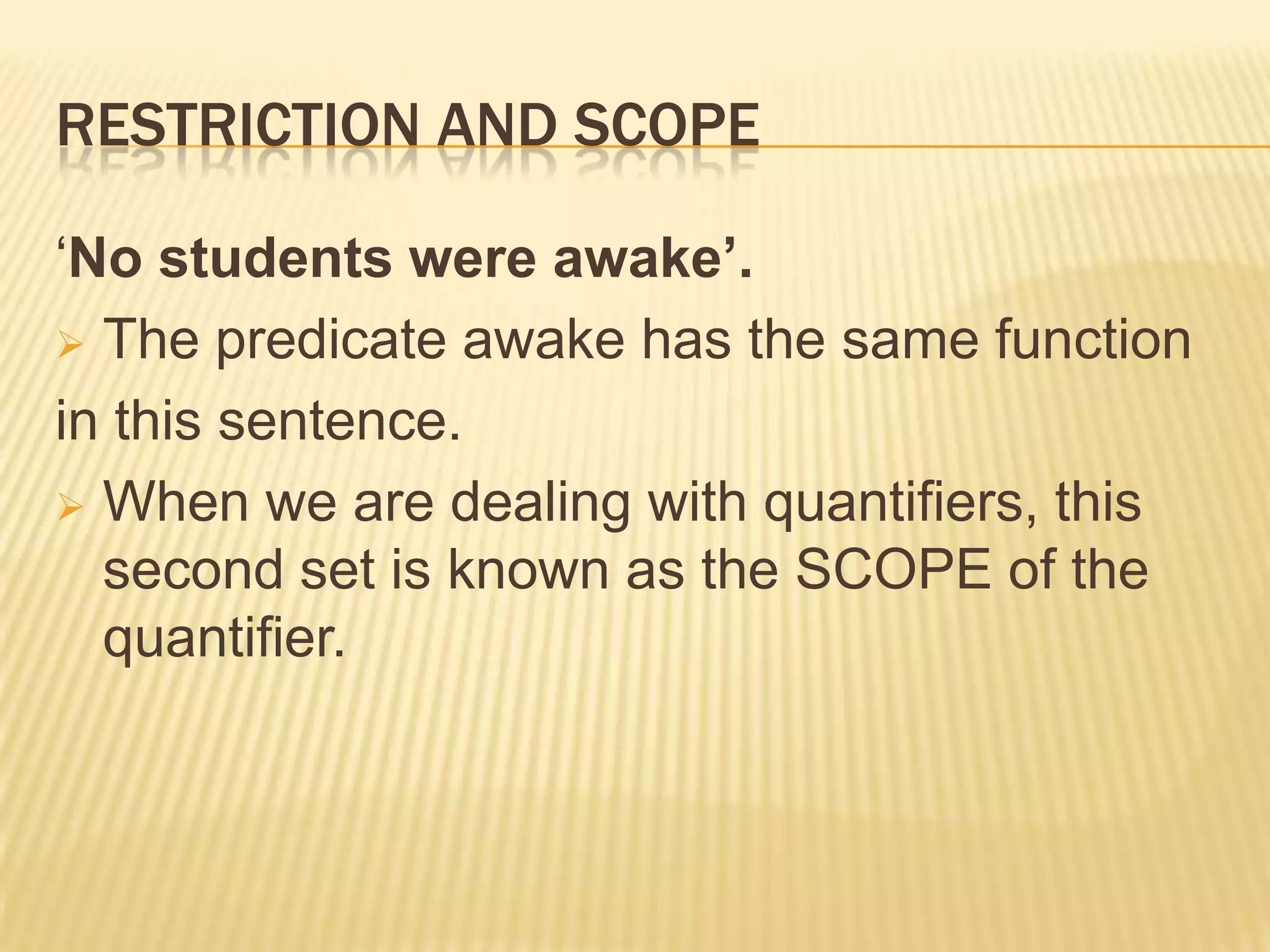
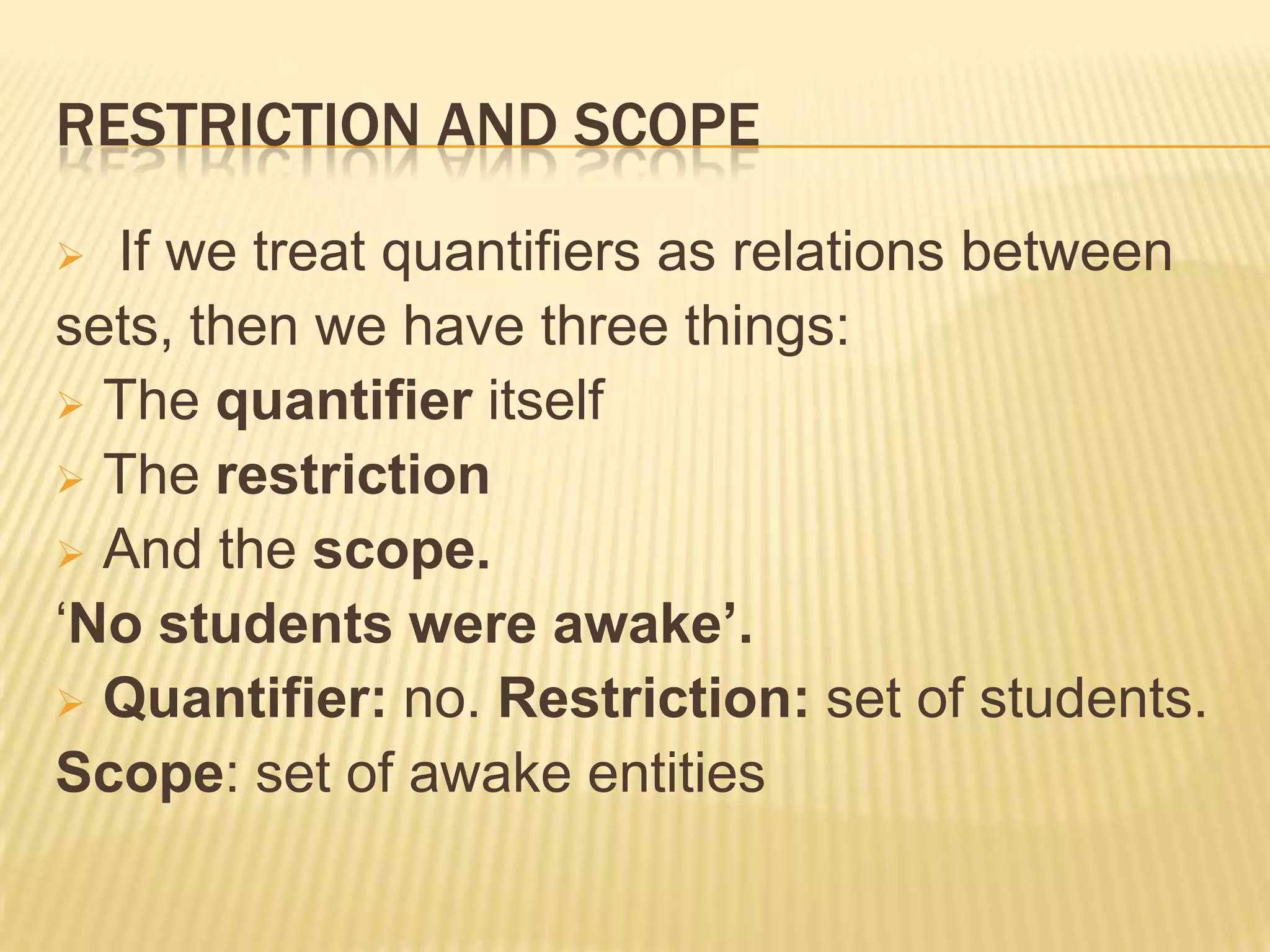
    The predicateawake has an individual as its argument. awake(john)RESTRICTION AND SCOPE‘No students were awake’. The predicate awake has the same function in this sentence. When we are dealing with quantifiers, this second set is known as the SCOPE of the quantifier.RESTRICTION AND SCOPE If we treat quantifiers as relations between sets, then we have three things: The quantifier itself
  • 20.
  • 21.
    And the scope.‘No students were awake’.Quantifier: no. Restriction: set of students. Scope: set of awake entities
  • 22.
    summaryNumerals: the samedenotation as quantifiers. Restriction of a quantifier
  • 23.
    Scope of aquantifier.