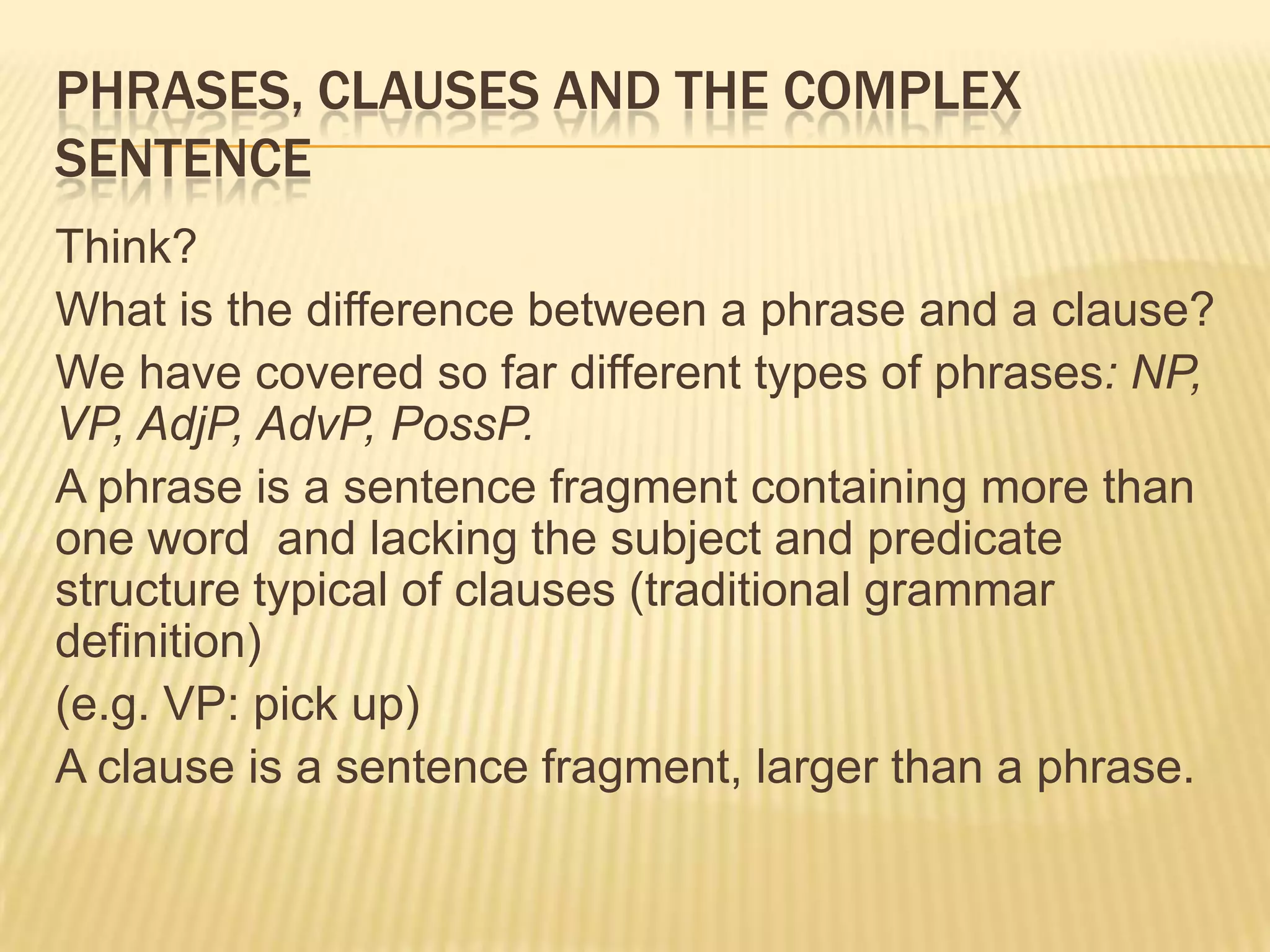
Phrases, clauses and the complex sentenceThink? What is the difference between a phrase and a clause?We have covered so far different types of phrases: NP, VP, AdjP, AdvP, PossP.A phrase is a sentence fragment containing more than one word  and lacking the subject and predicate structure typical of clauses (traditional grammar definition)(e.g. VP: pick up)A clause is a sentence fragment, larger than a phrase.
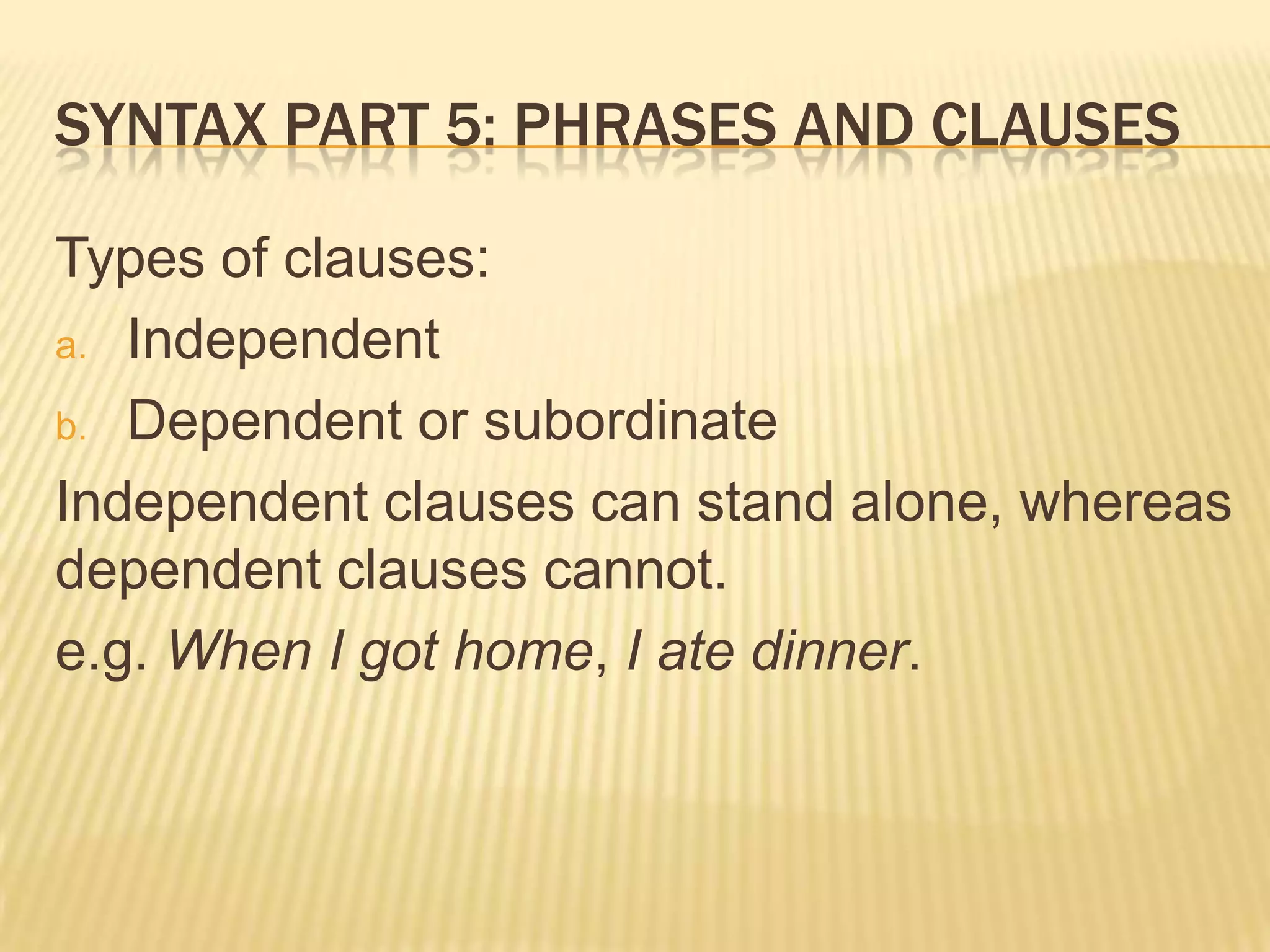
Syntax part 5: Phrases and clausesTypes of clauses:IndependentDependent or subordinateIndependent clauses can stand alone, whereas dependent clauses cannot. e.g. When I got home, I ate dinner.
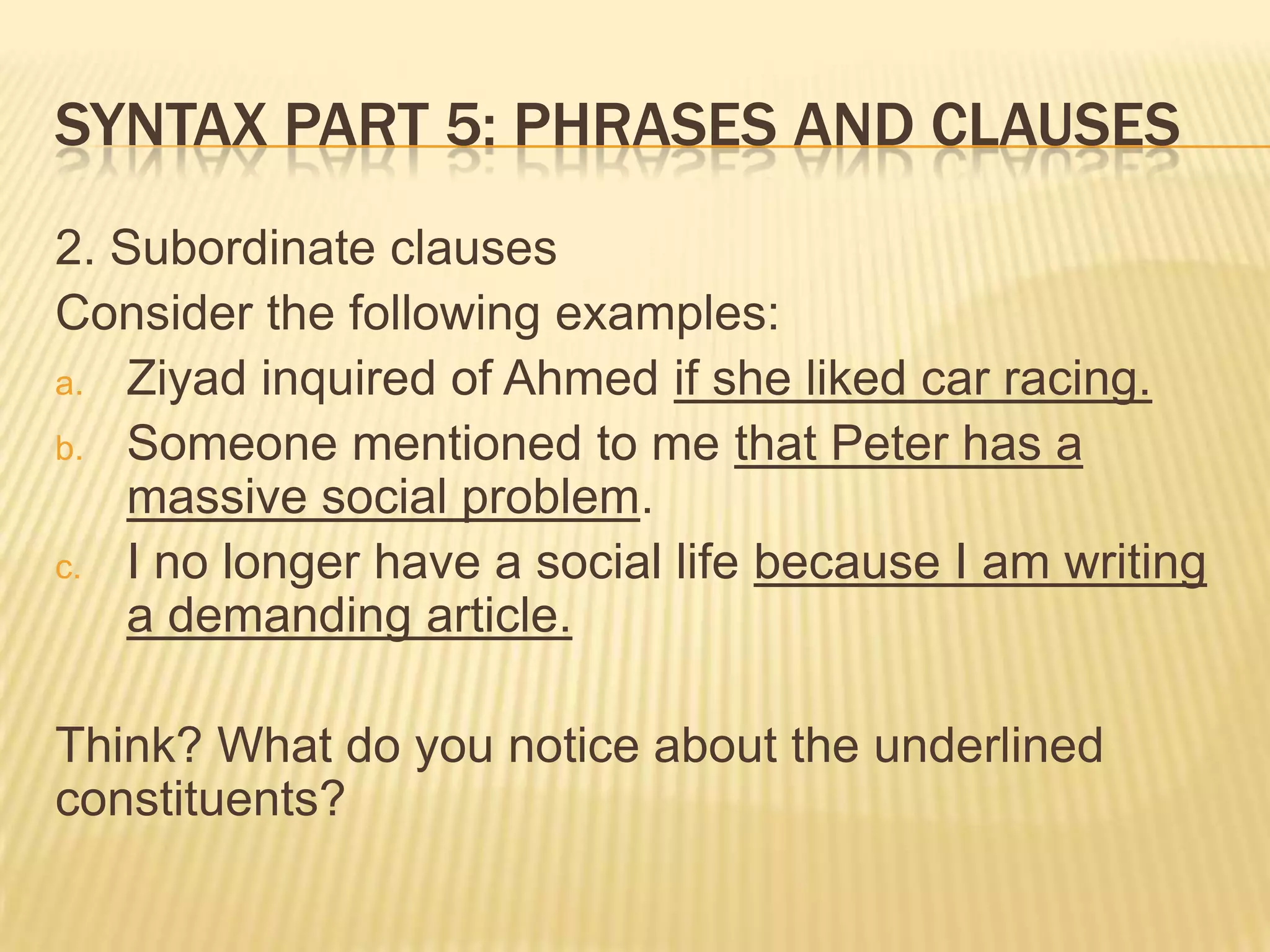
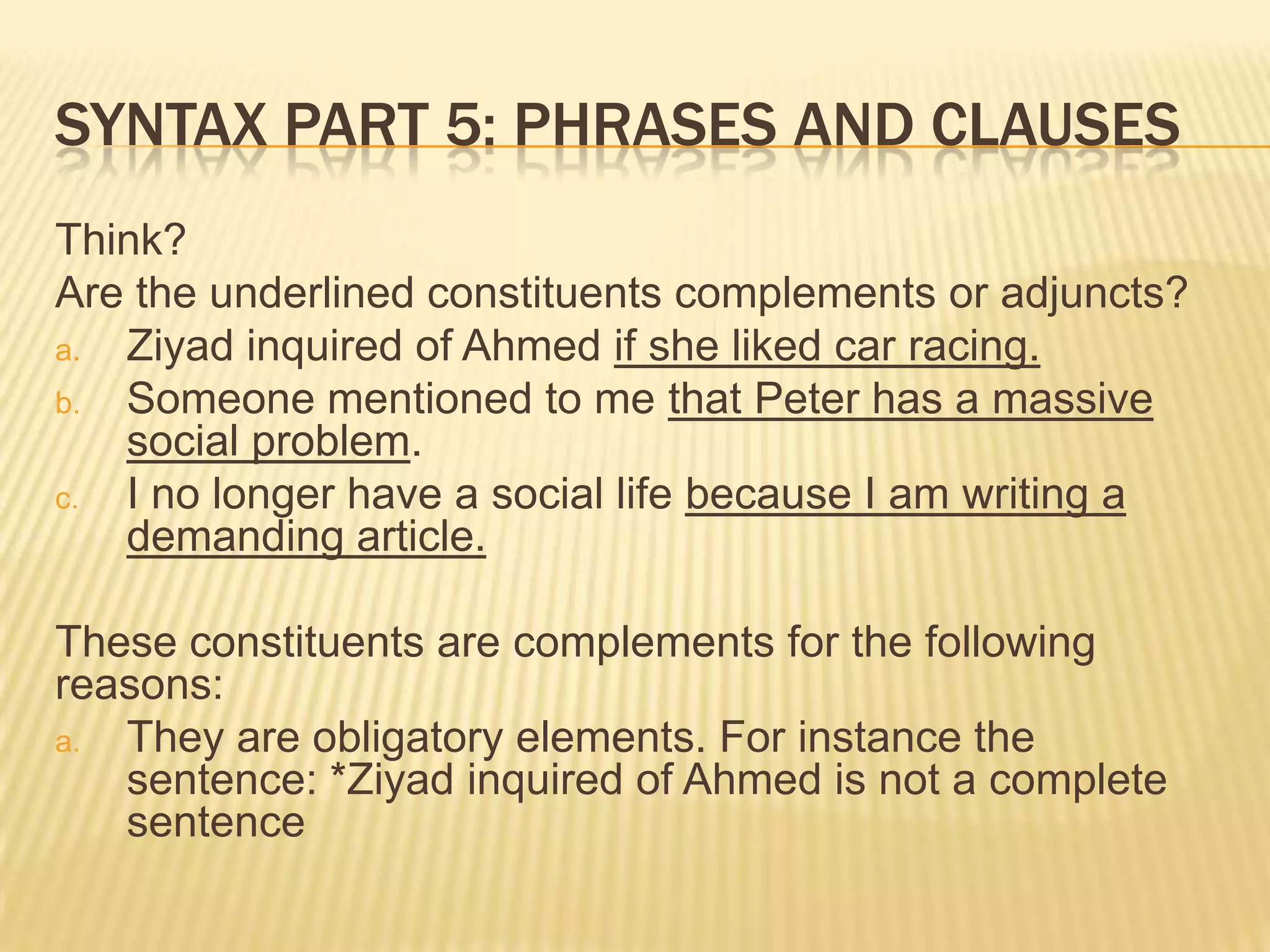
Syntax part 5: Phrases and clauses2. Subordinate clausesConsider the following examples:Ziyad inquired of Ahmed if she liked car racing.Someone mentioned to me that Peter has a massive social problem.I no longer have a social life because I am writing a demanding article.Think? What do you notice about the underlined constituents?
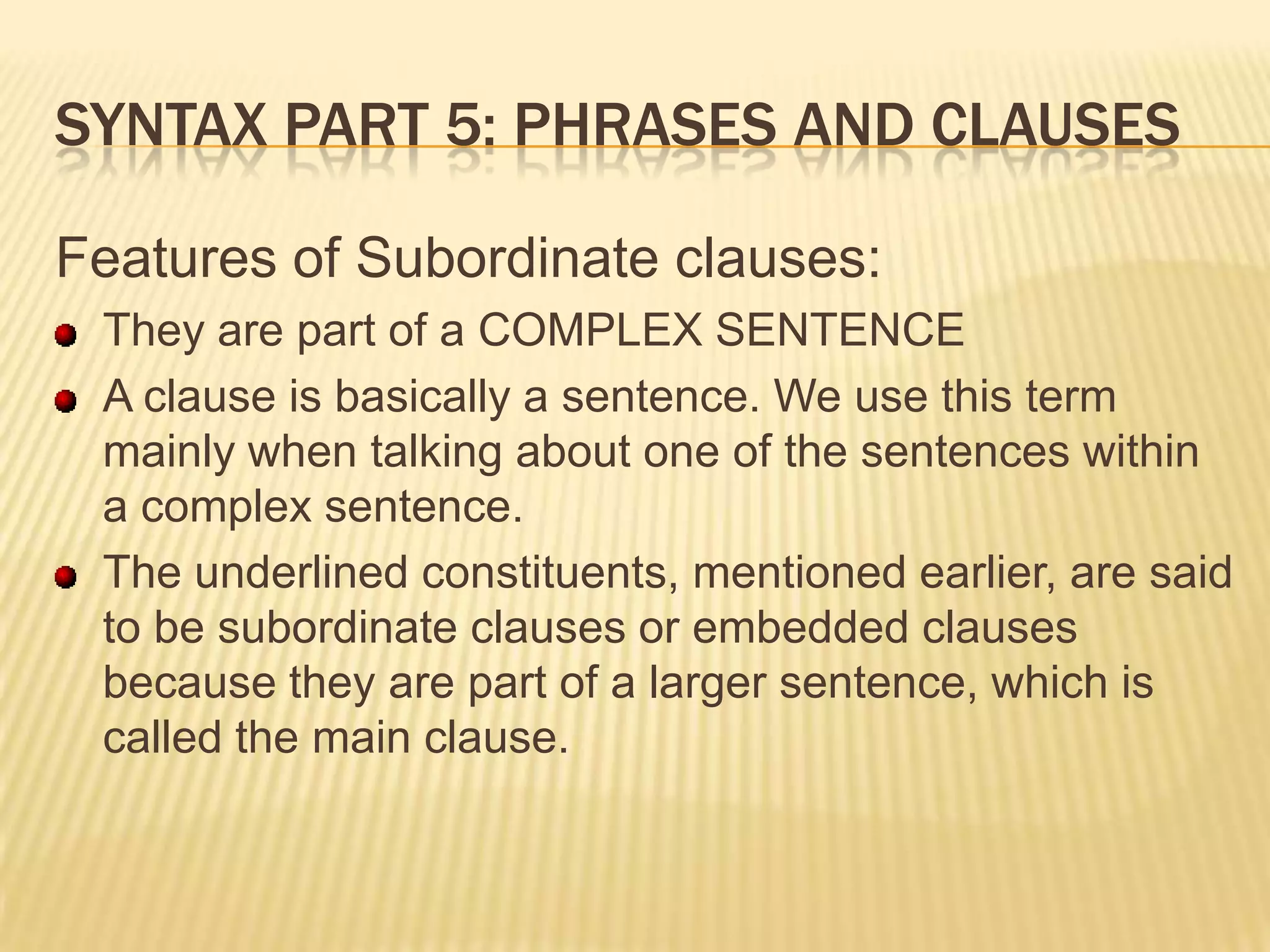
Syntax part 5: Phrases and clausesFeatures of Subordinate clauses:They are part of a COMPLEX SENTENCEA clause is basically a sentence. We use this term mainly when talking about one of the sentences within a complex sentence.The underlined constituents, mentioned earlier, are said to be subordinate clauses or embedded clauses because they are part of a larger sentence, which is called the main clause.
Syntax part 5: Phrases and clausesThink? Are the underlined constituents complements or adjuncts?Ziyad inquired of Ahmed if she liked car racing.Someone mentioned to me that Peter has a massive social problem.I no longer have a social life because I am writing a demanding article.These constituents are complements for the following reasons:They are obligatory elements. For instance the sentence: *Ziyad inquired of Ahmed is not a complete sentence
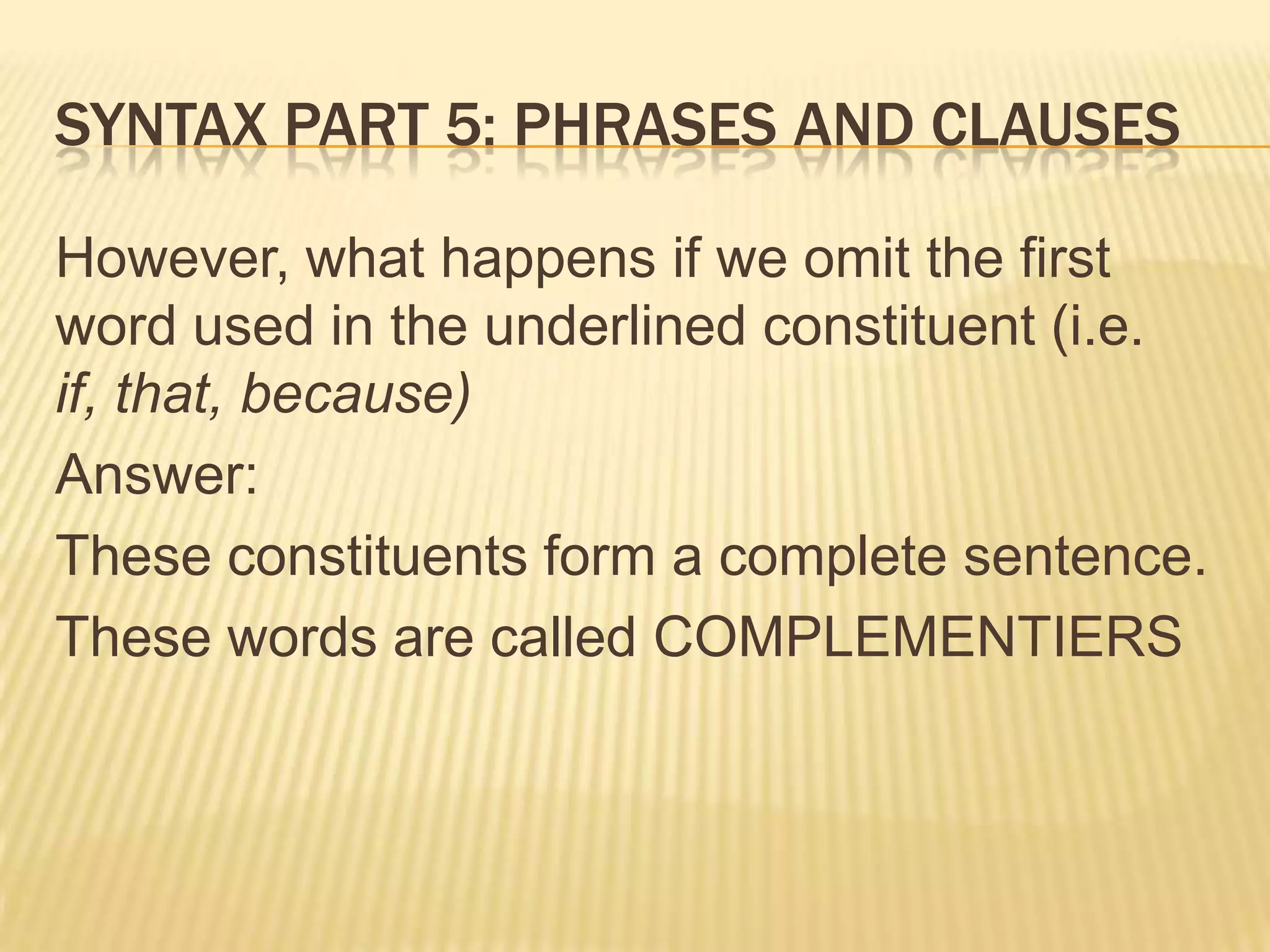
Syntax part 5: Phrases and clausesHowever, what happens if we omit the first word used in the underlined constituent (i.e. if, that, because)Answer:These constituents form a complete sentence.These words are called COMPLEMENTIERS
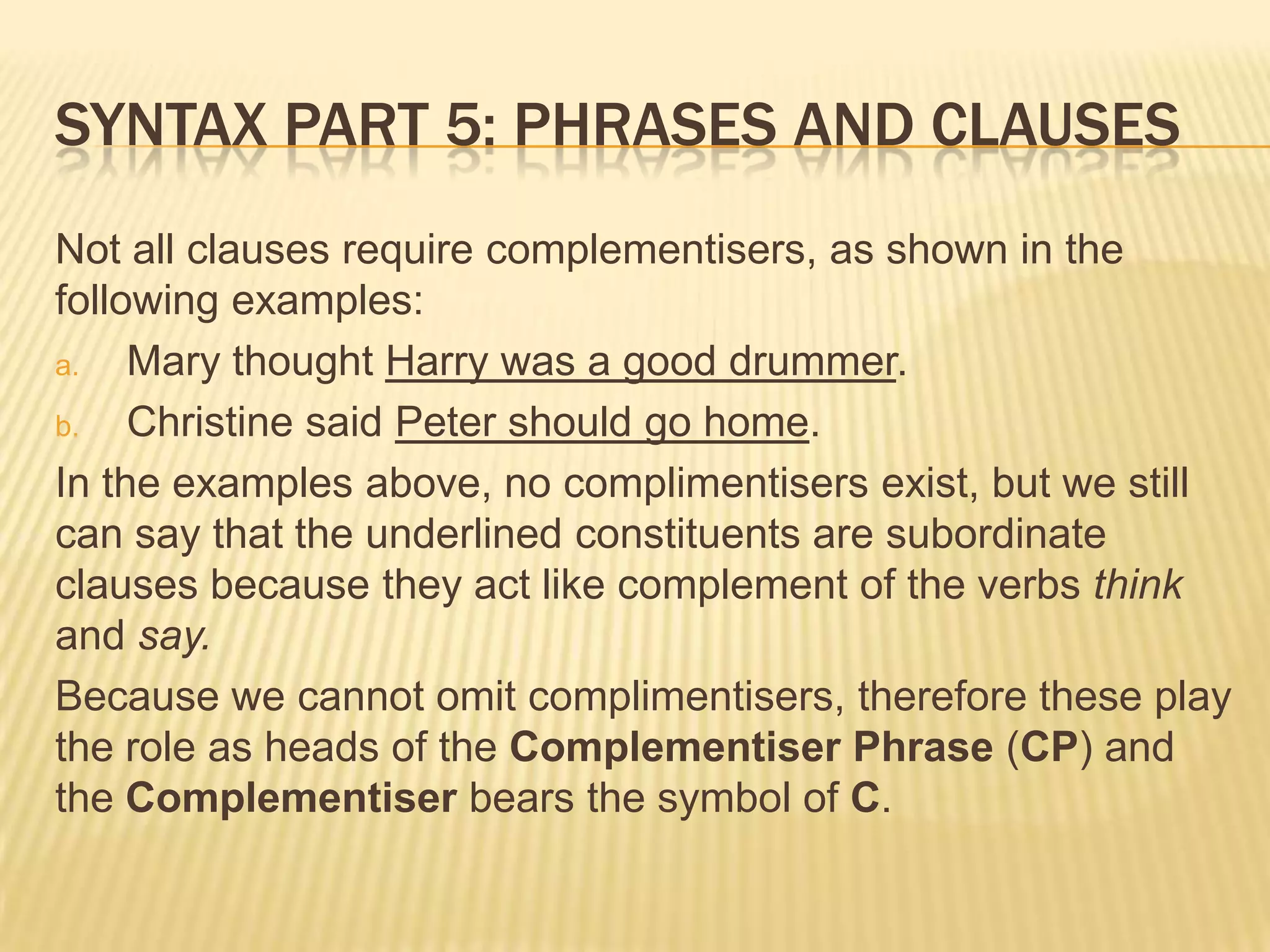
Syntax part 5: Phrases and clausesNot all clauses require complementisers, as shown in the following examples:Mary thought Harry was a good drummer.Christine said Peter should go home.In the examples above, no complimentisers exist, but we still can say that the underlined constituents are subordinate clauses because they act like complement of the verbs think and say.Because we cannot omit complimentisers, therefore these play the role as heads of the Complementiser Phrase (CP) and the Complementiser bears the symbol of C.
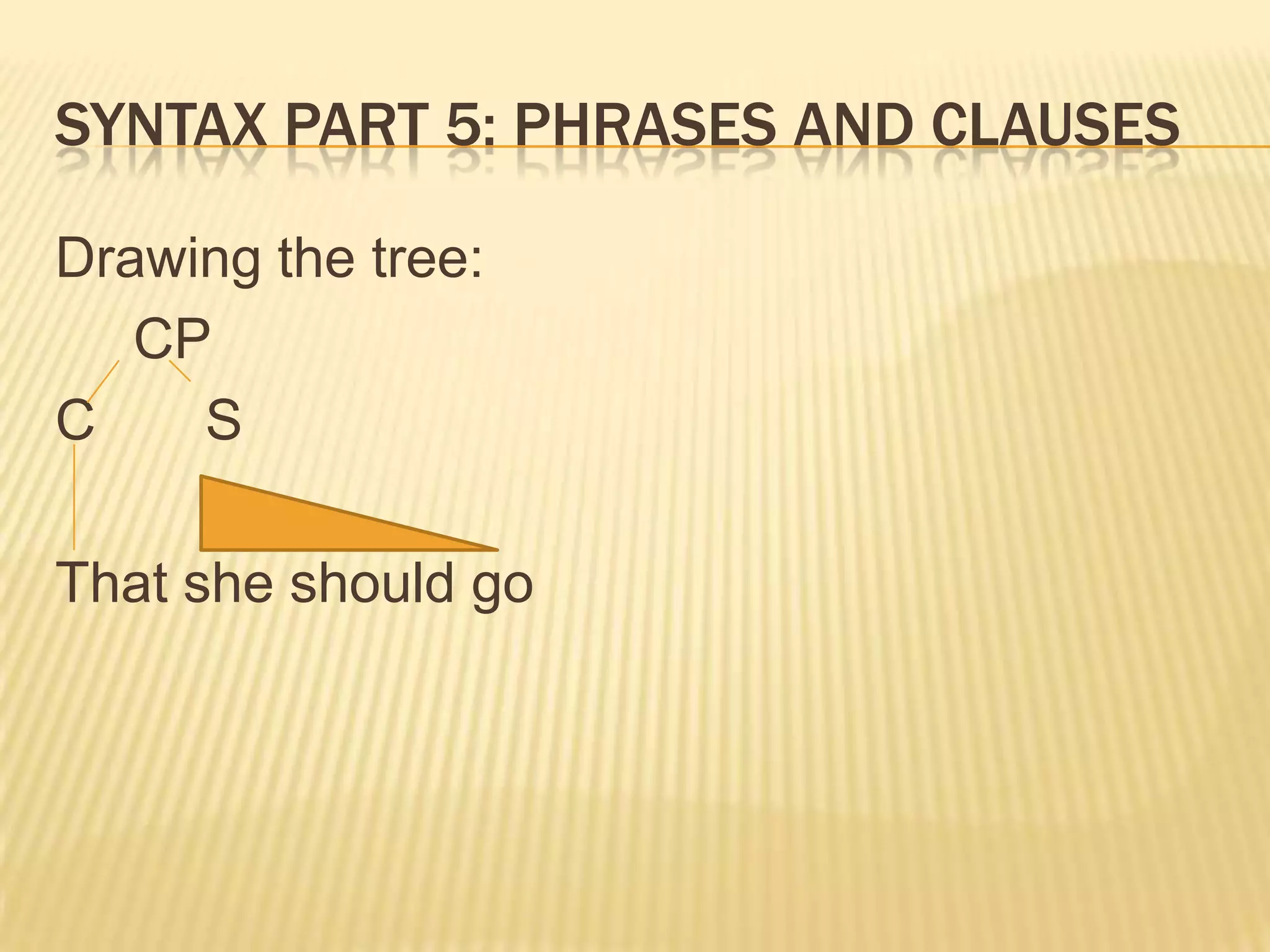
Syntax part 5: Phrases and clausesDrawing the tree:     CPC       SThat she should go
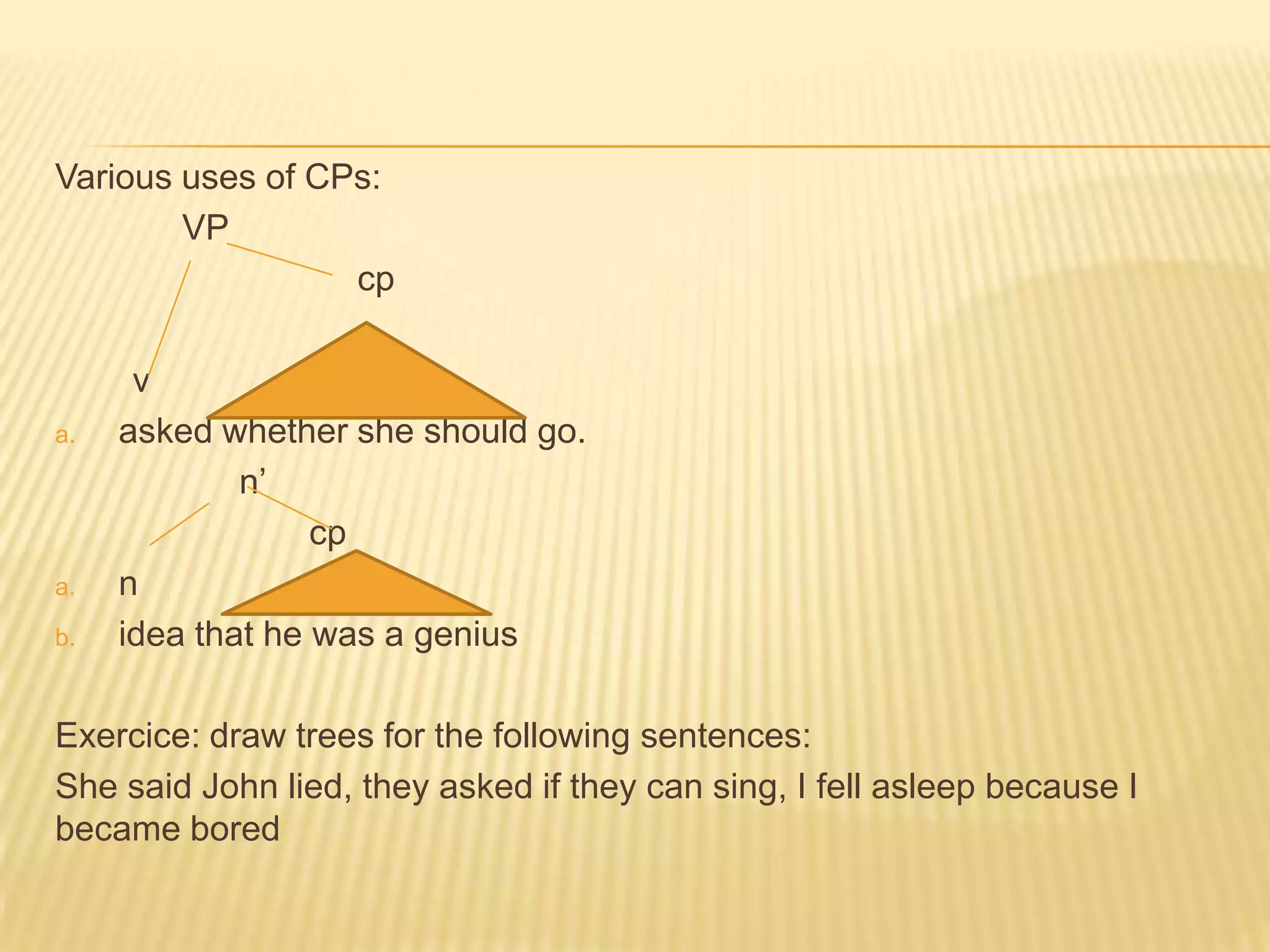
Various uses of CPs:	VPcp        vasked whether she should go.                   n’ cpnidea that he was a geniusExercice: draw trees for the following sentences: She said John lied, they asked if they can sing, I fell asleep because I became bored
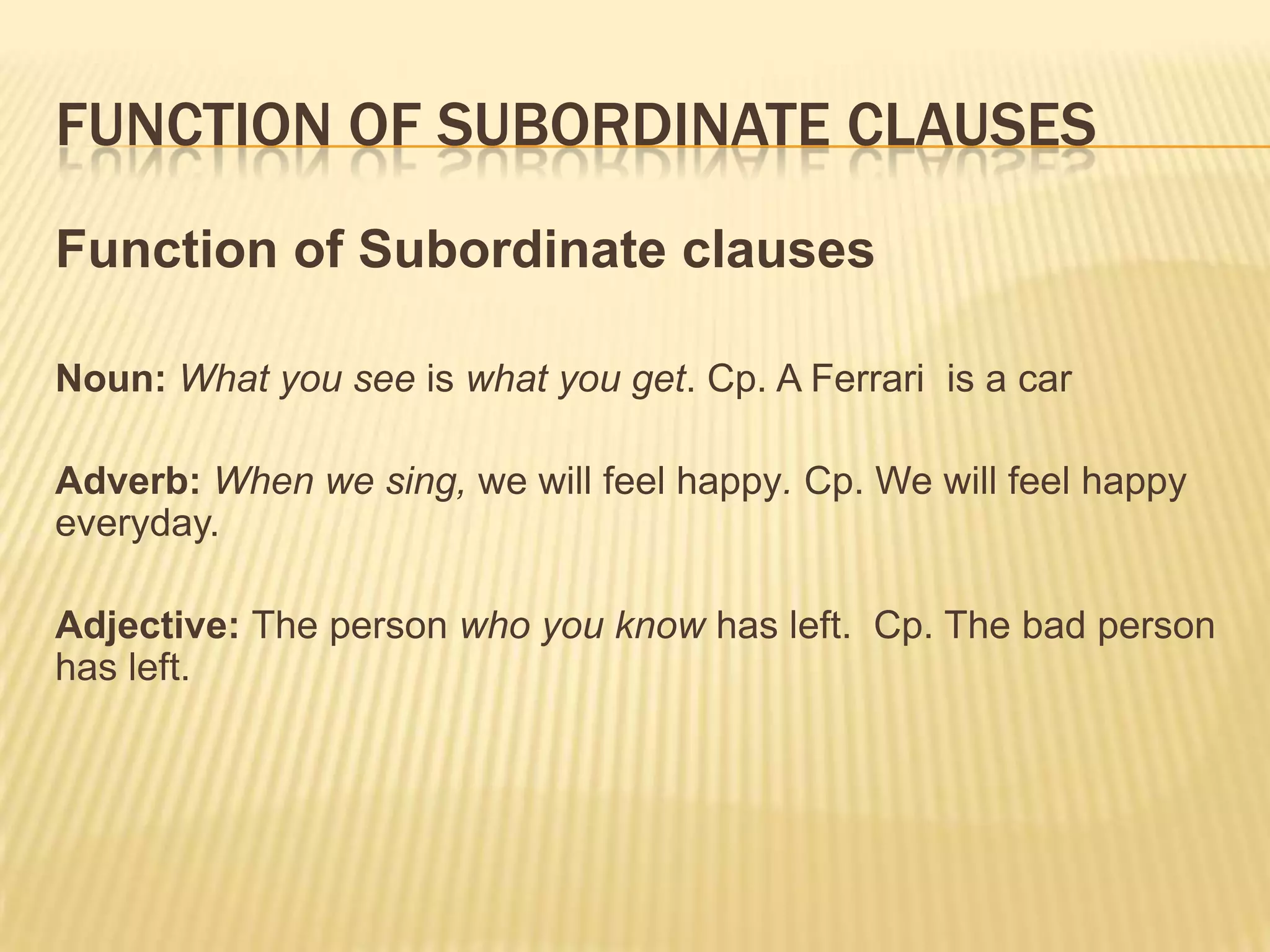
Function of subordinate clausesFunction of Subordinate clausesNoun: What you see is what you get. Cp. A Ferrari  is a carAdverb: When we sing, we will feel happy. Cp. We will feel happy everyday.Adjective: The person who you know has left.  Cp. The bad person has left.
ExerciceExercise (pair work)Each of the following subordinate clauses is a fragment.  Make a complete sentence by placing an independent clause and draw the tree diagram:	Example:	After I ate a salad	Answer:		After I ate a salad, I ordered dessert. 			I ordered dessert after I ate a salad. a. If I were richb. Since I didn’t see you at the partyc. Until Sally finds her textbookd. When I finally save up enough moneye. While you were sleeping

Syntax part 5

  • 1.
    Phrases, clauses andthe complex sentenceThink? What is the difference between a phrase and a clause?We have covered so far different types of phrases: NP, VP, AdjP, AdvP, PossP.A phrase is a sentence fragment containing more than one word and lacking the subject and predicate structure typical of clauses (traditional grammar definition)(e.g. VP: pick up)A clause is a sentence fragment, larger than a phrase.
  • 2.
    Syntax part 5:Phrases and clausesTypes of clauses:IndependentDependent or subordinateIndependent clauses can stand alone, whereas dependent clauses cannot. e.g. When I got home, I ate dinner.
  • 3.
    Syntax part 5:Phrases and clauses2. Subordinate clausesConsider the following examples:Ziyad inquired of Ahmed if she liked car racing.Someone mentioned to me that Peter has a massive social problem.I no longer have a social life because I am writing a demanding article.Think? What do you notice about the underlined constituents?
  • 4.
    Syntax part 5:Phrases and clausesFeatures of Subordinate clauses:They are part of a COMPLEX SENTENCEA clause is basically a sentence. We use this term mainly when talking about one of the sentences within a complex sentence.The underlined constituents, mentioned earlier, are said to be subordinate clauses or embedded clauses because they are part of a larger sentence, which is called the main clause.
  • 5.
    Syntax part 5:Phrases and clausesThink? Are the underlined constituents complements or adjuncts?Ziyad inquired of Ahmed if she liked car racing.Someone mentioned to me that Peter has a massive social problem.I no longer have a social life because I am writing a demanding article.These constituents are complements for the following reasons:They are obligatory elements. For instance the sentence: *Ziyad inquired of Ahmed is not a complete sentence
  • 6.
    Syntax part 5:Phrases and clausesHowever, what happens if we omit the first word used in the underlined constituent (i.e. if, that, because)Answer:These constituents form a complete sentence.These words are called COMPLEMENTIERS
  • 7.
    Syntax part 5:Phrases and clausesNot all clauses require complementisers, as shown in the following examples:Mary thought Harry was a good drummer.Christine said Peter should go home.In the examples above, no complimentisers exist, but we still can say that the underlined constituents are subordinate clauses because they act like complement of the verbs think and say.Because we cannot omit complimentisers, therefore these play the role as heads of the Complementiser Phrase (CP) and the Complementiser bears the symbol of C.
  • 8.
    Syntax part 5:Phrases and clausesDrawing the tree: CPC SThat she should go
  • 9.
    Various uses ofCPs: VPcp vasked whether she should go. n’ cpnidea that he was a geniusExercice: draw trees for the following sentences: She said John lied, they asked if they can sing, I fell asleep because I became bored
  • 10.
    Function of subordinateclausesFunction of Subordinate clausesNoun: What you see is what you get. Cp. A Ferrari is a carAdverb: When we sing, we will feel happy. Cp. We will feel happy everyday.Adjective: The person who you know has left. Cp. The bad person has left.
  • 11.
    ExerciceExercise (pair work)Eachof the following subordinate clauses is a fragment. Make a complete sentence by placing an independent clause and draw the tree diagram: Example: After I ate a salad Answer: After I ate a salad, I ordered dessert. I ordered dessert after I ate a salad. a. If I were richb. Since I didn’t see you at the partyc. Until Sally finds her textbookd. When I finally save up enough moneye. While you were sleeping