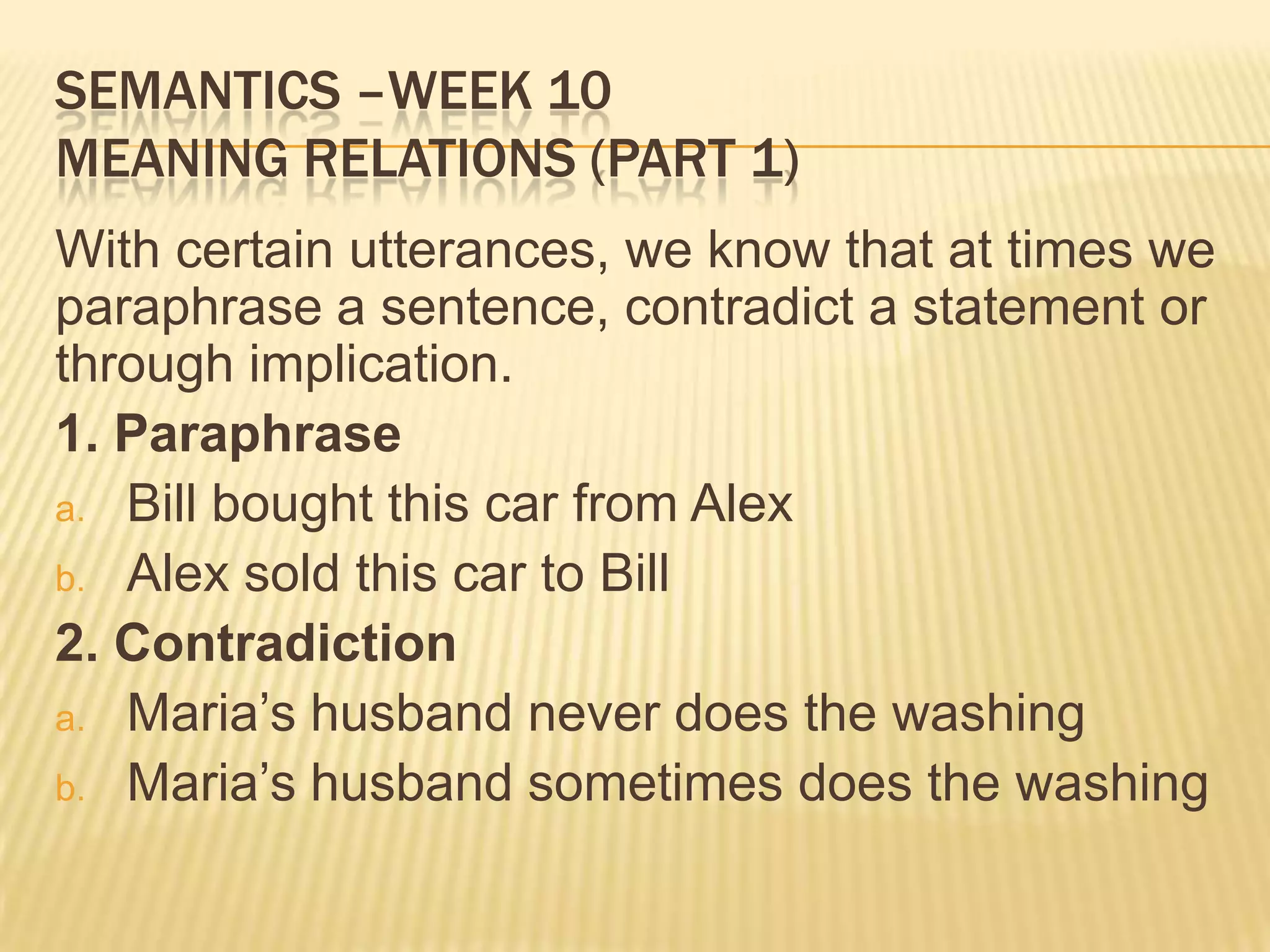
Semantics –week 10Meaning relations (part 1)With certain utterances, we know that at times we paraphrase a sentence, contradict a statement or through implication.1. ParaphraseBill bought this car from AlexAlex sold this car toBill2. ContradictionMaria’s husband never does the washingMaria’s husband sometimes does the washing
3. ImplicationMary has a Burmese cat implies that…Mary has a cat.
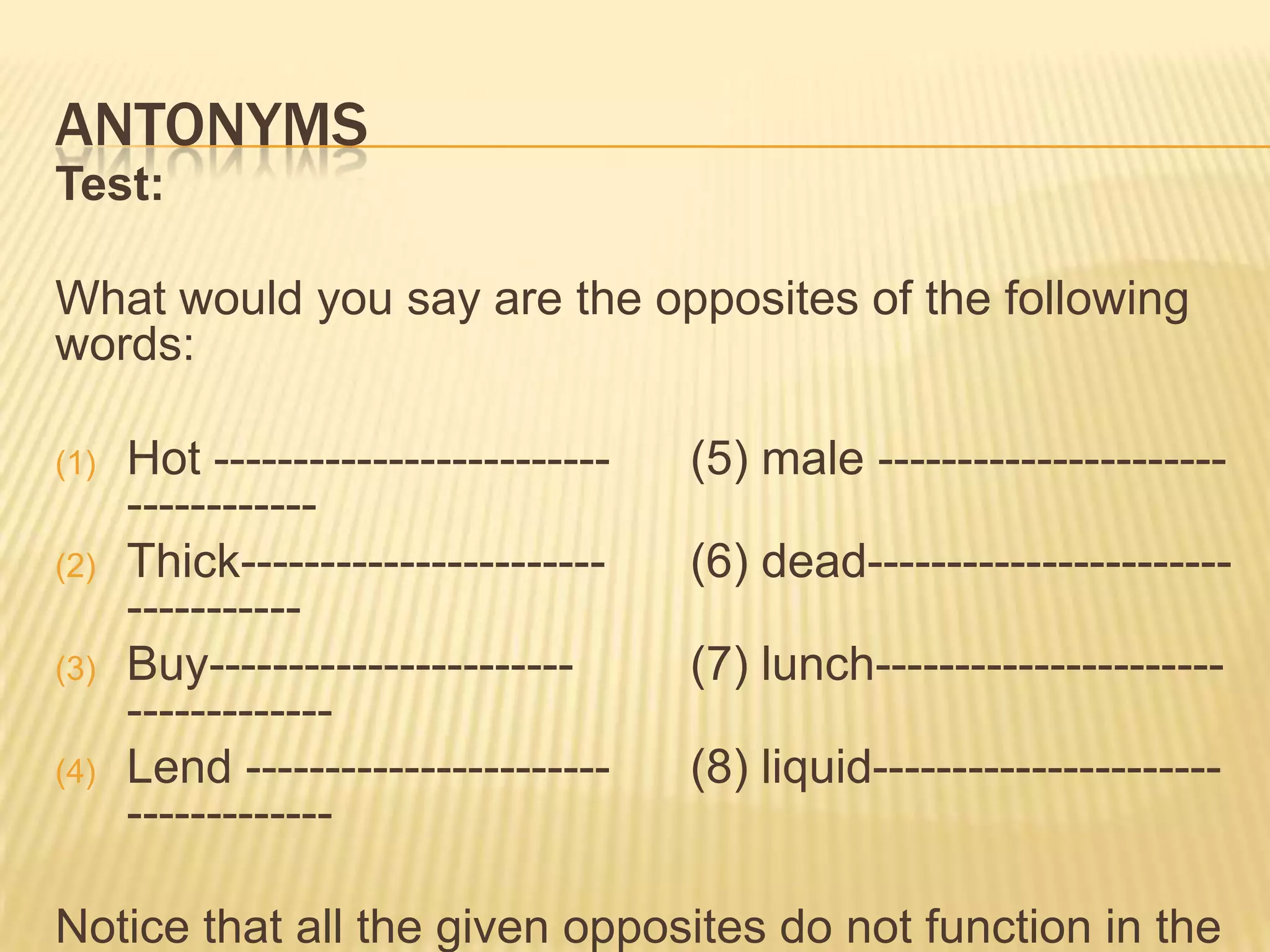
AntonymsTest:What would you say are the opposites of the following words:Hot -------------------------	(5) male ----------------------------------Thick-----------------------	(6) dead----------------------------------Buy-----------------------	(7) lunch-----------------------------------Lend -----------------------	(8) liquid-----------------------------------Notice that all the given opposites do not function in the same way. We will talk not just opposites of meanings but the types of opposites.There are four types of antonyms.
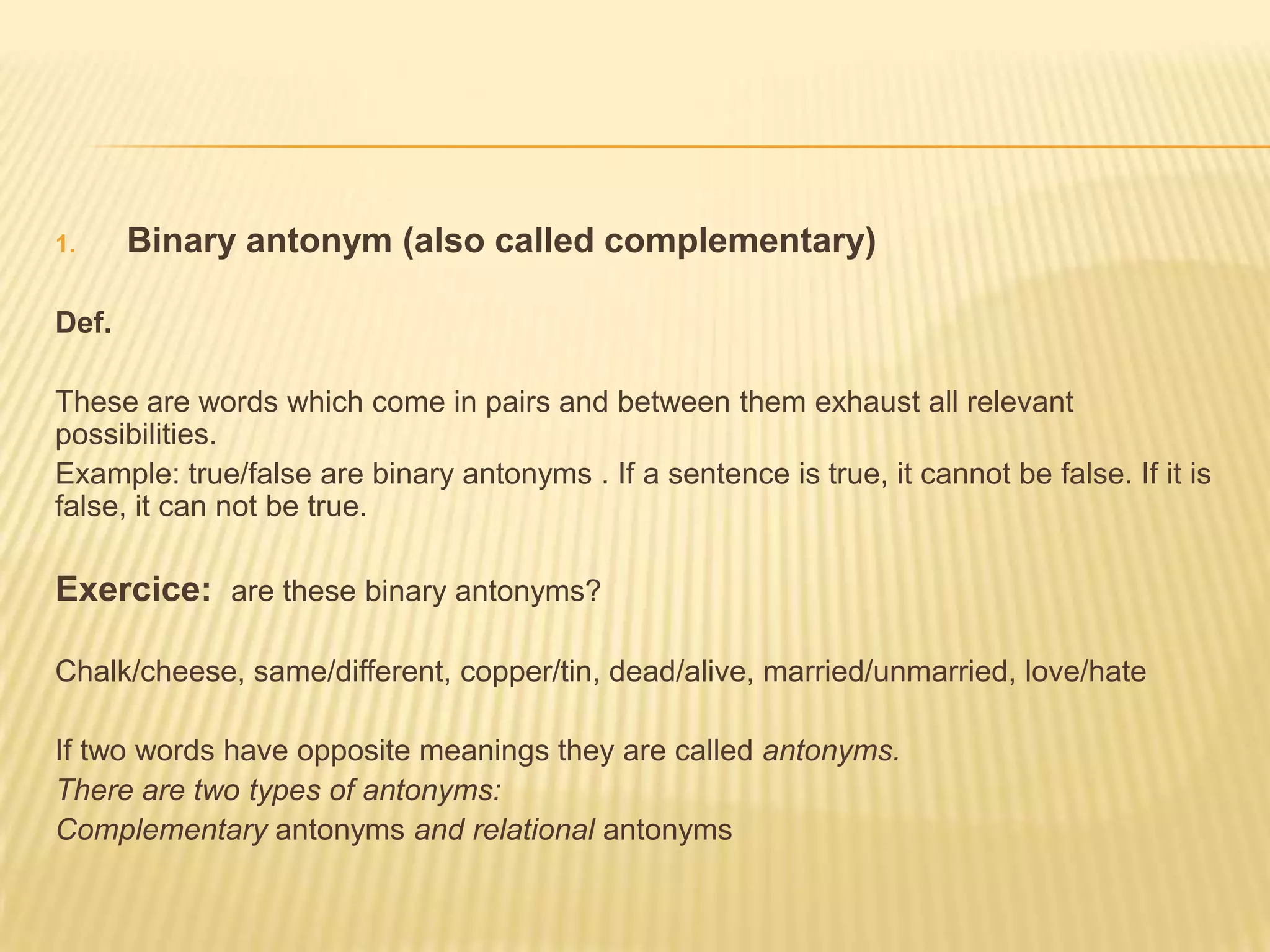
Binary antonym (also called complementary)Def. These are words which come in pairs and between them exhaust all relevant possibilities.Example: true/false are binary antonyms . If a sentence is true, it cannot be false. If it is false, it can not be true.Exercice: are these binary antonyms?Chalk/cheese, same/different, copper/tin, dead/alive, married/unmarried, love/hateIf two words have opposite meanings they are called antonyms.There are two types of antonyms:Complementary antonyms and relational antonyms
2. Relational antonyms (also called converses)are opposites where one word describes a relationship between two objects, and the other word describes the same relationship when the two objects are reversed.   For example, parent and child, teacher and student, or buy and sell.
Exercice:Are the following pairs of expressions converses:below/aboveGrandparent/grandchilsLove/hateConceal/revealGreater than/less than
Use the following logic to answer the following questions:If John bought a car from Fred, is it the case that Fred sold a car to John?6. Are buy/sell converses?7. borrow/lend8. give/take9. come/go
Semantic networks or semantic fieldsThis is an important concept because the words in a semantic field are not synonymous, but are all used to talk about the same general phenomenon.Example: Under the word book, we have ‘plays’ and ‘novels’ and under ‘play’ we have Romeo and Juliet. Under novel, we have ‘war and peace’
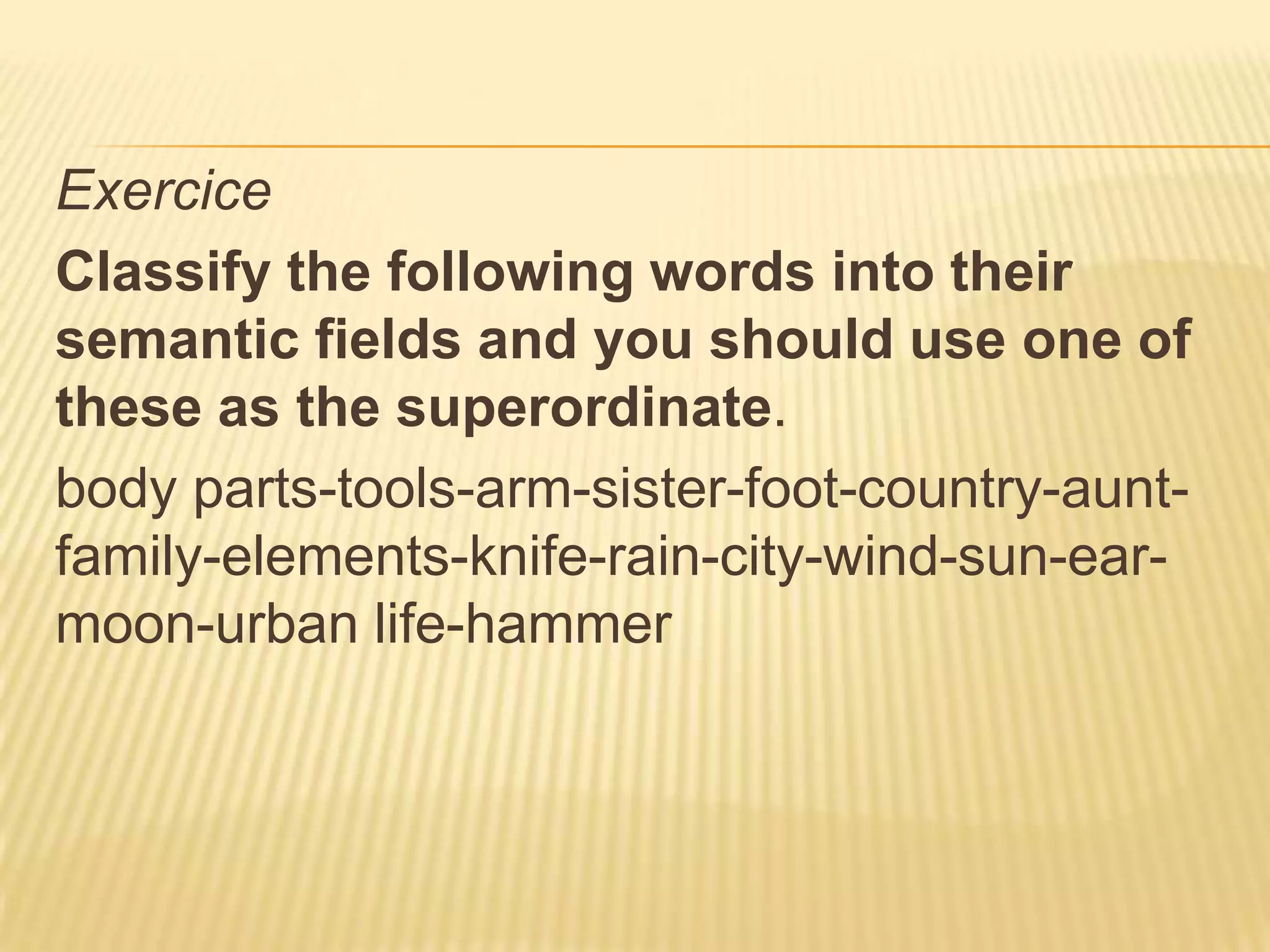
ExerciceClassify the following words into their semantic fields and you should use one of these as the superordinate.body parts-tools-arm-sister-foot-country-aunt-family-elements-knife-rain-city-wind-sun-ear-moon-urban life-hammer

Semantics –week 10

  • 1.
    Semantics –week 10Meaningrelations (part 1)With certain utterances, we know that at times we paraphrase a sentence, contradict a statement or through implication.1. ParaphraseBill bought this car from AlexAlex sold this car toBill2. ContradictionMaria’s husband never does the washingMaria’s husband sometimes does the washing
  • 2.
    3. ImplicationMary hasa Burmese cat implies that…Mary has a cat.
  • 3.
    AntonymsTest:What would yousay are the opposites of the following words:Hot ------------------------- (5) male ----------------------------------Thick----------------------- (6) dead----------------------------------Buy----------------------- (7) lunch-----------------------------------Lend ----------------------- (8) liquid-----------------------------------Notice that all the given opposites do not function in the same way. We will talk not just opposites of meanings but the types of opposites.There are four types of antonyms.
  • 4.
    Binary antonym (alsocalled complementary)Def. These are words which come in pairs and between them exhaust all relevant possibilities.Example: true/false are binary antonyms . If a sentence is true, it cannot be false. If it is false, it can not be true.Exercice: are these binary antonyms?Chalk/cheese, same/different, copper/tin, dead/alive, married/unmarried, love/hateIf two words have opposite meanings they are called antonyms.There are two types of antonyms:Complementary antonyms and relational antonyms
  • 5.
    2. Relational antonyms (alsocalled converses)are opposites where one word describes a relationship between two objects, and the other word describes the same relationship when the two objects are reversed.   For example, parent and child, teacher and student, or buy and sell.
  • 6.
    Exercice:Are the followingpairs of expressions converses:below/aboveGrandparent/grandchilsLove/hateConceal/revealGreater than/less than
  • 7.
    Use the followinglogic to answer the following questions:If John bought a car from Fred, is it the case that Fred sold a car to John?6. Are buy/sell converses?7. borrow/lend8. give/take9. come/go
  • 8.
    Semantic networks orsemantic fieldsThis is an important concept because the words in a semantic field are not synonymous, but are all used to talk about the same general phenomenon.Example: Under the word book, we have ‘plays’ and ‘novels’ and under ‘play’ we have Romeo and Juliet. Under novel, we have ‘war and peace’
  • 9.
    ExerciceClassify the followingwords into their semantic fields and you should use one of these as the superordinate.body parts-tools-arm-sister-foot-country-aunt-family-elements-knife-rain-city-wind-sun-ear-moon-urban life-hammer