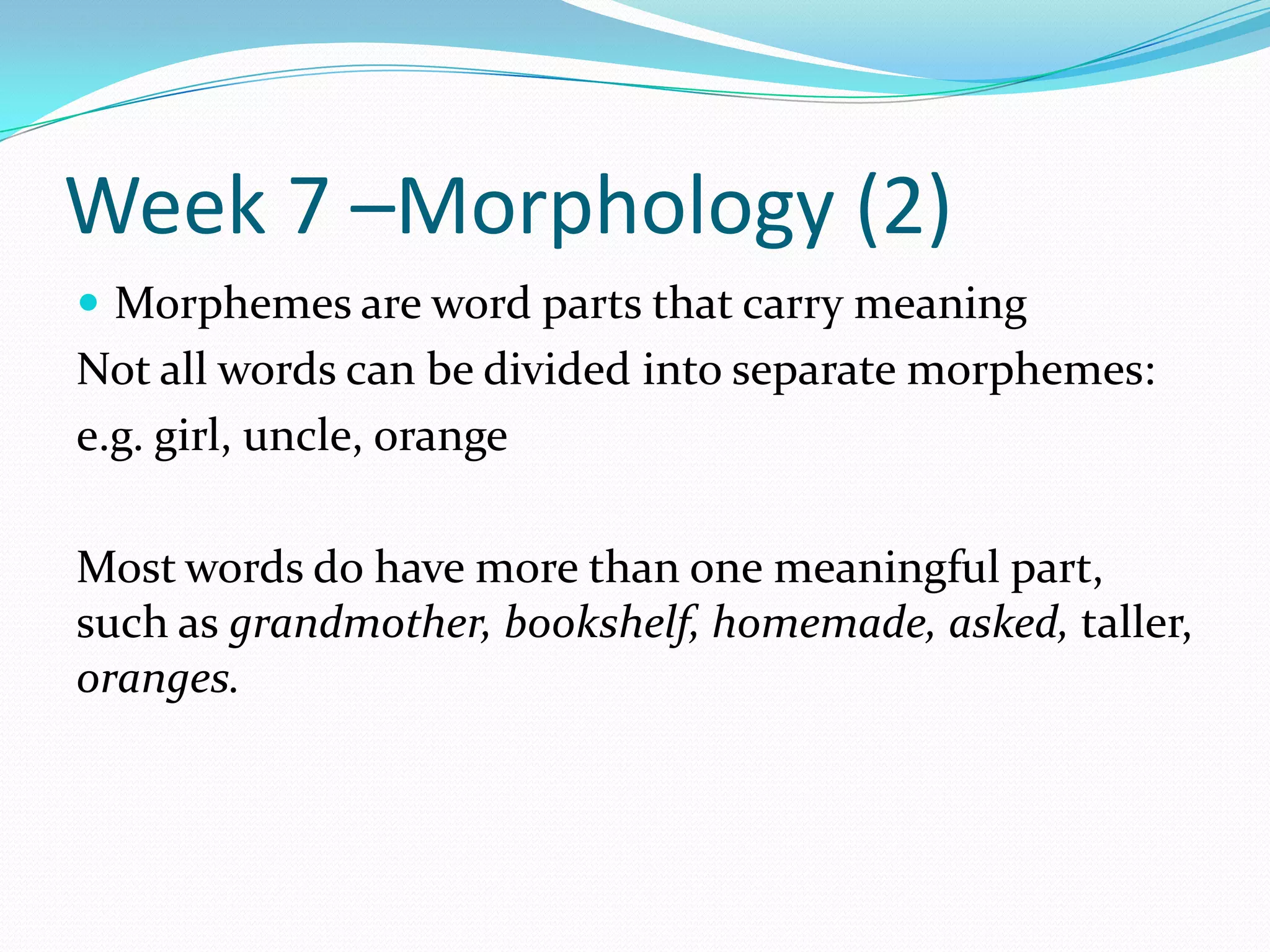
Week 7 –Morphology (2)Morphemes are word parts that carry meaningNot all words can be divided into separate morphemes:e.g. girl, uncle, orangeMost words do have more than one meaningful part, such as grandmother, bookshelf, homemade, asked, taller, oranges.
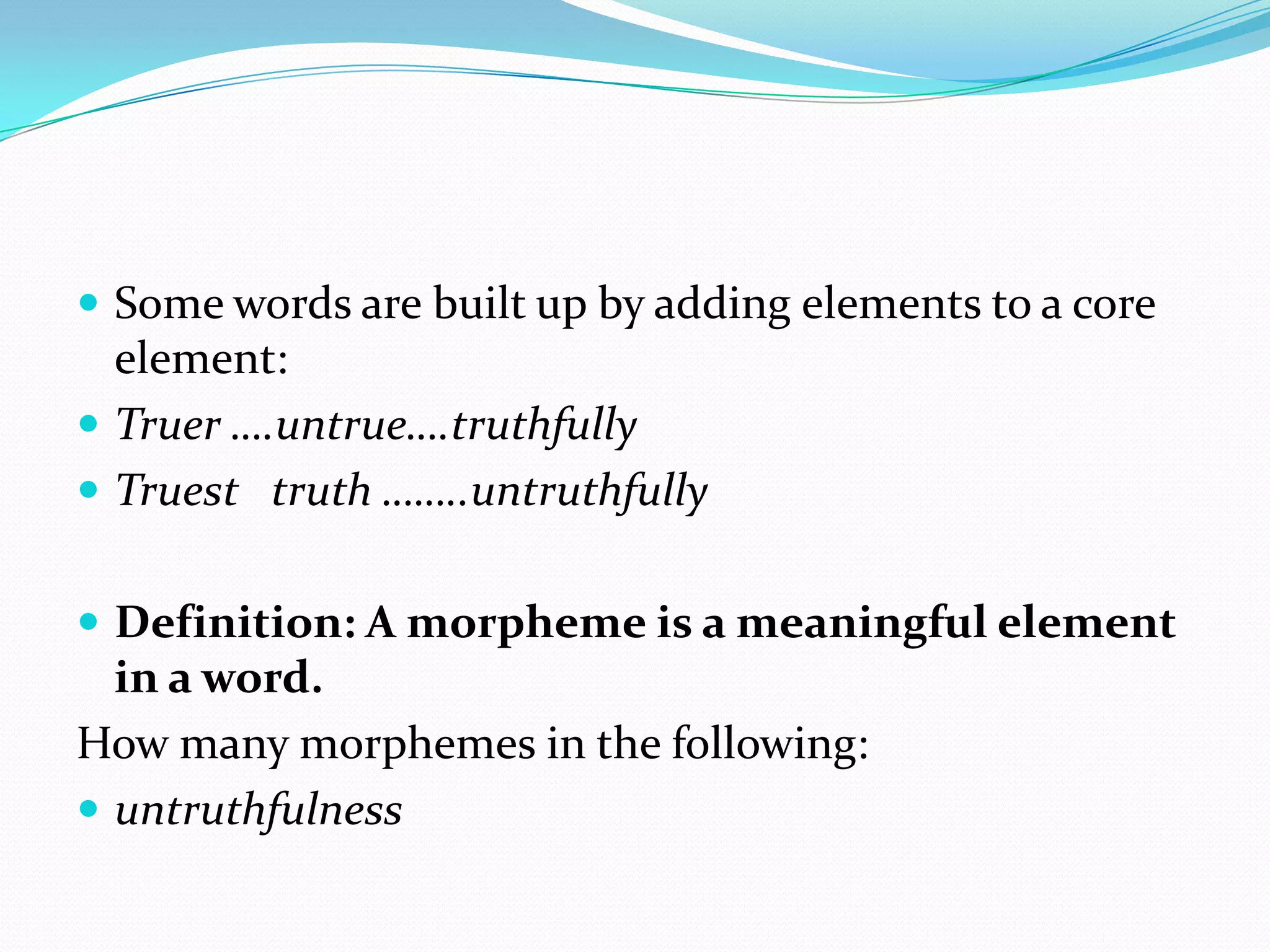
Some words are built up by adding elements to a core element:Truer ….untrue….truthfullyTruest   truth ……..untruthfullyDefinition: A morpheme is a meaningful element in a word.How many morphemes in the following:untruthfulness
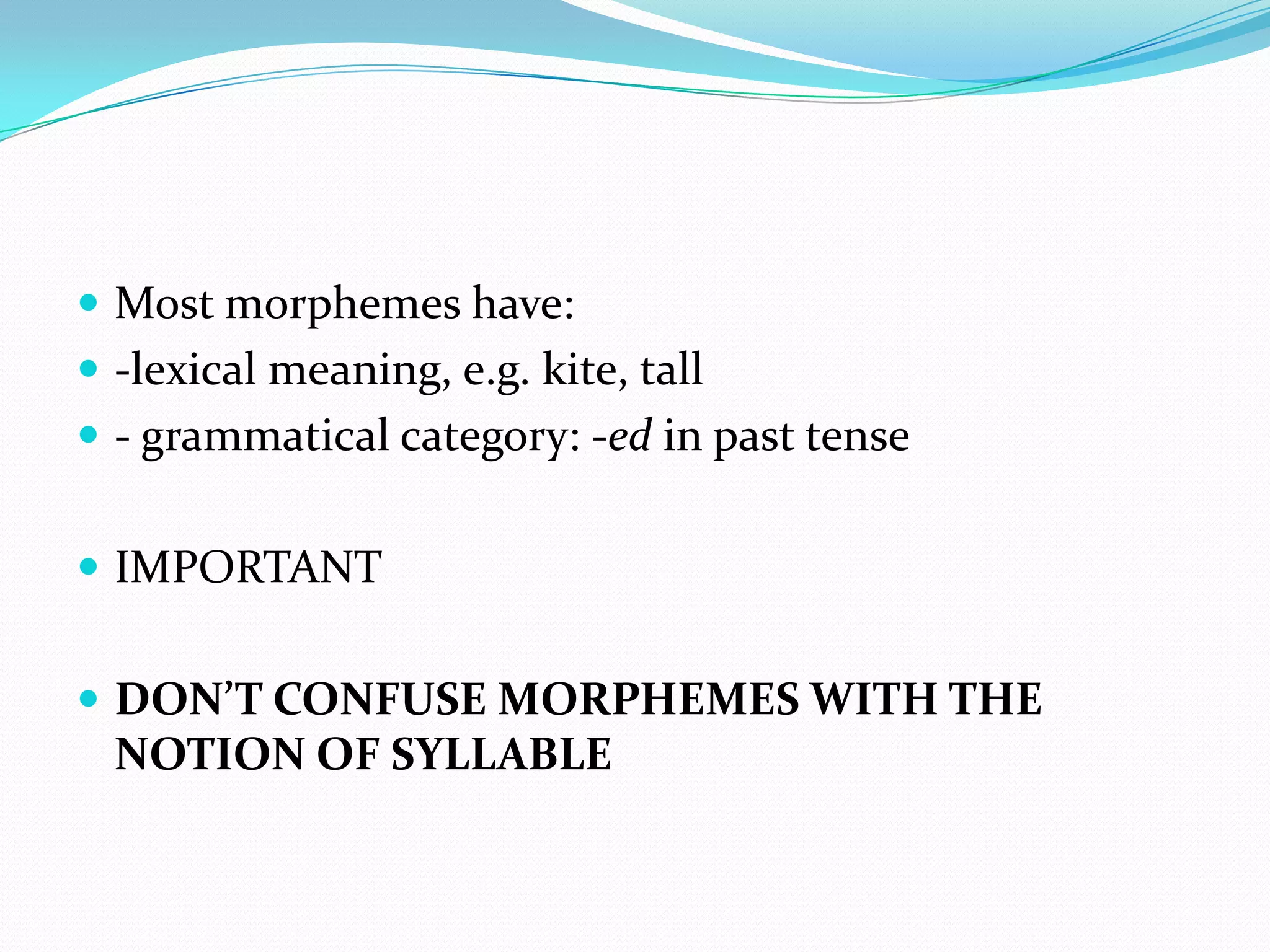
Most morphemes have:-lexical meaning, e.g. kite, tall- grammatical category: -edin past tenseIMPORTANTDON’T CONFUSE MORPHEMES WITH THE NOTION OF SYLLABLE
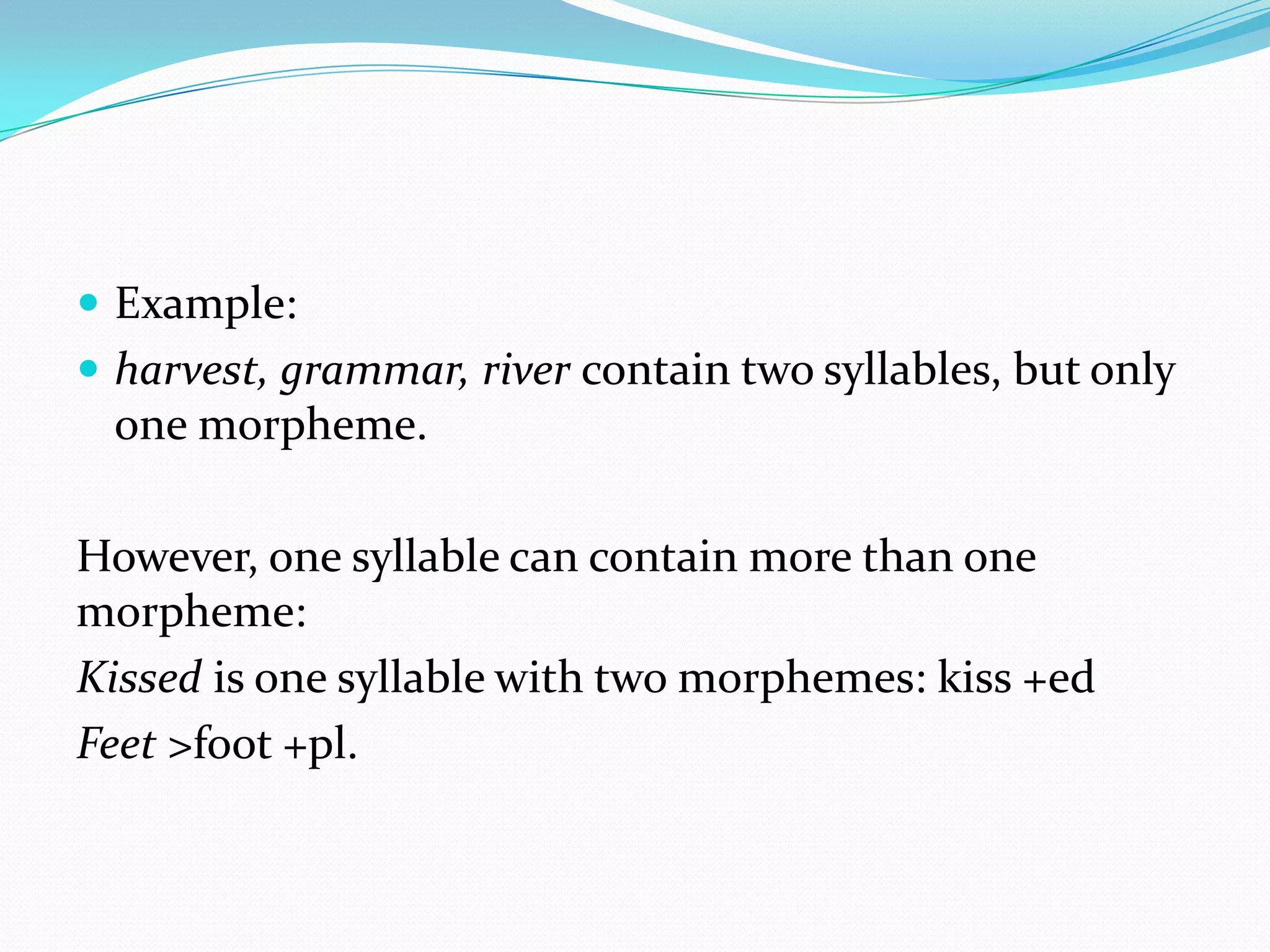
Example:harvest, grammar, river contain two syllables, but only one morpheme.However, one syllable can contain more than one morpheme:Kissed is one syllable with two morphemes: kiss +edFeet >foot +pl.
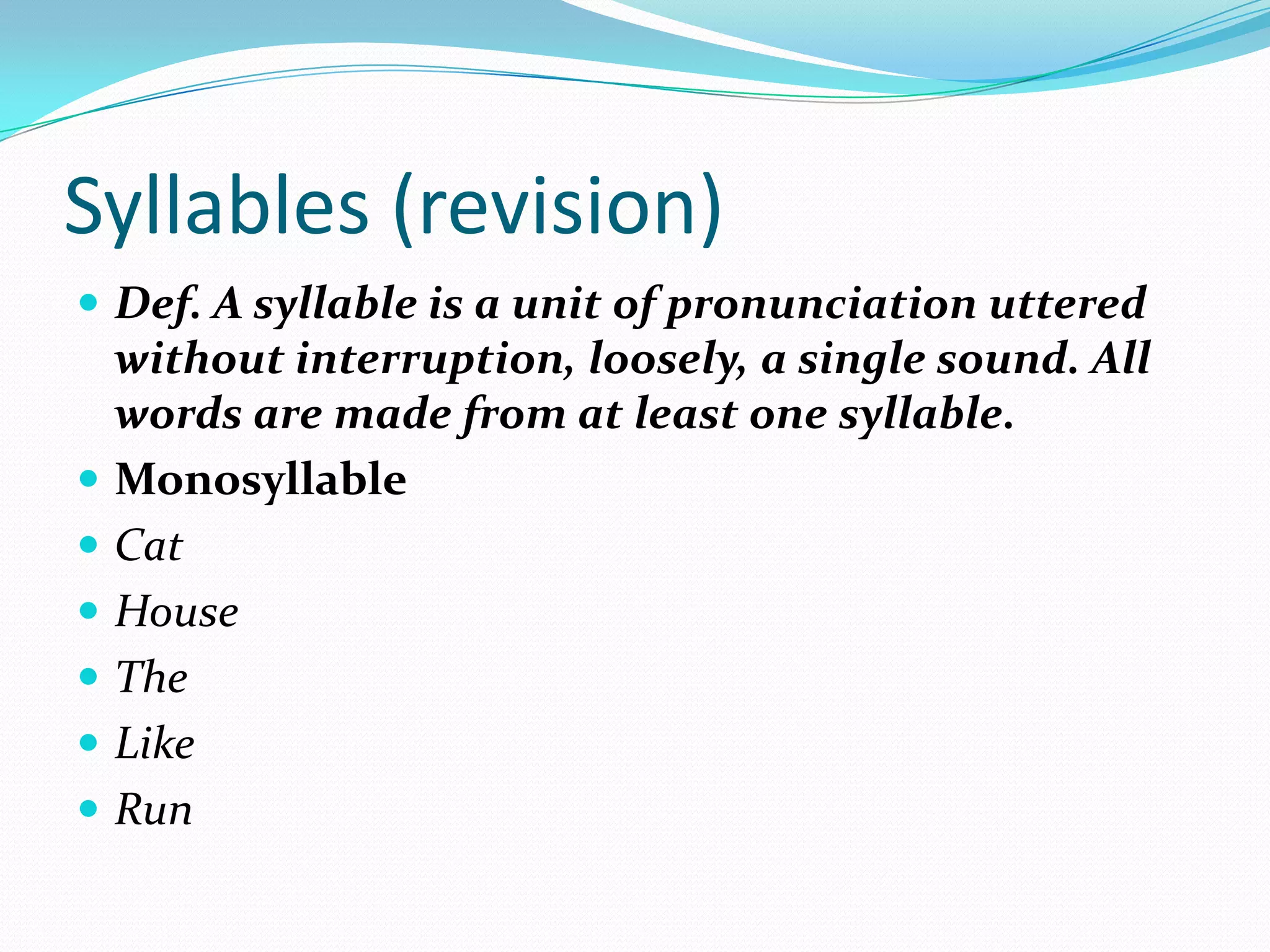
Syllables (revision)Def. A syllable is a unit of pronunciation uttered without interruption, loosely, a single sound. All words are made from at least one syllable.MonosyllableCatHouseTheLikeRun
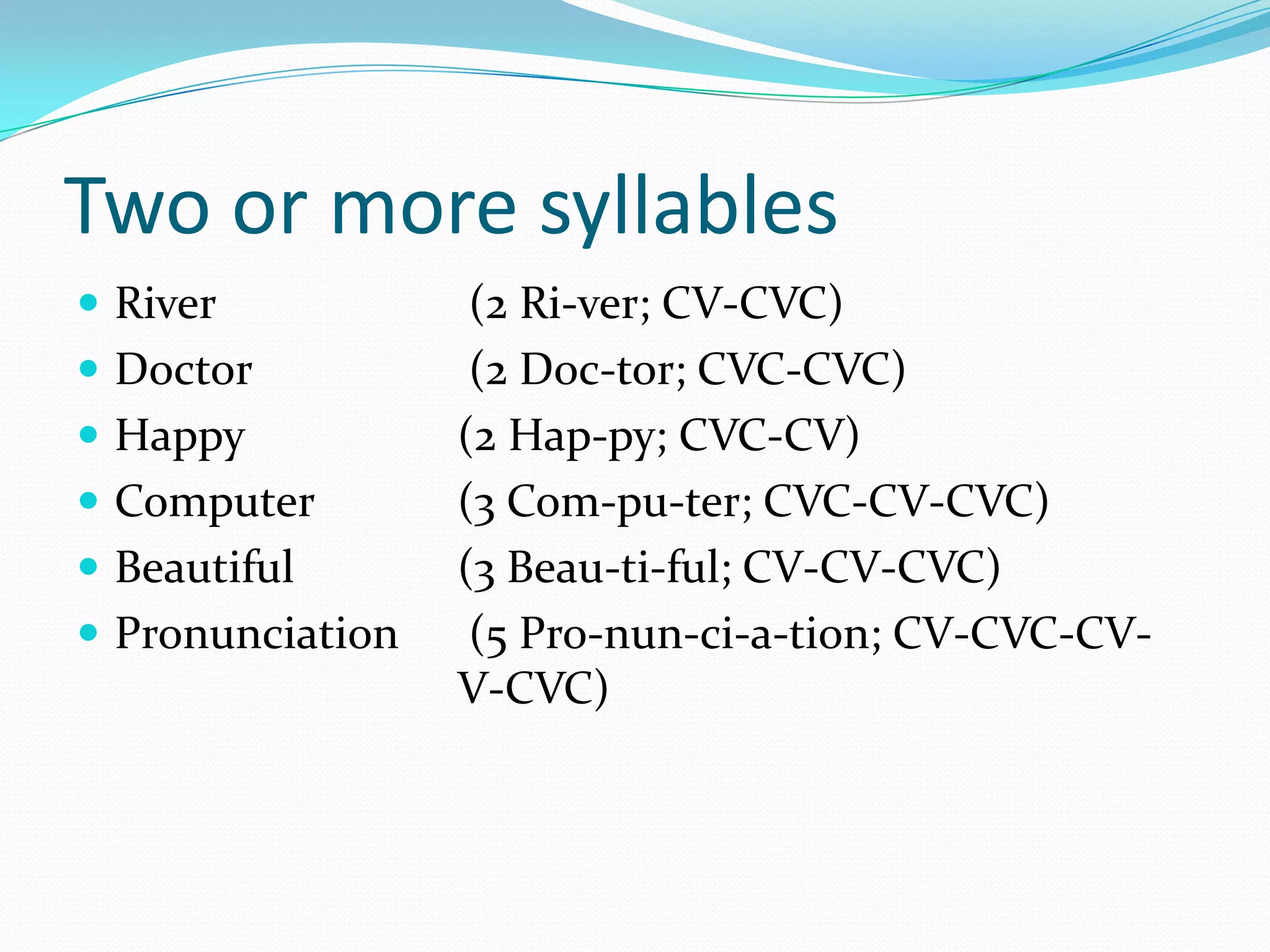
Two or more syllablesRiver		 (2 Ri-ver; CV-CVC)Doctor		 (2 Doc-tor; CVC-CVC)Happy 		(2 Hap-py; CVC-CV)Computer 		(3 Com-pu-ter; CVC-CV-CVC)Beautiful 		(3 Beau-ti-ful; CV-CV-CVC)Pronunciation	 (5 Pro-nun-ci-a-tion; CV-CVC-CV-			V-CVC)
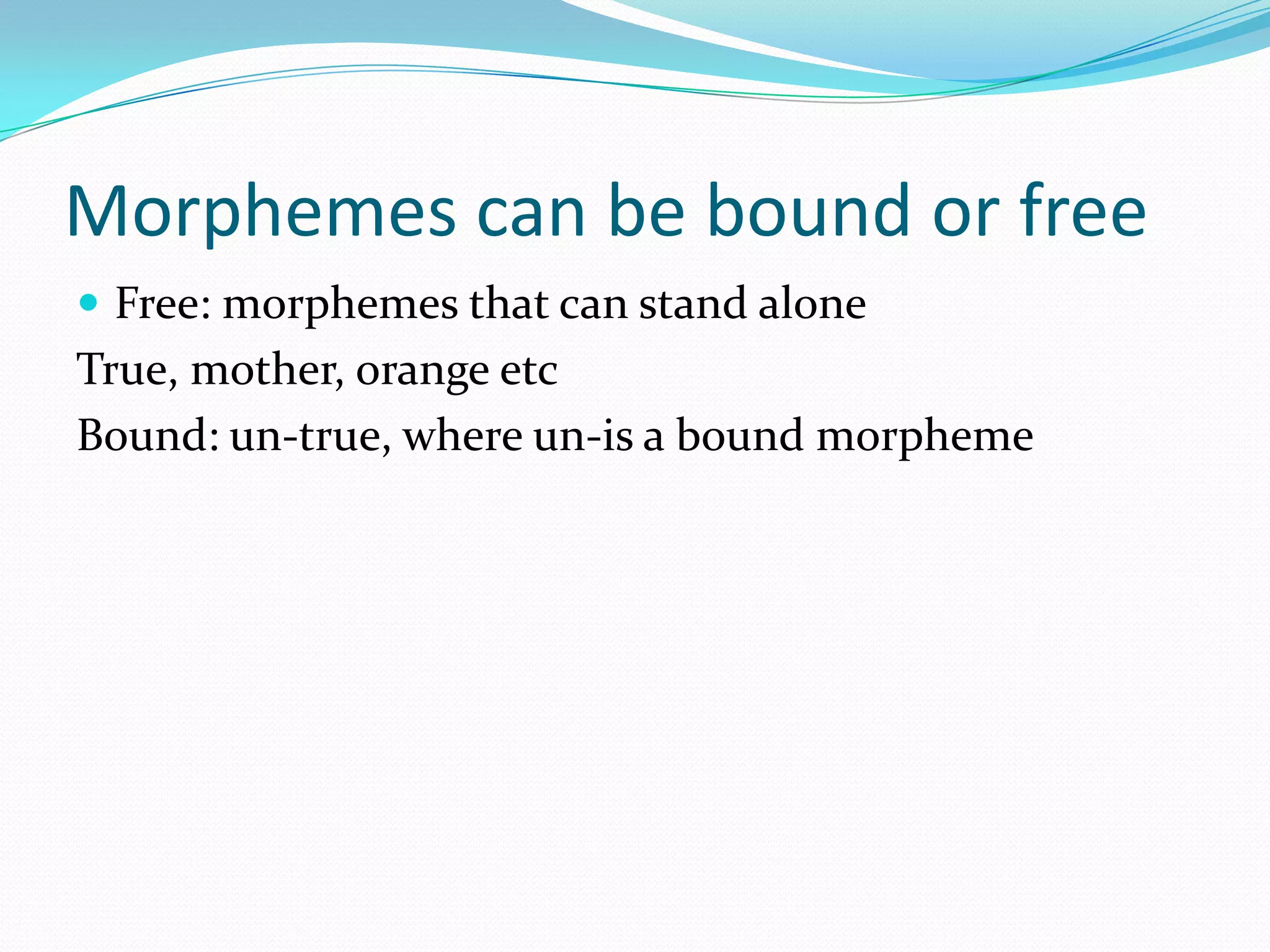
Morphemes can be bound or freeFree: morphemes that can stand aloneTrue, mother, orange etcBound: un-true, where un-is a bound morpheme
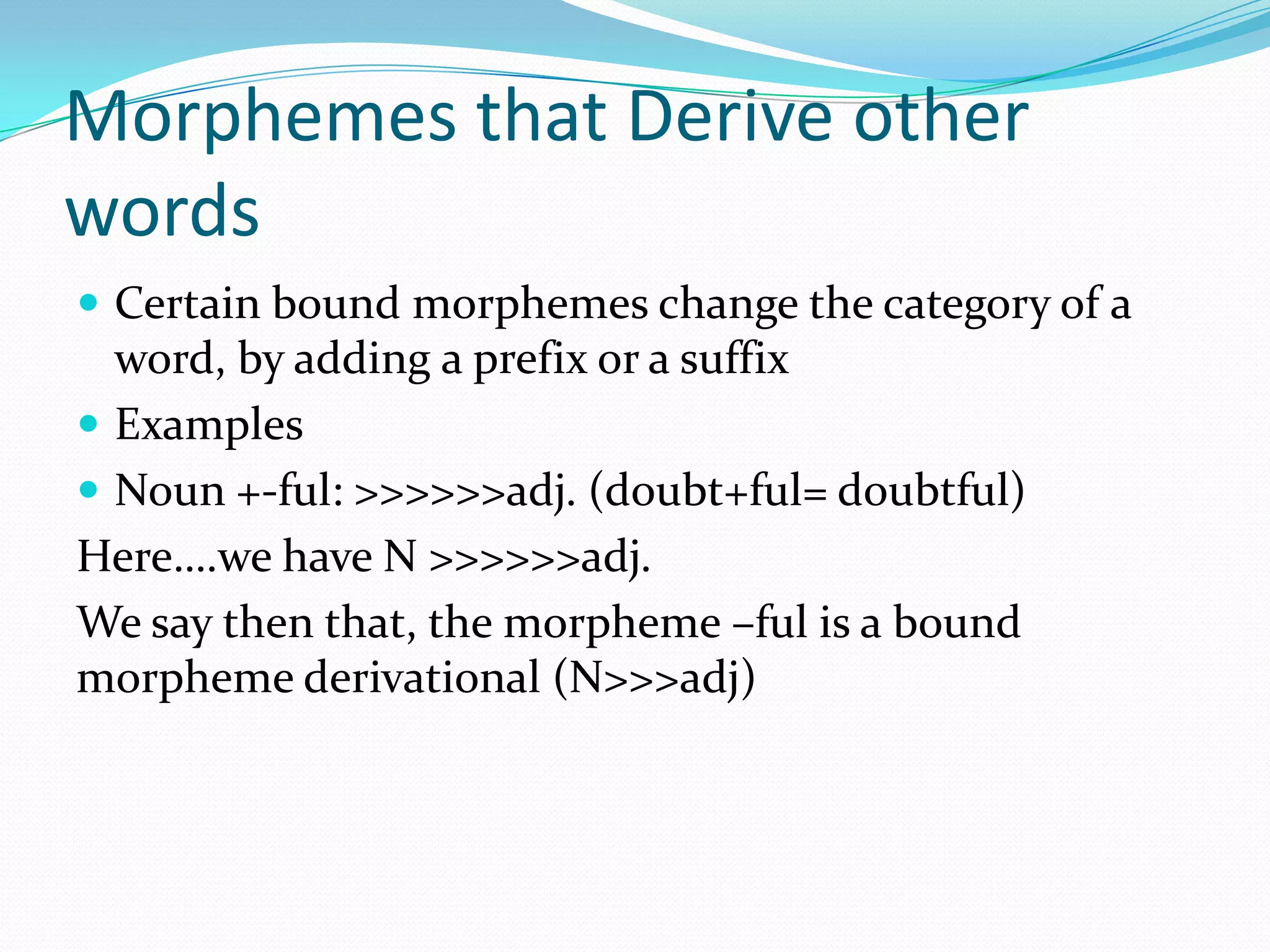
Morphemes that Derive other wordsCertain bound morphemes change the category of a word, by adding a prefix or a suffixExamplesNoun +-ful: >>>>>>adj. (doubt+ful= doubtful)Here….we have N >>>>>>adj.We say then that, the morpheme –ful is a bound morpheme derivational (N>>>adj)
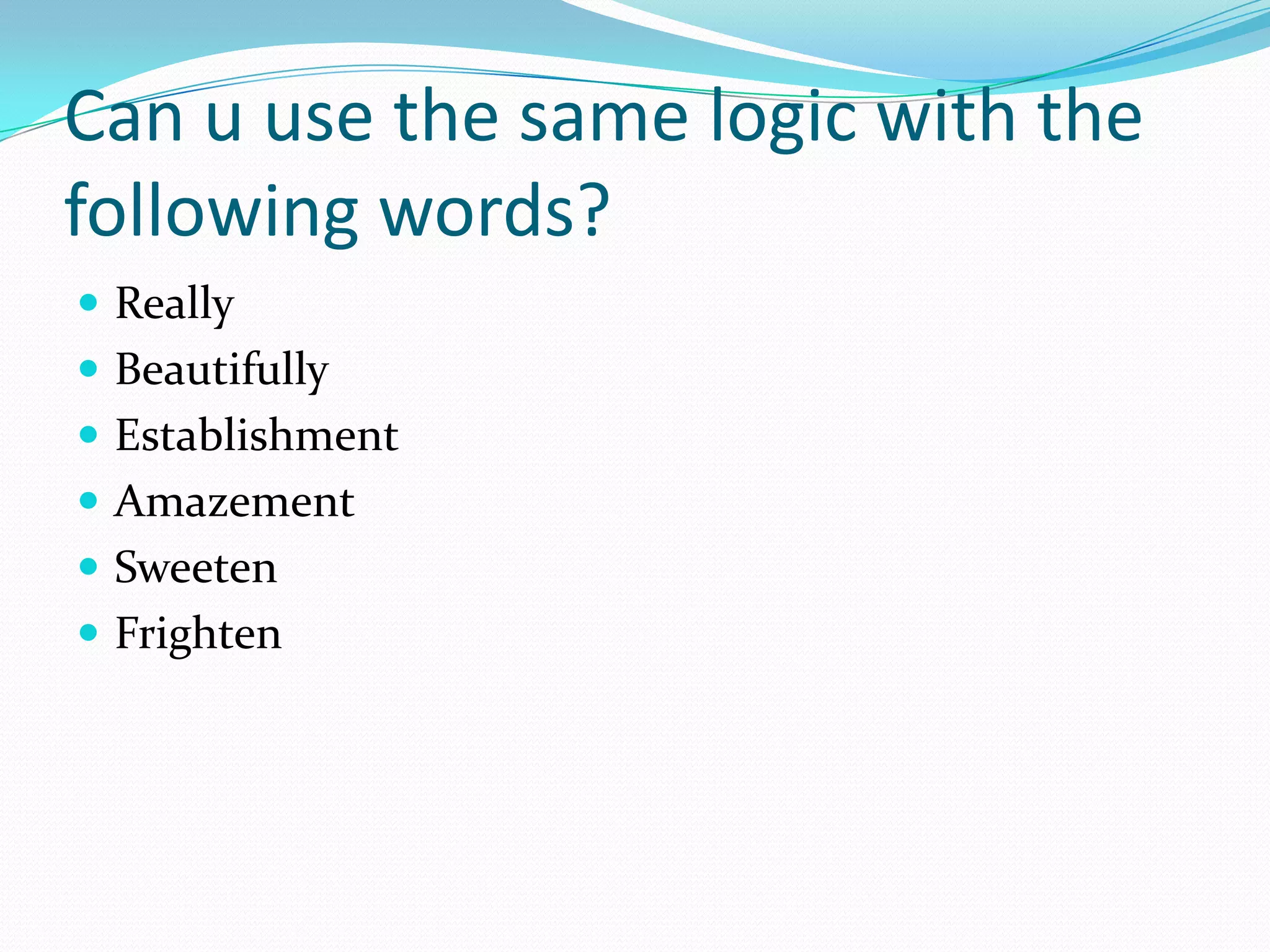
Can u use the same logic with the following words?ReallyBeautifullyEstablishmentAmazementSweetenFrighten
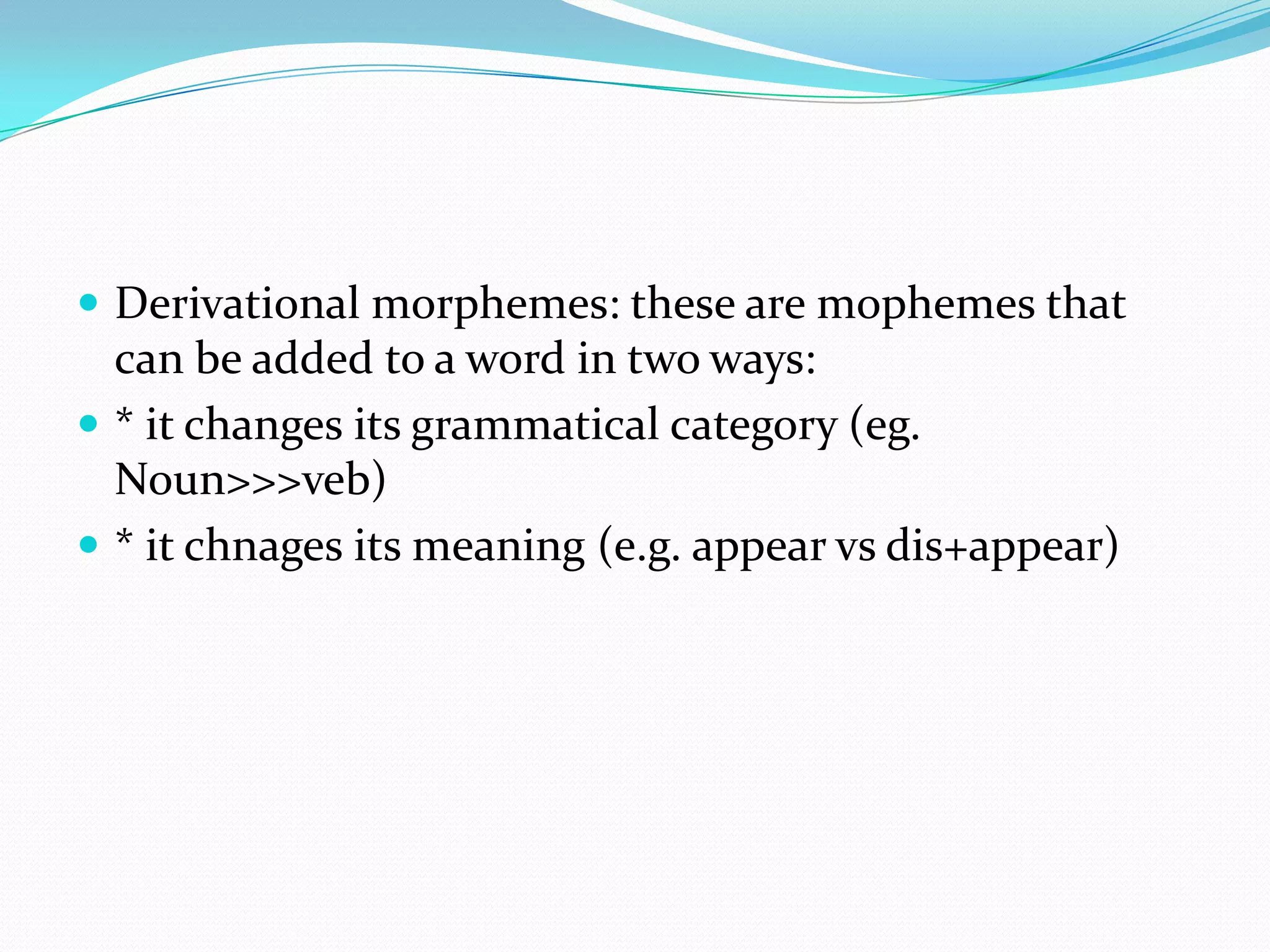
Derivational morphemes: these are mophemes that can be added to a word in two ways:* it changes its grammatical category (eg. Noun>>>veb)* it chnages its meaning (e.g. appear vsdis+appear)
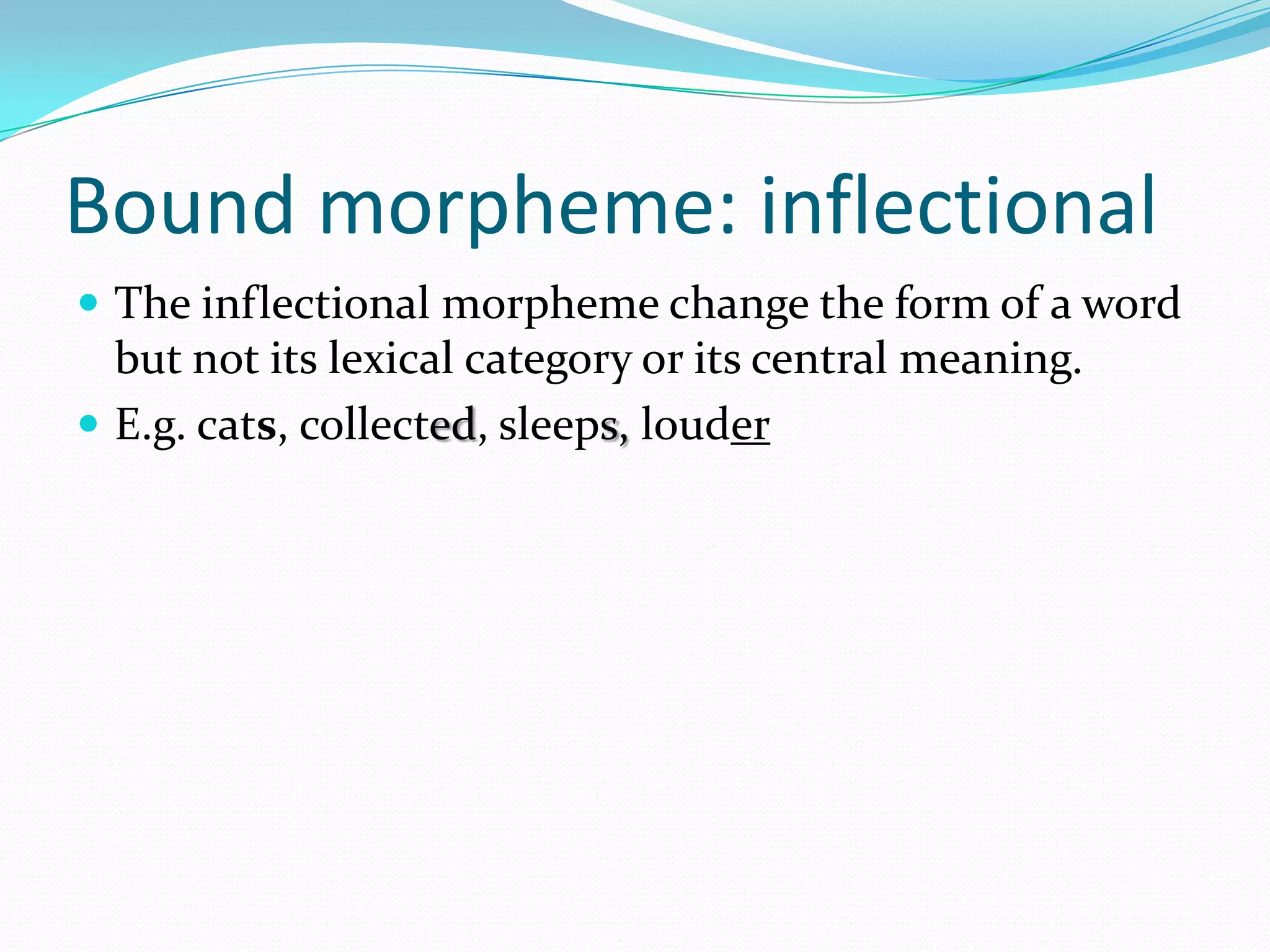
Bound morpheme: inflectionalThe inflectional morpheme change the form of a word but not its lexical category or its central meaning.E.g. cats, collected, sleeps, louder

Week 7 –morphology (part 3)

  • 1.
    Week 7 –Morphology(2)Morphemes are word parts that carry meaningNot all words can be divided into separate morphemes:e.g. girl, uncle, orangeMost words do have more than one meaningful part, such as grandmother, bookshelf, homemade, asked, taller, oranges.
  • 2.
    Some words arebuilt up by adding elements to a core element:Truer ….untrue….truthfullyTruest truth ……..untruthfullyDefinition: A morpheme is a meaningful element in a word.How many morphemes in the following:untruthfulness
  • 3.
    Most morphemes have:-lexicalmeaning, e.g. kite, tall- grammatical category: -edin past tenseIMPORTANTDON’T CONFUSE MORPHEMES WITH THE NOTION OF SYLLABLE
  • 4.
    Example:harvest, grammar, rivercontain two syllables, but only one morpheme.However, one syllable can contain more than one morpheme:Kissed is one syllable with two morphemes: kiss +edFeet >foot +pl.
  • 5.
    Syllables (revision)Def. Asyllable is a unit of pronunciation uttered without interruption, loosely, a single sound. All words are made from at least one syllable.MonosyllableCatHouseTheLikeRun
  • 6.
    Two or moresyllablesRiver (2 Ri-ver; CV-CVC)Doctor (2 Doc-tor; CVC-CVC)Happy (2 Hap-py; CVC-CV)Computer (3 Com-pu-ter; CVC-CV-CVC)Beautiful (3 Beau-ti-ful; CV-CV-CVC)Pronunciation (5 Pro-nun-ci-a-tion; CV-CVC-CV- V-CVC)
  • 7.
    Morphemes can bebound or freeFree: morphemes that can stand aloneTrue, mother, orange etcBound: un-true, where un-is a bound morpheme
  • 8.
    Morphemes that Deriveother wordsCertain bound morphemes change the category of a word, by adding a prefix or a suffixExamplesNoun +-ful: >>>>>>adj. (doubt+ful= doubtful)Here….we have N >>>>>>adj.We say then that, the morpheme –ful is a bound morpheme derivational (N>>>adj)
  • 9.
    Can u usethe same logic with the following words?ReallyBeautifullyEstablishmentAmazementSweetenFrighten
  • 10.
    Derivational morphemes: theseare mophemes that can be added to a word in two ways:* it changes its grammatical category (eg. Noun>>>veb)* it chnages its meaning (e.g. appear vsdis+appear)
  • 11.
    Bound morpheme: inflectionalTheinflectional morpheme change the form of a word but not its lexical category or its central meaning.E.g. cats, collected, sleeps, louder