Datami Keeps Developer Productivity High
with Loggly
Profile
Millions of mobile subscribers
generate billions of log events
Highlights
Datami enables enhanced
mobile engagement for
brands, scalable mobile
marketing for operators,
and access for consumers.
Combining real-time customer
data with mobile marketing
solutions, its platform
increases in click-through
rates and in-app daily active
usage and conversion.
Datami runs cloud-based applications that serve major cellular
carriers throughout the world. The microservices run in diverse
Amazon Web Services (AWS) regions or in carriers’ private data
centers. With millions of mobile subscribers as the end users,
the Datami products can experience very high loads—and
generate huge log volumes.
• Saves time and increases
productivity with easier
troubleshooting
• Keeps developers focused
on coding
• Improves quality assurance
and performance in
commercial trials
• Effectively monitors new
deployments
CASE STUDY
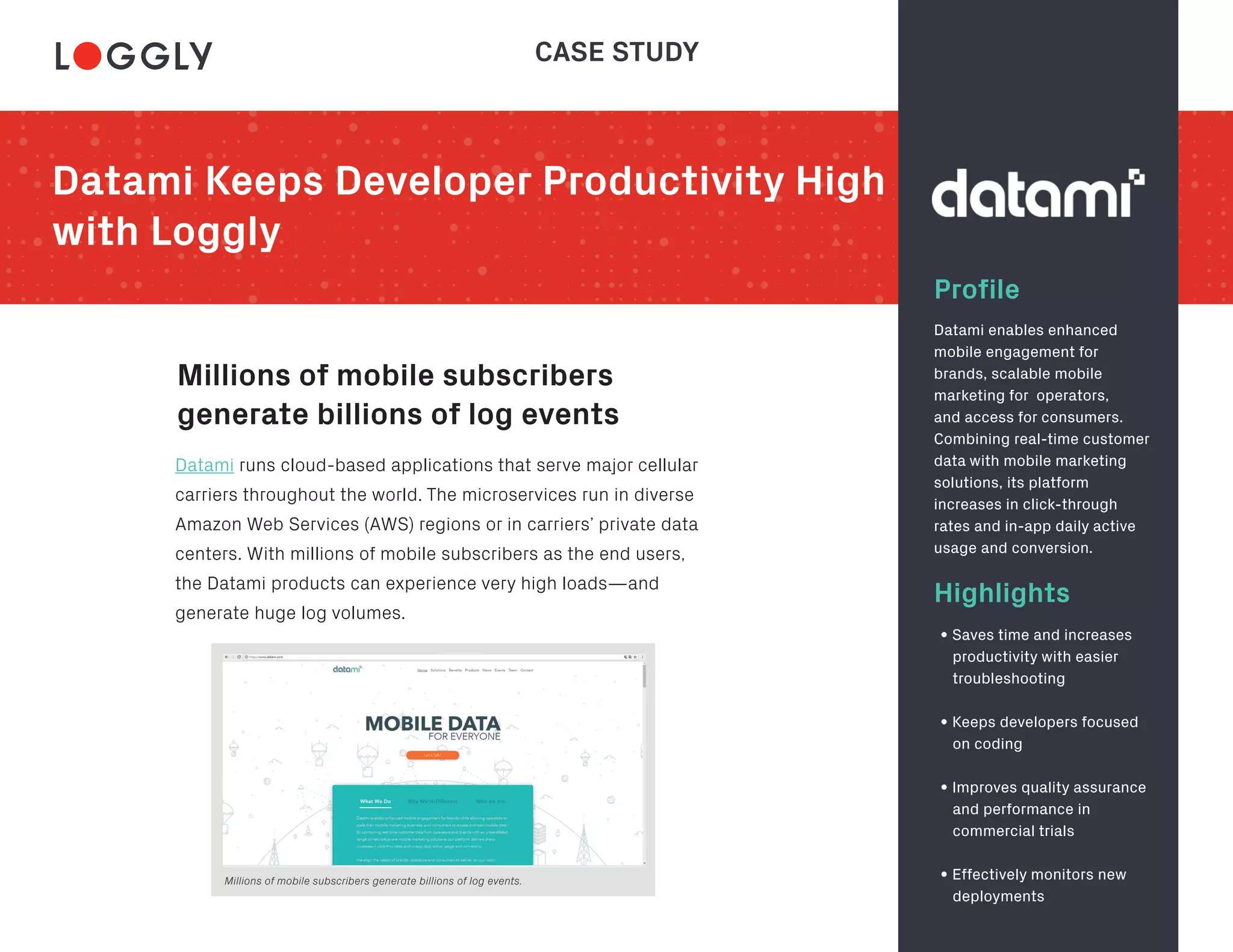
Millions of mobile subscribers generate billions of log events.
Solution
Faster mean time to resolution
Datami now sends application logs as well as logs from its
Apache Kafka infrastructure and MongoDB database to Loggly.
Most of these logs are formatted in JSON, so they are easier to
search and filter with Loggly. The Datami team kept its existing
Fluentd log collector in place and simply pointed it to Loggly.
“Fluentd worked right out of the box for us, and it made things
easy because our team already knew it,” Khanna reports.
CASE STUDY
Datami’s team of 20 developers and two DevOps professionals
uses Loggly to troubleshoot problems and has seen productivity
improvements across the team. “Before Loggly, reaction times
were much longer,” Khanna says. “Now, we’re able to tell what
went wrong in five minutes.”
The development team has handed over a lot of this day-to-
day log analysis to the QA department and in some cases to
customer support. The Datami team might search to identify
which microservice is causing a particular issue, look into the
— Mohit Khanna, Senior Cloud Architect, Datami
“Loggly has increased our productivity across the product
lifecycle and allowed our developers to concentrate on
coding.”
Why Loggly?
When Datami initially launched, developers and DevOps teams
were logging directly into servers for troubleshooting. Realizing
that this approach would not scale, it began aggregating its
logs with Fluentd and deployed the Elasticsearch-Logstash-
Kibana (ELK) stack for search and visualization. However,
the Datami team soon discovered that it was very difficult to
keep ELK running correctly without devoting extra staff to log
management. “We really wanted to focus the company’s limited
resources on its core business,” explains Mohit Khanna, senior
cloud architect at Datami.
Easier troubleshooting
in QA
Log management plays
an important role with
microservices
history using log data, or investigate
the latency of a particular REST API. The
team uses Slack extensively and will
often share Loggly search results when
collaborating on a problem. When a team
member needs to share log data with a
customer, it’s easy to put a search result
in grid view and export the data to a CSV
file. “This approach is helpful because
not all of our customer contacts are
technical,” Khanna adds.
When a product launches in a new
market, Datami usually sees sudden
spikes in subscriber traffic. The team
has created Loggly alerts that send
notifications directly to a Slack channel,
so that the DevOps team knows to
increase its monitoring using a toolset
that includes Datadog, Kibana, and their
internal monitoring portal in addition
to Loggly. Datami also uses Loggly
alerts to detect exceptions thrown in its
microservices.
CASE STUDY
The QA group at Datami also makes use
of log data in two ways:
Staying ahead of new
deployments
• Debugging code before it goes into
production.
• Supporting customers during
commercial trial periods with Datami
services. Datami includes trials in
many sales engagements and wants
to be sure everything runs smoothly.
The QA team takes advantage of Loggly
Derived Fields to create multiple fields
within log data, from which they can
set alerts to immediately detect certain
correlated data values.
“Personally, I own almost 50
Amazon EC2 instances. Now,
I hardly ever log into them.”
In a microservices architecture, log
management is a critical tool for
troubleshooting issues. “Anyone with
— Mohit Khanna, Senior Cloud
Architect, Datami
CASE STUDY
About Loggly
Loggly is the world’s most popular cloud-based, enterprise-
class log management service, serving more than 10,000
customers including one-third of the Fortune 500. The Loggly
service integrates into the engineering processes of teams
employing continuous deployment and DevOps practices to
reduce MTTR, improve service quality, accelerate innovation,
and make better use of valuable development resources. We
offer an alternative to traditional, search-based log analysis
by structuring and summarizing your log data before you ask
it to. With Loggly, your logs reveal what matters through real-
time metrics and dashboards. Founded in 2009 and based
in San Francisco, the company is backed by True Ventures,
Matrix Partners, Cisco, Trinity Ventures, Harmony Partners,
Data Collective Venture Capital, and others. Loggly is an
AWS Advanced Technology Partner and a Docker Ecosystem
Technology Partner. Visit us at www.loggly.com or follow 
@loggly on Twitter.
START YOUR FREE TRIAL >
loggly.com
more than six or seven microservices in production on
more than 20 servers simply must centralize the log data,”
Khanna concludes. “Loggly is a no-brainer.”

Loggly - Case Study - Datami Keeps Developer Productivity High with Loggly

  • 1.
    Datami Keeps DeveloperProductivity High with Loggly Profile Millions of mobile subscribers generate billions of log events Highlights Datami enables enhanced mobile engagement for brands, scalable mobile marketing for operators, and access for consumers. Combining real-time customer data with mobile marketing solutions, its platform increases in click-through rates and in-app daily active usage and conversion. Datami runs cloud-based applications that serve major cellular carriers throughout the world. The microservices run in diverse Amazon Web Services (AWS) regions or in carriers’ private data centers. With millions of mobile subscribers as the end users, the Datami products can experience very high loads—and generate huge log volumes. • Saves time and increases productivity with easier troubleshooting • Keeps developers focused on coding • Improves quality assurance and performance in commercial trials • Effectively monitors new deployments CASE STUDY Millions of mobile subscribers generate billions of log events.
  • 2.
    Solution Faster mean timeto resolution Datami now sends application logs as well as logs from its Apache Kafka infrastructure and MongoDB database to Loggly. Most of these logs are formatted in JSON, so they are easier to search and filter with Loggly. The Datami team kept its existing Fluentd log collector in place and simply pointed it to Loggly. “Fluentd worked right out of the box for us, and it made things easy because our team already knew it,” Khanna reports. CASE STUDY Datami’s team of 20 developers and two DevOps professionals uses Loggly to troubleshoot problems and has seen productivity improvements across the team. “Before Loggly, reaction times were much longer,” Khanna says. “Now, we’re able to tell what went wrong in five minutes.” The development team has handed over a lot of this day-to- day log analysis to the QA department and in some cases to customer support. The Datami team might search to identify which microservice is causing a particular issue, look into the — Mohit Khanna, Senior Cloud Architect, Datami “Loggly has increased our productivity across the product lifecycle and allowed our developers to concentrate on coding.” Why Loggly? When Datami initially launched, developers and DevOps teams were logging directly into servers for troubleshooting. Realizing that this approach would not scale, it began aggregating its logs with Fluentd and deployed the Elasticsearch-Logstash- Kibana (ELK) stack for search and visualization. However, the Datami team soon discovered that it was very difficult to keep ELK running correctly without devoting extra staff to log management. “We really wanted to focus the company’s limited resources on its core business,” explains Mohit Khanna, senior cloud architect at Datami.
  • 3.
    Easier troubleshooting in QA Logmanagement plays an important role with microservices history using log data, or investigate the latency of a particular REST API. The team uses Slack extensively and will often share Loggly search results when collaborating on a problem. When a team member needs to share log data with a customer, it’s easy to put a search result in grid view and export the data to a CSV file. “This approach is helpful because not all of our customer contacts are technical,” Khanna adds. When a product launches in a new market, Datami usually sees sudden spikes in subscriber traffic. The team has created Loggly alerts that send notifications directly to a Slack channel, so that the DevOps team knows to increase its monitoring using a toolset that includes Datadog, Kibana, and their internal monitoring portal in addition to Loggly. Datami also uses Loggly alerts to detect exceptions thrown in its microservices. CASE STUDY The QA group at Datami also makes use of log data in two ways: Staying ahead of new deployments • Debugging code before it goes into production. • Supporting customers during commercial trial periods with Datami services. Datami includes trials in many sales engagements and wants to be sure everything runs smoothly. The QA team takes advantage of Loggly Derived Fields to create multiple fields within log data, from which they can set alerts to immediately detect certain correlated data values. “Personally, I own almost 50 Amazon EC2 instances. Now, I hardly ever log into them.” In a microservices architecture, log management is a critical tool for troubleshooting issues. “Anyone with — Mohit Khanna, Senior Cloud Architect, Datami
  • 4.
    CASE STUDY About Loggly Logglyis the world’s most popular cloud-based, enterprise- class log management service, serving more than 10,000 customers including one-third of the Fortune 500. The Loggly service integrates into the engineering processes of teams employing continuous deployment and DevOps practices to reduce MTTR, improve service quality, accelerate innovation, and make better use of valuable development resources. We offer an alternative to traditional, search-based log analysis by structuring and summarizing your log data before you ask it to. With Loggly, your logs reveal what matters through real- time metrics and dashboards. Founded in 2009 and based in San Francisco, the company is backed by True Ventures, Matrix Partners, Cisco, Trinity Ventures, Harmony Partners, Data Collective Venture Capital, and others. Loggly is an AWS Advanced Technology Partner and a Docker Ecosystem Technology Partner. Visit us at www.loggly.com or follow  @loggly on Twitter. START YOUR FREE TRIAL > loggly.com more than six or seven microservices in production on more than 20 servers simply must centralize the log data,” Khanna concludes. “Loggly is a no-brainer.”