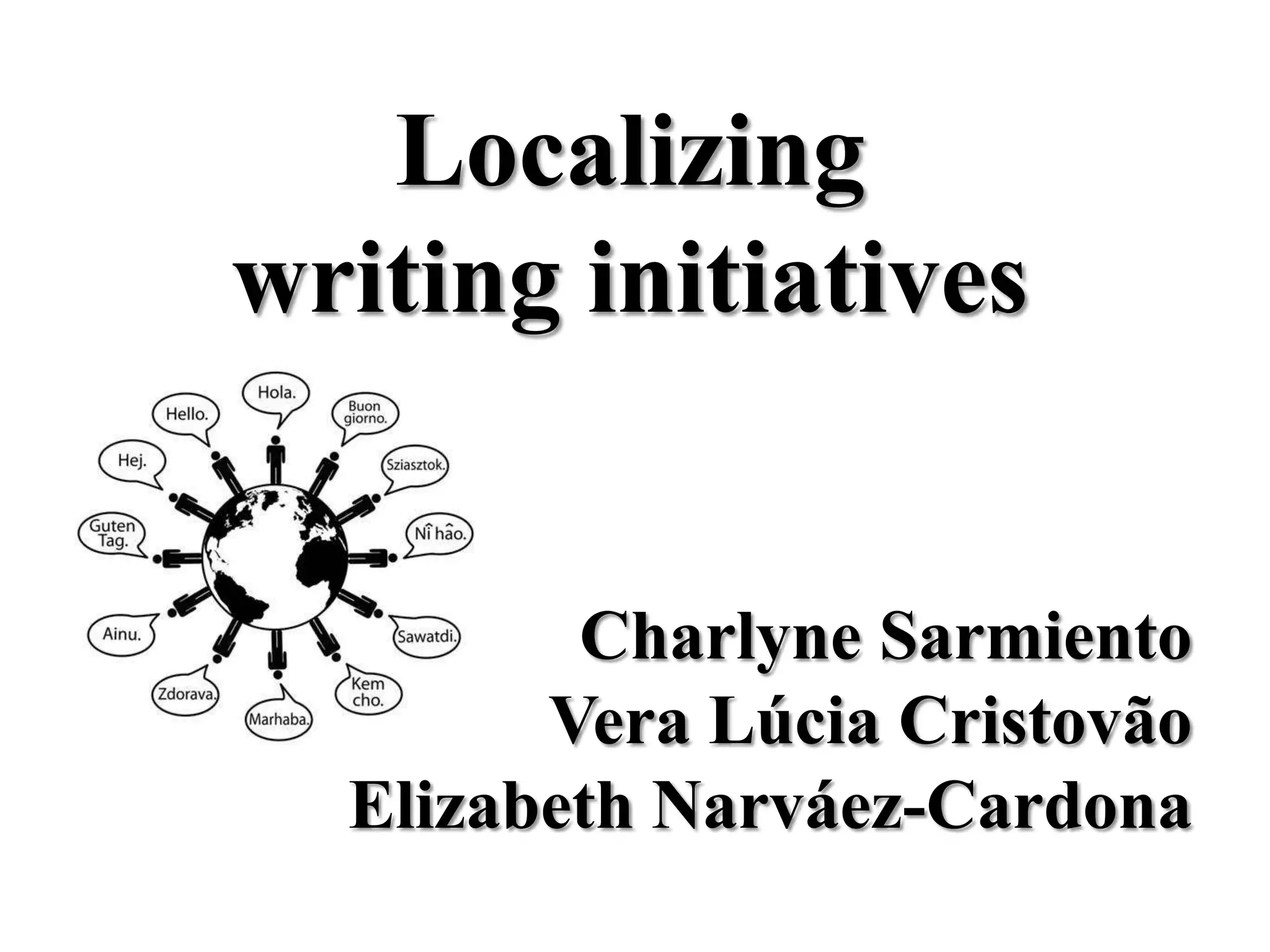
Localizing
writing initiatives


         Charlyne Sarmiento
        Vera Lúcia Cristovão
  Elizabeth Narváez-Cardona
Goal:

Reflecting upon different institutional contexts and
highlighting opportunities for WAC/WID movements.

                                           Activities:

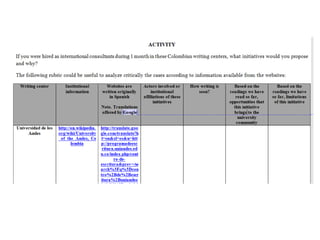
1. Demystifying situated genres by localizing
assessment criteria.
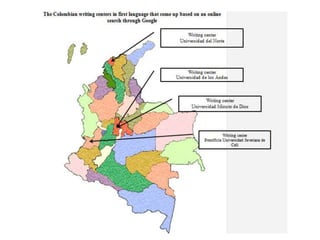
2. Finding opportunities to mobilize emerging
Colombian writing centers.
3.    Identifying    possibilities   for    curriculum
implementations in writing courses in Brazilian Higher
Education contexts
Contextual Background


       California Institute of Technology

              Hixon Writing Center
• History of Writing Center
• History of First Year Composition at Caltech
• Culture of Writing
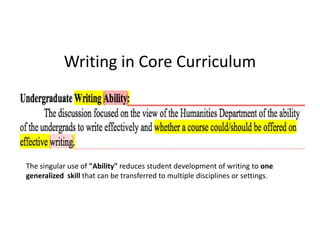
Writing in Core Curriculum


The singular use of "Ability" reduces student development of writing to one
generalized skill that can be transferred to multiple disciplines or settings.
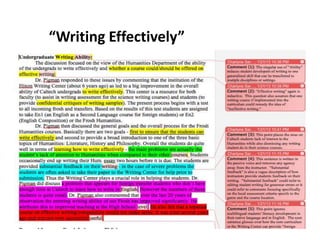
“Writing Effectively”
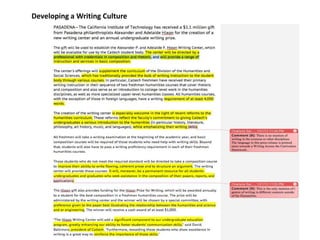
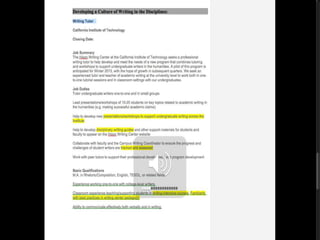
Developing a Writing Culture
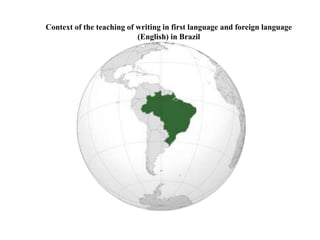
Context of the teaching of writing in first language and foreign language
                           (English) in Brazil
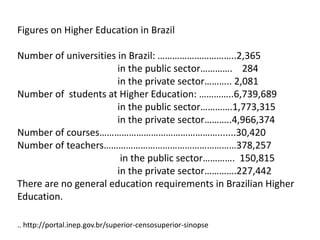
Figures on Higher Education in Brazil

Number of universities in Brazil: …………………………..2,365
                       in the public sector…………. 284
                       in the private sector……….. 2,081
Number of students at Higher Education: …………..6,739,689
                       in the public sector………….1,773,315
                       in the private sector………..4,966,374
Number of courses………………………………………….......30,420
Number of teachers………………………………………………378,257
                        in the public sector…………. 150,815
                       in the private sector………….227,442
There are no general education requirements in Brazilian Higher
Education.

.. http://portal.inep.gov.br/superior-censosuperior-sinopse
ESP PROJECT AT UNIVERSITIES IN
               BRAZIL:
       in the 1970s and 1980s
http://www4.pucsp.br/pos/lael/cepri
  l/workingpapers/BrazilianESP.pdf
The emerging status of English as a Lingua Franca in Brazil has fostered discussions
and new proposals regarding the teaching of writing. This is what has happened at
my university.
Activity

We have reproduced two abstracts of papers referring
to the teaching of writing both in the first language
(Portuguese) and in a foreign language (English, in this
                          case).
A. Choose one of them and make comments on the
literacy practices that you can infer that are being
offered      in     Brazilian    Higher     Education.
B. Reflect upon the experience about the University of
Wisconsin – Madison, and identify possibilities for
curriculum implementations in writing courses in
Brazilian Higher Education contexts.
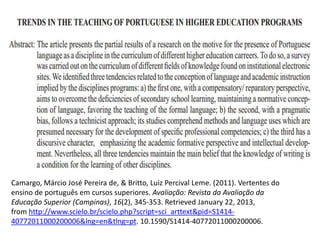
Camargo, Márcio José Pereira de, & Britto, Luiz Percival Leme. (2011). Vertentes do
ensino de português em cursos superiores. Avaliação: Revista da Avaliação da
Educação Superior (Campinas), 16(2), 345-353. Retrieved January 22, 2013,
from http://www.scielo.br/scielo.php?script=sci_arttext&pid=S1414-
40772011000200006&lng=en&tlng=pt. 10.1590/S1414-40772011000200006.
… CHAPTER 9.
ACADEMIC LITERACIES IN THE SOUTH: WRITING PRACTICES IN A BRAZILIAN UNIVERSITY
By Désirée Motta-Roth
Federal University of Santa Maria (Brazil)
Abstract: Paulo Freire (2000, p. 46), the renowned Brazilian educator, once stated that “one
learns to read by reading.” To understand what writing does, we need to experience interaction
mediated by writing. In this essay I focus on the importance of learners’ participation in
academic activities for the development of academic literacies: the material and symbolic acts
that (re)produce verified knowledge, associated with higher education. I will give an overview
of the writing practices at the Federal University of Santa Maria (Universidade Federal de
Santa Maria or UFSM), where I have been investigating and teaching academic writing since
1994. The essay starts with a brief history and mission statement about the university. The
second section brings a general description of writing at UFSM in relation to why and in relation
to what goals this writing occurs. In the third section, I analyze English undergraduate and
Applied Linguistics graduate students’ answers to a questionnaire about their literacy practices.
The essay closes with a description of the principles for a writing program and a note on
ambitions and frustrations regarding writing pedagogy in my local context.

 Chris Thaiss, Gerd Bräuer, Paula Carlino, Lisa Ganobcsik-Williams, and Aparna Sinha.
 2012. Writing Programs Worldwide: Profiles of Academic Writing in Many Places.
 Perspectives on Writing. Fort Collins, Colorado: The WAC Clearinghouse and Parlor Press.
 Available at http://wac.colostate.edu/books/wrab2011/

Localizing writing initiatives

  • 1.
    Localizing writing initiatives Charlyne Sarmiento Vera Lúcia Cristovão Elizabeth Narváez-Cardona
  • 2.
    Goal: Reflecting upon differentinstitutional contexts and highlighting opportunities for WAC/WID movements. Activities: 1. Demystifying situated genres by localizing assessment criteria. 2. Finding opportunities to mobilize emerging Colombian writing centers. 3. Identifying possibilities for curriculum implementations in writing courses in Brazilian Higher Education contexts
  • 3.
    Contextual Background California Institute of Technology Hixon Writing Center • History of Writing Center • History of First Year Composition at Caltech • Culture of Writing
  • 4.
    Writing in CoreCurriculum The singular use of "Ability" reduces student development of writing to one generalized skill that can be transferred to multiple disciplines or settings.
  • 5.
  • 6.
  • 14.
    Context of theteaching of writing in first language and foreign language (English) in Brazil
  • 15.
    Figures on HigherEducation in Brazil Number of universities in Brazil: …………………………..2,365 in the public sector…………. 284 in the private sector……….. 2,081 Number of students at Higher Education: …………..6,739,689 in the public sector………….1,773,315 in the private sector………..4,966,374 Number of courses………………………………………….......30,420 Number of teachers………………………………………………378,257 in the public sector…………. 150,815 in the private sector………….227,442 There are no general education requirements in Brazilian Higher Education. .. http://portal.inep.gov.br/superior-censosuperior-sinopse
  • 16.
    ESP PROJECT ATUNIVERSITIES IN BRAZIL: in the 1970s and 1980s http://www4.pucsp.br/pos/lael/cepri l/workingpapers/BrazilianESP.pdf The emerging status of English as a Lingua Franca in Brazil has fostered discussions and new proposals regarding the teaching of writing. This is what has happened at my university.
  • 17.
    Activity We have reproducedtwo abstracts of papers referring to the teaching of writing both in the first language (Portuguese) and in a foreign language (English, in this case). A. Choose one of them and make comments on the literacy practices that you can infer that are being offered in Brazilian Higher Education. B. Reflect upon the experience about the University of Wisconsin – Madison, and identify possibilities for curriculum implementations in writing courses in Brazilian Higher Education contexts.
  • 18.
    Camargo, Márcio JoséPereira de, & Britto, Luiz Percival Leme. (2011). Vertentes do ensino de português em cursos superiores. Avaliação: Revista da Avaliação da Educação Superior (Campinas), 16(2), 345-353. Retrieved January 22, 2013, from http://www.scielo.br/scielo.php?script=sci_arttext&pid=S1414- 40772011000200006&lng=en&tlng=pt. 10.1590/S1414-40772011000200006.
  • 19.
    … CHAPTER 9. ACADEMICLITERACIES IN THE SOUTH: WRITING PRACTICES IN A BRAZILIAN UNIVERSITY By Désirée Motta-Roth Federal University of Santa Maria (Brazil) Abstract: Paulo Freire (2000, p. 46), the renowned Brazilian educator, once stated that “one learns to read by reading.” To understand what writing does, we need to experience interaction mediated by writing. In this essay I focus on the importance of learners’ participation in academic activities for the development of academic literacies: the material and symbolic acts that (re)produce verified knowledge, associated with higher education. I will give an overview of the writing practices at the Federal University of Santa Maria (Universidade Federal de Santa Maria or UFSM), where I have been investigating and teaching academic writing since 1994. The essay starts with a brief history and mission statement about the university. The second section brings a general description of writing at UFSM in relation to why and in relation to what goals this writing occurs. In the third section, I analyze English undergraduate and Applied Linguistics graduate students’ answers to a questionnaire about their literacy practices. The essay closes with a description of the principles for a writing program and a note on ambitions and frustrations regarding writing pedagogy in my local context. Chris Thaiss, Gerd Bräuer, Paula Carlino, Lisa Ganobcsik-Williams, and Aparna Sinha. 2012. Writing Programs Worldwide: Profiles of Academic Writing in Many Places. Perspectives on Writing. Fort Collins, Colorado: The WAC Clearinghouse and Parlor Press. Available at http://wac.colostate.edu/books/wrab2011/