Georgia
O’Keefe
Abstraction through
   Observation
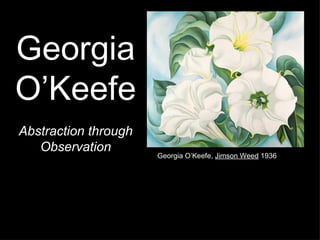
                      Georgia O’Keefe, Jimson Weed 1936
Georgia O’Keefe is an
important figure in
American art from the
1920s.

She challenged many
artistic conventions of
her time by
abstracting subjects
she painted from life.


                          Georgia O’Keefe, Abstraction 1919
O’Keefe worked
using strong
shifts in value
and clean,
smooth
surfaces.


                  Georgia O’Keefe, Blue and Green Music
                                  1921
Georgia O’Keefe, Grey Lines with
  Black, Yellow and Blue 1923
By examining
common, often
natural objects
from interesting
perspectives and
using unusual
compositions she
both painted from
life and abstracted
her subjects.


                      Georgia O’Keefe, Dark Abstraction
                                   1924
Georgia O’Keefe, Corn
     Dark 1924
In this piece she both
simplifies the form and
presents a view from
below.

She carefully uses the
entire composition space
to create interest and
abstraction.


                           Georgia O’Keefe, City Night 1926
Georgia O’Keefe, Morning Glory with Black No. 3
                    1926
Georgia O’Keefe, Abstraction White Rose 1927
Georgia O’Keefe, Black Iris 1926
Georgia O’Keefe, Shell and Old Shingle No. I 1927
Georgia O’Keefe, Shell and
   Shingle No. III 1926
Georgia O’Keefe, Shell and Shingle No. IV
                 1927
Georgia O’Keefe, Shell and Old
     Shingle No. II 1926
Georgia O’Keefe, Brown and Tan Leaves
                 1928
Georgia O’Keefe, Calla Lily on Grey
              1928
Georgia O’Keefe, The White Flower 1932
Georgia O’Keefe, Jimson Weed 1932
Georgia O’Keefe, Grey Hills II 1936

 Notice how similar this painting is to her close-up flower
 paintings. The lines and the shadows of the hills in this
 painting relate to the lines and shadows in her previous
paintings. This is accomplished by allowing the landscape
   to use the page in the same way that the flowers do.
Georgia O’Keefe, My Red Hills 1938
Georgia O’Keefe, Pelvis Bone IV
            1943
This composition
makes this pelvis
bone seem
otherworldly and
abstract, but notice
how well observed
the shadows and
surfaces are.


                       Georgia O’Keefe, Pelvis Bone II
                                   1944
Georgia O’Keefe, Pelvis with Shadows and the Moon 1943
This pelvis also feels abstract, but the attention to tonal shifts in the
shadows is key-- this is a well observed still life!
Georgia O’Keefe, Red Hills and Sky
              1945
Georgia O’Keefe, Pelvis with Distance 1943
Georgia O’Keefe, Patio with Black Door
                1955
Abstraction Through Observation: In
         Class Assignment
 For the next two classes you will work on S an
  accurate drawing from life that manages to
abstract the subject through composition, scale,
                and perspective.
   You may pick an object I provide, or find
something in nature outside of the classroom.

 Using your white or grey paper, you will spend
this class and Thursday working on this drawing
          in the medium of your choice.

 Although we are abstracting these objects we
  are only doing so through composition and
     perspective-- the drawing should be an
  accurate representation of the portion of the
          object you choose to draw.

Abstractobserv