2D ARTIST’S TOOLBOX
Smart use of
references
Creativity,
Originality,
THE SHOCK
OF THE NEW
Color
Anatomy
Perspective
Realistic light
& shadow
Composition
Value
Value + Realistic Light/Shadow
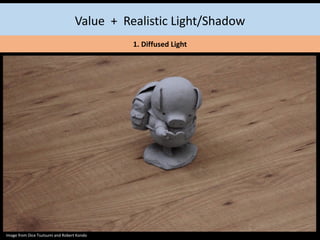
1. Diffused Light
Image from Dice Tsutsumi and Robert Kondo
Value + Realistic Light/Shadow
When you’d see diffused light:
• Under a cloudy sky
• Sometimes when light streams through the
window into a dark room
• From a portrait photographer’s soft box
1. Diffused Light
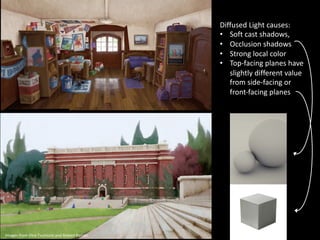
Diffused Light causes:
• Soft cast shadows,
• Occlusion shadows
• Strong local color
• Top-facing planes have
slightly different value
from side-facing or
front-facing planes
Images from Dice Tsutsumi and Robert Kondo
Pieter Bruegel the Elder, 1565, Netherlands
Annie Leibovitz, The White Stripes, 2003
Value + Realistic Light/Shadow
Diffused light - Bonus advanced techniques
You can also try
narrowing the range
of any painting’s
values for a special
artistic effect.
Claude Monet Marc Shetabi
Marc Shetabi
Emil Robinson
See how woodgrain
nearly disappears.
Value + Realistic Light/Shadow
2. Direct Light
Image from Dice Tsutsumi and Robert Kondo
Important:
Local value and color matter less
under direct light. 80% of your
attention should go to the shadow
shapes.
Also, contrast is highest in the
foreground. Everything gets grayer
in the middle- and background.
Value + Realistic Light/Shadow
2. Direct Light
When you’d see direct light:
• Direct sunlight
• Indoors under a spotlight
Value + Realistic Light/Shadow
2. Direct Light
Vocab:
A core shadow is the one
wrapping around the body
of the object (in this case,
it’s right on the sphere).
A cast shadow is cast onto
the surface.
Value + Realistic Light/Shadow
Bumblebee the Robot says:
Your human minds are programmed to pay
attention to local color/value. But you’re
oblivious to how light changes local value.
That’s why you fail this easy test . . .
Which square is lighter: 1 or 2 ?
Value + Realistic Light/Shadow
. . .
Value + Realistic Light/Shadow
. . . And a glossy black surface in bright light
can be lighter (aka higher value) than a white
surface in shadow.
A painter must be able to see these relative
values.
IN LIGHT
SHADOW
Maciej Kuciara
A painter must be able to see these
relative values . . .
Intermediate painter Advanced painter
Look: Dark fur in
sunlight and white
fur in shadow are
the same value.
It’s the same
optical illusion we
saw before.
According to the same
principle, an eyebrow in
bright light should be
about the same value as
skin in shadow.
IN LIGHT
SHADOW
LIGHTSHADOW Black in light
White/beige
in light
White in
shadow
Black in
shadow
Middle
Grey in light
IN LIGHT
SHADOW
Joon Ahn
from Craig Mullins demo (Schoolism)
Intermediate painter Advanced painter
Value + Realistic Light/Shadow
Putting it all together
Dean Cornwell
N.C. Wyeth
Value + Realistic Light/Shadow
Putting it all together
Value + Realistic Light/Shadow
Putting it all together
Thomas Moran
Value + Realistic Light/Shadow
Putting it all together
Kevin Zamir Goeke
Grant Wood
When your scene has extreme light/dark contrast
and lots of busy shadow shapes, use subtle colors.
Save your expressive colors for diffused light.
---Paraphrased from Harvey Dunn
Value + Realistic Light/Shadow
Putting it all together
George Inness
Notice the shadow
is transparent (like
a Photoshop
multiply layer)
Value + Realistic Light/Shadow
Putting it all together
Edward Hopper
Value + Realistic Light/Shadow
Direct light - Bonus advanced techniques
Hard-edged
cast shadow
Soft-edged core
shadow on cylinder
Zudarts Lee, 2019
(Taipei, Taiwan)
Hard-edged cast
shadow from hair
onto left cheek
Soft-edged core
shadow on right
cheek, forehead
Cast Core
Transparent
shadow
Value + Realistic Light/Shadow
Wayne Thiebaud, 1920
Direct light - Bonus advanced techniques
Colorized shadows
on a simple subject
(though I’d avoid this
embellishment for a
complex scene)
Value + Realistic Light/Shadow
Summary
• In diffuse light, your front-, side-, and top-
facing planes should have different values
• The most dramatic light/dark contrast
happens in the foreground. The
background gets grayer and hazier.
• In direct light, worry about the light and
shadow shapes first. Local color and local
value aren’t too important here.
Perspective + Realistic Light/Shadow
(a sneak preview)

How to Draw Better Shadows

  • 1.
  • 2.
    Smart use of references Creativity, Originality, THESHOCK OF THE NEW Color Anatomy Perspective Realistic light & shadow Composition Value
  • 3.
    Value + RealisticLight/Shadow 1. Diffused Light Image from Dice Tsutsumi and Robert Kondo
  • 4.
    Value + RealisticLight/Shadow When you’d see diffused light: • Under a cloudy sky • Sometimes when light streams through the window into a dark room • From a portrait photographer’s soft box 1. Diffused Light
  • 5.
    Diffused Light causes: •Soft cast shadows, • Occlusion shadows • Strong local color • Top-facing planes have slightly different value from side-facing or front-facing planes Images from Dice Tsutsumi and Robert Kondo
  • 6.
    Pieter Bruegel theElder, 1565, Netherlands
  • 7.
    Annie Leibovitz, TheWhite Stripes, 2003
  • 8.
    Value + RealisticLight/Shadow Diffused light - Bonus advanced techniques You can also try narrowing the range of any painting’s values for a special artistic effect. Claude Monet Marc Shetabi
  • 9.
  • 10.
  • 11.
    See how woodgrain nearlydisappears. Value + Realistic Light/Shadow 2. Direct Light Image from Dice Tsutsumi and Robert Kondo
  • 12.
    Important: Local value andcolor matter less under direct light. 80% of your attention should go to the shadow shapes. Also, contrast is highest in the foreground. Everything gets grayer in the middle- and background. Value + Realistic Light/Shadow 2. Direct Light
  • 13.
    When you’d seedirect light: • Direct sunlight • Indoors under a spotlight Value + Realistic Light/Shadow 2. Direct Light Vocab: A core shadow is the one wrapping around the body of the object (in this case, it’s right on the sphere). A cast shadow is cast onto the surface.
  • 14.
    Value + RealisticLight/Shadow Bumblebee the Robot says: Your human minds are programmed to pay attention to local color/value. But you’re oblivious to how light changes local value. That’s why you fail this easy test . . . Which square is lighter: 1 or 2 ?
  • 15.
    Value + RealisticLight/Shadow . . .
  • 16.
    Value + RealisticLight/Shadow . . . And a glossy black surface in bright light can be lighter (aka higher value) than a white surface in shadow. A painter must be able to see these relative values.
  • 17.
  • 18.
    A painter mustbe able to see these relative values . . .
  • 19.
  • 20.
    Look: Dark furin sunlight and white fur in shadow are the same value.
  • 21.
    It’s the same opticalillusion we saw before.
  • 22.
    According to thesame principle, an eyebrow in bright light should be about the same value as skin in shadow. IN LIGHT SHADOW
  • 23.
    LIGHTSHADOW Black inlight White/beige in light White in shadow Black in shadow Middle Grey in light
  • 24.
  • 25.
    from Craig Mullinsdemo (Schoolism) Intermediate painter Advanced painter
  • 26.
    Value + RealisticLight/Shadow Putting it all together Dean Cornwell
  • 27.
  • 28.
    Value + RealisticLight/Shadow Putting it all together
  • 29.
    Value + RealisticLight/Shadow Putting it all together Thomas Moran
  • 30.
    Value + RealisticLight/Shadow Putting it all together Kevin Zamir Goeke
  • 31.
    Grant Wood When yourscene has extreme light/dark contrast and lots of busy shadow shapes, use subtle colors. Save your expressive colors for diffused light. ---Paraphrased from Harvey Dunn
  • 32.
    Value + RealisticLight/Shadow Putting it all together George Inness Notice the shadow is transparent (like a Photoshop multiply layer)
  • 33.
    Value + RealisticLight/Shadow Putting it all together Edward Hopper
  • 34.
    Value + RealisticLight/Shadow Direct light - Bonus advanced techniques Hard-edged cast shadow Soft-edged core shadow on cylinder
  • 35.
    Zudarts Lee, 2019 (Taipei,Taiwan) Hard-edged cast shadow from hair onto left cheek Soft-edged core shadow on right cheek, forehead
  • 36.
  • 37.
    Value + RealisticLight/Shadow Wayne Thiebaud, 1920 Direct light - Bonus advanced techniques Colorized shadows on a simple subject (though I’d avoid this embellishment for a complex scene)
  • 38.
    Value + RealisticLight/Shadow Summary • In diffuse light, your front-, side-, and top- facing planes should have different values • The most dramatic light/dark contrast happens in the foreground. The background gets grayer and hazier. • In direct light, worry about the light and shadow shapes first. Local color and local value aren’t too important here.
  • 39.
    Perspective + RealisticLight/Shadow (a sneak preview)