
Summary presentation of the final report
May 2013
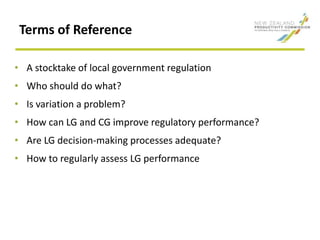
Terms of Reference
• A stocktake of local government regulation
• Who should do what?
• Is variation a problem?
• How can LG and CG improve regulatory performance?
• Are LG decision-making processes adequate?
• How to regularly assess LG performance
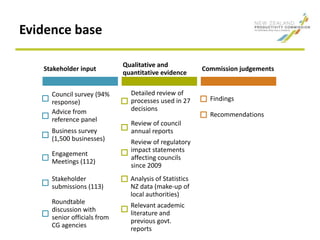
Evidence base
Stakeholder input
Council survey (94%
response)
Advice from
reference panel
Business survey
(1,500 businesses)
Engagement
Meetings (112)
Stakeholder
submissions (113)
Roundtable
discussion with
senior officials from
CG agencies
Qualitative and
quantitative evidence
Detailed review of
processes used in 27
decisions
Review of council
annual reports
Review of regulatory
impact statements
affecting councils
since 2009
Analysis of Statistics
NZ data (make-up of
local authorities)
Relevant academic
literature and
previous govt.
reports
Commission judgements
Findings
Recommendations
Context of LG regulation
• Highly diverse circumstances
– economic structure, sizes, natural resources, cultural
makeup, etc.
• Increasingly complex regulatory environment
– population growth vs decline
– diverse communities
– community expectations
– technical/scientific needs
– administrative and legal complexity
– pressure on physical environment
• Difficult trade-offs
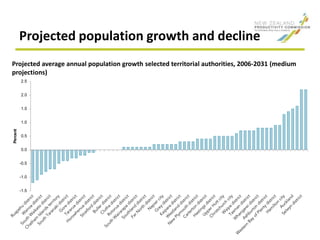
Projected population growth and decline
-1.5
-1.0
-0.5
0.0
0.5
1.0
1.5
2.0
2.5
Percent
Projected average annual population growth selected territorial authorities, 2006-2031 (medium
projections)
LG has a diverse range of regulatory
functions
Devolved powers
(Local democracy
function)
Delegated powers
(Service delivery function)
Resource
Managemen
t Act
Building
Code
Regulations relating to dog control,
liquor licencing, environmental health,
food safety and hazardous substances
Some policy
discretion
Limited policy
discretion
• 30 pieces of primary legislation plus secondary instruments
• Limited use of powers under LGA 2002 - most bylaws made
under enabling statutes
• LG/CG relationship specific to each regulatory function
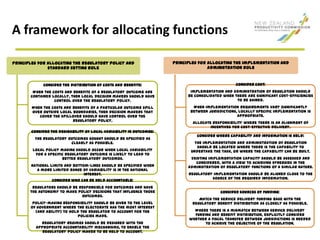
A framework for allocating functions
Principles for allocating the regulatory policy and
standard setting role
Consider the distribution of costs and benefits:
When the costs and benefits of a regulatory outcome are
contained locally, then local decision makers should have
control over the regulatory policy.
When the costs and benefits of a particular outcome spill
over outside local boundaries, then decision makers that
cover the spillover should have control over the
regulatory policy.
Consider who can be held accountable:
Regulators should be responsible for outcomes and have
the autonomy to make policy decisions that influence those
outcomes.
Policy-making responsibility should be given to the level
of government where the electorate has the most interest
(and ability) to hold the regulator to account for the
policies made.
Regulatory regimes should be designed with the
appropriate accountability mechanisms, to enable the
regulatory policy maker to be held to account.
Consider the desirability of local variability in outcomes:
The regulatory outcomes sought should be specified as
clearly as possible.
Local policy making should occur when local variability
for a specific regulatory outcome is likely to lead to
better regulatory outcomes.
National limits and bottom-lines should be specified when
a more limited range of variability is in the national
interest.
Principles for allocating the implementation and
administration role
Consider cost:
Implementation and administration of regulation should
be consolidated when there are significant cost-efficiencies
to be gained.
When implementation requirements vary significantly
between jurisdictions, locally specific implementation is
appropriate.
Allocate responsibility where there is an alignment of
incentives for cost-effective delivery.
Consider where capability and information is held:
The implementation and administration of regulation
should be located where there is the capability to
undertake the task, or where the capability can be built.
Existing implementation capacity should be assessed and
considered, with a view to achieving synergies in the
administration of regulatory functions of a similar nature.
Regulatory implementation should be aligned close to the
source of the required information.
Consider sources of funding:
Match the service delivery funding base with the
regulatory benefit distribution as closely as possible.
Where there is a mismatch between service delivery
funding and benefit distribution, explicitly consider
whether a fiscal transfer between jurisdictions is needed
to achieve the objective of the regulation.
Framework - no substitute for hard work
• No simple formula for allocating regulatory functions
• Officials still need to think carefully about how to apply
the framework
• Need to ask specific questions to fit the regulation being
developed
• We tested the framework on LG functions under the
Gambling Act 2003 and the Building Act 2004
Interaction between parts of the system
• Not enough focus on how the whole system works
• Poor interaction between CG and LG
– Inadequate consultation and engagement
– Different views of the role and function of LG
– LG ‘agents’ of CG or independently accountable to
ratepayers and voters?
Capability across the system
• LG has gaps in technical, policy and management skills
• CG has gaps in knowledge of LG and capability for robust
implementation analysis
• Capacity of Māori does not match the requirements of the
system
If the system relies on capability that does not exist, the
desired outcomes will not be achieved
Performance reporting across the
system
• Lack of effective feedback loops
• Reporting seen as compliance exercise (not a learning tool)
• Dominated by timeliness and transactional measures –
little attention to outcomes or impacts
• Some duplication in reporting to CG (eg, reporting building
consent numbers to Statistics NZ and MBIE)
• Fragmented reporting – gives a limited view of the
performance of the regulatory system
CG needs to:
• Recognise local authorities as ‘co-producers’ of regulatory
outcomes
• Engage meaningfully early in the policy process
• Strengthen capability and incentive for rigorous policy
analysis
• Ensure enforcement tools/penalties are adequate
LG needs to:
• Improve analysis underpinning regulatory decisions
• Develop systems to reduce internal variation
• Improve monitoring and enforcement through:
– more sophisticated use of risk-based compliance strategies
– stronger compliance monitoring
• Learn from, and appropriately apply, innovative
approaches to Māori participation
• Develop capability to implement these improvements
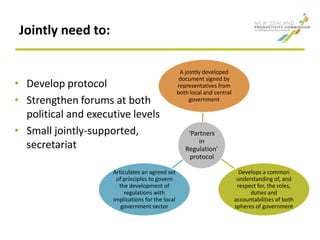
Jointly need to:
• Develop protocol
• Strengthen forums at both
political and executive levels
• Small jointly-supported,
secretariat
‘Partners
in
Regulation’
protocol
A jointly developed
document signed by
representatives from
both local and central
government
Develops a common
understanding of, and
respect for, the roles,
duties and
accountabilities of both
spheres of government
Articulates an agreed set
of principles to govern
the development of
regulations with
implications for the local
government sector

Towards better local regulation - final report

  • 1.
    Summary presentation ofthe final report May 2013
  • 2.
    Terms of Reference •A stocktake of local government regulation • Who should do what? • Is variation a problem? • How can LG and CG improve regulatory performance? • Are LG decision-making processes adequate? • How to regularly assess LG performance
  • 3.
    Evidence base Stakeholder input Councilsurvey (94% response) Advice from reference panel Business survey (1,500 businesses) Engagement Meetings (112) Stakeholder submissions (113) Roundtable discussion with senior officials from CG agencies Qualitative and quantitative evidence Detailed review of processes used in 27 decisions Review of council annual reports Review of regulatory impact statements affecting councils since 2009 Analysis of Statistics NZ data (make-up of local authorities) Relevant academic literature and previous govt. reports Commission judgements Findings Recommendations
  • 4.
    Context of LGregulation • Highly diverse circumstances – economic structure, sizes, natural resources, cultural makeup, etc. • Increasingly complex regulatory environment – population growth vs decline – diverse communities – community expectations – technical/scientific needs – administrative and legal complexity – pressure on physical environment • Difficult trade-offs
  • 5.
    Projected population growthand decline -1.5 -1.0 -0.5 0.0 0.5 1.0 1.5 2.0 2.5 Percent Projected average annual population growth selected territorial authorities, 2006-2031 (medium projections)
  • 6.
    LG has adiverse range of regulatory functions Devolved powers (Local democracy function) Delegated powers (Service delivery function) Resource Managemen t Act Building Code Regulations relating to dog control, liquor licencing, environmental health, food safety and hazardous substances Some policy discretion Limited policy discretion • 30 pieces of primary legislation plus secondary instruments • Limited use of powers under LGA 2002 - most bylaws made under enabling statutes • LG/CG relationship specific to each regulatory function
  • 7.
    A framework forallocating functions Principles for allocating the regulatory policy and standard setting role Consider the distribution of costs and benefits: When the costs and benefits of a regulatory outcome are contained locally, then local decision makers should have control over the regulatory policy. When the costs and benefits of a particular outcome spill over outside local boundaries, then decision makers that cover the spillover should have control over the regulatory policy. Consider who can be held accountable: Regulators should be responsible for outcomes and have the autonomy to make policy decisions that influence those outcomes. Policy-making responsibility should be given to the level of government where the electorate has the most interest (and ability) to hold the regulator to account for the policies made. Regulatory regimes should be designed with the appropriate accountability mechanisms, to enable the regulatory policy maker to be held to account. Consider the desirability of local variability in outcomes: The regulatory outcomes sought should be specified as clearly as possible. Local policy making should occur when local variability for a specific regulatory outcome is likely to lead to better regulatory outcomes. National limits and bottom-lines should be specified when a more limited range of variability is in the national interest. Principles for allocating the implementation and administration role Consider cost: Implementation and administration of regulation should be consolidated when there are significant cost-efficiencies to be gained. When implementation requirements vary significantly between jurisdictions, locally specific implementation is appropriate. Allocate responsibility where there is an alignment of incentives for cost-effective delivery. Consider where capability and information is held: The implementation and administration of regulation should be located where there is the capability to undertake the task, or where the capability can be built. Existing implementation capacity should be assessed and considered, with a view to achieving synergies in the administration of regulatory functions of a similar nature. Regulatory implementation should be aligned close to the source of the required information. Consider sources of funding: Match the service delivery funding base with the regulatory benefit distribution as closely as possible. Where there is a mismatch between service delivery funding and benefit distribution, explicitly consider whether a fiscal transfer between jurisdictions is needed to achieve the objective of the regulation.
  • 8.
    Framework - nosubstitute for hard work • No simple formula for allocating regulatory functions • Officials still need to think carefully about how to apply the framework • Need to ask specific questions to fit the regulation being developed • We tested the framework on LG functions under the Gambling Act 2003 and the Building Act 2004
  • 9.
    Interaction between partsof the system • Not enough focus on how the whole system works • Poor interaction between CG and LG – Inadequate consultation and engagement – Different views of the role and function of LG – LG ‘agents’ of CG or independently accountable to ratepayers and voters?
  • 10.
    Capability across thesystem • LG has gaps in technical, policy and management skills • CG has gaps in knowledge of LG and capability for robust implementation analysis • Capacity of Māori does not match the requirements of the system If the system relies on capability that does not exist, the desired outcomes will not be achieved
  • 11.
    Performance reporting acrossthe system • Lack of effective feedback loops • Reporting seen as compliance exercise (not a learning tool) • Dominated by timeliness and transactional measures – little attention to outcomes or impacts • Some duplication in reporting to CG (eg, reporting building consent numbers to Statistics NZ and MBIE) • Fragmented reporting – gives a limited view of the performance of the regulatory system
  • 12.
    CG needs to: •Recognise local authorities as ‘co-producers’ of regulatory outcomes • Engage meaningfully early in the policy process • Strengthen capability and incentive for rigorous policy analysis • Ensure enforcement tools/penalties are adequate
  • 13.
    LG needs to: •Improve analysis underpinning regulatory decisions • Develop systems to reduce internal variation • Improve monitoring and enforcement through: – more sophisticated use of risk-based compliance strategies – stronger compliance monitoring • Learn from, and appropriately apply, innovative approaches to Māori participation • Develop capability to implement these improvements
  • 14.
    Jointly need to: •Develop protocol • Strengthen forums at both political and executive levels • Small jointly-supported, secretariat ‘Partners in Regulation’ protocol A jointly developed document signed by representatives from both local and central government Develops a common understanding of, and respect for, the roles, duties and accountabilities of both spheres of government Articulates an agreed set of principles to govern the development of regulations with implications for the local government sector