Productivity Commission
Jenny Gordon
Principal Adviser Research
Wednesday 15 June 2016
Assessing the gains from better
regulation
Productivity Commission 2
A hierarchy of approaches
• First principles
• Principles plus evidence
• Partial cost-benefit
• Full cost-benefit
• The Commission mainly does ex ante
assessment
Productivity Commission 3
Principles as a starting point
• Addressing market failures
– Information asymmetry
– Market power
– Externalities
• Improving market function
– Greater competition
– Lower transactions costs
– Removing price wedges
Productivity Commission 4
Principles (cont)
• Low/no cost of change
– Compliance costs – business as usual or lower
– Distortions – removal or reorientate
– Costs only on those who had previously benefited
Productivity Commission 5
Example: tariff reform
• Clear first principle case that tariffs distort relative
prices and impose net costs on the economy
(allocative inefficiency)
• But winning the reform argument required:
– Evidence of failure of infant industry argument
– Demonstration of the effective rate of protection provided
– Demonstration of the costs to exporting industries
Productivity Commission 6
Principles plus evidence
• Principles that have been shown to work before
– Such as demand curves slope down
– Businesses will take opportunities to rent seek if offered
• Evidence threshold
– that principle holds in the situation considered
– that shows it does not hold in the situation
Productivity Commission 7
Developing evidence
• Testing principles in practice on stakeholders
– Issues paper
– Consultations
– Workshops
– Submissions
– Draft report
– More feedback loops to test logic
• Testing principles on available evidence
Productivity Commission 8
Example: minimum wages
• Empirical question is how much they reduce
employment
• Workplace relations undertook econometric analysis
(regression discontinuity) – found small effects on the
probability of finding a job for people who were
unemployed
• But also that the FWC minimum wage decisions took
labour market conditions into account
Productivity Commission 9
Partial cost benefit
• Quantify main economic costs and benefits
• Methods:
– Market prices and quantities distortions
(subsidies, tariffs etc) – first round effects
– Economy-wide effects
• Econometric estimates
• Modelling
Productivity Commission 10
Determine the hurdle
• What do the benefits of change need to be to exceed
the costs imposed by the reform?
• Who benefits and who pays the costs matters
– Is compensation needed to get the reform up?
• Useful where benefits of reform are hard to quantify
– Clarity on the cost of not reforming (should be high)
– Clarity on the costs of a reform (should be low)
Productivity Commission 11
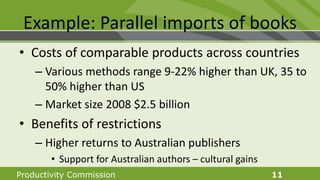
Example: Parallel imports of books
• Costs of comparable products across countries
– Various methods range 9-22% higher than UK, 35 to
50% higher than US
– Market size 2008 $2.5 billion
• Benefits of restrictions
– Higher returns to Australian publishers
• Support for Australian authors – cultural gains
Productivity Commission 12
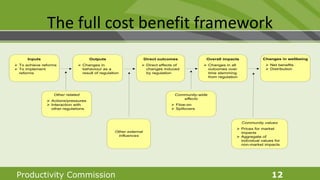
The full cost benefit framework
Inputs
Ø To achieve reforms
Ø To implement
reforms
Direct outcomes
Ø Direct effects of
changes induced
by regulation
Community-wide
effects
Ø Flow-on
Ø Spillovers
Other external
influences
Overall impacts
Ø Changes in all
outcomes over
time stemming
from regulation
Other related
Ø Actions/pressures
Ø Interaction with
other regulations
Changes in wellbeing
Ø Net benefits
Ø Distribution
Outputs
Ø Changes in
behaviour as a
result of regulation
Community values
Ø Prices for market
impacts
Ø Aggregate of
individual values for
non-market impacts
Productivity Commission 13
Empirical methods for quantification
• Modelling impacts
– Partial equilibrium
– Computable General Equilibrium
– Microsimulation
• NATSEM type
• Behavioural type
Productivity Commission 14
Empirical impact assessment
• Randomised control trials
• Natural experiments (regression discontinuity)
• Regression analysis
• Other statistical methods
Productivity Commission 15
Tools for valuing non-market outcomes
• Stated preference
– Contingent valuation
– Choice modelling
• Revealed preference
– Travel cost
– Hedonic pricing
• Benefit transfer
Productivity Commission 16
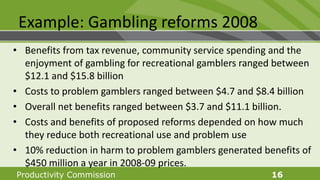
Example: Gambling reforms 2008
• Benefits from tax revenue, community service spending and the
enjoyment of gambling for recreational gamblers ranged between
$12.1 and $15.8 billion
• Costs to problem gamblers ranged between $4.7 and $8.4 billion
• Overall net benefits ranged between $3.7 and $11.1 billion.
• Costs and benefits of proposed reforms depended on how much
they reduce both recreational use and problem use
• 10% reduction in harm to problem gamblers generated benefits of
$450 million a year in 2008-09 prices.
Productivity Commission 17
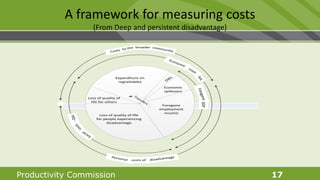
A framework for measuring costs
(From Deep and persistent disadvantage)
Transfers
Expenditure on
regrettables
D
W
L
Economic
spillovers
Foregone
employment
income
Loss of quality of life
for people experiencing
disadvantage
Loss of quality of
life for others
Costs
community
broader
to the
costs
-SoL
Economic
ForegoneGDP
Personal costs of disadvantage
-QoL
costs
Social

Assessing the gains from better regulation

  • 1.
    Productivity Commission Jenny Gordon PrincipalAdviser Research Wednesday 15 June 2016 Assessing the gains from better regulation
  • 2.
    Productivity Commission 2 Ahierarchy of approaches • First principles • Principles plus evidence • Partial cost-benefit • Full cost-benefit • The Commission mainly does ex ante assessment
  • 3.
    Productivity Commission 3 Principlesas a starting point • Addressing market failures – Information asymmetry – Market power – Externalities • Improving market function – Greater competition – Lower transactions costs – Removing price wedges
  • 4.
    Productivity Commission 4 Principles(cont) • Low/no cost of change – Compliance costs – business as usual or lower – Distortions – removal or reorientate – Costs only on those who had previously benefited
  • 5.
    Productivity Commission 5 Example:tariff reform • Clear first principle case that tariffs distort relative prices and impose net costs on the economy (allocative inefficiency) • But winning the reform argument required: – Evidence of failure of infant industry argument – Demonstration of the effective rate of protection provided – Demonstration of the costs to exporting industries
  • 6.
    Productivity Commission 6 Principlesplus evidence • Principles that have been shown to work before – Such as demand curves slope down – Businesses will take opportunities to rent seek if offered • Evidence threshold – that principle holds in the situation considered – that shows it does not hold in the situation
  • 7.
    Productivity Commission 7 Developingevidence • Testing principles in practice on stakeholders – Issues paper – Consultations – Workshops – Submissions – Draft report – More feedback loops to test logic • Testing principles on available evidence
  • 8.
    Productivity Commission 8 Example:minimum wages • Empirical question is how much they reduce employment • Workplace relations undertook econometric analysis (regression discontinuity) – found small effects on the probability of finding a job for people who were unemployed • But also that the FWC minimum wage decisions took labour market conditions into account
  • 9.
    Productivity Commission 9 Partialcost benefit • Quantify main economic costs and benefits • Methods: – Market prices and quantities distortions (subsidies, tariffs etc) – first round effects – Economy-wide effects • Econometric estimates • Modelling
  • 10.
    Productivity Commission 10 Determinethe hurdle • What do the benefits of change need to be to exceed the costs imposed by the reform? • Who benefits and who pays the costs matters – Is compensation needed to get the reform up? • Useful where benefits of reform are hard to quantify – Clarity on the cost of not reforming (should be high) – Clarity on the costs of a reform (should be low)
  • 11.
    Productivity Commission 11 Example:Parallel imports of books • Costs of comparable products across countries – Various methods range 9-22% higher than UK, 35 to 50% higher than US – Market size 2008 $2.5 billion • Benefits of restrictions – Higher returns to Australian publishers • Support for Australian authors – cultural gains
  • 12.
    Productivity Commission 12 Thefull cost benefit framework Inputs Ø To achieve reforms Ø To implement reforms Direct outcomes Ø Direct effects of changes induced by regulation Community-wide effects Ø Flow-on Ø Spillovers Other external influences Overall impacts Ø Changes in all outcomes over time stemming from regulation Other related Ø Actions/pressures Ø Interaction with other regulations Changes in wellbeing Ø Net benefits Ø Distribution Outputs Ø Changes in behaviour as a result of regulation Community values Ø Prices for market impacts Ø Aggregate of individual values for non-market impacts
  • 13.
    Productivity Commission 13 Empiricalmethods for quantification • Modelling impacts – Partial equilibrium – Computable General Equilibrium – Microsimulation • NATSEM type • Behavioural type
  • 14.
    Productivity Commission 14 Empiricalimpact assessment • Randomised control trials • Natural experiments (regression discontinuity) • Regression analysis • Other statistical methods
  • 15.
    Productivity Commission 15 Toolsfor valuing non-market outcomes • Stated preference – Contingent valuation – Choice modelling • Revealed preference – Travel cost – Hedonic pricing • Benefit transfer
  • 16.
    Productivity Commission 16 Example:Gambling reforms 2008 • Benefits from tax revenue, community service spending and the enjoyment of gambling for recreational gamblers ranged between $12.1 and $15.8 billion • Costs to problem gamblers ranged between $4.7 and $8.4 billion • Overall net benefits ranged between $3.7 and $11.1 billion. • Costs and benefits of proposed reforms depended on how much they reduce both recreational use and problem use • 10% reduction in harm to problem gamblers generated benefits of $450 million a year in 2008-09 prices.
  • 17.
    Productivity Commission 17 Aframework for measuring costs (From Deep and persistent disadvantage) Transfers Expenditure on regrettables D W L Economic spillovers Foregone employment income Loss of quality of life for people experiencing disadvantage Loss of quality of life for others Costs community broader to the costs -SoL Economic ForegoneGDP Personal costs of disadvantage -QoL costs Social