Welcome to Antibiotic Guardian
Birmingham
Chairs introduction
Dr Cliodna McNulty, Head, PHE Primary Care Unit
& Consultant Medical Microbiologist, and Honorary
Visiting Professor Cardiff University, National
Infection Service, Public Health England
Antimicrobial stewardship: Changing risk-related
behaviours in the general population
Simon Howard
Public Health Specialty Registrar
Disclaimer
• I am a ‘topic expert member’ for guideline on
‘Antimicrobial stewardship: Changing risk-
related behaviours in the general population’
• I am not a NICE employee
• NICE has not had prior sight or approval of this
presentation
NICE: history and
background
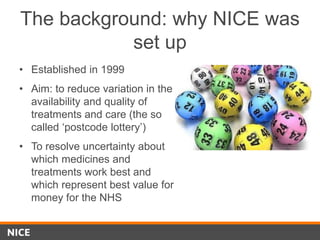
The background: why NICE was
set up
• Established in 1999
• Aim: to reduce variation in the
availability and quality of
treatments and care (the so
called ‘postcode lottery’)
• To resolve uncertainty about
which medicines and
treatments work best and
which represent best value for
money for the NHS
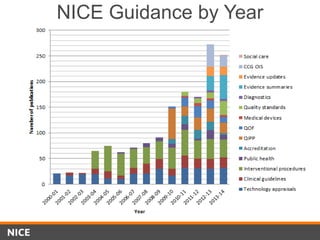
NICE Guidance by Year
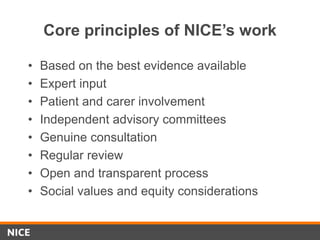
Core principles of NICE’s work
• Based on the best evidence available
• Expert input
• Patient and carer involvement
• Independent advisory committees
• Genuine consultation
• Regular review
• Open and transparent process
• Social values and equity considerations
Antimicrobial stewardship:
Changing risk-related
behaviours in the general
population
Guideline still in draft
• Guideline has been in development for
about 18 months
• Public consultation on guidance:
8 September to 20 October 2015
• Expected date of issue:
March 2016
Scope
• Interventions to change public’s behaviour
to reduce development of AMR and stop
spread of resistant microbes
– Includes measures to raise awareness and
knowledge
– Includes measures to prevent and control
infection
Target audience
• Those with responsibility for prescribing and
dispensing antimicrobials
• Those in public health
• Those who give information and advice to the
public
• Those responsible for preventing and controlling
infections
• The public themselves – especially vulnerable
groups
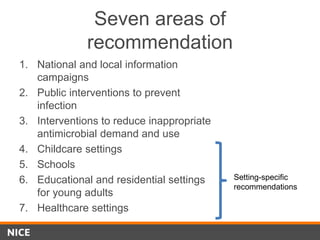
Seven areas of
recommendation
1. National and local information
campaigns
2. Public interventions to prevent
infection
3. Interventions to reduce inappropriate
antimicrobial demand and use
4. Childcare settings
5. Schools
6. Educational and residential settings
for young adults
7. Healthcare settings
Setting-specific
recommendations
1. National and local information
campaigns
• Raise awareness of AMR
• Give info on preventing and controlling
infections
• Using range of modes of delivery (verbal
advice, multimedia, written, mass media)
2. Public interventions to
prevent infection
• Advice on handwashing (including when
and how to wash hands; when hand
sanitisers are / are not appropriate)
• Food hygiene advice
• Wider aspects of infection prevention
(such as the need for vaccinations)
3. Reduce inappropriate
antimicrobial demand and use
• Educating the public about the natural
course of self-limiting conditions (including
red-flag symptoms)
• Educating the public about where to seek
help/advice if/when they need it (e.g. use
pharmacies rather than A&E)
• Advising people to use prescribed
antimicrobials appropriately
4. Childcare settings
• Clean appropriately, and train staff in
cleaning appropriately
• Provide handwashing facilities
• Educate children about handwashing,
involving parents and carers
• Ensure parents and carers are aware of
the importance of preventing AMR
5. Schools
• Take a ‘whole-school’ approach
• Provide handwashing facilities, and teach
handwashing in an age-appropriate way
• Use teaching resources such as PHE’s “e-
bug” to educate children about microbes
and AMR
• Consider integration wider messages
• Consider involving parents and carers
6. Educational and residential
settings for young adults
• Awareness raising activities, including
about handwashing (with posters in
strategic locations) and food-safety
campaigns
• Raise awareness about other aspects of
infection prevention (e.g. vaccinations)
• Help students to understand about self-
care and where to seek help
7. Healthcare settings
• Give advice about self-limiting conditions,
including natural course and where to seek help
• Consider using decision-support aids to
encourage health professionals not to prescribe
antibiotics for self-limiting conditions
• When not prescribing antibiotics, explain why,
and give written information including safety-
netting advice
• When prescribing antibiotics, explain why, and
give written information on antibiotics
Research recommendations
• Cost-effectiveness
• Multi-component interventions
• High-risk groups
• Workplaces
Overarching implementation
• Consider developing a local area
antimicrobial stewardship strategy linking
public health, local authorities, healthcare,
and social care.
Due for final publication:
March 2016
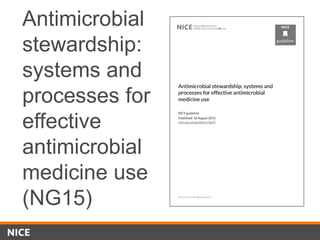
Antimicrobial
stewardship:
systems and
processes for
effective
antimicrobial
medicine use
(NG15)
Scope
• Effective use of antimicrobials as part of all
publically funded health and social care
commissioned or provided by NHS
organisations, local authorities (in
England), independent organisations or
independent contractors.
Recommendations for:
• Organisations (commissioners and providers)
– Establish antimicrobial stewardship programme
– Establish antimicrobial stewardship team
– Further specific recommendations around
communication, interventions, and lab testing
• Prescribers and practitioners
– Specific guidelines for prescribing antimicrobials
• Introduction of new antimicrobials
Full guidance at:
nice.org.uk/guidance/ng15
Keeping up to date with
the latest from NICE
NICE Pathways- guidance at
your fingertips
Pathways brings
together all
NICE guidance,
quality standards
and support in
easy-to-navigate
flowcharts
pathways.nice.org.uk
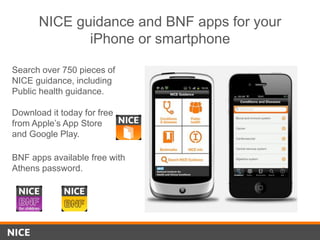
NICE guidance and BNF apps for your
iPhone or smartphone
Search over 750 pieces of
NICE guidance, including
Public health guidance.
Download it today for free
from Apple’s App Store
and Google Play.
BNF apps available free with
Athens password.
Follow us on Twitter
@NICEcomms
Subscribe online to NICE News, our
monthly newsletter - containing
information about new guidance,
quality standards and
implementation resources launched
each month.
Sign up at:
www.nice.org.uk/newsletter
Keep up to date with the latest from NICE...
Get involved
Did you know you can…
• Join a NICE Committee- use your expertise to
support development of our guidance
• Comment on a Consultation- feedback on
scope and drafts of guidance and quality
standards
• Join our Fellows and Scholars programme- a
growing group of professionals benefitting from
NICE sponsorship and mentoring
• www.nice.org.uk/getinvolved
Section Title
Fighting antimicrobial
resistance at grass root level
Professor Jayne Lawrence
Chief Scientist
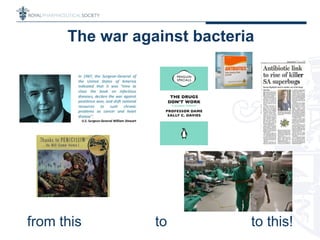
The war against bacteria
from this to to this!
Section Title
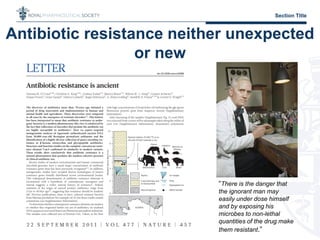
“There is the danger that
the ignorant man may
easily under dose himself
and by exposing his
microbes to non-lethal
quantities of the drug make
them resistant.”
Antibiotic resistance neither unexpected
or new
Hunter-gatherers host more diverse bacteria than humans in
industrialized nations.
When scientists first made contact with an
isolated village of Yanomami hunter-
gatherers in the remote mountains of the
Amazon jungle of Venezuela in 2009, they
marveled at the chance to study the health
of people who had never been exposed to
Western medicine or diets. But much to
their surprise, these Yanomami’s gut
bacteria have already evolved a diverse
array of antibiotic-resistance genes,
according to a new study, even though
these mountain people had never
ingested antibiotics or animals raised
with drugs. The find suggests that
microbes have long evolved the capability
to fight toxins, including antibiotics, and
that preventing drug resistance may be
harder than scientists thought.
Resistance to antibiotics found in
isolated Amazonian tribe
Article in Science 17th April 2015
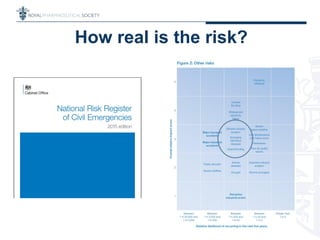
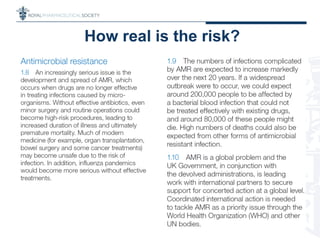
How real is the risk?
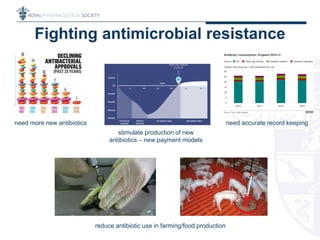
Fighting antimicrobial resistance
stimulate production of new
antibiotics – new payment models
need accurate record keepingneed more new antibiotics
reduce antibiotic use in farming/food production
Fighting antimicrobial resistance
stimulate production of new
antibiotics – new payment models
need accurate record keepingneed more new antibiotics
reduce antibiotic use in farming/food production
The World Health Organisation
‘the cost effective use of antimicrobials which maximises clinical
therapeutic effect while minimising both drug-related toxicity and the
development of antimicrobial resistance’
Chief Medical Officer
‘embodies an organisational or healthcare-system-wide approach to
promoting and monitoring judicious use of an to preserve their effect’
We need to
- optimise therapy for an individual
- prevent overuse, misuse and abuse
- minimise the development of resistance at patient and community
levels
What is antimicrobial stewardship?
The role of community pharmacists in
antimicrobial stewardship
Recognising signs of infection
• fever, aches, pain
• presence of pus, swelling, and/or redness in a potentially
infected site
• confusion, of sudden onset, particularly in older people
• drowsiness, irritability, poor appetite in children
Determining the duration of symptoms (e.g. cough, sore throat) and whether
the patient’s condition is improving or deteriorating
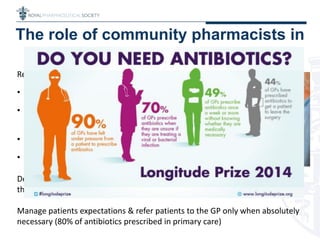
Manage patients expectations & refer patients to the GP only when absolutely
necessary (80% of antibiotics prescribed in primary care)
The role of community pharmacists in
antimicrobial stewardship
Recognising signs of infection
• fever, aches, pain
• presence of pus, swelling, and/or redness in a potentially
infected site
• confusion, of sudden onset, particularly in older people
• drowsiness, irritability, poor appetite in children
Determining the duration of symptoms (e.g. cough, sore throat) and whether
the patient’s condition is improving or deteriorating
Manage patients expectations & refer patients to the GP only when absolutely
necessary (80% of antibiotics prescribed in primary care)
The role of community pharmacists in
antimicrobial stewardship
Counsel patients on appropriate antibiotic use when
prescribed
Counsel patients on adverse effects
Counsel patients on antibiotic resistance, as appropriate
Recommend symptomatic therapy for non-vulnerable
patients
The role of community pharmacists in
antimicrobial stewardship
Counsel patients on appropriate antibiotic use when
prescribed
Counsel patients on adverse effects
Counsel patients on antibiotic resistance, as appropriate
Recommend symptomatic therapy for non-vulnerable
patients
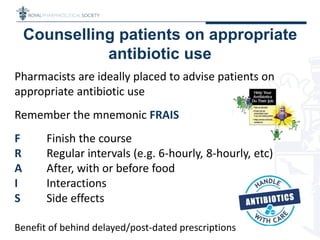
Counselling patients on appropriate
antibiotic use
Pharmacists are ideally placed to advise patients on
appropriate antibiotic use
Remember the mnemonic FRAIS
F Finish the course
R Regular intervals (e.g. 6-hourly, 8-hourly, etc)
A After, with or before food
I Interactions
S Side effects
Benefit of behind delayed/post-dated prescriptions
The role of community pharmacists in
antimicrobial stewardship
Counsel patients on appropriate antibiotic use when
prescribed
Counsel patients on adverse effects
Counsel patients on antibiotic resistance, as appropriate
Recommend symptomatic therapy for non-vulnerable
patients
Counselling patients on adverse effects
and how to avoid them
Common, mild, side effects of antibiotics include sickness, diarrhoea, bloating &
indigestion, abdominal pain and loss of appetite.
Less frequent is an allergic response may include rash, more serious is swelling of
the face and tongue and difficulty in breathing.
Clostridium difficile may be the cause of antibiotic-associated diarrhoea. Important
to be familiar with the symptoms, the antibiotics commonly associated with it and
its diagnosis and management
Antibiotics, often referred to as ‘the 4Cs’ are ciprofloxacin (quinolones), co-
amoxiclav (broad spectrum penicillins,) clindamycin and (3rd generation)
cephalosporins
Dont to sell or advise to take anti-spasmodics, e.g. loperamide as these agents can
increase the severity and length of disease due to the prolonged contact time of C
difficile toxins in the colon
The role of community pharmacists in
antimicrobial stewardship
Counsel patients on appropriate antibiotic use when
prescribed
Counsel patients on adverse effects
Counsel patients on antibiotic resistance, as appropriate
Recommend symptomatic therapy for non-vulnerable
patients
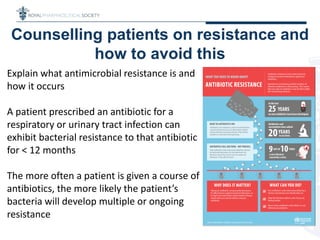
Counselling patients on resistance and
how to avoid this
Explain what antimicrobial resistance is and
how it occurs
A patient prescribed an antibiotic for a
respiratory or urinary tract infection can
exhibit bacterial resistance to that antibiotic
for < 12 months
The more often a patient is given a course of
antibiotics, the more likely the patient’s
bacteria will develop multiple or ongoing
resistance
The role of community pharmacists in
antimicrobial stewardship
Counsel patients on appropriate antibiotic use when
prescribed
Counsel patients on adverse effects
Counsel patients on antibiotic resistance, as appropriate
Recommend symptomatic therapy for non-vulnerable
patients
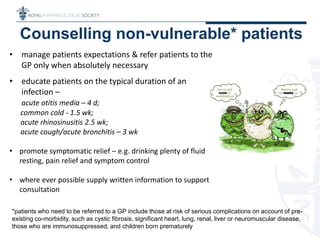
• manage patients expectations & refer patients to the
GP only when absolutely necessary
• educate patients on the typical duration of an
infection –
acute otitis media – 4 d;
common cold - 1.5 wk;
acute rhinosinusitis 2.5 wk;
acute cough/acute bronchitis – 3 wk
• promote symptomatic relief – e.g. drinking plenty of fluids,
resting, pain relief and symptom control
• where ever possible supply written information to support
consultation
Counselling non-vulnerable* patients
*patients who need to be referred to a GP include those at risk of serious complications on account of pre-
existing co-morbidity, such as cystic fibrosis, significant heart, lung, renal, liver or neuromuscular disease,
those who are immunosuppressed, and children born prematurely
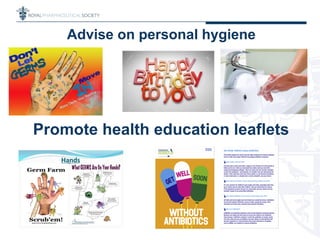
Advise on personal hygiene
Promote health education leaflets
Section Title
Antimicrobial Stewardship Auditing,
Training and Reporting Technology
Ann Higgins, Clinical Director of Infection
Prevention and Quality, Medical Audits Limited
Question & Answers
Refreshments & Networking
Welcome back
Dr Cliodna McNulty, Head, PHE Primary Care Unit
& Consultant Medical Microbiologist, and Honorary
Visiting Professor Cardiff University, National
Infection Service, Public Health England
Healthy Eating
“The Route to Health
and Wellbeing”
61
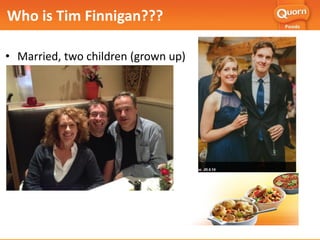
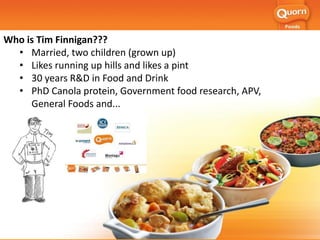
Who is Tim Finnigan???
• Married, two children (grown up)
Who is Tim Finnigan???
• Married, two children (grown up)
• Likes running up hills and likes a pint
• 30 years R&D in Food and Drink
• PhD Canola protein, Government food research, APV,
General Foods and...
I’M HERE IN PART TO TELL
“THE QUORN STORY” BUT
ONLY IN THE CONTEXT OF…..
 AS AN ILLUSTRATION OF WHY WE NEED HEALTHY NEW PROTEINS WITH A
LOW ENVIRONMENTAL IMPACT
 AND THE GOOD NEWS THAT ‘IT CAN BE DONE’
The 1960s was a time of
huge achievements...
The context
....And growing concerns
The Green Revolution
A man with a big idea
Inter-generational equity
“Quorn ….began by
taking the original
fungi found in soil and
domesticating it in the
same way that our
ancestors did with
many plants.”
Spector, T (2015) The Diet Myth. Weidenfield
and Nicholson pp 137
Quorn has many influential advocates
68
69
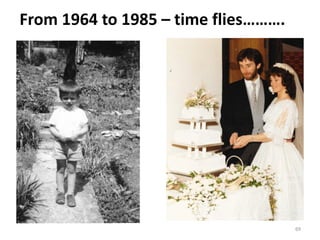
From 1964 to 1985 – time flies……….
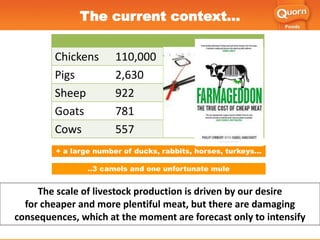
+ a large number of ducks, rabbits, horses, turkeys…
..3 camels and one unfortunate mule
Chickens 110,000
Pigs 2,630
Sheep 922
Goats 781
Cows 557
The scale of livestock production is driven by our desire
for cheaper and more plentiful meat, but there are damaging
consequences, which at the moment are forecast only to intensify
The current context…
http://www.fao.org/fileadmin/templates/wsfs/docs/expert_paper/How_to_Feed_the_World_in_2050.pdf
http://www.tristramstuart.co.uk/FoodWasteFacts.html
http://ecowatch.com/2014/04/11/agricultures-greenhouse-gas-emissions-2050/
Challenge Consequence
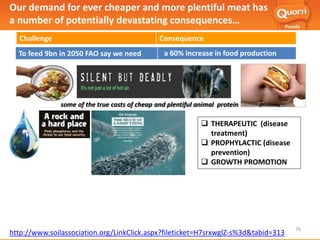
To feed 9bn in 2050 FAO say we need a 60% increase in food production
some of the true costs of cheap and plentiful animal protein
Our demand for ever cheaper and more plentiful meat has
a number of potentially devastating consequences…
71
Challenge Consequence
To feed 9bn in 2050 FAO say we need a 60% increase in food production
some of the true costs of cheap and plentiful animal protein
Our demand for ever cheaper and more plentiful meat has
a number of potentially devastating consequences…
73
http://www.fao.org/fileadmin/templates/wsfs/docs/expert_paper/How_to_Feed_the_World_in_2050.pdf
http://www.tristramstuart.co.uk/FoodWasteFacts.html
http://ecowatch.com/2014/04/11/agricultures-greenhouse-gas-emissions-2050/
Challenge Consequence
To feed 9bn in 2050 FAO say we need a 60% increase in food production
some of the true costs of cheap and plentiful animal protein
Our demand for ever cheaper and more plentiful meat has
a number of potentially devastating consequences…
74
Challenge Consequence
To feed 9bn in 2050 FAO say we need a 60% increase in food production
some of the true costs of cheap and plentiful animal protein
Our demand for ever cheaper and more plentiful meat has
a number of potentially devastating consequences…
76
 THERAPEUTIC (disease
treatment)
 PROPHYLACTIC (disease
prevention)
 GROWTH PROMOTION
http://www.soilassociation.org/LinkClick.aspx?fileticket=H7srxwglZ-s%3d&tabid=313
For most of us it’s a real surprise to learn that
antibiotics are used so freely in animal production
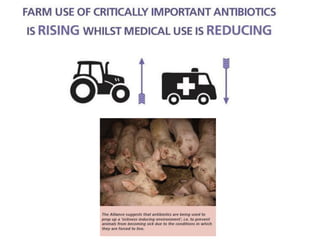
80% ANTIBIOTICS PRODUCED IN THE USA FED TO ANIMALS
AS OUR DEMAND FOR CHEAPER AND PLENTIFUL MEAT RISES SO WILL THE USE OF
ANTIBIOTICS IN INDUSTRIAL ANIMAL PRODUCTION
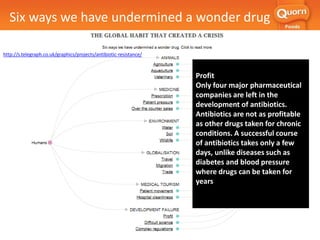
Six ways we have undermined a wonder drug
http://s.telegraph.co.uk/graphics/projects/antibiotic-resistance/
Agriculture
Globally more than 70 per cent
of antibiotics are used in animal
agriculture including some of the
most potent antibiotics
available. In more than 100
countries antibiotics are
routinely added to animal feed
to promote growth. So-called
mega farms, intensive meat and
poultry farms where diseases
can sweep through herds, are
blamed in particular for overuse
Aquaculture
Intensive aquaculture (shrimp
and fish farming) has led to
growing problems with
antibiotics routinely used to
treat diseases. The industry
supplies the world with 110
million metric tonnes of food
fish per year. 75 per cent of the
antibiotics fed to fish are
excreted back into the water
Veterinary
In Britain the veterinary sector
has been criticised for
irresponsible prescription of
antibiotics, as vets can profit by
selling the same drugs they
prescribe. The government does
not track the use of veterinary
antibiotics in detail, with the
main data available the total
annual tonnage of antibiotics
sold. In 2012, 409 tonnes of
antibiotics were prescribed by
vets in Britain
Soil
Many antibiotics are non bio-
degradable and can persist in
high concentrations in soil for a
long time. An estimated 70
million tonnes of animal manure
waste is spread on to agricultural
land each year in Britain. Crops
can take up substantial amount
of antibiotics by the roots.
Antibiotics are also sprayed on
to crops, such as high value fruit
trees, to prevent bacterial
diseases.
Profit
Only four major pharmaceutical
companies are left in the
development of antibiotics.
Antibiotics are not as profitable
as other drugs taken for chronic
conditions. A successful course
of antibiotics takes only a few
days, unlike diseases such as
diabetes and blood pressure
where drugs can be taken for
years.
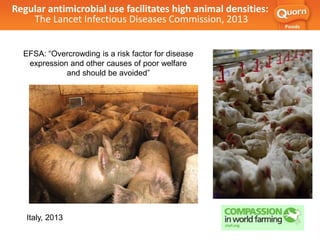
Italy, 2013
EFSA: “Overcrowding is a risk factor for disease
expression and other causes of poor welfare
and should be avoided”
Regular antimicrobial use facilitates high animal densities:
The Lancet Infectious Diseases Commission, 2013
• “Urgent action is needed to ... reduce antibiotic usage in animal
husbandry”, WHO, 2014
• “Use of antibiotics as growth promoters should be banned worldwide as
has happened in the EU”: The Lancet Infectious Diseases Commission, 2013
• “Routine preventative use of antibiotics is unacceptable” UK AMR Strategy:
Annual progress report and implementation plan, December 2014
“failure to address antibiotic
overuse in agriculture and
its role in drug resistance is
like trying to stop lung
cancer without factoring in
smoking…..”
Challenge Consequence
To feed 9bn in 2050 FAO say we need a 60% increase in food production
some of the true costs of cheap and plentiful animal protein
Our demand for ever cheaper and more plentiful meat has
a number of potentially devastating consequences…
83
Challenges for a scalable meat based
sustainable food future
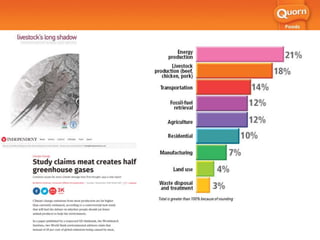
Our biggest lever globally is to eat less meat
New FAO report quantifies the cost of industrial livestock
production to the environment
THE No 1 CONTRIBUTER
 1/3rd water use
 18% -30% of global GHG emissions
 45% of all land
 91% of rainforest destruction to date (1 acre per second)
 Species loss
 Ocean deadzones
 Habitat destruction
 The rise of the superbug
 Micronutrient depletion
 Unaccounted costs of poor health and environmental impact
 Animal welfare and cruelty on an unprecedented scale
All the evidence is there to see
“The need for new
business models that help
address the 9bn challenge
- including a healthy new
protein with a lower
environmental impact….”
Prof. Alan Knight Single Planet Living
Big steps toward small footprints
“For all Mankind’s supposed
accomplishments, his continued
existence is completely dependent
on six inches of topsoil and the
fact that it rains…..”
Tackling antimicrobial resistance
in dentistry
Nick Palmer BDS MFGDP(UK)
PhD FDSRCSEng FFGDP(UK)
Outline
Facts and figures
Evidence of AMR in dentistry
Scientific evidence of inappropriate
prescribing
FGDP’s role in tackling AMR
Facts & Figures
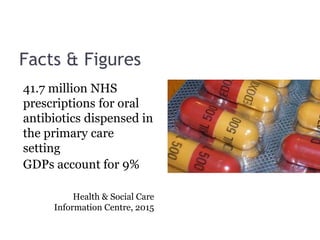
41.7 million NHS
prescriptions for oral
antibiotics dispensed in
the primary care
setting
GDPs account for 9%
Health & Social Care
Information Centre, 2015
Facts & Figures
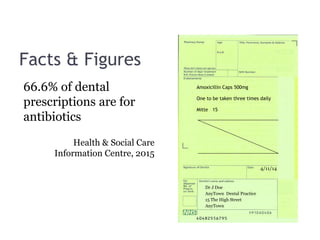
66.6% of dental
prescriptions are for
antibiotics
Health & Social Care
Information Centre, 2015
Amoxicillin Caps 500mg
One to be taken three times daily
Mitte 15
Dr J Doe
AnyTown Dental Practice
15 The High Street
AnyTown
4/11/14
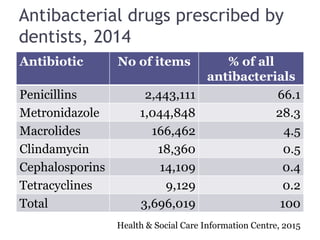
Antibacterial drugs prescribed by
dentists, 2014
Antibiotic No of items % of all
antibacterials
Penicillins 2,443,111 66.1
Metronidazole 1,044,848 28.3
Macrolides 166,462 4.5
Clindamycin 18,360 0.5
Cephalosporins 14,109 0.4
Tetracyclines 9,129 0.2
Total 3,696,019 100
Health & Social Care Information Centre, 2015
3100
3200
3300
3400
3500
3600
3700
3800
3900
4000
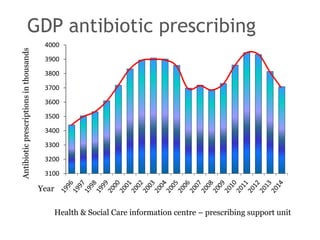
GDP antibiotic prescribing
Year
Health & Social Care information centre – prescribing support unit
Antibioticprescriptionsinthousands
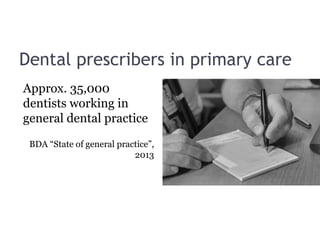
Dental prescribers in primary care
Approx. 35,000
dentists working in
general dental practice
BDA “State of general practice”,
2013
Dental prescribers in primary care
11,000 dentists in
solely private practice
BDA “State of general practice”,
2013
Dental prescribers in primary care
23,947 working in NHS
practice with only 11%
totally NHS
HSCIC, 2015 & BDA “State of
general practice”, 2013
Dental prescribers in primary care
30 million patients
seen in last 24 months
within NHS general
practice
HSCIC, 2015
Dental prescribing in primary care
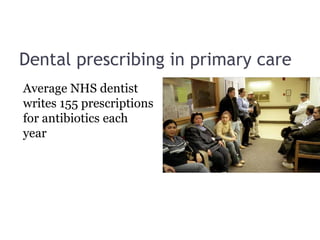
Average NHS dentist
writes 155 prescriptions
for antibiotics each
year
Dental prescribing in primary care
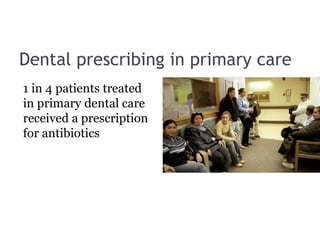
1 in 4 patients treated
in primary dental care
received a prescription
for antibiotics
Antibiotic use link to AMR
The strength of the
selective pressure (i.e. the
rate of drug consumption)
is intimately and positively
associated with the rate of
development of resistance
Levin et al. Clinical Infectious
Diseases, 1997
Costelloe et al. BMJ, 2010
Antibiotic use link to AMR
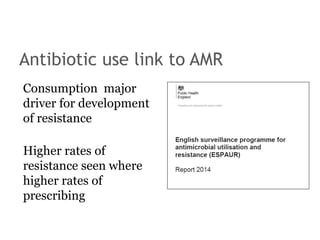
Consumption major
driver for development
of resistance
Higher rates of
resistance seen where
higher rates of
prescribing
Antimicrobial resistance & dentistry
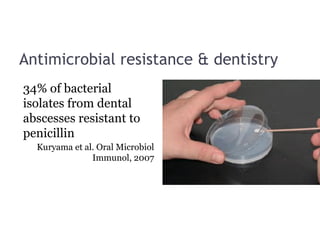
34% of bacterial
isolates from dental
abscesses resistant to
penicillin
Kuryama et al. Oral Microbiol
Immunol, 2007
Antimicrobial resistance & dentistry
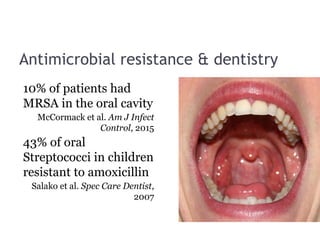
10% of patients had
MRSA in the oral cavity
McCormack et al. Am J Infect
Control, 2015
43% of oral
Streptococci in children
resistant to amoxicillin
Salako et al. Spec Care Dentist,
2007
Antibiotic resistance & oral infections
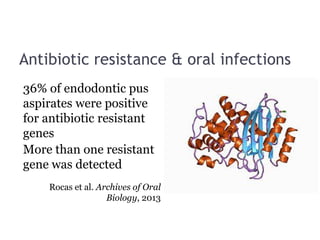
36% of endodontic pus
aspirates were positive
for antibiotic resistant
genes
More than one resistant
gene was detected
Rocas et al. Archives of Oral
Biology, 2013
Antibiotic resistance & oral infections
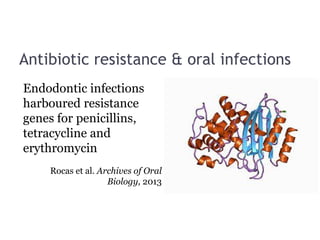
Endodontic infections
harboured resistance
genes for penicillins,
tetracycline and
erythromycin
Rocas et al. Archives of Oral
Biology, 2013
AMR and periodontal patients
“74% of periodontal
patients have
subgingival pathogens
resistant to either
doxycycline, amoxicillin
or metronidazole”
Rams et a. J Perio, 2014
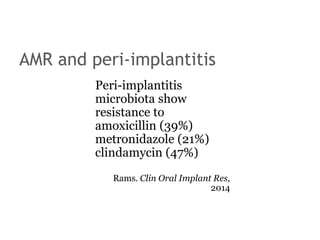
AMR and peri-implantitis
Peri-implantitis
microbiota show
resistance to
amoxicillin (39%)
metronidazole (21%)
clindamycin (47%)
Rams. Clin Oral Implant Res,
2014
Do dentists prescribe antibiotics
appropriately?
Management of bacterial infections
All bacterial dental
infections have a
treatable cause
Management of bacterial infections
Antibiotics only used as an
adjunct to removal of the cause
and
temperature is elevated, there
is systemic spread and lymph
gland involvement
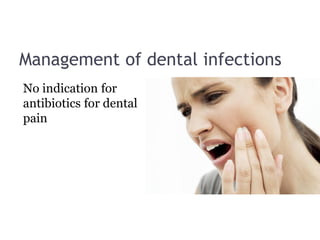
Management of dental infections
No indication for
antibiotics for dental
pain
Management of dental infections
No indication for localised
infections/swellings
Management of dental infections
No indication for antibiotic
prophylaxis for dento-alveolar
surgery
Evidence of inappropriate
antibiotic prescribing
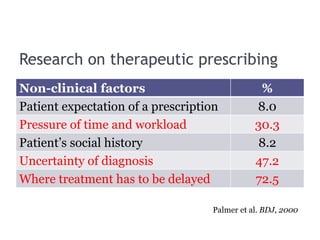
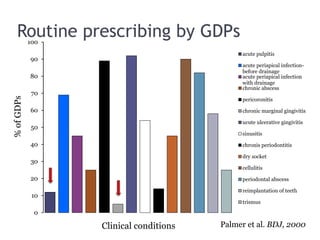
Research on therapeutic prescribing
Non-clinical factors %
Patient expectation of a prescription 8.0
Pressure of time and workload 30.3
Patient’s social history 8.2
Uncertainty of diagnosis 47.2
Where treatment has to be delayed 72.5
Palmer et al. BDJ, 2000
0
10
20
30
40
50
60
70
80
90
100
acute pulpitis
acute periapical infection-
before drainage
acute periapical infection
with drainage
chronic abscess
pericoronitis
chronic marginal gingivitis
ucute ulcerative gingivitis
sinusitis
chronis periodontitis
dry socket
cellulitis
periodontal abscess
reimplantation of teeth
trismus
Clinical conditions
%ofGDPs
Palmer et al. BDJ, 2000
Routine prescribing by GDPs
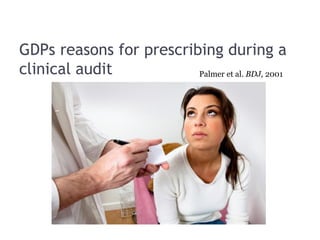
GDPs reasons for prescribing during a
clinical audit Palmer et al. BDJ, 2001
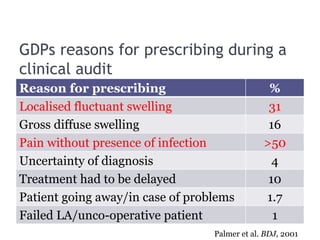
GDPs reasons for prescribing during a
clinical audit
Reason for prescribing %
Localised fluctuant swelling 31
Gross diffuse swelling 16
Pain without presence of infection >50
Uncertainty of diagnosis 4
Treatment had to be delayed 10
Patient going away/in case of problems 1.7
Failed LA/unco-operative patient 1
Palmer et al. BDJ, 2001
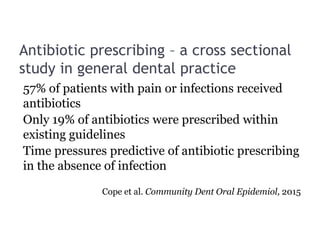
Antibiotic prescribing – a cross sectional
study in general dental practice
57% of patients with pain or infections received
antibiotics
Only 19% of antibiotics were prescribed within
existing guidelines
Time pressures predictive of antibiotic prescribing
in the absence of infection
Cope et al. Community Dent Oral Epidemiol, 2015
FDs reasons for prescribing antibiotics
in a clinical audit Palmer et al. Prim Dent Care, 2004
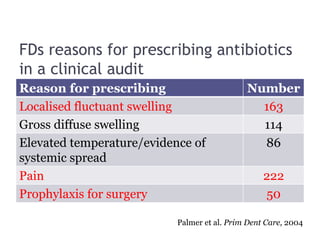
FDs reasons for prescribing antibiotics
in a clinical audit
Reason for prescribing Number
Localised fluctuant swelling 163
Gross diffuse swelling 114
Elevated temperature/evidence of
systemic spread
86
Pain 222
Prophylaxis for surgery 50
Palmer et al. Prim Dent Care, 2004
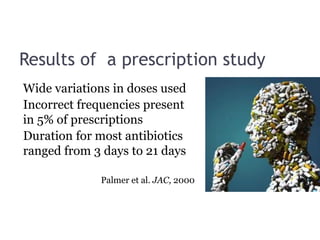
Results of a prescription study
Wide variations in doses used
Incorrect frequencies present
in 5% of prescriptions
Duration for most antibiotics
ranged from 3 days to 21 days
Palmer et al. JAC, 2000
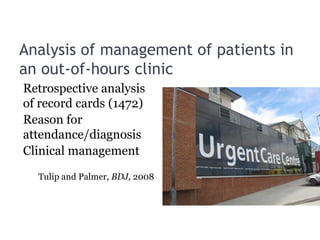
Analysis of management of patients in
an out-of-hours clinic
Retrospective analysis
of record cards (1472)
Reason for
attendance/diagnosis
Clinical management
Tulip and Palmer, BDJ, 2008
Analysis of management of patients in
an out-of-hours clinic
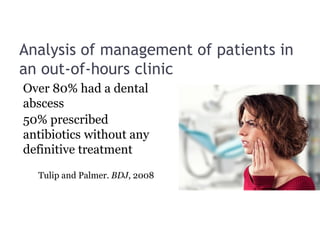
Over 80% had a dental
abscess
50% prescribed
antibiotics without any
definitive treatment
Tulip and Palmer. BDJ, 2008
Dental antibiotic prescribing in acute
care hospitals
63% of dental and oral surgery
patients were prescribed
antibiotics
5% had more than one antibiotic
13% had more than two antibiotics
Kanerva et al. JAC, 2007
Dental prescribing in paediatric
departments of three dental hospitals
Only 28% of
prescriptions issued in
first audit cycle were
appropriate
Yesudian et al. BDJ, 2015
Dental prescribing in paediatric
departments of three dental hospitals
Errors in prescription
writing were evident
e.g. no signature,
duration, quantity
Yesudian et al. BDJ, 2015
Dental prescribing in paediatric
departments of three dental hospitals
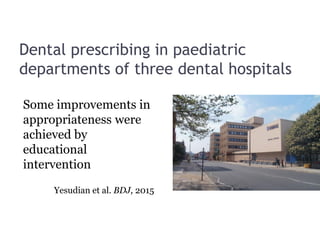
Some improvements in
appropriateness were
achieved by
educational
intervention
Yesudian et al. BDJ, 2015
Patient compliance to antibiotic
prescriptions
40% did not remember receiving
instructions
67% did not comply with
prescription
Blinder et al. Int J Oral Maxillofac Surg, 2001
Patient compliance to antibiotic
prescriptions
43% took more, 31% took less
4% who had no prescription took
antibiotics anyway
Blinder et al. Int J Oral Maxillofac Surg, 2001
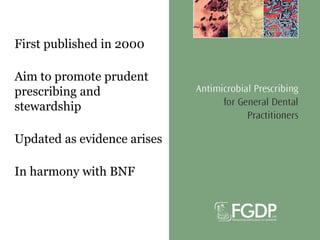
First published in 2000
Aim to promote prudent
prescribing and
stewardship
Updated as evidence arises
In harmony with BNF
www.fgdp.org.uk
Assessment of the patient
Comprehensive medical and dental history
Presence of fever, malaise, fatigue, dizziness
Measuring pulse and temperature
Defining nature, location and extent of swelling
Identifying the cause of infection
Reproduced with kind permission of FGDP(UK)
Indications for referral
Septicaemia - temperature above 39.5°C
Spreading cellulitis
Swellings that compromise airway, difficulty in
swallowing or eye closure
Dehydration
Significant trismus due to infection
Failure to respond to treatment
Uncooperative patient
Reproduced with kind permission of FGDP(UK)
Clinical management
Treatment options to remove cause of infection
When to prescribe antimicrobials
What antimicrobials to prescribe
Patient follow up and when to stop antimicrobials
How to manage failed resolution of infection
Reproduced with kind permission of FGDP(UK)
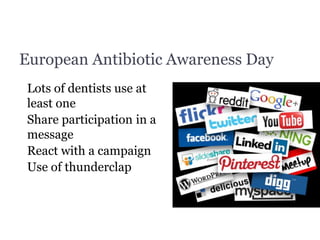
European Antibiotic Awareness Day
Lots of dentists use at
least one
Share participation in a
message
React with a campaign
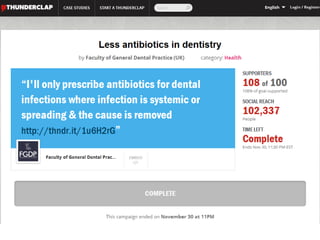
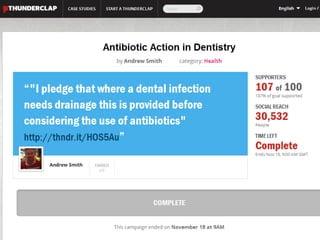
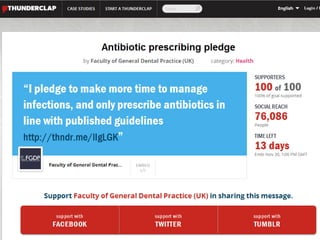
Use of thunderclap
Crowd speaking platform
Single message mass
shared
A tangible way for
measuring awareness
www.thunderclap.it
Press release 30/09/2015
The Faculty of General Dental Practice UK (FGDP(UK)) welcomes the
update to NICE guidance on prophylaxis against infective endocarditis
and supports its recommendation that no changes be made to the
original guidance published in 2008.
The FGDP(UK)’s guidelines Antimicrobial Prescribing For General
Dental Practitioners reflect the NICE guidance and with the
increasing problem of antimicrobial resistance provide evidence
based guidance for prudent prescribing and antimicrobial
stewardship. This is freely available to view online on the FGDP(UK)
website.
The FGDP(UK) will again be actively supporting European Antibiotic
Awareness Day on 18 November and Public Health England’s
Antibiotic pledge campaign in the same month.
http://www.fgdp.org.uk/content/news/fgdpuk-supports-nice-decision-on-guidance-for-prop.ashx
Press release 17/10/2015
“The FGDP(UK) supports a report by the Centre
for Disease Dynamics, Economics and Policy in
Washington DC, published this week in the
Lancet (15/10/15), which highlights the
detrimental overuse of antibiotics, the dangers of
inappropriate use, and what steps can be taken to
keep them working.”
http://www.fgdp.org.uk/content/news/fgdpuk-press-release-
antibiotic-resistance.ashx
Our message this year asks dentists to pledge
“To make more time to manage infections and
only prescribe antibiotics in line with published
guidelines.”
Press release 9/11/2015
Join in the Thunderclap to keep antibiotics
working
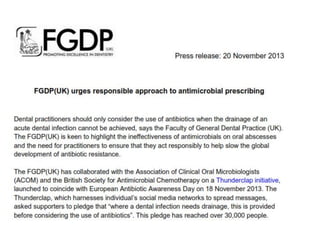
The Faculty of General Dental Practice (UK) is asking dentists and dental care
professionals to take part in a ‘Thunderclap’ to promote more prudent use of
antibiotics. Dentists have a significant role to play in helping to slow the global
development of antibiotic resistance, and the Faculty is keen to highlight the
problem.
FGDP(UK), whose guidelines Antimicrobial Prescribing for General Dental
Practitioners are available for free online, has joined forces for the second year
with the Association of Clinical Oral Microbiologists (ACOM) and the British
Society for Antimicrobial Chemotherapy (BSAC) to create a Thunderclap,
which harnesses individuals’ social media networks to spread messages.
http://www.fgdp.org.uk/content/news/pledge-to-keep-antibiotics-working.ashx
How will FGDP(UK) tackle the
challenge of AMR in the future?
Promote prudent
prescribing and
stewardship through
online guideline and
journal
How will FGDP(UK) tackle the
challenge of AMR in the future?
Collaborate to
highlight AMR and
judicious use of
antimicrobials at
every opportunity
How will FGDP(UK) tackle the
challenge of AMR in the future?
Help to develop a
freely available audit
tool for dental
practitioners
How will FGDP(UK) tackle the
challenge of AMR in the future?
Promote prudent
prescribing and
stewardship
throughout teaching
programmes
IMPLEMENTING START
SMART AND FOCUS IN
PRACTICE – A CASE
STUDY
Danielle Stacey
Specialist Antimicrobial Pharmacist
Dudley Group NHS Foundation Trust
• Serves a population of 450,000 across Dudley and areas
of Sandwell, South Staffs and Wyre Forest
• District General
• Provides specialist
services to Black
Country and West
Midlands
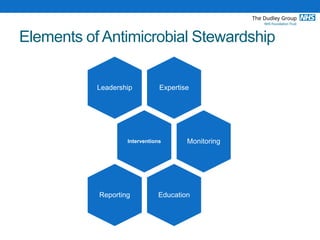
Elements of Antimicrobial Stewardship
ExpertiseLeadership
Interventions Monitoring
EducationReporting
First steps
• Start Smart then Focus toolkit first published in November
2011
• Antimicrobial Steering Group established
• Online antibiotic guidelines and credit card published
• Restricted formulary introduced to reduce high-risk broad
spectrum antibiotics
• Antibiotic usage monitoring began
• Quarterly Point prevalence surveys started
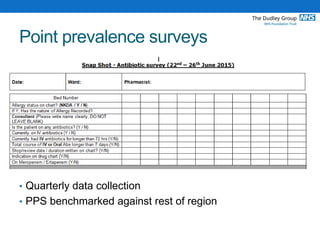
Point prevalence surveys
• Quarterly data collection
• PPS benchmarked against rest of region
Issues Identified for Improvement
• Adherence to guidelines
• Elements of Start Smart and Focus
• Documentation of indication
• Documentation of duration/date for review
• High IV antibiotic usage
• Duration of antibiotic course
• Underpinning all of this: Education and Training
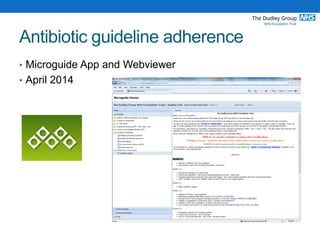
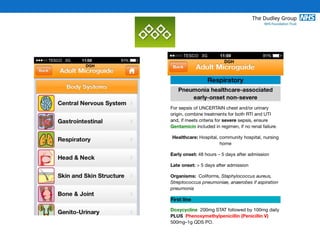
Antibiotic guideline adherence
• Microguide App and Webviewer
• April 2014
Reducing duration of IV and overall
course length
• New drug chart – 72 hr review banner
• Drug chart update – duration and micro approved box
added
• Further update – indication box added
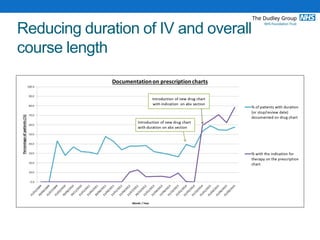
Reducing duration of IV and overall
course length
Feedback of point prevalence surveys
• After new drug charts introduced, improvements in results
became static
• What will make these improve?
• Educational outreach
• Rolling programme to visit every speciality 6 monthly
• Feedback on C.diff cases and apportionment outcomes
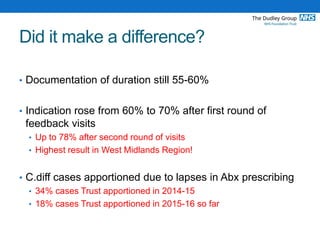
Did it make a difference?
• Documentation of duration still 55-60%
• Indication rose from 60% to 70% after first round of
feedback visits
• Up to 78% after second round of visits
• Highest result in West Midlands Region!
• C.diff cases apportioned due to lapses in Abx prescribing
• 34% cases Trust apportioned in 2014-15
• 18% cases Trust apportioned in 2015-16 so far
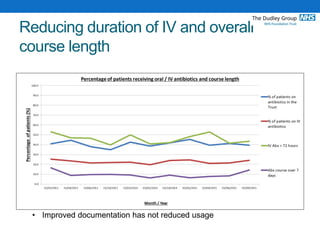
Reducing duration of IV and overall
course length
• Improved documentation has not reduced usage
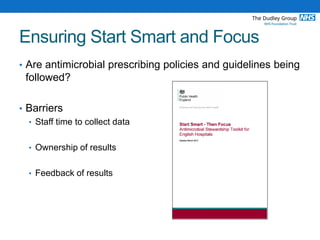
Ensuring Start Smart and Focus
• Are antimicrobial prescribing policies and guidelines being
followed?
• Barriers
• Staff time to collect data
• Ownership of results
• Feedback of results
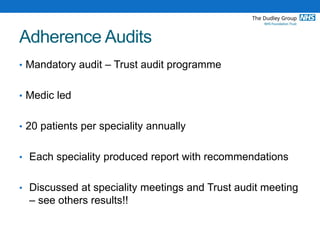
Adherence Audits
• Mandatory audit – Trust audit programme
• Medic led
• 20 patients per speciality annually
• Each speciality produced report with recommendations
• Discussed at speciality meetings and Trust audit meeting
– see others results!!
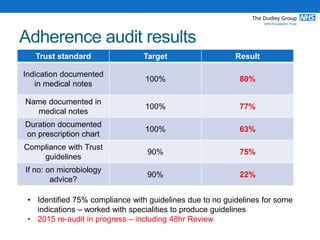
Adherence audit results
Trust standard Target Result
Indication documented
in medical notes
100% 80%
Name documented in
medical notes
100% 77%
Duration documented
on prescription chart
100% 63%
Compliance with Trust
guidelines
90% 75%
If no: on microbiology
advice?
90% 22%
• Identified 75% compliance with guidelines due to no guidelines for some
indications – worked with specialities to produce guidelines
• 2015 re-audit in progress – including 48hr Review
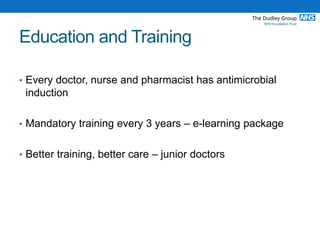
Education and Training
• Every doctor, nurse and pharmacist has antimicrobial
induction
• Mandatory training every 3 years – e-learning package
• Better training, better care – junior doctors
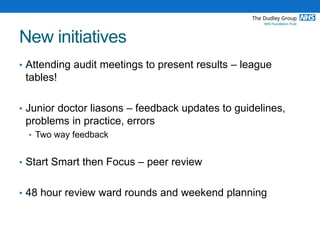
New initiatives
• Attending audit meetings to present results – league
tables!
• Junior doctor liasons – feedback updates to guidelines,
problems in practice, errors
• Two way feedback
• Start Smart then Focus – peer review
• 48 hour review ward rounds and weekend planning
Summary
• Effective leadership and expertise essential
• Monitor – intervene – monitor
• Prescriber ownership is essential
• Competition helps
• Effective feedback mechanisms – two-way
• Continual education – not one-off
Thank you
Any Questions?
Question & Answers
Chairs concluding comments
Dr Cliodna McNulty, Head, PHE Primary Care Unit
& Consultant Medical Microbiologist, and Honorary
Visiting Professor Cardiff University, National
Infection Service, Public Health England
Developed by Public Health England
National Awards
May 2016, Date and Venue tbc
Categories include:
Staff engagement: How have staff promoted Antibiotic Guardian and stewardship within their
organisation?
Community: How has your organisation worked within the community to highlight Antibiotic Guardian?
Prescribing: How has your organisation tackled prescription and prescribing antibiotics effectively?
Innovation: Tell us how you have demonstrated innovation to address Antimicrobial Resistance?
Antibiotic Stewardship: How have you improved or measured antibiotic usage in your area or
community?
AMS Research: How have you demonstrated development of research to support
Antimicrobial Stewardship?
For details of how to apply please visit
www.antibioticguardian.com
Developed by Public Health England
Why attend?
• Gain guidance on effective prescribing methods
• Hear the latest information on antimicrobial stewardship from leading experts
• Collaborate with fellow health professionals
• Receive resources to promote Antibiotic Stewardship in your workplace
Educational Roadshow Series
October 29th- Leeds
November 18th- Birmingham
February 24th-London

Antibiotic Guardian Birmingham Workshop

  • 1.
    Welcome to AntibioticGuardian Birmingham
  • 2.
    Chairs introduction Dr CliodnaMcNulty, Head, PHE Primary Care Unit & Consultant Medical Microbiologist, and Honorary Visiting Professor Cardiff University, National Infection Service, Public Health England
  • 3.
    Antimicrobial stewardship: Changingrisk-related behaviours in the general population Simon Howard Public Health Specialty Registrar
  • 4.
    Disclaimer • I ama ‘topic expert member’ for guideline on ‘Antimicrobial stewardship: Changing risk- related behaviours in the general population’ • I am not a NICE employee • NICE has not had prior sight or approval of this presentation
  • 5.
  • 6.
    The background: whyNICE was set up • Established in 1999 • Aim: to reduce variation in the availability and quality of treatments and care (the so called ‘postcode lottery’) • To resolve uncertainty about which medicines and treatments work best and which represent best value for money for the NHS
  • 7.
  • 8.
    Core principles ofNICE’s work • Based on the best evidence available • Expert input • Patient and carer involvement • Independent advisory committees • Genuine consultation • Regular review • Open and transparent process • Social values and equity considerations
  • 9.
  • 10.
    Guideline still indraft • Guideline has been in development for about 18 months • Public consultation on guidance: 8 September to 20 October 2015 • Expected date of issue: March 2016
  • 11.
    Scope • Interventions tochange public’s behaviour to reduce development of AMR and stop spread of resistant microbes – Includes measures to raise awareness and knowledge – Includes measures to prevent and control infection
  • 12.
    Target audience • Thosewith responsibility for prescribing and dispensing antimicrobials • Those in public health • Those who give information and advice to the public • Those responsible for preventing and controlling infections • The public themselves – especially vulnerable groups
  • 13.
    Seven areas of recommendation 1.National and local information campaigns 2. Public interventions to prevent infection 3. Interventions to reduce inappropriate antimicrobial demand and use 4. Childcare settings 5. Schools 6. Educational and residential settings for young adults 7. Healthcare settings Setting-specific recommendations
  • 14.
    1. National andlocal information campaigns • Raise awareness of AMR • Give info on preventing and controlling infections • Using range of modes of delivery (verbal advice, multimedia, written, mass media)
  • 15.
    2. Public interventionsto prevent infection • Advice on handwashing (including when and how to wash hands; when hand sanitisers are / are not appropriate) • Food hygiene advice • Wider aspects of infection prevention (such as the need for vaccinations)
  • 16.
    3. Reduce inappropriate antimicrobialdemand and use • Educating the public about the natural course of self-limiting conditions (including red-flag symptoms) • Educating the public about where to seek help/advice if/when they need it (e.g. use pharmacies rather than A&E) • Advising people to use prescribed antimicrobials appropriately
  • 17.
    4. Childcare settings •Clean appropriately, and train staff in cleaning appropriately • Provide handwashing facilities • Educate children about handwashing, involving parents and carers • Ensure parents and carers are aware of the importance of preventing AMR
  • 18.
    5. Schools • Takea ‘whole-school’ approach • Provide handwashing facilities, and teach handwashing in an age-appropriate way • Use teaching resources such as PHE’s “e- bug” to educate children about microbes and AMR • Consider integration wider messages • Consider involving parents and carers
  • 19.
    6. Educational andresidential settings for young adults • Awareness raising activities, including about handwashing (with posters in strategic locations) and food-safety campaigns • Raise awareness about other aspects of infection prevention (e.g. vaccinations) • Help students to understand about self- care and where to seek help
  • 20.
    7. Healthcare settings •Give advice about self-limiting conditions, including natural course and where to seek help • Consider using decision-support aids to encourage health professionals not to prescribe antibiotics for self-limiting conditions • When not prescribing antibiotics, explain why, and give written information including safety- netting advice • When prescribing antibiotics, explain why, and give written information on antibiotics
  • 21.
    Research recommendations • Cost-effectiveness •Multi-component interventions • High-risk groups • Workplaces
  • 22.
    Overarching implementation • Considerdeveloping a local area antimicrobial stewardship strategy linking public health, local authorities, healthcare, and social care.
  • 23.
    Due for finalpublication: March 2016
  • 24.
  • 25.
    Scope • Effective useof antimicrobials as part of all publically funded health and social care commissioned or provided by NHS organisations, local authorities (in England), independent organisations or independent contractors.
  • 26.
    Recommendations for: • Organisations(commissioners and providers) – Establish antimicrobial stewardship programme – Establish antimicrobial stewardship team – Further specific recommendations around communication, interventions, and lab testing • Prescribers and practitioners – Specific guidelines for prescribing antimicrobials • Introduction of new antimicrobials
  • 27.
  • 28.
    Keeping up todate with the latest from NICE
  • 29.
    NICE Pathways- guidanceat your fingertips Pathways brings together all NICE guidance, quality standards and support in easy-to-navigate flowcharts pathways.nice.org.uk
  • 30.
    NICE guidance andBNF apps for your iPhone or smartphone Search over 750 pieces of NICE guidance, including Public health guidance. Download it today for free from Apple’s App Store and Google Play. BNF apps available free with Athens password.
  • 31.
    Follow us onTwitter @NICEcomms Subscribe online to NICE News, our monthly newsletter - containing information about new guidance, quality standards and implementation resources launched each month. Sign up at: www.nice.org.uk/newsletter Keep up to date with the latest from NICE...
  • 32.
    Get involved Did youknow you can… • Join a NICE Committee- use your expertise to support development of our guidance • Comment on a Consultation- feedback on scope and drafts of guidance and quality standards • Join our Fellows and Scholars programme- a growing group of professionals benefitting from NICE sponsorship and mentoring • www.nice.org.uk/getinvolved
  • 33.
    Section Title Fighting antimicrobial resistanceat grass root level Professor Jayne Lawrence Chief Scientist
  • 34.
    The war againstbacteria from this to to this!
  • 35.
    Section Title “There isthe danger that the ignorant man may easily under dose himself and by exposing his microbes to non-lethal quantities of the drug make them resistant.” Antibiotic resistance neither unexpected or new
  • 36.
    Hunter-gatherers host morediverse bacteria than humans in industrialized nations. When scientists first made contact with an isolated village of Yanomami hunter- gatherers in the remote mountains of the Amazon jungle of Venezuela in 2009, they marveled at the chance to study the health of people who had never been exposed to Western medicine or diets. But much to their surprise, these Yanomami’s gut bacteria have already evolved a diverse array of antibiotic-resistance genes, according to a new study, even though these mountain people had never ingested antibiotics or animals raised with drugs. The find suggests that microbes have long evolved the capability to fight toxins, including antibiotics, and that preventing drug resistance may be harder than scientists thought. Resistance to antibiotics found in isolated Amazonian tribe Article in Science 17th April 2015
  • 37.
    How real isthe risk?
  • 38.
    How real isthe risk?
  • 39.
    Fighting antimicrobial resistance stimulateproduction of new antibiotics – new payment models need accurate record keepingneed more new antibiotics reduce antibiotic use in farming/food production
  • 40.
    Fighting antimicrobial resistance stimulateproduction of new antibiotics – new payment models need accurate record keepingneed more new antibiotics reduce antibiotic use in farming/food production
  • 41.
    The World HealthOrganisation ‘the cost effective use of antimicrobials which maximises clinical therapeutic effect while minimising both drug-related toxicity and the development of antimicrobial resistance’ Chief Medical Officer ‘embodies an organisational or healthcare-system-wide approach to promoting and monitoring judicious use of an to preserve their effect’ We need to - optimise therapy for an individual - prevent overuse, misuse and abuse - minimise the development of resistance at patient and community levels What is antimicrobial stewardship?
  • 43.
    The role ofcommunity pharmacists in antimicrobial stewardship Recognising signs of infection • fever, aches, pain • presence of pus, swelling, and/or redness in a potentially infected site • confusion, of sudden onset, particularly in older people • drowsiness, irritability, poor appetite in children Determining the duration of symptoms (e.g. cough, sore throat) and whether the patient’s condition is improving or deteriorating Manage patients expectations & refer patients to the GP only when absolutely necessary (80% of antibiotics prescribed in primary care)
  • 44.
    The role ofcommunity pharmacists in antimicrobial stewardship Recognising signs of infection • fever, aches, pain • presence of pus, swelling, and/or redness in a potentially infected site • confusion, of sudden onset, particularly in older people • drowsiness, irritability, poor appetite in children Determining the duration of symptoms (e.g. cough, sore throat) and whether the patient’s condition is improving or deteriorating Manage patients expectations & refer patients to the GP only when absolutely necessary (80% of antibiotics prescribed in primary care)
  • 45.
    The role ofcommunity pharmacists in antimicrobial stewardship Counsel patients on appropriate antibiotic use when prescribed Counsel patients on adverse effects Counsel patients on antibiotic resistance, as appropriate Recommend symptomatic therapy for non-vulnerable patients
  • 46.
    The role ofcommunity pharmacists in antimicrobial stewardship Counsel patients on appropriate antibiotic use when prescribed Counsel patients on adverse effects Counsel patients on antibiotic resistance, as appropriate Recommend symptomatic therapy for non-vulnerable patients
  • 47.
    Counselling patients onappropriate antibiotic use Pharmacists are ideally placed to advise patients on appropriate antibiotic use Remember the mnemonic FRAIS F Finish the course R Regular intervals (e.g. 6-hourly, 8-hourly, etc) A After, with or before food I Interactions S Side effects Benefit of behind delayed/post-dated prescriptions
  • 48.
    The role ofcommunity pharmacists in antimicrobial stewardship Counsel patients on appropriate antibiotic use when prescribed Counsel patients on adverse effects Counsel patients on antibiotic resistance, as appropriate Recommend symptomatic therapy for non-vulnerable patients
  • 49.
    Counselling patients onadverse effects and how to avoid them Common, mild, side effects of antibiotics include sickness, diarrhoea, bloating & indigestion, abdominal pain and loss of appetite. Less frequent is an allergic response may include rash, more serious is swelling of the face and tongue and difficulty in breathing. Clostridium difficile may be the cause of antibiotic-associated diarrhoea. Important to be familiar with the symptoms, the antibiotics commonly associated with it and its diagnosis and management Antibiotics, often referred to as ‘the 4Cs’ are ciprofloxacin (quinolones), co- amoxiclav (broad spectrum penicillins,) clindamycin and (3rd generation) cephalosporins Dont to sell or advise to take anti-spasmodics, e.g. loperamide as these agents can increase the severity and length of disease due to the prolonged contact time of C difficile toxins in the colon
  • 50.
    The role ofcommunity pharmacists in antimicrobial stewardship Counsel patients on appropriate antibiotic use when prescribed Counsel patients on adverse effects Counsel patients on antibiotic resistance, as appropriate Recommend symptomatic therapy for non-vulnerable patients
  • 51.
    Counselling patients onresistance and how to avoid this Explain what antimicrobial resistance is and how it occurs A patient prescribed an antibiotic for a respiratory or urinary tract infection can exhibit bacterial resistance to that antibiotic for < 12 months The more often a patient is given a course of antibiotics, the more likely the patient’s bacteria will develop multiple or ongoing resistance
  • 52.
    The role ofcommunity pharmacists in antimicrobial stewardship Counsel patients on appropriate antibiotic use when prescribed Counsel patients on adverse effects Counsel patients on antibiotic resistance, as appropriate Recommend symptomatic therapy for non-vulnerable patients
  • 53.
    • manage patientsexpectations & refer patients to the GP only when absolutely necessary • educate patients on the typical duration of an infection – acute otitis media – 4 d; common cold - 1.5 wk; acute rhinosinusitis 2.5 wk; acute cough/acute bronchitis – 3 wk • promote symptomatic relief – e.g. drinking plenty of fluids, resting, pain relief and symptom control • where ever possible supply written information to support consultation Counselling non-vulnerable* patients *patients who need to be referred to a GP include those at risk of serious complications on account of pre- existing co-morbidity, such as cystic fibrosis, significant heart, lung, renal, liver or neuromuscular disease, those who are immunosuppressed, and children born prematurely
  • 54.
    Advise on personalhygiene Promote health education leaflets
  • 55.
  • 57.
    Antimicrobial Stewardship Auditing, Trainingand Reporting Technology Ann Higgins, Clinical Director of Infection Prevention and Quality, Medical Audits Limited
  • 58.
  • 59.
  • 60.
    Welcome back Dr CliodnaMcNulty, Head, PHE Primary Care Unit & Consultant Medical Microbiologist, and Honorary Visiting Professor Cardiff University, National Infection Service, Public Health England
  • 61.
    Healthy Eating “The Routeto Health and Wellbeing” 61
  • 62.
    Who is TimFinnigan??? • Married, two children (grown up)
  • 63.
    Who is TimFinnigan??? • Married, two children (grown up) • Likes running up hills and likes a pint • 30 years R&D in Food and Drink • PhD Canola protein, Government food research, APV, General Foods and...
  • 64.
    I’M HERE INPART TO TELL “THE QUORN STORY” BUT ONLY IN THE CONTEXT OF…..  AS AN ILLUSTRATION OF WHY WE NEED HEALTHY NEW PROTEINS WITH A LOW ENVIRONMENTAL IMPACT  AND THE GOOD NEWS THAT ‘IT CAN BE DONE’
  • 65.
    The 1960s wasa time of huge achievements... The context
  • 66.
  • 67.
    A man witha big idea Inter-generational equity
  • 68.
    “Quorn ….began by takingthe original fungi found in soil and domesticating it in the same way that our ancestors did with many plants.” Spector, T (2015) The Diet Myth. Weidenfield and Nicholson pp 137 Quorn has many influential advocates 68
  • 69.
    69 From 1964 to1985 – time flies……….
  • 70.
    + a largenumber of ducks, rabbits, horses, turkeys… ..3 camels and one unfortunate mule Chickens 110,000 Pigs 2,630 Sheep 922 Goats 781 Cows 557 The scale of livestock production is driven by our desire for cheaper and more plentiful meat, but there are damaging consequences, which at the moment are forecast only to intensify The current context…
  • 71.
    http://www.fao.org/fileadmin/templates/wsfs/docs/expert_paper/How_to_Feed_the_World_in_2050.pdf http://www.tristramstuart.co.uk/FoodWasteFacts.html http://ecowatch.com/2014/04/11/agricultures-greenhouse-gas-emissions-2050/ Challenge Consequence To feed9bn in 2050 FAO say we need a 60% increase in food production some of the true costs of cheap and plentiful animal protein Our demand for ever cheaper and more plentiful meat has a number of potentially devastating consequences… 71
  • 73.
    Challenge Consequence To feed9bn in 2050 FAO say we need a 60% increase in food production some of the true costs of cheap and plentiful animal protein Our demand for ever cheaper and more plentiful meat has a number of potentially devastating consequences… 73
  • 74.
    http://www.fao.org/fileadmin/templates/wsfs/docs/expert_paper/How_to_Feed_the_World_in_2050.pdf http://www.tristramstuart.co.uk/FoodWasteFacts.html http://ecowatch.com/2014/04/11/agricultures-greenhouse-gas-emissions-2050/ Challenge Consequence To feed9bn in 2050 FAO say we need a 60% increase in food production some of the true costs of cheap and plentiful animal protein Our demand for ever cheaper and more plentiful meat has a number of potentially devastating consequences… 74
  • 76.
    Challenge Consequence To feed9bn in 2050 FAO say we need a 60% increase in food production some of the true costs of cheap and plentiful animal protein Our demand for ever cheaper and more plentiful meat has a number of potentially devastating consequences… 76  THERAPEUTIC (disease treatment)  PROPHYLACTIC (disease prevention)  GROWTH PROMOTION http://www.soilassociation.org/LinkClick.aspx?fileticket=H7srxwglZ-s%3d&tabid=313
  • 78.
    For most ofus it’s a real surprise to learn that antibiotics are used so freely in animal production 80% ANTIBIOTICS PRODUCED IN THE USA FED TO ANIMALS AS OUR DEMAND FOR CHEAPER AND PLENTIFUL MEAT RISES SO WILL THE USE OF ANTIBIOTICS IN INDUSTRIAL ANIMAL PRODUCTION
  • 79.
    Six ways wehave undermined a wonder drug http://s.telegraph.co.uk/graphics/projects/antibiotic-resistance/ Agriculture Globally more than 70 per cent of antibiotics are used in animal agriculture including some of the most potent antibiotics available. In more than 100 countries antibiotics are routinely added to animal feed to promote growth. So-called mega farms, intensive meat and poultry farms where diseases can sweep through herds, are blamed in particular for overuse Aquaculture Intensive aquaculture (shrimp and fish farming) has led to growing problems with antibiotics routinely used to treat diseases. The industry supplies the world with 110 million metric tonnes of food fish per year. 75 per cent of the antibiotics fed to fish are excreted back into the water Veterinary In Britain the veterinary sector has been criticised for irresponsible prescription of antibiotics, as vets can profit by selling the same drugs they prescribe. The government does not track the use of veterinary antibiotics in detail, with the main data available the total annual tonnage of antibiotics sold. In 2012, 409 tonnes of antibiotics were prescribed by vets in Britain Soil Many antibiotics are non bio- degradable and can persist in high concentrations in soil for a long time. An estimated 70 million tonnes of animal manure waste is spread on to agricultural land each year in Britain. Crops can take up substantial amount of antibiotics by the roots. Antibiotics are also sprayed on to crops, such as high value fruit trees, to prevent bacterial diseases. Profit Only four major pharmaceutical companies are left in the development of antibiotics. Antibiotics are not as profitable as other drugs taken for chronic conditions. A successful course of antibiotics takes only a few days, unlike diseases such as diabetes and blood pressure where drugs can be taken for years.
  • 80.
    Italy, 2013 EFSA: “Overcrowdingis a risk factor for disease expression and other causes of poor welfare and should be avoided” Regular antimicrobial use facilitates high animal densities: The Lancet Infectious Diseases Commission, 2013
  • 81.
    • “Urgent actionis needed to ... reduce antibiotic usage in animal husbandry”, WHO, 2014 • “Use of antibiotics as growth promoters should be banned worldwide as has happened in the EU”: The Lancet Infectious Diseases Commission, 2013 • “Routine preventative use of antibiotics is unacceptable” UK AMR Strategy: Annual progress report and implementation plan, December 2014 “failure to address antibiotic overuse in agriculture and its role in drug resistance is like trying to stop lung cancer without factoring in smoking…..”
  • 83.
    Challenge Consequence To feed9bn in 2050 FAO say we need a 60% increase in food production some of the true costs of cheap and plentiful animal protein Our demand for ever cheaper and more plentiful meat has a number of potentially devastating consequences… 83
  • 84.
    Challenges for ascalable meat based sustainable food future Our biggest lever globally is to eat less meat
  • 85.
    New FAO reportquantifies the cost of industrial livestock production to the environment
  • 86.
    THE No 1CONTRIBUTER  1/3rd water use  18% -30% of global GHG emissions  45% of all land  91% of rainforest destruction to date (1 acre per second)  Species loss  Ocean deadzones  Habitat destruction  The rise of the superbug  Micronutrient depletion  Unaccounted costs of poor health and environmental impact  Animal welfare and cruelty on an unprecedented scale All the evidence is there to see
  • 87.
    “The need fornew business models that help address the 9bn challenge - including a healthy new protein with a lower environmental impact….” Prof. Alan Knight Single Planet Living Big steps toward small footprints
  • 88.
    “For all Mankind’ssupposed accomplishments, his continued existence is completely dependent on six inches of topsoil and the fact that it rains…..”
  • 89.
    Tackling antimicrobial resistance indentistry Nick Palmer BDS MFGDP(UK) PhD FDSRCSEng FFGDP(UK)
  • 93.
    Outline Facts and figures Evidenceof AMR in dentistry Scientific evidence of inappropriate prescribing FGDP’s role in tackling AMR
  • 94.
    Facts & Figures 41.7million NHS prescriptions for oral antibiotics dispensed in the primary care setting GDPs account for 9% Health & Social Care Information Centre, 2015
  • 95.
    Facts & Figures 66.6%of dental prescriptions are for antibiotics Health & Social Care Information Centre, 2015 Amoxicillin Caps 500mg One to be taken three times daily Mitte 15 Dr J Doe AnyTown Dental Practice 15 The High Street AnyTown 4/11/14
  • 96.
    Antibacterial drugs prescribedby dentists, 2014 Antibiotic No of items % of all antibacterials Penicillins 2,443,111 66.1 Metronidazole 1,044,848 28.3 Macrolides 166,462 4.5 Clindamycin 18,360 0.5 Cephalosporins 14,109 0.4 Tetracyclines 9,129 0.2 Total 3,696,019 100 Health & Social Care Information Centre, 2015
  • 97.
    3100 3200 3300 3400 3500 3600 3700 3800 3900 4000 GDP antibiotic prescribing Year Health& Social Care information centre – prescribing support unit Antibioticprescriptionsinthousands
  • 98.
    Dental prescribers inprimary care Approx. 35,000 dentists working in general dental practice BDA “State of general practice”, 2013
  • 99.
    Dental prescribers inprimary care 11,000 dentists in solely private practice BDA “State of general practice”, 2013
  • 100.
    Dental prescribers inprimary care 23,947 working in NHS practice with only 11% totally NHS HSCIC, 2015 & BDA “State of general practice”, 2013
  • 101.
    Dental prescribers inprimary care 30 million patients seen in last 24 months within NHS general practice HSCIC, 2015
  • 102.
    Dental prescribing inprimary care Average NHS dentist writes 155 prescriptions for antibiotics each year
  • 103.
    Dental prescribing inprimary care 1 in 4 patients treated in primary dental care received a prescription for antibiotics
  • 104.
    Antibiotic use linkto AMR The strength of the selective pressure (i.e. the rate of drug consumption) is intimately and positively associated with the rate of development of resistance Levin et al. Clinical Infectious Diseases, 1997 Costelloe et al. BMJ, 2010
  • 105.
    Antibiotic use linkto AMR Consumption major driver for development of resistance Higher rates of resistance seen where higher rates of prescribing
  • 106.
    Antimicrobial resistance &dentistry 34% of bacterial isolates from dental abscesses resistant to penicillin Kuryama et al. Oral Microbiol Immunol, 2007
  • 107.
    Antimicrobial resistance &dentistry 10% of patients had MRSA in the oral cavity McCormack et al. Am J Infect Control, 2015 43% of oral Streptococci in children resistant to amoxicillin Salako et al. Spec Care Dentist, 2007
  • 108.
    Antibiotic resistance &oral infections 36% of endodontic pus aspirates were positive for antibiotic resistant genes More than one resistant gene was detected Rocas et al. Archives of Oral Biology, 2013
  • 109.
    Antibiotic resistance &oral infections Endodontic infections harboured resistance genes for penicillins, tetracycline and erythromycin Rocas et al. Archives of Oral Biology, 2013
  • 110.
    AMR and periodontalpatients “74% of periodontal patients have subgingival pathogens resistant to either doxycycline, amoxicillin or metronidazole” Rams et a. J Perio, 2014
  • 111.
    AMR and peri-implantitis Peri-implantitis microbiotashow resistance to amoxicillin (39%) metronidazole (21%) clindamycin (47%) Rams. Clin Oral Implant Res, 2014
  • 112.
    Do dentists prescribeantibiotics appropriately?
  • 113.
    Management of bacterialinfections All bacterial dental infections have a treatable cause
  • 114.
    Management of bacterialinfections Antibiotics only used as an adjunct to removal of the cause and temperature is elevated, there is systemic spread and lymph gland involvement
  • 115.
    Management of dentalinfections No indication for antibiotics for dental pain
  • 116.
    Management of dentalinfections No indication for localised infections/swellings
  • 117.
    Management of dentalinfections No indication for antibiotic prophylaxis for dento-alveolar surgery
  • 118.
  • 119.
    Research on therapeuticprescribing Non-clinical factors % Patient expectation of a prescription 8.0 Pressure of time and workload 30.3 Patient’s social history 8.2 Uncertainty of diagnosis 47.2 Where treatment has to be delayed 72.5 Palmer et al. BDJ, 2000
  • 120.
    0 10 20 30 40 50 60 70 80 90 100 acute pulpitis acute periapicalinfection- before drainage acute periapical infection with drainage chronic abscess pericoronitis chronic marginal gingivitis ucute ulcerative gingivitis sinusitis chronis periodontitis dry socket cellulitis periodontal abscess reimplantation of teeth trismus Clinical conditions %ofGDPs Palmer et al. BDJ, 2000 Routine prescribing by GDPs
  • 121.
    GDPs reasons forprescribing during a clinical audit Palmer et al. BDJ, 2001
  • 122.
    GDPs reasons forprescribing during a clinical audit Reason for prescribing % Localised fluctuant swelling 31 Gross diffuse swelling 16 Pain without presence of infection >50 Uncertainty of diagnosis 4 Treatment had to be delayed 10 Patient going away/in case of problems 1.7 Failed LA/unco-operative patient 1 Palmer et al. BDJ, 2001
  • 123.
    Antibiotic prescribing –a cross sectional study in general dental practice 57% of patients with pain or infections received antibiotics Only 19% of antibiotics were prescribed within existing guidelines Time pressures predictive of antibiotic prescribing in the absence of infection Cope et al. Community Dent Oral Epidemiol, 2015
  • 124.
    FDs reasons forprescribing antibiotics in a clinical audit Palmer et al. Prim Dent Care, 2004
  • 125.
    FDs reasons forprescribing antibiotics in a clinical audit Reason for prescribing Number Localised fluctuant swelling 163 Gross diffuse swelling 114 Elevated temperature/evidence of systemic spread 86 Pain 222 Prophylaxis for surgery 50 Palmer et al. Prim Dent Care, 2004
  • 126.
    Results of aprescription study Wide variations in doses used Incorrect frequencies present in 5% of prescriptions Duration for most antibiotics ranged from 3 days to 21 days Palmer et al. JAC, 2000
  • 127.
    Analysis of managementof patients in an out-of-hours clinic Retrospective analysis of record cards (1472) Reason for attendance/diagnosis Clinical management Tulip and Palmer, BDJ, 2008
  • 128.
    Analysis of managementof patients in an out-of-hours clinic Over 80% had a dental abscess 50% prescribed antibiotics without any definitive treatment Tulip and Palmer. BDJ, 2008
  • 129.
    Dental antibiotic prescribingin acute care hospitals 63% of dental and oral surgery patients were prescribed antibiotics 5% had more than one antibiotic 13% had more than two antibiotics Kanerva et al. JAC, 2007
  • 130.
    Dental prescribing inpaediatric departments of three dental hospitals Only 28% of prescriptions issued in first audit cycle were appropriate Yesudian et al. BDJ, 2015
  • 131.
    Dental prescribing inpaediatric departments of three dental hospitals Errors in prescription writing were evident e.g. no signature, duration, quantity Yesudian et al. BDJ, 2015
  • 132.
    Dental prescribing inpaediatric departments of three dental hospitals Some improvements in appropriateness were achieved by educational intervention Yesudian et al. BDJ, 2015
  • 133.
    Patient compliance toantibiotic prescriptions 40% did not remember receiving instructions 67% did not comply with prescription Blinder et al. Int J Oral Maxillofac Surg, 2001
  • 134.
    Patient compliance toantibiotic prescriptions 43% took more, 31% took less 4% who had no prescription took antibiotics anyway Blinder et al. Int J Oral Maxillofac Surg, 2001
  • 136.
    First published in2000 Aim to promote prudent prescribing and stewardship Updated as evidence arises In harmony with BNF
  • 137.
  • 138.
    Assessment of thepatient Comprehensive medical and dental history Presence of fever, malaise, fatigue, dizziness Measuring pulse and temperature Defining nature, location and extent of swelling Identifying the cause of infection Reproduced with kind permission of FGDP(UK)
  • 139.
    Indications for referral Septicaemia- temperature above 39.5°C Spreading cellulitis Swellings that compromise airway, difficulty in swallowing or eye closure Dehydration Significant trismus due to infection Failure to respond to treatment Uncooperative patient Reproduced with kind permission of FGDP(UK)
  • 140.
    Clinical management Treatment optionsto remove cause of infection When to prescribe antimicrobials What antimicrobials to prescribe Patient follow up and when to stop antimicrobials How to manage failed resolution of infection Reproduced with kind permission of FGDP(UK)
  • 141.
    European Antibiotic AwarenessDay Lots of dentists use at least one Share participation in a message React with a campaign Use of thunderclap
  • 142.
    Crowd speaking platform Singlemessage mass shared A tangible way for measuring awareness www.thunderclap.it
  • 146.
    Press release 30/09/2015 TheFaculty of General Dental Practice UK (FGDP(UK)) welcomes the update to NICE guidance on prophylaxis against infective endocarditis and supports its recommendation that no changes be made to the original guidance published in 2008. The FGDP(UK)’s guidelines Antimicrobial Prescribing For General Dental Practitioners reflect the NICE guidance and with the increasing problem of antimicrobial resistance provide evidence based guidance for prudent prescribing and antimicrobial stewardship. This is freely available to view online on the FGDP(UK) website. The FGDP(UK) will again be actively supporting European Antibiotic Awareness Day on 18 November and Public Health England’s Antibiotic pledge campaign in the same month. http://www.fgdp.org.uk/content/news/fgdpuk-supports-nice-decision-on-guidance-for-prop.ashx
  • 147.
    Press release 17/10/2015 “TheFGDP(UK) supports a report by the Centre for Disease Dynamics, Economics and Policy in Washington DC, published this week in the Lancet (15/10/15), which highlights the detrimental overuse of antibiotics, the dangers of inappropriate use, and what steps can be taken to keep them working.” http://www.fgdp.org.uk/content/news/fgdpuk-press-release- antibiotic-resistance.ashx
  • 148.
    Our message thisyear asks dentists to pledge “To make more time to manage infections and only prescribe antibiotics in line with published guidelines.”
  • 149.
    Press release 9/11/2015 Joinin the Thunderclap to keep antibiotics working The Faculty of General Dental Practice (UK) is asking dentists and dental care professionals to take part in a ‘Thunderclap’ to promote more prudent use of antibiotics. Dentists have a significant role to play in helping to slow the global development of antibiotic resistance, and the Faculty is keen to highlight the problem. FGDP(UK), whose guidelines Antimicrobial Prescribing for General Dental Practitioners are available for free online, has joined forces for the second year with the Association of Clinical Oral Microbiologists (ACOM) and the British Society for Antimicrobial Chemotherapy (BSAC) to create a Thunderclap, which harnesses individuals’ social media networks to spread messages. http://www.fgdp.org.uk/content/news/pledge-to-keep-antibiotics-working.ashx
  • 151.
    How will FGDP(UK)tackle the challenge of AMR in the future? Promote prudent prescribing and stewardship through online guideline and journal
  • 152.
    How will FGDP(UK)tackle the challenge of AMR in the future? Collaborate to highlight AMR and judicious use of antimicrobials at every opportunity
  • 153.
    How will FGDP(UK)tackle the challenge of AMR in the future? Help to develop a freely available audit tool for dental practitioners
  • 154.
    How will FGDP(UK)tackle the challenge of AMR in the future? Promote prudent prescribing and stewardship throughout teaching programmes
  • 155.
    IMPLEMENTING START SMART ANDFOCUS IN PRACTICE – A CASE STUDY Danielle Stacey Specialist Antimicrobial Pharmacist Dudley Group NHS Foundation Trust
  • 156.
    Dudley Group NHSFoundation Trust • Serves a population of 450,000 across Dudley and areas of Sandwell, South Staffs and Wyre Forest • District General • Provides specialist services to Black Country and West Midlands
  • 157.
    Elements of AntimicrobialStewardship ExpertiseLeadership Interventions Monitoring EducationReporting
  • 158.
    First steps • StartSmart then Focus toolkit first published in November 2011 • Antimicrobial Steering Group established • Online antibiotic guidelines and credit card published • Restricted formulary introduced to reduce high-risk broad spectrum antibiotics • Antibiotic usage monitoring began • Quarterly Point prevalence surveys started
  • 159.
    Point prevalence surveys •Quarterly data collection • PPS benchmarked against rest of region
  • 160.
    Issues Identified forImprovement • Adherence to guidelines • Elements of Start Smart and Focus • Documentation of indication • Documentation of duration/date for review • High IV antibiotic usage • Duration of antibiotic course • Underpinning all of this: Education and Training
  • 161.
    Antibiotic guideline adherence •Microguide App and Webviewer • April 2014
  • 163.
    Reducing duration ofIV and overall course length • New drug chart – 72 hr review banner • Drug chart update – duration and micro approved box added • Further update – indication box added
  • 164.
    Reducing duration ofIV and overall course length
  • 165.
    Feedback of pointprevalence surveys • After new drug charts introduced, improvements in results became static • What will make these improve? • Educational outreach • Rolling programme to visit every speciality 6 monthly • Feedback on C.diff cases and apportionment outcomes
  • 166.
    Did it makea difference? • Documentation of duration still 55-60% • Indication rose from 60% to 70% after first round of feedback visits • Up to 78% after second round of visits • Highest result in West Midlands Region! • C.diff cases apportioned due to lapses in Abx prescribing • 34% cases Trust apportioned in 2014-15 • 18% cases Trust apportioned in 2015-16 so far
  • 167.
    Reducing duration ofIV and overall course length • Improved documentation has not reduced usage
  • 168.
    Ensuring Start Smartand Focus • Are antimicrobial prescribing policies and guidelines being followed? • Barriers • Staff time to collect data • Ownership of results • Feedback of results
  • 169.
    Adherence Audits • Mandatoryaudit – Trust audit programme • Medic led • 20 patients per speciality annually • Each speciality produced report with recommendations • Discussed at speciality meetings and Trust audit meeting – see others results!!
  • 170.
    Adherence audit results Truststandard Target Result Indication documented in medical notes 100% 80% Name documented in medical notes 100% 77% Duration documented on prescription chart 100% 63% Compliance with Trust guidelines 90% 75% If no: on microbiology advice? 90% 22% • Identified 75% compliance with guidelines due to no guidelines for some indications – worked with specialities to produce guidelines • 2015 re-audit in progress – including 48hr Review
  • 171.
    Education and Training •Every doctor, nurse and pharmacist has antimicrobial induction • Mandatory training every 3 years – e-learning package • Better training, better care – junior doctors
  • 172.
    New initiatives • Attendingaudit meetings to present results – league tables! • Junior doctor liasons – feedback updates to guidelines, problems in practice, errors • Two way feedback • Start Smart then Focus – peer review • 48 hour review ward rounds and weekend planning
  • 173.
    Summary • Effective leadershipand expertise essential • Monitor – intervene – monitor • Prescriber ownership is essential • Competition helps • Effective feedback mechanisms – two-way • Continual education – not one-off
  • 174.
  • 175.
  • 176.
    Chairs concluding comments DrCliodna McNulty, Head, PHE Primary Care Unit & Consultant Medical Microbiologist, and Honorary Visiting Professor Cardiff University, National Infection Service, Public Health England
  • 177.
    Developed by PublicHealth England National Awards May 2016, Date and Venue tbc Categories include: Staff engagement: How have staff promoted Antibiotic Guardian and stewardship within their organisation? Community: How has your organisation worked within the community to highlight Antibiotic Guardian? Prescribing: How has your organisation tackled prescription and prescribing antibiotics effectively? Innovation: Tell us how you have demonstrated innovation to address Antimicrobial Resistance? Antibiotic Stewardship: How have you improved or measured antibiotic usage in your area or community? AMS Research: How have you demonstrated development of research to support Antimicrobial Stewardship? For details of how to apply please visit www.antibioticguardian.com
  • 178.
    Developed by PublicHealth England Why attend? • Gain guidance on effective prescribing methods • Hear the latest information on antimicrobial stewardship from leading experts • Collaborate with fellow health professionals • Receive resources to promote Antibiotic Stewardship in your workplace Educational Roadshow Series October 29th- Leeds November 18th- Birmingham February 24th-London