 LNP delivery system
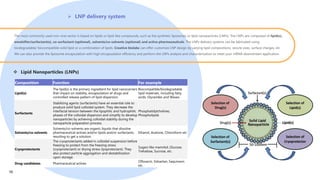
The most commonly used non-viral vector is based on lipids or lipid-like compounds, such as the synthetic liposomes or lipid nanoparticles (LNPs). The LNPs are composed of lipid(s),
emulsifier/surfactant(s), co-surfactant (optional), solvents/co-solvents (optional) and active pharmaceuticals. The LNPs delivery systems can be fabricated using
biodegradable/ biocompatible solid lipid or a combination of lipids. Creative biolabs can offer customize LNP design by varying lipid compositions, vesicle sizes, surface charges, etc.
We can also provide the liposome encapsulation with high encapsulation efficiency and perform the LNPs analysis and characterization to meet your mRNA downstream application.
 Lipid Nanoparticles (LNPs)
Composition Function For example
Lipid(s)
The lipid(s) is the primary ingredient for lipid nanocarriers
that impact on stability, encapsulation of drugs and
controlled release pattern of lipid dispersion.
Biocompatible/biodegradable
lipid materials, including fatty
acids, Glycerides and Waxes.
Surfactants
Stabilizing agents (surfactants) have an essential role to
produce solid lipid colloidal system. They decrease the
interfacial tension between the lipophilic and hydrophilic
phases of the colloidal dispersion and simplify to develop
nanoparticles by achieving colloidal stability during the
nanoparticle preparation process.
Phosphatidylcholines,
Phospholipids
Solvents/co-solvents
Solvents/co-solvents are organic liquids that dissolve
pharmaceutical actives and/or lipids and/or surfactants,
resulting to get a solution.
Ethanol, Acetone, Chloroform etc.
Cryoprotectants
The cryoprotectants added in colloidal suspension before
freezing to protect from the freezing stress
(cryoprotectant) or drying stress (lyoprotectant). They
also protect particle aggregation and destabilization
upon storage.
Sugars like mannitol, Glucose,
Trehalose, Sucrose, etc.
Drug candidates Pharmaceutical actives
Ofloxacin, Valsartan, Saquinavir,
etc.
16

LNP delivery system

  • 1.
     LNP deliverysystem The most commonly used non-viral vector is based on lipids or lipid-like compounds, such as the synthetic liposomes or lipid nanoparticles (LNPs). The LNPs are composed of lipid(s), emulsifier/surfactant(s), co-surfactant (optional), solvents/co-solvents (optional) and active pharmaceuticals. The LNPs delivery systems can be fabricated using biodegradable/ biocompatible solid lipid or a combination of lipids. Creative biolabs can offer customize LNP design by varying lipid compositions, vesicle sizes, surface charges, etc. We can also provide the liposome encapsulation with high encapsulation efficiency and perform the LNPs analysis and characterization to meet your mRNA downstream application.  Lipid Nanoparticles (LNPs) Composition Function For example Lipid(s) The lipid(s) is the primary ingredient for lipid nanocarriers that impact on stability, encapsulation of drugs and controlled release pattern of lipid dispersion. Biocompatible/biodegradable lipid materials, including fatty acids, Glycerides and Waxes. Surfactants Stabilizing agents (surfactants) have an essential role to produce solid lipid colloidal system. They decrease the interfacial tension between the lipophilic and hydrophilic phases of the colloidal dispersion and simplify to develop nanoparticles by achieving colloidal stability during the nanoparticle preparation process. Phosphatidylcholines, Phospholipids Solvents/co-solvents Solvents/co-solvents are organic liquids that dissolve pharmaceutical actives and/or lipids and/or surfactants, resulting to get a solution. Ethanol, Acetone, Chloroform etc. Cryoprotectants The cryoprotectants added in colloidal suspension before freezing to protect from the freezing stress (cryoprotectant) or drying stress (lyoprotectant). They also protect particle aggregation and destabilization upon storage. Sugars like mannitol, Glucose, Trehalose, Sucrose, etc. Drug candidates Pharmaceutical actives Ofloxacin, Valsartan, Saquinavir, etc. 16