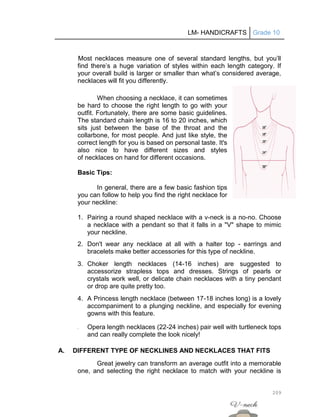
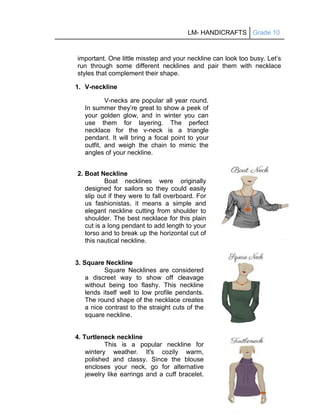
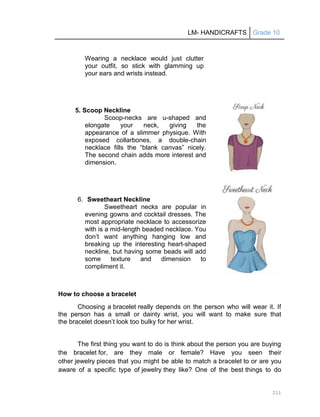
LM- HANDICRAFTS Grade 10
TABLE OF CONTENTS
Cover Page
Table of Contents
Introduction...……………………………………………………….………………
Content Standard and Performance Standard ………….………………
Objectives
Program Requirements
Learning Episodes
How to Use the Module
Diagnostic Assessment……………………………………………………........
Personal Entrepreneurial Competencies (PECs)
Environment and Market (EM)
Quarter I
Overview
Objectives
Pre-Test 1……………………………………………………………….……
Lesson 1: Perform Origami Production
LO 1 Trace the history and development of Origami
LO 2 Plan a design and pattern for an Origami
LO 3 Select materials for making Origami
LO 4 Follow methods and procedures in making Origami
LO 5 Produce the following products
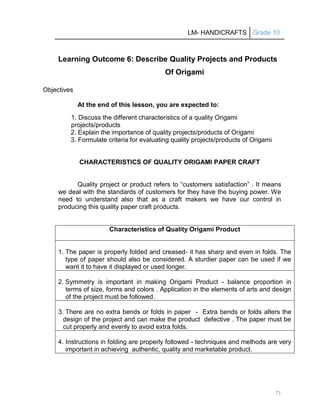
LO 6 Describe quality projects and products of Origami
LO 7 Package the finished Origami
Enhancement Activity
Post-Test 1
Quarter II
Overview
Objectives
Pre-Test 2
LM- HANDICRAFTS Grade 10
Lesson 1 Perform Paper Mache Production
LO 1 Trace the history and development of Paper
Mache
LO 2 Select materials for making Paper Mache
LO 3 Follow methods and procedures in making Paper Mache
LO 4 Produce the following products
Enhancement Activity………………………………………………………..
Post-Test 1…………………………………...……………………………….
Quarter III
Overview
Objectives
Pre-Test 3……………………………………………………………………
Lesson 1 Create Fashion Accessories
LO 1 Trace the history and development of Fashion
Accessory Production
LO 2 Enumerate different kinds of fashion accessory projects /
products
LO 3 Select materials , tools and equipment in making fashion
accessory
LO 4 Use basic tools in fashion accessory
Enhancement Activity………………………………………………………
Lesson 2 Calculate and Produce Fashion Accessory
Materials
LO 1 Identify fashion accessory cost component
Enhancement……………………………………………………………….
Post-Test 3…………………………………………………………………
Quarter IV
Overview
Objectives
Pre-Test 4…………………………………………………………....……….
LM- HANDICRAFTS Grade 10
Lesson 3 Preparation and production of fashion accessories
LO 1 Follow methods and procedures in making
fashion accessory
LO 2 Describe quality projects/ products of fashion
accessory
LO 3 Prepare packaging of finished Fashion
Accessory
LO 4 Evaluate finished product
Enhancement Activity……………………………………………………
Post-Test 4…………………….……..……………………………………
Summative Assessment………………….……………………………………..
Synthesis……………………….………………………………………………...
Glossary…………………….…………………………………………………….
References……………….……………………………………………………...
Key to Correction………………………………………………..……………….
LM- HANDICRAFTS Grade 10
Introduction
Technology and Livelihood Education (TLE) is one nomenclature in the
implementation of the K to 12 Basic Education Program (BEP). It is
composed of four components, namely, Agri-Fishery Arts, Home Economics,
Industrial Arts and Information and Communication Technology. In this
learning material, the focus is on a course in Home Economics – Handicraft
(Paper Craft and Fashion Accessory).
The course provides varied and relevant activities and opportunities to
determine your understanding of the key concepts and to demonstrate core
competencies as prescribed in TESDA Training Regulation in Handicraft.
Thus, it aims to provide quality service to target clients along side of
assessing yourself as to the aspects of business that you may consider to
strengthen and become part of the Handicraft sector.
The world of work today presents a picture of available jobs that are
getting scarcer each year. To address this reality, the Department of
Education is stretching its available resources, prioritizing needs, and
developing sustainable programs to lead and to prepare the young minds as
future skillful chef or any related job. The department further believes that it is
in honing the skills that the learner can have an edge over other job seekers.
DepEd endeavors to equip the learners with the appropriate knowledge,
attitudes, values and skills necessary to become productive citizen of our
society.
This learning material is specifically crafted to focus on the different
activities that will assess your level in terms of skills and knowledge
necessary to get a Certificate of Competency and/or National Certification.
This learning material will surely make you a certified food provider.
LM- HANDICRAFTS Grade 10
Content Standard
The learner demonstrates understanding of the core concepts and
theories in Paper Craft and Fashion Accessories.
Performance Standard
The learner independently demonstrates competencies in making
Paper craft and Fashion Accessories as prescribed in the TESDA Training
Regulation.
Objectives
Learners are expected to become proficient in performing skills on the
following competencies:
1. develop personal entrepreneurial skills;
2. perform origami production;
3. perform paper mache production;
4. create fashion accessories;
5. calculate and produce fashion accessory materials; and
6. perform preparation and production of fashion accessories.
Program Requirements
Grade 10 students who will take Handicraft course as their
specialization in Technology and Livelihood Education (TLE) – Home
Economics should have successfully taken the exploratory course in
Exploratory in Grade 7/8 and have successfully completed the competencies
indicated in Grade 9.
The student of this course must possess the following:
1. acquired skills and competencies in Grade 7/8 and Grade 9; and
2. creative and innovative skills in making different crafts.
Learners are expected to manifest a desire to further develop their
knowledge and skill in making Paper craft and Fashion Accessories .They
should have clear understanding about the different methods and techniques
in making the different crafts or projects. Learners are required to
demonstrate desirable work habits and attitudes towards the completion of
outputs.
This learner’s material should be taken for one school year for a total
of 160 hours. Lessons should be taken one at a time, following the correct
LM- HANDICRAFTS Grade 10
sequence being presented and should accomplish the assessment or
enhancement activities before proceeding to the next lesson.
Along the learning process, learners of this course are required to
complete the 25-hour industry involvement to different food services to
experience the actual workplace.
Learning Episodes
This learning resource is subdivided into four (4) quarters which may
serve as the recommended scope and limit for every academic grading
period. Every quarter, there are lessons that comprise the learning outcomes.
Before exploring the core competencies of Handicraft, you will be
guided on how to assess your own Personal Entrepreneurial Competencies
and Skills (PECS) and let you demonstrate your understanding about the
Environment and Market.
Quarter I includes Quarter 1 covers the preparation and production of
paper craft items specifically on Origami. Basic steps on origami making were
provided as foundation in making complex projects. Varieties of origami
products will also be introduced. Hence, teachers are encourage to dig more
deeper and continuously search for the updated and latest articles to keep the
learners cope up with the new trends. Activities and project making are also
presented allowing the learners to practice their acquired skills.
Quarter II has the continuation of the preparation and production of
paper craft specifically on Paper Mache. Accuracy, resourcefulness, patience
and creativity are skills emphasize in the project. Production of Paper Mache
and other paper craft products is the learner’s and teacher’s choice or option.
In undertaking any handicraft activity it is recommended to be aware of the
safety and sanitary requirements.
Quarter III covers focuses on the production of fashion accessories
specifically on earrings, necklaces, rings, bracelets, headbands (for female)
and belts for both male and female. To gain interest each fashion accessory
will include to create fine projects or products.
Quarter IV is the continuation on the preparation and production of
fashion accessories to further enhance the creativity of the learner through
the different activities and projects provided.
Good luck and use this learning material as your guide to become a
successful Handicraft worker provider in the future.
LM- HANDICRAFTS Grade 10
HOW TO USE THIS LEARNING MATERIAL?
Here are some reminders on how to use this material.
1. Answer the diagnostic assessment before you proceed to the different
activities. The diagnostic assessment determines how much you know
about the lessons and identifies the areas you ought to learn more. Your
teacher will check and analyze your score to determine your learning
needs.
2. This learner’s material contains relevant information and activities. Go
over each activity carefully. If you encounter difficulties, do not hesitate to
consult your teacher for assistance. Do not skip any topic unless you are
told to do so. REMEMBER that each activity is a preparation for the
succeeding activities.
3. For every lesson/learning outcomes, perform the enhancement activities
to enrich the knowledge and skills.
4. After successfully finished the tasks, answer the post-test to be given by
your teacher. Your score will be analyzed and will be used by your
teacher for the computation of your grades.
5. Lastly, DO NOT marks the learner’s material in any way.
LM- HANDICRAFTS Grade 10
1
A. Multiple Choice
Direction: Read the statements carefully and write the letter of your
best choice in your answer sheet.
1. The origin of Origami in Japan comes from the country of _______.
a.Germany c. China
b.Russia d. Korea
2. This was described as an era were Origami have rapidly gain recognition.
a. Genruko c. Edo
b. Showa d. Shinto
3. This is referred to as a paper used in Origami
a. Kami c. Ukiyue
b. Noshi d. Washi
4. This is referred as a rectangular sheet of paper in half along the short side.
a. Burito c. Shutter
b. Hotdog d. Taco
5. This is described as to fold the corner of a sheet of paper over to create a
triangle.
a. Hotdog c. Taco
b. Shutter d. Valley
6. This is a fold which has to find the midpoint on a piece of paper then fold
eachside to meet that point.
a. Burito c. Shutter
b. Hotdog d. Taco
7. This was referred to as a fold that must roll the page up without creating a
crease in the paper.
a.Burito c.Shutter
b. Hotdog d.Valley
8. This is arectangular fold that has sides that rise up from the center fold.
a. Hamburger c.Shutter
b. Hotdog d.Valley
DIAGNOSTIC ASSESSMENT
LM- HANDICRAFTS Grade 10
2
9. Described as a rectangular sheet of paper in half along the short side.
a. Hamburger c.Shutter
b. Hotdog d.Valley
10. Hamburger fold is a rectangular sheet of paper in half along the long side.
a. Hamburger c.Shutter
b. Hotdog d.Valley
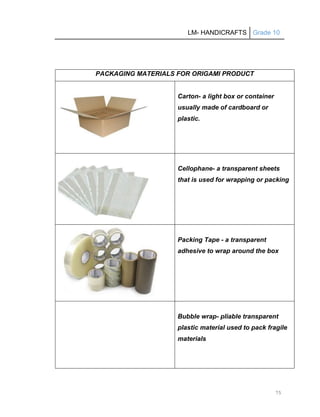
11. A material for packaging as a light box or container usually made of
cardboard or plastic.
a. bag c. pouch
b. carton d. storage container
12. Pliable transparent plastic material used to pack fragile materials
a. bubble wrap c. plastic Wrap
b. cellulose Plastic d. styrofoam
13.The most common paper craft method were strips of paper is soaked in
glue and added to a mold layer by layer.
a.cutting c. layering
b. folding d. pulping
14. In pulp method ,this is the reason of using fabric conditioner in procedure.
a. for scented purposes c. to separate the fiber
b. for cleaning the paper d. to soften the paper
15. A cellulose wallpaper paste which comes as granules which are
mixedwith water.
a.Flour and Water paste c. PVA adhesive
b.Glue d. Wallpaper paste
16. Referred to as method used modeling clay for making Paper Mache.
a.cutting c. layering
b.folding d. pulping
17.A cut thick cardboard and removed sharp edges.
a. cutter c. razor
b. knives d. scissor
18. These are water-mixable materials which have been used for decorating
the product.
a. Acrylic paints c. Latex Paints
b. Emulsion paints d. Varnishes
19. Described as a multi-purpose, easy-to-use adhesive which can be
usedboth as a glue and a vanish. Although white, when dries it is
transparent and, as a finish, gives a glossy, protective
a.flour and Water pastec. PVA adhesive
b.glue d. wallpaper paste
20. A paint uses water based as an undercoat before decoration.
a. acrylic paints c. latex Paints
b. emulsion paints d. varnishes
LM- HANDICRAFTS Grade 10
3
21. A paint described as to make the product gloss, satin or matte finish.
a. Acrylic paints c. Latex Paints
b. Emulsion paints d. Varnishes
22. Paper Mache originated from China during the _____Dynasty
a. Chang c. Hun
b. Han d. Sung
23. This is the early time which paper mache was used to make two
dimensional objects such
a. Armor c. Pots
b. Helmet d. Spears
24. This was described as the material used in paper mache as a basic
structure and surface decoration
a. Box c. Plywood
b. Cardboard d. Waxed paper
25. Which of the following is the BEST definition of fashion?
a. Refers to the latest trend in clothing
b. It is one way of expressing who you are and wanted to be as a person
c. It is about how you carry one’s dress and accessories.
d. It is changing and it does not prevails one’s personality
26. In the Philippines, which definition of Fashion was practice?
a. Culture c. Trending
b. Individual’s Preference d. Western Influences
27. A fashionable items like necklace, bracelets, earrings and brooch have
long been used to add stylish touches to all types of outfits.
a. Finishing Touches c. Hand Coverings
b. Footwear d. Jewelry
28. Which fashion accessories refers to boots and shoes served as practical
function?
a. Footwear c. Head wear
b. Hand Coverings d. Jewelry
29. An accessories refers to as belts and buckles as well as necktie and
Neckwear is called_____________.
a. Finishing Touches c. Hand Covering
b. Footwear d. Head wear
30. This is refers to all jewelry made from precious metal and semi-precious
stones
a. Fashion Costume Jewelry c. Precious Jewelry
b. Fine Jewelry d. Semi-precious Jewelry
31. An ornament which was first attached through the ear lobe
a. Bracelet c. Earrings
b. Brooches d. Necklace
LM- HANDICRAFTS Grade 10
4
32. Which ornament that is held by pins and clasp and usually worn near
to neck?
a. Bracelet c. Earrings
b. Brooches d. Necklace
33. This is refers to an article which is usually worn around the neck.
a. Bracelet c. Earrings
b. Brooches d. Necklace
34. This was described as a non-toxic material that can be sculpted, molded
and air dry to a hard finish
a. Beads c. Paper Clay
b. Coco shells d. Seeds
35. This is referred to as Fashion accessories material which is made from
metal and a necessity in jewelry making.
a. Leather c. Thread
b. Rattail d. Wire
36.This is a crucial material in jewelry making because of its wide variety of
shapes,designs and uses which comes from gemstone to metal
a. Beads c. Plastics
b. Paper clay d. Polymer Clay
37. This is described as the iridescent whitish coating inside oyster shells. It
is often used for studs, buttons, inexpensive jewelry, and carved jewelry.
a. Coco shells c. Mother of Pearl
b. Glass Beads d. Paper Clay
38. Which material of fashion accessories used to join jewelry components
together in completing the article or product
a. Findings c. Thread
b. Rattail d. Wire
39. This is used to cut paper, fabric or thread ends
a. Craft Cutter c. Pliers
b. Knife d. Scissor
40. This is an invaluable tool for stringing the beads as they easily secure
crimps
a. Chain- Nose Plier c. Curved-chain nose plier
b. Crimping Pliers d. Flush Cutter
41. Which needle are made from thin wires with a sharp point at one end a
narrow eye on the other end?
a. Beading Needle c. Embroidery Needle
b. Crewel Needle d. Tapestry Needle
41. This is referred to as for picking up tiny beads or for holding in one hand
while applying glue
a. Holder c. Tong
c. Puller d. Tweezer
LM- HANDICRAFTS Grade 10
5
42. This is used to keep beads and other small materials and findings
a. Bags c. Cellophane
b. Box d. Storage Box
43. Which material comes in various thickness and made of gold plated or
silver, surgical steel or colored wire?
a. Elastic Cord c. Nylon Cord
b. Monofilament d. Wire and Chain
44. This is Defined as buying or acquiring of goods or materials to make an
article or product.
a. Enrolling c. Purchasing
b. Licensing d. Selling
45. This is specified as the materials that you are going to acquire
a. Item c. Quantity
b. Name d. Unit Cost
46. This serves as an indicator of how many items are you going to buy
a. Item c. Quantity
b. Name d. Unit Cost
47. It is refers to all jewelry made from other metals, including precious silver,
or from unusual materials ( wood, glass, beads etc.) and semi-precious
or imitation gems.
a. Fine jewelry
b. Fashion Costume Jewelry
c. Precious Jewelry
d. Semi-precious Jewelry
48. What is the simplest type of earrings.
a. Drop c. Hoop
b. Hook d. Stud
49. This is a type of ear back that is more secure stud earring back
ascompare to the one that slides on the post.
a. Fish Hook c. Lever
b. French Hook d. Screw
50. This is a neckline that is best for long pendant to add length to your torso
and to break up the horizontal cut of the nautical neckline.
a. Boat c. Square
b. Heart d. Turtle
LM- HANDICRAFTS Grade 10
6
Personal Entrepreneurial Competencies (PECs)
Content Standards Performance Standards
The learner demonstrates
understanding of one’s PECs in
Handicraft.
The learner independently creates a
plan of action that strengthens
and/or further develops his/her
PECs in Handicraft.
Quarter I Time Allotment: 4 hours
Module 1
Personal Entrepreneurial Competencies
Introduction
In this module, you will learn more about entrepreneurship and the
entrepreneurial competencies related to Handicraft. You will have a first-hand
experience in educational activities leading to assessment of your personal
entrepreneurial competencies (PECs) and the entrepreneurial competencies
of a successful craftsman within your province. You will also have several
activities that will align your competencies with those of successful
practitioners. Moreover, this module will encourage you to think about
entrepreneurship and its role in the business community as well as in the
economic and social development of an individual.
To start with this module, let us first understand entrepreneurs and
entrepreneurship.
Entrepreneurs are those with the skills and capabilities to see and
evaluate business opportunities. They are individuals who can strategically
identify products or services needed by the community, and have the capacity
to deliver them at the right time and at the right place.
Entrepreneurs are agents of economic change; they organize,
manage, and assume risks of a business. Some of the good qualities of
LM- HANDICRAFTS Grade 10
7
entrepreneurs are: opportunity-seeker, risk-taker, goal-setter, excellent
planner, confident problem-solver, hardworking, persistent and committed.
Entrepreneurship, on the other hand, is not just a simple business
activity but a strategic process of innovation and new product creation.
Basically, entrepreneurship is both an art and science of converting business
ideas into marketable products or services to improve the quality of living.
Now that you have background knowledge about entrepreneurs and
entrepreneurship, you can now walk through in assessing your PECs. Always
remember that successful entrepreneurs continuously develop and improve
their PECs.
To begin, let us find out the competencies you will have gained upon
completion of this module.
Objectives
At the end of this module, you are expected to:
 identify areas for improvement, development, and growth,
 align your PECs according to your business or career choice, and
 create a plan of action that ensures success in your business or career
choice.
Now try to take the first challenge in this module, the pre assessment.
Pre-assessment
As part of your initial activity, try to assess your prior knowledge and
experience related to personal entrepreneurial competencies. Answer Task 1.
Task 1: Matching Type
Directions: Match the entrepreneurial competencies in column A with
their meaning in column B. Write the letter of the correct answer on the
space provided before each number.
A B
____1. Creative A. makes wise decisions towards the set
LM- HANDICRAFTS Grade 10
8
objectives
____2. Profit-oriented B. strategic thinking and setting of goals
____3. Disciplined C. trusting in one’s ability
____4. Sound decision maker D. adoptable to change
____5. Possess people skills E. innovates to have an edge over other
competitors
____6. Excellent Planner F. solid dedication
____7. Confident G. skillful in record keeping
____8. Hardworking H. always sticks to the plan
____9. Ability to accept change I. work diligently
____10. Committed J. effective and efficient communication
skills and relates well to people
K. always looking for an opportunity to
have/earn income.
Task 2: Guide Questions
Directions: The following are guide questions which covers the entire
module. Write your answers on your assignment notebook. Discuss / share
these to the class.
A. Explain why entrepreneurial activities are important to social
development and economy progress.
B. What entrepreneurial activities related to Handicraft do you know and
are capable of doing?
C. If you were given the opportunity to own a business that relates to
Handicraft, do you think you will be confident to manage it? Explain
your answer.
D. What do you think are the most important competencies one must
possess in order to be successful in running a chosen business?
LM- HANDICRAFTS Grade 10
9
E. Name successful entrepreneurs from your province whose businesses
are related to Handicraft. Make sure you will be able to share with the
class the PECs that made them successful.
After all the guide questions are answered, share these with your
classmates. You may also compare your insigths, personal knowledge,
and relevant experiences on the topic to make the sharing more exciting
and engaging.
Learning Goals and Targets
After understanding the objectives of this module, having gone through
pre-assessment, and answering the guide questions, you will be asked to set
your own personal goals and targets. These goals and targets will urge you to
further achieve the ultimate objective of this module. In the end, these
ultimate goals will motivate you to learn more about PECs.
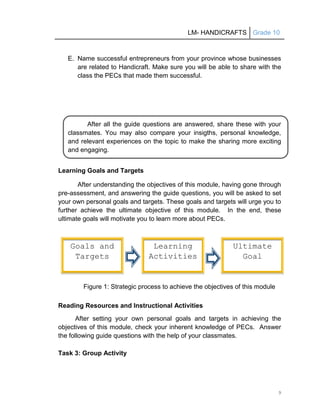
Figure 1: Strategic process to achieve the objectives of this module
Reading Resources and Instructional Activities
After setting your own personal goals and targets in achieving the
objectives of this module, check your inherent knowledge of PECs. Answer
the following guide questions with the help of your classmates.
Task 3: Group Activity
Goals and
Targets
Learning
Activities
Ultimate
Goal
LM- HANDICRAFTS Grade 10
10
Directions: Answer the following guide questions on a separate sheet of
paper. Share your answers with the class.
1. Explain the importance of assessing one’s PECs before engaging in a
particular entrepreneurial activity.
_________________________________________________________
_________________________________________________________
________________________________________________________.
2. Are there other strategies or approaches where you can assess your
PECs? Explain how these strategies will become more useful in
selecting a viable business venture.
_________________________________________________________
_________________________________________________________
________________________________________________________.
3. What are the desirable personal characteristics, attributes, lifestyles,
skills, and traits of a prospective entrepreneur? Why are these
important?
_________________________________________________________
_________________________________________________________
________________________________________________________.
4. Why is there a need to assess one’s PECs in terms of characteristics,
attributes, lifestyles, skills, and traits before starting a particular
business?
_________________________________________________________
_________________________________________________________
________________________________________________________.
5. What is the significance of evaluating PECs of a successful
entrepreneur? What helpful insights can you draw from this activity?
________________________________________________________
________________________________________________________
________________________________________________________.
LM- HANDICRAFTS Grade 10
11
How was your experience in answering the guide questions with your
classmates? Were you able to benefit from them? What were the insights you
have realized?
This time you’re going to study the different topics that will enrich your
knowledge of PECs. Read all the important details about the succeeding
topic carefully.
Assessment of Personal Entrepreneurial Competencies (PECs) and
Skills vis-à-vis a Practicing Entrepreneur in a Province
Entrepreneurial competencies refer to the important characteristics that
should be possessed by an individual in order to perform entrepreneurial
functions effectively. In this module, you will learn some of the most important
characteristics, attributes, lifestyle, skills and traits of a successful
entrepreneur or an employee to be successful in a chosen career.
Below are few important characteristics / traits / attributes of a good
entrepreneur:
 Hardworking: One of the important characteristics of a good
entrepreneur is hardworking. This means working diligently and
being consistent about it. Hardworking people keep improving their
performance to produce good products and/or provide good
services.
 Confident: Entrepreneurs have self-reliance in one’s ability and
judgment. They exhibit self-confidence to cope with the risks of
operating their own business.
 Disciplined: Successful entrepreneurs always stick to the plan
and fight the temptation to do what is unimportant.
Know
LM- HANDICRAFTS Grade 10
12
 Committed: Good entrepreneurs assume full responsibility over
their business. They give full commitment and solid dedication to
make the business successful.
 Ability to accept change: Nothing is permanent but change.
Change occurs frequently. When you own a business, you should
cope with and thrive on changes. Capitalize on positive changes
to make your business grow.
 Creative: An entrepreneur should be creative and innovative to
stay in the business and in order to have an edge over the other
competitors.
 Has the initiative: An entrepreneur takes the initiative. You must
put yourself in a position where you are responsible for the failure
or success of your business.
 Profit-oriented: An entrepreneur enters the world of business to
generate profit or additional income. The business shall become
your bread and butter. Therefore, you must see to it that the
business can generate income.
Listed below are the important skills of a successful entrepreneur:
 Excellent planner: Planning involves strategic thinking and goal
setting to achieve objectives by carefully maximizing all the
available resources. A good entrepreneur develops and follows the
steps in the plans diligently to realize goals. A good entrepreneur
knows that planning is an effective skill only when combined with
action.
 Possesses people skills: This is a very important skill needed to
be successful in any kind of business. People skills refer to
effective and efficient communication and establishing good
relationship to the people working in and out of your business. In
day-to-day business transactions, you need to deal with people. A
well-developed interpersonal skill can make a huge difference
between success and failure of the business.
LM- HANDICRAFTS Grade 10
13
 Sound decision maker: Successful entrepreneurs have the ability
to think quickly and to make wise decisions towards a
pre-determined set of objectives. No one can deny that the ability
to make wise decisions is an important skill that an entrepreneur
should possess. Sound decisions should be based on given facts
and information and lead towards the pre-determined objectives.
To firm up what you have learned and have a better appreciation of the
different entrepreneurial competencies, read the PECs checklist below, then
answer the same.
Task 4: PECs Checklist
Directions: Using the PECs checklist, assess yourself by putting a check
( ) mark in either strengths or development areas column. Interpret the
results by counting the total number of check marks in each of the columns.
After accomplishing the checklist, form a group and share your insights on the
result of the personal assessment.
Table 1: PECs Checklist
Personal Entrepreneurial Competencies
(PECs) of an Entrepreneur
Personal Assessment in terms
of:
Strengths Development
Areas
Hardworking
Works diligently
Confident
Self-reliance in one’s ability
Disciplined
Always stick to the plan
Committed
Process
LM- HANDICRAFTS Grade 10
14
Solid dedication
Ability to accept changes
Adaptable
Creative
Innovative to have edge over other
competitors
Profit-oriented
Always looking for an opportunity to
have/earn income
Excellent planner
Strategic thinking and setting of
goals
Possess people skill
Effective and efficient communication
skills and relates well to people
Sound decision maker
Makes wise decisions towards the
set objectives
TOTAL
Interpretation or Insight:
_____________________________________________________________________
_____________________________________________________________________
_____________________________________________________________________
_____________________________________________________________________
_____________________________________________________________________
_____________________________________________________________________
__________.
Reflect and Understand
LM- HANDICRAFTS Grade 10
15
How was your experience in discovering the strengths and the areas
you need to develop? Did you gain a valuable experience in exchanging
insights with your classmates? To learn more and deepen your understanding
of PECs, do task 5 below.
Task 5: Interview
Directions: In your province, interview a successful craftsman or
entrepreneur whose type of business is related with handicraft. Focus your
questions on PECs and other business-related attributes that helped them
become successful. Analyze the results of the interview and reflect on the
similarities and/or differences. Write your answer on a separate sheet of
paper.
Sample Interview Guide
Name of Proprietor/Practitioner: ____________________________________
Age: _______________ Number of Years in Business: _________________
Business Name: ________________________________________________
Business Address: ______________________________________________
1. What preparations did you make before you engaged in this type of
business or job?
________________________________________________________
________________________________________________________
_______________________________________________________.
2. What special skills and characteristics do you have that are related
with your business or job?
________________________________________________________
________________________________________________________
_______________________________________________________.
3. How did you solve business-related problems during the early years of
your business operation?
LM- HANDICRAFTS Grade 10
16
________________________________________________________
________________________________________________________
_______________________________________________________.
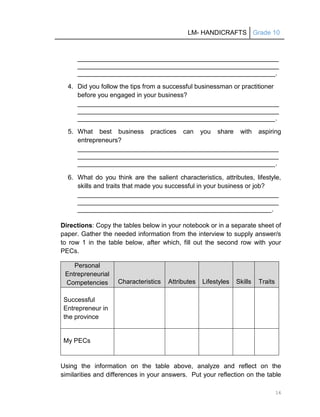
4. Did you follow the tips from a successful businessman or practitioner
before you engaged in your business?
________________________________________________________
________________________________________________________
_______________________________________________________.
5. What best business practices can you share with aspiring
entrepreneurs?
________________________________________________________
________________________________________________________
_______________________________________________________.
6. What do you think are the salient characteristics, attributes, lifestyle,
skills and traits that made you successful in your business or job?
________________________________________________________
________________________________________________________
______________________________________________________.
Directions: Copy the tables below in your notebook or in a separate sheet of
paper. Gather the needed information from the interview to supply answer/s
to row 1 in the table below, after which, fill out the second row with your
PECs.
Personal
Entrepreneurial
Competencies Characteristics Attributes Lifestyles Skills Traits
Successful
Entrepreneur in
the province
My PECs
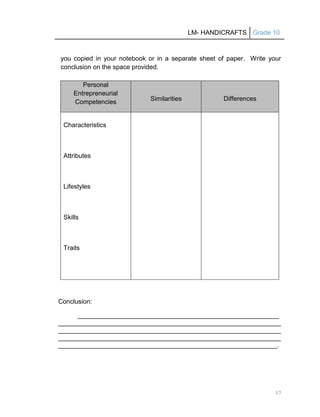
Using the information on the table above, analyze and reflect on the
similarities and differences in your answers. Put your reflection on the table
LM- HANDICRAFTS Grade 10
17
you copied in your notebook or in a separate sheet of paper. Write your
conclusion on the space provided.
Personal
Entrepreneurial
Competencies Similarities Differences
Characteristics
Attributes
Lifestyles
Skills
Traits
Conclusion:
________________________________________________________
______________________________________________________________
______________________________________________________________
______________________________________________________________
_____________________________________________________________.
LM- HANDICRAFTS Grade 10
18
After performing the activities on the importance of PECs, let’s
determine how much you have learned. Perform task 6 to determine how well
you have understood the lesson.
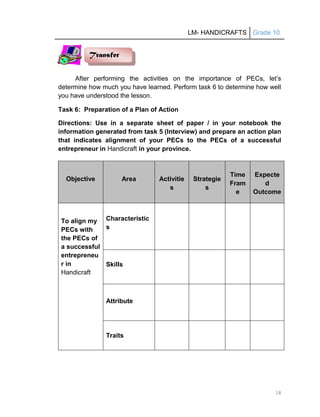
Task 6: Preparation of a Plan of Action
Directions: Use in a separate sheet of paper / in your notebook the
information generated from task 5 (Interview) and prepare an action plan
that indicates alignment of your PECs to the PECs of a successful
entrepreneur in Handicraft in your province.
Objective Area Activitie
s
Strategie
s
Time
Fram
e
Expecte
d
Outcome
To align my
PECs with
the PECs of
a successful
entrepreneu
r in
Handicraft
Characteristic
s
Skills
Attribute
Traits
Transfer
LM- HANDICRAFTS Grade 10
19
Task 7: Essential Questions
Directions: Read and study the following questions below. You may use a
separate sheet of paper or your notebook to write your answers.
1. Why is there a need to compare and align one’s PECs with the PECs
of a successful entrepreneur?
________________________________________________________
________________________________________________________
________________________________________________________
________________________________________________________
________________________________________________________
________________________________________________________
________________________________________________________
_______________________________________________________.
2. How does your action plan help sustain your strong PECs and/or
address your development areas?
________________________________________________________
________________________________________________________
________________________________________________________
________________________________________________________
________________________________________________________
________________________________________________________
________________________________________________________
_______________________________________________________.
3. What plan of action will you utilize to address your development areas?
________________________________________________________
________________________________________________________
________________________________________________________
________________________________________________________
________________________________________________________
________________________________________________________
________________________________________________________
_______________________________________________________.
LM- HANDICRAFTS Grade 10
20
ENVIRONMENT AND MARKET (EM)
Content Standards Performance Standards
The learner demonstrates
understanding of environment and
market in Handicraft in one’s
province.
The learner independently creates a
business vicinity map reflective of
potential market in Handicraft in a
province.
Quarter I Time Allotment: 4 hours
Module 2
Environment and Market
Introduction
Aspiring entrepreneur need to explore the economic, cultural, and
social conditions prevailing in an area. Needs and wants of the people in a
certain area that are not met may be considered business opportunities.
Identifying the needs of the community, its resources, available raw materials,
skills, and appropriate technology can help a new entrepreneur seize
business opportunities.
To be successful in any kind of business venture, potential
entrepreneurs should look closely at the environment and market. They
should always be watchful of existing opportunities and constraints, and to
take calculated risks. The opportunities in the business environment are
factors that provide possibilities for a business to expand and make more
profit. Constraints, on the other hand, are factors that limit business growth,
hence reduce the chance of generating profit. One of the best ways to
evaluate opportunities and constraints is to conduct a Strengths,
Weaknesses, Opportunities and Threats (SWOT) Analysis.
SWOT Analysis is a managerial tool used to assess the environment. It
is used to gather important information which is then used in strategic
LM- HANDICRAFTS Grade 10
21
planning. Strengths and weaknesses are internal in an organization. They
relate to resources owned by an organization that you have control over and
also the extent of its marketing.
Opportunities and threats exist in the external environment.
Opportunities relate to the market, new technologies, and the external factors
such as government policies, climate, and trends. Threats replace what the
competitors are doing. It also includes legal and other constraints.
Now that you have read some important considerations to explore to
be successful in any business, you are now ready to explore more about the
environment and market.
To begin with, let’s find out the competencies that you will master as
you finish this module.
Objectives
At the end of this module, you are expected to:
 identify what is of ―value‖ to the customer,
 identify the customer to sell to,
 explain what makes a product unique and competitive,
 apply creativity and innovative techniques to develop marketable
products, and
 employ a unique selling proposition (USP) to a product
and/or service.
Now that you have an idea about the things you will learn, take the first
challenge in this module – the pre-assessment.
LM- HANDICRAFTS Grade 10
22
Pre-assessment
Task 1: Multiple Choice
DIRECTIONS: Choose the letter of the best answer. Write your answer on a
separate sheet of paper.
1. It is generated by examining the goods and services sold in the
community.
A. business creation C. business concept
B. business pricing D. business idea
2. It is a process of making new products which will be sold to the
customers.
A. product analysis C. product
development
B. product conceptualization D. product
implementation
3. These are luxuries, advantages and desires that every individual
considers beyond necessary.
A. wants C. requirements
B. desires D. needs
4. It is a factor or consideration presented by a seller as the reason that a
product or service is different from and better than that of the
competition.
A. unique selling plan C. unique pricing
policy
B. unique selling proposition D. finding value-added
5. A stage in which the needs of the target market are identified,
reviewed, and evaluated.
A. concept development C. project development
B. economic analysis D. refine specification
6. It is the introduction of new ideas to make the product and services
more attractive and saleable to the target customers.
A. new idea C. product development
B. creativity D. innovation
7. It is a managerial tool used to assess the environment and to gather
important information that can be used for strategic planning.
A. scanning C. WOTS Analysis
B. SWOT Analysis D. survey analysis
LM- HANDICRAFTS Grade 10
23
8. It is creating names, symbol, or designs that identifies and
differentiates a product from the other products.
A. product naming C. branding
B. unique selling proposition D. tagline
9. It is a meaningful and unforgettable statement that captures the
essence of the brand.
A. product naming C. branding
B. unique selling proposition D. tagline
10. These are things that people cannot live without.
A. wants C. requirements
B. desires D. needs
Task 2: Guide Questions:
Directions: Read and study the guide questions below. Use a separate
sheet of paper to write your answer.
1. How does one determine the product or services to be produced
and/or to be provided to the target customers?
________________________________________________________
________________________________________________________
________________________________________________________
2. How does one select an entrepreneurial activity?
________________________________________________________
________________________________________________________
________________________________________________________
3. When can one say that a certain product has ―value?‖
________________________________________________________
________________________________________________________
________________________________________________________
4. Does applying creativity to your product or services important? Why?
________________________________________________________
________________________________________________________
________________________________________________________
LM- HANDICRAFTS Grade 10
24
5. How can one effectively respond to the needs of the target customer?
________________________________________________________
________________________________________________________
________________________________________________________
6. From the viewpoint of business owner, discuss the importance of
scanning the environment and market in generating business ideas.
________________________________________________________
________________________________________________________
________________________________________________________
7. Using self-assessment, explain the level of your confidence in
formulating a business idea.
________________________________________________________
________________________________________________________
________________________________________________________
After all the guide questions are answered and skills have been
mastered, share insights/ideas with your classmates. Discuss your insights,
personal knowledge, and relevant experiences on the topic to make it more
exciting and engaging.
Learning Goals and Target
After reading and understanding the objectives of this module and
having gone through the pre-assessment and guide questions, you will be
asked to set your own personal goals. These goals will urge you to further
achieve the ultimate objective of this module. In the end, these goals will
motivate you to learn more about environment and market.
Goals and
Targets
Learning
Activities
Ultimate
Goal
LM- HANDICRAFTS Grade 10
25
Figure 2: Strategic process to reach the objectives of this module
Reading Resources and Instructional Activities
After setting your own personal goals and targets in achieving the
objectives of this module, you will have the opportunity to read and learn
more about environment and market. You will also be given a chance to do
practical exercises and activities to deepen your understanding of the topic.
Product Development
When we talk of product development, we are referring to a process of
making a new product to be sold by a business or enterprise to its customers.
Product development may involve modification of an existing product or
its presentation, or formulation of an entirely new product that satisfies a
newly-defined customer’s needs, wants and/or a market place.
The term development in this module refers collectively to the entire
process of identifying a market opportunity, creating a product to appeal to
the identified market, and testing, modifying, and refining the product until it
becomes ready for production.
There are basic, yet vital questions that you can ask yourself about
product development. When you find acceptable answers to them, you may
now say that you are ready to develop a product and/or render services.
These questions include the following:
1. For whom are the product/services aimed at?
2. What benefit will the customers expect from product/service?
3. How will the product/service differ from the existing brand? From
its competitor?
In addition, needs and wants of the people within an area should also
be taken into big consideration. Everyone has his/her own needs and wants.
However, each person has different concepts of needs and wants. Needs in
Know
LM- HANDICRAFTS Grade 10
26
business are the important things that an individual cannot live without in a
society. These include:
1. basic commodities for consumption,
2. clothing and other personal belongings,
3. shelter, sanitation and health, and
4. education.
Basic needs are essential to an individual to live with dignity and pride
in a community. These needs can obviously help you generate business
ideas and subsequently to product development.
Wants are desires, luxury and extravagance that signify wealth and
expensive way of living. Wants or desires are considered above all the basic
necessities of life. Some examples of wants or desires are: fashion
accessories, expensive shoes and clothes, travels, eating in an expensive
restaurant, watching movies, concerts, having luxurious cars, wearing
expensive jewelry and perfume, living in impressive homes, among others.
Needs and wants of people are the basic indicators of the kind of
business that you may engage in because it can serve as the measure of
your success. Some other points that might be considered in business
undertakings are the kind of people, their needs, wants, lifestyle, culture and
tradition, and their social orientation.
To summarize, product development entirely depends on the needs
and wants of the customers. Another important issue to deal with is the key
concepts of developing a product. The succeeding topic shall enlighten you
about the procedure in coming up with a product.
Concepts of Developing a Product
Concept development is a critical phase in the development of a
product. In this stage, the needs of the target market are identified, and
competitive products are reviewed before the product specifications are
defined. The product concept is selected along with an economic analysis to
come up with an outline of how a product is being developed. Figure 3 shows
the stages of concept development of a product.
LM- HANDICRAFTS Grade 10
27
Figure 3: Stages of Concept Development
The process of product development follows the following stages:
1. Identify customer needs: Using survey forms, interviews,
researches, focus group discussions, and observations, an entrepreneur
can easily identify customers’ needs and wants. In this stage, the
information that can be possibly gathered are product specifications
(performance, taste, size, color, shape, life span of the product, etc.).
This stage is very important because it would determine the product to
be produced or provided.
Concept
Development
Identify
Customer
Needs
Plan
Remaining
Developme
nt
Project
Establish
Target
Specifica
tions
Generate
Product
Concepts
Select a
Product
Concept
Analyze
Competiti
ve
Products
Refine
Specificat
ions
Perform
Economic
Analysis
LM- HANDICRAFTS Grade 10
28
2. Establish target specifications: Based on customers' needs
and reviews of competitive products, you can now establish target
specifications of the prospective new product and/or services. A target
specification is essentially a wish-list.
3. Analyze competitive products: It is imperative to analyze
existing competitive products to provide important information in
establishing product or service specifications. Other products may
exhibit successful design attributes that should be emulated or improved
upon in the new product or service.
4. Generate product concepts: After having gone through with
the previous processes, you may now develop a number of product
concepts to illustrate the types of products or services that are
technically feasible and will best meet the requirements of the target
specifications.
5. Select a product concept: Through the process of evaluation
between attributes, a final concept is selected. After the final selection,
additional market research can be applied to obtain feedback from
certain key customers.
6. Refine product specifications: In this stage, product or
services specifications are refined on the basis of input from the
foregoing activities. Final specifications are the result of extensive study,
expected service life, projected selling price among others are being
considered in this stage.
7. Perform economic analysis: Throughout the process of
product development, it is very important to always review and estimate
the economic implications regarding development expenses,
manufacturing costs, and selling price of the product or services to be
offered or provided.
8. Plan the remaining development project: In this final stage of
concept development, you can prepare a detailed development plan
which includes list of activities, necessary resources and expenses, and
development schedule with milestones for tracking progress.
Finding Value
LM- HANDICRAFTS Grade 10
29
People buy for a reason. There should be something in your product or
service that would give consumers a good reason to go back and buy more.
There must be something that will make you the best option for target
customers; otherwise, they have no reason to buy what you are selling. This
implies further, that you offer something to your customers that will make
them value your product or service.
The value you incorporate in your product is called value proposition.
Value proposition is a believable collection of the most persuasive reasons
why people should notice you and take the action you’re asking for. It is what
gets people moving, what makes people spend for your product or service.
Innovation
Innovation is the introduction of something new in your product or
service. This may be a new idea, a new method, or a new device. If you want
to increase your sales and profit, you must innovate. Some of the possible
innovations for your products are change of packaging, improvement of taste,
color, size, shape, and perhaps price. Some of the possible innovations in
providing services are application of new and improved methods, additional
featured services, and possibly freebies.
Unique Selling Proposition (USP)
Unique Selling Proposition is the factor or consideration presented by a
seller as the reason that one product or service is different from and better
than that of the competition. Before you can begin to sell your product or
service to your target customers, you have to sell yourself in it. This is
especially important when your product or service is similar to your
competitors.
USP requires careful analysis of other businesses' ads and marketing
messages. If you analyze what they say or what they sell, not just their
product or service characteristics, you can learn a great deal about how
companies distinguish themselves from competitors.
Here's how to discover your USP and how to use it to increase your sales and
profit:
LM- HANDICRAFTS Grade 10
30
 Use empathy: Put yourself in the shoes of your customers. Always
focus on the needs of the target customers and forget falling in love
with your own product or service. Always remember, you are
making/providing this product not for yourself but for the target
customers to eventually increase sales and earn profit. Essential
question such as what could make them come back and ignore
competition, should be asked to oneself. Most possible answers may
be focused on quality, availability, convenience, cleanliness, and
reliability of the product or service.
 Identify customer’s desires. It is very important for you to understand
and find out what drives and motivates your customers to buy your
product or service. Make some effort to find out, analyze and utilize the
information that motivates the customers in their decision to purchase
the product or service.
 Discover customer’s genuine reasons for buying the product.
Information is very important in decision making. A competitive
entrepreneur always improve their products or services to provide
satisfaction and of course retention of customers. As your business
grows, you should always consider the process of asking your
customers important information and questions that you can use to
improve your product or service.
To enhance your understanding of the topic previously presented, you
will be tasked to form a group and arrange an interview with a successful
entrepreneur or practitioner. You have to document this interview and present
this to the whole class for reflection and appreciation.
Task 3: Interview
Directions: Select a successful entrepreneur or practitioner. Conduct an
interview using the set of questions below. Document the interview and
present it to the class. Use a separate sheet of paper.
1. How did you identify your customers?
Process
LM- HANDICRAFTS Grade 10
31
________________________________________________________
________________________________________________________
________________________________________________________
2. What were your considerations in selecting your customers?
________________________________________________________
________________________________________________________
________________________________________________________
3. Explain how your product or service became unique to other products.
________________________________________________________
________________________________________________________
________________________________________________________
4. Did you consult somebody before you engaged in this business?
Cite / give sample insights that you gained from the consultation.
________________________________________________________
________________________________________________________
________________________________________________________
5. What were your preparations before you started the actual business?
________________________________________________________
________________________________________________________
________________________________________________________
6. What creative and innovative techniques did you adapt in the
development of your product or service? What was the effect of the
innovative techniques to the sales and profits of your business?
________________________________________________________
________________________________________________________
________________________________________________________
7. What strategy did you consider to create a unique selling proposition to
your product or service?
________________________________________________________
________________________________________________________
________________________________________________________
Task 4: Browsing the Internet
Reflect and Understand
LM- HANDICRAFTS Grade 10
32
Directions: To deepen your understanding of the lesson, perform the
following tasks:
1. Browse the internet and view the topics related to:
a. customers’ needs and wants
b. techniques in identifying customers’ needs and wants
c. creativity or innovations in products and services
d. unique selling proposition
e. product development
2. Prepare a short narrative report about these topics and discuss it to the
class. You can highlight the aspect that intensifies your knowledge of
product development.
Task 5: Product Conceptualization
Directions: In a separate sheet of paper or in your notebook. Develop your
own concept of your product or service by using the figures on this page. Use
bullets in every stage of product conceptualization in listing important key
ideas.
Transfer
1. Identify
Customers
Need 2. Target
Specificatio
ns
-
-
-
-
7. Prepare a
Development
Plan
LM- HANDICRAFTS Grade 10
33
Generating Ideas for Business
The process of developing and generating a business idea is not a
simple process. Some people come up with a bunch of business ideas that
are not really feasible. There are two problems that arise; first is the
excessive generation of ideas that can forever remain as a dreaming stage
and the second is when they don’t have ideas and don’t want to become
entrepreneurs.
The most optimal way is to have a systematic approach in generating
and selecting a business idea that can be transformed into a real business.
Here are some basic yet very important considerations that can be used to
generate possible ideas for business:
Know
3. Analyze a
Competitive
Product
-
-
-
-
-
-
-
4. Generate
Product
Concept
-
-
-
-
5. Select A
product
Concept
-
-
-
-
-
-
6. Refine
Product
Specification
-
-
-
-
-
LM- HANDICRAFTS Grade 10
34
1. Examine existing goods and services. Are you satisfied with the
product? What do other people who use the product say about it? How
can it be improved? There are many ways of improving a product from the
way it is made to the way it is packed and sold. You can also improve the
materials used in crafting the product. In addition, you can introduce new
ways of using the product, making it more useful and adaptable to the
customers’ many needs. When you are improving the product or
enhancing it, you are doing an innovation. You can also do an invention
by introducing an entirely new product to replace the old one.
Business ideas may also be generated by examining what goods and
services are sold outside the community. Very often, these products are
sold in a form that can still be enhanced or improved.
2. Examine the present and future needs. Look and listen to what the
customers, institutions, and communities are missing in terms of goods
and services. Sometimes, these needs are already obvious and identified
right away. Other needs are not that obvious because they can only be
identified later on, in the event of certain development in the community.
For example, a province will have its electrification facility in the next six
months. Only by that time will the entrepreneur could think of electrically-
powered or generated business such as photo copying, computer service,
digital printing, etc.
3. Examine how the needs are being satisfied. Needs for the products
and services are referred to as market demand. To satisfy these needs is
to supply the products and services that meet the demands of the market.
The term market refers to whoever will use or buy the products or
services, and these may be people or institutions such as other
businesses, establishments, organizations, or government agencies.
There is a very good business opportunity when there is absolutely no
supply to a pressing market demand.
Businesses or industries in the locality also have needs for goods and
services. Their needs for raw materials, maintenance, and other services
such as selling and distribution are good sources of ideas for business.
LM- HANDICRAFTS Grade 10
35
4. Examine the available resources. Observe what materials or skills are
available in abundance in your area. A business can be started out of
available raw materials by selling them in raw form and by processing and
manufacturing them into finished products. For example, in a copra-
producing town, there will be many coconut husks and shells available as
―waste‖ products. These can be collected and made into coco rags or
doormats and charcoal bricks and sold profitably outside the community.
A group of people in your neighborhood may have some special skills that
can be harnessed for business. For example, women in the Mountain
Province possess loom weaving skills that have been passed on from one
generation to another. Some communities set up weaving businesses to
produce blankets, decorative, and various souvenir items for sale to
tourists and lowlanders.
Business ideas can come from your own skills. The work and experience
you may have in agricultural arts, industrial arts, home economics, or ICT
classes will provide you with business opportunities to acquire the needed
skills which will earn you extra income should you decide to engage in
income-generating activities. With your skills, you may also tinker around
with various things in your spare time. Many products are invented this
way.
5. Read magazines, news articles, and other publications on new
products and techniques or advances in technology. You can pick up
new business ideas from magazines such as Newsweek, Reader’s Digest,
Business Magazines, ―Go Negosyo‖, Know About Business (KAB)
materials, and Small-Industry Journal. The Internet also serves as a
library where you may browse and surf on possible businesses. It will also
guide you on how to put the right product in the right place, at the right
price, and at the right time.
Key Concepts of Selecting a Business Idea
Once you have identified business opportunities, you will eventually
see that there are many possibilities available for you. It is very unlikely that
you will have enough resources to pursue all of them at once.
LM- HANDICRAFTS Grade 10
36
You have to select the most promising one among hundreds of ideas.
It will be good to do this in stages. In the first stage, you screen your ideas to
narrow them down to about few choices. In the next stage, trim down the
choices to two options. In the final stage, choose between the two and
decide which business idea is worth pursuing.
In screening your ideas, examine each one in terms of the following
guide questions:
1. How much capital is needed to put up the business?
2. Where should the business be located?
3. How big is the demand for the product? Do many people need
this product and will continue to need it for a long time?
4. How is the demand met? Who are processing the products to
meet the needs (competition or demand)? How much of the need
is now being met (supply)?
5. Do you have the background and experiences needed to run this
particular business?
6. Will the business be legal and not against any existing or
foreseeable government regulation?
7. Is the business in line with your interest and expertise?
Your answers to these questions will be helpful in screening which
ones among your many ideas are worth examining further and worth
pursuing.
Branding
Branding is a marketing practice of creating a name, a symbol or
design that identifies and differentiates product or services from the rest. It is
also a promise to your customers. It tells them what they can expect from
your product or service and it differentiates your offerings from other
competitors. Your brand is derived from who you are, who you want to be and
what people perceive you to be.
Branding is one of the most important aspects in any business. An
effective brand strategy gives you a major edge in increasingly competitive
markets.
A good product can:
LM- HANDICRAFTS Grade 10
37
- deliver message clearly,
- confirm credibility,
- connect to target prospect,
- motivate buyers, and
- concretize user loyalty.
Here are simple tips to publicize your brand:
 Develop a tagline. Write a statement that is meaningful,
impressive, and easy to remember to capture the essence of your
brand.
 Design a logo. Create a logo symbolic of your business and
consistent with your tagline and displace it strategically.
 Write a brand message. Select a key message to communicate
about your brand.
 Sustain a brand quality. Deliver a promise of quality through
your brand.
 Practice consistency. Be reliable and consistent to what your
brand means in your business.
In generating a business idea, you should first identify the type of
business suited to your business idea. You should analyze and scan the
potential environment, study the marketing practices and strategies of your
competitors, analyze strengths, weaknesses, opportunities, and threats in
your environment to ensure that the products or services you are planning to
offer will be patronized and within easy reach of target consumers.
How to conduct SWOT Analysis:
Process
LM- HANDICRAFTS Grade 10
38
 Be realistic about the strengths and weaknesses of your business
when conducting SWOT Analysis.
 SWOT Analysis should distinguish between where your business is
today, and where it can be in the future.
 SWOT Analysis should always be specific. Avoid any gray areas.
 Always apply SWOT Analysis in relation to your competition,
i.e. better than or worse than your competition.
 Keep your SWOT Analysis short and simple. Avoid complexity and
over analysis.
 SWOT Analysis is subjective.
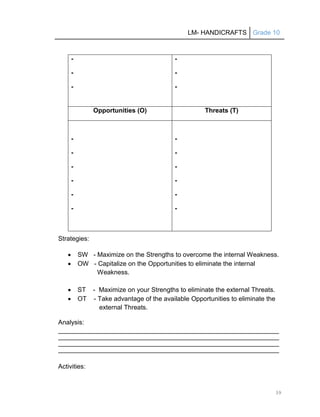
Task 6: SWOT Analysis
Directions: In a separate sheet of paper or in your notebook list down all your
observations for your business idea. Categorize your observations according
to strengths, weakness, opportunities and treats. After carefully listing them
down, use the stated strategies to come up with a sound analysis, activities
and best business idea.
Strength (S) Weaknesses (W)
-
-
-
-
-
-
LM- HANDICRAFTS Grade 10
39
Strategies:
 SW - Maximize on the Strengths to overcome the internal Weakness.
 OW - Capitalize on the Opportunities to eliminate the internal
Weakness.
 ST - Maximize on your Strengths to eliminate the external Threats.
 OT - Take advantage of the available Opportunities to eliminate the
external Threats.
Analysis:
__________________________________________________________________________________
__________________________________________________________________________________
__________________________________________________________________________________
__________________________________________________________________________________
Activities:
-
-
-
-
-
-
Opportunities (O) Threats (T)
-
-
-
-
-
-
-
-
-
-
-
-
LM- HANDICRAFTS Grade 10
40
__________________________________________________________________________________
__________________________________________________________________________________
__________________________________________________________________________________
__________________________________________________________________________________
My Best Business Idea:
__________________________________________________________________________________
__________________________________________________________________________________
__________________________________________________________________________________
__________________________________________________________________________________
To deepen your understanding of the topics previously discussed, you
will be asked to perform the following activities:
Task 7: Extra Reading and Video Viewing
Reading books and watching videos have been considered as some of
the most effective educational activities that can help learners broaden their
understanding on a certain topic. In this particular task, you will be asked to
conduct extra reading and video viewing on the Internet with the following
topics:
A. Steps in selecting a business idea
B. Criteria of a viable business idea
C. Benefits of a good brand
D. Ways on developing a brand
After successfully performing the assigned task, make a narrative
report about it and share it with the class.
Reflect and Understand
LM- HANDICRAFTS Grade 10
41
Task 8: Designing a Logo
Directions: In a separate sheet of paper or in your notebook draw a logo that
you will use in your business. Provide a simple statement to describe your
logo.
Tagline
Transfer
Logo
LM- HANDICRAFTS Grade 10
42
Task 9: Making My Own Vicinity Map
Directions: In a separate sheet of paper or in your notebook draw a vicinity
map reflective of potential market in Handicraft in your province. Provide a
simple statement to describe your map.
LM- HANDICRAFTS Grade 10
43
QUARTER I
Overview
In this quarter, you will learn how Origami as paper craft evolvedas a
worthwhile activities developed and creatively produced as one of
entrepreneurial product. While you develop the skills, you also innately
acquire discipline and positive work attitude towards making Origami products
or projects.
General Objectives
At the end of this quarter, learners are expected to:
1. trace the history and development of Origami,
2. plan a design and pattern for an Origami;
3. select materials for making Origami ;
4. follow methods and procedures in making Origami ; and
5. produce different products in Origami.
6. Describe quality projects and products of Origami
7. Package the finished Origami
LM- HANDICRAFTS Grade 10
44
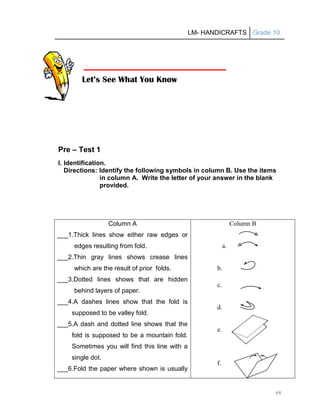
Pre – Test 1
I. Identification.
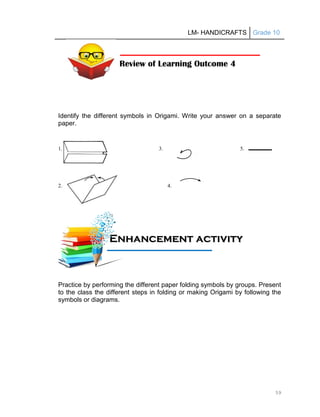
Directions: Identify the following symbols in column B. Use the items
in column A. Write the letter of your answer in the blank
provided.
Column A
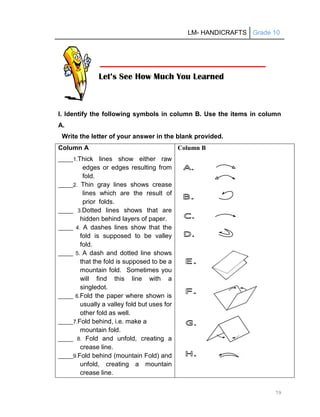
___1.Thick lines show either raw edges or
edges resulting from fold.
___2.Thin gray lines shows crease lines
which are the result of prior folds.
___3.Dotted lines shows that are hidden
behind layers of paper.
___4.A dashes lines show that the fold is
supposed to be valley fold.
___5.A dash and dotted line shows that the
fold is supposed to be a mountain fold.
Sometimes you will find this line with a
single dot.
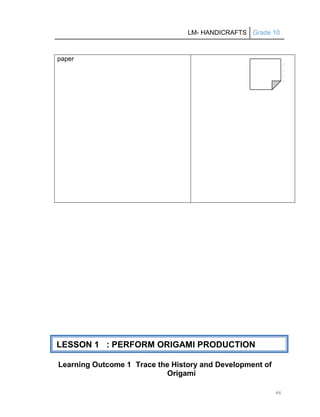
___6.Fold the paper where shown is usually
Column B
a.
b.
c.
d.
e.
f.
Let’s See What You Know
LM- HANDICRAFTS Grade 10
45
a valley fold but uses for other fold as
well.
___7.Fold behind, i.e. make a mountain fold.
___8.Fold and unfold, creating a crease line.
___9.Fold behind (mountain Fold) and
unfold, creating a mountain crease line.
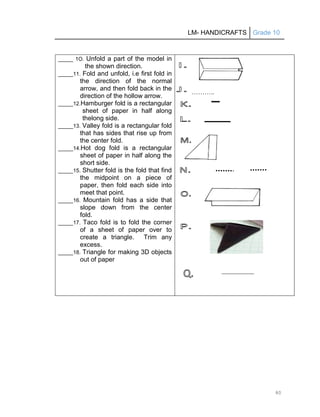
___10.Unfold a part of the model in the
shown direction.
___11.Fold and unfold, i.e first fold in the
direction of the normal arrow, and then
fold back in the direction of the hollow
arrow.
___12.Hamburger fold is a rectangular sheet
of paper in half along the long side.
___13.Valley fold is a rectangular fold that
has sides that rise up from the center
fold.
___14.Hot dog fold is a rectangular sheet of
paper in half along the short side.
___15.Shutter fold is the fold that find the
midpoint on a piece of paper, then fold
each side into meet that point.
___16.Mountain fold has a side that slope
down from the center fold.
___17.Taco fold is to fold the corner of a
sheet of paper over to create a triangle.
Trim any excess.
___18.Triangle for making 3D objects out of
g.
h. ………..
i.
j.
k.
l. -----------
m.
n. … …
o.
p.
q.
r. __________
LM- HANDICRAFTS Grade 10
46
Learning Outcome 1 Trace the History and Development of
Origami
paper
LESSON 1 : PERFORM ORIGAMI PRODUCTION
LM- HANDICRAFTS Grade 10
47
Objectives
At the end of this lesson, you are expected to:
1. discuss the history and development of Origami; and
2. analyze relevance of Origami
HISTORY OF ORIGAMI
The technique of paper making introduced into Japan by China during
the early seventh century, underwent considerable changes in its
manufacturing process in Japan ,giving rise to a type of ―washi‖ paper
possessing dual qualities of resilient sturdiness and softness which prevents
tearing when it is handled, Washi, a unique and distinct type of Japanese
paper kindled many forms of cultural creativity, among them origami.
Unfortunately, it is not clear when origami in Japan first originated,
However, well-regulated lifestyle came with the advent of samurai society
which gave rise to the art of paper folding for practical and formal purposes.
From the onset of the Showa period (1926-1989), the art has rapidly passed
into oblivion, but a vestige of its former use can still be seen in the noshi, a
decoration of folded red and white paper attached to a gift.
Origami made to assume concrete shapes of, for example, a crane or
boat is regarded as origami for pure enjoyment. It began to be made
sometime around the beginning of the Edo period (1600-1868) which
coincided with an age in which mass-produced, low-priced paper came to be
widely used by the people.
During the Genroku era (1688-1704), origami of the crane and several
varieties of boats used as designs on clothing became fashionable, and it was
also reproduced with great frequency in Ukiyoe prints. Origami rapidly came
to have a wide following during this period.
About a hundred years later, books and printed matter devoted
exclusively to origami were published, creating a diverse and advanced form
of origami. They were not only a form of children's amusement, but also a
form intended for adults. Many of these origami were difficult to make
because theyincorporated many complicated steps.
LM- HANDICRAFTS Grade 10
48
The technique of paper making was introduced into Europe in the
twelfth century producing a distinct form of origami. However, origami was not
taken up by a large number of people as it was in Japan.
Not only are there now many imaginative and novel origami creations,
but its educational worth and immense potential have been also reconsidered
and recognized. Origami has gained a widespread following as a hobby
among adults. There are now many origami associations that have been
formed overseas by origami enthusiasts.
The Japanese word "origami" itself is a compound of two smaller
Japanese words: "ori", meaning to fold, and "kami", meaning paper. Until
recently, all forms of paper folding were not grouped under the word origami,
namely "tsutsumi", a kind of wrapper used for formal occasions. Before that,
paperfolding for play was known by a variety of names, including "orikata",
"orisue", "orimono", "tatamigami" and others. Exactly why "origami" became
the common name is not known; it has been suggested that the word was
adopted in the kindergartens because the written characters were easier for
young children to write. Another theory is that the word "origami" was a direct
translation of the German word "Papierfalten", brought into Japan with the
Kindergarten Movement around 1880.
Initially due to the fact that paper was expensive, origami became an
art form practiced only by the elite and was used for practical purposes such
as folding letters. Samurai would give each other little paper good luck
charms known as noshi and Shinto weddings folded paper butterflies
Review of Learning Outcome 1
LM- HANDICRAFTS Grade 10
49
A. TRUE OR FALSE
Write True if the statement is correct and False if it is wrong. Write your
answers in the notebook or separate paper.
_____1. Origami originated from Japan during the seventh century.
_____2.At the onset of the Showa period, Origami ,had rapidly passed into
oblivion
_____3.Origami was known to have been created for the elite for their paper
folding in writing letters
_____4. Washi wasa type of paper possessing dual qualities of resilient
sturdiness and softness which prevented tearing when it was handled
_____5. Origami has been known for children’ s amusement only.
A. Prepare a 5 minute talk regarding Origami including how it evolved and was
known globally . Be able to discuss the importance of Origami in Japan and
other countries where it developed.
B. Make an organizational chart which traces the stages of development of
Origami and for each stage its contribution .
Learning Outcome 2 Plan a design and pattern for an Origami
Paper Craft
Objectives
E
En
nh
ha
an
nc
ce
em
me
en
nt
t a
ac
ct
ti
iv
vi
it
ty
y
A
Ac
ct
ti
iv
vi
it
ty
y
LM- HANDICRAFTS Grade 10
50
At the end of this lesson, you are expected to:
1. discuss the design to be made; and
2. sketch the design
DESIGN AND PATTERN OF ORIGAMI
Planning a design and pattern in Origami is very crucial . You have to make
a plan on what kind of Origami object you want to create. Does it have to be
creative? Functional? Durable? Or to what purpose do you create with.
The diagram below , is an example of a base on the Origami vase in 3D
design . It indicated the number of pieces of Origami fold we need to make.
Plan the measurement of the proposed Origami in terms of height,
circumference and the diameter of the base of your object.
You can use a graphing paper and a crayon or coloring pen in marking
the rows and column and do the counting. Then we can estimate the number
of Origami paper we are going to fold .
After folding, you can now divide the number of folds based on the form or
color of the vase you want to create. You can start assembling them.
LM- HANDICRAFTS Grade 10
51
An example of 3d Origami Vase
Enumerate the basic steps in making a design of an Origami Vase.
Steps in making Origami Vase
Design
Sketch the Design of Origami Vase
1st
2nd
3rd
4th
5th
E
En
nh
ha
an
nc
ce
em
me
en
nt
t a
ac
ct
ti
iv
vi
it
ty
y
A
Ac
ct
ti
iv
vi
it
ty
y
Review of Learning Outcome 2
LM- HANDICRAFTS Grade 10
52
A. Discuss the following statement below among your classmates or to the
class.
A. Why do we need to plan the design of our project?
B. Is it necessary for us to make a pattern or diagram in making Origami
project?
C. How are we going to make the design or pattern in Origami Project
B. Compile at least 10 different design and pattern of Origami project found in
the INTERNET . Analyze each design based on the description of the
picture. Cite references.
Learning Outcome 3 Select materials for making Origami
Objectives
LM- HANDICRAFTS Grade 10
53
At the end of this lesson, you are expected to:
1. Identify materials suited for making Origami
TOOLS AND MATERIALS USED IN MAKING ORIGAMI
There are simple tools used in Origami since most of the technique is
folding except for some complicated design. There are different kinds of
paper used in Origami but a sturdy paper will just do. We can use colored
paper of the magazines and catalogue and paper we want to recycle.
Material
1. Paper is the main material in making
origami, it can used paper or colored paper.
It is depend on your design.
Tools
2. Knives - are to slash paper on the desired
size.
3. Scissors – are used for cutting paper on the
desired design and size
Review of Learning Outcome 3
LM- HANDICRAFTS Grade 10
54
SELF-ASSESSMENT
Identify the tools and materials with their function and uses in making
Origami . Provide your answers in the table given.
TOOLS FUNCTION MATERIAL/S USE/S
1. 1.
2.
ACTIVITY 1
Discuss the importance of using appropriate tools employed to produce
quality craft material in the class. Explain how the tools and materials are
used in making Origami. Rate other groups in presenting their discussions
using the rubrics below.
Directions:
Ask the teacher to
assess your
performance in the
following critical task
and performance
criteria below
You will be rated
based on the overall
evaluation on the right
side.
SCORING RUBRICS
Performance Levels
Level
Achieved
10 - Can perform this skill without
supervision and with initiative and
adaptability to problem situations
.
7 - Can perform this skill satisfactorily
without assistance or supervision.
4 - Can perform this skill satisfactorily but
requires some assistance and/or
supervision.
E
En
nh
ha
an
nc
ce
em
me
en
nt
t a
ac
ct
ti
iv
vi
it
ty
y
A
Ac
ct
ti
iv
vi
it
ty
y
LM- HANDICRAFTS Grade 10
55
1 - Can perform parts of this skill
satisfactorily, but requires considerable
assistance and/or supervision.
Instructor will initial level achieved.
ACTIVITY 2
Make a research in identifying materials that are suited in making Origami and
materials that can substitute or alter if there are no materials available in the locale.
Write your output on the box below. Attach sample or picture.
Materials Description Suggested
project/Uses
Learning Outcome 4 Follow Methods and Procedures in
LM- HANDICRAFTS Grade 10
56
Making Origami
Objectives
At the end of this lesson, you are expected to:
1. discuss the different methods, techniques and procedures in making Origami
projects/products
2. follow procedures and techniques in making Origami projects/products
3. demonstrate methods/procedure in in making Origami projects/products
PROCEDURES IN MAKING ORIGAMI
Steps in Folding the Paper
1. Check that the paper you are folding is exactly a square.
2. Do not fold against a soft surface, such as a carpet, your lap or
bedsheets. Fold against a hard surface ,such as a large hardback book
or a table.
3. Crease slowly, firmly, and accurately. Form the early creases with
particular care – if they are incorrect place, all the later, smaller creases
will be difficult to place accurately and will look messy.
4. Read the instruction and follow the symbol on each step. Many mistakes
are made by ignoring written instructions or by not following all the written
instructions on a step, particularly during complex maneuvers.
5. The instruction and symbols on one step will create a shape which looks
like the next step but stripped of its symbols. So, you must always look
ahead to the next step to see what shape you are trying to make. Never
look at steps in isolation, but see them as being interconnected, like links
in a chain.
Symbols and Diagram
This shows the white and coloured side, like standard
origami paper. You will see a symbol which shows whether
you should start with the coloured side up or the
white side up
___________ Thick lines show either raw edges or edges resulting
from fold.
LM- HANDICRAFTS Grade 10
57
______________ Thin grey lines show crease lines which are the result
of prior folds.
................ ....
Dotted lines show that are hidden behind layers of
paper.
--------------------------
Dash lines shows that the fold is supposed to be
valley fold.
....._______........
Dash and dotted line shows that the fold is supposed
to be a mountain fold. Sometimes you will find this
line with a single dot.
Fold the paper where shown is usually a valley fold
but uses for other fold as well.
Fold behind, i.e. make a mountain fold.
Fold and unfold, creating a crease line.
Fold behind (mountain Fold) and unfold, creating a
mountain crease line.
Unfold a part of the model in the shown direction.
Fold and unfold, i.e first fold in the direction of the
normal arrow, and then fold back in the direction of
the hollow arrow.
Hamburger fold is a rectangular sheet of paper in half
along the long side.
LM- HANDICRAFTS Grade 10
58
Valley fold is a rectangular fold that has sides that
rise up from the center fold.
Hot dog fold is a rectangular sheet of paper in half
along the short side.
Shutter fold is the fold that find the midpoint on a
piece of paper, folded each side to meet that point.
Mountain fold has a side that slope down from the
center fold.
Taco fold is to fold the corner of a sheet of paper over
to create a triangle. Trim any excess.
Burito fold must roll the page up without creating a
crease in the paper.
LM- HANDICRAFTS Grade 10
59
Identify the different symbols in Origami. Write your answer on a separate
paper.
1. 3. 5.
2. 4.
Practice by performing the different paper folding symbols by groups. Present
to the class the different steps in folding or making Origami by following the
symbols or diagrams.
Review of Learning Outcome 4
E
En
nh
ha
an
nc
ce
em
me
en
nt
t a
ac
ct
ti
iv
vi
it
ty
y
A
Ac
ct
ti
iv
vi
it
ty
y
LM- HANDICRAFTS Grade 10
60
Rubrics for Performance in Paper Folding
Direction:
Let the teacher
assess your
performance in
the following
critical task and
performance
criteria.
OVER ALL EVALUATION
Performance Levels Level Achieved
10 - Can perform this skill without supervision
and with initiative and adaptability to
problem situations.
7 - Can perform this skill satisfactorily without
assistance or supervision.
5 - Can perform this skill satisfactorily but
requires some assistance and/or supervision.
3- Can perform parts of this skill satisfactorily,
but requires considerable assistance and/or
supervision.
Instructor will initial level achieved.
Discuss by groups through the questions below.
1. What are the different techniques and methods in paper folding? Why
is it crucial for us to follow them?
2. Is it necessary for us to follow the procedure or can we innovate or
create another way of folding? Explain your answer.
LM- HANDICRAFTS Grade 10
61
Learning Outcome 5 Produce Projects or Products
Objectives
At the end of this lesson, you are expected to:
1. Produce projects or products such as
A. Vase
B. Bouquet of Lilies
Project #1 BOUQUET OF LILY FLOWERS
1. Start with your paper coloured
side up.
a. Fold in half, then in half again,
as shown. Crease well, then
open out again.
b. Turn the paper over and fold
in halfdiagonally and in both
directions. Crease well and
open out once again.
C. Holding the points shown,
bring them both down to the
centre point on the bottom
line. Flatten model. This is
called a waterbomb base.
LM- HANDICRAFTS Grade 10
62
D. Fold the top triangle into the
centre and unfold. Using this
crease, open out the triangle
and flatten.
E. On the uppermost diamond,
fold the outside corners into the
center line, crease well then
open.
F. Fold the whole model in half
and open.
LM- HANDICRAFTS Grade 10
63
G. Using the creases made in step
6 and 7, lift the bottom point of
the model (the uppermost layer
only) up to the top point,
bringing in the sides of the
model at the same time, as
shown.
H. Repeat steps 6, 7 and 8 on
each if the four sides. The
model should now look like this.
I. Now fold down each of these
triangles, on all four sides.
J. Rotate model upside down, so
the open part is at the top.
LM- HANDICRAFTS Grade 10
64
K. Fold the outer flaps toward the
centre and flatten.Fold the outer
flaps toward the centre and
flatten.
L. Repeat step 12 on all four sides
of the model. The model should
now look like this. Fold down all
petals, opening the flower as
you go.
M. Create more flowers in order to
make a bouquet.
LM- HANDICRAFTS Grade 10
65
Project # 2 :3D FLOWER BASE
1. Make a 3D pieces (Triangle)
 In a small rectangularpieces of paper
and hold with the longer side on the
bottom( In a regular 4A bond paper, you
can make 32 pieces of small rectangle.
 Fold in half from the bottom to the
top.Fold again from left to right but don't
press the fold very hard
 Fold the right side of the paper to the fold
line in the middle then do the same to the
left side. This should now look like an
upside down house.
 Turn over. Fold down outside corners
Fold the top 2 flaps down. You'll end up
with a triangle. Fold in half and you are
done.
2. Make a Triangle (744 pcs. Of White +
114 pcs. Of Black + 36 pcs. Blue.)
3. Start with Rows 1 and 2 by making
connector units
4. First we will make the neck of the vase.
For this we will assemble a structure of 11
Rows with 24 White units in each row.
5. Here is the neck of the vase after the 11
rows have been inserted. We will shape it
later.
LM- HANDICRAFTS Grade 10
66
6. Now for the the base (/bowl) of the vase, in
the same manner aswe assembled the neck
of the vase, we will assemble the units.
The bowl will have a total of 15 Rows
with 42 units in each Row.Rows 1 to 3 will
have only white units.
7. Row 4 is inserted by alternating between 4
Black and 3 Blue units.
8. Add few more black and blue units as
shown.
9. Fill in the remaining part of the rows with
white units
10. Keep adding White units for the rows till
you have a total of 15 rows.
11. Shove the neck into the base/bowl of the
vase. This model would not need any
glue to hold the two parts together.
LM- HANDICRAFTS Grade 10
67
12. Put some flowers
Self- assessment
1. Give the different steps in making the following project or article
A. BOUQUET OF LILY FLOWERS
B. 3D VASE
Review of Learning Outcome 5
LM- HANDICRAFTS Grade 10
68
Make a project plan for the suggested articles/projects by following the
template.
PROJECT PLAN
Project No. ______
Name:________________________________ Date Begun:___________________
Year and Section:_________________ Date Finished: _________________
I. Name of Project:(State the name of your project in a manner that it would give
clear picture of your product/article. Be creative and catchy as you can but make
sure that it is appropriate to your product/article)
II. Purpose of the Project: (Write the objectives of the project in statement form.)
1.
2.
3.
III. Specification of the Project: (Attach perspective/pictorial view and work
drawing) (Provide illustration of your expected product/article. Make sure to indicate
the details of your product/article such as stitches to be used, size etc.)
IV. Bill of Materials: (This section provides the budgetary requirement needed to
create the product/article. See the sample content for reference.
E
En
nh
ha
an
nc
ce
em
me
en
nt
t a
ac
ct
ti
iv
vi
it
ty
y
A
Ac
ct
ti
iv
vi
it
ty
y
LM- HANDICRAFTS Grade 10
69
Materials and Supplies:
V. Tools, Materials &Equipment:(Enumerate the tools, materials and equipment
you will be using. These are already available and not included to the things that you
need to buy)
1. __________________
2. __________________
3. __________________
VI. Work Procedure (Write down the step by step procedure in making your
product/article. Make sure to arrange it in sequence)
1.
2.
3.
VII. Safety Measures or Precautions: (Indicate safety reminders based on the
potential hazards in needlecraft.)
VIII. Evaluation:(Leave this blank. Your teacher will be the one to give the
evaluation based on your performance. You will find in this section the assessment
of your teacher such as the weaknesses and strengths of your output.)
___________________________________________________________________
___________________________________________________________________
IX. Remarks: (Leave this blank. Your teacher will be the one to give the remarks.
You will find in this section the things to be improved in your product based on the
evaluation)
LM- HANDICRAFTS Grade 10
70
Produce the different articles/projects by applying the methods and
techniques in paper folding. Rating is based on the Rubrics of the finished
product
Criteria DESCRIPTION
(10 ) (9-7) (6-4)
Design Product design is
original
Product design is
common in the market
Product design
appear copied &
stereotyped
Materials Materials used are
always in the market
Materials used are
seldom available in
the market
Materials used
are not easily
available in the
market
Products Products appears
original
Products appear
similar to commercial
products
Products appear
closely to
commercial
products
LM- HANDICRAFTS Grade 10
71
Learning Outcome 6: Describe Quality Projects and Products
Of Origami
Objectives
At the end of this lesson, you are expected to:
1. Discuss the different characteristics of a quality Origami
projects/products
2. Explain the importance of quality projects/products of Origami
3. Formulate criteria for evaluating quality projects/products of Origami
CHARACTERISTICS OF QUALITY ORIGAMI PAPER CRAFT
Quality project or product refers to ―customers satisfaction‖ . It means
we deal with the standards of customers for they have the buying power. We
need to understand also that as a craft makers we have our control in
producing this quality paper craft products.
Characteristics of Quality Origami Product
1. The paper is properly folded and creased- it has sharp and even in folds. The
type of paper should also be considered. A sturdier paper can be used if we
want it to have it displayed or used longer.
2. Symmetry is important in making Origami Product - balance proportion in
terms of size, forms and colors . Application in the elements of arts and design
of the project must be followed.
3. There are no extra bends or folds in paper - Extra bends or folds alters the
design of the project and can make the product defective . The paper must be
cut properly and evenly to avoid extra folds.
4. Instructions in folding are properly followed - techniques and methods are very
important in achieving authentic, quality and marketable product.
LM- HANDICRAFTS Grade 10
72
Activity 1. List the different characteristics of quality origami product
Characteristics of Quality
Origami Product
1.______________________
2. _____________________
3.______________________
4.______________________
5.______________________
Activity 1
Panel discussion on the importance of making quality projects of Origami.
Guide questions:
1. Describe a quality Origami product.
2. What are the purpose in making quality Origami products?
3. Why do we need to make quality Origami products?
4. How do we meet the quality standards of our potential market or buyers?
Review of Learning Outcome 6
E
En
nh
ha
an
nc
ce
em
me
en
nt
t a
ac
ct
ti
iv
vi
it
ty
y
A
Ac
ct
ti
iv
vi
it
ty
y
LM- HANDICRAFTS Grade 10
73
Activity 2
As a craftsman what criteria are we going to follow in evaluating our
quality projects/products of Origami ? Formulate criteria for evaluating your
product or project based on the characteristics of a quality Origami product.
Scoring Rubrics for Discussion
Criteria Points
Content 10
Delivery 5
Creativity 5
TOTAL 20
LM- HANDICRAFTS Grade 10
74
Learning Outcome 7: Package the finished Origami
Objectives
At the end of this lesson, you are expected to:
1. Select appropriate quality packaging material for fashion
accessory
2. Apply creativity in packaging
3. Arrange projects in packaging
4. Hands-on packaging
PACKAGING OF FINISHED PROJECTS/PRODUCTS
Packaging
We often consider the products we use and their packaging to be two
separate things – the product is the thing we want, and its packaging is a
piece of trash to be thrown away.
Good design isn’t just about the product – it’s about good packaging as
well.Some of the other packaging, while not exactly useful, is still helpful and
stylish. It make their products just a bit more fun to use. It doesn’t always
have to be about function.
LM- HANDICRAFTS Grade 10
75
PACKAGING MATERIALS FOR ORIGAMI PRODUCT
Carton- a light box or container
usually made of cardboard or
plastic.
Cellophane- a transparent sheets
that is used for wrapping or packing
Packing Tape - a transparent
adhesive to wrap around the box
Bubble wrap- pliable transparent
plastic material used to pack fragile
materials
LM- HANDICRAFTS Grade 10
76
String or cord - composed of a
strand of fibers or plastic it is
usually composed by bundle
Marking Pen - a black and
permanent pen and does not blot
Creativity in Packaging
Most of the packaging designs we see are boring square boxes with
brand logos. But there are a few products out there with creative packaging
designs that are bound to attract consumers’ attention.
For a packaging design to be considered good, it should not only look
fantastic, but also should clearly project the message the manufacturer wants
to convey so the consumers can get it. This is not an easy feat, but there are
a few creative packaging designs that get this right.
LM- HANDICRAFTS Grade 10
77
Self-Assessment
Name the different packaging materials and write their function.
Materials for Packaging Uses /function in packaging
1.
2.
3.
4
5.
A. Write the different steps in packaging ensure to apply your creativity or
innovative way of packing your product.
B. Make a presentation on the different style in packaging to the class.
Review of Learning Outcome 7
E
En
nh
ha
an
nc
ce
em
me
en
nt
t a
ac
ct
ti
iv
vi
it
ty
y
A
Ac
ct
ti
iv
vi
it
ty
y
LM- HANDICRAFTS Grade 10
78
Criteria Descriptions Value
1 2 3 4
Display All parts are
not clearly
labeled.
Some parts
are clearly
labeled
Most parts
are clearly
labeled.
All parts are
clearly
labeled
Mechanics There are
many
mistakes in
mechanics .
There are
several
mistakes in
mechanics .
There are
minor
mistakes in
mechanics .
There are
no mistakes
in
mechanics .
Presentation The
packaging is
presented as
very difficult
for the
audience to
understand.
The
packaging is
presented
as difficult
for the
audience to
understand.
The
packaging is
presented
as less
difficult for
the
audience to
understand
The
packaging is
presented
with ease
for the
audience to
understand
Layout Layout is
confusing.
Components
are
inconsistent
and
information
is missing.
Layout is
somewhat
organized.
Most of the
components
are not
organized.
Partial
information
can be
located
Layout is
almost
organized.
Most
components
are
consistent
within the
publication.
Almost all
information
can be
located.
Layout is
well
organized.
There is
consistency
in its
components
that allows
the readers
to easily
locate
information.
Total
Student’s comments:
__________________________________________________________
Teacher’s comments:
_________________________________________________________
LM- HANDICRAFTS Grade 10
79
I. Identify the following symbols in column B. Use the items in column
A.
Write the letter of your answer in the blank provided.
Column A
_____1.Thick lines show either raw
edges or edges resulting from
fold.
_____2. Thin gray lines shows crease
lines which are the result of
prior folds.
_____ 3.Dotted lines shows that are
hidden behind layers of paper.
_____ 4. A dashes lines show that the
fold is supposed to be valley
fold.
_____ 5. A dash and dotted line shows
that the fold is supposed to be a
mountain fold. Sometimes you
will find this line with a
singledot.
_____ 6.Fold the paper where shown is
usually a valley fold but uses for
other fold as well.
_____7.Fold behind, i.e. make a
mountain fold.
_____ 8. Fold and unfold, creating a
crease line.
_____9.Fold behind (mountain Fold) and
unfold, creating a mountain
crease line.
Column B
Let’s See How Much You Learned
LM- HANDICRAFTS Grade 10
80
_____ 1O. Unfold a part of the model in
the shown direction.
_____11. Fold and unfold, i.e first fold in
the direction of the normal
arrow, and then fold back in the
direction of the hollow arrow.
_____12.Hamburger fold is a rectangular
sheet of paper in half along
thelong side.
_____13. Valley fold is a rectangular fold
that has sides that rise up from
the center fold.
_____14.Hot dog fold is a rectangular
sheet of paper in half along the
short side.
_____15. Shutter fold is the fold that find
the midpoint on a piece of
paper, then fold each side into
meet that point.
_____16. Mountain fold has a side that
slope down from the center
fold.
_____17. Taco fold is to fold the corner
of a sheet of paper over to
create a triangle. Trim any
excess.
_____18. Triangle for making 3D objects
out of paper
………..
__________
LM- HANDICRAFTS Grade 10
81
QUARTER 2
Overview
In this quarter, you will learn how Paper Maché as paper craft
evolvedas a worthwhile activities developed and creatively produced as one
of entrepreneurial product. While you develop the skills, you also innately
acquire discipline and positive work attitude towards making Paper Maché
products or projects.
General Objectives
At the end of this quarter, learners are expected to:
1. trace the history and development of Paper Maché,
2. plan a design and pattern for an Paper Maché;
3. select materials for making Paper Maché;
4. follow methods and procedures in making Paper Maché;
5. produce different products in Paper Maché; and
6. evaluate finished product
Pre – Test 1
I. Multiple choice
Directions: Read each statement carefully. Choose the correct answer and write its
corresponding letter on the space provided.
_____1. On what dynasty was Paper Mache developed, where the paper itself was
discovered.
a. Han
b. Tang
c.Tea
Let’s See What You Know
LM- HANDICRAFTS Grade 10
82
_____2. This is the most common paper craft method were strips of paper is soaked
in glue and added to a mold layer by layer.
a. cutting
b. layering
c. pulp
_____3. What is the reason of using fabric conditioner in pulp method,.
a. for scented purposes
b. for cleaning the paper
c. to soften the paper
_____4. This is acellulose wallpaper paste which comes as granules then mixed with
water.
a. wallpaper paste
b. PVA adhesive
c. four and water paste
______5. This is rreferred to amethod used in molding clay for making Paper Mache.
a. cutting
b. layering
c. pulp
_____6. This is use tocut a thick cardboard and can removed sharp edges.
a. scissors
b. cutter
c. knives
_____7. These are water-mixable materials which have been used for decorating the
product.
a. acrylic paints
b. emulsion paints
c. varnishes
_____8. This was described as a multi-purpose, easy-to-use adhesive which can be
used both as a glue and a vanish. Although white, when dries it is
transparent and, as a finish, gives a glossy, protective
a. wallpaper paste
b. PVA adhesive
c. flour and water paste
_____9. This is a paint uses awater based as an undercoat before decoration.
a. acrylic paint
b. emulsion paint
c. varnish
_____10. This is paintthat I uses to make the product gloss, satin or matte finish.
a. water
b. varnish
c. White Cosmetics
LM- HANDICRAFTS Grade 10
83
II. Arrange the following procedure correctly for layering method write A-C and for
Pulp methods write A-D on the blank before the number.
A. Layering Method
______1. Use water only to damped or dampen the strips and smooth each one in
place, overlapping the edges slightly, to build a layer reaching to the
outside edge.
Allow the strips to overlap the edge slightly as this can be trimmed later.
______2. Add another layer of glued strips, working downward in the same direction
as the first layer. Continue in this way until the layers are thick enough to
hold the shape. Apply the second layer of strips, this time using paste and
work the strips in other direction. This help to build a firm, strong web.
Paint paste overthe surface and smooth with your hands to remove any
air bubbles. Do thisafter applying each layer of strips.
_____3. Prepare the mould or structure. Tear paper into small strips about ½ in (1
cm) wide X 2 in (5 cm ) long. This size strip will mold well round most
curves.
B. Pulp method
_____1. Transfer the strained pulp to a large mixing bowl. Stirring well, mix in the
whiting and wall paper paste, then the linseed oil and PVA adhesive. Mix
thoroughly. The pulp is ready for use.
_____2. Pour water and paper into large saucepan and bring to boil. Simmer for 30
the minutes. The paper will begin to break up. If a dark scum rises to the
top of water, skim this off. Leave the mix to cool.
_____3. Tear the paper into small pieces no larger than 5/8 in (15 mm) square. Put
the paper into the bucket and cover with water. Add the fabric conditioner.
_____4. Work in batches, mix, using the blender. Strain the pulp into a sieve
andpress with the back of a spoon to remove as much water as possible.
LM- HANDICRAFTS Grade 10
84
Learning Outcome 1 Trace the History and Development of
Paper Maché
Objectives
At the end of this lesson, you are expected to:
1. discuss the history and development of Paper Maché;
and
2. analyze relevance of Paper Maché
The History of Paper Maché
During the ancient time paper Maché was developed as the paper itself
and was discovered in the time of Han Dynasty, c. 202 B.C. – 220 A.D. This
early time paper was used to make three dimensional objects, like artifacts
,suchas helmet and pot lids. During this dynasty, paper Maché was
described as pasteboard.
From China, the interest in papermaché spread to Japan and Persia. It is
use to make mask in celebrating festivals. Eventually it spread across the
world, European start using paperMachéin making their own wares . From
the 1670’s, until the late 1700’s there was a half-heart intent of paper maché.
In 1800’s paper maché was commonly used for ornamental attachment’s on
architecture and furniture, when it became widely used
The oldest surviving artifacts made of this lightweight but strong material
is a falcon’s coffin from Persia and it was interesting that as of this day
papermaché was recommended to use for human coffins because it so strong
that it was equally as durable as wood.
LESSON 1 : PERFORM PAPER MACHE PRODUCTION
LM- HANDICRAFTS Grade 10
85
Write True if the statement is correct and False if it is wrong. Write your
answers in the notebook or separate paper.
_____1. The paper maché originated from China during the Tang Dynasty.
_____2.This early time paper was used to make two dimensional objects like
artifacts such helmet and pot lids.
____3. The interest in PaperMaché spread to Japan and Persia
____4. In 1800’s PaperMaché was commonly used for ornamental
attachment’s on architecture
____5. The oldest surviving artifacts made of this lightweight but strong
materialis a falcon’s coffin from Persia
ACTIVITY 1
Research on the different local products that are made from paper
maché. State and how they started in our country. Present your research
outputs to the class.
Review of Learning Outcome 1
E
En
nh
ha
an
nc
ce
em
me
en
nt
t a
ac
ct
ti
iv
vi
it
ty
y
1
11
11
1A
Ac
ct
ti
iv
vi
it
ty
y
LM- HANDICRAFTS Grade 10
86
Criteria Descriptions Value
1 2 3 4
Display All parts are
not clearly
labeled.
Some parts
are clearly
labeled
Most parts
are clearly
labeled.
All parts are
clearly
labeled
Mechanics
and Spelling
There are
many
mistakes in
mechanics
and/or
spelling.
There are
several
mistakes in
mechanics
and/or
spelling.
There are
minor
mistakes in
mechanics
and/or
spelling.
There are
no mistakes
in
mechanics
and/or
spelling.
Presentation The research
is presented
as very
difficult for
the audience
to
understand.
The
research is
presented
as difficult
for the
audience to
understand.
The
research is
presented
as less
difficult for
the
audience to
understand
The
research is
presented
with ease
for the
audience to
understand
Format Format is
confusing.
Components
are
inconsistent
and
information
is missing.
Format is
somewhat
organized.
Most of the
components
are not
organized.
Partial
information
can be
located
Format is
almost
organized.
Most
components
are
consistent
within the
publication.
Almost all
information
can be
located.
Format is
well
organized.
There is
consistency
in its
components
that allows
the readers
to easily
locate
information.
Total
Student’s comments:
__________________________________________________________
Teacher’s comments:
________________________________________________________
LM- HANDICRAFTS Grade 10
87
Make a diagram on how Paper Mache was discovered and developed.
China Japan Persia
E
En
nh
ha
an
nc
ce
em
me
en
nt
t a
ac
ct
ti
iv
vi
it
ty
y 2
2
1
11
1A
Ac
ct
ti
iv
vi
it
ty
y
LM- HANDICRAFTS Grade 10
88
Learning Outcome 2 : Select Tools and Materials in Making Paper Maché
Objective:
1. Identify the tools and materials for making Paper Maché
TOOLS AND MATERIALS USED IN MAKING PAPER MACHÉ
TOOLS & MATERIALS
1. Paper is the main material in making paper mache
such as: old newspaper, type writing, magazine, old
books, and others.
2. Cardboard are used to make basic structures and
for surface decoration.
3. Knives are used to cut thick cardboard and removed
sharp edges.
4. Scissors is used to cut paper and thin cardboard.
6. Brush like Household paint brushes can be used for
applying paints and Vanishes.
LM- HANDICRAFTS Grade 10
89
7. Adhesive is used to bind the paper.
a. Wallpaper paste is a cellulose wallpaper paste
come as granules which are mixed with water.
Mix paste beforehand in order to allow time for
the grains to swell.
b. PVA adhesive is a multi-purpose, easy-to-use
adhesive which can be used both as a glue and
a vanish. Although white, when dries it is
transparent and, as a finish, gives a glossy,
protective surface.
c. Flour and water paste is ideal for paper maché
layering and works as well as wallpaper paste. If
salt is added, the paste will keep for several
days. Between sessions, cover the paste and
put in the refrigerator.
8. Paints, Dyes and Varnishes is used for finishing and
protection.
a. Acrylic paints – are water-mixable which have
been used for decorating the product.
LM- HANDICRAFTS Grade 10
90
b. Emulsion paint is a water based white paint used
as an undercoat before decoration.
c. Varnish this make the product gloss, satin or
matt finish.
d. Dyeing pulp is a cold water dye or fabric dye can
be used for colouring pulp where interesting
effects are possible. The dye colour will lighten
on drying.
SELF-ASSESSMENT
Answer the crossword puzzle
4 5
1
2
3
Across
1. Used to bind paper
2. It is used to cut thick cardboard and removed sharp edges.
Review of Learning Outcome 2
LM- HANDICRAFTS Grade 10
91
3. The main material in making paper mache such as: old newspaper, type writing,
magazine, old books, and others.
Down
4. Household paint brushes which can be used for applying paints and Vanishes.
5. It is used to make basic structures and for surface decoration.
ACTIVITY 1
Discuss the importance of using appropriate tools employed to produce
quality craft material in the class. Explain how tools and materials are used in
making paper mache. Rate other groups in presenting their discussions.
Direction:
Let the teacher
assess your
performance in
the following
critical task and
performance
criteria.
OVER ALL EVALUATION
Performance Levels
Level
Achieved
10 - Can perform this skill without
supervision and with initiative and
adaptability to problem situations.
7 - Can perform this skill satisfactorily
without assistance or supervision
.
5 - Can perform this skill satisfactorily but
requires some assistance and/or
supervision
.
3- Can perform parts of this skill
satisfactorily, but requires considerable
assistance and/or supervision.
E
En
nh
ha
an
nc
ce
em
me
en
nt
t a
ac
ct
ti
iv
vi
it
ty
y
1
11
11
1A
Ac
ct
ti
iv
vi
it
ty
y
LM- HANDICRAFTS Grade 10
92
Make a research in identify materials that are suited in making paper maché
and tools that can substitute or alter if there are no materials available in the
locale. Choose at least 5 alternative materials; describe how they can be
used. Present your research outputs to the class.
.
Scoring Rubrics for Discussion
LO3: Follow Methods and Procedures in Making Paper Mache
Objectives:
1. Discuss different methods, techniques and procedures in making Paper Mache
projects/products
2. Follow procedures and techniques in making Paper Mache projects/products
3. Demonstrate methods/procedure in in making Paper Mache projects/products
Criteria Points
Content 10
Delivery 5
Creativity 5
TOTAL 20
E
En
nh
ha
an
nc
ce
em
me
en
nt
t a
ac
ct
ti
iv
vi
it
ty
y
2
21
11
1A
Ac
ct
ti
iv
vi
it
ty
y
LM- HANDICRAFTS Grade 10
93
PROCEDURES IN MAKING PAPER MACHE
Paper Mache Basic Techniques
a. Prepare the mould or structure. Tear paper into small strips about ½
in (1 cm) wide X 2 in (5 cm ) long. This size strip will mould well round
most curves.
b. Use water only to damped the strips and smooth each one in place,
overlapping the edges slightly, to build a layer reaching to the outside
edge. Allow the strips to overlap the edge slightly as this can be
trimmed later.
c. Apply the second layer of strips, this time using paste and work the
strips in other direction. This help to build a firm, strong web. Paint
paste over the surface and smooth with your hands to remove any air
bubbles. Do this after applying each layer of strips.
d. Add another layer of glued strips, working downward in the same
direction as the first layer. Continue in this way until the layers are
thick enough to hold the shape.
2. Pulp method is modeling clay for making papier mache.
Materials:
6 double sheets of newspaper (or similar quantity of other white paper)
¼ cup fabric conditioner
7 large spoons of whiting or ground chalk
6 large spoons mixed wallpaper paste
2 medium-sized spoons linseed oil
4 medium-sized spoons PVA adhesive
Large saucepan
a. Tear the paper into small pieces no larger than 5/8 in (15
mm) square. Put the paper into the bucket and cover with
water. Add the fabric conditioner.
1. Layering methodis the most common sort of
paper mâché, where strips are soaked in glue and
added to a mold layer by layer.
LM- HANDICRAFTS Grade 10
94
b. Pour water and paper into large saucepan and bring to boil.
Simmer for 30 minutes. The paper will begin to break up. If
a dark scum rises to the top of the water, skim this off.
Leave the mix to cool.
c. Working in batches, mix, using the blender. Strain the pulp
into a sieve and press with the back of a spoon to remove as
much water as possible.
d. Transfer the strained pulp to a large mixing bowl. Stirring
well, mix in the whiting and wall paper paste, then the
linseed oil and PVA adhesive. Mix thoroughly. The pulp is
ready for use.
SELF-ASSESSMENT
Give the different procedure when applying techniques in Layering and Pulping the
paper.
A. Layering
1. ___________________________________
2.___________________________________
3. ___________________________________
4.___________________________________
B. Pulping
1. ___________________________________
2.___________________________________
3. ___________________________________
4.___________________________________
Review of Learning Outcome 3
LM- HANDICRAFTS Grade 10
95
ACTIVITY
Demonstrate on how to make the different methods in Paper Maché by Layering and
Pulping. Your demonstration is rated through performance rubrics.
Evaluate your project by using the Rubrics below.
Direction:
CRITERIA FOR EVALUATION OF THE
PRODUCT/PROJECT
VALUE SCORE
Let the
teacher
assess your
project in the
following
criteria.
1. Product Design 30
A. Originality (5)
B. Visual impact as reflected by proper
application of the elements of design and
the principles of art.
(10)
C. Showing well proportioned and stable
structure of the product. (15)
2. Materials used 30
A. Material accessibility of procurement -
reflecting environmental care and
friendliness
(10)
B. Quality of materials used - reflecting
durability and beauty (10)
C. Economy of the materials used -
reflecting affordability if materials are
purchased
(5)
D. Observable availability of materials
during product/project making (5)
3. Craftmanship 40
A. Manner of technique demonstration-
reflecting coherence from the start to
finish
(10)
B. Condition of Craftmanship- reflecting
quality of finished product. (10)
C. Individuality or uniqueness of technique -
reflecting feasibility of style and originality
of craftmanship.
(10)
D. Suitability of the technique employed to
the design and product created (10)
Total 100
L
Le
et
t’
’s
s D
Do
o i
it
t!
!
LM- HANDICRAFTS Grade 10
96
Evaluate the finished results on the different methods of making paper maché
materials based on the rubrics of the finished product. Write down the positive and
negative results of the finished materials of paper maché.
LO4: Produce Paper Mache Products/Projects
Objectives
1. Produce the following product
A. Art Deco Plate
B. Rose Bowl
Guidelines in making the project
1. Prepare the necessary tools and materials in making the products.
2. Based on the given procedures, execute the article with a project plan.
You may refer to this procedure but you could also make some
modifications. Be creative in doing your paper craft articles.
3. Practice safety and precautionary measures
4. Follow the rules and regulations when making projects in the laboratory
E
En
nh
ha
an
nc
ce
em
me
en
nt
t a
ac
ct
ti
iv
vi
it
ty
y
1
11
11
1A
Ac
ct
ti
iv
vi
it
ty
y
LM- HANDICRAFTS Grade 10
97
PROJECT # 1
ART DECO PLATE (Layering Method)
Things You’ll Need
1. Plate for a Mould 5. Tissue paper
2. Petroleum jelly 6. PVA adhesive
3. Newspaper torn into 4 X ½ in (10 X 1 cm) strips 7. White emulsion paint
4. Mixed wallpaper paste 8. Acrylic paints
Procedure:
1. Smear the surface and edges of the plate with petroleum jelly.
2. Brush paste on to one side of the paper strips. Apply to the plate. Start
the edges and work towards the center, overlapping the strips.
3. When the plate has complete layer of paper, leave to dry.
4. Apply 5 more layers, leaving the work to dry between each application.
5. After the final layer, gently lift the paper shell from the plate. Trim the
edges with sharp scissors.
6. Paste small pieces of tissue paper over the surface of the shell, taking the
tissue over the edges. Then work the back of the shell.
7. Continue adding layers of paste tissue paper until the paper plate
thickens and solidifies and the surface becomes smooth.
8. When the plate is completely dry, paint it with white emulsion paint.
9. Finally, decorate the plate with acrylic colours.
Follow the process in making paper maché products based on the techniques you
have learned from the previous lesson.
Apply the procedure mentioned below .
L
Le
et
t’
’s
s D
Do
o i
it
t!
!
LM- HANDICRAFTS Grade 10
98
PROJECT # 2
ROSE BOWL (Pulp Method)
Things You’ll Need
1. Bowl for a mould 6. PVA adhesive
2. Petroleum jelly 7. Clear Polyurethane varnish
3. 4 cups of mixed paper pulp (refer to the procedure in making pulp mache)
4. Fine sandpaper
5. Acrylic paints
Procedure:
1. Grease the inside of the bowl with petroleum jelly.
2. Press an even layer of pulp, 1/4 in (6mm) thick, to the inside of the bowl.
Begin at the bottom of the bowl and work up the sides. Leave itto dry.
3. If cracks appear after drying, fill them with more pulp and smooth out the
surface. Leave itto dry again.
4. Twist the pulp bowl gently to remove it from the mould.
5. If there are uneven places on the edges, fill out with paper pulp. Leave
itto dry.
6. Rub the edges of the bowl with sand paper for a smooth finish.
7. Paint the bowl inside and out in a plain colour or in a deceive pattern,
such as the simple rose design.
8. Give the finished bowl 2 coats of diluted PVA adhesive or 4-5 coats of
polyurethane varnish. Leave each coat to dry before applying the next.
A. What are the appropriate procedures to assure the production of quality
articles/products.?
B. How are we going to apply the procedure to ensure quality products?
Review of Learning Outcome 4
LM- HANDICRAFTS Grade 10
99
Evaluate your project by using the Rubrics below.
Direction:
CRITERIA FOR EVALUATION OF THE
PRODUCT/PROJECT
VALUE SCORE
Let the
teacher
assess your
project in the
following
criteria.
1. Product Design 30
A. Originality (5)
B. Visual impact as reflected by proper
application of the elements of design
and the principles of art.
(10)
C. Showing well proportioned and stable
structure of the product. (15)
2. Materials used 30
A. Material accessibility of procurement -
reflecting environmental care and
friendliness
(10)
B. Quality of materials used - reflecting
durability and beauty (10)
C. Economy of the materials used -
reflecting affordability if materials are
purchased
(5)
D. Observable availability of materials
during product/project making (5)
3. Craftmanship 40
A. Manner of technique demonstration-
reflecting coherence from the start to
finish
(10)
B. Condition of Craftmanship- reflecting
quality of finished product. (10)
C. Individuality or uniqueness of
technique - reflecting feasibility of
style and originality of craftmanship.
(10)
D. Suitability of the technique employed
to the design and product created (10)
Total 100
L
Le
et
t’
’s
s D
Do
o i
it
t!
!
LM- HANDICRAFTS Grade 10
100
I. Multiple choice
Directions: Read each statement carefully. Choose the correct answer and write its
corresponding letter on the space provided.
_____1. On what dynasty was Paper Mache developed, where the paper itself was
discovered.
d. Han
e. Tang
f. Tea
_____2. This is the most common paper craft method were strips of paper is soaked
in glue and added to a mold layer by layer.
d. cutting
e. layering
f. pulp
_____3. What is the reason of using fabric conditioner in pulp method,.
d. for scented purposes
e. for cleaning the paper
f. to soften the paper
_____4. This is acellulose wallpaper paste which comes as granules then mixed with
water.
d. wallpaper paste
e. PVA adhesive
f. four and water paste
______5. This is rreferred to a method used in molding clay for making Paper
Mache.
d. cutting
e. layering
f. pulp
_____6. This is use tocut a thick cardboard and can removed sharp edges.
d. scissors
e. cutter
f. knives
Let’s See How Much You Learned
LM- HANDICRAFTS Grade 10
101
_____7. These are water-mixable materials which have been used for decorating the
product.
d. acrylic paints
e. emulsion paints
f. varnishes
_____8. This was described as a multi-purpose, easy-to-use adhesive which can be
used both as a glue and a vanish. Although white, when dries it is
transparent and, as a finish, gives a glossy, protective
d. wallpaper paste
e. PVA adhesive
f. flour and water paste
_____9. This is a paint uses a water based as an undercoat before decoration.
d. acrylic paint
e. emulsion paint
f. varnish
_____10. This is paint that I uses to make the product gloss, satin or matte finish.
d. water
e. varnish
f. White Cosmetics
II. Arrange the following procedure correctly for layering method write A-C and for
Pulp methods write A-D on the blank before the number.
C. Layering Method
______1. Use water only to damped or dampen the strips and smooth each one in
place, overlapping the edges slightly, to build a layer reaching to the
outside edge.
Allow the strips to overlap the edge slightly as this can be trimmed later.
______2. Add another layer of glued strips, working downward in the same direction
as the first layer. Continue in this way until the layers are thick enough to
hold the shape. Apply the second layer of strips, this time using paste and
work the strips in other direction. This help to build a firm, strong web.
Paint paste overthe surface and smooth with your hands to remove any
air bubbles. Do thisafter applying each layer of strips.
_____3. Prepare the mould or structure. Tear paper into small strips about ½ in (1
cm) wide X 2 in (5 cm ) long. This size strip will mold well round most
curves.
LM- HANDICRAFTS Grade 10
102
D. Pulp method
_____1. Transfer the strained pulp to a large mixing bowl. Stirring well, mix in the
whiting and wall paper paste, then the linseed oil and PVA adhesive. Mix
thoroughly. The pulp is ready for use.
_____2. Pour water and paper into large saucepan and bring to boil. Simmer for 30
the minutes. The paper will begin to break up. If a dark scum rises to the
top of water, skim this off. Leave the mix to cool.
_____3. Tear the paper into small pieces no larger than 5/8 in (15 mm) square. Put
the paper into the bucket and cover with water. Add the fabric conditioner.
_____4. Work in batches, mix, using the blender. Strain the pulp into a sieve
andpress with the back of a spoon to remove as much water as possible.
QUARTER 3
Overview
The term Fashion accessories came into use in the 19th
century. They
are considered an enhancement to the wearer’s outfit and improve one’s
outlook. Both men and women can wear fashion accessories. Just like
women, men’s fashion has evolved dynamically. Fashion accessories allow
men and women to project what they want others to see them even without
saying a word, either you wanted to look as someone as neat, smart and
dignified looking. Hence, if not properly chosen, it might also bring not so
positive impact to others. Therefore, one must gain knowledge in choosing
the right accessory considering the body structure, outfit and even wearer’s
personality. The good news is, by using this module, you will have the chance
to open and explore the world of fashion accessories, enhance your physical
self and boost your self-esteem.
General Objectives
LM- HANDICRAFTS Grade 10
103
At the end of this quarter, learners are expected to:
1. trace the history and development of fashion accessory
2. enumerate different kinds of fashion accessory
3. select materials tools and equipment in making fashion accessories
4. use basic tools in fashion accessory; and
5. identify fashion accessory cost component
Pre – Test 1
I. Multiple choice
Directions: Read each statement carefully. Write the letter of the correct
answer on the space provided before the number.
____1. In what year does fashion designing started?
A. 18th
century
B. 19th
century
C. 20th
century
D. 21st
century
____2. Which of the following is the BEST definition of fashion?
Let’s See What You Know
LM- HANDICRAFTS Grade 10
104
A. Refers to the latest trend in clothing
B. It is one way of expressing who you are and wanted to be as a
person
C. It is about how you carry one’s dress and accessories.
D. It is changing and it does not prevails one’s personality
____3. In our country, which definition of fashion we practice?
A. culture
B. individual’s Preference
C. western Influences
D. trending
___4. The fashionable items like necklace, bracelets, earrings and brooch
have long been used to add stylish touches to all types of outfits is
called
A. finishing touches
B. footwear
C. hand Coverings
D. jewellery
____5. Which fashion accessories refers to boots and shoes served as
practical function?
A. footwear
B. hand coverings
C. head wear
D. jewelry
____6. Which of the following accessories refers to as belts and buckles as
well as necktie and neckwear?
a. finishing touches
b. footwear
c. hand covering
d. head wear
____7. The pieces of jewellery made from precious metal and semi-precious
jewellery is .
A. fashion costume jewellery
B. fine jewellery
C. precious jewellery
D. semi-precious jewellery
____8. An ornament which was first attached through the ear lobe
A. bracelet
B. brooches
C. earrings
D. necklace
____9. Which ornament that is held by pins and clasp and usually worn near
to neck?
A. Bracelet
LM- HANDICRAFTS Grade 10
105
B. Brooches
C. Earrings
D. Necklace
____10. Which of the following article usually worn around the neck?
A. Bracelet
B. Brooches
C. Earrings
D. Necklace
____11. A non-toxic material that can be sculpted, moulded and air dry to a
hard finish is called .
A. beads
B. cocoshells
C. paper clay
D. seeds
____12. Which of the following fashion accessories material which is made
from metal and a necessity in jewelry making?
a. leather
b. rattail
c. thread
d. wire
____13. A crucial material in jewelry making because of its wide variety of
shapes, designs and uses which comes from gemstone to metal
a. beads
b. paper clay
c. plastics
d. polymer clay
____14. Described as the iridescent whitish coating inside oyster shells. It is
often used for studs, buttons, inexpensive jewelry, and carved
jewelry.
a. coco shells
b. glass beads
c. mother of pearl
d. paper clay
____15. Which material of fashion accessories used to join jewelry
components together in completing the article or product
A. findings
B. rattail
C. thread
D. wire
LM- HANDICRAFTS Grade 10
106
____16. Used to cut paper, fabric or thread ends
A. craft cutter
B. knife
C. pliers
D. scissor
____17. An invaluable tool for stringing the beads as they easily secure
crimps
A. chain- nose plier
B. crimping pliers
C. curved-chain nose plier
D. flush cutter
_____18. Which needle are made from thin wires with a sharp point at one
end a narrow eye on the other end?
A. beading needle
B. crewel needle
C. embroidery needle
D. tapestry needle
____19. Referred to as a tool for picking up tiny beads or for holding in one
hand while applying glue
A. holder
B. puller
C. tong
D. tweezer
____20. Used to keep beads and other small materials and findings
A. bags
B. box
C. cellophane
D. storage box with compartment
____21. Which material comes in various thickness and made of gold plated
or silver, surgical steel or colored wire?
A. elastic cord
B. monofilament
C. nylon cord
D. wire and chain
____22. Defined as buying or acquiring of goods or materials to make an
article or product.
a. enrolling
b. licensing
c. purchasing
d. selling
LM- HANDICRAFTS Grade 10
107
____23. Specified as the materials that you are going to acquire
a. item
b. name
c. quantity
d. unit cost
____24. Served as indicator of how many items are you going to buy
a. item
b. name
c. quantity
d. unit cost
____25. What part of production cost indicates the amount per piece of an
item?
a. item
b. name
c. quantity
d. unit cost
Learning Outcome 1: Trace the history and development of Fashion
Accessory Production
Objectives:
1. Discuss history and development of fashion accessory; and
2. Analyze the relevance of fashion accessory products
HISTORY OF FASHION ACCESSORY
LESSON 1 : CREATE FASHION ACCESSORIES
LM- HANDICRAFTS Grade 10
108
Do you have any idea of the beginnings of fashion accessory? Well,
according to the history fashion design is generally considered to have started
in the 19th
century. The manner of clothing highly represents the economic
status of an individual and expression of occasion or feeling of the wearer.
During the mid-19th
century, new styles in clothing denoted middle class
status. The dark suit, in somber shades of black, grey, or brown, for men
connoted authority, responsibility, and respectability. The sailor suit became
an essential uniform for middle-class boys. Neo-classicism influenced middle-
class women's styles of dress. A respectable, middle class woman did not
expose her body. They wore their hair in curls or knotted like women in
classical statues. Middle-class girls, like princesses, wore bows, ruffles, and
pastels as a symbol of their distinctiveness.
Fashion is one way of expressing oneself. It is a way of exploring
yourself and standing in front of the crowd with confidence. In reality, the
reason why we want to choose our own clothes and other stuff is to satisfy
our own desire and fashion taste. We wanted to look attractive and
presentable through the clothes and other accessories we wear based on
personal comfortability, standard and preferences. The more we fulfill our
wants and desire in terms of fashion accessories, the more we feel happy and
light. And the more we feel happy of what we have, the more we raise our
level of confidence to socialize with others.
In the Philippines, fashion styles of Filipinos largely depends on the
culture, nature of community and even the weather a certain location mostly
experiences, from Luzon, Visayas and Mindanao. It preserves the identity
especially the native Filipinos which is quite traditional and antique style of
fashion as taught by our great ancestors many years ago. Despite of
emerging technologies, other people such as those who are living in the
mountain still uphold the values and culture they inherited from their
predecessor.
Still, fashion accessories continuously evolving and keep on
innovating. Before, not all can wear fashion accessories, but at present it was
totally different since it became more accessible, whether young or old, girls
or boys are patronizing the use of fashion accessories. Either you came from
upper class family or not, you can have the accessories you want and mix it
up with your own fashion style. Wide varieties of materials are available in the
market and if you are patient enough, you can eye materials cheaper in price
but of good quality.
Review of Learning Outcome 1
LM- HANDICRAFTS Grade 10
109
Direction: Based on the given history, illustrate the development of fashion
accessories by filling the diagram below.
19th
Century
Men Accessories Women Accessories
Direction: Choose five regions in the Philippines and give least one fashion
accessories for each region as well as the materials used in each
accessory. You may use books or surf the internet for your reference.
E
En
nh
ha
an
nc
ce
em
me
en
nt
t a
ac
ct
ti
iv
vi
it
ty
y 1
1
1
11
1A
Ac
ct
ti
iv
vi
it
ty
y
LM- HANDICRAFTS Grade 10
110
Direction: Make a compilation of Fashion Accessories articles in the
Philippines. Prepare and submit it using the rubrics below.
RUBRIC PERFORMANCE
Criteria
Ideal
Score
Actual
Score
Neatness and creativity of the compilation with
proper labeling and description
5
Variety of fashion accessories representing different
regions
3
Duration of submission 2
Total Score 10
Learning Outcome 2: Enumerate different kinds of fashion accessory
projects/products
Objectives:
1. Enumerate kinds of fashion accessory projects/products
2. Discuss different kinds of fashion accessory projects/products
KINDS OF FASHION ACCESSORY
Fashion Accessory Region Materials used
1
2
3
4
5
E
En
nh
ha
an
nc
ce
em
me
en
nt
t a
ac
ct
ti
iv
vi
it
ty
y 2
2
1
11
1A
Ac
ct
ti
iv
vi
it
ty
y
LM- HANDICRAFTS Grade 10
111
While the ―look‖ of popular accessories changes often, the general categories
and types of items that people wear to add finishing touches to their attire have been
fairly consistent throughout the history.
 Jewelry – Fashionable items like necklaces, bracelets, earrings, and
brooches have long been used to add stylish touches to all types of outfits
 Footwear – While shoes and boots serve a practical function, they can also
be stylish fashion accessories for women, men and children.
 Headwear – Berets and other types of hats are functional and fashionable
items, providing warmth while also making a fashion statement.
 Hand coverings – Gloves are an important fashion accessory, with some
styles providing warmth and hand protection while others add elegant style to
formal attire.
 Finishing touches – Accessories like belts and buckles as well as neckties
and neckwear add critical finishing touches to many outfits.
 Walking aids – Items like canes and walking sticks have long been used,
sometimes as an elegant accessory and other times out of medical necessity.
For this manual, we focus on the production of jewelry such as earrings,
necklace, rings, brooch, and hand band or bracelet, some of the hair accessories,
and finishing touches like belts.
Jewelry
Jewelry is the ultimate decorative accessory. Some sort has been worn since
prehistoric man first strung beans, shells, or animal teeth and hung them around his
neck. Nowadays, men, women and children wear jewelry in many forms including
bracelets, necklaces, earrings, brooch and many more.
Classification of Jewelry
a. Fine Jewelry – refers to all pieces of jewelry made from precious
metals (gold and platinum) in combination with precious or
semiprecious gems. This jewelry is generally expensive.
b. Fashion Costume Jewelry – refers to all pieces of jewelry made from
other metals, including precious silver, or from unusual materials
(wood, glass, beads, etc.) and semiprecious or imitation gems. This
jewelry is inexpensive, but excellent designing has often boosted the
prices fashion jewelry into the range of fine jewelry.
Jewelry Styles for Men and Women Types of Jewelries
LM- HANDICRAFTS Grade 10
112
1. Earrings are ornament worn on the
ears. They may have a backing for
pierced ears, or screws, clips, or wires.
Earrings come in many shapes and
sizes, including ball, button, hoop, and
drop.
1. Necklace is an article of jewelry which
is worn around the neck. Necklaces
are frequently formed from a metal
jewelry chain. Others are woven or
manufactured from cloth using string or
twine.
3. Ring is a circular band worn on the
finger. It can be of metal, plastic, or
wood; jeweled or plain. Some ring
has special significance, like a
friendship, engagement, wedding,
school, or signet ring; other are purely
decorative
4. Bracelet is an arm band of various
types. A bangle is a ring that slips
onto the wrist; it may have a hinge
opening. There are linked bracelets,
chain bracelets, identification
bracelets, and charm bracelets.
5. Brooch is an ornament that is held by a
pin or clasp and is worn at or near the
neck
Hair accessories are parts of clothing which are worn or an accent and decor
on one’s hair
LM- HANDICRAFTS Grade 10
113
Headbands are clothing accessory
worn in the hair or around the forehead,
usually to hold hair away from the face
or eyes. Headbands generally consist
of a loop of elastic material or a
horseshoe-shaped piece of flexible
plastic or metal. They come in assorted
shapes and sizes and are used for both
fashion and practical/utilitarian
purposes.
Finishing touches
Belts are flexible band or strap,
typically made of leather or heavy cloth,
or knots and worn around the waist. A
belt supports trousers or other articles
of clothing.
Self Assessment
Direction: Name the different fashion accessories that are trending in the market.
Give each of their description.
Fashion Accessories Description/s
1
2
3
4
5
Review of Learning Outcome 4
E
En
nh
ha
an
nc
ce
em
me
en
nt
t a
ac
ct
ti
iv
vi
it
ty
y 1
1
1
11
1A
Ac
ct
ti
iv
vi
it
ty
y
LM- HANDICRAFTS Grade 10
114
Activity 1
Directions: Form a group with at least 5 members. Brainstorm with your
group mates about innovating at least 1 kind of jewelry/accessory and think
for an added function or materials that would make your accessory unique.
Draw it on the space provided, name it and present by groups.
Directions:
Ask the teacher to
assess your
performance in the
following critical task
and performance
criteria below
You will be rated
based on the overall
evaluation on the right
side.
SCORING RUBRICS
PERFORMANCE LEVELS
Level
Achieved
10 - Can perform this skill without
supervision and with initiative and
adaptability to problem situations.
7 - Can perform this skill satisfactorily
without assistance or supervision.
4 - Can perform this skill satisfactorily
but requires some assistance and/or
supervision.
1 - Can perform parts of this skill
satisfactorily, but requires
considerable assistance and/or
supervision.
Instructor will initial level achieved.
LM- HANDICRAFTS Grade 10
115
Directions: Collect pictures from magazines, catalogue or browse from
internet of different fashion accessories used by both male and female.
Provide some examples when the best time to use chosen fashion
accessories. Present it in the class creatively.
Learning Outcome 3: Select Materials, Tools and Equipment in making
Fashion Accessories
Objectives:
1. Identify materials, tools, and equipment in making fashion accessories; and
2. Describe each material, tools and equipment for making fashion
Accessories
CLASSIFICATION OF MATERIALS, TOOLS AND EQUIPMENT IN FASHION
ACCESSORIES
Materials Used in Making Fashion Accessories
A. Fashion Accessories Materials
Metals include copper, brass, stainless, wires and
aluminum, as well as alloys.
E
En
nh
ha
an
nc
ce
em
me
en
nt
t a
ac
ct
ti
iv
vi
it
ty
y 2
2
1
11
1A
Ac
ct
ti
iv
vi
it
ty
y
LM- HANDICRAFTS Grade 10
116
Plastics are solid molded pieces of transparent,
translucent, or opaque plastic. Plastic can be used to
copy ivory, horn, or tortoise, or used on its own merits.
Paper Clay is a non-toxic modeling material that can be
sculpted, molded or shaped, and air dries to a hard
finish that can be carved, or sanded.
Glass can be formed or moulded into any shape. In its
most solid forms, it has also been used for beads. It can
be coloured by adding metallic salts and can also be
painted
Wire is an extruded metal and is quite versatile in
jewellery-making because it can hold its shape. It
comes in different thicknesses or gauges. The larger
the gauge, the smaller the diameter of the wire.
However, if you are making earring hooks for a pierced
ear, you should use sterling silver or sterling silver
coated wire to avoid earlobe infections. Sterling silver
wire is available in most craft stores.
Polymer Clay is polymer polyvinyl chloride (PVC)
modeling clay that will harden, thus making firm objects
we can use for jewelry making. Other PVC items are
white glue also known as PVC glue. Although this
product is called clay, it does not contain clay. In its
manufacture, liquid is added to dry particles to create a
gel-like substance that has working properties like clay.
LM- HANDICRAFTS Grade 10
117
Beads vary in types and shapes. Beads are made from
a wide range of materials such as gemstones, plastic
glass, wood, stone, metal. They can also be made from
natural materials such as plant seeds, pearls, bone,
ivory, wood. Even glass beads are wide ranging from
lead crystal like Swarovski to pressed glass to lamped
work to fused to faceted.
Inexpensive imitations of gemstones are made from
colored glass, plastic, or clay. These are different from
synthetic stones which are made by chemists to
duplicate real gemstones.
Leather is a durable and flexible material created by the
tanning of animal rawhide and skin, often cattle hide.
Findings are the parts used to join jewelry components
together to form a completed article.
B. Indigenous Materials(Local Materials)
Tusks or teeth of elephants, walruses, and whales
where ivory comes from. It is hard, opaque, creamy-
white. It can be carved into intricate medallions or
figures. Fine-line carving of a picture on ivory, known
as scrimshaw, was originally done by sailors. Ivory is
used for pendants, bracelets, rings, earrings, pins,
beads. It can be decoratively carved or spartanly
unadorned. ** (Substitution for these materials are
widely used to protect the animal welfare.) There are
imitations or synthetic made from plastics or fiber cast.
LM- HANDICRAFTS Grade 10
118
Tortoise shell is the hard, mottled brown shell of some
tortoises and turtles. It is translucent. Tortoise shell is
often used as an inlay material; it is also used for rings,
bracelets, earrings. Tortoise has also been combined
with silver. Horn comes from the horns of many
different animals. Often used like tortoise shell or ivory,
it is hard and usually translucent, ranging in color from
creamy tones to pale, mottled browns.**
Mother-of-pearl is the iridescent whitish coating inside
oyster shells. It is often used for studs, buttons,
inexpensive jewelry, and carved jewelry. Abalone is the
multicolored pearlized lining from shellfish of the same
name.
Wood can be used alone or in combination with metals
or other materials.
Seeds have been popular which beads can be made of.
Paper which is normally made from trees goes through
a pulping process and become paper. However, it can
be made from many other things as well such as
banana leaves, grasses etc. A variety of paper can be
used for the paper-based activities from recycled glossy
magazines, newspaper, junk mail, new gift wrap or
coloured bond paper.
Coconut Shells are the common materials used as
buttons as well as accessories . It comes from the inner
part of the coconut fruit. They are the hard parts of the
coconut fruits which contains the meat or the edible
part.
LM- HANDICRAFTS Grade 10
119
Jute is a thick and stiff but makes great plant hangers.
Hemp is a scratchy and stiff but gets softer with wear
and frequent washings.
Rattail is really smooth and slippery but makes up into
beautiful pieces.
C. Tools in Fashion Accessories and Their Uses
C.1. Cutting Tools
Scissors are used for cutting paper, fabric and thread
ends. Keep one sharp for cutting fabric and another for
paper as cutting paper blunt scissors. Do not use these
to cut wire.
Cookie cutters are ideal for cutting shapes out of slabs
of polymer clay.
LM- HANDICRAFTS Grade 10
120
Craft Knife is a type of utility knife. It has a small fixed-
blades or retractable, snap off blades. It is good for
cutting thin, lightweight materials with high degree of
precision and control.
C.2. Measuring and Sizing Tools
Ruler is used for measurement and for drawing straight
lines. Generally, a metal one is better than a plastic
Measuring tape is handy for measuring curved
surfaces, like your wrist for a bracelet. Alternatively you
can use a piece of string.
C.3. Pliers
Curved chain-nose pliers are used to reach into tight
places to grip components, close jump rings, bend wire
and stabilize a design while working. The bent tip allows
access into difficult areas without blocking your line of
vision
LM- HANDICRAFTS Grade 10
121
Chain-nose pliers are available in both long-nose and
short-nose varieties. Short-nose pliers offer more
strength and stability while long-nose pliers give more
reach.
Crimping pliers are an invaluable tool for stringing
beads, as they easily secure crimp tubes to your
beading wire. The jaws have two notches (when closed,
one notch forms an ''O'' shape, the other a ''U'' shape).
To crimp, first squeeze the crimp tube or bead in the ''U''
shaped notch to lock it into place. Then squeeze the
crimped tube in the ''O'' notch to further secure and
round it.
Flush-cutters trim headpins, eyepins and beading wire,
as well as fine wire used in wireworking. Flush-cutters
allow a flat, even cut even in the tightest of places
(hence the name), making for less filing and cleanup
time. The tiny jaws camouflage their incredible accuracy
and power. After cutting the end of a piece of metal
wire, check out the cutting surfaces and see how one
side makes a "V" shape and the other is flat. For a
perfectly flush cut, always keep the waste end of the
wire toward the concave side of the cutters.
D.Beading and Knotting Tools
Beading needles are thin wires with a sharp point at
one end and a narrow eye on the other end.
LM- HANDICRAFTS Grade 10
122
Tapestry needles are needles with blunt end and a
large eye very useful for beading.
Embroidery needles have a longer eye to enable
easier threading of multiple embroidery threads and
thicker yarns
Directions: Give the functions of the different materials and tools
No. Materials & Tools Functions
1 Wire
2 Coco shells
3 Embroidery needles
4 Crimping pliers
5 Scissor
Review of Learning Outcome 3
E
En
nh
ha
an
nc
ce
em
me
en
nt
t a
ac
ct
ti
iv
vi
it
ty
y
1
11
11
1A
Ac
ct
ti
iv
vi
it
ty
y
LM- HANDICRAFTS Grade 10
123
Group Discussion
Direction: Group yourselves according to the kind of accessories you are going to
make. The group will assign somebody as a leader and reporter. The group will have
to discuss the following questions:
1. What are the materials and tools used making fashion accessory articles?
2. Why do we need to familiarize the different materials and tools as well as their
functions?
RUBRIC PERFORMANCE
Criteria
Ideal
Score
Actual
Score
Clarity and correctness of concept/answer to each
question
5
Confidence and creativity to present (uses example,
etc to make the discussion more interesting and
comprehensive)
3
Participation of each group member 2
Total Score 10
Learning Outcome 4: Uses Basic Tools in Fashion Accessory
Objectives:
1. Discuss the functions and uses of each materials, tools and equipment; and
2. Demonstrate techniques and procedures in using the tools in making fashion
Accessory
USE OF TOOLS, MATERIALS AND EQUIPMENT IN FASHION ACCESSORY
PROJECTS/PRODUCTS
TOOLS & EQUIPMENT FUNCTIONS
LM- HANDICRAFTS Grade 10
124
Tape measure Is useful in making necklaces in terms of length
Wire cutters
Specifically for jewelry-making to snip wire as they
are easier to get close to small components than the
larger wire cutters
Scissors
An old scissor will suffice for fine wires. Use sharp
scissors to cut threads and, ribbon, thong, cord and
fabric
Snipe-nose pliers
A versatile pliers have flat faces and are used to
close crimps and tag ends
Round -nose pliers Used to create loops or jump rings
Crimping pliers
Used to secure crimps tightly and neatly. The crimp
made with crimping pliers is more rounded than a
crimp made with flat-nose pliers
Tweezers
Come in handy to pick up tiny beads and for holding
pieces in one hand while applying glue with the other
Needles
Thread tiny beads for smaller size, thicker threads for
the use of large beads
Super Glue Used in securing the knots with a small dab
Clear Nail Varnish Suitable for gluing knots and ribbon to prevent fraying
Masking Tape
Low-tack adhesive tape can be wrapped around the
end of tigertail or to stop beads from falling off the
wire
Storage Box with
compartments
Used to keep beads and other small materials and
findings
MATERIALS FUNCTION/S
Beads and Pendants
There are varieties of beads and pendants it can be a
bit expensive, but there are inexpensive and exotic
beads. We can recycle beads from broken or
outdated accessories. Example are plastic beads,
glass beads , seed beads, spacers or charms
Threading Material
Accessories can be hung in many ways with the use
of different threads. The finer the beads, the smaller
thread that we use. The larger the hole of the
materials we can use the cords or ribbons. Example
are Monofilament, cord, thong, ribbon and nylon
bead string.
Wire And Chain
It comes in various thickness and materials like gold-
plated, silver, surgical steel or colored wire made
from coated copper alloy.Tiger tail and chain are
LM- HANDICRAFTS Grade 10
125
examples.
Findings
Used to make a collection of fashion accessories to
wearable. Example of these are head pins, Tag ends
and fastening.
Directions: List the different tools and materials used in making fashion
accessories. Fill in the function of each tools, equipment and uses of
materials.
Tools Functions Materials Uses
1.
2.
3.
4.
5.
Direction: Discuss by group on the different uses and function of tools,
materials and equipment. Write the different information and opinions on the
Manila paper and present this to the class. You will be evaluated through the
Performance Rubrics below.
Review of Learning Outcome 4
E
En
nh
ha
an
nc
ce
em
me
en
nt
t a
ac
ct
ti
iv
vi
it
ty
y 1
1
1
11
1A
Ac
ct
ti
iv
vi
it
ty
y
LM- HANDICRAFTS Grade 10
126
RUBRIC PERFORMANCE
Criteria
Ideal
Score
Actual
Score
Clarity and correctness of concept/answer to each
question
5
Confidence and creativity to present (uses example,
etc to make the discussion more interesting and
comprehensive)
3
Participation of each group member 2
Total Score 10
Direction: Collect materials available at home such as seed beads, plastic
beads or from out dated fashion accessories. Out of those materials, create
something new fashion accessories. Do it creatively.
RUBRIC PERFORMANCE
Criteria
Ideal
Score
Actual
Score
Original, innovative in concept and design 10
Appropriate application of elements and principles in
art, well-proportioned, structurally stable
5
Well-exhibited, from pre-construction to finishing,
resulting to a strong and durable product.
2
Fine craftsmanship 3
Total Score 20
LM- HANDICRAFTS Grade 10
127
Learning Outcome 5: Identify Fashion Accessory Cost Component
Objectives:
1. Compute production cost; and
2. Purchase fashion accessory materials
CALCULATE AND PRODUCE FASHION ACCESSORY MATERIAL
Purchasing
Have you ever experienced going to the market and about to finish
buying your stuff when suddenly struck by the thoughts if you buy all your
needs or forgetting something? And finally when you arrived at home, you
check the items you bought with enthusiasm only to find out that there’s
missing and forgot one important item to buy! This is one of the common
mistakes one can experience if there was no proper planning before the
action is performed.
However, the good news is you can prevent such unwanted
circumstances to happen by making your actions more organize. It is not an
innate talent but rather acquired through practicing even in doing simple
tasks.
One of the simplest ways is to list down the items you will purchase
before going to the market. By doing so, you lessen the chance of impulse
buying and can easily point out the things you really need down to the least
priority. This is also helpful to avoid wasting of time, energy and money.
Below is a sample format to systematize your items to buy. It aims to provide
you meaningful and practical inputs in developing yourself to be a wise
consumer since varieties of fashion accessories are offered and available in
the market. Gaining helpful information on the areas to consider in purchasing
materials will be your advantage to save time, energy and even financial
resources.
LESSON 2:CALCULATE AND PRODUCE FASHION
ACCESSORY MATERIAL
LM- HANDICRAFTS Grade 10
128
Project: Date to purchase:
This will give you direction on the specific items to buy as needed in your
project to work on and the date to purchase the items.
Item
(What to buy?)
Quantity
(How many?)
Unit Cost
(How much per
item?)
Total Amount
(How much all?)
1. Beads (assorted) 4 packs ₱30.00 ₱120.00
2. Glue (big) 1 pc ₱25.00 ₱25.00
GRAND TOTAL ₱145.00
The first column on the above table refers to the materials with brief
specification such as the size of the item, the color and other description for
you to easily find what you are looking for. The second column which is the
quantity serves as the indicator how many of the specific items are to buy.
However, be sure that the number of items to be listed is only enough for the
project. Provide some allowance but not too much. The third column indicates
the cost or amount per piece of an item. If you have enough time, you may
also canvass to different stores and compare the price to save money but
never comprise the quality of the products. And the last column refers to the
total amount of the specific item. Notice that the formula is to multiply the
quantity to the unit cost. After filing in the tables, add the total amount to come
up with the grand total. Having doing so, you will now have the idea how
much you need to avoid shortage or overspending of money. Be aware not to
buy more than you can afford.
Self-Assessment
Directions: Answer the following questions on a separate paper.
1. What are the different considerations when purchasing or buying the
materials needed in making the project?
Review of Learning Outcome 5
LM- HANDICRAFTS Grade 10
129
2. How do you compute the production cost?
3. Why is it necessary for us to compute our purchases?
Direction: Choose one fashion accessory. Prepare a plan using the template given
in the manual. Then, make your production cost computation.
RUBRIC PERFORMANCE
Criteria
Ideal
Score
Actual
Score
Followed the format properly 5
Submitted the output on time 3
Prepared the plan individually without supervision 2
Total Score 10
I. Multiple choice
Directions: Read the statements carefully. Write the letter that best
describes the statement of the correct answer on the space
provided before the number on your answer sheet.
I. Multiple choice
E
En
nh
ha
an
nc
ce
em
me
en
nt
t a
ac
ct
ti
iv
vi
it
ty
y 1
1
1
11
1A
Ac
ct
ti
iv
vi
it
ty
y
Let’s See How Much You Learned
LM- HANDICRAFTS Grade 10
130
Directions: Read each statement carefully. Write the letter of the correct
answer on the space provided before the number.
____1. In what year does fashion designing started?
a. 18th
century
b. 19th
century
c. 20th
century
d. 21st
century
____2. Which of the following is the BEST definition of fashion?
a. Refers to the latest trend in clothing
b. It is one way of expressing who you are and wanted to be as a
person
c. It is about how you carry one’s dress and accessories.
d. It is changing and it does not prevails one’s personality
____3. In our country, which definition of fashion we practice?
a. culture
b. individual’s Preference
c. western Influences
d. trending
___4. The fashionable items like necklace, bracelets, earrings and brooch
have long been used to add stylish touches to all types of outfits is
called
a. finishing touches
b. footwear
c. hand Coverings
d. jewelry
____5. Which fashion accessories refers to boots and shoes served as
practical function?
a. footwear
b. hand coverings
c. head wear
d. jewelry
____6. Which of the following accessories refers to as belts and buckles as
well as necktie and neckwear?
a. finishing touches
b. footwear
c. hand covering
d. head wear
____7. The pieces of jewelry made from precious metal and semi-precious
jewelry is .
LM- HANDICRAFTS Grade 10
131
a. fashion costume jewelry
b. fine jewelry
c. precious jewelry
d. semi-precious jewelry
____8. An ornament which was first attached through the ear lobe
a. bracelet
b. brooches
c. earrings
d. necklace
____9. Which ornament that is held by pins and clasp and usually worn near
to neck?
a. Bracelet
b. Brooches
c. Earrings
d. Necklace
____10. Which of the following article usually worn around the neck?
a. Bracelet
b. Brooches
c. Earrings
d. Necklace
____11. A non-toxic material that can be sculpted, moulded and air dry to a
hard finish is called .
a. beads
b. cocoshells
c. paper clay
d. seeds
____12. Which of the following fashion accessories material which is made
from metal and a necessity in jewelry making?
a. leather
b. rattail
c. thread
d. wire
____13. A crucial material in jewelry making because of its wide variety of
shapes, designs and uses which comes from gemstone to metal
a. beads
b. paper clay
c. plastics
d. polymer clay
____14. Described as the iridescent whitish coating inside oyster shells. It is
often used for studs, buttons, inexpensive jewelry, and carved
jewelry.
a. coco shells
LM- HANDICRAFTS Grade 10
132
b. glass beads
c. mother of pearl
d. paper clay
____15. Which material of fashion accessories used to join jewelry
components together in completing the article or product
a. findings
b. rattail
c. thread
d. wire
____16. Used to cut paper, fabric or thread ends
a. craft cutter
b. knife
c. pliers
d. scissor
____17. An invaluable tool for stringing the beads as they easily secure
crimps
a. chain- nose plier
b. crimping pliers
c. curved-chain nose plier
d. flush cutter
_____18. Which needle are made from thin wires with a sharp point at one
end a narrow eye on the other end?
a. beading needle
b. crewel needle
c. embroidery needle
d. tapestry needle
____19. Referred to as a tool for picking up tiny beads or for holding in one
hand while applying glue
a. holder
b. puller
c. tong
d. tweezer
____20. Used to keep beads and other small materials and findings
a. bags
b. box
c. cellophane
d. storage box with compartment
____21. Which material comes in various thickness and made of gold plated
or silver, surgical steel or colored wire?
LM- HANDICRAFTS Grade 10
133
E. elastic cord
F. monofilament
G. nylon cord
H. wire and chain
____22. Defined as buying or acquiring of goods or materials to make an
article or product.
a. enrolling
b. licensing
c. purchasing
d. selling
____23. Specified as the materials that you are going to acquire
a. item
b. name
c. quantity
d. unit cost
____24. Served as indicator of how many items are you going to buy
a. item
b. name
c. quantity
d. unit cost
____25. What part of production cost indicates the amount per piece of an
item?
a. item
b. name
c. quantity
d. unit cost
LM- HANDICRAFTS Grade 10
134
QUARTER 4
Overview
Fashion accessories production is a crucial stage where the quality of
the product is at stake. It is important for the learners to understand what the
market needs and wants. In making fashion accessories one has to consider
on the varied ways of innovating and making the product unique. Following
the method of producing is not enough but creating a fashion accessories that
astounds the competitor to thrive more.
General Objectives
At the end of this quarter, learners are expected to:
1. trace the history and development of fashion accessory;
2. enumerate different kinds of fashion accessory;
3. select materials tools and equipment in making fashion accessories;
4. use basic tools in fashion accessory; and
5. identify fashion accessory cost component.
Let’s See What You Know
LM- HANDICRAFTS Grade 10
135
Pre – Test 1
Test I. Multiple choice
Directions: Read the statements carefully. Write the letter that best
describes the statement of the correct answer on the space provided before
the number on your answer sheet.
____1. The jewelry made from other metals, including precious silver, or from
unusual materials ( wood, glass, beads etc.) and semi-precious or
imitation gems is called
A. fine jewelry
B. fashion costume jewelry
C. precious jewelry
D. semi-precious jewelry
_____2. Which of the following is the simplest type of earrings?
A. stud
B. hook
C. hoop
D. drop
____3. A type of ear back that is more secure stud earring back as compare
to the one that slides on the post is
A. fish hook
B. french hook
C. lever
D. screw
____4. A neckline that is best for long pendant to add length to your torso and
to break up the horizontal cut of the nautical neckline is
A. Boat
B. Heart
C. Square
D. turtle
____5. The style of rings that is slender and simple, set with the wearer’s
birthstone, or birthstone of the wearer’s spouse
A. birth
B. mourning
C. toe
D. wedding
LM- HANDICRAFTS Grade 10
136
____6. Which of the following refer to a "rectangular" face, the narrow face
has the same general shape as a square face but is elongated?
a. diamond shape
b. heart shape
c. narrow shape
d. square shape
_____7. Which type of earrings is applicable to wear if you have feature
foreheads that are as wide as the cheekbones and the face narrows
from the cheeks to the chin, creating the oval shape?
a. chandelier earrings
b. dangling earrings
c. hoop earrings
d. teardrop
____8. Which of the following is worn on clothes such as jackets, shirts,
dresses, sweaters and hats?
A. Bracelet
B. brooches and pins
C. earrings
D. necklace
____9. The portrait brooch which is characterized by a small three-
dimensional face planted on a rounded metal base, and the pin
attached to the back is .
A. annular brooch
B. cameo brooch
C. gemstone brooch
D. stick pin
____10. Which of the following can be wear both as functional or decorative
hair accessory?
A. beret
B. crown
C. headband
D. tiara
____11. A jeweled headpiece similar to a crown is .
a. berret
b. crown
c. headband
d. tiara
____12. A stretch elastic belt that fits tightly to the figure and used to describe
a wide belt which laces up the front to accent the waist is .
A. bandolier
B. cinch
C. contour
LM- HANDICRAFTS Grade 10
137
D. cowboy
_____13. A woven belt made from leather is .
a. lariat
b. link
c. metallic
d. polo
_____14. Which of the following belt cut to a figure-conforming shape?
a. cinch
b. contour
c. cowboy
d. cummerbund
_____15. The fundamental process of any project which gives direction and
guidance is called .
a. managing
b. organizing
c. planning
d. selling
___16. The technical details in accomplishing as certain task is called .
a. instructions
b. manage
c. numbering
d. techniques
___17. An aspect that is important in producing a product which has a distinct
attributes is .
a. color
b. designs
c. materials
d. workmanship
___18. Which of the following describes a good product for market demands?
a. colorful
b. durable
c. functional
d. quality
___19. The lightness and darkness in combining the beads in making fashion
accessories is called .
a. color
b. form
c. hue
d. value
___20. Which of the following refers to the smoothness and roughness of a
finished fashion accessory?
a. color
b. form
LM- HANDICRAFTS Grade 10
138
c. shape
d. texture
____21.The distance or area around or between elements of an artwork is
called .
a. balance
b. contrast
c. emphasis
d. proportion
____22. It is created by visually reinforcing something we want the viewer to
pay attention to. Focal points are areas of interest the viewer's eyes
skip to .
a. balance
b. contrast
c. emphasis
d. proportion
____23. The difference in quality between two instances of an art element, or
using opposing qualities next to each other is called .
a. balance
b. contrast
c. emphasis
d. rhythm
____24. Part of the production that is crucial in the presentation of the product
in the market is .
a. advertising
b. capital
c. producing
d. packaging
___25. A requirement in any production process which looks after the work or
skill of the crafter and his finished product is called .
a. calculation
b. evaluation
c. packaging
d. pricing
LM- HANDICRAFTS Grade 10
139
Learning Outcome 1. Follow Methods and Procedures in Making
Fashion Accessories
Objectives:
1. discuss the different methods, techniques and procedures in making
fashion accessory projects/products;
2. follow procedures and techniques in making fashion sccessory
projects/products; and
3. demonstrate methods/procedures in making Fashion Accessory
projects/products
LESSON 3: PREPARATION AND PRODUCTION OF
FASHION ACCESSORIES
LM- HANDICRAFTS Grade 10
140
KNOW
LESSON 1. METHODS AND PROCEDURES/TECHNIQUES IN MAKING
FASHION ACCESSORY PROJECTS/PRODUCTS
Are you ready to start your project? But you need to know first what
are the different techniques in making fashion accessories before you start
your own product or project.
A. Techniques
WIRING
1. As shown here in the first picture. This
demonstrates how to hold your pliers
so that your control is good.
Completed Bead wires.
LM- HANDICRAFTS Grade 10
141
1. Cut a length of wire approximately 1
in (25 cm) longer in length than the
beads to be threaded.
2. Secure one end of the wire in a pair
of round-nose pliers, and carefully
bend the wire to create a loop.
3. Thread the beads into the wire,
pushing them up to the looped end
of the wire.
4. Secure one end of the wire in a pair
of round-nosed pliers, and carefully
bend the wire to create a loop.
WIRING A DOUGHNUT
LM- HANDICRAFTS Grade 10
142
1. To wire a donut or something similar,
cut your wire similar proportion to those
shown in the picture.
2. Fold the wire through the donut,
leaving one end longer the other.
3. Roll the short end to make a loop. Then
wrap the longer end around the bottom
of the loop.
4. Keep wrapping this wire until you have
several neat coils, then clip the end
and gently press the top oil in with your
pliers to make it neat.
LM- HANDICRAFTS Grade 10
143
KNOTTING BETWEEN THE BEADS- To make sure the knot is close to your
beads, put a needle out when the knot back towards the beads with the needle,
and gently pull the needle out when the knot is sitting next to the beads.
1. To knot between beads, you need to
allow approximately twice as much
thread as the length of your finished
necklace.
2. The needle of course, is dependent on
the size of your beads and the number
of knots, and you should allow even
more thread if you are going to have a
lot of knots, as it is easier to cut off the
excess than to have to re knot due to
lack of thread
3. Use a needle in the knots between
beads so that all your spacing is even.
LM- HANDICRAFTS Grade 10
144
MAKING A HOOK
1. To make a hook, cut a few millimetres
of wire.
2. File one end, and turn a loop in this
end.
3. Now curve the wire back around your
pliers and clip off any excess wire.
4. Bend up the end of this wire to make a
good shape, and file this end too.
LM- HANDICRAFTS Grade 10
145
DOUBLE KNOTTING OF THE BEADS is used if you have bigger or larger holes
you can make double knots to go between them
1. Wrap the thread loosely twice around
your finger.
2. Gently slide off the thread keeping the
loops in place.
3. Put the needle in the loop in the same
way as the single knot, and tighten.
Beading
LM- HANDICRAFTS Grade 10
146
1. To work your beads as shown on the
opposite picture, use two threads and two
needles, and put the three threads either
side of the long beads, so that they cross
in the middle
2. Bring the needle back out of the beads,
thread a bead or several beads between
them, and then thread into the next bead
from either side. Keep working in this way.
BRAIDING THE ENDS- if you have a few special beads, another way to finish
them is to braid the ends. The technique that we have used is a simple macrame
technique.
1. You need three strands , either single
or double. When your strands are
ready, leave the middle one in lace and
work the leaft-hand strand under the
middle and over the right-strand.
LM- HANDICRAFTS Grade 10
147
2. Work the right-hand strand over the
middle and under the left-hand strand.
Continue in this way as the braid
builds.
3. You can knot the ends or add a
fastener, and braid back over the ends
that attach the fastener.
COILING A HOOK AND LOOP FASTENING
1. Cut a length of wire approximately 12
in. (30 cm) in length. Using a pair of
round-nosed pliers, coil the wire,
starting from the bottom of the pliers,
and work upward.
LM- HANDICRAFTS Grade 10
148
2. Using the flat-nosed pliers, bend the
excess wire at 90 degrees.
3. With the round-nosed pliers, bend the
wire over, forming a loop.
4. Using the tips f the round-nosed pliers,
bend the wire back on itself, forming a
hook.
5. Take the flat- nosed pliers, and
carefully manipulate the bent wire so
that it follows the first wire.
LM- HANDICRAFTS Grade 10
149
6. When the wire is satisfactorily bent, cut
off the excess wire with a pair of wire
snips, and tuck the end discreetly into
the coil.
7. At the opposite and wider end of the
coil, used the flat-nosed pliers to bend
the very last coil in half at 90 degrees,
again making sure the end of the wire
is tucked into the coil itself. This forms
the mechanism by which the fastener is
connected to the necklace.
TWISTING A WIRE
1. With the wire snips, cut two equal 48 in
(120 cm) lengths of wire and bend
them both in half. Secure the ends in a
vice. Take a hook piece of wire, which
is fastened into a drill and hook into the
looped end of the bent wires.
2. Turn the hand drill to make the wires
twist together. It is important to turn the
drill slowly to allow the wires to twist
together evenly.
LM- HANDICRAFTS Grade 10
150
3. Continue to turn the drill until the wires
are tightly, and evenly twisted together
along the length of the wire. You can
choose how loosely or tightly twisted
you want your wire to be.
4. Remove the twisted wires from the vice
and drill. Using the wire snips, cut off
the looped end, so that you are left with
an even length of wire.
5. Secure a circular rod, and one end of
the twisted wire around the rod.
6. Continue to bend the twisted wire
around the rod until all of the wire has
been used, and the wires have formed
a coil.
LM- HANDICRAFTS Grade 10
151
1. Cut a piece of wire approximately 10 in
(25 cm) in length. Using a pair of
round-nosed pliers, coil the wire,
starting from the bottom of the pliers
and working upward.
2. Continue to coil the wire along the
length of the nose of the pliers, keeping
the growing coil tight and even.
3. Remove the tapering coil from the
pliers, and use the excess straight wire
to form a loop.
4. The loop is created by bending the wire
over on itself, and tucking the end into
the coil. This forms the fastening
mechanism
LM- HANDICRAFTS Grade 10
152
5. At the opposite and wider end of the
coil, use the flat-nosed pliers to bend
the very last coil in half at 90 degrees,
again making sure that the end of the
wire is tucked into the coil. This forms
the mechanism by which the fastener is
connected to the necklace or bracelet.
ATTACHING A FASTENER is an appropriate way of finishing a necklace, knots
are used to attach fasteners.
1. To do this make a single knot next to
your beads, and leave a needle in it.
2. Put on your fasteners, leaving space
for more knots between it, and the
knot, with the needle in it. Then put the
knots into this space, remembering
how many you have used, and how
much space you left, so that you can
duplicate on the other side
LM- HANDICRAFTS Grade 10
153
3. When you made these knots, put your
thread into the needle that you left in
the knot, and pull the needle through to
tighten everything.
4. Either put a drop of glue into the last
knot, and cut off your loose thread, or if
you have large enough holes, thread
back into your beads
Self-assessment:
Direction: Answer the following questions on a separate answer sheet.
1. What are the different techniques in manipulating the tools and
materials in making fashion accessories?
2. How are we going to manipulate the different tools and materials in
using the different techniques?
Review of Learning Outcome 1
E
En
nh
ha
an
nc
ce
em
me
en
nt
t a
ac
ct
ti
iv
vi
it
ty
y
1
11
1A
Ac
ct
ti
iv
vi
it
ty
y
LM- HANDICRAFTS Grade 10
154
Direction: Demonstrate among your groups the different techniques in making the
fashion accessories as well as the proper use of tools and materials
RUBRIC PERFORMANCE
Criteria
Ideal
Score
Actual
Score
Accuracy and correctness of techniques and the use
of tools and materials
5
Confidence and creativity to present 3
Clarity of thoughts and explanations 2
Total Score 10
A. EARRINGS
Women, Men & Earring Fashion
Both sexes wear earrings in most countries, but in the West the
practice is sometimes deemed effeminate for men. But earrings became
almost obsolete for women during the Middle Ages in Europe because they
were overshadowed by gigantic hats, towering wigs and high collars. In the
16th
and 17th
centuries, however, lower necklines and more subdued
hairstyles brought earrings back in vogue, allowing jewelers and talented
craftsmen to sell gold earrings to the upper classes, who could display their
wealth in the jewelry they wore.
Earrings Today
By the 1970s, some people were wearing more than one set of
earrings at a time, with multiple piercings, in all areas of the outer ear, not just
LM- HANDICRAFTS Grade 10
155
the lobes. Styles and materials continued to multiply, reflecting the changes
in cultural attitudes of the latter years of the 20th
century.
Gold earrings have remained a stable of the woman’s jewelry box,
because they’re versatile and can be worn with almost any color or clothing
style, from casual to formal. Since ancient times, gold jewelry has been
considered classic and essential to the wardrobe. Jewelers continue to sell
gold earrings as gifts, basics and special pieces.
TYPES OF EARRINGS
Stud Earrings are the most simple of all
earrings. They can be diamonds,
gemstones, pearls, gold or silver balls that
are on a metal rod that stick through the
ear lobe, with a small backing to secure
them. These are usually the starter
earrings that everyone gets when you first
get your ears pierced. Simple and
classic… They never go out of style!
Hoop Earrings are also a classic style
that never seem to go out of fashion. They
are a loop shape that goes through the ear
lobe and hooks in the back.
Drop Earrings is a lovely earrings, which
dangle off the ear… these earrings usually
hang off a fish hook, or they dangle down
from a lever back. These can include
chandelier type earrings, which have
different lengths dangling down off the ear.
They can include metal, silver, gold, and
have gemstones dropping down.
LM- HANDICRAFTS Grade 10
156
Types of Earring Backs is a list of the types of earring backings that help secure the
earring on your ear. Some are stronger than others, and some have screw on backs, to
prevent loss of your favorite and cherished jewelry.
Fish Hook is curved like a hook, that goes
through the ear. It’s long enough that it
normally doesn’t have a backing.
Screw Back is a more secure stud earring
backing, as compared to the one that just
slides on the post. The backing screws in
on the post, and usually takes a little
longer to put on your ears, but then you
don’t have to worry about losing your
earrings.
Lever Back - The back is curved like a fish
hook with an enclosure that latches behind
the ear. Advantages of this type of earring
backing is having it secure on your ear, so
you won’t have a chance of losing it.
French Back has a post that goes through
a loop in the back, also sometimes called
the ―Omega‖ Backing.
Latch Back is a hinged backing, usually
on hoops that the post goes through.
Push Back is the most common earring
backing. It is also sometimes called a
―butterfly‖ back because of it’s shape. It
just slides on the post behind your ear
lobe.
LM- HANDICRAFTS Grade 10
157
Read the procedure and prepare the tools and materials you need.
PROJECT # 1
HANGING EARRINGS
Things You’ll Need:
1. Chain nose (round nose) pliers
2. Beading wire cutters
3. Needle nose pliers
4. Head pins
5. Earring hooks
6. Jump Rings
7. Beads
Procedure
1. Select your beads and gather the
earring hooks, head pins, needle
nose and chain nose pliers. These
tools and materials are all
essential. See the picture for
further detail.
2. Arrange the beads the way you
would like them, placing the bead
you would like at the bottom on first
and so on.
L
Le
et
t’
’s
s D
Do
o i
it
t!
!
LM- HANDICRAFTS Grade 10
158
3. With your pliers, bend the excess
head pin over 90 degrees on both
earrings.
4. With the steel cutting pliers, cut off
the pin until it is only 1 cm long.
Alternatively, attempt the "Jump
Ring" Technique below:
Jump Ring Technique
1. Follow instructions 1 to 3 as above, but skip step 4 by not cutting the pin yet.
2. Bend the head pin all the way around, then wrap it several times around the
pin whre it just comes out of the bead. Cut the excess and tuck the end in so
that the it does not stick out. This creates a closed secure loop.
3. Open a ―jump ring‖ (basically a circle of wire that's not entirely closed) and
slide on the head pin with beads and the earring hook. Close the jump ring
securely.
4. When opening a jump ring, do not pull the ends apart directly away from
each other (such that they are still in the same plane); this weakens the
ring.Instead, slide one end past the other (perpendicular to the plane of the
ring) to open, and slide back in the same manner to close.
5. Get your earring hook and with the
chain nose pliers, bend the head pin
around in a circle. Notice in the
picture that the pins are not bent all
the way around.
LM- HANDICRAFTS Grade 10
159
6. Slide the hook onto the half bent pin
and then bend the pin all the way
around so there is no way the hook
can slip off and earring fall apart.
Congratulations! You have crafted your
first handmade earrings!
RUBRIC PERFORMANCE
Criteria
Ideal
Score
Actual
Score
DESIGN (30%)
Original, innovative in concept and design 5
Appropriate for the intended use 10
Beauty/Appearance– appropriate application of
elements and principles in art, well-
proportioned, structurally stable
15
MATERIAL (30%)
Appropriate choice for the design and function 10
Readily available – legally approved for use,
environment-friendly.
5
Contribute to the appeal of the product. 5
Mature, well-seasoned, of good quality.
Properly and adequately processed.
5
Economically used. 5
LM- HANDICRAFTS Grade 10
160
TECHNIQUE (40%)
Suited to the design and materials. 10
Blend well with the design and appeal of the object. 10
Well-exhibited, from pre-construction to finishing,
resulting to a strong and durable product.
10
Fine craftsmanship 10
Total Score 100
(Adapted and modified from Arribas, 2009)
Directions: Search for traditional/indigenous earrings of at least one region
except to where you are residing. Identify the different indigenous materials
they used and other information related to the accessory. Paste the picture of
selected accessories in a short bond paper and present it to the class.
PROJECT # 2
Craft your own design and style of earrings. You may use other materials you
prefer. This will serve as your project # 2. Be sure to accompany it with a
project plan. Have fun and enjoy earrings making!
B. NECKLACE
E
En
nh
ha
an
nc
ce
em
me
en
nt
t a
ac
ct
ti
iv
vi
it
ty
y 1
1
1
11
1A
Ac
ct
ti
iv
vi
it
ty
y
L
Le
et
t’
’s
s D
Do
o i
it
t!
!
LM- HANDICRAFTS Grade 10
161
KNOW
Archaeologists believe that the necklace was born during the
Stone Age about 40,000 years before than previously believed. April
2004, scientists were excavating a cave in South Africa discovered
forty-one mollusks that may have been strung as neck jewelry
about 75,000 years ago.
Before this discovery, the oldest known necklace to have been
found about 30,000 B.C. are made mostly of shells,bones, stones,
animal teeth or claws, strung on a thread. Basically the same concept
is used today though there are some variations.
Since then however, necklaces are very popular among all the
classes. It became a favorite gift for mothers, friends and loved ones to
express one’s feeling. They are precious not in gemstones or gold but
in sentiment and heart value.
Necklaces are worn now for a variety of reasons not the least of
which personal adornment. Many people wear medals that are
religiously significant. It stands to reason that it can be said that
necklaces have been and will remain a piece of jewelry that is
completely versatile in its design and the intent of the wearer.
PROJECT # 1
BEADED NECKLACE
Things you’ll need:
1. Stainless steel
2. coated wire
3. nylon
4. crimp beads
5. plastic pearl
6. cultured pearl
L
Le
et
t’
’s
s D
Do
o i
it
t!
!
LM- HANDICRAFTS Grade 10
162
PROCEDURE:
1. Gather your stringing materials. The best
kinds are flexible beading wire and beading
thread.
Look for wire that has 19, 21 or 49 strands of
stainless steel wire, coated with nylon.
(Strands that only have 3 or 7 wires will kink
easily.) Beading thread is a great option if you
are stringing lightweight beads and it comes
in several different colors.
2. Before cutting your thread or wire, determine
the length of your necklace and add 4-8
inches (10-20 cm), so that you have enough
to connect the clasp to the stringing materials.
3. Gather 2 crimp beads, 1 clasp, and the beads
for the desired necklace.
4. Slide a tiny bead on the threading material,
then the crimping bead, then another tiny
bead about 1 inch (2.5 cm) or so down.
LM- HANDICRAFTS Grade 10
163
5. Place one end of the clasp (the jump ring) on
after the crimp bead and make a loop with the
stringing material.
6. Place the end of the stringing material
through the clasp section and then the bead-
crimp-bead combo and use the crimping
tool/chain nose pliers to crimp the bead in
place.
7. Place the end of the stringing material
through the clasp section and then the bead-
crimp-bead combo and use the crimping
tool/chain nose pliers to crimp the bead in
place.
8. If using bead thread, you may wish to put a
dot of super glue of hypo cement on either
end to ensure that the beads and crimp stay
on.) These steps will protect the stringing
material from rubbing on the ends of the
crimp bead, which may cause the necklace to
break.
LM- HANDICRAFTS Grade 10
164
9. Choose your beads and lay out your design
before stringing; using a beading board can
be beneficial allowing the design to be laid
out and measured before stringing.
10.When you are satisfied, string them onto your
necklace. Be sure to leave about 3-4 inches
(7.5-10 cm) of stringing material at the end.
11.Use a clasp section/ jump ring and the bead-
crimp-bead combo and try to push the
remaining stringing material into the bead
holes below the crimp bead.
Be careful not to pull the stringing
material too tight. Leave a small amount
of slack in the necklace (2-4 mm or 1/4
inch). This leaves room for the beads to
move and rotate, so they don't rub on
each other or the stringing material too
much. If the stringing material is too tight
the necklace will be rigid and this can
make the design look angular instead of
slightly rounded like a necklace should
be.
LM- HANDICRAFTS Grade 10
165
12.Crimp the second end and cut the stringing
material with slush cutters. It is not
recommended that you cut the wire too close
to the crimp bead. 1 inch (2.5 cm) of wire,
carefully hidden in the bead holes, is good
insurance against breakage.
Congratulations! You have made your first
handmade necklace!
RUBRIC PERFORMANCE
Criteria
Ideal
Score
Actual
Score
DESIGN (30%)
Original, innovative in concept and design 5
Appropriate for the intended use 10
Beauty/Appearance– appropriate application of
elements and principles in art, well-
proportioned, structurally stable
15
MATERIAL (30%)
Appropriate choice for the design and function 10
Readily available – legally approved for use,
environment-friendly.
5
Contribute to the appeal of the product. 5
LM- HANDICRAFTS Grade 10
166
Mature, well-seasoned, of good quality.
Properly and adequately processed.
5
Economically used. 5
TECHNIQUE (40%)
Suited to the design and materials. 10
Blend well with the design and appeal of the object. 10
Well-exhibited, from pre-construction to finishing,
resulting to a strong and durable product.
10
Fine craftsmanship 10
Total Score 100
(Adapted and modified from Arribas, 2009)
Directions: Search for traditional/indigenous necklace of at least one region
except to where you are residing. Identify the different indigenous materials
they used and other information related to the accessory. Present how does
the accessory becomes different and unique from other accessories.
PROJECT # 2
E
En
nh
ha
an
nc
ce
em
me
en
nt
t a
ac
ct
ti
iv
vi
it
ty
y 1
1
1
11
1A
Ac
ct
ti
iv
vi
it
ty
y
L
Le
et
t’
’s
s D
Do
o i
it
t!
!
LM- HANDICRAFTS Grade 10
167
Presto! You now have the guts to make your own hand made necklace. Craft
your own design of necklace. You may use other materials you prefer. This
will serve as your project # 2. Be sure to accompany it with a project plan.
Have fun and enjoy necklace making!
C. BRACELET
The English word "bracelet" is derived from the Latin word
"brachium" which simply means "arm."Exactly when someone first
discovered that tying a vine around the wrist made a pretty decoration
isn't known, but people have worn bracelets for centuries.
Early bracelets: The wearing of jewelry for adornment and ritual may
have started as far back as 7,000 years ago, and archeologists have
found evidence that people wore bracelets in ancient Egypt,
Mesopotamia and China.
Ancient Egypt: By the time of the First Dynasty (2680 B.C.),
Egyptians were wearing bracelets made of gold and silver and
decorated with semiprecious stones. Skilled goldsmiths of the New
Kingdom (1558 to 1085 B.C.) crafted inlaid designs made of African
gemstones.
Mediterranean influences: The ancient Greeks wore cuffs on the
upper and lower arm as decoration. Greek soldiers used wide leather
and metal cuffs as part of their dress uniform and for protection, a
practice later adopted by Roman soldiers.
Asian artistry: Intricate cuffs and bangles carved from jade existed in
China as early as 2000 B.C. The ancient Chinese also valued gold
bracelets and etched elaborate patterns of nature, animals and
mythical creatures into the gold. Gold bangles were the common
bracelet style found in India, too, although strands of colorful metal and
glass beads have become popular in modern times.
European revival: European women revived bracelets as common
fashion accessories in the 17th century. They wore ribbons and thin
bangles -- often wearing several at a time. Bracelet chains became
stylish accessories, especially in the 19th century; the designs linked
cameos and medallions decorated with ivory and coral. Charm
bracelets with dangling lockets and engraved charms became popular
during the Victorian Era.
LM- HANDICRAFTS Grade 10
168
20th
century: During the 20th century, consumers could find bracelets
of almost any design imaginable. Bracelets also became more
affordable as mass production increased the availability of fashion
jewelry. Men started wearing bracelets again, usually choosing gold or
sterling silver link chains.
21st
century: Several lasting innovations in bracelet design occurred in
the last decade. Silver became the most common material for link
bracelets, cuffs and bangles. This trend started in the 20th century
when manufacturers mass-produced silver jewelry, which was less
expensive than gold but still had the sparkle of a precious metal that
buyers loved. The preference for silver over yellow extended to
industrial metals, such as silvery grey steel, titanium and tungsten.
Industrial metals are now the dominant material in men's bracelets. As
the green-living movement grows, more people are demanding natural
materials in their wardrobe. Finally, today's young people often wear
simple bracelets to support social causes and showcase group identity;
their banner can be a colorful rubber band, dangling charm or even a
piece of string.
TYPES OF BRACELET
1. Chain. There are many different types of
chains, first the metal can vary from different
karats of yellow or white gold, platinum, and
sterling silver. Next, there are many different
varieties of chains; some can have large links,
while others are flat and flush to each other and
have no openings.
A chain bracelet can either be plain or can have
a pendent or other decoration on it.
LM- HANDICRAFTS Grade 10
169
2. Pearl. Natural pearls are rare and their price
tags forbid many and so, most of the freshwater
pearl brooches sold now is made of cultured
pearls though one could hardly tell the
difference between a good quality cultured pearl
and a natural pearl.
Cultured pearls come in two primary forms -
pearls that are grown in saltwater and those that
are cultured in freshwater. Since saltwater
cultured pearls are much higher in quality as
compared to their freshwater cousins, saltwater
cultured pearl jewelry is much more expensive.
3. Bangle. A bangle bracelet isn’t like any
other bracelet. Sometimes they are thin, and
sometimes they are thick, but they normally
don’t close all the way and they are stiff rather
than loose and free moving like a
regular bracelet. This type of bracelet is
normally more ―spunky‖ and ―hip‖.
4. Charm. A charm bracelet is a simple chain that
wraps around the wrist, but it has links large
enough to attach charms to them. Charms are
small decorative pendants made in a variety of
shapes, colors, and designs, and they often
signify a special event or relationship. They
might include jewels, miniature animals, signs
such as hearts or stars, tiny photo frames,
initials of the wearer and her friends, or special
engraved items from loved ones. This type of
bracelet can hold charms of all types,
representing gifts, friendships, or special
occasions.
LM- HANDICRAFTS Grade 10
170
Choosing a bracelet really depends on the person who will wear it. If
the person has a small or dainty wrist, you will want to make sure that
the bracelet does not look too bulky for her wrist.
PROJECT # 1
BEADED BRACELET
Things You’ll Need:
1. Elastic beading string (if you have no
bracelet clasps)
2. Beading string
3. Bracelet clasps
4. Beads
5. Ruler
6. Towel
Procedure
1. Cut whatever string you are going to use about 10
inches, more if you have a bigger wrist.
L
Le
et
t’
’s
s D
Do
o i
it
t!
!
LM- HANDICRAFTS Grade 10
171
2. Lay out the beads on a flat surface and make a
design for your bracelet.
3. String the beads on the beading or elastic string
until it is as long as you want.
4. When there is about 2 inches of string left on each
side of the bracelet, you are ready to finish off the
bracelet.
5. If you used elastic string, you can just knot the
ends. If you used beading string, you are going to
need to use bracelet clasps so you can take the
bracelet on and off - knot the ends of the string
around those holes on each side of the clasp.
Congratulations! You just made your first handmade bracelet!
RUBRIC PERFORMANCE
Criteria
Ideal
Score
Actual
Score
LM- HANDICRAFTS Grade 10
172
DESIGN (30%)
Original, innovative in concept and design 5
Appropriate for the intended use 10
Beauty/Appearance– appropriate application of
elements and principles in art, well-
proportioned, structurally stable
15
MATERIAL (30%)
Appropriate choice for the design and function 10
Readily available – legally approved for use,
environment-friendly.
5
Contribute to the appeal of the product. 5
Mature, well-seasoned, of good quality.
Properly and adequately processed.
5
Economically used. 5
TECHNIQUE (40%)
Suited to the design and materials. 10
Blend well with the design and appeal of the object. 10
Well-exhibited, from pre-construction to finishing,
resulting to a strong and durable product.
10
Fine craftsmanship 10
Total Score 100
(Adapted and modified from Arribas, 2009)
E
En
nh
ha
an
nc
ce
em
me
en
nt
t a
ac
ct
ti
iv
vi
it
ty
y 1
1
1
11
1A
Ac
ct
ti
iv
vi
it
ty
y
LM- HANDICRAFTS Grade 10
173
Directions: Search for variety of bracelet present in a specific region except
to where you are residing. Discuss the details of such accessory including its
significant as well as the occasion it is suited.
PROJECT # 2
Presto! You now have the guts to make your own hand made bracelet. Craft
your own design of charm bracelet using indigenous materials such as seeds
etc. This will serve as your project # 2. Be sure to accompany it with a project
plan. Have fun and enjoy bracelet making!
D. RINGS
Rings are noted everywhere in nature. The idea of a circle gives out
notions of eternity, with no beginning and no ending. The symbolism of the
ring later became a status symbol of authority, wealth, and position-especially
in the ancient Roman world. This idea of the ring as a status symbol is
derived from the ring’s cosmetic qualities, which is seen in its ―value‖ to some
as an adornment of the body.
The ancients had at least three uses for rings: (1) to distinguish status
or conditions of quality; (2) betrothal or engagement rings, and (3) rings used
as seals in business or other personal transactions.
It seems that the use of a ring as a seal was the earliest employment
of rings in the civilized world. In this use of the ring, it was associated with the
transfer of goods or property.
The earliest use of the ring in the civilized world seems to have been in
making impressions or imprints upon wax or clay. This ring, then, was used to
designate ownership. It was normally too large to be worn upon the finger,
and was sometimes a part of a bracelet or necklace, or just attached to the
waist by a thong or a cord.
L
Le
et
t’
’s
s D
Do
o i
it
t!
!
LM- HANDICRAFTS Grade 10
174
By the sixteenth century B.C. finger rings were noted among the
ancient Egyptians, which leads some to believe that this was about the time
when the finger ring evolved from the signet ring, which was used as a seal.
This means that the finger ring, at this time, became ―ornamental‖ rather than
useful as a seal or signet.
TYPES OF RING
1. BIRTHSTONE RINGS - Usually a
slender, simple ring (sometimes
consisting of a band), set with the
wearer's birthstone, or the birthstone
of the wearer's spouse.
2. TOE RING - A toe ring is a ring made
out of various metals and non-metals
worn on any of the toes. The second
toe of either foot is where they are
worn most commonly. This is because
proportionately it's the longest toe and
thus the easiest toe to put a ring on
and stay without being connected to
anything else.
3. WEDDING RING - A ring presented at
the time of marriage to signify
espousal and marital commitment.
Originally worn only by women, it is
now common for both spouses to wear
such a ring. A wedding ring or wedding
band is a metal ring indicating the
wearer is married. Depending on the
local culture, it is worn on the base of
the right or the left ring finger.
4. MOURNING RING - Mourning rings
are memorial rings used to
commemorate a deceased relative,
close friend or an historical
LM- HANDICRAFTS Grade 10
175
figure. These rings were given at the
funeral to close friends and/or family
members as specified in the will of the
deceased.
5. MOOD RING - The mood ring was
invented by Joshua Reynolds. Mood
rings enjoyed fad popularity in the
1970s and are still around today. The
stone of the ring changes color,
supposedly according to the mood or
emotional state of the wearer.
PROJECT # 1
BEADED RING
Things You’ll Need:
1. Lots of tiny beads (any color you like)
2. Nylon thread (15-20cm long
3. A pair of scissors
Procedure:
L
Le
et
t’
’s
s D
Do
o i
it
t!
!
LM- HANDICRAFTS Grade 10
176
1. Put three beads through the plastic thread.
Bring these towards the middle of the thread
length.
2. Put a fourth bead through one end of the
thread and cross that bead, passing the other
end of the thread through it as well.
3. Pull both ends of the thread outwards to bring
all four beads together in a closed, flower-like
formation.
Now, put one bead through each end of the
thread.
4. Put another bead through one end of the
thread and cross that bead with the other end
of the thread as done in the previous step.
LM- HANDICRAFTS Grade 10
177
5. Keep repeating step 3 till you achieve the
desired chain-length for your ring.
Close the ring by crossing the two ends of the
thread through the first bead in the chain.
6. Tie a couple of tight knots at the
end of the last bead and cut away
the excess thread. And it’s done!
Congratulations! You just made your first handmade ring!
RUBRIC PERFORMANCE
Criteria
Ideal
Score
Actual
Score
DESIGN (30%)
Original, innovative in concept and design 5
LM- HANDICRAFTS Grade 10
178
Appropriate for the intended use 10
Beauty/Appearance– appropriate application of
elements and principles in art, well-
proportioned, structurally stable
15
MATERIAL (30%)
Appropriate choice for the design and function 10
Readily available – legally approved for use,
environment-friendly.
5
Contribute to the appeal of the product. 5
Mature, well-seasoned, of good quality.
Properly and adequately processed.
5
Economically used. 5
TECHNIQUE (40%)
Suited to the design and materials. 10
Blend well with the design and appeal of the object. 10
Well-exhibited, from pre-construction to finishing,
resulting to a strong and durable product.
10
Fine craftsmanship 10
Total Score 100
(Adapted and modified from Arribas, 2009)
E
En
nh
ha
an
nc
ce
em
me
en
nt
t a
ac
ct
ti
iv
vi
it
ty
y 1
1
1
11
1A
Ac
ct
ti
iv
vi
it
ty
y
LM- HANDICRAFTS Grade 10
179
Directions: Search for traditional/indigenous ring of at least one region
except to where you are residing. Identify the different indigenous materials
they used and other information related to the accessory. Paste the picture of
selected accessories in a short bond paper and present it to the class.
PROJECT # 2
Presto! You now have the guts to make your own hand made bracelet. Craft
your own design of ring using indigenous materials such as seeds etc. This
will serve as your project # 2. Be sure to accompany it with a project plan.
Have fun and enjoy ring making!
E. BROOCH
A brooch is a fashion decorative accessory that usually attaches to
clothes with a rotating pin clasp.
A pin is usually a smaller brooch that attaches with a small sharpened
rod and push-on safety clasp, but some use the rotating rod with a clasp,
similar to that of brooches. Pins and brooches are traditionally worn on
clothes such as jackets, shirts, dresses, sweaters and hats.In the older days
brooches were used to hold clothing together. Brooches come in different
designs and are made from different materials, including Swarovski crystals,
feathers, plastic stones, sea shells, pearls and pearl imitation .Bronze,
copper, pewter, steel and silver are used to make brooches' base or be the
L
Le
et
t’
’s
s D
Do
o i
it
t!
!
LM- HANDICRAFTS Grade 10
180
only ingredient in the brooch design. A fashion brooch with a good design
oftentimes looks better than an expensive gold and diamonds brooch.
Types of Brooches
1. A cameo brooch, often called a portrait
brooch, is characterized by a small three-
dimensional face planted on a rounded
metal base, which has a pin attached to the
back. Cameo jewelry, including pendants,
rings and earrings, dates back to the
fifteenth century, but it wasn't until the
Victorian Era (1837-1901) that cameo
brooches became a fashionable must-have
accessory. The faces are carved out of
shell, glass or stone and traditionally feature
the faces of Greek or Roman goddesses
and famous heads of state.
2. For glamorous events and black tie parties,
gemstone-encrusted brooches are a way
to add a dash of glitz to an ensemble. A
staple of 1920's flapper dressing, the
jeweled brooch became a functional (and
fun) way to hold up stockings while out
dancing at the local jazz club. And with the
advent of costume jewelry, pieces crafted of
non-precious metals and fake stones,
during that time, sparkling brooches
became more affordable. Even today,
costume brooches can be found almost
anywhere jewelry is sold.
LM- HANDICRAFTS Grade 10
181
3. Stick pin brooches look just like they
sound: a long, thin piece of metal with a
sharp point at the bottom end and a fancy
bauble at the top. They are descended from
the spina, a pin made out of a single thorn,
worn by ancient Romans to fasten their
clothing closed. During the modern era,
stick brooches became available in different
sizes, their lengths dependent upon their
function. Hat pins are longer and used to
secure a hat into a woman's hair, while lapel
pins are shorter and worn to dress up a
men's suit.
4. Annular brooch is one of the oldest types
of brooches. Also called the ring brooch,
this style dates all the way back to the fifth
century in Europe. Annulars have a very
simple open design of a ring with a pin that
stretches down the back. Similar is the
penannular brooch, which also has a ring
shape, but the circle is broken at some
point. Both variations can be plain or
encrusted with gems or even embossed
with intricate designs.
PROJECT # 1
BROOCH PIN
Things you’ll need:
1. ric rac color of your choice
2. hot glue
3. small piece of feltpin back or hair clip
(optional)
L
Le
et
t’
’s
s D
Do
o i
it
t!
!
LM- HANDICRAFTS Grade 10
182
Procedure
1. Cut 2 lengths of the ric rac to 28
inches
2. With a dab of hot glue at one end
glue the two pieces together. Make
sure your two pieces mirror each
other and are not going the same
way.
3. Begin overlapping one piece over
another, interlocking the waves
LM- HANDICRAFTS Grade 10
183
4. Once you wound the two pieces
together, add another small dab of
glue at the end to hold them
together
5. Begin with one end and begin rolling
the ric rac. Add a very small dab of
glue every inch or so to help hold
the flower together.
6. Once you have rolled most of the
flower, glue the tail end to the back
of the flower
7. Glue a small square of felt to the
back of the entire flower
8. Carefully begin pulling the ric rac
down to ―open‖ the bloom
9. Hot glue your pin back or hair clip to
the flower and enjoy!
LM- HANDICRAFTS Grade 10
184
RUBRIC PERFORMANCE
Criteria
Ideal
Score
Actual
Score
DESIGN (30%)
Original, innovative in concept and design 5
Appropriate for the intended use 10
Beauty/Appearance– appropriate application of
elements and principles in art, well-
proportioned, structurally stable
15
MATERIAL (30%)
Appropriate choice for the design and function 10
Readily available – legally approved for use,
environment-friendly.
5
Contribute to the appeal of the product. 5
Mature, well-seasoned, of good quality.
Properly and adequately processed.
5
Economically used. 5
TECHNIQUE (40%)
Suited to the design and materials. 10
Blend well with the design and appeal of the object. 10
Well-exhibited, from pre-construction to finishing,
resulting to a strong and durable product.
10
Fine craftsmanship 10
Total Score 100
(Adapted and modified from Arribas, 2009)
E
En
nh
ha
an
nc
ce
em
me
en
nt
t a
ac
ct
ti
iv
vi
it
ty
y 1
1
1
11
1A
Ac
ct
ti
iv
vi
it
ty
y
LM- HANDICRAFTS Grade 10
185
Directions: Look for other type of brooch that matches different personalities
of wearers. Present it by showing some pictures to your classmates.
PROJECT # 2
Presto! You now have the guts to make your own hand made brooch Craft
your own design of brooch using indigenous materials such as seeds etc.
This will serve as your project # 2. Be sure to accompany it with a project
plan. Have fun and enjoy brooch making!
F. HEADBAND
A headband can be a functional or decorative hair accessory
and sometimes both. Predecessors of the headband in history include
wreaths and ribbons, and there have been many times when people
sought to either decorate the hair with a band around the head, or to
keep it in place with a skillfully placed band. There are numerous types
of headbands to choose from presently, and they are made in many
different materials.
Headbands and Other Hair Accessories
L
Le
et
t’
’s
s D
Do
o i
it
t!
!
LM- HANDICRAFTS Grade 10
186
Coronet is a jeweled band worn
around the head; a small crown.
Tiarra a jeweled headpiece similar to a
crown; a coronet.
Clip is an ornament with a clip backing.
Crown is a jeweled and ornament head
covering; often just a circlet.
Barette is a woman’s hair clasp; may
be made as a costume or fine jewelry
hair ornament.
RUBRIC PERFORMANCE
Criteria
Ideal
Score
Actual
Score
DESIGN (30%)
Original, innovative in concept and design 5
LM- HANDICRAFTS Grade 10
187
Appropriate for the intended use 10
Beauty/Appearance– appropriate application of
elements and principles in art, well-
proportioned, structurally stable
15
MATERIAL (30%)
Appropriate choice for the design and function 10
Readily available – legally approved for use,
environment-friendly.
5
Contribute to the appeal of the product. 5
Mature, well-seasoned, of good quality.
Properly and adequately processed.
5
Economically used. 5
TECHNIQUE (40%)
Suited to the design and materials. 10
Blend well with the design and appeal of the object. 10
Well-exhibited, from pre-construction to finishing,
resulting to a strong and durable product.
10
Fine craftsmanship 10
Total Score 100
(Adapted and modified from Arribas, 2009)
L
Le
et
t’
’s
s D
Do
o i
it
t!
!
LM- HANDICRAFTS Grade 10
188
Project # 1
Headband
Things You’ll Need:
15 cm cord
60 cm cord of St. Francis or any
satin ribbon (60 cm No. 01 and 60 cm
No. 03)
2 rings of 1.5 cm and a ring No. 03
1 Pendant
1 account acrylic
1 cotter pin with 10 cm chain
1 hook: 10 x 10 cm satin
10 x 10 cm crushed voile
3 sequins
3 beads
candle, hot glue, scissors, thread,
needle and pliers
Add the satin ribbons and cord of St.
Francis, pass the ends inside the ring
and tie with gold cord. (1)
Cut the tips left over. trance umbilical
tape and let them loose and bulky.
repeat the mooring. (2)
LM- HANDICRAFTS Grade 10
189
Open the ring No. 03 and push it to the
hook and one of the largest rings.
Close. (3)
Place the pendant, the current account
and the pin and seal it with the help of
pliers. Attach the current in the other
ring of the braid. (4)
Fold the satin and cut into four pieces
in the shape of a petal fold without
detaching. repeat the process in voile.
Burn the surrounding tissue with
candle or lighter to prevent fraying. (6)
LM- HANDICRAFTS Grade 10
190
(5)
Now you can use your custom headband and succeed as the famous!
RUBRIC PERFORMANCE
Criteria
Ideal
Score
Actual
Score
DESIGN (30%)
Original, innovative in concept and design 5
Appropriate for the intended use 10
Beauty/Appearance– appropriate application of
elements and principles in art, well-
proportioned, structurally stable
15
MATERIAL (30%)
Appropriate choice for the design and function 10
Overlap the petals flowers
interspersed. sew the sequins and
beads connecting the two flowers.(7)
Place the flower where you intend to use
it. may be on the side of the head or
neck. Then secure it with hot glue.(8)
LM- HANDICRAFTS Grade 10
191
Readily available – legally approved for use,
environment-friendly.
5
Contribute to the appeal of the product. 5
Mature, well-seasoned, of good quality.
Properly and adequately processed.
5
Economically used. 5
TECHNIQUE (40%)
Suited to the design and materials. 10
Blend well with the design and appeal of the object. 10
Well-exhibited, from pre-construction to finishing,
resulting to a strong and durable product.
10
Fine craftsmanship 10
Total Score 100
(Adapted and modified from Arribas, 2009)
PROJECT # 2
Presto! You now have the guts to make your own hand made headband Craft
your own design of headband using indigenous materials such as seeds etc.
This will serve as your project # 2. Be sure to accompany it with a project
plan. Have fun and enjoy necklace making!
L
Le
et
t’
’s
s D
Do
o i
it
t!
!
LM- HANDICRAFTS Grade 10
192
G. BELTS
Belts can be a decorative or functional part of a wardrobe.
While most people have at least one garment that requires a belt to
hold it up, a decorative belt can be an important fashion detail on a
garment.
Probably since prehistoric time, some type of belt was used to
keep clothing up. The Egyptians were first civilization known to have
used belts. Belts, or girdle, held the man’s loincloth, or schenti, and
woman’s robes in place. Egyptian belts represented wealth and
royalty. They were gold, beaded, or embroidered.
In the middle ages, belts were worn to connote social stature.
Men wore wide, richly detailed belts to hold their swords. Later an
aumônière, or purse, was hung from the belt. Silken or golden,
jeweled cords which ended in tassels were wrapped around women’s
waists. In the fourteenth century silver bells became a craze and were
hung from belts all across Europe. Many laws passed to forbid the
wearing of belts.
The men’s swordbelt continued into the Renaissance. In
Elizabethan England women hung small mirrors from their belts.
French women wore chain belts, troussoire, with a long tail ending in a
pendant or rosary hanging in front.
In the seventeenth and eighteenth centuries, belts were not of
great importance although men wore swordbelts into the seventeenth
century. Englishmen in the latter part of seventeenth century wore
fringed sashes. Prior to the French Revolution, simple ribbon sashes
accented women’s natural waistlines.
When the women’s waistline returned to its natural place in the
1820s a wide, straight belt accented it. The belts, actually sashes, did
not become popular again until the 1890s waist less silhouettes
resulted in a decline of belts, although low ones were worn, but the
1930s put decorative ones back at the normal waistline. Since that
time, the style and placement of women’s belts have varied with the
season’s fashions.
LM- HANDICRAFTS Grade 10
193
Belt Styles
1. Adjustable is any unsized belt that
can be made to fit the wearer; often
the buckle can be removed and belt
shortened.
2. Bandolier is a belt worn over the
shoulder and torso rather than
around the waist.
3. Cinch is usually a stretch elastic belt
that fits tightly to the figure; also
used to describe a wide belt which
laces up the front to accent the
waist.
4. Contour is a belt cut to a figure
conforming shape.
5. Cowboy is a stiff, tooled leather belt,
usually with a metal buckle.
LM- HANDICRAFTS Grade 10
194
6. Cummerbund is a wide sashlike
fabric belt; usually worn by men with
evening clothes.
7. Dangle is a belt with decorations
hanging from it.
8. Dog leash is a belt resembling a
dog’s leash with the same type of
spring-loaded snap closure.
9. Lariat is a woven belt, usually
leather, that looks like a cowboy’s.
10.Link is any belt made of interlocking
links, such as a chain belt.
11.Metallic is any metal belt, including
linked ones
LM- HANDICRAFTS Grade 10
195
12.Polo is a stiff belt with front straps,
adapted from those worn by polo
players.
13.Rope is a cord belt that can be
wrapped and tied.
14.Sash is a soft fabric of the same
fabric as the garment it will be
15.Self is a belt made of the same
fabric as the garment it will be worn
with; it can be sash style or backed
and buckled.
16.Wrap is a belt that is wrapped
around the waist and either tied or
buckled; it can be of varying
materials or widths.
MEN’S BELT
LM- HANDICRAFTS Grade 10
196
Wearing a belt well is one of those litmus tests of fashion: the
simple task, done right, confirms you as a man who knows his clothes.
A mismatch or other error shows that you still need to learn about
dressing well. Fortunately, the basics of good belts aren’t hard to
learn, and most are common sense. The rest is personal taste — and
belts allow plenty of room to express it.
Project # 1
SAILOR’S BELT
Thing’s you’ll need:
1. 5 ft white cotton twisted rope (or your
circumference x 2 + about 1 ft)
2. 10 ft jute cord (or twice as much of the
white rope)
3. strong white thread and a needle
4. a big ring
5. a lobster clasp
PROCEDURE
L
Le
et
t’
’s
s D
Do
o i
it
t!
!
LM- HANDICRAFTS Grade 10
197
1. Cut the hemp rope in half, and all
the three strands in half (so I had 6
strands of 2.5 ft each)
2. Following the drawing, make the
first knot using the white rope
3. With the jute cord, go around
following the white cord
LM- HANDICRAFTS Grade 10
198
4. And another time so you end up
with jute/cotton/jute
5. Tie your knot and adjust the cords
in place
6. Keep the strands on both sides
straight and loop it around your
clasp
7. Fold and sew keeping all the
strands aligned and straight
LM- HANDICRAFTS Grade 10
199
8. Cut the tails in the back
9. Repeat on the other side with the
ring
RUBRIC PERFORMANCE
LM- HANDICRAFTS Grade 10
200
Criteria
Ideal
Score
Actual
Score
DESIGN (30%)
Original, innovative in concept and design 5
Appropriate for the intended use 10
Beauty/Appearance– appropriate application of
elements and principles in art, well-
proportioned, structurally stable
15
MATERIAL (30%)
Appropriate choice for the design and function 10
Readily available – legally approved for use,
environment-friendly.
5
Contribute to the appeal of the product. 5
Mature, well-seasoned, of good quality.
Properly and adequately processed.
5
Economically used. 5
TECHNIQUE (40%)
Suited to the design and materials. 10
Blend well with the design and appeal of the object. 10
Well-exhibited, from pre-construction to finishing,
resulting to a strong and durable product.
10
Fine craftsmanship 10
Total Score 100
(Adapted and modified from Arribas, 2009)
LM- HANDICRAFTS Grade 10
201
Directions: Narrate briefly your experience in crafting your project on belt.
Then, identify the good values you developed by providing symbols and short
explanation. You have 10 minutes to do this. After which, go around with your
classmates and find if there are same values as answered by your
classmates. Write the name of your classmate on the values which you
shared in common.
Example: Good Listener. I learned to accept feedbacks from my
classmates and to others in making my project more
attractive and better.
MY JOURNAL
The Good Values I developed:
E
En
nh
ha
an
nc
ce
em
me
en
nt
t a
ac
ct
ti
iv
vi
it
ty
y 1
1
1
11
1A
Ac
ct
ti
iv
vi
it
ty
y
LM- HANDICRAFTS Grade 10
202
TRANSFER
PROJECT # 2
Presto! You now have the guts to make your own hand made Belt . Craft your
own design of Belt using indigenous materials such as Abaca or Hemp Fibers
and etc. This will serve as your project # 2. Be sure to accompany it with a
project plan. Have fun and enjoy Belt making!
Learning Outcome 2. Describe Quality Projects/Products of Fashion
Accessory
Objectives
1. Discuss the different characteristics quality fashion accessory
projects/products;
2. Explain the importance of quality projects/products of fashion accessory;
3. Formulate criteria for evaluating quality projects/products of fashion accessory;
4. Apply elements of arts and principles of design in fashion accessory
projects/products; and
5. Select quality supply and materials for fashion accessory
CHARACTERISTICS OF QUALITY FASHION ACCESSORIES
LM- HANDICRAFTS Grade 10
203
A craft maker should know what are the essentials in making fashion
accessories. These are some considerations when we are going to produce
accessories.
1. Design - updated fashion pieces which offers the latest styles with
everyday functionality. It coordinates the principles of the arts
and design.
2. Price - affordable that suits to any budget
3. Availability - the supplies of the materials are abundant and can suffice
the demand of the consumers
4. Value in terms of catering to ones essence of individuality or satisfaction
of the product regardless of the price.
When making the accessories, we should apply the elements of the arts
and principle of design. It is important to develop a product that can give
customers appreciation.
A brief description an example of elements of the arts.
Example of finished
product
Elements
LINE - A continuous mark made on a
surface by a moving point;
COLOR - The visible spectrum of
radiation reflected from an object
LM- HANDICRAFTS Grade 10
204
VALUE- The lightness or darkness of a
color. How much white or black shows
through or is mixed in. Can be used to
depict light and shadow on a color and
help show volume/form.
SHAPE - An enclosed space defined by
a line or by contrast to its surroundings.
Shapes are two-dimensional (flat): circle,
square, triangle, organic blob
FORM - A three-dimensional object: a
defined volume of space.
SPACE - The distance or area around or
between elements of an artwork. The
illusion of depth created on a flat surface
through the use of perspective,
overlapping elements, size, level of
detail, color and value.
TEXTURE - The tactile sensation or feel
of a surface (rough, smooth, spiky, etc.)
or how something appears to feel.
LM- HANDICRAFTS Grade 10
205
Art Principles Applied in Fashion Accessories
BALANCE - The distribution of interest or
visual weight in a work.a smaller element can
balance out a larger one if the smaller one is
farther from the center and the larger one
nearer.
EMPHASIS - is created by visually reinforcing
something we want the viewer to pay attention
to. Focal points are areas of interest the
viewer's eyes skip to.
CONTRAST - The difference in quality
between two instances of an art element, or
using opposing qualities next to each other.
For example, black and white (contrasting
values), organic/curvy and geometric/angular
(contrasting lines/shapes/forms), and rough
and smooth (contrasting textures).
LM- HANDICRAFTS Grade 10
206
REPETITION & PATTERN -Repeating art
elements in regular or cyclical fashion to create
interest, movement, and/or harmony and unity.
Rhythms can be random, regular, alternating,
flowing, and progressive. Classes of pattern
include mosaics, lattices, spirals, meanders,
waves, symmetry and fractals, among others.
PROPORTION/SCALE - The relationship of
sizes between different parts of a work
VARIETY - Using a range of different qualities
or instances of an art element to create a
desired visual effect - e.g., a variety of shapes,
colors, etc. Variety can add interest and break
the monotony of simple repetitions.
HARMONY/UNITY - Harmonious elements
have a logical relationship or progression - in
some way they work together and complement
each other.
In addition to these principles of design and art ,the wearer has to take
the consideration on how she/he wears it. Accessories can either make a
wearer astounding or it can be a distraction nor cannot complement on how
he or she wears it.
LM- HANDICRAFTS Grade 10
207
Tips on how to choose earrings
The world of fashion, human faces are described according both to
their shape and skin tone. While some women choose earrings to
complement their skin tones, most fashion experts agree that it is more
important to choose earrings that flatter the general face shape. Below
provides a description of the different face shapes.
Shape of the Face Description Type of Earrings
Oval shaped. Oval-shaped
faces feature foreheads
that are as wide as the
cheekbones. The face
narrows from the cheeks to
the chin, creating the oval
shape.
Dangling
Earrings
Round shaped. Also called
circular faces, round faces
are widest at the
cheekbones. The
cheekbones do not taper
down to the chin as with
other face shapes.
Teardrop and
Dangle Earring
Heart shaped. Heart-
shaped faces feature a
forehead that is wider than
the cheeks. The cheeks
further taper down to the
chin.
Dangle ,
Teardrop and
Chandelier
Earring
Square shaped. The
forehead, cheeks, and jaws
are all about the same
width on a square-shaped
face. Women with square-
shaped faces tend to have
very strong jaw lines.
Rounded
Designs,
Elongated ,Hoop
Dangling and
Earrings
LM- HANDICRAFTS Grade 10
208
Narrow shaped. Sometimes
called a "rectangular" face,
the narrow face has the
same general shape as a
square face but is
elongated.
Clustered pearl
earrings and
Dangle Earrings
Diamond shaped. On the
diamond-shaped face, the
forehead and chin are
narrower than the
cheekbones. Women with
diamond-shaped faces tend
to have very strong
cheekbones.
Dangle and
Hoop Earrings
HOW TO CHOOSE NECKLACE THAT IS RIGHT FOR YOU?
Necklace adds elegance to the wearer. It adds formality and class to
the wearer. However, one should have knowledge how to choose necklace
that would fit well. What are the things to be considered so that necklace will
help in giving positive impression to others? Let’s read the tips in choosing
right necklace for you.
A. Choose the Perfect Length
LM- HANDICRAFTS Grade 10
209
Most necklaces measure one of several standard lengths, but you’ll
find there’s a huge variation of styles within each length category. If
your overall build is larger or smaller than what’s considered average,
necklaces will fit you differently.
When choosing a necklace, it can sometimes
be hard to choose the right length to go with your
outfit. Fortunately, there are some basic guidelines.
The standard chain length is 16 to 20 inches, which
sits just between the base of the throat and the
collarbone, for most people. And just like style, the
correct length for you is based on personal taste. It's
also nice to have different sizes and styles
of necklaces on hand for different occasions.
Basic Tips:
In general, there are a few basic fashion tips
you can follow to help you find the right necklace for
your neckline:
1. Pairing a round shaped necklace with a v-neck is a no-no. Choose
a necklace with a pendant so that it falls in a "V" shape to mimic
your neckline.
2. Don't wear any necklace at all with a halter top - earrings and
bracelets make better accessories for this type of neckline.
3. Choker length necklaces (14-16 inches) are suggested to
accessorize strapless tops and dresses. Strings of pearls or
crystals work well, or delicate chain necklaces with a tiny pendant
or drop are quite pretty too.
4. A Princess length necklace (between 17-18 inches long) is a lovely
accompaniment to a plunging neckline, and especially for evening
gowns with this feature.
5. Opera length necklaces (22-24 inches) pair well with turtleneck tops
and can really complete the look nicely!
A. DIFFERENT TYPE OF NECKLINES AND NECKLACES THAT FITS
Great jewelry can transform an average outfit into a memorable
one, and selecting the right necklace to match with your neckline is
LM- HANDICRAFTS Grade 10
210
important. One little misstep and your neckline can look too busy. Let’s
run through some different necklines and pair them with necklace
styles that complement their shape.
1. V-neckline
V-necks are popular all year round.
In summer they’re great to show a peek of
your golden glow, and in winter you can
use them for layering. The perfect
necklace for the v-neck is a triangle
pendant. It will bring a focal point to your
outfit, and weigh the chain to mimic the
angles of your neckline.
2. Boat Neckline
Boat necklines were originally
designed for sailors so they could easily
slip out if they were to fall overboard. For
us fashionistas, it means a simple and
elegant neckline cutting from shoulder to
shoulder. The best necklace for this plain
cut is a long pendant to add length to your
torso and to break up the horizontal cut of
this nautical neckline.
3. Square Neckline
Square Necklines are considered
a discreet way to show off cleavage
without being too flashy. This neckline
lends itself well to low profile pendants.
The round shape of the necklace creates
a nice contrast to the straight cuts of the
square neckline.
4. Turtleneck neckline
This is a popular neckline for
wintery weather. It's cozily warm,
polished and classy. Since the blouse
encloses your neck, go for alternative
jewelry like earrings and a cuff bracelet.
LM- HANDICRAFTS Grade 10
211
Wearing a necklace would just clutter
your outfit, so stick with glamming up
your ears and wrists instead.
5. Scoop Neckline
Scoop-necks are u-shaped and
elongate your neck, giving the
appearance of a slimmer physique. With
exposed collarbones, a double-chain
necklace fills the ―blank canvas‖ nicely.
The second chain adds more interest and
dimension.
6. Sweetheart Neckline
Sweetheart necks are popular in
evening gowns and cocktail dresses. The
most appropriate necklace to accessorize
with is a mid-length beaded necklace. You
don’t want anything hanging low and
breaking up the interesting heart-shaped
neckline, but having some beads will add
some texture and dimension to
compliment it.
How to choose a bracelet
Choosing a bracelet really depends on the person who will wear it. If
the person has a small or dainty wrist, you will want to make sure that
the bracelet doesn’t look too bulky for her wrist.
The first thing you want to do is think about the person you are buying
the bracelet for, are they male or female? Have you seen their
other jewelry pieces that you might be able to match a bracelet to or are you
aware of a specific type of jewelry they like? One of the best things to do
LM- HANDICRAFTS Grade 10
212
in this situation is to ask their friends for their taste in jewelry, you might also
ask for her size or borrow one of her current bracelets so that you can get the
right size. This way when you give her the perfect bracelet, it will fit her right
away!
In Choosing a Headband
In choosing headbands, be sure to know first the occasion, the dress
you will wear, the shape of your face and the hairstyle you have. Through
this, it’s pretty sure that your asset or feature will be enhanced and will add
beauty to your physical appearance.
Draw different fashion accessories an think of based on the projects that you
have produced and illustrate the different art elements and design principles.
Instruct the students to draw different fashion accessories based on the
projects that they have produced and let them apply the principles of design
and elements of arts. Let them draw on the other side of the table.
Review of Learning Outcome
LM- HANDICRAFTS Grade 10
213
Sample Fashion
Accessories Design
LM- HANDICRAFTS Grade 10
214
1. Make a discussion on how to formulate or create a design of an
accessories that will attract customers to buy it. Follow the guide
questions given below.
A. Who are the possible customers who will buy our product?
B. What makes them buy our product?
C. How do we visualize a good product?
D. What makes a good product?
E. Why we need to apply the principles of design and elements of art
L
Le
et
t’
’s
s D
Do
o i
it
t!
!
LM- HANDICRAFTS Grade 10
215
2. Make a compilation of the different fashion accessories that applies the
principles of design and elements of the art.
LO3: Package the Finished Fashion Accessory
Objectives:
1. select appropriate quality packaging material for fashion accessory;
2. apply creativity in packaging;
3. arrange projects in packaging; and
4. hands-on packaging
KNOW
LESSON 3: PACKAGING OF FINISHED PROJECTS/PRODUCTS
How to Package your Fashion Accessories?
Packaging can be practical as well as memorable, and if a customer is
impressed they are more likely to return to your shop. This makes packaging
an extremely important marketing tool; one which is often unfortunately
overlooked as most people strive to keep packaging as cheap and as minimal
as possible.
How to package your product?
1. Figure out who your customer is,
2. How much you can afford to spend on packaging, and
LM- HANDICRAFTS Grade 10
216
3. Whether you want to use handmade packaging or outsource the
making of it.
Why is it important to spend the extra time & money on beautiful
packaging?
First impressions are everything. The way you package your product is
a way of putting your best ―face‖ forward to a potential customer.
What are 3 tips you’d give to someone trying to figure out how to
package their product?
1) Figure out what works and what won’t work:
2) Try different things out.
3) Spend some time researching, looking for ideas and gathering inspiration
PACKAGING MATERIALS FOR FASHION
ACCESSORIES
Zip Lock Resealable
LM- HANDICRAFTS Grade 10
217
Earring Cards
Tags and Label
Pouches
LM- HANDICRAFTS Grade 10
218
Cotton filled Gift Boxes
Printed Polypropylene Gift Box
Hanging Display Card
Packaging Procedure for Finished Products
LM- HANDICRAFTS Grade 10
219
1. Sort of products according to:
• Style
• Color
• Size
2. Put labels and price tags.
3. Fold finished product.
4. Pack finished products in cellophane/box
5. Seal the packed products in cellophane/box
Self- Assessment
Directions: Answer the following statement. Write your answer on the
separate paper
.
1. Enumerate the different packaging materials
2. Give your reasons on the importance of packaging in your product.
Group Activity: Make a plan in designing your package.
Review of Learning Outcome
L
Le
et
t’
’s
s D
Do
o i
it
t!
!
LM- HANDICRAFTS Grade 10
220
1. Organize the materials that you are going to use, labels and logos of
your package.
2. Have a computation of your production cost of the plan package aside
from the product that you are going to sell.
3. Collaborate your ideas and put together the package that you want to
have for your product.
4. Assemble a package for your fashion accessories projects/articles that
you made. Present your concept to the class.
LO4: Evaluate finished product (Use Rubrics)
Objective
1. Evaluate the finished product or project
After making the project or product, it is very important that we
evaluate and delve of its purpose. From the previous discussion on this
learning manual, quality is very essential when making the product. How do
you achieve a quality product? Why do we need to produce quality product.
What criteria do we follow?
On this topic, there are two things we evaluate, you as the handicraft
worker and your finished product. The handicraft worker is evaluated through
your performance such as the design of your product, materials, methods or
techniques do you use, and lastly how do you work as a craft worker or
producer.
The second is your finished product, as you go through the process of
producing there are essential questions you will ask yourself. Am I satisfied
with what I made? Will my future customer like it? So, you as a craftsman you
should consider your design, materials and your workmanship.
There are two examples of rubric for you to follow on this learning
manual. Try to assess yourself and your product.
LM- HANDICRAFTS Grade 10
221
A. Performance Evaluation
DIRECTION CRITERIA FOR PERFORMANCE IN
MAKING THE PRODUCT/PROJECT
VALUE SCORE
Ask the teacher
to assess your
performance in
the following
critical task and
performance
criteria below
You will be
rated based on
the overall
evaluation on
the right side.
1. Visual Impact of the Finished
Product
25
a. Reflects originality of design (5)
b. Follows the requirements of the
design chosen
(10)
c. Projects the correct application of
the elements of good design
(5)
2. Composition of the finished
product
20
a. Shows very observable economy
in the materials used
(5)
b. Utilizes indigenous materials
noticed to be available in the
locality
(5)
c. Exudes honesty and integrity of
the materials used such that
sincerity is reflected in the finished
product
(10)
3. Manipulation of skills through
reflected procedure
20
a. Employs the best techniques for
design and for material
procurement
(10)
b. Exposes vividly the correct
process and procedure in product
making.
(5)
c. Exhibits a finished product
reflecting artful and adept
technique
(5)
4. Appropriateness of tools 10
a. Displays use of appropriate tools (5)
b. Operates the tools used skillfully
and takes good care of them
(5)
5. Work Ethics 25
a. Discuss proper planning of work-
makes a work plan showing
complete and relevant information,
(10)
LM- HANDICRAFTS Grade 10
222
works relative to the set time table
and submits the finished products
on time
b. Demonstrates optimism in work-
displays positive attitudes,
initiative and orderliness of work
(5)
c. Exercise caution in work and
project safety consciousness to
prevent untoward incidents
(5)
d. Displays proper posture and
bearing at work at all times
(5)
TOTAL SCORE 100
______
B. Product Performance
Direction:
CRITERIA FOR EVALUATION OF THE
PRODUCT/PROJECT
VALUE SCORE
Let the
teacher
assess your
project in the
following
critical task
and
performance
criteria.
1. Product Design 30
A. Originality (5)
B. Visual impact as reflected by
proper application of the elements
of design and the principles of art.
(10)
C. Showing well proportioned and
stable structure of the product.
(15)
2. Materials used
30
A. Material accessibility of
procurement - reflecting
environmental care and
friendliness
(10)
B. Quality of materials used -
reflecting durability and beauty
(10)
C. Economy of the materials used -
reflecting affordability if materials
are purchased
(5)
D. Observable availability of
materials during product/project
making
(5)
LM- HANDICRAFTS Grade 10
223
3. Craftmanship
40
A. Manner of technique
demonstration- reflecting
coherence from the start to finish
(10)
B. Condition of Craftmanship-
reflecting quality of finished
product.
(10)
C. Individuality or uniqueness of
technique - reflecting feasibility of
style and originality of
craftmanship.
(10)
D. Suitability of the technique
employed to the design and
product created
(10)
Total 100 _______
How did you rate yourself? How about your project or product? Write your
explanation on the separate paper together with your scored rubrics.
Group Activity:
A. Make an evaluation of the finished product of your group mates. Express
your opinion on the rating of the performance and product .
Review of Learning Outcome 4
E
En
nh
ha
an
nc
ce
em
me
en
nt
t a
ac
ct
ti
iv
vi
it
ty
y
1
11
11
1A
Ac
ct
ti
iv
vi
it
ty
y
LM- HANDICRAFTS Grade 10
224
B. Discuss among your group mates on how did you evaluate the finished
products. Explain the results on to what you are going to develop or
improve based on the criteria given.
Test I. Multiple choice
Directions: Read the statements carefully. Write the letter that best describes
the statement of the correct answer on the space provided
before the number on your answer sheet.
____1. The jewelry made from other metals, including precious silver, or from
unusual materials ( wood, glass, beads etc.) and semi-precious or
imitation gems is called
a. fine jewelry
b. fashion costume jewelry
c. precious jewelry
d. semi-precious jewelry
_____2. Which of the following is the simplest type of earrings?
a. stud
Let’s See How Much You Learned
LM- HANDICRAFTS Grade 10
225
b. hook
c. hoop
d. drop
____3. A type of ear back that is more secure stud earring back as compare
to the one that slides on the post is
a. fish hook
b. french hook
c. lever
d. screw
____4. A neckline that is best for long pendant to add length to your torso and
to break up the horizontal cut of the nautical neckline is
a. boat
b. heart
c. square
d. turtle
____5. The style of rings that is slender and simple, set with the wearer’s
birthstone, or birthstone of the wearer’s spouse
a. birth
b. mourning
c. toe
d. wedding
____6. Which of the following refer to a "rectangular" face, the narrow face
has the same general shape as a square face but is elongated?
a. diamond shape
b. heart shape
c. narrow shape
d. square shape
_____7. Which type of earrings is applicable to wear if you have feature
foreheads that are as wide as the cheekbones and the face narrows
from the cheeks to the chin, creating the oval shape?
a. chandelier earrings
b. dangling earrings
c. hoop earrings
d. teardrop
____8. Which of the following is worn on clothes such as jackets, shirts,
dresses, sweaters and hats?
a. bracelet
b. brooches and pins
c. earrings
d. necklace
LM- HANDICRAFTS Grade 10
226
____9. The portrait brooch which is characterized by a small three-
dimensional face planted on a rounded metal base, and the pin
attached to the back is .
a. annular brooch
b. cameo brooch
c. gemstone brooch
d. stick pin
____10. Which of the following can be wear both as functional or decorative
hair accessory?
a. beret
b. crown
c. headband
d. tiara
____11. A jeweled headpiece similar to a crown is .
a. berret
b. crown
c. headband
d. tiara
____12. A stretch elastic belt that fits tightly to the figure and used to describe
a wide belt which laces up the front to accent the waist is .
a. bandolier
b. cinch
c. contour
d. cowboy
_____13. A woven belt made from leather is .
a. lariat
b. link
c. metallic
d. polo
_____14. Which of the following belt cut to a figure-conforming shape?
a. cinch
b. contour
c. cowboy
d. cummerbund
_____15. The fundamental process of any project which gives direction and
guidance is called .
a. managing
b. organizing
c. planning
d. selling
___16. The technical details in accomplishing as certain task is called .
a. instructions
LM- HANDICRAFTS Grade 10
227
b. manage
c. numbering
d. techniques
___17. An aspect that is important in producing a product which has a distinct
attributes is .
a. color
b. designs
c. materials
d. workmanship
___18. Which of the following describes a good product for market demands?
a. colorful
b. durable
c. functional
d. quality
___19. The lightness and darkness in combining the beads in making fashion
accessories is called .
a. color
b. form
c. hue
d. value
___20. Which of the following refers to the smoothness and roughness of a
finished fashion accessory?
a. color
b. form
c. shape
d. texture
____21.The distance or area around or between elements of an artwork is
called .
a. balance
b. contrast
c. emphasis
d. proportion
____22. It is created by visually reinforcing something we want the viewer to
pay attention to. Focal points are areas of interest the viewer's eyes
skip to .
a. balance
b. contrast
c. emphasis
d. proportion
____23. The difference in quality between two instances of an art element, or
using opposing qualities next to each other is called .
a. balance
b. contrast
LM- HANDICRAFTS Grade 10
228
c. emphasis
d. rhythm
____24. Part of the production that is crucial in the presentation of the product
in the market is .
a. advertising
b. capital
c. producing
d. packaging
___25. A requirement in any production process which looks after the work or
skill of the crafter and his finished product is called .
a. calculation
b. evaluation
c. packaging
d. pricing
A. Multiple Choice
Direction: Read the statements carefully and write the letter of your best
choice in your answer sheet.
1. The origin of Origami in Japan comes from the country of _______.
SUMMATIVE ASSESSMENT
LM- HANDICRAFTS Grade 10
229
a.Germany c. China
b.Russia d. Korea
2. Described as an era were Origami have rapidly gain recognition
a. Genruko c. Edo
b. Showa d. Shinto
3. Referred to as a paper used in Origami
a. Kami c. Ukiyue
b. Noshi d. Washi
5. Referred as a rectangular sheet of paper in half along the short side.
a. burito c. shutter
b. hotdog d. taco
6. Described as to fold the corner of a sheet of paper over to create a
triangle.
a. hotdog c. taco
b. shutter d. valley
7. A fold is the fold that find the midpoint on a piece of paper, folded each
side to meet that point.
a. burito c. shutter
b. hotdog d. taco
8. Referred to as a fold must roll the page up without creating a crease in the
paper.
a. burito c. shutter
b. hotdog d. valley
9. A rectangular fold that has sides that rise up from the center fold.
a. hamburger c. shutter
b. hotdog d. valley
10. Described as a rectangular sheet of paper in half along the short side.
a. hamburger c. shutter
b. hotdog d. valley
11. Hamburger fold is a rectangular sheet of paper in half along the long side.
a. hamburger c. shutter
b. hotdog d. valley
LM- HANDICRAFTS Grade 10
230
12. A material for packaging as a light box or container usually made of
cardboard or plastic.
a. bag c. pouch
b. carton d. storage container
13. Pliable transparent plastic material used to pack fragile materials
a. bubble wrap c. plastic wrap
b. cellulose plastic d. styrofoam
14. The most common paper craft method is to strip paper soaked in glue and
added to a mold layer by layer.
a.cutting c. layering
b. folding d. pulping
14. In pulp method ,this is the reason of using fabric conditioner in procedure.
a.for scented purposes c. to separate the fiber
b. for cleaning the paper d. to soften the paper
16. A cellulose wallpaper paste which comes as granules which are mixed
with water.
a.flour and water paste c. pva adhesive
b.glue d. wallpaper paste
16. Referred to as method used modeling clay for making Paper Mache.
a.cutting c. layering
b.folding d. pulping
17. A cut thick cardboard and removed sharp edges.
a. cutter c. razor
b. knives d. scissor
19. These are water-mixable materials which have been used for decorating
the product.
a. Acrylic paints c. Latex Paints
b. Emulsion paints d. Varnishes
20. Described as a multi-purpose, easy-to-use adhesive which can be use
both as a glue and a vanish. Although white, when dries it is
transparent and, as a finish, gives a glossy, protective
a.flour and water paste c. PVA adhesive
b.glue d. wallpaper paste
LM- HANDICRAFTS Grade 10
231
21. A paint uses water based as an undercoat before decoration.
a. acrylic paints c. latex paints
b. emulsion paints d. varnishes
21. A paint described as to make the product gloss, satin or matte finish.
a. acrylic paints c. latex paints
b. emulsion paints d. varnishes
22. Paper Mache originated from China during the _____Dynasty
a. Chang c. Hun
b. Han d. Sung
23. This early time paper mache was used to make two dimensional objects
such
a. armor c. pots
b. helmet d. spears
24. Described as the material used in paper mache as a basic structure and
surface decoration
a. box c. plywood
b. cardboard d. waxed paper
25. Which of the following is the BEST definition of fashion
a. Refers to the latest trend in clothing
b. It is one way of expressing who you are and wanted to be as a person
c. It is about how you carry one’s dress and accessories.
d. It is changing and it does not prevails one’s personality
26. In our country,which definition of Fashion we practice?
a. culture c. trending
b. individual’s preference d. western influences
28. A fashionable items like necklace, bracelets, earrings and brooch have
long been used to add stylish touches to all types of outfits.
a. finishing touches c. hand coverings
b. footwear d. jewelry
29. Which fashion accessories refers to boots and shoes served as practical
function?
a. footwear c. head wear
LM- HANDICRAFTS Grade 10
232
b. hand coverings d. jewelry
30. An accessories refers to as belts and buckles as well as necktie and
neckwear
a. finishing touches c. hand covering
b. footwear d. head wear
30. Refers to all jewelry made from precious metal and semi-precious stones
a. fashion costume jewelry c. precious jewelry
b. fine jewelry d. semi-precious jewelry
31. An ornament which was first attached through the ear lobe
a. bracelet c. earrings
b. brooches d. necklace
32. Which ornament that is held by pins and clasp and usually worn near to
neck?
a. bracelet c. earrings
b. brooches d. necklace
33. Refers to an article which is usually worn around the neck.
a. bracelet c. earrings
b. brooches d. necklace
34. Described as a non-toxic material that can be sculpted, molded and air
dry to a hard finish
a. beads c. paper clay
b. coco shells d. seeds
35. Referred to as Fashion accessories material which is made from metal
and a necessity in jewelry making.
a. leather c. thread
b. rattail d. wire
36. A crucial material in jewelry making because of its wide variety of
shapes,designs and uses which comes from gemstone to metal
a. beads c. plastics
b. paper clay d. polymer clay
LM- HANDICRAFTS Grade 10
233
38. Described as the iridescent whitish coating inside oyster shells. It is often
used for studs, buttons, inexpensive jewelry, and carved jewelry.
a. coco shells c. mother of pearl
b. glass beads d. paper clay
39. Which material of fashion accessories used to join jewelry components
together in completing the article or product
a. findings c. thread
b. rattail d. wire
39. Used to cut paper, fabric or thread ends
a. craft cutter c. pliers
b. knife d. scissor
40. An invaluable tool for stringing the beads as they easily secure crimps
a. chain- nose plier c. curved-chain nose plier
b. crimping pliers d. flush cutter
42. Which needle are made from thin wires with a sharp point at one end a
narrow eye on the other end?
a. beading needle c. embroidery needle
b. crewel needle d. tapestry needle
41. Referred to as for picking up tiny beads or for holding in one hand while
applying glue
a. holder c. tong
b. puller d. tweezer
42. Used to keep beads and other small materials and findings
a. bags c. cellophane
b. box d. storage box
45. Which material comes in various thickness and made of gold plated or
silver, surgical steel or colored wire?
a. elastic cord c. nylon cord
b. monofilament d. wire and chain
44. Defined as buying or acquiring of goods or materials to make an article or
product.
a. enrolling c. purchasing
b. licensing d. selling
45. Specified as the materials that you are going to acquire
a. item c. quantity
b. name d. unit cost
LM- HANDICRAFTS Grade 10
234
47. Served as indicator of how many items are you going to buy
a. item c. quantity
b. name d. unit cost
48. It is refers to all jewelry made from other metals, including precious
silver, or from unusual materials ( wood, glass, beads etc.) and semi-
precious or imitation gems.
a. fine jewelry
b. fashion costume jewelry
c. precious jewelry
d. semi-precious jewelry
48. This is the simplest type of earrings.
a. drop c. hoop
b. hook d. stud
49. This is a type of ear back that is more secure stud earring back as
compare to the one that slides on the post.
a. fish hook c. lever
b. french hook d. screw
50. This is a neckline that is best for long pendant to add length to your torso
and to break up the horizontal cut of the nautical neckline.
a. boat c. square
b. heart d. turtle
LM- HANDICRAFTS Grade 10
235
Synthesis
Paper Craft and Fashion Accessories are in demand products in the
market. It functions are widely used and even keep for years. Filipinos were
known for keepers or even hoarders those whom they loved and cherished.
With the vast competition and cheap production of competitors, our crafts can
be at part from them. The skills we inherit and enhanced cannot compare to
those commercially produced.
This learning manual have presented two types of crafts namely:
Paper Crafts,and Fashion Accessories . Each lesson, with the aid of the
teacher, would enable almost anyone to learn how to come up with basic,
and with more practice and proficiency, even complex projects. Each
project also required a plan that trains the learners for a systematic work
procedure and to identify and manage the available resources, including
money. There is also additional training on the packaging of the products.
These trainings become relevant when these articles are considered for an
entrepreneurial venture. Indeed, the competencies that one can learn in
Handicraft can truly empower a Filipino citizen.
LM- HANDICRAFTS Grade 10
236
Accessory - an object that is added or adorned in the body to put emphasis
Adhesive - a material that stick or to clasp on something
Beading - the process sewing or knotting the beads to form an accessory.
Bend - used as an instruction in paper folding wherein we try to bend or
curved in the paper
Clasping - techniques in holding or hooking the jewelry
Crease - a mark made by folding or pressing the paper
Crimping - to pinch or curl the wire into desired shape
Diagrams- drawings or illustrations to follow
fashion - a distinct or popular way or dressing or accessorizing an individual
Fashion Accessories- a formed object that is used to make one attractive
either functional or not.
Finished product - actual or completed project
Fold- a technique used in Origami where to lay one part of the paper over
another
Grease- a method used in paper mache where to dab the molded material as
to prevent the paper from sticking
Hook- a curved or bent device for holding one end of the jewelry
Indigenous Materials- materials that are available in the locality.
Jewelry - a decorative object refers to earrings, bracelet, necklace or any
object people that wear
Knotting- a fastening made by tying together length of cord, rope or ribbon
GLOSSARY
LM- HANDICRAFTS Grade 10
237
Layering - spreading strips of paper over or under another in making a
molder or paper mache
Lines- symbols used in Origami as an indication either to fold or bend the
paper to form a shape
Material – the stuff from which anything is made
Origami- defined as the Japanese way of folding the paper
Ornament - an embellishing object to put one self with beauty and grace
Overlapping - a technique used in macrame wherein a decorative or
functional way to use knots
Paper Craft- referred as collection art works that uses paper as the main
material. Techniques varied from folding, cutting , pasting, layered, molded
and stitched.
Paper Mache - a paper craft that has a light strong molding material of waste
paper either pulped or layered with glue and other additives.
Pasting - a mixture of flour and water, often with starch or the like, used for
causing paper or other material to stick together.
Pulping- a process where the paper is soaked and extracted
Quality product - a valuable product from the finished craft
Safety and precautionary measures - an emphasis on extra care of one self
or to another in the workshop or laboratory in preventing untoward accident or
harm.
Tool - utensils used to make paper maché and origami products
Tearing - a process of distressing the paper or recycled paper for stripping
and pulping in paper mache
Twisting -curling or rotating the wire
LM- HANDICRAFTS Grade 10
238
References
Making Beadworks as an Enterprise, Entrepreneur Magazine, 2012 edition
The Complete Guide to Bead Jewelry and Decoration, Quantum Publishing
Ltd, 2006
101 Sparkling Necklace, Cheryl Owen, 2007, Nw Holland Publishers
The History, Technology, and Careof Papier-Mache: Case Study
of the Conservation Treatment of a Victorian"Japan Ware"
Chair By Dianne van der Reyden and Don Williams
Craetive Paper crafts, Anaya Publishing, LDT London
Get Creative with over 175 ways to Stick, Fold, Wrap Mold and Mash Paper ,
Paul Jackson and Angela a Court
David Porteous< Art Craft Book
http://www.origami.gr.jp/Archives/People/OKMR_/history-
e.html
http://origamihistory.wordpress.com/2010/11/16/where-did-
origami-come-from/
LM- HANDICRAFTS Grade 10
239
http://fashion-kripa.blogspot.com/2011/01/advantages-of-
fashion.html
http://www.asianhomes.biz/history-and-best-benefits-of-
fashion-accessories.html
http://myyearwithoutclothesshopping.com/top-ten-shopping-
tips/
http://www.origami.gr.jp/Archives/People/OKMR_/history-
e.html
http://en.wikipedia.org/wiki/History_of_origami
http://www.origami-instructions.com/origami-flowers.html
http://onahumanjourney.files.wordpress.com/2012/01/vase1.
jpg
http://www.wikihow.com/Make-a-Bracelet-Using-Beads
http://www.instructables.com/id/Beautiful-Beaded-
Bracelet/
http://www.instructables.com/id/Make-a-RECYCLED-PAPER-
BEAD-Bracelet/
http://www.wikihow.com/Make-Feather-Earrings
http://www.examiner.com/article/make-your-own-simple-
drop-earrings-just-a-few-steps
http://www.instructables.com/id/How-To-Make-The-Ultimate-
Friendship-Bracelet/?ALLSTEPS
http://www.papercraftcentral.net/tag/origami-3d-vase/
http://www.artplatter.com/wp-
content/uploads/2012/04/OrigamiVase-290x290.jpg
http://www.psdgraphics.com/file/paper-notes-template.jpg
LM- HANDICRAFTS Grade 10
240
http://www.sedddalcrafts.co.uk/images/C6%20CELLO%20BAGS%2
0SELF%20SEAL.jpg
http://www.klltapes.com.tw/newweb/products/bopp_packaging
/02.jpg
http://www.foxybeads.com/images/jea/jea022202c.jpg
http://www.labelmaster.com/images/products/400x400/KBUBAG
45.jpg
http://loveshav.com/wp-content/uploads/2013/07/Turquoise-
Jewelry-necklace-For-Men.jpg
http://onahumanjourney.files.wordpress.com/2012/01/vase1.
jpg
http://www.papercraftcentral.net/tag/origami-3d-vase/
http://www.artplatter.com/wp-
content/uploads/2012/04/OrigamiVase-290x290.jpg
http://www.psdgraphics.com/file/paper-notes-template.jpg
http://www.sedddalcrafts.co.uk/images/C6%20CELLO%20BAGS%2
0SELF%20SEAL.jpg
http://www.klltapes.com.tw/newweb/products/bopp_packaging
/02.jpg
http://www.foxybeads.com/images/jea/jea022202c.jpg
http://www.labelmaster.com/images/products/400x400/KBUBAG
45.jpg
http://loveshav.com/wp-content/uploads/2013/07/Turquoise-
Jewelry-necklace-For-Men.jpg
LM- HANDICRAFTS Grade 10
241
http://howdidyoumakethis.com/wp-
content/uploads/2012/11/diagram01.jpg
http://www.wikihow.com/Make-a-Simple-Origami-Lotus-Flower
http://www.origami-instructions.com/origami-2-unit-
flower.html
http://www.fishgoth.com/origami/pictures/basics_arrows.gi
f
https://encrypted-
tbn1.gstatic.com/images?q=tbn:ANd9GcRKwyyDJNgk_9l4qkvehsg
wy0wQXfVpNxDjNCCxiEiVkfWfYrva
http://www.wikihow.com/Make-3D-Origami-Pieces
http://pad2.whstatic.com/images/thumb/2/2c/Make-3D-
Origami-Pieces-Step-16.jpg/670px-Make-3D-Origami-Pieces-
Step-16.jpg
http://www.papiermache.co.uk/articles/history-of-papier-
mache/
http://artclubblog.files.wordpress.com/2010/03/symbols.jp
g?w=227&h=300
LM- HANDICRAFTS Grade 10
242
Accessory- an object that is added or adorned in the body to put emphasis
Adhesive - a material that stick or to clasp on something
Beading - the process sewing or knotting the beads to form an accessory.
Bend- used as an instruction in paper folding wherein we try to bend or
curved in the paper
Clasping- techniques in holding or hooking the jewelry
Crease- a mark made by folding or pressing the paper
Crimping- to pinch or curl the wire into desired shape
Diagrams- drawings or illustrations to follow
fashion- a distinct or popular way or dressing or accessorizing an individual
Fashion Accessories- a formed object that is used to make one attractive
either functional or not.
Finished product - actual or completed project
Fold- a technique used in Origami where to lay one part of the paper over
another
Grease- a method used in paper mache where to dab the molded material as
to prevent the paper from sticking
GLOSSARY
LM- HANDICRAFTS Grade 10
243
Hook- a curved or bent device for holding one end of the jewelry
Indigenous Materials- materials that are available in the locality.
Jewelry- a decorative object refers to earrings, bracelet, necklace or any
object people that wear
Knotting- a fastening made by tying together length of cord, rope or ribbon
Layering - spreading strips of paper over or under another in making a
molder or paper mache
Lines- symbols used in Origami as an indication either to fold or bend the
paper to form a shape
Material – the stuff from which anything is made
Origami- defined as the Japanese way of folding the paper
Ornament - an embellishing object to put one self with beauty and grace
Overlapping- a technique used in macrame wherein a decorative or
functional way to use knots
Paper Craft- referred as collection art works that uses paper as the main
material. Techniques varied from folding, cutting , pasting, layered, molded
and stitched.
Paper Mache - a paper craft that has a light strong molding material of waste
paper either pulped or layered with glue and other additives.
Pasting- a mixture of flour and water, often with starch or the like, used for
causing paper or other material to stick together.
Pulping- a process where the paper is soaked and extracted
Quality product - a valuable product from the finished craft
Safety and precautionary measures - an emphasis on extra care of one self
or to another in the workshop or laboratory in preventing untoward accident or
harm.
Tool – utensils used to make paper maché and origami products
Tearing- a process of distressing the paper or recycled paper for stripping
and pulping in paper mache
LM- HANDICRAFTS Grade 10
244
Twisting -curling or rotating the wire
References
Making Beadworks as an Enterprise, Entrepreneur Magazine, 2012 edition
The Complete Guide to Bead Jewelry and Decoration, Quantum Publishing
Ltd, 2006
101 Sparkling Necklace, Cheryl Owen, 2007, Nw Holland Publishers
The History, Technology, and Careof Papier-Mache: Case Study
of the Conservation Treatment of a Victorian"Japan Ware"
ChairBy Dianne van der Reyden and Don Williams
Craetive Paper crafts, Anaya Publishing, LDT London
Get Creative with over 175 ways to Stick, Fold, Wrap Mold and Mash Paper ,
Paul Jackson and Angela a Court
David Porteous< Art Craft Book
http://onahumanjourney.files.wordpress.com/2012/01/vase1.
jpg
http://www.papercraftcentral.net/tag/origami-3d-vase/
LM- HANDICRAFTS Grade 10
245
http://www.artplatter.com/wp-
content/uploads/2012/04/OrigamiVase-290x290.jpg
http://www.psdgraphics.com/file/paper-notes-template.jpg
http://www.sedddalcrafts.co.uk/images/C6%20CELLO%20BAGS%2
0SELF%20SEAL.jpg
http://www.klltapes.com.tw/newweb/products/bopp_packaging
/02.jpg
http://www.foxybeads.com/images/jea/jea022202c.jpg
http://www.labelmaster.com/images/products/400x400/KBUBAG
45.jpg
http://loveshav.com/wp-content/uploads/2013/07/Turquoise-
Jewelry-necklace-For-Men.jpg
http://howdidyoumakethis.com/wp-
content/uploads/2012/11/diagram01.jpg
http://www.wikihow.com/Make-a-Simple-Origami-Lotus-Flower
http://www.origami-instructions.com/origami-2-unit-
flower.html
http://www.fishgoth.com/origami/pictures/basics_arrows.gi
f
https://encrypted-
tbn1.gstatic.com/images?q=tbn:ANd9GcRKwyyDJNgk_9l4qkvehsg
wy0wQXfVpNxDjNCCxiEiVkfWfYrva
http://www.wikihow.com/Make-3D-Origami-Pieces
http://pad2.whstatic.com/images/thumb/2/2c/Make-3D-
Origami-Pieces-Step-16.jpg/670px-Make-3D-Origami-Pieces-
Step-16.jpg
http://www.papiermache.co.uk/articles/history-of-papier-mache/
LM- HANDICRAFTS Grade 10
246
http://artclubblog.files.wordpress.com/2010/03/symbols.jp
g?w=227&h=300

LM_Handicraft G10 (2).pdf

  • 1.
    LM- HANDICRAFTS Grade10 TABLE OF CONTENTS Cover Page Table of Contents Introduction...……………………………………………………….……………… Content Standard and Performance Standard ………….……………… Objectives Program Requirements Learning Episodes How to Use the Module Diagnostic Assessment……………………………………………………........ Personal Entrepreneurial Competencies (PECs) Environment and Market (EM) Quarter I Overview Objectives Pre-Test 1……………………………………………………………….…… Lesson 1: Perform Origami Production LO 1 Trace the history and development of Origami LO 2 Plan a design and pattern for an Origami LO 3 Select materials for making Origami LO 4 Follow methods and procedures in making Origami LO 5 Produce the following products LO 6 Describe quality projects and products of Origami LO 7 Package the finished Origami Enhancement Activity Post-Test 1 Quarter II Overview Objectives Pre-Test 2
  • 2.
    LM- HANDICRAFTS Grade10 Lesson 1 Perform Paper Mache Production LO 1 Trace the history and development of Paper Mache LO 2 Select materials for making Paper Mache LO 3 Follow methods and procedures in making Paper Mache LO 4 Produce the following products Enhancement Activity……………………………………………………….. Post-Test 1…………………………………...………………………………. Quarter III Overview Objectives Pre-Test 3…………………………………………………………………… Lesson 1 Create Fashion Accessories LO 1 Trace the history and development of Fashion Accessory Production LO 2 Enumerate different kinds of fashion accessory projects / products LO 3 Select materials , tools and equipment in making fashion accessory LO 4 Use basic tools in fashion accessory Enhancement Activity……………………………………………………… Lesson 2 Calculate and Produce Fashion Accessory Materials LO 1 Identify fashion accessory cost component Enhancement………………………………………………………………. Post-Test 3………………………………………………………………… Quarter IV Overview Objectives Pre-Test 4…………………………………………………………....……….
  • 3.
    LM- HANDICRAFTS Grade10 Lesson 3 Preparation and production of fashion accessories LO 1 Follow methods and procedures in making fashion accessory LO 2 Describe quality projects/ products of fashion accessory LO 3 Prepare packaging of finished Fashion Accessory LO 4 Evaluate finished product Enhancement Activity…………………………………………………… Post-Test 4…………………….……..…………………………………… Summative Assessment………………….…………………………………….. Synthesis……………………….………………………………………………... Glossary…………………….……………………………………………………. References……………….……………………………………………………... Key to Correction………………………………………………..……………….
  • 4.
    LM- HANDICRAFTS Grade10 Introduction Technology and Livelihood Education (TLE) is one nomenclature in the implementation of the K to 12 Basic Education Program (BEP). It is composed of four components, namely, Agri-Fishery Arts, Home Economics, Industrial Arts and Information and Communication Technology. In this learning material, the focus is on a course in Home Economics – Handicraft (Paper Craft and Fashion Accessory). The course provides varied and relevant activities and opportunities to determine your understanding of the key concepts and to demonstrate core competencies as prescribed in TESDA Training Regulation in Handicraft. Thus, it aims to provide quality service to target clients along side of assessing yourself as to the aspects of business that you may consider to strengthen and become part of the Handicraft sector. The world of work today presents a picture of available jobs that are getting scarcer each year. To address this reality, the Department of Education is stretching its available resources, prioritizing needs, and developing sustainable programs to lead and to prepare the young minds as future skillful chef or any related job. The department further believes that it is in honing the skills that the learner can have an edge over other job seekers. DepEd endeavors to equip the learners with the appropriate knowledge, attitudes, values and skills necessary to become productive citizen of our society. This learning material is specifically crafted to focus on the different activities that will assess your level in terms of skills and knowledge necessary to get a Certificate of Competency and/or National Certification. This learning material will surely make you a certified food provider.
  • 5.
    LM- HANDICRAFTS Grade10 Content Standard The learner demonstrates understanding of the core concepts and theories in Paper Craft and Fashion Accessories. Performance Standard The learner independently demonstrates competencies in making Paper craft and Fashion Accessories as prescribed in the TESDA Training Regulation. Objectives Learners are expected to become proficient in performing skills on the following competencies: 1. develop personal entrepreneurial skills; 2. perform origami production; 3. perform paper mache production; 4. create fashion accessories; 5. calculate and produce fashion accessory materials; and 6. perform preparation and production of fashion accessories. Program Requirements Grade 10 students who will take Handicraft course as their specialization in Technology and Livelihood Education (TLE) – Home Economics should have successfully taken the exploratory course in Exploratory in Grade 7/8 and have successfully completed the competencies indicated in Grade 9. The student of this course must possess the following: 1. acquired skills and competencies in Grade 7/8 and Grade 9; and 2. creative and innovative skills in making different crafts. Learners are expected to manifest a desire to further develop their knowledge and skill in making Paper craft and Fashion Accessories .They should have clear understanding about the different methods and techniques in making the different crafts or projects. Learners are required to demonstrate desirable work habits and attitudes towards the completion of outputs. This learner’s material should be taken for one school year for a total of 160 hours. Lessons should be taken one at a time, following the correct
  • 6.
    LM- HANDICRAFTS Grade10 sequence being presented and should accomplish the assessment or enhancement activities before proceeding to the next lesson. Along the learning process, learners of this course are required to complete the 25-hour industry involvement to different food services to experience the actual workplace. Learning Episodes This learning resource is subdivided into four (4) quarters which may serve as the recommended scope and limit for every academic grading period. Every quarter, there are lessons that comprise the learning outcomes. Before exploring the core competencies of Handicraft, you will be guided on how to assess your own Personal Entrepreneurial Competencies and Skills (PECS) and let you demonstrate your understanding about the Environment and Market. Quarter I includes Quarter 1 covers the preparation and production of paper craft items specifically on Origami. Basic steps on origami making were provided as foundation in making complex projects. Varieties of origami products will also be introduced. Hence, teachers are encourage to dig more deeper and continuously search for the updated and latest articles to keep the learners cope up with the new trends. Activities and project making are also presented allowing the learners to practice their acquired skills. Quarter II has the continuation of the preparation and production of paper craft specifically on Paper Mache. Accuracy, resourcefulness, patience and creativity are skills emphasize in the project. Production of Paper Mache and other paper craft products is the learner’s and teacher’s choice or option. In undertaking any handicraft activity it is recommended to be aware of the safety and sanitary requirements. Quarter III covers focuses on the production of fashion accessories specifically on earrings, necklaces, rings, bracelets, headbands (for female) and belts for both male and female. To gain interest each fashion accessory will include to create fine projects or products. Quarter IV is the continuation on the preparation and production of fashion accessories to further enhance the creativity of the learner through the different activities and projects provided. Good luck and use this learning material as your guide to become a successful Handicraft worker provider in the future.
  • 7.
    LM- HANDICRAFTS Grade10 HOW TO USE THIS LEARNING MATERIAL? Here are some reminders on how to use this material. 1. Answer the diagnostic assessment before you proceed to the different activities. The diagnostic assessment determines how much you know about the lessons and identifies the areas you ought to learn more. Your teacher will check and analyze your score to determine your learning needs. 2. This learner’s material contains relevant information and activities. Go over each activity carefully. If you encounter difficulties, do not hesitate to consult your teacher for assistance. Do not skip any topic unless you are told to do so. REMEMBER that each activity is a preparation for the succeeding activities. 3. For every lesson/learning outcomes, perform the enhancement activities to enrich the knowledge and skills. 4. After successfully finished the tasks, answer the post-test to be given by your teacher. Your score will be analyzed and will be used by your teacher for the computation of your grades. 5. Lastly, DO NOT marks the learner’s material in any way.
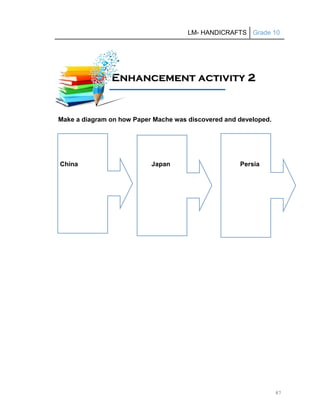
  • 8.
    LM- HANDICRAFTS Grade10 1 A. Multiple Choice Direction: Read the statements carefully and write the letter of your best choice in your answer sheet. 1. The origin of Origami in Japan comes from the country of _______. a.Germany c. China b.Russia d. Korea 2. This was described as an era were Origami have rapidly gain recognition. a. Genruko c. Edo b. Showa d. Shinto 3. This is referred to as a paper used in Origami a. Kami c. Ukiyue b. Noshi d. Washi 4. This is referred as a rectangular sheet of paper in half along the short side. a. Burito c. Shutter b. Hotdog d. Taco 5. This is described as to fold the corner of a sheet of paper over to create a triangle. a. Hotdog c. Taco b. Shutter d. Valley 6. This is a fold which has to find the midpoint on a piece of paper then fold eachside to meet that point. a. Burito c. Shutter b. Hotdog d. Taco 7. This was referred to as a fold that must roll the page up without creating a crease in the paper. a.Burito c.Shutter b. Hotdog d.Valley 8. This is arectangular fold that has sides that rise up from the center fold. a. Hamburger c.Shutter b. Hotdog d.Valley DIAGNOSTIC ASSESSMENT
  • 9.
    LM- HANDICRAFTS Grade10 2 9. Described as a rectangular sheet of paper in half along the short side. a. Hamburger c.Shutter b. Hotdog d.Valley 10. Hamburger fold is a rectangular sheet of paper in half along the long side. a. Hamburger c.Shutter b. Hotdog d.Valley 11. A material for packaging as a light box or container usually made of cardboard or plastic. a. bag c. pouch b. carton d. storage container 12. Pliable transparent plastic material used to pack fragile materials a. bubble wrap c. plastic Wrap b. cellulose Plastic d. styrofoam 13.The most common paper craft method were strips of paper is soaked in glue and added to a mold layer by layer. a.cutting c. layering b. folding d. pulping 14. In pulp method ,this is the reason of using fabric conditioner in procedure. a. for scented purposes c. to separate the fiber b. for cleaning the paper d. to soften the paper 15. A cellulose wallpaper paste which comes as granules which are mixedwith water. a.Flour and Water paste c. PVA adhesive b.Glue d. Wallpaper paste 16. Referred to as method used modeling clay for making Paper Mache. a.cutting c. layering b.folding d. pulping 17.A cut thick cardboard and removed sharp edges. a. cutter c. razor b. knives d. scissor 18. These are water-mixable materials which have been used for decorating the product. a. Acrylic paints c. Latex Paints b. Emulsion paints d. Varnishes 19. Described as a multi-purpose, easy-to-use adhesive which can be usedboth as a glue and a vanish. Although white, when dries it is transparent and, as a finish, gives a glossy, protective a.flour and Water pastec. PVA adhesive b.glue d. wallpaper paste 20. A paint uses water based as an undercoat before decoration. a. acrylic paints c. latex Paints b. emulsion paints d. varnishes
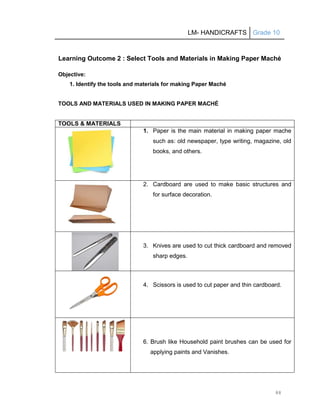
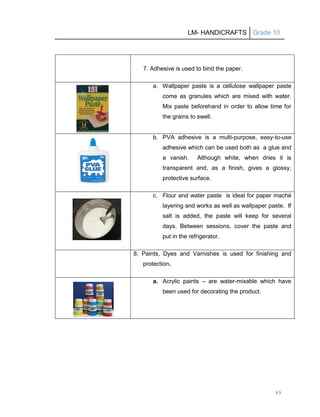
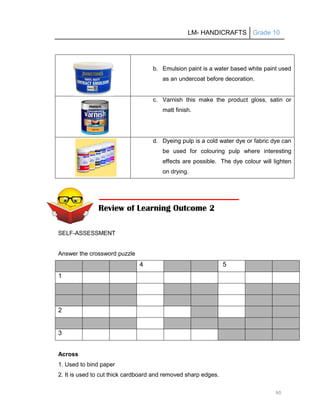
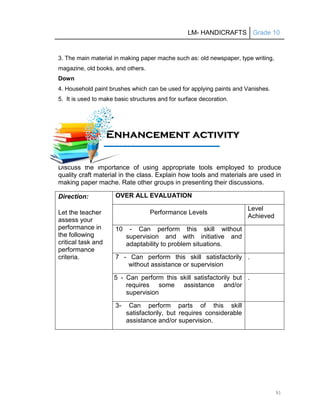
  • 10.
    LM- HANDICRAFTS Grade10 3 21. A paint described as to make the product gloss, satin or matte finish. a. Acrylic paints c. Latex Paints b. Emulsion paints d. Varnishes 22. Paper Mache originated from China during the _____Dynasty a. Chang c. Hun b. Han d. Sung 23. This is the early time which paper mache was used to make two dimensional objects such a. Armor c. Pots b. Helmet d. Spears 24. This was described as the material used in paper mache as a basic structure and surface decoration a. Box c. Plywood b. Cardboard d. Waxed paper 25. Which of the following is the BEST definition of fashion? a. Refers to the latest trend in clothing b. It is one way of expressing who you are and wanted to be as a person c. It is about how you carry one’s dress and accessories. d. It is changing and it does not prevails one’s personality 26. In the Philippines, which definition of Fashion was practice? a. Culture c. Trending b. Individual’s Preference d. Western Influences 27. A fashionable items like necklace, bracelets, earrings and brooch have long been used to add stylish touches to all types of outfits. a. Finishing Touches c. Hand Coverings b. Footwear d. Jewelry 28. Which fashion accessories refers to boots and shoes served as practical function? a. Footwear c. Head wear b. Hand Coverings d. Jewelry 29. An accessories refers to as belts and buckles as well as necktie and Neckwear is called_____________. a. Finishing Touches c. Hand Covering b. Footwear d. Head wear 30. This is refers to all jewelry made from precious metal and semi-precious stones a. Fashion Costume Jewelry c. Precious Jewelry b. Fine Jewelry d. Semi-precious Jewelry 31. An ornament which was first attached through the ear lobe a. Bracelet c. Earrings b. Brooches d. Necklace
  • 11.
    LM- HANDICRAFTS Grade10 4 32. Which ornament that is held by pins and clasp and usually worn near to neck? a. Bracelet c. Earrings b. Brooches d. Necklace 33. This is refers to an article which is usually worn around the neck. a. Bracelet c. Earrings b. Brooches d. Necklace 34. This was described as a non-toxic material that can be sculpted, molded and air dry to a hard finish a. Beads c. Paper Clay b. Coco shells d. Seeds 35. This is referred to as Fashion accessories material which is made from metal and a necessity in jewelry making. a. Leather c. Thread b. Rattail d. Wire 36.This is a crucial material in jewelry making because of its wide variety of shapes,designs and uses which comes from gemstone to metal a. Beads c. Plastics b. Paper clay d. Polymer Clay 37. This is described as the iridescent whitish coating inside oyster shells. It is often used for studs, buttons, inexpensive jewelry, and carved jewelry. a. Coco shells c. Mother of Pearl b. Glass Beads d. Paper Clay 38. Which material of fashion accessories used to join jewelry components together in completing the article or product a. Findings c. Thread b. Rattail d. Wire 39. This is used to cut paper, fabric or thread ends a. Craft Cutter c. Pliers b. Knife d. Scissor 40. This is an invaluable tool for stringing the beads as they easily secure crimps a. Chain- Nose Plier c. Curved-chain nose plier b. Crimping Pliers d. Flush Cutter 41. Which needle are made from thin wires with a sharp point at one end a narrow eye on the other end? a. Beading Needle c. Embroidery Needle b. Crewel Needle d. Tapestry Needle 41. This is referred to as for picking up tiny beads or for holding in one hand while applying glue a. Holder c. Tong c. Puller d. Tweezer
  • 12.
    LM- HANDICRAFTS Grade10 5 42. This is used to keep beads and other small materials and findings a. Bags c. Cellophane b. Box d. Storage Box 43. Which material comes in various thickness and made of gold plated or silver, surgical steel or colored wire? a. Elastic Cord c. Nylon Cord b. Monofilament d. Wire and Chain 44. This is Defined as buying or acquiring of goods or materials to make an article or product. a. Enrolling c. Purchasing b. Licensing d. Selling 45. This is specified as the materials that you are going to acquire a. Item c. Quantity b. Name d. Unit Cost 46. This serves as an indicator of how many items are you going to buy a. Item c. Quantity b. Name d. Unit Cost 47. It is refers to all jewelry made from other metals, including precious silver, or from unusual materials ( wood, glass, beads etc.) and semi-precious or imitation gems. a. Fine jewelry b. Fashion Costume Jewelry c. Precious Jewelry d. Semi-precious Jewelry 48. What is the simplest type of earrings. a. Drop c. Hoop b. Hook d. Stud 49. This is a type of ear back that is more secure stud earring back ascompare to the one that slides on the post. a. Fish Hook c. Lever b. French Hook d. Screw 50. This is a neckline that is best for long pendant to add length to your torso and to break up the horizontal cut of the nautical neckline. a. Boat c. Square b. Heart d. Turtle
  • 13.
    LM- HANDICRAFTS Grade10 6 Personal Entrepreneurial Competencies (PECs) Content Standards Performance Standards The learner demonstrates understanding of one’s PECs in Handicraft. The learner independently creates a plan of action that strengthens and/or further develops his/her PECs in Handicraft. Quarter I Time Allotment: 4 hours Module 1 Personal Entrepreneurial Competencies Introduction In this module, you will learn more about entrepreneurship and the entrepreneurial competencies related to Handicraft. You will have a first-hand experience in educational activities leading to assessment of your personal entrepreneurial competencies (PECs) and the entrepreneurial competencies of a successful craftsman within your province. You will also have several activities that will align your competencies with those of successful practitioners. Moreover, this module will encourage you to think about entrepreneurship and its role in the business community as well as in the economic and social development of an individual. To start with this module, let us first understand entrepreneurs and entrepreneurship. Entrepreneurs are those with the skills and capabilities to see and evaluate business opportunities. They are individuals who can strategically identify products or services needed by the community, and have the capacity to deliver them at the right time and at the right place. Entrepreneurs are agents of economic change; they organize, manage, and assume risks of a business. Some of the good qualities of
  • 14.
    LM- HANDICRAFTS Grade10 7 entrepreneurs are: opportunity-seeker, risk-taker, goal-setter, excellent planner, confident problem-solver, hardworking, persistent and committed. Entrepreneurship, on the other hand, is not just a simple business activity but a strategic process of innovation and new product creation. Basically, entrepreneurship is both an art and science of converting business ideas into marketable products or services to improve the quality of living. Now that you have background knowledge about entrepreneurs and entrepreneurship, you can now walk through in assessing your PECs. Always remember that successful entrepreneurs continuously develop and improve their PECs. To begin, let us find out the competencies you will have gained upon completion of this module. Objectives At the end of this module, you are expected to:  identify areas for improvement, development, and growth,  align your PECs according to your business or career choice, and  create a plan of action that ensures success in your business or career choice. Now try to take the first challenge in this module, the pre assessment. Pre-assessment As part of your initial activity, try to assess your prior knowledge and experience related to personal entrepreneurial competencies. Answer Task 1. Task 1: Matching Type Directions: Match the entrepreneurial competencies in column A with their meaning in column B. Write the letter of the correct answer on the space provided before each number. A B ____1. Creative A. makes wise decisions towards the set
  • 15.
    LM- HANDICRAFTS Grade10 8 objectives ____2. Profit-oriented B. strategic thinking and setting of goals ____3. Disciplined C. trusting in one’s ability ____4. Sound decision maker D. adoptable to change ____5. Possess people skills E. innovates to have an edge over other competitors ____6. Excellent Planner F. solid dedication ____7. Confident G. skillful in record keeping ____8. Hardworking H. always sticks to the plan ____9. Ability to accept change I. work diligently ____10. Committed J. effective and efficient communication skills and relates well to people K. always looking for an opportunity to have/earn income. Task 2: Guide Questions Directions: The following are guide questions which covers the entire module. Write your answers on your assignment notebook. Discuss / share these to the class. A. Explain why entrepreneurial activities are important to social development and economy progress. B. What entrepreneurial activities related to Handicraft do you know and are capable of doing? C. If you were given the opportunity to own a business that relates to Handicraft, do you think you will be confident to manage it? Explain your answer. D. What do you think are the most important competencies one must possess in order to be successful in running a chosen business?
  • 16.
    LM- HANDICRAFTS Grade10 9 E. Name successful entrepreneurs from your province whose businesses are related to Handicraft. Make sure you will be able to share with the class the PECs that made them successful. After all the guide questions are answered, share these with your classmates. You may also compare your insigths, personal knowledge, and relevant experiences on the topic to make the sharing more exciting and engaging. Learning Goals and Targets After understanding the objectives of this module, having gone through pre-assessment, and answering the guide questions, you will be asked to set your own personal goals and targets. These goals and targets will urge you to further achieve the ultimate objective of this module. In the end, these ultimate goals will motivate you to learn more about PECs. Figure 1: Strategic process to achieve the objectives of this module Reading Resources and Instructional Activities After setting your own personal goals and targets in achieving the objectives of this module, check your inherent knowledge of PECs. Answer the following guide questions with the help of your classmates. Task 3: Group Activity Goals and Targets Learning Activities Ultimate Goal
  • 17.
    LM- HANDICRAFTS Grade10 10 Directions: Answer the following guide questions on a separate sheet of paper. Share your answers with the class. 1. Explain the importance of assessing one’s PECs before engaging in a particular entrepreneurial activity. _________________________________________________________ _________________________________________________________ ________________________________________________________. 2. Are there other strategies or approaches where you can assess your PECs? Explain how these strategies will become more useful in selecting a viable business venture. _________________________________________________________ _________________________________________________________ ________________________________________________________. 3. What are the desirable personal characteristics, attributes, lifestyles, skills, and traits of a prospective entrepreneur? Why are these important? _________________________________________________________ _________________________________________________________ ________________________________________________________. 4. Why is there a need to assess one’s PECs in terms of characteristics, attributes, lifestyles, skills, and traits before starting a particular business? _________________________________________________________ _________________________________________________________ ________________________________________________________. 5. What is the significance of evaluating PECs of a successful entrepreneur? What helpful insights can you draw from this activity? ________________________________________________________ ________________________________________________________ ________________________________________________________.
  • 18.
    LM- HANDICRAFTS Grade10 11 How was your experience in answering the guide questions with your classmates? Were you able to benefit from them? What were the insights you have realized? This time you’re going to study the different topics that will enrich your knowledge of PECs. Read all the important details about the succeeding topic carefully. Assessment of Personal Entrepreneurial Competencies (PECs) and Skills vis-à-vis a Practicing Entrepreneur in a Province Entrepreneurial competencies refer to the important characteristics that should be possessed by an individual in order to perform entrepreneurial functions effectively. In this module, you will learn some of the most important characteristics, attributes, lifestyle, skills and traits of a successful entrepreneur or an employee to be successful in a chosen career. Below are few important characteristics / traits / attributes of a good entrepreneur:  Hardworking: One of the important characteristics of a good entrepreneur is hardworking. This means working diligently and being consistent about it. Hardworking people keep improving their performance to produce good products and/or provide good services.  Confident: Entrepreneurs have self-reliance in one’s ability and judgment. They exhibit self-confidence to cope with the risks of operating their own business.  Disciplined: Successful entrepreneurs always stick to the plan and fight the temptation to do what is unimportant. Know
  • 19.
    LM- HANDICRAFTS Grade10 12  Committed: Good entrepreneurs assume full responsibility over their business. They give full commitment and solid dedication to make the business successful.  Ability to accept change: Nothing is permanent but change. Change occurs frequently. When you own a business, you should cope with and thrive on changes. Capitalize on positive changes to make your business grow.  Creative: An entrepreneur should be creative and innovative to stay in the business and in order to have an edge over the other competitors.  Has the initiative: An entrepreneur takes the initiative. You must put yourself in a position where you are responsible for the failure or success of your business.  Profit-oriented: An entrepreneur enters the world of business to generate profit or additional income. The business shall become your bread and butter. Therefore, you must see to it that the business can generate income. Listed below are the important skills of a successful entrepreneur:  Excellent planner: Planning involves strategic thinking and goal setting to achieve objectives by carefully maximizing all the available resources. A good entrepreneur develops and follows the steps in the plans diligently to realize goals. A good entrepreneur knows that planning is an effective skill only when combined with action.  Possesses people skills: This is a very important skill needed to be successful in any kind of business. People skills refer to effective and efficient communication and establishing good relationship to the people working in and out of your business. In day-to-day business transactions, you need to deal with people. A well-developed interpersonal skill can make a huge difference between success and failure of the business.
  • 20.
    LM- HANDICRAFTS Grade10 13  Sound decision maker: Successful entrepreneurs have the ability to think quickly and to make wise decisions towards a pre-determined set of objectives. No one can deny that the ability to make wise decisions is an important skill that an entrepreneur should possess. Sound decisions should be based on given facts and information and lead towards the pre-determined objectives. To firm up what you have learned and have a better appreciation of the different entrepreneurial competencies, read the PECs checklist below, then answer the same. Task 4: PECs Checklist Directions: Using the PECs checklist, assess yourself by putting a check ( ) mark in either strengths or development areas column. Interpret the results by counting the total number of check marks in each of the columns. After accomplishing the checklist, form a group and share your insights on the result of the personal assessment. Table 1: PECs Checklist Personal Entrepreneurial Competencies (PECs) of an Entrepreneur Personal Assessment in terms of: Strengths Development Areas Hardworking Works diligently Confident Self-reliance in one’s ability Disciplined Always stick to the plan Committed Process
  • 21.
    LM- HANDICRAFTS Grade10 14 Solid dedication Ability to accept changes Adaptable Creative Innovative to have edge over other competitors Profit-oriented Always looking for an opportunity to have/earn income Excellent planner Strategic thinking and setting of goals Possess people skill Effective and efficient communication skills and relates well to people Sound decision maker Makes wise decisions towards the set objectives TOTAL Interpretation or Insight: _____________________________________________________________________ _____________________________________________________________________ _____________________________________________________________________ _____________________________________________________________________ _____________________________________________________________________ _____________________________________________________________________ __________. Reflect and Understand
  • 22.
    LM- HANDICRAFTS Grade10 15 How was your experience in discovering the strengths and the areas you need to develop? Did you gain a valuable experience in exchanging insights with your classmates? To learn more and deepen your understanding of PECs, do task 5 below. Task 5: Interview Directions: In your province, interview a successful craftsman or entrepreneur whose type of business is related with handicraft. Focus your questions on PECs and other business-related attributes that helped them become successful. Analyze the results of the interview and reflect on the similarities and/or differences. Write your answer on a separate sheet of paper. Sample Interview Guide Name of Proprietor/Practitioner: ____________________________________ Age: _______________ Number of Years in Business: _________________ Business Name: ________________________________________________ Business Address: ______________________________________________ 1. What preparations did you make before you engaged in this type of business or job? ________________________________________________________ ________________________________________________________ _______________________________________________________. 2. What special skills and characteristics do you have that are related with your business or job? ________________________________________________________ ________________________________________________________ _______________________________________________________. 3. How did you solve business-related problems during the early years of your business operation?
  • 23.
    LM- HANDICRAFTS Grade10 16 ________________________________________________________ ________________________________________________________ _______________________________________________________. 4. Did you follow the tips from a successful businessman or practitioner before you engaged in your business? ________________________________________________________ ________________________________________________________ _______________________________________________________. 5. What best business practices can you share with aspiring entrepreneurs? ________________________________________________________ ________________________________________________________ _______________________________________________________. 6. What do you think are the salient characteristics, attributes, lifestyle, skills and traits that made you successful in your business or job? ________________________________________________________ ________________________________________________________ ______________________________________________________. Directions: Copy the tables below in your notebook or in a separate sheet of paper. Gather the needed information from the interview to supply answer/s to row 1 in the table below, after which, fill out the second row with your PECs. Personal Entrepreneurial Competencies Characteristics Attributes Lifestyles Skills Traits Successful Entrepreneur in the province My PECs Using the information on the table above, analyze and reflect on the similarities and differences in your answers. Put your reflection on the table
  • 24.
    LM- HANDICRAFTS Grade10 17 you copied in your notebook or in a separate sheet of paper. Write your conclusion on the space provided. Personal Entrepreneurial Competencies Similarities Differences Characteristics Attributes Lifestyles Skills Traits Conclusion: ________________________________________________________ ______________________________________________________________ ______________________________________________________________ ______________________________________________________________ _____________________________________________________________.
  • 25.
    LM- HANDICRAFTS Grade10 18 After performing the activities on the importance of PECs, let’s determine how much you have learned. Perform task 6 to determine how well you have understood the lesson. Task 6: Preparation of a Plan of Action Directions: Use in a separate sheet of paper / in your notebook the information generated from task 5 (Interview) and prepare an action plan that indicates alignment of your PECs to the PECs of a successful entrepreneur in Handicraft in your province. Objective Area Activitie s Strategie s Time Fram e Expecte d Outcome To align my PECs with the PECs of a successful entrepreneu r in Handicraft Characteristic s Skills Attribute Traits Transfer
  • 26.
    LM- HANDICRAFTS Grade10 19 Task 7: Essential Questions Directions: Read and study the following questions below. You may use a separate sheet of paper or your notebook to write your answers. 1. Why is there a need to compare and align one’s PECs with the PECs of a successful entrepreneur? ________________________________________________________ ________________________________________________________ ________________________________________________________ ________________________________________________________ ________________________________________________________ ________________________________________________________ ________________________________________________________ _______________________________________________________. 2. How does your action plan help sustain your strong PECs and/or address your development areas? ________________________________________________________ ________________________________________________________ ________________________________________________________ ________________________________________________________ ________________________________________________________ ________________________________________________________ ________________________________________________________ _______________________________________________________. 3. What plan of action will you utilize to address your development areas? ________________________________________________________ ________________________________________________________ ________________________________________________________ ________________________________________________________ ________________________________________________________ ________________________________________________________ ________________________________________________________ _______________________________________________________.
  • 27.
    LM- HANDICRAFTS Grade10 20 ENVIRONMENT AND MARKET (EM) Content Standards Performance Standards The learner demonstrates understanding of environment and market in Handicraft in one’s province. The learner independently creates a business vicinity map reflective of potential market in Handicraft in a province. Quarter I Time Allotment: 4 hours Module 2 Environment and Market Introduction Aspiring entrepreneur need to explore the economic, cultural, and social conditions prevailing in an area. Needs and wants of the people in a certain area that are not met may be considered business opportunities. Identifying the needs of the community, its resources, available raw materials, skills, and appropriate technology can help a new entrepreneur seize business opportunities. To be successful in any kind of business venture, potential entrepreneurs should look closely at the environment and market. They should always be watchful of existing opportunities and constraints, and to take calculated risks. The opportunities in the business environment are factors that provide possibilities for a business to expand and make more profit. Constraints, on the other hand, are factors that limit business growth, hence reduce the chance of generating profit. One of the best ways to evaluate opportunities and constraints is to conduct a Strengths, Weaknesses, Opportunities and Threats (SWOT) Analysis. SWOT Analysis is a managerial tool used to assess the environment. It is used to gather important information which is then used in strategic
  • 28.
    LM- HANDICRAFTS Grade10 21 planning. Strengths and weaknesses are internal in an organization. They relate to resources owned by an organization that you have control over and also the extent of its marketing. Opportunities and threats exist in the external environment. Opportunities relate to the market, new technologies, and the external factors such as government policies, climate, and trends. Threats replace what the competitors are doing. It also includes legal and other constraints. Now that you have read some important considerations to explore to be successful in any business, you are now ready to explore more about the environment and market. To begin with, let’s find out the competencies that you will master as you finish this module. Objectives At the end of this module, you are expected to:  identify what is of ―value‖ to the customer,  identify the customer to sell to,  explain what makes a product unique and competitive,  apply creativity and innovative techniques to develop marketable products, and  employ a unique selling proposition (USP) to a product and/or service. Now that you have an idea about the things you will learn, take the first challenge in this module – the pre-assessment.
  • 29.
    LM- HANDICRAFTS Grade10 22 Pre-assessment Task 1: Multiple Choice DIRECTIONS: Choose the letter of the best answer. Write your answer on a separate sheet of paper. 1. It is generated by examining the goods and services sold in the community. A. business creation C. business concept B. business pricing D. business idea 2. It is a process of making new products which will be sold to the customers. A. product analysis C. product development B. product conceptualization D. product implementation 3. These are luxuries, advantages and desires that every individual considers beyond necessary. A. wants C. requirements B. desires D. needs 4. It is a factor or consideration presented by a seller as the reason that a product or service is different from and better than that of the competition. A. unique selling plan C. unique pricing policy B. unique selling proposition D. finding value-added 5. A stage in which the needs of the target market are identified, reviewed, and evaluated. A. concept development C. project development B. economic analysis D. refine specification 6. It is the introduction of new ideas to make the product and services more attractive and saleable to the target customers. A. new idea C. product development B. creativity D. innovation 7. It is a managerial tool used to assess the environment and to gather important information that can be used for strategic planning. A. scanning C. WOTS Analysis B. SWOT Analysis D. survey analysis
  • 30.
    LM- HANDICRAFTS Grade10 23 8. It is creating names, symbol, or designs that identifies and differentiates a product from the other products. A. product naming C. branding B. unique selling proposition D. tagline 9. It is a meaningful and unforgettable statement that captures the essence of the brand. A. product naming C. branding B. unique selling proposition D. tagline 10. These are things that people cannot live without. A. wants C. requirements B. desires D. needs Task 2: Guide Questions: Directions: Read and study the guide questions below. Use a separate sheet of paper to write your answer. 1. How does one determine the product or services to be produced and/or to be provided to the target customers? ________________________________________________________ ________________________________________________________ ________________________________________________________ 2. How does one select an entrepreneurial activity? ________________________________________________________ ________________________________________________________ ________________________________________________________ 3. When can one say that a certain product has ―value?‖ ________________________________________________________ ________________________________________________________ ________________________________________________________ 4. Does applying creativity to your product or services important? Why? ________________________________________________________ ________________________________________________________ ________________________________________________________
  • 31.
    LM- HANDICRAFTS Grade10 24 5. How can one effectively respond to the needs of the target customer? ________________________________________________________ ________________________________________________________ ________________________________________________________ 6. From the viewpoint of business owner, discuss the importance of scanning the environment and market in generating business ideas. ________________________________________________________ ________________________________________________________ ________________________________________________________ 7. Using self-assessment, explain the level of your confidence in formulating a business idea. ________________________________________________________ ________________________________________________________ ________________________________________________________ After all the guide questions are answered and skills have been mastered, share insights/ideas with your classmates. Discuss your insights, personal knowledge, and relevant experiences on the topic to make it more exciting and engaging. Learning Goals and Target After reading and understanding the objectives of this module and having gone through the pre-assessment and guide questions, you will be asked to set your own personal goals. These goals will urge you to further achieve the ultimate objective of this module. In the end, these goals will motivate you to learn more about environment and market. Goals and Targets Learning Activities Ultimate Goal
  • 32.
    LM- HANDICRAFTS Grade10 25 Figure 2: Strategic process to reach the objectives of this module Reading Resources and Instructional Activities After setting your own personal goals and targets in achieving the objectives of this module, you will have the opportunity to read and learn more about environment and market. You will also be given a chance to do practical exercises and activities to deepen your understanding of the topic. Product Development When we talk of product development, we are referring to a process of making a new product to be sold by a business or enterprise to its customers. Product development may involve modification of an existing product or its presentation, or formulation of an entirely new product that satisfies a newly-defined customer’s needs, wants and/or a market place. The term development in this module refers collectively to the entire process of identifying a market opportunity, creating a product to appeal to the identified market, and testing, modifying, and refining the product until it becomes ready for production. There are basic, yet vital questions that you can ask yourself about product development. When you find acceptable answers to them, you may now say that you are ready to develop a product and/or render services. These questions include the following: 1. For whom are the product/services aimed at? 2. What benefit will the customers expect from product/service? 3. How will the product/service differ from the existing brand? From its competitor? In addition, needs and wants of the people within an area should also be taken into big consideration. Everyone has his/her own needs and wants. However, each person has different concepts of needs and wants. Needs in Know
  • 33.
    LM- HANDICRAFTS Grade10 26 business are the important things that an individual cannot live without in a society. These include: 1. basic commodities for consumption, 2. clothing and other personal belongings, 3. shelter, sanitation and health, and 4. education. Basic needs are essential to an individual to live with dignity and pride in a community. These needs can obviously help you generate business ideas and subsequently to product development. Wants are desires, luxury and extravagance that signify wealth and expensive way of living. Wants or desires are considered above all the basic necessities of life. Some examples of wants or desires are: fashion accessories, expensive shoes and clothes, travels, eating in an expensive restaurant, watching movies, concerts, having luxurious cars, wearing expensive jewelry and perfume, living in impressive homes, among others. Needs and wants of people are the basic indicators of the kind of business that you may engage in because it can serve as the measure of your success. Some other points that might be considered in business undertakings are the kind of people, their needs, wants, lifestyle, culture and tradition, and their social orientation. To summarize, product development entirely depends on the needs and wants of the customers. Another important issue to deal with is the key concepts of developing a product. The succeeding topic shall enlighten you about the procedure in coming up with a product. Concepts of Developing a Product Concept development is a critical phase in the development of a product. In this stage, the needs of the target market are identified, and competitive products are reviewed before the product specifications are defined. The product concept is selected along with an economic analysis to come up with an outline of how a product is being developed. Figure 3 shows the stages of concept development of a product.
  • 34.
    LM- HANDICRAFTS Grade10 27 Figure 3: Stages of Concept Development The process of product development follows the following stages: 1. Identify customer needs: Using survey forms, interviews, researches, focus group discussions, and observations, an entrepreneur can easily identify customers’ needs and wants. In this stage, the information that can be possibly gathered are product specifications (performance, taste, size, color, shape, life span of the product, etc.). This stage is very important because it would determine the product to be produced or provided. Concept Development Identify Customer Needs Plan Remaining Developme nt Project Establish Target Specifica tions Generate Product Concepts Select a Product Concept Analyze Competiti ve Products Refine Specificat ions Perform Economic Analysis
  • 35.
    LM- HANDICRAFTS Grade10 28 2. Establish target specifications: Based on customers' needs and reviews of competitive products, you can now establish target specifications of the prospective new product and/or services. A target specification is essentially a wish-list. 3. Analyze competitive products: It is imperative to analyze existing competitive products to provide important information in establishing product or service specifications. Other products may exhibit successful design attributes that should be emulated or improved upon in the new product or service. 4. Generate product concepts: After having gone through with the previous processes, you may now develop a number of product concepts to illustrate the types of products or services that are technically feasible and will best meet the requirements of the target specifications. 5. Select a product concept: Through the process of evaluation between attributes, a final concept is selected. After the final selection, additional market research can be applied to obtain feedback from certain key customers. 6. Refine product specifications: In this stage, product or services specifications are refined on the basis of input from the foregoing activities. Final specifications are the result of extensive study, expected service life, projected selling price among others are being considered in this stage. 7. Perform economic analysis: Throughout the process of product development, it is very important to always review and estimate the economic implications regarding development expenses, manufacturing costs, and selling price of the product or services to be offered or provided. 8. Plan the remaining development project: In this final stage of concept development, you can prepare a detailed development plan which includes list of activities, necessary resources and expenses, and development schedule with milestones for tracking progress. Finding Value
  • 36.
    LM- HANDICRAFTS Grade10 29 People buy for a reason. There should be something in your product or service that would give consumers a good reason to go back and buy more. There must be something that will make you the best option for target customers; otherwise, they have no reason to buy what you are selling. This implies further, that you offer something to your customers that will make them value your product or service. The value you incorporate in your product is called value proposition. Value proposition is a believable collection of the most persuasive reasons why people should notice you and take the action you’re asking for. It is what gets people moving, what makes people spend for your product or service. Innovation Innovation is the introduction of something new in your product or service. This may be a new idea, a new method, or a new device. If you want to increase your sales and profit, you must innovate. Some of the possible innovations for your products are change of packaging, improvement of taste, color, size, shape, and perhaps price. Some of the possible innovations in providing services are application of new and improved methods, additional featured services, and possibly freebies. Unique Selling Proposition (USP) Unique Selling Proposition is the factor or consideration presented by a seller as the reason that one product or service is different from and better than that of the competition. Before you can begin to sell your product or service to your target customers, you have to sell yourself in it. This is especially important when your product or service is similar to your competitors. USP requires careful analysis of other businesses' ads and marketing messages. If you analyze what they say or what they sell, not just their product or service characteristics, you can learn a great deal about how companies distinguish themselves from competitors. Here's how to discover your USP and how to use it to increase your sales and profit:
  • 37.
    LM- HANDICRAFTS Grade10 30  Use empathy: Put yourself in the shoes of your customers. Always focus on the needs of the target customers and forget falling in love with your own product or service. Always remember, you are making/providing this product not for yourself but for the target customers to eventually increase sales and earn profit. Essential question such as what could make them come back and ignore competition, should be asked to oneself. Most possible answers may be focused on quality, availability, convenience, cleanliness, and reliability of the product or service.  Identify customer’s desires. It is very important for you to understand and find out what drives and motivates your customers to buy your product or service. Make some effort to find out, analyze and utilize the information that motivates the customers in their decision to purchase the product or service.  Discover customer’s genuine reasons for buying the product. Information is very important in decision making. A competitive entrepreneur always improve their products or services to provide satisfaction and of course retention of customers. As your business grows, you should always consider the process of asking your customers important information and questions that you can use to improve your product or service. To enhance your understanding of the topic previously presented, you will be tasked to form a group and arrange an interview with a successful entrepreneur or practitioner. You have to document this interview and present this to the whole class for reflection and appreciation. Task 3: Interview Directions: Select a successful entrepreneur or practitioner. Conduct an interview using the set of questions below. Document the interview and present it to the class. Use a separate sheet of paper. 1. How did you identify your customers? Process
  • 38.
    LM- HANDICRAFTS Grade10 31 ________________________________________________________ ________________________________________________________ ________________________________________________________ 2. What were your considerations in selecting your customers? ________________________________________________________ ________________________________________________________ ________________________________________________________ 3. Explain how your product or service became unique to other products. ________________________________________________________ ________________________________________________________ ________________________________________________________ 4. Did you consult somebody before you engaged in this business? Cite / give sample insights that you gained from the consultation. ________________________________________________________ ________________________________________________________ ________________________________________________________ 5. What were your preparations before you started the actual business? ________________________________________________________ ________________________________________________________ ________________________________________________________ 6. What creative and innovative techniques did you adapt in the development of your product or service? What was the effect of the innovative techniques to the sales and profits of your business? ________________________________________________________ ________________________________________________________ ________________________________________________________ 7. What strategy did you consider to create a unique selling proposition to your product or service? ________________________________________________________ ________________________________________________________ ________________________________________________________ Task 4: Browsing the Internet Reflect and Understand
  • 39.
    LM- HANDICRAFTS Grade10 32 Directions: To deepen your understanding of the lesson, perform the following tasks: 1. Browse the internet and view the topics related to: a. customers’ needs and wants b. techniques in identifying customers’ needs and wants c. creativity or innovations in products and services d. unique selling proposition e. product development 2. Prepare a short narrative report about these topics and discuss it to the class. You can highlight the aspect that intensifies your knowledge of product development. Task 5: Product Conceptualization Directions: In a separate sheet of paper or in your notebook. Develop your own concept of your product or service by using the figures on this page. Use bullets in every stage of product conceptualization in listing important key ideas. Transfer 1. Identify Customers Need 2. Target Specificatio ns - - - - 7. Prepare a Development Plan
  • 40.
    LM- HANDICRAFTS Grade10 33 Generating Ideas for Business The process of developing and generating a business idea is not a simple process. Some people come up with a bunch of business ideas that are not really feasible. There are two problems that arise; first is the excessive generation of ideas that can forever remain as a dreaming stage and the second is when they don’t have ideas and don’t want to become entrepreneurs. The most optimal way is to have a systematic approach in generating and selecting a business idea that can be transformed into a real business. Here are some basic yet very important considerations that can be used to generate possible ideas for business: Know 3. Analyze a Competitive Product - - - - - - - 4. Generate Product Concept - - - - 5. Select A product Concept - - - - - - 6. Refine Product Specification - - - - -
  • 41.
    LM- HANDICRAFTS Grade10 34 1. Examine existing goods and services. Are you satisfied with the product? What do other people who use the product say about it? How can it be improved? There are many ways of improving a product from the way it is made to the way it is packed and sold. You can also improve the materials used in crafting the product. In addition, you can introduce new ways of using the product, making it more useful and adaptable to the customers’ many needs. When you are improving the product or enhancing it, you are doing an innovation. You can also do an invention by introducing an entirely new product to replace the old one. Business ideas may also be generated by examining what goods and services are sold outside the community. Very often, these products are sold in a form that can still be enhanced or improved. 2. Examine the present and future needs. Look and listen to what the customers, institutions, and communities are missing in terms of goods and services. Sometimes, these needs are already obvious and identified right away. Other needs are not that obvious because they can only be identified later on, in the event of certain development in the community. For example, a province will have its electrification facility in the next six months. Only by that time will the entrepreneur could think of electrically- powered or generated business such as photo copying, computer service, digital printing, etc. 3. Examine how the needs are being satisfied. Needs for the products and services are referred to as market demand. To satisfy these needs is to supply the products and services that meet the demands of the market. The term market refers to whoever will use or buy the products or services, and these may be people or institutions such as other businesses, establishments, organizations, or government agencies. There is a very good business opportunity when there is absolutely no supply to a pressing market demand. Businesses or industries in the locality also have needs for goods and services. Their needs for raw materials, maintenance, and other services such as selling and distribution are good sources of ideas for business.
  • 42.
    LM- HANDICRAFTS Grade10 35 4. Examine the available resources. Observe what materials or skills are available in abundance in your area. A business can be started out of available raw materials by selling them in raw form and by processing and manufacturing them into finished products. For example, in a copra- producing town, there will be many coconut husks and shells available as ―waste‖ products. These can be collected and made into coco rags or doormats and charcoal bricks and sold profitably outside the community. A group of people in your neighborhood may have some special skills that can be harnessed for business. For example, women in the Mountain Province possess loom weaving skills that have been passed on from one generation to another. Some communities set up weaving businesses to produce blankets, decorative, and various souvenir items for sale to tourists and lowlanders. Business ideas can come from your own skills. The work and experience you may have in agricultural arts, industrial arts, home economics, or ICT classes will provide you with business opportunities to acquire the needed skills which will earn you extra income should you decide to engage in income-generating activities. With your skills, you may also tinker around with various things in your spare time. Many products are invented this way. 5. Read magazines, news articles, and other publications on new products and techniques or advances in technology. You can pick up new business ideas from magazines such as Newsweek, Reader’s Digest, Business Magazines, ―Go Negosyo‖, Know About Business (KAB) materials, and Small-Industry Journal. The Internet also serves as a library where you may browse and surf on possible businesses. It will also guide you on how to put the right product in the right place, at the right price, and at the right time. Key Concepts of Selecting a Business Idea Once you have identified business opportunities, you will eventually see that there are many possibilities available for you. It is very unlikely that you will have enough resources to pursue all of them at once.
  • 43.
    LM- HANDICRAFTS Grade10 36 You have to select the most promising one among hundreds of ideas. It will be good to do this in stages. In the first stage, you screen your ideas to narrow them down to about few choices. In the next stage, trim down the choices to two options. In the final stage, choose between the two and decide which business idea is worth pursuing. In screening your ideas, examine each one in terms of the following guide questions: 1. How much capital is needed to put up the business? 2. Where should the business be located? 3. How big is the demand for the product? Do many people need this product and will continue to need it for a long time? 4. How is the demand met? Who are processing the products to meet the needs (competition or demand)? How much of the need is now being met (supply)? 5. Do you have the background and experiences needed to run this particular business? 6. Will the business be legal and not against any existing or foreseeable government regulation? 7. Is the business in line with your interest and expertise? Your answers to these questions will be helpful in screening which ones among your many ideas are worth examining further and worth pursuing. Branding Branding is a marketing practice of creating a name, a symbol or design that identifies and differentiates product or services from the rest. It is also a promise to your customers. It tells them what they can expect from your product or service and it differentiates your offerings from other competitors. Your brand is derived from who you are, who you want to be and what people perceive you to be. Branding is one of the most important aspects in any business. An effective brand strategy gives you a major edge in increasingly competitive markets. A good product can:
  • 44.
    LM- HANDICRAFTS Grade10 37 - deliver message clearly, - confirm credibility, - connect to target prospect, - motivate buyers, and - concretize user loyalty. Here are simple tips to publicize your brand:  Develop a tagline. Write a statement that is meaningful, impressive, and easy to remember to capture the essence of your brand.  Design a logo. Create a logo symbolic of your business and consistent with your tagline and displace it strategically.  Write a brand message. Select a key message to communicate about your brand.  Sustain a brand quality. Deliver a promise of quality through your brand.  Practice consistency. Be reliable and consistent to what your brand means in your business. In generating a business idea, you should first identify the type of business suited to your business idea. You should analyze and scan the potential environment, study the marketing practices and strategies of your competitors, analyze strengths, weaknesses, opportunities, and threats in your environment to ensure that the products or services you are planning to offer will be patronized and within easy reach of target consumers. How to conduct SWOT Analysis: Process
  • 45.
    LM- HANDICRAFTS Grade10 38  Be realistic about the strengths and weaknesses of your business when conducting SWOT Analysis.  SWOT Analysis should distinguish between where your business is today, and where it can be in the future.  SWOT Analysis should always be specific. Avoid any gray areas.  Always apply SWOT Analysis in relation to your competition, i.e. better than or worse than your competition.  Keep your SWOT Analysis short and simple. Avoid complexity and over analysis.  SWOT Analysis is subjective. Task 6: SWOT Analysis Directions: In a separate sheet of paper or in your notebook list down all your observations for your business idea. Categorize your observations according to strengths, weakness, opportunities and treats. After carefully listing them down, use the stated strategies to come up with a sound analysis, activities and best business idea. Strength (S) Weaknesses (W) - - - - - -
  • 46.
    LM- HANDICRAFTS Grade10 39 Strategies:  SW - Maximize on the Strengths to overcome the internal Weakness.  OW - Capitalize on the Opportunities to eliminate the internal Weakness.  ST - Maximize on your Strengths to eliminate the external Threats.  OT - Take advantage of the available Opportunities to eliminate the external Threats. Analysis: __________________________________________________________________________________ __________________________________________________________________________________ __________________________________________________________________________________ __________________________________________________________________________________ Activities: - - - - - - Opportunities (O) Threats (T) - - - - - - - - - - - -
  • 47.
    LM- HANDICRAFTS Grade10 40 __________________________________________________________________________________ __________________________________________________________________________________ __________________________________________________________________________________ __________________________________________________________________________________ My Best Business Idea: __________________________________________________________________________________ __________________________________________________________________________________ __________________________________________________________________________________ __________________________________________________________________________________ To deepen your understanding of the topics previously discussed, you will be asked to perform the following activities: Task 7: Extra Reading and Video Viewing Reading books and watching videos have been considered as some of the most effective educational activities that can help learners broaden their understanding on a certain topic. In this particular task, you will be asked to conduct extra reading and video viewing on the Internet with the following topics: A. Steps in selecting a business idea B. Criteria of a viable business idea C. Benefits of a good brand D. Ways on developing a brand After successfully performing the assigned task, make a narrative report about it and share it with the class. Reflect and Understand
  • 48.
    LM- HANDICRAFTS Grade10 41 Task 8: Designing a Logo Directions: In a separate sheet of paper or in your notebook draw a logo that you will use in your business. Provide a simple statement to describe your logo. Tagline Transfer Logo
  • 49.
    LM- HANDICRAFTS Grade10 42 Task 9: Making My Own Vicinity Map Directions: In a separate sheet of paper or in your notebook draw a vicinity map reflective of potential market in Handicraft in your province. Provide a simple statement to describe your map.
  • 50.
    LM- HANDICRAFTS Grade10 43 QUARTER I Overview In this quarter, you will learn how Origami as paper craft evolvedas a worthwhile activities developed and creatively produced as one of entrepreneurial product. While you develop the skills, you also innately acquire discipline and positive work attitude towards making Origami products or projects. General Objectives At the end of this quarter, learners are expected to: 1. trace the history and development of Origami, 2. plan a design and pattern for an Origami; 3. select materials for making Origami ; 4. follow methods and procedures in making Origami ; and 5. produce different products in Origami. 6. Describe quality projects and products of Origami 7. Package the finished Origami
  • 51.
    LM- HANDICRAFTS Grade10 44 Pre – Test 1 I. Identification. Directions: Identify the following symbols in column B. Use the items in column A. Write the letter of your answer in the blank provided. Column A ___1.Thick lines show either raw edges or edges resulting from fold. ___2.Thin gray lines shows crease lines which are the result of prior folds. ___3.Dotted lines shows that are hidden behind layers of paper. ___4.A dashes lines show that the fold is supposed to be valley fold. ___5.A dash and dotted line shows that the fold is supposed to be a mountain fold. Sometimes you will find this line with a single dot. ___6.Fold the paper where shown is usually Column B a. b. c. d. e. f. Let’s See What You Know
  • 52.
    LM- HANDICRAFTS Grade10 45 a valley fold but uses for other fold as well. ___7.Fold behind, i.e. make a mountain fold. ___8.Fold and unfold, creating a crease line. ___9.Fold behind (mountain Fold) and unfold, creating a mountain crease line. ___10.Unfold a part of the model in the shown direction. ___11.Fold and unfold, i.e first fold in the direction of the normal arrow, and then fold back in the direction of the hollow arrow. ___12.Hamburger fold is a rectangular sheet of paper in half along the long side. ___13.Valley fold is a rectangular fold that has sides that rise up from the center fold. ___14.Hot dog fold is a rectangular sheet of paper in half along the short side. ___15.Shutter fold is the fold that find the midpoint on a piece of paper, then fold each side into meet that point. ___16.Mountain fold has a side that slope down from the center fold. ___17.Taco fold is to fold the corner of a sheet of paper over to create a triangle. Trim any excess. ___18.Triangle for making 3D objects out of g. h. ……….. i. j. k. l. ----------- m. n. … … o. p. q. r. __________
  • 53.
    LM- HANDICRAFTS Grade10 46 Learning Outcome 1 Trace the History and Development of Origami paper LESSON 1 : PERFORM ORIGAMI PRODUCTION
  • 54.
    LM- HANDICRAFTS Grade10 47 Objectives At the end of this lesson, you are expected to: 1. discuss the history and development of Origami; and 2. analyze relevance of Origami HISTORY OF ORIGAMI The technique of paper making introduced into Japan by China during the early seventh century, underwent considerable changes in its manufacturing process in Japan ,giving rise to a type of ―washi‖ paper possessing dual qualities of resilient sturdiness and softness which prevents tearing when it is handled, Washi, a unique and distinct type of Japanese paper kindled many forms of cultural creativity, among them origami. Unfortunately, it is not clear when origami in Japan first originated, However, well-regulated lifestyle came with the advent of samurai society which gave rise to the art of paper folding for practical and formal purposes. From the onset of the Showa period (1926-1989), the art has rapidly passed into oblivion, but a vestige of its former use can still be seen in the noshi, a decoration of folded red and white paper attached to a gift. Origami made to assume concrete shapes of, for example, a crane or boat is regarded as origami for pure enjoyment. It began to be made sometime around the beginning of the Edo period (1600-1868) which coincided with an age in which mass-produced, low-priced paper came to be widely used by the people. During the Genroku era (1688-1704), origami of the crane and several varieties of boats used as designs on clothing became fashionable, and it was also reproduced with great frequency in Ukiyoe prints. Origami rapidly came to have a wide following during this period. About a hundred years later, books and printed matter devoted exclusively to origami were published, creating a diverse and advanced form of origami. They were not only a form of children's amusement, but also a form intended for adults. Many of these origami were difficult to make because theyincorporated many complicated steps.
  • 55.
    LM- HANDICRAFTS Grade10 48 The technique of paper making was introduced into Europe in the twelfth century producing a distinct form of origami. However, origami was not taken up by a large number of people as it was in Japan. Not only are there now many imaginative and novel origami creations, but its educational worth and immense potential have been also reconsidered and recognized. Origami has gained a widespread following as a hobby among adults. There are now many origami associations that have been formed overseas by origami enthusiasts. The Japanese word "origami" itself is a compound of two smaller Japanese words: "ori", meaning to fold, and "kami", meaning paper. Until recently, all forms of paper folding were not grouped under the word origami, namely "tsutsumi", a kind of wrapper used for formal occasions. Before that, paperfolding for play was known by a variety of names, including "orikata", "orisue", "orimono", "tatamigami" and others. Exactly why "origami" became the common name is not known; it has been suggested that the word was adopted in the kindergartens because the written characters were easier for young children to write. Another theory is that the word "origami" was a direct translation of the German word "Papierfalten", brought into Japan with the Kindergarten Movement around 1880. Initially due to the fact that paper was expensive, origami became an art form practiced only by the elite and was used for practical purposes such as folding letters. Samurai would give each other little paper good luck charms known as noshi and Shinto weddings folded paper butterflies Review of Learning Outcome 1
  • 56.
    LM- HANDICRAFTS Grade10 49 A. TRUE OR FALSE Write True if the statement is correct and False if it is wrong. Write your answers in the notebook or separate paper. _____1. Origami originated from Japan during the seventh century. _____2.At the onset of the Showa period, Origami ,had rapidly passed into oblivion _____3.Origami was known to have been created for the elite for their paper folding in writing letters _____4. Washi wasa type of paper possessing dual qualities of resilient sturdiness and softness which prevented tearing when it was handled _____5. Origami has been known for children’ s amusement only. A. Prepare a 5 minute talk regarding Origami including how it evolved and was known globally . Be able to discuss the importance of Origami in Japan and other countries where it developed. B. Make an organizational chart which traces the stages of development of Origami and for each stage its contribution . Learning Outcome 2 Plan a design and pattern for an Origami Paper Craft Objectives E En nh ha an nc ce em me en nt t a ac ct ti iv vi it ty y A Ac ct ti iv vi it ty y
  • 57.
    LM- HANDICRAFTS Grade10 50 At the end of this lesson, you are expected to: 1. discuss the design to be made; and 2. sketch the design DESIGN AND PATTERN OF ORIGAMI Planning a design and pattern in Origami is very crucial . You have to make a plan on what kind of Origami object you want to create. Does it have to be creative? Functional? Durable? Or to what purpose do you create with. The diagram below , is an example of a base on the Origami vase in 3D design . It indicated the number of pieces of Origami fold we need to make. Plan the measurement of the proposed Origami in terms of height, circumference and the diameter of the base of your object. You can use a graphing paper and a crayon or coloring pen in marking the rows and column and do the counting. Then we can estimate the number of Origami paper we are going to fold . After folding, you can now divide the number of folds based on the form or color of the vase you want to create. You can start assembling them.
  • 58.
    LM- HANDICRAFTS Grade10 51 An example of 3d Origami Vase Enumerate the basic steps in making a design of an Origami Vase. Steps in making Origami Vase Design Sketch the Design of Origami Vase 1st 2nd 3rd 4th 5th E En nh ha an nc ce em me en nt t a ac ct ti iv vi it ty y A Ac ct ti iv vi it ty y Review of Learning Outcome 2
  • 59.
    LM- HANDICRAFTS Grade10 52 A. Discuss the following statement below among your classmates or to the class. A. Why do we need to plan the design of our project? B. Is it necessary for us to make a pattern or diagram in making Origami project? C. How are we going to make the design or pattern in Origami Project B. Compile at least 10 different design and pattern of Origami project found in the INTERNET . Analyze each design based on the description of the picture. Cite references. Learning Outcome 3 Select materials for making Origami Objectives
  • 60.
    LM- HANDICRAFTS Grade10 53 At the end of this lesson, you are expected to: 1. Identify materials suited for making Origami TOOLS AND MATERIALS USED IN MAKING ORIGAMI There are simple tools used in Origami since most of the technique is folding except for some complicated design. There are different kinds of paper used in Origami but a sturdy paper will just do. We can use colored paper of the magazines and catalogue and paper we want to recycle. Material 1. Paper is the main material in making origami, it can used paper or colored paper. It is depend on your design. Tools 2. Knives - are to slash paper on the desired size. 3. Scissors – are used for cutting paper on the desired design and size Review of Learning Outcome 3
  • 61.
    LM- HANDICRAFTS Grade10 54 SELF-ASSESSMENT Identify the tools and materials with their function and uses in making Origami . Provide your answers in the table given. TOOLS FUNCTION MATERIAL/S USE/S 1. 1. 2. ACTIVITY 1 Discuss the importance of using appropriate tools employed to produce quality craft material in the class. Explain how the tools and materials are used in making Origami. Rate other groups in presenting their discussions using the rubrics below. Directions: Ask the teacher to assess your performance in the following critical task and performance criteria below You will be rated based on the overall evaluation on the right side. SCORING RUBRICS Performance Levels Level Achieved 10 - Can perform this skill without supervision and with initiative and adaptability to problem situations . 7 - Can perform this skill satisfactorily without assistance or supervision. 4 - Can perform this skill satisfactorily but requires some assistance and/or supervision. E En nh ha an nc ce em me en nt t a ac ct ti iv vi it ty y A Ac ct ti iv vi it ty y
  • 62.
    LM- HANDICRAFTS Grade10 55 1 - Can perform parts of this skill satisfactorily, but requires considerable assistance and/or supervision. Instructor will initial level achieved. ACTIVITY 2 Make a research in identifying materials that are suited in making Origami and materials that can substitute or alter if there are no materials available in the locale. Write your output on the box below. Attach sample or picture. Materials Description Suggested project/Uses Learning Outcome 4 Follow Methods and Procedures in
  • 63.
    LM- HANDICRAFTS Grade10 56 Making Origami Objectives At the end of this lesson, you are expected to: 1. discuss the different methods, techniques and procedures in making Origami projects/products 2. follow procedures and techniques in making Origami projects/products 3. demonstrate methods/procedure in in making Origami projects/products PROCEDURES IN MAKING ORIGAMI Steps in Folding the Paper 1. Check that the paper you are folding is exactly a square. 2. Do not fold against a soft surface, such as a carpet, your lap or bedsheets. Fold against a hard surface ,such as a large hardback book or a table. 3. Crease slowly, firmly, and accurately. Form the early creases with particular care – if they are incorrect place, all the later, smaller creases will be difficult to place accurately and will look messy. 4. Read the instruction and follow the symbol on each step. Many mistakes are made by ignoring written instructions or by not following all the written instructions on a step, particularly during complex maneuvers. 5. The instruction and symbols on one step will create a shape which looks like the next step but stripped of its symbols. So, you must always look ahead to the next step to see what shape you are trying to make. Never look at steps in isolation, but see them as being interconnected, like links in a chain. Symbols and Diagram This shows the white and coloured side, like standard origami paper. You will see a symbol which shows whether you should start with the coloured side up or the white side up ___________ Thick lines show either raw edges or edges resulting from fold.
  • 64.
    LM- HANDICRAFTS Grade10 57 ______________ Thin grey lines show crease lines which are the result of prior folds. ................ .... Dotted lines show that are hidden behind layers of paper. -------------------------- Dash lines shows that the fold is supposed to be valley fold. ....._______........ Dash and dotted line shows that the fold is supposed to be a mountain fold. Sometimes you will find this line with a single dot. Fold the paper where shown is usually a valley fold but uses for other fold as well. Fold behind, i.e. make a mountain fold. Fold and unfold, creating a crease line. Fold behind (mountain Fold) and unfold, creating a mountain crease line. Unfold a part of the model in the shown direction. Fold and unfold, i.e first fold in the direction of the normal arrow, and then fold back in the direction of the hollow arrow. Hamburger fold is a rectangular sheet of paper in half along the long side.
  • 65.
    LM- HANDICRAFTS Grade10 58 Valley fold is a rectangular fold that has sides that rise up from the center fold. Hot dog fold is a rectangular sheet of paper in half along the short side. Shutter fold is the fold that find the midpoint on a piece of paper, folded each side to meet that point. Mountain fold has a side that slope down from the center fold. Taco fold is to fold the corner of a sheet of paper over to create a triangle. Trim any excess. Burito fold must roll the page up without creating a crease in the paper.
  • 66.
    LM- HANDICRAFTS Grade10 59 Identify the different symbols in Origami. Write your answer on a separate paper. 1. 3. 5. 2. 4. Practice by performing the different paper folding symbols by groups. Present to the class the different steps in folding or making Origami by following the symbols or diagrams. Review of Learning Outcome 4 E En nh ha an nc ce em me en nt t a ac ct ti iv vi it ty y A Ac ct ti iv vi it ty y
  • 67.
    LM- HANDICRAFTS Grade10 60 Rubrics for Performance in Paper Folding Direction: Let the teacher assess your performance in the following critical task and performance criteria. OVER ALL EVALUATION Performance Levels Level Achieved 10 - Can perform this skill without supervision and with initiative and adaptability to problem situations. 7 - Can perform this skill satisfactorily without assistance or supervision. 5 - Can perform this skill satisfactorily but requires some assistance and/or supervision. 3- Can perform parts of this skill satisfactorily, but requires considerable assistance and/or supervision. Instructor will initial level achieved. Discuss by groups through the questions below. 1. What are the different techniques and methods in paper folding? Why is it crucial for us to follow them? 2. Is it necessary for us to follow the procedure or can we innovate or create another way of folding? Explain your answer.
  • 68.
    LM- HANDICRAFTS Grade10 61 Learning Outcome 5 Produce Projects or Products Objectives At the end of this lesson, you are expected to: 1. Produce projects or products such as A. Vase B. Bouquet of Lilies Project #1 BOUQUET OF LILY FLOWERS 1. Start with your paper coloured side up. a. Fold in half, then in half again, as shown. Crease well, then open out again. b. Turn the paper over and fold in halfdiagonally and in both directions. Crease well and open out once again. C. Holding the points shown, bring them both down to the centre point on the bottom line. Flatten model. This is called a waterbomb base.
  • 69.
    LM- HANDICRAFTS Grade10 62 D. Fold the top triangle into the centre and unfold. Using this crease, open out the triangle and flatten. E. On the uppermost diamond, fold the outside corners into the center line, crease well then open. F. Fold the whole model in half and open.
  • 70.
    LM- HANDICRAFTS Grade10 63 G. Using the creases made in step 6 and 7, lift the bottom point of the model (the uppermost layer only) up to the top point, bringing in the sides of the model at the same time, as shown. H. Repeat steps 6, 7 and 8 on each if the four sides. The model should now look like this. I. Now fold down each of these triangles, on all four sides. J. Rotate model upside down, so the open part is at the top.
  • 71.
    LM- HANDICRAFTS Grade10 64 K. Fold the outer flaps toward the centre and flatten.Fold the outer flaps toward the centre and flatten. L. Repeat step 12 on all four sides of the model. The model should now look like this. Fold down all petals, opening the flower as you go. M. Create more flowers in order to make a bouquet.
  • 72.
    LM- HANDICRAFTS Grade10 65 Project # 2 :3D FLOWER BASE 1. Make a 3D pieces (Triangle)  In a small rectangularpieces of paper and hold with the longer side on the bottom( In a regular 4A bond paper, you can make 32 pieces of small rectangle.  Fold in half from the bottom to the top.Fold again from left to right but don't press the fold very hard  Fold the right side of the paper to the fold line in the middle then do the same to the left side. This should now look like an upside down house.  Turn over. Fold down outside corners Fold the top 2 flaps down. You'll end up with a triangle. Fold in half and you are done. 2. Make a Triangle (744 pcs. Of White + 114 pcs. Of Black + 36 pcs. Blue.) 3. Start with Rows 1 and 2 by making connector units 4. First we will make the neck of the vase. For this we will assemble a structure of 11 Rows with 24 White units in each row. 5. Here is the neck of the vase after the 11 rows have been inserted. We will shape it later.
  • 73.
    LM- HANDICRAFTS Grade10 66 6. Now for the the base (/bowl) of the vase, in the same manner aswe assembled the neck of the vase, we will assemble the units. The bowl will have a total of 15 Rows with 42 units in each Row.Rows 1 to 3 will have only white units. 7. Row 4 is inserted by alternating between 4 Black and 3 Blue units. 8. Add few more black and blue units as shown. 9. Fill in the remaining part of the rows with white units 10. Keep adding White units for the rows till you have a total of 15 rows. 11. Shove the neck into the base/bowl of the vase. This model would not need any glue to hold the two parts together.
  • 74.
    LM- HANDICRAFTS Grade10 67 12. Put some flowers Self- assessment 1. Give the different steps in making the following project or article A. BOUQUET OF LILY FLOWERS B. 3D VASE Review of Learning Outcome 5
  • 75.
    LM- HANDICRAFTS Grade10 68 Make a project plan for the suggested articles/projects by following the template. PROJECT PLAN Project No. ______ Name:________________________________ Date Begun:___________________ Year and Section:_________________ Date Finished: _________________ I. Name of Project:(State the name of your project in a manner that it would give clear picture of your product/article. Be creative and catchy as you can but make sure that it is appropriate to your product/article) II. Purpose of the Project: (Write the objectives of the project in statement form.) 1. 2. 3. III. Specification of the Project: (Attach perspective/pictorial view and work drawing) (Provide illustration of your expected product/article. Make sure to indicate the details of your product/article such as stitches to be used, size etc.) IV. Bill of Materials: (This section provides the budgetary requirement needed to create the product/article. See the sample content for reference. E En nh ha an nc ce em me en nt t a ac ct ti iv vi it ty y A Ac ct ti iv vi it ty y
  • 76.
    LM- HANDICRAFTS Grade10 69 Materials and Supplies: V. Tools, Materials &Equipment:(Enumerate the tools, materials and equipment you will be using. These are already available and not included to the things that you need to buy) 1. __________________ 2. __________________ 3. __________________ VI. Work Procedure (Write down the step by step procedure in making your product/article. Make sure to arrange it in sequence) 1. 2. 3. VII. Safety Measures or Precautions: (Indicate safety reminders based on the potential hazards in needlecraft.) VIII. Evaluation:(Leave this blank. Your teacher will be the one to give the evaluation based on your performance. You will find in this section the assessment of your teacher such as the weaknesses and strengths of your output.) ___________________________________________________________________ ___________________________________________________________________ IX. Remarks: (Leave this blank. Your teacher will be the one to give the remarks. You will find in this section the things to be improved in your product based on the evaluation)
  • 77.
    LM- HANDICRAFTS Grade10 70 Produce the different articles/projects by applying the methods and techniques in paper folding. Rating is based on the Rubrics of the finished product Criteria DESCRIPTION (10 ) (9-7) (6-4) Design Product design is original Product design is common in the market Product design appear copied & stereotyped Materials Materials used are always in the market Materials used are seldom available in the market Materials used are not easily available in the market Products Products appears original Products appear similar to commercial products Products appear closely to commercial products
  • 78.
    LM- HANDICRAFTS Grade10 71 Learning Outcome 6: Describe Quality Projects and Products Of Origami Objectives At the end of this lesson, you are expected to: 1. Discuss the different characteristics of a quality Origami projects/products 2. Explain the importance of quality projects/products of Origami 3. Formulate criteria for evaluating quality projects/products of Origami CHARACTERISTICS OF QUALITY ORIGAMI PAPER CRAFT Quality project or product refers to ―customers satisfaction‖ . It means we deal with the standards of customers for they have the buying power. We need to understand also that as a craft makers we have our control in producing this quality paper craft products. Characteristics of Quality Origami Product 1. The paper is properly folded and creased- it has sharp and even in folds. The type of paper should also be considered. A sturdier paper can be used if we want it to have it displayed or used longer. 2. Symmetry is important in making Origami Product - balance proportion in terms of size, forms and colors . Application in the elements of arts and design of the project must be followed. 3. There are no extra bends or folds in paper - Extra bends or folds alters the design of the project and can make the product defective . The paper must be cut properly and evenly to avoid extra folds. 4. Instructions in folding are properly followed - techniques and methods are very important in achieving authentic, quality and marketable product.
  • 79.
    LM- HANDICRAFTS Grade10 72 Activity 1. List the different characteristics of quality origami product Characteristics of Quality Origami Product 1.______________________ 2. _____________________ 3.______________________ 4.______________________ 5.______________________ Activity 1 Panel discussion on the importance of making quality projects of Origami. Guide questions: 1. Describe a quality Origami product. 2. What are the purpose in making quality Origami products? 3. Why do we need to make quality Origami products? 4. How do we meet the quality standards of our potential market or buyers? Review of Learning Outcome 6 E En nh ha an nc ce em me en nt t a ac ct ti iv vi it ty y A Ac ct ti iv vi it ty y
  • 80.
    LM- HANDICRAFTS Grade10 73 Activity 2 As a craftsman what criteria are we going to follow in evaluating our quality projects/products of Origami ? Formulate criteria for evaluating your product or project based on the characteristics of a quality Origami product. Scoring Rubrics for Discussion Criteria Points Content 10 Delivery 5 Creativity 5 TOTAL 20
  • 81.
    LM- HANDICRAFTS Grade10 74 Learning Outcome 7: Package the finished Origami Objectives At the end of this lesson, you are expected to: 1. Select appropriate quality packaging material for fashion accessory 2. Apply creativity in packaging 3. Arrange projects in packaging 4. Hands-on packaging PACKAGING OF FINISHED PROJECTS/PRODUCTS Packaging We often consider the products we use and their packaging to be two separate things – the product is the thing we want, and its packaging is a piece of trash to be thrown away. Good design isn’t just about the product – it’s about good packaging as well.Some of the other packaging, while not exactly useful, is still helpful and stylish. It make their products just a bit more fun to use. It doesn’t always have to be about function.
  • 82.
    LM- HANDICRAFTS Grade10 75 PACKAGING MATERIALS FOR ORIGAMI PRODUCT Carton- a light box or container usually made of cardboard or plastic. Cellophane- a transparent sheets that is used for wrapping or packing Packing Tape - a transparent adhesive to wrap around the box Bubble wrap- pliable transparent plastic material used to pack fragile materials
  • 83.
    LM- HANDICRAFTS Grade10 76 String or cord - composed of a strand of fibers or plastic it is usually composed by bundle Marking Pen - a black and permanent pen and does not blot Creativity in Packaging Most of the packaging designs we see are boring square boxes with brand logos. But there are a few products out there with creative packaging designs that are bound to attract consumers’ attention. For a packaging design to be considered good, it should not only look fantastic, but also should clearly project the message the manufacturer wants to convey so the consumers can get it. This is not an easy feat, but there are a few creative packaging designs that get this right.
  • 84.
    LM- HANDICRAFTS Grade10 77 Self-Assessment Name the different packaging materials and write their function. Materials for Packaging Uses /function in packaging 1. 2. 3. 4 5. A. Write the different steps in packaging ensure to apply your creativity or innovative way of packing your product. B. Make a presentation on the different style in packaging to the class. Review of Learning Outcome 7 E En nh ha an nc ce em me en nt t a ac ct ti iv vi it ty y A Ac ct ti iv vi it ty y
  • 85.
    LM- HANDICRAFTS Grade10 78 Criteria Descriptions Value 1 2 3 4 Display All parts are not clearly labeled. Some parts are clearly labeled Most parts are clearly labeled. All parts are clearly labeled Mechanics There are many mistakes in mechanics . There are several mistakes in mechanics . There are minor mistakes in mechanics . There are no mistakes in mechanics . Presentation The packaging is presented as very difficult for the audience to understand. The packaging is presented as difficult for the audience to understand. The packaging is presented as less difficult for the audience to understand The packaging is presented with ease for the audience to understand Layout Layout is confusing. Components are inconsistent and information is missing. Layout is somewhat organized. Most of the components are not organized. Partial information can be located Layout is almost organized. Most components are consistent within the publication. Almost all information can be located. Layout is well organized. There is consistency in its components that allows the readers to easily locate information. Total Student’s comments: __________________________________________________________ Teacher’s comments: _________________________________________________________
  • 86.
    LM- HANDICRAFTS Grade10 79 I. Identify the following symbols in column B. Use the items in column A. Write the letter of your answer in the blank provided. Column A _____1.Thick lines show either raw edges or edges resulting from fold. _____2. Thin gray lines shows crease lines which are the result of prior folds. _____ 3.Dotted lines shows that are hidden behind layers of paper. _____ 4. A dashes lines show that the fold is supposed to be valley fold. _____ 5. A dash and dotted line shows that the fold is supposed to be a mountain fold. Sometimes you will find this line with a singledot. _____ 6.Fold the paper where shown is usually a valley fold but uses for other fold as well. _____7.Fold behind, i.e. make a mountain fold. _____ 8. Fold and unfold, creating a crease line. _____9.Fold behind (mountain Fold) and unfold, creating a mountain crease line. Column B Let’s See How Much You Learned
  • 87.
    LM- HANDICRAFTS Grade10 80 _____ 1O. Unfold a part of the model in the shown direction. _____11. Fold and unfold, i.e first fold in the direction of the normal arrow, and then fold back in the direction of the hollow arrow. _____12.Hamburger fold is a rectangular sheet of paper in half along thelong side. _____13. Valley fold is a rectangular fold that has sides that rise up from the center fold. _____14.Hot dog fold is a rectangular sheet of paper in half along the short side. _____15. Shutter fold is the fold that find the midpoint on a piece of paper, then fold each side into meet that point. _____16. Mountain fold has a side that slope down from the center fold. _____17. Taco fold is to fold the corner of a sheet of paper over to create a triangle. Trim any excess. _____18. Triangle for making 3D objects out of paper ……….. __________
  • 88.
    LM- HANDICRAFTS Grade10 81 QUARTER 2 Overview In this quarter, you will learn how Paper Maché as paper craft evolvedas a worthwhile activities developed and creatively produced as one of entrepreneurial product. While you develop the skills, you also innately acquire discipline and positive work attitude towards making Paper Maché products or projects. General Objectives At the end of this quarter, learners are expected to: 1. trace the history and development of Paper Maché, 2. plan a design and pattern for an Paper Maché; 3. select materials for making Paper Maché; 4. follow methods and procedures in making Paper Maché; 5. produce different products in Paper Maché; and 6. evaluate finished product Pre – Test 1 I. Multiple choice Directions: Read each statement carefully. Choose the correct answer and write its corresponding letter on the space provided. _____1. On what dynasty was Paper Mache developed, where the paper itself was discovered. a. Han b. Tang c.Tea Let’s See What You Know
  • 89.
    LM- HANDICRAFTS Grade10 82 _____2. This is the most common paper craft method were strips of paper is soaked in glue and added to a mold layer by layer. a. cutting b. layering c. pulp _____3. What is the reason of using fabric conditioner in pulp method,. a. for scented purposes b. for cleaning the paper c. to soften the paper _____4. This is acellulose wallpaper paste which comes as granules then mixed with water. a. wallpaper paste b. PVA adhesive c. four and water paste ______5. This is rreferred to amethod used in molding clay for making Paper Mache. a. cutting b. layering c. pulp _____6. This is use tocut a thick cardboard and can removed sharp edges. a. scissors b. cutter c. knives _____7. These are water-mixable materials which have been used for decorating the product. a. acrylic paints b. emulsion paints c. varnishes _____8. This was described as a multi-purpose, easy-to-use adhesive which can be used both as a glue and a vanish. Although white, when dries it is transparent and, as a finish, gives a glossy, protective a. wallpaper paste b. PVA adhesive c. flour and water paste _____9. This is a paint uses awater based as an undercoat before decoration. a. acrylic paint b. emulsion paint c. varnish _____10. This is paintthat I uses to make the product gloss, satin or matte finish. a. water b. varnish c. White Cosmetics
  • 90.
    LM- HANDICRAFTS Grade10 83 II. Arrange the following procedure correctly for layering method write A-C and for Pulp methods write A-D on the blank before the number. A. Layering Method ______1. Use water only to damped or dampen the strips and smooth each one in place, overlapping the edges slightly, to build a layer reaching to the outside edge. Allow the strips to overlap the edge slightly as this can be trimmed later. ______2. Add another layer of glued strips, working downward in the same direction as the first layer. Continue in this way until the layers are thick enough to hold the shape. Apply the second layer of strips, this time using paste and work the strips in other direction. This help to build a firm, strong web. Paint paste overthe surface and smooth with your hands to remove any air bubbles. Do thisafter applying each layer of strips. _____3. Prepare the mould or structure. Tear paper into small strips about ½ in (1 cm) wide X 2 in (5 cm ) long. This size strip will mold well round most curves. B. Pulp method _____1. Transfer the strained pulp to a large mixing bowl. Stirring well, mix in the whiting and wall paper paste, then the linseed oil and PVA adhesive. Mix thoroughly. The pulp is ready for use. _____2. Pour water and paper into large saucepan and bring to boil. Simmer for 30 the minutes. The paper will begin to break up. If a dark scum rises to the top of water, skim this off. Leave the mix to cool. _____3. Tear the paper into small pieces no larger than 5/8 in (15 mm) square. Put the paper into the bucket and cover with water. Add the fabric conditioner. _____4. Work in batches, mix, using the blender. Strain the pulp into a sieve andpress with the back of a spoon to remove as much water as possible.
  • 91.
    LM- HANDICRAFTS Grade10 84 Learning Outcome 1 Trace the History and Development of Paper Maché Objectives At the end of this lesson, you are expected to: 1. discuss the history and development of Paper Maché; and 2. analyze relevance of Paper Maché The History of Paper Maché During the ancient time paper Maché was developed as the paper itself and was discovered in the time of Han Dynasty, c. 202 B.C. – 220 A.D. This early time paper was used to make three dimensional objects, like artifacts ,suchas helmet and pot lids. During this dynasty, paper Maché was described as pasteboard. From China, the interest in papermaché spread to Japan and Persia. It is use to make mask in celebrating festivals. Eventually it spread across the world, European start using paperMachéin making their own wares . From the 1670’s, until the late 1700’s there was a half-heart intent of paper maché. In 1800’s paper maché was commonly used for ornamental attachment’s on architecture and furniture, when it became widely used The oldest surviving artifacts made of this lightweight but strong material is a falcon’s coffin from Persia and it was interesting that as of this day papermaché was recommended to use for human coffins because it so strong that it was equally as durable as wood. LESSON 1 : PERFORM PAPER MACHE PRODUCTION
  • 92.
    LM- HANDICRAFTS Grade10 85 Write True if the statement is correct and False if it is wrong. Write your answers in the notebook or separate paper. _____1. The paper maché originated from China during the Tang Dynasty. _____2.This early time paper was used to make two dimensional objects like artifacts such helmet and pot lids. ____3. The interest in PaperMaché spread to Japan and Persia ____4. In 1800’s PaperMaché was commonly used for ornamental attachment’s on architecture ____5. The oldest surviving artifacts made of this lightweight but strong materialis a falcon’s coffin from Persia ACTIVITY 1 Research on the different local products that are made from paper maché. State and how they started in our country. Present your research outputs to the class. Review of Learning Outcome 1 E En nh ha an nc ce em me en nt t a ac ct ti iv vi it ty y 1 11 11 1A Ac ct ti iv vi it ty y
  • 93.
    LM- HANDICRAFTS Grade10 86 Criteria Descriptions Value 1 2 3 4 Display All parts are not clearly labeled. Some parts are clearly labeled Most parts are clearly labeled. All parts are clearly labeled Mechanics and Spelling There are many mistakes in mechanics and/or spelling. There are several mistakes in mechanics and/or spelling. There are minor mistakes in mechanics and/or spelling. There are no mistakes in mechanics and/or spelling. Presentation The research is presented as very difficult for the audience to understand. The research is presented as difficult for the audience to understand. The research is presented as less difficult for the audience to understand The research is presented with ease for the audience to understand Format Format is confusing. Components are inconsistent and information is missing. Format is somewhat organized. Most of the components are not organized. Partial information can be located Format is almost organized. Most components are consistent within the publication. Almost all information can be located. Format is well organized. There is consistency in its components that allows the readers to easily locate information. Total Student’s comments: __________________________________________________________ Teacher’s comments: ________________________________________________________
  • 94.
    LM- HANDICRAFTS Grade10 87 Make a diagram on how Paper Mache was discovered and developed. China Japan Persia E En nh ha an nc ce em me en nt t a ac ct ti iv vi it ty y 2 2 1 11 1A Ac ct ti iv vi it ty y
  • 95.
    LM- HANDICRAFTS Grade10 88 Learning Outcome 2 : Select Tools and Materials in Making Paper Maché Objective: 1. Identify the tools and materials for making Paper Maché TOOLS AND MATERIALS USED IN MAKING PAPER MACHÉ TOOLS & MATERIALS 1. Paper is the main material in making paper mache such as: old newspaper, type writing, magazine, old books, and others. 2. Cardboard are used to make basic structures and for surface decoration. 3. Knives are used to cut thick cardboard and removed sharp edges. 4. Scissors is used to cut paper and thin cardboard. 6. Brush like Household paint brushes can be used for applying paints and Vanishes.
  • 96.
    LM- HANDICRAFTS Grade10 89 7. Adhesive is used to bind the paper. a. Wallpaper paste is a cellulose wallpaper paste come as granules which are mixed with water. Mix paste beforehand in order to allow time for the grains to swell. b. PVA adhesive is a multi-purpose, easy-to-use adhesive which can be used both as a glue and a vanish. Although white, when dries it is transparent and, as a finish, gives a glossy, protective surface. c. Flour and water paste is ideal for paper maché layering and works as well as wallpaper paste. If salt is added, the paste will keep for several days. Between sessions, cover the paste and put in the refrigerator. 8. Paints, Dyes and Varnishes is used for finishing and protection. a. Acrylic paints – are water-mixable which have been used for decorating the product.
  • 97.
    LM- HANDICRAFTS Grade10 90 b. Emulsion paint is a water based white paint used as an undercoat before decoration. c. Varnish this make the product gloss, satin or matt finish. d. Dyeing pulp is a cold water dye or fabric dye can be used for colouring pulp where interesting effects are possible. The dye colour will lighten on drying. SELF-ASSESSMENT Answer the crossword puzzle 4 5 1 2 3 Across 1. Used to bind paper 2. It is used to cut thick cardboard and removed sharp edges. Review of Learning Outcome 2
  • 98.
    LM- HANDICRAFTS Grade10 91 3. The main material in making paper mache such as: old newspaper, type writing, magazine, old books, and others. Down 4. Household paint brushes which can be used for applying paints and Vanishes. 5. It is used to make basic structures and for surface decoration. ACTIVITY 1 Discuss the importance of using appropriate tools employed to produce quality craft material in the class. Explain how tools and materials are used in making paper mache. Rate other groups in presenting their discussions. Direction: Let the teacher assess your performance in the following critical task and performance criteria. OVER ALL EVALUATION Performance Levels Level Achieved 10 - Can perform this skill without supervision and with initiative and adaptability to problem situations. 7 - Can perform this skill satisfactorily without assistance or supervision . 5 - Can perform this skill satisfactorily but requires some assistance and/or supervision . 3- Can perform parts of this skill satisfactorily, but requires considerable assistance and/or supervision. E En nh ha an nc ce em me en nt t a ac ct ti iv vi it ty y 1 11 11 1A Ac ct ti iv vi it ty y
  • 99.
    LM- HANDICRAFTS Grade10 92 Make a research in identify materials that are suited in making paper maché and tools that can substitute or alter if there are no materials available in the locale. Choose at least 5 alternative materials; describe how they can be used. Present your research outputs to the class. . Scoring Rubrics for Discussion LO3: Follow Methods and Procedures in Making Paper Mache Objectives: 1. Discuss different methods, techniques and procedures in making Paper Mache projects/products 2. Follow procedures and techniques in making Paper Mache projects/products 3. Demonstrate methods/procedure in in making Paper Mache projects/products Criteria Points Content 10 Delivery 5 Creativity 5 TOTAL 20 E En nh ha an nc ce em me en nt t a ac ct ti iv vi it ty y 2 21 11 1A Ac ct ti iv vi it ty y
  • 100.
    LM- HANDICRAFTS Grade10 93 PROCEDURES IN MAKING PAPER MACHE Paper Mache Basic Techniques a. Prepare the mould or structure. Tear paper into small strips about ½ in (1 cm) wide X 2 in (5 cm ) long. This size strip will mould well round most curves. b. Use water only to damped the strips and smooth each one in place, overlapping the edges slightly, to build a layer reaching to the outside edge. Allow the strips to overlap the edge slightly as this can be trimmed later. c. Apply the second layer of strips, this time using paste and work the strips in other direction. This help to build a firm, strong web. Paint paste over the surface and smooth with your hands to remove any air bubbles. Do this after applying each layer of strips. d. Add another layer of glued strips, working downward in the same direction as the first layer. Continue in this way until the layers are thick enough to hold the shape. 2. Pulp method is modeling clay for making papier mache. Materials: 6 double sheets of newspaper (or similar quantity of other white paper) ¼ cup fabric conditioner 7 large spoons of whiting or ground chalk 6 large spoons mixed wallpaper paste 2 medium-sized spoons linseed oil 4 medium-sized spoons PVA adhesive Large saucepan a. Tear the paper into small pieces no larger than 5/8 in (15 mm) square. Put the paper into the bucket and cover with water. Add the fabric conditioner. 1. Layering methodis the most common sort of paper mâché, where strips are soaked in glue and added to a mold layer by layer.
  • 101.
    LM- HANDICRAFTS Grade10 94 b. Pour water and paper into large saucepan and bring to boil. Simmer for 30 minutes. The paper will begin to break up. If a dark scum rises to the top of the water, skim this off. Leave the mix to cool. c. Working in batches, mix, using the blender. Strain the pulp into a sieve and press with the back of a spoon to remove as much water as possible. d. Transfer the strained pulp to a large mixing bowl. Stirring well, mix in the whiting and wall paper paste, then the linseed oil and PVA adhesive. Mix thoroughly. The pulp is ready for use. SELF-ASSESSMENT Give the different procedure when applying techniques in Layering and Pulping the paper. A. Layering 1. ___________________________________ 2.___________________________________ 3. ___________________________________ 4.___________________________________ B. Pulping 1. ___________________________________ 2.___________________________________ 3. ___________________________________ 4.___________________________________ Review of Learning Outcome 3
  • 102.
    LM- HANDICRAFTS Grade10 95 ACTIVITY Demonstrate on how to make the different methods in Paper Maché by Layering and Pulping. Your demonstration is rated through performance rubrics. Evaluate your project by using the Rubrics below. Direction: CRITERIA FOR EVALUATION OF THE PRODUCT/PROJECT VALUE SCORE Let the teacher assess your project in the following criteria. 1. Product Design 30 A. Originality (5) B. Visual impact as reflected by proper application of the elements of design and the principles of art. (10) C. Showing well proportioned and stable structure of the product. (15) 2. Materials used 30 A. Material accessibility of procurement - reflecting environmental care and friendliness (10) B. Quality of materials used - reflecting durability and beauty (10) C. Economy of the materials used - reflecting affordability if materials are purchased (5) D. Observable availability of materials during product/project making (5) 3. Craftmanship 40 A. Manner of technique demonstration- reflecting coherence from the start to finish (10) B. Condition of Craftmanship- reflecting quality of finished product. (10) C. Individuality or uniqueness of technique - reflecting feasibility of style and originality of craftmanship. (10) D. Suitability of the technique employed to the design and product created (10) Total 100 L Le et t’ ’s s D Do o i it t! !
  • 103.
    LM- HANDICRAFTS Grade10 96 Evaluate the finished results on the different methods of making paper maché materials based on the rubrics of the finished product. Write down the positive and negative results of the finished materials of paper maché. LO4: Produce Paper Mache Products/Projects Objectives 1. Produce the following product A. Art Deco Plate B. Rose Bowl Guidelines in making the project 1. Prepare the necessary tools and materials in making the products. 2. Based on the given procedures, execute the article with a project plan. You may refer to this procedure but you could also make some modifications. Be creative in doing your paper craft articles. 3. Practice safety and precautionary measures 4. Follow the rules and regulations when making projects in the laboratory E En nh ha an nc ce em me en nt t a ac ct ti iv vi it ty y 1 11 11 1A Ac ct ti iv vi it ty y
  • 104.
    LM- HANDICRAFTS Grade10 97 PROJECT # 1 ART DECO PLATE (Layering Method) Things You’ll Need 1. Plate for a Mould 5. Tissue paper 2. Petroleum jelly 6. PVA adhesive 3. Newspaper torn into 4 X ½ in (10 X 1 cm) strips 7. White emulsion paint 4. Mixed wallpaper paste 8. Acrylic paints Procedure: 1. Smear the surface and edges of the plate with petroleum jelly. 2. Brush paste on to one side of the paper strips. Apply to the plate. Start the edges and work towards the center, overlapping the strips. 3. When the plate has complete layer of paper, leave to dry. 4. Apply 5 more layers, leaving the work to dry between each application. 5. After the final layer, gently lift the paper shell from the plate. Trim the edges with sharp scissors. 6. Paste small pieces of tissue paper over the surface of the shell, taking the tissue over the edges. Then work the back of the shell. 7. Continue adding layers of paste tissue paper until the paper plate thickens and solidifies and the surface becomes smooth. 8. When the plate is completely dry, paint it with white emulsion paint. 9. Finally, decorate the plate with acrylic colours. Follow the process in making paper maché products based on the techniques you have learned from the previous lesson. Apply the procedure mentioned below . L Le et t’ ’s s D Do o i it t! !
  • 105.
    LM- HANDICRAFTS Grade10 98 PROJECT # 2 ROSE BOWL (Pulp Method) Things You’ll Need 1. Bowl for a mould 6. PVA adhesive 2. Petroleum jelly 7. Clear Polyurethane varnish 3. 4 cups of mixed paper pulp (refer to the procedure in making pulp mache) 4. Fine sandpaper 5. Acrylic paints Procedure: 1. Grease the inside of the bowl with petroleum jelly. 2. Press an even layer of pulp, 1/4 in (6mm) thick, to the inside of the bowl. Begin at the bottom of the bowl and work up the sides. Leave itto dry. 3. If cracks appear after drying, fill them with more pulp and smooth out the surface. Leave itto dry again. 4. Twist the pulp bowl gently to remove it from the mould. 5. If there are uneven places on the edges, fill out with paper pulp. Leave itto dry. 6. Rub the edges of the bowl with sand paper for a smooth finish. 7. Paint the bowl inside and out in a plain colour or in a deceive pattern, such as the simple rose design. 8. Give the finished bowl 2 coats of diluted PVA adhesive or 4-5 coats of polyurethane varnish. Leave each coat to dry before applying the next. A. What are the appropriate procedures to assure the production of quality articles/products.? B. How are we going to apply the procedure to ensure quality products? Review of Learning Outcome 4
  • 106.
    LM- HANDICRAFTS Grade10 99 Evaluate your project by using the Rubrics below. Direction: CRITERIA FOR EVALUATION OF THE PRODUCT/PROJECT VALUE SCORE Let the teacher assess your project in the following criteria. 1. Product Design 30 A. Originality (5) B. Visual impact as reflected by proper application of the elements of design and the principles of art. (10) C. Showing well proportioned and stable structure of the product. (15) 2. Materials used 30 A. Material accessibility of procurement - reflecting environmental care and friendliness (10) B. Quality of materials used - reflecting durability and beauty (10) C. Economy of the materials used - reflecting affordability if materials are purchased (5) D. Observable availability of materials during product/project making (5) 3. Craftmanship 40 A. Manner of technique demonstration- reflecting coherence from the start to finish (10) B. Condition of Craftmanship- reflecting quality of finished product. (10) C. Individuality or uniqueness of technique - reflecting feasibility of style and originality of craftmanship. (10) D. Suitability of the technique employed to the design and product created (10) Total 100 L Le et t’ ’s s D Do o i it t! !
  • 107.
    LM- HANDICRAFTS Grade10 100 I. Multiple choice Directions: Read each statement carefully. Choose the correct answer and write its corresponding letter on the space provided. _____1. On what dynasty was Paper Mache developed, where the paper itself was discovered. d. Han e. Tang f. Tea _____2. This is the most common paper craft method were strips of paper is soaked in glue and added to a mold layer by layer. d. cutting e. layering f. pulp _____3. What is the reason of using fabric conditioner in pulp method,. d. for scented purposes e. for cleaning the paper f. to soften the paper _____4. This is acellulose wallpaper paste which comes as granules then mixed with water. d. wallpaper paste e. PVA adhesive f. four and water paste ______5. This is rreferred to a method used in molding clay for making Paper Mache. d. cutting e. layering f. pulp _____6. This is use tocut a thick cardboard and can removed sharp edges. d. scissors e. cutter f. knives Let’s See How Much You Learned
  • 108.
    LM- HANDICRAFTS Grade10 101 _____7. These are water-mixable materials which have been used for decorating the product. d. acrylic paints e. emulsion paints f. varnishes _____8. This was described as a multi-purpose, easy-to-use adhesive which can be used both as a glue and a vanish. Although white, when dries it is transparent and, as a finish, gives a glossy, protective d. wallpaper paste e. PVA adhesive f. flour and water paste _____9. This is a paint uses a water based as an undercoat before decoration. d. acrylic paint e. emulsion paint f. varnish _____10. This is paint that I uses to make the product gloss, satin or matte finish. d. water e. varnish f. White Cosmetics II. Arrange the following procedure correctly for layering method write A-C and for Pulp methods write A-D on the blank before the number. C. Layering Method ______1. Use water only to damped or dampen the strips and smooth each one in place, overlapping the edges slightly, to build a layer reaching to the outside edge. Allow the strips to overlap the edge slightly as this can be trimmed later. ______2. Add another layer of glued strips, working downward in the same direction as the first layer. Continue in this way until the layers are thick enough to hold the shape. Apply the second layer of strips, this time using paste and work the strips in other direction. This help to build a firm, strong web. Paint paste overthe surface and smooth with your hands to remove any air bubbles. Do thisafter applying each layer of strips. _____3. Prepare the mould or structure. Tear paper into small strips about ½ in (1 cm) wide X 2 in (5 cm ) long. This size strip will mold well round most curves.
  • 109.
    LM- HANDICRAFTS Grade10 102 D. Pulp method _____1. Transfer the strained pulp to a large mixing bowl. Stirring well, mix in the whiting and wall paper paste, then the linseed oil and PVA adhesive. Mix thoroughly. The pulp is ready for use. _____2. Pour water and paper into large saucepan and bring to boil. Simmer for 30 the minutes. The paper will begin to break up. If a dark scum rises to the top of water, skim this off. Leave the mix to cool. _____3. Tear the paper into small pieces no larger than 5/8 in (15 mm) square. Put the paper into the bucket and cover with water. Add the fabric conditioner. _____4. Work in batches, mix, using the blender. Strain the pulp into a sieve andpress with the back of a spoon to remove as much water as possible. QUARTER 3 Overview The term Fashion accessories came into use in the 19th century. They are considered an enhancement to the wearer’s outfit and improve one’s outlook. Both men and women can wear fashion accessories. Just like women, men’s fashion has evolved dynamically. Fashion accessories allow men and women to project what they want others to see them even without saying a word, either you wanted to look as someone as neat, smart and dignified looking. Hence, if not properly chosen, it might also bring not so positive impact to others. Therefore, one must gain knowledge in choosing the right accessory considering the body structure, outfit and even wearer’s personality. The good news is, by using this module, you will have the chance to open and explore the world of fashion accessories, enhance your physical self and boost your self-esteem. General Objectives
  • 110.
    LM- HANDICRAFTS Grade10 103 At the end of this quarter, learners are expected to: 1. trace the history and development of fashion accessory 2. enumerate different kinds of fashion accessory 3. select materials tools and equipment in making fashion accessories 4. use basic tools in fashion accessory; and 5. identify fashion accessory cost component Pre – Test 1 I. Multiple choice Directions: Read each statement carefully. Write the letter of the correct answer on the space provided before the number. ____1. In what year does fashion designing started? A. 18th century B. 19th century C. 20th century D. 21st century ____2. Which of the following is the BEST definition of fashion? Let’s See What You Know
  • 111.
    LM- HANDICRAFTS Grade10 104 A. Refers to the latest trend in clothing B. It is one way of expressing who you are and wanted to be as a person C. It is about how you carry one’s dress and accessories. D. It is changing and it does not prevails one’s personality ____3. In our country, which definition of fashion we practice? A. culture B. individual’s Preference C. western Influences D. trending ___4. The fashionable items like necklace, bracelets, earrings and brooch have long been used to add stylish touches to all types of outfits is called A. finishing touches B. footwear C. hand Coverings D. jewellery ____5. Which fashion accessories refers to boots and shoes served as practical function? A. footwear B. hand coverings C. head wear D. jewelry ____6. Which of the following accessories refers to as belts and buckles as well as necktie and neckwear? a. finishing touches b. footwear c. hand covering d. head wear ____7. The pieces of jewellery made from precious metal and semi-precious jewellery is . A. fashion costume jewellery B. fine jewellery C. precious jewellery D. semi-precious jewellery ____8. An ornament which was first attached through the ear lobe A. bracelet B. brooches C. earrings D. necklace ____9. Which ornament that is held by pins and clasp and usually worn near to neck? A. Bracelet
  • 112.
    LM- HANDICRAFTS Grade10 105 B. Brooches C. Earrings D. Necklace ____10. Which of the following article usually worn around the neck? A. Bracelet B. Brooches C. Earrings D. Necklace ____11. A non-toxic material that can be sculpted, moulded and air dry to a hard finish is called . A. beads B. cocoshells C. paper clay D. seeds ____12. Which of the following fashion accessories material which is made from metal and a necessity in jewelry making? a. leather b. rattail c. thread d. wire ____13. A crucial material in jewelry making because of its wide variety of shapes, designs and uses which comes from gemstone to metal a. beads b. paper clay c. plastics d. polymer clay ____14. Described as the iridescent whitish coating inside oyster shells. It is often used for studs, buttons, inexpensive jewelry, and carved jewelry. a. coco shells b. glass beads c. mother of pearl d. paper clay ____15. Which material of fashion accessories used to join jewelry components together in completing the article or product A. findings B. rattail C. thread D. wire
  • 113.
    LM- HANDICRAFTS Grade10 106 ____16. Used to cut paper, fabric or thread ends A. craft cutter B. knife C. pliers D. scissor ____17. An invaluable tool for stringing the beads as they easily secure crimps A. chain- nose plier B. crimping pliers C. curved-chain nose plier D. flush cutter _____18. Which needle are made from thin wires with a sharp point at one end a narrow eye on the other end? A. beading needle B. crewel needle C. embroidery needle D. tapestry needle ____19. Referred to as a tool for picking up tiny beads or for holding in one hand while applying glue A. holder B. puller C. tong D. tweezer ____20. Used to keep beads and other small materials and findings A. bags B. box C. cellophane D. storage box with compartment ____21. Which material comes in various thickness and made of gold plated or silver, surgical steel or colored wire? A. elastic cord B. monofilament C. nylon cord D. wire and chain ____22. Defined as buying or acquiring of goods or materials to make an article or product. a. enrolling b. licensing c. purchasing d. selling
  • 114.
    LM- HANDICRAFTS Grade10 107 ____23. Specified as the materials that you are going to acquire a. item b. name c. quantity d. unit cost ____24. Served as indicator of how many items are you going to buy a. item b. name c. quantity d. unit cost ____25. What part of production cost indicates the amount per piece of an item? a. item b. name c. quantity d. unit cost Learning Outcome 1: Trace the history and development of Fashion Accessory Production Objectives: 1. Discuss history and development of fashion accessory; and 2. Analyze the relevance of fashion accessory products HISTORY OF FASHION ACCESSORY LESSON 1 : CREATE FASHION ACCESSORIES
  • 115.
    LM- HANDICRAFTS Grade10 108 Do you have any idea of the beginnings of fashion accessory? Well, according to the history fashion design is generally considered to have started in the 19th century. The manner of clothing highly represents the economic status of an individual and expression of occasion or feeling of the wearer. During the mid-19th century, new styles in clothing denoted middle class status. The dark suit, in somber shades of black, grey, or brown, for men connoted authority, responsibility, and respectability. The sailor suit became an essential uniform for middle-class boys. Neo-classicism influenced middle- class women's styles of dress. A respectable, middle class woman did not expose her body. They wore their hair in curls or knotted like women in classical statues. Middle-class girls, like princesses, wore bows, ruffles, and pastels as a symbol of their distinctiveness. Fashion is one way of expressing oneself. It is a way of exploring yourself and standing in front of the crowd with confidence. In reality, the reason why we want to choose our own clothes and other stuff is to satisfy our own desire and fashion taste. We wanted to look attractive and presentable through the clothes and other accessories we wear based on personal comfortability, standard and preferences. The more we fulfill our wants and desire in terms of fashion accessories, the more we feel happy and light. And the more we feel happy of what we have, the more we raise our level of confidence to socialize with others. In the Philippines, fashion styles of Filipinos largely depends on the culture, nature of community and even the weather a certain location mostly experiences, from Luzon, Visayas and Mindanao. It preserves the identity especially the native Filipinos which is quite traditional and antique style of fashion as taught by our great ancestors many years ago. Despite of emerging technologies, other people such as those who are living in the mountain still uphold the values and culture they inherited from their predecessor. Still, fashion accessories continuously evolving and keep on innovating. Before, not all can wear fashion accessories, but at present it was totally different since it became more accessible, whether young or old, girls or boys are patronizing the use of fashion accessories. Either you came from upper class family or not, you can have the accessories you want and mix it up with your own fashion style. Wide varieties of materials are available in the market and if you are patient enough, you can eye materials cheaper in price but of good quality. Review of Learning Outcome 1
  • 116.
    LM- HANDICRAFTS Grade10 109 Direction: Based on the given history, illustrate the development of fashion accessories by filling the diagram below. 19th Century Men Accessories Women Accessories Direction: Choose five regions in the Philippines and give least one fashion accessories for each region as well as the materials used in each accessory. You may use books or surf the internet for your reference. E En nh ha an nc ce em me en nt t a ac ct ti iv vi it ty y 1 1 1 11 1A Ac ct ti iv vi it ty y
  • 117.
    LM- HANDICRAFTS Grade10 110 Direction: Make a compilation of Fashion Accessories articles in the Philippines. Prepare and submit it using the rubrics below. RUBRIC PERFORMANCE Criteria Ideal Score Actual Score Neatness and creativity of the compilation with proper labeling and description 5 Variety of fashion accessories representing different regions 3 Duration of submission 2 Total Score 10 Learning Outcome 2: Enumerate different kinds of fashion accessory projects/products Objectives: 1. Enumerate kinds of fashion accessory projects/products 2. Discuss different kinds of fashion accessory projects/products KINDS OF FASHION ACCESSORY Fashion Accessory Region Materials used 1 2 3 4 5 E En nh ha an nc ce em me en nt t a ac ct ti iv vi it ty y 2 2 1 11 1A Ac ct ti iv vi it ty y
  • 118.
    LM- HANDICRAFTS Grade10 111 While the ―look‖ of popular accessories changes often, the general categories and types of items that people wear to add finishing touches to their attire have been fairly consistent throughout the history.  Jewelry – Fashionable items like necklaces, bracelets, earrings, and brooches have long been used to add stylish touches to all types of outfits  Footwear – While shoes and boots serve a practical function, they can also be stylish fashion accessories for women, men and children.  Headwear – Berets and other types of hats are functional and fashionable items, providing warmth while also making a fashion statement.  Hand coverings – Gloves are an important fashion accessory, with some styles providing warmth and hand protection while others add elegant style to formal attire.  Finishing touches – Accessories like belts and buckles as well as neckties and neckwear add critical finishing touches to many outfits.  Walking aids – Items like canes and walking sticks have long been used, sometimes as an elegant accessory and other times out of medical necessity. For this manual, we focus on the production of jewelry such as earrings, necklace, rings, brooch, and hand band or bracelet, some of the hair accessories, and finishing touches like belts. Jewelry Jewelry is the ultimate decorative accessory. Some sort has been worn since prehistoric man first strung beans, shells, or animal teeth and hung them around his neck. Nowadays, men, women and children wear jewelry in many forms including bracelets, necklaces, earrings, brooch and many more. Classification of Jewelry a. Fine Jewelry – refers to all pieces of jewelry made from precious metals (gold and platinum) in combination with precious or semiprecious gems. This jewelry is generally expensive. b. Fashion Costume Jewelry – refers to all pieces of jewelry made from other metals, including precious silver, or from unusual materials (wood, glass, beads, etc.) and semiprecious or imitation gems. This jewelry is inexpensive, but excellent designing has often boosted the prices fashion jewelry into the range of fine jewelry. Jewelry Styles for Men and Women Types of Jewelries
  • 119.
    LM- HANDICRAFTS Grade10 112 1. Earrings are ornament worn on the ears. They may have a backing for pierced ears, or screws, clips, or wires. Earrings come in many shapes and sizes, including ball, button, hoop, and drop. 1. Necklace is an article of jewelry which is worn around the neck. Necklaces are frequently formed from a metal jewelry chain. Others are woven or manufactured from cloth using string or twine. 3. Ring is a circular band worn on the finger. It can be of metal, plastic, or wood; jeweled or plain. Some ring has special significance, like a friendship, engagement, wedding, school, or signet ring; other are purely decorative 4. Bracelet is an arm band of various types. A bangle is a ring that slips onto the wrist; it may have a hinge opening. There are linked bracelets, chain bracelets, identification bracelets, and charm bracelets. 5. Brooch is an ornament that is held by a pin or clasp and is worn at or near the neck Hair accessories are parts of clothing which are worn or an accent and decor on one’s hair
  • 120.
    LM- HANDICRAFTS Grade10 113 Headbands are clothing accessory worn in the hair or around the forehead, usually to hold hair away from the face or eyes. Headbands generally consist of a loop of elastic material or a horseshoe-shaped piece of flexible plastic or metal. They come in assorted shapes and sizes and are used for both fashion and practical/utilitarian purposes. Finishing touches Belts are flexible band or strap, typically made of leather or heavy cloth, or knots and worn around the waist. A belt supports trousers or other articles of clothing. Self Assessment Direction: Name the different fashion accessories that are trending in the market. Give each of their description. Fashion Accessories Description/s 1 2 3 4 5 Review of Learning Outcome 4 E En nh ha an nc ce em me en nt t a ac ct ti iv vi it ty y 1 1 1 11 1A Ac ct ti iv vi it ty y
  • 121.
    LM- HANDICRAFTS Grade10 114 Activity 1 Directions: Form a group with at least 5 members. Brainstorm with your group mates about innovating at least 1 kind of jewelry/accessory and think for an added function or materials that would make your accessory unique. Draw it on the space provided, name it and present by groups. Directions: Ask the teacher to assess your performance in the following critical task and performance criteria below You will be rated based on the overall evaluation on the right side. SCORING RUBRICS PERFORMANCE LEVELS Level Achieved 10 - Can perform this skill without supervision and with initiative and adaptability to problem situations. 7 - Can perform this skill satisfactorily without assistance or supervision. 4 - Can perform this skill satisfactorily but requires some assistance and/or supervision. 1 - Can perform parts of this skill satisfactorily, but requires considerable assistance and/or supervision. Instructor will initial level achieved.
  • 122.
    LM- HANDICRAFTS Grade10 115 Directions: Collect pictures from magazines, catalogue or browse from internet of different fashion accessories used by both male and female. Provide some examples when the best time to use chosen fashion accessories. Present it in the class creatively. Learning Outcome 3: Select Materials, Tools and Equipment in making Fashion Accessories Objectives: 1. Identify materials, tools, and equipment in making fashion accessories; and 2. Describe each material, tools and equipment for making fashion Accessories CLASSIFICATION OF MATERIALS, TOOLS AND EQUIPMENT IN FASHION ACCESSORIES Materials Used in Making Fashion Accessories A. Fashion Accessories Materials Metals include copper, brass, stainless, wires and aluminum, as well as alloys. E En nh ha an nc ce em me en nt t a ac ct ti iv vi it ty y 2 2 1 11 1A Ac ct ti iv vi it ty y
  • 123.
    LM- HANDICRAFTS Grade10 116 Plastics are solid molded pieces of transparent, translucent, or opaque plastic. Plastic can be used to copy ivory, horn, or tortoise, or used on its own merits. Paper Clay is a non-toxic modeling material that can be sculpted, molded or shaped, and air dries to a hard finish that can be carved, or sanded. Glass can be formed or moulded into any shape. In its most solid forms, it has also been used for beads. It can be coloured by adding metallic salts and can also be painted Wire is an extruded metal and is quite versatile in jewellery-making because it can hold its shape. It comes in different thicknesses or gauges. The larger the gauge, the smaller the diameter of the wire. However, if you are making earring hooks for a pierced ear, you should use sterling silver or sterling silver coated wire to avoid earlobe infections. Sterling silver wire is available in most craft stores. Polymer Clay is polymer polyvinyl chloride (PVC) modeling clay that will harden, thus making firm objects we can use for jewelry making. Other PVC items are white glue also known as PVC glue. Although this product is called clay, it does not contain clay. In its manufacture, liquid is added to dry particles to create a gel-like substance that has working properties like clay.
  • 124.
    LM- HANDICRAFTS Grade10 117 Beads vary in types and shapes. Beads are made from a wide range of materials such as gemstones, plastic glass, wood, stone, metal. They can also be made from natural materials such as plant seeds, pearls, bone, ivory, wood. Even glass beads are wide ranging from lead crystal like Swarovski to pressed glass to lamped work to fused to faceted. Inexpensive imitations of gemstones are made from colored glass, plastic, or clay. These are different from synthetic stones which are made by chemists to duplicate real gemstones. Leather is a durable and flexible material created by the tanning of animal rawhide and skin, often cattle hide. Findings are the parts used to join jewelry components together to form a completed article. B. Indigenous Materials(Local Materials) Tusks or teeth of elephants, walruses, and whales where ivory comes from. It is hard, opaque, creamy- white. It can be carved into intricate medallions or figures. Fine-line carving of a picture on ivory, known as scrimshaw, was originally done by sailors. Ivory is used for pendants, bracelets, rings, earrings, pins, beads. It can be decoratively carved or spartanly unadorned. ** (Substitution for these materials are widely used to protect the animal welfare.) There are imitations or synthetic made from plastics or fiber cast.
  • 125.
    LM- HANDICRAFTS Grade10 118 Tortoise shell is the hard, mottled brown shell of some tortoises and turtles. It is translucent. Tortoise shell is often used as an inlay material; it is also used for rings, bracelets, earrings. Tortoise has also been combined with silver. Horn comes from the horns of many different animals. Often used like tortoise shell or ivory, it is hard and usually translucent, ranging in color from creamy tones to pale, mottled browns.** Mother-of-pearl is the iridescent whitish coating inside oyster shells. It is often used for studs, buttons, inexpensive jewelry, and carved jewelry. Abalone is the multicolored pearlized lining from shellfish of the same name. Wood can be used alone or in combination with metals or other materials. Seeds have been popular which beads can be made of. Paper which is normally made from trees goes through a pulping process and become paper. However, it can be made from many other things as well such as banana leaves, grasses etc. A variety of paper can be used for the paper-based activities from recycled glossy magazines, newspaper, junk mail, new gift wrap or coloured bond paper. Coconut Shells are the common materials used as buttons as well as accessories . It comes from the inner part of the coconut fruit. They are the hard parts of the coconut fruits which contains the meat or the edible part.
  • 126.
    LM- HANDICRAFTS Grade10 119 Jute is a thick and stiff but makes great plant hangers. Hemp is a scratchy and stiff but gets softer with wear and frequent washings. Rattail is really smooth and slippery but makes up into beautiful pieces. C. Tools in Fashion Accessories and Their Uses C.1. Cutting Tools Scissors are used for cutting paper, fabric and thread ends. Keep one sharp for cutting fabric and another for paper as cutting paper blunt scissors. Do not use these to cut wire. Cookie cutters are ideal for cutting shapes out of slabs of polymer clay.
  • 127.
    LM- HANDICRAFTS Grade10 120 Craft Knife is a type of utility knife. It has a small fixed- blades or retractable, snap off blades. It is good for cutting thin, lightweight materials with high degree of precision and control. C.2. Measuring and Sizing Tools Ruler is used for measurement and for drawing straight lines. Generally, a metal one is better than a plastic Measuring tape is handy for measuring curved surfaces, like your wrist for a bracelet. Alternatively you can use a piece of string. C.3. Pliers Curved chain-nose pliers are used to reach into tight places to grip components, close jump rings, bend wire and stabilize a design while working. The bent tip allows access into difficult areas without blocking your line of vision
  • 128.
    LM- HANDICRAFTS Grade10 121 Chain-nose pliers are available in both long-nose and short-nose varieties. Short-nose pliers offer more strength and stability while long-nose pliers give more reach. Crimping pliers are an invaluable tool for stringing beads, as they easily secure crimp tubes to your beading wire. The jaws have two notches (when closed, one notch forms an ''O'' shape, the other a ''U'' shape). To crimp, first squeeze the crimp tube or bead in the ''U'' shaped notch to lock it into place. Then squeeze the crimped tube in the ''O'' notch to further secure and round it. Flush-cutters trim headpins, eyepins and beading wire, as well as fine wire used in wireworking. Flush-cutters allow a flat, even cut even in the tightest of places (hence the name), making for less filing and cleanup time. The tiny jaws camouflage their incredible accuracy and power. After cutting the end of a piece of metal wire, check out the cutting surfaces and see how one side makes a "V" shape and the other is flat. For a perfectly flush cut, always keep the waste end of the wire toward the concave side of the cutters. D.Beading and Knotting Tools Beading needles are thin wires with a sharp point at one end and a narrow eye on the other end.
  • 129.
    LM- HANDICRAFTS Grade10 122 Tapestry needles are needles with blunt end and a large eye very useful for beading. Embroidery needles have a longer eye to enable easier threading of multiple embroidery threads and thicker yarns Directions: Give the functions of the different materials and tools No. Materials & Tools Functions 1 Wire 2 Coco shells 3 Embroidery needles 4 Crimping pliers 5 Scissor Review of Learning Outcome 3 E En nh ha an nc ce em me en nt t a ac ct ti iv vi it ty y 1 11 11 1A Ac ct ti iv vi it ty y
  • 130.
    LM- HANDICRAFTS Grade10 123 Group Discussion Direction: Group yourselves according to the kind of accessories you are going to make. The group will assign somebody as a leader and reporter. The group will have to discuss the following questions: 1. What are the materials and tools used making fashion accessory articles? 2. Why do we need to familiarize the different materials and tools as well as their functions? RUBRIC PERFORMANCE Criteria Ideal Score Actual Score Clarity and correctness of concept/answer to each question 5 Confidence and creativity to present (uses example, etc to make the discussion more interesting and comprehensive) 3 Participation of each group member 2 Total Score 10 Learning Outcome 4: Uses Basic Tools in Fashion Accessory Objectives: 1. Discuss the functions and uses of each materials, tools and equipment; and 2. Demonstrate techniques and procedures in using the tools in making fashion Accessory USE OF TOOLS, MATERIALS AND EQUIPMENT IN FASHION ACCESSORY PROJECTS/PRODUCTS TOOLS & EQUIPMENT FUNCTIONS
  • 131.
    LM- HANDICRAFTS Grade10 124 Tape measure Is useful in making necklaces in terms of length Wire cutters Specifically for jewelry-making to snip wire as they are easier to get close to small components than the larger wire cutters Scissors An old scissor will suffice for fine wires. Use sharp scissors to cut threads and, ribbon, thong, cord and fabric Snipe-nose pliers A versatile pliers have flat faces and are used to close crimps and tag ends Round -nose pliers Used to create loops or jump rings Crimping pliers Used to secure crimps tightly and neatly. The crimp made with crimping pliers is more rounded than a crimp made with flat-nose pliers Tweezers Come in handy to pick up tiny beads and for holding pieces in one hand while applying glue with the other Needles Thread tiny beads for smaller size, thicker threads for the use of large beads Super Glue Used in securing the knots with a small dab Clear Nail Varnish Suitable for gluing knots and ribbon to prevent fraying Masking Tape Low-tack adhesive tape can be wrapped around the end of tigertail or to stop beads from falling off the wire Storage Box with compartments Used to keep beads and other small materials and findings MATERIALS FUNCTION/S Beads and Pendants There are varieties of beads and pendants it can be a bit expensive, but there are inexpensive and exotic beads. We can recycle beads from broken or outdated accessories. Example are plastic beads, glass beads , seed beads, spacers or charms Threading Material Accessories can be hung in many ways with the use of different threads. The finer the beads, the smaller thread that we use. The larger the hole of the materials we can use the cords or ribbons. Example are Monofilament, cord, thong, ribbon and nylon bead string. Wire And Chain It comes in various thickness and materials like gold- plated, silver, surgical steel or colored wire made from coated copper alloy.Tiger tail and chain are
  • 132.
    LM- HANDICRAFTS Grade10 125 examples. Findings Used to make a collection of fashion accessories to wearable. Example of these are head pins, Tag ends and fastening. Directions: List the different tools and materials used in making fashion accessories. Fill in the function of each tools, equipment and uses of materials. Tools Functions Materials Uses 1. 2. 3. 4. 5. Direction: Discuss by group on the different uses and function of tools, materials and equipment. Write the different information and opinions on the Manila paper and present this to the class. You will be evaluated through the Performance Rubrics below. Review of Learning Outcome 4 E En nh ha an nc ce em me en nt t a ac ct ti iv vi it ty y 1 1 1 11 1A Ac ct ti iv vi it ty y
  • 133.
    LM- HANDICRAFTS Grade10 126 RUBRIC PERFORMANCE Criteria Ideal Score Actual Score Clarity and correctness of concept/answer to each question 5 Confidence and creativity to present (uses example, etc to make the discussion more interesting and comprehensive) 3 Participation of each group member 2 Total Score 10 Direction: Collect materials available at home such as seed beads, plastic beads or from out dated fashion accessories. Out of those materials, create something new fashion accessories. Do it creatively. RUBRIC PERFORMANCE Criteria Ideal Score Actual Score Original, innovative in concept and design 10 Appropriate application of elements and principles in art, well-proportioned, structurally stable 5 Well-exhibited, from pre-construction to finishing, resulting to a strong and durable product. 2 Fine craftsmanship 3 Total Score 20
  • 134.
    LM- HANDICRAFTS Grade10 127 Learning Outcome 5: Identify Fashion Accessory Cost Component Objectives: 1. Compute production cost; and 2. Purchase fashion accessory materials CALCULATE AND PRODUCE FASHION ACCESSORY MATERIAL Purchasing Have you ever experienced going to the market and about to finish buying your stuff when suddenly struck by the thoughts if you buy all your needs or forgetting something? And finally when you arrived at home, you check the items you bought with enthusiasm only to find out that there’s missing and forgot one important item to buy! This is one of the common mistakes one can experience if there was no proper planning before the action is performed. However, the good news is you can prevent such unwanted circumstances to happen by making your actions more organize. It is not an innate talent but rather acquired through practicing even in doing simple tasks. One of the simplest ways is to list down the items you will purchase before going to the market. By doing so, you lessen the chance of impulse buying and can easily point out the things you really need down to the least priority. This is also helpful to avoid wasting of time, energy and money. Below is a sample format to systematize your items to buy. It aims to provide you meaningful and practical inputs in developing yourself to be a wise consumer since varieties of fashion accessories are offered and available in the market. Gaining helpful information on the areas to consider in purchasing materials will be your advantage to save time, energy and even financial resources. LESSON 2:CALCULATE AND PRODUCE FASHION ACCESSORY MATERIAL
  • 135.
    LM- HANDICRAFTS Grade10 128 Project: Date to purchase: This will give you direction on the specific items to buy as needed in your project to work on and the date to purchase the items. Item (What to buy?) Quantity (How many?) Unit Cost (How much per item?) Total Amount (How much all?) 1. Beads (assorted) 4 packs ₱30.00 ₱120.00 2. Glue (big) 1 pc ₱25.00 ₱25.00 GRAND TOTAL ₱145.00 The first column on the above table refers to the materials with brief specification such as the size of the item, the color and other description for you to easily find what you are looking for. The second column which is the quantity serves as the indicator how many of the specific items are to buy. However, be sure that the number of items to be listed is only enough for the project. Provide some allowance but not too much. The third column indicates the cost or amount per piece of an item. If you have enough time, you may also canvass to different stores and compare the price to save money but never comprise the quality of the products. And the last column refers to the total amount of the specific item. Notice that the formula is to multiply the quantity to the unit cost. After filing in the tables, add the total amount to come up with the grand total. Having doing so, you will now have the idea how much you need to avoid shortage or overspending of money. Be aware not to buy more than you can afford. Self-Assessment Directions: Answer the following questions on a separate paper. 1. What are the different considerations when purchasing or buying the materials needed in making the project? Review of Learning Outcome 5
  • 136.
    LM- HANDICRAFTS Grade10 129 2. How do you compute the production cost? 3. Why is it necessary for us to compute our purchases? Direction: Choose one fashion accessory. Prepare a plan using the template given in the manual. Then, make your production cost computation. RUBRIC PERFORMANCE Criteria Ideal Score Actual Score Followed the format properly 5 Submitted the output on time 3 Prepared the plan individually without supervision 2 Total Score 10 I. Multiple choice Directions: Read the statements carefully. Write the letter that best describes the statement of the correct answer on the space provided before the number on your answer sheet. I. Multiple choice E En nh ha an nc ce em me en nt t a ac ct ti iv vi it ty y 1 1 1 11 1A Ac ct ti iv vi it ty y Let’s See How Much You Learned
  • 137.
    LM- HANDICRAFTS Grade10 130 Directions: Read each statement carefully. Write the letter of the correct answer on the space provided before the number. ____1. In what year does fashion designing started? a. 18th century b. 19th century c. 20th century d. 21st century ____2. Which of the following is the BEST definition of fashion? a. Refers to the latest trend in clothing b. It is one way of expressing who you are and wanted to be as a person c. It is about how you carry one’s dress and accessories. d. It is changing and it does not prevails one’s personality ____3. In our country, which definition of fashion we practice? a. culture b. individual’s Preference c. western Influences d. trending ___4. The fashionable items like necklace, bracelets, earrings and brooch have long been used to add stylish touches to all types of outfits is called a. finishing touches b. footwear c. hand Coverings d. jewelry ____5. Which fashion accessories refers to boots and shoes served as practical function? a. footwear b. hand coverings c. head wear d. jewelry ____6. Which of the following accessories refers to as belts and buckles as well as necktie and neckwear? a. finishing touches b. footwear c. hand covering d. head wear ____7. The pieces of jewelry made from precious metal and semi-precious jewelry is .
  • 138.
    LM- HANDICRAFTS Grade10 131 a. fashion costume jewelry b. fine jewelry c. precious jewelry d. semi-precious jewelry ____8. An ornament which was first attached through the ear lobe a. bracelet b. brooches c. earrings d. necklace ____9. Which ornament that is held by pins and clasp and usually worn near to neck? a. Bracelet b. Brooches c. Earrings d. Necklace ____10. Which of the following article usually worn around the neck? a. Bracelet b. Brooches c. Earrings d. Necklace ____11. A non-toxic material that can be sculpted, moulded and air dry to a hard finish is called . a. beads b. cocoshells c. paper clay d. seeds ____12. Which of the following fashion accessories material which is made from metal and a necessity in jewelry making? a. leather b. rattail c. thread d. wire ____13. A crucial material in jewelry making because of its wide variety of shapes, designs and uses which comes from gemstone to metal a. beads b. paper clay c. plastics d. polymer clay ____14. Described as the iridescent whitish coating inside oyster shells. It is often used for studs, buttons, inexpensive jewelry, and carved jewelry. a. coco shells
  • 139.
    LM- HANDICRAFTS Grade10 132 b. glass beads c. mother of pearl d. paper clay ____15. Which material of fashion accessories used to join jewelry components together in completing the article or product a. findings b. rattail c. thread d. wire ____16. Used to cut paper, fabric or thread ends a. craft cutter b. knife c. pliers d. scissor ____17. An invaluable tool for stringing the beads as they easily secure crimps a. chain- nose plier b. crimping pliers c. curved-chain nose plier d. flush cutter _____18. Which needle are made from thin wires with a sharp point at one end a narrow eye on the other end? a. beading needle b. crewel needle c. embroidery needle d. tapestry needle ____19. Referred to as a tool for picking up tiny beads or for holding in one hand while applying glue a. holder b. puller c. tong d. tweezer ____20. Used to keep beads and other small materials and findings a. bags b. box c. cellophane d. storage box with compartment ____21. Which material comes in various thickness and made of gold plated or silver, surgical steel or colored wire?
  • 140.
    LM- HANDICRAFTS Grade10 133 E. elastic cord F. monofilament G. nylon cord H. wire and chain ____22. Defined as buying or acquiring of goods or materials to make an article or product. a. enrolling b. licensing c. purchasing d. selling ____23. Specified as the materials that you are going to acquire a. item b. name c. quantity d. unit cost ____24. Served as indicator of how many items are you going to buy a. item b. name c. quantity d. unit cost ____25. What part of production cost indicates the amount per piece of an item? a. item b. name c. quantity d. unit cost
  • 141.
    LM- HANDICRAFTS Grade10 134 QUARTER 4 Overview Fashion accessories production is a crucial stage where the quality of the product is at stake. It is important for the learners to understand what the market needs and wants. In making fashion accessories one has to consider on the varied ways of innovating and making the product unique. Following the method of producing is not enough but creating a fashion accessories that astounds the competitor to thrive more. General Objectives At the end of this quarter, learners are expected to: 1. trace the history and development of fashion accessory; 2. enumerate different kinds of fashion accessory; 3. select materials tools and equipment in making fashion accessories; 4. use basic tools in fashion accessory; and 5. identify fashion accessory cost component. Let’s See What You Know
  • 142.
    LM- HANDICRAFTS Grade10 135 Pre – Test 1 Test I. Multiple choice Directions: Read the statements carefully. Write the letter that best describes the statement of the correct answer on the space provided before the number on your answer sheet. ____1. The jewelry made from other metals, including precious silver, or from unusual materials ( wood, glass, beads etc.) and semi-precious or imitation gems is called A. fine jewelry B. fashion costume jewelry C. precious jewelry D. semi-precious jewelry _____2. Which of the following is the simplest type of earrings? A. stud B. hook C. hoop D. drop ____3. A type of ear back that is more secure stud earring back as compare to the one that slides on the post is A. fish hook B. french hook C. lever D. screw ____4. A neckline that is best for long pendant to add length to your torso and to break up the horizontal cut of the nautical neckline is A. Boat B. Heart C. Square D. turtle ____5. The style of rings that is slender and simple, set with the wearer’s birthstone, or birthstone of the wearer’s spouse A. birth B. mourning C. toe D. wedding
  • 143.
    LM- HANDICRAFTS Grade10 136 ____6. Which of the following refer to a "rectangular" face, the narrow face has the same general shape as a square face but is elongated? a. diamond shape b. heart shape c. narrow shape d. square shape _____7. Which type of earrings is applicable to wear if you have feature foreheads that are as wide as the cheekbones and the face narrows from the cheeks to the chin, creating the oval shape? a. chandelier earrings b. dangling earrings c. hoop earrings d. teardrop ____8. Which of the following is worn on clothes such as jackets, shirts, dresses, sweaters and hats? A. Bracelet B. brooches and pins C. earrings D. necklace ____9. The portrait brooch which is characterized by a small three- dimensional face planted on a rounded metal base, and the pin attached to the back is . A. annular brooch B. cameo brooch C. gemstone brooch D. stick pin ____10. Which of the following can be wear both as functional or decorative hair accessory? A. beret B. crown C. headband D. tiara ____11. A jeweled headpiece similar to a crown is . a. berret b. crown c. headband d. tiara ____12. A stretch elastic belt that fits tightly to the figure and used to describe a wide belt which laces up the front to accent the waist is . A. bandolier B. cinch C. contour
  • 144.
    LM- HANDICRAFTS Grade10 137 D. cowboy _____13. A woven belt made from leather is . a. lariat b. link c. metallic d. polo _____14. Which of the following belt cut to a figure-conforming shape? a. cinch b. contour c. cowboy d. cummerbund _____15. The fundamental process of any project which gives direction and guidance is called . a. managing b. organizing c. planning d. selling ___16. The technical details in accomplishing as certain task is called . a. instructions b. manage c. numbering d. techniques ___17. An aspect that is important in producing a product which has a distinct attributes is . a. color b. designs c. materials d. workmanship ___18. Which of the following describes a good product for market demands? a. colorful b. durable c. functional d. quality ___19. The lightness and darkness in combining the beads in making fashion accessories is called . a. color b. form c. hue d. value ___20. Which of the following refers to the smoothness and roughness of a finished fashion accessory? a. color b. form
  • 145.
    LM- HANDICRAFTS Grade10 138 c. shape d. texture ____21.The distance or area around or between elements of an artwork is called . a. balance b. contrast c. emphasis d. proportion ____22. It is created by visually reinforcing something we want the viewer to pay attention to. Focal points are areas of interest the viewer's eyes skip to . a. balance b. contrast c. emphasis d. proportion ____23. The difference in quality between two instances of an art element, or using opposing qualities next to each other is called . a. balance b. contrast c. emphasis d. rhythm ____24. Part of the production that is crucial in the presentation of the product in the market is . a. advertising b. capital c. producing d. packaging ___25. A requirement in any production process which looks after the work or skill of the crafter and his finished product is called . a. calculation b. evaluation c. packaging d. pricing
  • 146.
    LM- HANDICRAFTS Grade10 139 Learning Outcome 1. Follow Methods and Procedures in Making Fashion Accessories Objectives: 1. discuss the different methods, techniques and procedures in making fashion accessory projects/products; 2. follow procedures and techniques in making fashion sccessory projects/products; and 3. demonstrate methods/procedures in making Fashion Accessory projects/products LESSON 3: PREPARATION AND PRODUCTION OF FASHION ACCESSORIES
  • 147.
    LM- HANDICRAFTS Grade10 140 KNOW LESSON 1. METHODS AND PROCEDURES/TECHNIQUES IN MAKING FASHION ACCESSORY PROJECTS/PRODUCTS Are you ready to start your project? But you need to know first what are the different techniques in making fashion accessories before you start your own product or project. A. Techniques WIRING 1. As shown here in the first picture. This demonstrates how to hold your pliers so that your control is good. Completed Bead wires.
  • 148.
    LM- HANDICRAFTS Grade10 141 1. Cut a length of wire approximately 1 in (25 cm) longer in length than the beads to be threaded. 2. Secure one end of the wire in a pair of round-nose pliers, and carefully bend the wire to create a loop. 3. Thread the beads into the wire, pushing them up to the looped end of the wire. 4. Secure one end of the wire in a pair of round-nosed pliers, and carefully bend the wire to create a loop. WIRING A DOUGHNUT
  • 149.
    LM- HANDICRAFTS Grade10 142 1. To wire a donut or something similar, cut your wire similar proportion to those shown in the picture. 2. Fold the wire through the donut, leaving one end longer the other. 3. Roll the short end to make a loop. Then wrap the longer end around the bottom of the loop. 4. Keep wrapping this wire until you have several neat coils, then clip the end and gently press the top oil in with your pliers to make it neat.
  • 150.
    LM- HANDICRAFTS Grade10 143 KNOTTING BETWEEN THE BEADS- To make sure the knot is close to your beads, put a needle out when the knot back towards the beads with the needle, and gently pull the needle out when the knot is sitting next to the beads. 1. To knot between beads, you need to allow approximately twice as much thread as the length of your finished necklace. 2. The needle of course, is dependent on the size of your beads and the number of knots, and you should allow even more thread if you are going to have a lot of knots, as it is easier to cut off the excess than to have to re knot due to lack of thread 3. Use a needle in the knots between beads so that all your spacing is even.
  • 151.
    LM- HANDICRAFTS Grade10 144 MAKING A HOOK 1. To make a hook, cut a few millimetres of wire. 2. File one end, and turn a loop in this end. 3. Now curve the wire back around your pliers and clip off any excess wire. 4. Bend up the end of this wire to make a good shape, and file this end too.
  • 152.
    LM- HANDICRAFTS Grade10 145 DOUBLE KNOTTING OF THE BEADS is used if you have bigger or larger holes you can make double knots to go between them 1. Wrap the thread loosely twice around your finger. 2. Gently slide off the thread keeping the loops in place. 3. Put the needle in the loop in the same way as the single knot, and tighten. Beading
  • 153.
    LM- HANDICRAFTS Grade10 146 1. To work your beads as shown on the opposite picture, use two threads and two needles, and put the three threads either side of the long beads, so that they cross in the middle 2. Bring the needle back out of the beads, thread a bead or several beads between them, and then thread into the next bead from either side. Keep working in this way. BRAIDING THE ENDS- if you have a few special beads, another way to finish them is to braid the ends. The technique that we have used is a simple macrame technique. 1. You need three strands , either single or double. When your strands are ready, leave the middle one in lace and work the leaft-hand strand under the middle and over the right-strand.
  • 154.
    LM- HANDICRAFTS Grade10 147 2. Work the right-hand strand over the middle and under the left-hand strand. Continue in this way as the braid builds. 3. You can knot the ends or add a fastener, and braid back over the ends that attach the fastener. COILING A HOOK AND LOOP FASTENING 1. Cut a length of wire approximately 12 in. (30 cm) in length. Using a pair of round-nosed pliers, coil the wire, starting from the bottom of the pliers, and work upward.
  • 155.
    LM- HANDICRAFTS Grade10 148 2. Using the flat-nosed pliers, bend the excess wire at 90 degrees. 3. With the round-nosed pliers, bend the wire over, forming a loop. 4. Using the tips f the round-nosed pliers, bend the wire back on itself, forming a hook. 5. Take the flat- nosed pliers, and carefully manipulate the bent wire so that it follows the first wire.
  • 156.
    LM- HANDICRAFTS Grade10 149 6. When the wire is satisfactorily bent, cut off the excess wire with a pair of wire snips, and tuck the end discreetly into the coil. 7. At the opposite and wider end of the coil, used the flat-nosed pliers to bend the very last coil in half at 90 degrees, again making sure the end of the wire is tucked into the coil itself. This forms the mechanism by which the fastener is connected to the necklace. TWISTING A WIRE 1. With the wire snips, cut two equal 48 in (120 cm) lengths of wire and bend them both in half. Secure the ends in a vice. Take a hook piece of wire, which is fastened into a drill and hook into the looped end of the bent wires. 2. Turn the hand drill to make the wires twist together. It is important to turn the drill slowly to allow the wires to twist together evenly.
  • 157.
    LM- HANDICRAFTS Grade10 150 3. Continue to turn the drill until the wires are tightly, and evenly twisted together along the length of the wire. You can choose how loosely or tightly twisted you want your wire to be. 4. Remove the twisted wires from the vice and drill. Using the wire snips, cut off the looped end, so that you are left with an even length of wire. 5. Secure a circular rod, and one end of the twisted wire around the rod. 6. Continue to bend the twisted wire around the rod until all of the wire has been used, and the wires have formed a coil.
  • 158.
    LM- HANDICRAFTS Grade10 151 1. Cut a piece of wire approximately 10 in (25 cm) in length. Using a pair of round-nosed pliers, coil the wire, starting from the bottom of the pliers and working upward. 2. Continue to coil the wire along the length of the nose of the pliers, keeping the growing coil tight and even. 3. Remove the tapering coil from the pliers, and use the excess straight wire to form a loop. 4. The loop is created by bending the wire over on itself, and tucking the end into the coil. This forms the fastening mechanism
  • 159.
    LM- HANDICRAFTS Grade10 152 5. At the opposite and wider end of the coil, use the flat-nosed pliers to bend the very last coil in half at 90 degrees, again making sure that the end of the wire is tucked into the coil. This forms the mechanism by which the fastener is connected to the necklace or bracelet. ATTACHING A FASTENER is an appropriate way of finishing a necklace, knots are used to attach fasteners. 1. To do this make a single knot next to your beads, and leave a needle in it. 2. Put on your fasteners, leaving space for more knots between it, and the knot, with the needle in it. Then put the knots into this space, remembering how many you have used, and how much space you left, so that you can duplicate on the other side
  • 160.
    LM- HANDICRAFTS Grade10 153 3. When you made these knots, put your thread into the needle that you left in the knot, and pull the needle through to tighten everything. 4. Either put a drop of glue into the last knot, and cut off your loose thread, or if you have large enough holes, thread back into your beads Self-assessment: Direction: Answer the following questions on a separate answer sheet. 1. What are the different techniques in manipulating the tools and materials in making fashion accessories? 2. How are we going to manipulate the different tools and materials in using the different techniques? Review of Learning Outcome 1 E En nh ha an nc ce em me en nt t a ac ct ti iv vi it ty y 1 11 1A Ac ct ti iv vi it ty y
  • 161.
    LM- HANDICRAFTS Grade10 154 Direction: Demonstrate among your groups the different techniques in making the fashion accessories as well as the proper use of tools and materials RUBRIC PERFORMANCE Criteria Ideal Score Actual Score Accuracy and correctness of techniques and the use of tools and materials 5 Confidence and creativity to present 3 Clarity of thoughts and explanations 2 Total Score 10 A. EARRINGS Women, Men & Earring Fashion Both sexes wear earrings in most countries, but in the West the practice is sometimes deemed effeminate for men. But earrings became almost obsolete for women during the Middle Ages in Europe because they were overshadowed by gigantic hats, towering wigs and high collars. In the 16th and 17th centuries, however, lower necklines and more subdued hairstyles brought earrings back in vogue, allowing jewelers and talented craftsmen to sell gold earrings to the upper classes, who could display their wealth in the jewelry they wore. Earrings Today By the 1970s, some people were wearing more than one set of earrings at a time, with multiple piercings, in all areas of the outer ear, not just
  • 162.
    LM- HANDICRAFTS Grade10 155 the lobes. Styles and materials continued to multiply, reflecting the changes in cultural attitudes of the latter years of the 20th century. Gold earrings have remained a stable of the woman’s jewelry box, because they’re versatile and can be worn with almost any color or clothing style, from casual to formal. Since ancient times, gold jewelry has been considered classic and essential to the wardrobe. Jewelers continue to sell gold earrings as gifts, basics and special pieces. TYPES OF EARRINGS Stud Earrings are the most simple of all earrings. They can be diamonds, gemstones, pearls, gold or silver balls that are on a metal rod that stick through the ear lobe, with a small backing to secure them. These are usually the starter earrings that everyone gets when you first get your ears pierced. Simple and classic… They never go out of style! Hoop Earrings are also a classic style that never seem to go out of fashion. They are a loop shape that goes through the ear lobe and hooks in the back. Drop Earrings is a lovely earrings, which dangle off the ear… these earrings usually hang off a fish hook, or they dangle down from a lever back. These can include chandelier type earrings, which have different lengths dangling down off the ear. They can include metal, silver, gold, and have gemstones dropping down.
  • 163.
    LM- HANDICRAFTS Grade10 156 Types of Earring Backs is a list of the types of earring backings that help secure the earring on your ear. Some are stronger than others, and some have screw on backs, to prevent loss of your favorite and cherished jewelry. Fish Hook is curved like a hook, that goes through the ear. It’s long enough that it normally doesn’t have a backing. Screw Back is a more secure stud earring backing, as compared to the one that just slides on the post. The backing screws in on the post, and usually takes a little longer to put on your ears, but then you don’t have to worry about losing your earrings. Lever Back - The back is curved like a fish hook with an enclosure that latches behind the ear. Advantages of this type of earring backing is having it secure on your ear, so you won’t have a chance of losing it. French Back has a post that goes through a loop in the back, also sometimes called the ―Omega‖ Backing. Latch Back is a hinged backing, usually on hoops that the post goes through. Push Back is the most common earring backing. It is also sometimes called a ―butterfly‖ back because of it’s shape. It just slides on the post behind your ear lobe.
  • 164.
    LM- HANDICRAFTS Grade10 157 Read the procedure and prepare the tools and materials you need. PROJECT # 1 HANGING EARRINGS Things You’ll Need: 1. Chain nose (round nose) pliers 2. Beading wire cutters 3. Needle nose pliers 4. Head pins 5. Earring hooks 6. Jump Rings 7. Beads Procedure 1. Select your beads and gather the earring hooks, head pins, needle nose and chain nose pliers. These tools and materials are all essential. See the picture for further detail. 2. Arrange the beads the way you would like them, placing the bead you would like at the bottom on first and so on. L Le et t’ ’s s D Do o i it t! !
  • 165.
    LM- HANDICRAFTS Grade10 158 3. With your pliers, bend the excess head pin over 90 degrees on both earrings. 4. With the steel cutting pliers, cut off the pin until it is only 1 cm long. Alternatively, attempt the "Jump Ring" Technique below: Jump Ring Technique 1. Follow instructions 1 to 3 as above, but skip step 4 by not cutting the pin yet. 2. Bend the head pin all the way around, then wrap it several times around the pin whre it just comes out of the bead. Cut the excess and tuck the end in so that the it does not stick out. This creates a closed secure loop. 3. Open a ―jump ring‖ (basically a circle of wire that's not entirely closed) and slide on the head pin with beads and the earring hook. Close the jump ring securely. 4. When opening a jump ring, do not pull the ends apart directly away from each other (such that they are still in the same plane); this weakens the ring.Instead, slide one end past the other (perpendicular to the plane of the ring) to open, and slide back in the same manner to close. 5. Get your earring hook and with the chain nose pliers, bend the head pin around in a circle. Notice in the picture that the pins are not bent all the way around.
  • 166.
    LM- HANDICRAFTS Grade10 159 6. Slide the hook onto the half bent pin and then bend the pin all the way around so there is no way the hook can slip off and earring fall apart. Congratulations! You have crafted your first handmade earrings! RUBRIC PERFORMANCE Criteria Ideal Score Actual Score DESIGN (30%) Original, innovative in concept and design 5 Appropriate for the intended use 10 Beauty/Appearance– appropriate application of elements and principles in art, well- proportioned, structurally stable 15 MATERIAL (30%) Appropriate choice for the design and function 10 Readily available – legally approved for use, environment-friendly. 5 Contribute to the appeal of the product. 5 Mature, well-seasoned, of good quality. Properly and adequately processed. 5 Economically used. 5
  • 167.
    LM- HANDICRAFTS Grade10 160 TECHNIQUE (40%) Suited to the design and materials. 10 Blend well with the design and appeal of the object. 10 Well-exhibited, from pre-construction to finishing, resulting to a strong and durable product. 10 Fine craftsmanship 10 Total Score 100 (Adapted and modified from Arribas, 2009) Directions: Search for traditional/indigenous earrings of at least one region except to where you are residing. Identify the different indigenous materials they used and other information related to the accessory. Paste the picture of selected accessories in a short bond paper and present it to the class. PROJECT # 2 Craft your own design and style of earrings. You may use other materials you prefer. This will serve as your project # 2. Be sure to accompany it with a project plan. Have fun and enjoy earrings making! B. NECKLACE E En nh ha an nc ce em me en nt t a ac ct ti iv vi it ty y 1 1 1 11 1A Ac ct ti iv vi it ty y L Le et t’ ’s s D Do o i it t! !
  • 168.
    LM- HANDICRAFTS Grade10 161 KNOW Archaeologists believe that the necklace was born during the Stone Age about 40,000 years before than previously believed. April 2004, scientists were excavating a cave in South Africa discovered forty-one mollusks that may have been strung as neck jewelry about 75,000 years ago. Before this discovery, the oldest known necklace to have been found about 30,000 B.C. are made mostly of shells,bones, stones, animal teeth or claws, strung on a thread. Basically the same concept is used today though there are some variations. Since then however, necklaces are very popular among all the classes. It became a favorite gift for mothers, friends and loved ones to express one’s feeling. They are precious not in gemstones or gold but in sentiment and heart value. Necklaces are worn now for a variety of reasons not the least of which personal adornment. Many people wear medals that are religiously significant. It stands to reason that it can be said that necklaces have been and will remain a piece of jewelry that is completely versatile in its design and the intent of the wearer. PROJECT # 1 BEADED NECKLACE Things you’ll need: 1. Stainless steel 2. coated wire 3. nylon 4. crimp beads 5. plastic pearl 6. cultured pearl L Le et t’ ’s s D Do o i it t! !
  • 169.
    LM- HANDICRAFTS Grade10 162 PROCEDURE: 1. Gather your stringing materials. The best kinds are flexible beading wire and beading thread. Look for wire that has 19, 21 or 49 strands of stainless steel wire, coated with nylon. (Strands that only have 3 or 7 wires will kink easily.) Beading thread is a great option if you are stringing lightweight beads and it comes in several different colors. 2. Before cutting your thread or wire, determine the length of your necklace and add 4-8 inches (10-20 cm), so that you have enough to connect the clasp to the stringing materials. 3. Gather 2 crimp beads, 1 clasp, and the beads for the desired necklace. 4. Slide a tiny bead on the threading material, then the crimping bead, then another tiny bead about 1 inch (2.5 cm) or so down.
  • 170.
    LM- HANDICRAFTS Grade10 163 5. Place one end of the clasp (the jump ring) on after the crimp bead and make a loop with the stringing material. 6. Place the end of the stringing material through the clasp section and then the bead- crimp-bead combo and use the crimping tool/chain nose pliers to crimp the bead in place. 7. Place the end of the stringing material through the clasp section and then the bead- crimp-bead combo and use the crimping tool/chain nose pliers to crimp the bead in place. 8. If using bead thread, you may wish to put a dot of super glue of hypo cement on either end to ensure that the beads and crimp stay on.) These steps will protect the stringing material from rubbing on the ends of the crimp bead, which may cause the necklace to break.
  • 171.
    LM- HANDICRAFTS Grade10 164 9. Choose your beads and lay out your design before stringing; using a beading board can be beneficial allowing the design to be laid out and measured before stringing. 10.When you are satisfied, string them onto your necklace. Be sure to leave about 3-4 inches (7.5-10 cm) of stringing material at the end. 11.Use a clasp section/ jump ring and the bead- crimp-bead combo and try to push the remaining stringing material into the bead holes below the crimp bead. Be careful not to pull the stringing material too tight. Leave a small amount of slack in the necklace (2-4 mm or 1/4 inch). This leaves room for the beads to move and rotate, so they don't rub on each other or the stringing material too much. If the stringing material is too tight the necklace will be rigid and this can make the design look angular instead of slightly rounded like a necklace should be.
  • 172.
    LM- HANDICRAFTS Grade10 165 12.Crimp the second end and cut the stringing material with slush cutters. It is not recommended that you cut the wire too close to the crimp bead. 1 inch (2.5 cm) of wire, carefully hidden in the bead holes, is good insurance against breakage. Congratulations! You have made your first handmade necklace! RUBRIC PERFORMANCE Criteria Ideal Score Actual Score DESIGN (30%) Original, innovative in concept and design 5 Appropriate for the intended use 10 Beauty/Appearance– appropriate application of elements and principles in art, well- proportioned, structurally stable 15 MATERIAL (30%) Appropriate choice for the design and function 10 Readily available – legally approved for use, environment-friendly. 5 Contribute to the appeal of the product. 5
  • 173.
    LM- HANDICRAFTS Grade10 166 Mature, well-seasoned, of good quality. Properly and adequately processed. 5 Economically used. 5 TECHNIQUE (40%) Suited to the design and materials. 10 Blend well with the design and appeal of the object. 10 Well-exhibited, from pre-construction to finishing, resulting to a strong and durable product. 10 Fine craftsmanship 10 Total Score 100 (Adapted and modified from Arribas, 2009) Directions: Search for traditional/indigenous necklace of at least one region except to where you are residing. Identify the different indigenous materials they used and other information related to the accessory. Present how does the accessory becomes different and unique from other accessories. PROJECT # 2 E En nh ha an nc ce em me en nt t a ac ct ti iv vi it ty y 1 1 1 11 1A Ac ct ti iv vi it ty y L Le et t’ ’s s D Do o i it t! !
  • 174.
    LM- HANDICRAFTS Grade10 167 Presto! You now have the guts to make your own hand made necklace. Craft your own design of necklace. You may use other materials you prefer. This will serve as your project # 2. Be sure to accompany it with a project plan. Have fun and enjoy necklace making! C. BRACELET The English word "bracelet" is derived from the Latin word "brachium" which simply means "arm."Exactly when someone first discovered that tying a vine around the wrist made a pretty decoration isn't known, but people have worn bracelets for centuries. Early bracelets: The wearing of jewelry for adornment and ritual may have started as far back as 7,000 years ago, and archeologists have found evidence that people wore bracelets in ancient Egypt, Mesopotamia and China. Ancient Egypt: By the time of the First Dynasty (2680 B.C.), Egyptians were wearing bracelets made of gold and silver and decorated with semiprecious stones. Skilled goldsmiths of the New Kingdom (1558 to 1085 B.C.) crafted inlaid designs made of African gemstones. Mediterranean influences: The ancient Greeks wore cuffs on the upper and lower arm as decoration. Greek soldiers used wide leather and metal cuffs as part of their dress uniform and for protection, a practice later adopted by Roman soldiers. Asian artistry: Intricate cuffs and bangles carved from jade existed in China as early as 2000 B.C. The ancient Chinese also valued gold bracelets and etched elaborate patterns of nature, animals and mythical creatures into the gold. Gold bangles were the common bracelet style found in India, too, although strands of colorful metal and glass beads have become popular in modern times. European revival: European women revived bracelets as common fashion accessories in the 17th century. They wore ribbons and thin bangles -- often wearing several at a time. Bracelet chains became stylish accessories, especially in the 19th century; the designs linked cameos and medallions decorated with ivory and coral. Charm bracelets with dangling lockets and engraved charms became popular during the Victorian Era.
  • 175.
    LM- HANDICRAFTS Grade10 168 20th century: During the 20th century, consumers could find bracelets of almost any design imaginable. Bracelets also became more affordable as mass production increased the availability of fashion jewelry. Men started wearing bracelets again, usually choosing gold or sterling silver link chains. 21st century: Several lasting innovations in bracelet design occurred in the last decade. Silver became the most common material for link bracelets, cuffs and bangles. This trend started in the 20th century when manufacturers mass-produced silver jewelry, which was less expensive than gold but still had the sparkle of a precious metal that buyers loved. The preference for silver over yellow extended to industrial metals, such as silvery grey steel, titanium and tungsten. Industrial metals are now the dominant material in men's bracelets. As the green-living movement grows, more people are demanding natural materials in their wardrobe. Finally, today's young people often wear simple bracelets to support social causes and showcase group identity; their banner can be a colorful rubber band, dangling charm or even a piece of string. TYPES OF BRACELET 1. Chain. There are many different types of chains, first the metal can vary from different karats of yellow or white gold, platinum, and sterling silver. Next, there are many different varieties of chains; some can have large links, while others are flat and flush to each other and have no openings. A chain bracelet can either be plain or can have a pendent or other decoration on it.
  • 176.
    LM- HANDICRAFTS Grade10 169 2. Pearl. Natural pearls are rare and their price tags forbid many and so, most of the freshwater pearl brooches sold now is made of cultured pearls though one could hardly tell the difference between a good quality cultured pearl and a natural pearl. Cultured pearls come in two primary forms - pearls that are grown in saltwater and those that are cultured in freshwater. Since saltwater cultured pearls are much higher in quality as compared to their freshwater cousins, saltwater cultured pearl jewelry is much more expensive. 3. Bangle. A bangle bracelet isn’t like any other bracelet. Sometimes they are thin, and sometimes they are thick, but they normally don’t close all the way and they are stiff rather than loose and free moving like a regular bracelet. This type of bracelet is normally more ―spunky‖ and ―hip‖. 4. Charm. A charm bracelet is a simple chain that wraps around the wrist, but it has links large enough to attach charms to them. Charms are small decorative pendants made in a variety of shapes, colors, and designs, and they often signify a special event or relationship. They might include jewels, miniature animals, signs such as hearts or stars, tiny photo frames, initials of the wearer and her friends, or special engraved items from loved ones. This type of bracelet can hold charms of all types, representing gifts, friendships, or special occasions.
  • 177.
    LM- HANDICRAFTS Grade10 170 Choosing a bracelet really depends on the person who will wear it. If the person has a small or dainty wrist, you will want to make sure that the bracelet does not look too bulky for her wrist. PROJECT # 1 BEADED BRACELET Things You’ll Need: 1. Elastic beading string (if you have no bracelet clasps) 2. Beading string 3. Bracelet clasps 4. Beads 5. Ruler 6. Towel Procedure 1. Cut whatever string you are going to use about 10 inches, more if you have a bigger wrist. L Le et t’ ’s s D Do o i it t! !
  • 178.
    LM- HANDICRAFTS Grade10 171 2. Lay out the beads on a flat surface and make a design for your bracelet. 3. String the beads on the beading or elastic string until it is as long as you want. 4. When there is about 2 inches of string left on each side of the bracelet, you are ready to finish off the bracelet. 5. If you used elastic string, you can just knot the ends. If you used beading string, you are going to need to use bracelet clasps so you can take the bracelet on and off - knot the ends of the string around those holes on each side of the clasp. Congratulations! You just made your first handmade bracelet! RUBRIC PERFORMANCE Criteria Ideal Score Actual Score
  • 179.
    LM- HANDICRAFTS Grade10 172 DESIGN (30%) Original, innovative in concept and design 5 Appropriate for the intended use 10 Beauty/Appearance– appropriate application of elements and principles in art, well- proportioned, structurally stable 15 MATERIAL (30%) Appropriate choice for the design and function 10 Readily available – legally approved for use, environment-friendly. 5 Contribute to the appeal of the product. 5 Mature, well-seasoned, of good quality. Properly and adequately processed. 5 Economically used. 5 TECHNIQUE (40%) Suited to the design and materials. 10 Blend well with the design and appeal of the object. 10 Well-exhibited, from pre-construction to finishing, resulting to a strong and durable product. 10 Fine craftsmanship 10 Total Score 100 (Adapted and modified from Arribas, 2009) E En nh ha an nc ce em me en nt t a ac ct ti iv vi it ty y 1 1 1 11 1A Ac ct ti iv vi it ty y
  • 180.
    LM- HANDICRAFTS Grade10 173 Directions: Search for variety of bracelet present in a specific region except to where you are residing. Discuss the details of such accessory including its significant as well as the occasion it is suited. PROJECT # 2 Presto! You now have the guts to make your own hand made bracelet. Craft your own design of charm bracelet using indigenous materials such as seeds etc. This will serve as your project # 2. Be sure to accompany it with a project plan. Have fun and enjoy bracelet making! D. RINGS Rings are noted everywhere in nature. The idea of a circle gives out notions of eternity, with no beginning and no ending. The symbolism of the ring later became a status symbol of authority, wealth, and position-especially in the ancient Roman world. This idea of the ring as a status symbol is derived from the ring’s cosmetic qualities, which is seen in its ―value‖ to some as an adornment of the body. The ancients had at least three uses for rings: (1) to distinguish status or conditions of quality; (2) betrothal or engagement rings, and (3) rings used as seals in business or other personal transactions. It seems that the use of a ring as a seal was the earliest employment of rings in the civilized world. In this use of the ring, it was associated with the transfer of goods or property. The earliest use of the ring in the civilized world seems to have been in making impressions or imprints upon wax or clay. This ring, then, was used to designate ownership. It was normally too large to be worn upon the finger, and was sometimes a part of a bracelet or necklace, or just attached to the waist by a thong or a cord. L Le et t’ ’s s D Do o i it t! !
  • 181.
    LM- HANDICRAFTS Grade10 174 By the sixteenth century B.C. finger rings were noted among the ancient Egyptians, which leads some to believe that this was about the time when the finger ring evolved from the signet ring, which was used as a seal. This means that the finger ring, at this time, became ―ornamental‖ rather than useful as a seal or signet. TYPES OF RING 1. BIRTHSTONE RINGS - Usually a slender, simple ring (sometimes consisting of a band), set with the wearer's birthstone, or the birthstone of the wearer's spouse. 2. TOE RING - A toe ring is a ring made out of various metals and non-metals worn on any of the toes. The second toe of either foot is where they are worn most commonly. This is because proportionately it's the longest toe and thus the easiest toe to put a ring on and stay without being connected to anything else. 3. WEDDING RING - A ring presented at the time of marriage to signify espousal and marital commitment. Originally worn only by women, it is now common for both spouses to wear such a ring. A wedding ring or wedding band is a metal ring indicating the wearer is married. Depending on the local culture, it is worn on the base of the right or the left ring finger. 4. MOURNING RING - Mourning rings are memorial rings used to commemorate a deceased relative, close friend or an historical
  • 182.
    LM- HANDICRAFTS Grade10 175 figure. These rings were given at the funeral to close friends and/or family members as specified in the will of the deceased. 5. MOOD RING - The mood ring was invented by Joshua Reynolds. Mood rings enjoyed fad popularity in the 1970s and are still around today. The stone of the ring changes color, supposedly according to the mood or emotional state of the wearer. PROJECT # 1 BEADED RING Things You’ll Need: 1. Lots of tiny beads (any color you like) 2. Nylon thread (15-20cm long 3. A pair of scissors Procedure: L Le et t’ ’s s D Do o i it t! !
  • 183.
    LM- HANDICRAFTS Grade10 176 1. Put three beads through the plastic thread. Bring these towards the middle of the thread length. 2. Put a fourth bead through one end of the thread and cross that bead, passing the other end of the thread through it as well. 3. Pull both ends of the thread outwards to bring all four beads together in a closed, flower-like formation. Now, put one bead through each end of the thread. 4. Put another bead through one end of the thread and cross that bead with the other end of the thread as done in the previous step.
  • 184.
    LM- HANDICRAFTS Grade10 177 5. Keep repeating step 3 till you achieve the desired chain-length for your ring. Close the ring by crossing the two ends of the thread through the first bead in the chain. 6. Tie a couple of tight knots at the end of the last bead and cut away the excess thread. And it’s done! Congratulations! You just made your first handmade ring! RUBRIC PERFORMANCE Criteria Ideal Score Actual Score DESIGN (30%) Original, innovative in concept and design 5
  • 185.
    LM- HANDICRAFTS Grade10 178 Appropriate for the intended use 10 Beauty/Appearance– appropriate application of elements and principles in art, well- proportioned, structurally stable 15 MATERIAL (30%) Appropriate choice for the design and function 10 Readily available – legally approved for use, environment-friendly. 5 Contribute to the appeal of the product. 5 Mature, well-seasoned, of good quality. Properly and adequately processed. 5 Economically used. 5 TECHNIQUE (40%) Suited to the design and materials. 10 Blend well with the design and appeal of the object. 10 Well-exhibited, from pre-construction to finishing, resulting to a strong and durable product. 10 Fine craftsmanship 10 Total Score 100 (Adapted and modified from Arribas, 2009) E En nh ha an nc ce em me en nt t a ac ct ti iv vi it ty y 1 1 1 11 1A Ac ct ti iv vi it ty y
  • 186.
    LM- HANDICRAFTS Grade10 179 Directions: Search for traditional/indigenous ring of at least one region except to where you are residing. Identify the different indigenous materials they used and other information related to the accessory. Paste the picture of selected accessories in a short bond paper and present it to the class. PROJECT # 2 Presto! You now have the guts to make your own hand made bracelet. Craft your own design of ring using indigenous materials such as seeds etc. This will serve as your project # 2. Be sure to accompany it with a project plan. Have fun and enjoy ring making! E. BROOCH A brooch is a fashion decorative accessory that usually attaches to clothes with a rotating pin clasp. A pin is usually a smaller brooch that attaches with a small sharpened rod and push-on safety clasp, but some use the rotating rod with a clasp, similar to that of brooches. Pins and brooches are traditionally worn on clothes such as jackets, shirts, dresses, sweaters and hats.In the older days brooches were used to hold clothing together. Brooches come in different designs and are made from different materials, including Swarovski crystals, feathers, plastic stones, sea shells, pearls and pearl imitation .Bronze, copper, pewter, steel and silver are used to make brooches' base or be the L Le et t’ ’s s D Do o i it t! !
  • 187.
    LM- HANDICRAFTS Grade10 180 only ingredient in the brooch design. A fashion brooch with a good design oftentimes looks better than an expensive gold and diamonds brooch. Types of Brooches 1. A cameo brooch, often called a portrait brooch, is characterized by a small three- dimensional face planted on a rounded metal base, which has a pin attached to the back. Cameo jewelry, including pendants, rings and earrings, dates back to the fifteenth century, but it wasn't until the Victorian Era (1837-1901) that cameo brooches became a fashionable must-have accessory. The faces are carved out of shell, glass or stone and traditionally feature the faces of Greek or Roman goddesses and famous heads of state. 2. For glamorous events and black tie parties, gemstone-encrusted brooches are a way to add a dash of glitz to an ensemble. A staple of 1920's flapper dressing, the jeweled brooch became a functional (and fun) way to hold up stockings while out dancing at the local jazz club. And with the advent of costume jewelry, pieces crafted of non-precious metals and fake stones, during that time, sparkling brooches became more affordable. Even today, costume brooches can be found almost anywhere jewelry is sold.
  • 188.
    LM- HANDICRAFTS Grade10 181 3. Stick pin brooches look just like they sound: a long, thin piece of metal with a sharp point at the bottom end and a fancy bauble at the top. They are descended from the spina, a pin made out of a single thorn, worn by ancient Romans to fasten their clothing closed. During the modern era, stick brooches became available in different sizes, their lengths dependent upon their function. Hat pins are longer and used to secure a hat into a woman's hair, while lapel pins are shorter and worn to dress up a men's suit. 4. Annular brooch is one of the oldest types of brooches. Also called the ring brooch, this style dates all the way back to the fifth century in Europe. Annulars have a very simple open design of a ring with a pin that stretches down the back. Similar is the penannular brooch, which also has a ring shape, but the circle is broken at some point. Both variations can be plain or encrusted with gems or even embossed with intricate designs. PROJECT # 1 BROOCH PIN Things you’ll need: 1. ric rac color of your choice 2. hot glue 3. small piece of feltpin back or hair clip (optional) L Le et t’ ’s s D Do o i it t! !
  • 189.
    LM- HANDICRAFTS Grade10 182 Procedure 1. Cut 2 lengths of the ric rac to 28 inches 2. With a dab of hot glue at one end glue the two pieces together. Make sure your two pieces mirror each other and are not going the same way. 3. Begin overlapping one piece over another, interlocking the waves
  • 190.
    LM- HANDICRAFTS Grade10 183 4. Once you wound the two pieces together, add another small dab of glue at the end to hold them together 5. Begin with one end and begin rolling the ric rac. Add a very small dab of glue every inch or so to help hold the flower together. 6. Once you have rolled most of the flower, glue the tail end to the back of the flower 7. Glue a small square of felt to the back of the entire flower 8. Carefully begin pulling the ric rac down to ―open‖ the bloom 9. Hot glue your pin back or hair clip to the flower and enjoy!
  • 191.
    LM- HANDICRAFTS Grade10 184 RUBRIC PERFORMANCE Criteria Ideal Score Actual Score DESIGN (30%) Original, innovative in concept and design 5 Appropriate for the intended use 10 Beauty/Appearance– appropriate application of elements and principles in art, well- proportioned, structurally stable 15 MATERIAL (30%) Appropriate choice for the design and function 10 Readily available – legally approved for use, environment-friendly. 5 Contribute to the appeal of the product. 5 Mature, well-seasoned, of good quality. Properly and adequately processed. 5 Economically used. 5 TECHNIQUE (40%) Suited to the design and materials. 10 Blend well with the design and appeal of the object. 10 Well-exhibited, from pre-construction to finishing, resulting to a strong and durable product. 10 Fine craftsmanship 10 Total Score 100 (Adapted and modified from Arribas, 2009) E En nh ha an nc ce em me en nt t a ac ct ti iv vi it ty y 1 1 1 11 1A Ac ct ti iv vi it ty y
  • 192.
    LM- HANDICRAFTS Grade10 185 Directions: Look for other type of brooch that matches different personalities of wearers. Present it by showing some pictures to your classmates. PROJECT # 2 Presto! You now have the guts to make your own hand made brooch Craft your own design of brooch using indigenous materials such as seeds etc. This will serve as your project # 2. Be sure to accompany it with a project plan. Have fun and enjoy brooch making! F. HEADBAND A headband can be a functional or decorative hair accessory and sometimes both. Predecessors of the headband in history include wreaths and ribbons, and there have been many times when people sought to either decorate the hair with a band around the head, or to keep it in place with a skillfully placed band. There are numerous types of headbands to choose from presently, and they are made in many different materials. Headbands and Other Hair Accessories L Le et t’ ’s s D Do o i it t! !
  • 193.
    LM- HANDICRAFTS Grade10 186 Coronet is a jeweled band worn around the head; a small crown. Tiarra a jeweled headpiece similar to a crown; a coronet. Clip is an ornament with a clip backing. Crown is a jeweled and ornament head covering; often just a circlet. Barette is a woman’s hair clasp; may be made as a costume or fine jewelry hair ornament. RUBRIC PERFORMANCE Criteria Ideal Score Actual Score DESIGN (30%) Original, innovative in concept and design 5
  • 194.
    LM- HANDICRAFTS Grade10 187 Appropriate for the intended use 10 Beauty/Appearance– appropriate application of elements and principles in art, well- proportioned, structurally stable 15 MATERIAL (30%) Appropriate choice for the design and function 10 Readily available – legally approved for use, environment-friendly. 5 Contribute to the appeal of the product. 5 Mature, well-seasoned, of good quality. Properly and adequately processed. 5 Economically used. 5 TECHNIQUE (40%) Suited to the design and materials. 10 Blend well with the design and appeal of the object. 10 Well-exhibited, from pre-construction to finishing, resulting to a strong and durable product. 10 Fine craftsmanship 10 Total Score 100 (Adapted and modified from Arribas, 2009) L Le et t’ ’s s D Do o i it t! !
  • 195.
    LM- HANDICRAFTS Grade10 188 Project # 1 Headband Things You’ll Need: 15 cm cord 60 cm cord of St. Francis or any satin ribbon (60 cm No. 01 and 60 cm No. 03) 2 rings of 1.5 cm and a ring No. 03 1 Pendant 1 account acrylic 1 cotter pin with 10 cm chain 1 hook: 10 x 10 cm satin 10 x 10 cm crushed voile 3 sequins 3 beads candle, hot glue, scissors, thread, needle and pliers Add the satin ribbons and cord of St. Francis, pass the ends inside the ring and tie with gold cord. (1) Cut the tips left over. trance umbilical tape and let them loose and bulky. repeat the mooring. (2)
  • 196.
    LM- HANDICRAFTS Grade10 189 Open the ring No. 03 and push it to the hook and one of the largest rings. Close. (3) Place the pendant, the current account and the pin and seal it with the help of pliers. Attach the current in the other ring of the braid. (4) Fold the satin and cut into four pieces in the shape of a petal fold without detaching. repeat the process in voile. Burn the surrounding tissue with candle or lighter to prevent fraying. (6)
  • 197.
    LM- HANDICRAFTS Grade10 190 (5) Now you can use your custom headband and succeed as the famous! RUBRIC PERFORMANCE Criteria Ideal Score Actual Score DESIGN (30%) Original, innovative in concept and design 5 Appropriate for the intended use 10 Beauty/Appearance– appropriate application of elements and principles in art, well- proportioned, structurally stable 15 MATERIAL (30%) Appropriate choice for the design and function 10 Overlap the petals flowers interspersed. sew the sequins and beads connecting the two flowers.(7) Place the flower where you intend to use it. may be on the side of the head or neck. Then secure it with hot glue.(8)
  • 198.
    LM- HANDICRAFTS Grade10 191 Readily available – legally approved for use, environment-friendly. 5 Contribute to the appeal of the product. 5 Mature, well-seasoned, of good quality. Properly and adequately processed. 5 Economically used. 5 TECHNIQUE (40%) Suited to the design and materials. 10 Blend well with the design and appeal of the object. 10 Well-exhibited, from pre-construction to finishing, resulting to a strong and durable product. 10 Fine craftsmanship 10 Total Score 100 (Adapted and modified from Arribas, 2009) PROJECT # 2 Presto! You now have the guts to make your own hand made headband Craft your own design of headband using indigenous materials such as seeds etc. This will serve as your project # 2. Be sure to accompany it with a project plan. Have fun and enjoy necklace making! L Le et t’ ’s s D Do o i it t! !
  • 199.
    LM- HANDICRAFTS Grade10 192 G. BELTS Belts can be a decorative or functional part of a wardrobe. While most people have at least one garment that requires a belt to hold it up, a decorative belt can be an important fashion detail on a garment. Probably since prehistoric time, some type of belt was used to keep clothing up. The Egyptians were first civilization known to have used belts. Belts, or girdle, held the man’s loincloth, or schenti, and woman’s robes in place. Egyptian belts represented wealth and royalty. They were gold, beaded, or embroidered. In the middle ages, belts were worn to connote social stature. Men wore wide, richly detailed belts to hold their swords. Later an aumônière, or purse, was hung from the belt. Silken or golden, jeweled cords which ended in tassels were wrapped around women’s waists. In the fourteenth century silver bells became a craze and were hung from belts all across Europe. Many laws passed to forbid the wearing of belts. The men’s swordbelt continued into the Renaissance. In Elizabethan England women hung small mirrors from their belts. French women wore chain belts, troussoire, with a long tail ending in a pendant or rosary hanging in front. In the seventeenth and eighteenth centuries, belts were not of great importance although men wore swordbelts into the seventeenth century. Englishmen in the latter part of seventeenth century wore fringed sashes. Prior to the French Revolution, simple ribbon sashes accented women’s natural waistlines. When the women’s waistline returned to its natural place in the 1820s a wide, straight belt accented it. The belts, actually sashes, did not become popular again until the 1890s waist less silhouettes resulted in a decline of belts, although low ones were worn, but the 1930s put decorative ones back at the normal waistline. Since that time, the style and placement of women’s belts have varied with the season’s fashions.
  • 200.
    LM- HANDICRAFTS Grade10 193 Belt Styles 1. Adjustable is any unsized belt that can be made to fit the wearer; often the buckle can be removed and belt shortened. 2. Bandolier is a belt worn over the shoulder and torso rather than around the waist. 3. Cinch is usually a stretch elastic belt that fits tightly to the figure; also used to describe a wide belt which laces up the front to accent the waist. 4. Contour is a belt cut to a figure conforming shape. 5. Cowboy is a stiff, tooled leather belt, usually with a metal buckle.
  • 201.
    LM- HANDICRAFTS Grade10 194 6. Cummerbund is a wide sashlike fabric belt; usually worn by men with evening clothes. 7. Dangle is a belt with decorations hanging from it. 8. Dog leash is a belt resembling a dog’s leash with the same type of spring-loaded snap closure. 9. Lariat is a woven belt, usually leather, that looks like a cowboy’s. 10.Link is any belt made of interlocking links, such as a chain belt. 11.Metallic is any metal belt, including linked ones
  • 202.
    LM- HANDICRAFTS Grade10 195 12.Polo is a stiff belt with front straps, adapted from those worn by polo players. 13.Rope is a cord belt that can be wrapped and tied. 14.Sash is a soft fabric of the same fabric as the garment it will be 15.Self is a belt made of the same fabric as the garment it will be worn with; it can be sash style or backed and buckled. 16.Wrap is a belt that is wrapped around the waist and either tied or buckled; it can be of varying materials or widths. MEN’S BELT
  • 203.
    LM- HANDICRAFTS Grade10 196 Wearing a belt well is one of those litmus tests of fashion: the simple task, done right, confirms you as a man who knows his clothes. A mismatch or other error shows that you still need to learn about dressing well. Fortunately, the basics of good belts aren’t hard to learn, and most are common sense. The rest is personal taste — and belts allow plenty of room to express it. Project # 1 SAILOR’S BELT Thing’s you’ll need: 1. 5 ft white cotton twisted rope (or your circumference x 2 + about 1 ft) 2. 10 ft jute cord (or twice as much of the white rope) 3. strong white thread and a needle 4. a big ring 5. a lobster clasp PROCEDURE L Le et t’ ’s s D Do o i it t! !
  • 204.
    LM- HANDICRAFTS Grade10 197 1. Cut the hemp rope in half, and all the three strands in half (so I had 6 strands of 2.5 ft each) 2. Following the drawing, make the first knot using the white rope 3. With the jute cord, go around following the white cord
  • 205.
    LM- HANDICRAFTS Grade10 198 4. And another time so you end up with jute/cotton/jute 5. Tie your knot and adjust the cords in place 6. Keep the strands on both sides straight and loop it around your clasp 7. Fold and sew keeping all the strands aligned and straight
  • 206.
    LM- HANDICRAFTS Grade10 199 8. Cut the tails in the back 9. Repeat on the other side with the ring RUBRIC PERFORMANCE
  • 207.
    LM- HANDICRAFTS Grade10 200 Criteria Ideal Score Actual Score DESIGN (30%) Original, innovative in concept and design 5 Appropriate for the intended use 10 Beauty/Appearance– appropriate application of elements and principles in art, well- proportioned, structurally stable 15 MATERIAL (30%) Appropriate choice for the design and function 10 Readily available – legally approved for use, environment-friendly. 5 Contribute to the appeal of the product. 5 Mature, well-seasoned, of good quality. Properly and adequately processed. 5 Economically used. 5 TECHNIQUE (40%) Suited to the design and materials. 10 Blend well with the design and appeal of the object. 10 Well-exhibited, from pre-construction to finishing, resulting to a strong and durable product. 10 Fine craftsmanship 10 Total Score 100 (Adapted and modified from Arribas, 2009)
  • 208.
    LM- HANDICRAFTS Grade10 201 Directions: Narrate briefly your experience in crafting your project on belt. Then, identify the good values you developed by providing symbols and short explanation. You have 10 minutes to do this. After which, go around with your classmates and find if there are same values as answered by your classmates. Write the name of your classmate on the values which you shared in common. Example: Good Listener. I learned to accept feedbacks from my classmates and to others in making my project more attractive and better. MY JOURNAL The Good Values I developed: E En nh ha an nc ce em me en nt t a ac ct ti iv vi it ty y 1 1 1 11 1A Ac ct ti iv vi it ty y
  • 209.
    LM- HANDICRAFTS Grade10 202 TRANSFER PROJECT # 2 Presto! You now have the guts to make your own hand made Belt . Craft your own design of Belt using indigenous materials such as Abaca or Hemp Fibers and etc. This will serve as your project # 2. Be sure to accompany it with a project plan. Have fun and enjoy Belt making! Learning Outcome 2. Describe Quality Projects/Products of Fashion Accessory Objectives 1. Discuss the different characteristics quality fashion accessory projects/products; 2. Explain the importance of quality projects/products of fashion accessory; 3. Formulate criteria for evaluating quality projects/products of fashion accessory; 4. Apply elements of arts and principles of design in fashion accessory projects/products; and 5. Select quality supply and materials for fashion accessory CHARACTERISTICS OF QUALITY FASHION ACCESSORIES
  • 210.
    LM- HANDICRAFTS Grade10 203 A craft maker should know what are the essentials in making fashion accessories. These are some considerations when we are going to produce accessories. 1. Design - updated fashion pieces which offers the latest styles with everyday functionality. It coordinates the principles of the arts and design. 2. Price - affordable that suits to any budget 3. Availability - the supplies of the materials are abundant and can suffice the demand of the consumers 4. Value in terms of catering to ones essence of individuality or satisfaction of the product regardless of the price. When making the accessories, we should apply the elements of the arts and principle of design. It is important to develop a product that can give customers appreciation. A brief description an example of elements of the arts. Example of finished product Elements LINE - A continuous mark made on a surface by a moving point; COLOR - The visible spectrum of radiation reflected from an object
  • 211.
    LM- HANDICRAFTS Grade10 204 VALUE- The lightness or darkness of a color. How much white or black shows through or is mixed in. Can be used to depict light and shadow on a color and help show volume/form. SHAPE - An enclosed space defined by a line or by contrast to its surroundings. Shapes are two-dimensional (flat): circle, square, triangle, organic blob FORM - A three-dimensional object: a defined volume of space. SPACE - The distance or area around or between elements of an artwork. The illusion of depth created on a flat surface through the use of perspective, overlapping elements, size, level of detail, color and value. TEXTURE - The tactile sensation or feel of a surface (rough, smooth, spiky, etc.) or how something appears to feel.
  • 212.
    LM- HANDICRAFTS Grade10 205 Art Principles Applied in Fashion Accessories BALANCE - The distribution of interest or visual weight in a work.a smaller element can balance out a larger one if the smaller one is farther from the center and the larger one nearer. EMPHASIS - is created by visually reinforcing something we want the viewer to pay attention to. Focal points are areas of interest the viewer's eyes skip to. CONTRAST - The difference in quality between two instances of an art element, or using opposing qualities next to each other. For example, black and white (contrasting values), organic/curvy and geometric/angular (contrasting lines/shapes/forms), and rough and smooth (contrasting textures).
  • 213.
    LM- HANDICRAFTS Grade10 206 REPETITION & PATTERN -Repeating art elements in regular or cyclical fashion to create interest, movement, and/or harmony and unity. Rhythms can be random, regular, alternating, flowing, and progressive. Classes of pattern include mosaics, lattices, spirals, meanders, waves, symmetry and fractals, among others. PROPORTION/SCALE - The relationship of sizes between different parts of a work VARIETY - Using a range of different qualities or instances of an art element to create a desired visual effect - e.g., a variety of shapes, colors, etc. Variety can add interest and break the monotony of simple repetitions. HARMONY/UNITY - Harmonious elements have a logical relationship or progression - in some way they work together and complement each other. In addition to these principles of design and art ,the wearer has to take the consideration on how she/he wears it. Accessories can either make a wearer astounding or it can be a distraction nor cannot complement on how he or she wears it.
  • 214.
    LM- HANDICRAFTS Grade10 207 Tips on how to choose earrings The world of fashion, human faces are described according both to their shape and skin tone. While some women choose earrings to complement their skin tones, most fashion experts agree that it is more important to choose earrings that flatter the general face shape. Below provides a description of the different face shapes. Shape of the Face Description Type of Earrings Oval shaped. Oval-shaped faces feature foreheads that are as wide as the cheekbones. The face narrows from the cheeks to the chin, creating the oval shape. Dangling Earrings Round shaped. Also called circular faces, round faces are widest at the cheekbones. The cheekbones do not taper down to the chin as with other face shapes. Teardrop and Dangle Earring Heart shaped. Heart- shaped faces feature a forehead that is wider than the cheeks. The cheeks further taper down to the chin. Dangle , Teardrop and Chandelier Earring Square shaped. The forehead, cheeks, and jaws are all about the same width on a square-shaped face. Women with square- shaped faces tend to have very strong jaw lines. Rounded Designs, Elongated ,Hoop Dangling and Earrings
  • 215.
    LM- HANDICRAFTS Grade10 208 Narrow shaped. Sometimes called a "rectangular" face, the narrow face has the same general shape as a square face but is elongated. Clustered pearl earrings and Dangle Earrings Diamond shaped. On the diamond-shaped face, the forehead and chin are narrower than the cheekbones. Women with diamond-shaped faces tend to have very strong cheekbones. Dangle and Hoop Earrings HOW TO CHOOSE NECKLACE THAT IS RIGHT FOR YOU? Necklace adds elegance to the wearer. It adds formality and class to the wearer. However, one should have knowledge how to choose necklace that would fit well. What are the things to be considered so that necklace will help in giving positive impression to others? Let’s read the tips in choosing right necklace for you. A. Choose the Perfect Length
  • 216.
    LM- HANDICRAFTS Grade10 209 Most necklaces measure one of several standard lengths, but you’ll find there’s a huge variation of styles within each length category. If your overall build is larger or smaller than what’s considered average, necklaces will fit you differently. When choosing a necklace, it can sometimes be hard to choose the right length to go with your outfit. Fortunately, there are some basic guidelines. The standard chain length is 16 to 20 inches, which sits just between the base of the throat and the collarbone, for most people. And just like style, the correct length for you is based on personal taste. It's also nice to have different sizes and styles of necklaces on hand for different occasions. Basic Tips: In general, there are a few basic fashion tips you can follow to help you find the right necklace for your neckline: 1. Pairing a round shaped necklace with a v-neck is a no-no. Choose a necklace with a pendant so that it falls in a "V" shape to mimic your neckline. 2. Don't wear any necklace at all with a halter top - earrings and bracelets make better accessories for this type of neckline. 3. Choker length necklaces (14-16 inches) are suggested to accessorize strapless tops and dresses. Strings of pearls or crystals work well, or delicate chain necklaces with a tiny pendant or drop are quite pretty too. 4. A Princess length necklace (between 17-18 inches long) is a lovely accompaniment to a plunging neckline, and especially for evening gowns with this feature. 5. Opera length necklaces (22-24 inches) pair well with turtleneck tops and can really complete the look nicely! A. DIFFERENT TYPE OF NECKLINES AND NECKLACES THAT FITS Great jewelry can transform an average outfit into a memorable one, and selecting the right necklace to match with your neckline is
  • 217.
    LM- HANDICRAFTS Grade10 210 important. One little misstep and your neckline can look too busy. Let’s run through some different necklines and pair them with necklace styles that complement their shape. 1. V-neckline V-necks are popular all year round. In summer they’re great to show a peek of your golden glow, and in winter you can use them for layering. The perfect necklace for the v-neck is a triangle pendant. It will bring a focal point to your outfit, and weigh the chain to mimic the angles of your neckline. 2. Boat Neckline Boat necklines were originally designed for sailors so they could easily slip out if they were to fall overboard. For us fashionistas, it means a simple and elegant neckline cutting from shoulder to shoulder. The best necklace for this plain cut is a long pendant to add length to your torso and to break up the horizontal cut of this nautical neckline. 3. Square Neckline Square Necklines are considered a discreet way to show off cleavage without being too flashy. This neckline lends itself well to low profile pendants. The round shape of the necklace creates a nice contrast to the straight cuts of the square neckline. 4. Turtleneck neckline This is a popular neckline for wintery weather. It's cozily warm, polished and classy. Since the blouse encloses your neck, go for alternative jewelry like earrings and a cuff bracelet.
  • 218.
    LM- HANDICRAFTS Grade10 211 Wearing a necklace would just clutter your outfit, so stick with glamming up your ears and wrists instead. 5. Scoop Neckline Scoop-necks are u-shaped and elongate your neck, giving the appearance of a slimmer physique. With exposed collarbones, a double-chain necklace fills the ―blank canvas‖ nicely. The second chain adds more interest and dimension. 6. Sweetheart Neckline Sweetheart necks are popular in evening gowns and cocktail dresses. The most appropriate necklace to accessorize with is a mid-length beaded necklace. You don’t want anything hanging low and breaking up the interesting heart-shaped neckline, but having some beads will add some texture and dimension to compliment it. How to choose a bracelet Choosing a bracelet really depends on the person who will wear it. If the person has a small or dainty wrist, you will want to make sure that the bracelet doesn’t look too bulky for her wrist. The first thing you want to do is think about the person you are buying the bracelet for, are they male or female? Have you seen their other jewelry pieces that you might be able to match a bracelet to or are you aware of a specific type of jewelry they like? One of the best things to do
  • 219.
    LM- HANDICRAFTS Grade10 212 in this situation is to ask their friends for their taste in jewelry, you might also ask for her size or borrow one of her current bracelets so that you can get the right size. This way when you give her the perfect bracelet, it will fit her right away! In Choosing a Headband In choosing headbands, be sure to know first the occasion, the dress you will wear, the shape of your face and the hairstyle you have. Through this, it’s pretty sure that your asset or feature will be enhanced and will add beauty to your physical appearance. Draw different fashion accessories an think of based on the projects that you have produced and illustrate the different art elements and design principles. Instruct the students to draw different fashion accessories based on the projects that they have produced and let them apply the principles of design and elements of arts. Let them draw on the other side of the table. Review of Learning Outcome
  • 220.
    LM- HANDICRAFTS Grade10 213 Sample Fashion Accessories Design
  • 221.
    LM- HANDICRAFTS Grade10 214 1. Make a discussion on how to formulate or create a design of an accessories that will attract customers to buy it. Follow the guide questions given below. A. Who are the possible customers who will buy our product? B. What makes them buy our product? C. How do we visualize a good product? D. What makes a good product? E. Why we need to apply the principles of design and elements of art L Le et t’ ’s s D Do o i it t! !
  • 222.
    LM- HANDICRAFTS Grade10 215 2. Make a compilation of the different fashion accessories that applies the principles of design and elements of the art. LO3: Package the Finished Fashion Accessory Objectives: 1. select appropriate quality packaging material for fashion accessory; 2. apply creativity in packaging; 3. arrange projects in packaging; and 4. hands-on packaging KNOW LESSON 3: PACKAGING OF FINISHED PROJECTS/PRODUCTS How to Package your Fashion Accessories? Packaging can be practical as well as memorable, and if a customer is impressed they are more likely to return to your shop. This makes packaging an extremely important marketing tool; one which is often unfortunately overlooked as most people strive to keep packaging as cheap and as minimal as possible. How to package your product? 1. Figure out who your customer is, 2. How much you can afford to spend on packaging, and
  • 223.
    LM- HANDICRAFTS Grade10 216 3. Whether you want to use handmade packaging or outsource the making of it. Why is it important to spend the extra time & money on beautiful packaging? First impressions are everything. The way you package your product is a way of putting your best ―face‖ forward to a potential customer. What are 3 tips you’d give to someone trying to figure out how to package their product? 1) Figure out what works and what won’t work: 2) Try different things out. 3) Spend some time researching, looking for ideas and gathering inspiration PACKAGING MATERIALS FOR FASHION ACCESSORIES Zip Lock Resealable
  • 224.
    LM- HANDICRAFTS Grade10 217 Earring Cards Tags and Label Pouches
  • 225.
    LM- HANDICRAFTS Grade10 218 Cotton filled Gift Boxes Printed Polypropylene Gift Box Hanging Display Card Packaging Procedure for Finished Products
  • 226.
    LM- HANDICRAFTS Grade10 219 1. Sort of products according to: • Style • Color • Size 2. Put labels and price tags. 3. Fold finished product. 4. Pack finished products in cellophane/box 5. Seal the packed products in cellophane/box Self- Assessment Directions: Answer the following statement. Write your answer on the separate paper . 1. Enumerate the different packaging materials 2. Give your reasons on the importance of packaging in your product. Group Activity: Make a plan in designing your package. Review of Learning Outcome L Le et t’ ’s s D Do o i it t! !
  • 227.
    LM- HANDICRAFTS Grade10 220 1. Organize the materials that you are going to use, labels and logos of your package. 2. Have a computation of your production cost of the plan package aside from the product that you are going to sell. 3. Collaborate your ideas and put together the package that you want to have for your product. 4. Assemble a package for your fashion accessories projects/articles that you made. Present your concept to the class. LO4: Evaluate finished product (Use Rubrics) Objective 1. Evaluate the finished product or project After making the project or product, it is very important that we evaluate and delve of its purpose. From the previous discussion on this learning manual, quality is very essential when making the product. How do you achieve a quality product? Why do we need to produce quality product. What criteria do we follow? On this topic, there are two things we evaluate, you as the handicraft worker and your finished product. The handicraft worker is evaluated through your performance such as the design of your product, materials, methods or techniques do you use, and lastly how do you work as a craft worker or producer. The second is your finished product, as you go through the process of producing there are essential questions you will ask yourself. Am I satisfied with what I made? Will my future customer like it? So, you as a craftsman you should consider your design, materials and your workmanship. There are two examples of rubric for you to follow on this learning manual. Try to assess yourself and your product.
  • 228.
    LM- HANDICRAFTS Grade10 221 A. Performance Evaluation DIRECTION CRITERIA FOR PERFORMANCE IN MAKING THE PRODUCT/PROJECT VALUE SCORE Ask the teacher to assess your performance in the following critical task and performance criteria below You will be rated based on the overall evaluation on the right side. 1. Visual Impact of the Finished Product 25 a. Reflects originality of design (5) b. Follows the requirements of the design chosen (10) c. Projects the correct application of the elements of good design (5) 2. Composition of the finished product 20 a. Shows very observable economy in the materials used (5) b. Utilizes indigenous materials noticed to be available in the locality (5) c. Exudes honesty and integrity of the materials used such that sincerity is reflected in the finished product (10) 3. Manipulation of skills through reflected procedure 20 a. Employs the best techniques for design and for material procurement (10) b. Exposes vividly the correct process and procedure in product making. (5) c. Exhibits a finished product reflecting artful and adept technique (5) 4. Appropriateness of tools 10 a. Displays use of appropriate tools (5) b. Operates the tools used skillfully and takes good care of them (5) 5. Work Ethics 25 a. Discuss proper planning of work- makes a work plan showing complete and relevant information, (10)
  • 229.
    LM- HANDICRAFTS Grade10 222 works relative to the set time table and submits the finished products on time b. Demonstrates optimism in work- displays positive attitudes, initiative and orderliness of work (5) c. Exercise caution in work and project safety consciousness to prevent untoward incidents (5) d. Displays proper posture and bearing at work at all times (5) TOTAL SCORE 100 ______ B. Product Performance Direction: CRITERIA FOR EVALUATION OF THE PRODUCT/PROJECT VALUE SCORE Let the teacher assess your project in the following critical task and performance criteria. 1. Product Design 30 A. Originality (5) B. Visual impact as reflected by proper application of the elements of design and the principles of art. (10) C. Showing well proportioned and stable structure of the product. (15) 2. Materials used 30 A. Material accessibility of procurement - reflecting environmental care and friendliness (10) B. Quality of materials used - reflecting durability and beauty (10) C. Economy of the materials used - reflecting affordability if materials are purchased (5) D. Observable availability of materials during product/project making (5)
  • 230.
    LM- HANDICRAFTS Grade10 223 3. Craftmanship 40 A. Manner of technique demonstration- reflecting coherence from the start to finish (10) B. Condition of Craftmanship- reflecting quality of finished product. (10) C. Individuality or uniqueness of technique - reflecting feasibility of style and originality of craftmanship. (10) D. Suitability of the technique employed to the design and product created (10) Total 100 _______ How did you rate yourself? How about your project or product? Write your explanation on the separate paper together with your scored rubrics. Group Activity: A. Make an evaluation of the finished product of your group mates. Express your opinion on the rating of the performance and product . Review of Learning Outcome 4 E En nh ha an nc ce em me en nt t a ac ct ti iv vi it ty y 1 11 11 1A Ac ct ti iv vi it ty y
  • 231.
    LM- HANDICRAFTS Grade10 224 B. Discuss among your group mates on how did you evaluate the finished products. Explain the results on to what you are going to develop or improve based on the criteria given. Test I. Multiple choice Directions: Read the statements carefully. Write the letter that best describes the statement of the correct answer on the space provided before the number on your answer sheet. ____1. The jewelry made from other metals, including precious silver, or from unusual materials ( wood, glass, beads etc.) and semi-precious or imitation gems is called a. fine jewelry b. fashion costume jewelry c. precious jewelry d. semi-precious jewelry _____2. Which of the following is the simplest type of earrings? a. stud Let’s See How Much You Learned
  • 232.
    LM- HANDICRAFTS Grade10 225 b. hook c. hoop d. drop ____3. A type of ear back that is more secure stud earring back as compare to the one that slides on the post is a. fish hook b. french hook c. lever d. screw ____4. A neckline that is best for long pendant to add length to your torso and to break up the horizontal cut of the nautical neckline is a. boat b. heart c. square d. turtle ____5. The style of rings that is slender and simple, set with the wearer’s birthstone, or birthstone of the wearer’s spouse a. birth b. mourning c. toe d. wedding ____6. Which of the following refer to a "rectangular" face, the narrow face has the same general shape as a square face but is elongated? a. diamond shape b. heart shape c. narrow shape d. square shape _____7. Which type of earrings is applicable to wear if you have feature foreheads that are as wide as the cheekbones and the face narrows from the cheeks to the chin, creating the oval shape? a. chandelier earrings b. dangling earrings c. hoop earrings d. teardrop ____8. Which of the following is worn on clothes such as jackets, shirts, dresses, sweaters and hats? a. bracelet b. brooches and pins c. earrings d. necklace
  • 233.
    LM- HANDICRAFTS Grade10 226 ____9. The portrait brooch which is characterized by a small three- dimensional face planted on a rounded metal base, and the pin attached to the back is . a. annular brooch b. cameo brooch c. gemstone brooch d. stick pin ____10. Which of the following can be wear both as functional or decorative hair accessory? a. beret b. crown c. headband d. tiara ____11. A jeweled headpiece similar to a crown is . a. berret b. crown c. headband d. tiara ____12. A stretch elastic belt that fits tightly to the figure and used to describe a wide belt which laces up the front to accent the waist is . a. bandolier b. cinch c. contour d. cowboy _____13. A woven belt made from leather is . a. lariat b. link c. metallic d. polo _____14. Which of the following belt cut to a figure-conforming shape? a. cinch b. contour c. cowboy d. cummerbund _____15. The fundamental process of any project which gives direction and guidance is called . a. managing b. organizing c. planning d. selling ___16. The technical details in accomplishing as certain task is called . a. instructions
  • 234.
    LM- HANDICRAFTS Grade10 227 b. manage c. numbering d. techniques ___17. An aspect that is important in producing a product which has a distinct attributes is . a. color b. designs c. materials d. workmanship ___18. Which of the following describes a good product for market demands? a. colorful b. durable c. functional d. quality ___19. The lightness and darkness in combining the beads in making fashion accessories is called . a. color b. form c. hue d. value ___20. Which of the following refers to the smoothness and roughness of a finished fashion accessory? a. color b. form c. shape d. texture ____21.The distance or area around or between elements of an artwork is called . a. balance b. contrast c. emphasis d. proportion ____22. It is created by visually reinforcing something we want the viewer to pay attention to. Focal points are areas of interest the viewer's eyes skip to . a. balance b. contrast c. emphasis d. proportion ____23. The difference in quality between two instances of an art element, or using opposing qualities next to each other is called . a. balance b. contrast
  • 235.
    LM- HANDICRAFTS Grade10 228 c. emphasis d. rhythm ____24. Part of the production that is crucial in the presentation of the product in the market is . a. advertising b. capital c. producing d. packaging ___25. A requirement in any production process which looks after the work or skill of the crafter and his finished product is called . a. calculation b. evaluation c. packaging d. pricing A. Multiple Choice Direction: Read the statements carefully and write the letter of your best choice in your answer sheet. 1. The origin of Origami in Japan comes from the country of _______. SUMMATIVE ASSESSMENT
  • 236.
    LM- HANDICRAFTS Grade10 229 a.Germany c. China b.Russia d. Korea 2. Described as an era were Origami have rapidly gain recognition a. Genruko c. Edo b. Showa d. Shinto 3. Referred to as a paper used in Origami a. Kami c. Ukiyue b. Noshi d. Washi 5. Referred as a rectangular sheet of paper in half along the short side. a. burito c. shutter b. hotdog d. taco 6. Described as to fold the corner of a sheet of paper over to create a triangle. a. hotdog c. taco b. shutter d. valley 7. A fold is the fold that find the midpoint on a piece of paper, folded each side to meet that point. a. burito c. shutter b. hotdog d. taco 8. Referred to as a fold must roll the page up without creating a crease in the paper. a. burito c. shutter b. hotdog d. valley 9. A rectangular fold that has sides that rise up from the center fold. a. hamburger c. shutter b. hotdog d. valley 10. Described as a rectangular sheet of paper in half along the short side. a. hamburger c. shutter b. hotdog d. valley 11. Hamburger fold is a rectangular sheet of paper in half along the long side. a. hamburger c. shutter b. hotdog d. valley
  • 237.
    LM- HANDICRAFTS Grade10 230 12. A material for packaging as a light box or container usually made of cardboard or plastic. a. bag c. pouch b. carton d. storage container 13. Pliable transparent plastic material used to pack fragile materials a. bubble wrap c. plastic wrap b. cellulose plastic d. styrofoam 14. The most common paper craft method is to strip paper soaked in glue and added to a mold layer by layer. a.cutting c. layering b. folding d. pulping 14. In pulp method ,this is the reason of using fabric conditioner in procedure. a.for scented purposes c. to separate the fiber b. for cleaning the paper d. to soften the paper 16. A cellulose wallpaper paste which comes as granules which are mixed with water. a.flour and water paste c. pva adhesive b.glue d. wallpaper paste 16. Referred to as method used modeling clay for making Paper Mache. a.cutting c. layering b.folding d. pulping 17. A cut thick cardboard and removed sharp edges. a. cutter c. razor b. knives d. scissor 19. These are water-mixable materials which have been used for decorating the product. a. Acrylic paints c. Latex Paints b. Emulsion paints d. Varnishes 20. Described as a multi-purpose, easy-to-use adhesive which can be use both as a glue and a vanish. Although white, when dries it is transparent and, as a finish, gives a glossy, protective a.flour and water paste c. PVA adhesive b.glue d. wallpaper paste
  • 238.
    LM- HANDICRAFTS Grade10 231 21. A paint uses water based as an undercoat before decoration. a. acrylic paints c. latex paints b. emulsion paints d. varnishes 21. A paint described as to make the product gloss, satin or matte finish. a. acrylic paints c. latex paints b. emulsion paints d. varnishes 22. Paper Mache originated from China during the _____Dynasty a. Chang c. Hun b. Han d. Sung 23. This early time paper mache was used to make two dimensional objects such a. armor c. pots b. helmet d. spears 24. Described as the material used in paper mache as a basic structure and surface decoration a. box c. plywood b. cardboard d. waxed paper 25. Which of the following is the BEST definition of fashion a. Refers to the latest trend in clothing b. It is one way of expressing who you are and wanted to be as a person c. It is about how you carry one’s dress and accessories. d. It is changing and it does not prevails one’s personality 26. In our country,which definition of Fashion we practice? a. culture c. trending b. individual’s preference d. western influences 28. A fashionable items like necklace, bracelets, earrings and brooch have long been used to add stylish touches to all types of outfits. a. finishing touches c. hand coverings b. footwear d. jewelry 29. Which fashion accessories refers to boots and shoes served as practical function? a. footwear c. head wear
  • 239.
    LM- HANDICRAFTS Grade10 232 b. hand coverings d. jewelry 30. An accessories refers to as belts and buckles as well as necktie and neckwear a. finishing touches c. hand covering b. footwear d. head wear 30. Refers to all jewelry made from precious metal and semi-precious stones a. fashion costume jewelry c. precious jewelry b. fine jewelry d. semi-precious jewelry 31. An ornament which was first attached through the ear lobe a. bracelet c. earrings b. brooches d. necklace 32. Which ornament that is held by pins and clasp and usually worn near to neck? a. bracelet c. earrings b. brooches d. necklace 33. Refers to an article which is usually worn around the neck. a. bracelet c. earrings b. brooches d. necklace 34. Described as a non-toxic material that can be sculpted, molded and air dry to a hard finish a. beads c. paper clay b. coco shells d. seeds 35. Referred to as Fashion accessories material which is made from metal and a necessity in jewelry making. a. leather c. thread b. rattail d. wire 36. A crucial material in jewelry making because of its wide variety of shapes,designs and uses which comes from gemstone to metal a. beads c. plastics b. paper clay d. polymer clay
  • 240.
    LM- HANDICRAFTS Grade10 233 38. Described as the iridescent whitish coating inside oyster shells. It is often used for studs, buttons, inexpensive jewelry, and carved jewelry. a. coco shells c. mother of pearl b. glass beads d. paper clay 39. Which material of fashion accessories used to join jewelry components together in completing the article or product a. findings c. thread b. rattail d. wire 39. Used to cut paper, fabric or thread ends a. craft cutter c. pliers b. knife d. scissor 40. An invaluable tool for stringing the beads as they easily secure crimps a. chain- nose plier c. curved-chain nose plier b. crimping pliers d. flush cutter 42. Which needle are made from thin wires with a sharp point at one end a narrow eye on the other end? a. beading needle c. embroidery needle b. crewel needle d. tapestry needle 41. Referred to as for picking up tiny beads or for holding in one hand while applying glue a. holder c. tong b. puller d. tweezer 42. Used to keep beads and other small materials and findings a. bags c. cellophane b. box d. storage box 45. Which material comes in various thickness and made of gold plated or silver, surgical steel or colored wire? a. elastic cord c. nylon cord b. monofilament d. wire and chain 44. Defined as buying or acquiring of goods or materials to make an article or product. a. enrolling c. purchasing b. licensing d. selling 45. Specified as the materials that you are going to acquire a. item c. quantity b. name d. unit cost
  • 241.
    LM- HANDICRAFTS Grade10 234 47. Served as indicator of how many items are you going to buy a. item c. quantity b. name d. unit cost 48. It is refers to all jewelry made from other metals, including precious silver, or from unusual materials ( wood, glass, beads etc.) and semi- precious or imitation gems. a. fine jewelry b. fashion costume jewelry c. precious jewelry d. semi-precious jewelry 48. This is the simplest type of earrings. a. drop c. hoop b. hook d. stud 49. This is a type of ear back that is more secure stud earring back as compare to the one that slides on the post. a. fish hook c. lever b. french hook d. screw 50. This is a neckline that is best for long pendant to add length to your torso and to break up the horizontal cut of the nautical neckline. a. boat c. square b. heart d. turtle
  • 242.
    LM- HANDICRAFTS Grade10 235 Synthesis Paper Craft and Fashion Accessories are in demand products in the market. It functions are widely used and even keep for years. Filipinos were known for keepers or even hoarders those whom they loved and cherished. With the vast competition and cheap production of competitors, our crafts can be at part from them. The skills we inherit and enhanced cannot compare to those commercially produced. This learning manual have presented two types of crafts namely: Paper Crafts,and Fashion Accessories . Each lesson, with the aid of the teacher, would enable almost anyone to learn how to come up with basic, and with more practice and proficiency, even complex projects. Each project also required a plan that trains the learners for a systematic work procedure and to identify and manage the available resources, including money. There is also additional training on the packaging of the products. These trainings become relevant when these articles are considered for an entrepreneurial venture. Indeed, the competencies that one can learn in Handicraft can truly empower a Filipino citizen.
  • 243.
    LM- HANDICRAFTS Grade10 236 Accessory - an object that is added or adorned in the body to put emphasis Adhesive - a material that stick or to clasp on something Beading - the process sewing or knotting the beads to form an accessory. Bend - used as an instruction in paper folding wherein we try to bend or curved in the paper Clasping - techniques in holding or hooking the jewelry Crease - a mark made by folding or pressing the paper Crimping - to pinch or curl the wire into desired shape Diagrams- drawings or illustrations to follow fashion - a distinct or popular way or dressing or accessorizing an individual Fashion Accessories- a formed object that is used to make one attractive either functional or not. Finished product - actual or completed project Fold- a technique used in Origami where to lay one part of the paper over another Grease- a method used in paper mache where to dab the molded material as to prevent the paper from sticking Hook- a curved or bent device for holding one end of the jewelry Indigenous Materials- materials that are available in the locality. Jewelry - a decorative object refers to earrings, bracelet, necklace or any object people that wear Knotting- a fastening made by tying together length of cord, rope or ribbon GLOSSARY
  • 244.
    LM- HANDICRAFTS Grade10 237 Layering - spreading strips of paper over or under another in making a molder or paper mache Lines- symbols used in Origami as an indication either to fold or bend the paper to form a shape Material – the stuff from which anything is made Origami- defined as the Japanese way of folding the paper Ornament - an embellishing object to put one self with beauty and grace Overlapping - a technique used in macrame wherein a decorative or functional way to use knots Paper Craft- referred as collection art works that uses paper as the main material. Techniques varied from folding, cutting , pasting, layered, molded and stitched. Paper Mache - a paper craft that has a light strong molding material of waste paper either pulped or layered with glue and other additives. Pasting - a mixture of flour and water, often with starch or the like, used for causing paper or other material to stick together. Pulping- a process where the paper is soaked and extracted Quality product - a valuable product from the finished craft Safety and precautionary measures - an emphasis on extra care of one self or to another in the workshop or laboratory in preventing untoward accident or harm. Tool - utensils used to make paper maché and origami products Tearing - a process of distressing the paper or recycled paper for stripping and pulping in paper mache Twisting -curling or rotating the wire
  • 245.
    LM- HANDICRAFTS Grade10 238 References Making Beadworks as an Enterprise, Entrepreneur Magazine, 2012 edition The Complete Guide to Bead Jewelry and Decoration, Quantum Publishing Ltd, 2006 101 Sparkling Necklace, Cheryl Owen, 2007, Nw Holland Publishers The History, Technology, and Careof Papier-Mache: Case Study of the Conservation Treatment of a Victorian"Japan Ware" Chair By Dianne van der Reyden and Don Williams Craetive Paper crafts, Anaya Publishing, LDT London Get Creative with over 175 ways to Stick, Fold, Wrap Mold and Mash Paper , Paul Jackson and Angela a Court David Porteous< Art Craft Book http://www.origami.gr.jp/Archives/People/OKMR_/history- e.html http://origamihistory.wordpress.com/2010/11/16/where-did- origami-come-from/
  • 246.
    LM- HANDICRAFTS Grade10 239 http://fashion-kripa.blogspot.com/2011/01/advantages-of- fashion.html http://www.asianhomes.biz/history-and-best-benefits-of- fashion-accessories.html http://myyearwithoutclothesshopping.com/top-ten-shopping- tips/ http://www.origami.gr.jp/Archives/People/OKMR_/history- e.html http://en.wikipedia.org/wiki/History_of_origami http://www.origami-instructions.com/origami-flowers.html http://onahumanjourney.files.wordpress.com/2012/01/vase1. jpg http://www.wikihow.com/Make-a-Bracelet-Using-Beads http://www.instructables.com/id/Beautiful-Beaded- Bracelet/ http://www.instructables.com/id/Make-a-RECYCLED-PAPER- BEAD-Bracelet/ http://www.wikihow.com/Make-Feather-Earrings http://www.examiner.com/article/make-your-own-simple- drop-earrings-just-a-few-steps http://www.instructables.com/id/How-To-Make-The-Ultimate- Friendship-Bracelet/?ALLSTEPS http://www.papercraftcentral.net/tag/origami-3d-vase/ http://www.artplatter.com/wp- content/uploads/2012/04/OrigamiVase-290x290.jpg http://www.psdgraphics.com/file/paper-notes-template.jpg
  • 247.
    LM- HANDICRAFTS Grade10 240 http://www.sedddalcrafts.co.uk/images/C6%20CELLO%20BAGS%2 0SELF%20SEAL.jpg http://www.klltapes.com.tw/newweb/products/bopp_packaging /02.jpg http://www.foxybeads.com/images/jea/jea022202c.jpg http://www.labelmaster.com/images/products/400x400/KBUBAG 45.jpg http://loveshav.com/wp-content/uploads/2013/07/Turquoise- Jewelry-necklace-For-Men.jpg http://onahumanjourney.files.wordpress.com/2012/01/vase1. jpg http://www.papercraftcentral.net/tag/origami-3d-vase/ http://www.artplatter.com/wp- content/uploads/2012/04/OrigamiVase-290x290.jpg http://www.psdgraphics.com/file/paper-notes-template.jpg http://www.sedddalcrafts.co.uk/images/C6%20CELLO%20BAGS%2 0SELF%20SEAL.jpg http://www.klltapes.com.tw/newweb/products/bopp_packaging /02.jpg http://www.foxybeads.com/images/jea/jea022202c.jpg http://www.labelmaster.com/images/products/400x400/KBUBAG 45.jpg http://loveshav.com/wp-content/uploads/2013/07/Turquoise- Jewelry-necklace-For-Men.jpg
  • 248.
    LM- HANDICRAFTS Grade10 241 http://howdidyoumakethis.com/wp- content/uploads/2012/11/diagram01.jpg http://www.wikihow.com/Make-a-Simple-Origami-Lotus-Flower http://www.origami-instructions.com/origami-2-unit- flower.html http://www.fishgoth.com/origami/pictures/basics_arrows.gi f https://encrypted- tbn1.gstatic.com/images?q=tbn:ANd9GcRKwyyDJNgk_9l4qkvehsg wy0wQXfVpNxDjNCCxiEiVkfWfYrva http://www.wikihow.com/Make-3D-Origami-Pieces http://pad2.whstatic.com/images/thumb/2/2c/Make-3D- Origami-Pieces-Step-16.jpg/670px-Make-3D-Origami-Pieces- Step-16.jpg http://www.papiermache.co.uk/articles/history-of-papier- mache/ http://artclubblog.files.wordpress.com/2010/03/symbols.jp g?w=227&h=300
  • 249.
    LM- HANDICRAFTS Grade10 242 Accessory- an object that is added or adorned in the body to put emphasis Adhesive - a material that stick or to clasp on something Beading - the process sewing or knotting the beads to form an accessory. Bend- used as an instruction in paper folding wherein we try to bend or curved in the paper Clasping- techniques in holding or hooking the jewelry Crease- a mark made by folding or pressing the paper Crimping- to pinch or curl the wire into desired shape Diagrams- drawings or illustrations to follow fashion- a distinct or popular way or dressing or accessorizing an individual Fashion Accessories- a formed object that is used to make one attractive either functional or not. Finished product - actual or completed project Fold- a technique used in Origami where to lay one part of the paper over another Grease- a method used in paper mache where to dab the molded material as to prevent the paper from sticking GLOSSARY
  • 250.
    LM- HANDICRAFTS Grade10 243 Hook- a curved or bent device for holding one end of the jewelry Indigenous Materials- materials that are available in the locality. Jewelry- a decorative object refers to earrings, bracelet, necklace or any object people that wear Knotting- a fastening made by tying together length of cord, rope or ribbon Layering - spreading strips of paper over or under another in making a molder or paper mache Lines- symbols used in Origami as an indication either to fold or bend the paper to form a shape Material – the stuff from which anything is made Origami- defined as the Japanese way of folding the paper Ornament - an embellishing object to put one self with beauty and grace Overlapping- a technique used in macrame wherein a decorative or functional way to use knots Paper Craft- referred as collection art works that uses paper as the main material. Techniques varied from folding, cutting , pasting, layered, molded and stitched. Paper Mache - a paper craft that has a light strong molding material of waste paper either pulped or layered with glue and other additives. Pasting- a mixture of flour and water, often with starch or the like, used for causing paper or other material to stick together. Pulping- a process where the paper is soaked and extracted Quality product - a valuable product from the finished craft Safety and precautionary measures - an emphasis on extra care of one self or to another in the workshop or laboratory in preventing untoward accident or harm. Tool – utensils used to make paper maché and origami products Tearing- a process of distressing the paper or recycled paper for stripping and pulping in paper mache
  • 251.
    LM- HANDICRAFTS Grade10 244 Twisting -curling or rotating the wire References Making Beadworks as an Enterprise, Entrepreneur Magazine, 2012 edition The Complete Guide to Bead Jewelry and Decoration, Quantum Publishing Ltd, 2006 101 Sparkling Necklace, Cheryl Owen, 2007, Nw Holland Publishers The History, Technology, and Careof Papier-Mache: Case Study of the Conservation Treatment of a Victorian"Japan Ware" ChairBy Dianne van der Reyden and Don Williams Craetive Paper crafts, Anaya Publishing, LDT London Get Creative with over 175 ways to Stick, Fold, Wrap Mold and Mash Paper , Paul Jackson and Angela a Court David Porteous< Art Craft Book http://onahumanjourney.files.wordpress.com/2012/01/vase1. jpg http://www.papercraftcentral.net/tag/origami-3d-vase/
  • 252.
    LM- HANDICRAFTS Grade10 245 http://www.artplatter.com/wp- content/uploads/2012/04/OrigamiVase-290x290.jpg http://www.psdgraphics.com/file/paper-notes-template.jpg http://www.sedddalcrafts.co.uk/images/C6%20CELLO%20BAGS%2 0SELF%20SEAL.jpg http://www.klltapes.com.tw/newweb/products/bopp_packaging /02.jpg http://www.foxybeads.com/images/jea/jea022202c.jpg http://www.labelmaster.com/images/products/400x400/KBUBAG 45.jpg http://loveshav.com/wp-content/uploads/2013/07/Turquoise- Jewelry-necklace-For-Men.jpg http://howdidyoumakethis.com/wp- content/uploads/2012/11/diagram01.jpg http://www.wikihow.com/Make-a-Simple-Origami-Lotus-Flower http://www.origami-instructions.com/origami-2-unit- flower.html http://www.fishgoth.com/origami/pictures/basics_arrows.gi f https://encrypted- tbn1.gstatic.com/images?q=tbn:ANd9GcRKwyyDJNgk_9l4qkvehsg wy0wQXfVpNxDjNCCxiEiVkfWfYrva http://www.wikihow.com/Make-3D-Origami-Pieces http://pad2.whstatic.com/images/thumb/2/2c/Make-3D- Origami-Pieces-Step-16.jpg/670px-Make-3D-Origami-Pieces- Step-16.jpg http://www.papiermache.co.uk/articles/history-of-papier-mache/
  • 253.
    LM- HANDICRAFTS Grade10 246 http://artclubblog.files.wordpress.com/2010/03/symbols.jp g?w=227&h=300