LLP
   Mohit &
  Shailesh
1   LLP
2   Brief Overview of LLP Act, 2008
3   Merits and Demerits of LLP
4   LLP v/s Other Forms
5   Taxation Aspects on LLP
6   Taxation Aspect on Conversion to LLP
7   FDI in LLP
8   Audit & Accounts of LLP
9   LLP v/s LLC
LLP

•A form of business organization which has been introduced in
India by way of LLP Act, 2008

•Which Combines the advantages of both the Company and
Partnership into a single form of organization

•LLP also limits the personal liability of a partner for the
errors, omissions, incompetence, or negligence of the LLP's
employees or other agents

•A separate legal entity
Brief Overview of LLP Act, 2008
•Chapter I – Preliminary

•Chapter II – Nature of LLP
•Section 3
   •(1) - A LLP is a Body Corporate
   •(2) - Shall have Perpetual Succession

•Section 4: The Partnership Act, 1932 is not applicable to LLP

•Section 5: Capability of becoming a partner in an LLP
(Unsound, insolvent)

•Section 6 (1): Every LLP shall have at least two partners
•Section 6(2): If at any time number of partners fall below 2 and
LLP carries on business for >6 months, then the partner carrying on
business (knowing the fact) is personally liable for the obligations

•Section 7
   •(1): At least one partner should be resident of India
       •IF partners are body corporate
   •(2): Any partner may be admitted to or retired from a LLP in
   accordance with LLP agreement
•Section 7
   •(3): An individual shall not become a designated partner in any
   LLP unless he has given his prior consent to act as such to the
   LLP in such form and manner as may be prescribed

   •(4): Every LLP shall file with the Registrar the particulars of
   every individual who has given his consent to act as designated
   partner in such form and manner as may be prescribed within
   30 days of his appointment

   •(5): An individual eligible to be a designated partner shall
   satisfy such conditions and requirements as may be prescribed

   •(6): Every designated partner of a LLP shall obtain a DPIN from
   the CG
•Section 8: Designated partner responsible for doing all the
acts, matters and things to be done by LLP and Liable to all
penalties imposed on LLP for any contravention of the provisions

•Section 9: A LLP shall appoint Designated partner within 30 Days
of a Vacancy for any reasons

•Section 10:
   •(1): If a LLP contravenes the provisions Section 7(1), LLP and
   its every partner shall be punishable with fine – 25,000 to
   5,00,000
   •(2): If a LLP contravenes the provisions Section 7(4) & (5), 8
   and 9, LLP and its partnership shall be punishable with fine –
   10,000 – 5,00,000
Chapter III - Incorporation of Limited Liability Partnership And
Matters Incidental Thereto ( Section 11 – Section 21)

•LLP shall only be formed for carrying any business with profit motive
•That the incorporation documents shall contain the prescribed
information.
•Registrar on registration shall issue the necessary certificate of
incorporation
•Every LLP shall have a registered office to which all communications
and notices may be addressed and where they shall be received.
•The name of LLP shall end with words “LLP” or “Limited Liability
Partnership” as suffix.
•The LLP can also change its name
•LLP can apply to the CG for directing any other LLP registered with
similar nor identical name, to rectify its name.
Chapter IV - Partners And their Relationships (Section 22 to
Section 25):

•The mutual rights and duties of the partners of a LLP, shall be
governed by the LLP agreement.
•In the absence of agreement as to any matter, the mutual rights
and duties of the partners shall be determined by the provisions
relating to that matter as are set out in the First Schedule.
•LLP Agreement can also be amended.
•A partner can also cease to be partner of the firm
•Cessations , not by itself discharge the partner from any obligation
to the LLP or to the other partners or to any other person which he
incurred while being a partner the obligation for acts.
•Consent is necessary to become a partner in LLP
•Partner to notify change in address or name to the LLP , which in
turn will notify the same to the Registrar
•Any person ceasing to be partner of the LLP, can himself file the
intimation of his cessation to the Registrar of Companies

Chapter V - Extent & Limitations of Liability of LLP & Partners
(Section 26 to Section 31):

•The mutual rights and duties of the partners of a LLP, shall be
governed by the LLP agreement.
•In the absence of agreement as to any matter, the mutual rights
and duties of the partners shall be determined by the provisions
relating to that matter as are set out in the First Schedule.
•LLP Agreement can also be amended.

•A partner can also cease to be partner of the firm

•Cessations , not by itself discharge the partner from any obligation
to the LLP or to the other partners or to any other person which he
incurred while being a partner the obligation for acts.

•Partner to notify change in address or name to the LLP , which in
turn will notify the same to the Registrar

•Consent is necessary to become a partner in LLP

•Any person ceasing to be partner of the LLP, can himself file the
intimation of his cessation to the Registrar of Companies
Chapter VI – Contributions (Section 32 to Section 33):

•A contribution of a partner may consist of tangible, movable or
immovable or intangible property or other benefit to the limited
liability partnership.
•The obligation of a partner to contribute shall be as per the limited
liability partnership agreement

•Chapter VII – Financial Disclosures (Section 34 – Section 41)
•The LLP shall maintain such proper books of account as may be
prescribed.
•Prepare & file within 6 months of end of the FY a Statement of
Account and Solvency with Registrar of Companies
•Statement of Account and Solvency will be signed by the
Designated Partners
•Prepare & file within 60 days of end of the financial year an
Annual Return with the Registrar of Companies.
•The documents filed with ROC shall be available for public
inspection.
•Central Government can compound offence punishable with fine
only.

Chapter VIII - Assignment and Transfer of Partnership Rights
(Section 42):
•The rights of a partner to a share of the profits and losses of the
limited liability partnership are transferable either wholly or in part.
•Transfer does not entitle the partner to participate in the
management or the conduct of the activities of the LLP.
•Chapter IX – Investigation (Section 43 – Section 54):

•The CG shall appoint one or more competent persons as
inspectors to investigate the affairs of a LLP and to report thereon
in such manner as it may direct if—

(a) the Tribunal
(b) on an application received from >1/5th of the total number of
partners LLP, by order, declares that the affairs of the LLP ought to
be investigated; or
(c) any Court, by order, declares that the affairs of a LLP ought to be
investigated.

•The CG may appoint one or more competent persons as inspectors
to investigate the affairs of a LLP.
Chapter X - Conversion to LLP (Section 55 to Section 58)

Chapter XI - Foreign Limited Liability Partnerships (Section 59)

•The CG may make rules for provisions therein by applying or
incorporating, with such modifications, as appear appropriate


Chapter XII - Compromise or Arrangement of Limited Liability
Partnerships

•LLP can enter into compromise or arrangement with its creditors
or the partners
•Consent of 3/4th in value of the partners or creditors will be
required
•An application is required to be filed with the High Court for any
compromise or arrangement.


Chapter XIII - Winding Up and Dissolution (Section 63 – Section 65)

•A LLP can be wound up either voluntarily or by the order of tribunal
•The Act prescribes the circumstances under which the LLP can be
wound up compulsorily by the High Court.
Merits of LLP

•Renowned form of business
•Easy to Form
•Body Corporate ( Separate Legal Entity)
•Limited Liability
•Perpetual Succession
•Flexible to Manage
•Easy Transferable Ownership
•Capacity to sue
•Lesser Compliances
Demerits of LLP

•Any act of the partner without the other partner, may bind
the LLP

•Under some cases, liability may extend to personal assets of
partners.

•Cannot raise money from Public.
LLP v/s Other Forms
  Category       Partnership      Company             LLP
Common Seal          r                 a            Depends

  Cost of         Negligible   Minimum Statutory    800 Only
 Formation                            Fees
                                Pvt. Co. – 6,000
                               Public Co. – 9,000
Separate Legal
  Entity and
                     r                a                a
  Perpetual
  Succession
 Evidence of     Partnership    Share Certificate      LLP
  Ownership         Deed                            Agreement
Category       Partnership       Company               LLP
Applicability of Not Applicable     Compulsory    The necessary
  Accounting                                      rules in this regard
  Standards                                       not yet issued.
 Annual Filing    Not Required       With ROC      With Registrar of
                                                           LLP

  Dissolution       Agreement,    Voluntary or by Voluntary or by
                       Mutual    order of National order of National
                  Consent, or by Company Law        Company Law
                    Court Order      Tribunal.         Tribunal.
    Creation         Created by   Created by Law Created by Law
                      Contract
Principal / Agent Partners are The directors act Partners act as
  Relationship     agents of the as agents of the agents of LLP and
                  firm and other   company and     not of the other
                      partners.      not of the       partners.
                                     members
Category        Partnership        Company              LLP
Annual Filing     Not Required       With ROC       With Registrar of
                                                          LLP

Whistle Blowing    No Such            No Such      Provision made to
                   Provision          Provision         protect
                                                     employees &
                                                        Partners
Prevailing Law    The Indian       The Companies The LLP Act, 2008
               Partnership Act,      Act, 1956
                     1932
Contracts with Partners are free   Restrictions on Partners are free
  Partners /   to enter into any   Board regarding to enter into any
   Director        contract.       some specified      contract.
                                     contracts, in
                                   which directors
                                    are interested.
Taxation Aspect on LLP

•LLP will be treated as Partnership firms for the purpose of
Income Tax and will be taxed like a partnership firm.

•Section 40(b) : Interest to partners, any payment of salary,
bonus, commission or remuneration allowed as deduction in
the hands of Partnership firm

•LLP not covered under presumptive taxation
Section 184
Section 184: In order for Limited Liability Partnership to be assessed as
firm as Income Tax Act, it has to satisfy the following criteria:
•The LLP is evidenced by an instrument.

•The individual shares of the partners are very clearly specified in the
deed

•A certified copy of LLP Agreement must accompany the return of
income of the LLP of the previous year in which the partnership was
formed (If LLP Agreement amended, submit return of income with LLP
agreement)

•No Failure on the part of LLP while attending notices given by ITO
What happens if section 184 is not
               complied by firms?


•Section 185 applies to the LLP

•Section 185:
       When section 184 is not complied with, the
       consequence is that no deduction towards interest and
       remuneration is allowed. This is the mandate of the
       section 185.
Taxation aspect on Conversion to LLP

•Capital Gain on conversion of Partnership into LLP

       •No tax implication
          •If the rights and obligation of the partners remain
          the same after conversion
          •If there is no transfer of any asset or liability after
          conversion

•If there is a violation of these conditions , the provision of
capital gain will apply.
Capital Gain on conversion of
                  Company into LLP
•Any transaction concerning transfer of a capital asset or
intangible asset by a Private Company or unlisted Public
Company to a Limited Liability Partnership

•As a result of conversion of the company into a LLP in
accordance with the provisions of section 56 or section 57 of
the LLP Act, 2008

•Would be exempted from the provision of Capital Gain
Tax, , only if the following conditions are satisfied :
•All the assets and liabilities of the Company immediately
before the conversion shall become the assets and liabilities of
the LLP

•All the shareholders of the Company immediately before the
conversion shall become the partners of the LLP and their
capital contribution & PSR in LLP should remain in the same
proportion as their shareholding in the company on the date
of conversion

•The shareholders of the company do not receive any
consideration or benefit, directly or indirectly, in any form or
manner, other than by way of share in profit and capital
contribution in the limited liability partnership
•The aggregate of the PSR of the shareholders of the company in the
LLP shall >50% at any time during the period of 5 years from the date
of conversion

•The turnover in business of the company in any of the 3PPY in which
the conversion takes place does not exceed 60 Lakhs

•No amount is paid, either directly or indirectly, to any partner out of
balance of accumulated profit standing in the accounts of the
company on the date of conversion for a period of 3 years from the
date of conversion.

•If conditions not satisfied, profits taxed as deemed profits
Carry forward and set off of accumulated loss and
     unabsorbed depreciation allowance, on
             conversion into LLP and
   Amortization of expenditure incurred under
          Voluntary Retirement Scheme

•Conversion of a Private Company or unlisted Public Company
to Limited Liability Partnership;
    •Compliance of conditions laid down under 47(xiiib) –
    Benefit of Carry forward and Setoff and amortization
    allowed

   •Non-compliance of conditions laid down under 47(xiiib)
   – No benefit of Carry forward and Set off and amorization
Benefit of tax credit in respect of Minimum
   Alternate Tax (MAT) paid by the Company


•Any benefit of the MAT credit in hands of Private Company or
unlisted Public Companies will not be continued in the hands
of successor LLP
FDI in LLP
•Allowed –
    •LLPs with FDI will be allowed, through the Government
    approval route, in those sectors/activities where 100% FDI
    is allowed, through the automatic route and there are no
    FDI-linked performance related conditions.

   By FDI-linked performance related conditions, it is meant
   that in sectors, where conditions like minimum
   capitalization etc are prescribed like development of
   Townships, NBFC, even though 100% FDI is allowed under
   automatic route, LLP’s will not be allowed to bring FDI with
   the approval of Government of India.
•Not Allowed –
   •To operate in agricultural/plantation activity, print media
   or real estate business
   •LLP having FDI, cannot make further investment in LLP or
   companies engaged in any business

•Funding of LLP:
   •Allowed:
       •Downstream investment by company
       •Investment by Cash Considerations
   •Not Allowed: FII’s, Foreign Venture Capitalists and ECB’s
•Ownership and management of LLPs

   •Determination of Designated Partner:
      •At least one designated partner shall be person
      resident in India

   •Body Corporate as Designated Partner:
      •Registered under The companies act, 1956
Tax on LLP (Summary)
•LLP’s will be treated as Partnership Firms for the purpose of
Income Tax w.e.f assessment year 2010-11
•No surcharge will be levied on income tax.
•Profit will be taxed in the hands of the LLP and not in the
hands of the partners.
•Minimum Alternate Tax a nd Dividend Distribution Tax will
not be applicable for LLP.
•Remuneration to partners will be taxed as “Income from
Business & Profession”.
•No capital gain on conversion of partnership firms into LLP.
•Designated Partners will be liable to sign and file the Income
Tax return.

•LLP shall not be eligible for presumptive taxation.

•Capital Gain on conversion of Company into LLP will be
exempt from tax, if prescribed conditions are complied with.

•On conversion, the successor LLP , will be allowed to carry
forward and set off of accumulated loss and unabsorbed
depreciation allowance

• On conversion, the successor LLP will be allowed to amortize
the expenditure incurred under voluntary retirement scheme
On conversion, the successor LLP will not be allowed to take
the credit of MAT paid by the predecessor company.
Accounts of LLP

•LLP has to maintain books of accounts as prescribed in Rule
24 of LLP Rules
•These books to be retained for 8 years
•Either on Cash or on Accrual Basis
•The accounting year of each LLP must end on 31st March ( LLP
cannot choose accounting year ending on any other date)
•It has to prepare statement of accounts and solvency
statement on or before 30th September each year (To be
signed by designated partners)
Audit of LLP
•To be audited by a CA in accordance with rule 24 of LLP Rules
•Audit is compulsory if:
    •Contribution exceeds 25Lakhs or;
    •Turnover exceeds 40Lakhs
    (No specific form of audit report is required to be given)

•Appointment of Auditor:
   •Appoint auditors within 30 Days before the end of each FY
   •If 1st FY, appointment to be done before the end of first FY
Annual Return Compliance


•LLP has to file an annual return with ROC

•On or before 30th May each year

•In form no. 11 with the prescribed fees
LLP V/s LLC
Basis of Difference            LLP                    LLC


    Formation          Easier to from than    Most states require
                               LLCs           filing of articles of
                                            organization and other
                                                      docs
    Paperwork         Partnership agreement Operating agreement
                           to be drafted     along with company
                                             bylaws to be drafted
       Size               Minimum of 2        LLCs may be single
                        partners required     member operated.
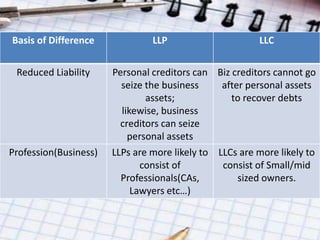
Basis of Difference             LLP                     LLC


 Reduced Liability     Personal creditors can Biz creditors cannot go
                         seize the business     after personal assets
                               assets;            to recover debts
                         likewise, business
                         creditors can seize
                           personal assets
Profession(Business)   LLPs are more likely to LLCs are more likely to
                              consist of        consist of Small/mid
                         Professionals(CAs,         sized owners.
                            Lawyers etc…)
Thank
 YOU
    Mohit &
   Shailesh

LLP Introduction

  • 1.
    LLP Mohit & Shailesh
  • 2.
    1 LLP 2 Brief Overview of LLP Act, 2008 3 Merits and Demerits of LLP 4 LLP v/s Other Forms 5 Taxation Aspects on LLP 6 Taxation Aspect on Conversion to LLP 7 FDI in LLP 8 Audit & Accounts of LLP 9 LLP v/s LLC
  • 3.
    LLP •A form ofbusiness organization which has been introduced in India by way of LLP Act, 2008 •Which Combines the advantages of both the Company and Partnership into a single form of organization •LLP also limits the personal liability of a partner for the errors, omissions, incompetence, or negligence of the LLP's employees or other agents •A separate legal entity
  • 4.
    Brief Overview ofLLP Act, 2008 •Chapter I – Preliminary •Chapter II – Nature of LLP •Section 3 •(1) - A LLP is a Body Corporate •(2) - Shall have Perpetual Succession •Section 4: The Partnership Act, 1932 is not applicable to LLP •Section 5: Capability of becoming a partner in an LLP (Unsound, insolvent) •Section 6 (1): Every LLP shall have at least two partners
  • 5.
    •Section 6(2): Ifat any time number of partners fall below 2 and LLP carries on business for >6 months, then the partner carrying on business (knowing the fact) is personally liable for the obligations •Section 7 •(1): At least one partner should be resident of India •IF partners are body corporate •(2): Any partner may be admitted to or retired from a LLP in accordance with LLP agreement
  • 6.
    •Section 7 •(3): An individual shall not become a designated partner in any LLP unless he has given his prior consent to act as such to the LLP in such form and manner as may be prescribed •(4): Every LLP shall file with the Registrar the particulars of every individual who has given his consent to act as designated partner in such form and manner as may be prescribed within 30 days of his appointment •(5): An individual eligible to be a designated partner shall satisfy such conditions and requirements as may be prescribed •(6): Every designated partner of a LLP shall obtain a DPIN from the CG
  • 7.
    •Section 8: Designatedpartner responsible for doing all the acts, matters and things to be done by LLP and Liable to all penalties imposed on LLP for any contravention of the provisions •Section 9: A LLP shall appoint Designated partner within 30 Days of a Vacancy for any reasons •Section 10: •(1): If a LLP contravenes the provisions Section 7(1), LLP and its every partner shall be punishable with fine – 25,000 to 5,00,000 •(2): If a LLP contravenes the provisions Section 7(4) & (5), 8 and 9, LLP and its partnership shall be punishable with fine – 10,000 – 5,00,000
  • 8.
    Chapter III -Incorporation of Limited Liability Partnership And Matters Incidental Thereto ( Section 11 – Section 21) •LLP shall only be formed for carrying any business with profit motive •That the incorporation documents shall contain the prescribed information. •Registrar on registration shall issue the necessary certificate of incorporation •Every LLP shall have a registered office to which all communications and notices may be addressed and where they shall be received. •The name of LLP shall end with words “LLP” or “Limited Liability Partnership” as suffix. •The LLP can also change its name •LLP can apply to the CG for directing any other LLP registered with similar nor identical name, to rectify its name.
  • 9.
    Chapter IV -Partners And their Relationships (Section 22 to Section 25): •The mutual rights and duties of the partners of a LLP, shall be governed by the LLP agreement. •In the absence of agreement as to any matter, the mutual rights and duties of the partners shall be determined by the provisions relating to that matter as are set out in the First Schedule. •LLP Agreement can also be amended. •A partner can also cease to be partner of the firm •Cessations , not by itself discharge the partner from any obligation to the LLP or to the other partners or to any other person which he incurred while being a partner the obligation for acts. •Consent is necessary to become a partner in LLP
  • 10.
    •Partner to notifychange in address or name to the LLP , which in turn will notify the same to the Registrar •Any person ceasing to be partner of the LLP, can himself file the intimation of his cessation to the Registrar of Companies Chapter V - Extent & Limitations of Liability of LLP & Partners (Section 26 to Section 31): •The mutual rights and duties of the partners of a LLP, shall be governed by the LLP agreement. •In the absence of agreement as to any matter, the mutual rights and duties of the partners shall be determined by the provisions relating to that matter as are set out in the First Schedule.
  • 11.
    •LLP Agreement canalso be amended. •A partner can also cease to be partner of the firm •Cessations , not by itself discharge the partner from any obligation to the LLP or to the other partners or to any other person which he incurred while being a partner the obligation for acts. •Partner to notify change in address or name to the LLP , which in turn will notify the same to the Registrar •Consent is necessary to become a partner in LLP •Any person ceasing to be partner of the LLP, can himself file the intimation of his cessation to the Registrar of Companies
  • 12.
    Chapter VI –Contributions (Section 32 to Section 33): •A contribution of a partner may consist of tangible, movable or immovable or intangible property or other benefit to the limited liability partnership. •The obligation of a partner to contribute shall be as per the limited liability partnership agreement •Chapter VII – Financial Disclosures (Section 34 – Section 41) •The LLP shall maintain such proper books of account as may be prescribed. •Prepare & file within 6 months of end of the FY a Statement of Account and Solvency with Registrar of Companies
  • 13.
    •Statement of Accountand Solvency will be signed by the Designated Partners •Prepare & file within 60 days of end of the financial year an Annual Return with the Registrar of Companies. •The documents filed with ROC shall be available for public inspection. •Central Government can compound offence punishable with fine only. Chapter VIII - Assignment and Transfer of Partnership Rights (Section 42): •The rights of a partner to a share of the profits and losses of the limited liability partnership are transferable either wholly or in part. •Transfer does not entitle the partner to participate in the management or the conduct of the activities of the LLP.
  • 14.
    •Chapter IX –Investigation (Section 43 – Section 54): •The CG shall appoint one or more competent persons as inspectors to investigate the affairs of a LLP and to report thereon in such manner as it may direct if— (a) the Tribunal (b) on an application received from >1/5th of the total number of partners LLP, by order, declares that the affairs of the LLP ought to be investigated; or (c) any Court, by order, declares that the affairs of a LLP ought to be investigated. •The CG may appoint one or more competent persons as inspectors to investigate the affairs of a LLP.
  • 15.
    Chapter X -Conversion to LLP (Section 55 to Section 58) Chapter XI - Foreign Limited Liability Partnerships (Section 59) •The CG may make rules for provisions therein by applying or incorporating, with such modifications, as appear appropriate Chapter XII - Compromise or Arrangement of Limited Liability Partnerships •LLP can enter into compromise or arrangement with its creditors or the partners
  • 16.
    •Consent of 3/4thin value of the partners or creditors will be required •An application is required to be filed with the High Court for any compromise or arrangement. Chapter XIII - Winding Up and Dissolution (Section 63 – Section 65) •A LLP can be wound up either voluntarily or by the order of tribunal •The Act prescribes the circumstances under which the LLP can be wound up compulsorily by the High Court.
  • 17.
    Merits of LLP •Renownedform of business •Easy to Form •Body Corporate ( Separate Legal Entity) •Limited Liability •Perpetual Succession •Flexible to Manage •Easy Transferable Ownership •Capacity to sue •Lesser Compliances
  • 18.
    Demerits of LLP •Anyact of the partner without the other partner, may bind the LLP •Under some cases, liability may extend to personal assets of partners. •Cannot raise money from Public.
  • 19.
    LLP v/s OtherForms Category Partnership Company LLP Common Seal r a Depends Cost of Negligible Minimum Statutory 800 Only Formation Fees Pvt. Co. – 6,000 Public Co. – 9,000 Separate Legal Entity and r a a Perpetual Succession Evidence of Partnership Share Certificate LLP Ownership Deed Agreement
  • 20.
    Category Partnership Company LLP Applicability of Not Applicable Compulsory The necessary Accounting rules in this regard Standards not yet issued. Annual Filing Not Required With ROC With Registrar of LLP Dissolution Agreement, Voluntary or by Voluntary or by Mutual order of National order of National Consent, or by Company Law Company Law Court Order Tribunal. Tribunal. Creation Created by Created by Law Created by Law Contract Principal / Agent Partners are The directors act Partners act as Relationship agents of the as agents of the agents of LLP and firm and other company and not of the other partners. not of the partners. members
  • 21.
    Category Partnership Company LLP Annual Filing Not Required With ROC With Registrar of LLP Whistle Blowing No Such No Such Provision made to Provision Provision protect employees & Partners Prevailing Law The Indian The Companies The LLP Act, 2008 Partnership Act, Act, 1956 1932 Contracts with Partners are free Restrictions on Partners are free Partners / to enter into any Board regarding to enter into any Director contract. some specified contract. contracts, in which directors are interested.
  • 22.
    Taxation Aspect onLLP •LLP will be treated as Partnership firms for the purpose of Income Tax and will be taxed like a partnership firm. •Section 40(b) : Interest to partners, any payment of salary, bonus, commission or remuneration allowed as deduction in the hands of Partnership firm •LLP not covered under presumptive taxation
  • 23.
    Section 184 Section 184:In order for Limited Liability Partnership to be assessed as firm as Income Tax Act, it has to satisfy the following criteria: •The LLP is evidenced by an instrument. •The individual shares of the partners are very clearly specified in the deed •A certified copy of LLP Agreement must accompany the return of income of the LLP of the previous year in which the partnership was formed (If LLP Agreement amended, submit return of income with LLP agreement) •No Failure on the part of LLP while attending notices given by ITO
  • 24.
    What happens ifsection 184 is not complied by firms? •Section 185 applies to the LLP •Section 185: When section 184 is not complied with, the consequence is that no deduction towards interest and remuneration is allowed. This is the mandate of the section 185.
  • 25.
    Taxation aspect onConversion to LLP •Capital Gain on conversion of Partnership into LLP •No tax implication •If the rights and obligation of the partners remain the same after conversion •If there is no transfer of any asset or liability after conversion •If there is a violation of these conditions , the provision of capital gain will apply.
  • 26.
    Capital Gain onconversion of Company into LLP •Any transaction concerning transfer of a capital asset or intangible asset by a Private Company or unlisted Public Company to a Limited Liability Partnership •As a result of conversion of the company into a LLP in accordance with the provisions of section 56 or section 57 of the LLP Act, 2008 •Would be exempted from the provision of Capital Gain Tax, , only if the following conditions are satisfied :
  • 27.
    •All the assetsand liabilities of the Company immediately before the conversion shall become the assets and liabilities of the LLP •All the shareholders of the Company immediately before the conversion shall become the partners of the LLP and their capital contribution & PSR in LLP should remain in the same proportion as their shareholding in the company on the date of conversion •The shareholders of the company do not receive any consideration or benefit, directly or indirectly, in any form or manner, other than by way of share in profit and capital contribution in the limited liability partnership
  • 28.
    •The aggregate ofthe PSR of the shareholders of the company in the LLP shall >50% at any time during the period of 5 years from the date of conversion •The turnover in business of the company in any of the 3PPY in which the conversion takes place does not exceed 60 Lakhs •No amount is paid, either directly or indirectly, to any partner out of balance of accumulated profit standing in the accounts of the company on the date of conversion for a period of 3 years from the date of conversion. •If conditions not satisfied, profits taxed as deemed profits
  • 29.
    Carry forward andset off of accumulated loss and unabsorbed depreciation allowance, on conversion into LLP and Amortization of expenditure incurred under Voluntary Retirement Scheme •Conversion of a Private Company or unlisted Public Company to Limited Liability Partnership; •Compliance of conditions laid down under 47(xiiib) – Benefit of Carry forward and Setoff and amortization allowed •Non-compliance of conditions laid down under 47(xiiib) – No benefit of Carry forward and Set off and amorization
  • 30.
    Benefit of taxcredit in respect of Minimum Alternate Tax (MAT) paid by the Company •Any benefit of the MAT credit in hands of Private Company or unlisted Public Companies will not be continued in the hands of successor LLP
  • 31.
    FDI in LLP •Allowed– •LLPs with FDI will be allowed, through the Government approval route, in those sectors/activities where 100% FDI is allowed, through the automatic route and there are no FDI-linked performance related conditions. By FDI-linked performance related conditions, it is meant that in sectors, where conditions like minimum capitalization etc are prescribed like development of Townships, NBFC, even though 100% FDI is allowed under automatic route, LLP’s will not be allowed to bring FDI with the approval of Government of India.
  • 32.
    •Not Allowed – •To operate in agricultural/plantation activity, print media or real estate business •LLP having FDI, cannot make further investment in LLP or companies engaged in any business •Funding of LLP: •Allowed: •Downstream investment by company •Investment by Cash Considerations •Not Allowed: FII’s, Foreign Venture Capitalists and ECB’s
  • 33.
    •Ownership and managementof LLPs •Determination of Designated Partner: •At least one designated partner shall be person resident in India •Body Corporate as Designated Partner: •Registered under The companies act, 1956
  • 34.
    Tax on LLP(Summary) •LLP’s will be treated as Partnership Firms for the purpose of Income Tax w.e.f assessment year 2010-11 •No surcharge will be levied on income tax. •Profit will be taxed in the hands of the LLP and not in the hands of the partners. •Minimum Alternate Tax a nd Dividend Distribution Tax will not be applicable for LLP. •Remuneration to partners will be taxed as “Income from Business & Profession”. •No capital gain on conversion of partnership firms into LLP.
  • 35.
    •Designated Partners willbe liable to sign and file the Income Tax return. •LLP shall not be eligible for presumptive taxation. •Capital Gain on conversion of Company into LLP will be exempt from tax, if prescribed conditions are complied with. •On conversion, the successor LLP , will be allowed to carry forward and set off of accumulated loss and unabsorbed depreciation allowance • On conversion, the successor LLP will be allowed to amortize the expenditure incurred under voluntary retirement scheme On conversion, the successor LLP will not be allowed to take the credit of MAT paid by the predecessor company.
  • 36.
    Accounts of LLP •LLPhas to maintain books of accounts as prescribed in Rule 24 of LLP Rules •These books to be retained for 8 years •Either on Cash or on Accrual Basis •The accounting year of each LLP must end on 31st March ( LLP cannot choose accounting year ending on any other date) •It has to prepare statement of accounts and solvency statement on or before 30th September each year (To be signed by designated partners)
  • 37.
    Audit of LLP •Tobe audited by a CA in accordance with rule 24 of LLP Rules •Audit is compulsory if: •Contribution exceeds 25Lakhs or; •Turnover exceeds 40Lakhs (No specific form of audit report is required to be given) •Appointment of Auditor: •Appoint auditors within 30 Days before the end of each FY •If 1st FY, appointment to be done before the end of first FY
  • 38.
    Annual Return Compliance •LLPhas to file an annual return with ROC •On or before 30th May each year •In form no. 11 with the prescribed fees
  • 39.
    LLP V/s LLC Basisof Difference LLP LLC Formation Easier to from than Most states require LLCs filing of articles of organization and other docs Paperwork Partnership agreement Operating agreement to be drafted along with company bylaws to be drafted Size Minimum of 2 LLCs may be single partners required member operated.
  • 40.
    Basis of Difference LLP LLC Reduced Liability Personal creditors can Biz creditors cannot go seize the business after personal assets assets; to recover debts likewise, business creditors can seize personal assets Profession(Business) LLPs are more likely to LLCs are more likely to consist of consist of Small/mid Professionals(CAs, sized owners. Lawyers etc…)
  • 41.
    Thank YOU Mohit & Shailesh