Are Large Language Models Randomized
Algorithms?
Exploring Randomness, Adversaries, and Robustness
By - Tamanna
NextGen_Outlier 1
LLMs Have a Curious Habit
Ask the exact same question twice → you might get two different answers
Traditional programs are deterministic:
2 + 2 → always 4
sort([3,1,4,1,5]) → always [1,1,3,4,5]
LLMs behave differently on purpose
→ This unpredictability is not a bug — it is a feature built on randomness
NextGen_Outlier 2
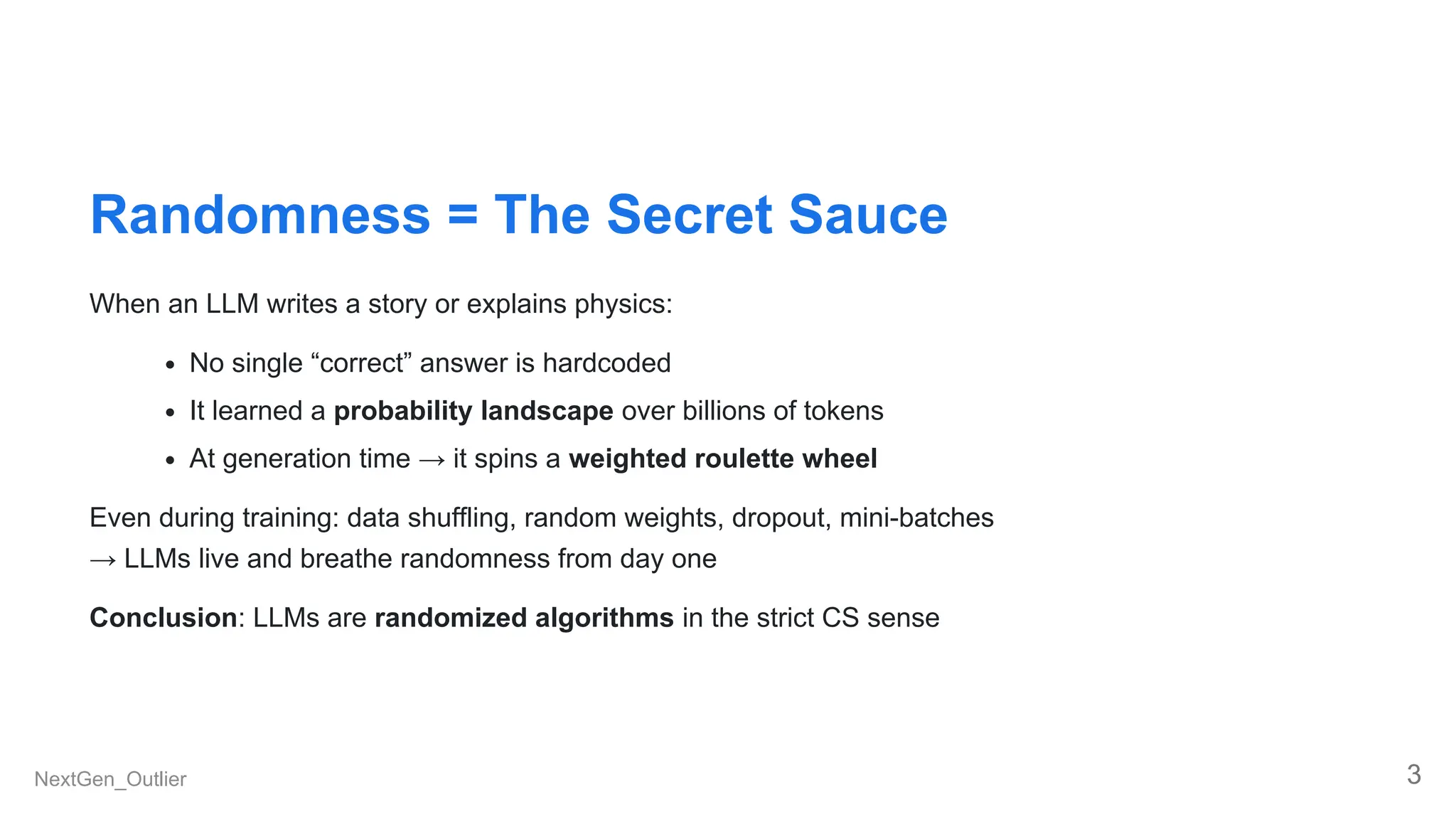
Randomness = The Secret Sauce
When an LLM writes a story or explains physics:
No single “correct” answer is hardcoded
It learned a probability landscape over billions of tokens
At generation time → it spins a weighted roulette wheel
Even during training: data shuffling, random weights, dropout, mini-batches
→ LLMs live and breathe randomness from day one
Conclusion: LLMs are randomized algorithms in the strict CS sense
NextGen_Outlier 3
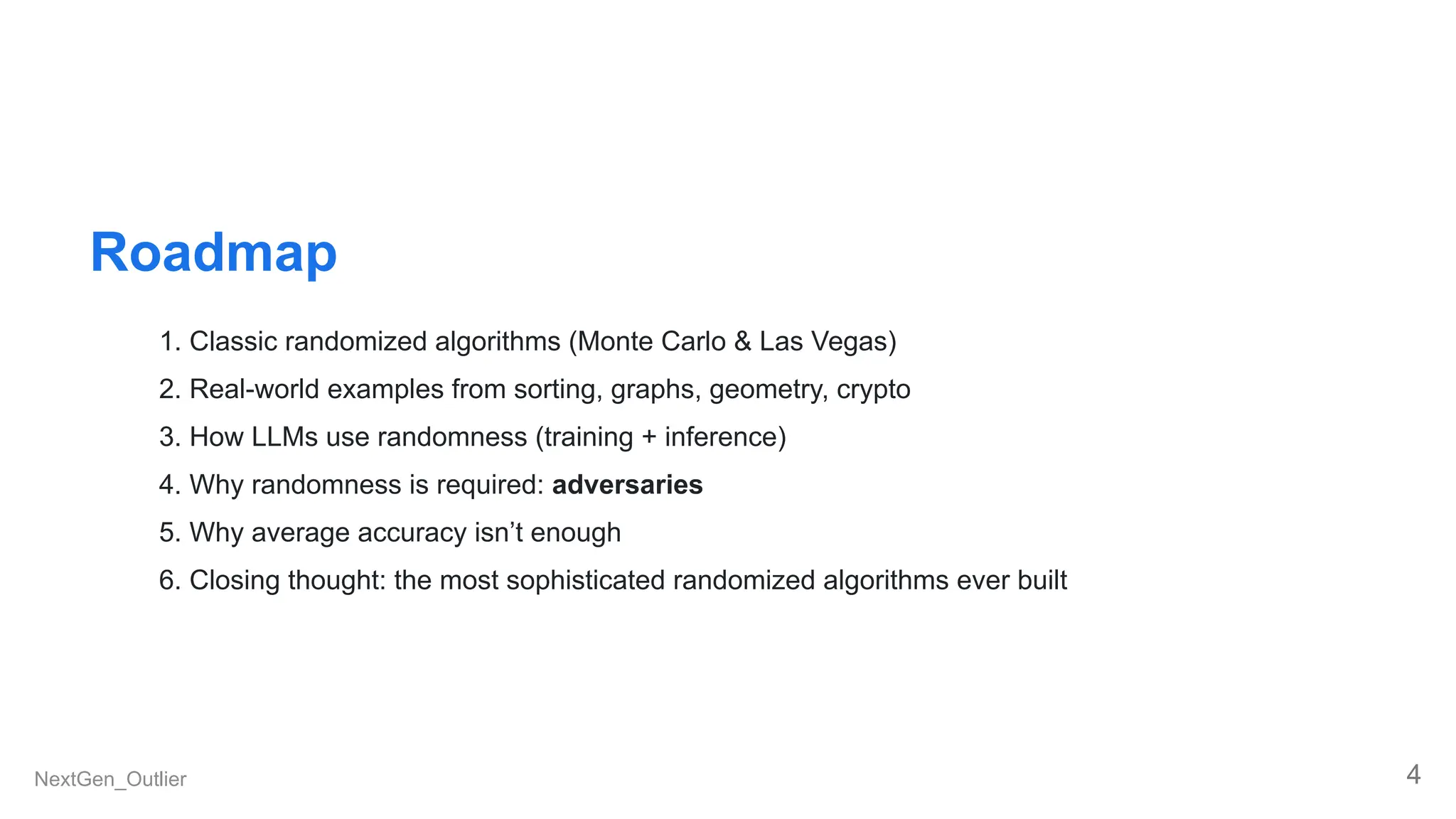
Roadmap
1. Classic randomized algorithms (Monte Carlo & Las Vegas)
2. Real-world examples from sorting, graphs, geometry, crypto
3. How LLMs use randomness (training + inference)
4. Why randomness is required: adversaries
5. Why average accuracy isn’t enough
6. Closing thought: the most sophisticated randomized algorithms ever built
NextGen_Outlier 4
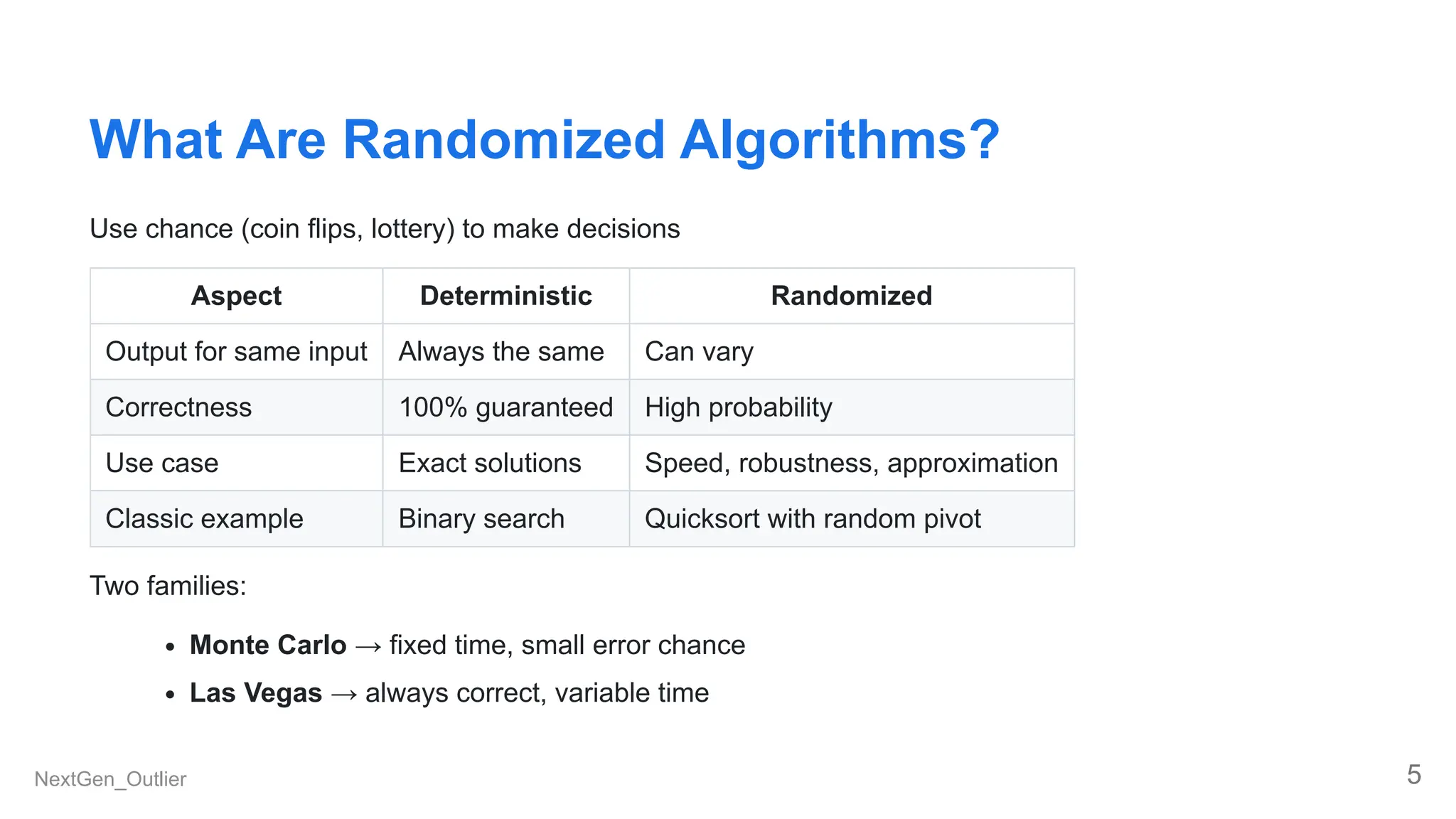
What Are Randomized Algorithms?
Use chance (coin flips, lottery) to make decisions
Aspect Deterministic Randomized
Output for same input Always the same Can vary
Correctness 100% guaranteed High probability
Use case Exact solutions Speed, robustness, approximation
Classic example Binary search Quicksort with random pivot
Two families:
Monte Carlo → fixed time, small error chance
Las Vegas → always correct, variable time
NextGen_Outlier 5
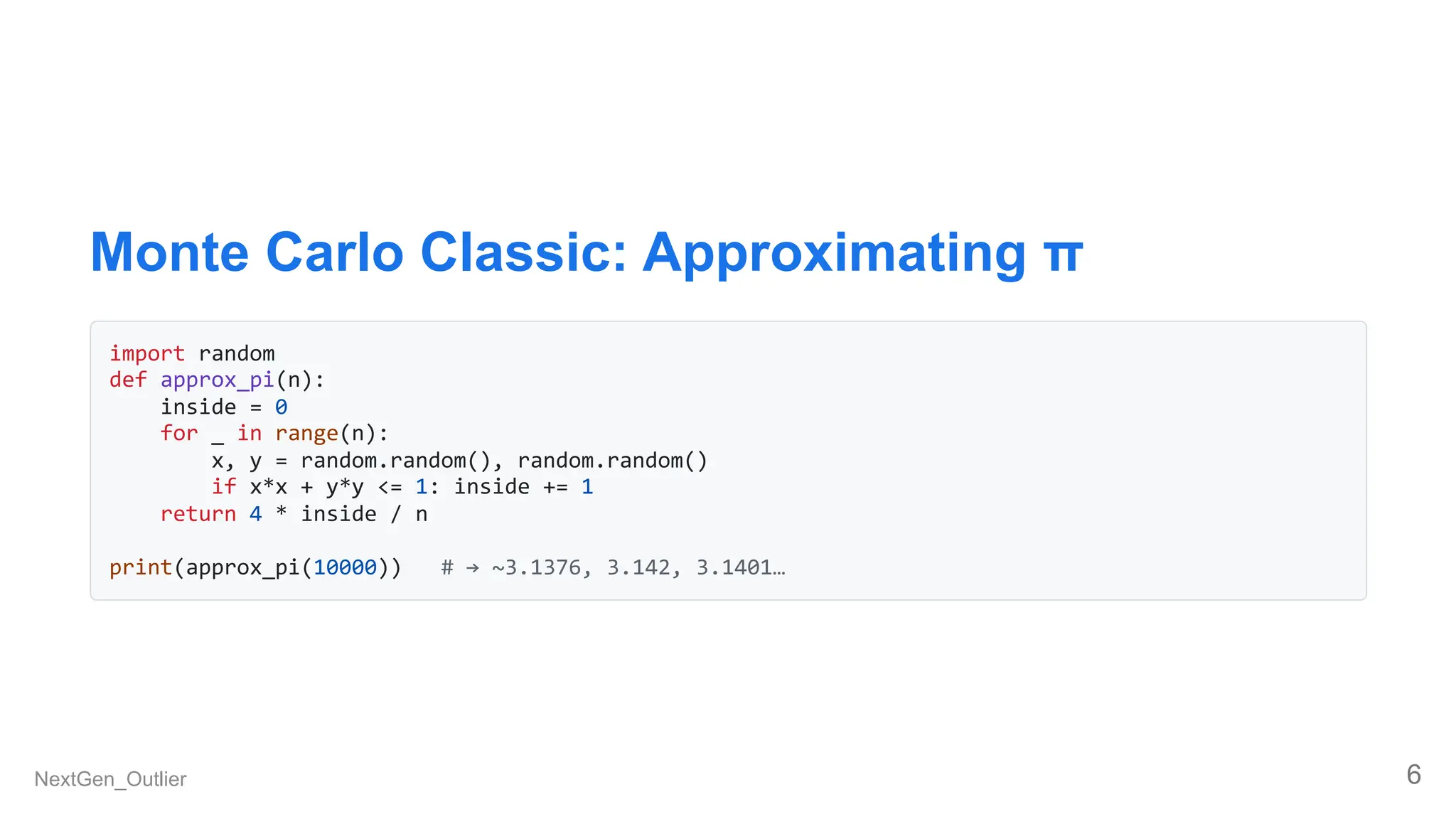
Monte Carlo Classic: Approximating π
import random
def approx_pi(n):
inside = 0
for _ in range(n):
x, y = random.random(), random.random()
if x*x + y*y <= 1: inside += 1
return 4 * inside / n
print(approx_pi(10000)) # → ~3.1376, 3.142, 3.1401…
NextGen_Outlier 6
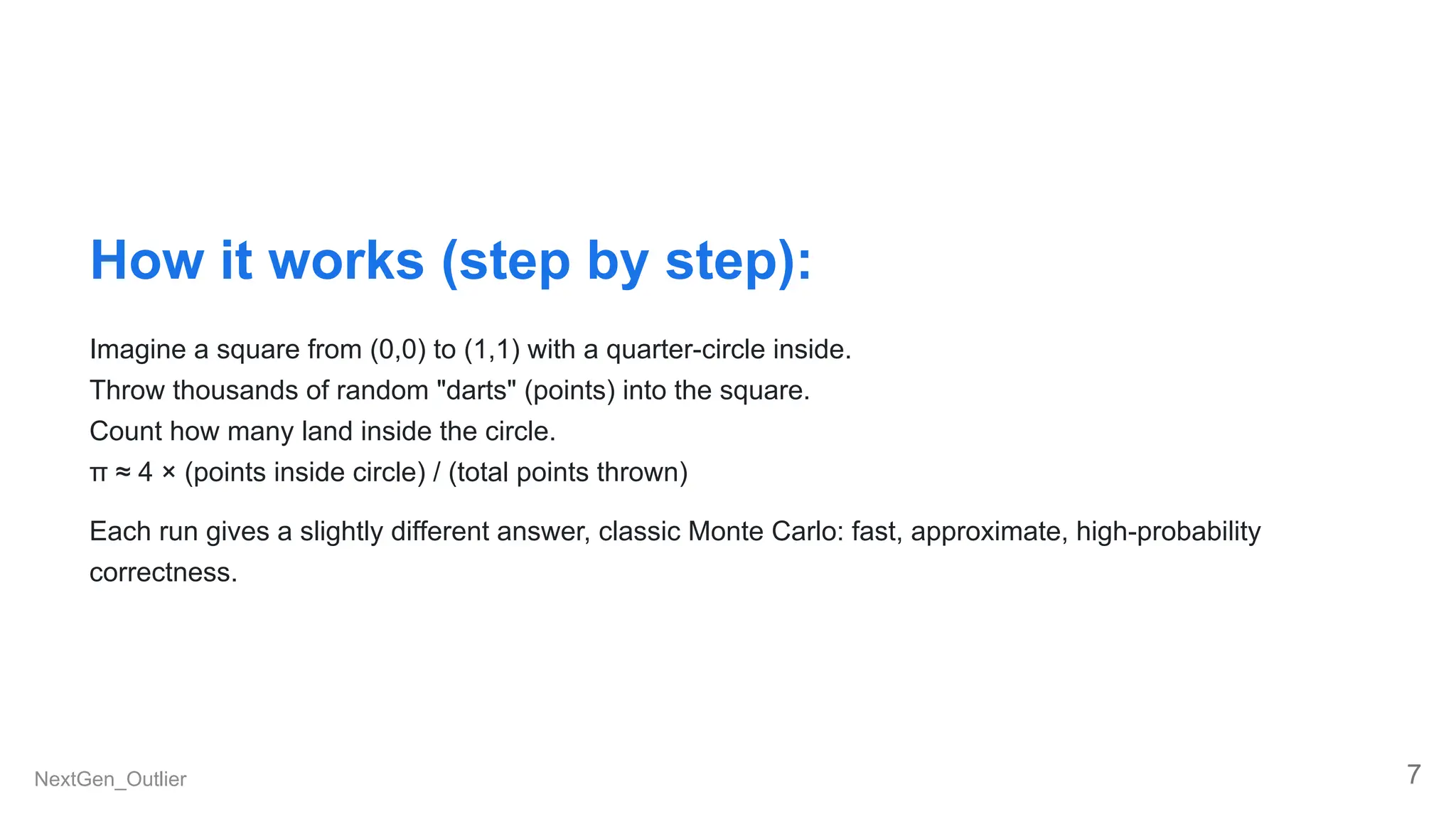
How it works (step by step):
Imagine a square from (0,0) to (1,1) with a quarter-circle inside.
Throw thousands of random "darts" (points) into the square.
Count how many land inside the circle.
π ≈ 4 × (points inside circle) / (total points thrown)
Each run gives a slightly different answer, classic Monte Carlo: fast, approximate, high-probability
correctness.
NextGen_Outlier 7
Las Vegas Classic: BogoSort (the worst &
funniest)
import random
def is_sorted(arr):
return all(arr[i] <= arr[i+1] for i in range(len(arr)-1))
def bogosort(arr):
while not is_sorted(arr):
random.shuffle(arr)
return arr
# Warning: Expected time O(n!) only use on tiny lists!
How it works:
Keep shuffling the array completely at random.
After each shuffle, check if it's sorted.
Stop only when it is (which might take forever).
Pure Las Vegas: always correct, but time varies wildly. Perfectly illustrates the trade-off.
NextGen_Outlier 8
Quicksort with Random Pivot
import random
def quicksort(arr):
if len(arr) <= 1: return arr
pivot = random.choice(arr)
left = [x for x in arr if x < pivot]
middle = [x for x in arr if x == pivot]
right = [x for x in arr if x > pivot]
return quicksort(left) + middle + quicksort(right)
print(quicksort([3,1,4,1,5,9,2,6,5,3,5]))
# → [1, 1, 2, 3, 3, 4, 5, 5, 5, 6, 9]
NextGen_Outlier 9
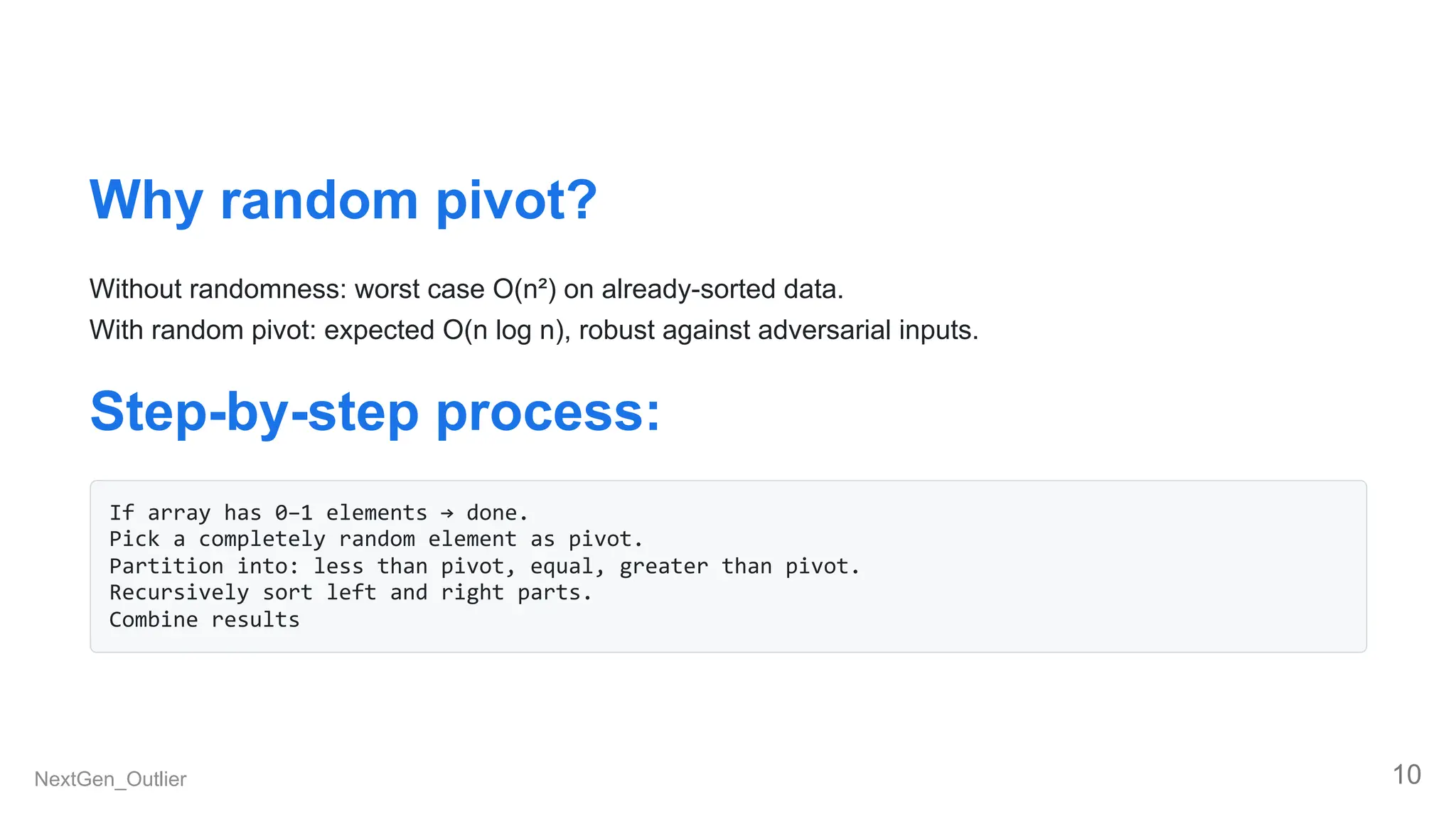
Why random pivot?
Without randomness: worst case O(n²) on already-sorted data.
With random pivot: expected O(n log n), robust against adversarial inputs.
Step-by-step process:
If array has 0–1 elements → done.
Pick a completely random element as pivot.
Partition into: less than pivot, equal, greater than pivot.
Recursively sort left and right parts.
Combine results
NextGen_Outlier 10
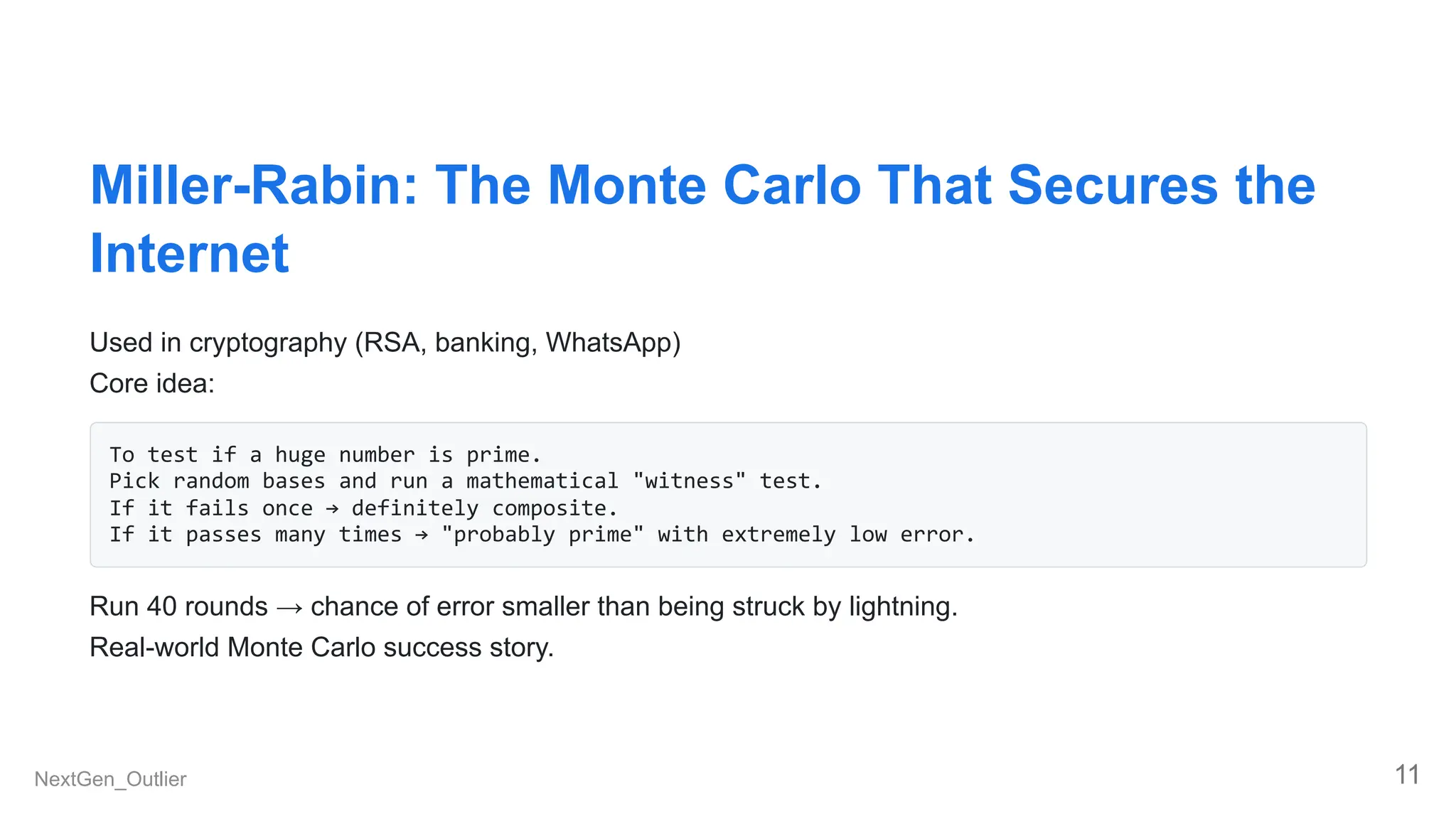
Miller-Rabin: The Monte Carlo That Secures the
Internet
Used in cryptography (RSA, banking, WhatsApp)
Core idea:
To test if a huge number is prime.
Pick random bases and run a mathematical "witness" test.
If it fails once → definitely composite.
If it passes many times → "probably prime" with extremely low error.
Run 40 rounds → chance of error smaller than being struck by lightning.
Real-world Monte Carlo success story.
NextGen_Outlier 11
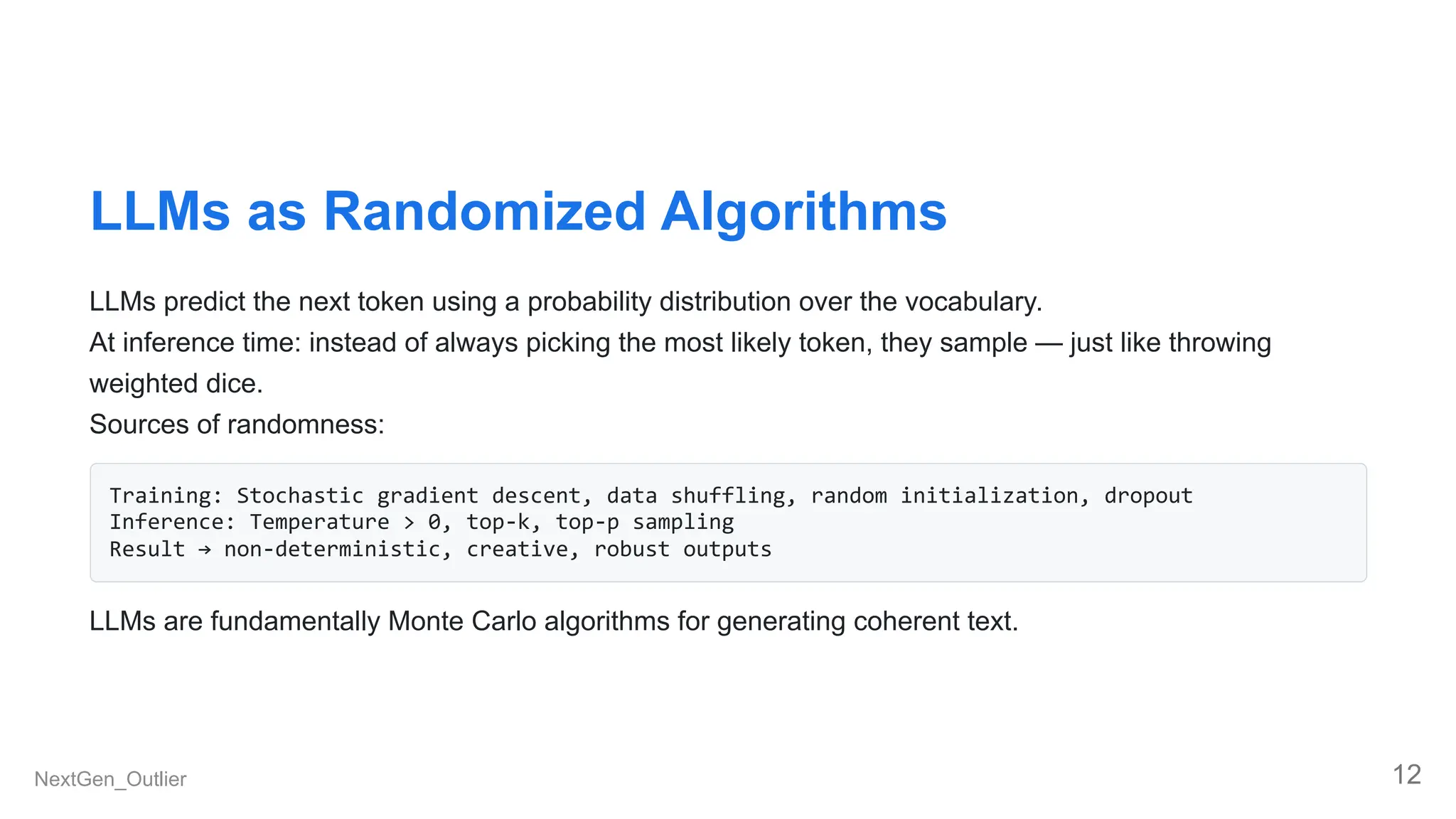
LLMs as Randomized Algorithms
LLMs predict the next token using a probability distribution over the vocabulary.
At inference time: instead of always picking the most likely token, they sample — just like throwing
weighted dice.
Sources of randomness:
Training: Stochastic gradient descent, data shuffling, random initialization, dropout
Inference: Temperature > 0, top-k, top-p sampling
Result → non-deterministic, creative, robust outputs
LLMs are fundamentally Monte Carlo algorithms for generating coherent text.
NextGen_Outlier 12
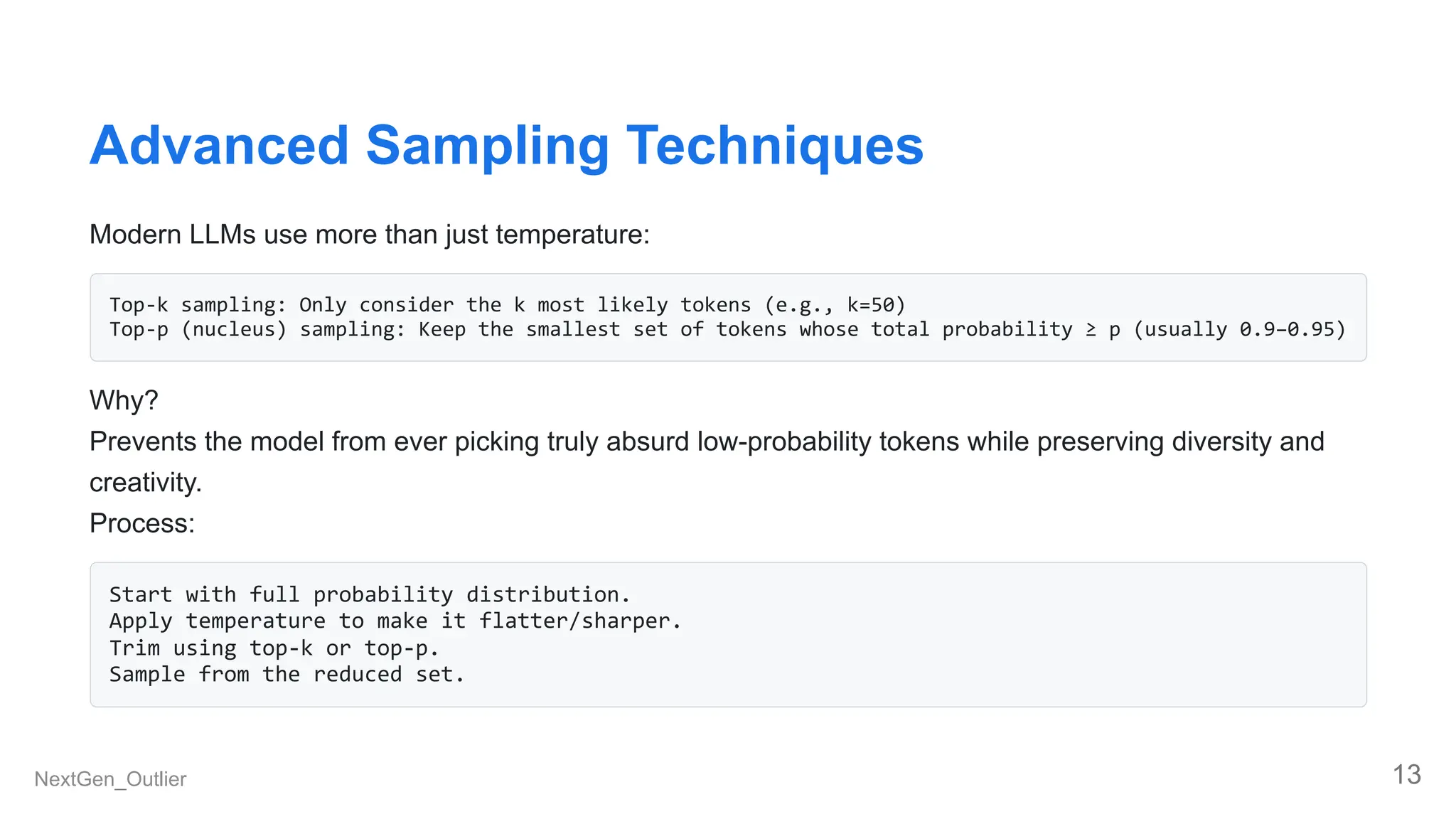
Advanced Sampling Techniques
Modern LLMs use more than just temperature:
Top-k sampling: Only consider the k most likely tokens (e.g., k=50)
Top-p (nucleus) sampling: Keep the smallest set of tokens whose total probability ≥ p (usually 0.9–0.95)
Why?
Prevents the model from ever picking truly absurd low-probability tokens while preserving diversity and
creativity.
Process:
Start with full probability distribution.
Apply temperature to make it flatter/sharper.
Trim using top-k or top-p.
Sample from the reduced set.
NextGen_Outlier 13
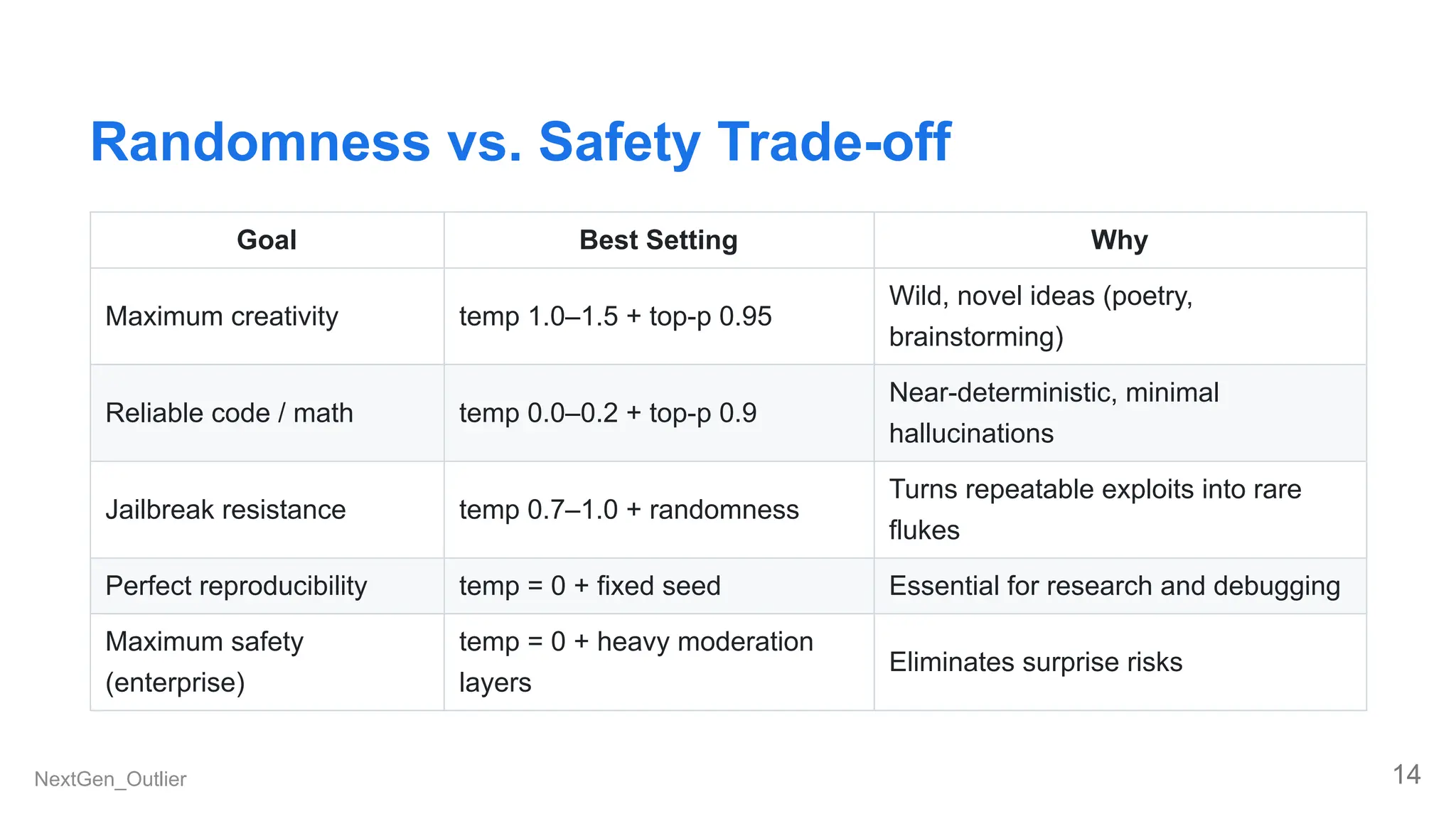
Randomness vs. Safety Trade-off
Goal Best Setting Why
Maximum creativity temp 1.0–1.5 + top-p 0.95
Wild, novel ideas (poetry,
brainstorming)
Reliable code / math temp 0.0–0.2 + top-p 0.9
Near-deterministic, minimal
hallucinations
Jailbreak resistance temp 0.7–1.0 + randomness
Turns repeatable exploits into rare
flukes
Perfect reproducibility temp = 0 + fixed seed Essential for research and debugging
Maximum safety
(enterprise)
temp = 0 + heavy moderation
layers
Eliminates surprise risks
NextGen_Outlier 14
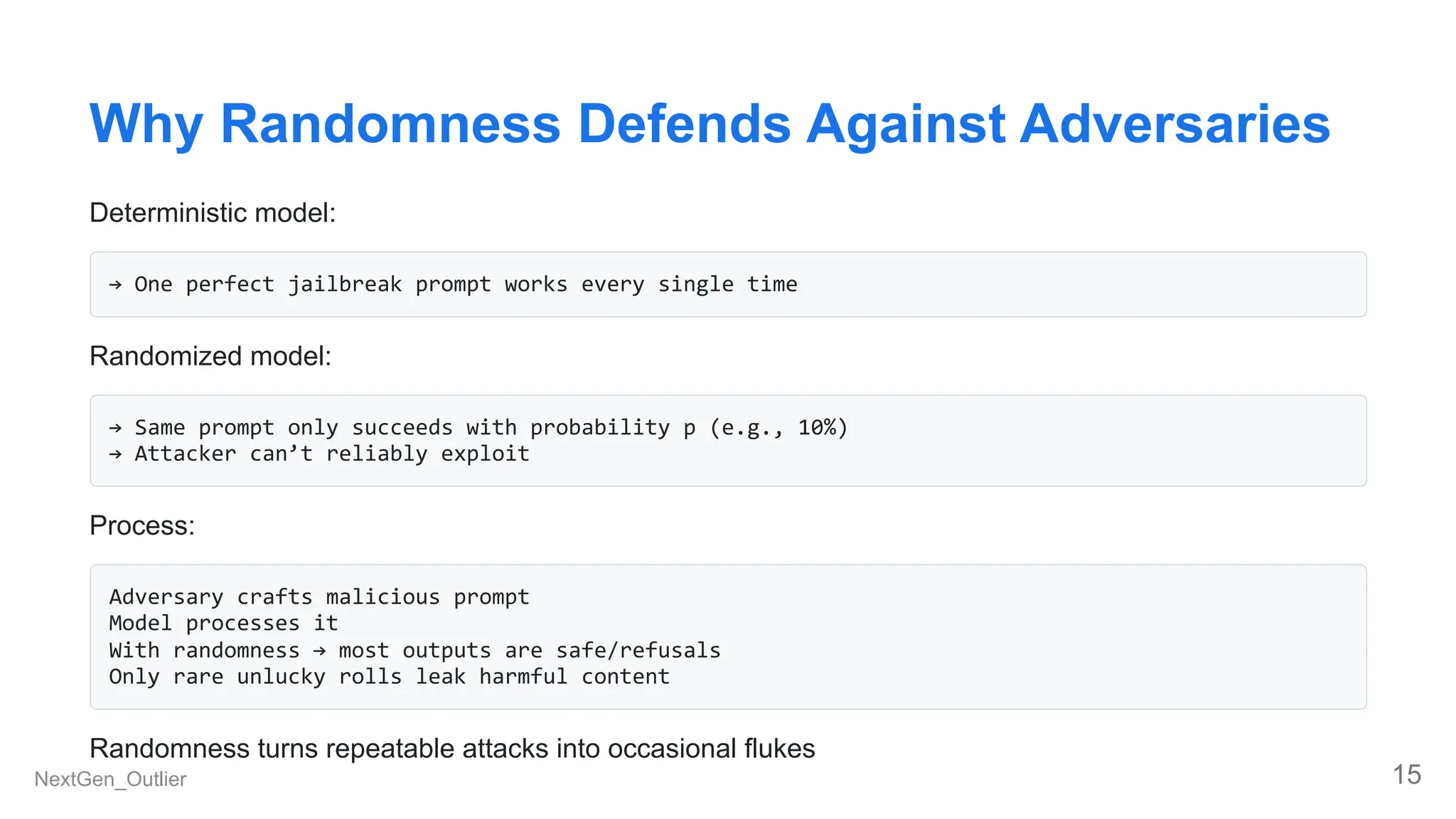
Why Randomness Defends Against Adversaries
Deterministic model:
→ One perfect jailbreak prompt works every single time
Randomized model:
→ Same prompt only succeeds with probability p (e.g., 10%)
→ Attacker can’t reliably exploit
Process:
Adversary crafts malicious prompt
Model processes it
With randomness → most outputs are safe/refusals
Only rare unlucky rolls leak harmful content
Randomness turns repeatable attacks into occasional flukes
NextGen_Outlier 15
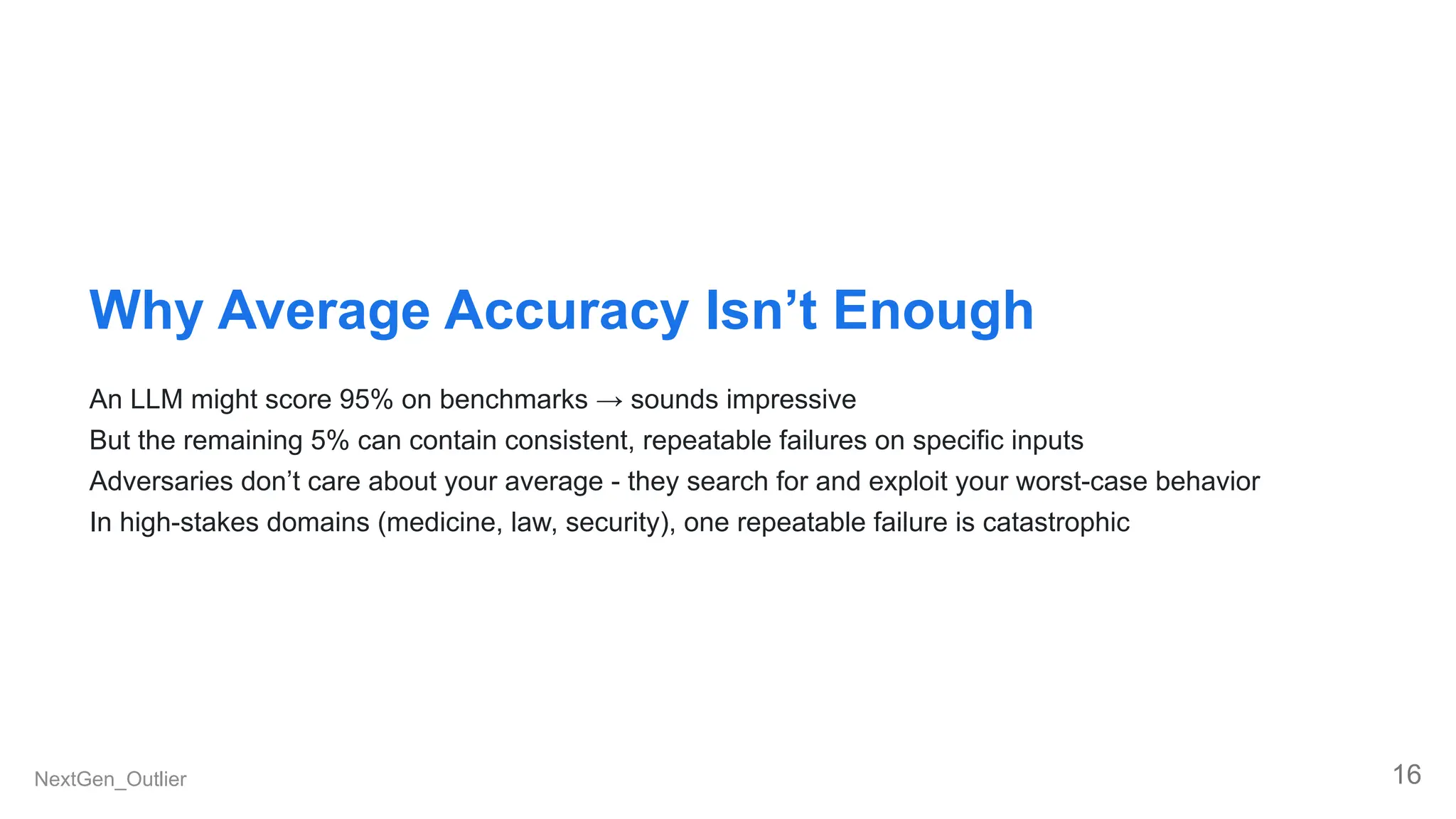
Why Average Accuracy Isn’t Enough
An LLM might score 95% on benchmarks → sounds impressive
But the remaining 5% can contain consistent, repeatable failures on specific inputs
Adversaries don’t care about your average - they search for and exploit your worst-case behavior
In high-stakes domains (medicine, law, security), one repeatable failure is catastrophic
NextGen_Outlier 16
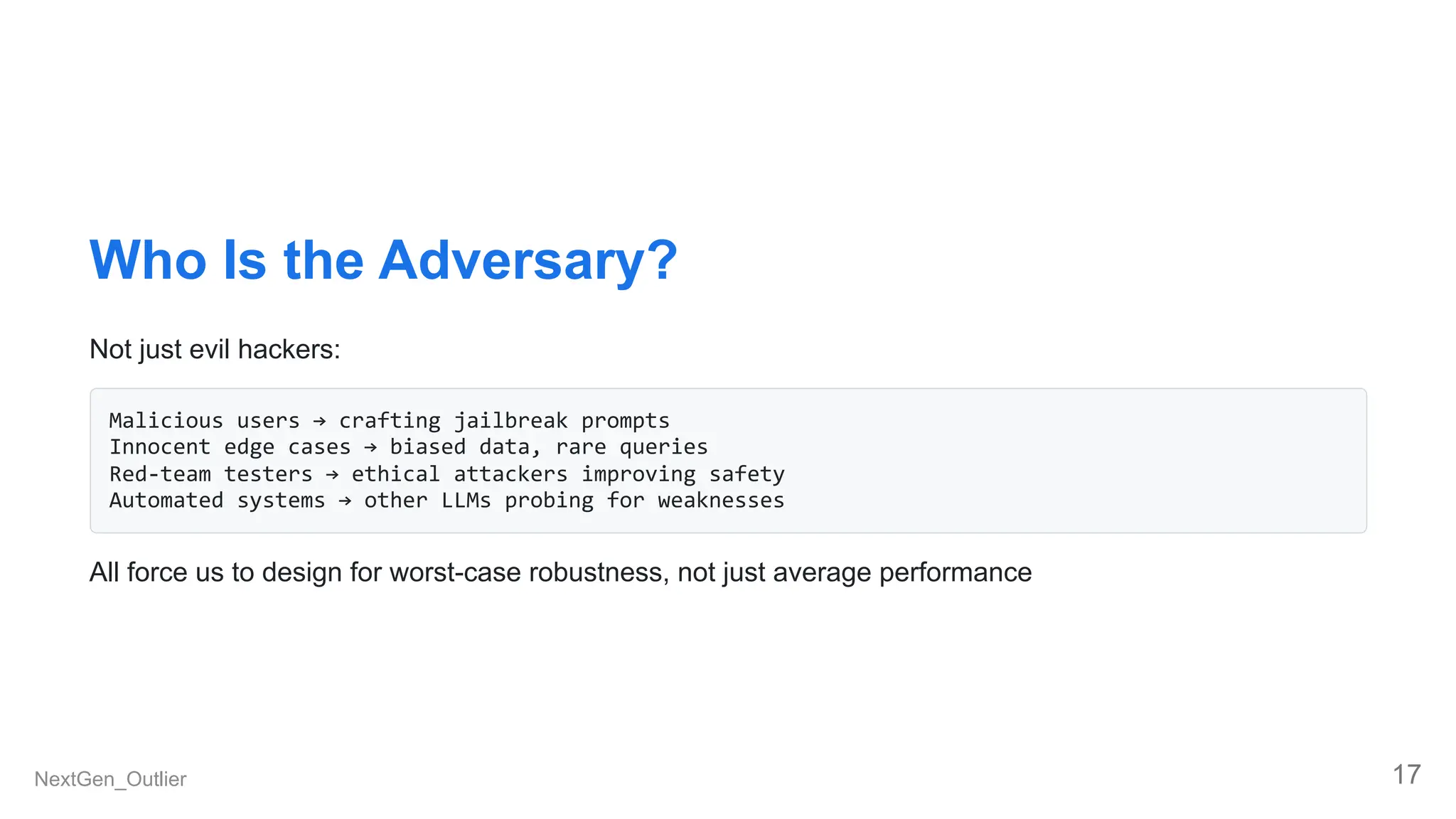
Who Is the Adversary?
Not just evil hackers:
Malicious users → crafting jailbreak prompts
Innocent edge cases → biased data, rare queries
Red-team testers → ethical attackers improving safety
Automated systems → other LLMs probing for weaknesses
All force us to design for worst-case robustness, not just average performance
NextGen_Outlier 17
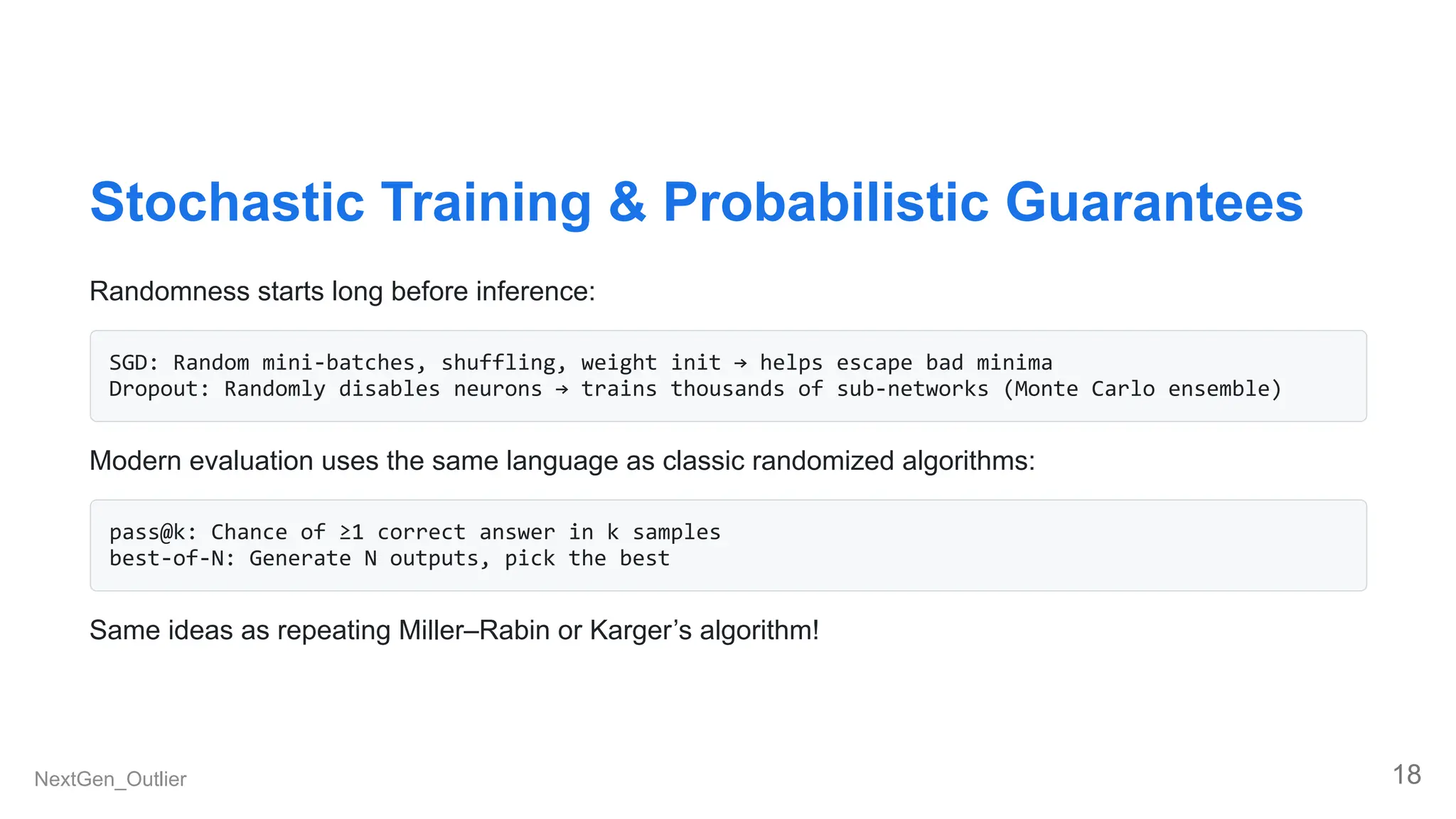
Stochastic Training & Probabilistic Guarantees
Randomness starts long before inference:
SGD: Random mini-batches, shuffling, weight init → helps escape bad minima
Dropout: Randomly disables neurons → trains thousands of sub-networks (Monte Carlo ensemble)
Modern evaluation uses the same language as classic randomized algorithms:
pass@k: Chance of ≥1 correct answer in k samples
best-of-N: Generate N outputs, pick the best
Same ideas as repeating Miller–Rabin or Karger’s algorithm!
NextGen_Outlier 18
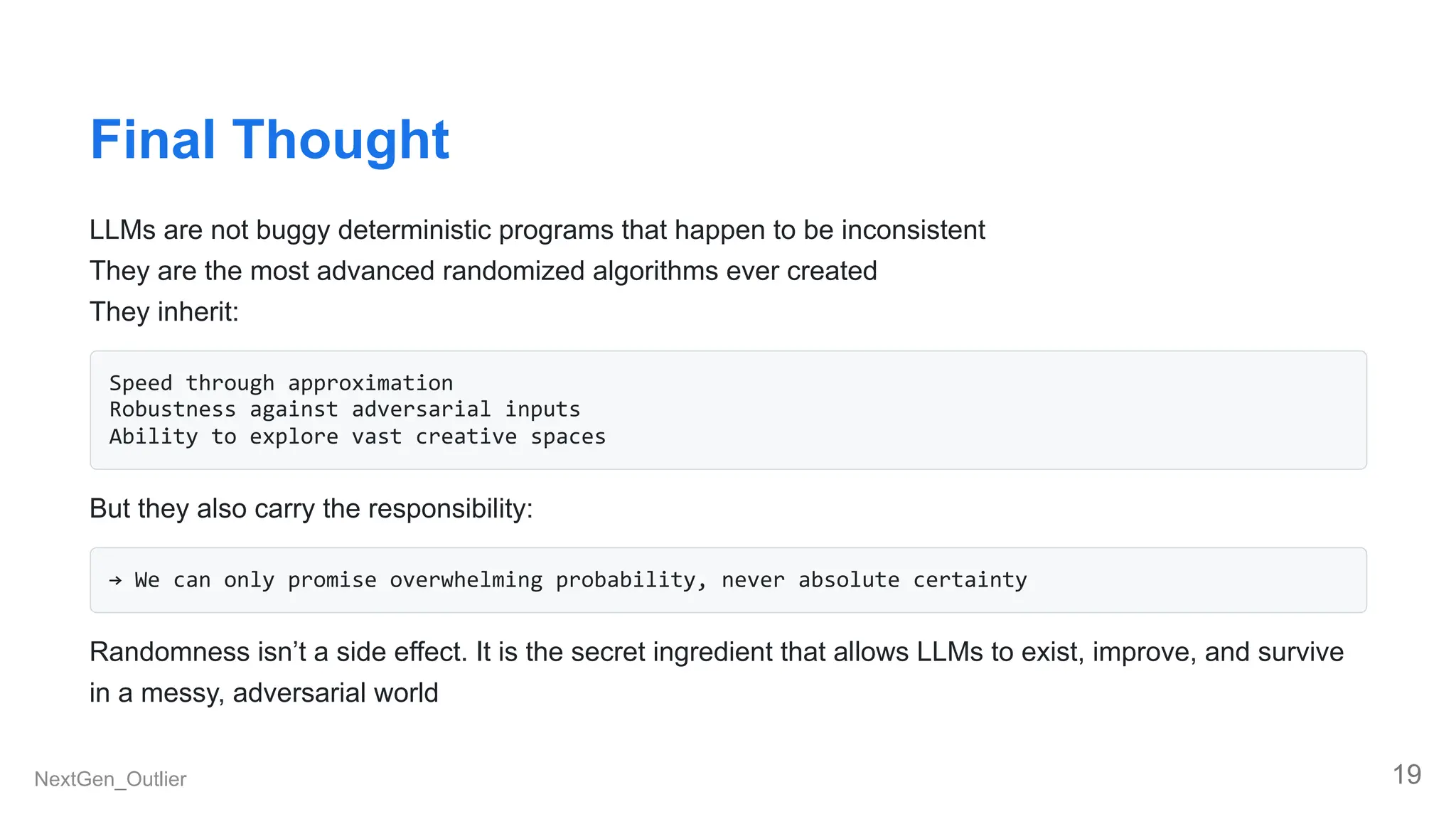
Final Thought
LLMs are not buggy deterministic programs that happen to be inconsistent
They are the most advanced randomized algorithms ever created
They inherit:
Speed through approximation
Robustness against adversarial inputs
Ability to explore vast creative spaces
But they also carry the responsibility:
→ We can only promise overwhelming probability, never absolute certainty
Randomness isn’t a side effect. It is the secret ingredient that allows LLMs to exist, improve, and survive
in a messy, adversarial world
NextGen_Outlier 19
Thank You!
NextGen_Outlier 20

LLMs_Randomize: Are Large Language Models Actually Randomized Algorithms?

  • 1.
    Are Large LanguageModels Randomized Algorithms? Exploring Randomness, Adversaries, and Robustness By - Tamanna NextGen_Outlier 1
  • 2.
    LLMs Have aCurious Habit Ask the exact same question twice → you might get two different answers Traditional programs are deterministic: 2 + 2 → always 4 sort([3,1,4,1,5]) → always [1,1,3,4,5] LLMs behave differently on purpose → This unpredictability is not a bug — it is a feature built on randomness NextGen_Outlier 2
  • 3.
    Randomness = TheSecret Sauce When an LLM writes a story or explains physics: No single “correct” answer is hardcoded It learned a probability landscape over billions of tokens At generation time → it spins a weighted roulette wheel Even during training: data shuffling, random weights, dropout, mini-batches → LLMs live and breathe randomness from day one Conclusion: LLMs are randomized algorithms in the strict CS sense NextGen_Outlier 3
  • 4.
    Roadmap 1. Classic randomizedalgorithms (Monte Carlo & Las Vegas) 2. Real-world examples from sorting, graphs, geometry, crypto 3. How LLMs use randomness (training + inference) 4. Why randomness is required: adversaries 5. Why average accuracy isn’t enough 6. Closing thought: the most sophisticated randomized algorithms ever built NextGen_Outlier 4
  • 5.
    What Are RandomizedAlgorithms? Use chance (coin flips, lottery) to make decisions Aspect Deterministic Randomized Output for same input Always the same Can vary Correctness 100% guaranteed High probability Use case Exact solutions Speed, robustness, approximation Classic example Binary search Quicksort with random pivot Two families: Monte Carlo → fixed time, small error chance Las Vegas → always correct, variable time NextGen_Outlier 5
  • 6.
    Monte Carlo Classic:Approximating π import random def approx_pi(n): inside = 0 for _ in range(n): x, y = random.random(), random.random() if x*x + y*y <= 1: inside += 1 return 4 * inside / n print(approx_pi(10000)) # → ~3.1376, 3.142, 3.1401… NextGen_Outlier 6
  • 7.
    How it works(step by step): Imagine a square from (0,0) to (1,1) with a quarter-circle inside. Throw thousands of random "darts" (points) into the square. Count how many land inside the circle. π ≈ 4 × (points inside circle) / (total points thrown) Each run gives a slightly different answer, classic Monte Carlo: fast, approximate, high-probability correctness. NextGen_Outlier 7
  • 8.
    Las Vegas Classic:BogoSort (the worst & funniest) import random def is_sorted(arr): return all(arr[i] <= arr[i+1] for i in range(len(arr)-1)) def bogosort(arr): while not is_sorted(arr): random.shuffle(arr) return arr # Warning: Expected time O(n!) only use on tiny lists! How it works: Keep shuffling the array completely at random. After each shuffle, check if it's sorted. Stop only when it is (which might take forever). Pure Las Vegas: always correct, but time varies wildly. Perfectly illustrates the trade-off. NextGen_Outlier 8
  • 9.
    Quicksort with RandomPivot import random def quicksort(arr): if len(arr) <= 1: return arr pivot = random.choice(arr) left = [x for x in arr if x < pivot] middle = [x for x in arr if x == pivot] right = [x for x in arr if x > pivot] return quicksort(left) + middle + quicksort(right) print(quicksort([3,1,4,1,5,9,2,6,5,3,5])) # → [1, 1, 2, 3, 3, 4, 5, 5, 5, 6, 9] NextGen_Outlier 9
  • 10.
    Why random pivot? Withoutrandomness: worst case O(n²) on already-sorted data. With random pivot: expected O(n log n), robust against adversarial inputs. Step-by-step process: If array has 0–1 elements → done. Pick a completely random element as pivot. Partition into: less than pivot, equal, greater than pivot. Recursively sort left and right parts. Combine results NextGen_Outlier 10
  • 11.
    Miller-Rabin: The MonteCarlo That Secures the Internet Used in cryptography (RSA, banking, WhatsApp) Core idea: To test if a huge number is prime. Pick random bases and run a mathematical "witness" test. If it fails once → definitely composite. If it passes many times → "probably prime" with extremely low error. Run 40 rounds → chance of error smaller than being struck by lightning. Real-world Monte Carlo success story. NextGen_Outlier 11
  • 12.
    LLMs as RandomizedAlgorithms LLMs predict the next token using a probability distribution over the vocabulary. At inference time: instead of always picking the most likely token, they sample — just like throwing weighted dice. Sources of randomness: Training: Stochastic gradient descent, data shuffling, random initialization, dropout Inference: Temperature > 0, top-k, top-p sampling Result → non-deterministic, creative, robust outputs LLMs are fundamentally Monte Carlo algorithms for generating coherent text. NextGen_Outlier 12
  • 13.
    Advanced Sampling Techniques ModernLLMs use more than just temperature: Top-k sampling: Only consider the k most likely tokens (e.g., k=50) Top-p (nucleus) sampling: Keep the smallest set of tokens whose total probability ≥ p (usually 0.9–0.95) Why? Prevents the model from ever picking truly absurd low-probability tokens while preserving diversity and creativity. Process: Start with full probability distribution. Apply temperature to make it flatter/sharper. Trim using top-k or top-p. Sample from the reduced set. NextGen_Outlier 13
  • 14.
    Randomness vs. SafetyTrade-off Goal Best Setting Why Maximum creativity temp 1.0–1.5 + top-p 0.95 Wild, novel ideas (poetry, brainstorming) Reliable code / math temp 0.0–0.2 + top-p 0.9 Near-deterministic, minimal hallucinations Jailbreak resistance temp 0.7–1.0 + randomness Turns repeatable exploits into rare flukes Perfect reproducibility temp = 0 + fixed seed Essential for research and debugging Maximum safety (enterprise) temp = 0 + heavy moderation layers Eliminates surprise risks NextGen_Outlier 14
  • 15.
    Why Randomness DefendsAgainst Adversaries Deterministic model: → One perfect jailbreak prompt works every single time Randomized model: → Same prompt only succeeds with probability p (e.g., 10%) → Attacker can’t reliably exploit Process: Adversary crafts malicious prompt Model processes it With randomness → most outputs are safe/refusals Only rare unlucky rolls leak harmful content Randomness turns repeatable attacks into occasional flukes NextGen_Outlier 15
  • 16.
    Why Average AccuracyIsn’t Enough An LLM might score 95% on benchmarks → sounds impressive But the remaining 5% can contain consistent, repeatable failures on specific inputs Adversaries don’t care about your average - they search for and exploit your worst-case behavior In high-stakes domains (medicine, law, security), one repeatable failure is catastrophic NextGen_Outlier 16
  • 17.
    Who Is theAdversary? Not just evil hackers: Malicious users → crafting jailbreak prompts Innocent edge cases → biased data, rare queries Red-team testers → ethical attackers improving safety Automated systems → other LLMs probing for weaknesses All force us to design for worst-case robustness, not just average performance NextGen_Outlier 17
  • 18.
    Stochastic Training &Probabilistic Guarantees Randomness starts long before inference: SGD: Random mini-batches, shuffling, weight init → helps escape bad minima Dropout: Randomly disables neurons → trains thousands of sub-networks (Monte Carlo ensemble) Modern evaluation uses the same language as classic randomized algorithms: pass@k: Chance of ≥1 correct answer in k samples best-of-N: Generate N outputs, pick the best Same ideas as repeating Miller–Rabin or Karger’s algorithm! NextGen_Outlier 18
  • 19.
    Final Thought LLMs arenot buggy deterministic programs that happen to be inconsistent They are the most advanced randomized algorithms ever created They inherit: Speed through approximation Robustness against adversarial inputs Ability to explore vast creative spaces But they also carry the responsibility: → We can only promise overwhelming probability, never absolute certainty Randomness isn’t a side effect. It is the secret ingredient that allows LLMs to exist, improve, and survive in a messy, adversarial world NextGen_Outlier 19
  • 20.