NVIDIA Triton Inference Server
Streamlined AI Model Deployment
-Tamanna
NextGen Outlier 1
What is NVIDIA Triton Inference Server?
Open-source platform for deploying AI models at scale
Supports real-time, batch, and streaming inference
Part of NVIDIA AI Enterprise for enterprise-grade solutions
Simplifies AI inference across cloud, data center, edge, and embedded devices
Optimized for NVIDIA GPUs, CPUs, and AWS Inferentia
NextGen Outlier 2
Why Triton Matters
Scalability: Handles high-throughput workloads
Flexibility: Supports multiple ML/DL frameworks (TensorFlow, PyTorch, ONNX, etc.)
Performance: Optimized for NVIDIA GPUs and beyond
Reduces latency and increases throughput for production AI
Simplifies multi-model and multi-framework deployments
NextGen Outlier 3
Key Features
Dynamic Batching: Groups requests to maximize throughput
Multi-Framework Support: TensorFlow, PyTorch, ONNX, TensorRT, etc.
Ensemble Models: Chains multiple models for complex pipelines
Model Versioning: Supports A/B testing and rolling updates
Hardware Optimization: Leverages GPUs, CPUs, and Inferentia
Example: Dynamic batching can improve throughput by up to 2.5x
Ensemble models streamline preprocessing and postprocessing
NextGen Outlier 4
Architecture Overview
Components:
Model Repository: Stores models and configurations
Schedulers: Manage inference requests (default, dynamic batching)
Backends: Framework-specific inference engines
APIs: HTTP/REST, gRPC, C API for client interaction
graph TD
A[Client] --> B[Triton Server]
B --> C[Model Repository]
C --> D[Scheduler]
D --> E[Backend]
Modular architecture ensures flexibility and scalability
NextGen Outlier 5
Model Repository in Action
File-system-based repository with model artifacts and config.pbtxt
Example configuration for YOLO11:
name: "yolo11"
platform: "onnxruntime_onnx"
max_batch_size: 4
input [{ name: "images", data_type: TYPE_FP32, dims: [3, 640, 640] }]
output [{ name: "output", data_type: TYPE_FP32, dims: [1, 8400, 85] }]
Simple configuration enables rapid model deployment
Supports versioning for seamless updates
NextGen Outlier 6
Supported Frameworks
TensorFlow, PyTorch, ONNX, TensorRT, OpenVINO, RAPIDS FIL, XGBoost
Custom Python backends for preprocessing/postprocessing
Eliminates need for multiple inference servers
Custom backends extend Triton’s capabilities for unique use cases
NextGen Outlier 7
Deployment Scenarios
Cloud: AWS, Google Cloud, Azure
Data Center: High-throughput GPU servers
Edge: NVIDIA Jetson for low-latency inference
Embedded: ARM CPUs for resource-constrained devices
Kubernetes integration for scalable cloud deployments
Jetson support for edge AI applications
NextGen Outlier 8
Performance Optimization
TensorRT: Up to 2.5x throughput on NVIDIA GPUs
Model Analyzer: Profiles models for optimal batch size
Dynamic Batching: Configurable batching parameters
dynamic_batching {
preferred_batch_size: [4, 8]
max_queue_delay_microseconds: 100
}
Model Analyzer automates performance tuning
Dynamic batching reduces latency for real-time applications
NextGen Outlier 9
Real-World Use Cases
Object Detection: YOLO11 for real-time detection
Video Analysis: CognitiveMill’s CPU-GPU pipeline
Generative AI: LLMs with vLLM/TensorRT-LLM backends
YOLO11 achieves high throughput with Triton’s batching
LLMs scale efficiently for chatbots and text generation
NextGen Outlier 10
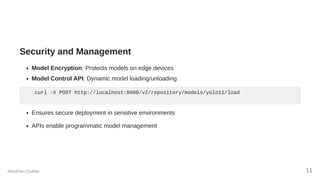
Security and Management
Model Encryption: Protects models on edge devices
Model Control API: Dynamic model loading/unloading
curl -X POST http://localhost:8000/v2/repository/models/yolo11/load
Ensures secure deployment in sensitive environments
APIs enable programmatic model management
NextGen Outlier 11
Getting Started
Steps:
i. Install Docker and NVIDIA Container Toolkit
ii. Pull Triton container: docker pull nvcr.io/nvidia/tritonserver:25.05-py3
iii. Set up model repository
iv. Run Triton: docker run --gpus all -v /path/to/models:/models ...
Test with Python Client:
import tritonclient.http as httpclient
client = httpclient.InferenceServerClient(url="localhost:8000")
inputs = httpclient.InferInput("images", [1, 3, 640, 640], "FP32")
results = client.infer(model_name="yolo11", inputs=[inputs])
Quick setup with Docker simplifies deployment
NextGen Outlier 12
Best Practices
Optimize batch size with Model Analyzer
Use ensemble models for complex pipelines
Monitor performance via metrics endpoint ( http://localhost:8002/metrics )
Test locally before cloud deployment
Fine-tune configurations for your workload
Leverage NVIDIA’s documentation and community support
NextGen Outlier 13
The Future: NVIDIA Dynamo
NVIDIA Dynamo (formerly Triton) enhances LLM serving
Features: Disaggregated prefill/decode, NIM microservices integration
Optimizes GPU utilization for LLMs
Part of NVIDIA AI Enterprise for enterprise support
NextGen Outlier 14
Conclusion
Scalable, flexible, and high-performance inference
Supports diverse frameworks, hardware, and use cases
Simplifies AI deployment with enterprise-grade tools
Call to Action: Start with Triton on NVIDIA LaunchPad or NGC
Join the Triton community for updates and support
NextGen Outlier 15
Q&A
Let’s discuss your use cases and questions!
Explore Triton hands-on with NVIDIA resources
NextGen Outlier 16
Thank you !
NextGen Outlier 17
NextGen Outlier 18

NVIDIA Triton Inference Server, a game-changing platform for deploying AI models at scale!

  • 1.
    NVIDIA Triton InferenceServer Streamlined AI Model Deployment -Tamanna NextGen Outlier 1
  • 2.
    What is NVIDIATriton Inference Server? Open-source platform for deploying AI models at scale Supports real-time, batch, and streaming inference Part of NVIDIA AI Enterprise for enterprise-grade solutions Simplifies AI inference across cloud, data center, edge, and embedded devices Optimized for NVIDIA GPUs, CPUs, and AWS Inferentia NextGen Outlier 2
  • 3.
    Why Triton Matters Scalability:Handles high-throughput workloads Flexibility: Supports multiple ML/DL frameworks (TensorFlow, PyTorch, ONNX, etc.) Performance: Optimized for NVIDIA GPUs and beyond Reduces latency and increases throughput for production AI Simplifies multi-model and multi-framework deployments NextGen Outlier 3
  • 4.
    Key Features Dynamic Batching:Groups requests to maximize throughput Multi-Framework Support: TensorFlow, PyTorch, ONNX, TensorRT, etc. Ensemble Models: Chains multiple models for complex pipelines Model Versioning: Supports A/B testing and rolling updates Hardware Optimization: Leverages GPUs, CPUs, and Inferentia Example: Dynamic batching can improve throughput by up to 2.5x Ensemble models streamline preprocessing and postprocessing NextGen Outlier 4
  • 5.
    Architecture Overview Components: Model Repository:Stores models and configurations Schedulers: Manage inference requests (default, dynamic batching) Backends: Framework-specific inference engines APIs: HTTP/REST, gRPC, C API for client interaction graph TD A[Client] --> B[Triton Server] B --> C[Model Repository] C --> D[Scheduler] D --> E[Backend] Modular architecture ensures flexibility and scalability NextGen Outlier 5
  • 6.
    Model Repository inAction File-system-based repository with model artifacts and config.pbtxt Example configuration for YOLO11: name: "yolo11" platform: "onnxruntime_onnx" max_batch_size: 4 input [{ name: "images", data_type: TYPE_FP32, dims: [3, 640, 640] }] output [{ name: "output", data_type: TYPE_FP32, dims: [1, 8400, 85] }] Simple configuration enables rapid model deployment Supports versioning for seamless updates NextGen Outlier 6
  • 7.
    Supported Frameworks TensorFlow, PyTorch,ONNX, TensorRT, OpenVINO, RAPIDS FIL, XGBoost Custom Python backends for preprocessing/postprocessing Eliminates need for multiple inference servers Custom backends extend Triton’s capabilities for unique use cases NextGen Outlier 7
  • 8.
    Deployment Scenarios Cloud: AWS,Google Cloud, Azure Data Center: High-throughput GPU servers Edge: NVIDIA Jetson for low-latency inference Embedded: ARM CPUs for resource-constrained devices Kubernetes integration for scalable cloud deployments Jetson support for edge AI applications NextGen Outlier 8
  • 9.
    Performance Optimization TensorRT: Upto 2.5x throughput on NVIDIA GPUs Model Analyzer: Profiles models for optimal batch size Dynamic Batching: Configurable batching parameters dynamic_batching { preferred_batch_size: [4, 8] max_queue_delay_microseconds: 100 } Model Analyzer automates performance tuning Dynamic batching reduces latency for real-time applications NextGen Outlier 9
  • 10.
    Real-World Use Cases ObjectDetection: YOLO11 for real-time detection Video Analysis: CognitiveMill’s CPU-GPU pipeline Generative AI: LLMs with vLLM/TensorRT-LLM backends YOLO11 achieves high throughput with Triton’s batching LLMs scale efficiently for chatbots and text generation NextGen Outlier 10
  • 11.
    Security and Management ModelEncryption: Protects models on edge devices Model Control API: Dynamic model loading/unloading curl -X POST http://localhost:8000/v2/repository/models/yolo11/load Ensures secure deployment in sensitive environments APIs enable programmatic model management NextGen Outlier 11
  • 12.
    Getting Started Steps: i. InstallDocker and NVIDIA Container Toolkit ii. Pull Triton container: docker pull nvcr.io/nvidia/tritonserver:25.05-py3 iii. Set up model repository iv. Run Triton: docker run --gpus all -v /path/to/models:/models ... Test with Python Client: import tritonclient.http as httpclient client = httpclient.InferenceServerClient(url="localhost:8000") inputs = httpclient.InferInput("images", [1, 3, 640, 640], "FP32") results = client.infer(model_name="yolo11", inputs=[inputs]) Quick setup with Docker simplifies deployment NextGen Outlier 12
  • 13.
    Best Practices Optimize batchsize with Model Analyzer Use ensemble models for complex pipelines Monitor performance via metrics endpoint ( http://localhost:8002/metrics ) Test locally before cloud deployment Fine-tune configurations for your workload Leverage NVIDIA’s documentation and community support NextGen Outlier 13
  • 14.
    The Future: NVIDIADynamo NVIDIA Dynamo (formerly Triton) enhances LLM serving Features: Disaggregated prefill/decode, NIM microservices integration Optimizes GPU utilization for LLMs Part of NVIDIA AI Enterprise for enterprise support NextGen Outlier 14
  • 15.
    Conclusion Scalable, flexible, andhigh-performance inference Supports diverse frameworks, hardware, and use cases Simplifies AI deployment with enterprise-grade tools Call to Action: Start with Triton on NVIDIA LaunchPad or NGC Join the Triton community for updates and support NextGen Outlier 15
  • 16.
    Q&A Let’s discuss youruse cases and questions! Explore Triton hands-on with NVIDIA resources NextGen Outlier 16
  • 17.
  • 18.