Why do embeddings (Usually) better than TF-IDF
Features?
Tamanna 1
Index
• Why?
• TF-IDF
• Embedding
• Comaprision
Tamanna 2
Why?
Tamanna 3
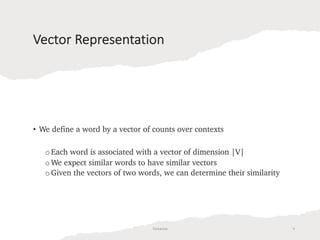
Vector Representation
• We define a word by a vector of counts over contexts
oEach word is associated with a vector of dimension |V|
oWe expect similar words to have similar vectors
oGiven the vectors of two words, we can determine their similarity
Tamanna 4
Vector Representation
Raw counts are problematic:
o frequent words will characterize most words -> not informative
Except from raw counts, we can use other functions:
o Pointwise Mutual Information (PMI)
o TF-IDF
Tamanna 5
From Sparse to Dense
• These vectors are:
o huge – each of dimension |V|
o sparse – most entries will be 0
• We want our vectors to be small and dense:
o Use a reduction algorithm over a matrix of sparse vectors
o Learn low-dimensional word vectors directly -usually referred as
“word embeddings”
Tamanna 6
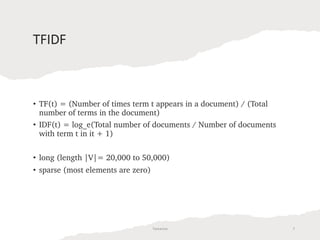
TFIDF
• TF(t) = (Number of times term t appears in a document) / (Total
number of terms in the document)
• IDF(t) = log_e(Total number of documents / Number of documents
with term t in it + 1)
• long (length |V|= 20,000 to 50,000)
• sparse (most elements are zero)
Tamanna 7
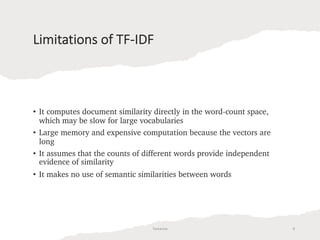
Limitations of TF-IDF
• It computes document similarity directly in the word-count space,
which may be slow for large vocabularies
• Large memory and expensive computation because the vectors are
long
• It assumes that the counts of different words provide independent
evidence of similarity
• It makes no use of semantic similarities between words
Tamanna 8
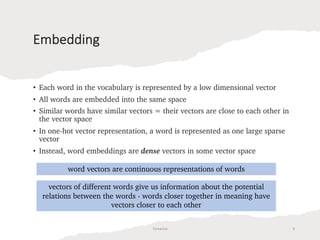
Embedding
• Each word in the vocabulary is represented by a low dimensional vector
• All words are embedded into the same space
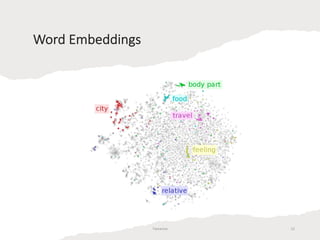
• Similar words have similar vectors = their vectors are close to each other in
the vector space
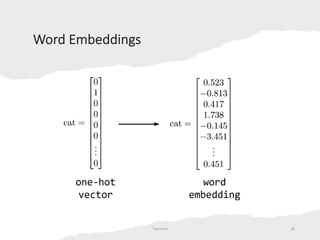
• In one-hot vector representation, a word is represented as one large sparse
vector
• Instead, word embeddings are dense vectors in some vector space
word vectors are continuous representations of words
vectors of different words give us information about the potential
relations between the words - words closer together in meaning have
vectors closer to each other
Tamanna 9
Word Embeddings
Tamanna 10
Word Embeddings
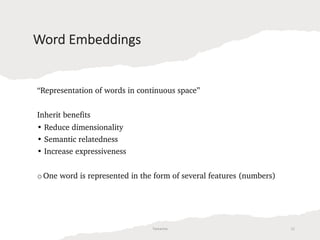
“Representation of words in continuous space”
Inherit benefits
• Reduce dimensionality
• Semantic relatedness
• Increase expressiveness
oOne word is represented in the form of several features (numbers)
Tamanna 11
Word Embeddings
Tamanna 12
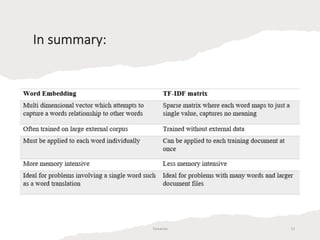
In summary:
Tamanna 13
References
Tamanna 14
• https://towardsdatascience.com/natural-language-processing-
feature-engineering-using-tf-idf-e8b9d00e7e76
• https://towardsdatascience.com/tf-idf-for-document-ranking-from-
scratch-in-python-on-real-world-dataset-
796d339a4089#:~:text=TF%2DIDF%20stands%20for%20%E2%80%9C
Term,Information%20Retrieval%20and%20Text%20Mining.
• https://miro.medium.com/max/4800/1*tKk9S7v_kxYLj7Sj-
VnTkg.jpeg
• https://ruder.io/word-embeddings-1/
• https://medium.com/@arihantjain25121995/word-embeddings-
using-bow-tf-idf-with-an-example-a10d2e2ab03e
Thank you for your attention!
Tamanna 15

Knowledge based System

  • 1.
    Why do embeddings(Usually) better than TF-IDF Features? Tamanna 1
  • 2.
    Index • Why? • TF-IDF •Embedding • Comaprision Tamanna 2
  • 3.
  • 4.
    Vector Representation • Wedefine a word by a vector of counts over contexts oEach word is associated with a vector of dimension |V| oWe expect similar words to have similar vectors oGiven the vectors of two words, we can determine their similarity Tamanna 4
  • 5.
    Vector Representation Raw countsare problematic: o frequent words will characterize most words -> not informative Except from raw counts, we can use other functions: o Pointwise Mutual Information (PMI) o TF-IDF Tamanna 5
  • 6.
    From Sparse toDense • These vectors are: o huge – each of dimension |V| o sparse – most entries will be 0 • We want our vectors to be small and dense: o Use a reduction algorithm over a matrix of sparse vectors o Learn low-dimensional word vectors directly -usually referred as “word embeddings” Tamanna 6
  • 7.
    TFIDF • TF(t) =(Number of times term t appears in a document) / (Total number of terms in the document) • IDF(t) = log_e(Total number of documents / Number of documents with term t in it + 1) • long (length |V|= 20,000 to 50,000) • sparse (most elements are zero) Tamanna 7
  • 8.
    Limitations of TF-IDF •It computes document similarity directly in the word-count space, which may be slow for large vocabularies • Large memory and expensive computation because the vectors are long • It assumes that the counts of different words provide independent evidence of similarity • It makes no use of semantic similarities between words Tamanna 8
  • 9.
    Embedding • Each wordin the vocabulary is represented by a low dimensional vector • All words are embedded into the same space • Similar words have similar vectors = their vectors are close to each other in the vector space • In one-hot vector representation, a word is represented as one large sparse vector • Instead, word embeddings are dense vectors in some vector space word vectors are continuous representations of words vectors of different words give us information about the potential relations between the words - words closer together in meaning have vectors closer to each other Tamanna 9
  • 10.
  • 11.
    Word Embeddings “Representation ofwords in continuous space” Inherit benefits • Reduce dimensionality • Semantic relatedness • Increase expressiveness oOne word is represented in the form of several features (numbers) Tamanna 11
  • 12.
  • 13.
  • 14.
    References Tamanna 14 • https://towardsdatascience.com/natural-language-processing- feature-engineering-using-tf-idf-e8b9d00e7e76 •https://towardsdatascience.com/tf-idf-for-document-ranking-from- scratch-in-python-on-real-world-dataset- 796d339a4089#:~:text=TF%2DIDF%20stands%20for%20%E2%80%9C Term,Information%20Retrieval%20and%20Text%20Mining. • https://miro.medium.com/max/4800/1*tKk9S7v_kxYLj7Sj- VnTkg.jpeg • https://ruder.io/word-embeddings-1/ • https://medium.com/@arihantjain25121995/word-embeddings- using-bow-tf-idf-with-an-example-a10d2e2ab03e
  • 15.
    Thank you foryour attention! Tamanna 15