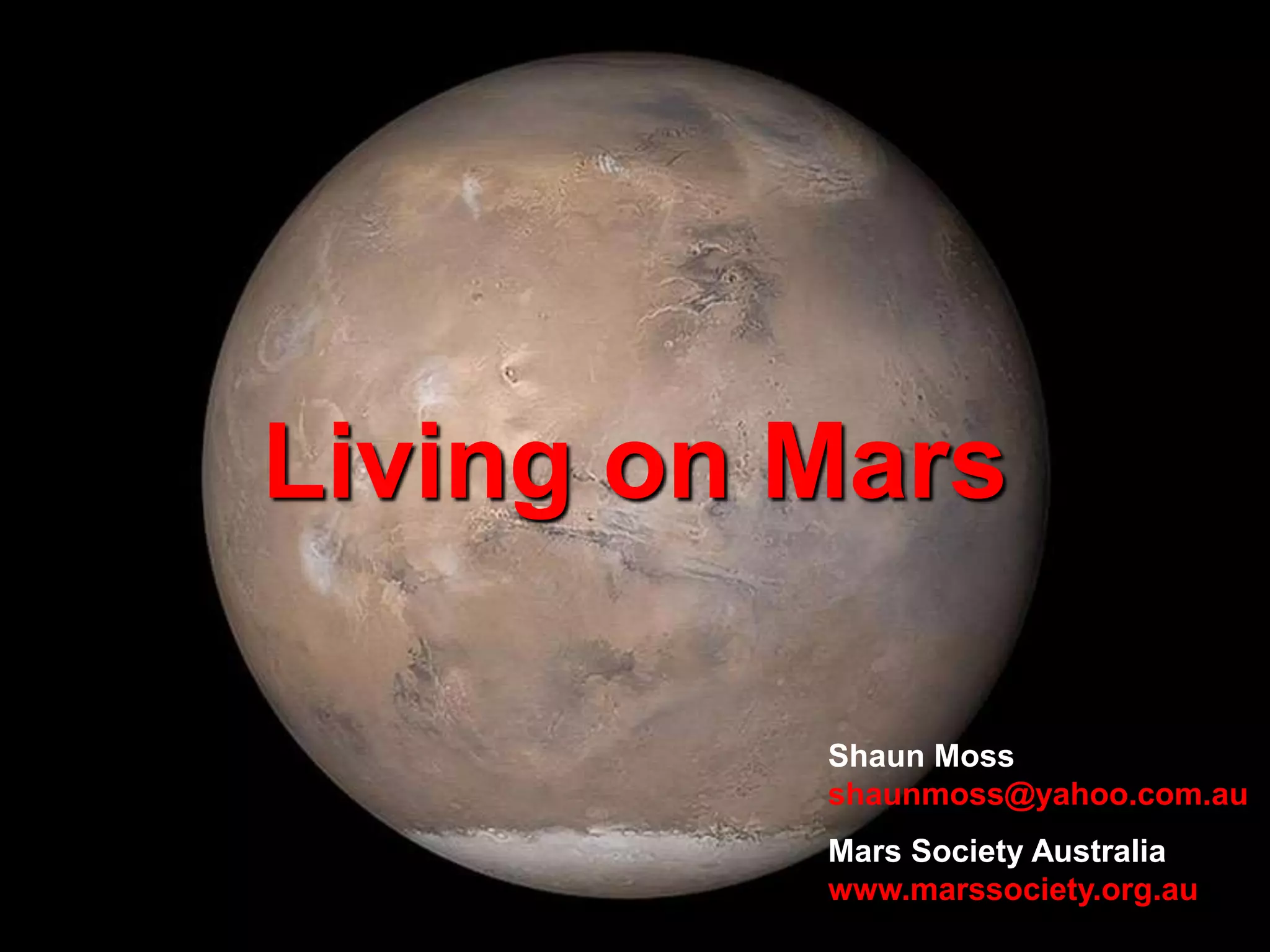
Living on Mars
Shaun Moss
shaunmoss@yahoo.com.au
Mars Society Australia
www.marssociety.org.au
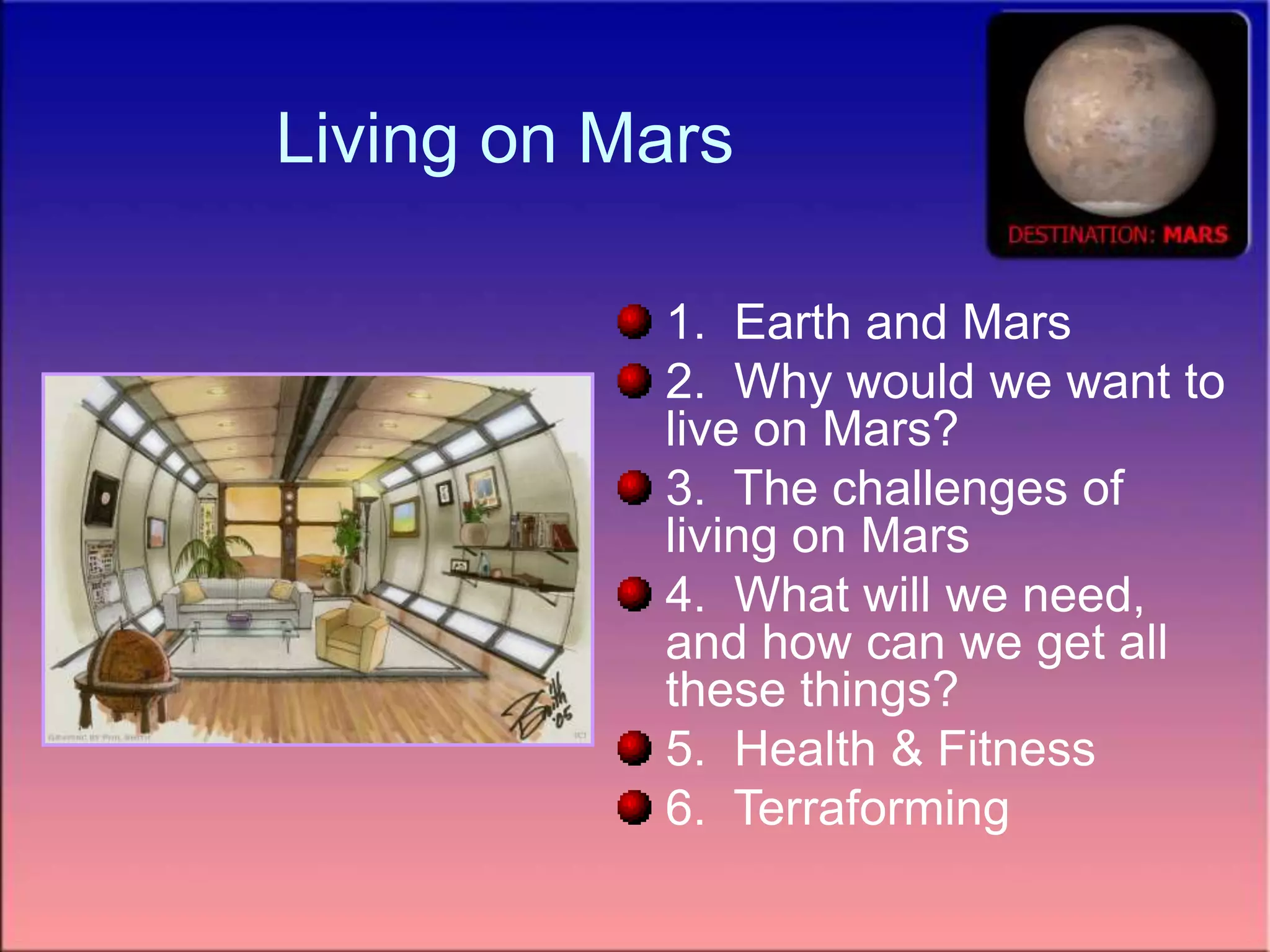
Living on Mars
1. Earth and Mars
2. Why would we want to
live on Mars?
3. The challenges of
living on Mars
4. What will we need,
and how can we get all
these things?
5. Health & Fitness
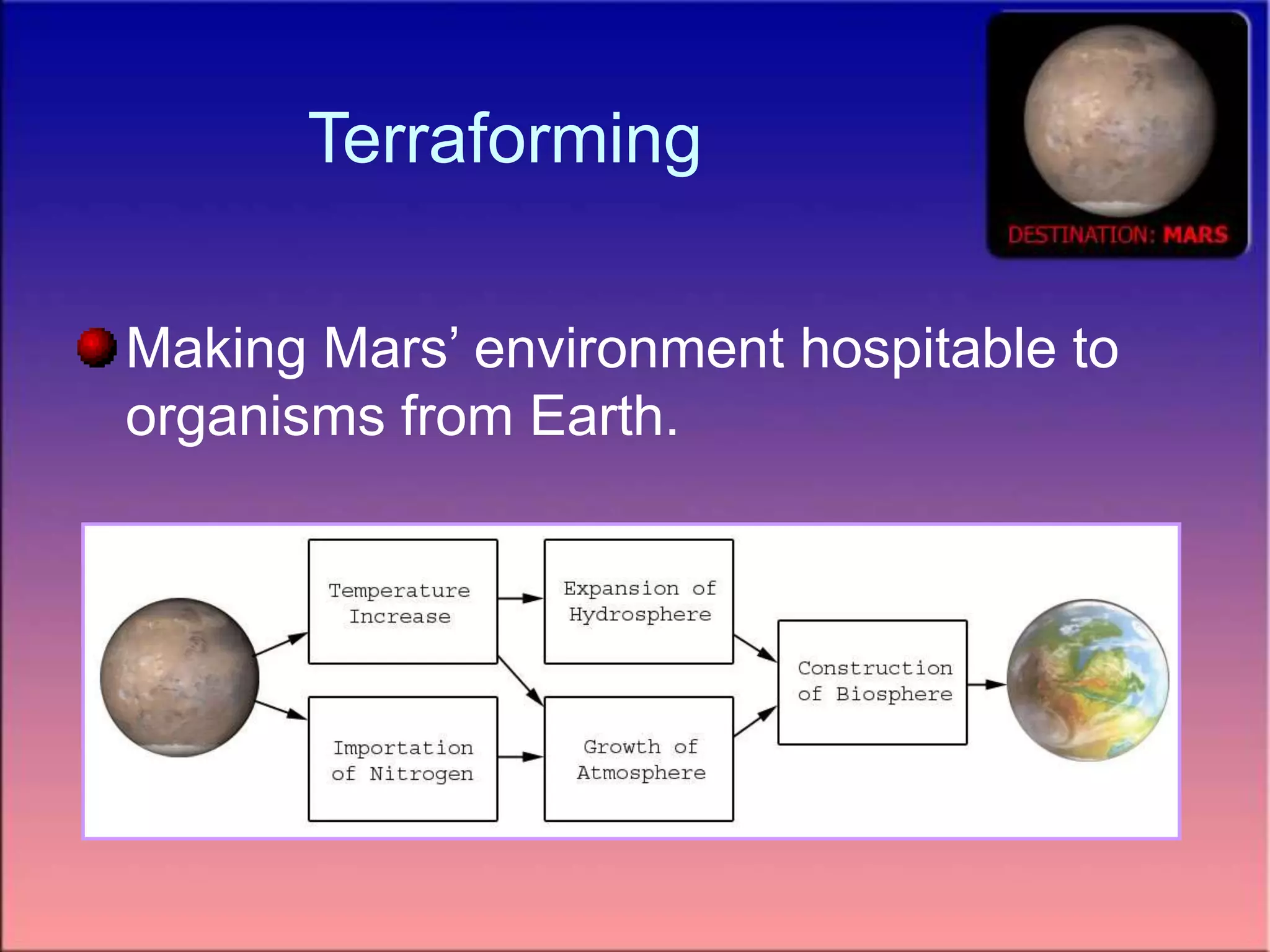
6. Terraforming
Earth and Mars
Radius: 12746km 6805km
Gravity: 1g 0.38g
Luna
Deimos
Phobos
Earth Mars
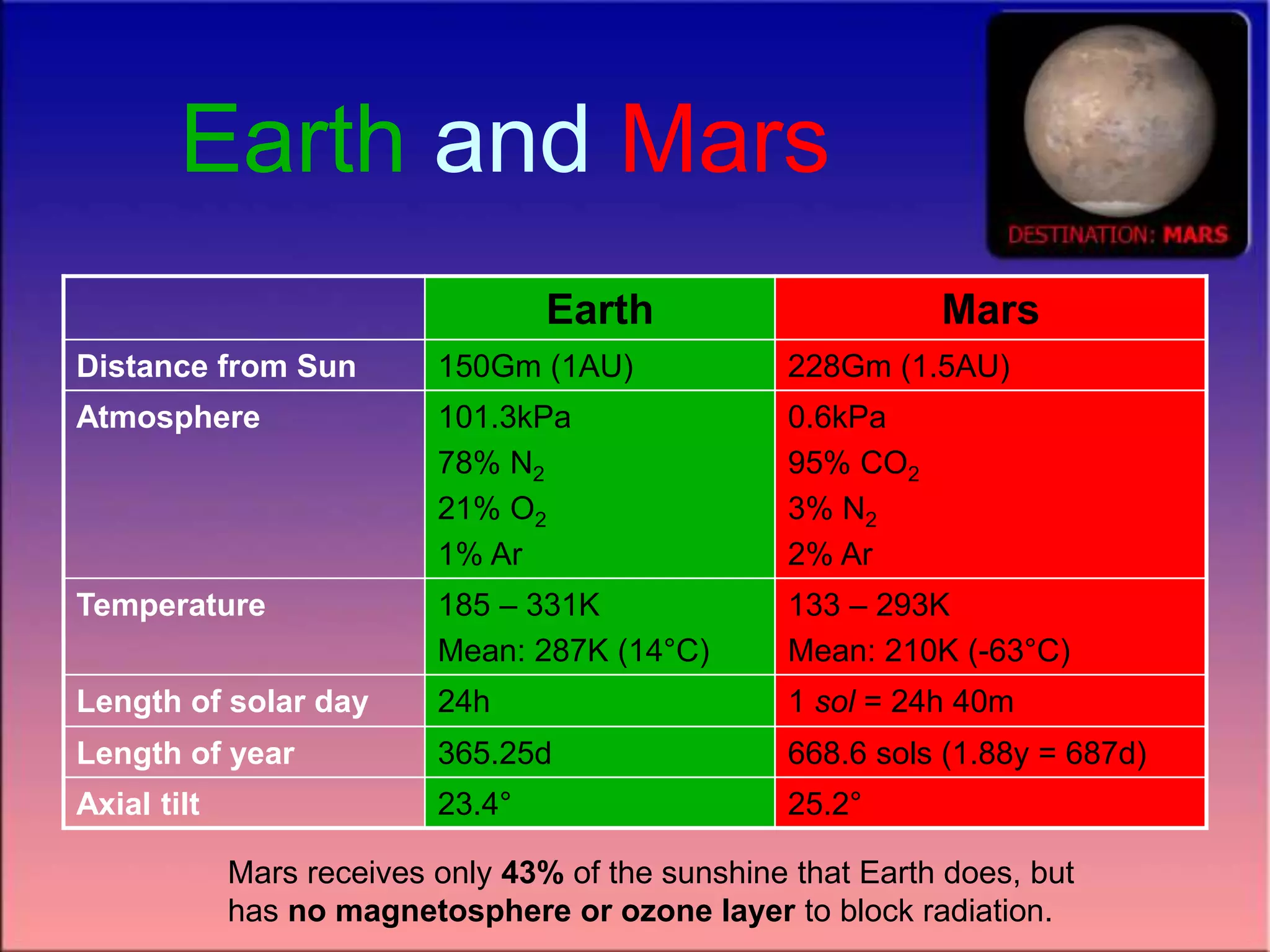
Distance from Sun 150Gm (1AU) 228Gm (1.5AU)
Atmosphere 101.3kPa
78% N2
21% O2
1% Ar
0.6kPa
95% CO2
3% N2
2% Ar
Temperature 185 – 331K
Mean: 287K (14°C)
133 – 293K
Mean: 210K (-63°C)
Length of solar day 24h 1 sol = 24h 40m
Length of year 365.25d 668.6 sols (1.88y = 687d)
Axial tilt 23.4° 25.2°
Earth and Mars
Mars receives only 43% of the sunshine that Earth does, but
has no magnetosphere or ozone layer to block radiation.
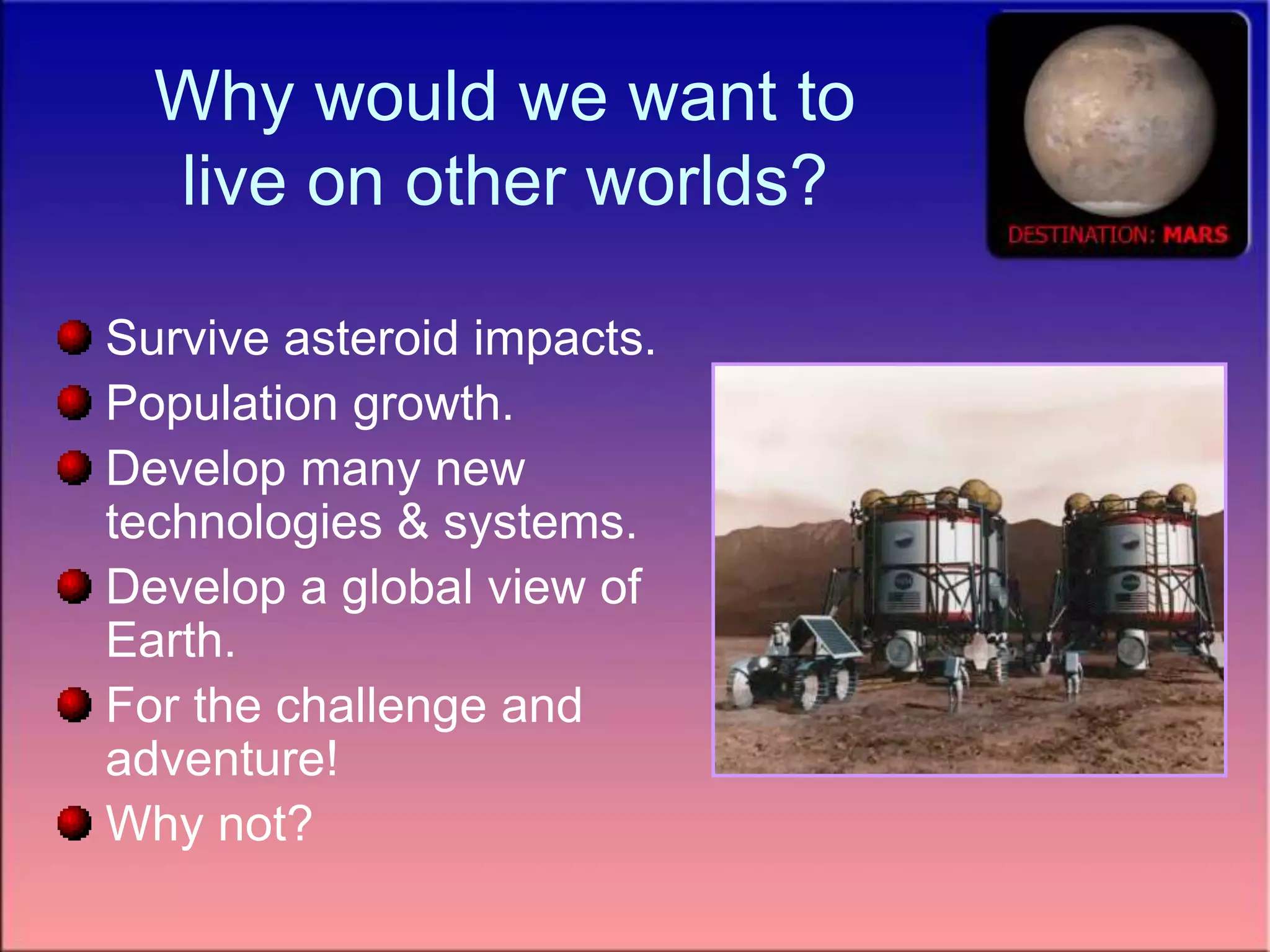
Why would we want to
live on other worlds?
Survive asteroid impacts.
Population growth.
Develop many new
technologies & systems.
Develop a global view of
Earth.
For the challenge and
adventure!
Why not?
But why Mars?
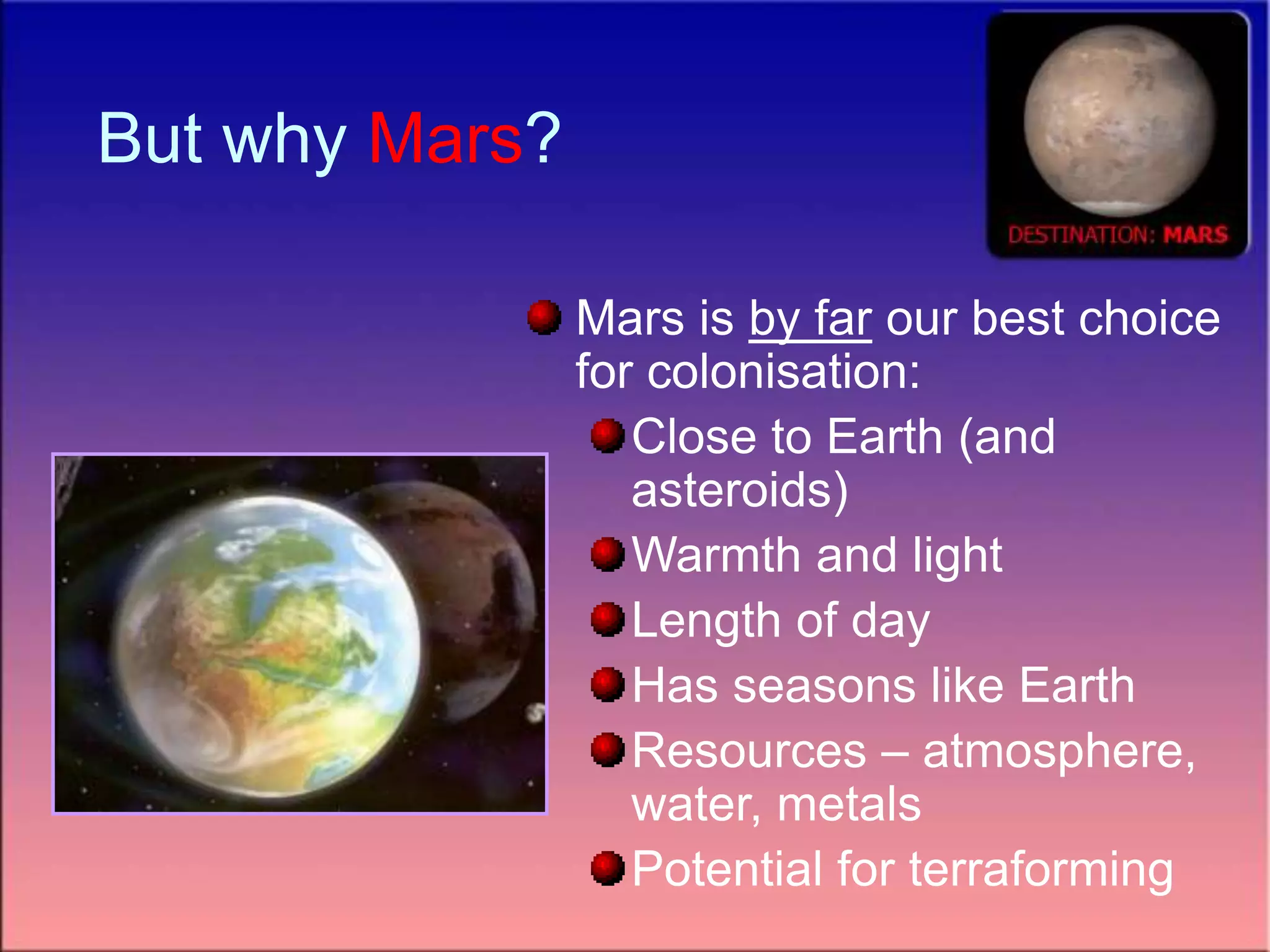
Mars is by far our best choice
for colonisation:
Close to Earth (and
asteroids)
Warmth and light
Length of day
Has seasons like Earth
Resources – atmosphere,
water, metals
Potential for terraforming
The challenges of
living on Mars
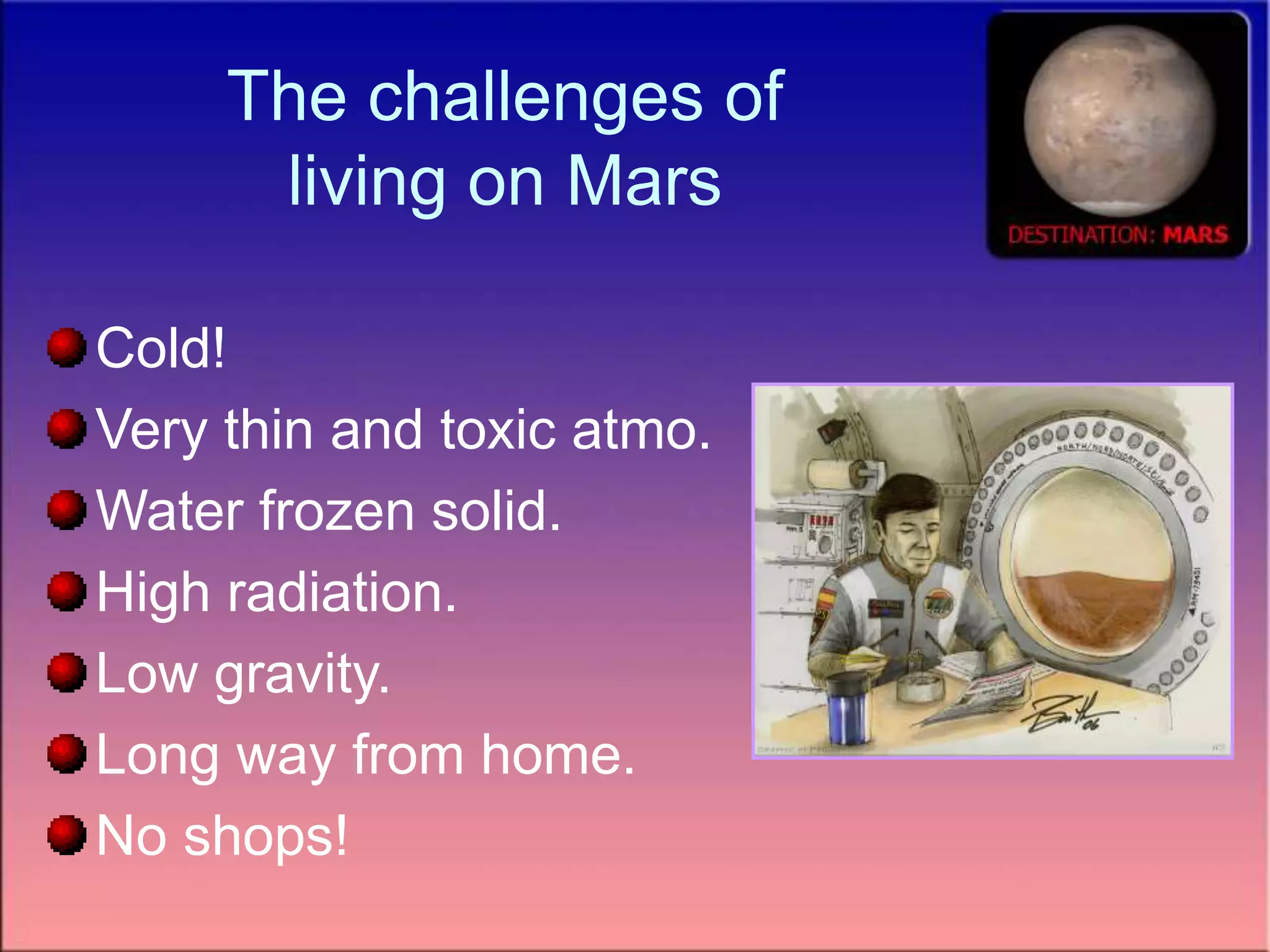
Cold!
Very thin and toxic atmo.
Water frozen solid.
High radiation.
Low gravity.
Long way from home.
No shops!
What will we need to
live on Mars?
Physical needs:
Water
Air
Food
Warmth
Sunshine
Clothing
Buildings
Technological needs:
Electricity
Materials
Tools
Computers &
communications
Vehicles & fuel
Robots
Water
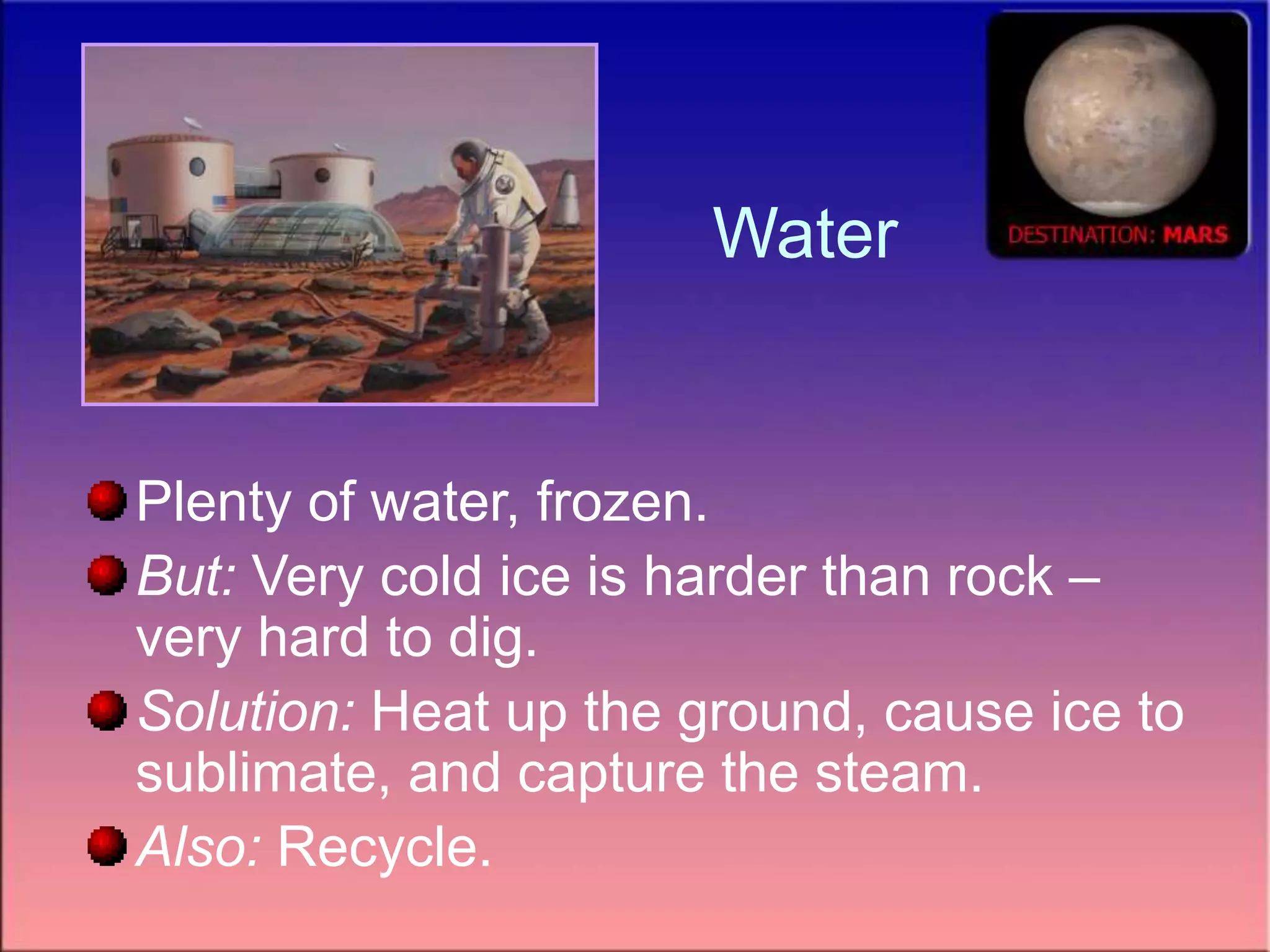
Plenty of water, frozen.
But: Very cold ice is harder than rock –
very hard to dig.
Solution: Heat up the ground, cause ice to
sublimate, and capture the steam.
Also: Recycle.
Air
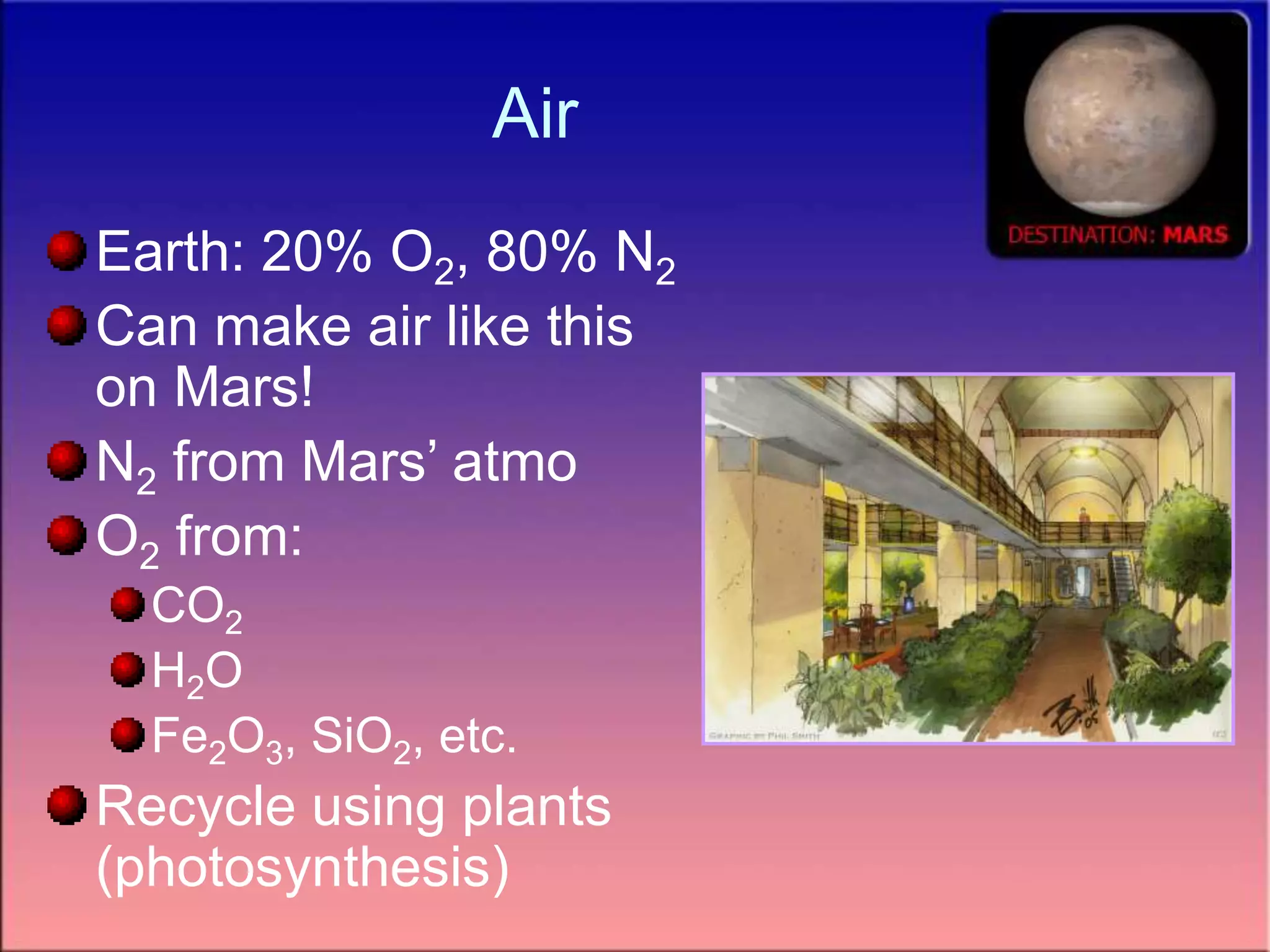
Earth: 20% O2, 80% N2
Can make air like this
on Mars!
N2 from Mars’ atmo
O2 from:
CO2
H2O
Fe2O3, SiO2, etc.
Recycle using plants
(photosynthesis)
Food
Mars’ dirt is not suited for
life (yet).
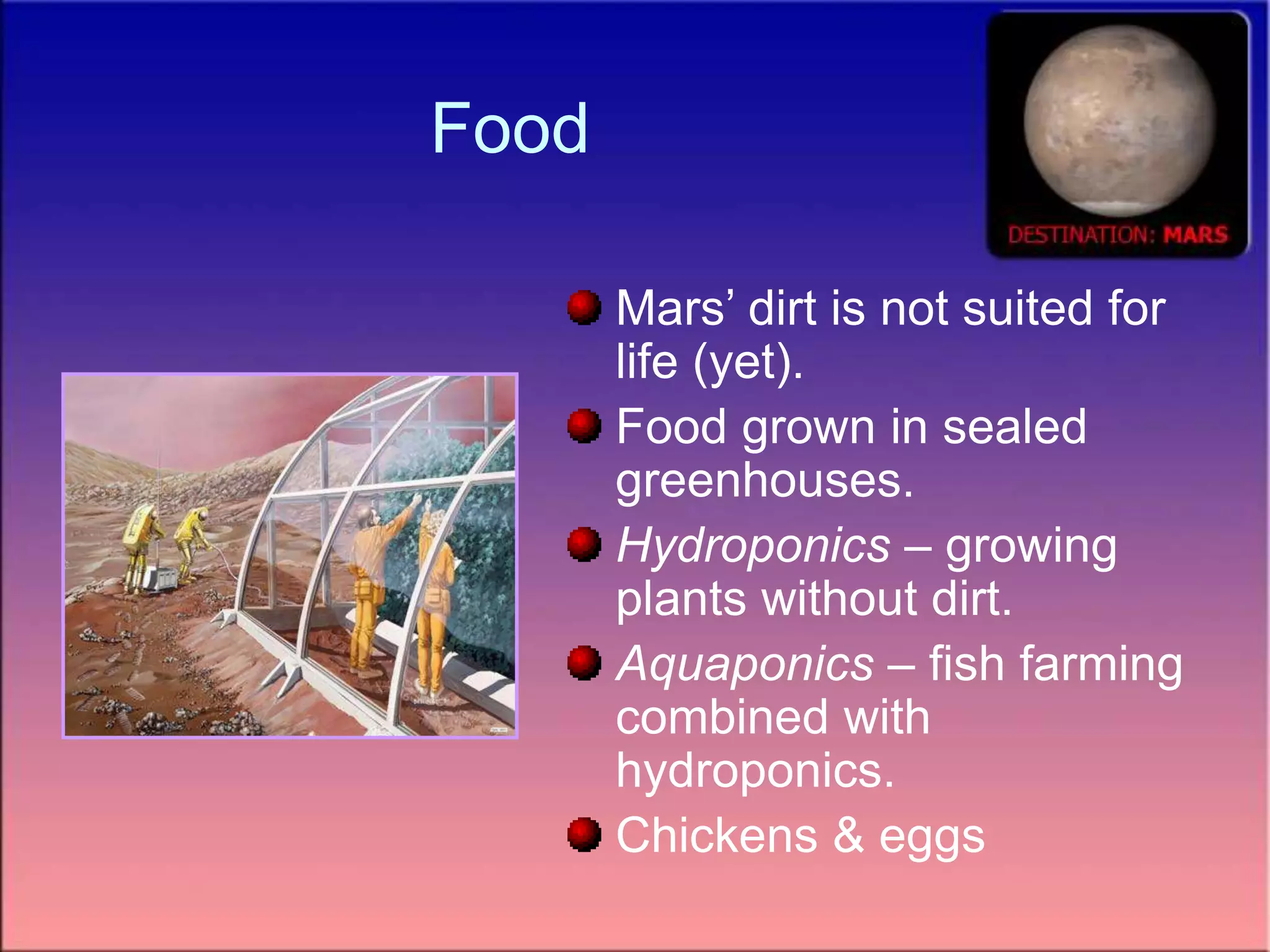
Food grown in sealed
greenhouses.
Hydroponics – growing
plants without dirt.
Aquaponics – fish farming
combined with
hydroponics.
Chickens & eggs
Making fertile dirt
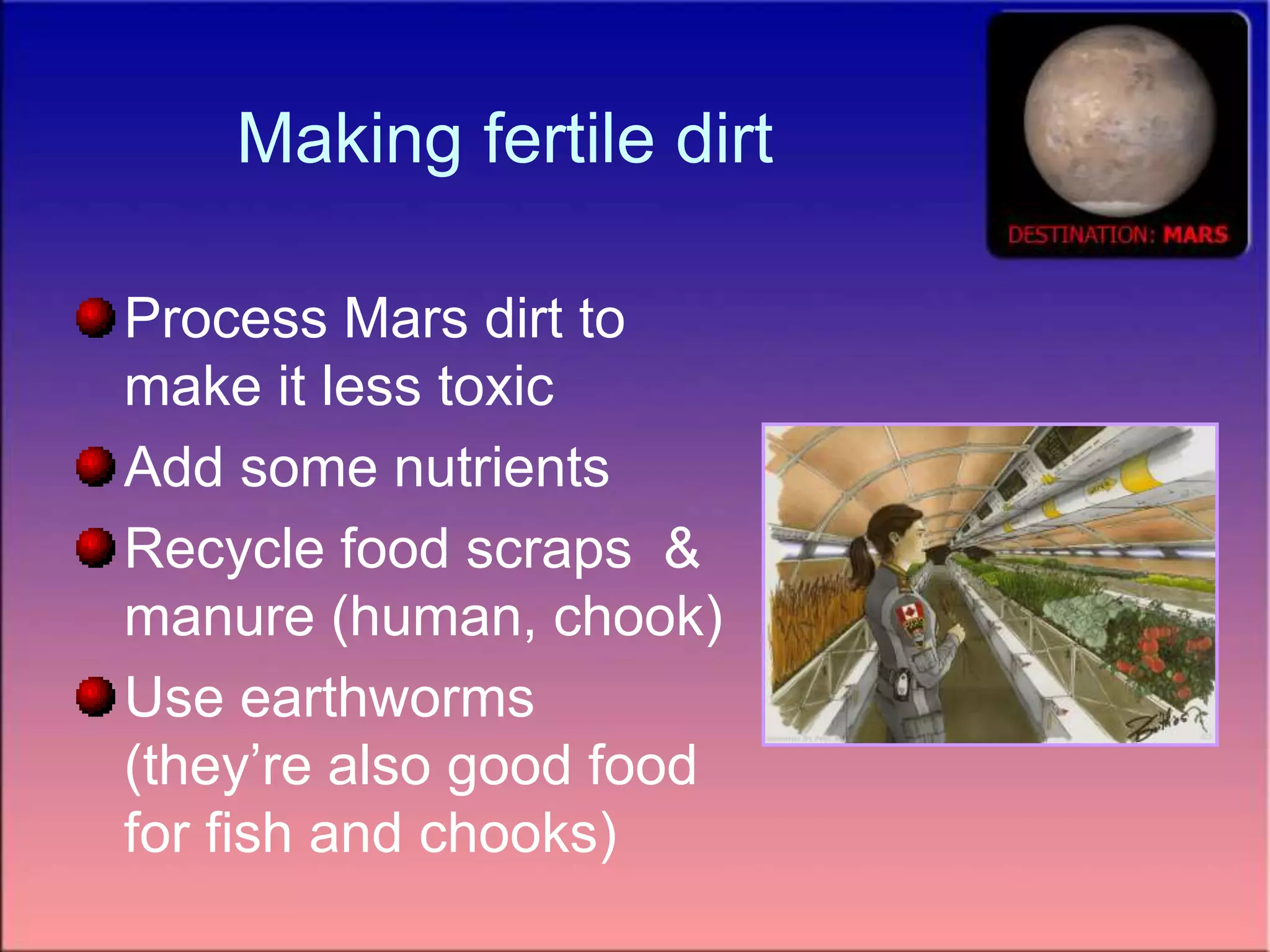
Process Mars dirt to
make it less toxic
Add some nutrients
Recycle food scraps &
manure (human, chook)
Use earthworms
(they’re also good food
for fish and chooks)
Clothing, etc.
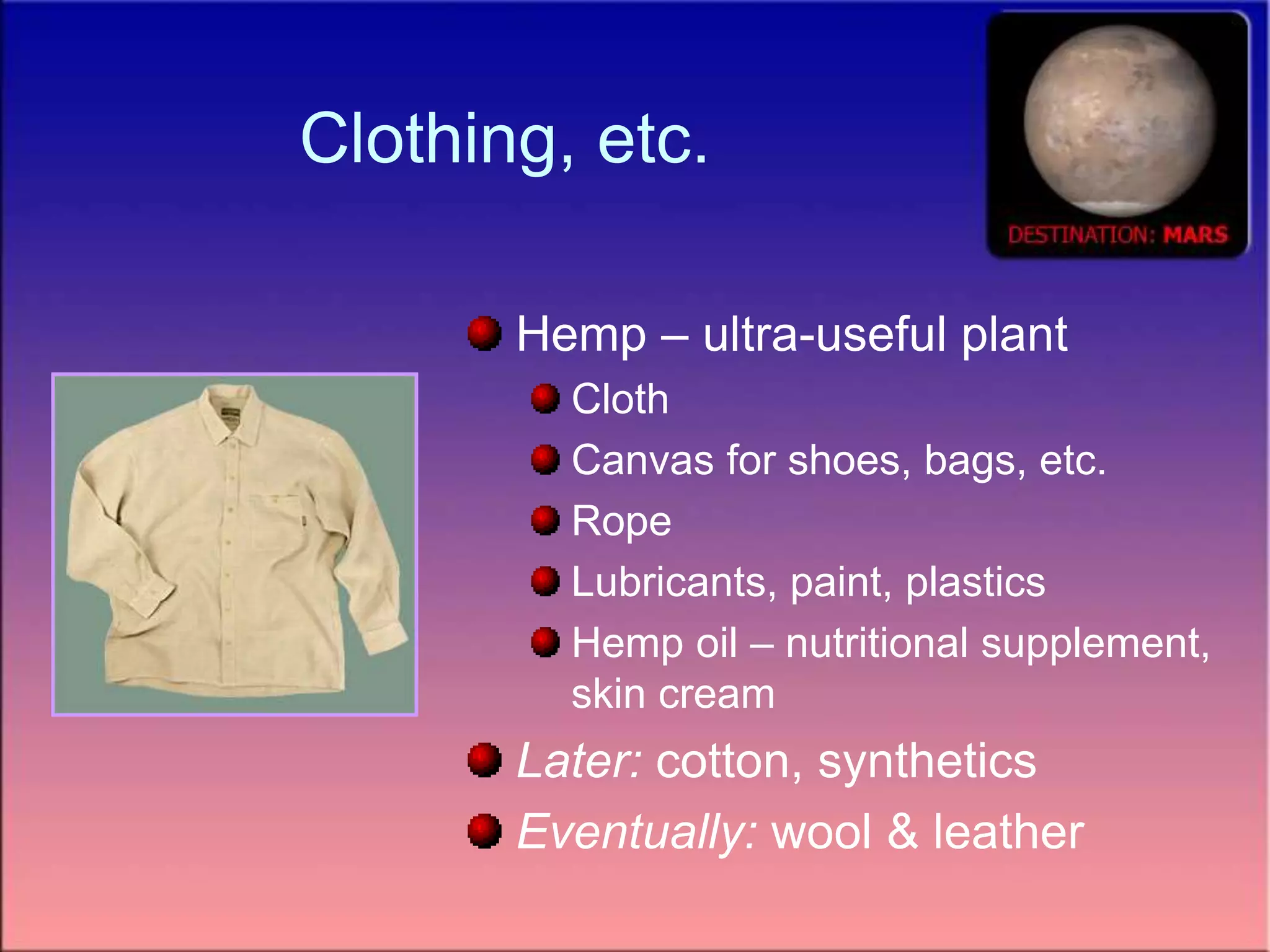
Hemp – ultra-useful plant
Cloth
Canvas for shoes, bags, etc.
Rope
Lubricants, paint, plastics
Hemp oil – nutritional supplement,
skin cream
Later: cotton, synthetics
Eventually: wool & leather
Buildings
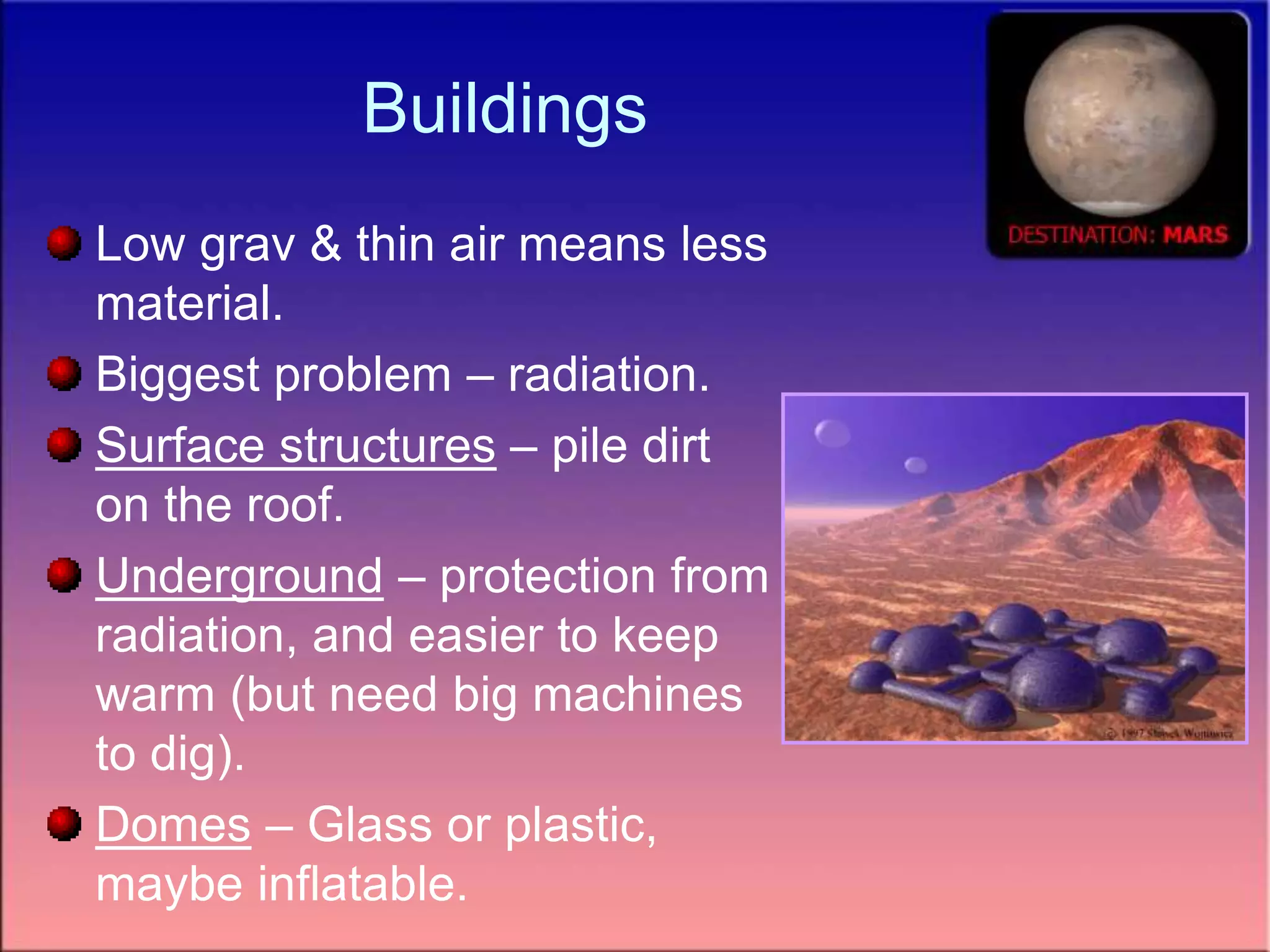
Low grav & thin air means less
material.
Biggest problem – radiation.
Surface structures – pile dirt
on the roof.
Underground – protection from
radiation, and easier to keep
warm (but need big machines
to dig).
Domes – Glass or plastic,
maybe inflatable.
Materials
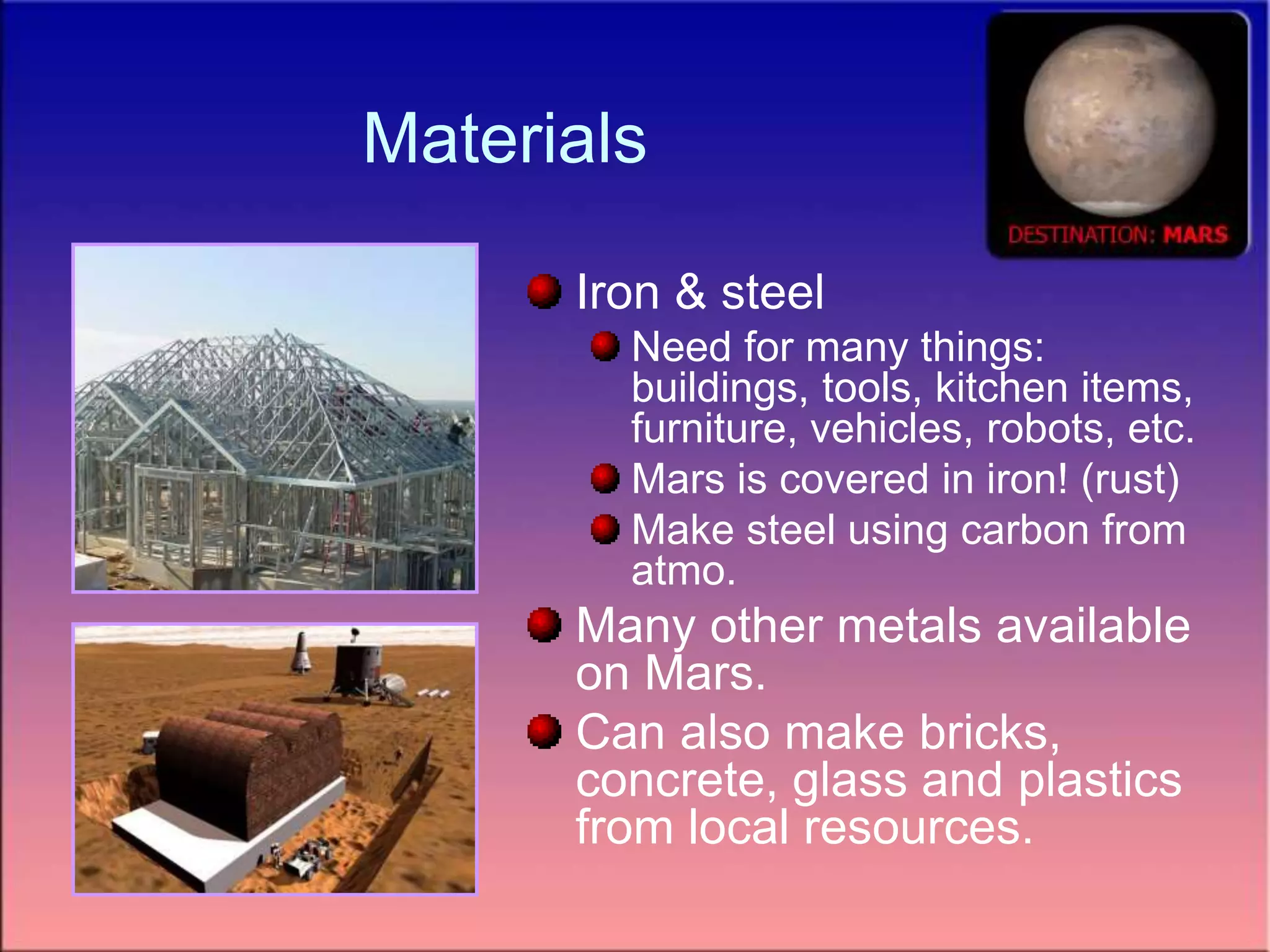
Iron & steel
Need for many things:
buildings, tools, kitchen items,
furniture, vehicles, robots, etc.
Mars is covered in iron! (rust)
Make steel using carbon from
atmo.
Many other metals available
on Mars.
Can also make bricks,
concrete, glass and plastics
from local resources.
Electricity
Nuclear: problematic on
Earth, even worse on Mars.
Also, would have to find
uranium.
Solar: possible, but less
sunlight on Mars.
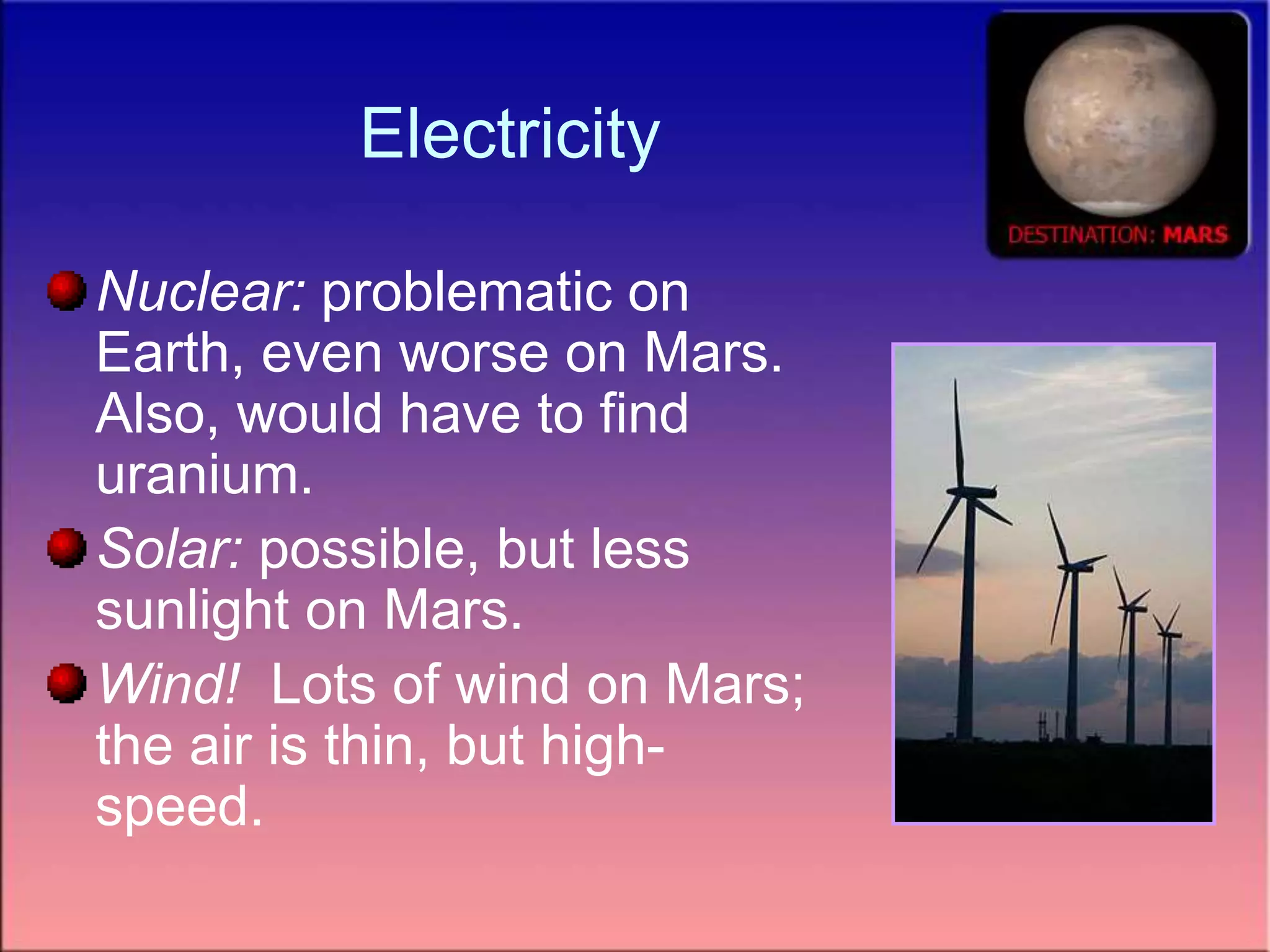
Wind! Lots of wind on Mars;
the air is thin, but high-
speed.
Vehicles & Fuel
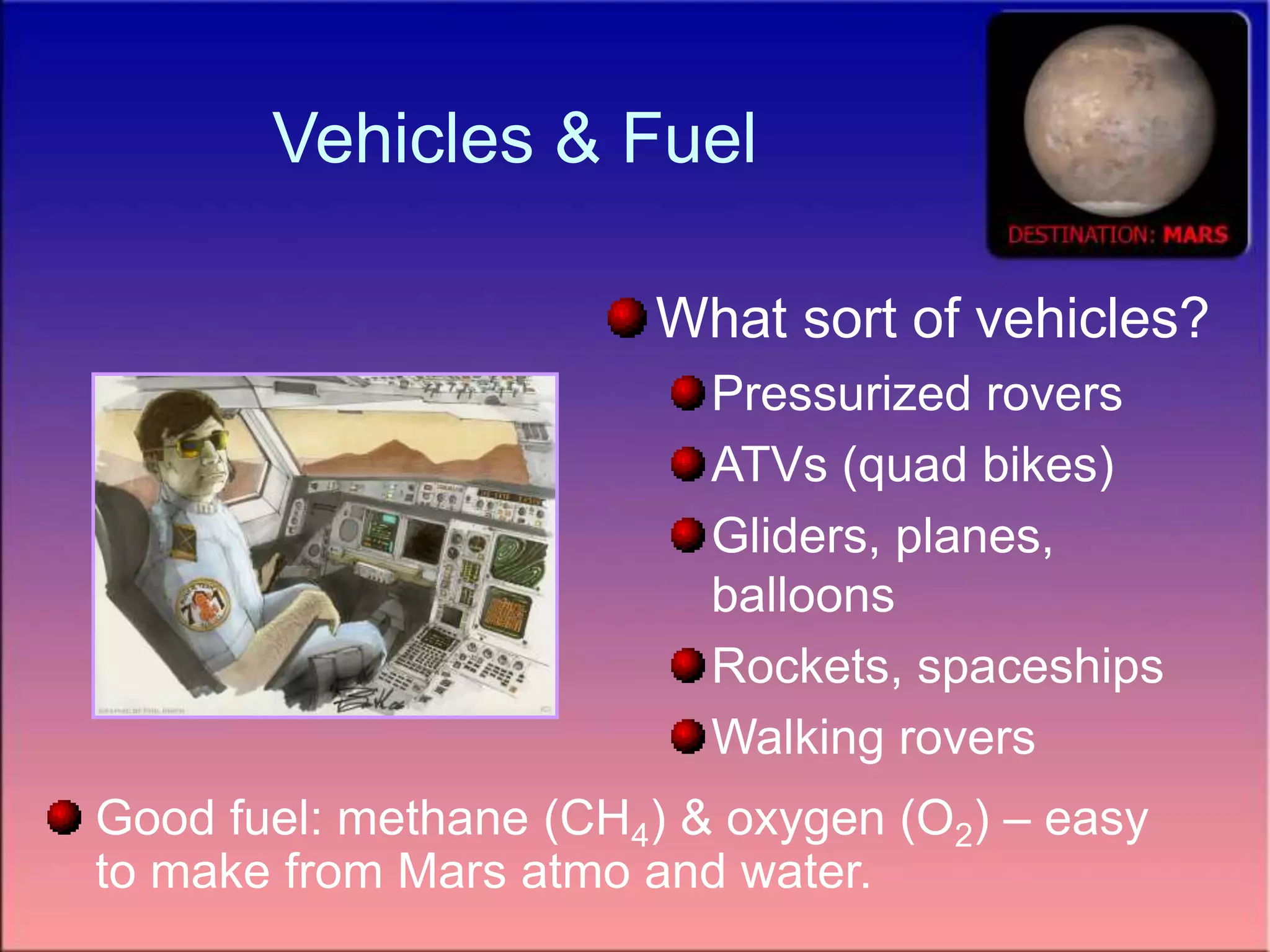
What sort of vehicles?
Pressurized rovers
ATVs (quad bikes)
Gliders, planes,
balloons
Rockets, spaceships
Walking rovers
Good fuel: methane (CH4) & oxygen (O2) – easy
to make from Mars atmo and water.
Robots
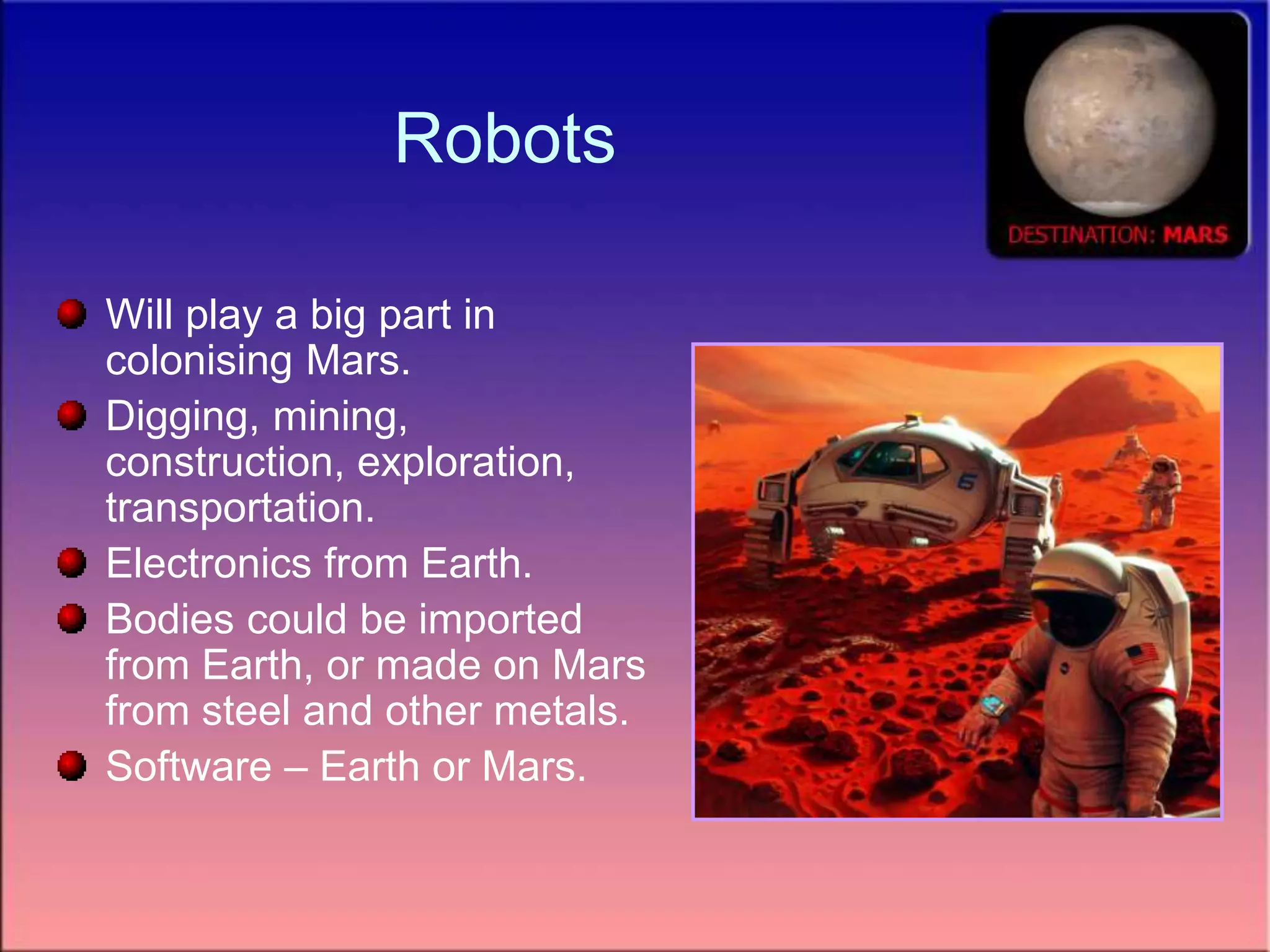
Will play a big part in
colonising Mars.
Digging, mining,
construction, exploration,
transportation.
Electronics from Earth.
Bodies could be imported
from Earth, or made on Mars
from steel and other metals.
Software – Earth or Mars.
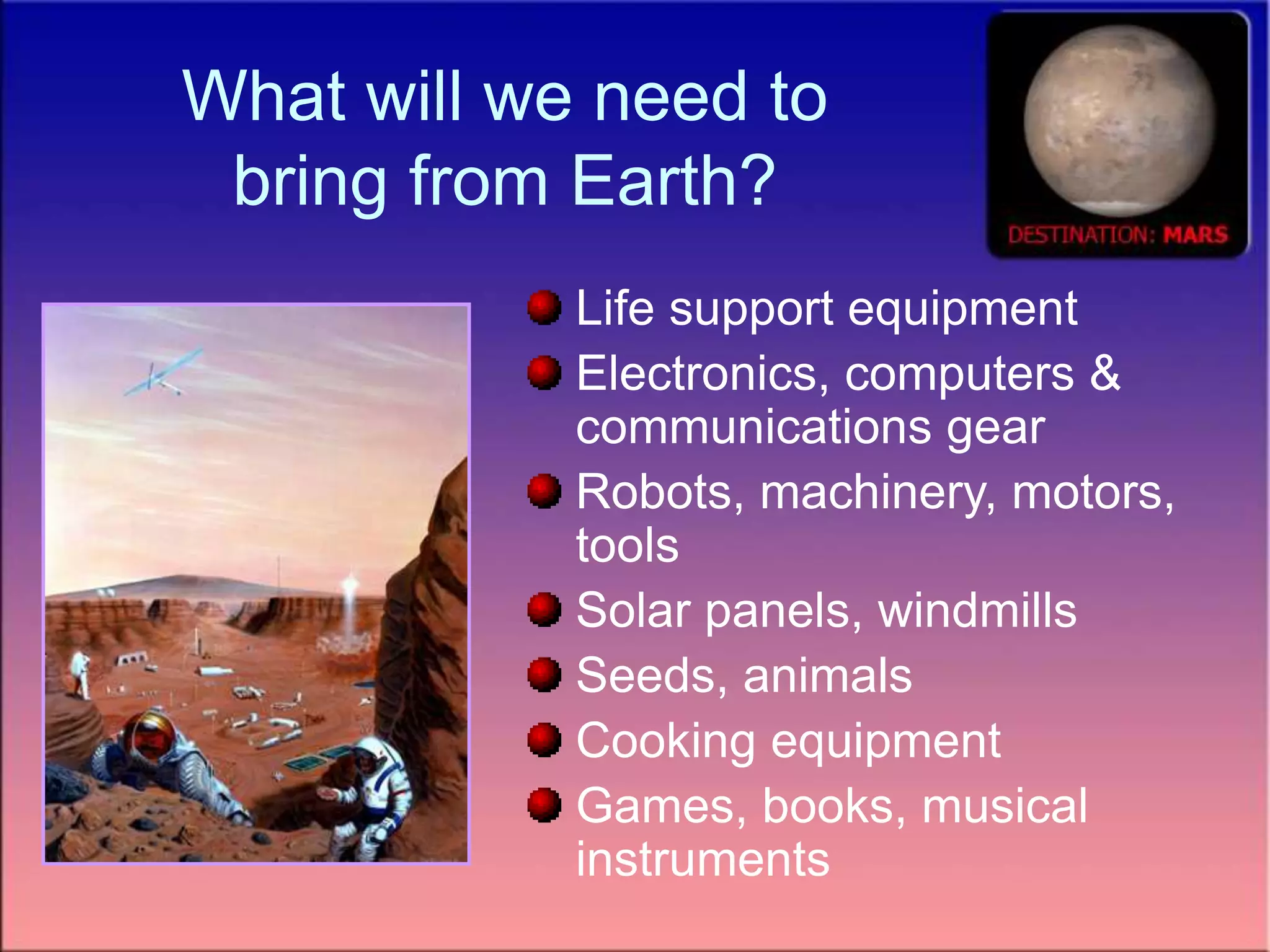
What will we need to
bring from Earth?
Life support equipment
Electronics, computers &
communications gear
Robots, machinery, motors,
tools
Solar panels, windmills
Seeds, animals
Cooking equipment
Games, books, musical
instruments
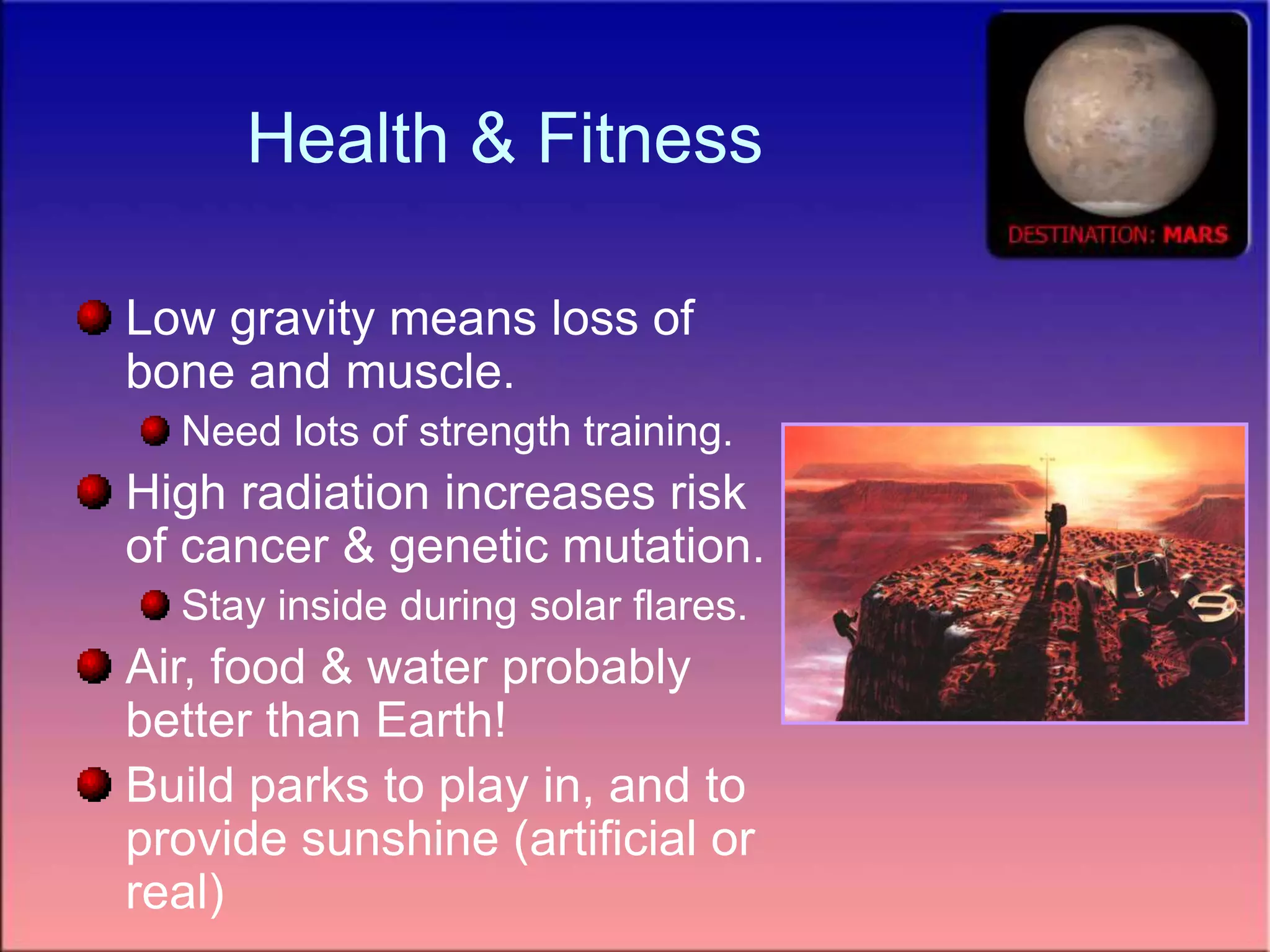
Health & Fitness
Low gravity means loss of
bone and muscle.
Need lots of strength training.
High radiation increases risk
of cancer & genetic mutation.
Stay inside during solar flares.
Air, food & water probably
better than Earth!
Build parks to play in, and to
provide sunshine (artificial or
real)
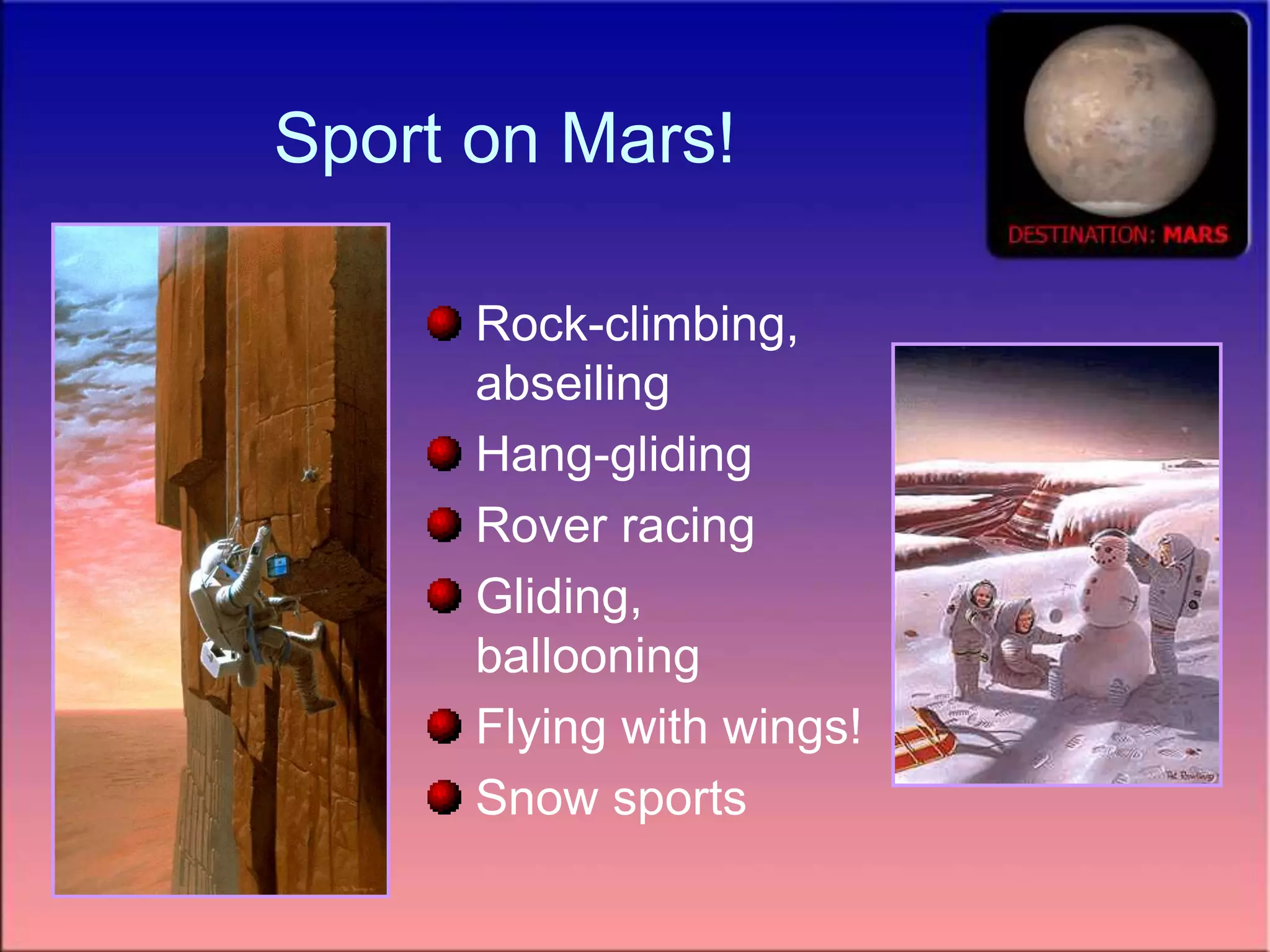
Sport on Mars!
Rock-climbing,
abseiling
Hang-gliding
Rover racing
Gliding,
ballooning
Flying with wings!
Snow sports
Terraforming
Making Mars’ environment hospitable to
organisms from Earth.
Warming Mars
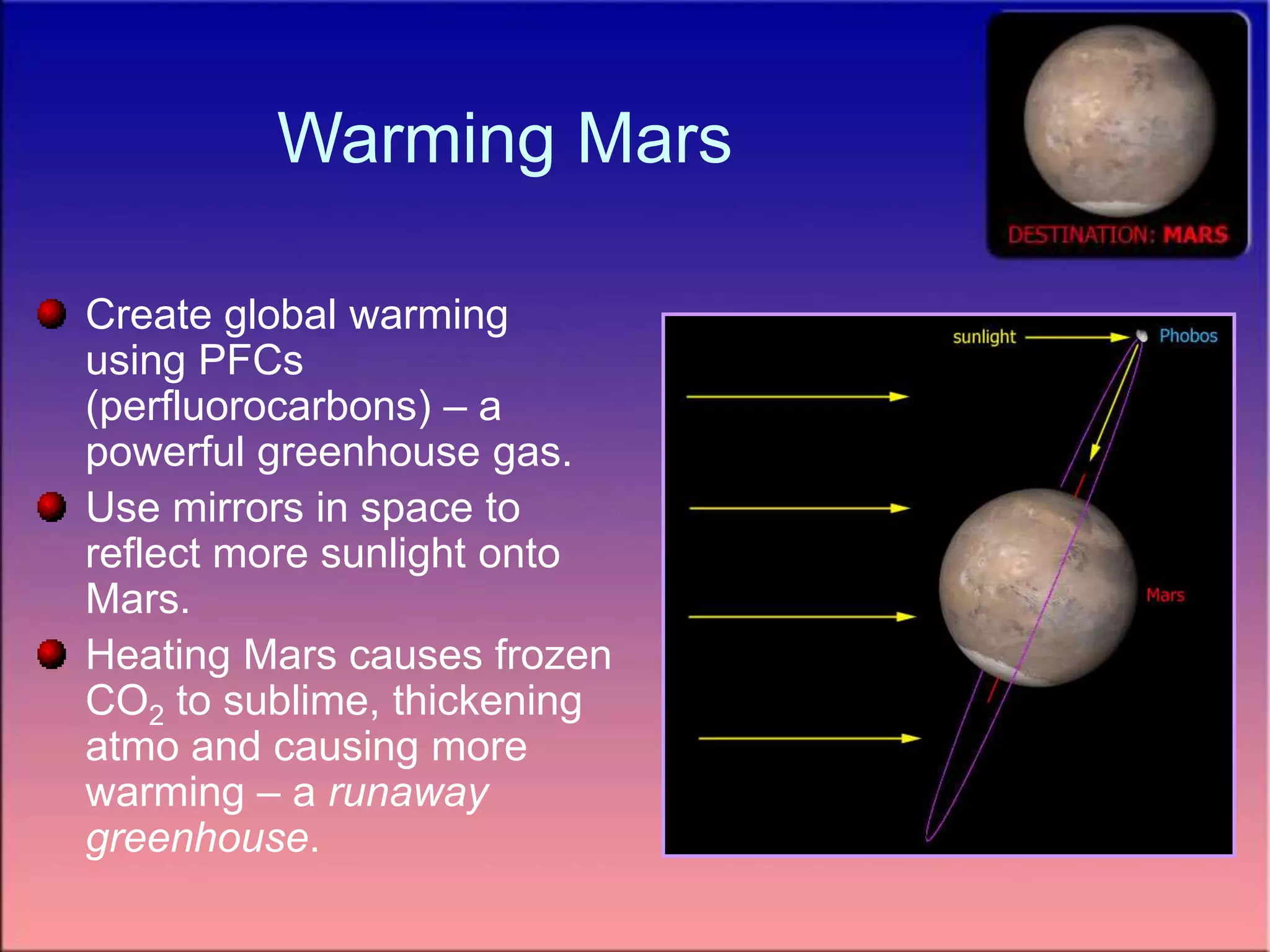
Create global warming
using PFCs
(perfluorocarbons) – a
powerful greenhouse gas.
Use mirrors in space to
reflect more sunlight onto
Mars.
Heating Mars causes frozen
CO2 to sublime, thickening
atmo and causing more
warming – a runaway
greenhouse.
Adding Nitrogen
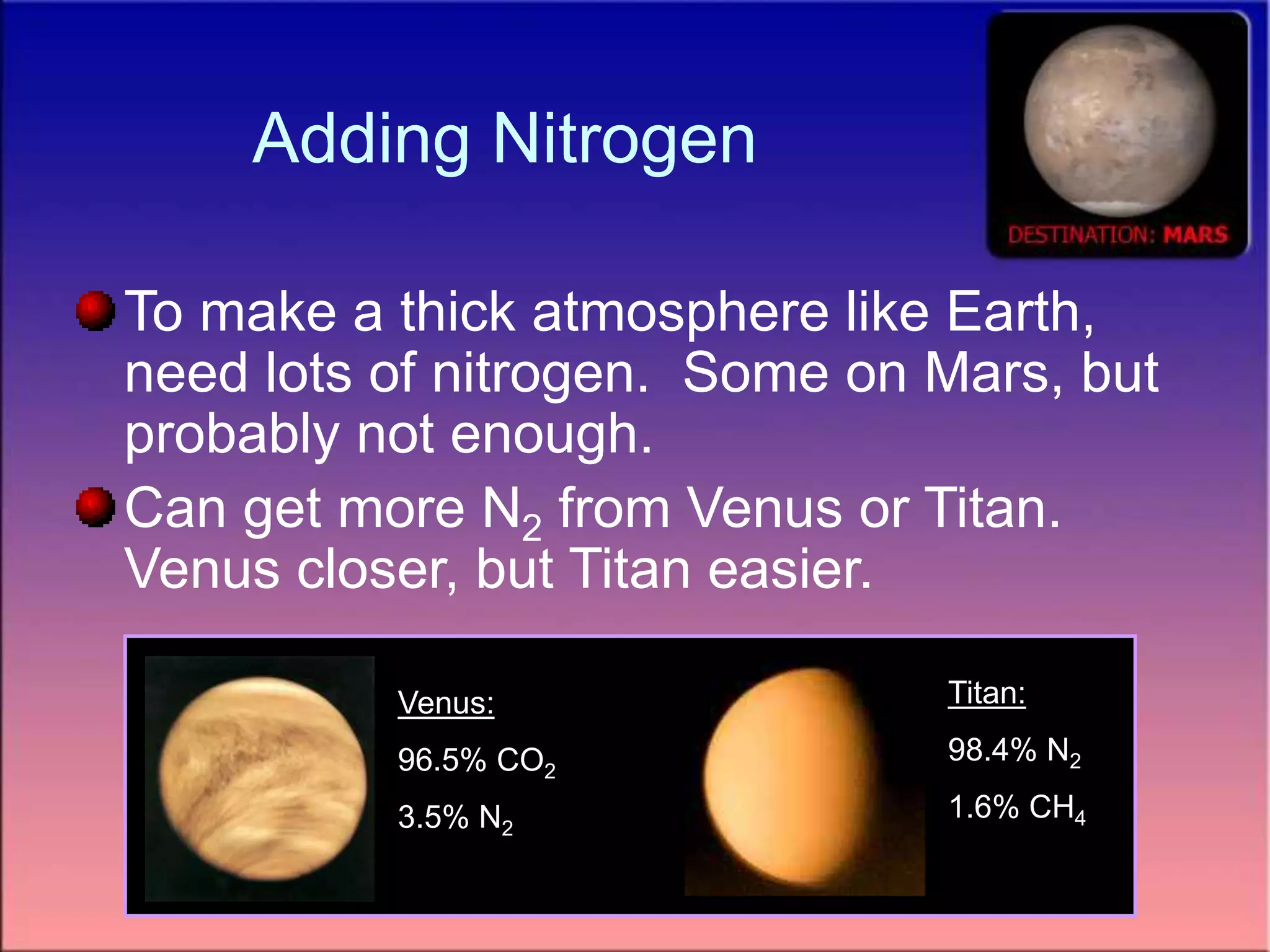
To make a thick atmosphere like Earth,
need lots of nitrogen. Some on Mars, but
probably not enough.
Can get more N2 from Venus or Titan.
Venus closer, but Titan easier.
Venus:
96.5% CO2
3.5% N2
Titan:
98.4% N2
1.6% CH4
Adding Life
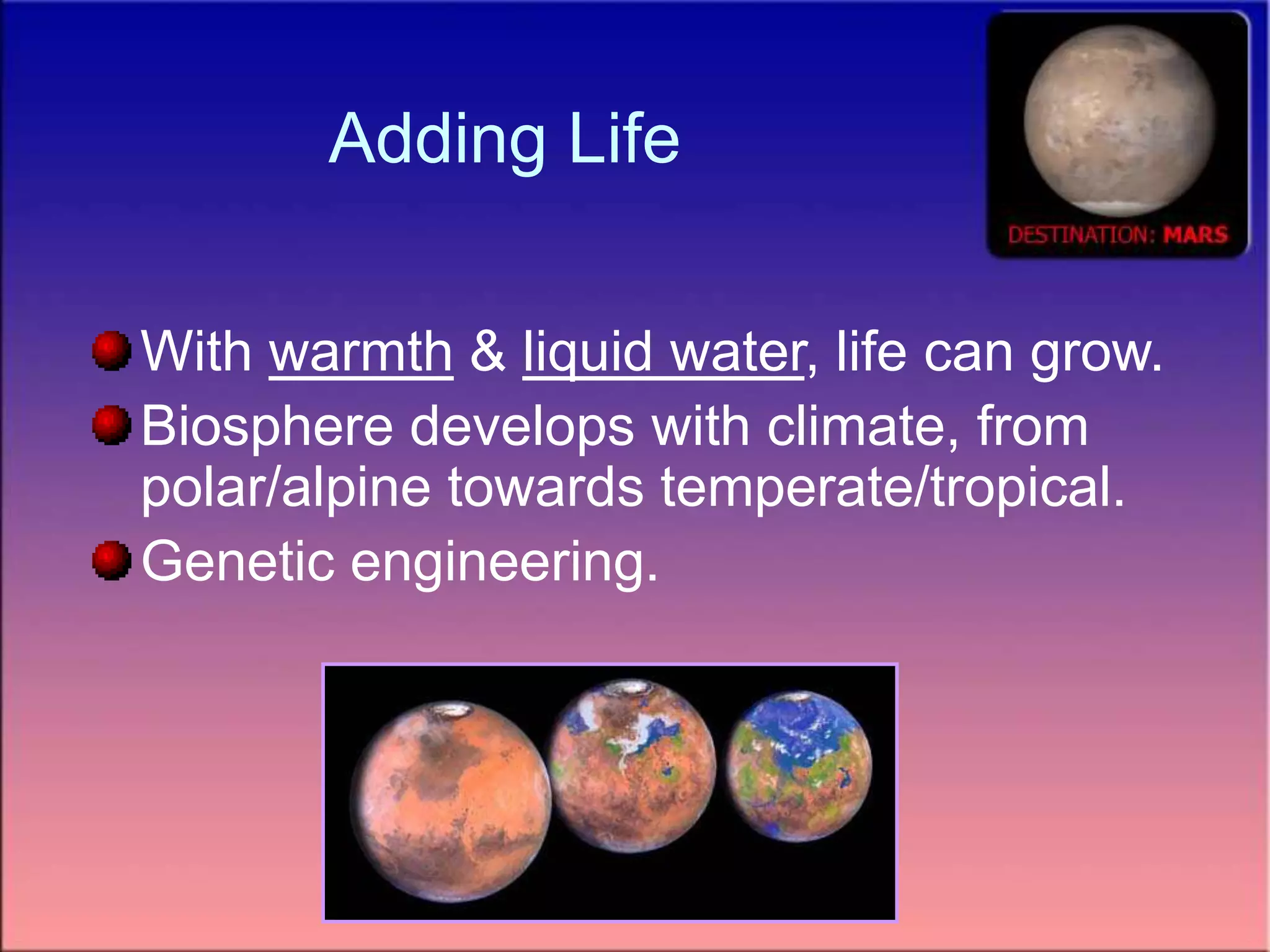
With warmth & liquid water, life can grow.
Biosphere develops with climate, from
polar/alpine towards temperate/tropical.
Genetic engineering.
Building a Biosphere
1. Begin with some hardy radiation- and cold-
resistant microbes.
2. As lakes form, add aquatic plants – these
convert the atmo to oxygen. Water provides
protection from UV.
3. Aquatic animals.
4. Rising oxygen levels cause an ozone (O3)
layer to form, providing UV protection on land.
5. Plants on land, then animals.
6. Eventually humans can walk around on Mars
without a spacesuit.
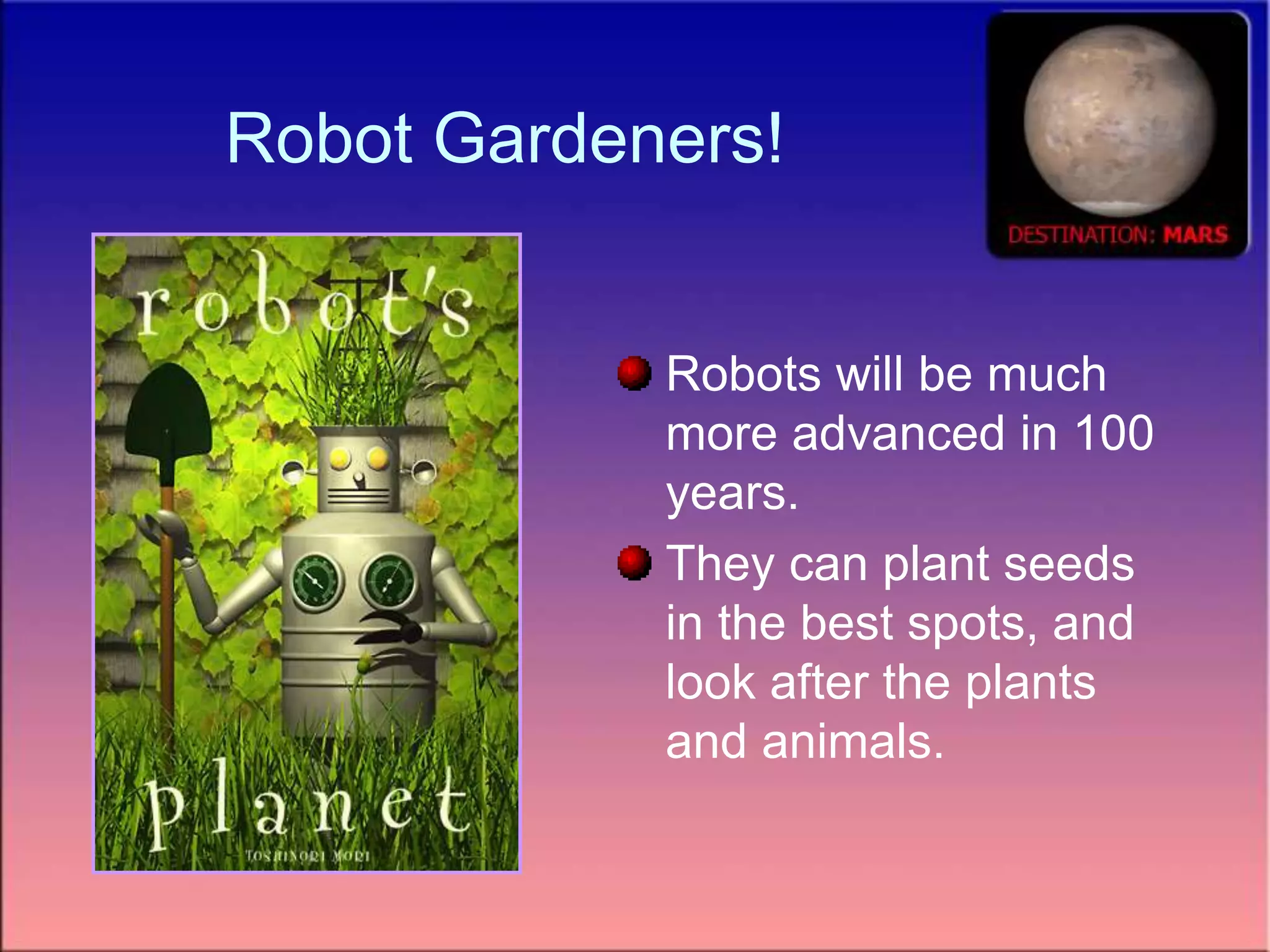
Robot Gardeners!
Robots will be much
more advanced in 100
years.
They can plant seeds
in the best spots, and
look after the plants
and animals.
Who’s making plans?
Mars Society – analog studies, research,
promoting manned Mars missions
(www.marssociety.org.au)
Mars Homestead – designing a future Mars
settlement. (www.marshome.org)
4 Frontiers – company planning to build Mars
settlement. (www.4frontierscorp.com)
Red Colony – open source plan for colonising
and terraforming Mars. (www.redcolony.com)
Do you want to go to Mars?
You will need:
Skills, education, and/or experience.
Some scientific knowledge.
Good health & fitness.
Good people skills.
A range of interests.
Good things to study:
Engineering, science, technology,
medicine
IT, electronics, mathematics, robotics
Metalworking trades, mechanics
Music, writing, film-making
Questions?
Email questions to: shaunmoss@yahoo.com.au

Living_on_Mars.ppt

  • 1.
    Living on Mars ShaunMoss shaunmoss@yahoo.com.au Mars Society Australia www.marssociety.org.au
  • 2.
    Living on Mars 1.Earth and Mars 2. Why would we want to live on Mars? 3. The challenges of living on Mars 4. What will we need, and how can we get all these things? 5. Health & Fitness 6. Terraforming
  • 3.
    Earth and Mars Radius:12746km 6805km Gravity: 1g 0.38g Luna Deimos Phobos
  • 4.
    Earth Mars Distance fromSun 150Gm (1AU) 228Gm (1.5AU) Atmosphere 101.3kPa 78% N2 21% O2 1% Ar 0.6kPa 95% CO2 3% N2 2% Ar Temperature 185 – 331K Mean: 287K (14°C) 133 – 293K Mean: 210K (-63°C) Length of solar day 24h 1 sol = 24h 40m Length of year 365.25d 668.6 sols (1.88y = 687d) Axial tilt 23.4° 25.2° Earth and Mars Mars receives only 43% of the sunshine that Earth does, but has no magnetosphere or ozone layer to block radiation.
  • 5.
    Why would wewant to live on other worlds? Survive asteroid impacts. Population growth. Develop many new technologies & systems. Develop a global view of Earth. For the challenge and adventure! Why not?
  • 6.
    But why Mars? Marsis by far our best choice for colonisation: Close to Earth (and asteroids) Warmth and light Length of day Has seasons like Earth Resources – atmosphere, water, metals Potential for terraforming
  • 7.
    The challenges of livingon Mars Cold! Very thin and toxic atmo. Water frozen solid. High radiation. Low gravity. Long way from home. No shops!
  • 8.
    What will weneed to live on Mars? Physical needs: Water Air Food Warmth Sunshine Clothing Buildings Technological needs: Electricity Materials Tools Computers & communications Vehicles & fuel Robots
  • 9.
    Water Plenty of water,frozen. But: Very cold ice is harder than rock – very hard to dig. Solution: Heat up the ground, cause ice to sublimate, and capture the steam. Also: Recycle.
  • 10.
    Air Earth: 20% O2,80% N2 Can make air like this on Mars! N2 from Mars’ atmo O2 from: CO2 H2O Fe2O3, SiO2, etc. Recycle using plants (photosynthesis)
  • 11.
    Food Mars’ dirt isnot suited for life (yet). Food grown in sealed greenhouses. Hydroponics – growing plants without dirt. Aquaponics – fish farming combined with hydroponics. Chickens & eggs
  • 12.
    Making fertile dirt ProcessMars dirt to make it less toxic Add some nutrients Recycle food scraps & manure (human, chook) Use earthworms (they’re also good food for fish and chooks)
  • 13.
    Clothing, etc. Hemp –ultra-useful plant Cloth Canvas for shoes, bags, etc. Rope Lubricants, paint, plastics Hemp oil – nutritional supplement, skin cream Later: cotton, synthetics Eventually: wool & leather
  • 14.
    Buildings Low grav &thin air means less material. Biggest problem – radiation. Surface structures – pile dirt on the roof. Underground – protection from radiation, and easier to keep warm (but need big machines to dig). Domes – Glass or plastic, maybe inflatable.
  • 15.
    Materials Iron & steel Needfor many things: buildings, tools, kitchen items, furniture, vehicles, robots, etc. Mars is covered in iron! (rust) Make steel using carbon from atmo. Many other metals available on Mars. Can also make bricks, concrete, glass and plastics from local resources.
  • 16.
    Electricity Nuclear: problematic on Earth,even worse on Mars. Also, would have to find uranium. Solar: possible, but less sunlight on Mars. Wind! Lots of wind on Mars; the air is thin, but high- speed.
  • 17.
    Vehicles & Fuel Whatsort of vehicles? Pressurized rovers ATVs (quad bikes) Gliders, planes, balloons Rockets, spaceships Walking rovers Good fuel: methane (CH4) & oxygen (O2) – easy to make from Mars atmo and water.
  • 18.
    Robots Will play abig part in colonising Mars. Digging, mining, construction, exploration, transportation. Electronics from Earth. Bodies could be imported from Earth, or made on Mars from steel and other metals. Software – Earth or Mars.
  • 19.
    What will weneed to bring from Earth? Life support equipment Electronics, computers & communications gear Robots, machinery, motors, tools Solar panels, windmills Seeds, animals Cooking equipment Games, books, musical instruments
  • 20.
    Health & Fitness Lowgravity means loss of bone and muscle. Need lots of strength training. High radiation increases risk of cancer & genetic mutation. Stay inside during solar flares. Air, food & water probably better than Earth! Build parks to play in, and to provide sunshine (artificial or real)
  • 21.
    Sport on Mars! Rock-climbing, abseiling Hang-gliding Roverracing Gliding, ballooning Flying with wings! Snow sports
  • 22.
    Terraforming Making Mars’ environmenthospitable to organisms from Earth.
  • 23.
    Warming Mars Create globalwarming using PFCs (perfluorocarbons) – a powerful greenhouse gas. Use mirrors in space to reflect more sunlight onto Mars. Heating Mars causes frozen CO2 to sublime, thickening atmo and causing more warming – a runaway greenhouse.
  • 24.
    Adding Nitrogen To makea thick atmosphere like Earth, need lots of nitrogen. Some on Mars, but probably not enough. Can get more N2 from Venus or Titan. Venus closer, but Titan easier. Venus: 96.5% CO2 3.5% N2 Titan: 98.4% N2 1.6% CH4
  • 25.
    Adding Life With warmth& liquid water, life can grow. Biosphere develops with climate, from polar/alpine towards temperate/tropical. Genetic engineering.
  • 26.
    Building a Biosphere 1.Begin with some hardy radiation- and cold- resistant microbes. 2. As lakes form, add aquatic plants – these convert the atmo to oxygen. Water provides protection from UV. 3. Aquatic animals. 4. Rising oxygen levels cause an ozone (O3) layer to form, providing UV protection on land. 5. Plants on land, then animals. 6. Eventually humans can walk around on Mars without a spacesuit.
  • 27.
    Robot Gardeners! Robots willbe much more advanced in 100 years. They can plant seeds in the best spots, and look after the plants and animals.
  • 28.
    Who’s making plans? MarsSociety – analog studies, research, promoting manned Mars missions (www.marssociety.org.au) Mars Homestead – designing a future Mars settlement. (www.marshome.org) 4 Frontiers – company planning to build Mars settlement. (www.4frontierscorp.com) Red Colony – open source plan for colonising and terraforming Mars. (www.redcolony.com)
  • 29.
    Do you wantto go to Mars? You will need: Skills, education, and/or experience. Some scientific knowledge. Good health & fitness. Good people skills. A range of interests. Good things to study: Engineering, science, technology, medicine IT, electronics, mathematics, robotics Metalworking trades, mechanics Music, writing, film-making
  • 30.
    Questions? Email questions to:shaunmoss@yahoo.com.au