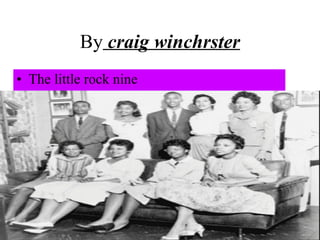
By  craig winchrster The little rock nine
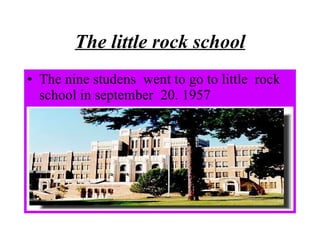
The little rock school The nine studens  went to go to little  rock school in september  20. 1957
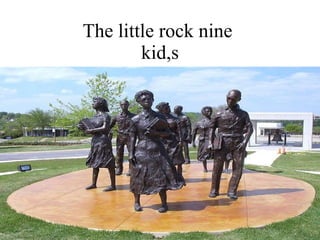
The little rock nine   kid,s
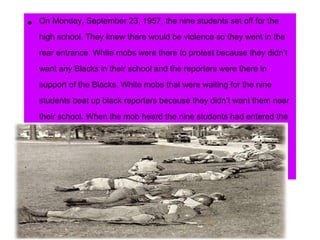
Little rock nine  On Monday, September 23, 1957, the nine students set off for the high school. They knew there would be violence so they went in the rear entrance. White mobs were there to protest because they didn’t want any Blacks in their school and the reporters were there in support of the Blacks. White mobs that were waiting for the nine students beat up black reporters because they didn’t want them near their school. When the mob heard the nine students had entered the school they went crazy. The black students left out the rear exit right when the mob came in so they wouldn’t get hurt
Little Rock High School, now Central High School National Historic Site, is a national emblem of the often violent struggle over school desegregation.  Parting the Waters  author Taylor Branch calls the Little Rock crisis "the most severe test of the Constitution since the Civil War."  Three years after the Supreme Court's  Brown v. Board of Education  decision, which officially ended public-school
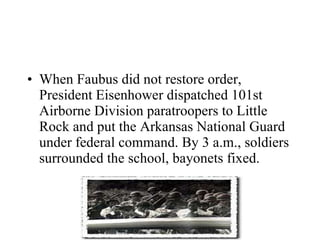
When Faubus did not restore order, President Eisenhower dispatched 101st Airborne Division paratroopers to Little Rock and put the Arkansas National Guard under federal command. By 3 a.m., soldiers surrounded the school, bayonets fixed.
May 5, 1959  Segregationist members of the School Board attempt to fire 44 teachers and administrators suspected of integrationist sympathies. The three moderates on the board walked out, refusing to participate
They didn't start out being known as the Little Rock Nine but now they are in America's history books together. Here is a brief glimpse at these former students and what they are doing today, 40 years after this momentus year. These nine students are unanimous in proclaiming the true heroes of the crisis at Central High School were their parents, who supported them and kept the faith that the process was right and that what they endured would give them opportunities they deserved.
17 black students were selected to attend the school, mostly because of they're grades, but only nine wanted to take the challenge. The nine black students names are Ernest Green, Melba Pattillo Minnijean Brown, Elizabeth Eckford, Thelma Mothershed, Gloria Ray, Carlotta Walls, Tarrence Roberts, and Jefferson Thomas. These nine black students were later known as the Little Rock Nine.
The other eight students remained at Central until the end of the school year. On May 27, 1958, Ernest Green became Central’s first black graduate. Dr. Martin Luther King Jr. attended his graduation ceremony. Green later told reporters, “It’s been an interesting year. I’ve had a course in human relations first hand.” The other eight, like their counterparts across the district, were forced to attend other schools or take correspondence classes the next year when voters opted to close all four of Little Rock’s high schools to prevent further desegregation efforts.

Little rock nine power point

  • 1.
    By craigwinchrster The little rock nine
  • 2.
    The little rockschool The nine studens went to go to little rock school in september 20. 1957
  • 3.
    The little rocknine kid,s
  • 4.
    Little rock nine On Monday, September 23, 1957, the nine students set off for the high school. They knew there would be violence so they went in the rear entrance. White mobs were there to protest because they didn’t want any Blacks in their school and the reporters were there in support of the Blacks. White mobs that were waiting for the nine students beat up black reporters because they didn’t want them near their school. When the mob heard the nine students had entered the school they went crazy. The black students left out the rear exit right when the mob came in so they wouldn’t get hurt
  • 5.
    Little Rock HighSchool, now Central High School National Historic Site, is a national emblem of the often violent struggle over school desegregation. Parting the Waters author Taylor Branch calls the Little Rock crisis "the most severe test of the Constitution since the Civil War." Three years after the Supreme Court's Brown v. Board of Education decision, which officially ended public-school
  • 6.
    When Faubus didnot restore order, President Eisenhower dispatched 101st Airborne Division paratroopers to Little Rock and put the Arkansas National Guard under federal command. By 3 a.m., soldiers surrounded the school, bayonets fixed.
  • 7.
    May 5, 1959 Segregationist members of the School Board attempt to fire 44 teachers and administrators suspected of integrationist sympathies. The three moderates on the board walked out, refusing to participate
  • 8.
    They didn't startout being known as the Little Rock Nine but now they are in America's history books together. Here is a brief glimpse at these former students and what they are doing today, 40 years after this momentus year. These nine students are unanimous in proclaiming the true heroes of the crisis at Central High School were their parents, who supported them and kept the faith that the process was right and that what they endured would give them opportunities they deserved.
  • 9.
    17 black studentswere selected to attend the school, mostly because of they're grades, but only nine wanted to take the challenge. The nine black students names are Ernest Green, Melba Pattillo Minnijean Brown, Elizabeth Eckford, Thelma Mothershed, Gloria Ray, Carlotta Walls, Tarrence Roberts, and Jefferson Thomas. These nine black students were later known as the Little Rock Nine.
  • 10.
    The other eightstudents remained at Central until the end of the school year. On May 27, 1958, Ernest Green became Central’s first black graduate. Dr. Martin Luther King Jr. attended his graduation ceremony. Green later told reporters, “It’s been an interesting year. I’ve had a course in human relations first hand.” The other eight, like their counterparts across the district, were forced to attend other schools or take correspondence classes the next year when voters opted to close all four of Little Rock’s high schools to prevent further desegregation efforts.