Doing a Literature Review
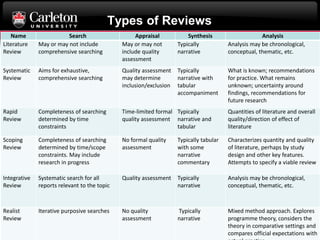
Types of Reviews
Name Search Appraisal Synthesis Analysis
Literature
Review
May or may not include
comprehensive searching
May or may not
include quality
assessment
Typically
narrative
Analysis may be chronological,
conceptual, thematic, etc.
Systematic
Review
Aims for exhaustive,
comprehensive searching
Quality assessment
may determine
inclusion/exclusion
Typically
narrative with
tabular
accompaniment
What is known; recommendations
for practice. What remains
unknown; uncertainty around
findings, recommendations for
future research
Rapid
Review
Completeness of searching
determined by time
constraints
Time-limited formal
quality assessment
Typically
narrative and
tabular
Quantities of literature and overall
quality/direction of effect of
literature
Scoping
Review
Completeness of searching
determined by time/scope
constraints. May include
research in progress
No formal quality
assessment
Typically tabular
with some
narrative
commentary
Characterizes quantity and quality
of literature, perhaps by study
design and other key features.
Attempts to specify a viable review
Integrative
Review
Systematic search for all
reports relevant to the topic
Quality assessment Typically
narrative
Analysis may be chronological,
conceptual, thematic, etc.
Realist
Review
Iterative purposive searches No quality
assessment
Typically
narrative
Mixed method approach. Explores
programme theory, considers the
theory in comparative settings and
compares official expectations with
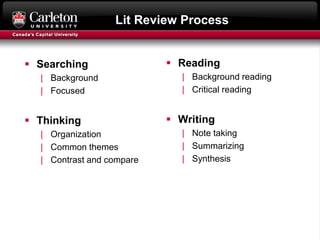
Lit Review Process
 Reading
| Background reading
| Critical reading
 Writing
| Note taking
| Summarizing
| Synthesis
 Searching
| Background
| Focused
 Thinking
| Organization
| Common themes
| Contrast and compare
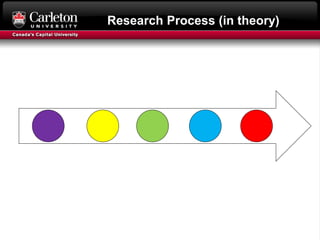
Research Process (in theory)
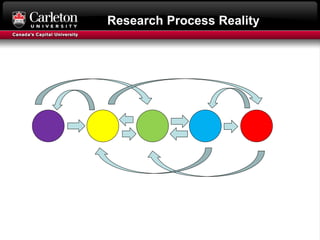
Research Process Reality
 A Hermeneutic Approach for Conducting
Literature Reviews and Literature Searches
| engagement with the literature is an intellectual
development process
| conducting a literature review is not a linear process
| an interactive and iterative process that aims for
saturation in understanding
| an important aspect of creating good literature reviews is
re-writing
| importance of (ongoing) reading
https://aisel.aisnet.org/cais/vol34/iss1/12/
Why a literature review
 Provides a rationale for your research
question
 Provides a frame of reference for your
research project
More specifically…
 A literature review should answer the
following questions:
| What is known/understood?
| What are the strengths and weaknesses of present
knowledge and understanding?
| What is not known?
| Where are the gaps in knowledge?
| What is needed to be studied to improve knowledge and
understanding?
| What theories can frame the approach to study of the topic?
https://libguides.bcu.ac.uk/resmap/lr
Lit review vs. essay
 Essay
| An essay focuses on a topic and uses the literature as a
support for the arguments.
 Literature Review
| In a standalone literature review, the literature itself is the
topic of discussion and evaluation. You draw connections and
comparisons of the included studies. You evaluate and
discuss not only the informational content, but the quality and
limitations of the content.
https://services.unimelb.edu.au/__data/assets/pdf_file/0009/821727/Reviewing_the_Literature_150613.pdf
Getting Started
 Find out what information is available
| OMNI
| PubMed
| Your favourite search tool
 Do some background reading
| Find a review article
• Use a database filter (Pubmed, Scopus, WoS)
• Use review as a search term
| Find a book
• Look at the Table of Contents
| Find an encyclopedia entry
• Often provide background readings
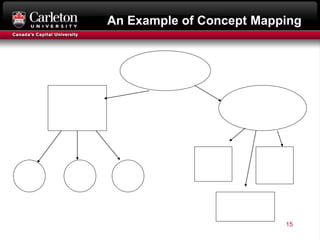
Map your topic
 Think of the landscape of your topic
 Outline the various aspects/concepts/main
ideas
An Example of Concept Mapping
15
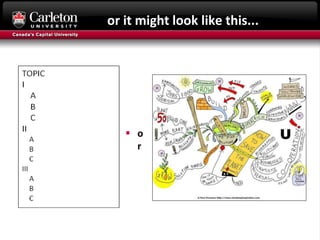
or it might look like this...
 o
r
 A Hermeneutic Approach for Conducting
Literature Reviews and Literature Searches
| “Develop a distinct, innovative and interesting way of
mapping and classifying the literature”
| “Eventually this will help in developing a review of the
literature that is centered around the discussion of
important concepts or ideas … rather than the
discussion of individual publications”
https://aisel.aisnet.org/cais/vol34/iss1/12/
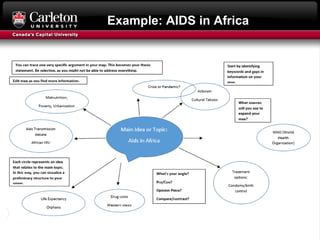
Example: AIDS in Africa
Narrowing your topic
 Pick one or two aspects to focus on
 Go deeper into these areas
 Think of questions about these aspects
| What population do you want to study?
| What is the relationship between an issue/intervention and a
particular outcome?
| What is the relationship between an independent variable
and a particular dependent variable?
Example: AIDS in Africa
 Malnutrition
| What impact does AIDS have on malnutrition?
| What is being done to combat this issue?
| Are theses interventions effective?
| What more can be done?
 Poverty
| What is the relationship between AIDS and poverty?
| What other factors are involved?
| What programs exist to tackle this problem?
| Why do certain programs/interventions work and others not?
 Orphans
| How has AIDS affected children of parents with AIDS in
Africa?
Identify Search Terms
 Concepts/main ideas
 PICO
| Population
| Intervention
| Comparison
| Outcome
 Related terms
 Controlled vocabulary
Combining Search Terms
 Boolean operators – AND, OR, NOT
 Phrase searching – “…”
 Truncation - *
 Proximity operators – N/x, NEARx
Example: AIDS in Africa
 AIDS in Africa
| (AIDS or “acquired immune deficiency syndrome” or HIV)
| (Africa or Sub-sahara* or Burundi or Malawi or ….)
| (Child* or youth)
| orphan*
| (Malnutrition or “nutritional deficiency” or malnourishment)
| (Poverty or “low income” or poor)
 You may need to do separate searches for
different aspects of your topic
Where to look
 Think about who/what is interested in the
topic
 Think about what subject area might
cover this topic
Example: AIDS in Africa
 African governments
 NGOs
 AIDs researchers
 Economists
 Nutritionists
Where to look
 Subject Guide > Detailed Guide > Health
 Subject Guides > Quick Guides
| Political Science
| Economics
| Public Policy
| etc…
 Government Information
| Canadian – federal, provincial
| International
| Canadian Public Documents Collection
Example: AIDS in Africa
 WHO
| IRIS Digital Library
| Health Topics
 PubMed
 CINAHL
 Worldwide Political Science Abstracts
 World Bank
 Government Info
Citation Tracking
 For key articles
| Look at the references to see who has been cited
(backward)
| Find who has cited these articles (forward)
 Tools
| Web of Science
| Scopus
| Google Scholar
Data and Statistics
 Data
| Canada
• ODESI
| WHO
• Data and statistics
| United Nations
• UNdata
| OECD
• OECD.Stat
Keeping it all organized
 Citation Management
| Mendeley
| Endnote
| Zotero
Note Taking
 Underline
 Highlight
 Take notes in your own words
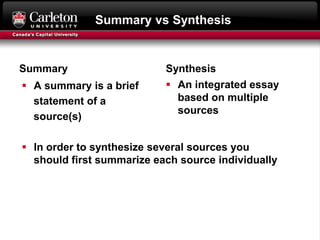
Summary vs Synthesis
Summary
 A summary is a brief
statement of a
source(s)
 In order to synthesize several sources you
should first summarize each source individually
Synthesis
 An integrated essay
based on multiple
sources
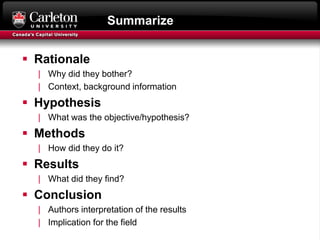
Summarize
 Rationale
| Why did they bother?
| Context, background information
 Hypothesis
| What was the objective/hypothesis?
 Methods
| How did they do it?
 Results
| What did they find?
 Conclusion
| Authors interpretation of the results
| Implication for the field
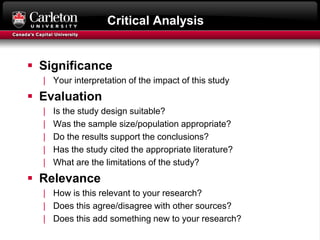
Critical Analysis
 Significance
| Your interpretation of the impact of this study
 Evaluation
| Is the study design suitable?
| Was the sample size/population appropriate?
| Do the results support the conclusions?
| Has the study cited the appropriate literature?
| What are the limitations of the study?
 Relevance
| How is this relevant to your research?
| Does this agree/disagree with other sources?
| Does this add something new to your research?
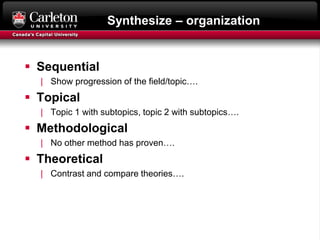
Synthesize – organization
 Sequential
| Show progression of the field/topic….
 Topical
| Topic 1 with subtopics, topic 2 with subtopics….
 Methodological
| No other method has proven….
 Theoretical
| Contrast and compare theories….
Identify Common Themes
 Hypotheses
 Populations studied
 Theories
 Methods
 Outcomes
Contrast and Compare
 He said/she said
| Do different studies agree or disagree
| Do they agree on some things but disagree on others
Identify Gaps
 What is missing?
 What can be studied next?
Writing and Reading
 ‘Writing while you collect and collecting
while you write.’ Wellington et al (2005)
| The writing stage is part of the research process, not
something that happens after you have finished reading the
literature.
| Once you are part way through your reading you can have a
go at writing the literature review.
| It is often not until you start explaining something in writing
that you find you need to collect more information.
https://www2.le.ac.uk/offices/ld/resources/writing/writing-resources/literature-review
Introduction
 Define the topic -WHAT
 Purpose - WHAT
 Rationale - WHY
 Scope – WHAT, WHEN
 Structure - HOW
When to stop
 ‘Build an [argument], not a library’ (Rudestam
and Newton (1992)
| Keep your research focus in mind, don’t stray
| Create an outline and stick to it
| As you read, ask yourself these questions:
• Have I answered my question without any obvious gaps?
• Are no new related issues coming up as I search the literature?
• Have I found multiple references which cover the same material
or just enough to prove agreement?
https://www2.le.ac.uk/offices/ld/resources/writing/writing-resources/literature-review
https://services.unimelb.edu.au/__data/assets/pdf_file/0009/821727/Reviewing_the_Literature_150613.pdf
Proofreading and editing
 Write a draft
 Let it sit
 Look at it with fresh eyes
 Ask your ____ to read it
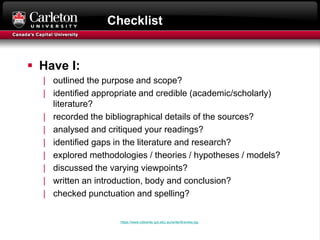
Checklist
 Have I:
| outlined the purpose and scope?
| identified appropriate and credible (academic/scholarly)
literature?
| recorded the bibliographical details of the sources?
| analysed and critiqued your readings?
| identified gaps in the literature and research?
| explored methodologies / theories / hypotheses / models?
| discussed the varying viewpoints?
| written an introduction, body and conclusion?
| checked punctuation and spelling?
https://www.citewrite.qut.edu.au/write/litreview.jsp
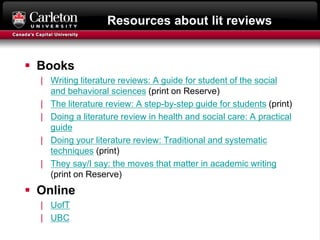
Resources about lit reviews
 Books
| Writing literature reviews: A guide for student of the social
and behavioral sciences (print on Reserve)
| The literature review: A step-by-step guide for students (print)
| Doing a literature review in health and social care: A practical
guide
| Doing your literature review: Traditional and systematic
techniques (print)
| They say/I say: the moves that matter in academic writing
(print on Reserve)
 Online
| UofT
| UBC
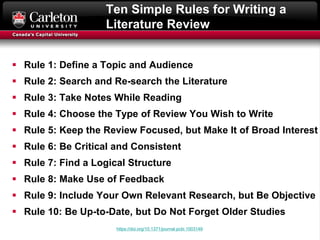
Ten Simple Rules for Writing a
Literature Review
 Rule 1: Define a Topic and Audience
 Rule 2: Search and Re-search the Literature
 Rule 3: Take Notes While Reading
 Rule 4: Choose the Type of Review You Wish to Write
 Rule 5: Keep the Review Focused, but Make It of Broad Interest
 Rule 6: Be Critical and Consistent
 Rule 7: Find a Logical Structure
 Rule 8: Make Use of Feedback
 Rule 9: Include Your Own Relevant Research, but Be Objective
 Rule 10: Be Up-to-Date, but Do Not Forget Older Studies
https://doi.org/10.1371/journal.pcbi.1003149
Need Help?
QUESTIONS?
• Book an appointment (in-person or virtual)
https://carletonu.libcal.com/appointments?u=34695
• Chat online
https://library.carleton.ca/help
• Email
heather.macdonald@carleton.ca

HLTH4909_2022xzccdscaascsdcsdzxczccs.ppt

  • 1.
  • 2.
    Types of Reviews NameSearch Appraisal Synthesis Analysis Literature Review May or may not include comprehensive searching May or may not include quality assessment Typically narrative Analysis may be chronological, conceptual, thematic, etc. Systematic Review Aims for exhaustive, comprehensive searching Quality assessment may determine inclusion/exclusion Typically narrative with tabular accompaniment What is known; recommendations for practice. What remains unknown; uncertainty around findings, recommendations for future research Rapid Review Completeness of searching determined by time constraints Time-limited formal quality assessment Typically narrative and tabular Quantities of literature and overall quality/direction of effect of literature Scoping Review Completeness of searching determined by time/scope constraints. May include research in progress No formal quality assessment Typically tabular with some narrative commentary Characterizes quantity and quality of literature, perhaps by study design and other key features. Attempts to specify a viable review Integrative Review Systematic search for all reports relevant to the topic Quality assessment Typically narrative Analysis may be chronological, conceptual, thematic, etc. Realist Review Iterative purposive searches No quality assessment Typically narrative Mixed method approach. Explores programme theory, considers the theory in comparative settings and compares official expectations with
  • 3.
    Lit Review Process Reading | Background reading | Critical reading  Writing | Note taking | Summarizing | Synthesis  Searching | Background | Focused  Thinking | Organization | Common themes | Contrast and compare
  • 4.
  • 5.
  • 6.
     A HermeneuticApproach for Conducting Literature Reviews and Literature Searches | engagement with the literature is an intellectual development process | conducting a literature review is not a linear process | an interactive and iterative process that aims for saturation in understanding | an important aspect of creating good literature reviews is re-writing | importance of (ongoing) reading https://aisel.aisnet.org/cais/vol34/iss1/12/
  • 7.
    Why a literaturereview  Provides a rationale for your research question  Provides a frame of reference for your research project
  • 8.
    More specifically…  Aliterature review should answer the following questions: | What is known/understood? | What are the strengths and weaknesses of present knowledge and understanding? | What is not known? | Where are the gaps in knowledge? | What is needed to be studied to improve knowledge and understanding? | What theories can frame the approach to study of the topic? https://libguides.bcu.ac.uk/resmap/lr
  • 9.
    Lit review vs.essay  Essay | An essay focuses on a topic and uses the literature as a support for the arguments.  Literature Review | In a standalone literature review, the literature itself is the topic of discussion and evaluation. You draw connections and comparisons of the included studies. You evaluate and discuss not only the informational content, but the quality and limitations of the content. https://services.unimelb.edu.au/__data/assets/pdf_file/0009/821727/Reviewing_the_Literature_150613.pdf
  • 11.
    Getting Started  Findout what information is available | OMNI | PubMed | Your favourite search tool  Do some background reading | Find a review article • Use a database filter (Pubmed, Scopus, WoS) • Use review as a search term | Find a book • Look at the Table of Contents | Find an encyclopedia entry • Often provide background readings
  • 12.
    Map your topic Think of the landscape of your topic  Outline the various aspects/concepts/main ideas
  • 13.
    An Example ofConcept Mapping 15
  • 14.
    or it mightlook like this...  o r
  • 15.
     A HermeneuticApproach for Conducting Literature Reviews and Literature Searches | “Develop a distinct, innovative and interesting way of mapping and classifying the literature” | “Eventually this will help in developing a review of the literature that is centered around the discussion of important concepts or ideas … rather than the discussion of individual publications” https://aisel.aisnet.org/cais/vol34/iss1/12/
  • 16.
  • 17.
    Narrowing your topic Pick one or two aspects to focus on  Go deeper into these areas  Think of questions about these aspects | What population do you want to study? | What is the relationship between an issue/intervention and a particular outcome? | What is the relationship between an independent variable and a particular dependent variable?
  • 18.
    Example: AIDS inAfrica  Malnutrition | What impact does AIDS have on malnutrition? | What is being done to combat this issue? | Are theses interventions effective? | What more can be done?  Poverty | What is the relationship between AIDS and poverty? | What other factors are involved? | What programs exist to tackle this problem? | Why do certain programs/interventions work and others not?  Orphans | How has AIDS affected children of parents with AIDS in Africa?
  • 19.
    Identify Search Terms Concepts/main ideas  PICO | Population | Intervention | Comparison | Outcome  Related terms  Controlled vocabulary
  • 20.
    Combining Search Terms Boolean operators – AND, OR, NOT  Phrase searching – “…”  Truncation - *  Proximity operators – N/x, NEARx
  • 21.
    Example: AIDS inAfrica  AIDS in Africa | (AIDS or “acquired immune deficiency syndrome” or HIV) | (Africa or Sub-sahara* or Burundi or Malawi or ….) | (Child* or youth) | orphan* | (Malnutrition or “nutritional deficiency” or malnourishment) | (Poverty or “low income” or poor)  You may need to do separate searches for different aspects of your topic
  • 22.
    Where to look Think about who/what is interested in the topic  Think about what subject area might cover this topic
  • 23.
    Example: AIDS inAfrica  African governments  NGOs  AIDs researchers  Economists  Nutritionists
  • 24.
    Where to look Subject Guide > Detailed Guide > Health  Subject Guides > Quick Guides | Political Science | Economics | Public Policy | etc…  Government Information | Canadian – federal, provincial | International | Canadian Public Documents Collection
  • 25.
    Example: AIDS inAfrica  WHO | IRIS Digital Library | Health Topics  PubMed  CINAHL  Worldwide Political Science Abstracts  World Bank  Government Info
  • 26.
    Citation Tracking  Forkey articles | Look at the references to see who has been cited (backward) | Find who has cited these articles (forward)  Tools | Web of Science | Scopus | Google Scholar
  • 27.
    Data and Statistics Data | Canada • ODESI | WHO • Data and statistics | United Nations • UNdata | OECD • OECD.Stat
  • 28.
    Keeping it allorganized  Citation Management | Mendeley | Endnote | Zotero
  • 29.
    Note Taking  Underline Highlight  Take notes in your own words
  • 30.
    Summary vs Synthesis Summary A summary is a brief statement of a source(s)  In order to synthesize several sources you should first summarize each source individually Synthesis  An integrated essay based on multiple sources
  • 31.
    Summarize  Rationale | Whydid they bother? | Context, background information  Hypothesis | What was the objective/hypothesis?  Methods | How did they do it?  Results | What did they find?  Conclusion | Authors interpretation of the results | Implication for the field
  • 32.
    Critical Analysis  Significance |Your interpretation of the impact of this study  Evaluation | Is the study design suitable? | Was the sample size/population appropriate? | Do the results support the conclusions? | Has the study cited the appropriate literature? | What are the limitations of the study?  Relevance | How is this relevant to your research? | Does this agree/disagree with other sources? | Does this add something new to your research?
  • 33.
    Synthesize – organization Sequential | Show progression of the field/topic….  Topical | Topic 1 with subtopics, topic 2 with subtopics….  Methodological | No other method has proven….  Theoretical | Contrast and compare theories….
  • 34.
    Identify Common Themes Hypotheses  Populations studied  Theories  Methods  Outcomes
  • 35.
    Contrast and Compare He said/she said | Do different studies agree or disagree | Do they agree on some things but disagree on others
  • 36.
    Identify Gaps  Whatis missing?  What can be studied next?
  • 37.
    Writing and Reading ‘Writing while you collect and collecting while you write.’ Wellington et al (2005) | The writing stage is part of the research process, not something that happens after you have finished reading the literature. | Once you are part way through your reading you can have a go at writing the literature review. | It is often not until you start explaining something in writing that you find you need to collect more information. https://www2.le.ac.uk/offices/ld/resources/writing/writing-resources/literature-review
  • 38.
    Introduction  Define thetopic -WHAT  Purpose - WHAT  Rationale - WHY  Scope – WHAT, WHEN  Structure - HOW
  • 39.
    When to stop ‘Build an [argument], not a library’ (Rudestam and Newton (1992) | Keep your research focus in mind, don’t stray | Create an outline and stick to it | As you read, ask yourself these questions: • Have I answered my question without any obvious gaps? • Are no new related issues coming up as I search the literature? • Have I found multiple references which cover the same material or just enough to prove agreement? https://www2.le.ac.uk/offices/ld/resources/writing/writing-resources/literature-review https://services.unimelb.edu.au/__data/assets/pdf_file/0009/821727/Reviewing_the_Literature_150613.pdf
  • 40.
    Proofreading and editing Write a draft  Let it sit  Look at it with fresh eyes  Ask your ____ to read it
  • 41.
    Checklist  Have I: |outlined the purpose and scope? | identified appropriate and credible (academic/scholarly) literature? | recorded the bibliographical details of the sources? | analysed and critiqued your readings? | identified gaps in the literature and research? | explored methodologies / theories / hypotheses / models? | discussed the varying viewpoints? | written an introduction, body and conclusion? | checked punctuation and spelling? https://www.citewrite.qut.edu.au/write/litreview.jsp
  • 42.
    Resources about litreviews  Books | Writing literature reviews: A guide for student of the social and behavioral sciences (print on Reserve) | The literature review: A step-by-step guide for students (print) | Doing a literature review in health and social care: A practical guide | Doing your literature review: Traditional and systematic techniques (print) | They say/I say: the moves that matter in academic writing (print on Reserve)  Online | UofT | UBC
  • 43.
    Ten Simple Rulesfor Writing a Literature Review  Rule 1: Define a Topic and Audience  Rule 2: Search and Re-search the Literature  Rule 3: Take Notes While Reading  Rule 4: Choose the Type of Review You Wish to Write  Rule 5: Keep the Review Focused, but Make It of Broad Interest  Rule 6: Be Critical and Consistent  Rule 7: Find a Logical Structure  Rule 8: Make Use of Feedback  Rule 9: Include Your Own Relevant Research, but Be Objective  Rule 10: Be Up-to-Date, but Do Not Forget Older Studies https://doi.org/10.1371/journal.pcbi.1003149
  • 44.
    Need Help? QUESTIONS? • Bookan appointment (in-person or virtual) https://carletonu.libcal.com/appointments?u=34695 • Chat online https://library.carleton.ca/help • Email heather.macdonald@carleton.ca