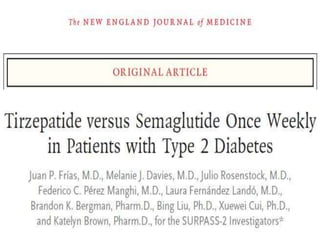
HARAMAYA UNIVERSITY HIWOT
FANA COMPREHENSIVE
SPECIALIZED HOSPITAL
CLINICAL PHARMACY AND DPIS
UNIT
JOURNAL CLUB PRESENTATION
By Salahadin M.Ali (B.Pharm)
1
2
Outline
 Background
 Introduction
 Authors and funding source
 Hypothesis
 Research questions
 Method
 Inclusion and exclusion criteria's
 Statistical analysis
 Result
 Discussion
 Conclusion
 Strength and weakness
3
Background
 Tirzepatide is a dual glucose insulinotropic
polypeptide glucagon like peptide (GLP-1)
receptor agonist that is under development for
the development of type 2 diabetes. The
efficacy and safety of once weekly tirzepatide
as compared with semaglutide, a selective
GLP -1 receptor agonist, are unknown.
4
Introduction
 Glucagon like peptide-1 (GLP-1) receptor
agonists are an effective option for patients
with type 2 diabetes. These agents act by
stimulating insulin secretion hyperglycemic
states, suppressing glucagon secretion in
hyperglycemic or euglycemic states, delaying
gastric emptying, decreasing appetite and
reducing body weight.
5
Cont’d
6
 Glucose-dependent insulinotropic polypeptide,
the main incretin hormone in healthy persons,
is insulinotropic ; however, unlike GLP-1, it is
glucaganotropic in glucose depedent manner.
 Under hyperglycemic conditions, glucose-
dependant insulinotropic polypeptide
stimulates the release of insulin, thereby
lowering glucagon levels and under
euglycemic or hypoglycemic conditions,
glucagon are increased.
Cont’d
7
 Glucose-dependent insulinotropic polypeptide
receptors are abundant in adipose tissue, and
glucose dependent insulinotropic polypeptide
enhances both the post-prandial lipid-buffering
capacity of white adipose tissue and the
sensitivity of adipose tissue to insulin, which
may prevent ectopic fat deposition.
Authors and funding sources
8
 Juan P. Frias, M.D., Melanie J. Davies, M.D.,
Julio Rosenstock, M.D., Federico C. Perez
Manghi, M.D., Laura Fernandez Lando, M.D.,
Brandon K. Bergman, Pharm.D., Bing Liu,
Ph.D., Xuewei cui, Ph.D., and Katelyn Brown,
Pharm. D.,
 Funded by Eli Lilly; SURPASS-2
ClinicalTrials.gov.number NCT03987919.
Hypothesis
 To compare the efficacy and safety of
tirzepatide at doses of 5mg, 10mg and 15mg
with those of semaglutide at doses of 1mg in
patients with type 2 diabetes that had been
inadequetly controlled with metformin
monotherapy.
9
Research questions
10
 Why this study was conducted?
 For how long it was conducted?
 What were the challenges encountered?
 Did the participants fill the eligible criteria's?
 How it would applicable clinically?
 did the authors who conduct it qualified?
 How would be the expense covered?
Method
 This 40-week, open label, parallel group,
randomized, active controlled, phase 3 trial
was conducted in 128 sites in the United
States, Argentina, Australia, Brazil, Canada,
Israel, Mexico, and the United Kingdom.
 The primary end point was the change in
glycated hemoglobin level from the baseline to
40 weeks.
11
Cont’d
12
 The patients were randomly assigned in a
1:1:1:1 ratio to receive a once-weekly
subcutaneous injection of either tirzepatide (at
a dose of 5 mg, 10 mg, or 15 mg; the doses
were double blinded) or semiglutide (1 mg) for
a 40 week treatment period, followed by a 4-
week.
 The patients were stratified at randomization
according to country and baseline glycated
hemoglobin level (≤8.5 % or >8.5%[≤69 or
>69mmol per mol]).
Cont’d
13
 Tirzepatide was initiated at a dose of 2.5 mg
once weekly, and the doses were increased by
2.5 mg every 4 weeks until the randomly
assigned doses reached. The final dose was
then maintained for the duration of trial.
Semiglutide was initiated at a dose of 0.25 mg
once weekly and the dose was doubled every
4 weeks until 1 mg was reached. The final
dose was then maintained for the duration of
the trial. Dose descalation was allowed. The
initiation of new antihyperglycemic
medications was allowed according to specific
criteria.
The primary and secondary
points
14
 The primary end point was the change in the
glycated hemoglobin level from baseline to
week 40.
 The key secondary end points were the
change in body weight from baseline to week
40 and the attainment of glycated hemoglobin
level targets of less than 7.0% and less than
5.7%.
The other end points
15
 Other end points were attainment of glycated
hemoglobin level of 6.5% or less and weight
loss of at least 5%, 10%, 15%; the mean
change from baseline in the fasting glucose
level and in the daily, patient-measured, mean
seven point glucose profiles (i.e., the mean of
seven measurements); BMI waist
circumfirunce; lipid levels; the results of
updated homoestasis model-assessment
insulin resistance (HOMA2-IR); and the fasting
glucagon level .
The composite end point
16
 A composite end point of a glycated
hemoglobin level of 6.5% or less with at least
10% weight l loss and without clinically
significant glycemia (blood glucose level, <54
mg per deciliter [3mmol per liter ] or severe
hypoglycemia events were also assessed.
The Safety points
17
 The safety end points of adverse events and
discontinuation of tirzepatide or semiglutide
because of adverse events.
 Other safety end points were adjudicuted
pancreatic adverse events; the serum
calcitonin level; the incidence of
hypersensitivity reactions; the mean changes
in the pulse rate and the systolic and diastolic
blood pressure; the occurrence of
hypoglycemia events; and the incidence of
initiation of rescue antihyperglycemic therapy.
Inclusion criteria's
18
 An age of 18 years or older and type 2
diabetes that was inadequately controlled with
metformin at a dose of at least 1500 mg per
day.
 Eligible patients had a glycated hemoglobin
level of 7% to 10.5% and a body mass index
(BMI; the weight in kilograms divided by the
square of height in meters) of at least 25, and
they had had stable weight (±5%) during the
previous 3 months.
Exclusion criteria's
19
 Type 1 diabetes;
 An estimated glomerular filteration rate 45 ml
per minute per 1.73 m2
 A history of pancreatitis; and
 A history of nonproliferative diabetic
nephropathy that warranted urgent treatment,
proliferative diabetic retinopathy or diabetic
maculopathy.
Statistical analysis
20
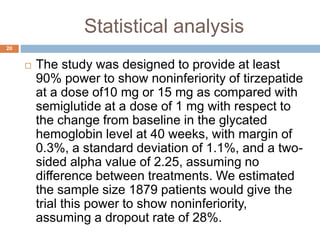
 The study was designed to provide at least
90% power to show noninferiority of tirzepatide
at a dose of10 mg or 15 mg as compared with
semiglutide at a dose of 1 mg with respect to
the change from baseline in the glycated
hemoglobin level at 40 weeks, with margin of
0.3%, a standard deviation of 1.1%, and a two-
sided alpha value of 2.25, assuming no
difference between treatments. We estimated
the sample size 1879 patients would give the
trial this power to show noninferiority,
assuming a dropout rate of 28%.
Result
21
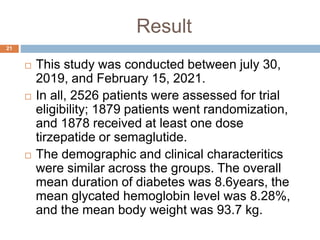
 This study was conducted between july 30,
2019, and February 15, 2021.
 In all, 2526 patients were assessed for trial
eligibility; 1879 patients went randomization,
and 1878 received at least one dose
tirzepatide or semaglutide.
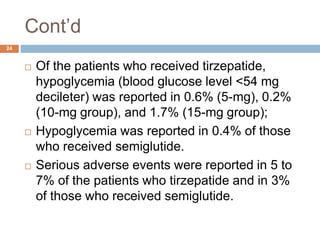
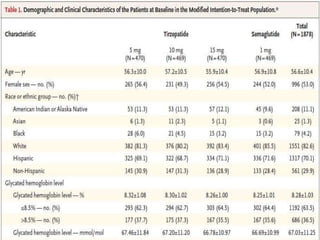
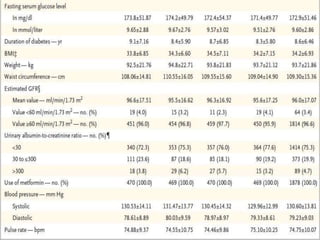
 The demographic and clinical characteritics
were similar across the groups. The overall
mean duration of diabetes was 8.6years, the
mean glycated hemoglobin level was 8.28%,
and the mean body weight was 93.7 kg.
Cont’d
22
 The estimated mean from baseline in the glycated
hemoglobin level was -2.01percentage points, -
2.24 percentage points, and -2.30 percentage with
5 mg, 10 mg and 15 mg of tirzepatide respectively
and -1.86 percentage points with semiglutide; the
estimated differences differences between the 5-
mg, 10-mg, and 15-mg tirzepatide groups and the
semiglutide group were -0.15 percentage points
(95% confidence interval [CI], -0.28 to -0.03;
P=0.02), -0.39 percentage points (95% CI, -0.51to
-0.26; P<0.001), and -0.45 percentage points
(95% CI, -0.57 to -0.32; P<0.001), respectively.
Cont’d
23
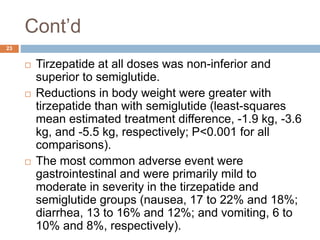
 Tirzepatide at all doses was non-inferior and
superior to semiglutide.
 Reductions in body weight were greater with
tirzepatide than with semiglutide (least-squares
mean estimated treatment difference, -1.9 kg, -3.6
kg, and -5.5 kg, respectively; P<0.001 for all
comparisons).
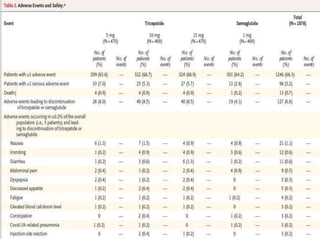
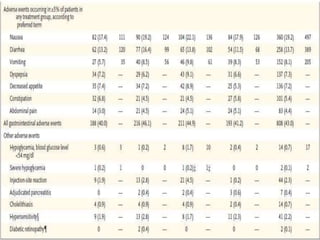
 The most common adverse event were
gastrointestinal and were primarily mild to
moderate in severity in the tirzepatide and
semiglutide groups (nausea, 17 to 22% and 18%;
diarrhea, 13 to 16% and 12%; and vomiting, 6 to
10% and 8%, respectively).
Cont’d
24
 Of the patients who received tirzepatide,
hypoglycemia (blood glucose level <54 mg
decileter) was reported in 0.6% (5-mg), 0.2%
(10-mg group), and 1.7% (15-mg group);
 Hypoglycemia was reported in 0.4% of those
who received semiglutide.
 Serious adverse events were reported in 5 to
7% of the patients who tirzepatide and in 3%
of those who received semiglutide.
25
26
27
28
Discussion
29
 In the current trial, tirzepatide at a dose of 5 mg, 10
mg or15 mg was noninferior and superior to
semiglutide at a dose of 1 mg, with respect to a
reduction in the glycated hemoglobin level inpatients
with type 2 diabetes who were receiving metformin.
 Tirzepatide was also superior to semiglutide with
respect to reductions in body weight.
 A total of body weight 82 to 86% of the patients who
received tirzepatide and 79% of those who received
semiglutide reached glycated hemoglobin level target
of less than 7.0% that is recommended by American
Diabetes Association and the European Association
for the Diabetes.
Cont’d
30
 The glycated hemoglobin level target less than
5.7% (normoglycemia) was met in 27 to 46%
of those patients who received tirze-patide and
in 19% of those who received semaglutide.
 The patients who received tizepatide at a dose
of 15 mg had almost twice the weight loss of
those who received semaglutide at a dose of
1mg.
 Weight reduction did not plateau in any of the
four treatment groups at 40 weeks.
Cont’d
31
 A glycated hemoglobin level of less than 5.7%
without increased risk of hypoglycemia has not
been considered attainable with current treatment
options.
 In this trial, this goal was met with a
gastrointestinal side-effect profile that was similar
to that reported with GLP-1 receptor agonists.
 In addition, many patients who received
tirzepatide were noted to have an improved lipid
profile as well as improved blood pressure,
biomarkers of insulin sensitivity, and liver enzyme
levels.
Conclusion
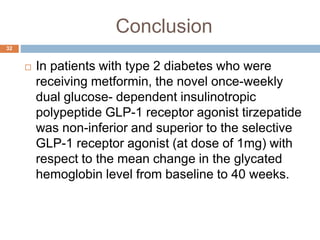
 In patients with type 2 diabetes who were
receiving metformin, the novel once-weekly
dual glucose- dependent insulinotropic
polypeptide GLP-1 receptor agonist tirzepatide
was non-inferior and superior to the selective
GLP-1 receptor agonist (at dose of 1mg) with
respect to the mean change in the glycated
hemoglobin level from baseline to 40 weeks.
32
Strength
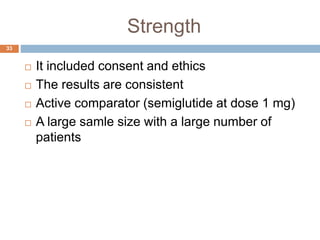
 It included consent and ethics
 The results are consistent
 Active comparator (semiglutide at dose 1 mg)
 A large samle size with a large number of
patients
33
Weakness
34
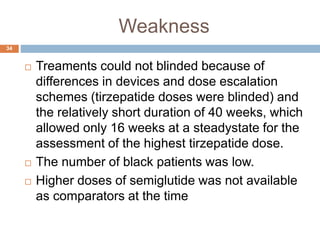
 Treaments could not blinded because of
differences in devices and dose escalation
schemes (tirzepatide doses were blinded) and
the relatively short duration of 40 weeks, which
allowed only 16 weeks at a steadystate for the
assessment of the highest tirzepatide dose.
 The number of black patients was low.
 Higher doses of semiglutide was not available
as comparators at the time
35
Thank you

Literature Evaluation.pptx

  • 1.
    HARAMAYA UNIVERSITY HIWOT FANACOMPREHENSIVE SPECIALIZED HOSPITAL CLINICAL PHARMACY AND DPIS UNIT JOURNAL CLUB PRESENTATION By Salahadin M.Ali (B.Pharm) 1
  • 2.
  • 3.
    Outline  Background  Introduction Authors and funding source  Hypothesis  Research questions  Method  Inclusion and exclusion criteria's  Statistical analysis  Result  Discussion  Conclusion  Strength and weakness 3
  • 4.
    Background  Tirzepatide isa dual glucose insulinotropic polypeptide glucagon like peptide (GLP-1) receptor agonist that is under development for the development of type 2 diabetes. The efficacy and safety of once weekly tirzepatide as compared with semaglutide, a selective GLP -1 receptor agonist, are unknown. 4
  • 5.
    Introduction  Glucagon likepeptide-1 (GLP-1) receptor agonists are an effective option for patients with type 2 diabetes. These agents act by stimulating insulin secretion hyperglycemic states, suppressing glucagon secretion in hyperglycemic or euglycemic states, delaying gastric emptying, decreasing appetite and reducing body weight. 5
  • 6.
    Cont’d 6  Glucose-dependent insulinotropicpolypeptide, the main incretin hormone in healthy persons, is insulinotropic ; however, unlike GLP-1, it is glucaganotropic in glucose depedent manner.  Under hyperglycemic conditions, glucose- dependant insulinotropic polypeptide stimulates the release of insulin, thereby lowering glucagon levels and under euglycemic or hypoglycemic conditions, glucagon are increased.
  • 7.
    Cont’d 7  Glucose-dependent insulinotropicpolypeptide receptors are abundant in adipose tissue, and glucose dependent insulinotropic polypeptide enhances both the post-prandial lipid-buffering capacity of white adipose tissue and the sensitivity of adipose tissue to insulin, which may prevent ectopic fat deposition.
  • 8.
    Authors and fundingsources 8  Juan P. Frias, M.D., Melanie J. Davies, M.D., Julio Rosenstock, M.D., Federico C. Perez Manghi, M.D., Laura Fernandez Lando, M.D., Brandon K. Bergman, Pharm.D., Bing Liu, Ph.D., Xuewei cui, Ph.D., and Katelyn Brown, Pharm. D.,  Funded by Eli Lilly; SURPASS-2 ClinicalTrials.gov.number NCT03987919.
  • 9.
    Hypothesis  To comparethe efficacy and safety of tirzepatide at doses of 5mg, 10mg and 15mg with those of semaglutide at doses of 1mg in patients with type 2 diabetes that had been inadequetly controlled with metformin monotherapy. 9
  • 10.
    Research questions 10  Whythis study was conducted?  For how long it was conducted?  What were the challenges encountered?  Did the participants fill the eligible criteria's?  How it would applicable clinically?  did the authors who conduct it qualified?  How would be the expense covered?
  • 11.
    Method  This 40-week,open label, parallel group, randomized, active controlled, phase 3 trial was conducted in 128 sites in the United States, Argentina, Australia, Brazil, Canada, Israel, Mexico, and the United Kingdom.  The primary end point was the change in glycated hemoglobin level from the baseline to 40 weeks. 11
  • 12.
    Cont’d 12  The patientswere randomly assigned in a 1:1:1:1 ratio to receive a once-weekly subcutaneous injection of either tirzepatide (at a dose of 5 mg, 10 mg, or 15 mg; the doses were double blinded) or semiglutide (1 mg) for a 40 week treatment period, followed by a 4- week.  The patients were stratified at randomization according to country and baseline glycated hemoglobin level (≤8.5 % or >8.5%[≤69 or >69mmol per mol]).
  • 13.
    Cont’d 13  Tirzepatide wasinitiated at a dose of 2.5 mg once weekly, and the doses were increased by 2.5 mg every 4 weeks until the randomly assigned doses reached. The final dose was then maintained for the duration of trial. Semiglutide was initiated at a dose of 0.25 mg once weekly and the dose was doubled every 4 weeks until 1 mg was reached. The final dose was then maintained for the duration of the trial. Dose descalation was allowed. The initiation of new antihyperglycemic medications was allowed according to specific criteria.
  • 14.
    The primary andsecondary points 14  The primary end point was the change in the glycated hemoglobin level from baseline to week 40.  The key secondary end points were the change in body weight from baseline to week 40 and the attainment of glycated hemoglobin level targets of less than 7.0% and less than 5.7%.
  • 15.
    The other endpoints 15  Other end points were attainment of glycated hemoglobin level of 6.5% or less and weight loss of at least 5%, 10%, 15%; the mean change from baseline in the fasting glucose level and in the daily, patient-measured, mean seven point glucose profiles (i.e., the mean of seven measurements); BMI waist circumfirunce; lipid levels; the results of updated homoestasis model-assessment insulin resistance (HOMA2-IR); and the fasting glucagon level .
  • 16.
    The composite endpoint 16  A composite end point of a glycated hemoglobin level of 6.5% or less with at least 10% weight l loss and without clinically significant glycemia (blood glucose level, <54 mg per deciliter [3mmol per liter ] or severe hypoglycemia events were also assessed.
  • 17.
    The Safety points 17 The safety end points of adverse events and discontinuation of tirzepatide or semiglutide because of adverse events.  Other safety end points were adjudicuted pancreatic adverse events; the serum calcitonin level; the incidence of hypersensitivity reactions; the mean changes in the pulse rate and the systolic and diastolic blood pressure; the occurrence of hypoglycemia events; and the incidence of initiation of rescue antihyperglycemic therapy.
  • 18.
    Inclusion criteria's 18  Anage of 18 years or older and type 2 diabetes that was inadequately controlled with metformin at a dose of at least 1500 mg per day.  Eligible patients had a glycated hemoglobin level of 7% to 10.5% and a body mass index (BMI; the weight in kilograms divided by the square of height in meters) of at least 25, and they had had stable weight (±5%) during the previous 3 months.
  • 19.
    Exclusion criteria's 19  Type1 diabetes;  An estimated glomerular filteration rate 45 ml per minute per 1.73 m2  A history of pancreatitis; and  A history of nonproliferative diabetic nephropathy that warranted urgent treatment, proliferative diabetic retinopathy or diabetic maculopathy.
  • 20.
    Statistical analysis 20  Thestudy was designed to provide at least 90% power to show noninferiority of tirzepatide at a dose of10 mg or 15 mg as compared with semiglutide at a dose of 1 mg with respect to the change from baseline in the glycated hemoglobin level at 40 weeks, with margin of 0.3%, a standard deviation of 1.1%, and a two- sided alpha value of 2.25, assuming no difference between treatments. We estimated the sample size 1879 patients would give the trial this power to show noninferiority, assuming a dropout rate of 28%.
  • 21.
    Result 21  This studywas conducted between july 30, 2019, and February 15, 2021.  In all, 2526 patients were assessed for trial eligibility; 1879 patients went randomization, and 1878 received at least one dose tirzepatide or semaglutide.  The demographic and clinical characteritics were similar across the groups. The overall mean duration of diabetes was 8.6years, the mean glycated hemoglobin level was 8.28%, and the mean body weight was 93.7 kg.
  • 22.
    Cont’d 22  The estimatedmean from baseline in the glycated hemoglobin level was -2.01percentage points, - 2.24 percentage points, and -2.30 percentage with 5 mg, 10 mg and 15 mg of tirzepatide respectively and -1.86 percentage points with semiglutide; the estimated differences differences between the 5- mg, 10-mg, and 15-mg tirzepatide groups and the semiglutide group were -0.15 percentage points (95% confidence interval [CI], -0.28 to -0.03; P=0.02), -0.39 percentage points (95% CI, -0.51to -0.26; P<0.001), and -0.45 percentage points (95% CI, -0.57 to -0.32; P<0.001), respectively.
  • 23.
    Cont’d 23  Tirzepatide atall doses was non-inferior and superior to semiglutide.  Reductions in body weight were greater with tirzepatide than with semiglutide (least-squares mean estimated treatment difference, -1.9 kg, -3.6 kg, and -5.5 kg, respectively; P<0.001 for all comparisons).  The most common adverse event were gastrointestinal and were primarily mild to moderate in severity in the tirzepatide and semiglutide groups (nausea, 17 to 22% and 18%; diarrhea, 13 to 16% and 12%; and vomiting, 6 to 10% and 8%, respectively).
  • 24.
    Cont’d 24  Of thepatients who received tirzepatide, hypoglycemia (blood glucose level <54 mg decileter) was reported in 0.6% (5-mg), 0.2% (10-mg group), and 1.7% (15-mg group);  Hypoglycemia was reported in 0.4% of those who received semiglutide.  Serious adverse events were reported in 5 to 7% of the patients who tirzepatide and in 3% of those who received semiglutide.
  • 25.
  • 26.
  • 27.
  • 28.
  • 29.
    Discussion 29  In thecurrent trial, tirzepatide at a dose of 5 mg, 10 mg or15 mg was noninferior and superior to semiglutide at a dose of 1 mg, with respect to a reduction in the glycated hemoglobin level inpatients with type 2 diabetes who were receiving metformin.  Tirzepatide was also superior to semiglutide with respect to reductions in body weight.  A total of body weight 82 to 86% of the patients who received tirzepatide and 79% of those who received semiglutide reached glycated hemoglobin level target of less than 7.0% that is recommended by American Diabetes Association and the European Association for the Diabetes.
  • 30.
    Cont’d 30  The glycatedhemoglobin level target less than 5.7% (normoglycemia) was met in 27 to 46% of those patients who received tirze-patide and in 19% of those who received semaglutide.  The patients who received tizepatide at a dose of 15 mg had almost twice the weight loss of those who received semaglutide at a dose of 1mg.  Weight reduction did not plateau in any of the four treatment groups at 40 weeks.
  • 31.
    Cont’d 31  A glycatedhemoglobin level of less than 5.7% without increased risk of hypoglycemia has not been considered attainable with current treatment options.  In this trial, this goal was met with a gastrointestinal side-effect profile that was similar to that reported with GLP-1 receptor agonists.  In addition, many patients who received tirzepatide were noted to have an improved lipid profile as well as improved blood pressure, biomarkers of insulin sensitivity, and liver enzyme levels.
  • 32.
    Conclusion  In patientswith type 2 diabetes who were receiving metformin, the novel once-weekly dual glucose- dependent insulinotropic polypeptide GLP-1 receptor agonist tirzepatide was non-inferior and superior to the selective GLP-1 receptor agonist (at dose of 1mg) with respect to the mean change in the glycated hemoglobin level from baseline to 40 weeks. 32
  • 33.
    Strength  It includedconsent and ethics  The results are consistent  Active comparator (semiglutide at dose 1 mg)  A large samle size with a large number of patients 33
  • 34.
    Weakness 34  Treaments couldnot blinded because of differences in devices and dose escalation schemes (tirzepatide doses were blinded) and the relatively short duration of 40 weeks, which allowed only 16 weeks at a steadystate for the assessment of the highest tirzepatide dose.  The number of black patients was low.  Higher doses of semiglutide was not available as comparators at the time
  • 35.