
Listening and
Nonverbal
Communication
Mr. Sudipta Sarkar
CONTENTS
A. Listening 3 – 11
A.1. Listening Process & Barriers 4 – 5
A.2. Listening In Workplace 6
A.3. Improve Listening In The Workplace 7
A.4. Skilful Listening To Customer 8
A.5. 10 Misconceptions About Listening 9 – 10
A.6. Most Irritating Listening Habits 11
B. Nonverbal Communication 12 – 20
B.1. Nonverbal Communication & It’s Function 13 – 14
B.2. Forms Of Nonverbal Communication 15
B.3. 3 Elements Of Nonverbal Communication 16
B.4. Types Of Nonverbal Communication 17
B.5. Body Language & Some Indicators 18 – 19
B.6. Tips For Improving Nonverbal Communication Skills 20
LISTENING
The Listening Process
PERCEPTION INTERPRETATION EVALUATION ACTION
Listening Process Barriers
Mental Barriers
•Inattention
•Prejudgment
•Frame of reference
•Closed-mindedness
•Pseudo listening
Physical & Other Barriers
Hearing impairment
Noisy surroundings
Speaker’s appearance
Speaker’s mannerisms
Lag time
Listening in the Workplace
Listening to
superiors
Listening to
employees
Listening to
customers
Improving
Listening in the
Workplace
 Stop talking
 Control external and internal distractions
 Become actively involved (be receptive)
 Separate facts from opinions
 Identify important facts
 Ask clarifying questions
 Paraphrase to increase understanding
 Capitalize on lag time
 Take notes to ensure retention
 Be aware of gender differences
Skillful Listening to Customers
 Defer judgment.
 Pay attention to content (not to appearance, form, or surface issues) –
judge ideas, not appearances
 Listen completely
 Listen primarily for the main idea; avoid responding to sidetracking issues
 Do only one thing at a time; listening is a full-time job
 Control your emotions
 Be silent for a moment after the customer finishes
 Make affirming statements and invite additional comments
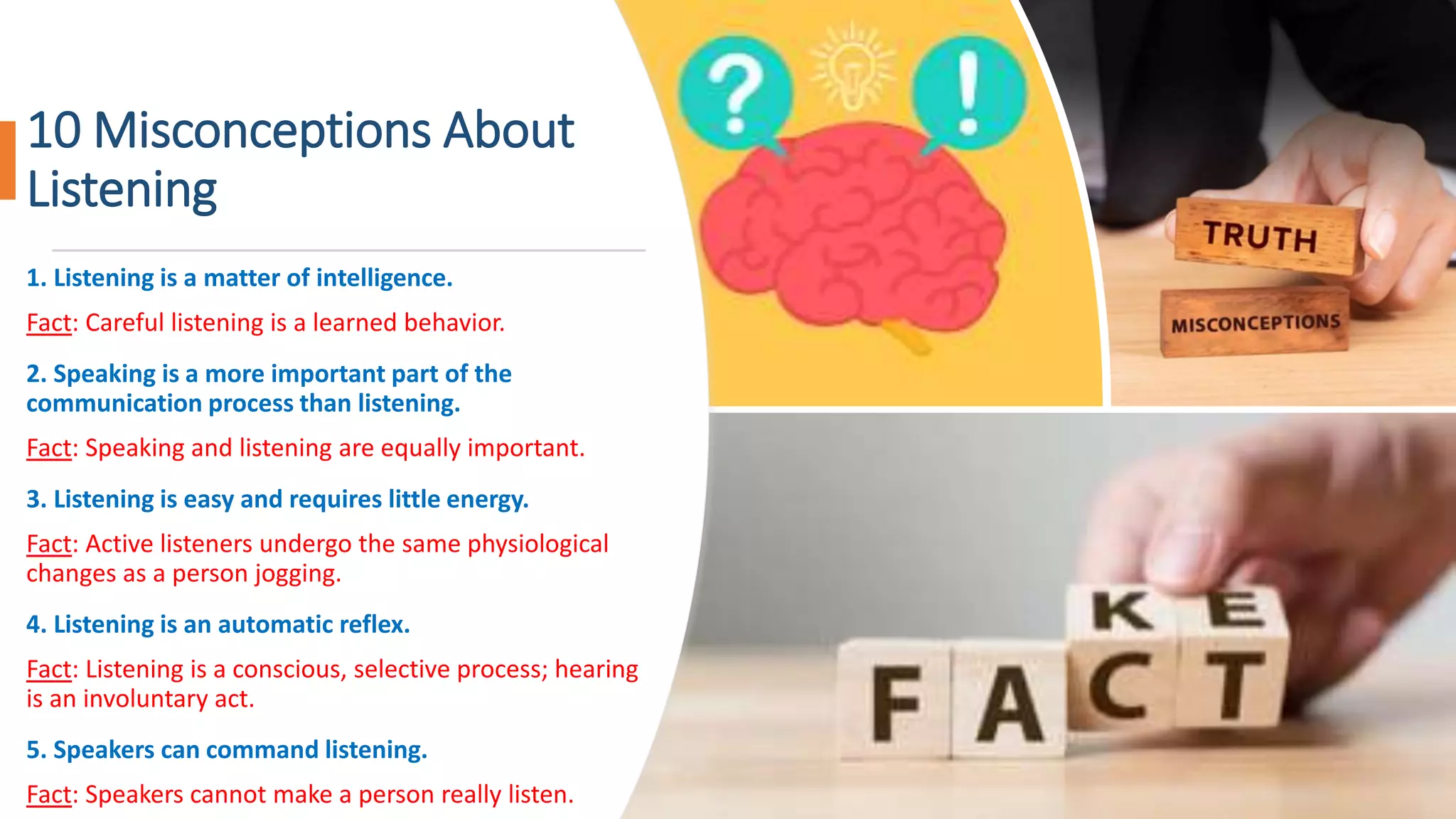
10 Misconceptions About
Listening
1. Listening is a matter of intelligence.
Fact: Careful listening is a learned behavior.
2. Speaking is a more important part of the
communication process than listening.
Fact: Speaking and listening are equally important.
3. Listening is easy and requires little energy.
Fact: Active listeners undergo the same physiological
changes as a person jogging.
4. Listening is an automatic reflex.
Fact: Listening is a conscious, selective process; hearing
is an involuntary act.
5. Speakers can command listening.
Fact: Speakers cannot make a person really listen.
10 Misconceptions About
Listening
6. Hearing ability determines listening ability.
Fact: Listening happens mentally – between the ears.
7. Speakers are totally responsible for communication
success.
Fact: Communication is a two-way street.
8. Listening is only a matter of understanding a speaker’s
words.
Fact: Nonverbal signals also help listeners gain
understanding.
9. Daily practice eliminates the need for listening
training.
Fact: Without effective listening training, most practice
merely reinforces negative behaviors.
10. Competence in listening develops naturally.
Fact: Untrained people listen at only 25% efficiency.
Most Irritating Listening Habits
• Rushing the speaker and making him feel he is wasting the listener’s time.
• Interrupting the speaker.
• Not looking at the speaker.
• Getting ahead of the speaker (finishing her thoughts).
• Not responding to the speaker’s requests.
• Showing interest in something other than what the speaker is saying.
• Saying “Yes, but . . .,” as if the listener’s mind is made up.
• Topping the speaker’s story with “That reminds me . . .” or “That’s nothing; let me tell
you about. . . .”
• Forgetting what was talked about previously.
• Asking too many questions about details.
Nonverbal
Communication
Nonverbal
Communication
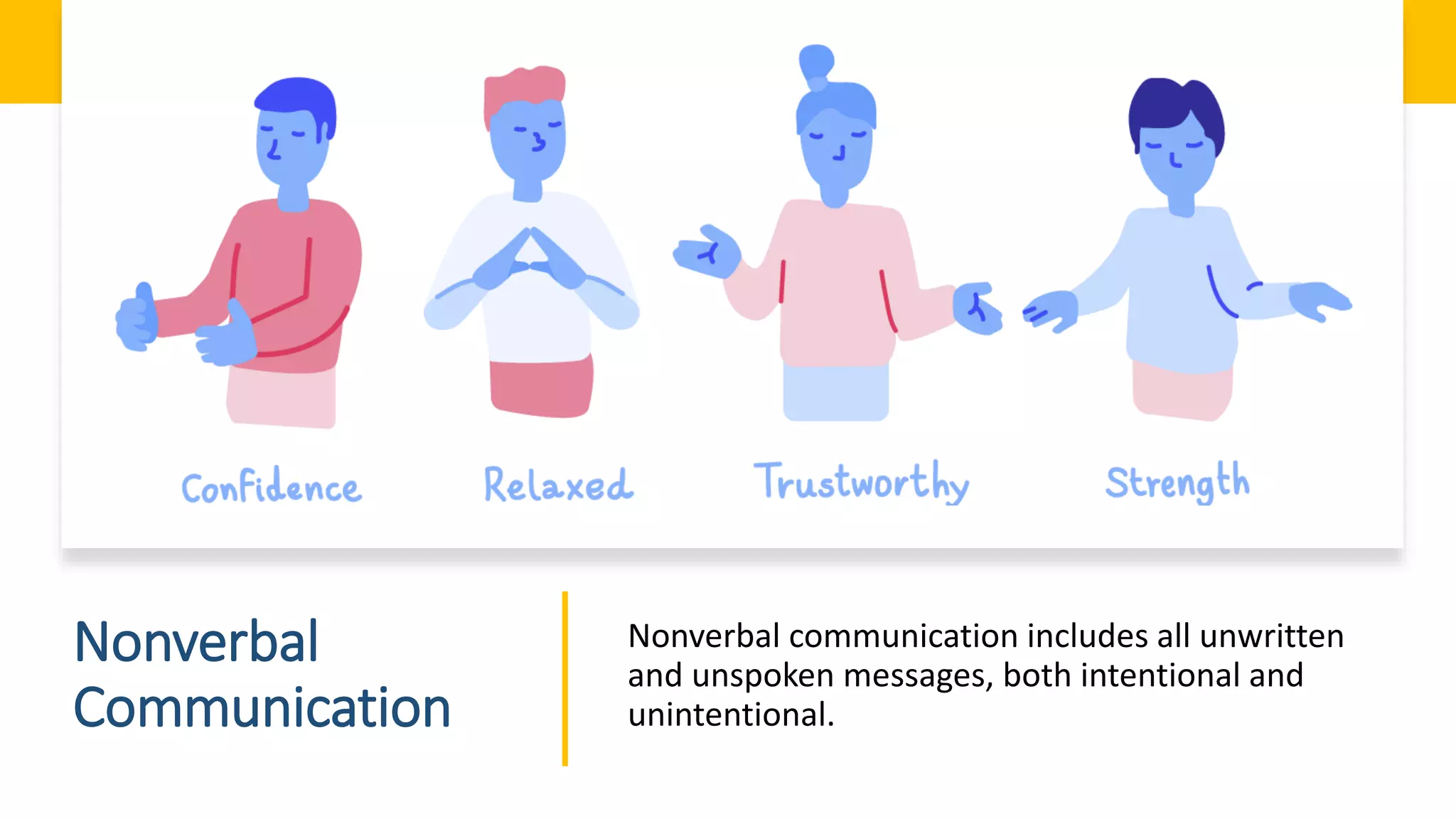
Nonverbal communication includes all unwritten
and unspoken messages, both intentional and
unintentional.
Functions of Nonverbal
Communication
 To complement and illustrate
 To reinforce and accentuate
 To replace and substitute
 To control and regulate
 To contradict
Forms of Nonverbal Communication
•Eye
contact
Facial
expression
Posture and
gestures
Appearance
of people
•Time
Space
Territory
Appearance
of
documents
How can these nonverbal forms be
used to send positive messages?
3 Elements of
Non-verbal
communication
Body Language
55%
Voice Tone
38%
Words
7%
TYPES OF
NONVERBAL
COMMUNICATION
 Paralanguage – Speed, Volume, Pitch, Fillers
 Kinesics – Body Movements
 Occulesics – Eye Behavior
 Appearance/Artifacts
 Proxemics – Territory, Distance Zones
 Haptics – Touch
 Olfactics – Smell
 Chronomics – Time
 Facial Expressions
Body Language – Some Indicators
 Walking tall, erect and briskly = Confidence
 Standing with hands on hips = Readiness, aggression
 Walking with hands in pockets, shoulders hunched =
Dejection
 Hands clasped behind back = Anger, frustration,
apprehension
 Sitting with legs crossed, foot kicking slightly =
Boredom
 Sitting with arms crossed on chest = Defensiveness
 Sitting with hands clasped behind head, legs crossed =
Confidence, superiority
 Biting nails = Nervousness
Body Language – Some More
Indicators
 Touching, slightly rubbing nose = Rejection, doubt, lying
 Stroking chin = Trying to decide
 Pulling or tugging at ear = Indecision
 Patting/fondling hair = Lack of self confidence,
insecurity
 Rubbing hands = Anticipation
 Pinching bridge of nose, eyes closed = Negative
evaluation
 Tilted head = Interest
 Open palm = Sincerity, openness, innocence
 Tapping or drumming fingers = Impatience
Tips for Improving
Your Nonverbal Skills
• Establish and maintain eye contact.
• Use posture to show interest.
• Improve your decoding skills.
• Probe for more information.
• Avoid assigning nonverbal meanings out
of context.
• Associate with people from diverse
cultures.
• Appreciate the power of appearance.
• Observe yourself on videotape.
• Enlist friends and family.
Thank You.

Listening and Nonverbal Communication

  • 1.
  • 2.
    CONTENTS A. Listening 3– 11 A.1. Listening Process & Barriers 4 – 5 A.2. Listening In Workplace 6 A.3. Improve Listening In The Workplace 7 A.4. Skilful Listening To Customer 8 A.5. 10 Misconceptions About Listening 9 – 10 A.6. Most Irritating Listening Habits 11 B. Nonverbal Communication 12 – 20 B.1. Nonverbal Communication & It’s Function 13 – 14 B.2. Forms Of Nonverbal Communication 15 B.3. 3 Elements Of Nonverbal Communication 16 B.4. Types Of Nonverbal Communication 17 B.5. Body Language & Some Indicators 18 – 19 B.6. Tips For Improving Nonverbal Communication Skills 20
  • 3.
  • 4.
    The Listening Process PERCEPTIONINTERPRETATION EVALUATION ACTION
  • 5.
    Listening Process Barriers MentalBarriers •Inattention •Prejudgment •Frame of reference •Closed-mindedness •Pseudo listening Physical & Other Barriers Hearing impairment Noisy surroundings Speaker’s appearance Speaker’s mannerisms Lag time
  • 6.
    Listening in theWorkplace Listening to superiors Listening to employees Listening to customers
  • 7.
    Improving Listening in the Workplace Stop talking  Control external and internal distractions  Become actively involved (be receptive)  Separate facts from opinions  Identify important facts  Ask clarifying questions  Paraphrase to increase understanding  Capitalize on lag time  Take notes to ensure retention  Be aware of gender differences
  • 8.
    Skillful Listening toCustomers  Defer judgment.  Pay attention to content (not to appearance, form, or surface issues) – judge ideas, not appearances  Listen completely  Listen primarily for the main idea; avoid responding to sidetracking issues  Do only one thing at a time; listening is a full-time job  Control your emotions  Be silent for a moment after the customer finishes  Make affirming statements and invite additional comments
  • 9.
    10 Misconceptions About Listening 1.Listening is a matter of intelligence. Fact: Careful listening is a learned behavior. 2. Speaking is a more important part of the communication process than listening. Fact: Speaking and listening are equally important. 3. Listening is easy and requires little energy. Fact: Active listeners undergo the same physiological changes as a person jogging. 4. Listening is an automatic reflex. Fact: Listening is a conscious, selective process; hearing is an involuntary act. 5. Speakers can command listening. Fact: Speakers cannot make a person really listen.
  • 10.
    10 Misconceptions About Listening 6.Hearing ability determines listening ability. Fact: Listening happens mentally – between the ears. 7. Speakers are totally responsible for communication success. Fact: Communication is a two-way street. 8. Listening is only a matter of understanding a speaker’s words. Fact: Nonverbal signals also help listeners gain understanding. 9. Daily practice eliminates the need for listening training. Fact: Without effective listening training, most practice merely reinforces negative behaviors. 10. Competence in listening develops naturally. Fact: Untrained people listen at only 25% efficiency.
  • 11.
    Most Irritating ListeningHabits • Rushing the speaker and making him feel he is wasting the listener’s time. • Interrupting the speaker. • Not looking at the speaker. • Getting ahead of the speaker (finishing her thoughts). • Not responding to the speaker’s requests. • Showing interest in something other than what the speaker is saying. • Saying “Yes, but . . .,” as if the listener’s mind is made up. • Topping the speaker’s story with “That reminds me . . .” or “That’s nothing; let me tell you about. . . .” • Forgetting what was talked about previously. • Asking too many questions about details.
  • 12.
  • 13.
    Nonverbal Communication Nonverbal communication includesall unwritten and unspoken messages, both intentional and unintentional.
  • 14.
    Functions of Nonverbal Communication To complement and illustrate  To reinforce and accentuate  To replace and substitute  To control and regulate  To contradict
  • 15.
    Forms of NonverbalCommunication •Eye contact Facial expression Posture and gestures Appearance of people •Time Space Territory Appearance of documents How can these nonverbal forms be used to send positive messages?
  • 16.
    3 Elements of Non-verbal communication BodyLanguage 55% Voice Tone 38% Words 7%
  • 17.
    TYPES OF NONVERBAL COMMUNICATION  Paralanguage– Speed, Volume, Pitch, Fillers  Kinesics – Body Movements  Occulesics – Eye Behavior  Appearance/Artifacts  Proxemics – Territory, Distance Zones  Haptics – Touch  Olfactics – Smell  Chronomics – Time  Facial Expressions
  • 18.
    Body Language –Some Indicators  Walking tall, erect and briskly = Confidence  Standing with hands on hips = Readiness, aggression  Walking with hands in pockets, shoulders hunched = Dejection  Hands clasped behind back = Anger, frustration, apprehension  Sitting with legs crossed, foot kicking slightly = Boredom  Sitting with arms crossed on chest = Defensiveness  Sitting with hands clasped behind head, legs crossed = Confidence, superiority  Biting nails = Nervousness
  • 19.
    Body Language –Some More Indicators  Touching, slightly rubbing nose = Rejection, doubt, lying  Stroking chin = Trying to decide  Pulling or tugging at ear = Indecision  Patting/fondling hair = Lack of self confidence, insecurity  Rubbing hands = Anticipation  Pinching bridge of nose, eyes closed = Negative evaluation  Tilted head = Interest  Open palm = Sincerity, openness, innocence  Tapping or drumming fingers = Impatience
  • 20.
    Tips for Improving YourNonverbal Skills • Establish and maintain eye contact. • Use posture to show interest. • Improve your decoding skills. • Probe for more information. • Avoid assigning nonverbal meanings out of context. • Associate with people from diverse cultures. • Appreciate the power of appearance. • Observe yourself on videotape. • Enlist friends and family.
  • 22.