LISTEN AND LOOK
AT YOUR PHP CODE!
Gabriele Santini
Forum AFUP 2010
Gabriele Santini
 Architect/Consultant at SQLI
 Contributor to PHP_CodeSniffer
 So expect a special focus on this…
 Sonar PHP Plugin
 I have to show you!
 Ex-mathematician :
 love business modelling
 love architectures
 love quality assurance
Static Analysis
 All you can say about your program without actually
execute the code
 The rest is also interesting, let’s talk about it another time !
 Examples ?
 Syntax check, coding style, anti-patterns, metrics,
OO design analysis, …
 What PHP does before executing the code ?
Levels of analysis
 Lexical analysis
 Read sources linearly searching for known patterns
 Convert them to a sequence of tokens
Levels of analysis
 Lexical analysis
 Read sources linearly searching for known patterns
 Convert them to a sequence of tokens
 Syntactic Analysis
 Parse the tokens to find their logical structure
Levels of analysis
 Lexical analysis
 Read sources linearly searching for known patterns
 Convert them to a sequence of tokens
 Syntactic Analysis
 Parse the tokens to find their logical structure
 Opcode (Bytecode) Generation
 Generates an intermediary code that the Zend Engine
will be able to execute
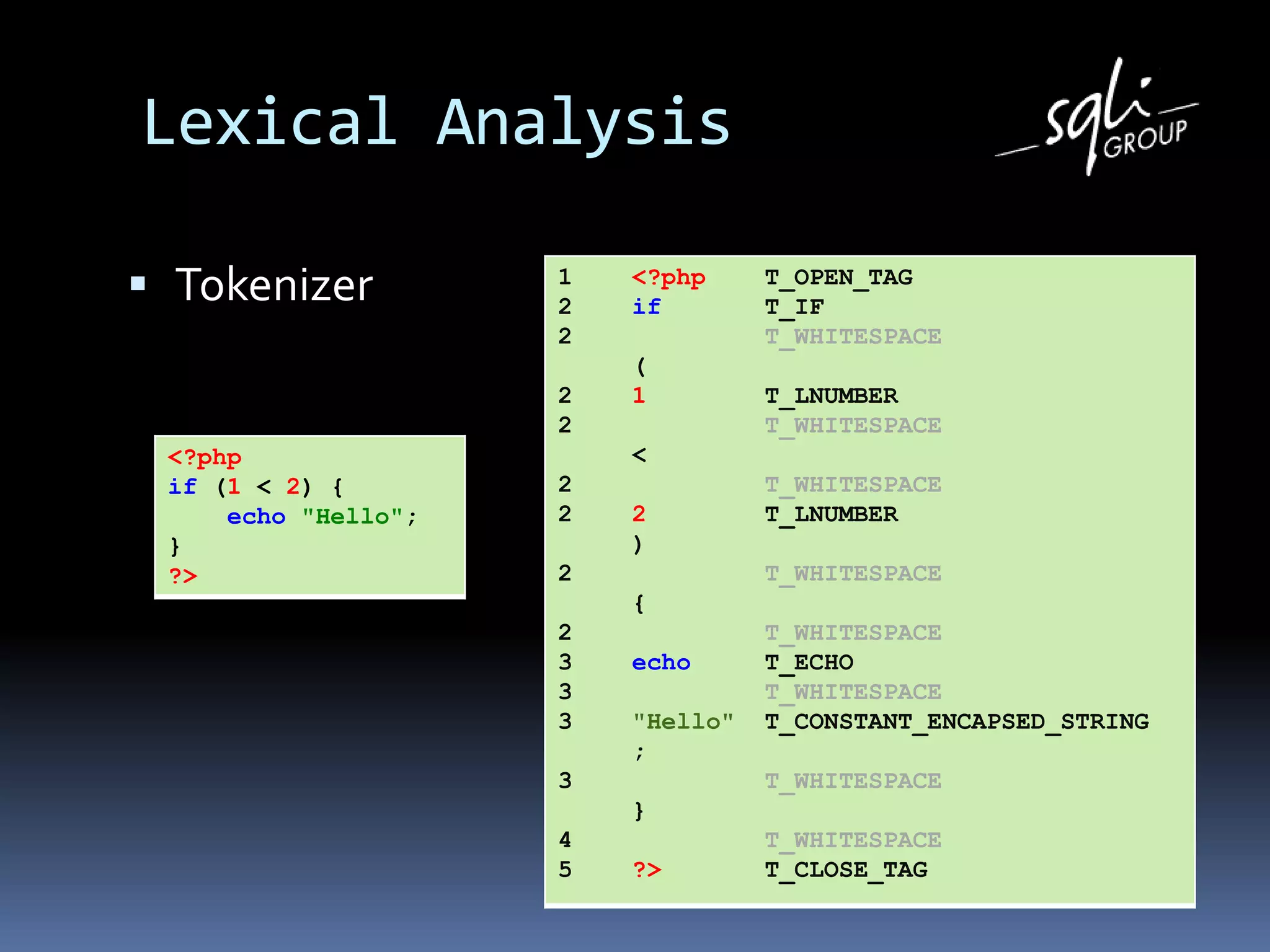
Lexical Analysis
 Tokenizer 1 <?php T_OPEN_TAG
2 if T_IF
2 T_WHITESPACE
(
2 1 T_LNUMBER
2 T_WHITESPACE
<
2 T_WHITESPACE
2 2 T_LNUMBER
)
2 T_WHITESPACE
{
2 T_WHITESPACE
3 echo T_ECHO
3 T_WHITESPACE
3 "Hello" T_CONSTANT_ENCAPSED_STRING
;
3 T_WHITESPACE
}
4 T_WHITESPACE
5 ?> T_CLOSE_TAG
<?php
if (1 < 2) {
echo "Hello";
}
?>
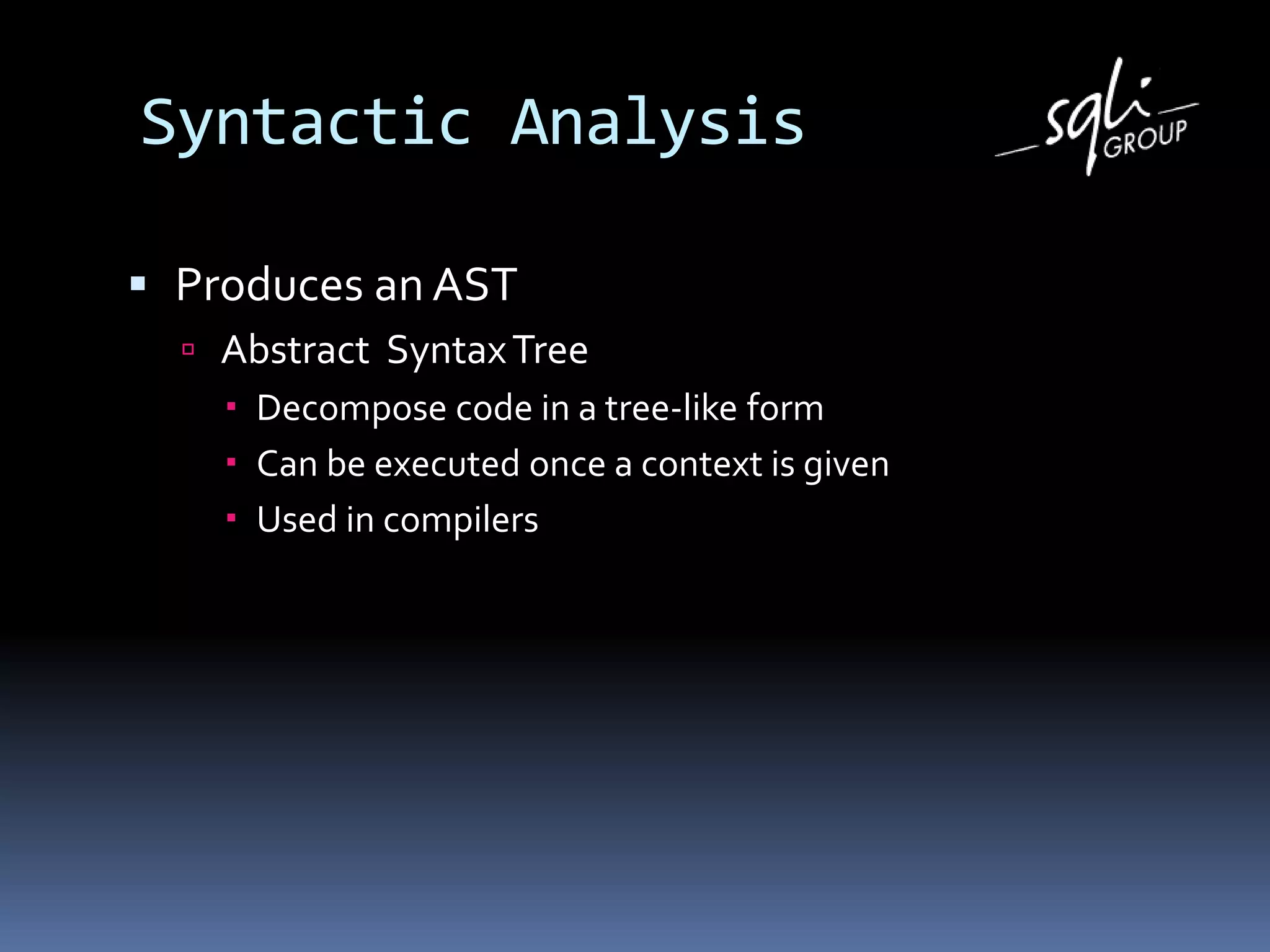
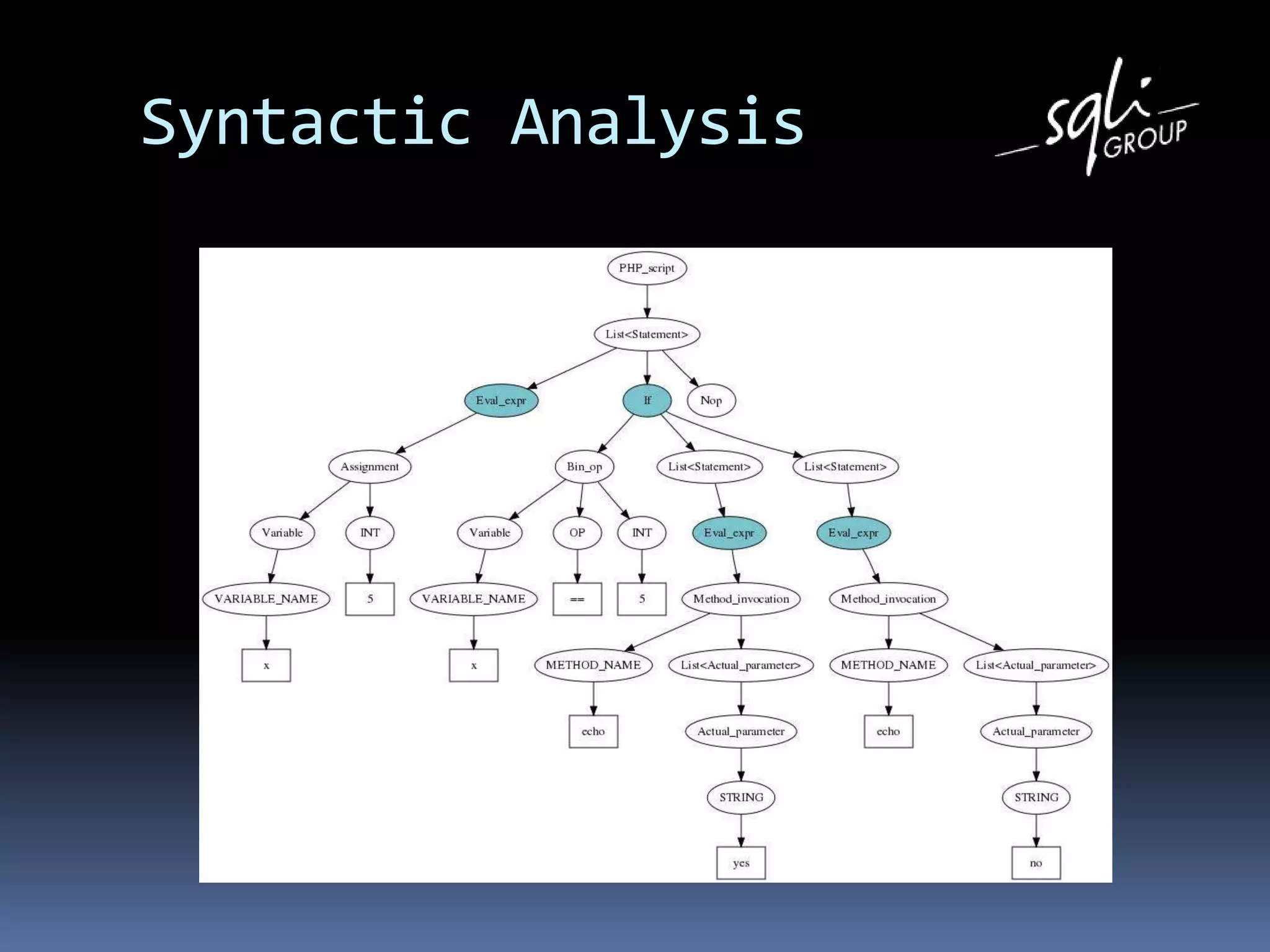
Syntactic Analysis
 Produces an AST
 Abstract SyntaxTree
 Decompose code in a tree-like form
 Can be executed once a context is given
 Used in compilers
Syntactic Analysis
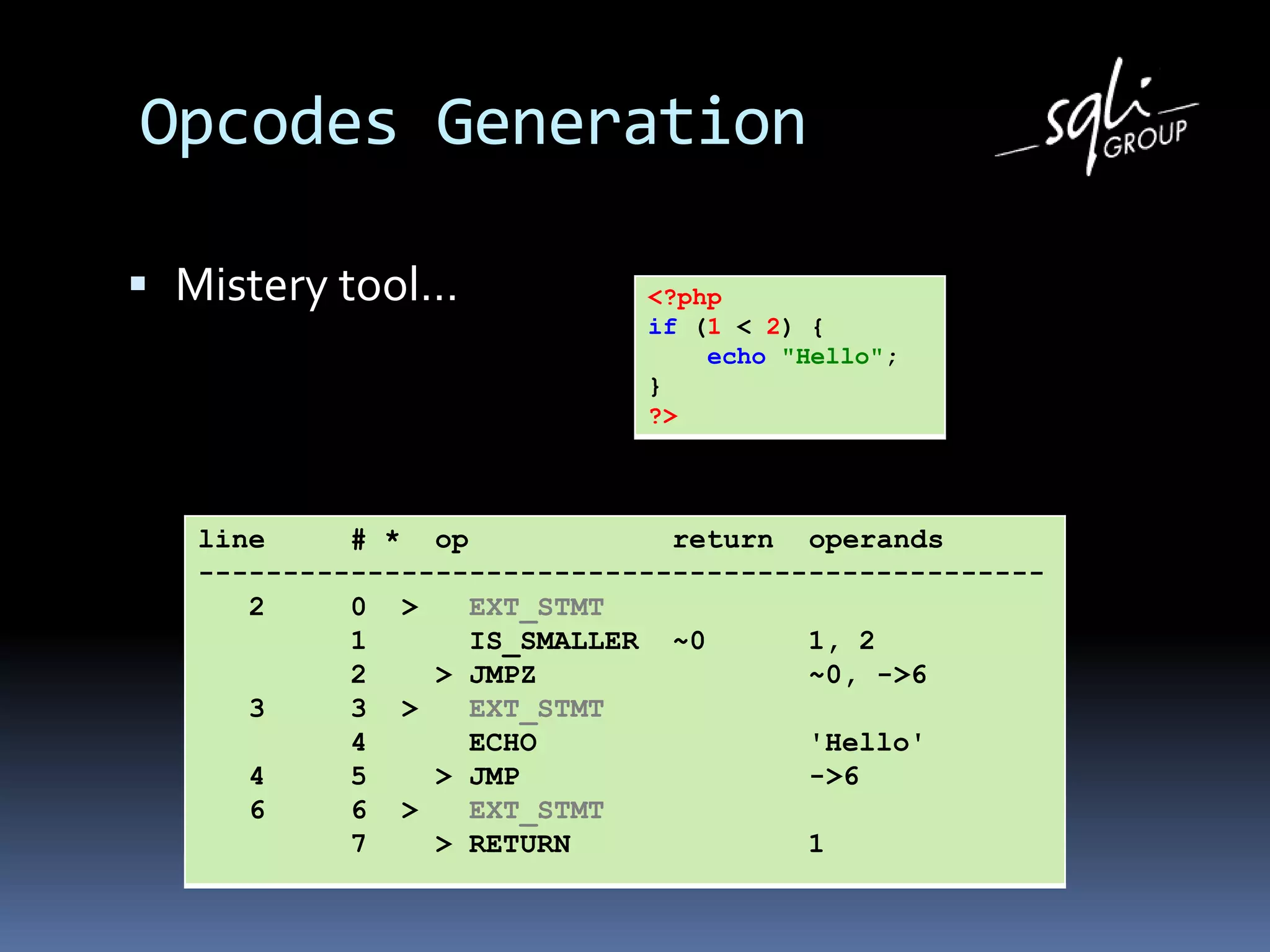
Opcodes Generation
 Mistery tool…
line # * op return operands
--------------------------------------------------
2 0 > EXT_STMT
1 IS_SMALLER ~0 1, 2
2 > JMPZ ~0, ->6
3 3 > EXT_STMT
4 ECHO 'Hello'
4 5 > JMP ->6
6 6 > EXT_STMT
7 > RETURN 1
<?php
if (1 < 2) {
echo "Hello";
}
?>
GIVE US THE TOOLS !
PHP_CodeSniffer
 By Greg Sherwood
 PEAR library
 Venerable project
 Code Style
 But also a lot more
 Works at lexical analysis level
 Heavily use the tokenizer extension
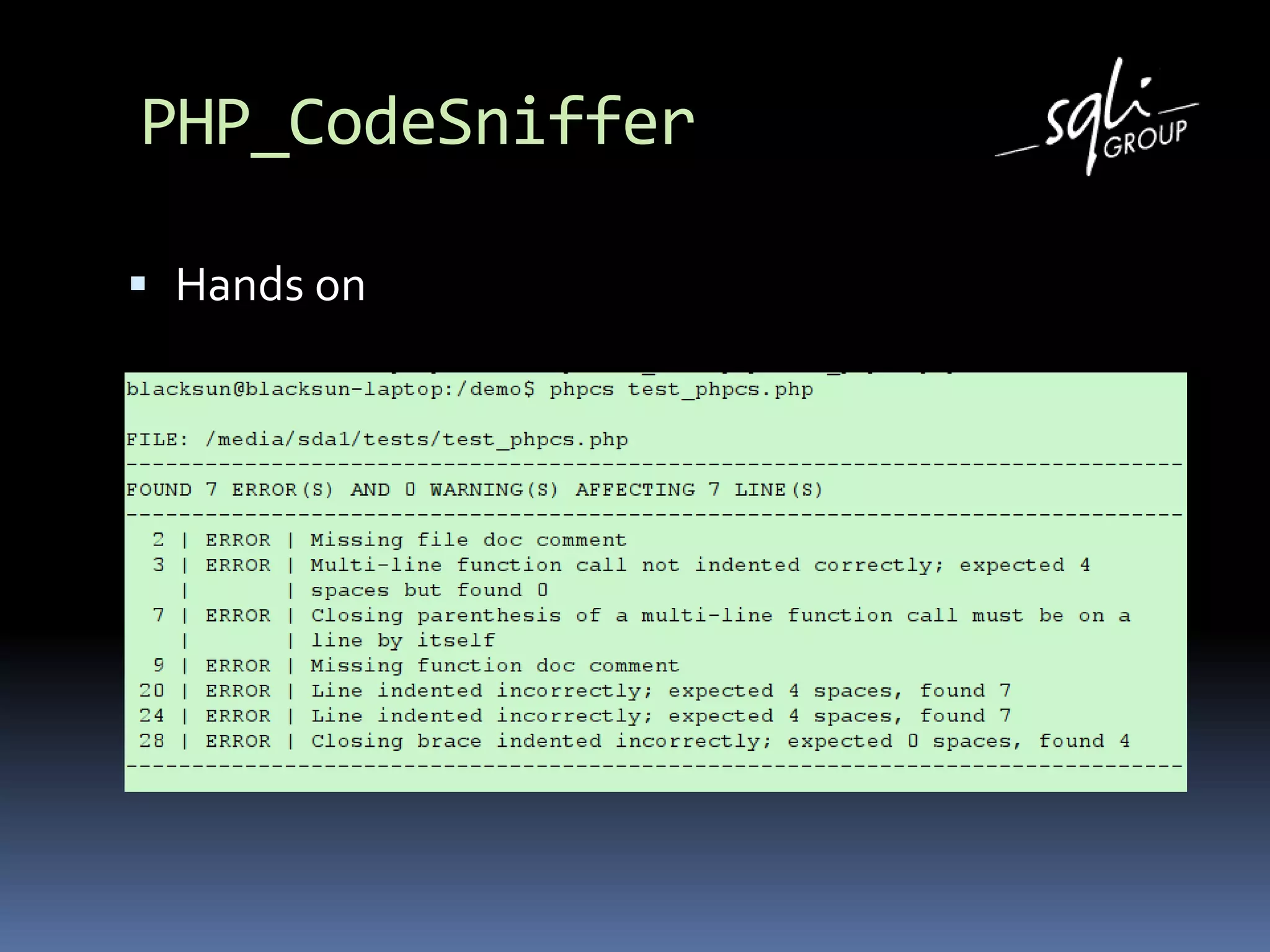
PHP_CodeSniffer
 Hands on
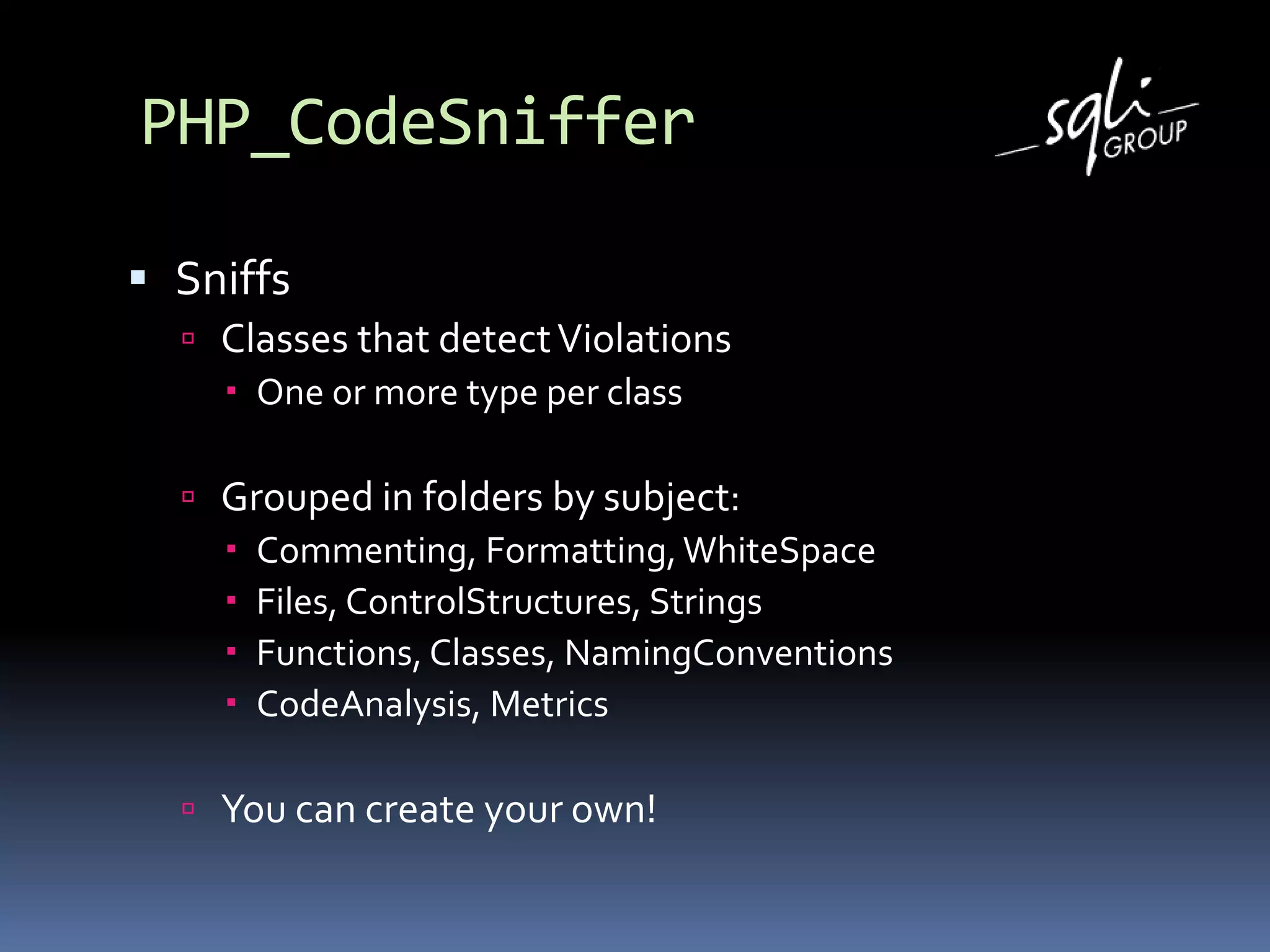
PHP_CodeSniffer
 Sniffs
 Classes that detectViolations
 One or more type per class
 Grouped in folders by subject:
 Commenting, Formatting,WhiteSpace
 Files, ControlStructures, Strings
 Functions, Classes, NamingConventions
 CodeAnalysis, Metrics
 You can create your own!
PHP_CodeSniffer
 Standards
 Sets of Sniffs that define your coding style
 Installed :
 PEAR,
 Generic,
 Zend*,
 Squiz, MySource
 PHPCS
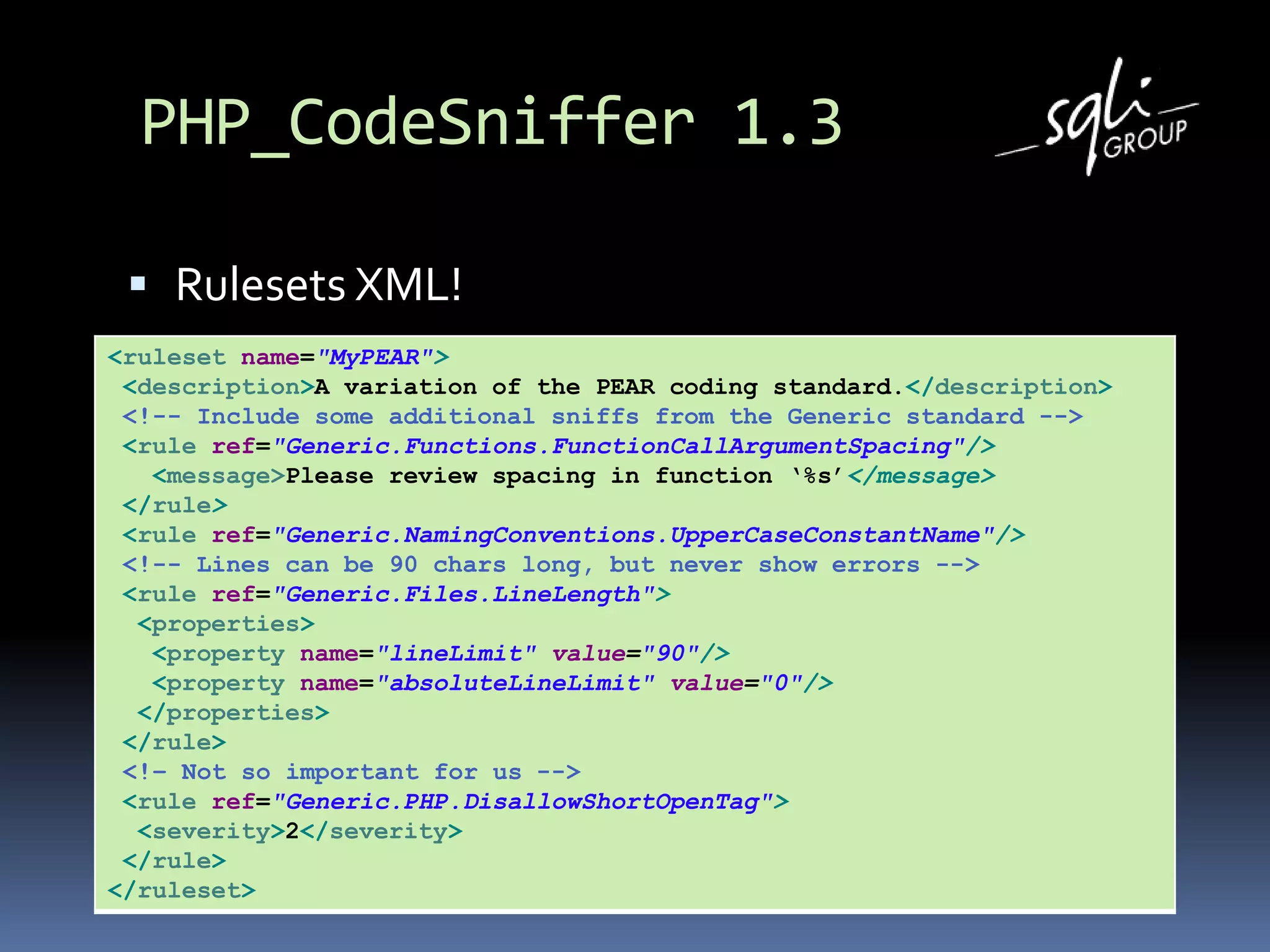
PHP_CodeSniffer 1.3
 Rulesets XML!
<ruleset name="MyPEAR">
<description>A variation of the PEAR coding standard.</description>
<!-- Include some additional sniffs from the Generic standard -->
<rule ref="Generic.Functions.FunctionCallArgumentSpacing"/>
<message>Please review spacing in function ‘%s’</message>
</rule>
<rule ref="Generic.NamingConventions.UpperCaseConstantName"/>
<!-- Lines can be 90 chars long, but never show errors -->
<rule ref="Generic.Files.LineLength">
<properties>
<property name="lineLimit" value="90"/>
<property name="absoluteLineLimit" value="0"/>
</properties>
</rule>
<!– Not so important for us -->
<rule ref="Generic.PHP.DisallowShortOpenTag">
<severity>2</severity>
</rule>
</ruleset>
Inside PHP_CodeSniffer
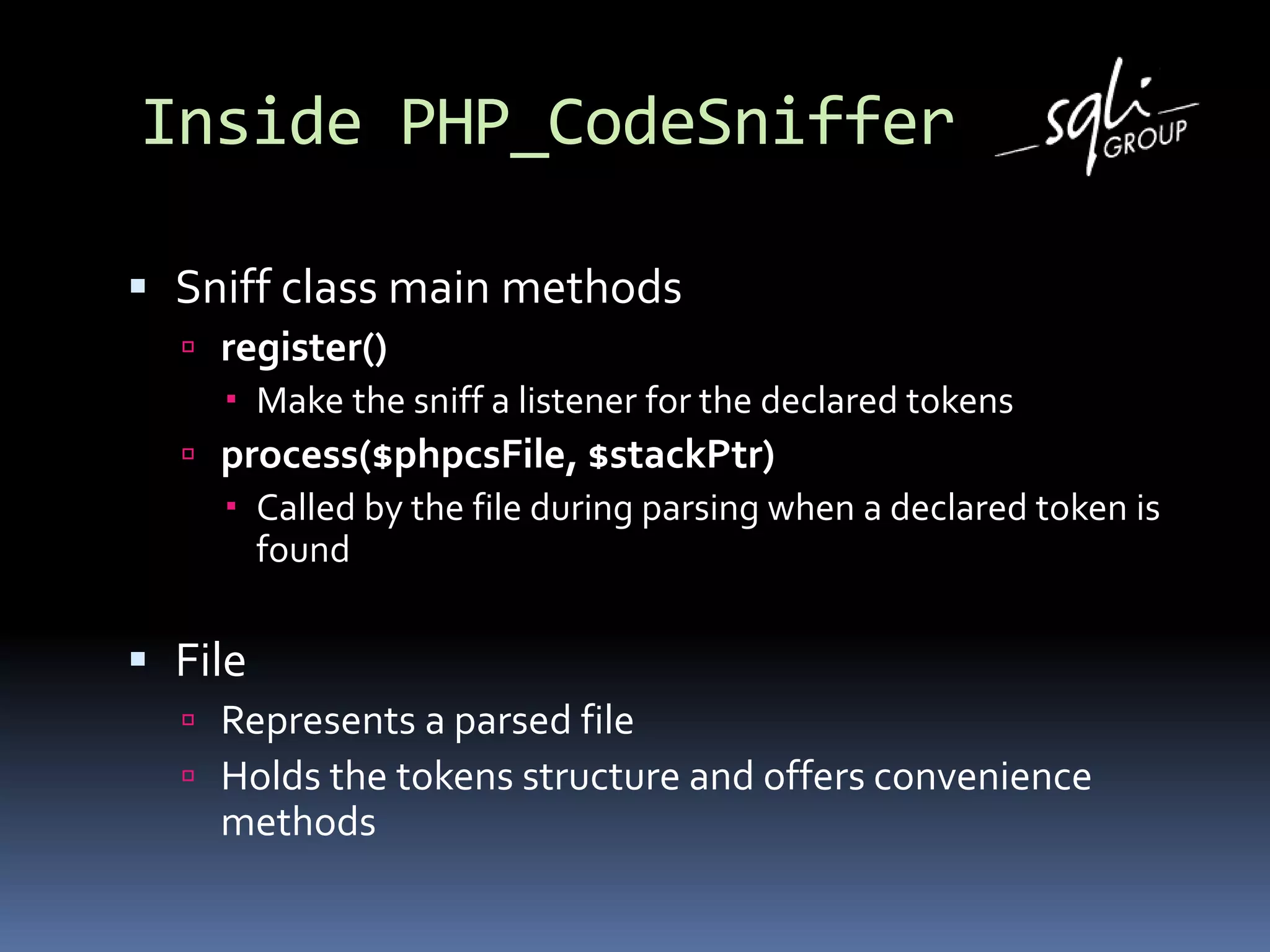
 Sniff class main methods
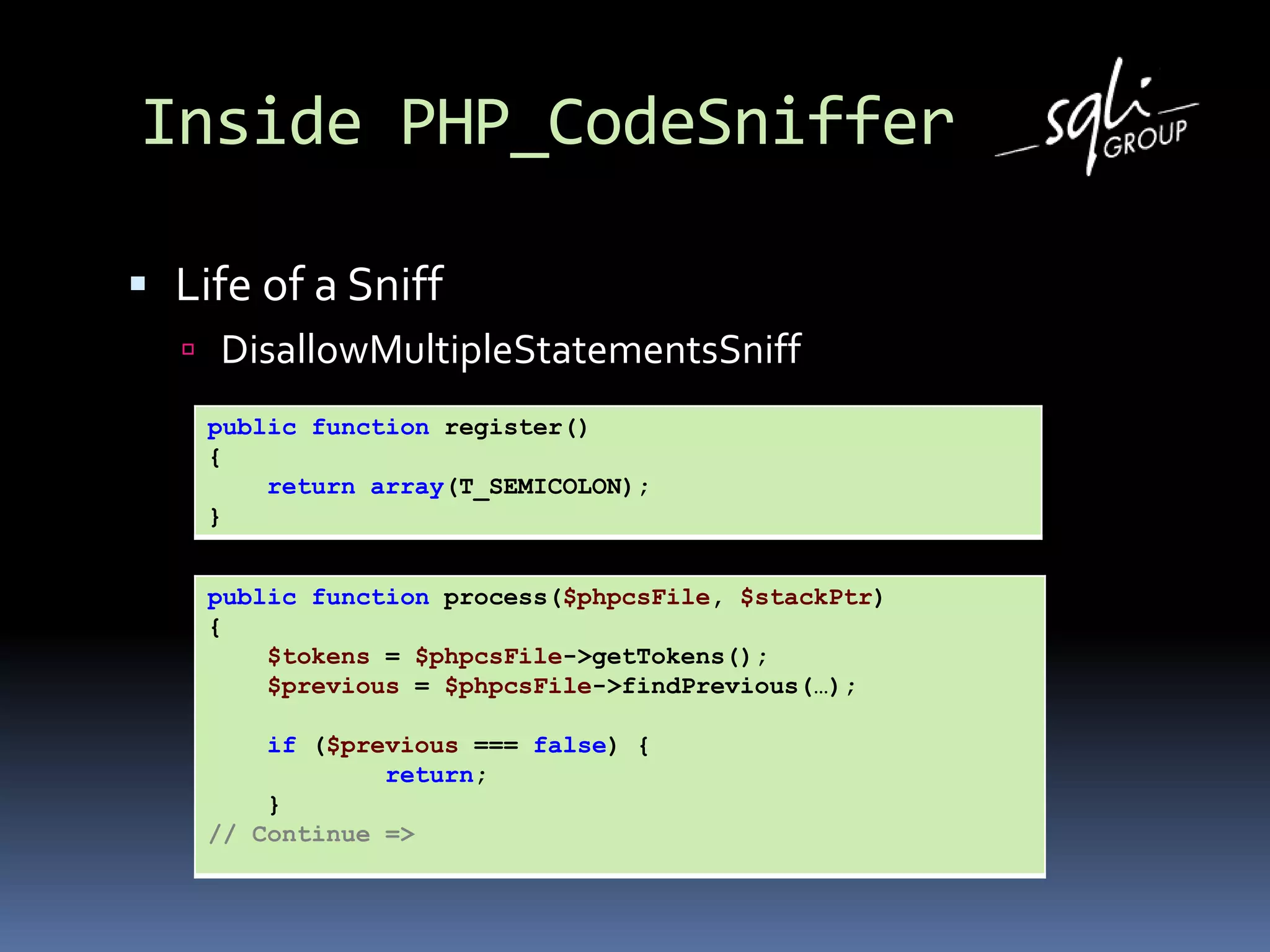
 register()
 Make the sniff a listener for the declared tokens
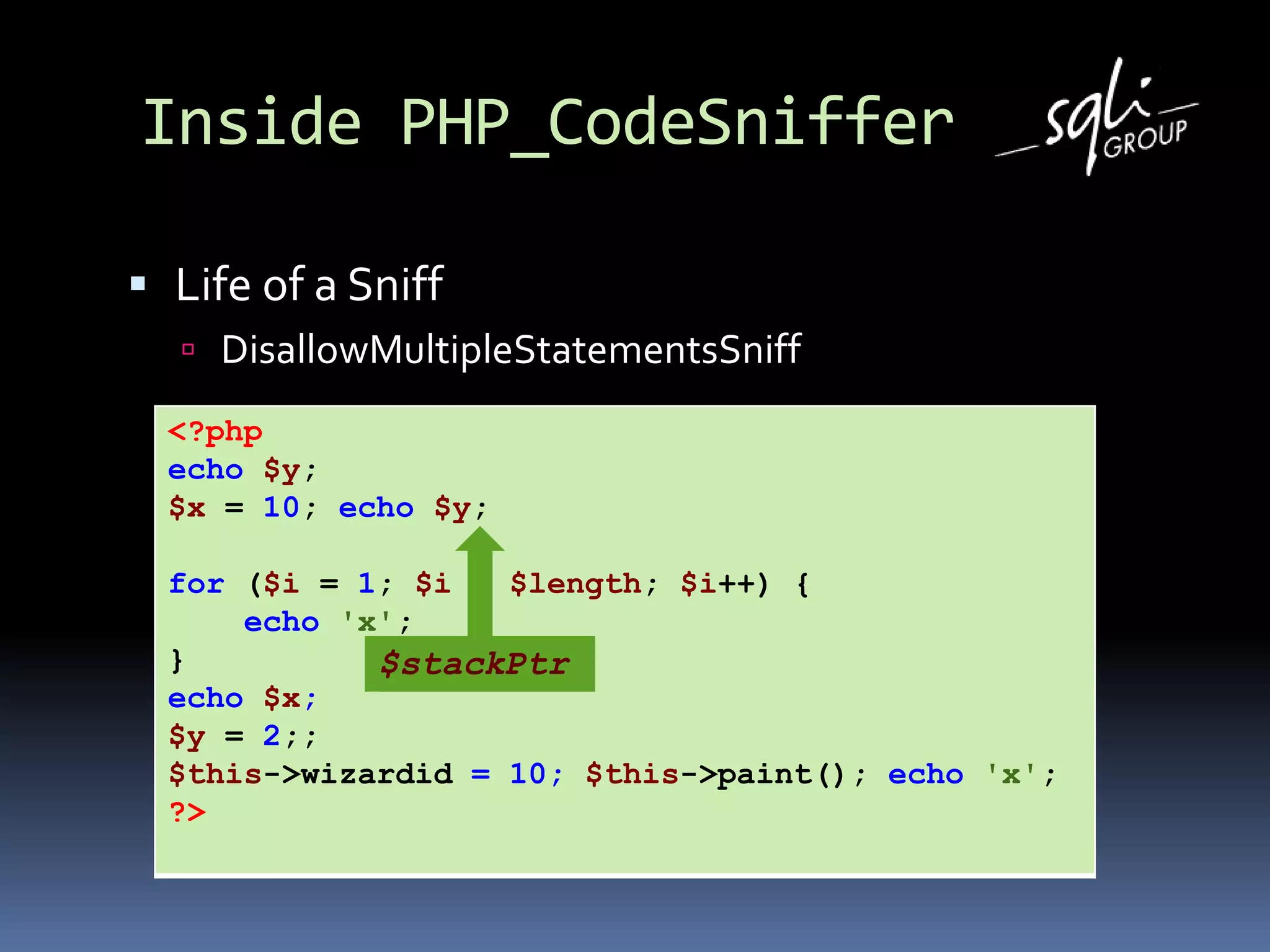
 process($phpcsFile, $stackPtr)
 Called by the file during parsing when a declared token is
found
 File
 Represents a parsed file
 Holds the tokens structure and offers convenience
methods
Inside PHP_CodeSniffer
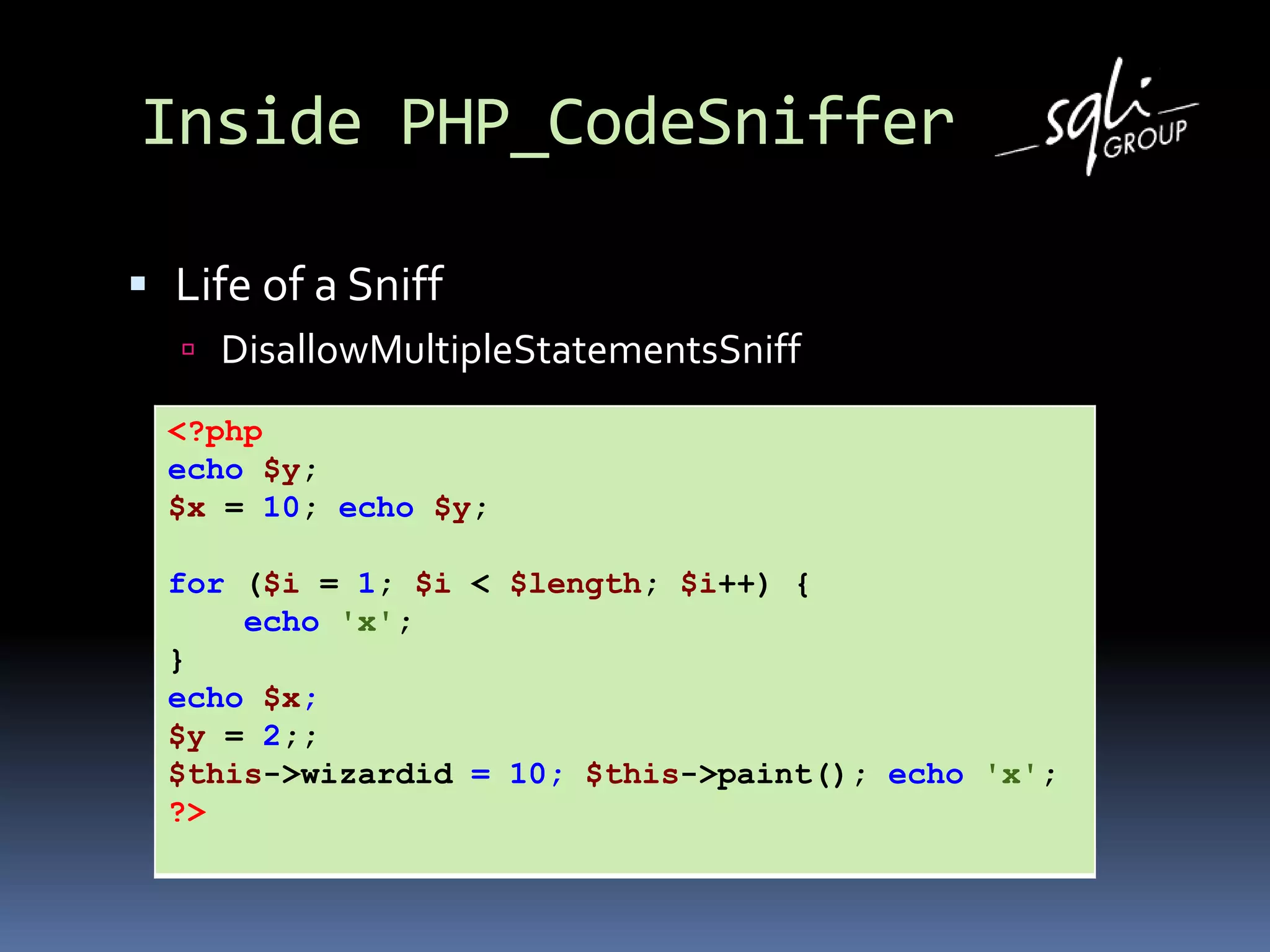
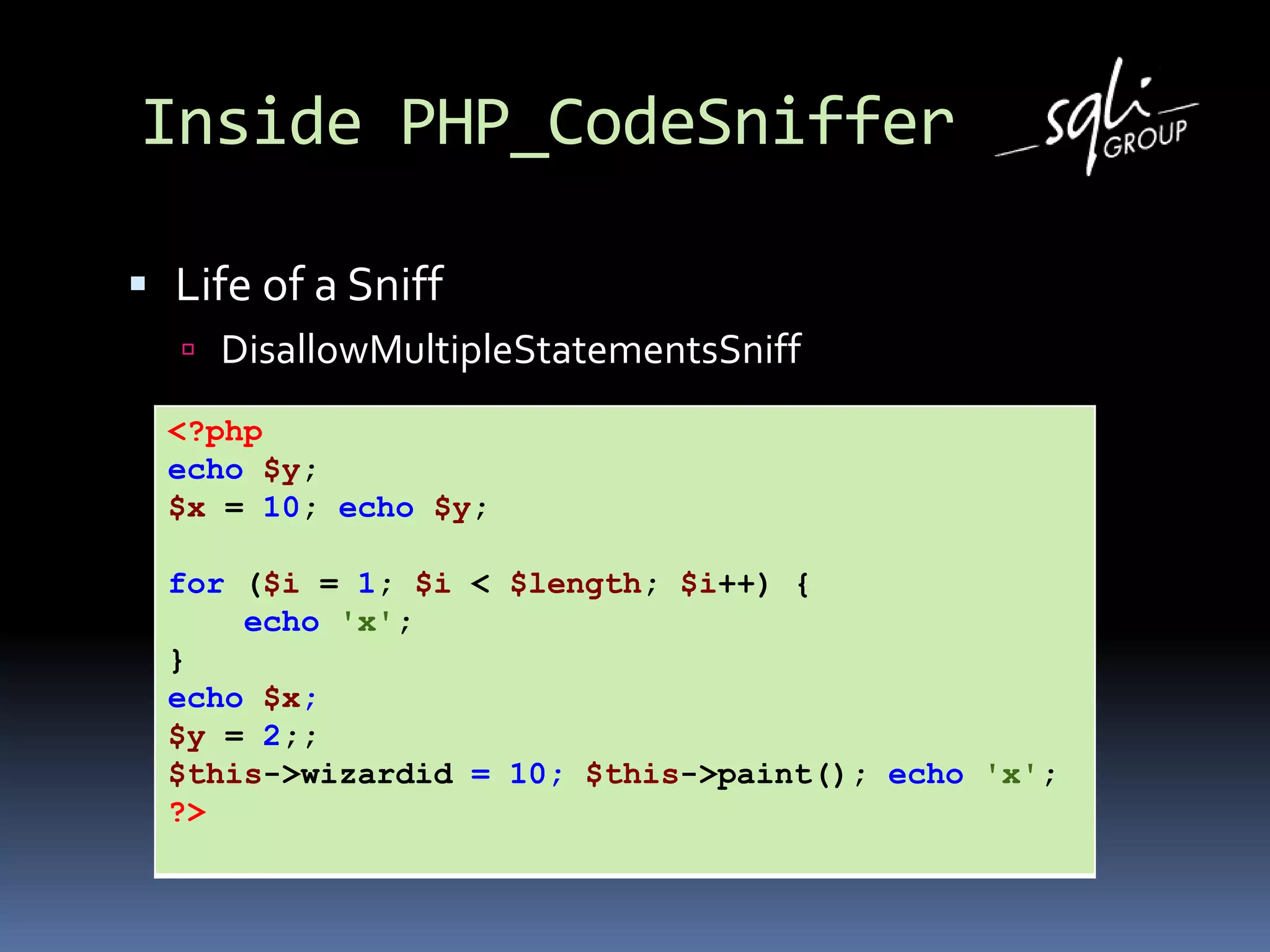
 Life of a Sniff
 DisallowMultipleStatementsSniff
<?php
echo $y;
$x = 10; echo $y;
for ($i = 1; $i < $length; $i++) {
echo 'x';
}
echo $x;
$y = 2;;
$this->wizardid = 10; $this->paint(); echo 'x';
?>
Inside PHP_CodeSniffer
 Life of a Sniff
 DisallowMultipleStatementsSniff
public function register()
{
return array(T_SEMICOLON);
}
public function process($phpcsFile, $stackPtr)
{
[…]
Inside PHP_CodeSniffer
 Life of a Sniff
 DisallowMultipleStatementsSniff
<?php
echo $y;
$x = 10; echo $y;
for ($i = 1; $i < $length; $i++) {
echo 'x';
}
echo $x;
$y = 2;;
$this->wizardid = 10; $this->paint(); echo 'x';
?>
Inside PHP_CodeSniffer
 Life of a Sniff
 DisallowMultipleStatementsSniff
<?php
echo $y;
$x = 10; echo $y;
for ($i = 1; $i < $length; $i++) {
echo 'x';
}
echo $x;
$y = 2;;
$this->wizardid = 10; $this->paint(); echo 'x';
?>
$stackPtr
Inside PHP_CodeSniffer
 Life of a Sniff
 DisallowMultipleStatementsSniff
public function register()
{
return array(T_SEMICOLON);
}
public function process($phpcsFile, $stackPtr)
{
$tokens = $phpcsFile->getTokens();
$previous = $phpcsFile->findPrevious(…);
if ($previous === false) {
return;
}
// Continue =>
Inside PHP_CodeSniffer
 Life of a Sniff (2)
// Ignore multiple statements in a FOR condition.
// First some gym for nested parenthesis
[…]
if ($tokens[$owner]['code'] === T_FOR) {
return;
}
[…]
// If the previous semicolon is on the same line we add an error
// to this file
if ($tokens[$previous]['line'] === $tokens[$stackPtr]['line']) {
$error = 'Each PHP statement must be on a line by itself';
$phpcsFile->addError($error, $stackPtr);
return;
}
}//end process()
PHP_CodeSniffer
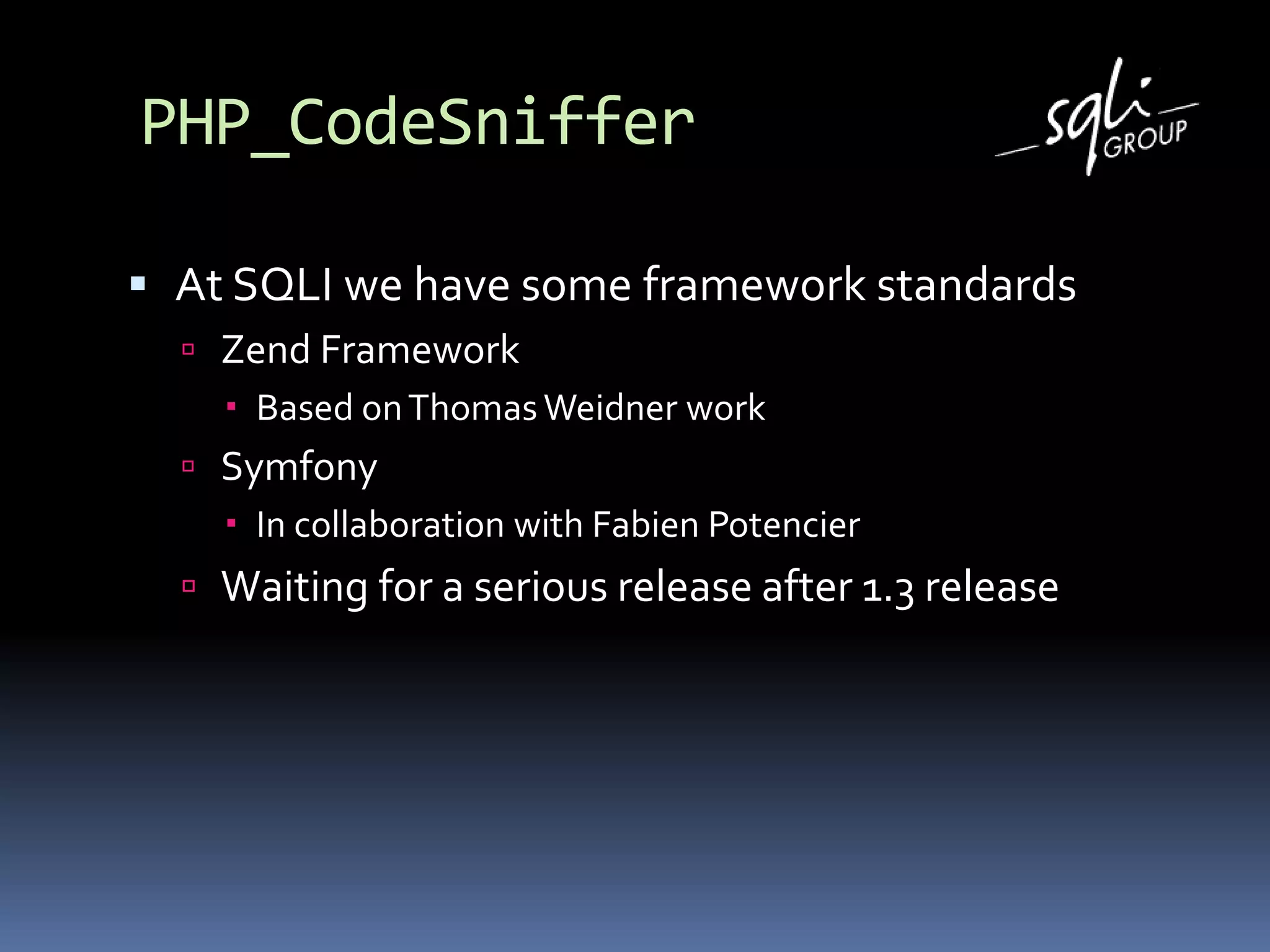
 At SQLI we have some framework standards
 Zend Framework
 Based onThomasWeidner work
 Symfony
 In collaboration with Fabien Potencier
 Waiting for a serious release after 1.3 release
PHP_CodeSniffer
 At SQLI we have some framework standards
 Zend Framework
 Based onThomasWeidner work
 Symfony
 In collaboration with Fabien Potencier
 Waiting for a serious release after 1.3 release
 That’s nice, but…
 Where are the standards for the other tools ?
 I’ld expect a Drupal,Wordpress, Cake official standard
PHP_CodeSniffer
 How far a standard can go in detection ?
PHP_CodeSniffer
 How far a standard can go in detection ?
 Interestingly far for generic PHP Code
PHP_CodeSniffer
 How far a standard can go in detection ?
 Interestingly far for generic PHP Code
 Very far if you know your tool’s structure
 Imagine for example forcing PHP alternative syntax in
Symfony views…
 Or checking for escaping in ZendViews !
PHP_Depend
 By Manuel Pichler
 Functional port of JDepend
 OO design analysis
 Metrics visualisation
 Dependency analyzer
 Works at the syntactic analysis level
PHP_Depend
 How it works
 PHP_Depend first makes an AST off your code
 A « personal » one, made by PHP objects
 ASTComment, ASTClosure, ASTEvalExpression, …
 This is made by the Builder/Parser component
 Using PHP Reflection
PHP_Depend
 How it works (2)
 Then PHP_Depend can answer questions by
« visiting » the AST
 Task of Metrics Analyzers, that extend AbstractVisitor
 IOC, the visitor decides what to do according to AST
Class : visitMethod, visitForStatement(), …
 Analyzers can fire listeners during analyze() call
 To get ongoing informations about the visit process
PHP_Depend
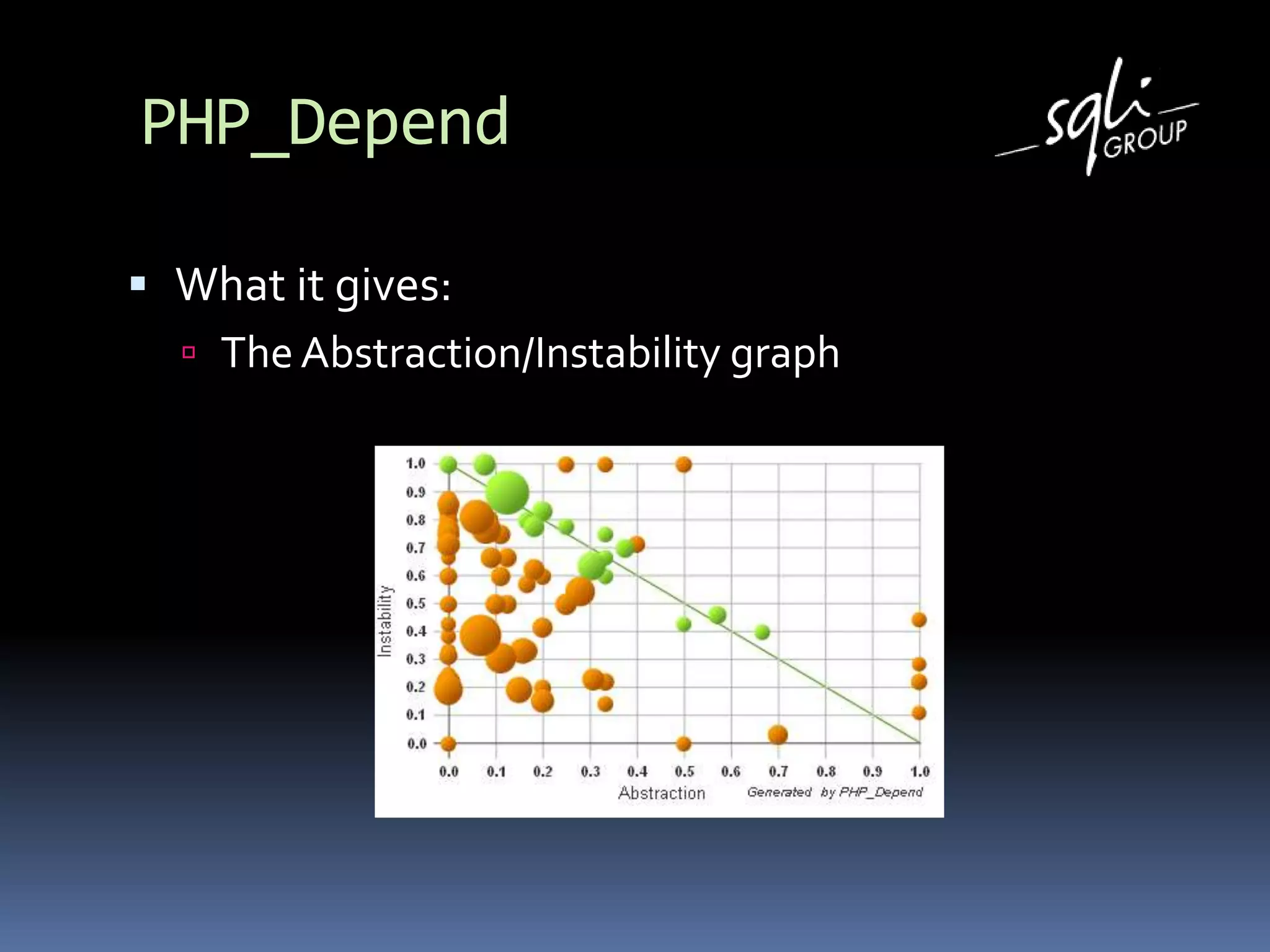
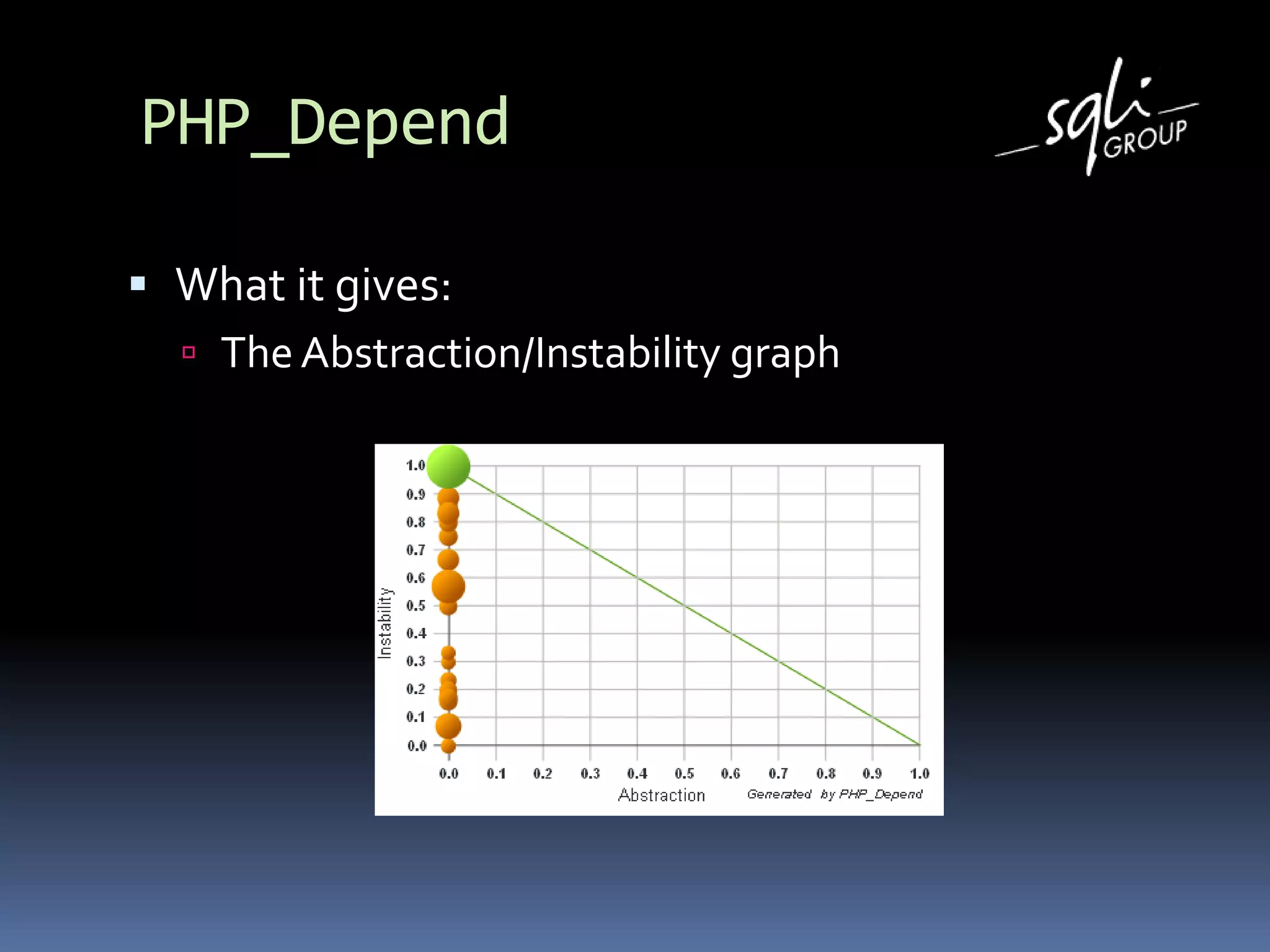
 What it gives:
 The Abstraction/Instability graph
PHP_Depend
 What it gives:
 The Abstraction/Instability graph
PHP_Depend
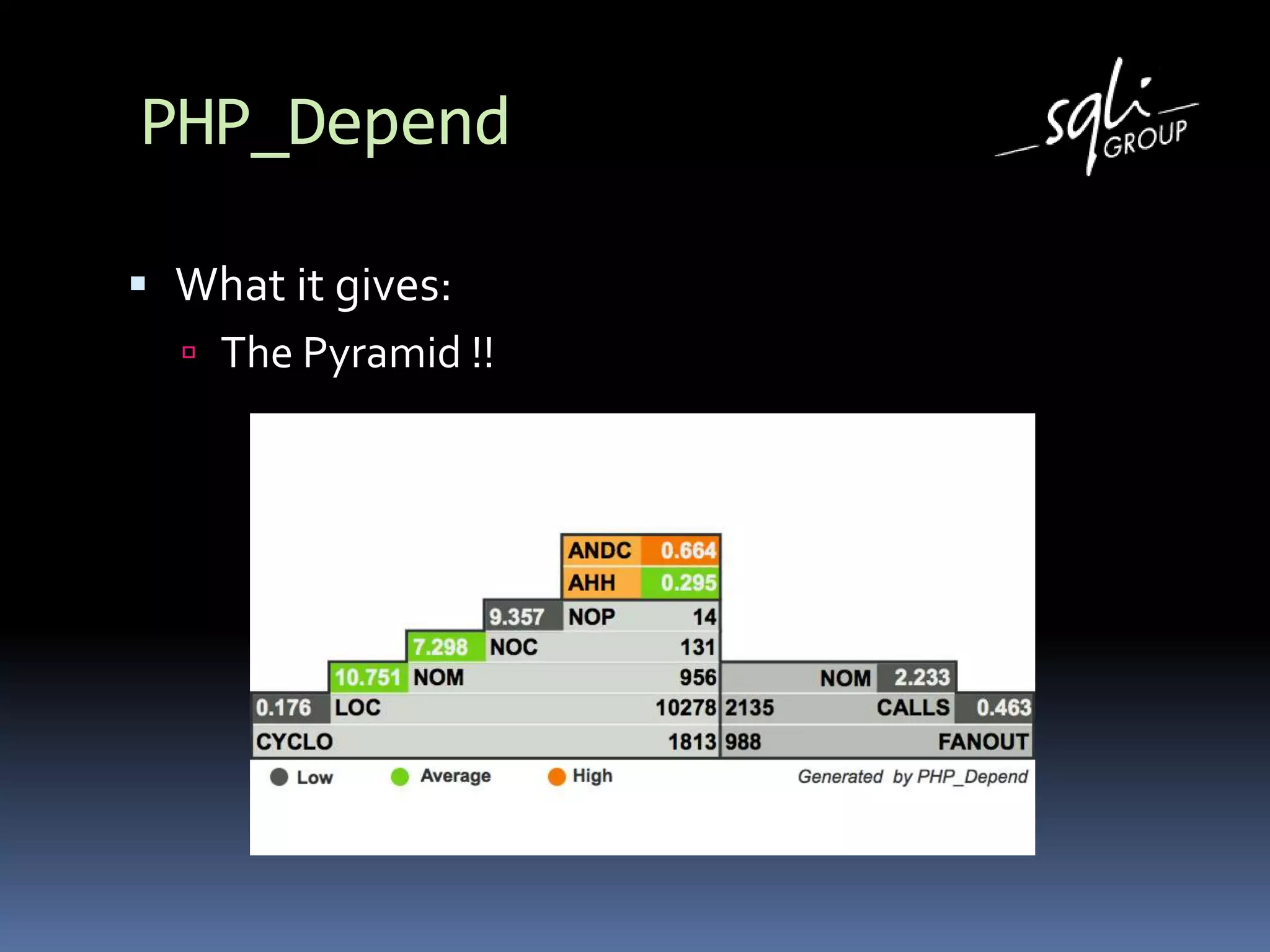
 What it gives:
 The Pyramid !!
PHPMD
 By Manuel Pichler
 Detects rules violations
 Analog to PHP_Codesniffer
 Works at syntactic analysis level
 Actually on the same AST
 Depends on PHP_Depend
 Has rulesets !
PHPMD
 What it gives:
 Code Size Rules
 complexities, lengths, too many, …
 Design Rules
 OO, exit, eval
 Naming Rules
 Too short/long identifiers, old constructors, …
 Unused Code Rules
 Methods, members, parameters
phploc
 By Sebastian Bergmann
 Simple tool to give basic metrics
 Fast, direct to the goal
 Works mostly on lexical level
 But use bytekit for ELOC if it can
phpcpd
 By Sebastian Bergmann
 Simple tool to detect duplicated code
 Works at lexical analysis level
 Use the tokenizer to minimize differences
 Comments, whitespaces, …
 Takes a minimum number of lines and tokens
 Encodes according to this
 Uses an hash table to find duplicates
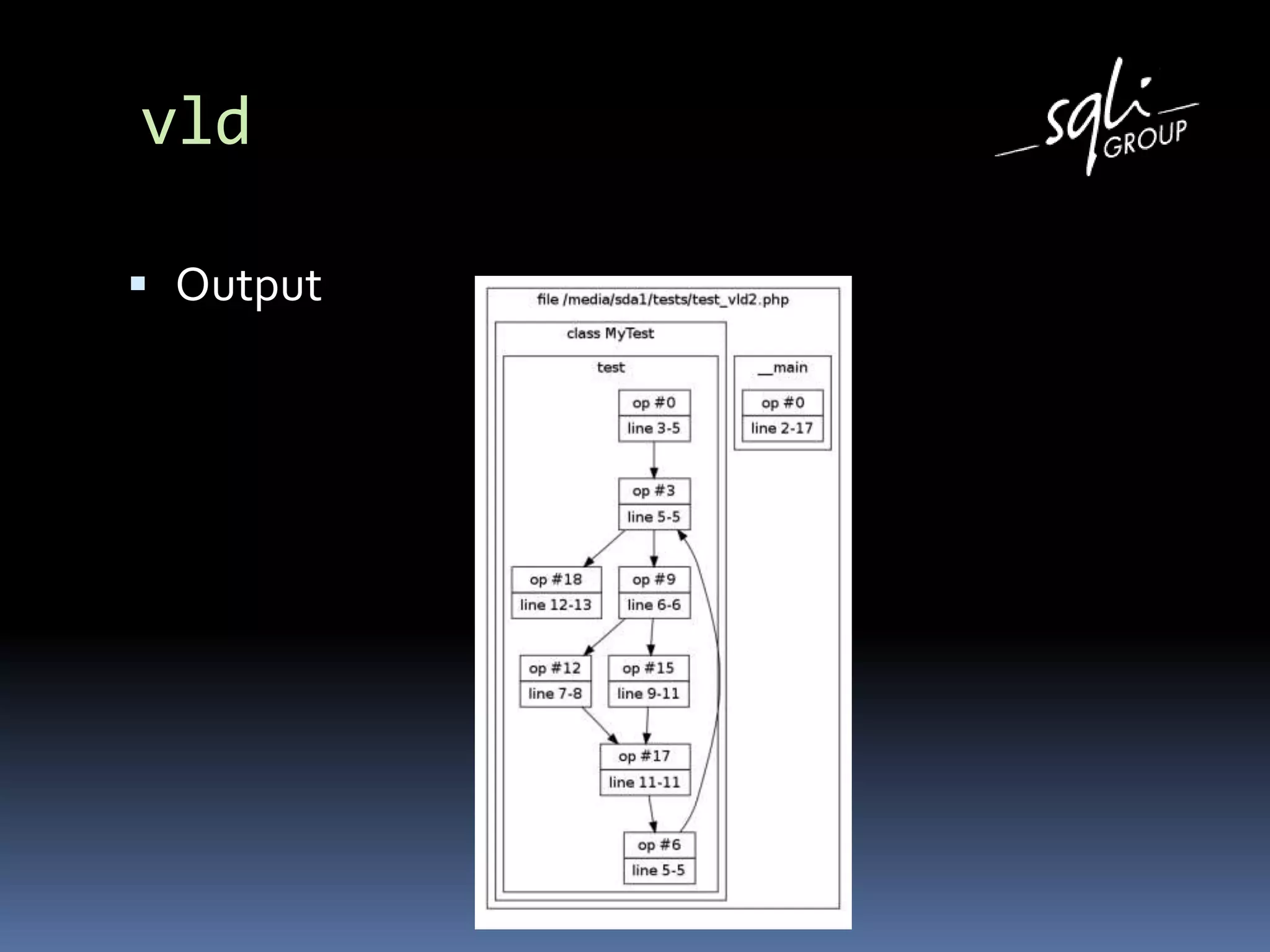
vld
 Vulcan Logic Disassembler
 By Derick Rethans
 Works at bytecode level
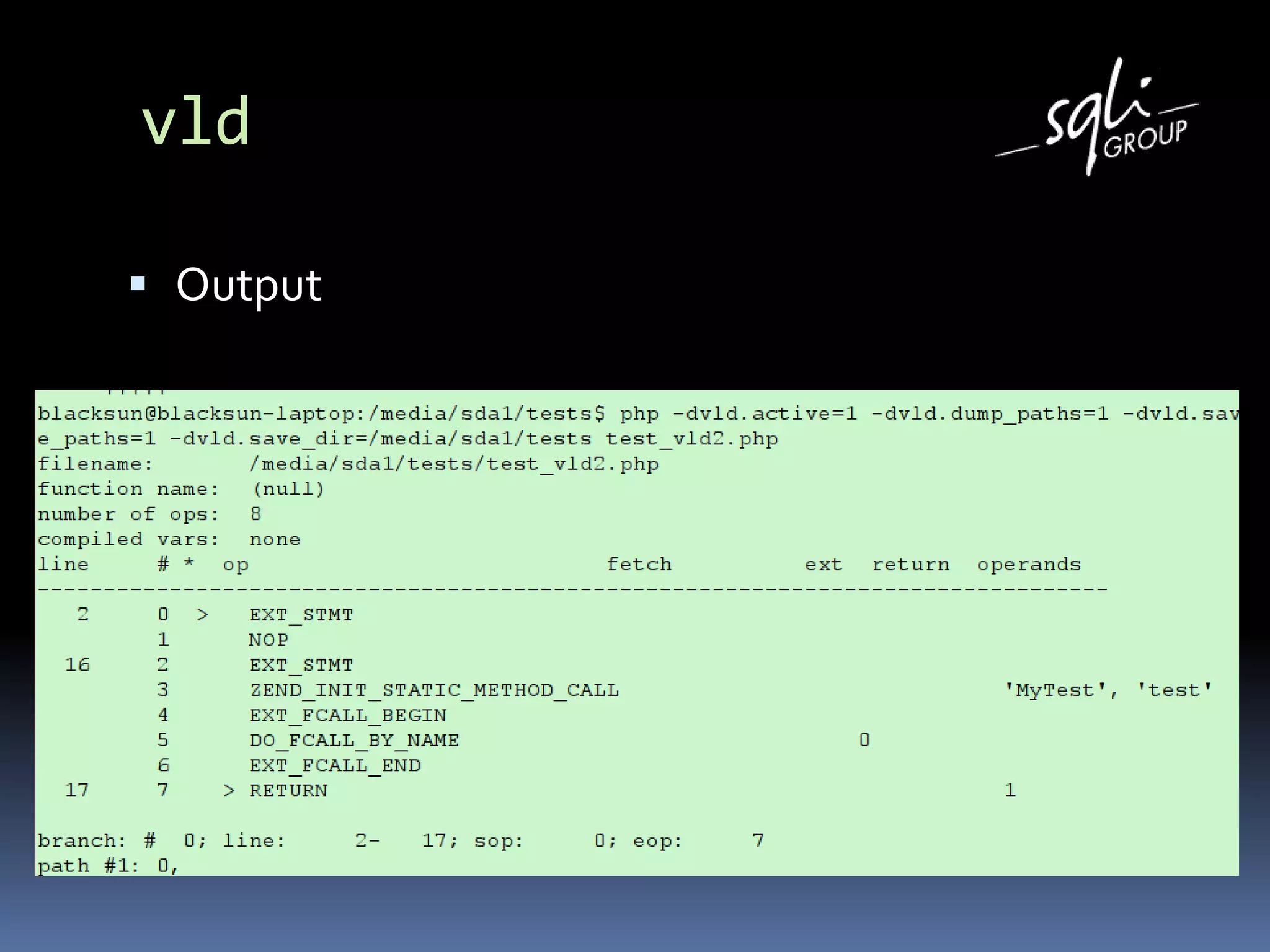
 Shows generated bytecodes
 Calculates possible paths (CFG)
 Find unreachable code
 Could be used for code coverage path metrics
vld
 Output
vld
 Output
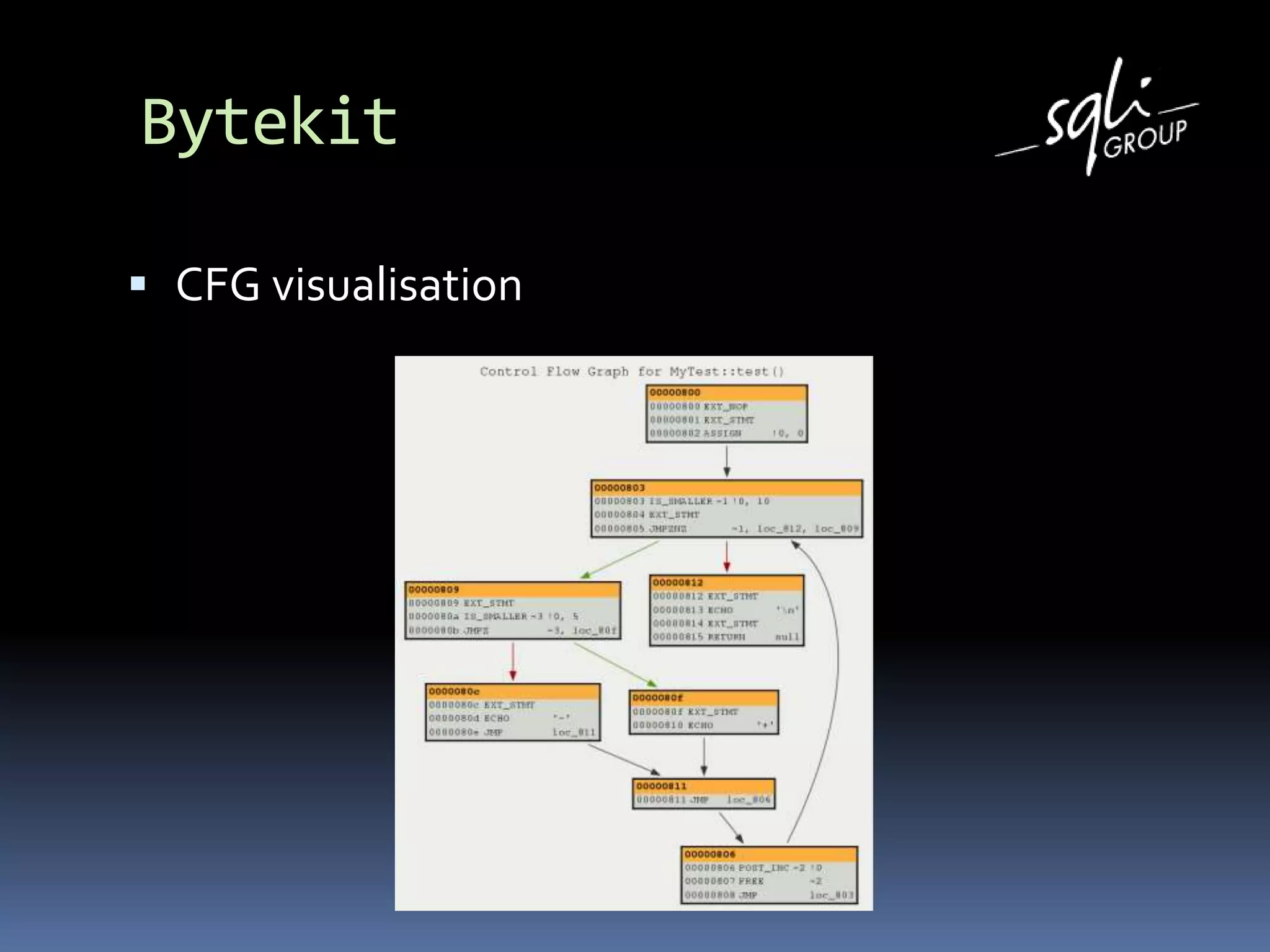
Bytekit
 By Stefan Esser (SektionEins)
 Works at … bytecode level
 Similar to vld
 Exposes opcodes to a PHP array
 bytekit_disassemble_file($filename)
 Can be used directly for a custom script
Bytekit
 CFG visualisation
Bytekit-cli
 By Sebastian Bergmann
 PHP Interface to use bytekit to spot violation rules
 Initial state
 Implemented rules :
 Check for disallowed opcodes (example eval, exit)
 Check for direct output of variables
 In svn, check for unescaped ZendView
Padawan
 By Florian Anderiasch
 Focus on anti-pattern detection
 alpha (?)
 Works on syntactic analysis level
 Based on PHC (PHP compiler)
 Use an XML dump of the AST PHC generates
 Makes xpath searches on it
Padawan
 Interesting approach
 Rules are fairly simple to write
 Already many interesting tests :
 Empty constructs (if, else, try,..), unsafe typecasts, loop
repeated calls, unused keys in foreach, …
 PHC not easy to install
 Risk on PHC manteinance
Phantm
 By Etienne Kneuss
 Highly experimental
 Severe limitation on PHP dynamic features
 False positives
 Works on syntax analysis level
 Based on Java tools (Jflex, CUP, Scala)
 Reports violations
 Non top-level declarations, call-time pass-by-ref, nontrivial
include calls, assign in conditional, …
 Exploring Type FlowAnalysis
 Tries to infer types and check for type safety
Conclusion
 Use the right tool for the right job
 Coding style is better analysed at the lexical level
 OO design is better viewed after syntactic analyses
 Unreachable code after bytecoding
 Contribute !
 Plenty of things still to implement
 Easy to have new ideas
 At least use them (you should!) and give feedback
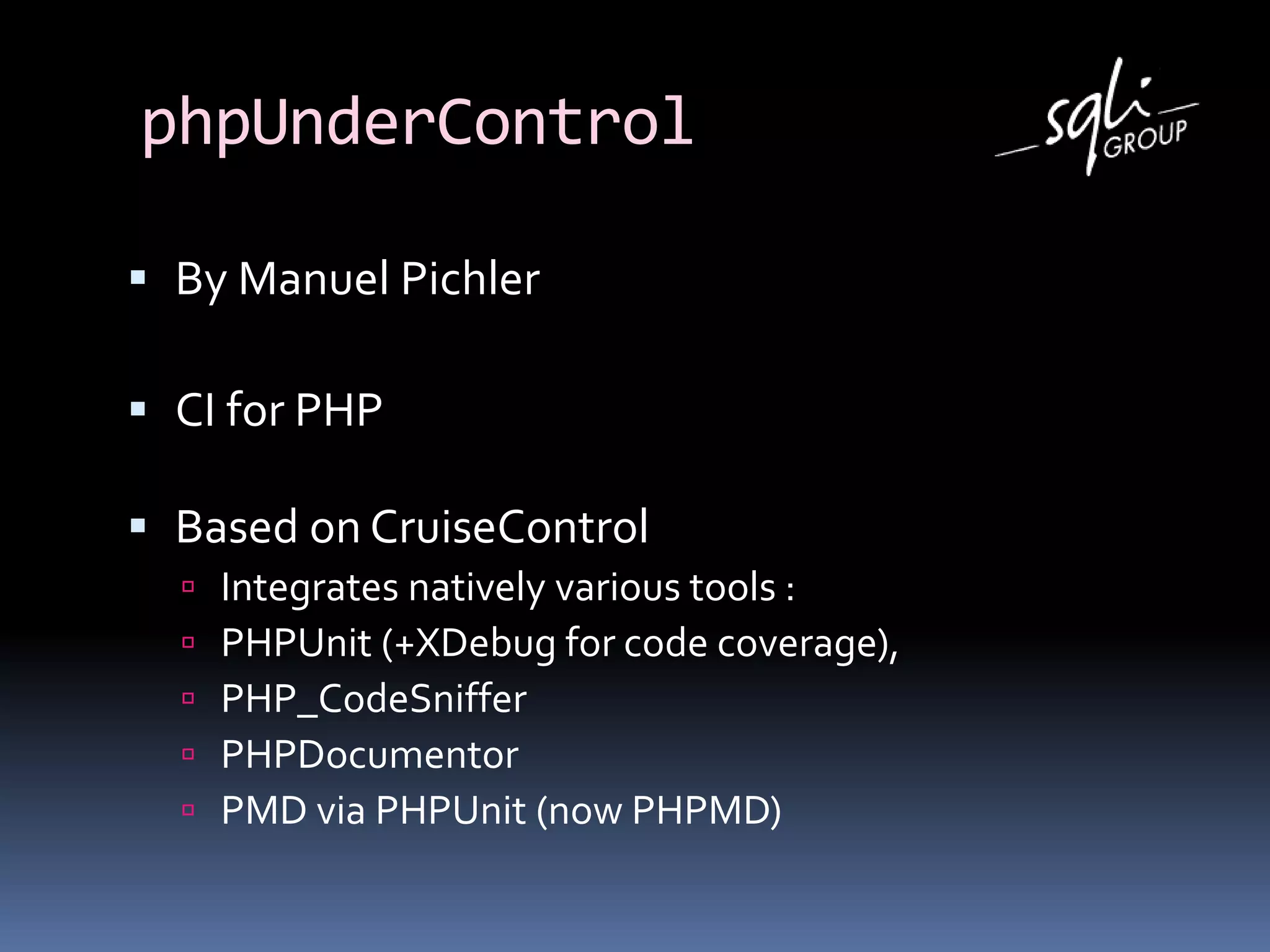
Restitution
 Once all this is collected what to do with it ?
 At least, show it in a suitable form
 At best, integrate this in your CI system
phpUnderControl
 By Manuel Pichler
 CI for PHP
 Based on CruiseControl
 Integrates natively various tools :
 PHPUnit (+XDebug for code coverage),
 PHP_CodeSniffer
 PHPDocumentor
 PMD via PHPUnit (now PHPMD)
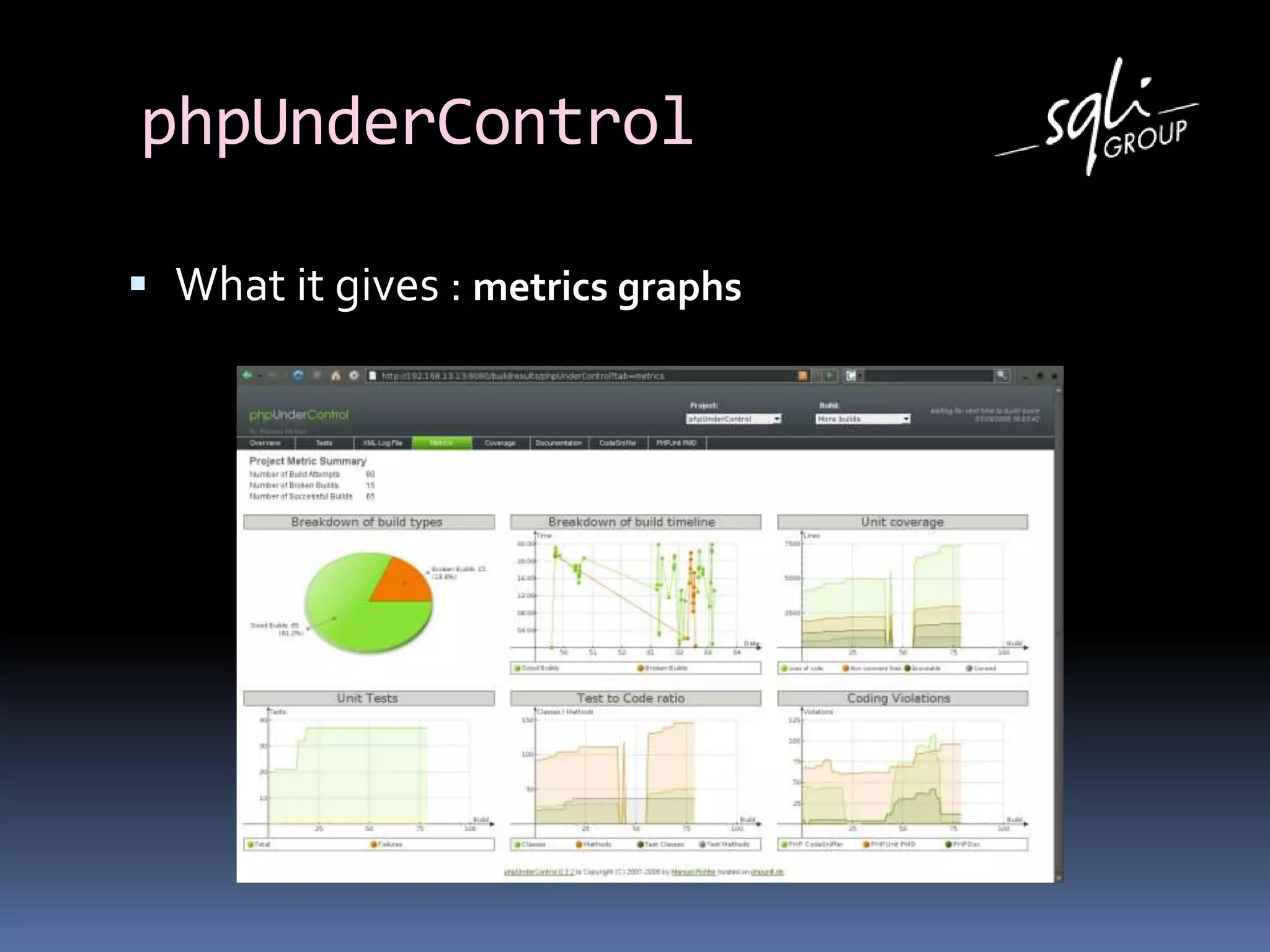
phpUnderControl
 What it gives : metrics graphs
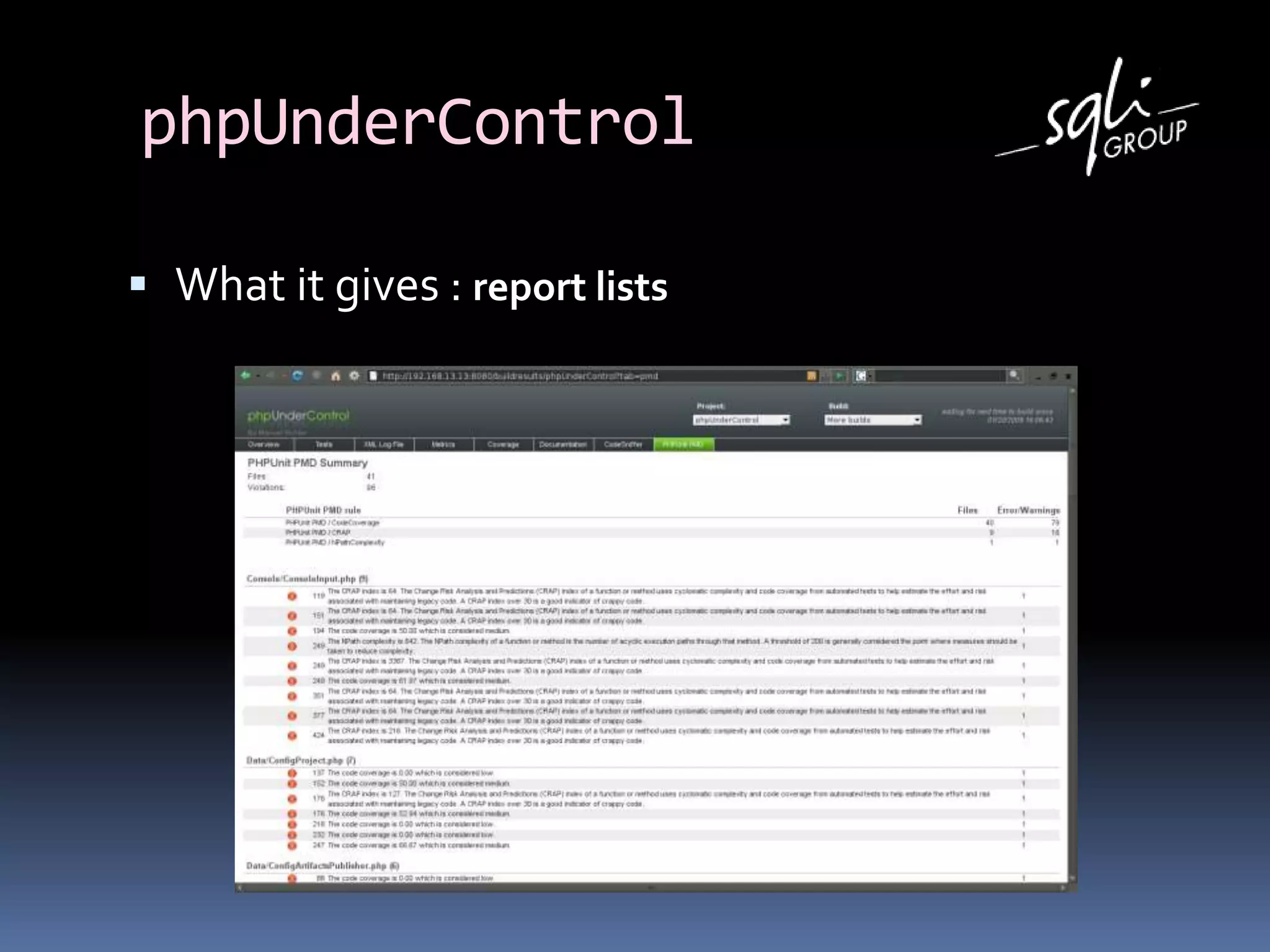
phpUnderControl
 What it gives : report lists
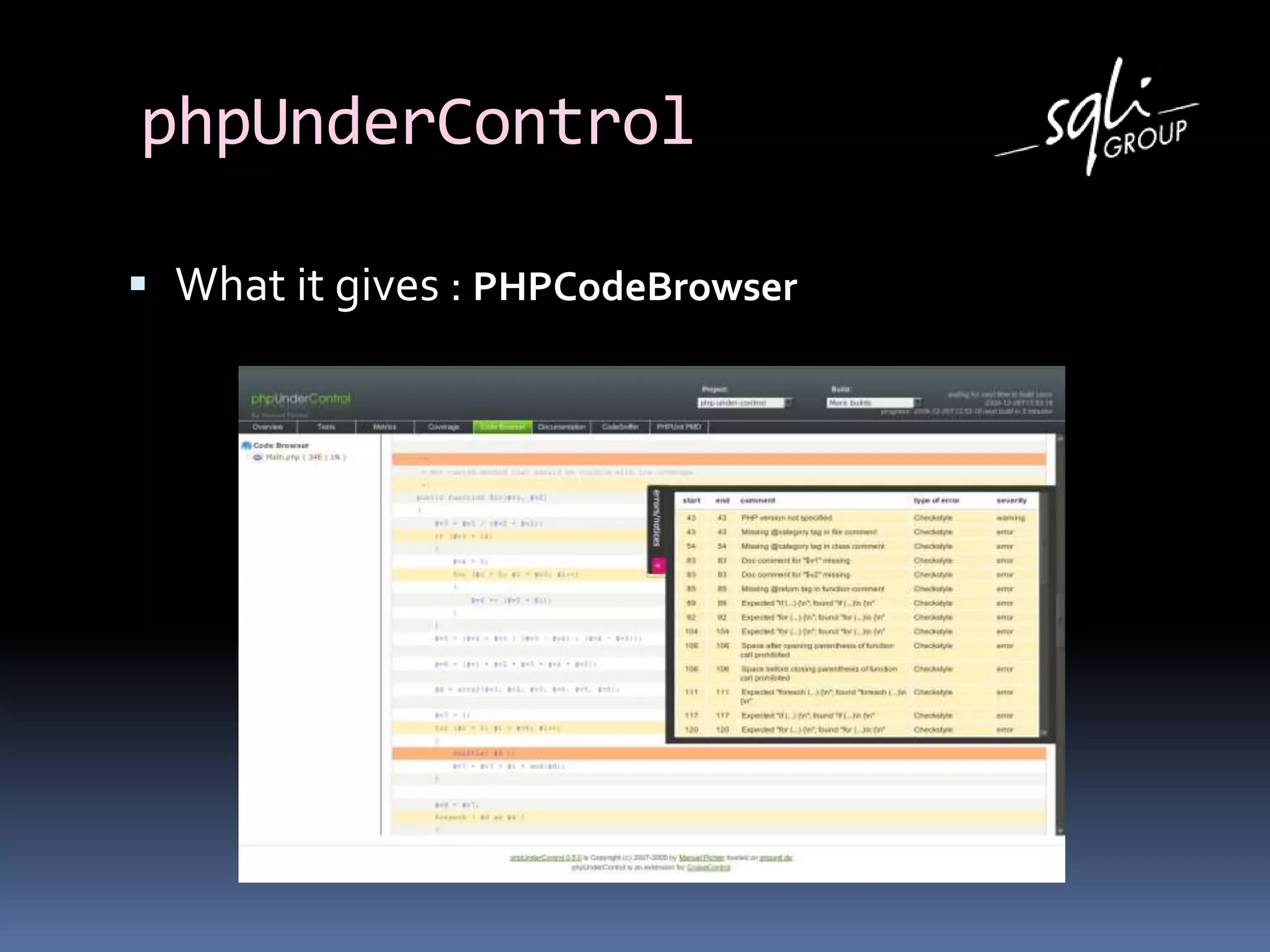
phpUnderControl
 What it gives : PHPCodeBrowser
Arbit
 By Qafoo (with Manuel Pichler)
 Basically a project multi-services tool
 Ticketing system
 Repository browser
 Continuous integration
 As Manuel is in it, some graphical
presentations are unique for this tool
 Still alpha
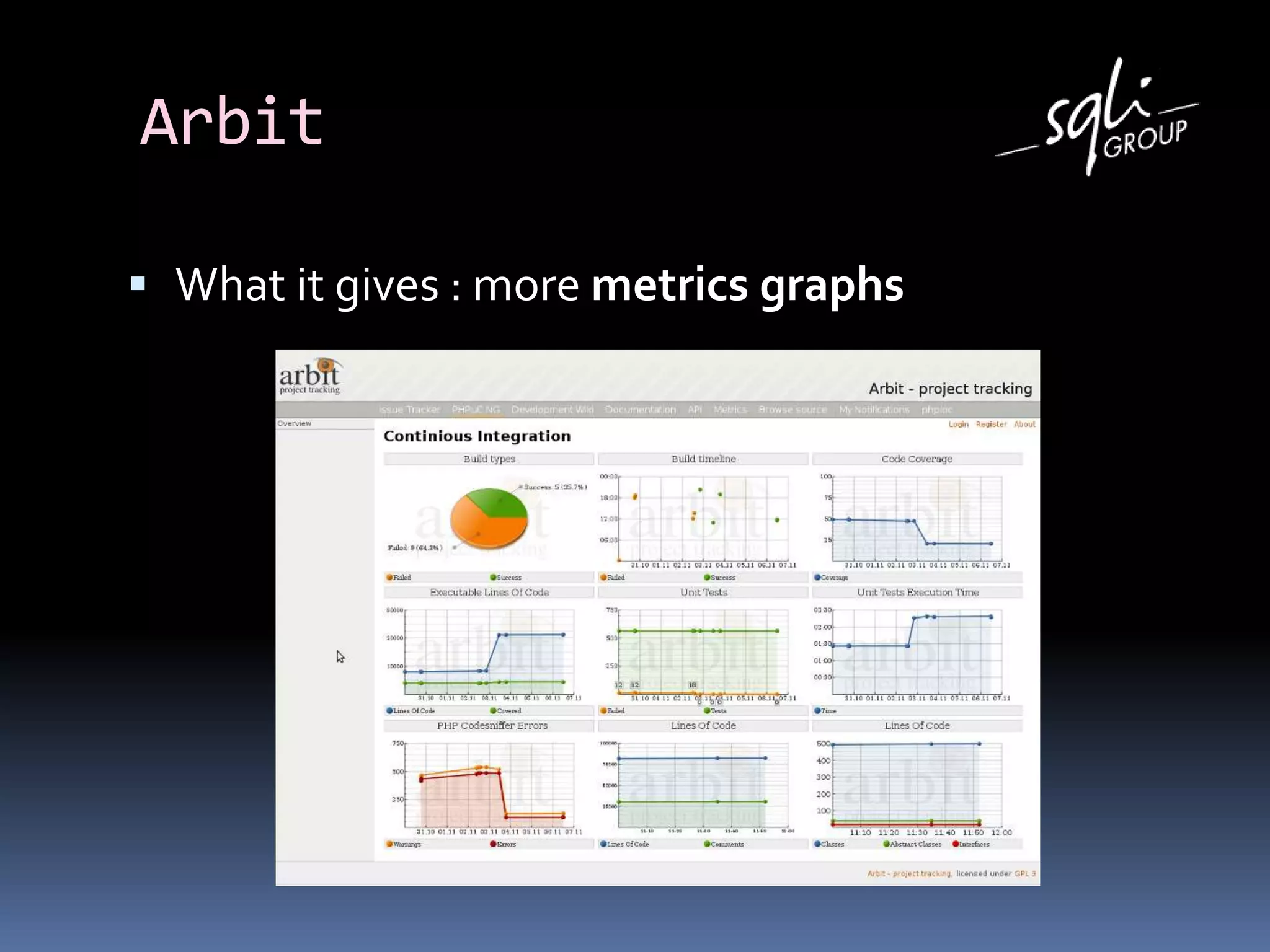
Arbit
 What it gives : more metrics graphs
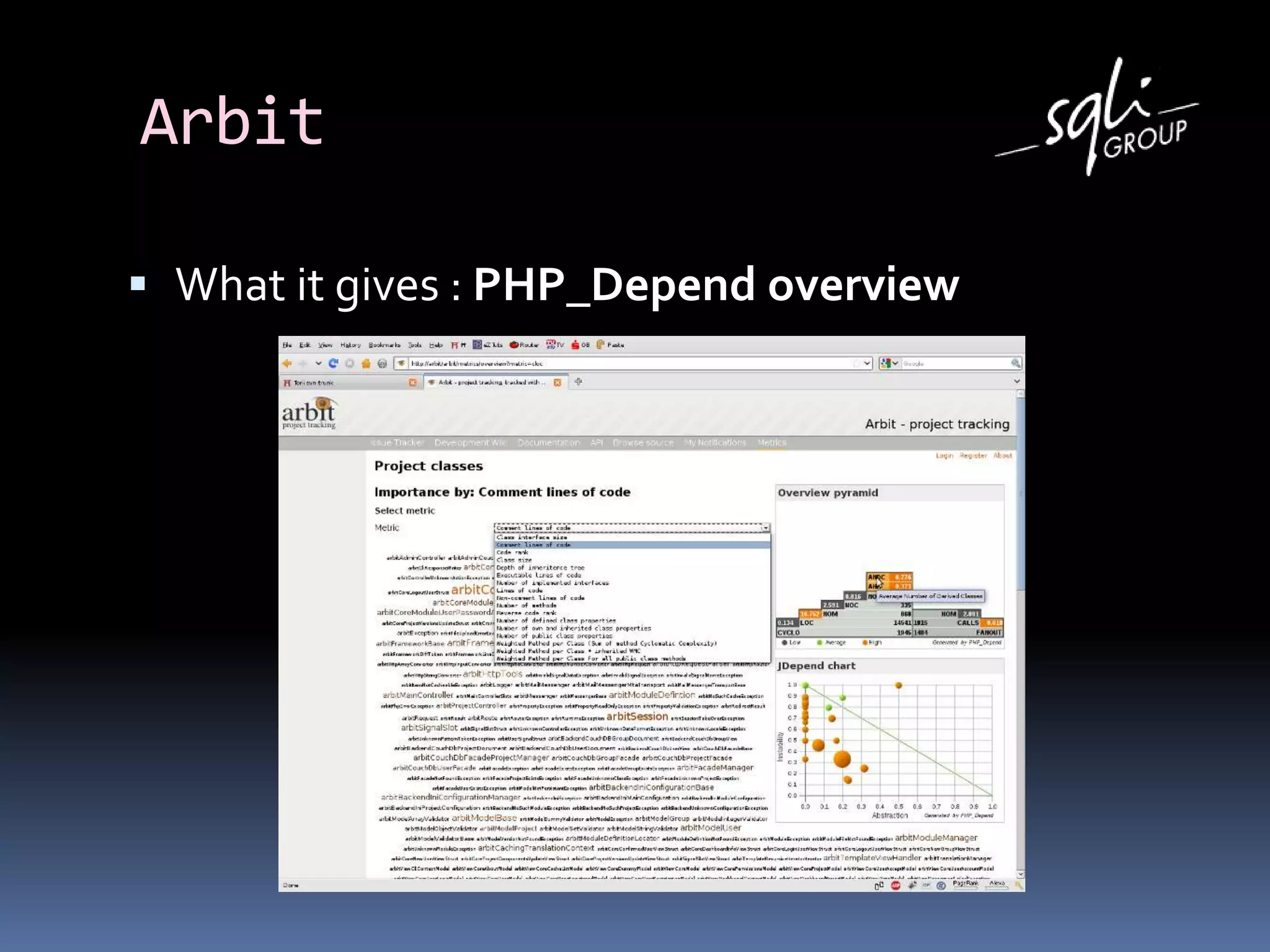
Arbit
 What it gives : PHP_Depend overview
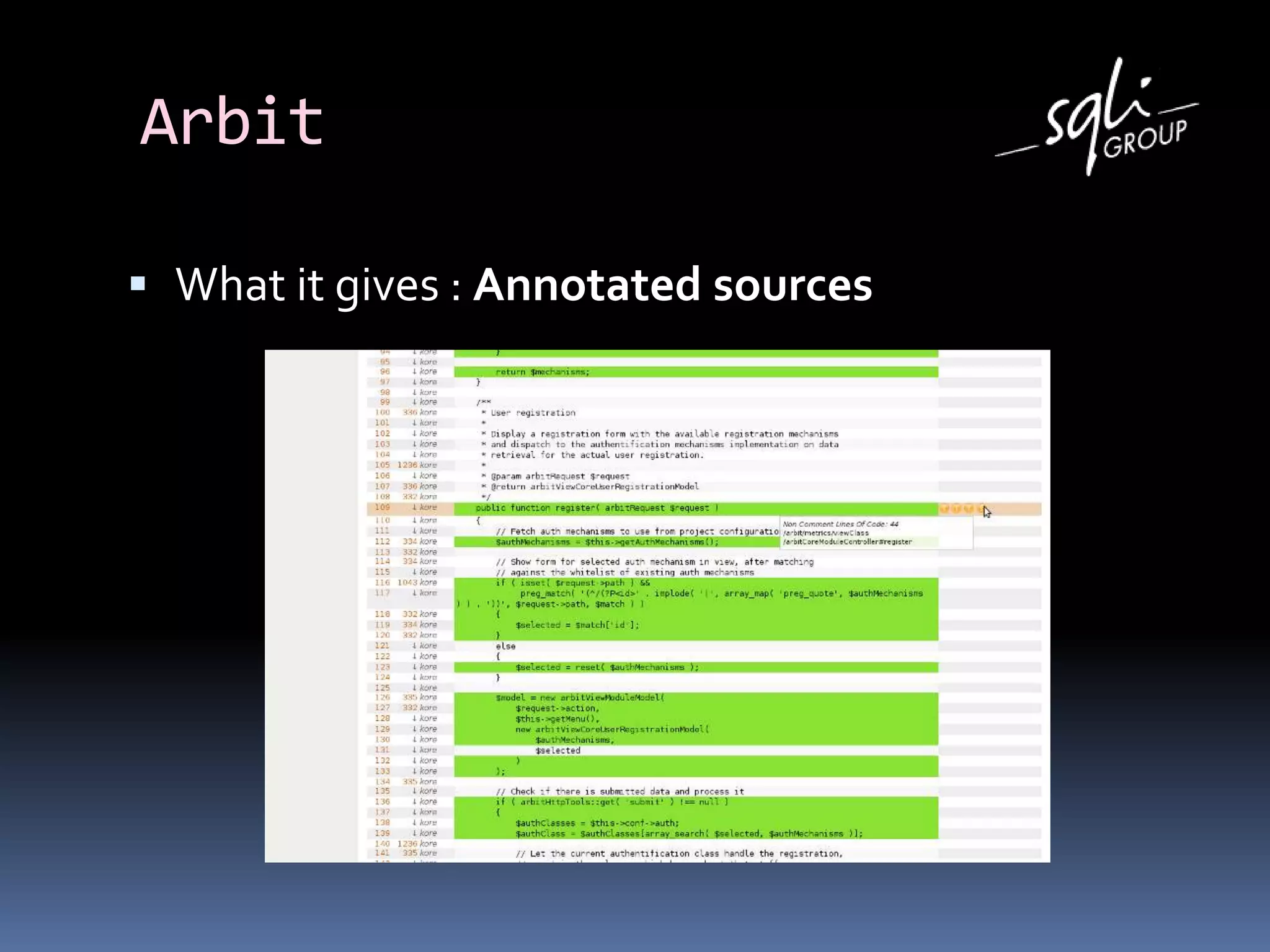
Arbit
 What it gives : Annotated sources
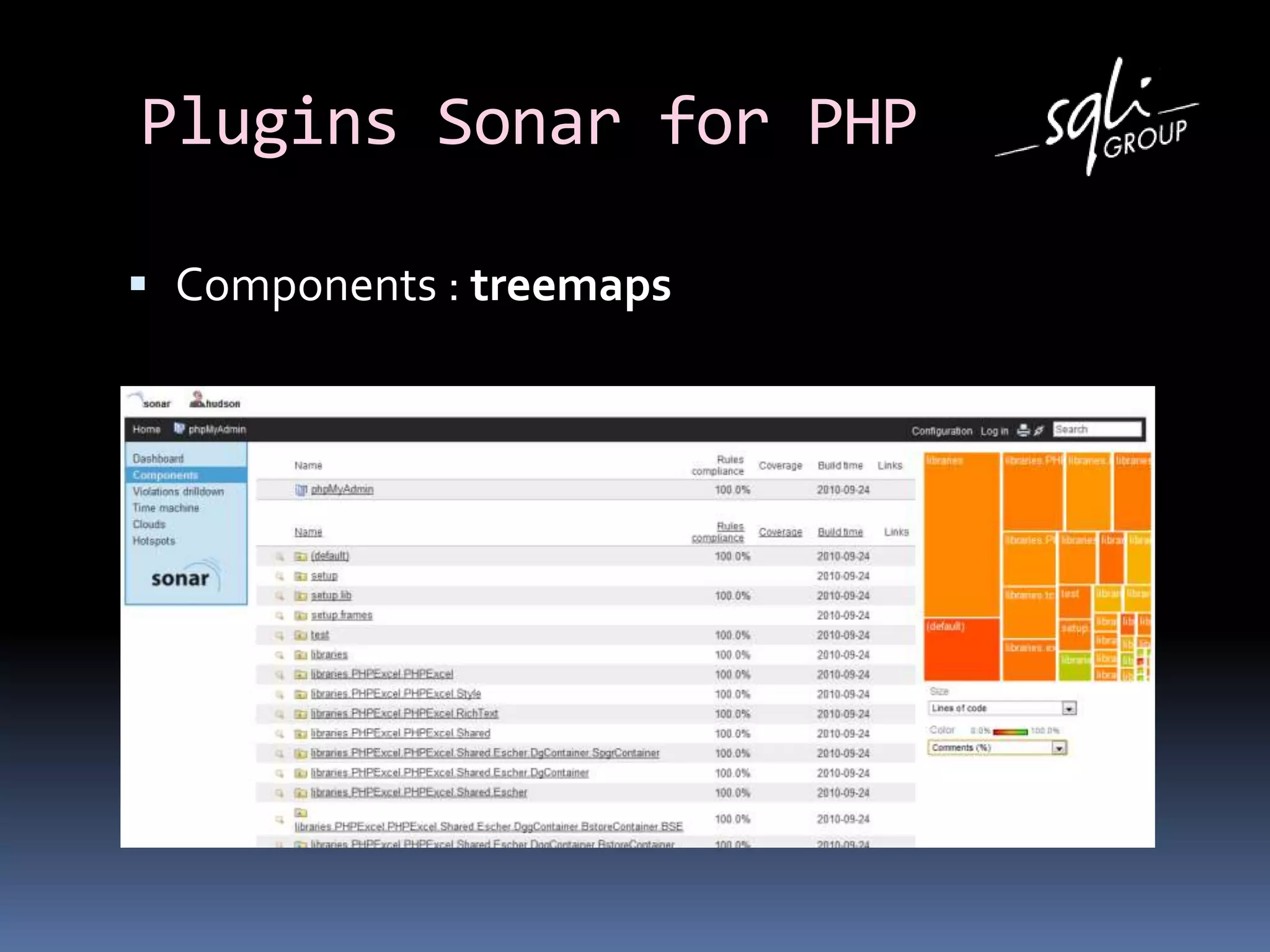
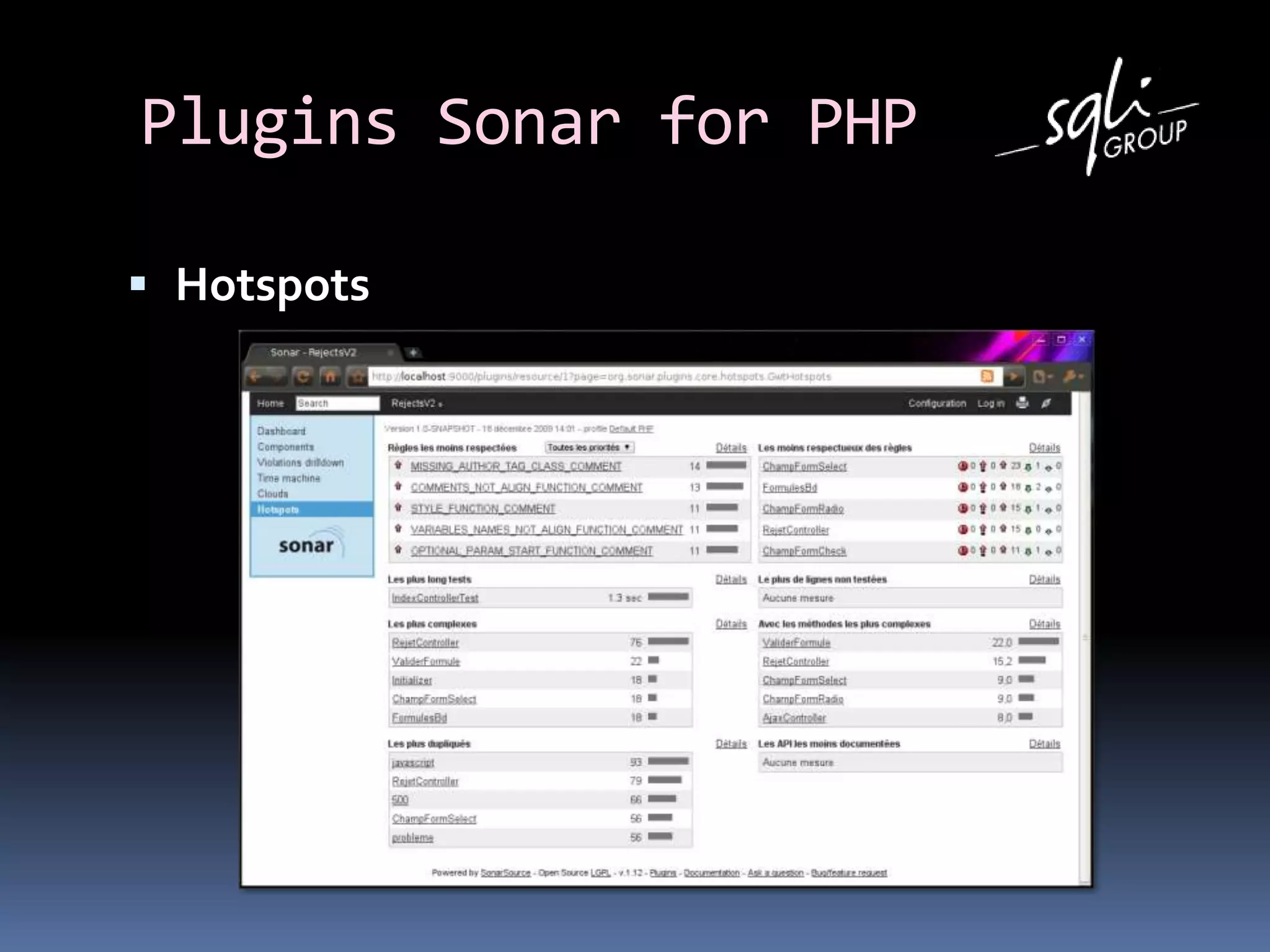
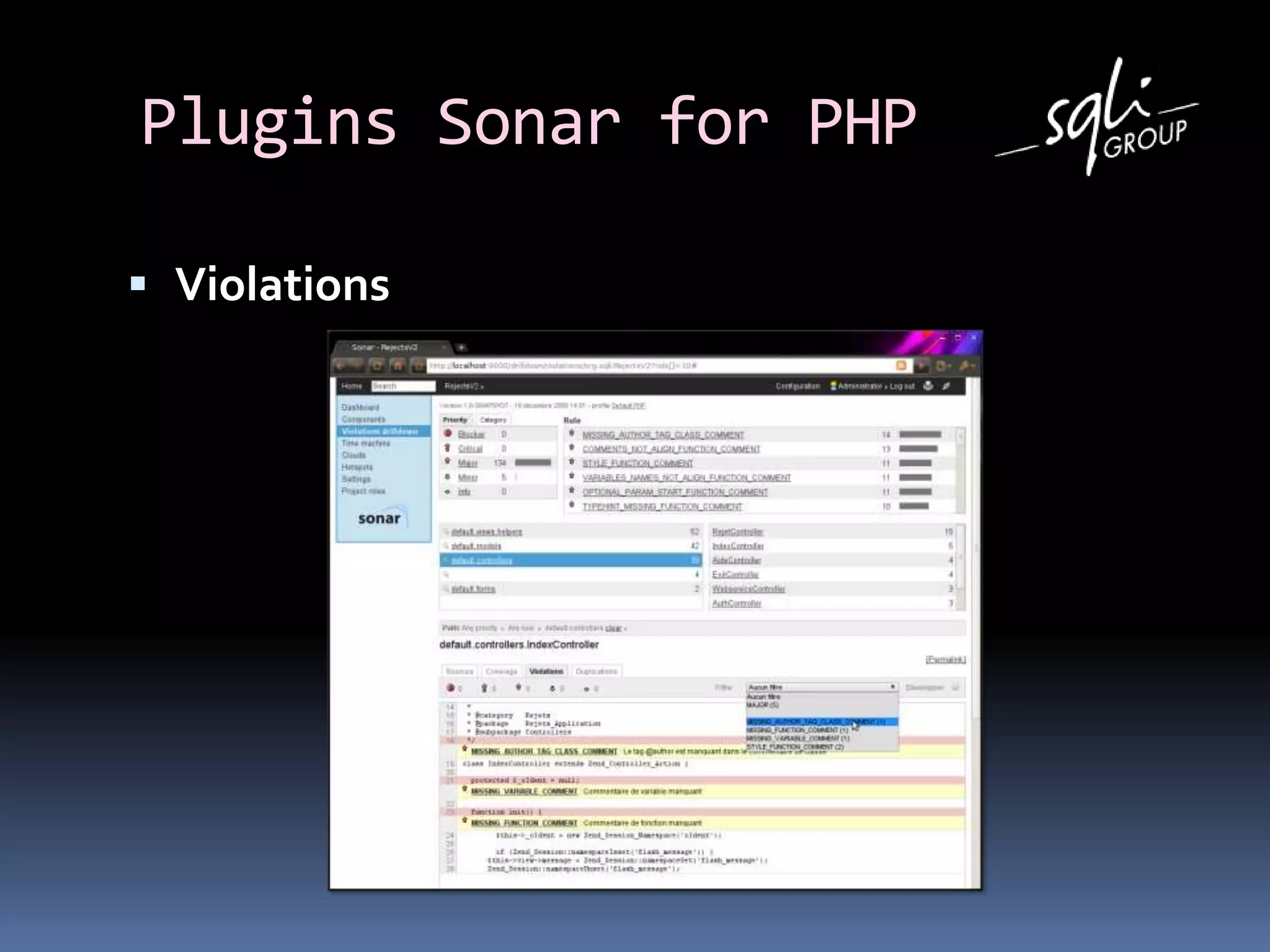
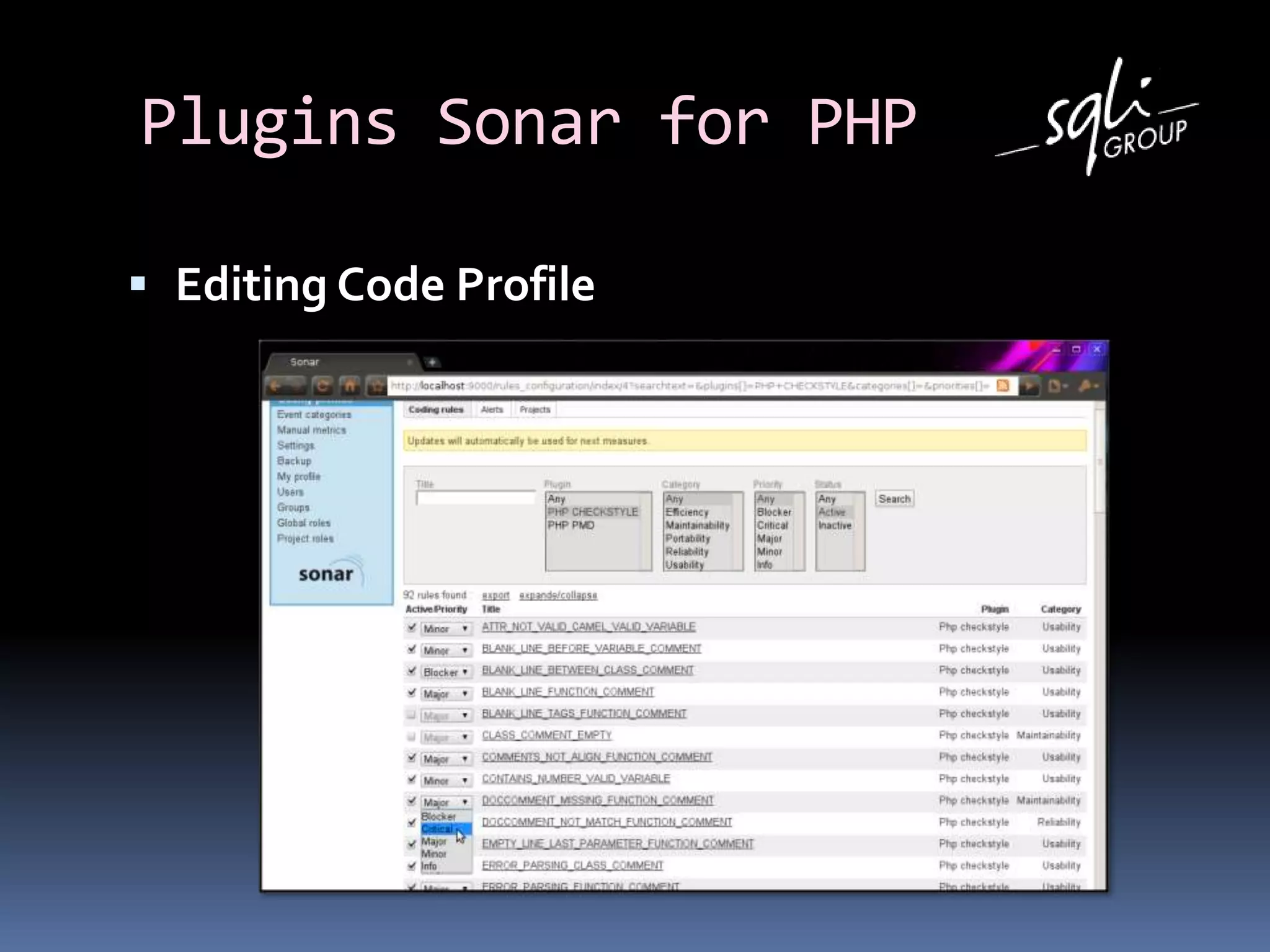
Plugins Sonar for PHP
 By me 
 Really by the Java guys at SQLI
 Frédéric Leroy, Akram Ben Aissi, JérômeTama
 Sonar is the state of the art for Open Source QA
Reporting in Java
 Thought for multilanguage
 Can easely integrate all PHP reportings ported from
Java tools
 Junit => PHPUnit
 JDepend => PHPDepend
 Java PMD => PHPMD
Plugins Sonar for PHP
 Ok, not always so easely
 CheckStyle is not PHP_CodeSniffer
 Formats are not identical
 Multi-language doesn’t mean no work to add one
 First release on May 2010
 0.2 Alpha state, but workable
 Easy to install : give it a try !
 Last version demo : sonar-php.sqli.com
 Ok, enough, here are the screenshots
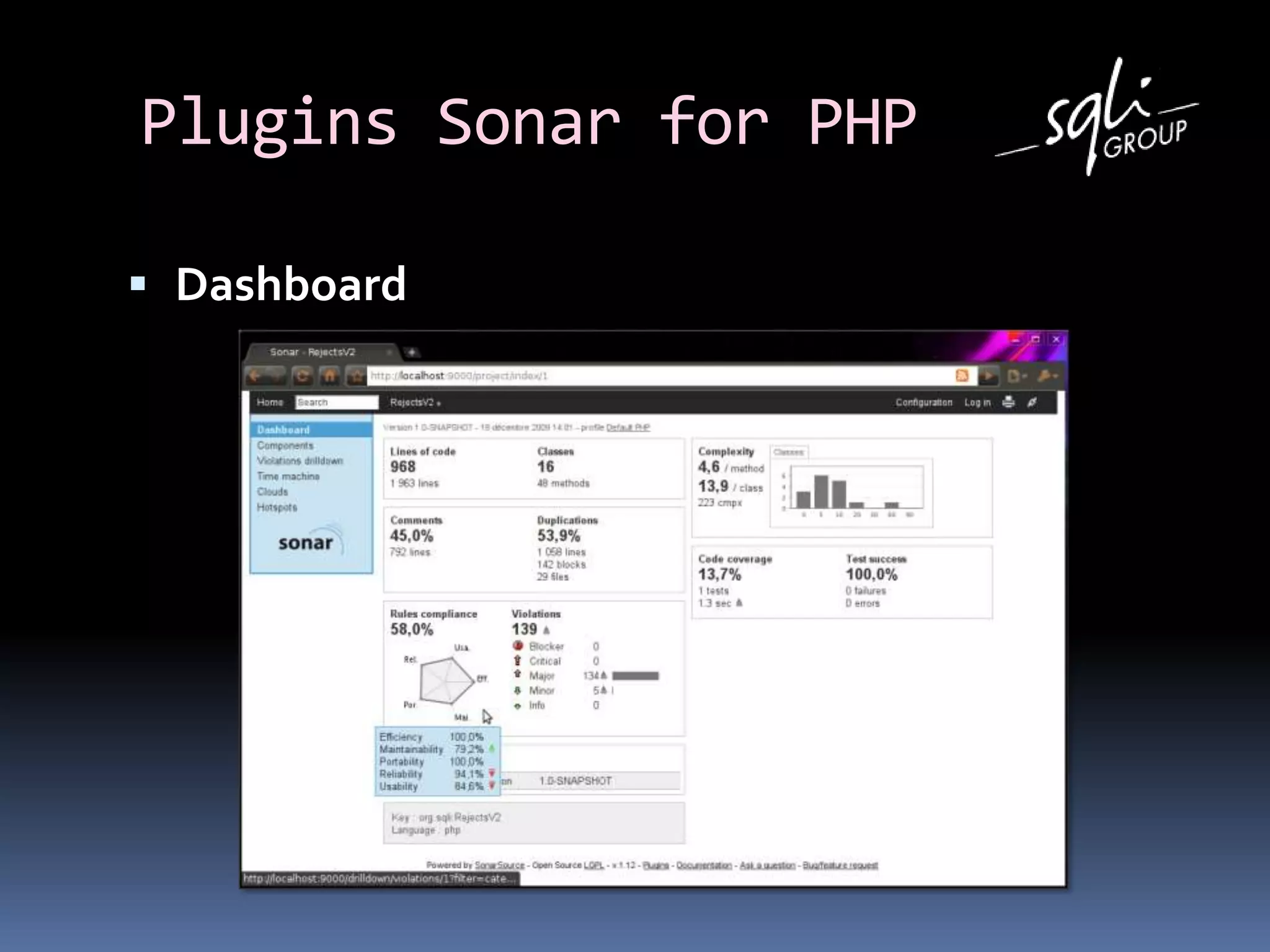
Plugins Sonar for PHP
 Dashboard
Plugins Sonar for PHP
 Components : treemaps
Plugins Sonar for PHP
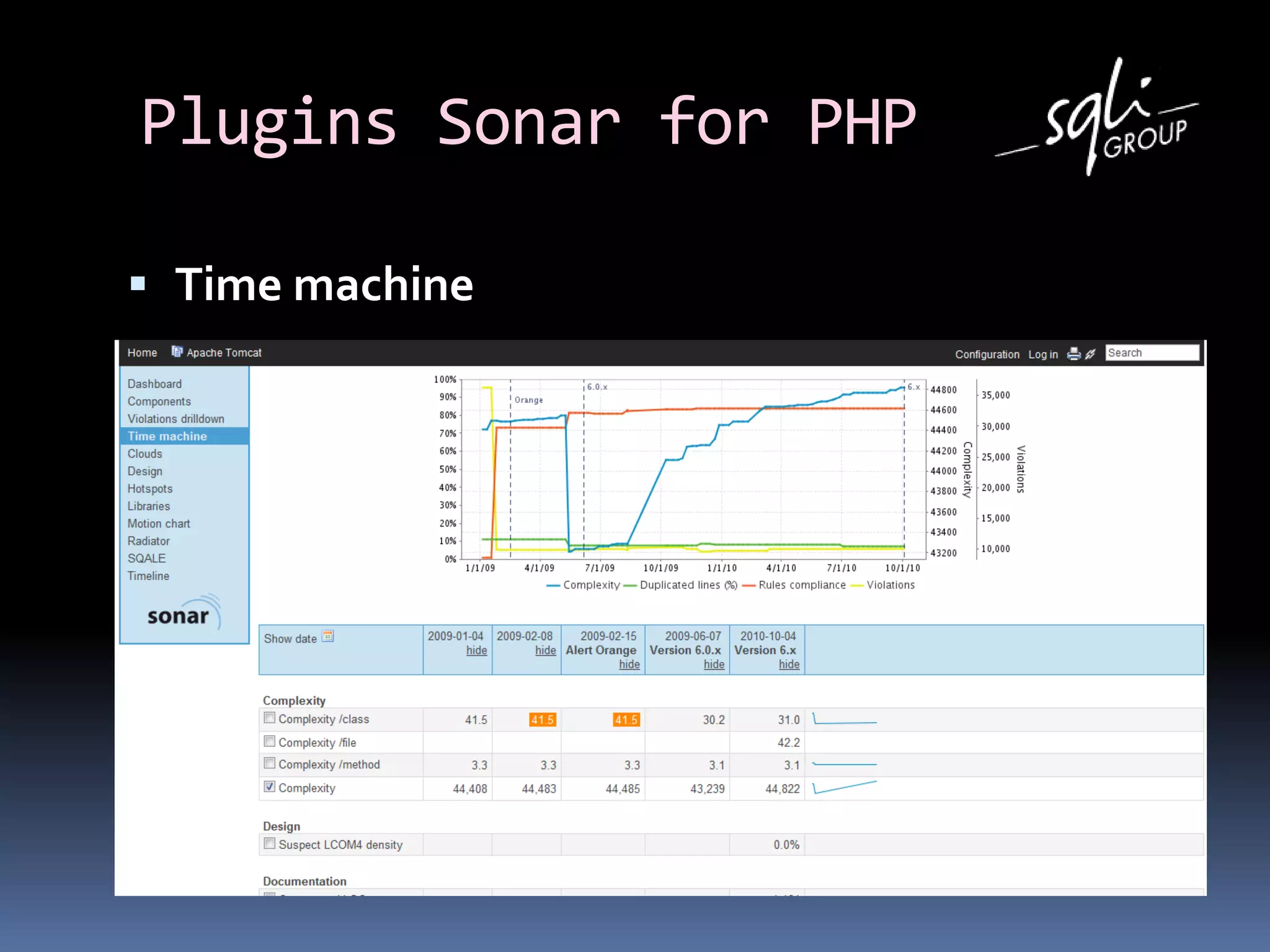
 Time machine
Plugins Sonar for PHP
 Hotspots
Plugins Sonar for PHP
 Violations
Plugins Sonar for PHP
 Editing Code Profile
Conclusion
 Sonar really goes further
 Best integrates with Hudson
 Still is java…
 But SonarSource really cooperates
 How to interact with phpUnderControl, Arbit ?
 (actually our solution – PIC PHP SQLI- is based on
phpUC + Sonar)
 This needs to evolve

Listen afup 2010

  • 1.
    LISTEN AND LOOK ATYOUR PHP CODE! Gabriele Santini Forum AFUP 2010
  • 2.
    Gabriele Santini  Architect/Consultantat SQLI  Contributor to PHP_CodeSniffer  So expect a special focus on this…  Sonar PHP Plugin  I have to show you!  Ex-mathematician :  love business modelling  love architectures  love quality assurance
  • 3.
    Static Analysis  Allyou can say about your program without actually execute the code  The rest is also interesting, let’s talk about it another time !  Examples ?  Syntax check, coding style, anti-patterns, metrics, OO design analysis, …  What PHP does before executing the code ?
  • 4.
    Levels of analysis Lexical analysis  Read sources linearly searching for known patterns  Convert them to a sequence of tokens
  • 5.
    Levels of analysis Lexical analysis  Read sources linearly searching for known patterns  Convert them to a sequence of tokens  Syntactic Analysis  Parse the tokens to find their logical structure
  • 6.
    Levels of analysis Lexical analysis  Read sources linearly searching for known patterns  Convert them to a sequence of tokens  Syntactic Analysis  Parse the tokens to find their logical structure  Opcode (Bytecode) Generation  Generates an intermediary code that the Zend Engine will be able to execute
  • 7.
    Lexical Analysis  Tokenizer1 <?php T_OPEN_TAG 2 if T_IF 2 T_WHITESPACE ( 2 1 T_LNUMBER 2 T_WHITESPACE < 2 T_WHITESPACE 2 2 T_LNUMBER ) 2 T_WHITESPACE { 2 T_WHITESPACE 3 echo T_ECHO 3 T_WHITESPACE 3 "Hello" T_CONSTANT_ENCAPSED_STRING ; 3 T_WHITESPACE } 4 T_WHITESPACE 5 ?> T_CLOSE_TAG <?php if (1 < 2) { echo "Hello"; } ?>
  • 8.
    Syntactic Analysis  Producesan AST  Abstract SyntaxTree  Decompose code in a tree-like form  Can be executed once a context is given  Used in compilers
  • 9.
  • 10.
    Opcodes Generation  Misterytool… line # * op return operands -------------------------------------------------- 2 0 > EXT_STMT 1 IS_SMALLER ~0 1, 2 2 > JMPZ ~0, ->6 3 3 > EXT_STMT 4 ECHO 'Hello' 4 5 > JMP ->6 6 6 > EXT_STMT 7 > RETURN 1 <?php if (1 < 2) { echo "Hello"; } ?>
  • 11.
    GIVE US THETOOLS !
  • 12.
    PHP_CodeSniffer  By GregSherwood  PEAR library  Venerable project  Code Style  But also a lot more  Works at lexical analysis level  Heavily use the tokenizer extension
  • 13.
  • 14.
    PHP_CodeSniffer  Sniffs  Classesthat detectViolations  One or more type per class  Grouped in folders by subject:  Commenting, Formatting,WhiteSpace  Files, ControlStructures, Strings  Functions, Classes, NamingConventions  CodeAnalysis, Metrics  You can create your own!
  • 15.
    PHP_CodeSniffer  Standards  Setsof Sniffs that define your coding style  Installed :  PEAR,  Generic,  Zend*,  Squiz, MySource  PHPCS
  • 16.
    PHP_CodeSniffer 1.3  RulesetsXML! <ruleset name="MyPEAR"> <description>A variation of the PEAR coding standard.</description> <!-- Include some additional sniffs from the Generic standard --> <rule ref="Generic.Functions.FunctionCallArgumentSpacing"/> <message>Please review spacing in function ‘%s’</message> </rule> <rule ref="Generic.NamingConventions.UpperCaseConstantName"/> <!-- Lines can be 90 chars long, but never show errors --> <rule ref="Generic.Files.LineLength"> <properties> <property name="lineLimit" value="90"/> <property name="absoluteLineLimit" value="0"/> </properties> </rule> <!– Not so important for us --> <rule ref="Generic.PHP.DisallowShortOpenTag"> <severity>2</severity> </rule> </ruleset>
  • 17.
    Inside PHP_CodeSniffer  Sniffclass main methods  register()  Make the sniff a listener for the declared tokens  process($phpcsFile, $stackPtr)  Called by the file during parsing when a declared token is found  File  Represents a parsed file  Holds the tokens structure and offers convenience methods
  • 18.
    Inside PHP_CodeSniffer  Lifeof a Sniff  DisallowMultipleStatementsSniff <?php echo $y; $x = 10; echo $y; for ($i = 1; $i < $length; $i++) { echo 'x'; } echo $x; $y = 2;; $this->wizardid = 10; $this->paint(); echo 'x'; ?>
  • 19.
    Inside PHP_CodeSniffer  Lifeof a Sniff  DisallowMultipleStatementsSniff public function register() { return array(T_SEMICOLON); } public function process($phpcsFile, $stackPtr) { […]
  • 20.
    Inside PHP_CodeSniffer  Lifeof a Sniff  DisallowMultipleStatementsSniff <?php echo $y; $x = 10; echo $y; for ($i = 1; $i < $length; $i++) { echo 'x'; } echo $x; $y = 2;; $this->wizardid = 10; $this->paint(); echo 'x'; ?>
  • 21.
    Inside PHP_CodeSniffer  Lifeof a Sniff  DisallowMultipleStatementsSniff <?php echo $y; $x = 10; echo $y; for ($i = 1; $i < $length; $i++) { echo 'x'; } echo $x; $y = 2;; $this->wizardid = 10; $this->paint(); echo 'x'; ?> $stackPtr
  • 22.
    Inside PHP_CodeSniffer  Lifeof a Sniff  DisallowMultipleStatementsSniff public function register() { return array(T_SEMICOLON); } public function process($phpcsFile, $stackPtr) { $tokens = $phpcsFile->getTokens(); $previous = $phpcsFile->findPrevious(…); if ($previous === false) { return; } // Continue =>
  • 23.
    Inside PHP_CodeSniffer  Lifeof a Sniff (2) // Ignore multiple statements in a FOR condition. // First some gym for nested parenthesis […] if ($tokens[$owner]['code'] === T_FOR) { return; } […] // If the previous semicolon is on the same line we add an error // to this file if ($tokens[$previous]['line'] === $tokens[$stackPtr]['line']) { $error = 'Each PHP statement must be on a line by itself'; $phpcsFile->addError($error, $stackPtr); return; } }//end process()
  • 24.
    PHP_CodeSniffer  At SQLIwe have some framework standards  Zend Framework  Based onThomasWeidner work  Symfony  In collaboration with Fabien Potencier  Waiting for a serious release after 1.3 release
  • 25.
    PHP_CodeSniffer  At SQLIwe have some framework standards  Zend Framework  Based onThomasWeidner work  Symfony  In collaboration with Fabien Potencier  Waiting for a serious release after 1.3 release  That’s nice, but…  Where are the standards for the other tools ?  I’ld expect a Drupal,Wordpress, Cake official standard
  • 26.
    PHP_CodeSniffer  How fara standard can go in detection ?
  • 27.
    PHP_CodeSniffer  How fara standard can go in detection ?  Interestingly far for generic PHP Code
  • 28.
    PHP_CodeSniffer  How fara standard can go in detection ?  Interestingly far for generic PHP Code  Very far if you know your tool’s structure  Imagine for example forcing PHP alternative syntax in Symfony views…  Or checking for escaping in ZendViews !
  • 29.
    PHP_Depend  By ManuelPichler  Functional port of JDepend  OO design analysis  Metrics visualisation  Dependency analyzer  Works at the syntactic analysis level
  • 30.
    PHP_Depend  How itworks  PHP_Depend first makes an AST off your code  A « personal » one, made by PHP objects  ASTComment, ASTClosure, ASTEvalExpression, …  This is made by the Builder/Parser component  Using PHP Reflection
  • 31.
    PHP_Depend  How itworks (2)  Then PHP_Depend can answer questions by « visiting » the AST  Task of Metrics Analyzers, that extend AbstractVisitor  IOC, the visitor decides what to do according to AST Class : visitMethod, visitForStatement(), …  Analyzers can fire listeners during analyze() call  To get ongoing informations about the visit process
  • 32.
    PHP_Depend  What itgives:  The Abstraction/Instability graph
  • 33.
    PHP_Depend  What itgives:  The Abstraction/Instability graph
  • 34.
    PHP_Depend  What itgives:  The Pyramid !!
  • 35.
    PHPMD  By ManuelPichler  Detects rules violations  Analog to PHP_Codesniffer  Works at syntactic analysis level  Actually on the same AST  Depends on PHP_Depend  Has rulesets !
  • 36.
    PHPMD  What itgives:  Code Size Rules  complexities, lengths, too many, …  Design Rules  OO, exit, eval  Naming Rules  Too short/long identifiers, old constructors, …  Unused Code Rules  Methods, members, parameters
  • 37.
    phploc  By SebastianBergmann  Simple tool to give basic metrics  Fast, direct to the goal  Works mostly on lexical level  But use bytekit for ELOC if it can
  • 38.
    phpcpd  By SebastianBergmann  Simple tool to detect duplicated code  Works at lexical analysis level  Use the tokenizer to minimize differences  Comments, whitespaces, …  Takes a minimum number of lines and tokens  Encodes according to this  Uses an hash table to find duplicates
  • 39.
    vld  Vulcan LogicDisassembler  By Derick Rethans  Works at bytecode level  Shows generated bytecodes  Calculates possible paths (CFG)  Find unreachable code  Could be used for code coverage path metrics
  • 40.
  • 41.
  • 42.
    Bytekit  By StefanEsser (SektionEins)  Works at … bytecode level  Similar to vld  Exposes opcodes to a PHP array  bytekit_disassemble_file($filename)  Can be used directly for a custom script
  • 43.
  • 44.
    Bytekit-cli  By SebastianBergmann  PHP Interface to use bytekit to spot violation rules  Initial state  Implemented rules :  Check for disallowed opcodes (example eval, exit)  Check for direct output of variables  In svn, check for unescaped ZendView
  • 45.
    Padawan  By FlorianAnderiasch  Focus on anti-pattern detection  alpha (?)  Works on syntactic analysis level  Based on PHC (PHP compiler)  Use an XML dump of the AST PHC generates  Makes xpath searches on it
  • 46.
    Padawan  Interesting approach Rules are fairly simple to write  Already many interesting tests :  Empty constructs (if, else, try,..), unsafe typecasts, loop repeated calls, unused keys in foreach, …  PHC not easy to install  Risk on PHC manteinance
  • 47.
    Phantm  By EtienneKneuss  Highly experimental  Severe limitation on PHP dynamic features  False positives  Works on syntax analysis level  Based on Java tools (Jflex, CUP, Scala)  Reports violations  Non top-level declarations, call-time pass-by-ref, nontrivial include calls, assign in conditional, …  Exploring Type FlowAnalysis  Tries to infer types and check for type safety
  • 48.
    Conclusion  Use theright tool for the right job  Coding style is better analysed at the lexical level  OO design is better viewed after syntactic analyses  Unreachable code after bytecoding  Contribute !  Plenty of things still to implement  Easy to have new ideas  At least use them (you should!) and give feedback
  • 49.
    Restitution  Once allthis is collected what to do with it ?  At least, show it in a suitable form  At best, integrate this in your CI system
  • 50.
    phpUnderControl  By ManuelPichler  CI for PHP  Based on CruiseControl  Integrates natively various tools :  PHPUnit (+XDebug for code coverage),  PHP_CodeSniffer  PHPDocumentor  PMD via PHPUnit (now PHPMD)
  • 51.
    phpUnderControl  What itgives : metrics graphs
  • 52.
    phpUnderControl  What itgives : report lists
  • 53.
    phpUnderControl  What itgives : PHPCodeBrowser
  • 54.
    Arbit  By Qafoo(with Manuel Pichler)  Basically a project multi-services tool  Ticketing system  Repository browser  Continuous integration  As Manuel is in it, some graphical presentations are unique for this tool  Still alpha
  • 55.
    Arbit  What itgives : more metrics graphs
  • 56.
    Arbit  What itgives : PHP_Depend overview
  • 57.
    Arbit  What itgives : Annotated sources
  • 58.
    Plugins Sonar forPHP  By me   Really by the Java guys at SQLI  Frédéric Leroy, Akram Ben Aissi, JérômeTama  Sonar is the state of the art for Open Source QA Reporting in Java  Thought for multilanguage  Can easely integrate all PHP reportings ported from Java tools  Junit => PHPUnit  JDepend => PHPDepend  Java PMD => PHPMD
  • 59.
    Plugins Sonar forPHP  Ok, not always so easely  CheckStyle is not PHP_CodeSniffer  Formats are not identical  Multi-language doesn’t mean no work to add one  First release on May 2010  0.2 Alpha state, but workable  Easy to install : give it a try !  Last version demo : sonar-php.sqli.com  Ok, enough, here are the screenshots
  • 60.
    Plugins Sonar forPHP  Dashboard
  • 61.
    Plugins Sonar forPHP  Components : treemaps
  • 62.
    Plugins Sonar forPHP  Time machine
  • 63.
    Plugins Sonar forPHP  Hotspots
  • 64.
    Plugins Sonar forPHP  Violations
  • 65.
    Plugins Sonar forPHP  Editing Code Profile
  • 66.
    Conclusion  Sonar reallygoes further  Best integrates with Hudson  Still is java…  But SonarSource really cooperates  How to interact with phpUnderControl, Arbit ?  (actually our solution – PIC PHP SQLI- is based on phpUC + Sonar)  This needs to evolve