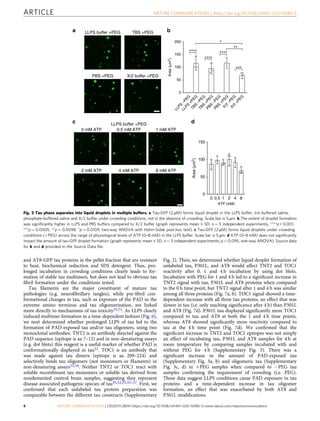
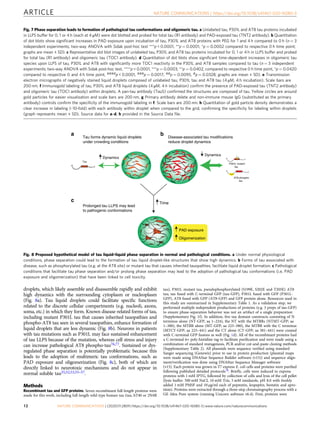
Tau, a protein involved in Alzheimer's disease and other tauopathies, can undergo liquid-liquid phase separation in vitro to form dynamic liquid droplets. Disease-associated modifications like the AT8 phospho-epitope and the P301L mutation enhance tau droplet formation and reduce droplet dynamics. Extended phase separation promotes the adoption of toxic tau conformations and oligomerization without filament formation, suggesting phase separation may facilitate pathogenic tau formation. The P301L mutation leads to the greatest oligomer formation following phase separation.
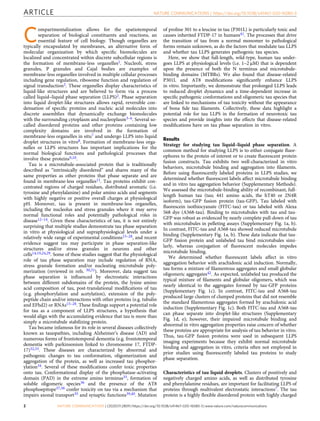
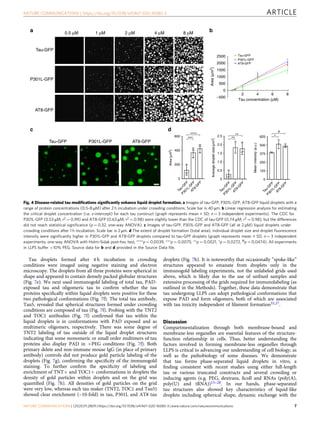
![tauopathies (e.g. P301L mutant tau in FTDP-17)33 or post-
translational modifications such as increased phosphorylation
(e.g. the AT8 phospho-tau site)37,38. Similar to tau-GFP, both
P301L-GFP and AT8-GFP (i.e. tau with pseudophosphorylation
mutations S199E/S202E/T205E at sites recognized by the
phospho-specific AT8 antibody) form liquid droplets only under
crowding conditions (Fig. 4). We confirmed that each tau-GFP
fusion protein preparation was comparable between the different
tau constructs (Supplementary Fig. 2). The critical droplet con-
centration (CDC) of tau-GFP, P301L-GFP and AT8-GFP was
determined by measuring the extent of droplet formation with a
range of tau (i.e. 0.5–8 μM). The CDC was estimated at 0.74 µM
for tau-GFP, 0.53 µM for P301L-GFP and 0.63 µM for AT8-GFP
(Fig. 4a, b). Image analysis was used to quantify the differences
between the liquid droplets formed by each tau construct at 2 µM.
The total amount of liquid droplets formed (i.e. total area),
individual droplet size and mean fluorescence intensity of dro-
plets formed by P301L-GFP and AT8-GFP were significantly
greater than tau-GFP droplets at 2 µM (Fig. 4c, d). These data
indicate that P301L and AT8 significantly enhance tau phase
separation and the lower limit of droplet formation for all three
tau proteins is <1 µM or just below the physiological levels of tau
in neurons43.
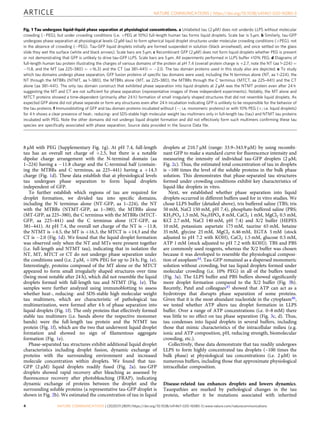
Next, we determined whether disease-related modifications of
tau impacted the dynamic properties of phase-separated tau
liquid droplets. First, the dynamics of tau liquid droplets were
measured with FRAP after 1 h incubation. Tau-GFP displayed
higher dynamic properties compared to P301L-GFP and AT8-
GFP (Fig. 5a–c). The immobile phase of tau-GFP (6.6%) is
approximately six and five times lower than P301L-GFP (42.2%)
and AT8-GFP (33.0%), respectively. However, all three forms of
tau display similar FRAP kinetics (i.e. FRAP time; tau-GFP=38.7
s; P301L-GFP=35.0 s; AT8-GFP=36.1 s). After 4 h of incubation,
the dynamics of all tau proteins tested are substantially reduced
(Fig. 5d–f). The immobile phase was similar for tau-GFP (69.5%),
P301L-GFP (63.1%) and AT8-GFP (61.8%), as were the FRAP
kinetics (tau-GFP=56.6 s; P301L-GFP=49.5 s; AT8-GFP=56.7 s).
These findings demonstrate that disease modifications of tau (i.e.
mutant P301L tau and phospho-AT8 tau) facilitate the formation
of less dynamic liquid droplets when compared to wild-type tau
protein.
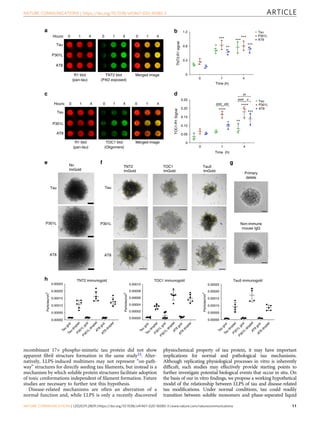
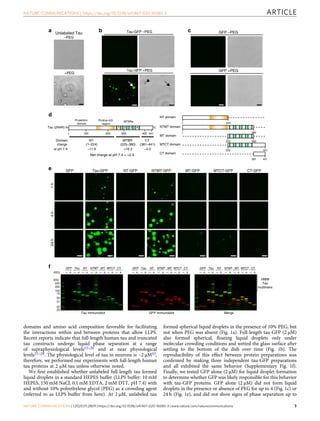
Tau phase separation leads to pathological tau conformations
and oligomerization. Previous reports using RNA/DNA binding
proteins, such as fused in sarcoma (FUS) and heterogeneous
nuclear ribonucleoprotein A1 (hnRNPA1), found that prolonged
incubation in liquid droplet-inducing conditions facilitates the
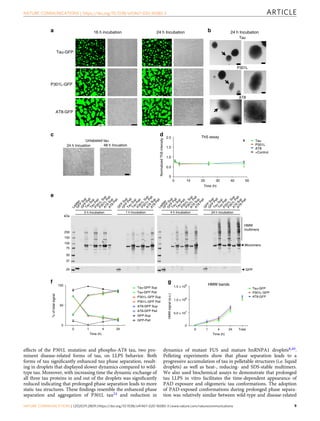
formation of fibrils8,47–50. We examined whether prolonged
incubation of tau in crowding conditions leads to fibril formation
using 4 µM tau (2 µM tau-GFP and 2 µM unlabeled tau) to pro-
vide more tau protein in the longer experiments. Incubation of
tau for 16 and 24 h produced substantial amounts of phase-
separated structures that were amorphous for all three tau con-
structs (Fig. 6a), but there was no evidence of fibril-like structures
using confocal microscopy imaging. We further confirmed the
lack of fibril formation with unlabeled tau, P301L and AT8 after
24 h in crowding conditions using electron microscopy (Fig. 6b).
Next, we assessed whether filaments form after extended phase
separation (24 and 48 h) using unlabeled tau protein and again
did not observe fibril-like structures using microscopy (Fig. 6c).
Moreover, we performed thioflavin S (ThS) fluorescence assays, a
standard fibrillar cross-β-sheet dye assay of tau fibrilization, and
did not observe evidence of enhanced ThS fluorescence from 1 to
48 h after phase separation (Fig. 6d). Finally, we performed
droplet pelleting assays to isolate phase-separated droplets and
determine whether there was evidence that LLPS leads to for-
mation of stable multimers, which are heat-, reducing- and SDS-
resistant multimers characteristic of pathological tau species, in
the absence of filament formation (Fig. 6e, f). Indeed, extended
phase separation showed a time-dependent increase in the
amount of tau stable multimers formed by tau-GFP, P301L-GFP
a
c
b
0 100 200 300 400 500
0
1000
2000
3000
4000
5000
GFP (µM)
Intensity
(a.u.)
Tau-GFP droplets (n = 50)
GFP standard
Mean droplet intensity
420 µM 210 µM 105 µM 52 µM
26 µM 13 µM 6 µM
* *
*
* *
*
Pre-fusion Fusion Post-fusion
0 s Bleach 10 s 20 s
40 s 80 s 160 s 320 s
0 100 200 300 400
0
0.5
1.0
Time [s]
Normalized
FRAP
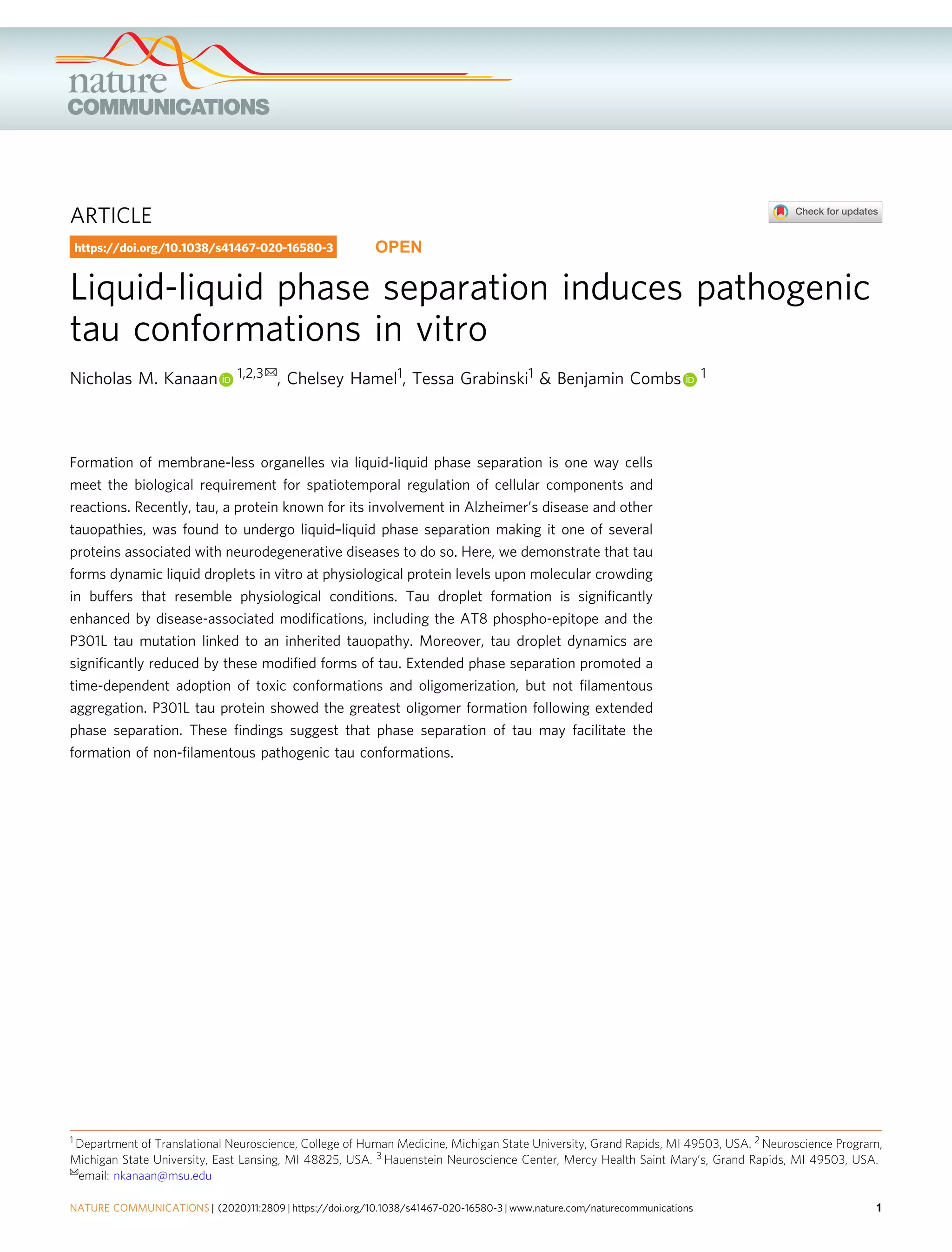
Fig. 2 Liquid droplet-like properties of phase-separated tau structures. a Tau-GFP (2 µM) phase-separated structures undergo fusion events, which are
characteristic of liquid droplets. Scale bars are 5 µm. b An illustrative example of tau-GFP fluorescence recovery after photobleaching (FRAP), which was
used to confirm the dynamic nature of tau liquid droplets (see Fig. 5 for additional FRAP data). Scale bar is 1 µm. c Tau-GFP (2 µM) concentration within
liquid droplets was estimated at an average of 210.7 μM (SD = ±71.82, Min = 33.9 μM, Max = 343.9 μM) after 2 h incubation (n = 50 droplets). Images of
recombinant GFP protein at a range of 6–420 μM were used for a standard curve of GFP fluorescence signal (linear regression, r2 = 0.98). Scale bar is
5 µm. The red data points and line are the GFP standard, open black circles are the individual droplets measured and the green circle indicates the mean
tau-GFP droplet intensity. Data are from a representative experiment that was repeated three times with similar results. All experiments in LLPS buffer
+10% PEG. Source data for b and c provided in the Source Data file.
NATURE COMMUNICATIONS | https://doi.org/10.1038/s41467-020-16580-3 ARTICLE
NATURE COMMUNICATIONS | (2020)11:2809 | https://doi.org/10.1038/s41467-020-16580-3 | www.nature.com/naturecommunications 5](https://image.slidesharecdn.com/liquidliquidphaseseparation-210726100505/85/Liquid-liquid-phase-separation-5-320.jpg)