By : Hammad Wali
Students of Biotechnology 4th- E
Quaid e Azam University
Lipids
(Methods to study lipids)
Table of
Contents
01 Introduction – Extraction
02 Seperation
03 Analysis
Introduction
• The word lipid is derived from a Greek word “lipos”
• They are soluble in non-polar solvents
• Lipids are hydrophobic
• Unlike the proteins, nucleic acids, and polysaccharides,
lipids are not polymer
• insoluble in water
• chief storage form of energy
• Fat and oils are the principle stored forms of energy
in many organism.
Functions Of Lipids
• Storage form of metabolic fuel.
• Transport form of metabolic fuel
• Provide the structural components of
membranes
• Serve as pigment
• Detergent
• Cofactors
• Hormone
• Protective functions
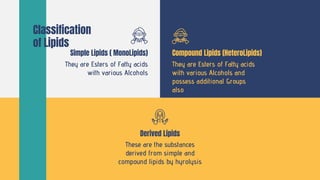
Compound Lipids (HeteroLipids)
Simple Lipids ( MonoLipids)
Classification
of Lipids
They are Esters of Fatty acids
with various Alcohols
They are Esters of Fatty acids
with various Alcohols and
possess additional Groups
also
Derived Lipids
These are the substances
derived from simple and
compound lipids by hyrolysis
Derived Lipids
(Fatty Acids)
Saturated Fatty Acids
● Saturated fatty acids have no double bonds
● They have higher melting points
● solid at room temperature
Unsaturated Fatty Acids
● Contain one or more double bonds
● Liquid at room temperature
● Low melting point
Working with
Lipids
When the lipids are
separated , ,We
analyze and identify
the lipids by various
methods
E.G Mass spectrometry
, Hydrolysis
Analysis
The lipids needs to be
separated from the
organic solvent when
separated
E.G HPLC , TLC , GLC
Separation
Extracting lipids
from a cell or tissue
by using organic
solvents
Preparing a solution
enriched in lipids
E.G Solvent
Extraction
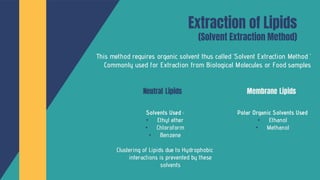
Extraction of Lipids
(Solvent Extraction Method)
This method requires organic solvent thus called ‘Solvent Extraction Method ‘
Commonly used for Extraction from Biological Molecules or Food samples
Polar Organic Solvents Used
• Ethanol
• Methanol
Solvents Used :
• Ethyl ether
• Chloroform
• Benzene
Clustering of Lipids due to Hydrophobic
interactions is prevented by these
solvents
• Mixture of Chloroform, Methanol and
Water is the most used solvent for
extraction from Tissues
• Tissue is homogenized in the above
solvent mixture
• When adding water, we see 2 phases
Top phase consists of water
Lower phase consists of chloroform
• Sugar and Proteins, the polar molecules
partition into the top phase
• While Lipids stays at the lower phase
Extraction with Commonly used Organic Solvent
(Steps of Extraction)
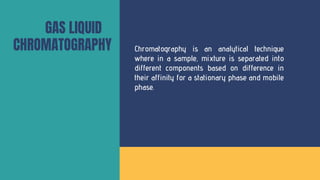
GAS LIQUID
CHROMATOGRAPHY Chromatography is an analytical technique
where in a sample, mixture is separated into
different components based on difference in
their affinity for a stationary phase and mobile
phase.
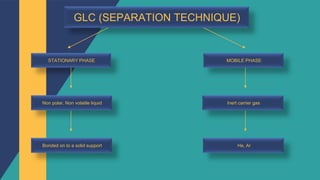
GLC (SEPARATION TECHNIQUE)
STATIONARY PHASE MOBILE PHASE
Non polar. Non volatile liquid Inert carrier gas
Bonded on to a solid support He, Ar
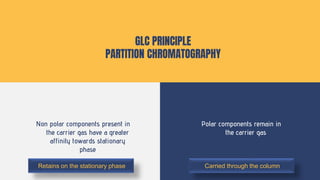
GLC PRINCIPLE
PARTITION CHROMATOGRAPHY
Non polar components present in
the carrier gas have a greater
affinity towards stationary
phase
Polar components remain in
the carrier gas
Retains on the stationary phase Carried through the column
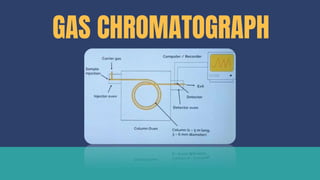
GAS CHROMATOGRAPH
GAS CHROMATOGRAPHY MASS
SPECTROSCOPY
• Instrument that allows to separate individual
components in an essential oil according to its
volatility and mass.
• There are many factors that go into analyzing an
essential oil for authentication.
• Gold standard for determining the purity in essential
oils
 Prepared sample is injected.
 Port is heated.
 Components pass through column.
 Column provides a surface for components to
interact.
 It allows the components “slow” so separation
can occur.
 Column is made of different affinities.
 Oil passes through column and temperature of
oven increased.
 Components hit the detector.
 Proportional peaks are recorded on a
chromatograph.
 Ions travel through an electromagnetic field that
filters them based on their mass.
 Detectors counts each number of ions.
 Information is sent to computer where a mass
spectrum is created.
● Lipidomic is a large-scale study of pathways and networks of cellular
lipids in biological systems.
● Lipidomic is used to describe:
● The complete lipid profile within a cell, tissue or organism
LIPIDOMICS
● Lipidomic research involves;
● Analyzing which lipid are and in
what proportions.
● Analyzing interactions of lipids
with other molecules.
● Quantitatively describing the
alterations in lipid content and
their composition in response to a
perturbation of a cell.
SUMMARY
• The first step in determining lipid composition from
tissues is extraction of lipids with organic solvents.
• Extracted lipids are then separated by thin layer, gas
liquid or high-performance liquid chromatography
techniques.
• Individual lipids can be identified by either their
behavior on the chromatography columns or by mass
spectrometry.
• Lipidomic is an extremely strong technique used to
determine the lipid profile in a cell/tissue/organism in
response to different stress conditions or during
differentiation.

Lipids and Methods to Study Lipids.pptx

  • 1.
    By : HammadWali Students of Biotechnology 4th- E Quaid e Azam University Lipids (Methods to study lipids)
  • 2.
    Table of Contents 01 Introduction– Extraction 02 Seperation 03 Analysis
  • 3.
    Introduction • The wordlipid is derived from a Greek word “lipos” • They are soluble in non-polar solvents • Lipids are hydrophobic • Unlike the proteins, nucleic acids, and polysaccharides, lipids are not polymer • insoluble in water • chief storage form of energy • Fat and oils are the principle stored forms of energy in many organism.
  • 4.
    Functions Of Lipids •Storage form of metabolic fuel. • Transport form of metabolic fuel • Provide the structural components of membranes • Serve as pigment • Detergent • Cofactors • Hormone • Protective functions
  • 5.
    Compound Lipids (HeteroLipids) SimpleLipids ( MonoLipids) Classification of Lipids They are Esters of Fatty acids with various Alcohols They are Esters of Fatty acids with various Alcohols and possess additional Groups also Derived Lipids These are the substances derived from simple and compound lipids by hyrolysis
  • 6.
    Derived Lipids (Fatty Acids) SaturatedFatty Acids ● Saturated fatty acids have no double bonds ● They have higher melting points ● solid at room temperature Unsaturated Fatty Acids ● Contain one or more double bonds ● Liquid at room temperature ● Low melting point
  • 7.
    Working with Lipids When thelipids are separated , ,We analyze and identify the lipids by various methods E.G Mass spectrometry , Hydrolysis Analysis The lipids needs to be separated from the organic solvent when separated E.G HPLC , TLC , GLC Separation Extracting lipids from a cell or tissue by using organic solvents Preparing a solution enriched in lipids E.G Solvent Extraction
  • 8.
    Extraction of Lipids (SolventExtraction Method) This method requires organic solvent thus called ‘Solvent Extraction Method ‘ Commonly used for Extraction from Biological Molecules or Food samples Polar Organic Solvents Used • Ethanol • Methanol Solvents Used : • Ethyl ether • Chloroform • Benzene Clustering of Lipids due to Hydrophobic interactions is prevented by these solvents
  • 9.
    • Mixture ofChloroform, Methanol and Water is the most used solvent for extraction from Tissues • Tissue is homogenized in the above solvent mixture • When adding water, we see 2 phases Top phase consists of water Lower phase consists of chloroform • Sugar and Proteins, the polar molecules partition into the top phase • While Lipids stays at the lower phase Extraction with Commonly used Organic Solvent (Steps of Extraction)
  • 10.
    GAS LIQUID CHROMATOGRAPHY Chromatographyis an analytical technique where in a sample, mixture is separated into different components based on difference in their affinity for a stationary phase and mobile phase.
  • 11.
    GLC (SEPARATION TECHNIQUE) STATIONARYPHASE MOBILE PHASE Non polar. Non volatile liquid Inert carrier gas Bonded on to a solid support He, Ar
  • 12.
    GLC PRINCIPLE PARTITION CHROMATOGRAPHY Nonpolar components present in the carrier gas have a greater affinity towards stationary phase Polar components remain in the carrier gas Retains on the stationary phase Carried through the column
  • 13.
  • 14.
    GAS CHROMATOGRAPHY MASS SPECTROSCOPY •Instrument that allows to separate individual components in an essential oil according to its volatility and mass. • There are many factors that go into analyzing an essential oil for authentication. • Gold standard for determining the purity in essential oils
  • 15.
     Prepared sampleis injected.  Port is heated.  Components pass through column.  Column provides a surface for components to interact.  It allows the components “slow” so separation can occur.  Column is made of different affinities.  Oil passes through column and temperature of oven increased.  Components hit the detector.  Proportional peaks are recorded on a chromatograph.  Ions travel through an electromagnetic field that filters them based on their mass.  Detectors counts each number of ions.  Information is sent to computer where a mass spectrum is created.
  • 16.
    ● Lipidomic isa large-scale study of pathways and networks of cellular lipids in biological systems. ● Lipidomic is used to describe: ● The complete lipid profile within a cell, tissue or organism LIPIDOMICS ● Lipidomic research involves; ● Analyzing which lipid are and in what proportions. ● Analyzing interactions of lipids with other molecules. ● Quantitatively describing the alterations in lipid content and their composition in response to a perturbation of a cell.
  • 17.
    SUMMARY • The firststep in determining lipid composition from tissues is extraction of lipids with organic solvents. • Extracted lipids are then separated by thin layer, gas liquid or high-performance liquid chromatography techniques. • Individual lipids can be identified by either their behavior on the chromatography columns or by mass spectrometry. • Lipidomic is an extremely strong technique used to determine the lipid profile in a cell/tissue/organism in response to different stress conditions or during differentiation.