Application Notes
Lipids Analysis
Theory
Thin layer chromatography (TLC) is a tried and true method for the separation of
components in a mixture based on the polarity of the individual components. When a
standard is included, this method can also be used for the identification of each component
of the mixture.
Silica gel column chromatography and thin layer chromatography (TLC) are available for the
isolation, identification and determination of each lipid component. TLC is able to analyze a
small amount of lipids faster than column chromatography.
The TLC technique requires 2 phases: a stationary phase, which involves some sort of
matrix, and a mobile phase, which is a mixture of solvents. The type of mixture you are
interested in separating dictates the precise materials used for the 2 phases.
The stationary phase for TLC consists of a plate, usually a sheet of plastic or glass, that is
coated with an absorbent material (i.e. silica). The extracted sample mixture (such as a lipid
extract from cells) is applied at the bottom of the plate, allowing the solid phase to capture
the mixture. The plated sample is then “developed” by placing the TLC plate into a sealed
chamber containing the mobile phase solvent system. The solvent system is selected based
on its ability to dissolve the desired components to be separated. This chamber also
contains a Whatman Paper “wick,” which is a sheet of filter paper that helps to ensure that
the chamber is evenly saturated with solvent vapors.
As the solvent migrates up the plate, it will carry with it the different components of the
mixture. The more soluble the components in the solvent, the easier it will migrate up the
plate. Also affecting how the samples migrate is the absorbent material on the plate. For
instance, silica, which is polar, will strongly interact with the polar components of the
mixture. Therefore, polar components will “stick” to the silica, and will migrate up the plate
with less efficiency than components that are weakly polar or nonpolar. In general, as the
polarity of a component (molecule) decreases, the ability for it to move up the plate
increases.
For the purposes of lipid separation, particularly for neutral lipids such as triglycerides, we
will be using a silica coated plastic plate (stationary phase) and an organic, largely nonpolar
solvent mobile phase. The lipids are then visualized using resublimed iodine, which will bind
to double bonds found in lipid hydrocarbon chains and aromatic compounds.
Application Notes
Method
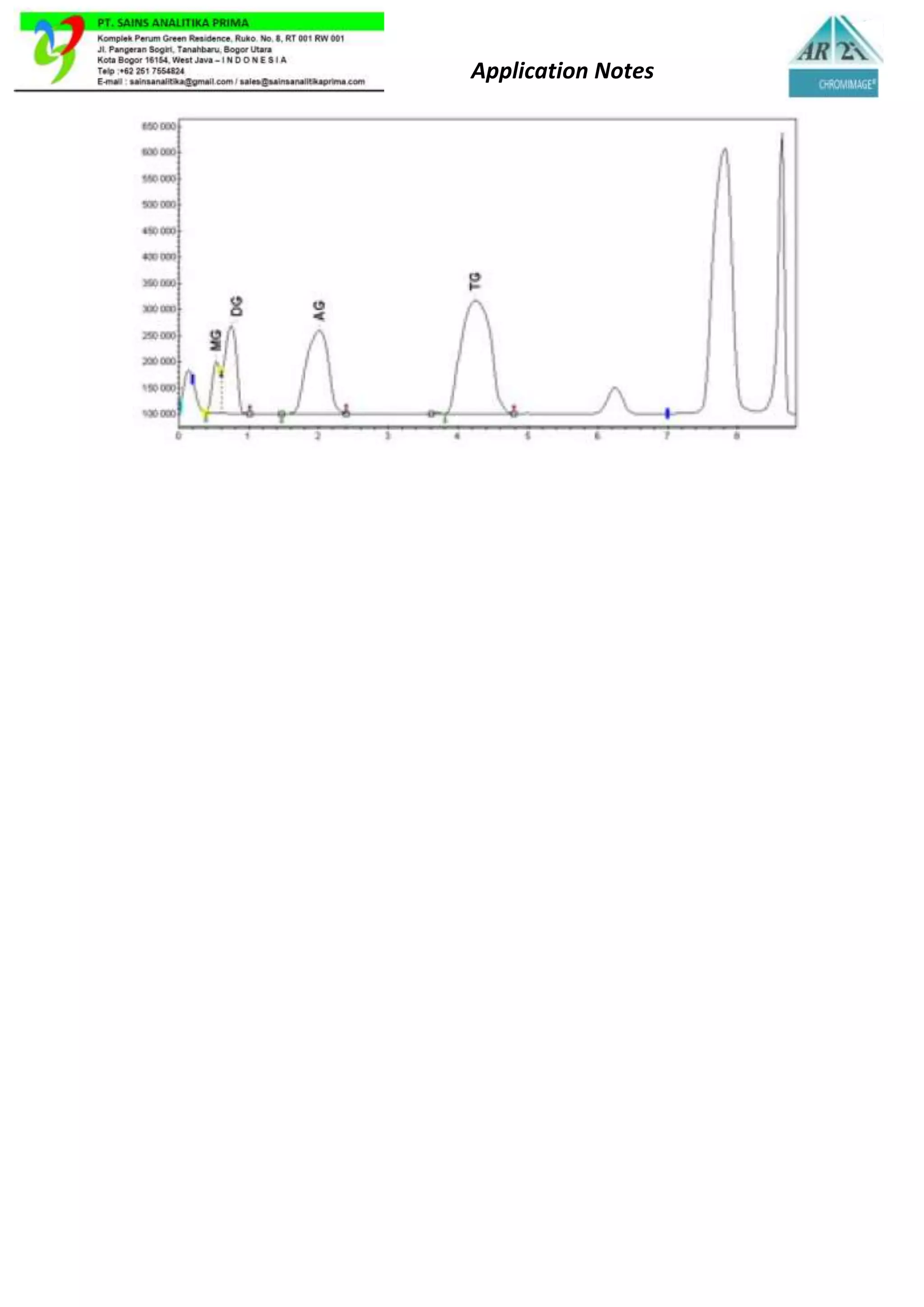
Chromatographic visualizer : AR2i CHROMIMAGE® 3X
Chromatographic plate : HPTLC silica 60, 10 x 20 cm
Phase mobile :
i. Petroleum ether 80 ml
ii. Diisopropyl ether 20 ml
iii. Acetic acid glacial 1 ml
Sample solutions :
1 mg/ml in monoglycerides, diglycerides and fatty acids
2 mg/ml in triglycerides
Solvent :
Chloroform / Methanol [2 vol./ 1 vol.]
Reagent addition :
i. Copper sulfate 10 g
ii. Purified water 69 ml
iii. Ethanol 24 ml
iv. Phosphoric acid at 85% 8 ml
Heat 120 minutes at 105°C
Detection :
In the visible: Black spots on a bluish background.
Application Notes

AN-SAP01-AR2I Lipids analysis.docx

  • 1.
    Application Notes Lipids Analysis Theory Thinlayer chromatography (TLC) is a tried and true method for the separation of components in a mixture based on the polarity of the individual components. When a standard is included, this method can also be used for the identification of each component of the mixture. Silica gel column chromatography and thin layer chromatography (TLC) are available for the isolation, identification and determination of each lipid component. TLC is able to analyze a small amount of lipids faster than column chromatography. The TLC technique requires 2 phases: a stationary phase, which involves some sort of matrix, and a mobile phase, which is a mixture of solvents. The type of mixture you are interested in separating dictates the precise materials used for the 2 phases. The stationary phase for TLC consists of a plate, usually a sheet of plastic or glass, that is coated with an absorbent material (i.e. silica). The extracted sample mixture (such as a lipid extract from cells) is applied at the bottom of the plate, allowing the solid phase to capture the mixture. The plated sample is then “developed” by placing the TLC plate into a sealed chamber containing the mobile phase solvent system. The solvent system is selected based on its ability to dissolve the desired components to be separated. This chamber also contains a Whatman Paper “wick,” which is a sheet of filter paper that helps to ensure that the chamber is evenly saturated with solvent vapors. As the solvent migrates up the plate, it will carry with it the different components of the mixture. The more soluble the components in the solvent, the easier it will migrate up the plate. Also affecting how the samples migrate is the absorbent material on the plate. For instance, silica, which is polar, will strongly interact with the polar components of the mixture. Therefore, polar components will “stick” to the silica, and will migrate up the plate with less efficiency than components that are weakly polar or nonpolar. In general, as the polarity of a component (molecule) decreases, the ability for it to move up the plate increases. For the purposes of lipid separation, particularly for neutral lipids such as triglycerides, we will be using a silica coated plastic plate (stationary phase) and an organic, largely nonpolar solvent mobile phase. The lipids are then visualized using resublimed iodine, which will bind to double bonds found in lipid hydrocarbon chains and aromatic compounds.
  • 2.
    Application Notes Method Chromatographic visualizer: AR2i CHROMIMAGE® 3X Chromatographic plate : HPTLC silica 60, 10 x 20 cm Phase mobile : i. Petroleum ether 80 ml ii. Diisopropyl ether 20 ml iii. Acetic acid glacial 1 ml Sample solutions : 1 mg/ml in monoglycerides, diglycerides and fatty acids 2 mg/ml in triglycerides Solvent : Chloroform / Methanol [2 vol./ 1 vol.] Reagent addition : i. Copper sulfate 10 g ii. Purified water 69 ml iii. Ethanol 24 ml iv. Phosphoric acid at 85% 8 ml Heat 120 minutes at 105°C Detection : In the visible: Black spots on a bluish background.
  • 3.