m n RAJU
“At the end of the day,
it’s not what I learned
but what I taught;
not what I got
but what I gave;
not what I did
but what I helped another achieve
that will make a difference
in someone’s life… and in mine.”
mnRAJU
Session
Objectives
 Explain concept of mentoring
 Recognize benefits to the mentee, the

mentor, and the association
 Recognize goals and processes of Lions
Mentoring Program
 Create a mentoring plan
mnRAJU
Who is a Mentor?

a trusted counselor and guide.
mnRAJU
Who is a
Mentee?

one who seeks to learn and grow with the
guidance of a more experienced or
knowledgeable person.
mnRAJU
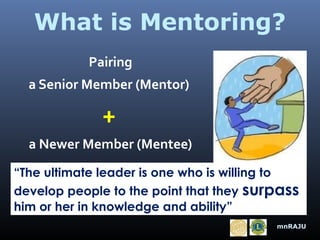
What is Mentoring?
Pairing
a Senior Member (Mentor)

+
a Newer Member (Mentee)
“The ultimate leader is one who is willing to
develop people to the point that they surpass
him or her in knowledge and ability”
mnRAJU
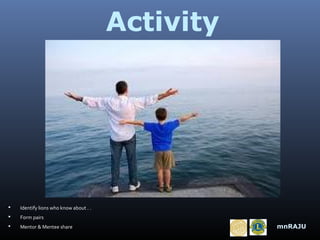
Activity



Identify lions who know about . .



Form pairs



Mentor & Mentee share

mnRAJU
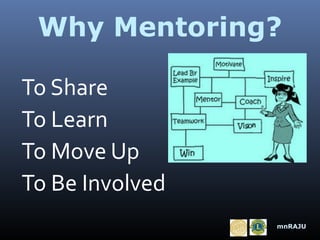
Why Mentoring?
To Share
To Learn
To Move Up
To Be Involved
mnRAJU
Two Levels
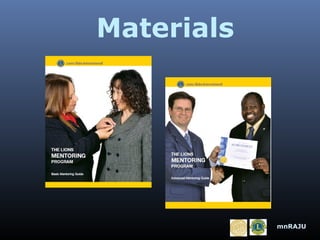
1. Lions Basic Mentoring Program
2. Lions Advanced Mentoring Program

mnRAJU
Basic Mentoring Program
-1
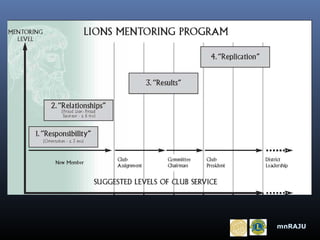
RESPONSIBILITY (Orientation)
 History
 Hierarchy
 Services
 Meetings
 Dues
 Branding
mnRAJU
Basic Mentoring Program –
2
RELATIONSHIPMeeting
 Attend a Board (Interaction)
 Participate in a Service Activity
 Participate in a Fund Raiser
 Visit another Club
 Attend a Convention
 Report back to club
mnRAJU
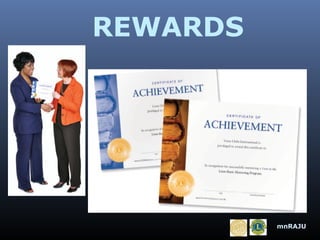
REWARDS

mnRAJU
Advanced Mentoring Program –
1

RESULTS (More Involvement)

Understand club goals
 Understand club activities
 Develop a Service Project
 Understand assignments
 Complete tasks
 Sponsor a new member

mnRAJU
Advanced Mentoring Program –
2

REPLICATION (Hold Office)
 Hold office as club president
 Obtain a Membership Key
 Participate in Extension
 Attend a Forum/Convention
 Become a leader

mnRAJU
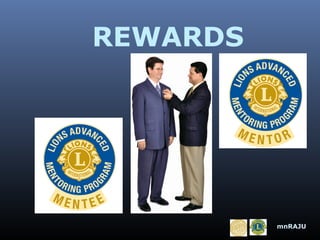
REWARDS

mnRAJU
Materials

mnRAJU
mnRAJU
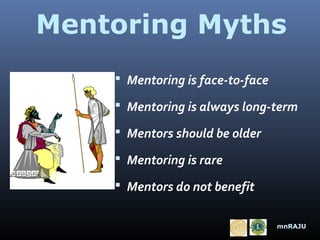
Mentoring Myths
 Mentoring is face-to-face
 Mentoring is always long-term
 Mentors should be older
 Mentoring is rare
 Mentors do not benefit
mnRAJU
True Success
“All of the certificates of recognition we receive in life
will fade. The monuments we build will crumble. The
trophies will corrode.
But what we do for others will make a lasting impact on
our world.
True success comes only when every generation
continues to develop the next generation, teaching
them the value and the method of developing the next
group of leaders.”
John C. Maxwell
mnRAJU
Session
Objectives
 Explain concept of mentoring
 Recognize benefits to the mentee, the

mentor, and the association
 Recognize goals and processes of Lions
Mentoring Program
 Create a mentoring plan
mnRAJU
Happy Mentoring

m n RAJU
lionnagaraju@gmail.com
This and other slideshows are available at
www.slideshare.net/lionnagaraju
www.authorstream.com/tab/lionnagaraju
mnRAJU

Lions Mentoring Programme

  • 1.
  • 2.
    “At the endof the day, it’s not what I learned but what I taught; not what I got but what I gave; not what I did but what I helped another achieve that will make a difference in someone’s life… and in mine.” mnRAJU
  • 3.
    Session Objectives  Explain conceptof mentoring  Recognize benefits to the mentee, the mentor, and the association  Recognize goals and processes of Lions Mentoring Program  Create a mentoring plan mnRAJU
  • 4.
    Who is aMentor? a trusted counselor and guide. mnRAJU
  • 5.
    Who is a Mentee? onewho seeks to learn and grow with the guidance of a more experienced or knowledgeable person. mnRAJU
  • 6.
    What is Mentoring? Pairing aSenior Member (Mentor) + a Newer Member (Mentee) “The ultimate leader is one who is willing to develop people to the point that they surpass him or her in knowledge and ability” mnRAJU
  • 7.
    Activity  Identify lions whoknow about . .  Form pairs  Mentor & Mentee share mnRAJU
  • 8.
    Why Mentoring? To Share ToLearn To Move Up To Be Involved mnRAJU
  • 9.
    Two Levels 1. LionsBasic Mentoring Program 2. Lions Advanced Mentoring Program mnRAJU
  • 10.
    Basic Mentoring Program -1 RESPONSIBILITY(Orientation)  History  Hierarchy  Services  Meetings  Dues  Branding mnRAJU
  • 11.
    Basic Mentoring Program– 2 RELATIONSHIPMeeting  Attend a Board (Interaction)  Participate in a Service Activity  Participate in a Fund Raiser  Visit another Club  Attend a Convention  Report back to club mnRAJU
  • 12.
  • 13.
    Advanced Mentoring Program– 1 RESULTS (More Involvement)  Understand club goals  Understand club activities  Develop a Service Project  Understand assignments  Complete tasks  Sponsor a new member mnRAJU
  • 14.
    Advanced Mentoring Program– 2 REPLICATION (Hold Office)  Hold office as club president  Obtain a Membership Key  Participate in Extension  Attend a Forum/Convention  Become a leader mnRAJU
  • 15.
  • 16.
  • 17.
  • 18.
    Mentoring Myths  Mentoringis face-to-face  Mentoring is always long-term  Mentors should be older  Mentoring is rare  Mentors do not benefit mnRAJU
  • 19.
    True Success “All ofthe certificates of recognition we receive in life will fade. The monuments we build will crumble. The trophies will corrode. But what we do for others will make a lasting impact on our world. True success comes only when every generation continues to develop the next generation, teaching them the value and the method of developing the next group of leaders.” John C. Maxwell mnRAJU
  • 20.
    Session Objectives  Explain conceptof mentoring  Recognize benefits to the mentee, the mentor, and the association  Recognize goals and processes of Lions Mentoring Program  Create a mentoring plan mnRAJU
  • 21.
    Happy Mentoring m nRAJU lionnagaraju@gmail.com This and other slideshows are available at www.slideshare.net/lionnagaraju www.authorstream.com/tab/lionnagaraju mnRAJU

Editor's Notes

  • #2 The word first appeared in The Odyssey – an educational journey. Exchange of information and knowledge – mutually beneficial. Built on a foundation of trust, truth and compassion.
  • #20 “It has been argued that leaders are not evaluated based on the number of followers they lead, but instead on the number of new leaders they develop.” Margaret J. Wheatley, Leadership and the New Science.