Linux Servers
An Overview
Contents
• Samba Server
• FTP Server
• NFS Server
• Apache Server
• Docker
Samba
• Free software re-implementation of the SMB networking protocol
• File and print services for various Microsoft Windows clients
• Integration with a Microsoft Windows Server domain, either as
a Domain Controller (DC) or as a domain member
• Version 4 Active Directory and Microsoft Windows NT domains
• Runs on most Unix-like systems, such as Linux, Solaris, AIX and
the BSD variants, including Apple's macOS Server,
and macOS client (Mac OS X 10.2 and greater).
Samba
• Runs on a number of other operating systems such
as OpenVMS and IBM i.
• Samba is standard on nearly all distributions of Linux and is
commonly included as a basic system service on other Unix-based
operating systems as well.
• Samba is released under the terms of the GNU General Public
License.
• The name Samba comes from SMB (Server Message Block), the
name of the proprietary protocol used by the Microsoft Windows
network file system.
Security of Samba
• Some versions of Samba 3.6.3 and lower suffer serious
security issues which can allow anonymous users to gain
root access to a system from an anonymous connection,
through the exploitation of an error in Samba's remote
procedure call.
• On 12 April 2016, Badlock, a crucial security bug in Windows
and Samba, was disclosed.
Security of Samba
• On 24 May 2017, it was announced that a remote code
execution vulnerability had been found in Samba named
EternalRed or SambaCry, affecting all versions since 3.5.0.
• On 14 September 2020, a proof-of-concept exploit for the
netlogon vulnerability called Zerologon (CVE-2020-1472) for
which a patch exists since August was published. Some
federal agencies using the software have been ordered to
install the patch.
File Transfer Protocol (FTP)
• Standard communication protocol used for the transfer of computer
files from a server to a client on a computer network.
• Built on a client–server model architecture using separate control
and data connections between the client and the server
• FTP users may authenticate themselves with a clear-text sign-in
protocol, normally in the form of a username and password, but can
connect anonymously if the server is configured to allow it.
• For secure transmission that protects the username and password,
and encrypts the content, FTP is often secured with SSL/TLS (FTPS)
or replaced with SSH File Transfer Protocol (SFTP)
File Transfer Protocol (FTP)
• The first FTP client applications were command-line programs and are still
shipped with most Windows, Unix, and Linux operating systems.
• Many dedicated FTP clients and automation utilities have since been developed
for desktops, servers, mobile devices, and hardware.
• FTP has been incorporated into productivity applications such as HTML editors
and file managers.
• An FTP client used to be commonly integrated in web browsers, where file
servers are browsed with the URI prefix "ftp://".
• Throughout 2021, the two major web browser vendors removed this ability
Data transfer modes in FTP
• Stream mode (MODE S):
• Data is sent as a continuous stream, relieving FTP from doing any processing.
• Rather, all processing is left up to TCP.
• No End-of-file indicator is needed, unless the data is divided into records.
• Block mode (MODE B):
• Designed primarily for transferring record-oriented files (STRU R), although can also
be used to transfer stream-oriented (STRU F) text files.
• FTP puts each record (or line) of data into several blocks (block header, byte count,
and data field) and then passes it on to TCP.
• Compressed mode (MODE C):
• Extends MODE B with data compression using run-length encoding.
Security in FTP
• FTP was not designed to be a secure protocol, and has many security weaknesses.
• In May 1999, the authors of RFC 2577 listed a vulnerability to the following problems:
• Brute-force attack
• FTP bounce attack
• Packet capture
• Port stealing (guessing the next open port and usurping a legitimate connection)
• Spoofing attack
• Username enumeration
• DoS or DDoS
Network File System (NFS)
• A distributed file system protocol originally developed by Sun Microsystems
(Sun) in 1984, allowing a user on a client computer to access files over a
computer network much like local storage is accessed.
• NFS, like many other protocols, builds on the Open Network Computing Remote
Procedure Call (ONC RPC) system.
• NFS is an open IETF standard defined in a Request for Comments (RFC),
allowing anyone to implement the protocol.
Version of NFS
• NFSv1
• for in-house experimental purposes
• NFSv2
• operated only over User Datagram Protocol (UDP)
• NFSv3
• Support 64 bits file sizes
• WebNFS
• Allowing it to function behind restrictive firewalls without the complexity of Portmap and MOUNT
protocols.
• WebNFS had a fixed TCP/UDP port number (2049)
• NFSv4
Apache HTTP Server
• Free and open-source cross-platform web server software
• Developed and maintained by an open community of developers under the
auspices of the Apache Software Foundation.
• The vast majority of Apache HTTP Server instances run on a Linux distribution
but current versions also run on Microsoft Windows, OpenVMS and a wide
variety of Unix-like systems
• As of March 2022, Netcraft estimated that Apache served 23.04% of the million
busiest websites
Security of Apache HTTP Server
• Can be hacked and exploited.
• The main Apache attack tool is Slowloris, which exploits a bug in Apache
software.
• It creates many sockets and keeps each of them alive and busy by sending
several bytes (known as "keep-alive headers") to let the server know that the
computer is still connected and not experiencing network problems.
• The Apache developers have addressed Slowloris with several modules to limit
the damage caused
Docker
• Set of platform as a service (PaaS) products that use OS-level virtualization to
deliver software in packages called containers.
• The service has both free and premium tiers.
• The software that hosts the containers is called Docker Engine.
• It was first started in 2013 and is developed by Docker, Inc.
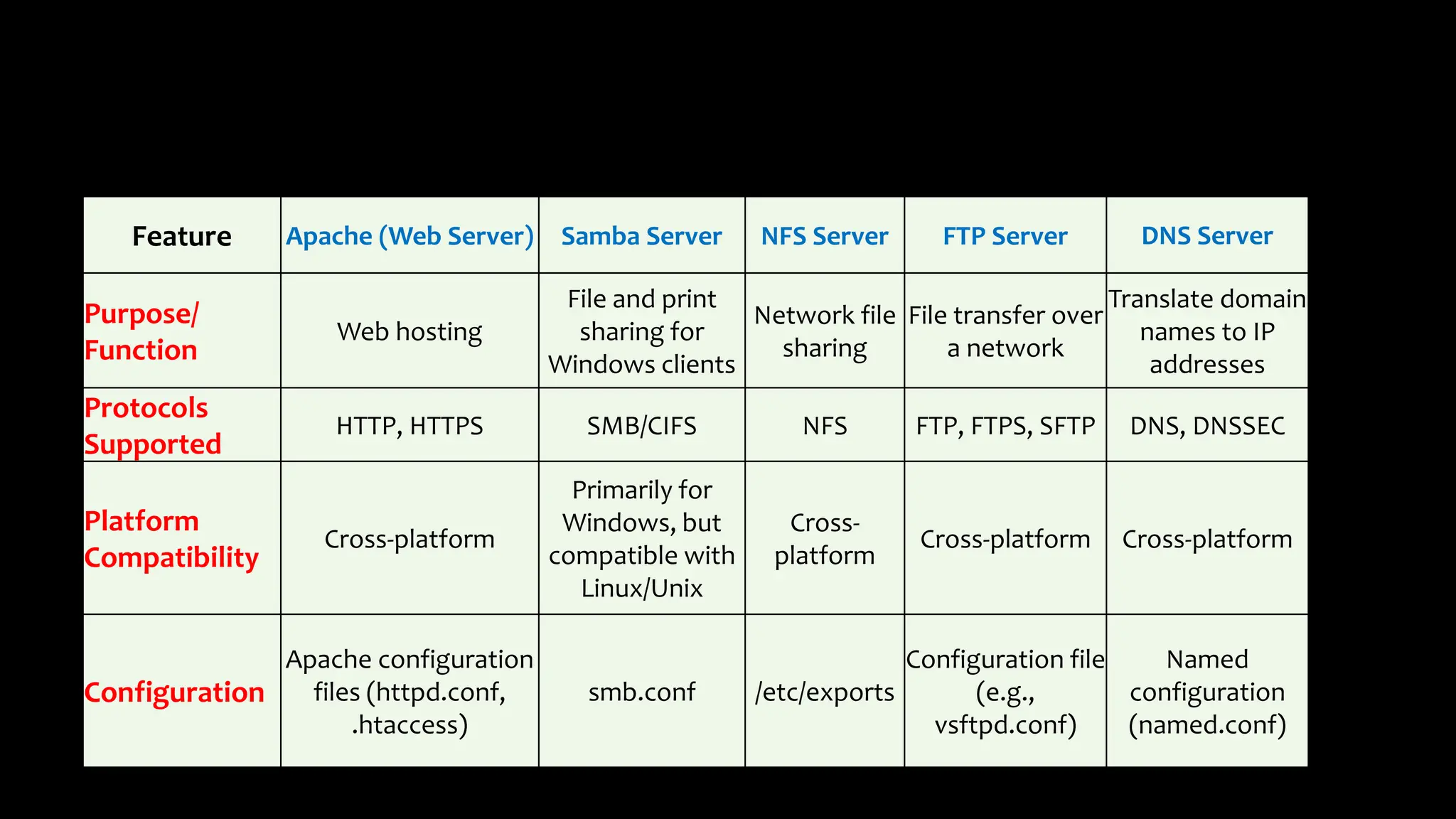
Feature Apache (Web Server) Samba Server NFS Server FTP Server DNS Server
Purpose/
Function
Web hosting
File and print
sharing for
Windows clients
Network file
sharing
File transfer over
a network
Translate domain
names to IP
addresses
Protocols
Supported
HTTP, HTTPS SMB/CIFS NFS FTP, FTPS, SFTP DNS, DNSSEC
Platform
Compatibility
Cross-platform
Primarily for
Windows, but
compatible with
Linux/Unix
Cross-
platform
Cross-platform Cross-platform
Configuration
Apache configuration
files (httpd.conf,
.htaccess)
smb.conf /etc/exports
Configuration file
(e.g.,
vsftpd.conf)
Named
configuration
(named.conf)
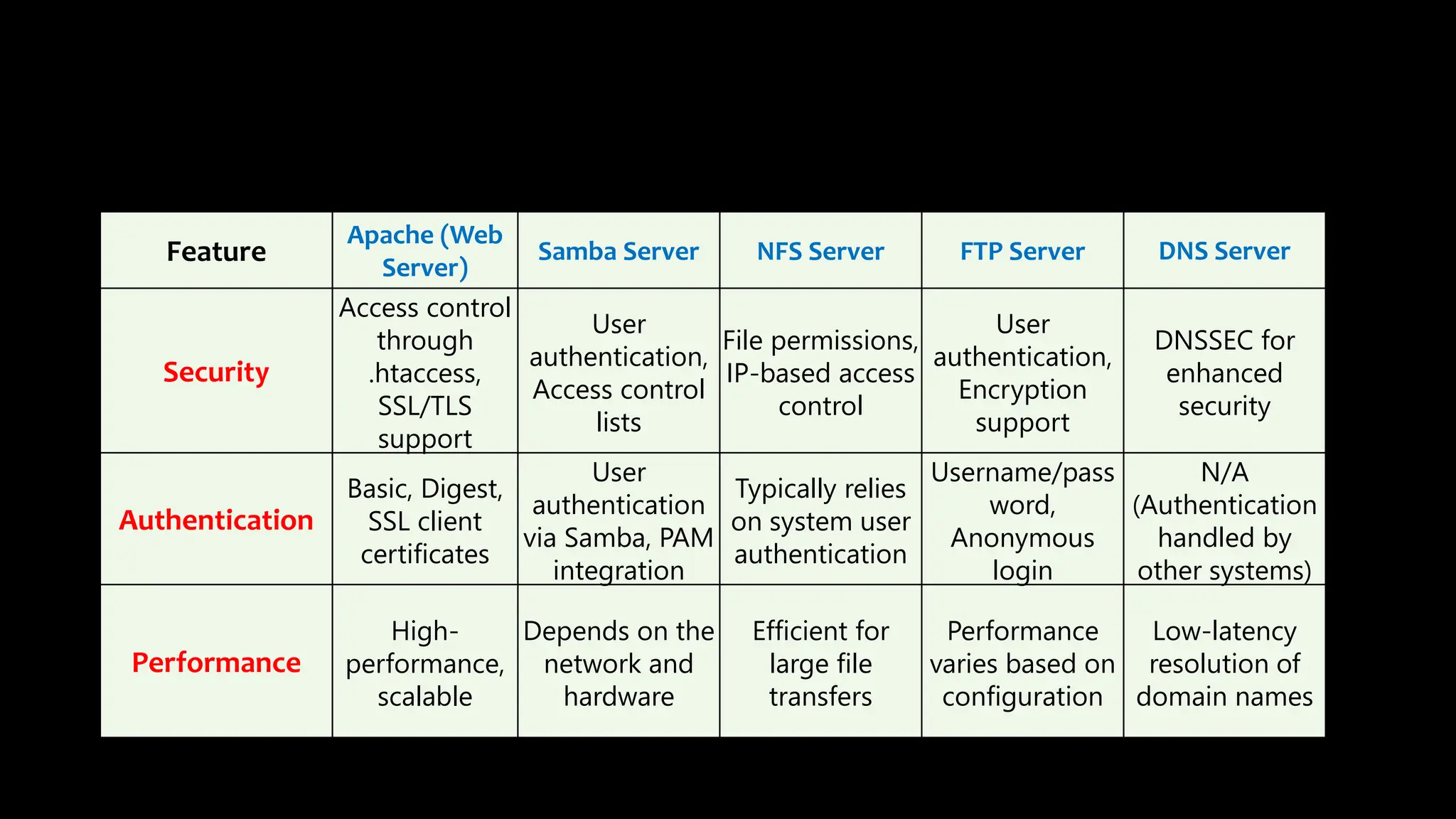
Feature
Apache (Web
Server)
Samba Server NFS Server FTP Server DNS Server
Security
Access control
through
.htaccess,
SSL/TLS
support
User
authentication,
Access control
lists
File permissions,
IP-based access
control
User
authentication,
Encryption
support
DNSSEC for
enhanced
security
Authentication
Basic, Digest,
SSL client
certificates
User
authentication
via Samba, PAM
integration
Typically relies
on system user
authentication
Username/pass
word,
Anonymous
login
N/A
(Authentication
handled by
other systems)
Performance
High-
performance,
scalable
Depends on the
network and
hardware
Efficient for
large file
transfers
Performance
varies based on
configuration
Low-latency
resolution of
domain names
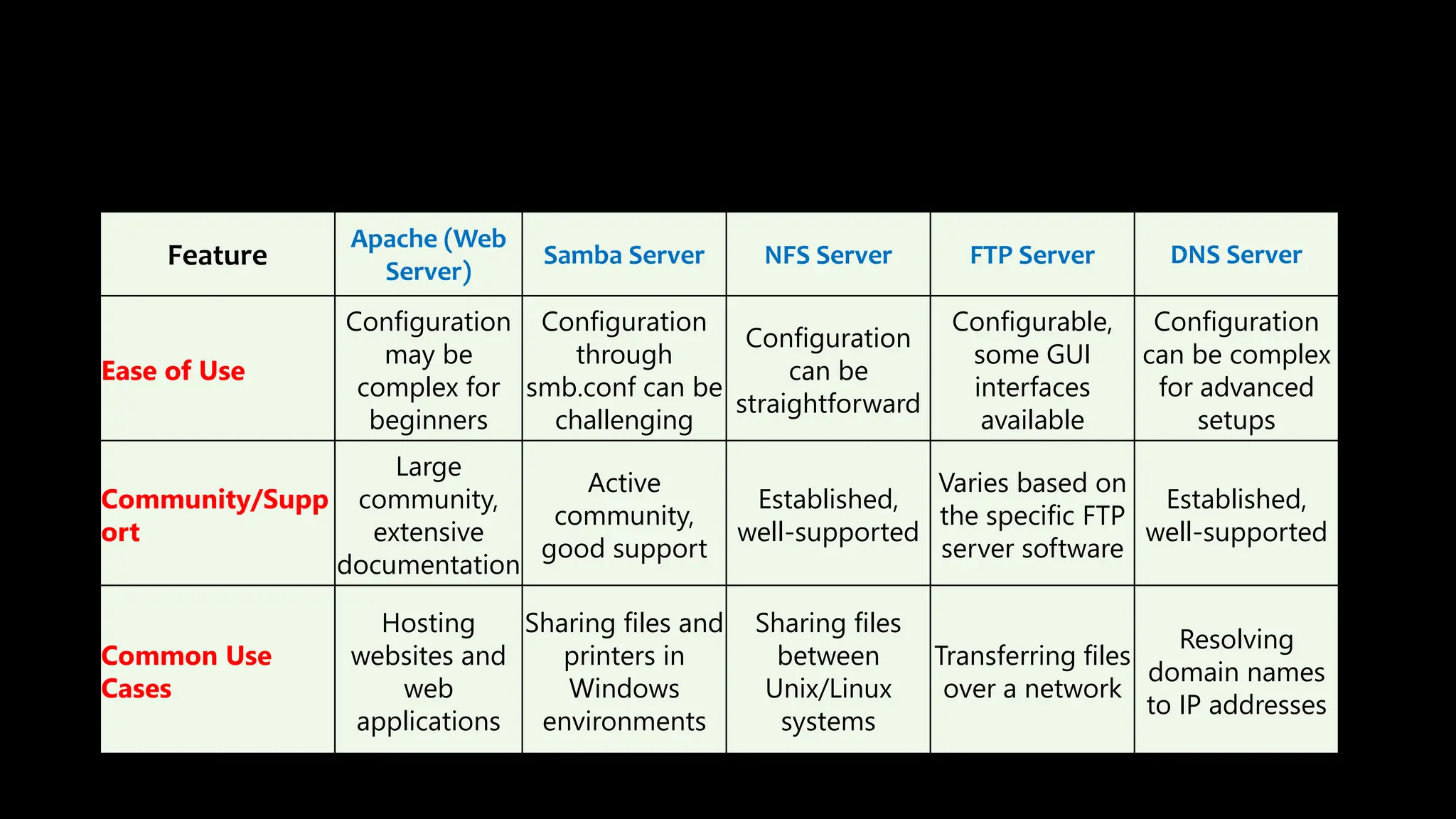
Feature
Apache (Web
Server)
Samba Server NFS Server FTP Server DNS Server
Ease of Use
Configuration
may be
complex for
beginners
Configuration
through
smb.conf can be
challenging
Configuration
can be
straightforward
Configurable,
some GUI
interfaces
available
Configuration
can be complex
for advanced
setups
Community/Supp
ort
Large
community,
extensive
documentation
Active
community,
good support
Established,
well-supported
Varies based on
the specific FTP
server software
Established,
well-supported
Common Use
Cases
Hosting
websites and
web
applications
Sharing files and
printers in
Windows
environments
Sharing files
between
Unix/Linux
systems
Transferring files
over a network
Resolving
domain names
to IP addresses
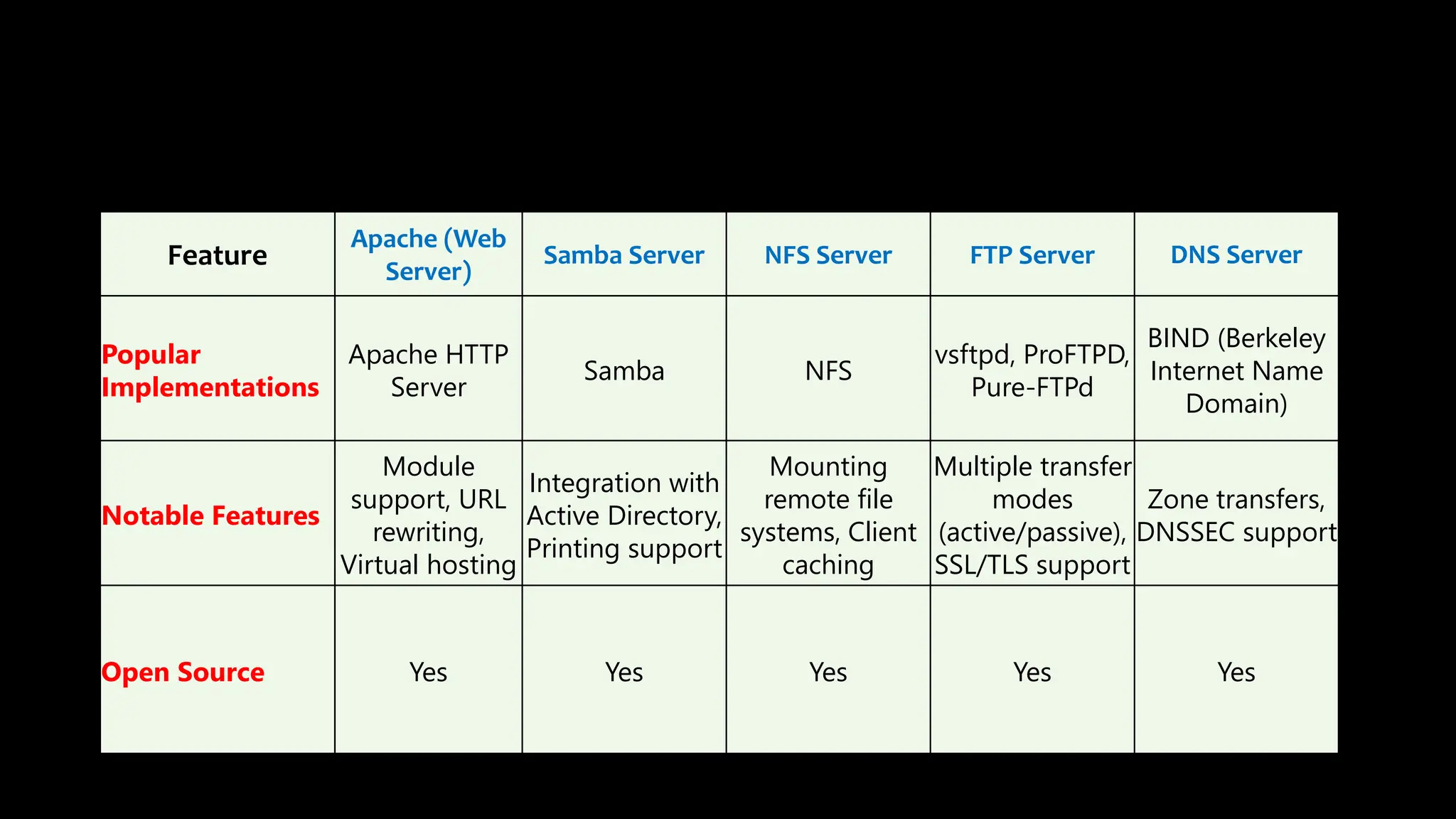
Feature
Apache (Web
Server)
Samba Server NFS Server FTP Server DNS Server
Popular
Implementations
Apache HTTP
Server
Samba NFS
vsftpd, ProFTPD,
Pure-FTPd
BIND (Berkeley
Internet Name
Domain)
Notable Features
Module
support, URL
rewriting,
Virtual hosting
Integration with
Active Directory,
Printing support
Mounting
remote file
systems, Client
caching
Multiple transfer
modes
(active/passive),
SSL/TLS support
Zone transfers,
DNSSEC support
Open Source Yes Yes Yes Yes Yes

Linux Servers.pptx

  • 1.
  • 2.
    Contents • Samba Server •FTP Server • NFS Server • Apache Server • Docker
  • 3.
    Samba • Free softwarere-implementation of the SMB networking protocol • File and print services for various Microsoft Windows clients • Integration with a Microsoft Windows Server domain, either as a Domain Controller (DC) or as a domain member • Version 4 Active Directory and Microsoft Windows NT domains • Runs on most Unix-like systems, such as Linux, Solaris, AIX and the BSD variants, including Apple's macOS Server, and macOS client (Mac OS X 10.2 and greater).
  • 4.
    Samba • Runs ona number of other operating systems such as OpenVMS and IBM i. • Samba is standard on nearly all distributions of Linux and is commonly included as a basic system service on other Unix-based operating systems as well. • Samba is released under the terms of the GNU General Public License. • The name Samba comes from SMB (Server Message Block), the name of the proprietary protocol used by the Microsoft Windows network file system.
  • 5.
    Security of Samba •Some versions of Samba 3.6.3 and lower suffer serious security issues which can allow anonymous users to gain root access to a system from an anonymous connection, through the exploitation of an error in Samba's remote procedure call. • On 12 April 2016, Badlock, a crucial security bug in Windows and Samba, was disclosed.
  • 6.
    Security of Samba •On 24 May 2017, it was announced that a remote code execution vulnerability had been found in Samba named EternalRed or SambaCry, affecting all versions since 3.5.0. • On 14 September 2020, a proof-of-concept exploit for the netlogon vulnerability called Zerologon (CVE-2020-1472) for which a patch exists since August was published. Some federal agencies using the software have been ordered to install the patch.
  • 7.
    File Transfer Protocol(FTP) • Standard communication protocol used for the transfer of computer files from a server to a client on a computer network. • Built on a client–server model architecture using separate control and data connections between the client and the server • FTP users may authenticate themselves with a clear-text sign-in protocol, normally in the form of a username and password, but can connect anonymously if the server is configured to allow it. • For secure transmission that protects the username and password, and encrypts the content, FTP is often secured with SSL/TLS (FTPS) or replaced with SSH File Transfer Protocol (SFTP)
  • 8.
    File Transfer Protocol(FTP) • The first FTP client applications were command-line programs and are still shipped with most Windows, Unix, and Linux operating systems. • Many dedicated FTP clients and automation utilities have since been developed for desktops, servers, mobile devices, and hardware. • FTP has been incorporated into productivity applications such as HTML editors and file managers. • An FTP client used to be commonly integrated in web browsers, where file servers are browsed with the URI prefix "ftp://". • Throughout 2021, the two major web browser vendors removed this ability
  • 9.
    Data transfer modesin FTP • Stream mode (MODE S): • Data is sent as a continuous stream, relieving FTP from doing any processing. • Rather, all processing is left up to TCP. • No End-of-file indicator is needed, unless the data is divided into records. • Block mode (MODE B): • Designed primarily for transferring record-oriented files (STRU R), although can also be used to transfer stream-oriented (STRU F) text files. • FTP puts each record (or line) of data into several blocks (block header, byte count, and data field) and then passes it on to TCP. • Compressed mode (MODE C): • Extends MODE B with data compression using run-length encoding.
  • 10.
    Security in FTP •FTP was not designed to be a secure protocol, and has many security weaknesses. • In May 1999, the authors of RFC 2577 listed a vulnerability to the following problems: • Brute-force attack • FTP bounce attack • Packet capture • Port stealing (guessing the next open port and usurping a legitimate connection) • Spoofing attack • Username enumeration • DoS or DDoS
  • 11.
    Network File System(NFS) • A distributed file system protocol originally developed by Sun Microsystems (Sun) in 1984, allowing a user on a client computer to access files over a computer network much like local storage is accessed. • NFS, like many other protocols, builds on the Open Network Computing Remote Procedure Call (ONC RPC) system. • NFS is an open IETF standard defined in a Request for Comments (RFC), allowing anyone to implement the protocol.
  • 12.
    Version of NFS •NFSv1 • for in-house experimental purposes • NFSv2 • operated only over User Datagram Protocol (UDP) • NFSv3 • Support 64 bits file sizes • WebNFS • Allowing it to function behind restrictive firewalls without the complexity of Portmap and MOUNT protocols. • WebNFS had a fixed TCP/UDP port number (2049) • NFSv4
  • 13.
    Apache HTTP Server •Free and open-source cross-platform web server software • Developed and maintained by an open community of developers under the auspices of the Apache Software Foundation. • The vast majority of Apache HTTP Server instances run on a Linux distribution but current versions also run on Microsoft Windows, OpenVMS and a wide variety of Unix-like systems • As of March 2022, Netcraft estimated that Apache served 23.04% of the million busiest websites
  • 14.
    Security of ApacheHTTP Server • Can be hacked and exploited. • The main Apache attack tool is Slowloris, which exploits a bug in Apache software. • It creates many sockets and keeps each of them alive and busy by sending several bytes (known as "keep-alive headers") to let the server know that the computer is still connected and not experiencing network problems. • The Apache developers have addressed Slowloris with several modules to limit the damage caused
  • 15.
    Docker • Set ofplatform as a service (PaaS) products that use OS-level virtualization to deliver software in packages called containers. • The service has both free and premium tiers. • The software that hosts the containers is called Docker Engine. • It was first started in 2013 and is developed by Docker, Inc.
  • 16.
    Feature Apache (WebServer) Samba Server NFS Server FTP Server DNS Server Purpose/ Function Web hosting File and print sharing for Windows clients Network file sharing File transfer over a network Translate domain names to IP addresses Protocols Supported HTTP, HTTPS SMB/CIFS NFS FTP, FTPS, SFTP DNS, DNSSEC Platform Compatibility Cross-platform Primarily for Windows, but compatible with Linux/Unix Cross- platform Cross-platform Cross-platform Configuration Apache configuration files (httpd.conf, .htaccess) smb.conf /etc/exports Configuration file (e.g., vsftpd.conf) Named configuration (named.conf)
  • 17.
    Feature Apache (Web Server) Samba ServerNFS Server FTP Server DNS Server Security Access control through .htaccess, SSL/TLS support User authentication, Access control lists File permissions, IP-based access control User authentication, Encryption support DNSSEC for enhanced security Authentication Basic, Digest, SSL client certificates User authentication via Samba, PAM integration Typically relies on system user authentication Username/pass word, Anonymous login N/A (Authentication handled by other systems) Performance High- performance, scalable Depends on the network and hardware Efficient for large file transfers Performance varies based on configuration Low-latency resolution of domain names
  • 18.
    Feature Apache (Web Server) Samba ServerNFS Server FTP Server DNS Server Ease of Use Configuration may be complex for beginners Configuration through smb.conf can be challenging Configuration can be straightforward Configurable, some GUI interfaces available Configuration can be complex for advanced setups Community/Supp ort Large community, extensive documentation Active community, good support Established, well-supported Varies based on the specific FTP server software Established, well-supported Common Use Cases Hosting websites and web applications Sharing files and printers in Windows environments Sharing files between Unix/Linux systems Transferring files over a network Resolving domain names to IP addresses
  • 19.
    Feature Apache (Web Server) Samba ServerNFS Server FTP Server DNS Server Popular Implementations Apache HTTP Server Samba NFS vsftpd, ProFTPD, Pure-FTPd BIND (Berkeley Internet Name Domain) Notable Features Module support, URL rewriting, Virtual hosting Integration with Active Directory, Printing support Mounting remote file systems, Client caching Multiple transfer modes (active/passive), SSL/TLS support Zone transfers, DNSSEC support Open Source Yes Yes Yes Yes Yes