Agile NoSQL with XRX
                     Dan McCreary
                     President
   M                 Dan McCreary & Associates
                     dan@danmccreary.com
          D
                     (952) 931 9198
                           931-9198
Metadata Solutions
Session Description
    What if all members of your software development team from
    Project Managers, Business Analysts, Testing and Documentation
             Managers              Analysts
    members could create and modify web applications and web
    services? With traditional SQL solutions this was difficult because
    of th need t convert web pages t objects, objects t t bl as
      f the    d to        t b           to bj t bj t to tables
    well as the reverse functions. But now with native XML databases
    and drag-and-drop forms builders, data can flow from the XML
    model of a web form to the database and back again without
    translation. This radically simpler process combined with
    standardized query languages makes it easier for non-
                                                       non
    programmers to build and maintain their own applications and web
    services.
M

    D                                                                     2 of
                       Copyright 2011 Dan McCreary & Associates
                                                                            N
During this session viewers will:
    •   Understand the challenges associated with traditional four-
        translation web/object/RDBMS systems
    •   Understand the elegant simplicity of zero-translation systems
    •   Understand the role of web standards in the XRX environment
    •   See how each component of XRX plays key roles in the
        application
    •   See how organizations have leveraged XRX for agile web
        development
    •   See variations of XRX architectures
    •   Create and objective p
                      j       process to evaluate the benefits of XRX
    •   Get resources for building XRX pilot projects


M

    D                                                                   3
                       Copyright 2011 Dan McCreary & Associates
Executive Summary
    • Schema-free, zero translation NoSQL
      systems have the ability to have a big
      impact on overall system agility
        p                  y      g y
    • XRX systems dramatically increase
      overall agility and can also empower
      non-progammers to build and maintain
      NoSQL systems

M

    D                                                     4
               Copyright 2011 Dan McCreary & Associates
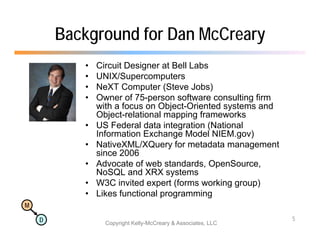
Background for Dan McCreary
           •   Circuit Designer at Bell Labs
           •   UNIX/Supercomputers
           •   NeXT Computer (Steve Jobs)
           •   Owner of 75-person software consulting firm
               with a focus on Object-Oriented systems and
                               Object Oriented
               Object-relational mapping frameworks
           •   US Federal data integration (National
               Information Exchange Model NIEM.gov)
           •   NativeXML/XQuery for metadata management
               since 2006
           •   Advocate of web standards, OpenSource,
               NoSQL d
               N SQL and XRX systems t
           •   W3C invited expert (forms working group)
           •   Likes functional programming
M

    D                                                         5
                 Copyright Kelly-McCreary & Associates, LLC
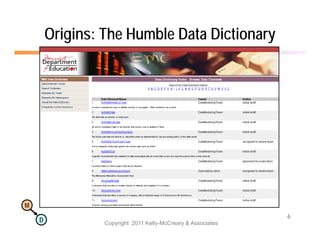
Origins: The Humble Data Dictionary


M
                                                              6
    D            Copyright 2011 Kelly-McCreary & Associates
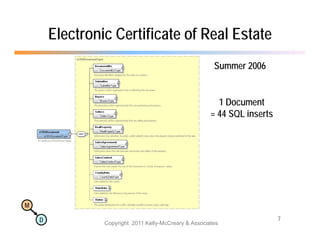
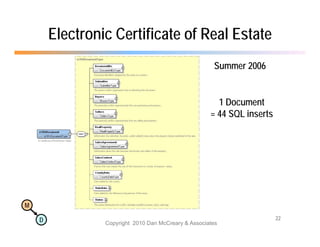
Electronic Certificate of Real Estate
                                                         Summer 2006


                                                          1 Document
                                                        = 44 SQL inserts


M

    D                                                                      7
                 Copyright 2011 Kelly-McCreary & Associates
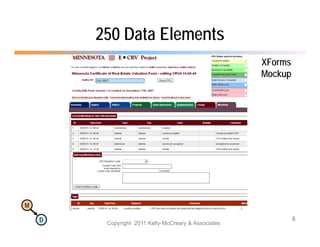
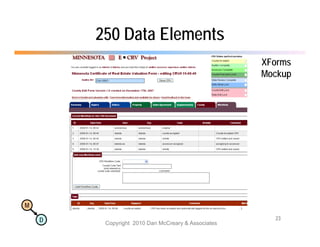
250 Data Elements
                                                      XForms
                                                      Mockup


M

    D                                                          8
         Copyright 2011 Kelly-McCreary & Associates
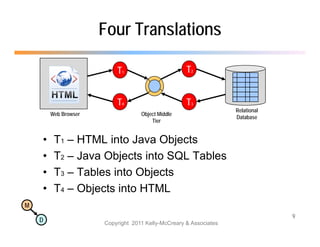
Four Translations

                          T1                        T2


                          T4                        T3
                                                                   Relational
        Web Browser                Object Middle
                                                                   Database
                                       Tier


    •    T1 – HTML into Java Objects
    •    T2 – Java Objects into SQL Tables
    •    T3 – Tables into Objects
    •    T4 – Objects into HTML
M
                                                                                9
    D                 Copyright 2011 Kelly-McCreary & Associates
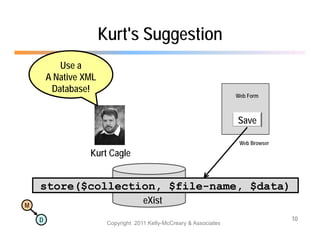
Kurt's Suggestion
           Use a
        A Native XML
         Database!
                                                                     Web Form


                                                                     Save

                                                                      Web Browser
                  Kurt Cagle


    store($collection, $file-name, $data)
M
                                     eXist
    D                                                                               10
                        Copyright 2011 Kelly-McCreary & Associates
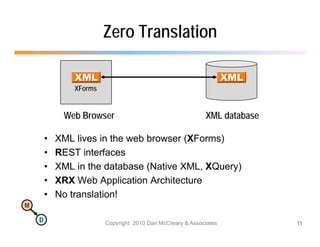
Zero Translation


                XForms


             Web Browser                                    XML database

        •   XML lives in the web browser (XForms)
        •   REST interfaces
        •   XML in the database (Native XML, XQuery)
                                 (          ,     y)
        •   XRX Web Application Architecture
        •   No translation!
M

    D                    Copyright 2010 Dan McCreary & Associates          11
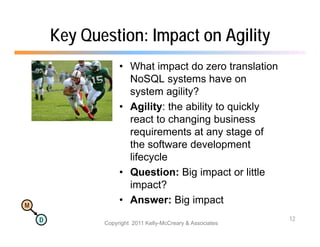
Key Question: Impact on Agility
                    • What impact do zero translation
                      NoSQL
                      N SQL systems h
                                  t      have on
                      system agility?
                    • Agility: the ability to quickly
                      react to changing business
                      requirements at any stage of
                      the software development
                      lifecycle
                    • Question: Big impact or little
                      impact?
M
                    • Answer: Big impact
    D                                                       12
               Copyright 2011 Kelly-McCreary & Associates
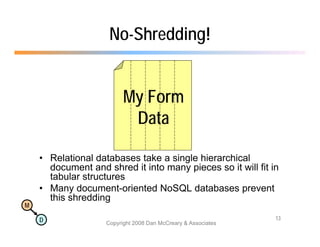
No-Shredding!


                          My Form
                           Data

    • Relational databases take a single hierarchical
      document and shred it into many pieces so it will fit in
      tabular structures
    • Many document-oriented NoSQL databases prevent
      this shreddingg
M

    D                                                          13
                    Copyright 2008 Dan McCreary & Associates
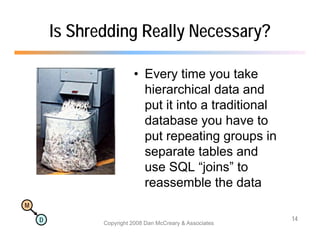
Is Shredding Really Necessary?

                         • Every time you take
                           hierarchical data and
                           put it into a traditional
                           database you have to
                           put repeating groups in
                           separate tables and
                           use SQL “joins” to
                                       joins
                           reassemble the data
M

    D                                                     14
               Copyright 2008 Dan McCreary & Associates
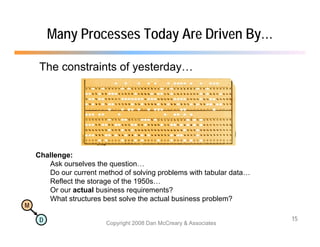
Many Processes Today Are Driven By…

     The constraints of yesterday…


    Challenge:
       Ask ourselves the question…
       Do
       D our current method of solving problems with t b l d t
                     t   th d f l i        bl       ith tabular data…
       Reflect the storage of the 1950s…
       Or our actual business requirements?
       What structures best solve the actual business problem?
                                                       p
M

     D                                                                  15
                         Copyright 2008 Dan McCreary & Associates
"Schema Free"
           • Systems that automatically determine
             how to index data as the data is loaded
             into the database
           • No a priori knowledge of data structure
           • N need f up-front logical d t modeling
             No       d for  f t l i l data        d li
              – …but some modeling is still critical
           • Adding new data elements or changing
                    g                             g g
             data elements is not disruptive
           • Searching millions of records still has sub-
             second response time


M

    D                                                   16
        Copyright 2010 Dan McCreary & Associates
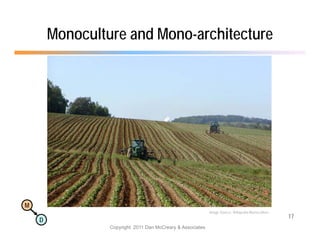
Monoculture and Mono-architecture


M
                                                            Image Source: Wikipedia Monoculture
                                                                                                  17
    D
                 Copyright 2011 Dan McCreary & Associates
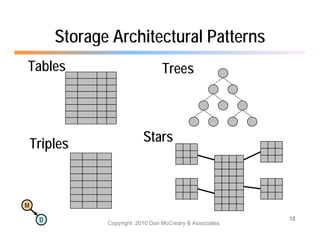
Storage Architectural Patterns
              g
Tables                             Trees


    Triples
    Ti l                    Stars


M

     D                                                     18
                Copyright 2010 Dan McCreary & Associates
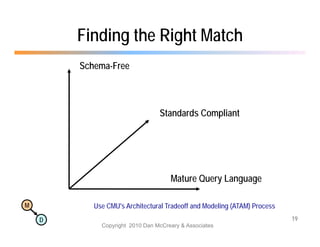
Finding the Right Match
        Schema-Free


                                 Standards Compliant


                                     Mature Query Language

M          Use CMU's Architectural Tradeoff and Modeling (ATAM) Process
    D                                                                     19
             Copyright 2010 Dan McCreary & Associates
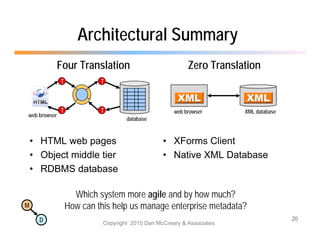
Architectural Summary
          Four Translation                                Zero Translation
              T            T


              T            T                         web browser       XML database
web browser
                                    database


    • HTML web pages
              eb                                 • XForms Client
    • Object middle tier                         • Native XML Database
    • RDBMS database

                    Which system more agile and by how much?
M                 How can this help us manage enterprise metadata?
      D                                                                               20
                            Copyright 2010 Dan McCreary & Associates
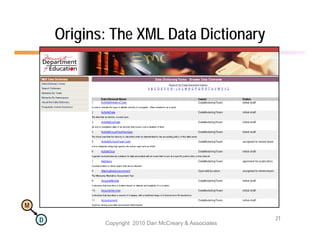
Origins: The XML Data Dictionary


M

    D                                                     21
               Copyright 2010 Dan McCreary & Associates
Electronic Certificate of Real Estate
                                                       Summer 2006


                                                        1 Document
                                                      = 44 SQL inserts


M

    D                                                                    22
                 Copyright 2010 Dan McCreary & Associates
250 Data Elements
                                                    XForms
                                                    Mockup


M

    D                                                 23
         Copyright 2010 Dan McCreary & Associates
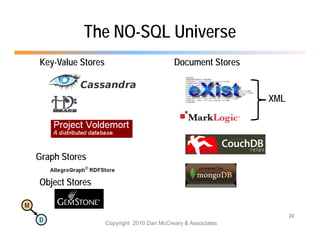
The NO-SQL Universe
    Key-Value Stores                           Document Stores


                                                                  XML


    Graph Stores

    Object Stores

M
                                                                        24
    D                  Copyright 2010 Dan McCreary & Associates
Three Core Processes
    1. Add new data to the database
        1. Use XML example but JSON and other
           formats could also be used
    2. Query the d
    2 Q       h data
    3. Create an XML web service

        • Analyze the effort for each step
        • Compare SQL and NoSQL XRX systems
                               NoSQL-XRX
        • Analyze impact on participation of non-programmers
        • Rate the relative agility of each system
M

    D                                                           25
                     Copyright 2010 Dan McCreary & Associates
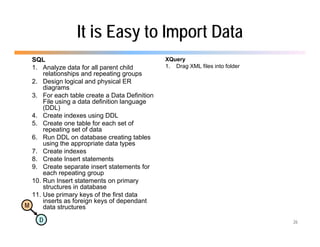
It is Easy to Import Data
  SQL                                          XQuery
  1. Analyze data for all parent child         1. Drag XML files into folder
      relationships and repeating g p
                 p         p      g groups
  2. Design logical and physical ER
      diagrams
  3. For each table create a Data Definition
      File using a data definition language
      (DDL)
  4. Create indexes using DDL
  5. Create one table for each set of
      repeating set of data
  6. Run DDL on database creating tables
      using the appropriate data types
  7. Create indexes
  8. Create Insert statements
  9. Create separate insert statements for
      each repeating group
  10. Run Insert statements on primary
      structures in database
  11. Use primary keys of the first data
      inserts as foreign keys of dependant
M     data structures

    D                                                                          26
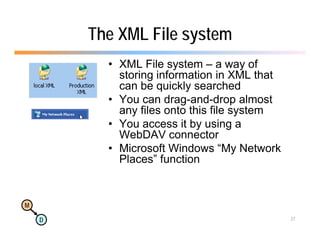
The XML File system
          • XML File system – a way of
            storing information in XML that
            can be quickly searched
          • You can drag-and-drop almost
            any fil onto thi fil system
                 files t this file   t
          • You access it by using a
            WebDAV connector
          • Microsoft Windows “My Network
            Places” function


M

    D                                         27
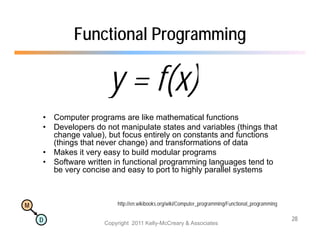
Functional Programming

                       y = f(x)
    •   Computer programs are like mathematical functions
    •   Developers do not manipulate states and variables (things that
        change value), but focus entirely on constants and functions
             g        )                  y
        (things that never change) and transformations of data
    •   Makes it very easy to build modular programs
    •   Software written in functional programming languages tend to
        be very concise and easy to port to highly parallel systems


M                         http://en.wikibooks.org/wiki/Computer_programming/Functional_programming

    D                                                                                                28
                      Copyright 2011 Kelly-McCreary & Associates
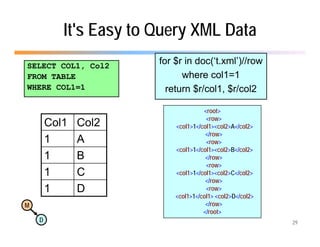
It's Easy to Query XML Data
SELECT COL1, Col2
                        for $r in doc(‘t.xml’)//row
FROM TABLE                    where col1=1
                                     col1 1
WHERE COL1=1              return $r/col1, $r/col2

                                      <root>
                                       <row>
        Col1   Col2         <col1>1</col1><col2>A</col2>
                                       </row>
        1      A                       <row>
                            <col1>1</col1><col2>B</col2>
        1      B                       </row>
                                       <row>
        1      C            <col1>1</col1><col2>C</col2>
                                       </row>
        1      D                       <row>
                            <col1>1</col1> <col2>D</col2>
M                                      </row>
                                      </root>
    D                                                       29
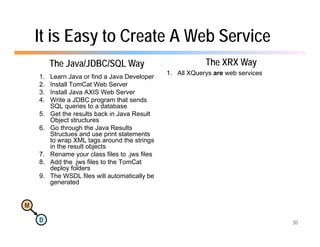
It is Easy to Create A Web Service
         The Java/JDBC/SQL Way                               The XRX Way
                                                 1. All XQuerys are web services
    1.
    1    Learn Java or find a Java Developer
    2.   Install TomCat Web Server
    3.   Install Java AXIS Web Server
    4.   Write a JDBC program that sends
         SQL queries to a database
    5.   Get the results back in Java Result
         Object structures
    6.   Go through the Java Results
         Structues and use print statements
         to wrap XML tags aro nd the strings
              rap            around
         in the result objects
    7.   Rename your class files to .jws files
    8.   Add the .jws files to the TomCat
         deploy folders
    9.   The WSDL files will automatically be
         generated


M

    D                                                                              30
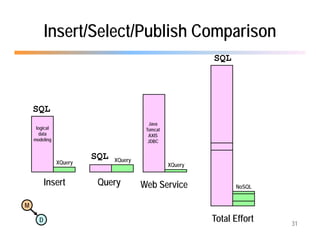
Insert/Select/Publish Comparison
                                                          SQL


    SQL
                                         Java
     logical                            Tomcat
      data                               AXIS
    modeling                             JDBC


                        SQL   XQuery
               XQuery                            XQuery


          Insert         Query         Web Service              NoSQL


M

      D                                                   Total Effort   31
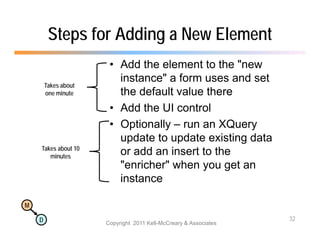
Steps for Adding a New Element
                       • Add the element to the "new
                         instance
                         instance" a form uses and set
        Takes about
        one minute       the default value there
                       • Add the UI control
                       • Optionally – run an XQuery
                         update to update existing data
    Takes about 10
       minutes
                         or add an insert to the
                         "enricher" when you get an
                                          y g
                         instance

M

    D                                                             32
                      Copyright 2011 Kell-McCreary & Associates
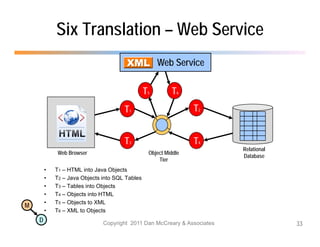
Six Translation – Web Service
                                                     Web Service

                                                T5        T6
                                      T1                         T2


                                      T3                         T4
                                                                         Relational
            Web Browser                          Object Middle
                                                                         Database
                                                     Tier
        •   T1 – HTML into Java Objects
        •   T2 – Java Objects into SQL Tables
        •   T3 – Tables into Objects
        •   T4 – Objects into HTML
        •   T5 – Objects to XML
M
        •   T6 – XML to Objects
    D                         Copyright 2011 Dan McCreary & Associates                33
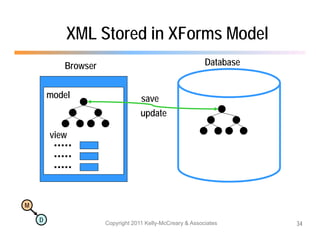
XML Stored in XForms Model
           Browser                                        Database


        model                     save
                                  update

        view


M

    D                Copyright 2011 Kelly-McCreary & Associates      34
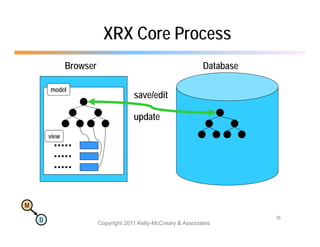
XRX Core Process
               Browser                                          Database

        model
                                      save/edit

                                      update
        view


M
                                                                           35
    D                    Copyright 2011 Kelly-McCreary & Associates
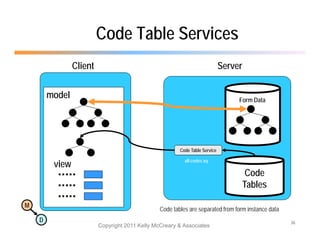
Code Table Services
                Client                                                       Server


        model                                                                     Form Data


                                                        Code Table Service

                                                          all-codes.xq
         view
                                                                                       Code
                                                                                       C d
                                                                                      Tables

M
                                                Code tables are separated from form instance data
    D                                                                                               36
                         Copyright 2011 Kelly McCreary & Associates
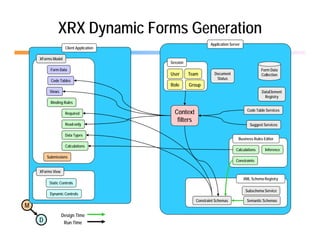
XRX Dynamic Forms Generation
                                                             Application Server
                   Client Application

    XForms Model
                                        Session
         Form Data                                                                          Form Data
                                        User      Team         Document                     Collection
                                                                Status
          Code Tables
                                        Role      Group
         Views                                                                              DataElement
                                                                                              Registry
         Binding Rules
                                                                                    Code Table Services
                   Required               Context
                                           filters
                   Read-only                                                         Suggest Services

                   Data Types
                                                                              Business Rules Editor
                   Calculations
                                                                            Calculations      Inference
        Submissions
                                                                            Constraints

    XForms View
    XF     Vi
                                                                                  XML Schema Registry
         Static Controls
                                                                                   Subschema Service
         Dynamic Controls
                                                     Constraint Schemas             Semantic Schemas
M
                  Design Time
    D              Run Time
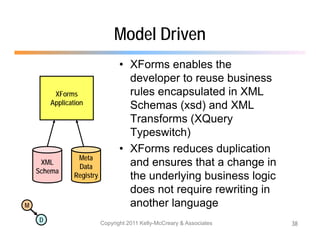
Model Driven
                                  • XForms enables the
                                    developer to reuse business
         XForms                     rules encapsulated in XML
        Application
                                    Schemas (xsd) and XML
                                    Transforms (XQuery
                                    Typeswitch)
                                  • XForms reduces duplication
                 Meta
     XML
                 Data               and ensures that a change in
    Schema
                Registry            the underlying business logic
                                    does not require rewriting in
M                                   another language
    D                      Copyright 2011 Kelly-McCreary & Associates   38
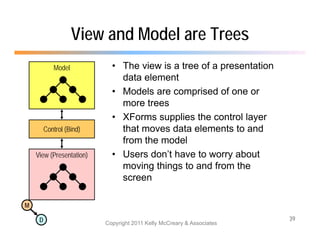
View and Model are Trees
            Model           • The view is a tree of a presentation
                              data element
                            • Models are comprised of one or
                              more trees
                            • XForms supplies the control layer
         Control (Bind)       that moves data elements to and
                              from the model
    View (Presentation)     • Users don’t have to worry about
                              moving things to and from the
                                    g    g
                              screen

M

     D                                                                 39
                          Copyright 2011 Kelly McCreary & Associates
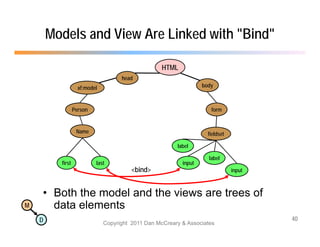
Models and View Are Linked with "Bind"

                                                    HTML
                                     head
                                     h d
                    xf:model                                       body


                  Person
                  P                                                   form
                                                                      f


                   Name                                              fieldset

                                                         label

                                                                     label
          first            last                            input
                                         <bind>                                 input


    • Both the model and the views are trees of
M     data l
      d t elements
                 t
    D                                                                                   40
                               Copyright 2011 Dan McCreary & Associates
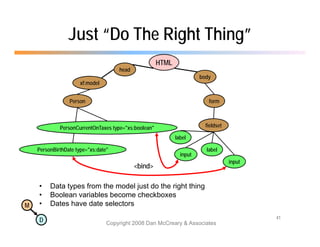
Just “Do The Right Thing”
                                                      HTML
                                     head
                                                                       body
                      xf:model


                 Person                                                   form


             PersonCurrentOnTaxes type="xs:boolean"                      fieldset

                                                             label

    PersonBirthDate type="xs:date"                                       label
                                                               input
                                                                                    input
                                            <bind>

    •    Data types from the model just do the right thing
    •    Boolean variables become checkboxes
M   •    Dates have d t selectors
         D t h       date l t
                                                                                            41
    D                            Copyright 2008 Dan McCreary & Associates
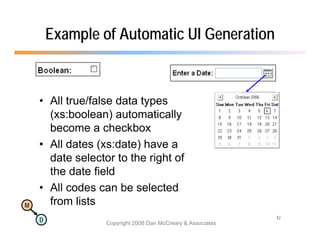
Example of Automatic UI Generation


    • All true/false data types
      (xs:boolean) automatically
      become a checkbox
    • All dates (xs:date) have a
      date selector to the right of
      the date field
    • All codes can be selected
M     from lists
                                                             42
    D             Copyright 2008 Dan McCreary & Associates
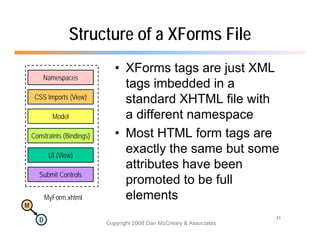
Structure of a XForms File
                                • XForms tags are just XML
        Namespaces
                                  tags imbedded in a
     CSS Imports (View)           standard XHTML file with
             Model                a different namespace
    Constraints (Bindings)
                (      g )      • Most HTML form tags are
                                                      g
            UI (View)
                                  exactly the same but some
                                  attributes have been
       Submit Controls
                                  promoted to be full
           MyForm.xhtml
            y                     elements
M
                                                                        43
       D                     Copyright 2008 Dan McCreary & Associates
REST
    • REpresentation State Transfer
    • Create applications based on well
      designed URLs
    • Take advantage of web caching
    • Migrate toward Resource Oriented
                      Resource-Oriented
      Computing (ROC)
    • REST evangelists: RESTifarians

M

    D        Copyright 2011 Kelly-McCreary & Associates   44
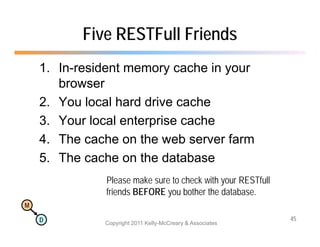
Five RESTFull Friends
    1. In-resident memory cache in your
       browser
    2. You local hard drive cache
    3. Your local enterprise cache
    4.
    4 The cache on the web server farm
    5. The cache on the database
              Please make sure to check with your RESTfull
              friends BEFORE you bother the database.
M

    D                                                        45
              Copyright 2011 Kelly-McCreary & Associates
Shallow REST vs. Deep REST
    • You can start taking advantage of ReST
      buy just doing
      b j t d i well th ll thought-out URL
                                ht t
      design
    • To take advantage of deep ReST you
      must consider the subtleties of the
      HTTP protocol
        – GET vs POST vs PUT
        – DELETE

M

    D                                                      46
                Copyright 2008 Dan McCreary & Associates
Benefits of REST
    •   Provides improved response time
    •   Reduced server load
    •   Improves server scalability
          p                       y
    •   Requires less client-side software
    •   Depends less on vendor dependencies
    •   Promotes discovery
    •   Provides better long-term compatibility
    •                         y
        Better and evolvability
M

    D                                                       47
                 Copyright 2008 Dan McCreary & Associates
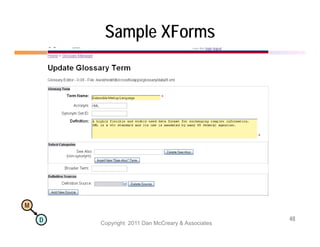
Sample XForms


M

    D                                              48
        Copyright 2011 Dan McCreary & Associates
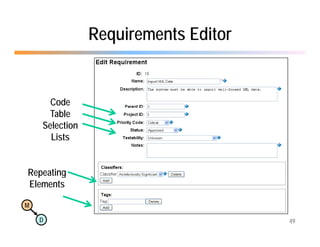
Requirements Editor


      Code
      Table
    Selection
      Lists


Repeating
R    ti
Elements

M

    D                                 49
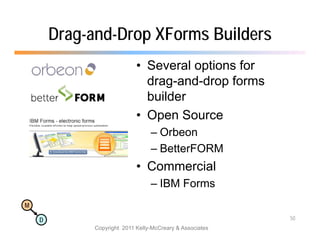
Drag-and-Drop XForms Builders
                             • Several options for
                               drag-and-drop f
                               d       dd    forms
                               builder
                             • Open Source
                                  – Orbeon
                                  – BetterFORM
                             • Commercial
                                  – IBM Forms
M

    D                                                      50
              Copyright 2011 Kelly-McCreary & Associates
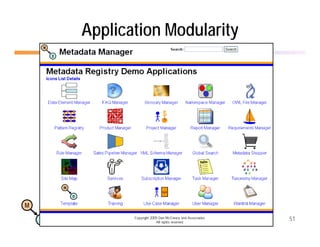
Application Modularity


M

    D                                                 51
           Copyright 2010 Dan McCreary & Associates
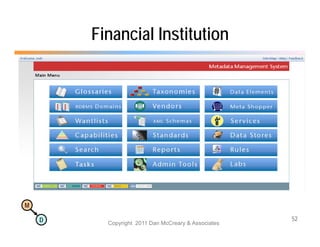
Financial Institution


M

    D                                                52
          Copyright 2011 Dan McCreary & Associates
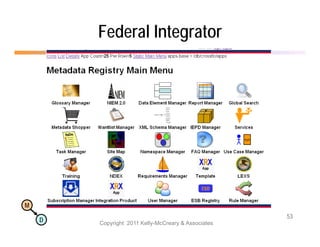
Federal Integrator


M
                                                     53
    D   Copyright 2011 Kelly-McCreary & Associates
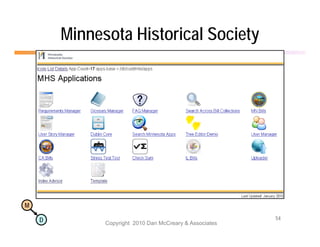
Minnesota Historical Society


M

    D                                                    54
              Copyright 2010 Dan McCreary & Associates
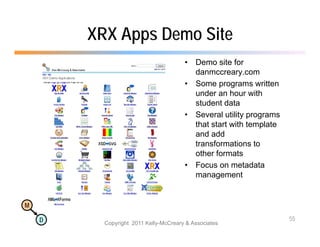
XRX Apps Demo Site
                                       •   Demo site for
                                           danmccreary.com
                                       •   Some programs written
                                           under an hour with
                                           student data
                                       •   Several utility programs
                                           that start with template
                                           and add
                                           transformations to
                                           other formats
                                       •   Focus on metadata
                                           management


M

    D                                                                 55
          Copyright 2011 Kelly-McCreary & Associates
Structured Retrieval is Better
                            Introduction to
                              Information Retrieval
                             by Christopher D. Manning,
                              y        p             g
                              Prabhakar Raghavan and
                              Hinrich Schütze
                            Cambridge University
                            C b id U i       i
                             Press, 2008


M
        http://nlp.stanford.edu/IR-book/information-retrieval-book.html
        http://nlp stanford edu/IR-book/information-retrieval-book html
    D                                                                56
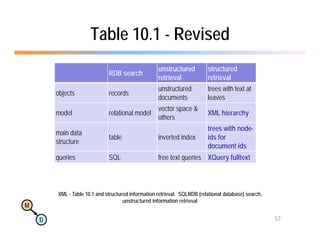
Table 10.1 - Revised
                                                    unstructured          structured
                              RDB search
                                                    retrieval             retrieval
                                                    unstructured          trees with text at
        objects               records
                                                    documents             leaves
                                                    vector space &
        model                 relational model                            XML hierarchy
                                                    others
                                                                          trees with node-
        main data
                              table                 inverted index        ids for
        structure
         t t
                                                                          document ids
        queries               SQL                   free text queries XQuery fulltext


        XML - Table 10.1 and structured information retrieval. SQLRDB (relational database) search,
                                     unstructured information retrieval
M

    D                                                                                                 57
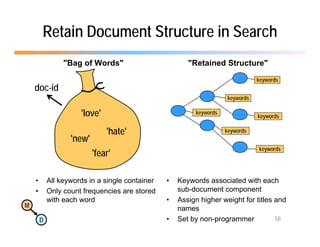
Retain Document Structure in Search
                 "Bag of Words"                         "Retained Structure"
                                                                                keywords
    doc-id
                                                                     keywords

                      'love'                              keywords
                                                                                keywords

                               'hate'                                keywords
                   'new'
                    new
                                                                                keywords
                           'fear'

    •       All keywords in a single container   •   Keywords associated with each
    •       Only count frequencies are stored        sub-document component
            with each word                       •   Assign higher weight for titles and
M
                                                     names
        D                                        •   Set by non-programmer           58
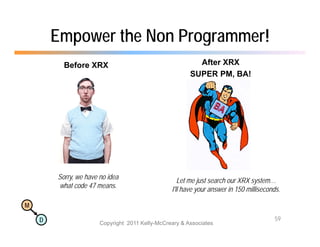
Empower the Non Programmer!
          Before XRX                                      After XRX
                                                        SUPER PM, BA!
                                                                  ,


        Sorry, we have no idea                      Let me just search our XRX system…
        what code 47 means.                      I'll have your answer in 150 milliseconds.

M

    D                                                                                   59
                       Copyright 2011 Kelly-McCreary & Associates
Using the Right Architecture


        Start                                                      Finish


                Find ways to remove barriers to empowering
                    the non programmers on your team
                                                  team.


M

    D                                                                       60
                      Copyright 2011 Kelly-McCreary & Associates
Six "S"s of XRX Agility
    1. Semantics – build around shard metadata
       registry services
          i t       i
    2. Search – structured search
    3. Standards – CSS, XML, XPath, XQuery,
       XForms, XML Schemas
    4. Services – all XQ i are REST services
    4 S i           ll XQueries                i
    5. Solutions - that are quickly customized
    6. Super – Empower the non-programmers

M
                                                            61
    D          Copyright 2010 Kelly-McCreary & Associates
XRX Resources
    •   XRX Wikipedia Page
        – http://en.wikipedia.org/wiki/XRX(web_application_architecture)
             p          p       g         (   _ pp        _            )
    •   XRX Resources
        – http://www.danmccreary.com/xrx/
    •   LinkedIn XRX Group
        – http://www.linkedin.com/groups/XRX-Web-Application-Architecture-1056777
    •   Beginner's Guide to XRX
        – http://www danmccreary com/xrx/beginners-guide
          http://www.danmccreary.com/xrx/beginners-guide
    •   XRX Wikibook
        – http://en.wikibooks.org/wiki/XRX
    •   Google Code
        – http://code.google.com/p/xrx/


M

    D                                                                               62
                        Copyright 2011 Kelly-McCreary & Associates
References


                                XForms
                                XQuery
                                XQ
                                  XRX

    A Beginner's Guide to XRX
                 Send e-mail to dan@danmccreary com for extended
                      e mail dan@danmccreary.com
M
                         list of "getting started" resources.
    D                                                              63
                 Copyright 2011 Kelly-McCreary & Associates
Thank You!
    Dan McCreary, President
    Kelly-McCreary & Associates
    dan@danmccreary.com
    (952) 931-9198


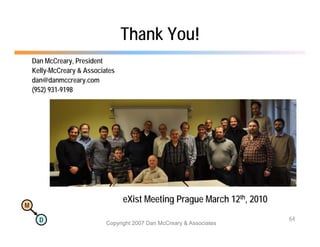
                                  eXist Meeting Prague March 12th, 2010
M

      D                                                                   64
                            Copyright 2007 Dan McCreary & Associates

Agile NoSQL With XRX

  • 1.
    Agile NoSQL withXRX Dan McCreary President M Dan McCreary & Associates dan@danmccreary.com D (952) 931 9198 931-9198 Metadata Solutions
  • 2.
    Session Description What if all members of your software development team from Project Managers, Business Analysts, Testing and Documentation Managers Analysts members could create and modify web applications and web services? With traditional SQL solutions this was difficult because of th need t convert web pages t objects, objects t t bl as f the d to t b to bj t bj t to tables well as the reverse functions. But now with native XML databases and drag-and-drop forms builders, data can flow from the XML model of a web form to the database and back again without translation. This radically simpler process combined with standardized query languages makes it easier for non- non programmers to build and maintain their own applications and web services. M D 2 of Copyright 2011 Dan McCreary & Associates N
  • 3.
    During this sessionviewers will: • Understand the challenges associated with traditional four- translation web/object/RDBMS systems • Understand the elegant simplicity of zero-translation systems • Understand the role of web standards in the XRX environment • See how each component of XRX plays key roles in the application • See how organizations have leveraged XRX for agile web development • See variations of XRX architectures • Create and objective p j process to evaluate the benefits of XRX • Get resources for building XRX pilot projects M D 3 Copyright 2011 Dan McCreary & Associates
  • 4.
    Executive Summary • Schema-free, zero translation NoSQL systems have the ability to have a big impact on overall system agility p y g y • XRX systems dramatically increase overall agility and can also empower non-progammers to build and maintain NoSQL systems M D 4 Copyright 2011 Dan McCreary & Associates
  • 5.
    Background for DanMcCreary • Circuit Designer at Bell Labs • UNIX/Supercomputers • NeXT Computer (Steve Jobs) • Owner of 75-person software consulting firm with a focus on Object-Oriented systems and Object Oriented Object-relational mapping frameworks • US Federal data integration (National Information Exchange Model NIEM.gov) • NativeXML/XQuery for metadata management since 2006 • Advocate of web standards, OpenSource, NoSQL d N SQL and XRX systems t • W3C invited expert (forms working group) • Likes functional programming M D 5 Copyright Kelly-McCreary & Associates, LLC
  • 6.
    Origins: The HumbleData Dictionary M 6 D Copyright 2011 Kelly-McCreary & Associates
  • 7.
    Electronic Certificate ofReal Estate Summer 2006 1 Document = 44 SQL inserts M D 7 Copyright 2011 Kelly-McCreary & Associates
  • 8.
    250 Data Elements XForms Mockup M D 8 Copyright 2011 Kelly-McCreary & Associates
  • 9.
    Four Translations T1 T2 T4 T3 Relational Web Browser Object Middle Database Tier • T1 – HTML into Java Objects • T2 – Java Objects into SQL Tables • T3 – Tables into Objects • T4 – Objects into HTML M 9 D Copyright 2011 Kelly-McCreary & Associates
  • 10.
    Kurt's Suggestion Use a A Native XML Database! Web Form Save Web Browser Kurt Cagle store($collection, $file-name, $data) M eXist D 10 Copyright 2011 Kelly-McCreary & Associates
  • 11.
    Zero Translation XForms Web Browser XML database • XML lives in the web browser (XForms) • REST interfaces • XML in the database (Native XML, XQuery) ( , y) • XRX Web Application Architecture • No translation! M D Copyright 2010 Dan McCreary & Associates 11
  • 12.
    Key Question: Impacton Agility • What impact do zero translation NoSQL N SQL systems h t have on system agility? • Agility: the ability to quickly react to changing business requirements at any stage of the software development lifecycle • Question: Big impact or little impact? M • Answer: Big impact D 12 Copyright 2011 Kelly-McCreary & Associates
  • 13.
    No-Shredding! My Form Data • Relational databases take a single hierarchical document and shred it into many pieces so it will fit in tabular structures • Many document-oriented NoSQL databases prevent this shreddingg M D 13 Copyright 2008 Dan McCreary & Associates
  • 14.
    Is Shredding ReallyNecessary? • Every time you take hierarchical data and put it into a traditional database you have to put repeating groups in separate tables and use SQL “joins” to joins reassemble the data M D 14 Copyright 2008 Dan McCreary & Associates
  • 15.
    Many Processes TodayAre Driven By… The constraints of yesterday… Challenge: Ask ourselves the question… Do D our current method of solving problems with t b l d t t th d f l i bl ith tabular data… Reflect the storage of the 1950s… Or our actual business requirements? What structures best solve the actual business problem? p M D 15 Copyright 2008 Dan McCreary & Associates
  • 16.
    "Schema Free" • Systems that automatically determine how to index data as the data is loaded into the database • No a priori knowledge of data structure • N need f up-front logical d t modeling No d for f t l i l data d li – …but some modeling is still critical • Adding new data elements or changing g g g data elements is not disruptive • Searching millions of records still has sub- second response time M D 16 Copyright 2010 Dan McCreary & Associates
  • 17.
    Monoculture and Mono-architecture M Image Source: Wikipedia Monoculture 17 D Copyright 2011 Dan McCreary & Associates
  • 18.
    Storage Architectural Patterns g Tables Trees Triples Ti l Stars M D 18 Copyright 2010 Dan McCreary & Associates
  • 19.
    Finding the RightMatch Schema-Free Standards Compliant Mature Query Language M Use CMU's Architectural Tradeoff and Modeling (ATAM) Process D 19 Copyright 2010 Dan McCreary & Associates
  • 20.
    Architectural Summary Four Translation Zero Translation T T T T web browser XML database web browser database • HTML web pages eb • XForms Client • Object middle tier • Native XML Database • RDBMS database Which system more agile and by how much? M How can this help us manage enterprise metadata? D 20 Copyright 2010 Dan McCreary & Associates
  • 21.
    Origins: The XMLData Dictionary M D 21 Copyright 2010 Dan McCreary & Associates
  • 22.
    Electronic Certificate ofReal Estate Summer 2006 1 Document = 44 SQL inserts M D 22 Copyright 2010 Dan McCreary & Associates
  • 23.
    250 Data Elements XForms Mockup M D 23 Copyright 2010 Dan McCreary & Associates
  • 24.
    The NO-SQL Universe Key-Value Stores Document Stores XML Graph Stores Object Stores M 24 D Copyright 2010 Dan McCreary & Associates
  • 25.
    Three Core Processes 1. Add new data to the database 1. Use XML example but JSON and other formats could also be used 2. Query the d 2 Q h data 3. Create an XML web service • Analyze the effort for each step • Compare SQL and NoSQL XRX systems NoSQL-XRX • Analyze impact on participation of non-programmers • Rate the relative agility of each system M D 25 Copyright 2010 Dan McCreary & Associates
  • 26.
    It is Easyto Import Data SQL XQuery 1. Analyze data for all parent child 1. Drag XML files into folder relationships and repeating g p p p g groups 2. Design logical and physical ER diagrams 3. For each table create a Data Definition File using a data definition language (DDL) 4. Create indexes using DDL 5. Create one table for each set of repeating set of data 6. Run DDL on database creating tables using the appropriate data types 7. Create indexes 8. Create Insert statements 9. Create separate insert statements for each repeating group 10. Run Insert statements on primary structures in database 11. Use primary keys of the first data inserts as foreign keys of dependant M data structures D 26
  • 27.
    The XML Filesystem • XML File system – a way of storing information in XML that can be quickly searched • You can drag-and-drop almost any fil onto thi fil system files t this file t • You access it by using a WebDAV connector • Microsoft Windows “My Network Places” function M D 27
  • 28.
    Functional Programming y = f(x) • Computer programs are like mathematical functions • Developers do not manipulate states and variables (things that change value), but focus entirely on constants and functions g ) y (things that never change) and transformations of data • Makes it very easy to build modular programs • Software written in functional programming languages tend to be very concise and easy to port to highly parallel systems M http://en.wikibooks.org/wiki/Computer_programming/Functional_programming D 28 Copyright 2011 Kelly-McCreary & Associates
  • 29.
    It's Easy toQuery XML Data SELECT COL1, Col2 for $r in doc(‘t.xml’)//row FROM TABLE where col1=1 col1 1 WHERE COL1=1 return $r/col1, $r/col2 <root> <row> Col1 Col2 <col1>1</col1><col2>A</col2> </row> 1 A <row> <col1>1</col1><col2>B</col2> 1 B </row> <row> 1 C <col1>1</col1><col2>C</col2> </row> 1 D <row> <col1>1</col1> <col2>D</col2> M </row> </root> D 29
  • 30.
    It is Easyto Create A Web Service The Java/JDBC/SQL Way The XRX Way 1. All XQuerys are web services 1. 1 Learn Java or find a Java Developer 2. Install TomCat Web Server 3. Install Java AXIS Web Server 4. Write a JDBC program that sends SQL queries to a database 5. Get the results back in Java Result Object structures 6. Go through the Java Results Structues and use print statements to wrap XML tags aro nd the strings rap around in the result objects 7. Rename your class files to .jws files 8. Add the .jws files to the TomCat deploy folders 9. The WSDL files will automatically be generated M D 30
  • 31.
    Insert/Select/Publish Comparison SQL SQL Java logical Tomcat data AXIS modeling JDBC SQL XQuery XQuery XQuery Insert Query Web Service NoSQL M D Total Effort 31
  • 32.
    Steps for Addinga New Element • Add the element to the "new instance instance" a form uses and set Takes about one minute the default value there • Add the UI control • Optionally – run an XQuery update to update existing data Takes about 10 minutes or add an insert to the "enricher" when you get an y g instance M D 32 Copyright 2011 Kell-McCreary & Associates
  • 33.
    Six Translation –Web Service Web Service T5 T6 T1 T2 T3 T4 Relational Web Browser Object Middle Database Tier • T1 – HTML into Java Objects • T2 – Java Objects into SQL Tables • T3 – Tables into Objects • T4 – Objects into HTML • T5 – Objects to XML M • T6 – XML to Objects D Copyright 2011 Dan McCreary & Associates 33
  • 34.
    XML Stored inXForms Model Browser Database model save update view M D Copyright 2011 Kelly-McCreary & Associates 34
  • 35.
    XRX Core Process Browser Database model save/edit update view M 35 D Copyright 2011 Kelly-McCreary & Associates
  • 36.
    Code Table Services Client Server model Form Data Code Table Service all-codes.xq view Code C d Tables M Code tables are separated from form instance data D 36 Copyright 2011 Kelly McCreary & Associates
  • 37.
    XRX Dynamic FormsGeneration Application Server Client Application XForms Model Session Form Data Form Data User Team Document Collection Status Code Tables Role Group Views DataElement Registry Binding Rules Code Table Services Required Context filters Read-only Suggest Services Data Types Business Rules Editor Calculations Calculations Inference Submissions Constraints XForms View XF Vi XML Schema Registry Static Controls Subschema Service Dynamic Controls Constraint Schemas Semantic Schemas M Design Time D Run Time
  • 38.
    Model Driven • XForms enables the developer to reuse business XForms rules encapsulated in XML Application Schemas (xsd) and XML Transforms (XQuery Typeswitch) • XForms reduces duplication Meta XML Data and ensures that a change in Schema Registry the underlying business logic does not require rewriting in M another language D Copyright 2011 Kelly-McCreary & Associates 38
  • 39.
    View and Modelare Trees Model • The view is a tree of a presentation data element • Models are comprised of one or more trees • XForms supplies the control layer Control (Bind) that moves data elements to and from the model View (Presentation) • Users don’t have to worry about moving things to and from the g g screen M D 39 Copyright 2011 Kelly McCreary & Associates
  • 40.
    Models and ViewAre Linked with "Bind" HTML head h d xf:model body Person P form f Name fieldset label label first last input <bind> input • Both the model and the views are trees of M data l d t elements t D 40 Copyright 2011 Dan McCreary & Associates
  • 41.
    Just “Do TheRight Thing” HTML head body xf:model Person form PersonCurrentOnTaxes type="xs:boolean" fieldset label PersonBirthDate type="xs:date" label input input <bind> • Data types from the model just do the right thing • Boolean variables become checkboxes M • Dates have d t selectors D t h date l t 41 D Copyright 2008 Dan McCreary & Associates
  • 42.
    Example of AutomaticUI Generation • All true/false data types (xs:boolean) automatically become a checkbox • All dates (xs:date) have a date selector to the right of the date field • All codes can be selected M from lists 42 D Copyright 2008 Dan McCreary & Associates
  • 43.
    Structure of aXForms File • XForms tags are just XML Namespaces tags imbedded in a CSS Imports (View) standard XHTML file with Model a different namespace Constraints (Bindings) ( g ) • Most HTML form tags are g UI (View) exactly the same but some attributes have been Submit Controls promoted to be full MyForm.xhtml y elements M 43 D Copyright 2008 Dan McCreary & Associates
  • 44.
    REST • REpresentation State Transfer • Create applications based on well designed URLs • Take advantage of web caching • Migrate toward Resource Oriented Resource-Oriented Computing (ROC) • REST evangelists: RESTifarians M D Copyright 2011 Kelly-McCreary & Associates 44
  • 45.
    Five RESTFull Friends 1. In-resident memory cache in your browser 2. You local hard drive cache 3. Your local enterprise cache 4. 4 The cache on the web server farm 5. The cache on the database Please make sure to check with your RESTfull friends BEFORE you bother the database. M D 45 Copyright 2011 Kelly-McCreary & Associates
  • 46.
    Shallow REST vs.Deep REST • You can start taking advantage of ReST buy just doing b j t d i well th ll thought-out URL ht t design • To take advantage of deep ReST you must consider the subtleties of the HTTP protocol – GET vs POST vs PUT – DELETE M D 46 Copyright 2008 Dan McCreary & Associates
  • 47.
    Benefits of REST • Provides improved response time • Reduced server load • Improves server scalability p y • Requires less client-side software • Depends less on vendor dependencies • Promotes discovery • Provides better long-term compatibility • y Better and evolvability M D 47 Copyright 2008 Dan McCreary & Associates
  • 48.
    Sample XForms M D 48 Copyright 2011 Dan McCreary & Associates
  • 49.
    Requirements Editor Code Table Selection Lists Repeating R ti Elements M D 49
  • 50.
    Drag-and-Drop XForms Builders • Several options for drag-and-drop f d dd forms builder • Open Source – Orbeon – BetterFORM • Commercial – IBM Forms M D 50 Copyright 2011 Kelly-McCreary & Associates
  • 51.
    Application Modularity M D 51 Copyright 2010 Dan McCreary & Associates
  • 52.
    Financial Institution M D 52 Copyright 2011 Dan McCreary & Associates
  • 53.
    Federal Integrator M 53 D Copyright 2011 Kelly-McCreary & Associates
  • 54.
    Minnesota Historical Society M D 54 Copyright 2010 Dan McCreary & Associates
  • 55.
    XRX Apps DemoSite • Demo site for danmccreary.com • Some programs written under an hour with student data • Several utility programs that start with template and add transformations to other formats • Focus on metadata management M D 55 Copyright 2011 Kelly-McCreary & Associates
  • 56.
    Structured Retrieval isBetter Introduction to Information Retrieval by Christopher D. Manning, y p g Prabhakar Raghavan and Hinrich Schütze Cambridge University C b id U i i Press, 2008 M http://nlp.stanford.edu/IR-book/information-retrieval-book.html http://nlp stanford edu/IR-book/information-retrieval-book html D 56
  • 57.
    Table 10.1 -Revised unstructured structured RDB search retrieval retrieval unstructured trees with text at objects records documents leaves vector space & model relational model XML hierarchy others trees with node- main data table inverted index ids for structure t t document ids queries SQL free text queries XQuery fulltext XML - Table 10.1 and structured information retrieval. SQLRDB (relational database) search, unstructured information retrieval M D 57
  • 58.
    Retain Document Structurein Search "Bag of Words" "Retained Structure" keywords doc-id keywords 'love' keywords keywords 'hate' keywords 'new' new keywords 'fear' • All keywords in a single container • Keywords associated with each • Only count frequencies are stored sub-document component with each word • Assign higher weight for titles and M names D • Set by non-programmer 58
  • 59.
    Empower the NonProgrammer! Before XRX After XRX SUPER PM, BA! , Sorry, we have no idea Let me just search our XRX system… what code 47 means. I'll have your answer in 150 milliseconds. M D 59 Copyright 2011 Kelly-McCreary & Associates
  • 60.
    Using the RightArchitecture Start Finish Find ways to remove barriers to empowering the non programmers on your team team. M D 60 Copyright 2011 Kelly-McCreary & Associates
  • 61.
    Six "S"s ofXRX Agility 1. Semantics – build around shard metadata registry services i t i 2. Search – structured search 3. Standards – CSS, XML, XPath, XQuery, XForms, XML Schemas 4. Services – all XQ i are REST services 4 S i ll XQueries i 5. Solutions - that are quickly customized 6. Super – Empower the non-programmers M 61 D Copyright 2010 Kelly-McCreary & Associates
  • 62.
    XRX Resources • XRX Wikipedia Page – http://en.wikipedia.org/wiki/XRX(web_application_architecture) p p g ( _ pp _ ) • XRX Resources – http://www.danmccreary.com/xrx/ • LinkedIn XRX Group – http://www.linkedin.com/groups/XRX-Web-Application-Architecture-1056777 • Beginner's Guide to XRX – http://www danmccreary com/xrx/beginners-guide http://www.danmccreary.com/xrx/beginners-guide • XRX Wikibook – http://en.wikibooks.org/wiki/XRX • Google Code – http://code.google.com/p/xrx/ M D 62 Copyright 2011 Kelly-McCreary & Associates
  • 63.
    References XForms XQuery XQ XRX A Beginner's Guide to XRX Send e-mail to dan@danmccreary com for extended e mail dan@danmccreary.com M list of "getting started" resources. D 63 Copyright 2011 Kelly-McCreary & Associates
  • 64.
    Thank You! Dan McCreary, President Kelly-McCreary & Associates dan@danmccreary.com (952) 931-9198 eXist Meeting Prague March 12th, 2010 M D 64 Copyright 2007 Dan McCreary & Associates