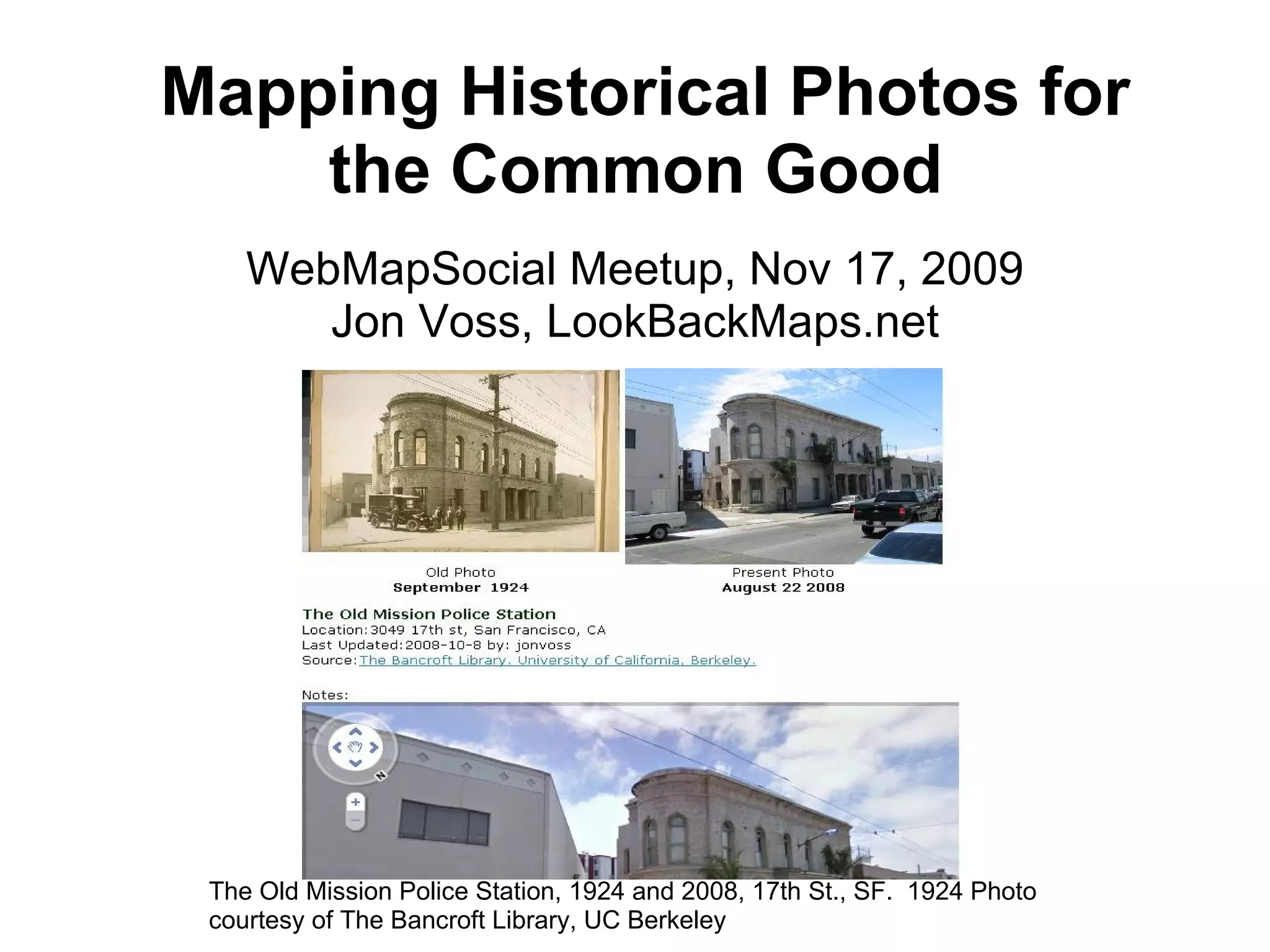
Mapping Historical Photos for the Common Good WebMapSocial Meetup, Nov 17, 2009 Jon Voss, LookBackMaps.net The Old Mission Police Station, 1924 and 2008, 17th St., SF.  1924 Photo courtesy of The Bancroft Library, UC Berkeley
Give me feedback... email: [email_address] www.twitter.com/LookBackMaps Comments welcome, just use @ or #LookBackMaps on Twitter or email me.
www.lookbackmaps.net  Started in 2008 as a Google MyMaps mashup  Based on the simple idea of creating community around local history. Created to solve the problem of disparate archives with no geotags through community and crowdsourcing
LookBackMaps in context I. Making Web 2.0 out of 1.0 Archives II. 2008 Marks a major shift in public digital archives and stakeholder expectations III. Stage is set for radical collaboration and innovation IV. Quick look at the possibilities
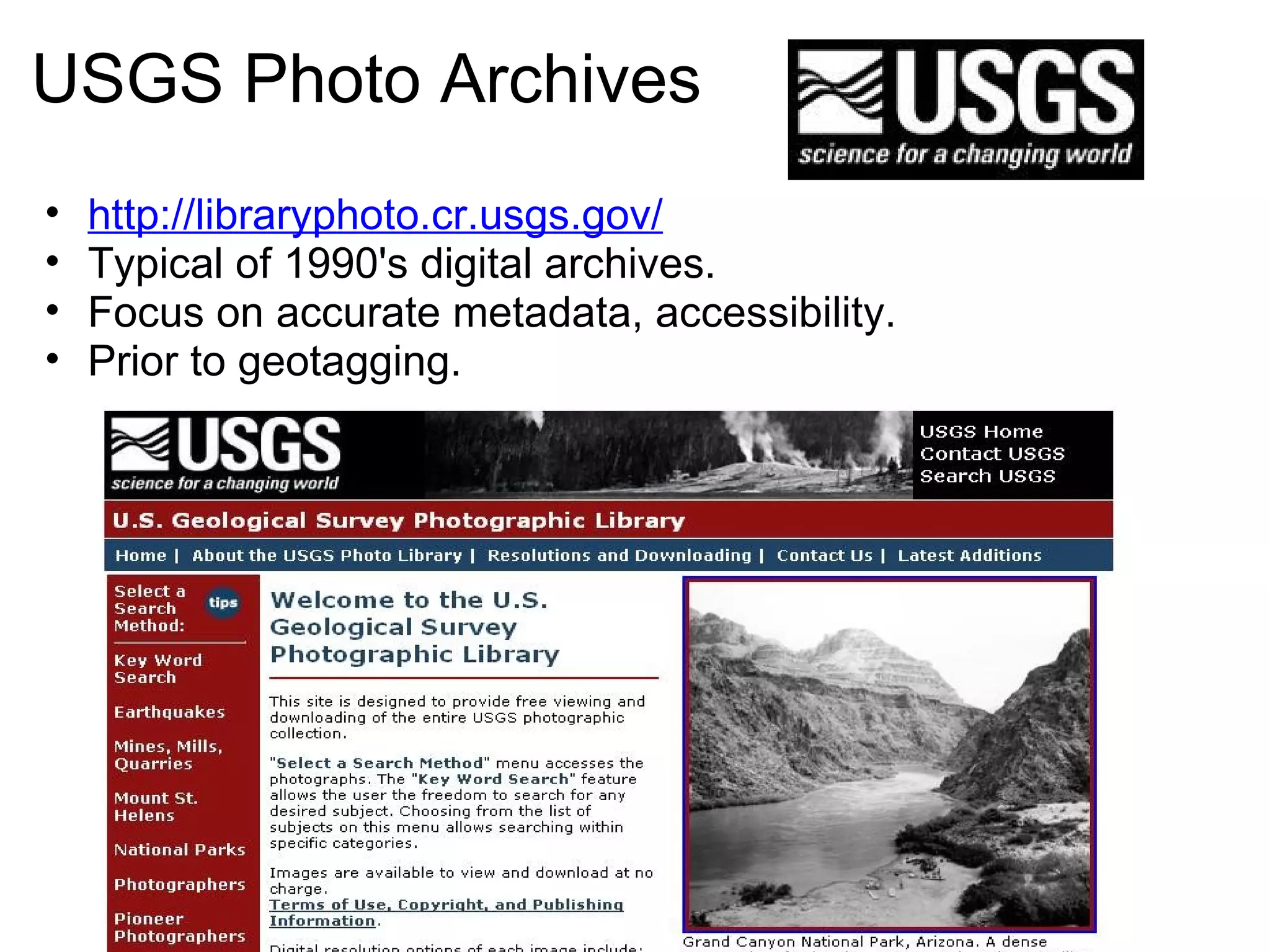
USGS Photo Archives http://libraryphoto.cr.usgs.gov/ Typical of 1990's digital archives. Focus on accurate metadata, accessibility. Prior to geotagging.
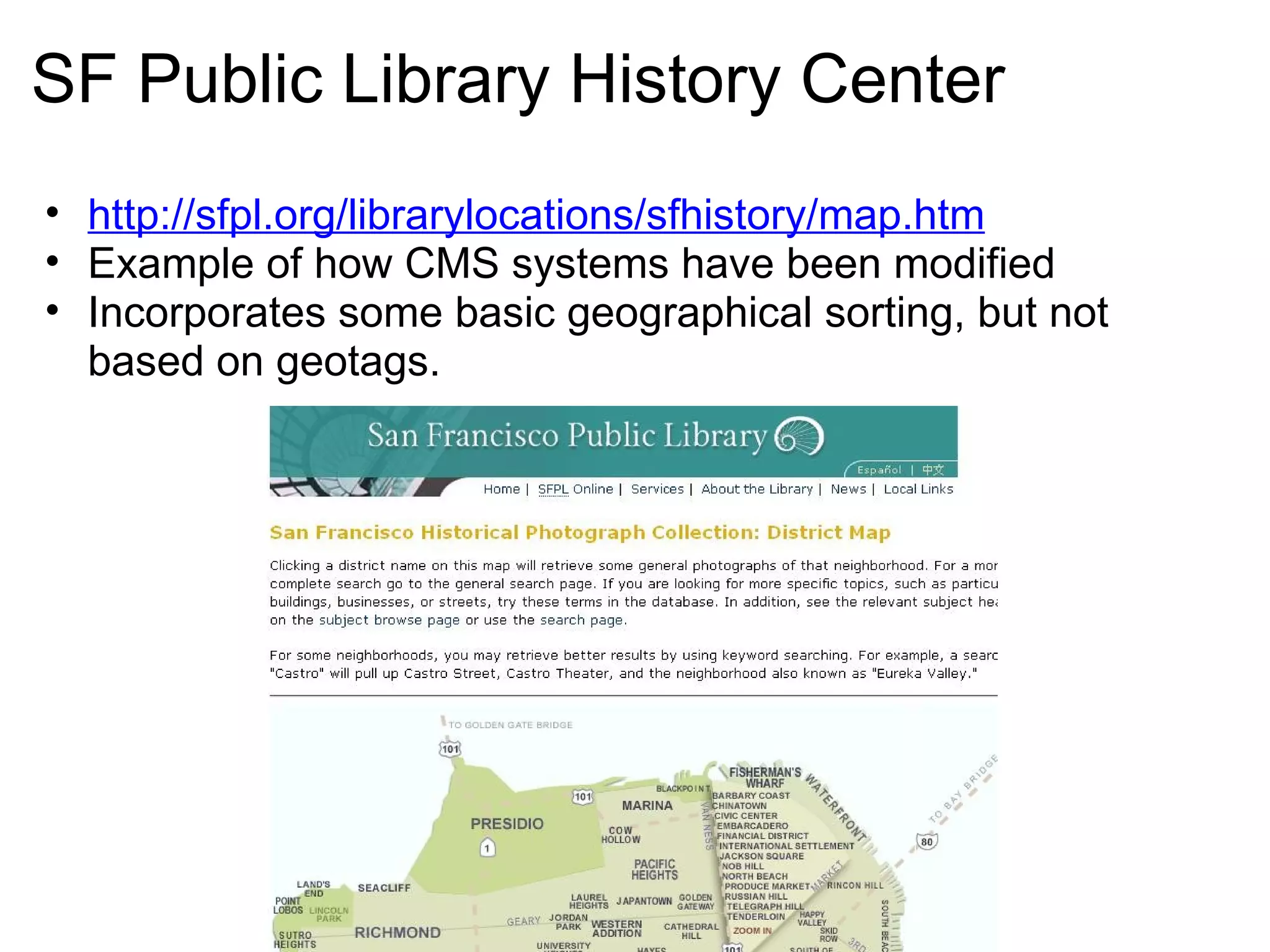
SF Public Library History Center http://sfpl.org/librarylocations/sfhistory/map.htm Example of how CMS systems have been modified Incorporates some basic geographical sorting, but not based on geotags.
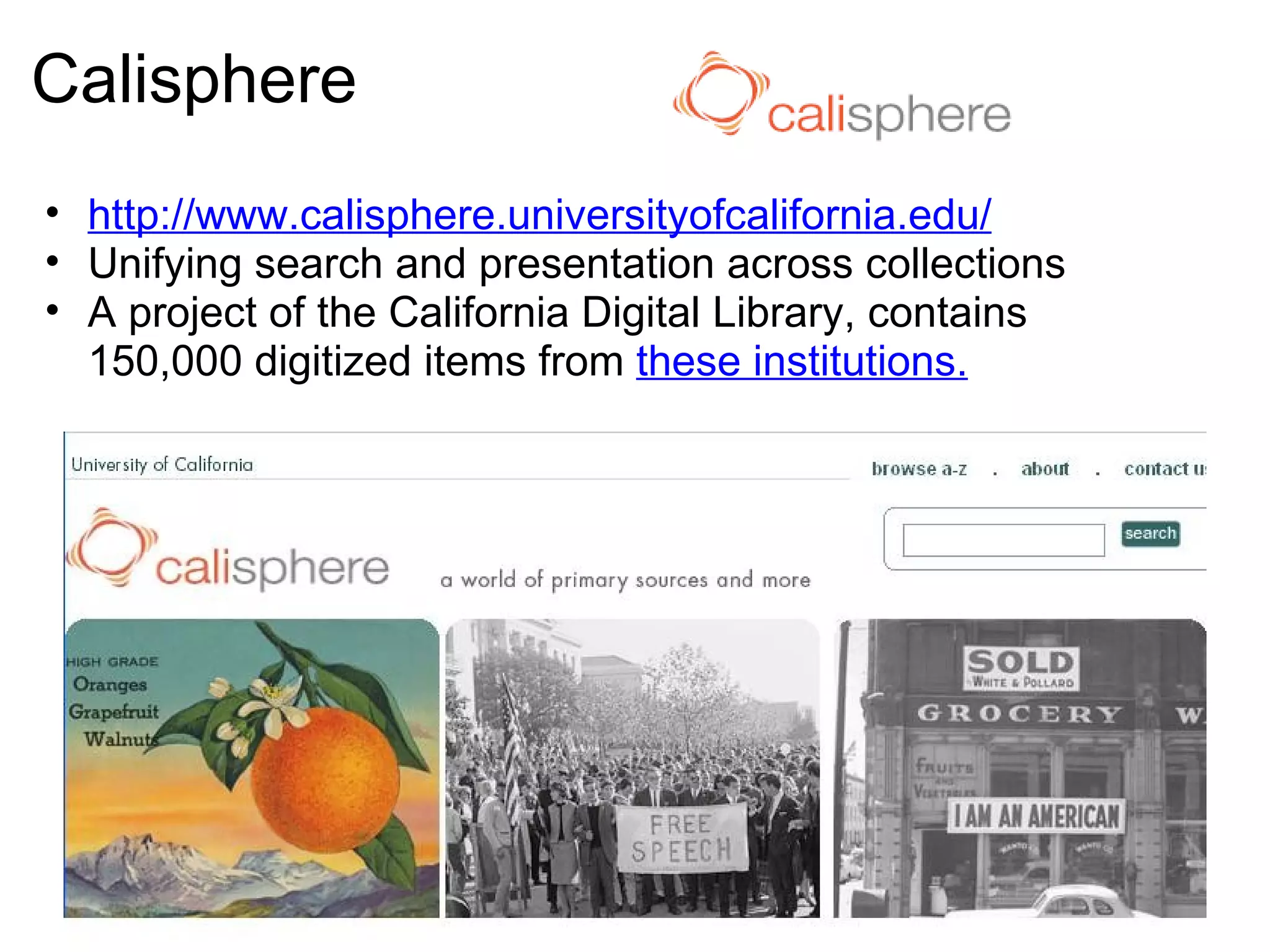
Calisphere http://www.calisphere.universityofcalifornia.edu/ Unifying search and presentation across collections A project of the California Digital Library, contains 150,000 digitized items from  these institutions.
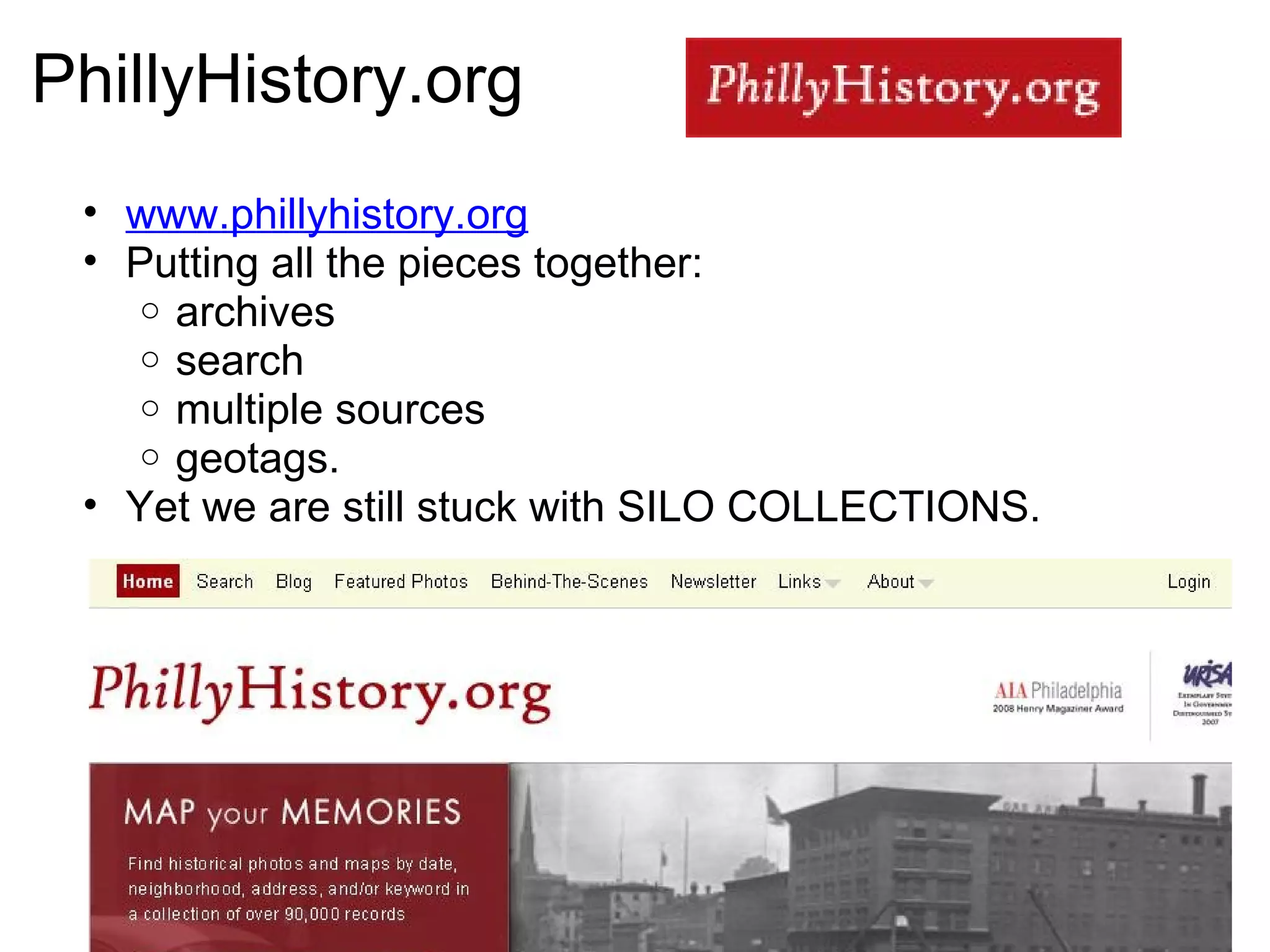
PhillyHistory.org www.phillyhistory.org Putting all the pieces together:  archives search multiple sources geotags. Yet we are still stuck with SILO COLLECTIONS.
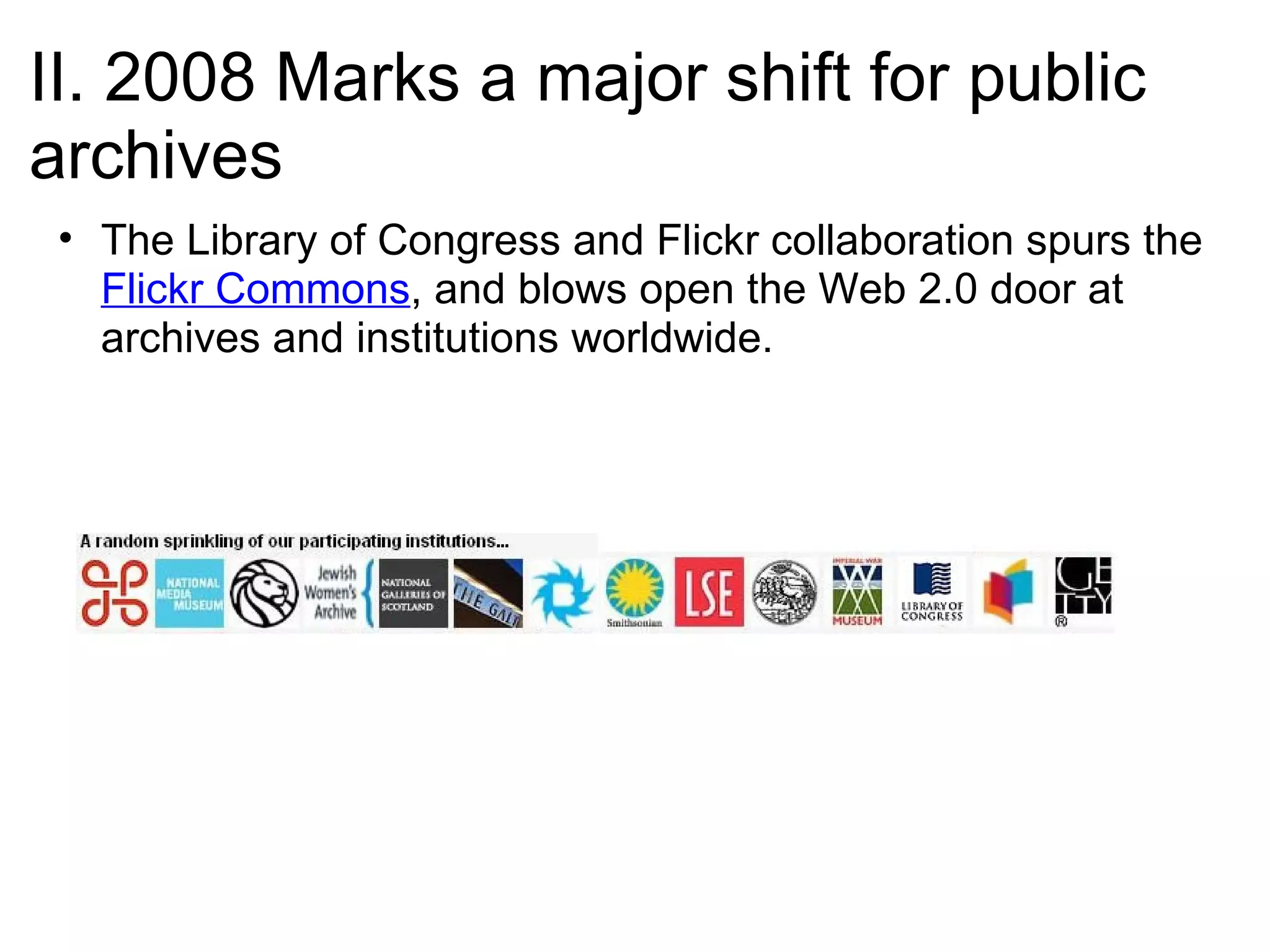
II. 2008 Marks a major shift for public archives The Library of Congress and Flickr collaboration spurs the  Flickr Commons , and blows open the Web 2.0 door at archives and institutions worldwide.
II. 2008 Marks a major shift for public archives The Library of Congress and Flickr collaboration spurs the  Flickr Commons , and blows open the Web 2.0 door at archives and institutions worldwide. Multiple open source collections management and web publishing platforms begin to take hold and lower the barrier to entry for Web 2.0 presentation, collaboration, plugins and extensions
Some stats from the  LOC summary report  a year after launch speaks to the success.  As of 10/23/08: 10.4 million views of LOC photos on Flickr 79% of the 4,615 photos have been made a "favorite" 67,176 tags were added by 2,518 unique Flickr accounts Less than 25 instances of user-generated comments were removed as inappropriate. More than 500 records have been enhanced with new information provided by the Flickr community. LOC/Flickr Commons
Public Archives in the Web 2.0 Environment Institutions and users are meeting in the middle to build community around holdings Search/Share : Archives want to get their holdings out to a wide-reaching public, Users want to search across institutions to discover based on interest, locality, etc. Comment/Community : the ability to discuss and engage, create community Contribute/Improve : Tag, geotag, crowdsource Compare : Then and now. community identity often tied to history
III. Stage is set for collaboration and innovation  Mashups, collaborations, shared datasets, open source, open data, and open tools
Including a new public/private collaboration focused on bridging silo archives which will: create a centralized database built on an open source platform to collect image urls and metadata of source material use public engagement strategies to solicit community input to increase traffic to the archives and add value to the data make the data searchable and available to other web applications via an application programming interface (API)
IV. What does the future of history hold? With the walls of the academy and cultural heritage institutions becoming more  porous , programmers, hackers, and archivists are finding more in common than ever. What will you do with all this data?
 
LookBackMaps iPhone App Currently in Development See screenshot demo here.
 
 
Give me feedback... email: [email_address] www.twitter.com/LookBackMaps Comments welcome, just use @ or #LookBackMaps on Twitter or email me.

Mapping Historical Photos For The Common Good

  • 1.
      Mapping HistoricalPhotos for the Common Good WebMapSocial Meetup, Nov 17, 2009 Jon Voss, LookBackMaps.net The Old Mission Police Station, 1924 and 2008, 17th St., SF.  1924 Photo courtesy of The Bancroft Library, UC Berkeley
  • 2.
    Give me feedback...email: [email_address] www.twitter.com/LookBackMaps Comments welcome, just use @ or #LookBackMaps on Twitter or email me.
  • 3.
    www.lookbackmaps.net  Started in2008 as a Google MyMaps mashup Based on the simple idea of creating community around local history. Created to solve the problem of disparate archives with no geotags through community and crowdsourcing
  • 4.
    LookBackMaps in contextI. Making Web 2.0 out of 1.0 Archives II. 2008 Marks a major shift in public digital archives and stakeholder expectations III. Stage is set for radical collaboration and innovation IV. Quick look at the possibilities
  • 5.
    USGS Photo Archiveshttp://libraryphoto.cr.usgs.gov/ Typical of 1990's digital archives. Focus on accurate metadata, accessibility. Prior to geotagging.
  • 6.
    SF Public LibraryHistory Center http://sfpl.org/librarylocations/sfhistory/map.htm Example of how CMS systems have been modified Incorporates some basic geographical sorting, but not based on geotags.
  • 7.
    Calisphere http://www.calisphere.universityofcalifornia.edu/ Unifyingsearch and presentation across collections A project of the California Digital Library, contains 150,000 digitized items from these institutions.
  • 8.
    PhillyHistory.org www.phillyhistory.org Puttingall the pieces together:  archives search multiple sources geotags. Yet we are still stuck with SILO COLLECTIONS.
  • 9.
    II. 2008 Marksa major shift for public archives The Library of Congress and Flickr collaboration spurs the Flickr Commons , and blows open the Web 2.0 door at archives and institutions worldwide.
  • 10.
    II. 2008 Marksa major shift for public archives The Library of Congress and Flickr collaboration spurs the Flickr Commons , and blows open the Web 2.0 door at archives and institutions worldwide. Multiple open source collections management and web publishing platforms begin to take hold and lower the barrier to entry for Web 2.0 presentation, collaboration, plugins and extensions
  • 11.
    Some stats fromthe LOC summary report a year after launch speaks to the success.  As of 10/23/08: 10.4 million views of LOC photos on Flickr 79% of the 4,615 photos have been made a "favorite" 67,176 tags were added by 2,518 unique Flickr accounts Less than 25 instances of user-generated comments were removed as inappropriate. More than 500 records have been enhanced with new information provided by the Flickr community. LOC/Flickr Commons
  • 12.
    Public Archives inthe Web 2.0 Environment Institutions and users are meeting in the middle to build community around holdings Search/Share : Archives want to get their holdings out to a wide-reaching public, Users want to search across institutions to discover based on interest, locality, etc. Comment/Community : the ability to discuss and engage, create community Contribute/Improve : Tag, geotag, crowdsource Compare : Then and now. community identity often tied to history
  • 13.
    III. Stage isset for collaboration and innovation Mashups, collaborations, shared datasets, open source, open data, and open tools
  • 14.
    Including a newpublic/private collaboration focused on bridging silo archives which will: create a centralized database built on an open source platform to collect image urls and metadata of source material use public engagement strategies to solicit community input to increase traffic to the archives and add value to the data make the data searchable and available to other web applications via an application programming interface (API)
  • 15.
    IV. What doesthe future of history hold? With the walls of the academy and cultural heritage institutions becoming more porous , programmers, hackers, and archivists are finding more in common than ever. What will you do with all this data?
  • 16.
  • 17.
    LookBackMaps iPhone AppCurrently in Development See screenshot demo here.
  • 18.
  • 19.
  • 20.
    Give me feedback...email: [email_address] www.twitter.com/LookBackMaps Comments welcome, just use @ or #LookBackMaps on Twitter or email me.