RESOLVING CONFLICT
• Liberal v Conservative
• Political Parties – Function & Organization
• Political Parties – US Today
• Voting
• Elections
• Public Opinion, Interest Groups & Mass Media
• How a Bill Becomes a Law
POLITICAL IDEOLOGY
LIBERAL v CONSERVATIVE
LIBERAL (LEFT)
• Liberals feel the government
has a responsibility to solve
social problems.
• Liberals think that the
government must regulate
business to protect society
from harmful business
practices.
CONSERVATIVE (RIGHT)
• Conservatives feel that the
government should be less
active.
• Conservatives feel that
government regulation tends to
decrease productivity and
harms the economy.
There are various degrees of being liberal and conservative.
Democrats tend to be mildly liberal, and Republicans are
mildly conservative. Third parties offer a more radical move
to right or left.
PARTY SYSTEMS
• One Party System – A system in which there is only one
major political party. The party runs the government.
(Example – Communism; China, North Korea, Cuba)
• Two Party System – A system in which two major
political parties battle for control of the government.
(Example – United States; Democrats & Republicans)
• Multi-Party System – A system in which three or more
political parties impact elections, and battle for control
of the government. (Example – France, Germany,
England)
History of Political Parties
• Democratic-Republican Party – Thomas Jefferson –
Wanted to limit the power of the federal
government – more power to state government.
• Federalist Party – Alexander Hamilton – Wanted a
strong national government to protect people’s
rights, and solve problems created by a weak
government under the Articles of Confederation.
DEMOCRATS & REPUBLICANS
• Democrats – Believe that the government must be
active in solving social problems. This generally
leads to bigger government and increased taxes.
• Republicans – Believe that problems will be solved
by the government being less active, and letting
people solve problems.
THIRD PARTIES
• Parties that do not have enough following to
compete and win elections on the national level.
• Third Parties offer an alternative to major
parties. They are important because if they gain
support, the issues that are important to them will
be recognized by the major parties.
• There is no legal barrier to a third party becoming
a major political party.
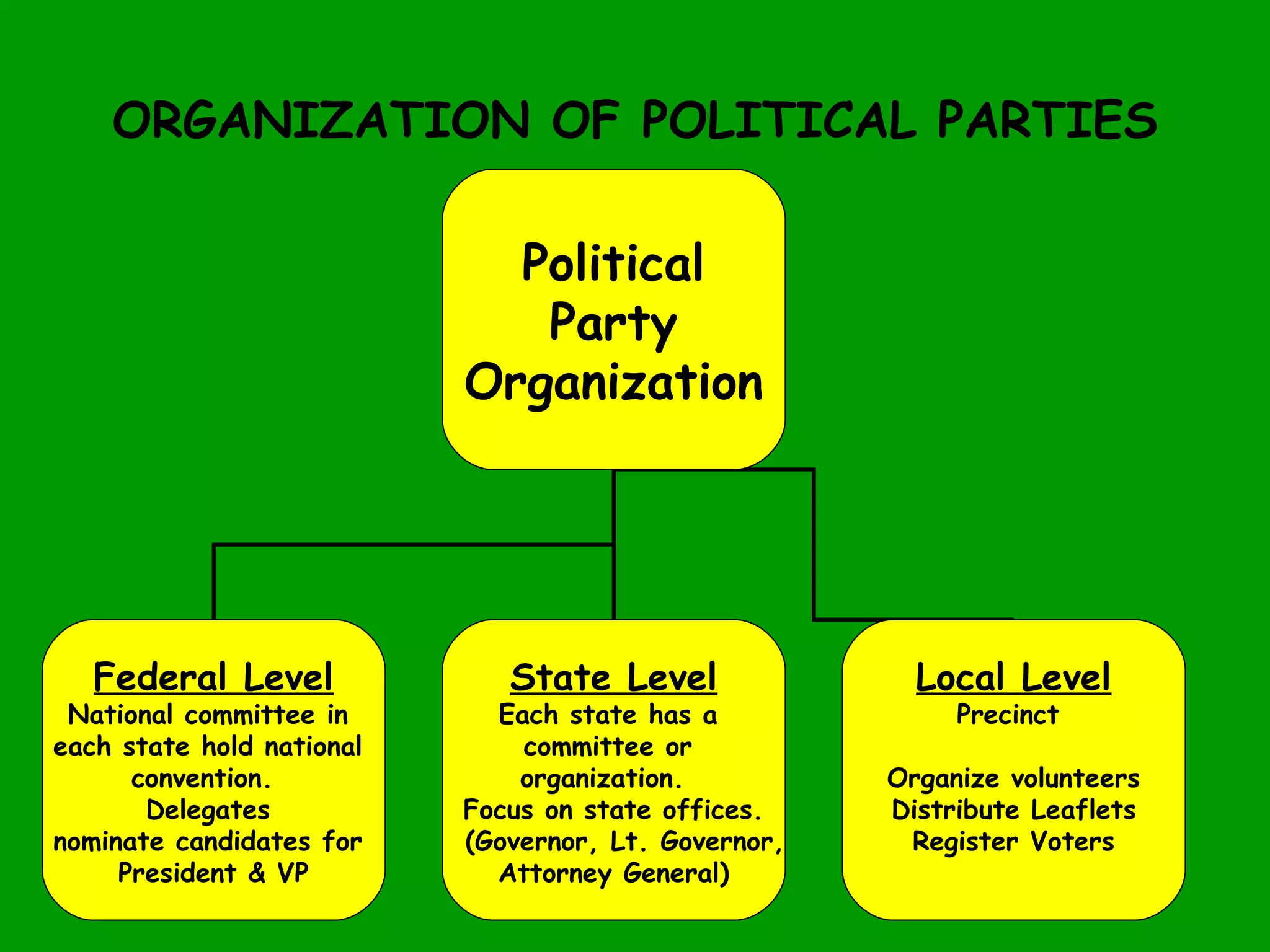
ORGANIZATION OF POLITICAL PARTIES
Political
Party
Organization
Federal Level
National committee in
each state hold national
convention.
Delegates
nominate candidates for
President & VP
State Level
Each state has a
committee or
organization.
Focus on state offices.
(Governor, Lt. Governor,
Attorney General)
Local Level
Precinct
Organize volunteers
Distribute Leaflets
Register Voters
5 Functions of Political Parties
• Campaigning for Candidates – help politicians get elected to
office.
• Informing Citizens – help citizens get information about
issues, and how government operates.
• Help Manage Government – appoint loyal members to certain
jobs.
• Linking Different Levels – provides a link between local,
state, & federal government.
• Watchdog – alert public of wrongdoing.
ISSUES Economy Education Foreign Policy Civil Rights Crime Environment
Republican
Supports free
market
competition.
Deregulation
and cutting
entitlement
spending.
Promote
school
choice/school
vouchers and
home
schooling.
Spread
Democracy.
Stop nuclear
armament.
Peace
through
strength.
Oppose
affirmative
action.
Oppose gay
marriage.
Tough on
criminals.
Limit gun
control
restrictions.
Believe the
government
puts too many
restrictions on
businesses
that are not
necessary.
Democrat
Increase taxes
to wealthy to
cut deficit.
Must limit
deficit to
stimulate
economy.
Oppose
vouchers.
Lower class
size, more
teachers.
Support
worldwide
coalitions and
multi-national
programs.
Support UN.
Support
affirmative
action.
Support civil
unions.
Oppose same
sex marriage
amendment.
Support
rehabilitation
over
punishment.
Support
increased gun
control.
Environment
over business.
Increased
regulation of
business to
protect the
environment.
Libertarian
100% free
market.
Oppose
government
regulation.
Privatize
public
schools.
Oppose
federal
government
involvement.
Military is
used for
protection
only.
Oppose
government
mandates.
Support
equality
including
marriage.
Decriminalize
drugs. Prison
should be for
violent
offenders.
Repeal drug
laws.
No government
regulation.
Green
Party
Community
based
economics.
Support locally
owned
business,
oppose
corporations.
State & Local
control of
education.
Increase $
to support
education &
provide equal
access.
Nonviolence –
military
should be
used as
absolute last
resort.
Support
equality
based on
race, gender,
etc…
Rehabilitation
Crime is a
result of lack
of
opportunity.
#1 issue.
Protection of
the
environment is
absolutely
vital to future
generations.
Public Opinion
Forming Public Opinion
(4) Sources of Public Opinion
• Personal Background
• Mass Media
• Public Officials
• Interest Groups
The Mass Media
• Print (newspapers, magazines)
• Electronic (radio, television, internet)
Interest Groups
• Interest Group – organization that supports a particular
issue.
• PAC – political action committee. Raise $ to get candidates
elected.
• Lobbyist – person hired by interest group to provide info and
influence politicians.
VOTING
HISTORY
• White Males 21 years of age or
older (early US history)
• Black Males (15th
Amendment)
• Females (19th
Amendment)
• 18 Years of Age (26th
Amendment)
REGISTERING TO VOTE
• Where? – County Offices, DMV
• What? – Proof of Citizenship,
Address, & Age – Driver’s License
or Birth Certificate
QUALIFICATIONS TO VOTE
• 18 Years of age
• Resident of state for a specific
amount of time
• Citizen of the US
• States may deny if you have
committed a serious crime
• Cannot vote while in prison
VOCABULARY
• Polling Place – location where
people vote
• Precinct – a voting district
(geographic area)
• Ballot – list of candidates on which
you vote
• Returns – counting of ballots
• Exit Poll – sample of voters and
how they voted
• Primary Election – an election in which the political
parties choose candidate for office to compete in
the general election.
• Direct Primary – election in which voters choose candidates
for political part in general election.
• Closed Primary – only registered members of political party
can vote.
• Open Primary – choose party, can only vote in one, do not
have to be a registered member.
• Plurality – most votes among those running wins.
• Run-Off Primary – if majority is necessary, top (2) have a
run-off
• Petition – unaffiliated candidates must get on ballot by
petition. (Ralph Nader)
Types of Elections
ELECTIONS
ELECTION PROCESS
• Declare Intent to Run for
Office
• Primary Election
• General Election
PRESIDENTIAL ELECTION
• Primary Election
• General Election
• Electoral College
CAMPAIGNS
• Canvassing – going door to door
getting info out about candidates
• Endorsements – using celebrities
& other politicians to gain support
• Advertising & Image Molding –
using television, newspaper, radio,
internet to portray candidate a
particular way
CAMPAIGN FINANCING
• Public Financing – Presidential
Election Campaign Fund - $3 on
tax form. 3rd
party candidate are
eligible if they receive 5% of vote
in previous election.
• Private Funding – Individual
Citizens, Party Organizations,
Corporations, Special Interest
Groups, PACs, Soft Money
HOW A BILL BECOMES A LAW
Step 1: Proposing a Law
• Bill – a proposed law (must be passed)
• Sponsor – a person in Congress that introduces a
bill
• Senate – bills are introduced in the morning session
• House of Representatives – bills are placed in a
hopper; (wooden box for bills)
HOW A BILL BECOMES A LAW
Step 2: Committee Consideration
• Bills are assigned to a certain committee by the
presiding officer of each house; (House – Speaker;
Senate – Majority Leader)
• Committee will study the bill, and eventually must
take action
• The purpose of committees is to serve as a filter,
strengthen, or disregard needless legislation.
HOW A BILL BECOMES A LAW
Step 2 continued: Committee Action
1. Pigeonholing – practice of killing a bill by refusing to pass
out of committee. (Bill is dead unless discharge petition in
the House)
2. Mark/Amend – change all or parts of the bill. Committee
can delete, add, reword, or rewrite the bill.
3. Report out of committee favorably – committee will
recommend that the bill be passed.
4. Report out of committee unfavorably – committee does not
want to take responsibility for killing the bill, but does not
want the bill to be passed.
Bypassing Committee
• Discharge Petition (House of Reps Only) – needs 218
signatures; committee pigeonholes a bill majority want
passed.
HOW A BILL BECOMES A LAW
Step 3: Floor Action/Debate
1. Rules of Debate
• House – one bill at a time; discussion must be
relevant to the bill
• Senate – more leisurely; fewer members, 3 to 4
bills at a time, unlimited speaking time
• Filibuster – tactic by a member of the Senate in
which they try to block the passage of a bill by
monopolizing time.
• Cloture – measure to stop filibuster; 1/6 must
ask; 3/5 must vote for motion.
HOW A BILL BECOMES A LAW
Step 3: Floor Action/Debate (continued)
2. Voting
• After debate, the house will conduct a vote. In this step,
a majority vote is necessary to pass.
• If there is no majority, the bill is dead.
Once the bill has passed one house of Congress, it must be sent
to the other, and go through the same process.
Issues the may occur in the other House
1. Bill is changed by the committee studying the bill. If this
occurs and the house passes the bill, it must be sent to a
conference committee.
2. Conference Committee – made up of members of both
houses. They will iron out differences in the bill, and then
send the bill back to both houses to vote again.
HOW A BILL BECOMES A LAW
Step 4: Presidential Action
• A bill will be sent to the President if it has
passed both houses of Congress by a majority
vote, and it is the exact bill in both houses.
The president has 10 days to act on the bill
once the President receives the bill.
Presidential Action – (10 days to Act)
1) Sign the bill – becomes law.
2) Hold the bill for 10 days.
• If Congress adjourns in 10 days, the bill is
dead. (pocket veto)
• If Congress stays in session, the bill will pass
without signature.
3) Veto – the president rejects the bill.
(Presidential check over Congress)
HOW A BILL BECOMES A LAW
Step 5: Congress – Override the Veto
• Congress has the authority to override a
presidential veto. If the President vetoes a bill,
it goes back to Congress.
• A bill that has been vetoed, must be passed by
2/3 majority of both houses to become law. If
not it is dead.
• Congressional Check over the President.
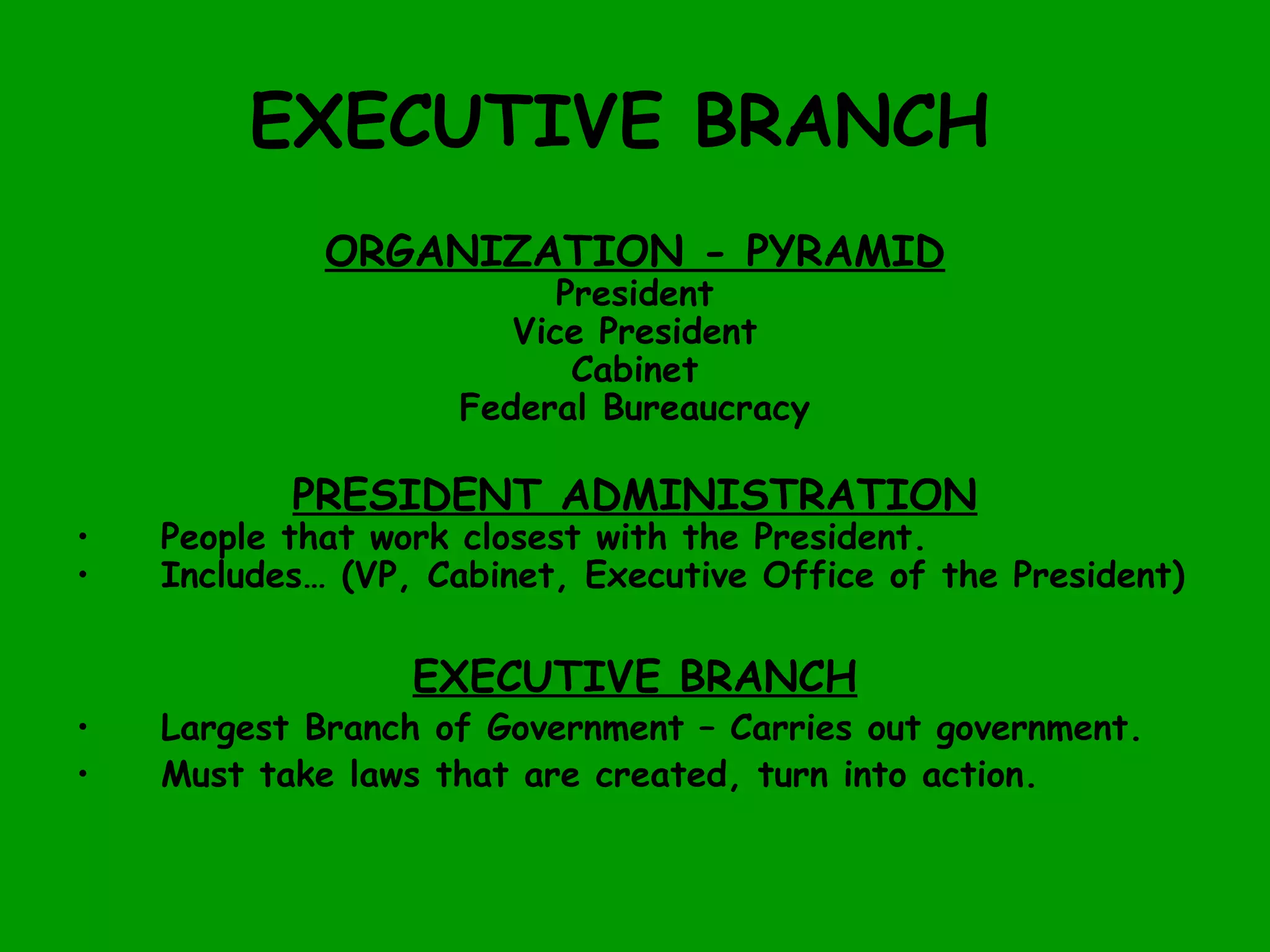
EXECUTIVE BRANCH
ORGANIZATION - PYRAMID
President
Vice President
Cabinet
Federal Bureaucracy
PRESIDENT ADMINISTRATION
• People that work closest with the President.
• Includes… (VP, Cabinet, Executive Office of the President)
EXECUTIVE BRANCH
• Largest Branch of Government – Carries out government.
• Must take laws that are created, turn into action.
FEDERAL BUREAUCRACY
3 BASIC TASKS
1. Turn laws into action
2. Day-to-Day Operation of the federal government
3. Regulate Activities
EXECUTIVE OFFICE of the PRESIDENT
1. White House Office
2. Office of Management & Budget
3. National Security Council
4. Council of Economic Advisors
INDEPENDENT AGENCIES
1. Executive Agencies – NASA
2. Government Corporations – USPS
3. Regulatory Boards & Commissions – FDA, EPA
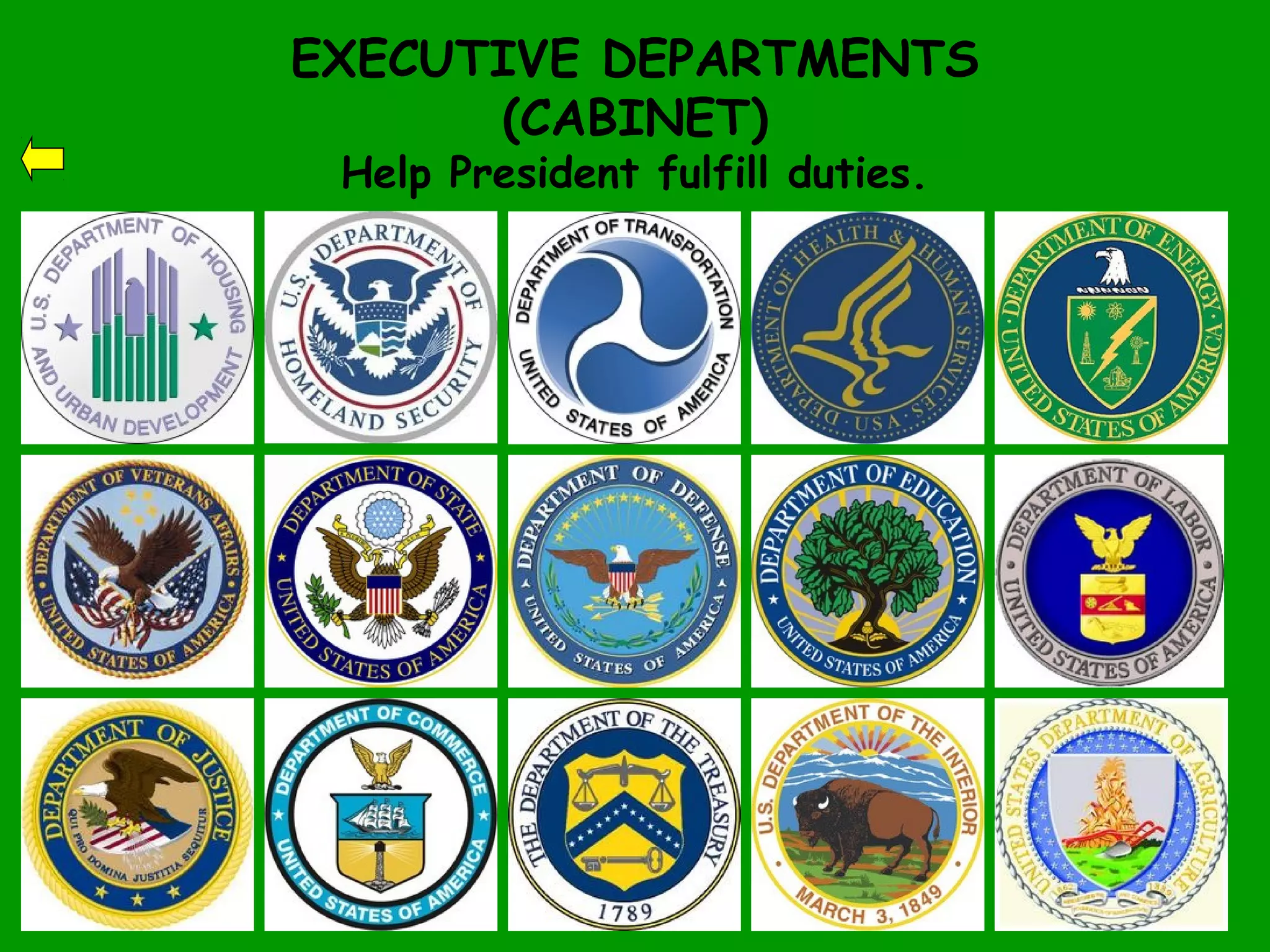
EXECUTIVE DEPARTMENTS
(CABINET)
Help President fulfill duties.

Linkage institutions

  • 1.
    RESOLVING CONFLICT • Liberalv Conservative • Political Parties – Function & Organization • Political Parties – US Today • Voting • Elections • Public Opinion, Interest Groups & Mass Media • How a Bill Becomes a Law
  • 2.
    POLITICAL IDEOLOGY LIBERAL vCONSERVATIVE LIBERAL (LEFT) • Liberals feel the government has a responsibility to solve social problems. • Liberals think that the government must regulate business to protect society from harmful business practices. CONSERVATIVE (RIGHT) • Conservatives feel that the government should be less active. • Conservatives feel that government regulation tends to decrease productivity and harms the economy. There are various degrees of being liberal and conservative. Democrats tend to be mildly liberal, and Republicans are mildly conservative. Third parties offer a more radical move to right or left.
  • 3.
    PARTY SYSTEMS • OneParty System – A system in which there is only one major political party. The party runs the government. (Example – Communism; China, North Korea, Cuba) • Two Party System – A system in which two major political parties battle for control of the government. (Example – United States; Democrats & Republicans) • Multi-Party System – A system in which three or more political parties impact elections, and battle for control of the government. (Example – France, Germany, England)
  • 4.
    History of PoliticalParties • Democratic-Republican Party – Thomas Jefferson – Wanted to limit the power of the federal government – more power to state government. • Federalist Party – Alexander Hamilton – Wanted a strong national government to protect people’s rights, and solve problems created by a weak government under the Articles of Confederation.
  • 5.
    DEMOCRATS & REPUBLICANS •Democrats – Believe that the government must be active in solving social problems. This generally leads to bigger government and increased taxes. • Republicans – Believe that problems will be solved by the government being less active, and letting people solve problems.
  • 6.
    THIRD PARTIES • Partiesthat do not have enough following to compete and win elections on the national level. • Third Parties offer an alternative to major parties. They are important because if they gain support, the issues that are important to them will be recognized by the major parties. • There is no legal barrier to a third party becoming a major political party.
  • 7.
    ORGANIZATION OF POLITICALPARTIES Political Party Organization Federal Level National committee in each state hold national convention. Delegates nominate candidates for President & VP State Level Each state has a committee or organization. Focus on state offices. (Governor, Lt. Governor, Attorney General) Local Level Precinct Organize volunteers Distribute Leaflets Register Voters
  • 8.
    5 Functions ofPolitical Parties • Campaigning for Candidates – help politicians get elected to office. • Informing Citizens – help citizens get information about issues, and how government operates. • Help Manage Government – appoint loyal members to certain jobs. • Linking Different Levels – provides a link between local, state, & federal government. • Watchdog – alert public of wrongdoing.
  • 9.
    ISSUES Economy EducationForeign Policy Civil Rights Crime Environment Republican Supports free market competition. Deregulation and cutting entitlement spending. Promote school choice/school vouchers and home schooling. Spread Democracy. Stop nuclear armament. Peace through strength. Oppose affirmative action. Oppose gay marriage. Tough on criminals. Limit gun control restrictions. Believe the government puts too many restrictions on businesses that are not necessary. Democrat Increase taxes to wealthy to cut deficit. Must limit deficit to stimulate economy. Oppose vouchers. Lower class size, more teachers. Support worldwide coalitions and multi-national programs. Support UN. Support affirmative action. Support civil unions. Oppose same sex marriage amendment. Support rehabilitation over punishment. Support increased gun control. Environment over business. Increased regulation of business to protect the environment. Libertarian 100% free market. Oppose government regulation. Privatize public schools. Oppose federal government involvement. Military is used for protection only. Oppose government mandates. Support equality including marriage. Decriminalize drugs. Prison should be for violent offenders. Repeal drug laws. No government regulation. Green Party Community based economics. Support locally owned business, oppose corporations. State & Local control of education. Increase $ to support education & provide equal access. Nonviolence – military should be used as absolute last resort. Support equality based on race, gender, etc… Rehabilitation Crime is a result of lack of opportunity. #1 issue. Protection of the environment is absolutely vital to future generations.
  • 10.
    Public Opinion Forming PublicOpinion (4) Sources of Public Opinion • Personal Background • Mass Media • Public Officials • Interest Groups The Mass Media • Print (newspapers, magazines) • Electronic (radio, television, internet) Interest Groups • Interest Group – organization that supports a particular issue. • PAC – political action committee. Raise $ to get candidates elected. • Lobbyist – person hired by interest group to provide info and influence politicians.
  • 11.
    VOTING HISTORY • White Males21 years of age or older (early US history) • Black Males (15th Amendment) • Females (19th Amendment) • 18 Years of Age (26th Amendment) REGISTERING TO VOTE • Where? – County Offices, DMV • What? – Proof of Citizenship, Address, & Age – Driver’s License or Birth Certificate QUALIFICATIONS TO VOTE • 18 Years of age • Resident of state for a specific amount of time • Citizen of the US • States may deny if you have committed a serious crime • Cannot vote while in prison VOCABULARY • Polling Place – location where people vote • Precinct – a voting district (geographic area) • Ballot – list of candidates on which you vote • Returns – counting of ballots • Exit Poll – sample of voters and how they voted
  • 12.
    • Primary Election– an election in which the political parties choose candidate for office to compete in the general election. • Direct Primary – election in which voters choose candidates for political part in general election. • Closed Primary – only registered members of political party can vote. • Open Primary – choose party, can only vote in one, do not have to be a registered member. • Plurality – most votes among those running wins. • Run-Off Primary – if majority is necessary, top (2) have a run-off • Petition – unaffiliated candidates must get on ballot by petition. (Ralph Nader) Types of Elections
  • 13.
    ELECTIONS ELECTION PROCESS • DeclareIntent to Run for Office • Primary Election • General Election PRESIDENTIAL ELECTION • Primary Election • General Election • Electoral College CAMPAIGNS • Canvassing – going door to door getting info out about candidates • Endorsements – using celebrities & other politicians to gain support • Advertising & Image Molding – using television, newspaper, radio, internet to portray candidate a particular way CAMPAIGN FINANCING • Public Financing – Presidential Election Campaign Fund - $3 on tax form. 3rd party candidate are eligible if they receive 5% of vote in previous election. • Private Funding – Individual Citizens, Party Organizations, Corporations, Special Interest Groups, PACs, Soft Money
  • 14.
    HOW A BILLBECOMES A LAW
  • 15.
    HOW A BILLBECOMES A LAW Step 1: Proposing a Law • Bill – a proposed law (must be passed) • Sponsor – a person in Congress that introduces a bill • Senate – bills are introduced in the morning session • House of Representatives – bills are placed in a hopper; (wooden box for bills)
  • 16.
    HOW A BILLBECOMES A LAW Step 2: Committee Consideration • Bills are assigned to a certain committee by the presiding officer of each house; (House – Speaker; Senate – Majority Leader) • Committee will study the bill, and eventually must take action • The purpose of committees is to serve as a filter, strengthen, or disregard needless legislation.
  • 17.
    HOW A BILLBECOMES A LAW Step 2 continued: Committee Action 1. Pigeonholing – practice of killing a bill by refusing to pass out of committee. (Bill is dead unless discharge petition in the House) 2. Mark/Amend – change all or parts of the bill. Committee can delete, add, reword, or rewrite the bill. 3. Report out of committee favorably – committee will recommend that the bill be passed. 4. Report out of committee unfavorably – committee does not want to take responsibility for killing the bill, but does not want the bill to be passed. Bypassing Committee • Discharge Petition (House of Reps Only) – needs 218 signatures; committee pigeonholes a bill majority want passed.
  • 18.
    HOW A BILLBECOMES A LAW Step 3: Floor Action/Debate 1. Rules of Debate • House – one bill at a time; discussion must be relevant to the bill • Senate – more leisurely; fewer members, 3 to 4 bills at a time, unlimited speaking time • Filibuster – tactic by a member of the Senate in which they try to block the passage of a bill by monopolizing time. • Cloture – measure to stop filibuster; 1/6 must ask; 3/5 must vote for motion.
  • 19.
    HOW A BILLBECOMES A LAW Step 3: Floor Action/Debate (continued) 2. Voting • After debate, the house will conduct a vote. In this step, a majority vote is necessary to pass. • If there is no majority, the bill is dead. Once the bill has passed one house of Congress, it must be sent to the other, and go through the same process. Issues the may occur in the other House 1. Bill is changed by the committee studying the bill. If this occurs and the house passes the bill, it must be sent to a conference committee. 2. Conference Committee – made up of members of both houses. They will iron out differences in the bill, and then send the bill back to both houses to vote again.
  • 20.
    HOW A BILLBECOMES A LAW Step 4: Presidential Action • A bill will be sent to the President if it has passed both houses of Congress by a majority vote, and it is the exact bill in both houses. The president has 10 days to act on the bill once the President receives the bill. Presidential Action – (10 days to Act) 1) Sign the bill – becomes law. 2) Hold the bill for 10 days. • If Congress adjourns in 10 days, the bill is dead. (pocket veto) • If Congress stays in session, the bill will pass without signature. 3) Veto – the president rejects the bill. (Presidential check over Congress)
  • 21.
    HOW A BILLBECOMES A LAW Step 5: Congress – Override the Veto • Congress has the authority to override a presidential veto. If the President vetoes a bill, it goes back to Congress. • A bill that has been vetoed, must be passed by 2/3 majority of both houses to become law. If not it is dead. • Congressional Check over the President.
  • 22.
    EXECUTIVE BRANCH ORGANIZATION -PYRAMID President Vice President Cabinet Federal Bureaucracy PRESIDENT ADMINISTRATION • People that work closest with the President. • Includes… (VP, Cabinet, Executive Office of the President) EXECUTIVE BRANCH • Largest Branch of Government – Carries out government. • Must take laws that are created, turn into action.
  • 23.
    FEDERAL BUREAUCRACY 3 BASICTASKS 1. Turn laws into action 2. Day-to-Day Operation of the federal government 3. Regulate Activities EXECUTIVE OFFICE of the PRESIDENT 1. White House Office 2. Office of Management & Budget 3. National Security Council 4. Council of Economic Advisors INDEPENDENT AGENCIES 1. Executive Agencies – NASA 2. Government Corporations – USPS 3. Regulatory Boards & Commissions – FDA, EPA
  • 24.