International Journal of Engineering and Science Invention
ISSN (Online): 2319 – 6734, ISSN (Print): 2319 – 6726
www.ijesi.org ||Volume 5 Issue 9|| September 2016 || PP.11-16
www.ijesi.org 11 | Page
Link Prediction And Link Establishment Based On Network
Nodes Life Time In Mobile Ad Hoc Network
A.Ayubkhan1
, A.R.MohamedShanavasPh.D2
, Dr. Khalid Idrissi3
1
Lecturer, Omar Al-MuktharUniversity,Libya
2
Associate Professor, Jamal Mohamed College, Tiruchirappalli.
3
Lecturer, Omar Al-MuktharUniversity,Libya
Abstract: In this paper we propose a new modified adhoc routing algorithm for adhoc network that locally
repairs a link failure and also conflicts the noise and link modification simultaneously. Due to topology changes
caused by nodes’ mobility in adhoc network, the link routes get disconnected frequently. Our proposed scheme
does a local repair of link failure and also takes care of malicious nodes with the help of a reliability measure
while performing route discovery using link-prediction routing algorithm(LPRA). These two performance
metrics are integrated by Route link-prediction algorithm. This algorithm is carried out as follows, Select the
least dynamic route link with the longest lifetime for persistent data forwarding. Node Lifetime and link lifetime
prediction methods. The receiver can measure the signal strength when it receives the packets from sender in
same power level and then it calculates the distance between two nodes by applying the radio propagation
model in LPRA using adhoc network. Simulation results show that our proposed schemeperforms better in
comparison to a popular existing technique.
Keywords: Link-prediction routing algorithm, persistent data forwarding, data exchange, adhoc network
I. Introduction
The impact of mobility on link stability over a wide spectrum of mobility speeds and mobility patterns. We
show from extensive simulation results that link lifetime is a function of current link age, mobility speed and
mobility pattern and does not vary monotonically with age. Therefore, the intuitive idea that older links are more
stable does not work well across a large spectrum of mobility speeds and models.Mobile adhoc networks
contain assembly of nodes which has their possess mobility environment in addition to they have no limits in
moving towards some direction.
In mobile adhoc networks the nodes in addition contribute in routing distribution belong to other nodes of the
network. These two-way environments of the network have many merits in addition to demerits also. The on the
mobility of the nodes, not approximating other networks in which a way is exposed between any dispatcher and
receiver may or possibly will not be existing after positive occasion which causes association crash among any
two nodes. Because of the association of any node, the particular node will not be in attendance in the reporting
of a forward node which causes link failure.
The attendance of connection collapse will not be known to the sender node and the sender will decide the path
and forward the communication.At one stage there will be association failure and the forward node tries to
discover a few other way. Otherwise it will be acknowledgement to the dispatcher as not available; at this time
the foundations has to procedure route particular again and process the similar again and again. Several
direction-finding protocol studies are based on node lifetime and link lifetime.
The major object here is to evaluate the node time and the link lifetime utilize the lively nature, such as the
energy drain rate in addition to the relative mobility opinion rate of nodes. These two presentation metrics are
included by Route lifetime-prediction algorithm. This algorithm is approved out as follow select the least lively
route with the best lifetime for unrelenting data forward. Node Lifetime in addition to link lifetime forecast
methods, the exponentially weighted moving average technique is used to approximation the energy use up rate.
Mobile stations are mounted upon public buses circulating within urban environments on fixed trajectories and
near-periodic schedule. Namely, sinks motion is not controllable and their routes do not adapt upon specific
adhoc network deployments. Our only assumption is that adhoc s is deployed in urban areas in proximity to
public transportation vehicle routes. As a fair compromise between a small numbers which results in their rapid
energy depletion and a large number.
II. Related Work
Ad hoc QoS on-demand routing proposes an on-demand routing protocol activated QoS support in terms of
bandwidth and end-to-end delay. The AQOR mechanism estimates the bandwidth and end-to-end delay needs
and use these metrics to make admission and resource reservation result [1]. It’s discussed the various
constraints for the capability of mobile adhoc networks and methods for distributed channel meet in multi-hop
Link Prediction And Link Establishment Based On Network Nodes Life Time In Mobile Ad Hoc…
www.ijesi.org 12 | Page
wireless networks. By assigning orthogonal channels to nearest nodes, the constraints can be minimized and the
network parameters such as throughput and delay performance can be improved [2].
The protocol modifiesand extends AODVto discover the routes and maintain the minimum required bandwidth
based on priorityof multiple applications in queue. QoS constrained routes in terms of available bandwidth
andfollows alternate route method for route maintenance. It considers only bandwidth constrained routing based
onpriority for multiple applications in queue and supports real-time applications [3, 4]. In QoS
constrainedrouting has been proposed that provides feedback about the available bandwidth throughout the route
with minimizedoverall overheads during transmission of data [5].
Throughput is significantly improved with minimizing overall end-to-end delay. This protocol issuitable for
highly dynamic ad hoc networks where link failures and route breaks occur frequently. It findsmultiple disjoint
paths from source to destination where each path satisfies the QoS constraints.Ifavailable residual bandwidth is
less than desired bandwidth, node will discard REQ [6]. In case of Soft QoSpacket will be forwarded when
residual bandwidth on that link is greater than the desired bandwidth on that path and mark this route.
If residual bandwidth on that path is less than the desired bandwidth but equal toor greater than half of the
required bandwidth, desired bandwidth will be updated in RREQ header and will beforwarded [7].They found
thatlink-cache strategies are better than path-cache strategies.As one of the link-cache strategy, they propose
techniqueto combine stability value of a link, which is dependenton the usage of the link, and hop-count [8].
They found thatthis technique though perform better, but not better than astatic scheme of the link expiration.
We will show that ourscheme performed better than the best link-cache schemes.a trust based incentive model
on aself-policing mechanism to make collaboration rational formalicious nodes [9, 10]. The nodes evaluate the
trust of theirneighbors locally by direct observation and also by using thesecond-hand information available.
The nodes maintain a trustrating about its neighbor.
III. Proposed System
The proposed algorithm consists of the following three phases: Route discovery, Data forwarding using link,
and link prediction maintenance. There are seven main differences between the link-prediction routing
algorithm (LPRA) and the network. First, in the LPRA, every node saves the received signal strength and the
received time of the route link request packet in its local memory and adds this information into the route link
request packet header in a piggyback manner when it receives the route link request for the corresponding route
link request packet to meet the requirement of the connection lifetime-prediction algorithm. Second, node agents
need to update their predicted node lifetime during every period. Third the node-lifetime information in the
route response packet is updated when the route response packet is returned from a destination node to the
source node. In this work the reliability is the measurement of the data packets forwarding functionality of a
node in ad hoc network. This value is the ratio between the data packets actually forwarded and the data packets
to be forwarded by an intermediate node. The reliability value is measured with respect to a neighbor node.
3.1 Link Prediction Algorithm for data forwarding:
A link is composed of the two nodes in a connection and the connection itself, and the LPRA includes both the
node lifetime and the connection lifetime. The LPRA consists the energy for node, the total energy spent at a
node is the sum of the energy spent at it due to all the nodes in the reception and interference area of this node.
Thus, in this model, the transmission and reception costs are included if the node belongs to a flow, and
reception costs are included if it is near the flow. Through the cost value we can predict the optimal path in
dynamic nature and estimate the reliable path for the large scale network.
Algorithm:
Link Li= link establish in hop count
Perform dynamic link prospect approach.
Onward data D to the first relay nodeNi(Ri)
Else if Li==1 then
Forward data D to the first relay node Ni
Else
Generate Node loactaion and Broadcast.
Initialize synchronization Timer ST.
While (ST==true)
RR = receive RBP-RREP.
If Li==Yes then
Li(i) =
End
End
Make Lively Link Probability.
Link Prediction And Link Establishment Based On Network Nodes Life Time In Mobile Ad Hoc…
www.ijesi.org 13 | Page
Choose most usage link.
Li = Max(RT(ALP)).
Forward Packet through Li.
End.
Constant value with a range of the current condition of node link predictionwell, we grant a higher priority. The
path link lifetime, RREQ time, and RREQ signal strength, is added to the common header of an RREP packet.
3.2 Persistent data forwarding using LPRA:
The president data forwarding is handle the connections that are in an unstable state and may only last for a
short period particularly for ignoring the stable one for simplicity. The reasons are given as follows: First, we
are only concerned with the minimum node link lifetime or the connection link life time in a route. Since two
nodes of a stable connection are within the communication range of each other, the connection node link
lifetime may last longer, and they are not a route from the link to which they belong. It is easier to model the
mobility of nodes in a short period during which unstable connections last. We can assume reasonably and
simply that the nodes move at a constant speed toward the same direction in such a short period measure the
distance between nodes in network.
Algorithm:
Input: Route link RL, packet P.
Initialize hop count Hp.
For each route Hp from RL
Identify the occurrence of way to reach endpoint
If NF= then
Link to established and hop count will increase
End
End
Split node link into node position in network
DTS =
Br = broadcast range. Recognize the link of network
Rl =
RN =
Produce detailed link.
Time synchronization = {DTS, QoS analysis}.
Hop count based link establishment in network.
We use LPRA is location information to measure the received signal strength. Assuming that senders transmit
packets with the same power level a receiver can measure the received signal power strength when receiving a
packet and then calculates the distance by directly applying the radio propagation model. If the received signal
power strength is lower than a threshold value, we regard this link as an unstable state and then calculate the
connection time.
IV. Result And Discussion
To analyze performance of the DTSR by using path connected Networks. The replication surroundings produced
in NS-2, in that provide keep up for a wireless Mobile Ad hoc networks. NS-2 was using C++ language and it
has used for OTCL. It came as extension of Tool Command Language (TCL). The execution approved out using
a cluster environment of 19 wireless mobile nodes rootless over a simulation area of 1200 meters x 1200 meters
level gap in service for 10 seconds of simulation time.
Then also used into MAC layer models. The network based data processing or most expensive and data
communication level on their performance on the network. The sources create multiple packets and its sending
to the destination node; each data has a steady size of 512 bytes.
Parameters Value
version Ns-all-in-one 2.28
Protocols DTSR , Ad hoc
Area 1200m x 1200m
Broadcast Area 250 m
Transfer model UDP,CBR
Data size 512 bytes
Link Prediction And Link Establishment Based On Network Nodes Life Time In Mobile Ad Hoc…
www.ijesi.org 14 | Page
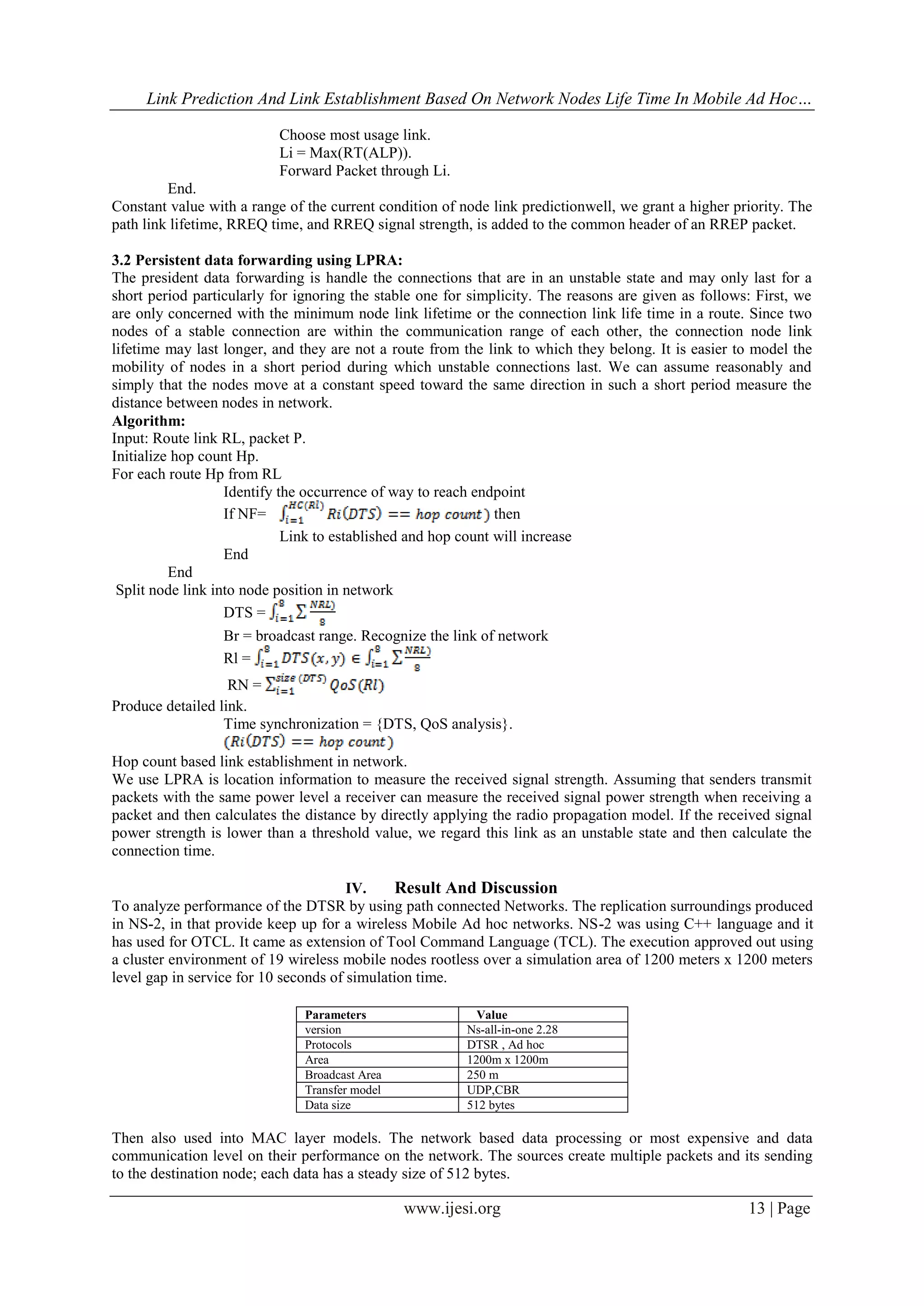
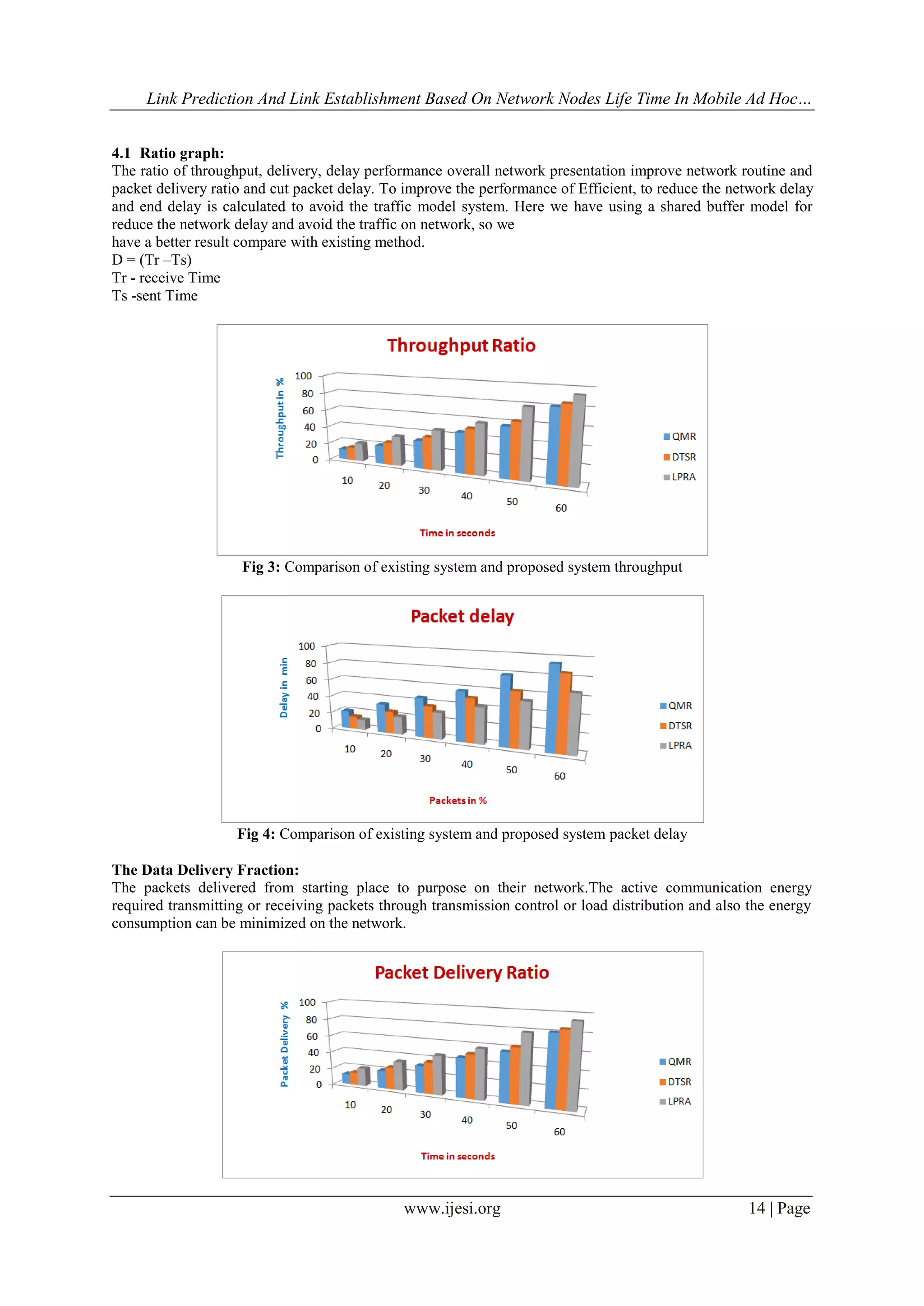
4.1 Ratio graph:
The ratio of throughput, delivery, delay performance overall network presentation improve network routine and
packet delivery ratio and cut packet delay. To improve the performance of Efficient, to reduce the network delay
and end delay is calculated to avoid the traffic model system. Here we have using a shared buffer model for
reduce the network delay and avoid the traffic on network, so we
have a better result compare with existing method.
D = (Tr –Ts)
Tr - receive Time
Ts -sent Time
Fig 3: Comparison of existing system and proposed system throughput
Fig 4: Comparison of existing system and proposed system packet delay
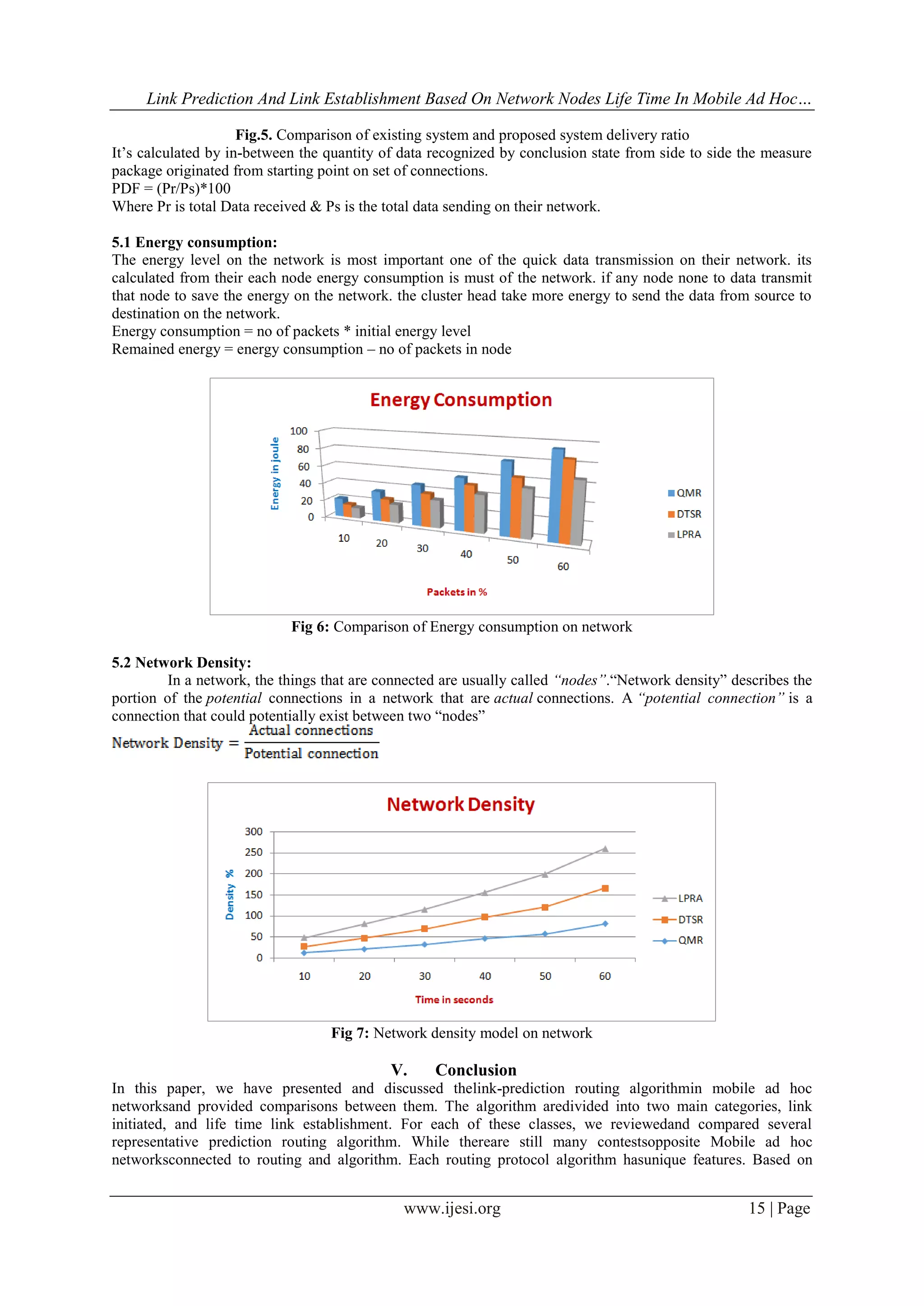
The Data Delivery Fraction:
The packets delivered from starting place to purpose on their network.The active communication energy
required transmitting or receiving packets through transmission control or load distribution and also the energy
consumption can be minimized on the network.
Link Prediction And Link Establishment Based On Network Nodes Life Time In Mobile Ad Hoc…
www.ijesi.org 15 | Page
Fig.5. Comparison of existing system and proposed system delivery ratio
It’s calculated by in-between the quantity of data recognized by conclusion state from side to side the measure
package originated from starting point on set of connections.
PDF = (Pr/Ps)*100
Where Pr is total Data received & Ps is the total data sending on their network.
5.1 Energy consumption:
The energy level on the network is most important one of the quick data transmission on their network. its
calculated from their each node energy consumption is must of the network. if any node none to data transmit
that node to save the energy on the network. the cluster head take more energy to send the data from source to
destination on the network.
Energy consumption = no of packets * initial energy level
Remained energy = energy consumption – no of packets in node
Fig 6: Comparison of Energy consumption on network
5.2 Network Density:
In a network, the things that are connected are usually called “nodes”.“Network density” describes the
portion of the potential connections in a network that are actual connections. A “potential connection” is a
connection that could potentially exist between two “nodes”
Fig 7: Network density model on network
V. Conclusion
In this paper, we have presented and discussed thelink-prediction routing algorithmin mobile ad hoc
networksand provided comparisons between them. The algorithm aredivided into two main categories, link
initiated, and life time link establishment. For each of these classes, we reviewedand compared several
representative prediction routing algorithm. While thereare still many contestsopposite Mobile ad hoc
networksconnected to routing and algorithm. Each routing protocol algorithm hasunique features. Based on
Link Prediction And Link Establishment Based On Network Nodes Life Time In Mobile Ad Hoc…
www.ijesi.org 16 | Page
network environments, we consumeto choose the appropriate routing in network. It has mainly focused on this
method to improve the network performance and energy consumption model on the network.
References
[1]. A. Boukerche, B. Turgut, N. Aydin, M. Z. Ahmad, L. Bölöni, andD.Turgut, “Routing protocols in ad hoc networks: A survey,”june
2012.
[2]. John Paul Walters, Zhengqiang Liang, “Wireless Sensor Network Security: A Survey”, jan 2006.
[3]. S. Murthy and J. J. Garcia-Luna-Aceves, “An Efficient Routing Protocol for Wireless Networks,” Oct. 1996, pp. 183–97.
[4]. Sudhir Agrawal, Sanjeev Jain and Sanjeev Sharma, “A Survey of Routing Attacks and Security Measures in Mobile Ad-Hoc
Networks”, Journal of Computing, Vol. 3, Issue 1, January 2011.
[5]. Jean-Fran, Anton Stiglic, “Security Issues in the Diffie-Hellman Key Agreement Protocol”, feb-2002.
[6]. SyeLoongKeoh, Emil Lupu and Morris Sloman “Securing Body Sensor Networks: Sensor Association and Key Management”,
October 2005.
[7]. ParulTomar, Prof. P. K. Suri and Dr. M. K. Soni, “A Comparative Study for Secure Routing in MANET”, International Journal of
Computer Applications, July 2010.
[8]. Victor C. Zandy and Barton P. Miller, “Reliable Network Connections”, September 23-2002.
[9]. Wenliang Du∗, Jing Deng†, Yunghsiang S ,“A Key Pre-distribution Scheme for Sensor Networks Using Deployment Knowledge”,
7-sept-2004.
[10]. Manisha and Dr. Mukesh Kumar, “Implementation and Removal of Co-operative black hole and worm hole Attacks on MANET
with DSR”, December 2014.

Link Prediction And Link Establishment Based On Network Nodes Life Time In Mobile Ad Hoc Network

  • 1.
    International Journal ofEngineering and Science Invention ISSN (Online): 2319 – 6734, ISSN (Print): 2319 – 6726 www.ijesi.org ||Volume 5 Issue 9|| September 2016 || PP.11-16 www.ijesi.org 11 | Page Link Prediction And Link Establishment Based On Network Nodes Life Time In Mobile Ad Hoc Network A.Ayubkhan1 , A.R.MohamedShanavasPh.D2 , Dr. Khalid Idrissi3 1 Lecturer, Omar Al-MuktharUniversity,Libya 2 Associate Professor, Jamal Mohamed College, Tiruchirappalli. 3 Lecturer, Omar Al-MuktharUniversity,Libya Abstract: In this paper we propose a new modified adhoc routing algorithm for adhoc network that locally repairs a link failure and also conflicts the noise and link modification simultaneously. Due to topology changes caused by nodes’ mobility in adhoc network, the link routes get disconnected frequently. Our proposed scheme does a local repair of link failure and also takes care of malicious nodes with the help of a reliability measure while performing route discovery using link-prediction routing algorithm(LPRA). These two performance metrics are integrated by Route link-prediction algorithm. This algorithm is carried out as follows, Select the least dynamic route link with the longest lifetime for persistent data forwarding. Node Lifetime and link lifetime prediction methods. The receiver can measure the signal strength when it receives the packets from sender in same power level and then it calculates the distance between two nodes by applying the radio propagation model in LPRA using adhoc network. Simulation results show that our proposed schemeperforms better in comparison to a popular existing technique. Keywords: Link-prediction routing algorithm, persistent data forwarding, data exchange, adhoc network I. Introduction The impact of mobility on link stability over a wide spectrum of mobility speeds and mobility patterns. We show from extensive simulation results that link lifetime is a function of current link age, mobility speed and mobility pattern and does not vary monotonically with age. Therefore, the intuitive idea that older links are more stable does not work well across a large spectrum of mobility speeds and models.Mobile adhoc networks contain assembly of nodes which has their possess mobility environment in addition to they have no limits in moving towards some direction. In mobile adhoc networks the nodes in addition contribute in routing distribution belong to other nodes of the network. These two-way environments of the network have many merits in addition to demerits also. The on the mobility of the nodes, not approximating other networks in which a way is exposed between any dispatcher and receiver may or possibly will not be existing after positive occasion which causes association crash among any two nodes. Because of the association of any node, the particular node will not be in attendance in the reporting of a forward node which causes link failure. The attendance of connection collapse will not be known to the sender node and the sender will decide the path and forward the communication.At one stage there will be association failure and the forward node tries to discover a few other way. Otherwise it will be acknowledgement to the dispatcher as not available; at this time the foundations has to procedure route particular again and process the similar again and again. Several direction-finding protocol studies are based on node lifetime and link lifetime. The major object here is to evaluate the node time and the link lifetime utilize the lively nature, such as the energy drain rate in addition to the relative mobility opinion rate of nodes. These two presentation metrics are included by Route lifetime-prediction algorithm. This algorithm is approved out as follow select the least lively route with the best lifetime for unrelenting data forward. Node Lifetime in addition to link lifetime forecast methods, the exponentially weighted moving average technique is used to approximation the energy use up rate. Mobile stations are mounted upon public buses circulating within urban environments on fixed trajectories and near-periodic schedule. Namely, sinks motion is not controllable and their routes do not adapt upon specific adhoc network deployments. Our only assumption is that adhoc s is deployed in urban areas in proximity to public transportation vehicle routes. As a fair compromise between a small numbers which results in their rapid energy depletion and a large number. II. Related Work Ad hoc QoS on-demand routing proposes an on-demand routing protocol activated QoS support in terms of bandwidth and end-to-end delay. The AQOR mechanism estimates the bandwidth and end-to-end delay needs and use these metrics to make admission and resource reservation result [1]. It’s discussed the various constraints for the capability of mobile adhoc networks and methods for distributed channel meet in multi-hop
  • 2.
    Link Prediction AndLink Establishment Based On Network Nodes Life Time In Mobile Ad Hoc… www.ijesi.org 12 | Page wireless networks. By assigning orthogonal channels to nearest nodes, the constraints can be minimized and the network parameters such as throughput and delay performance can be improved [2]. The protocol modifiesand extends AODVto discover the routes and maintain the minimum required bandwidth based on priorityof multiple applications in queue. QoS constrained routes in terms of available bandwidth andfollows alternate route method for route maintenance. It considers only bandwidth constrained routing based onpriority for multiple applications in queue and supports real-time applications [3, 4]. In QoS constrainedrouting has been proposed that provides feedback about the available bandwidth throughout the route with minimizedoverall overheads during transmission of data [5]. Throughput is significantly improved with minimizing overall end-to-end delay. This protocol issuitable for highly dynamic ad hoc networks where link failures and route breaks occur frequently. It findsmultiple disjoint paths from source to destination where each path satisfies the QoS constraints.Ifavailable residual bandwidth is less than desired bandwidth, node will discard REQ [6]. In case of Soft QoSpacket will be forwarded when residual bandwidth on that link is greater than the desired bandwidth on that path and mark this route. If residual bandwidth on that path is less than the desired bandwidth but equal toor greater than half of the required bandwidth, desired bandwidth will be updated in RREQ header and will beforwarded [7].They found thatlink-cache strategies are better than path-cache strategies.As one of the link-cache strategy, they propose techniqueto combine stability value of a link, which is dependenton the usage of the link, and hop-count [8]. They found thatthis technique though perform better, but not better than astatic scheme of the link expiration. We will show that ourscheme performed better than the best link-cache schemes.a trust based incentive model on aself-policing mechanism to make collaboration rational formalicious nodes [9, 10]. The nodes evaluate the trust of theirneighbors locally by direct observation and also by using thesecond-hand information available. The nodes maintain a trustrating about its neighbor. III. Proposed System The proposed algorithm consists of the following three phases: Route discovery, Data forwarding using link, and link prediction maintenance. There are seven main differences between the link-prediction routing algorithm (LPRA) and the network. First, in the LPRA, every node saves the received signal strength and the received time of the route link request packet in its local memory and adds this information into the route link request packet header in a piggyback manner when it receives the route link request for the corresponding route link request packet to meet the requirement of the connection lifetime-prediction algorithm. Second, node agents need to update their predicted node lifetime during every period. Third the node-lifetime information in the route response packet is updated when the route response packet is returned from a destination node to the source node. In this work the reliability is the measurement of the data packets forwarding functionality of a node in ad hoc network. This value is the ratio between the data packets actually forwarded and the data packets to be forwarded by an intermediate node. The reliability value is measured with respect to a neighbor node. 3.1 Link Prediction Algorithm for data forwarding: A link is composed of the two nodes in a connection and the connection itself, and the LPRA includes both the node lifetime and the connection lifetime. The LPRA consists the energy for node, the total energy spent at a node is the sum of the energy spent at it due to all the nodes in the reception and interference area of this node. Thus, in this model, the transmission and reception costs are included if the node belongs to a flow, and reception costs are included if it is near the flow. Through the cost value we can predict the optimal path in dynamic nature and estimate the reliable path for the large scale network. Algorithm: Link Li= link establish in hop count Perform dynamic link prospect approach. Onward data D to the first relay nodeNi(Ri) Else if Li==1 then Forward data D to the first relay node Ni Else Generate Node loactaion and Broadcast. Initialize synchronization Timer ST. While (ST==true) RR = receive RBP-RREP. If Li==Yes then Li(i) = End End Make Lively Link Probability.
  • 3.
    Link Prediction AndLink Establishment Based On Network Nodes Life Time In Mobile Ad Hoc… www.ijesi.org 13 | Page Choose most usage link. Li = Max(RT(ALP)). Forward Packet through Li. End. Constant value with a range of the current condition of node link predictionwell, we grant a higher priority. The path link lifetime, RREQ time, and RREQ signal strength, is added to the common header of an RREP packet. 3.2 Persistent data forwarding using LPRA: The president data forwarding is handle the connections that are in an unstable state and may only last for a short period particularly for ignoring the stable one for simplicity. The reasons are given as follows: First, we are only concerned with the minimum node link lifetime or the connection link life time in a route. Since two nodes of a stable connection are within the communication range of each other, the connection node link lifetime may last longer, and they are not a route from the link to which they belong. It is easier to model the mobility of nodes in a short period during which unstable connections last. We can assume reasonably and simply that the nodes move at a constant speed toward the same direction in such a short period measure the distance between nodes in network. Algorithm: Input: Route link RL, packet P. Initialize hop count Hp. For each route Hp from RL Identify the occurrence of way to reach endpoint If NF= then Link to established and hop count will increase End End Split node link into node position in network DTS = Br = broadcast range. Recognize the link of network Rl = RN = Produce detailed link. Time synchronization = {DTS, QoS analysis}. Hop count based link establishment in network. We use LPRA is location information to measure the received signal strength. Assuming that senders transmit packets with the same power level a receiver can measure the received signal power strength when receiving a packet and then calculates the distance by directly applying the radio propagation model. If the received signal power strength is lower than a threshold value, we regard this link as an unstable state and then calculate the connection time. IV. Result And Discussion To analyze performance of the DTSR by using path connected Networks. The replication surroundings produced in NS-2, in that provide keep up for a wireless Mobile Ad hoc networks. NS-2 was using C++ language and it has used for OTCL. It came as extension of Tool Command Language (TCL). The execution approved out using a cluster environment of 19 wireless mobile nodes rootless over a simulation area of 1200 meters x 1200 meters level gap in service for 10 seconds of simulation time. Then also used into MAC layer models. The network based data processing or most expensive and data communication level on their performance on the network. The sources create multiple packets and its sending to the destination node; each data has a steady size of 512 bytes. Parameters Value version Ns-all-in-one 2.28 Protocols DTSR , Ad hoc Area 1200m x 1200m Broadcast Area 250 m Transfer model UDP,CBR Data size 512 bytes
  • 4.
    Link Prediction AndLink Establishment Based On Network Nodes Life Time In Mobile Ad Hoc… www.ijesi.org 14 | Page 4.1 Ratio graph: The ratio of throughput, delivery, delay performance overall network presentation improve network routine and packet delivery ratio and cut packet delay. To improve the performance of Efficient, to reduce the network delay and end delay is calculated to avoid the traffic model system. Here we have using a shared buffer model for reduce the network delay and avoid the traffic on network, so we have a better result compare with existing method. D = (Tr –Ts) Tr - receive Time Ts -sent Time Fig 3: Comparison of existing system and proposed system throughput Fig 4: Comparison of existing system and proposed system packet delay The Data Delivery Fraction: The packets delivered from starting place to purpose on their network.The active communication energy required transmitting or receiving packets through transmission control or load distribution and also the energy consumption can be minimized on the network.
  • 5.
    Link Prediction AndLink Establishment Based On Network Nodes Life Time In Mobile Ad Hoc… www.ijesi.org 15 | Page Fig.5. Comparison of existing system and proposed system delivery ratio It’s calculated by in-between the quantity of data recognized by conclusion state from side to side the measure package originated from starting point on set of connections. PDF = (Pr/Ps)*100 Where Pr is total Data received & Ps is the total data sending on their network. 5.1 Energy consumption: The energy level on the network is most important one of the quick data transmission on their network. its calculated from their each node energy consumption is must of the network. if any node none to data transmit that node to save the energy on the network. the cluster head take more energy to send the data from source to destination on the network. Energy consumption = no of packets * initial energy level Remained energy = energy consumption – no of packets in node Fig 6: Comparison of Energy consumption on network 5.2 Network Density: In a network, the things that are connected are usually called “nodes”.“Network density” describes the portion of the potential connections in a network that are actual connections. A “potential connection” is a connection that could potentially exist between two “nodes” Fig 7: Network density model on network V. Conclusion In this paper, we have presented and discussed thelink-prediction routing algorithmin mobile ad hoc networksand provided comparisons between them. The algorithm aredivided into two main categories, link initiated, and life time link establishment. For each of these classes, we reviewedand compared several representative prediction routing algorithm. While thereare still many contestsopposite Mobile ad hoc networksconnected to routing and algorithm. Each routing protocol algorithm hasunique features. Based on
  • 6.
    Link Prediction AndLink Establishment Based On Network Nodes Life Time In Mobile Ad Hoc… www.ijesi.org 16 | Page network environments, we consumeto choose the appropriate routing in network. It has mainly focused on this method to improve the network performance and energy consumption model on the network. References [1]. A. Boukerche, B. Turgut, N. Aydin, M. Z. Ahmad, L. Bölöni, andD.Turgut, “Routing protocols in ad hoc networks: A survey,”june 2012. [2]. John Paul Walters, Zhengqiang Liang, “Wireless Sensor Network Security: A Survey”, jan 2006. [3]. S. Murthy and J. J. Garcia-Luna-Aceves, “An Efficient Routing Protocol for Wireless Networks,” Oct. 1996, pp. 183–97. [4]. Sudhir Agrawal, Sanjeev Jain and Sanjeev Sharma, “A Survey of Routing Attacks and Security Measures in Mobile Ad-Hoc Networks”, Journal of Computing, Vol. 3, Issue 1, January 2011. [5]. Jean-Fran, Anton Stiglic, “Security Issues in the Diffie-Hellman Key Agreement Protocol”, feb-2002. [6]. SyeLoongKeoh, Emil Lupu and Morris Sloman “Securing Body Sensor Networks: Sensor Association and Key Management”, October 2005. [7]. ParulTomar, Prof. P. K. Suri and Dr. M. K. Soni, “A Comparative Study for Secure Routing in MANET”, International Journal of Computer Applications, July 2010. [8]. Victor C. Zandy and Barton P. Miller, “Reliable Network Connections”, September 23-2002. [9]. Wenliang Du∗, Jing Deng†, Yunghsiang S ,“A Key Pre-distribution Scheme for Sensor Networks Using Deployment Knowledge”, 7-sept-2004. [10]. Manisha and Dr. Mukesh Kumar, “Implementation and Removal of Co-operative black hole and worm hole Attacks on MANET with DSR”, December 2014.