Outlines
• Problem Definition
•Bias and Weights
• How machines learn it?
• Multivariate Linear Regression
• Solve the problem graphically
• Solve the problem Mathematically
• Cost Function (Error)
• Gradient Descent
• Some training tricks
• SKlearn
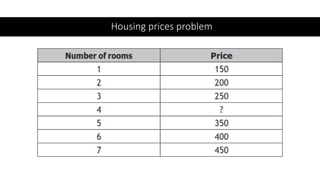
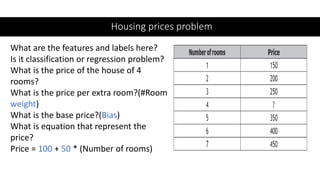
Housing prices problem
Whatare the features and labels here?
Is it classification or regression problem?
What is the price of the house of 4
rooms?
What is the price per extra room?(#Room
weight)
What is the base price?(Bias)
What is equation that represent the
price?
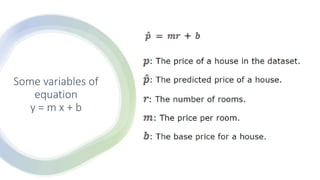
Price = 100 + 50 * (Number of rooms)
6.
Weights and Bias
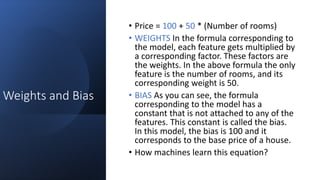
•Price = 100 + 50 * (Number of rooms)
• WEIGHTS In the formula corresponding to
the model, each feature gets multiplied by
a corresponding factor. These factors are
the weights. In the above formula the only
feature is the number of rooms, and its
corresponding weight is 50.
• BIAS As you can see, the formula
corresponding to the model has a
constant that is not attached to any of the
features. This constant is called the bias.
In this model, the bias is 100 and it
corresponds to the base price of a house.
• How machines learn this equation?
How machines learnit? [Remember-Formulate-Predict]
Price = 100 + 50 * (Number of rooms)
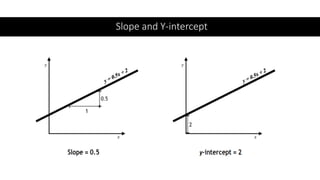
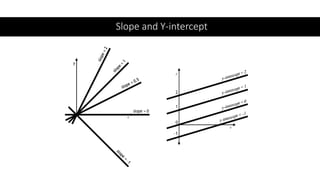
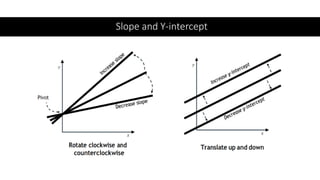
- Slope measures how steep the line is.
It is calculated by dividing the rise
over the run.
- Y-intercept is the height at which the
line crosses the vertical (y) axis.
- Linear Equation is the equation of a
line. y= m x + b
How many lines can solve the problem?
9.
How machines learnit? [Remember-Formulate-Predict]
Price = 100 + 50 * (Number of
rooms)
Price = 100 + 50 * (4) = 300
Some Questions:
- Can we have multiple features
data?
- How does computer get this
equation?
10.
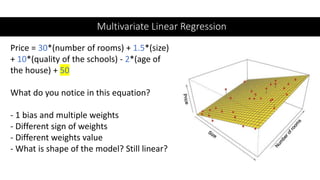
Multivariate Linear Regression
Price= 30*(number of rooms) + 1.5*(size)
+ 10*(quality of the schools) - 2*(age of
the house) + 50
What do you notice in this equation?
- 1 bias and multiple weights
- Different sign of weights
- Different weights value
- What is shape of the model? Still linear?
11.
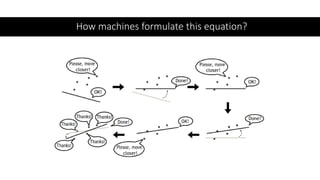
How machines
formulate this
equation?
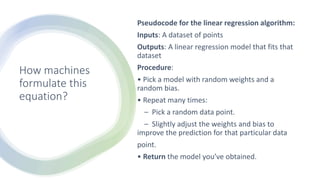
Pseudocodefor the linear regression algorithm:
Inputs: A dataset of points
Outputs: A linear regression model that fits that
dataset
Procedure:
• Pick a model with random weights and a
random bias.
• Repeat many times:
– Pick a random data point.
– Slightly adjust the weights and bias to
improve the prediction for that particular data
point.
• Return the model you’ve obtained.
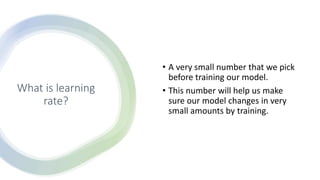
What is learning
rate?
•A very small number that we pick
before training our model.
• This number will help us make
sure our model changes in very
small amounts by training.
How machines formulatethis equation?[The full algorithm]
https://colab.research.google.com/github/s7s/machine_learning_1/blob/master/linear_regression/Coding_linear_re
gression.ipynb


![How machines learn it? [Remember-Formulate-Predict]](https://image.slidesharecdn.com/linearregression-250427101140-c2f133f3/85/Linear-Regression-artificial-intelligence-pdf-7-320.jpg)
![How machines learn it? [Remember-Formulate-Predict]
Price = 100 + 50 * (Number of rooms)
- Slope measures how steep the line is.
It is calculated by dividing the rise
over the run.
- Y-intercept is the height at which the
line crosses the vertical (y) axis.
- Linear Equation is the equation of a
line. y= m x + b
How many lines can solve the problem?](https://image.slidesharecdn.com/linearregression-250427101140-c2f133f3/85/Linear-Regression-artificial-intelligence-pdf-8-320.jpg)
![How machines learn it? [Remember-Formulate-Predict]
Price = 100 + 50 * (Number of
rooms)
Price = 100 + 50 * (4) = 300
Some Questions:
- Can we have multiple features
data?
- How does computer get this
equation?](https://image.slidesharecdn.com/linearregression-250427101140-c2f133f3/85/Linear-Regression-artificial-intelligence-pdf-9-320.jpg)
![How machines formulate this equation?[The simple trick]](https://image.slidesharecdn.com/linearregression-250427101140-c2f133f3/85/Linear-Regression-artificial-intelligence-pdf-17-320.jpg)
![How machines formulate this equation?[The simple trick]](https://image.slidesharecdn.com/linearregression-250427101140-c2f133f3/85/Linear-Regression-artificial-intelligence-pdf-18-320.jpg)
![How machines formulate this equation?[The square trick]](https://image.slidesharecdn.com/linearregression-250427101140-c2f133f3/85/Linear-Regression-artificial-intelligence-pdf-20-320.jpg)
![How machines formulate this equation?[The square trick]](https://image.slidesharecdn.com/linearregression-250427101140-c2f133f3/85/Linear-Regression-artificial-intelligence-pdf-21-320.jpg)
![How machines formulate this equation?[The square trick]](https://image.slidesharecdn.com/linearregression-250427101140-c2f133f3/85/Linear-Regression-artificial-intelligence-pdf-22-320.jpg)
![How machines formulate this equation?[The square trick]
https://colab.research.google.com/github/s7s/machine_learning_1/blob/master/linear_regression/Coding_linear_re
gression.ipynb](https://image.slidesharecdn.com/linearregression-250427101140-c2f133f3/85/Linear-Regression-artificial-intelligence-pdf-23-320.jpg)
![How machines formulate this equation?[The absolute trick]](https://image.slidesharecdn.com/linearregression-250427101140-c2f133f3/85/Linear-Regression-artificial-intelligence-pdf-24-320.jpg)
![How machines formulate this equation?[The absolute trick]
https://colab.research.google.com/github/s7s/machine_learning_1/blob/master/linear_regression/Coding_linear_re
gression.ipynb](https://image.slidesharecdn.com/linearregression-250427101140-c2f133f3/85/Linear-Regression-artificial-intelligence-pdf-25-320.jpg)
![How machines formulate this equation?[The full algorithm]](https://image.slidesharecdn.com/linearregression-250427101140-c2f133f3/85/Linear-Regression-artificial-intelligence-pdf-26-320.jpg)
![How machines formulate this equation?[The full algorithm]
https://colab.research.google.com/github/s7s/machine_learning_1/blob/master/linear_regression/Coding_linear_re
gression.ipynb](https://image.slidesharecdn.com/linearregression-250427101140-c2f133f3/85/Linear-Regression-artificial-intelligence-pdf-27-320.jpg)
![How machines formulate this equation?[The full algorithm]](https://image.slidesharecdn.com/linearregression-250427101140-c2f133f3/85/Linear-Regression-artificial-intelligence-pdf-28-320.jpg)
![How machines formulate this equation?[Multivariate]](https://image.slidesharecdn.com/linearregression-250427101140-c2f133f3/85/Linear-Regression-artificial-intelligence-pdf-29-320.jpg)
![How machines formulate this equation?[Multivariate]](https://image.slidesharecdn.com/linearregression-250427101140-c2f133f3/85/Linear-Regression-artificial-intelligence-pdf-30-320.jpg)
![How machines formulate this equation?[Multivariate]](https://image.slidesharecdn.com/linearregression-250427101140-c2f133f3/85/Linear-Regression-artificial-intelligence-pdf-31-320.jpg)