Introduction to
Machine Learning
Liberate | Simplify | Connect www.finbourne.com
1
Introduction
• This talk aims to give a reasonably comprehensive
introduction to machine learning
• Covers the common structure and inner workings of
ML algorithms
• Covers how they fail, how to select and tune them
• Ties it all together at the end with a demonstration
on a real dataset
1. Learning processes
2. First Machine Learning Example
3. Empirical Risk Minimisation
4. ML Model Capacity
5. Regularisation
6. Hyperparameter tuning and model
selection
7. Example tying it all together
2
What is Learning
Anyway?
3
• Improvement at some task as measured by some
metric given some experience
• Inductive process: combine premises to reach
conclusion
• Needs some internal model that can be updated by
some optimisation process
• This model takes features (premises) and produces
predictions (conclusions)
What is Learning?
4
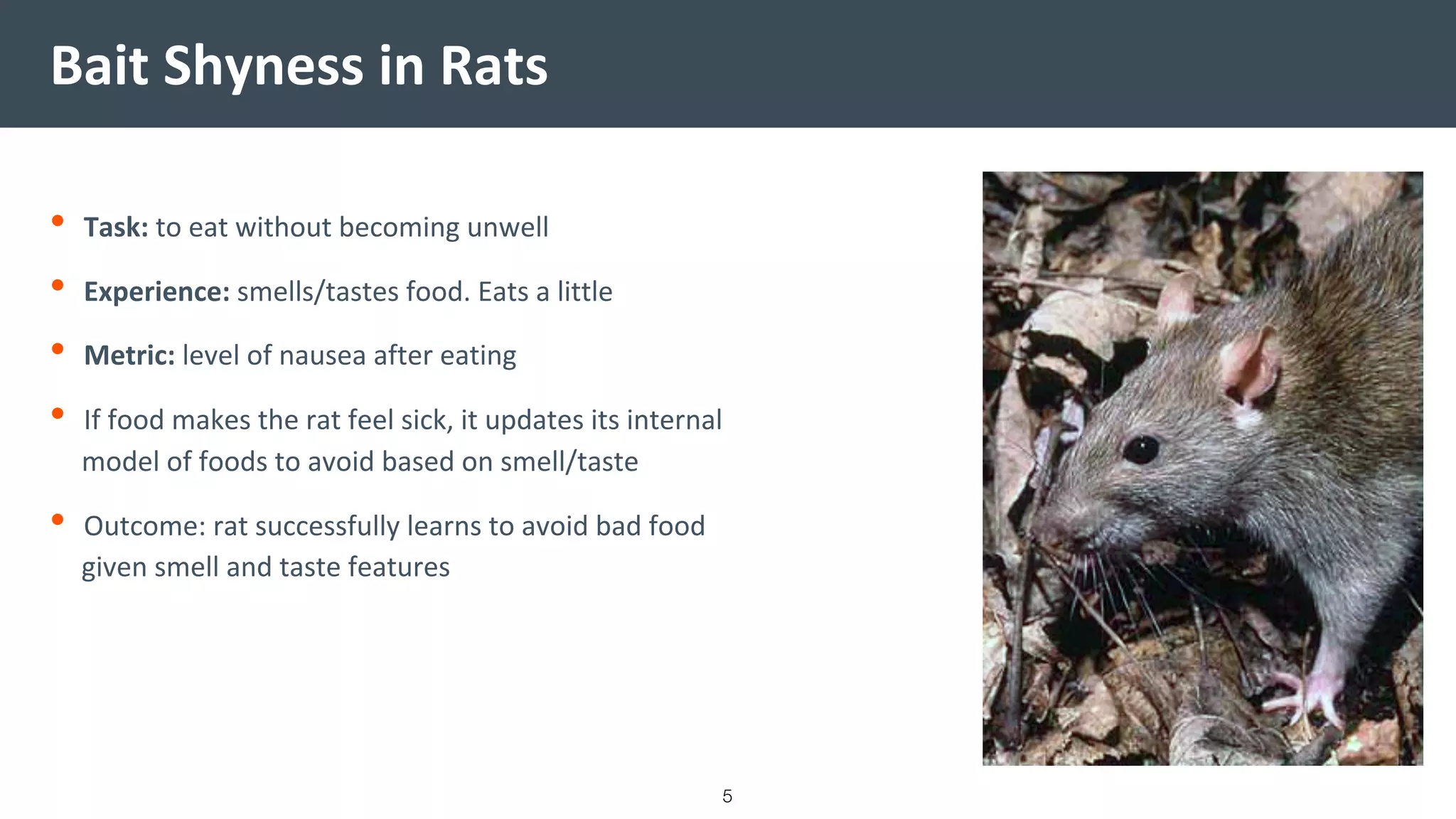
Bait Shyness in Rats
• Task: to eat without becoming unwell
• Experience: smells/tastes food. Eats a little
• Metric: level of nausea after eating
• If food makes the rat feel sick, it updates its internal
model of foods to avoid based on smell/taste
• Outcome: rat successfully learns to avoid bad food
given smell and taste features
5
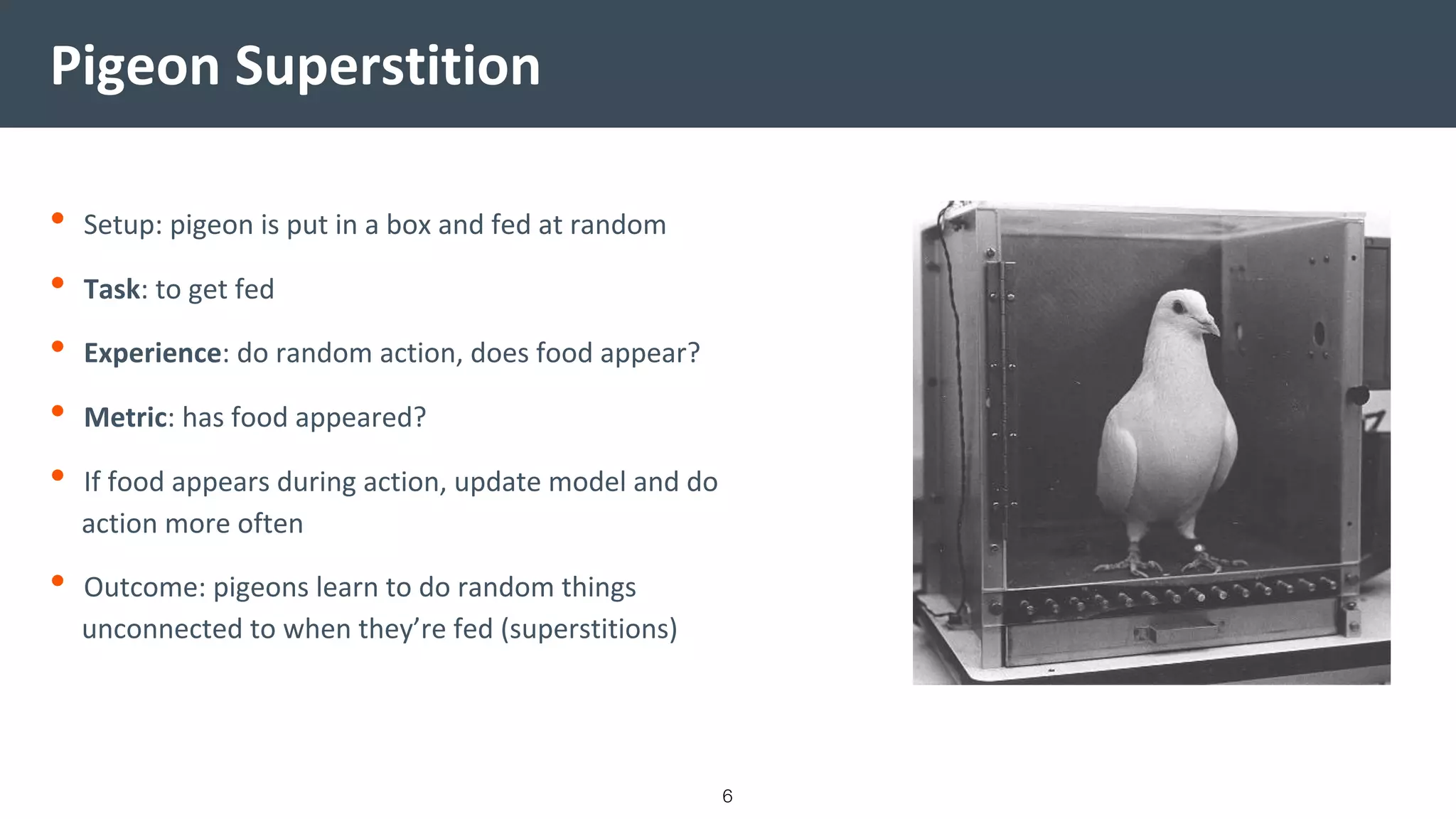
Pigeon Superstition
• Setup: pigeon is put in a box and fed at random
• Task: to get fed
• Experience: do random action, does food appear?
• Metric: has food appeared?
• If food appears during action, update model and do
action more often
• Outcome: pigeons learn to do random things
unconnected to when they’re fed (superstitions)
6
What happened?
• Why did the rats succeed and the pigeons fail?
• Rats don’t avoid food if given a different unpleasant
stimulus
• Rats have an inductive bias towards associating
smells, tastes and nausea with bad food (due to
natural selection)
• Inductive bias is crucial for learning: without it
learning can’t succeed
• For a machine to be able to learn we need to
describe this learning process mathematically
7
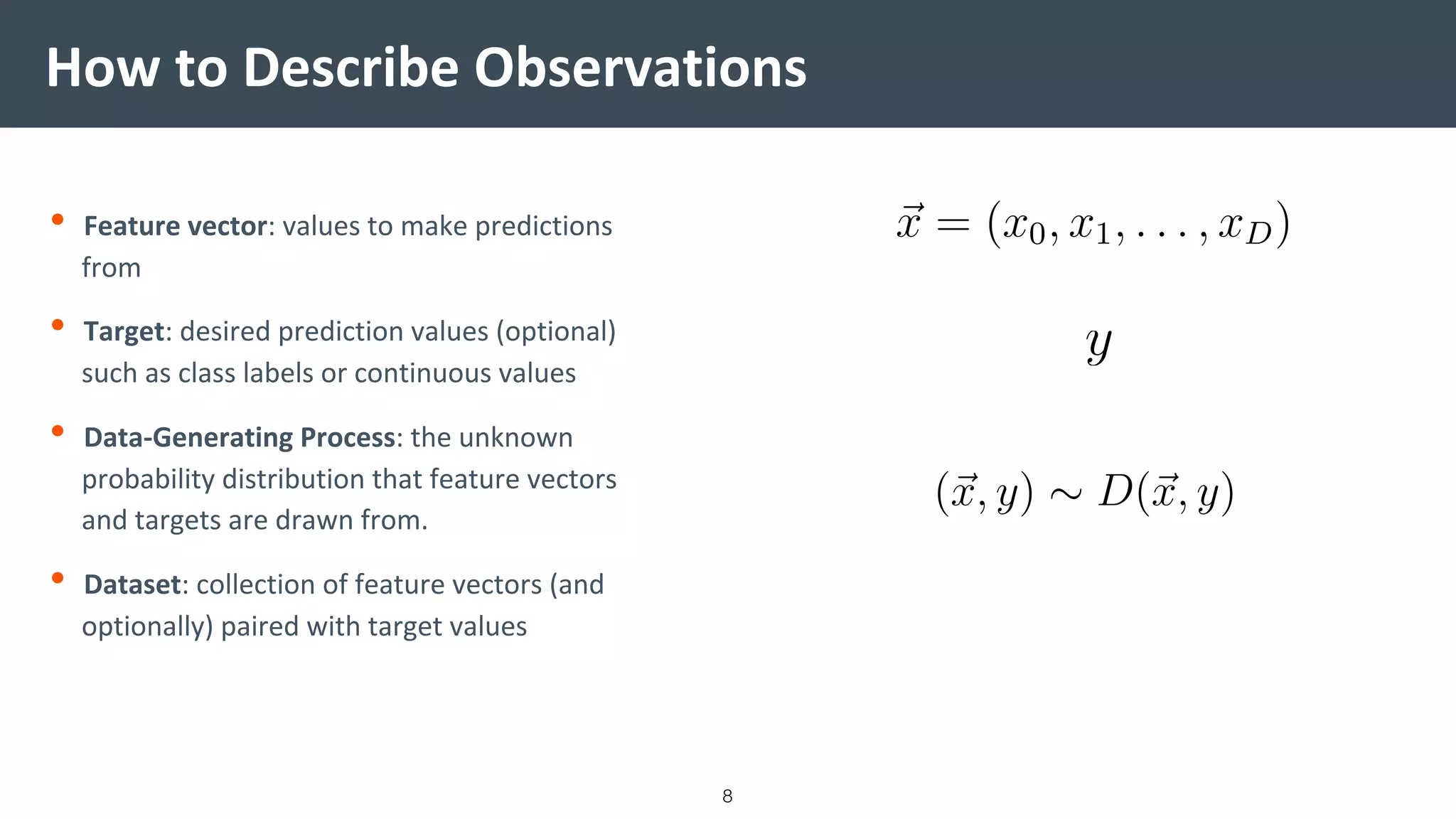
How to Describe Observations
• Feature vector: values to make predictions
from
• Target: desired prediction values (optional)
such as class labels or continuous values
• Data-Generating Process: the unknown
probability distribution that feature vectors
and targets are drawn from.
• Dataset: collection of feature vectors (and
optionally) paired with target values
8
Features and Data: Irises
9
0 1 2 3 4 5 6 7
petal length (cm)
0.0
0.5
1.0
1.5
2.0
2.5
3.0
petalwidth(cm)
Iris Features
Setosa
Versicolor
Virginica
[1.4 0.2][0]
[1.4 0.2][0]
[1.3 0.2][0]
[1.5 0.2][0]
[1.4 0.2][0]
[6.0 2.5][2]
[5.1 1.9][2]
[5.9 2.1][2]
[5.6 1.8][2]
[5.8 2.2][2]
[4.7 1.4][1]
[4.5 1.5][1]
[4.9 1.5][1]
[4.0 1.3][1]
[4.6 1.5][1]
1 2 3 4 5 6 7
petal length (cm)
Iris Features
Setosa
Versicolor
Virginica
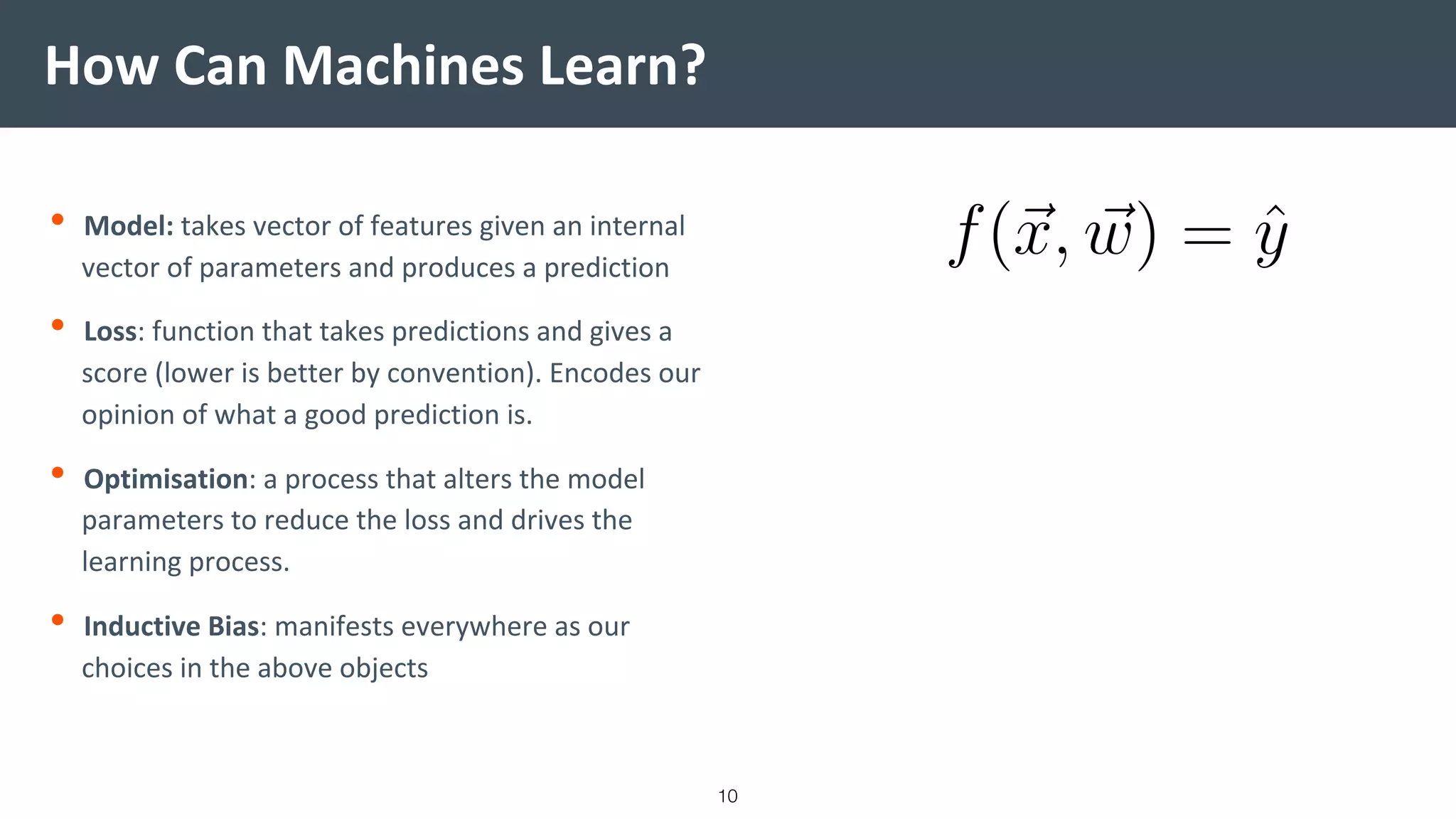
How Can Machines Learn?
• Model: takes vector of features given an internal
vector of parameters and produces a prediction
• Loss: function that takes predictions and gives a
score (lower is better by convention). Encodes our
opinion of what a good prediction is.
• Optimisation: a process that alters the model
parameters to reduce the loss and drives the
learning process.
• Inductive Bias: manifests everywhere as our
choices in the above objects
10
A First Example: Linear
Regressor
11
Problem and Dataset
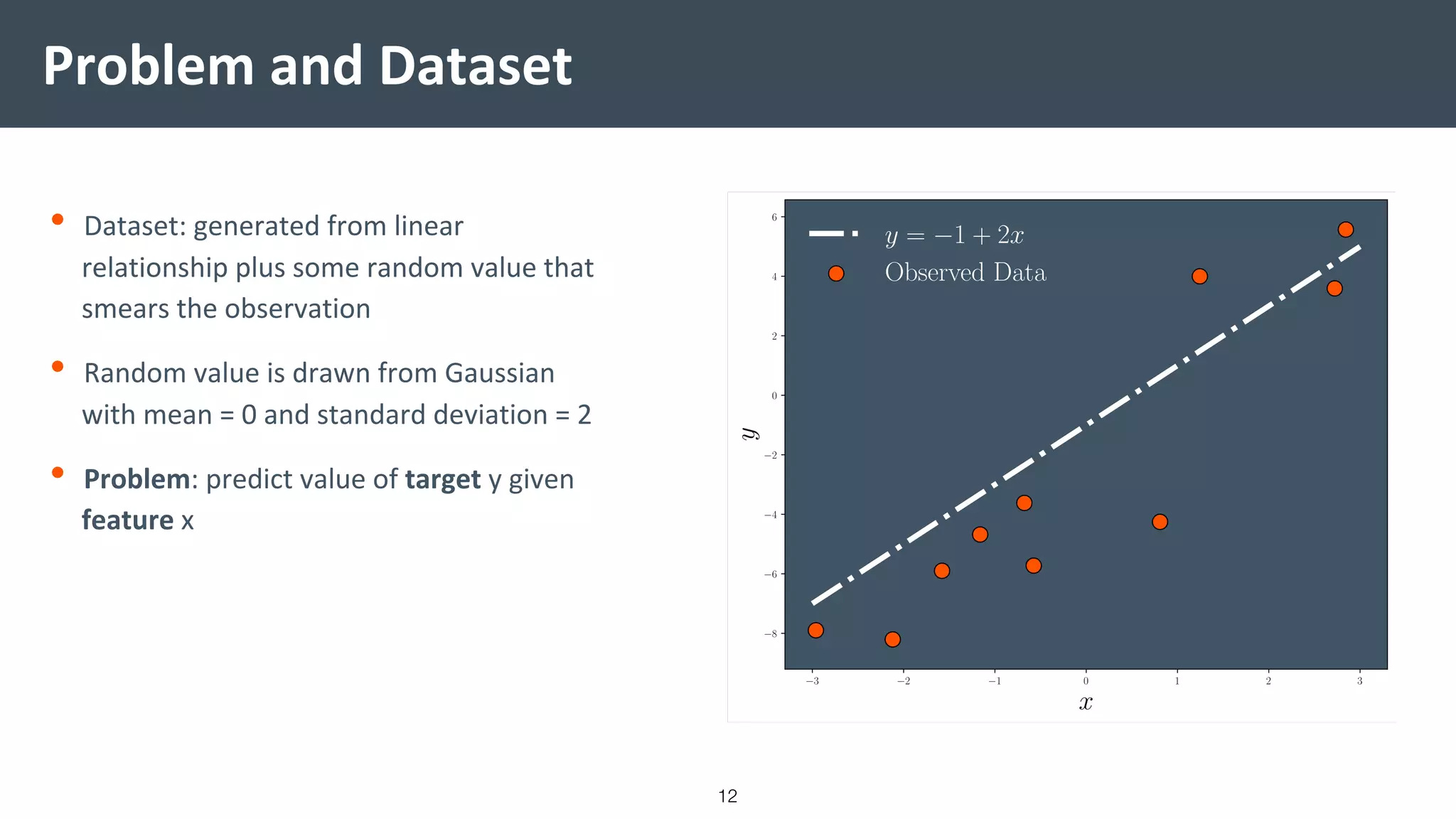
• Dataset: generated from linear
relationship plus some random value that
smears the observation
• Random value is drawn from Gaussian
with mean = 0 and standard deviation = 2
• Problem: predict value of target y given
feature x
12
Model and Parameters
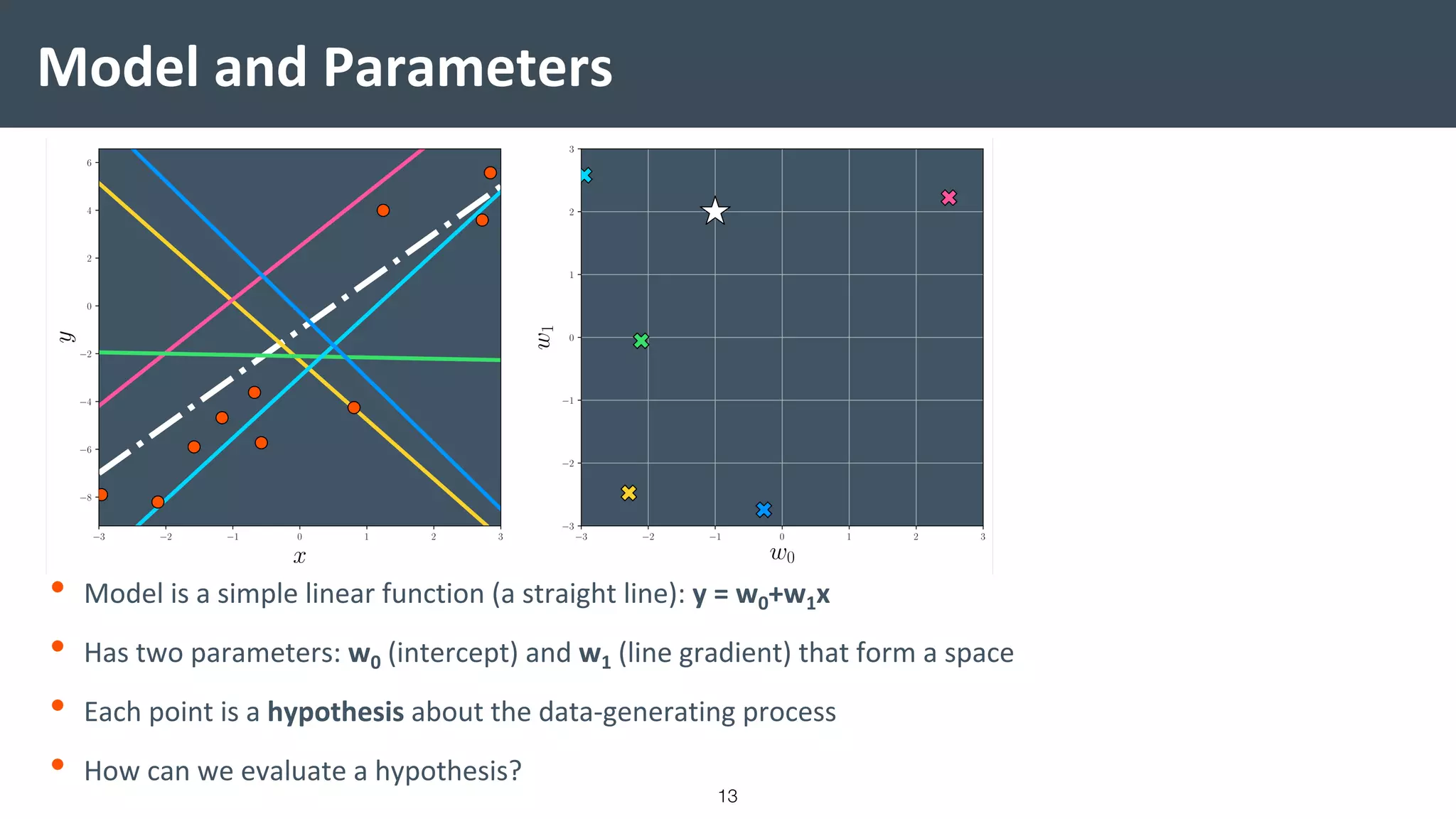
• Model is a simple linear function (a straight line): y = w0+w1x
• Has two parameters: w0 (intercept) and w1 (line gradient) that form a space
• Each point is a hypothesis about the data-generating process
• How can we evaluate a hypothesis?
13
The Loss
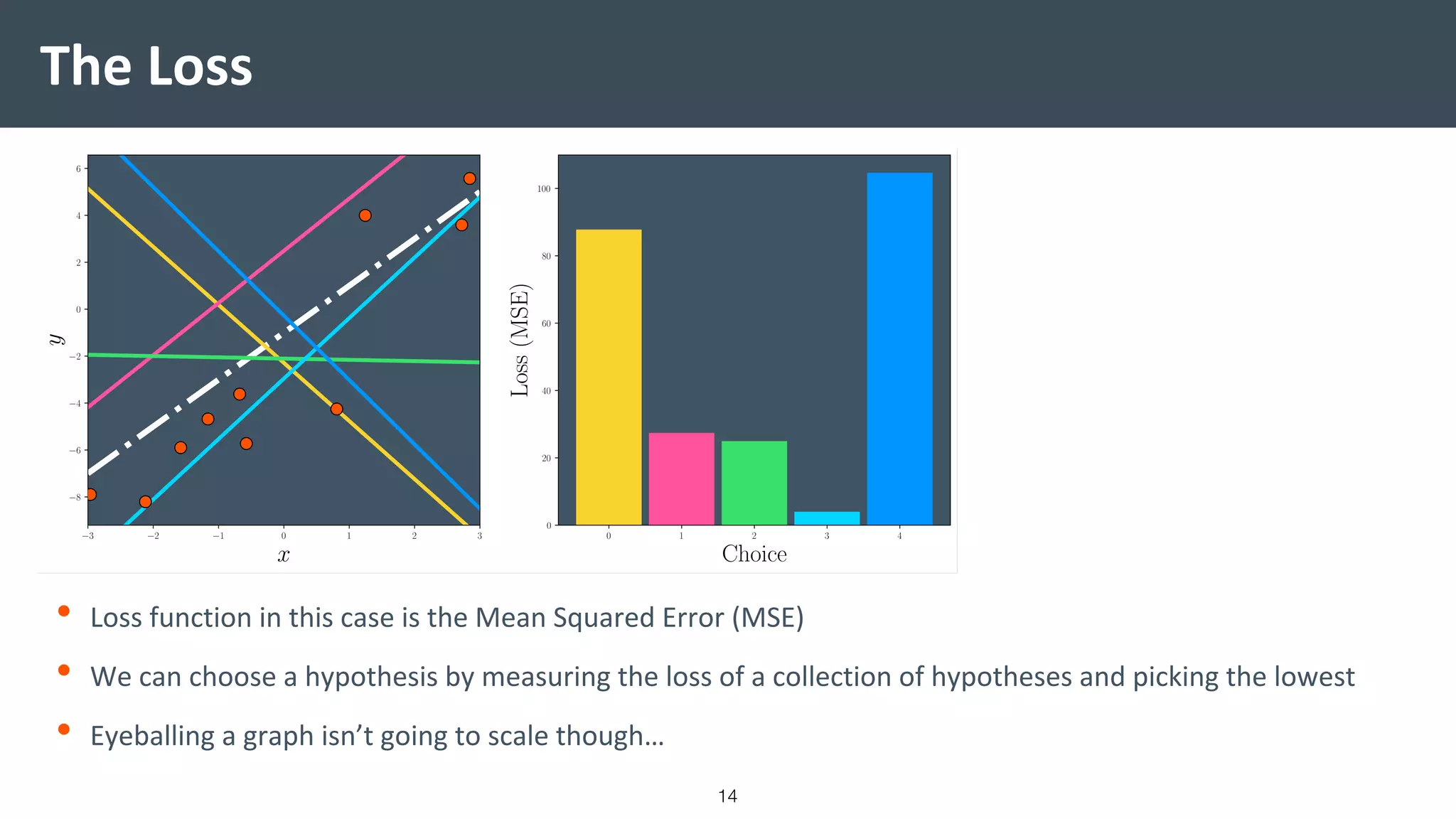
• Loss function in this case is the Mean Squared Error (MSE)
• We can choose a hypothesis by measuring the loss of a collection of hypotheses and picking the lowest
• Eyeballing a graph isn’t going to scale though…
14
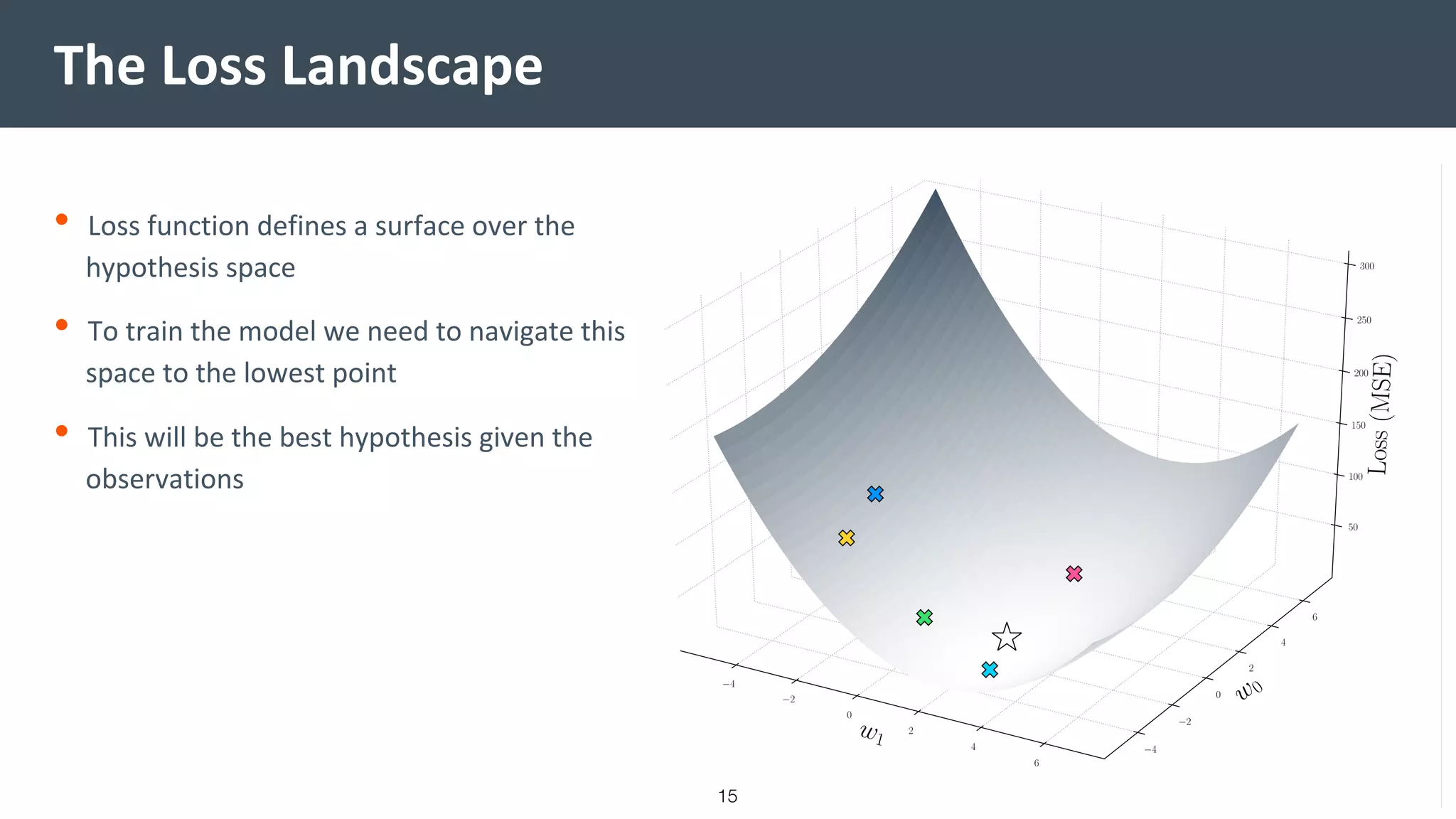
The Loss Landscape
• Loss function defines a surface over the
hypothesis space
• To train the model we need to navigate this
space to the lowest point
• This will be the best hypothesis given the
observations
15
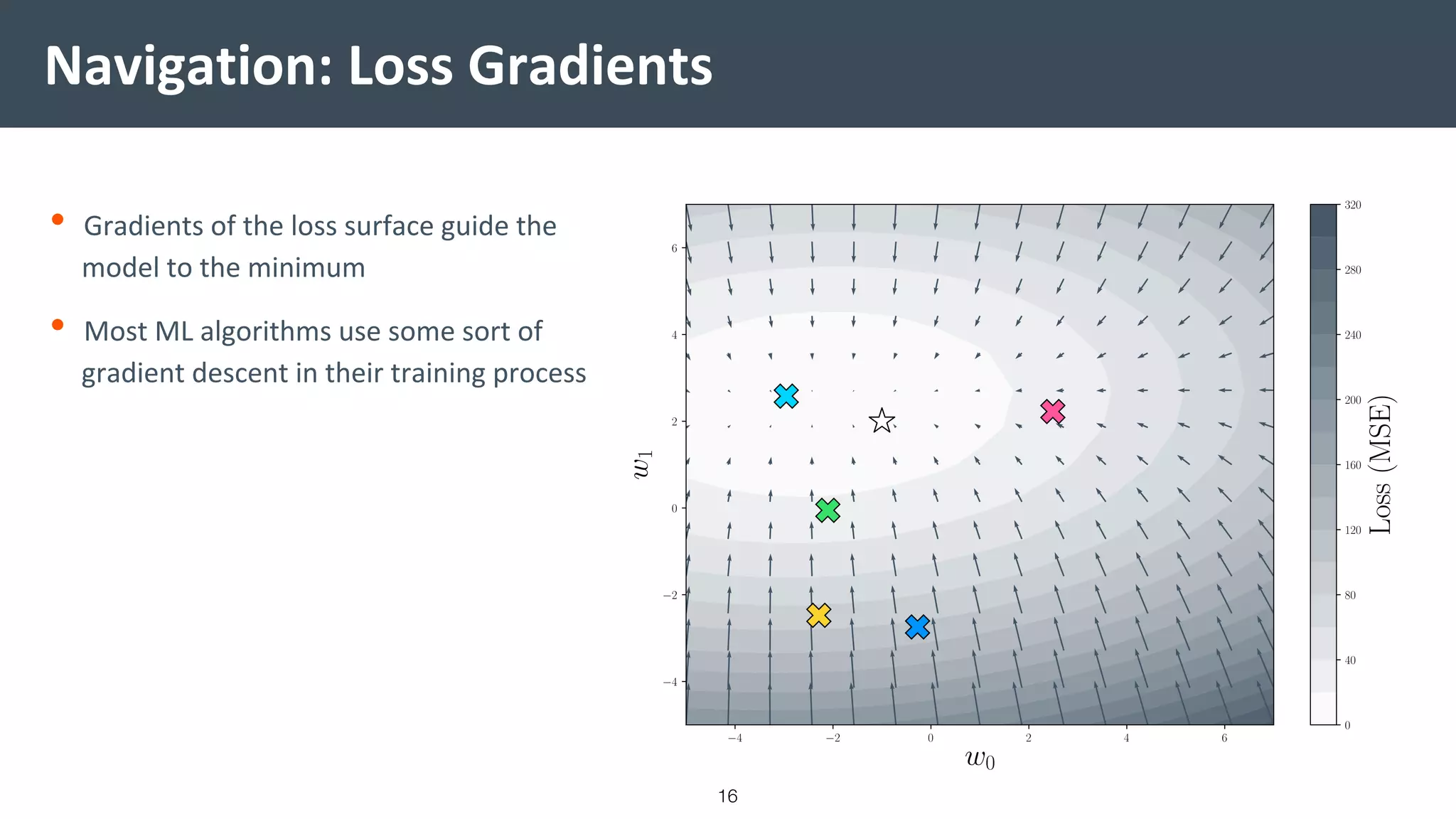
Navigation: Loss Gradients
• Gradients of the loss surface guide the
model to the minimum
• Most ML algorithms use some sort of
gradient descent in their training process
16
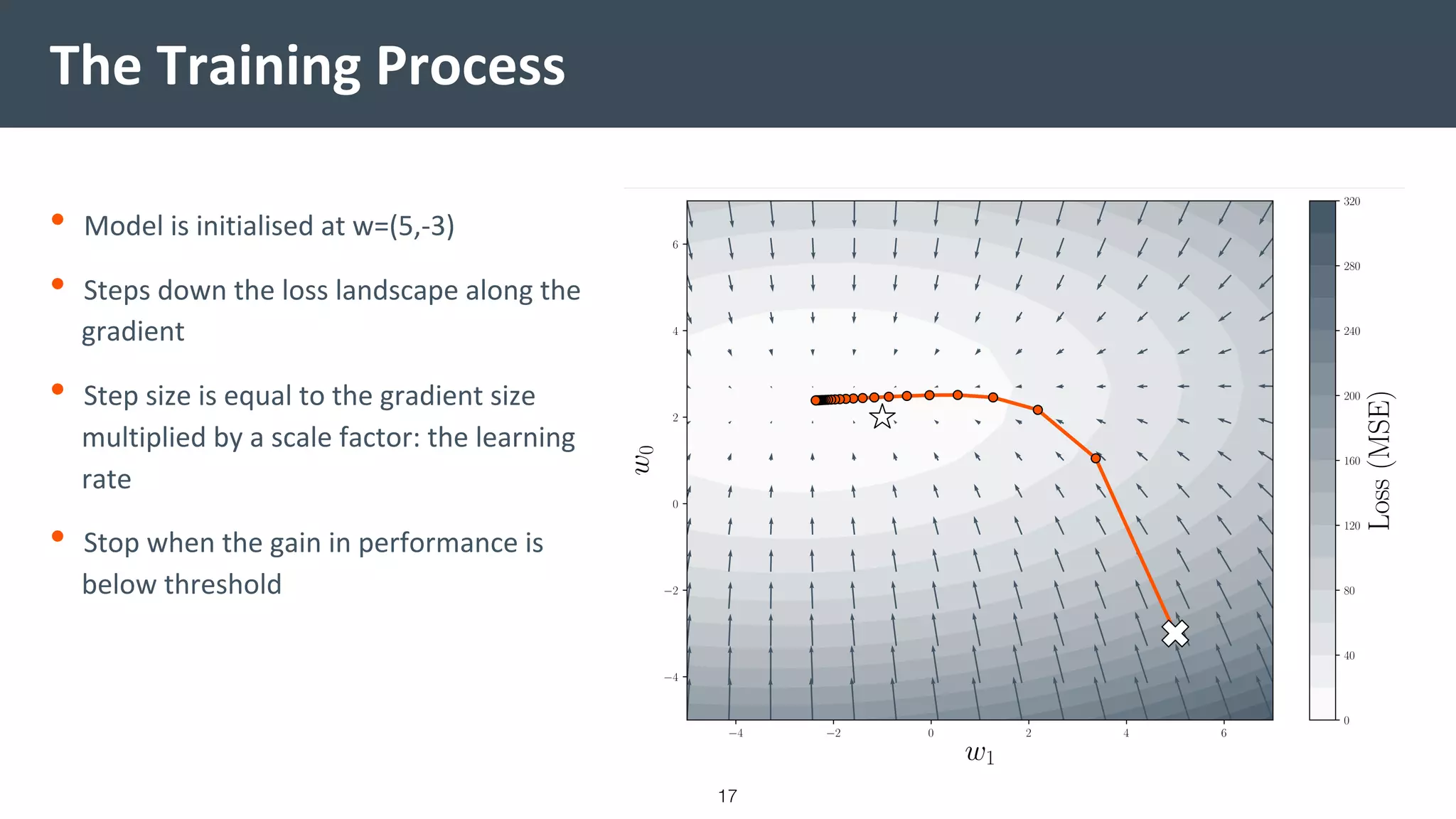
The Training Process
• Model is initialised at w=(5,-3)
• Steps down the loss landscape along the
gradient
• Step size is equal to the gradient size
multiplied by a scale factor: the learning
rate
• Stop when the gain in performance is
below threshold
17
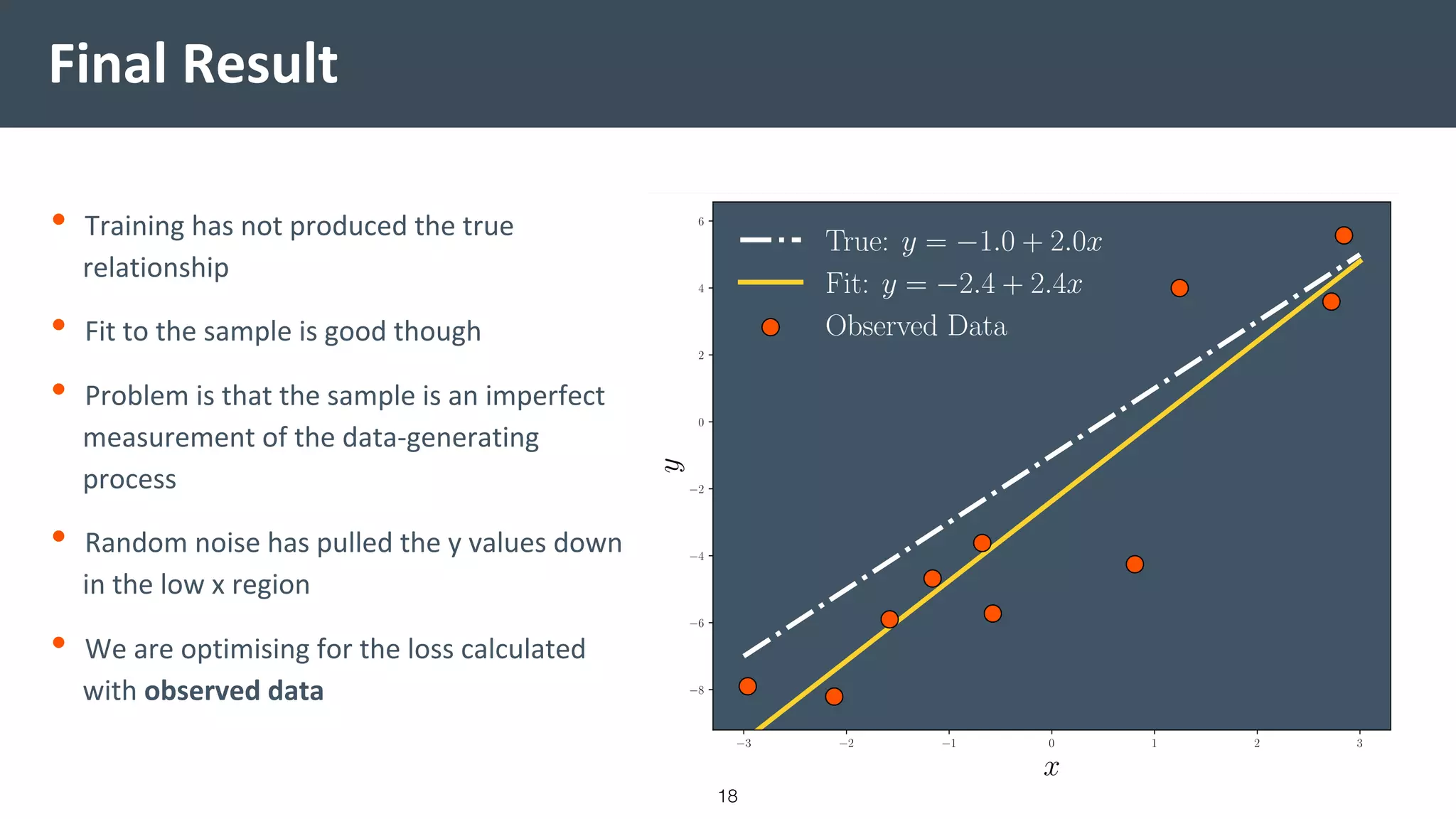
Final Result
• Training has not produced the true
relationship
• Fit to the sample is good though
• Problem is that the sample is an imperfect
measurement of the data-generating
process
• Random noise has pulled the y values down
in the low x region
• We are optimising for the loss calculated
with observed data
18
Empirical Risk
Minimisation
19
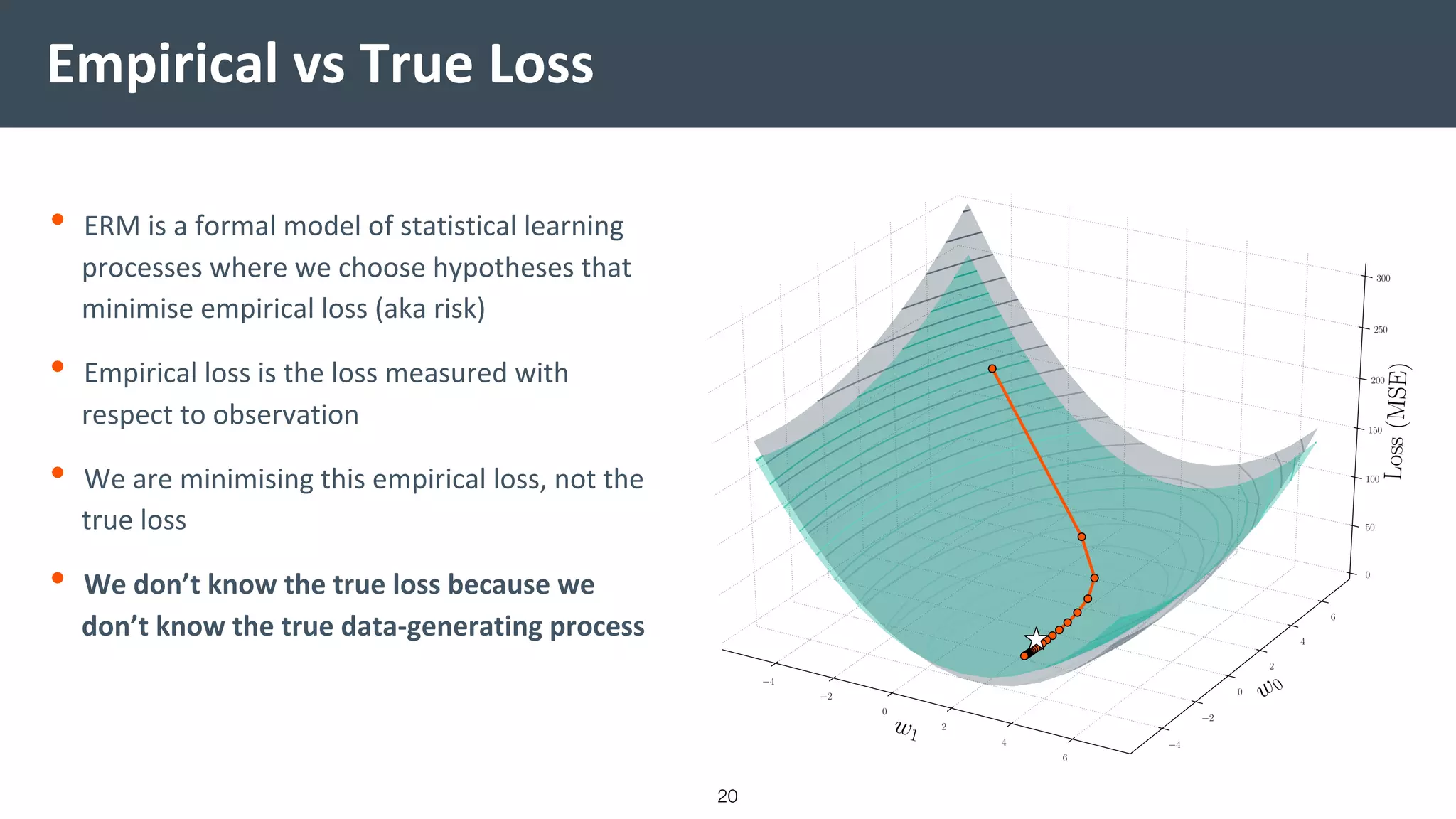
Empirical vs True Loss
• ERM is a formal model of statistical learning
processes where we choose hypotheses that
minimise empirical loss (aka risk)
• Empirical loss is the loss measured with
respect to observation
• We are minimising this empirical loss, not the
true loss
• We don’t know the true loss because we
don’t know the true data-generating process
20
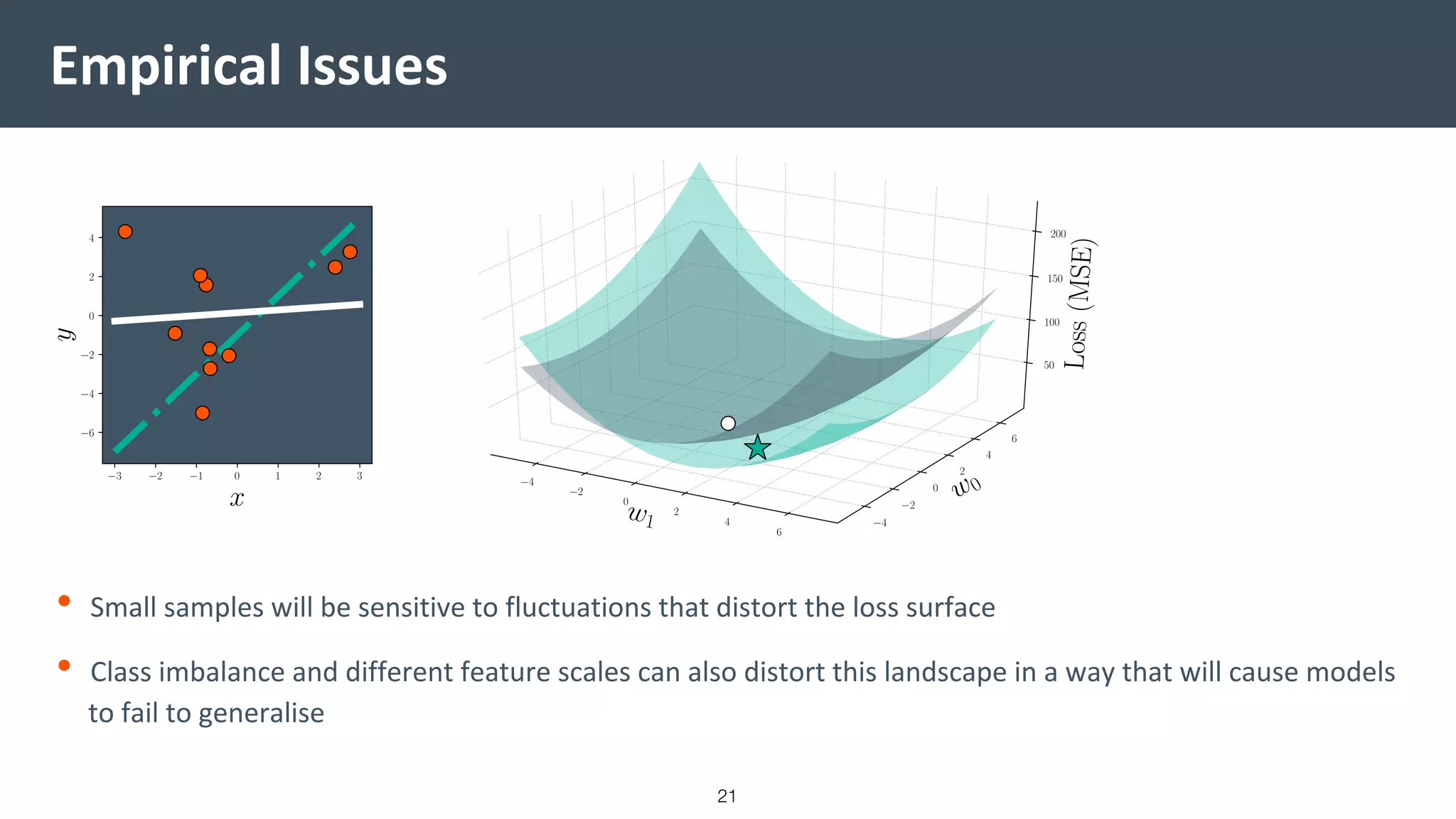
Empirical Issues
• Small samples will be sensitive to fluctuations that distort the loss surface
• Class imbalance and different feature scales can also distort this landscape in a way that will cause models
to fail to generalise
21
°3 °2 °1 0 1 2 3
x
0
100
200
300
400
500
Later
Decision Line
Class 0
Class 1
0
100
200
300
400
500
Now
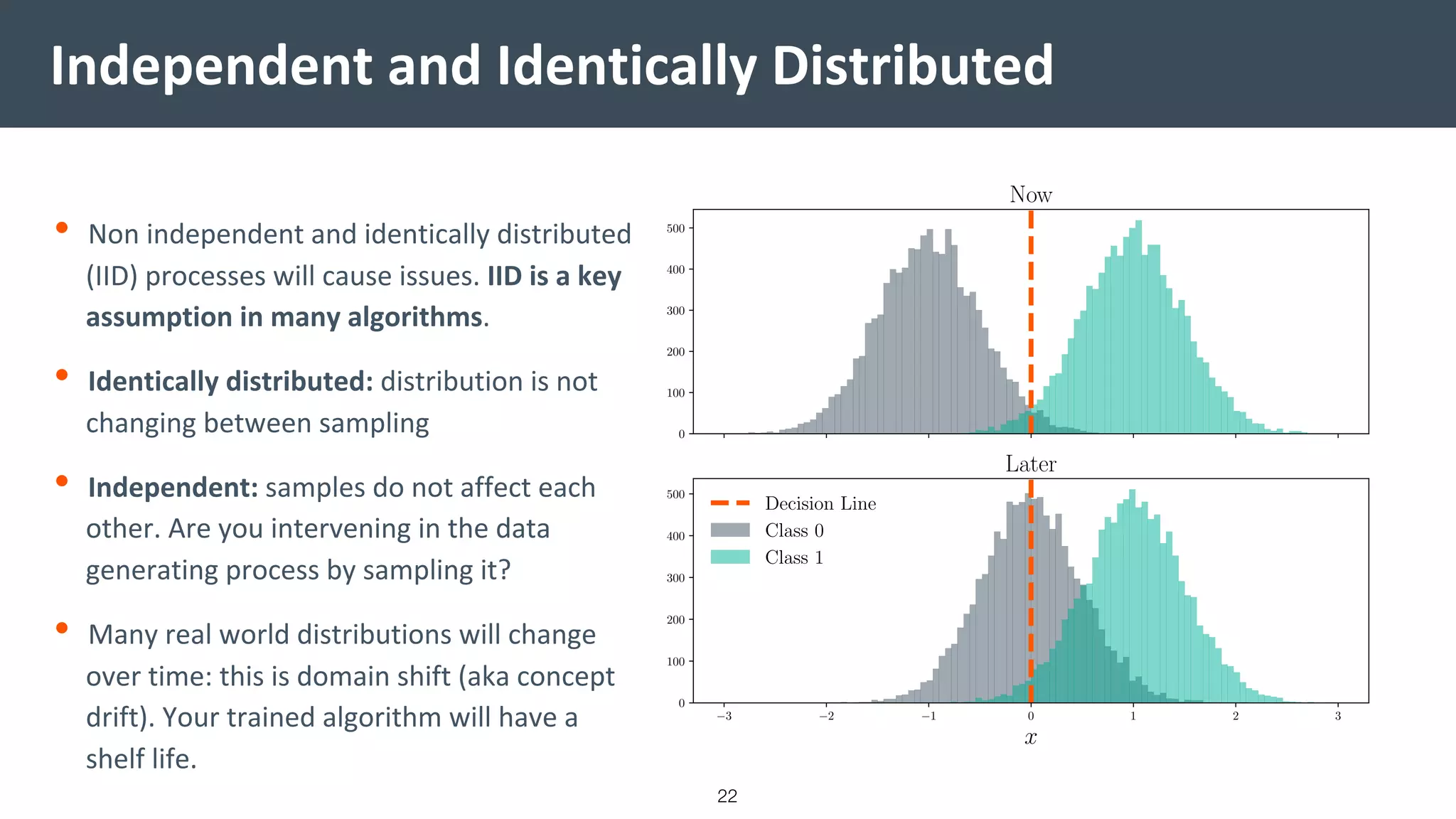
Independent and Identically Distributed
• Non independent and identically distributed
(IID) processes will cause issues. IID is a key
assumption in many algorithms.
• Identically distributed: distribution is not
changing between sampling
• Independent: samples do not affect each
other. Are you intervening in the data
generating process by sampling it?
• Many real world distributions will change
over time: this is domain shift (aka concept
drift). Your trained algorithm will have a
shelf life.
22
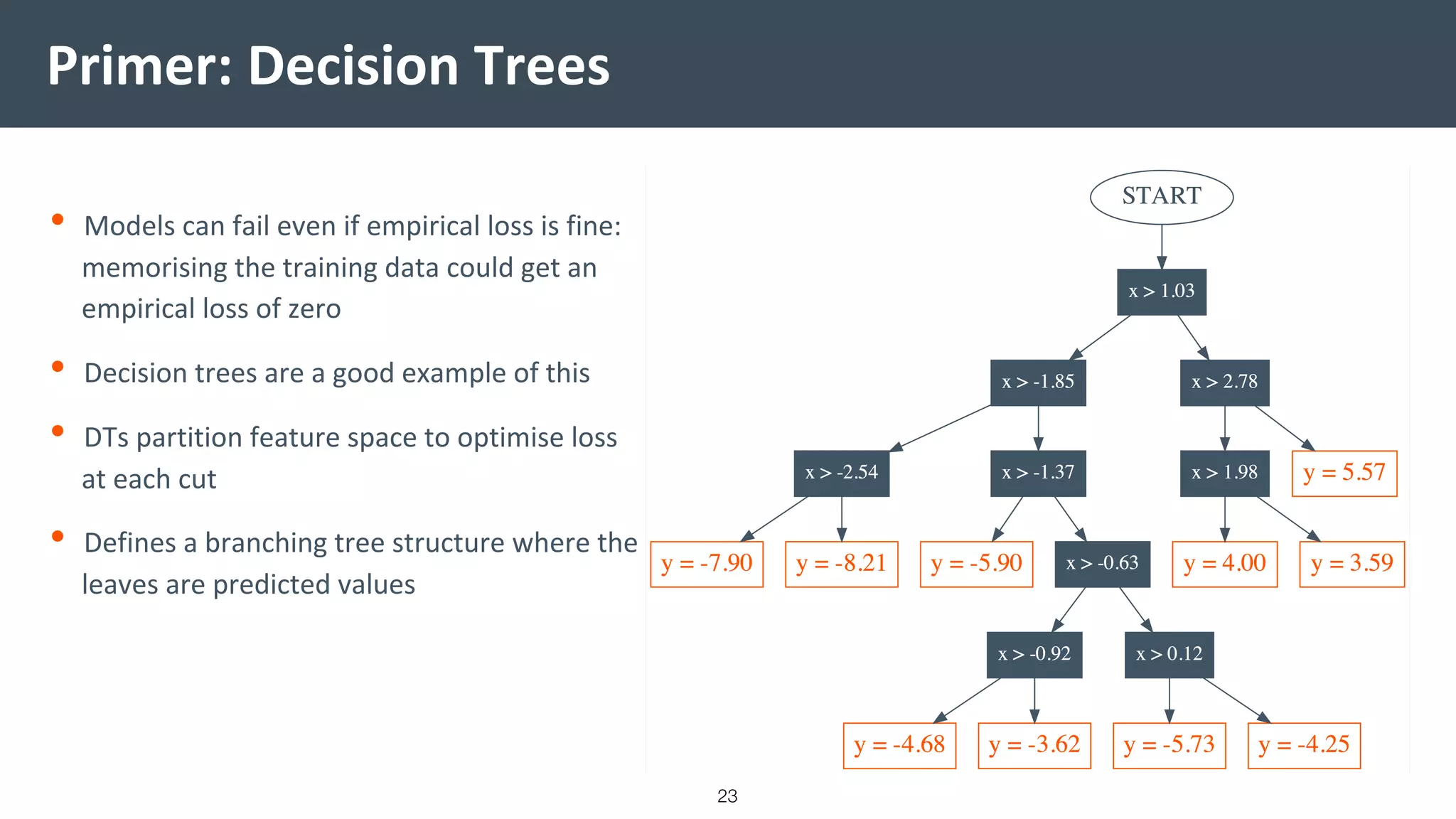
Primer: Decision Trees
• Models can fail even if empirical loss is fine:
memorising the training data could get an
empirical loss of zero
• Decision trees are a good example of this
• DTs partition feature space to optimise loss
at each cut
• Defines a branching tree structure where the
leaves are predicted values
23
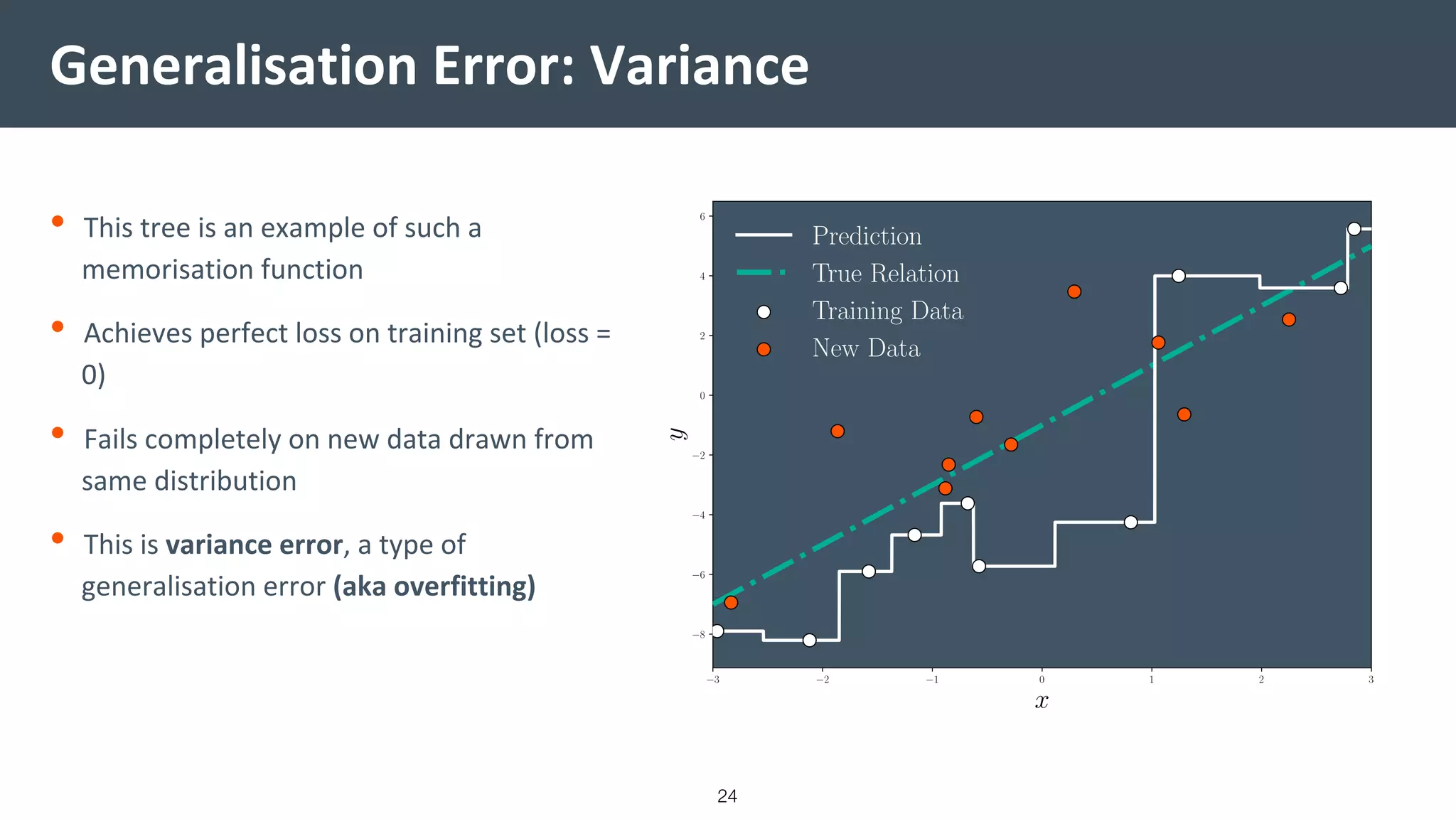
Generalisation Error: Variance
• This tree is an example of such a
memorisation function
• Achieves perfect loss on training set (loss =
0)
• Fails completely on new data drawn from
same distribution
• This is variance error, a type of
generalisation error (aka overfitting)
24
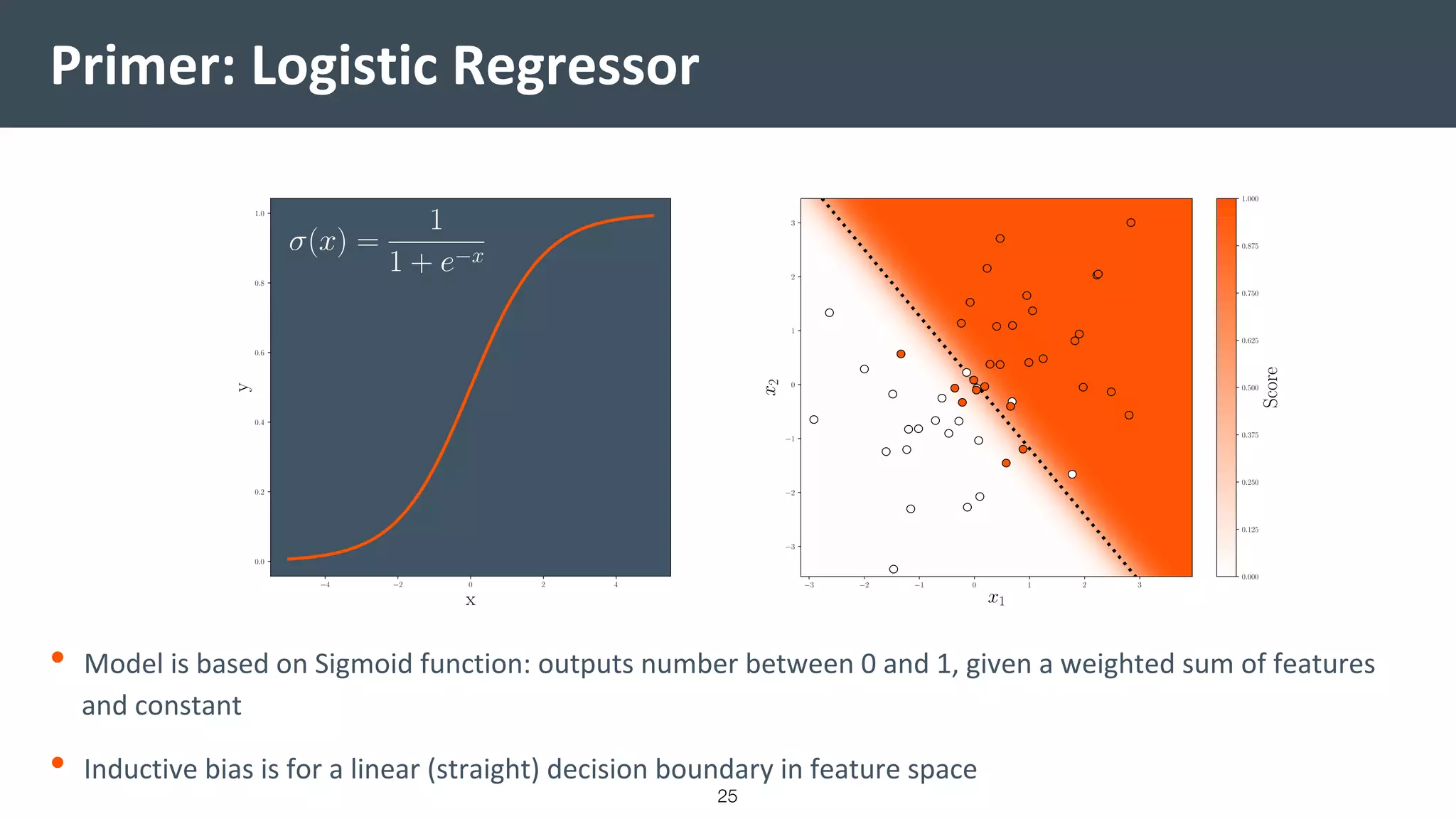
Primer: Logistic Regressor
• Model is based on Sigmoid function: outputs number between 0 and 1, given a weighted sum of features
and constant
• Inductive bias is for a linear (straight) decision boundary in feature space
25
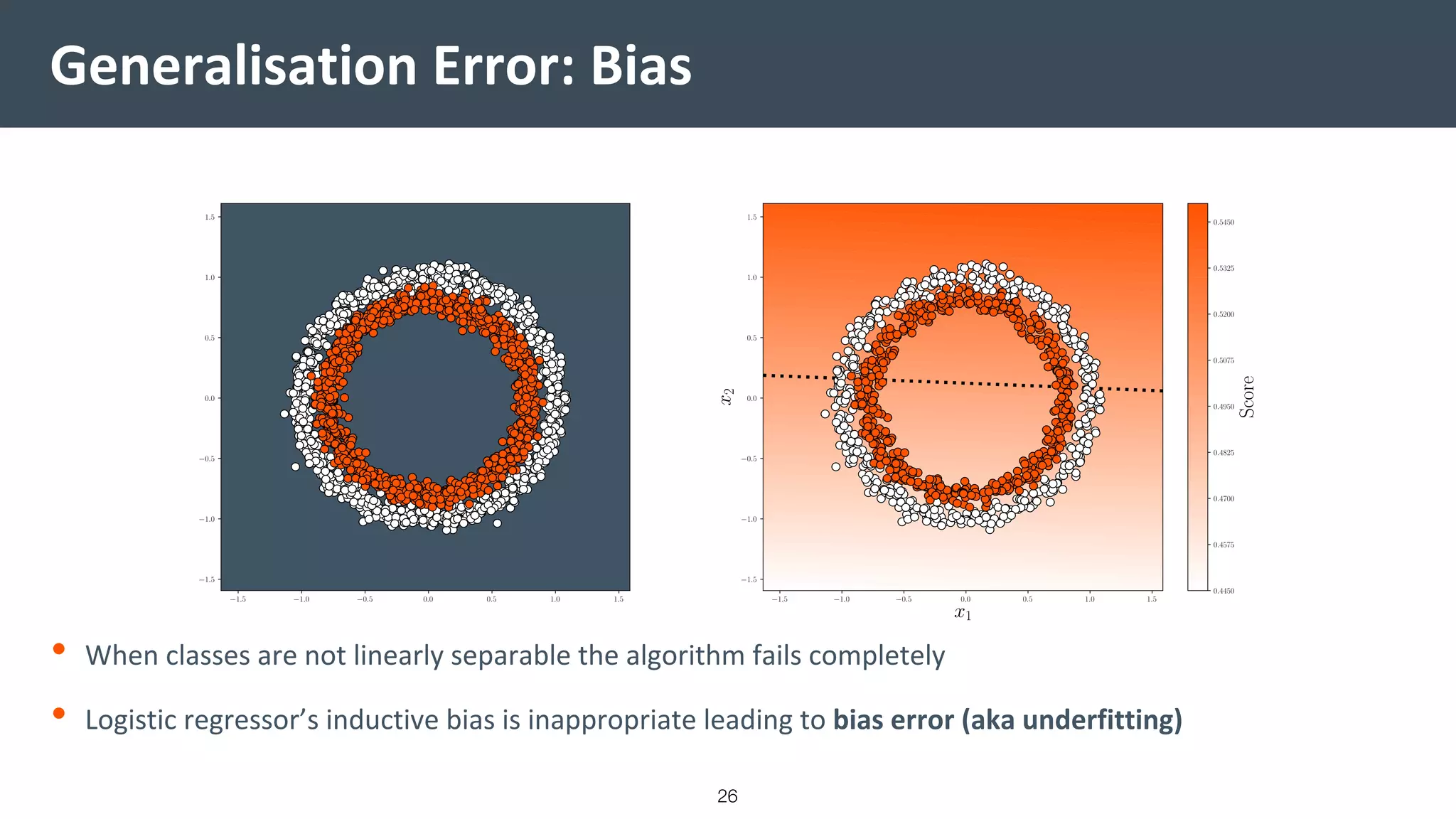
Generalisation Error: Bias
• When classes are not linearly separable the algorithm fails completely
• Logistic regressor’s inductive bias is inappropriate leading to bias error (aka underfitting)
26
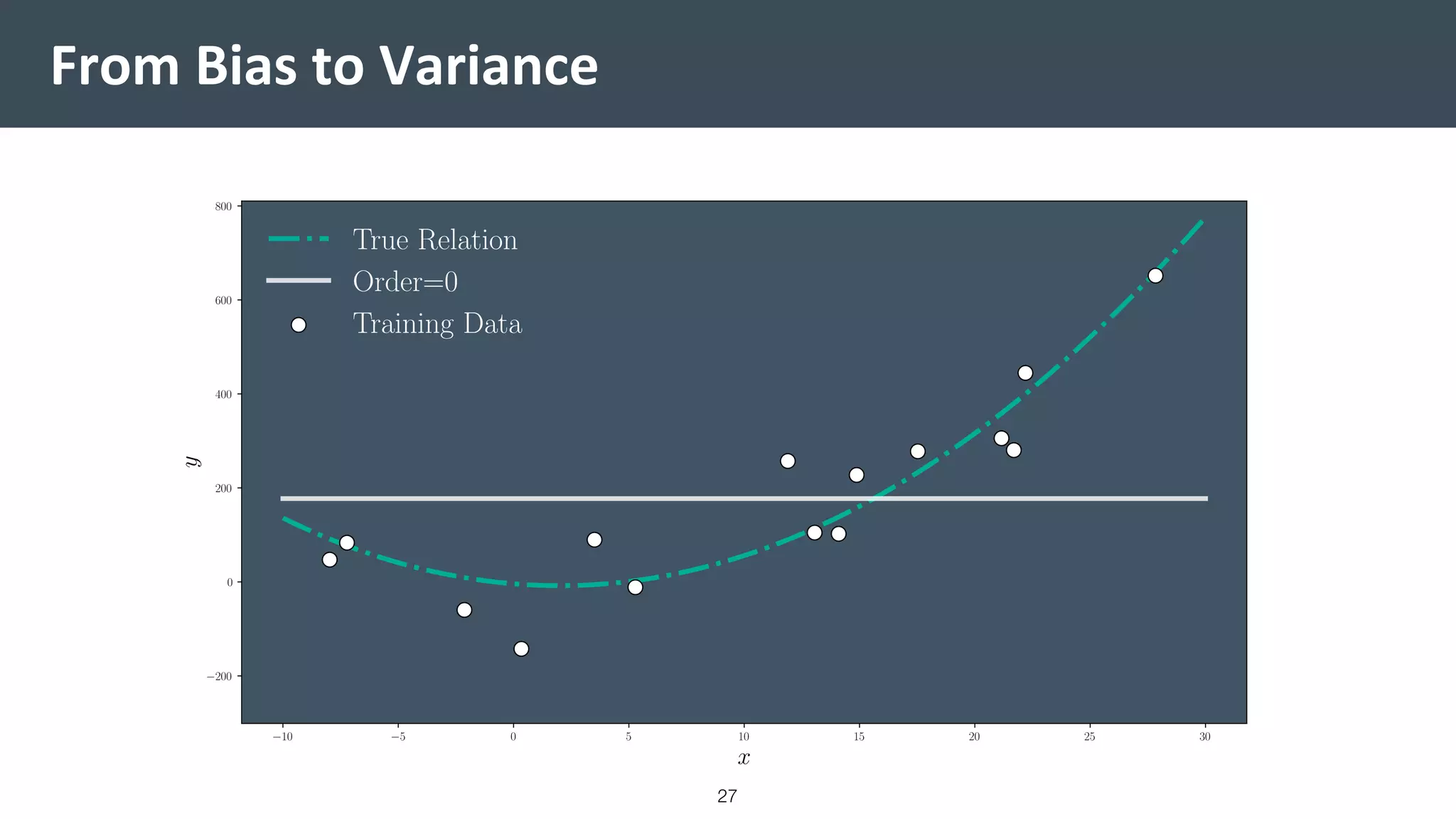
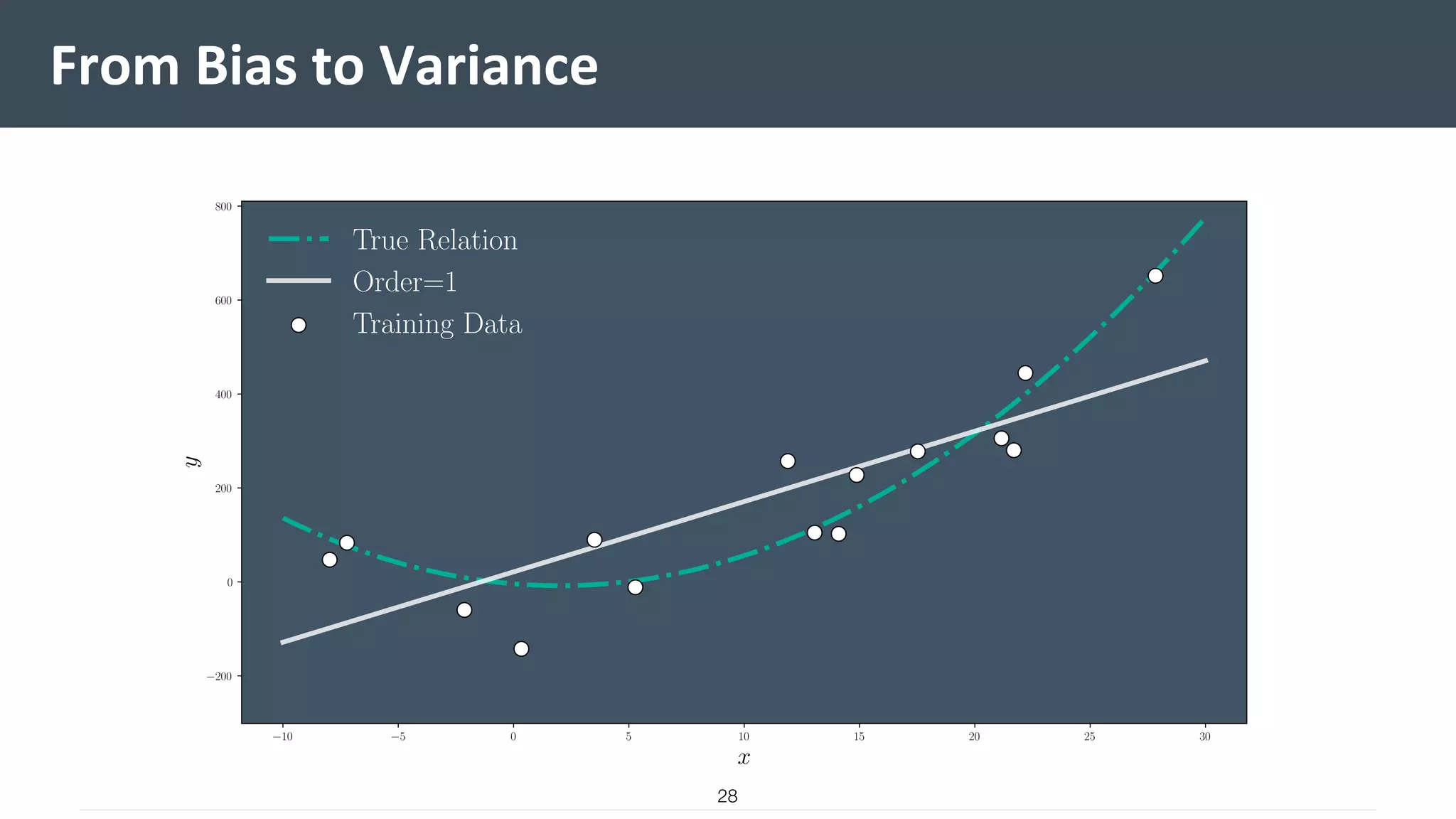
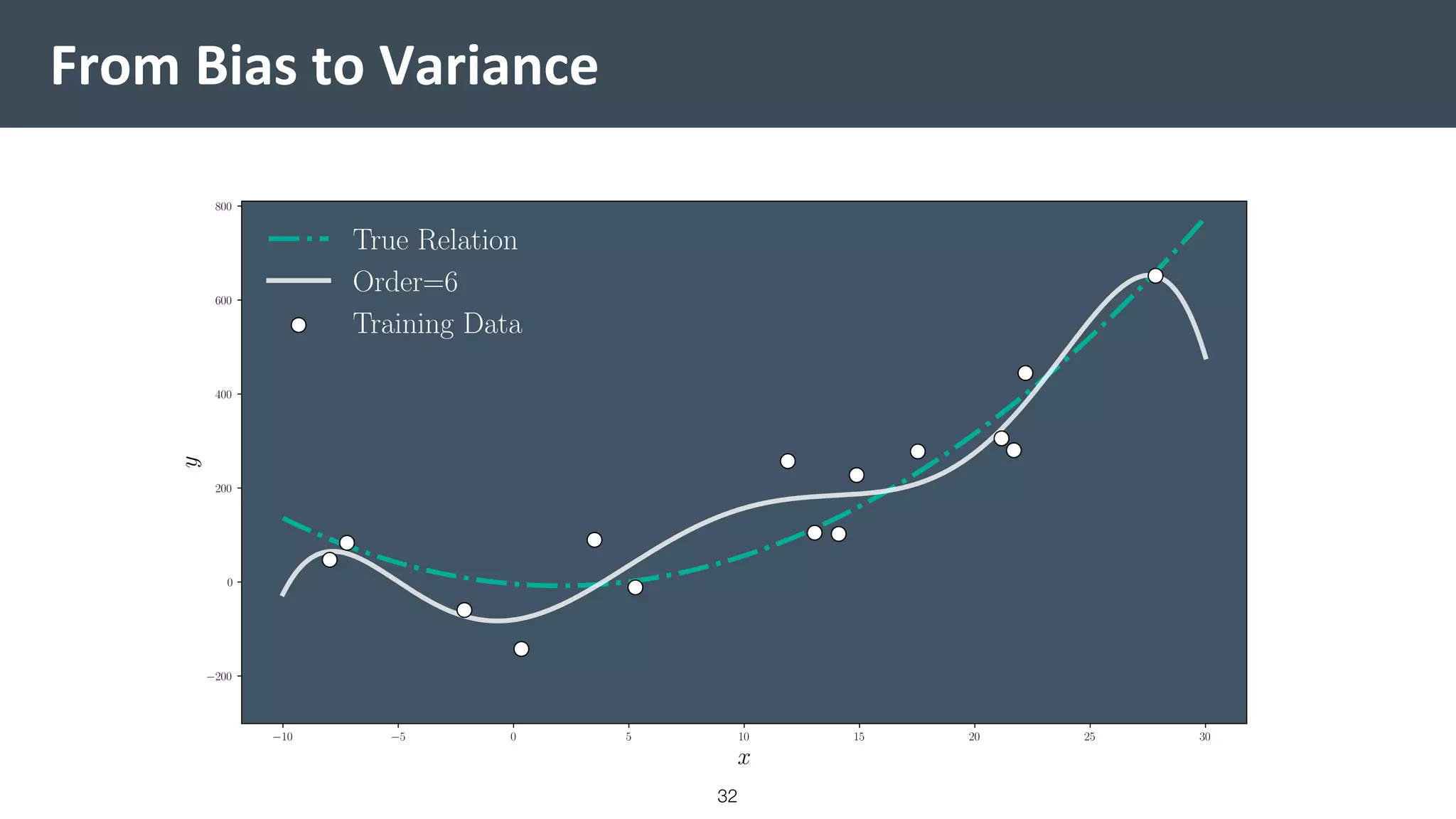
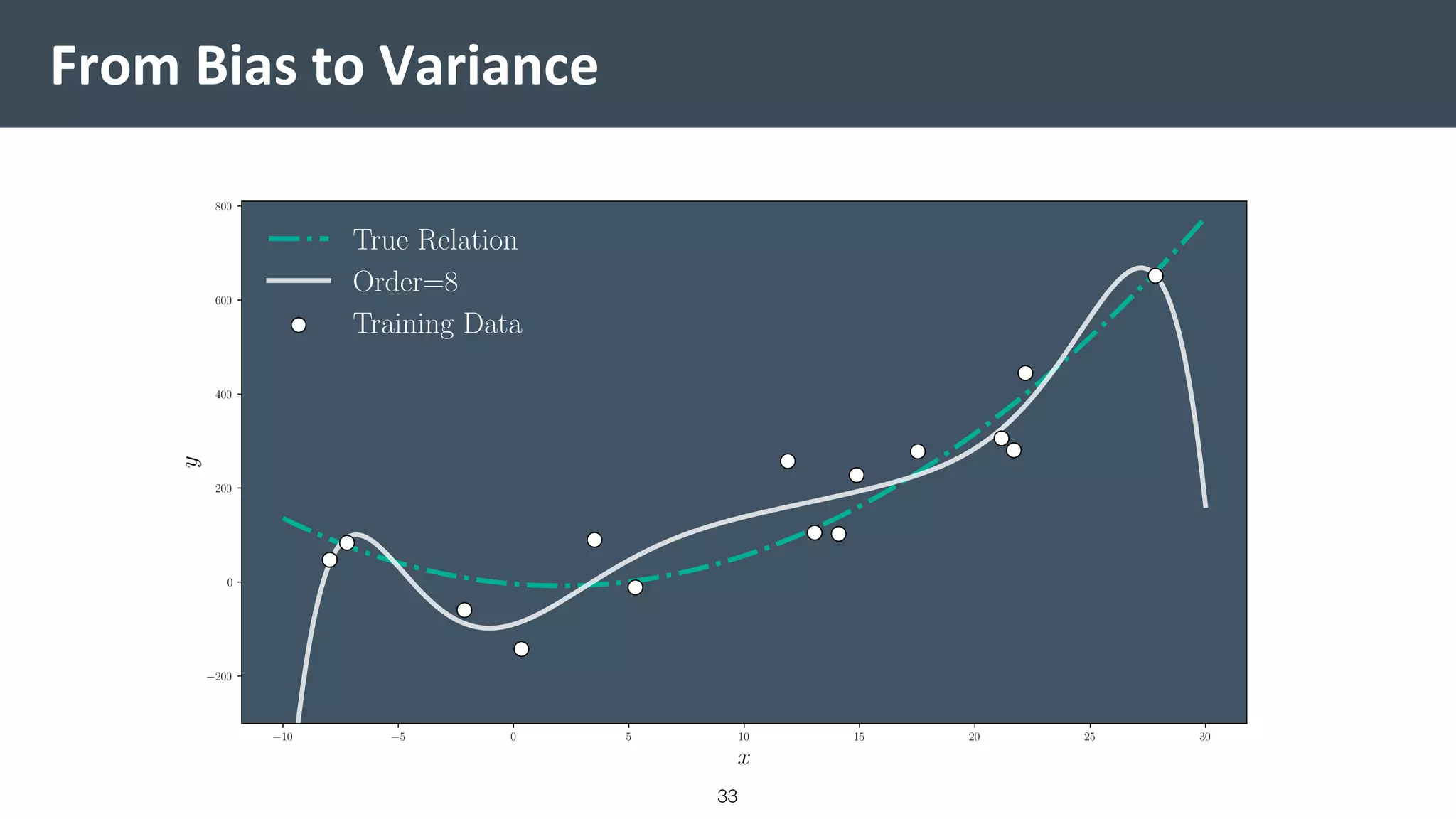
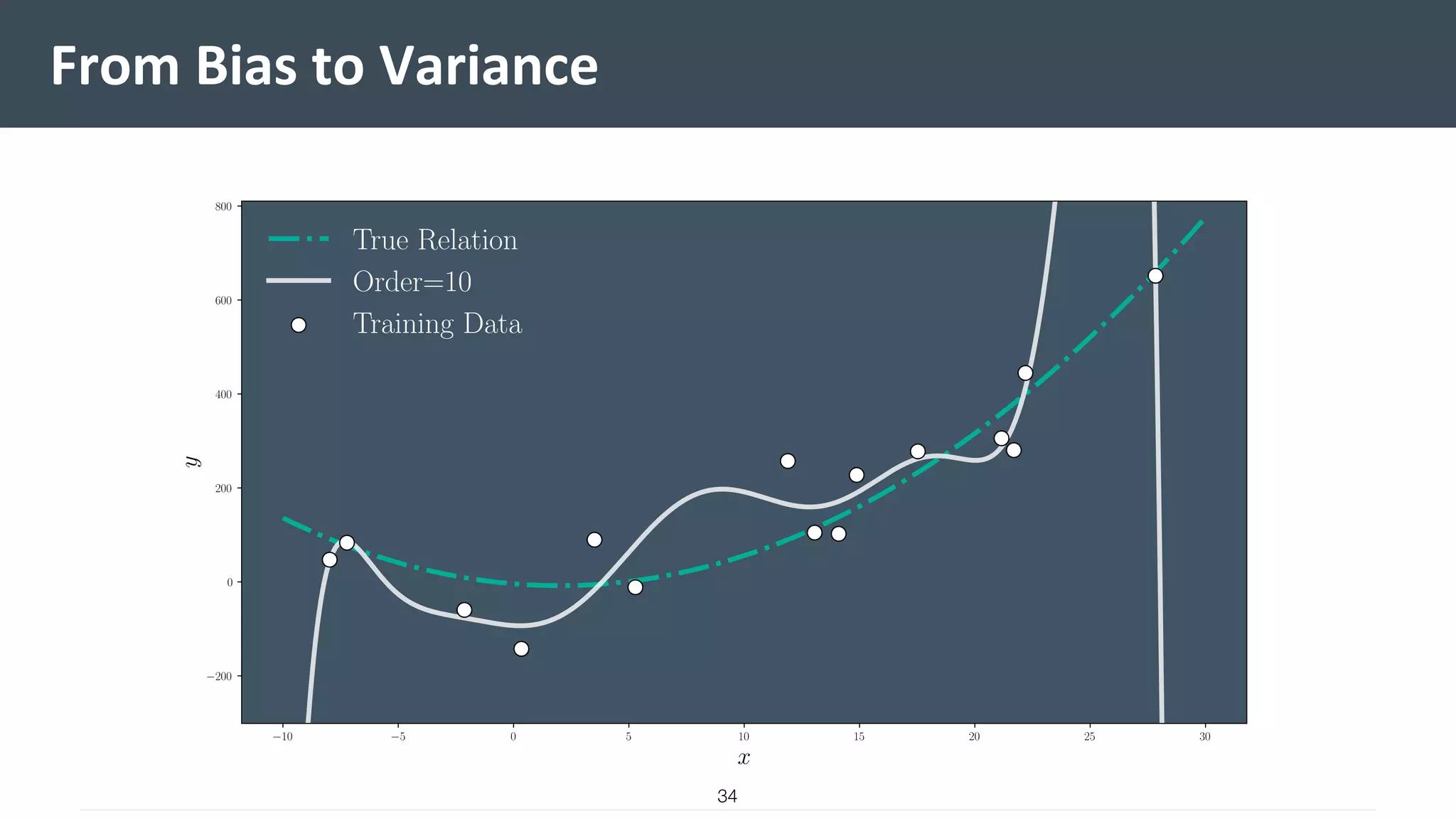
From Bias to Variance
27
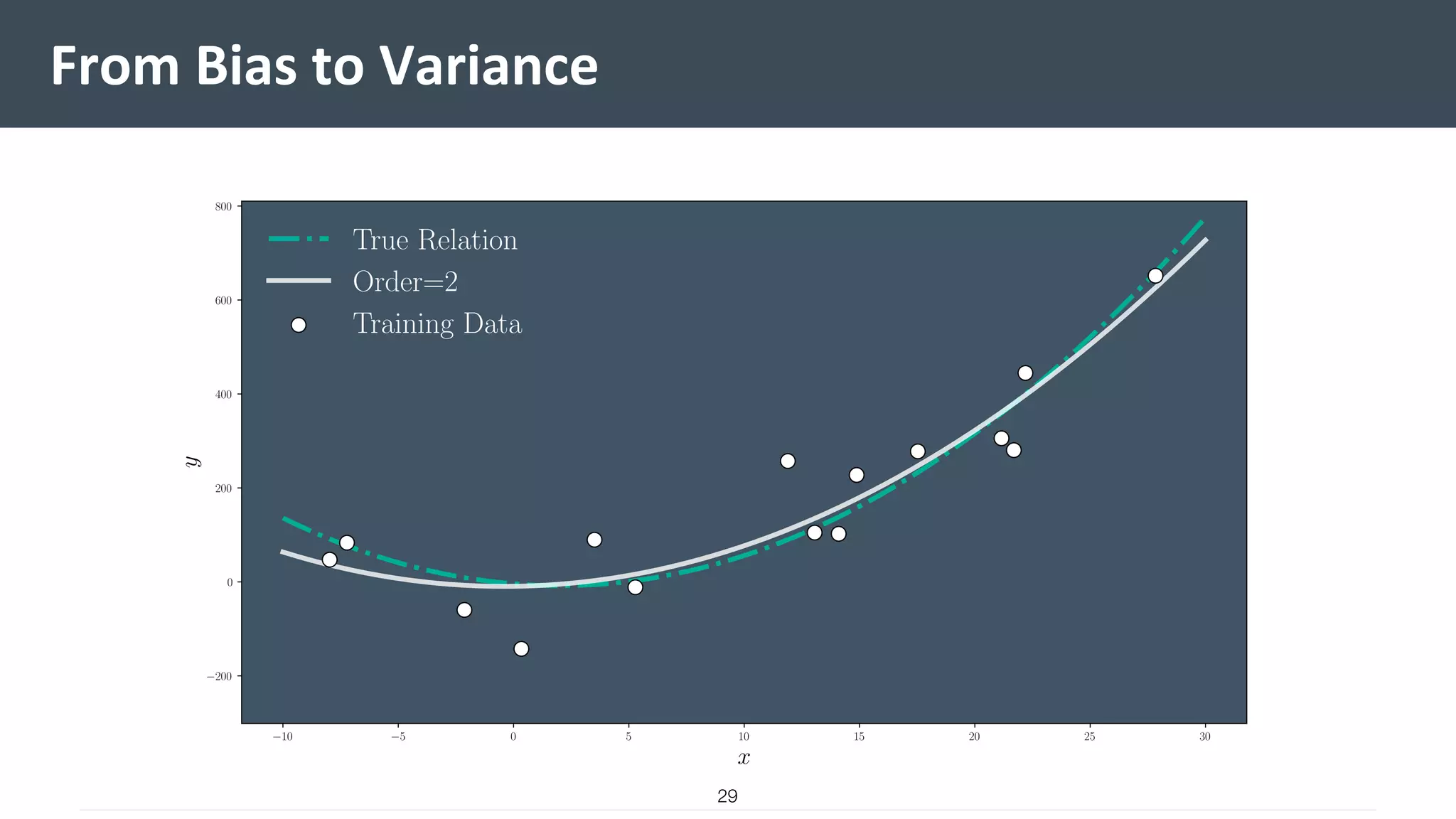
From Bias to Variance
28
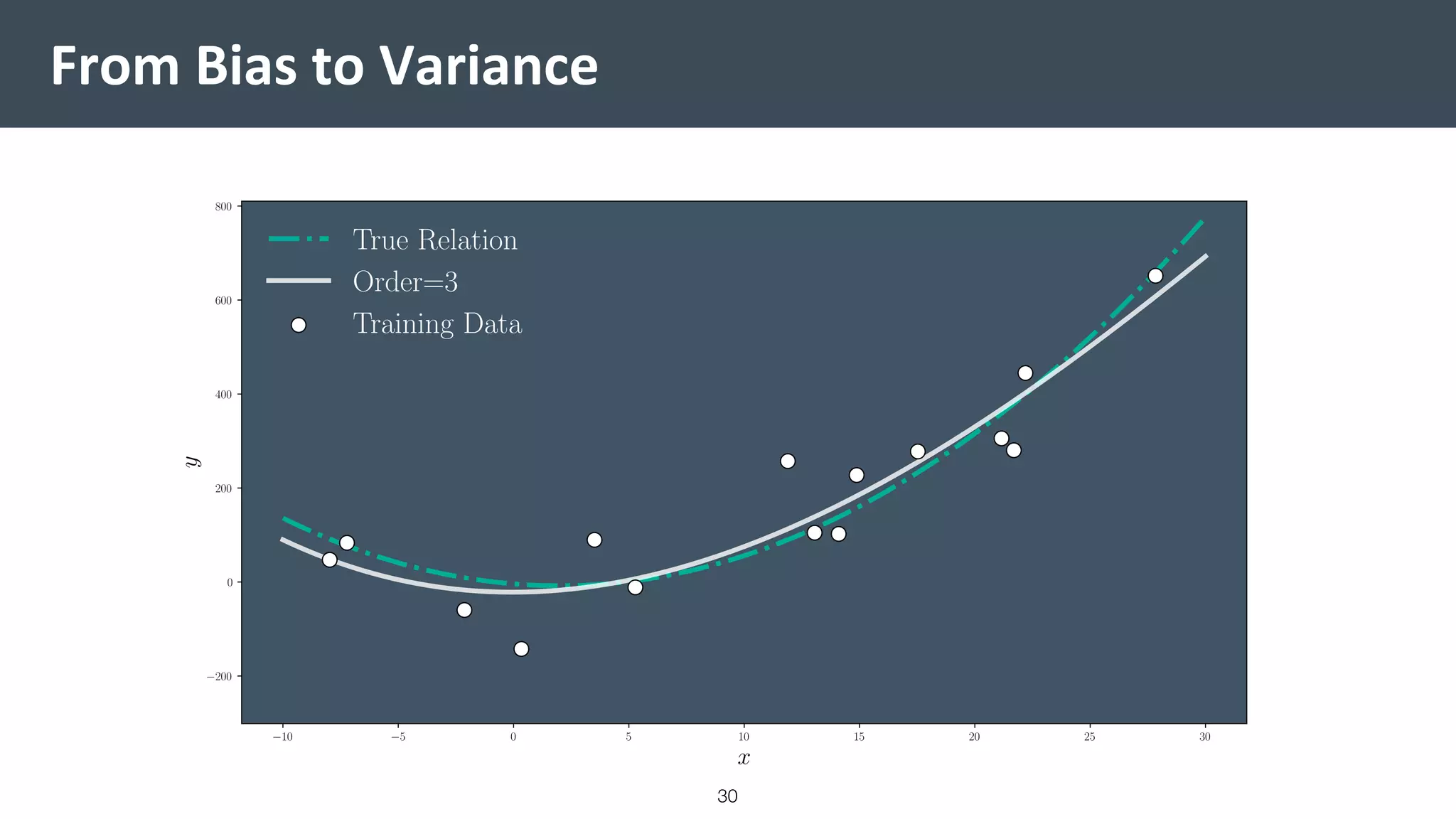
From Bias to Variance
29
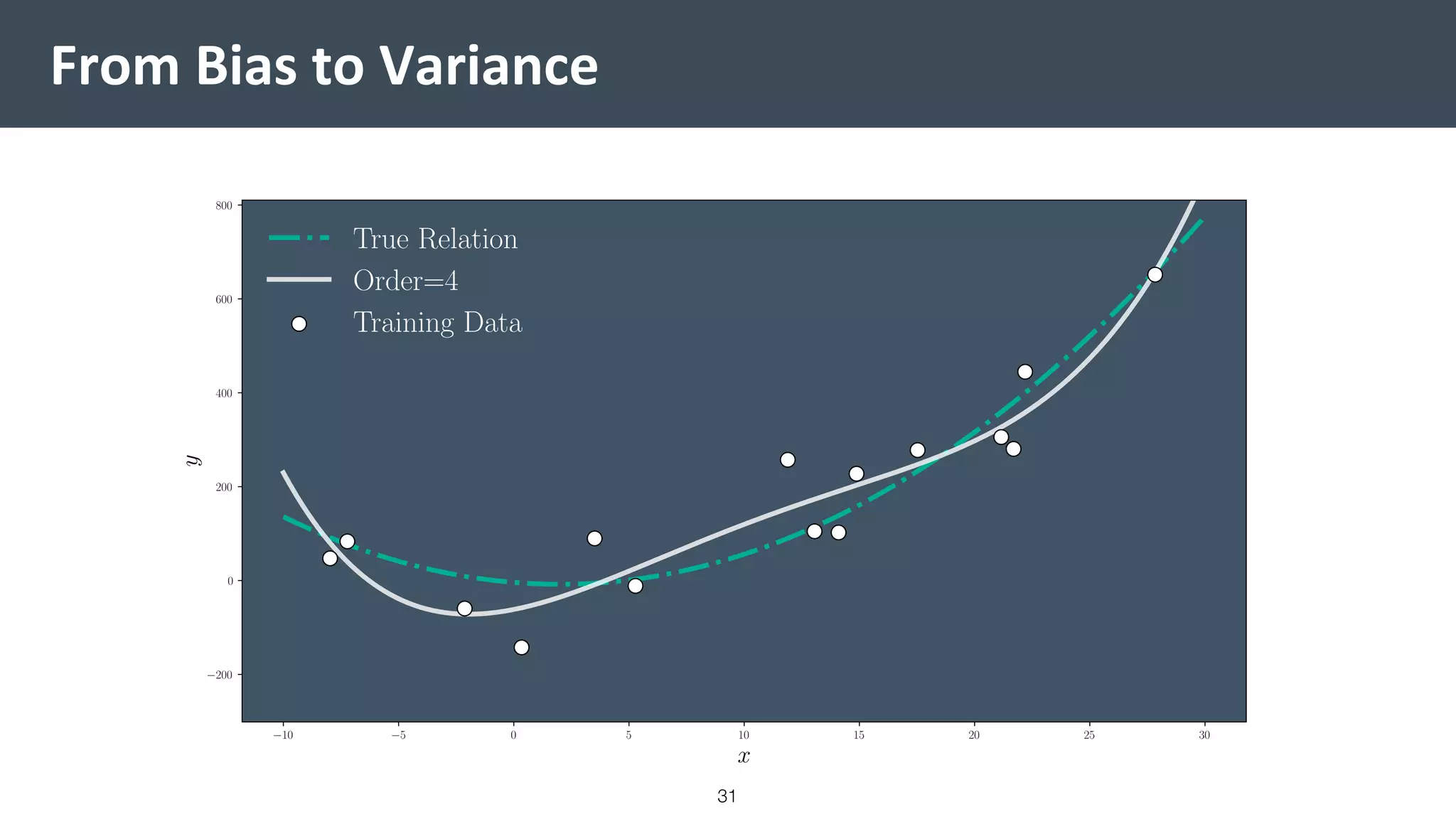
From Bias to Variance
30
From Bias to Variance
31
From Bias to Variance
32
From Bias to Variance
33
From Bias to Variance
34
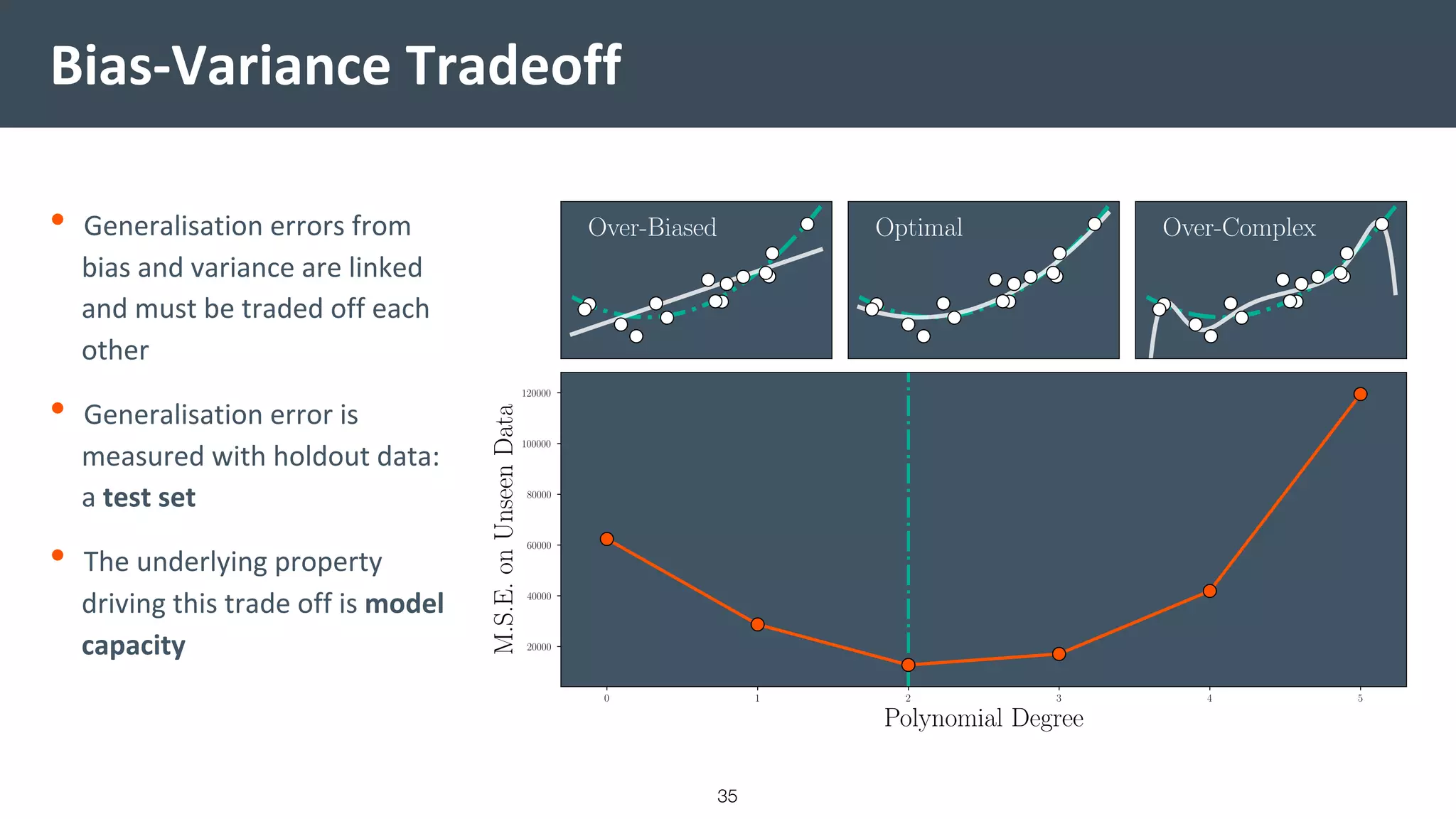
Bias-Variance Tradeoff
• Generalisation errors from
bias and variance are linked
and must be traded off each
other
• Generalisation error is
measured with holdout data:
a test set
• The underlying property
driving this trade off is model
capacity
35
Capacity and
Hypothesis Space
36
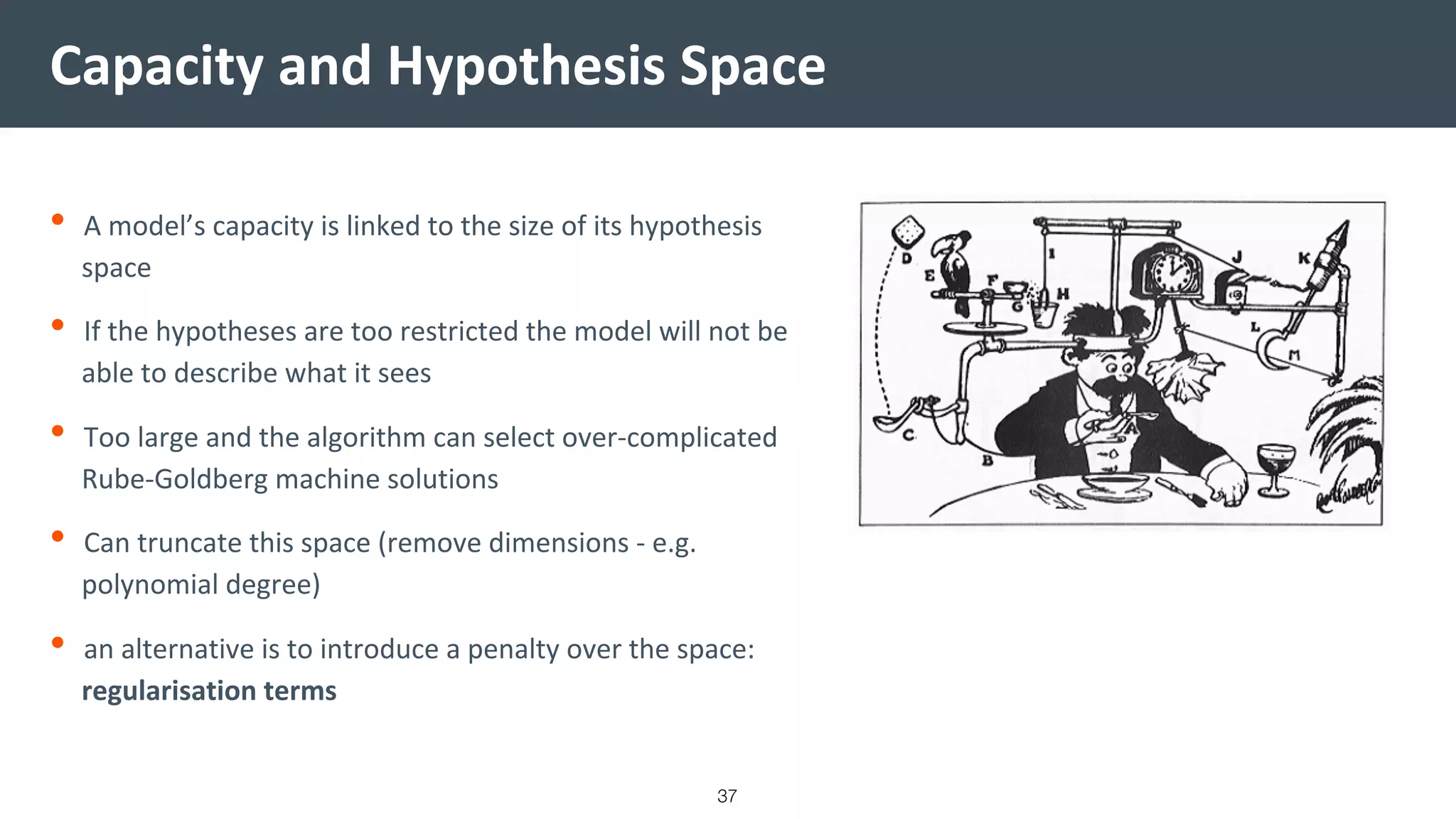
Capacity and Hypothesis Space
• A model’s capacity is linked to the size of its hypothesis
space
• If the hypotheses are too restricted the model will not be
able to describe what it sees
• Too large and the algorithm can select over-complicated
Rube-Goldberg machine solutions
• Can truncate this space (remove dimensions - e.g.
polynomial degree)
• an alternative is to introduce a penalty over the space:
regularisation terms
37
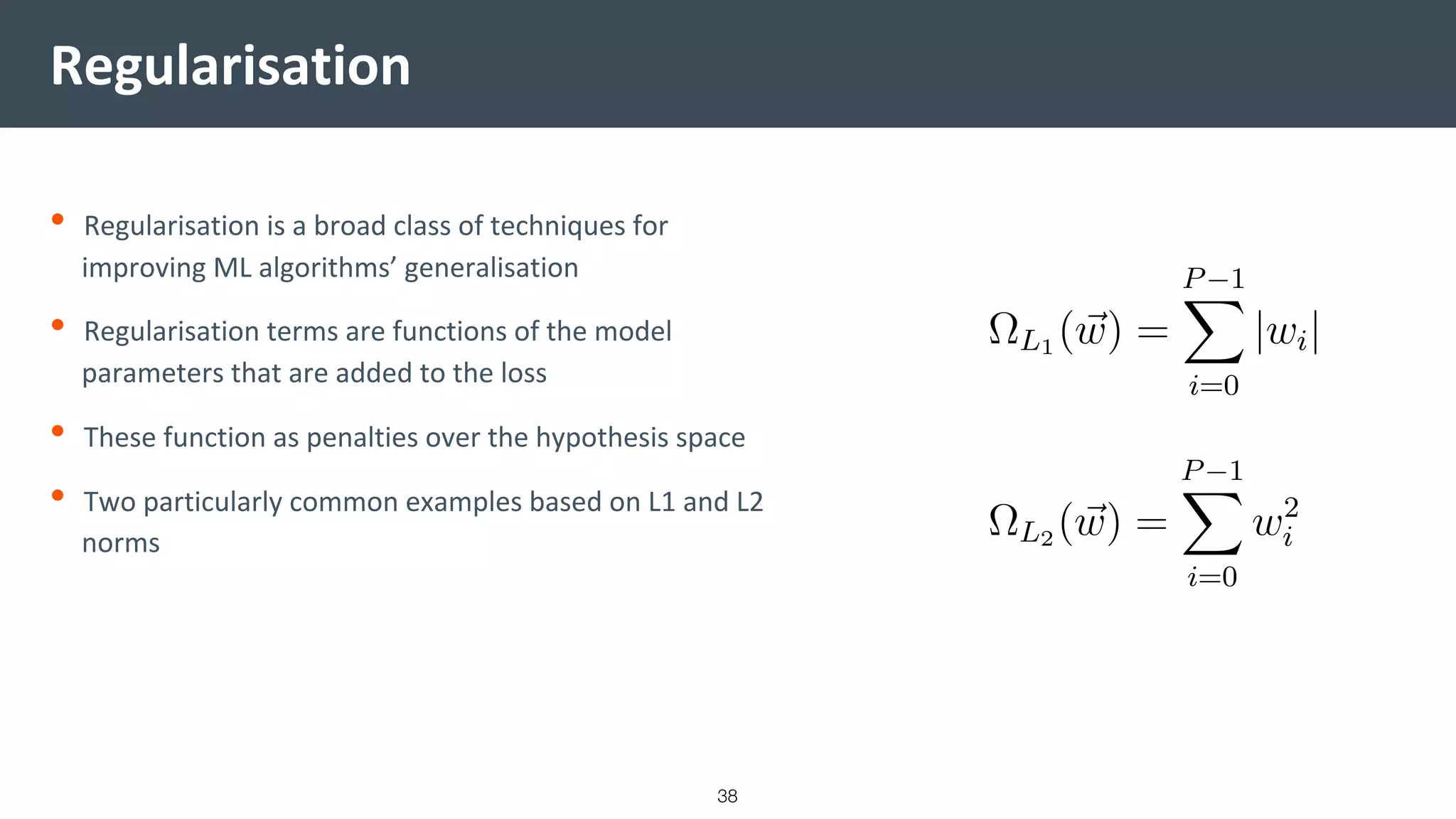
Regularisation
• Regularisation is a broad class of techniques for
improving ML algorithms’ generalisation
• Regularisation terms are functions of the model
parameters that are added to the loss
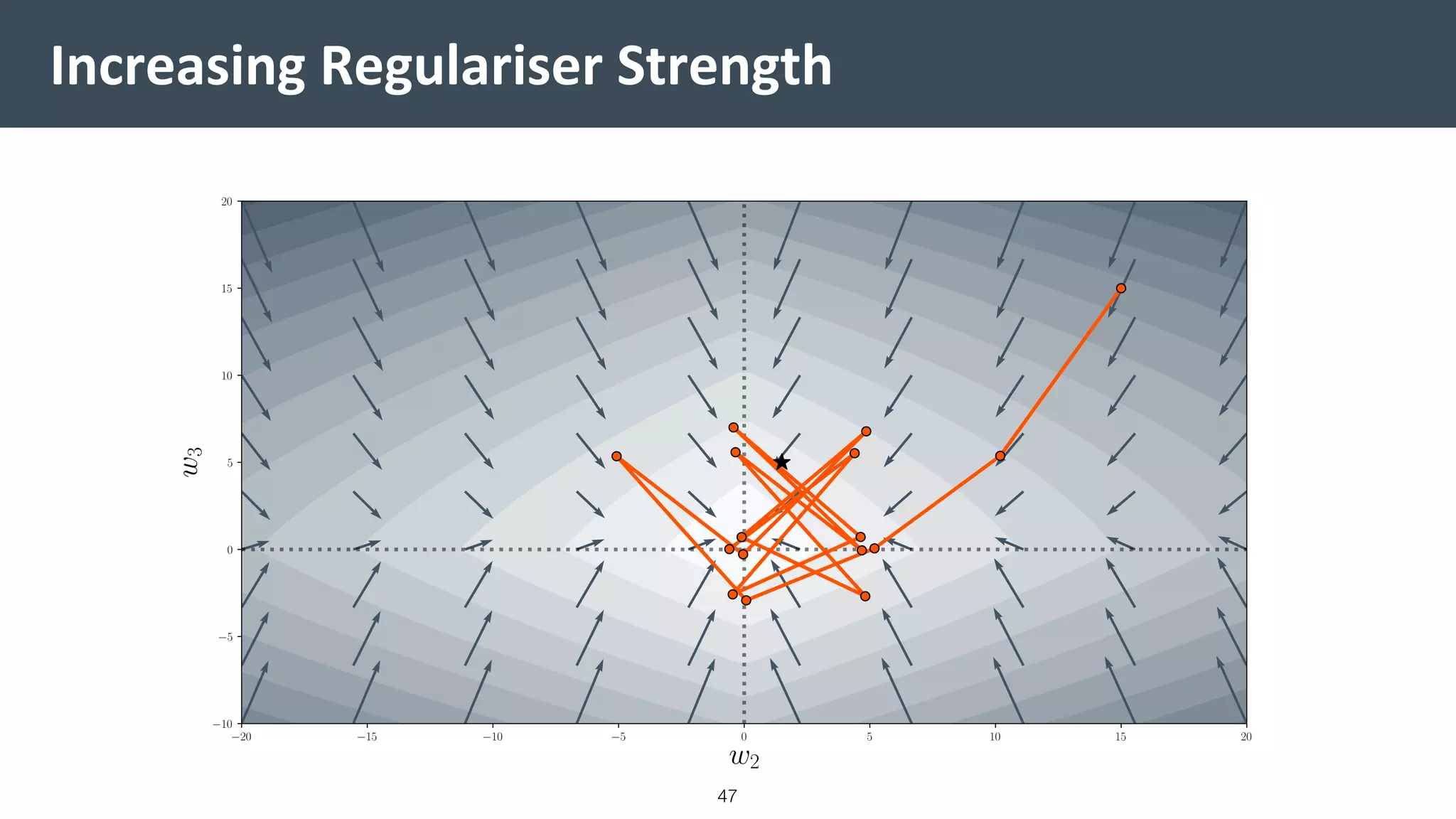
• These function as penalties over the hypothesis space
• Two particularly common examples based on L1 and L2
norms
38
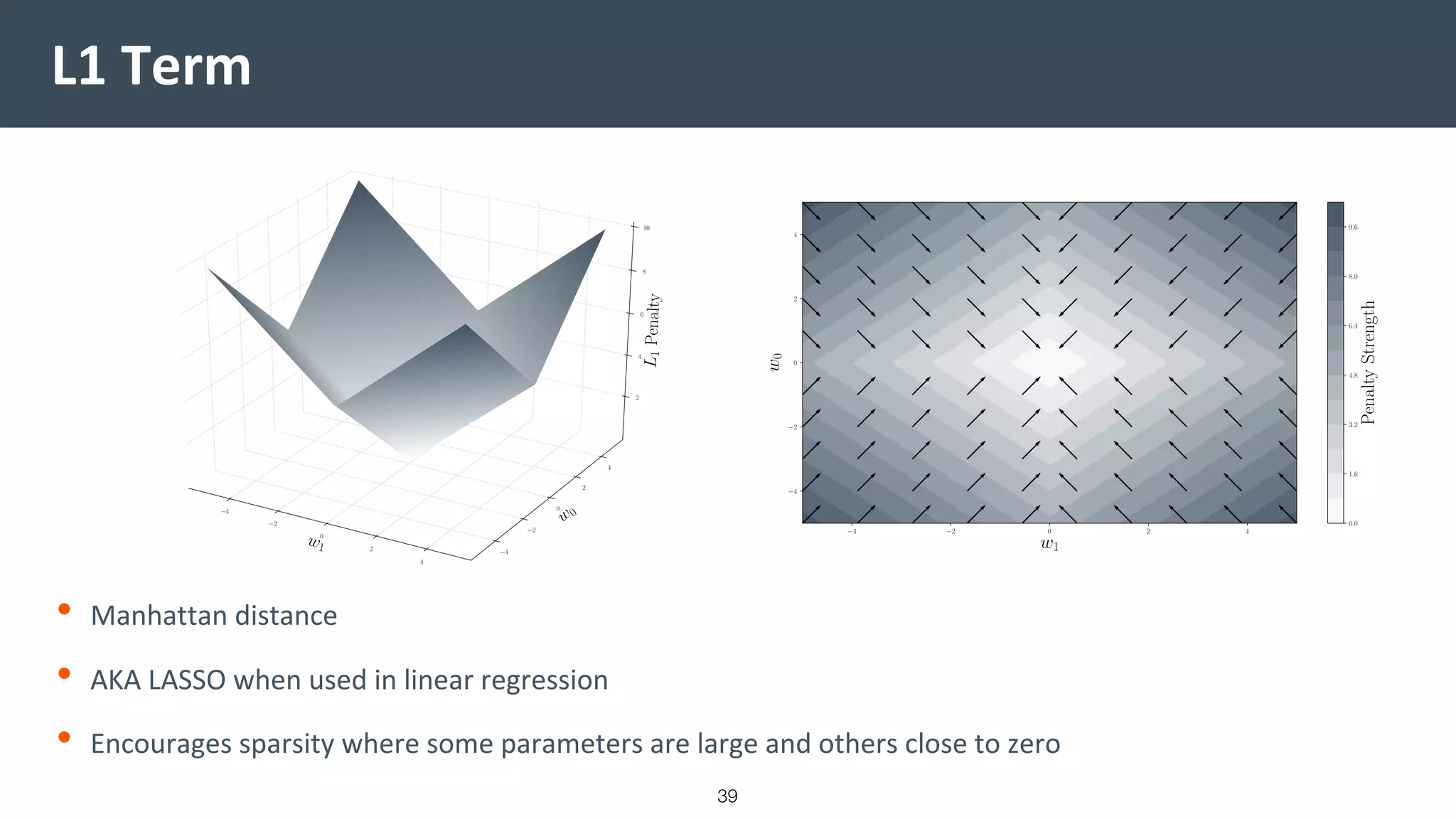
L1 Term
• Manhattan distance
• AKA LASSO when used in linear regression
• Encourages sparsity where some parameters are large and others close to zero
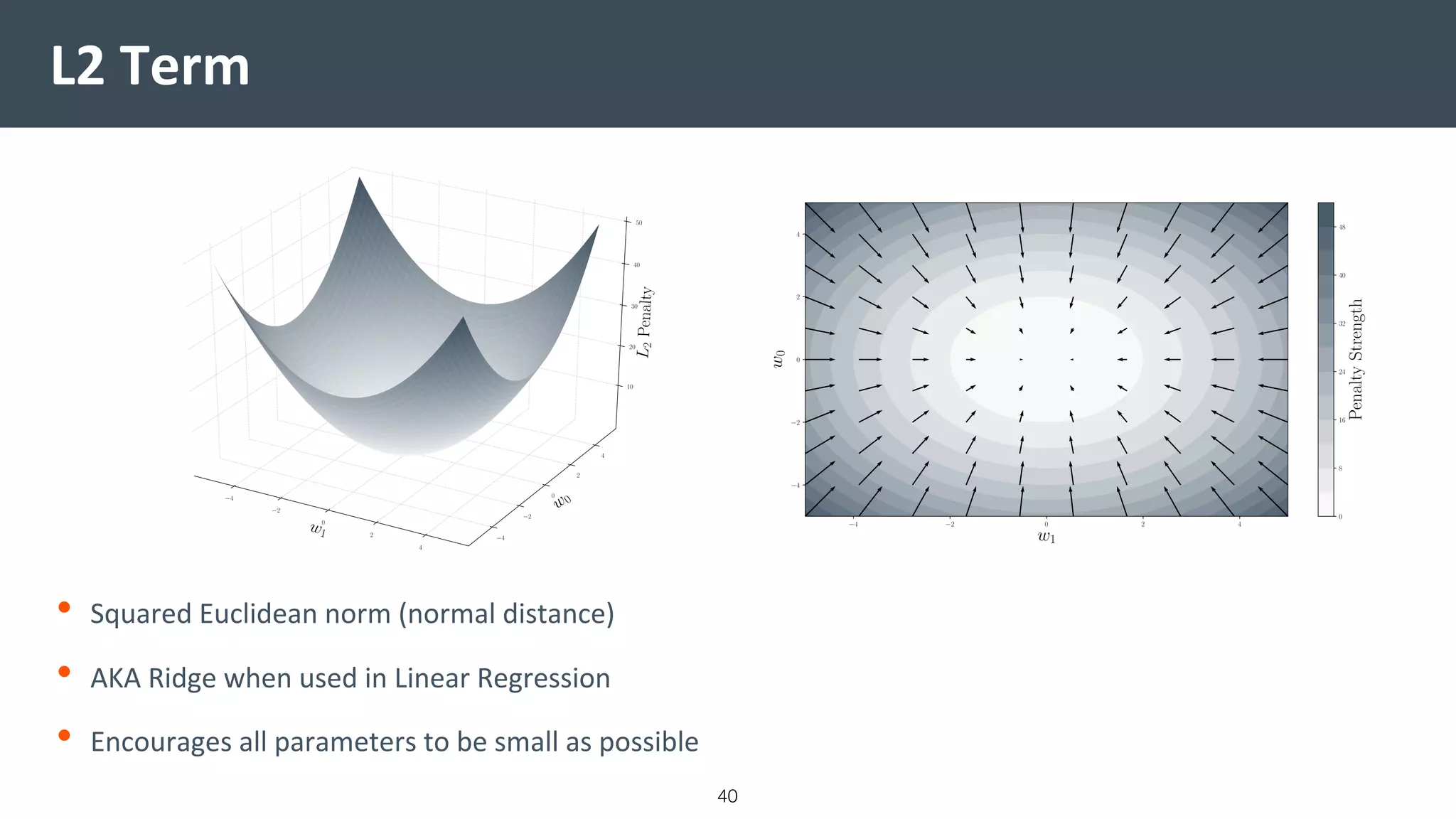
39
L2 Term
• Squared Euclidean norm (normal distance)
• AKA Ridge when used in Linear Regression
• Encourages all parameters to be small as possible
40
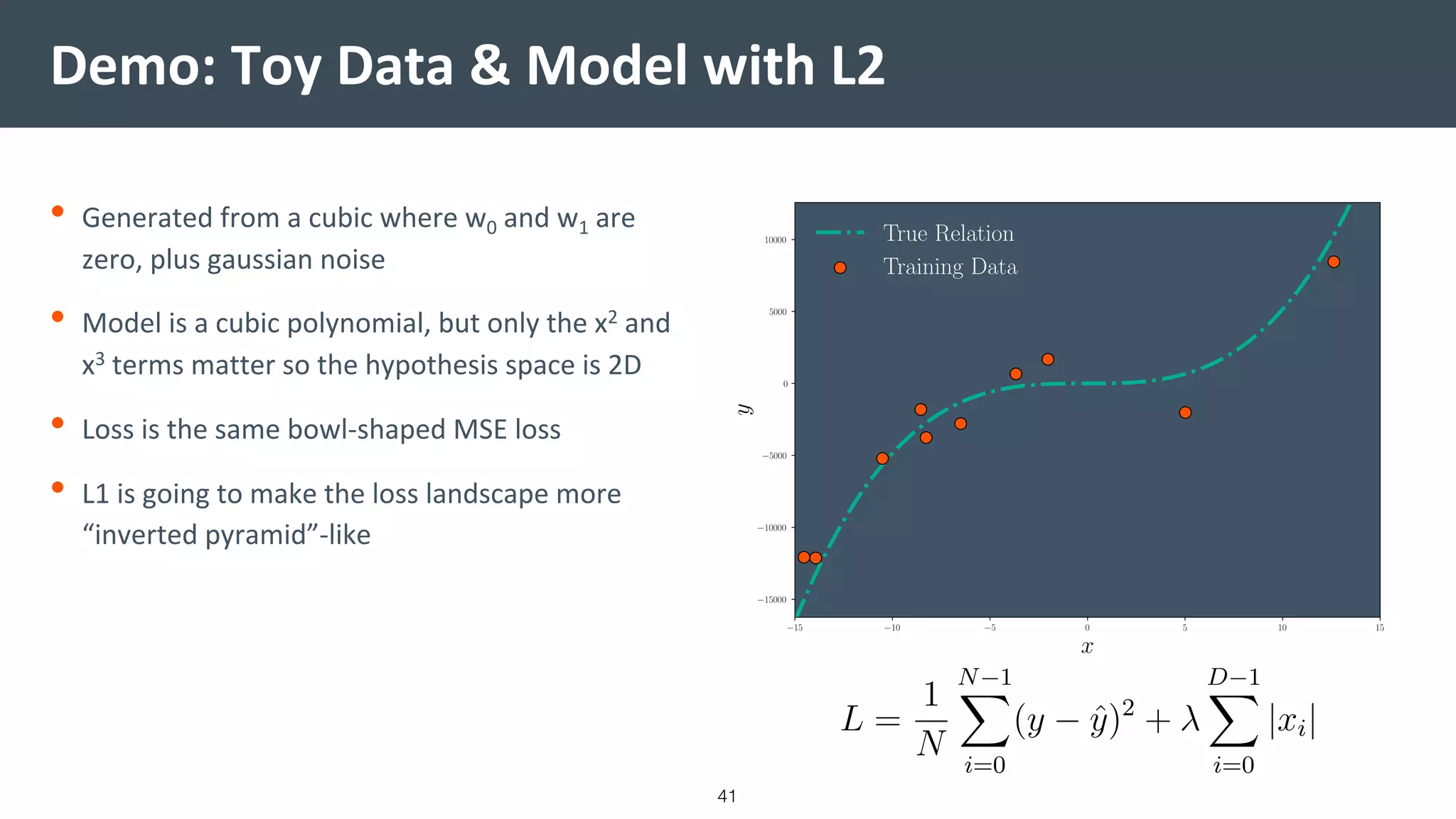
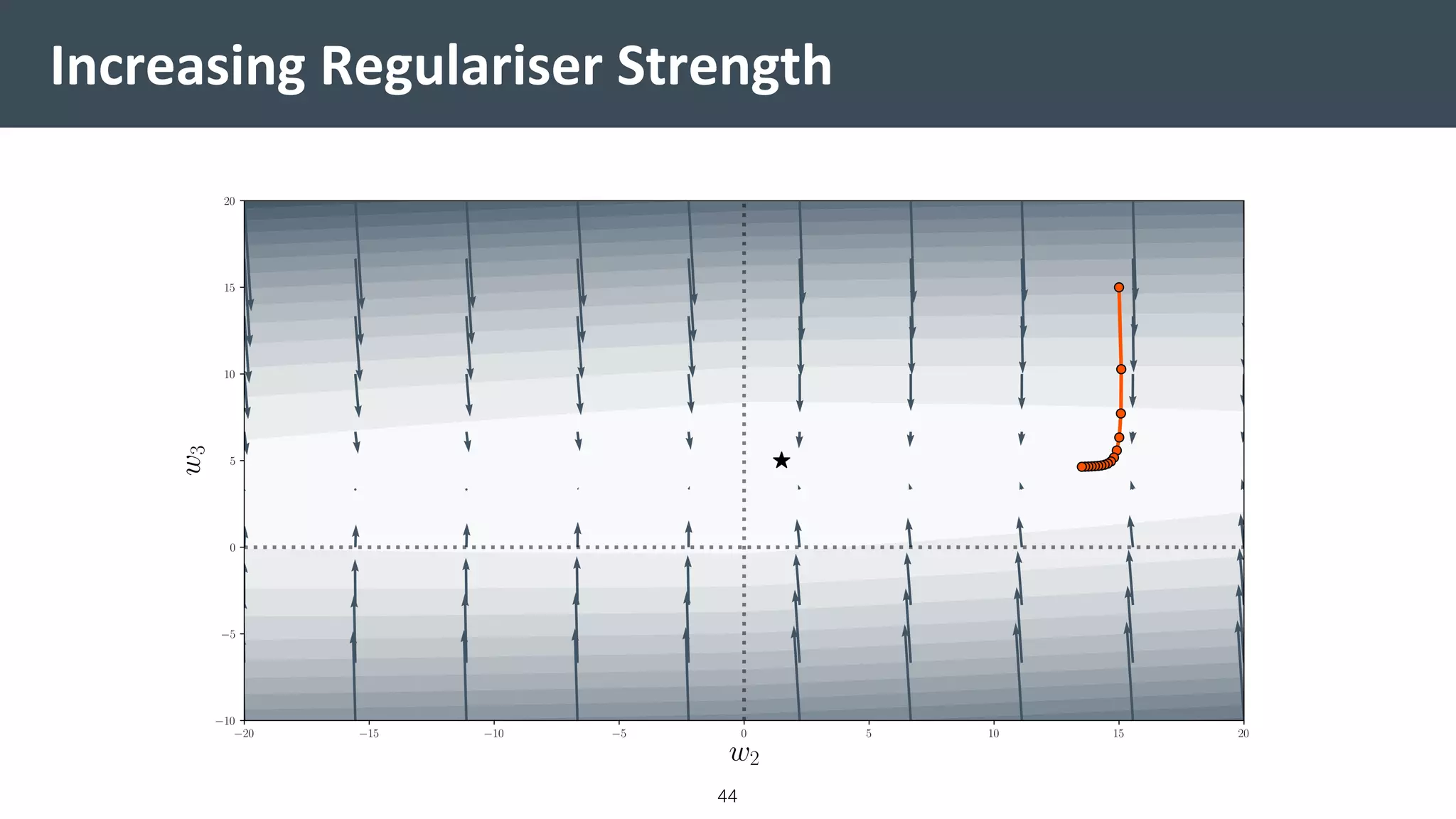
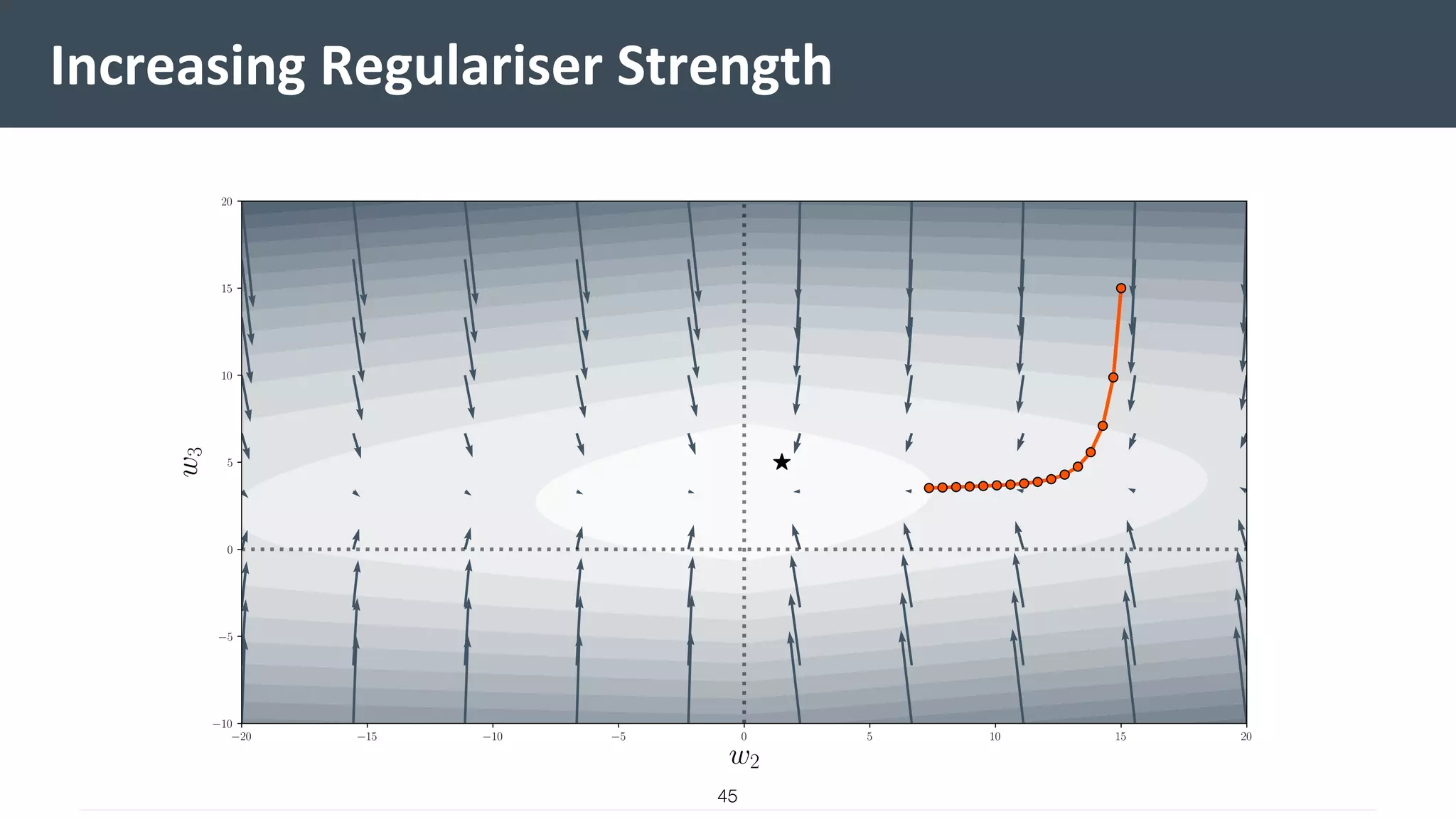
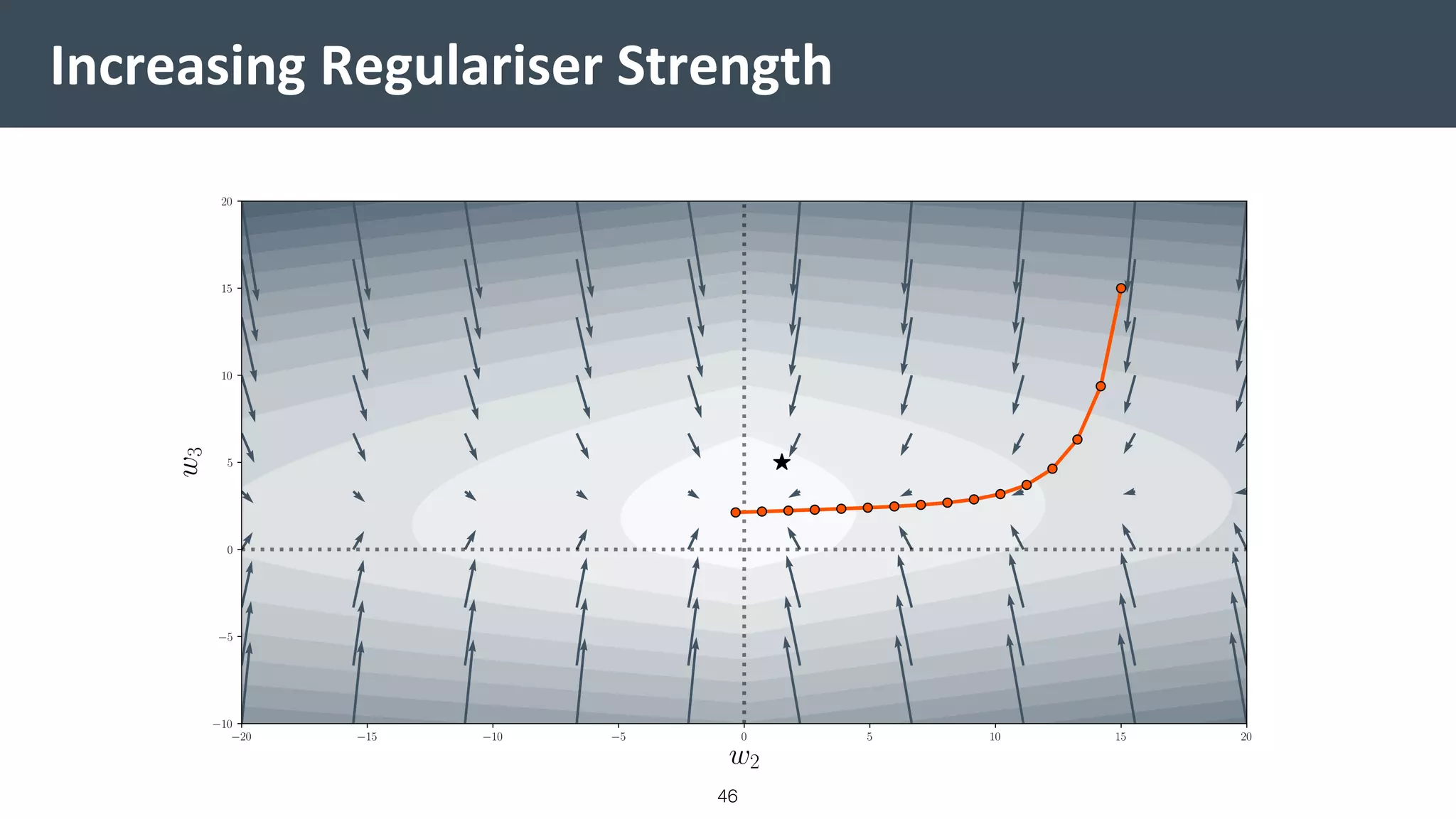
Demo: Toy Data & Model with L2
• Generated from a cubic where w0 and w1 are
zero, plus gaussian noise
• Model is a cubic polynomial, but only the x2 and
x3 terms matter so the hypothesis space is 2D
• Loss is the same bowl-shaped MSE loss
• L1 is going to make the loss landscape more
“inverted pyramid”-like
41
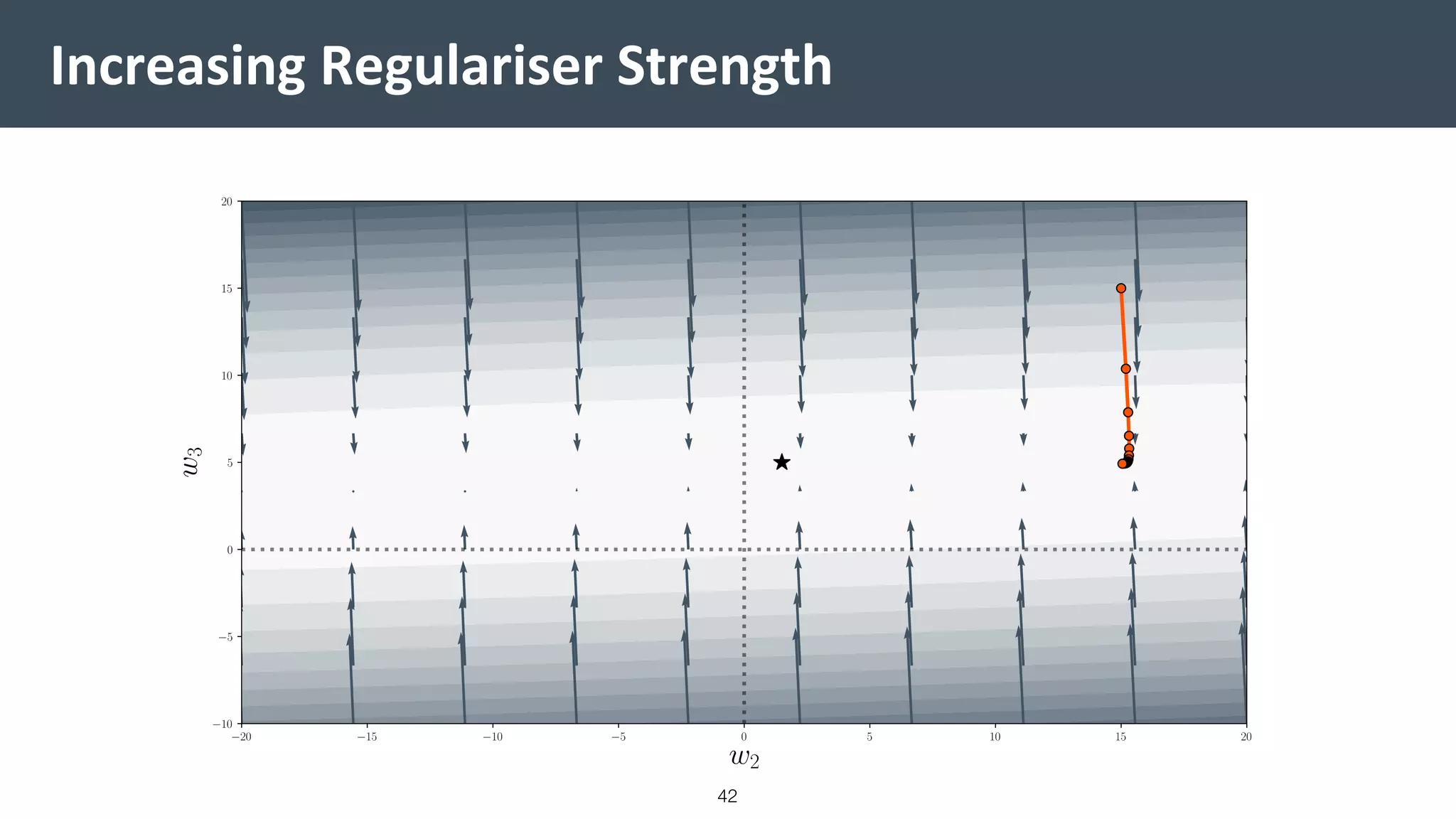
Increasing Regulariser Strength
42
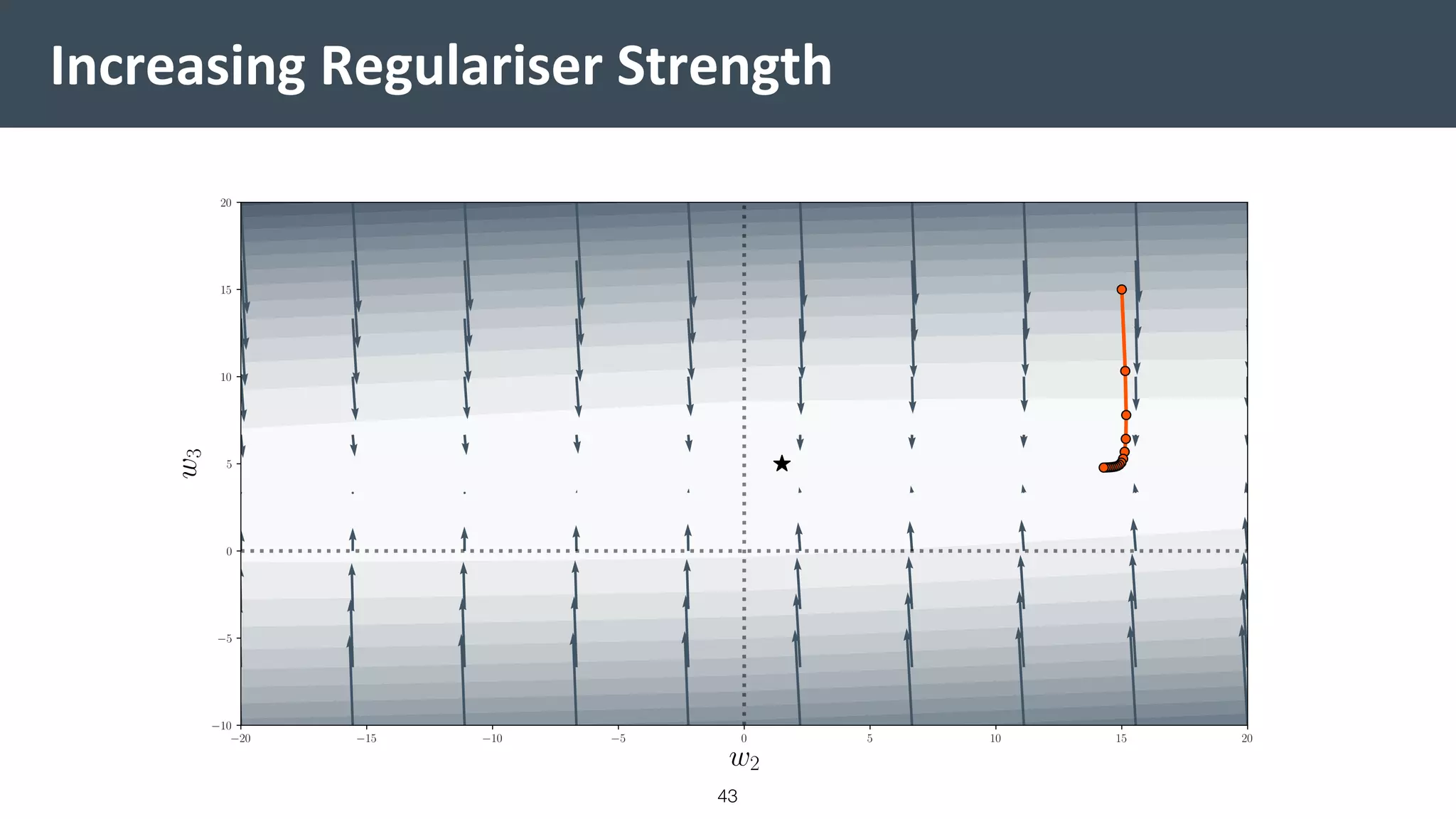
Increasing Regulariser Strength
43
Increasing Regulariser Strength
44
Increasing Regulariser Strength
45
Increasing Regulariser Strength
46
Increasing Regulariser Strength
47
Hyperparameters and
model selection
48
Hyperparameters and Model Selection
• Hyperparameters are non-learned model parameters such as regulariser
strength
• Can’t use training data to tune them because the training process will just grant
itself max capacity and overfit
• Can’t use the test data to tune them because we lose our unbiased estimate of
generalisation performance
• To select these we optimise with respect to another holdout set, typically a
subsample of the training data: a validation set
• Selecting which ML algorithm to use follows the same workflow
49
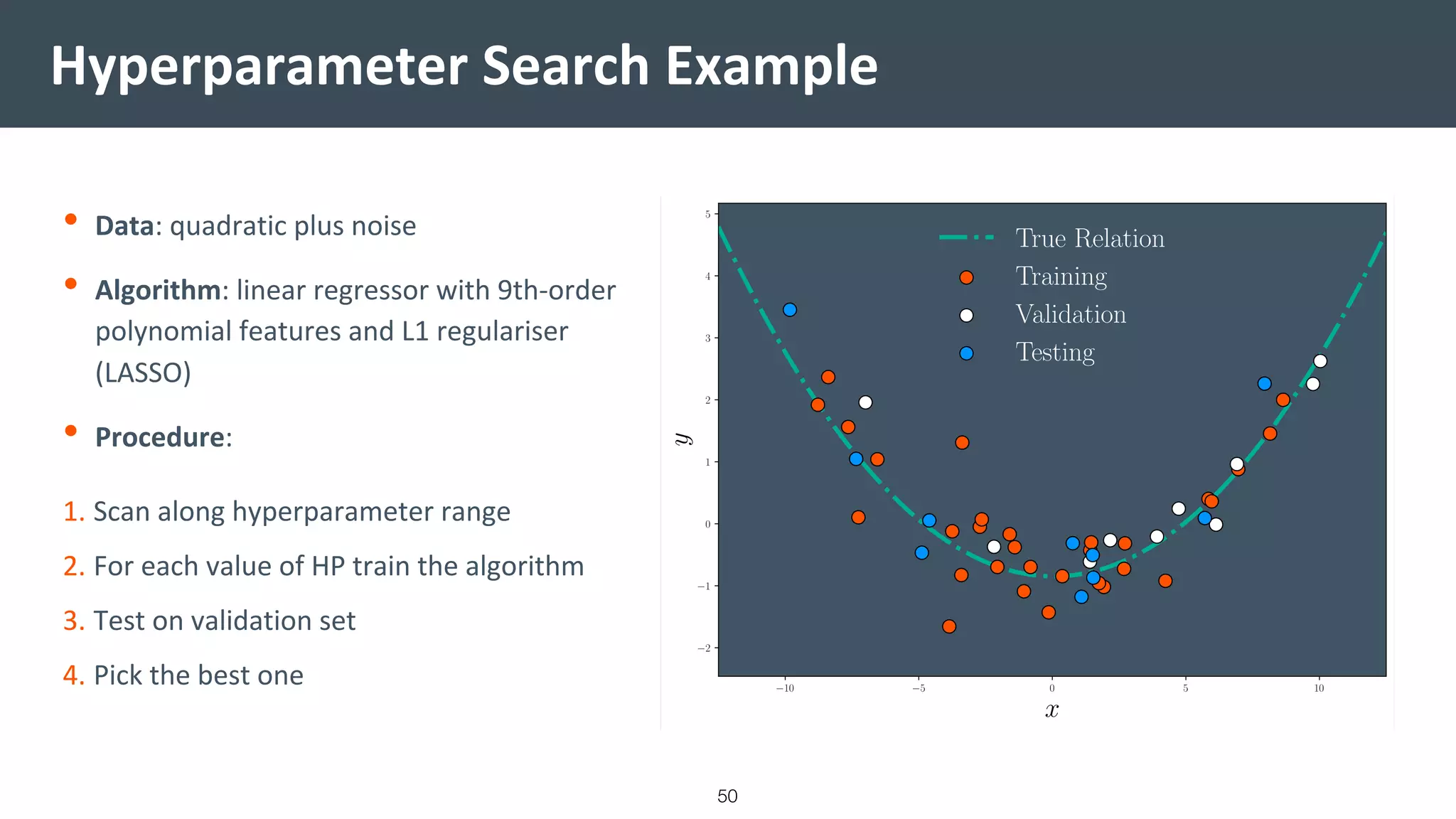
Hyperparameter Search Example
• Data: quadratic plus noise
• Algorithm: linear regressor with 9th-order
polynomial features and L1 regulariser
(LASSO)
• Procedure:
1. Scan along hyperparameter range
2. For each value of HP train the algorithm
3. Test on validation set
4. Pick the best one
50
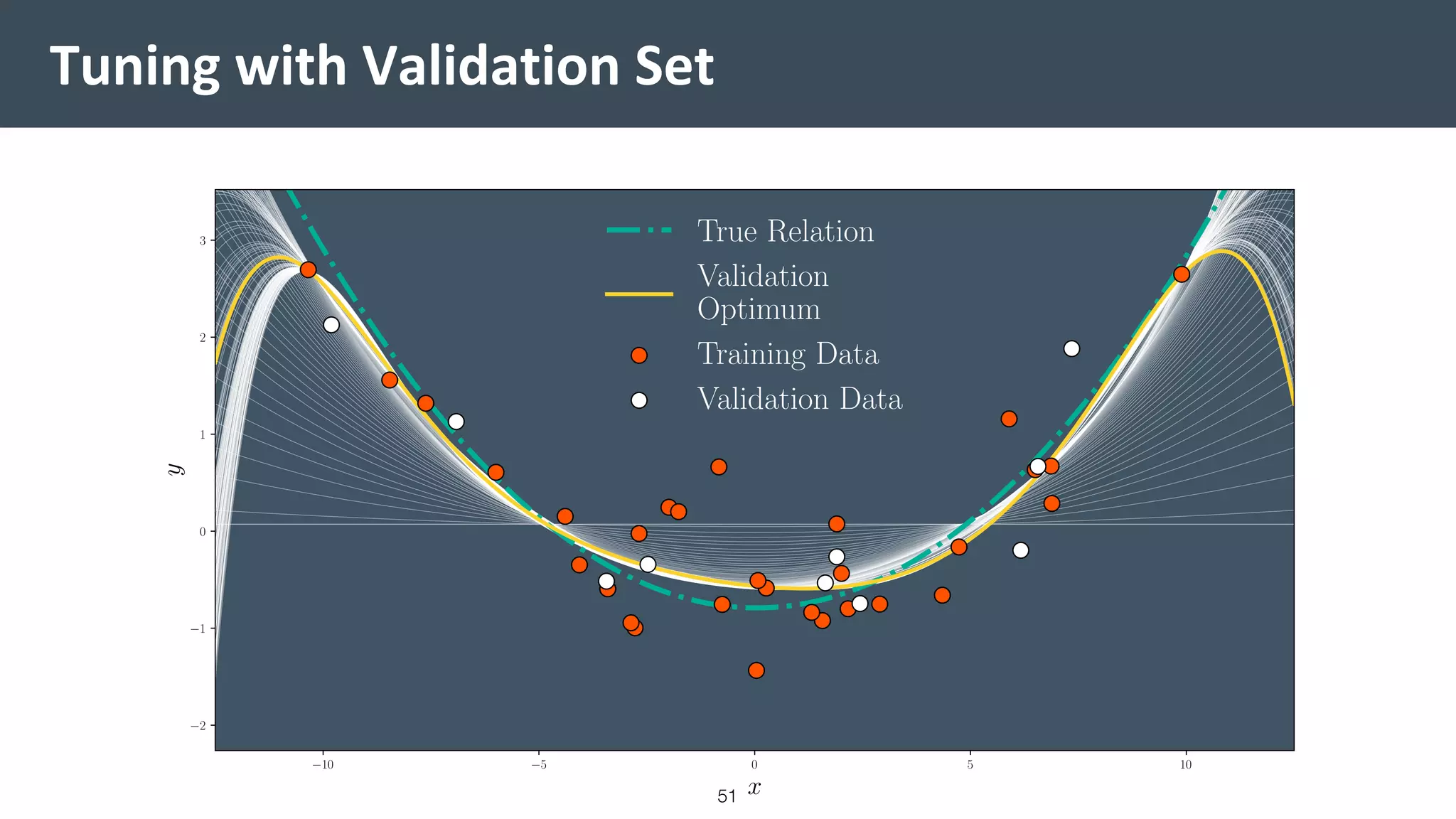
Tuning with Validation Set
51
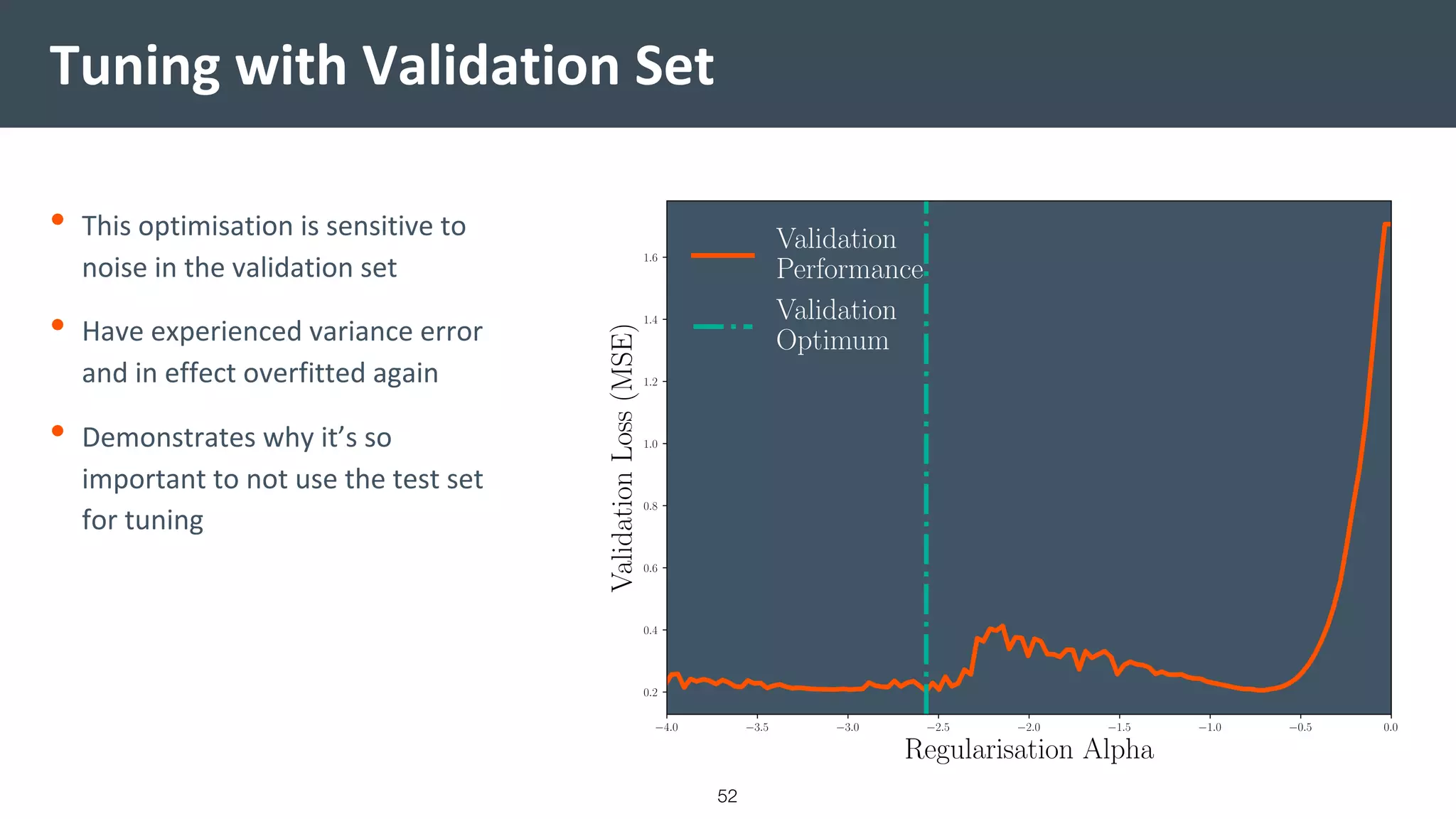
Tuning with Validation Set
• This optimisation is sensitive to
noise in the validation set
• Have experienced variance error
and in effect overfitted again
• Demonstrates why it’s so
important to not use the test set
for tuning
52
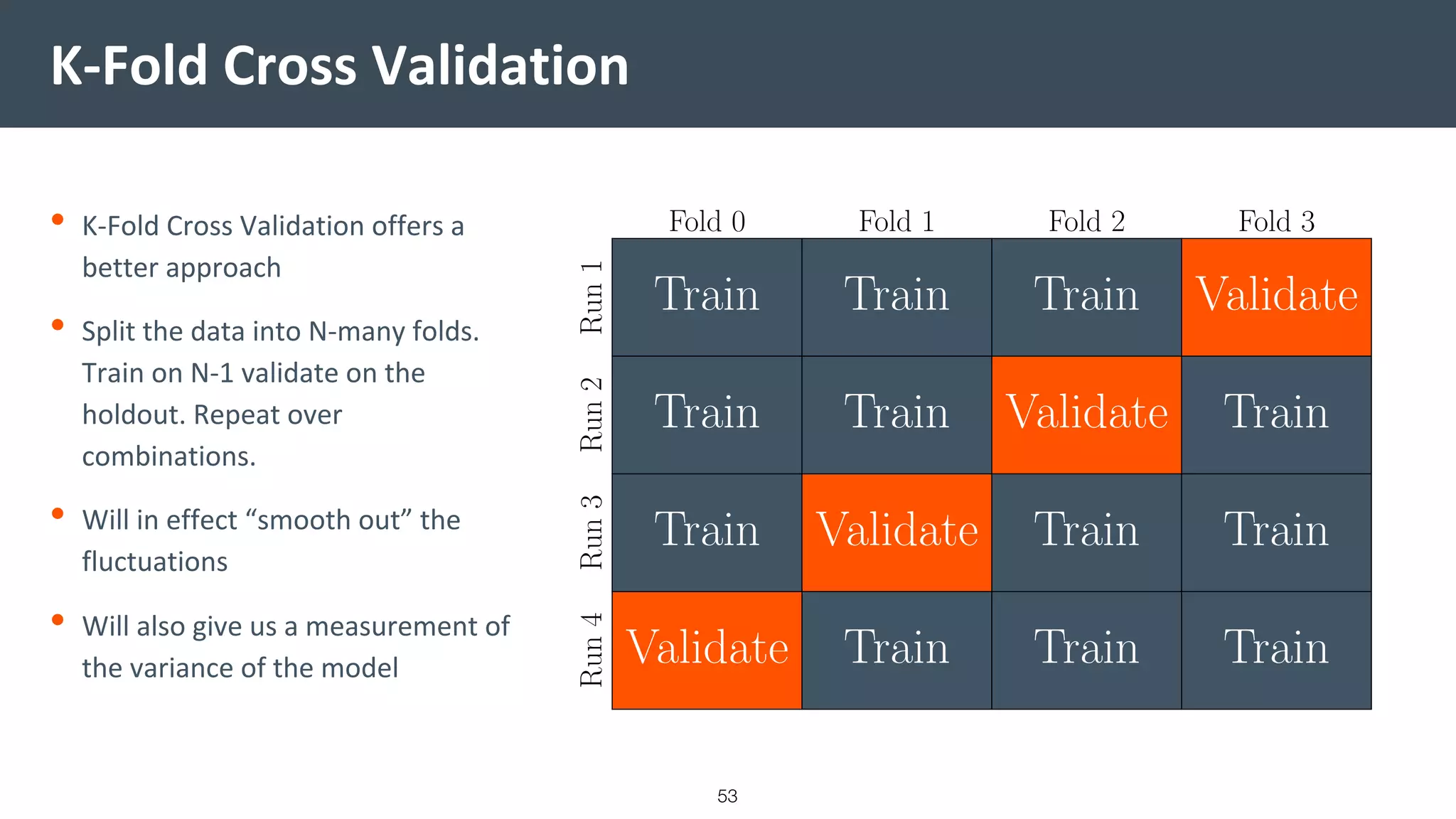
K-Fold Cross Validation
• K-Fold Cross Validation offers a
better approach
• Split the data into N-many folds.
Train on N-1 validate on the
holdout. Repeat over
combinations.
• Will in effect “smooth out” the
fluctuations
• Will also give us a measurement of
the variance of the model
53
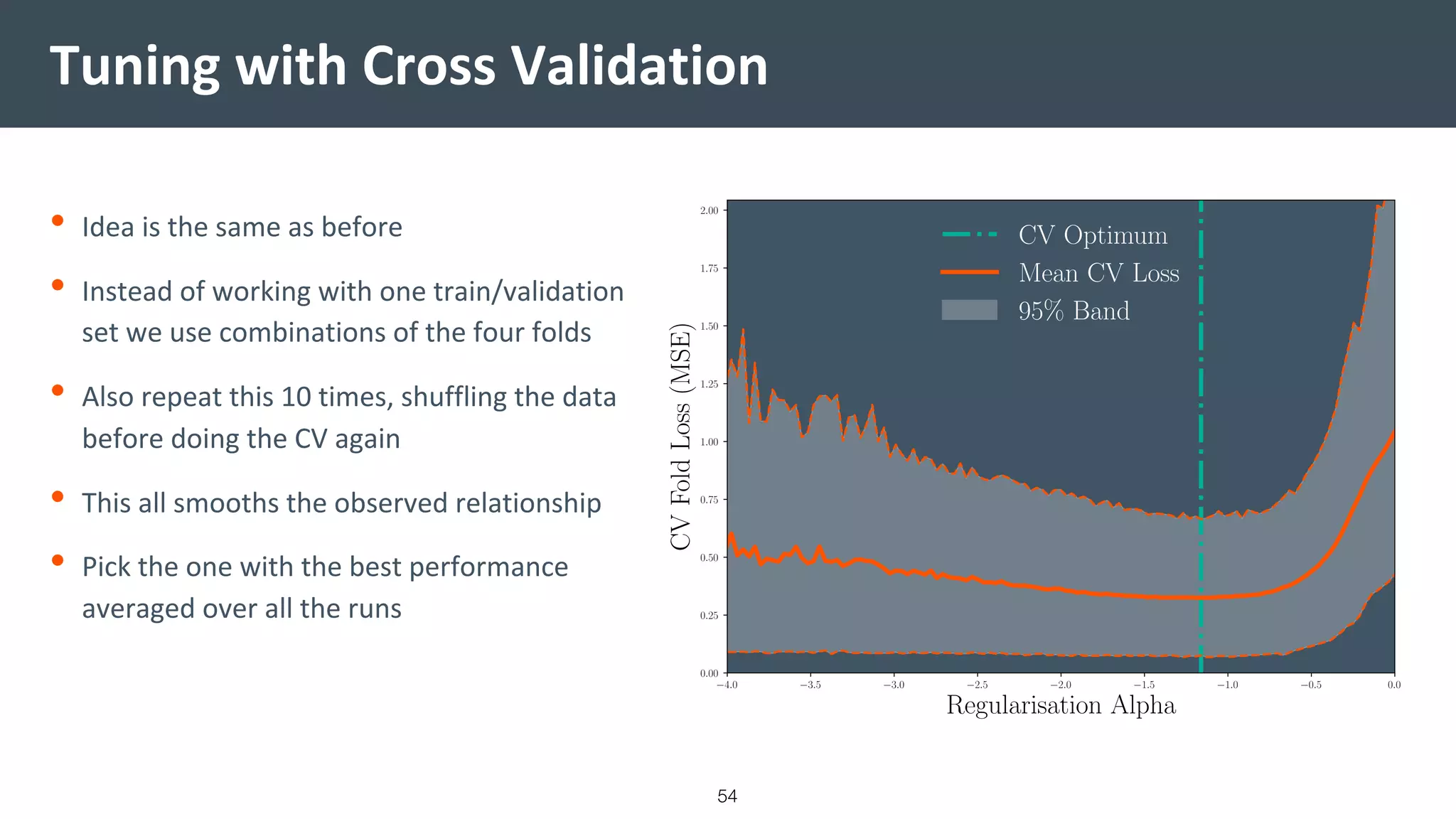
Tuning with Cross Validation
• Idea is the same as before
• Instead of working with one train/validation
set we use combinations of the four folds
• Also repeat this 10 times, shuffling the data
before doing the CV again
• This all smooths the observed relationship
• Pick the one with the best performance
averaged over all the runs
54
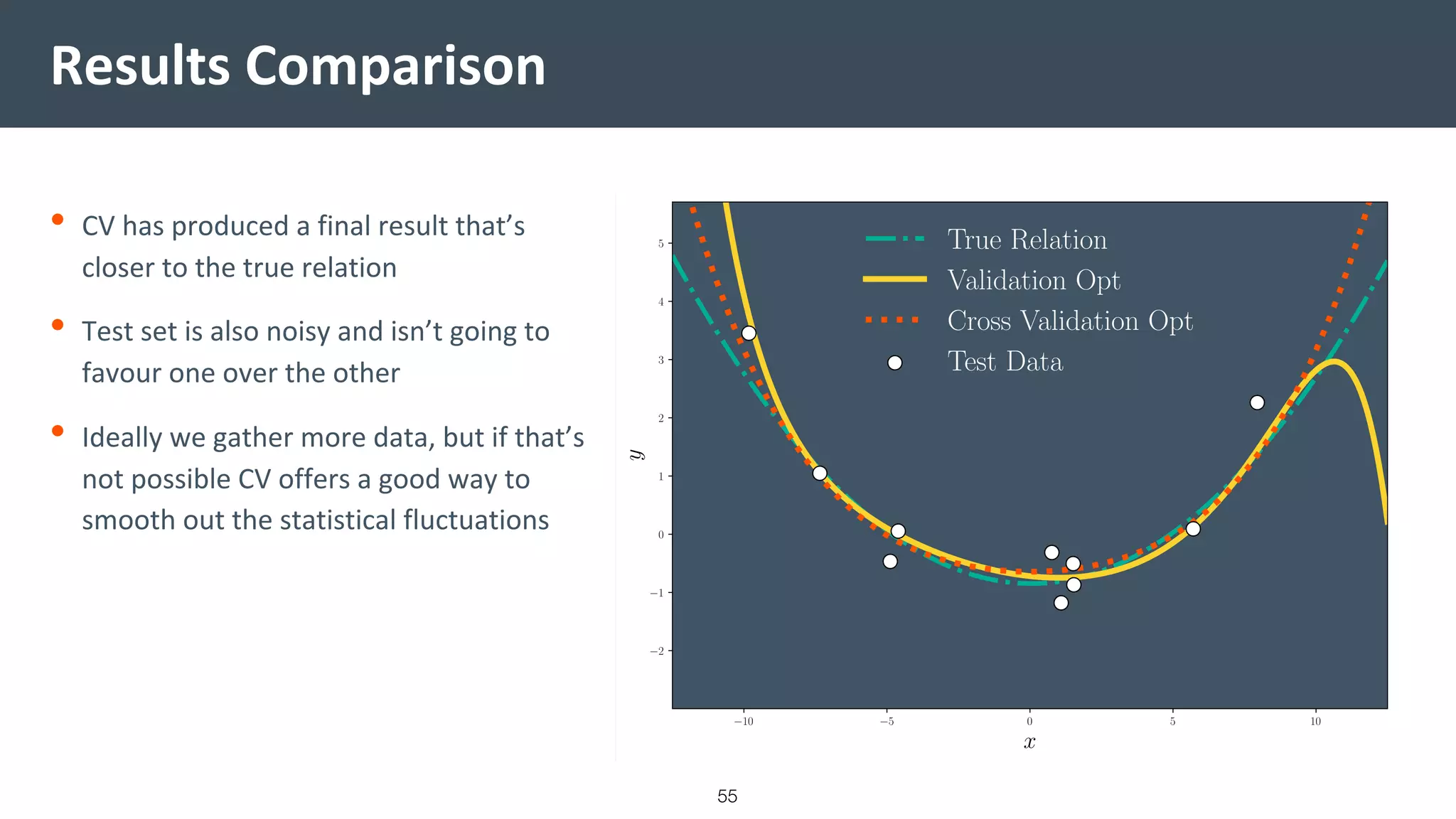
Results Comparison
• CV has produced a final result that’s
closer to the true relation
• Test set is also noisy and isn’t going to
favour one over the other
• Ideally we gather more data, but if that’s
not possible CV offers a good way to
smooth out the statistical fluctuations
55
Putting it all together: a
Practical Example
56
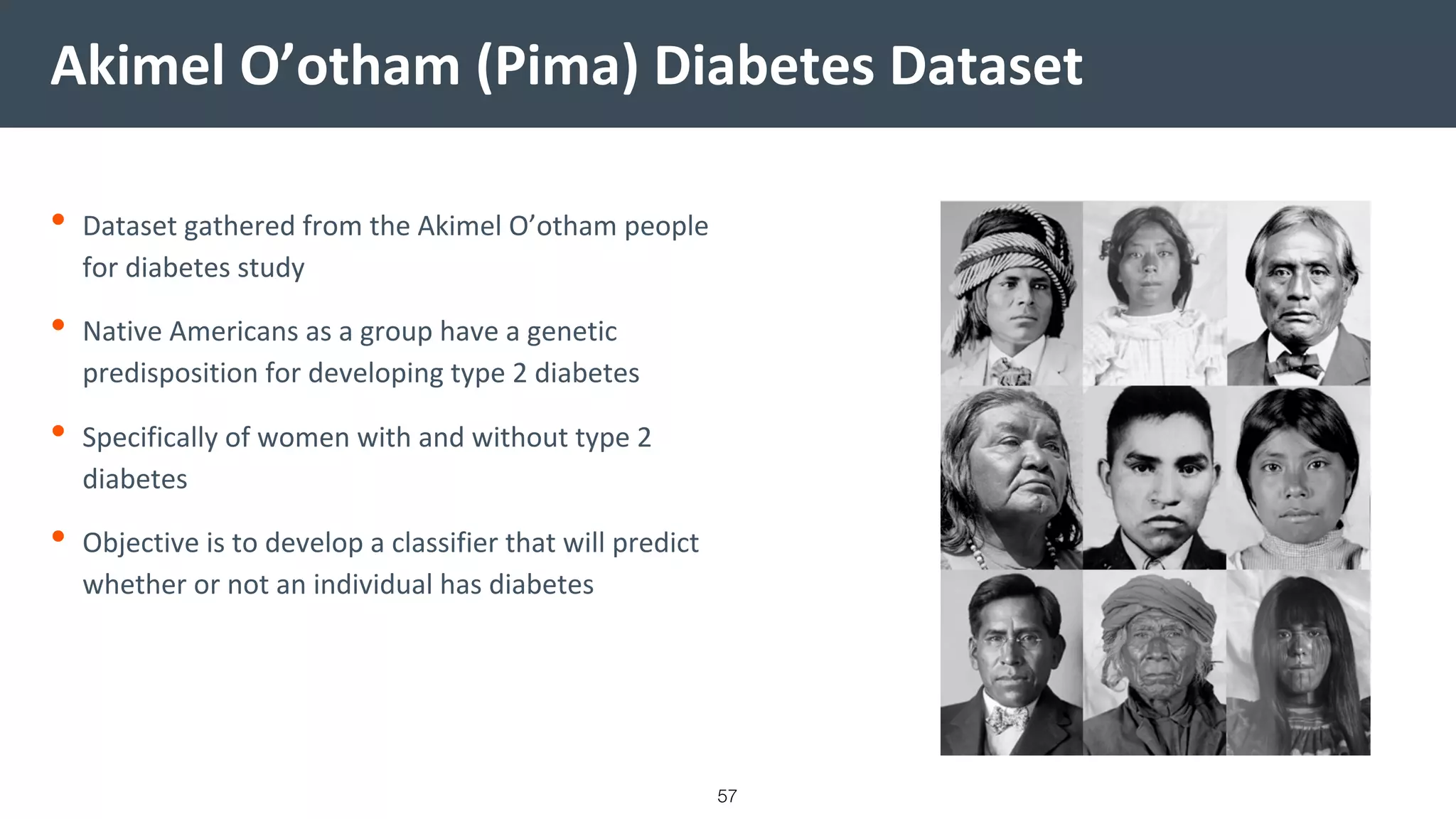
Akimel O’otham (Pima) Diabetes Dataset
• Dataset gathered from the Akimel O’otham people
for diabetes study
• Native Americans as a group have a genetic
predisposition for developing type 2 diabetes
• Specifically of women with and without type 2
diabetes
• Objective is to develop a classifier that will predict
whether or not an individual has diabetes
57
Data Exploration and Cleaning
n_pregnancies plasma_glucoseblood_pressure skin_thickness insulin bmi pedigree_func age outcome
6 148 72 35 0 33.6 0.627 50 1
1 85 66 29 0 26.6 0.351 31 0
8 183 64 0 0 23.3 0.672 32 1
1 89 66 23 94 28.1 0.167 21 0
0 137 40 35 168 43.1 2.288 33 1
5 116 74 0 0 25.6 0.201 30 0
3 78 50 32 88 31 0.248 26 1
10 115 0 0 0 35.3 0.134 29 0
2 197 70 45 543 30.5 0.158 53 1
8 125 96 0 0 0 0.232 54 1
4 110 92 0 0 37.6 0.191 30 0
10 168 74 0 0 38 0.537 34 1
10 139 80 0 0 27.1 1.441 57 0
1 189 60 23 846 30.1 0.398 59 1
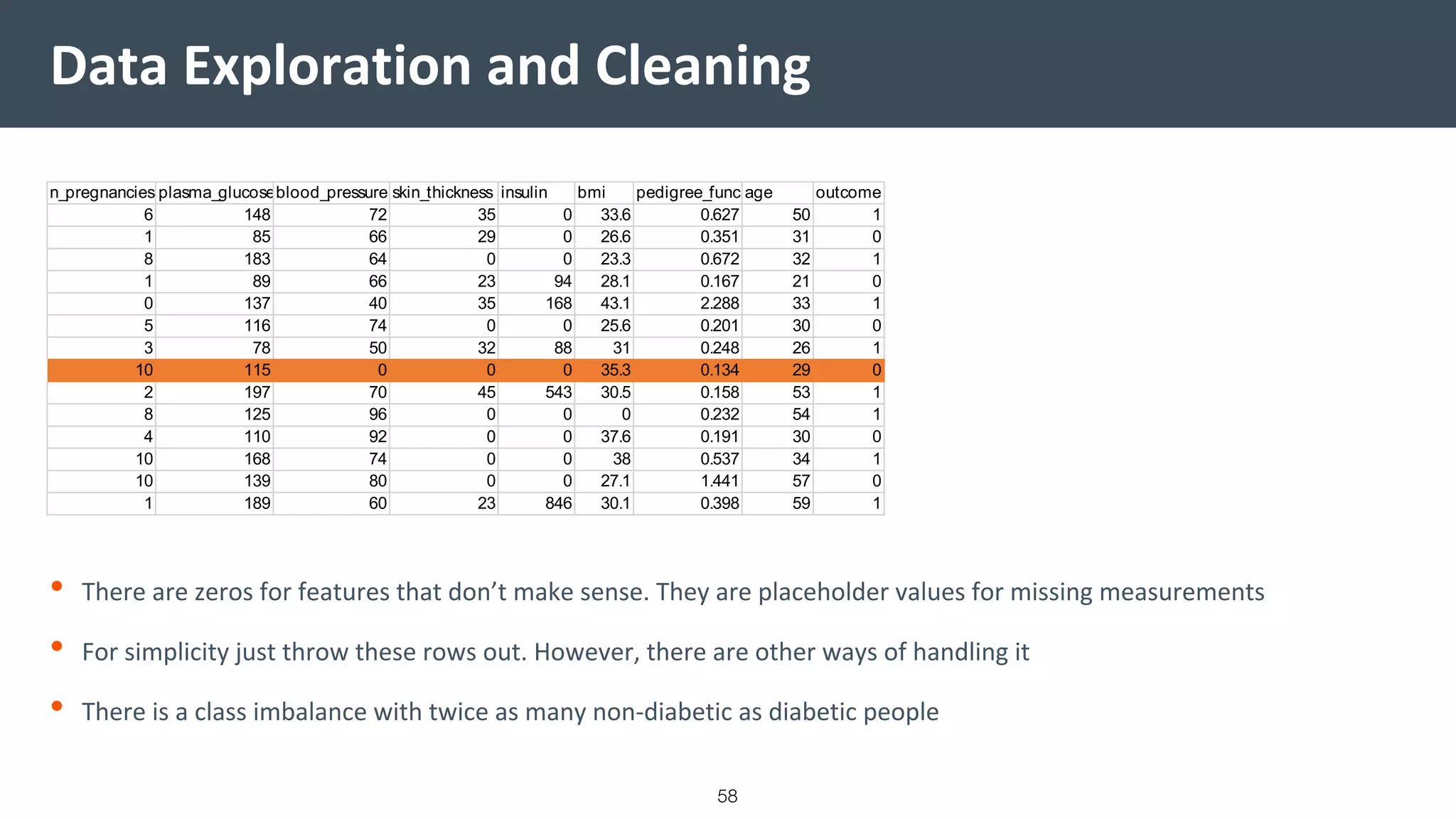
• There are zeros for features that don’t make sense. They are placeholder values for missing measurements
• For simplicity just throw these rows out. However, there are other ways of handling it
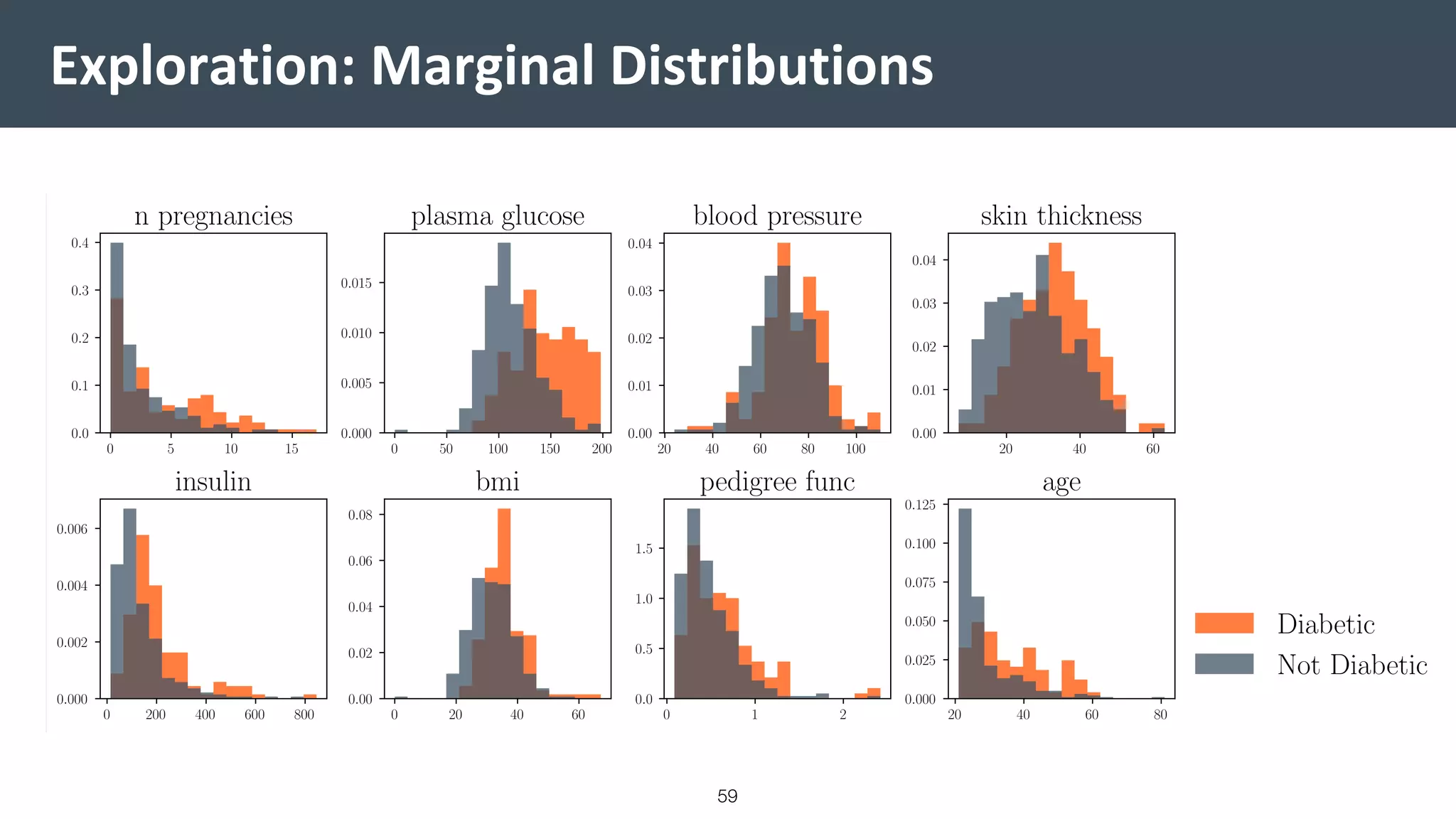
• There is a class imbalance with twice as many non-diabetic as diabetic people
58
Exploration: Marginal Distributions
59
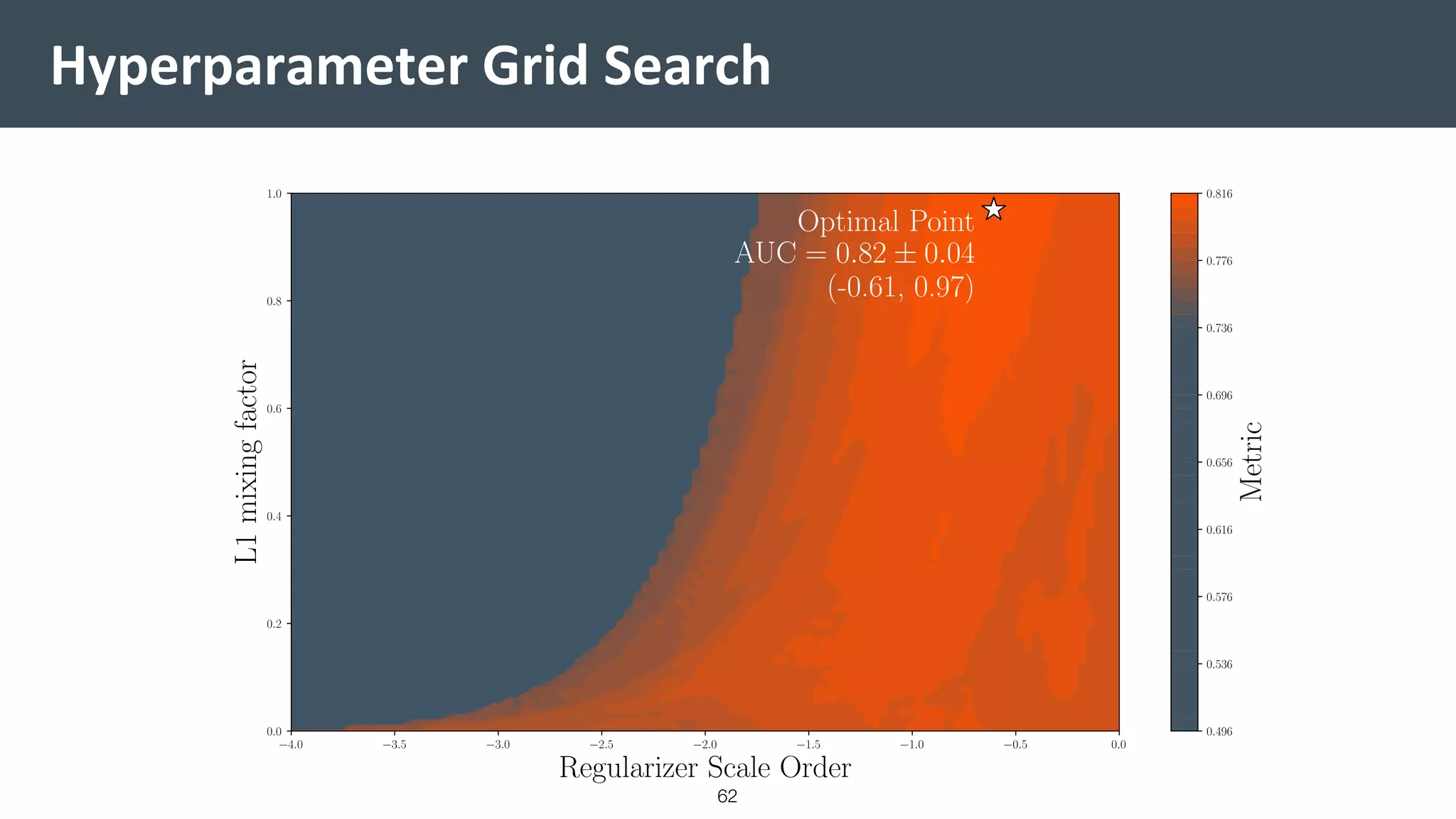
Setup and Procedure
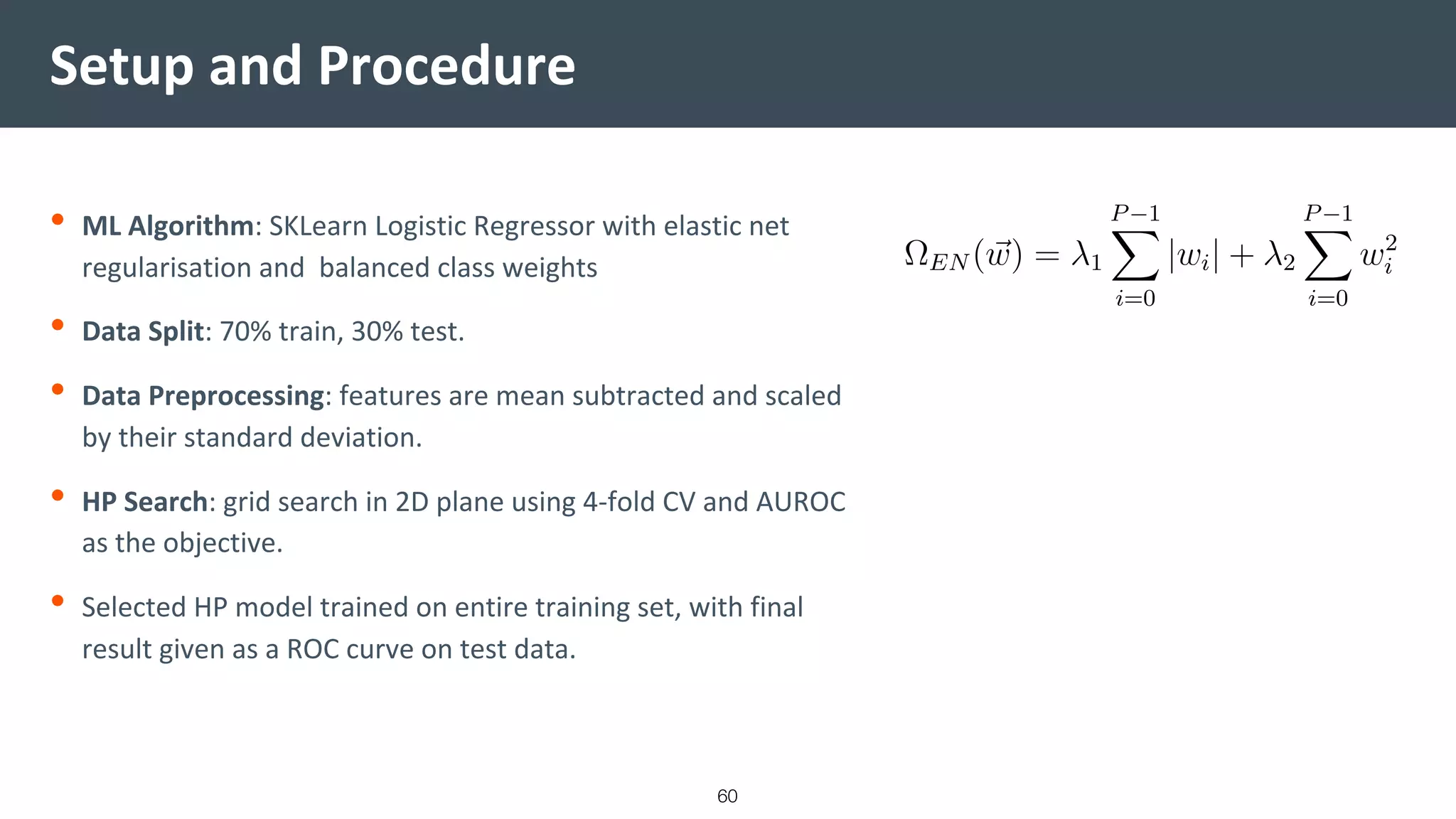
• ML Algorithm: SKLearn Logistic Regressor with elastic net
regularisation and balanced class weights
• Data Split: 70% train, 30% test.
• Data Preprocessing: features are mean subtracted and scaled
by their standard deviation.
• HP Search: grid search in 2D plane using 4-fold CV and AUROC
as the objective.
• Selected HP model trained on entire training set, with final
result given as a ROC curve on test data.
60
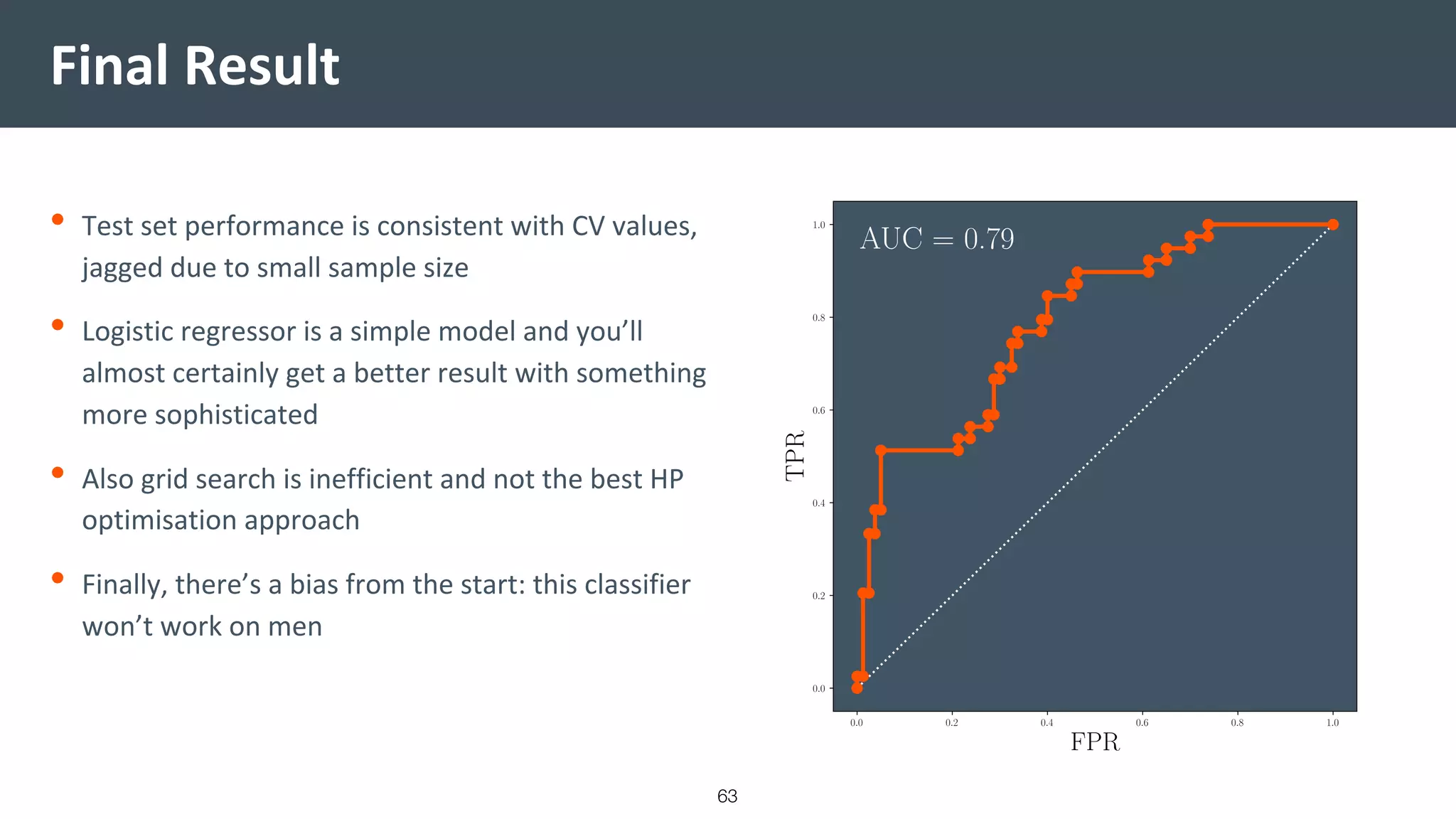
Receiver Operating Characteristic (ROC)
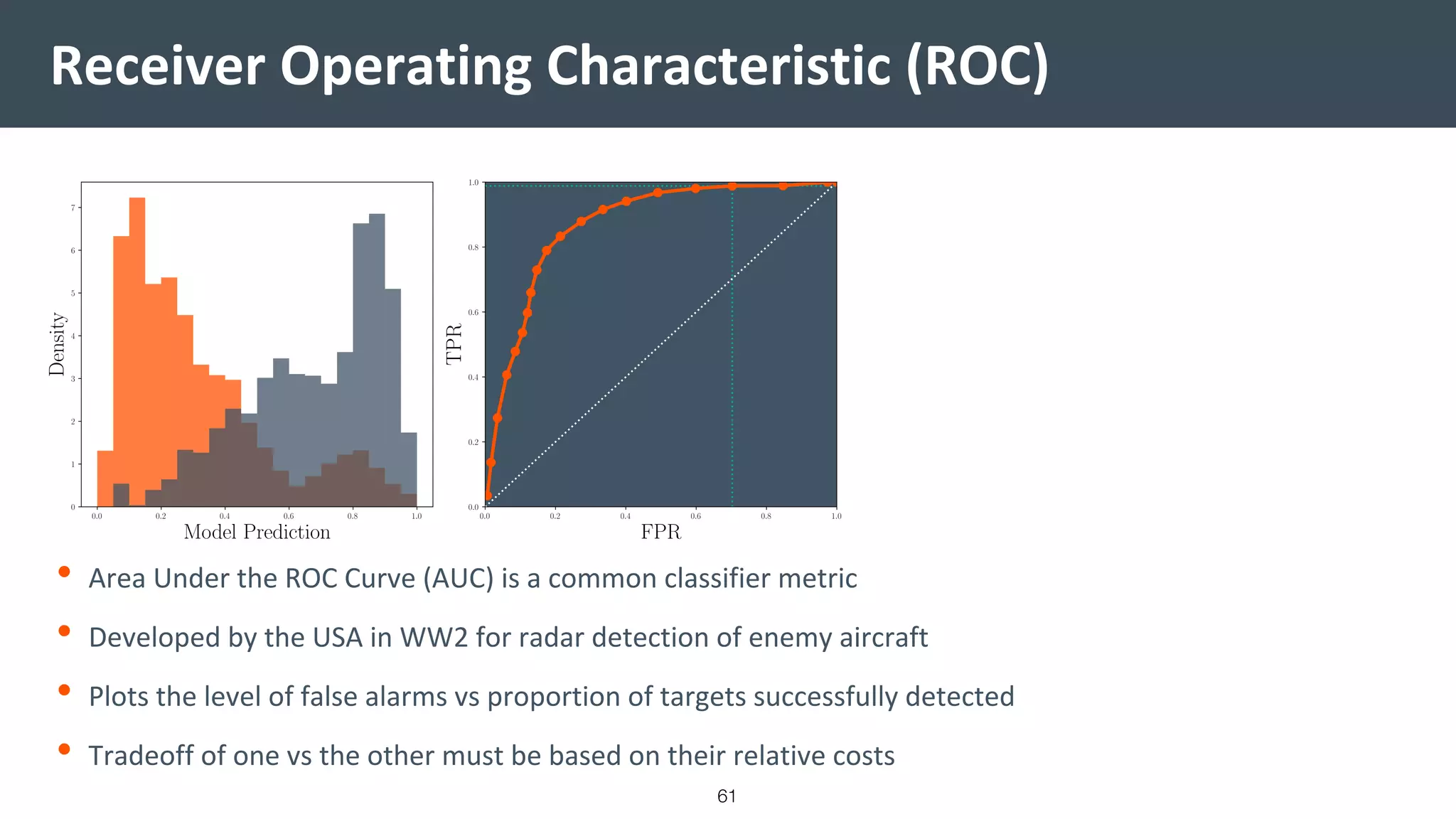
• Area Under the ROC Curve (AUC) is a common classifier metric
• Developed by the USA in WW2 for radar detection of enemy aircraft
• Plots the level of false alarms vs proportion of targets successfully detected
• Tradeoff of one vs the other must be based on their relative costs
61
Hyperparameter Grid Search
62
Final Result
• Test set performance is consistent with CV values,
jagged due to small sample size
• Logistic regressor is a simple model and you’ll
almost certainly get a better result with something
more sophisticated
• Also grid search is inefficient and not the best HP
optimisation approach
• Finally, there’s a bias from the start: this classifier
won’t work on men
63
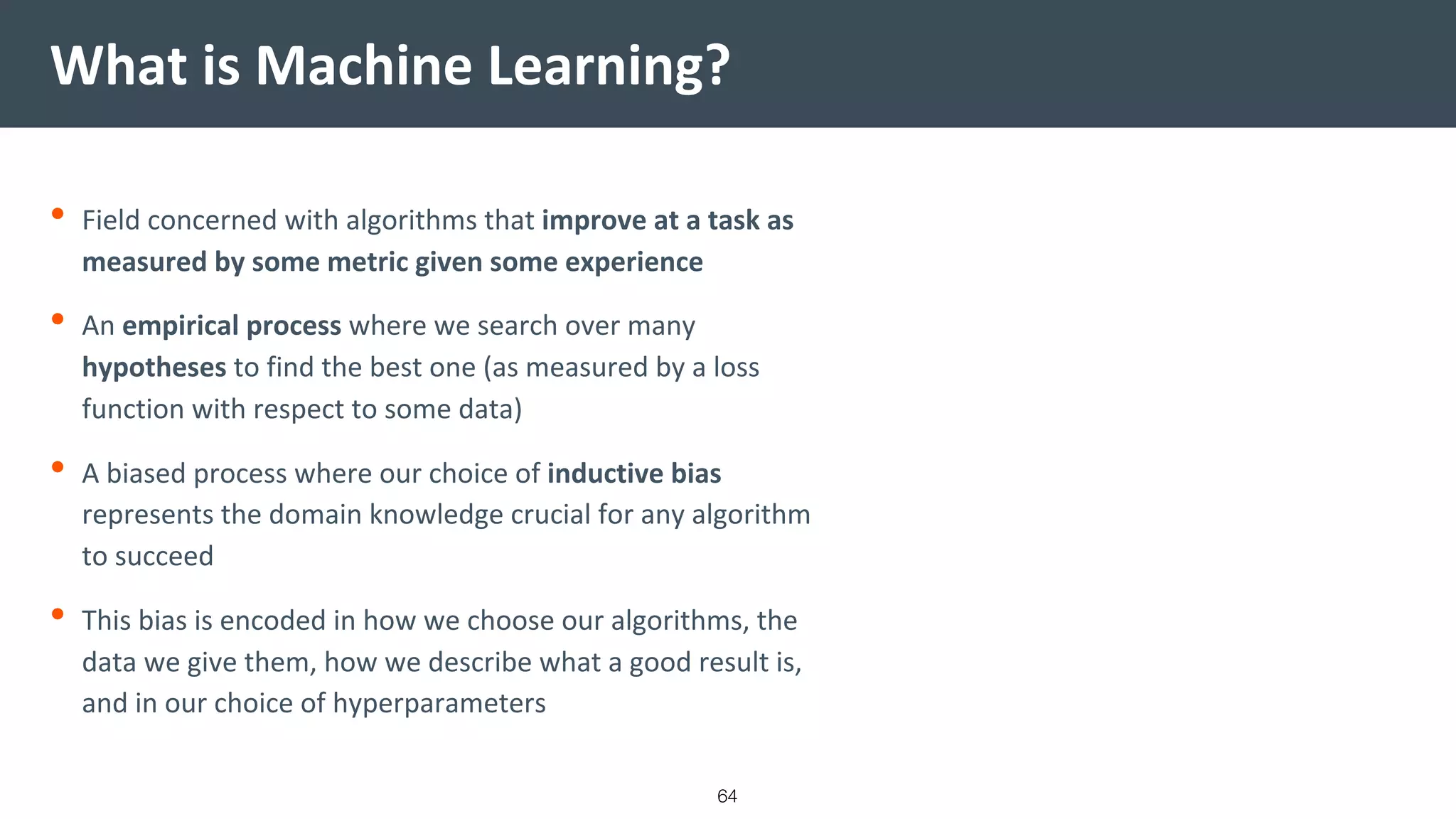
What is Machine Learning?
64
• Field concerned with algorithms that improve at a task as
measured by some metric given some experience
• An empirical process where we search over many
hypotheses to find the best one (as measured by a loss
function with respect to some data)
• A biased process where our choice of inductive bias
represents the domain knowledge crucial for any algorithm
to succeed
• This bias is encoded in how we choose our algorithms, the
data we give them, how we describe what a good result is,
and in our choice of hyperparameters
Outlook
• Although the examples we considered are simple their usage and
optimisation is common amongst all ML algorithms
• They also set the groundwork for more complex ones:
• Decision Trees are weak learners commonly used in ensembles
(XGBoost, LightGBM) a class of techniques for fighting variance
• Logistic Regressors are the individual neurons of neural nets (Deep
Learning)
• Mapping non-linearly separable data into a space where they are
underlies kernels (Kernel Support Vector Machines, Gaussian
Processes)
65
Jack Wright
Jack.wright@finbourne.com
Liberate | Simplify | Connect www.finbourne.com
66

Introduction to Machine Learning

  • 1.
    Introduction to Machine Learning Liberate| Simplify | Connect www.finbourne.com 1
  • 2.
    Introduction • This talkaims to give a reasonably comprehensive introduction to machine learning • Covers the common structure and inner workings of ML algorithms • Covers how they fail, how to select and tune them • Ties it all together at the end with a demonstration on a real dataset 1. Learning processes 2. First Machine Learning Example 3. Empirical Risk Minimisation 4. ML Model Capacity 5. Regularisation 6. Hyperparameter tuning and model selection 7. Example tying it all together 2
  • 3.
  • 4.
    • Improvement atsome task as measured by some metric given some experience • Inductive process: combine premises to reach conclusion • Needs some internal model that can be updated by some optimisation process • This model takes features (premises) and produces predictions (conclusions) What is Learning? 4
  • 5.
    Bait Shyness inRats • Task: to eat without becoming unwell • Experience: smells/tastes food. Eats a little • Metric: level of nausea after eating • If food makes the rat feel sick, it updates its internal model of foods to avoid based on smell/taste • Outcome: rat successfully learns to avoid bad food given smell and taste features 5
  • 6.
    Pigeon Superstition • Setup:pigeon is put in a box and fed at random • Task: to get fed • Experience: do random action, does food appear? • Metric: has food appeared? • If food appears during action, update model and do action more often • Outcome: pigeons learn to do random things unconnected to when they’re fed (superstitions) 6
  • 7.
    What happened? • Whydid the rats succeed and the pigeons fail? • Rats don’t avoid food if given a different unpleasant stimulus • Rats have an inductive bias towards associating smells, tastes and nausea with bad food (due to natural selection) • Inductive bias is crucial for learning: without it learning can’t succeed • For a machine to be able to learn we need to describe this learning process mathematically 7
  • 8.
    How to DescribeObservations • Feature vector: values to make predictions from • Target: desired prediction values (optional) such as class labels or continuous values • Data-Generating Process: the unknown probability distribution that feature vectors and targets are drawn from. • Dataset: collection of feature vectors (and optionally) paired with target values 8
  • 9.
    Features and Data:Irises 9 0 1 2 3 4 5 6 7 petal length (cm) 0.0 0.5 1.0 1.5 2.0 2.5 3.0 petalwidth(cm) Iris Features Setosa Versicolor Virginica [1.4 0.2][0] [1.4 0.2][0] [1.3 0.2][0] [1.5 0.2][0] [1.4 0.2][0] [6.0 2.5][2] [5.1 1.9][2] [5.9 2.1][2] [5.6 1.8][2] [5.8 2.2][2] [4.7 1.4][1] [4.5 1.5][1] [4.9 1.5][1] [4.0 1.3][1] [4.6 1.5][1] 1 2 3 4 5 6 7 petal length (cm) Iris Features Setosa Versicolor Virginica
  • 10.
    How Can MachinesLearn? • Model: takes vector of features given an internal vector of parameters and produces a prediction • Loss: function that takes predictions and gives a score (lower is better by convention). Encodes our opinion of what a good prediction is. • Optimisation: a process that alters the model parameters to reduce the loss and drives the learning process. • Inductive Bias: manifests everywhere as our choices in the above objects 10
  • 11.
    A First Example:Linear Regressor 11
  • 12.
    Problem and Dataset •Dataset: generated from linear relationship plus some random value that smears the observation • Random value is drawn from Gaussian with mean = 0 and standard deviation = 2 • Problem: predict value of target y given feature x 12
  • 13.
    Model and Parameters •Model is a simple linear function (a straight line): y = w0+w1x • Has two parameters: w0 (intercept) and w1 (line gradient) that form a space • Each point is a hypothesis about the data-generating process • How can we evaluate a hypothesis? 13
  • 14.
    The Loss • Lossfunction in this case is the Mean Squared Error (MSE) • We can choose a hypothesis by measuring the loss of a collection of hypotheses and picking the lowest • Eyeballing a graph isn’t going to scale though… 14
  • 15.
    The Loss Landscape •Loss function defines a surface over the hypothesis space • To train the model we need to navigate this space to the lowest point • This will be the best hypothesis given the observations 15
  • 16.
    Navigation: Loss Gradients •Gradients of the loss surface guide the model to the minimum • Most ML algorithms use some sort of gradient descent in their training process 16
  • 17.
    The Training Process •Model is initialised at w=(5,-3) • Steps down the loss landscape along the gradient • Step size is equal to the gradient size multiplied by a scale factor: the learning rate • Stop when the gain in performance is below threshold 17
  • 18.
    Final Result • Traininghas not produced the true relationship • Fit to the sample is good though • Problem is that the sample is an imperfect measurement of the data-generating process • Random noise has pulled the y values down in the low x region • We are optimising for the loss calculated with observed data 18
  • 19.
  • 20.
    Empirical vs TrueLoss • ERM is a formal model of statistical learning processes where we choose hypotheses that minimise empirical loss (aka risk) • Empirical loss is the loss measured with respect to observation • We are minimising this empirical loss, not the true loss • We don’t know the true loss because we don’t know the true data-generating process 20
  • 21.
    Empirical Issues • Smallsamples will be sensitive to fluctuations that distort the loss surface • Class imbalance and different feature scales can also distort this landscape in a way that will cause models to fail to generalise 21
  • 22.
    °3 °2 °10 1 2 3 x 0 100 200 300 400 500 Later Decision Line Class 0 Class 1 0 100 200 300 400 500 Now Independent and Identically Distributed • Non independent and identically distributed (IID) processes will cause issues. IID is a key assumption in many algorithms. • Identically distributed: distribution is not changing between sampling • Independent: samples do not affect each other. Are you intervening in the data generating process by sampling it? • Many real world distributions will change over time: this is domain shift (aka concept drift). Your trained algorithm will have a shelf life. 22
  • 23.
    Primer: Decision Trees •Models can fail even if empirical loss is fine: memorising the training data could get an empirical loss of zero • Decision trees are a good example of this • DTs partition feature space to optimise loss at each cut • Defines a branching tree structure where the leaves are predicted values 23
  • 24.
    Generalisation Error: Variance •This tree is an example of such a memorisation function • Achieves perfect loss on training set (loss = 0) • Fails completely on new data drawn from same distribution • This is variance error, a type of generalisation error (aka overfitting) 24
  • 25.
    Primer: Logistic Regressor •Model is based on Sigmoid function: outputs number between 0 and 1, given a weighted sum of features and constant • Inductive bias is for a linear (straight) decision boundary in feature space 25
  • 26.
    Generalisation Error: Bias •When classes are not linearly separable the algorithm fails completely • Logistic regressor’s inductive bias is inappropriate leading to bias error (aka underfitting) 26
  • 27.
    From Bias toVariance 27
  • 28.
    From Bias toVariance 28
  • 29.
    From Bias toVariance 29
  • 30.
    From Bias toVariance 30
  • 31.
    From Bias toVariance 31
  • 32.
    From Bias toVariance 32
  • 33.
    From Bias toVariance 33
  • 34.
    From Bias toVariance 34
  • 35.
    Bias-Variance Tradeoff • Generalisationerrors from bias and variance are linked and must be traded off each other • Generalisation error is measured with holdout data: a test set • The underlying property driving this trade off is model capacity 35
  • 36.
  • 37.
    Capacity and HypothesisSpace • A model’s capacity is linked to the size of its hypothesis space • If the hypotheses are too restricted the model will not be able to describe what it sees • Too large and the algorithm can select over-complicated Rube-Goldberg machine solutions • Can truncate this space (remove dimensions - e.g. polynomial degree) • an alternative is to introduce a penalty over the space: regularisation terms 37
  • 38.
    Regularisation • Regularisation isa broad class of techniques for improving ML algorithms’ generalisation • Regularisation terms are functions of the model parameters that are added to the loss • These function as penalties over the hypothesis space • Two particularly common examples based on L1 and L2 norms 38
  • 39.
    L1 Term • Manhattandistance • AKA LASSO when used in linear regression • Encourages sparsity where some parameters are large and others close to zero 39
  • 40.
    L2 Term • SquaredEuclidean norm (normal distance) • AKA Ridge when used in Linear Regression • Encourages all parameters to be small as possible 40
  • 41.
    Demo: Toy Data& Model with L2 • Generated from a cubic where w0 and w1 are zero, plus gaussian noise • Model is a cubic polynomial, but only the x2 and x3 terms matter so the hypothesis space is 2D • Loss is the same bowl-shaped MSE loss • L1 is going to make the loss landscape more “inverted pyramid”-like 41
  • 42.
  • 43.
  • 44.
  • 45.
  • 46.
  • 47.
  • 48.
  • 49.
    Hyperparameters and ModelSelection • Hyperparameters are non-learned model parameters such as regulariser strength • Can’t use training data to tune them because the training process will just grant itself max capacity and overfit • Can’t use the test data to tune them because we lose our unbiased estimate of generalisation performance • To select these we optimise with respect to another holdout set, typically a subsample of the training data: a validation set • Selecting which ML algorithm to use follows the same workflow 49
  • 50.
    Hyperparameter Search Example •Data: quadratic plus noise • Algorithm: linear regressor with 9th-order polynomial features and L1 regulariser (LASSO) • Procedure: 1. Scan along hyperparameter range 2. For each value of HP train the algorithm 3. Test on validation set 4. Pick the best one 50
  • 51.
  • 52.
    Tuning with ValidationSet • This optimisation is sensitive to noise in the validation set • Have experienced variance error and in effect overfitted again • Demonstrates why it’s so important to not use the test set for tuning 52
  • 53.
    K-Fold Cross Validation •K-Fold Cross Validation offers a better approach • Split the data into N-many folds. Train on N-1 validate on the holdout. Repeat over combinations. • Will in effect “smooth out” the fluctuations • Will also give us a measurement of the variance of the model 53
  • 54.
    Tuning with CrossValidation • Idea is the same as before • Instead of working with one train/validation set we use combinations of the four folds • Also repeat this 10 times, shuffling the data before doing the CV again • This all smooths the observed relationship • Pick the one with the best performance averaged over all the runs 54
  • 55.
    Results Comparison • CVhas produced a final result that’s closer to the true relation • Test set is also noisy and isn’t going to favour one over the other • Ideally we gather more data, but if that’s not possible CV offers a good way to smooth out the statistical fluctuations 55
  • 56.
    Putting it alltogether: a Practical Example 56
  • 57.
    Akimel O’otham (Pima)Diabetes Dataset • Dataset gathered from the Akimel O’otham people for diabetes study • Native Americans as a group have a genetic predisposition for developing type 2 diabetes • Specifically of women with and without type 2 diabetes • Objective is to develop a classifier that will predict whether or not an individual has diabetes 57
  • 58.
    Data Exploration andCleaning n_pregnancies plasma_glucoseblood_pressure skin_thickness insulin bmi pedigree_func age outcome 6 148 72 35 0 33.6 0.627 50 1 1 85 66 29 0 26.6 0.351 31 0 8 183 64 0 0 23.3 0.672 32 1 1 89 66 23 94 28.1 0.167 21 0 0 137 40 35 168 43.1 2.288 33 1 5 116 74 0 0 25.6 0.201 30 0 3 78 50 32 88 31 0.248 26 1 10 115 0 0 0 35.3 0.134 29 0 2 197 70 45 543 30.5 0.158 53 1 8 125 96 0 0 0 0.232 54 1 4 110 92 0 0 37.6 0.191 30 0 10 168 74 0 0 38 0.537 34 1 10 139 80 0 0 27.1 1.441 57 0 1 189 60 23 846 30.1 0.398 59 1 • There are zeros for features that don’t make sense. They are placeholder values for missing measurements • For simplicity just throw these rows out. However, there are other ways of handling it • There is a class imbalance with twice as many non-diabetic as diabetic people 58
  • 59.
  • 60.
    Setup and Procedure •ML Algorithm: SKLearn Logistic Regressor with elastic net regularisation and balanced class weights • Data Split: 70% train, 30% test. • Data Preprocessing: features are mean subtracted and scaled by their standard deviation. • HP Search: grid search in 2D plane using 4-fold CV and AUROC as the objective. • Selected HP model trained on entire training set, with final result given as a ROC curve on test data. 60
  • 61.
    Receiver Operating Characteristic(ROC) • Area Under the ROC Curve (AUC) is a common classifier metric • Developed by the USA in WW2 for radar detection of enemy aircraft • Plots the level of false alarms vs proportion of targets successfully detected • Tradeoff of one vs the other must be based on their relative costs 61
  • 62.
  • 63.
    Final Result • Testset performance is consistent with CV values, jagged due to small sample size • Logistic regressor is a simple model and you’ll almost certainly get a better result with something more sophisticated • Also grid search is inefficient and not the best HP optimisation approach • Finally, there’s a bias from the start: this classifier won’t work on men 63
  • 64.
    What is MachineLearning? 64 • Field concerned with algorithms that improve at a task as measured by some metric given some experience • An empirical process where we search over many hypotheses to find the best one (as measured by a loss function with respect to some data) • A biased process where our choice of inductive bias represents the domain knowledge crucial for any algorithm to succeed • This bias is encoded in how we choose our algorithms, the data we give them, how we describe what a good result is, and in our choice of hyperparameters
  • 65.
    Outlook • Although theexamples we considered are simple their usage and optimisation is common amongst all ML algorithms • They also set the groundwork for more complex ones: • Decision Trees are weak learners commonly used in ensembles (XGBoost, LightGBM) a class of techniques for fighting variance • Logistic Regressors are the individual neurons of neural nets (Deep Learning) • Mapping non-linearly separable data into a space where they are underlies kernels (Kernel Support Vector Machines, Gaussian Processes) 65
  • 66.
    Jack Wright Jack.wright@finbourne.com Liberate |Simplify | Connect www.finbourne.com 66