Measurement<br />The main focus of this unit is to introduce and explore measurement as non-standard units can be used to measure objects<br />Mass is a measure of how heavy an object is. Mass can be measured using non-standard units. Students can make comparison statements.<br />The activities and problems presented will give the teachers opportunities to assess students’ knowledge of linear measurement and mass. Students will be engaged in opportunities to communicate their understandings individually and with others, develop and apply strategies to measure objects and make connections to prior knowledge, justify their thinking and represent their understanding in a variety of ways.<br />Assessment Methods or Strategies<br />Whole class/ group observations-checklists
Individual anecdotal observations- sticky notes
Individual interviews- with those who need intervention
Journals or learning logs-written communication and representation- Class Journal on Measurement
“Show What You Know” or Exemplar Problems to score using a rubric from NCTM
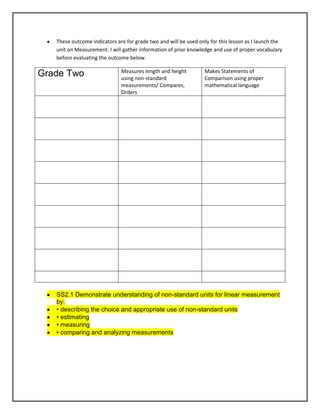
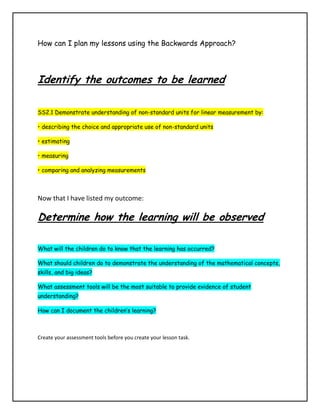
These outcome indicators are for grade two and will be used only for this lesson as I launch the unit on Measurement. I will gather information of prior knowledge and use of proper vocabulary before evaluating the outcome below.Grade TwoMeasures length and height using non-standard measurements/ Compares, OrdersMakes Statements of Comparison using proper mathematical language<br />SS2.1 Demonstrate understanding of non-standard units for linear measurement by:
• describing the choice and appropriate use of non-standard units
• estimating
• measuring
• comparing and analyzing measurementsA Three-Part Format for Problem-Based Lessons<br />Lesson 1- Introduction to Linear Measurement<br />Curriculum Outcomes:<br />Shape and Space<br />SSK.1 Use direct comparison to compare two objects based on a single attribute, such as • length including height • mass • volume • capacity. <br />a) Compare the length or height of two objects and explain how they compare using the words shorter, longer, taller, or almost the same. <br />b) Compare the mass of two objects and explain how they compare using the words lighter, heavier, or almost the same. <br />c) Compare the volume of two objects or capacity of two containers and explain how they compare using the words less, more, bigger, smaller, or almost the same.<br />SS1.1 Demonstrate an understanding of measurement as a process of comparing by:<br />• identifying attributes that can be compared<br />• ordering objects<br />• making statements of comparison<br />• filling, covering, or matching<br />SS2.1 Demonstrate understanding of non-standard units for linear measurement by:<br />• describing the choice and appropriate use of non-standard units<br />• estimating<br />• measuring<br />• comparing and analyzing measurements<br />SS3.3. Demonstrate an understanding of linear measurement (cm and m) including: <br />selecting and justifying referents <br />generalizing the relationship between cm and m <br />estimating length and perimeter using referents <br />measuring and recording length, width, height, and perimeter <br />constructing 2-D shapes with a given perimeter or given lengths. <br />Math Word Wall:<br />measurement
non-standard unitMaterials:<br />various lengths of yarn/lots of string/craft sticks/giant gingerbread man/recording sheetBefore:  Opening Warm-up “Compare Yarn Lengths”<br />Have students take a piece of yarn from the basket and compare their yarn length with that of their partners. Encourage students to compare their pieces with questions and statements such as, whose is longer? Whose is shorter? Discuss findings. Have students make statements about their comparison findings. Share in full group.<br />“Samantha’s yarn is longer than my yarn. My yarn is shorter than Samantha’s yarn.”<br />__________________________________________________________________________<br />Guided Discussion<br />Display giant gingerbread man <br />ASK: <br />About how many craft sticks tall do you think this gingerbread is?
How could we measure to find out?
Lay the cut-out on the floor.
Lay some craft sticks out with spaces between “How’s this, have I done it right?”
Rearrange sticks now with overlap. “How’s this, have I done it right?”
Lay the sticks end to end in a crooked line. “How’s this, have I done it right?”
Have a volunteer show how to place the sticks to measure you may even want to use a metre stick to get a straight line.
Discuss what to do when you get close to the end
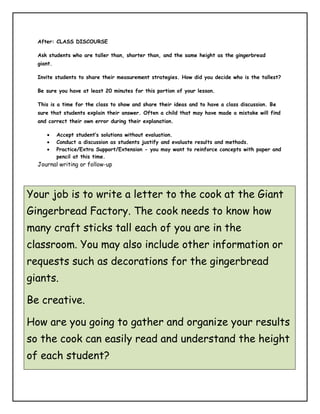
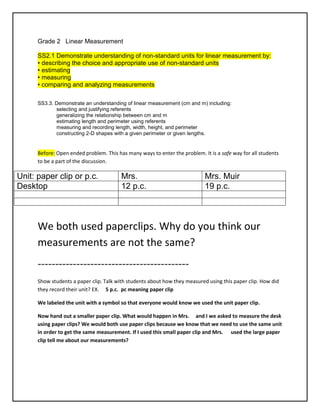
“About how many craft a stick tall is the gingerbread man? How do you know?Tape the gingerbread man to the wall.<br />How tall is the gingerbread man now? How do you know? How could we measure to check? Show a roll of yarn or string. “How could the string help us?”<br />Demonstrate how to record the height on line master 8. Provide students with string, scissors, and craft sticks.<br />Think Pair Share:<br />How will you measure your height with the string? Think of the answer to yourself. Now turn to a partner and discuss. Full group: Does anyone want to share?<br />How will you decide how many craft sticks you will need? Think of the answer to yourself. Now turn to a partner and discuss. Full group: Does anyone want to share?<br />Are there any questions before you begin?<br />__________________________________________________________________________<br />During: STUDENTS WORK<br />Today you will solve a problem of measurement.The gingerbread factory wants to build life size gingerbread cookies of the students in this classroom. The cook needs to know how many craft sticks tall each of you are.With a partner, you will work together to measure how tall you are in craft sticks. Begin by measuring your height using the string.Record your work.Who is the tallest? Is it you, your partner or the ginger giant?<br />Assessment during task:  Observational Notes- Assessment Master 3.2 Grade 2 Lesson 3<br />This is when you give the student a problem based task- work in partners or small group.<br />Letting go is the most important and also can be very difficult.<br />During this time you may want to walk around and observe and evaluate by using rubrics or anecdotal records.<br />You may provide hints but not solutions.<br />Find out what your students KNOW, HOW THEY THINK AND HOW THEY APPROACH THE TASK GIVEN.<br />Let go!<br />Listen carefully.<br />Provide guided questions.<br />Observe and assess.<br />After: CLASS DISCOURSE<br />Ask students who are taller than, shorter than, and the same height as the gingerbread giant.<br />Invite students to share their measurement strategies. How did you decide who is the tallest?<br />Be sure you have at least 20 minutes for this portion of your lesson.<br />This is a time for the class to show and share their ideas and to have a class discussion. Be sure that students explain their answer. Often a child that may have made a mistake will find and correct their own error during their explanation.<br />Accept student’s solutions without evaluation.<br />Conduct a discussion as students justify and evaluate results and methods.<br />Practice/Extra Support/Extension - you may want to reinforce concepts with paper and pencil at this time.<br />Your job is to write a letter to the cook at the Giant Gingerbread Factory. The cook needs to know how many craft sticks tall each of you are in the classroom. You may also include other information or requests such as decorations for the gingerbread giants.Be creative.How are you going to gather and organize your results so the cook can easily read and understand the height of each student?<br />Journal writing or follow-up<br />What information are you going to need to get started?<br />What materials will you need?<br />*This is an individual assignment that can be evaluated using a rubric.<br />What criteria do you expect? You may want to establish the criteria with students before they begin.<br />How could you modify this assignment for a few of your students? <br />Today you will be working with a partner to measure the Ginger Giant’s footprint.<br />You will have a variety of non-standard units to measure with. <br />You will need to choose one unit and estimate how many it would take to measure the length of the Ginger Giant’s footprint. Your estimate may be different from that of your partner’s estimate.<br />Record your estimate and then measure using the unit you chose. Remember you need to use the same unit to measure the length of the footprint. Always measure twice to check your work!!!<br />Continue on choosing a different unit. Always begin with an estimate.<br />Have Fun!<br />http://www.storyit.com/Borders/christginbreadmanbw.htm<br />Today you will solve a problem of measurement.<br />The gingerbread factory wants to build life size gingerbread cookies of the students in this classroom. The cook needs to know how many craft sticks tall each of you are.<br />With a partner, you will work together to measure how tall you are in craft sticks. Begin by measuring your height using the string.<br />Record your work.<br />Who is the tallest? Is it you, your partner or the ginger giant?<br />Height _________My height ______My partner’s name:__________My partner’s height: _________<br />List the heights from greatest to least.<br />______________ _______________ ______________<br />Who is the tallest? ____________________<br />Show how you measured and compared heights<br />Grade 2   Linear Measurement<br />SS2.1 Demonstrate understanding of non-standard units for linear measurement by:<br />• describing the choice and appropriate use of non-standard units<br />• estimating<br />• measuring<br />• comparing and analyzing measurements<br />SS3.3. Demonstrate an understanding of linear measurement (cm and m) including: <br />selecting and justifying referents <br />generalizing the relationship between cm and m <br />estimating length and perimeter using referents <br />measuring and recording length, width, height, and perimeter <br />constructing 2-D shapes with a given perimeter or given lengths. <br />Before: Open ended problem. This has many ways to enter the problem. It is a safe way for all students to be a part of the discussion.<br />Unit: paper clip or p.c.Mrs. Mrs. MuirDesktop12 p.c.19 p.c.<br />We both used paperclips. Why do you think our measurements are not the same?<br />-------------------------------------------<br />Show students a paper clip. Talk with students about how they measured using this paper clip. How did they record their unit? EX.     5 p.c.  pc meaning paper clip<br />We labeled the unit with a symbol so that everyone would know we used the unit paper clip.<br />Now hand out a smaller paper clip. What would happen in Mrs.     and I we asked to measure the desk using paper clips? We would both use paper clips because we know that we need to use the same unit in order to get the same measurement. If I used this small paper clip and Mrs.      used the large paper clip tell me about our measurements?<br />Grade 3:<br />(This is where the concept of Standard Measurement comes into the lesson. What do you think standard is? Why is it important to have standard units?)<br />A centimetre is a standard unit used to measure length. It is about the length of the width of your small fingernail. Pass out base ten blocks ones and tens. Have the students examine these math materials and ask what they notice about them?<br />A “one” is a cm cube. It has a length, width and height of one centimetre.<br />What about the “rod” or ten stick? What would the dimensions be of it?  How could we use a ten rod to measure length?<br />Have students take out their ruler.<br />Demonstrate using the SMART board how to measure lining up with the zero mark on their ruler.<br />Pass out a worksheet for students to practice measuring using the unit centimetre.<br />Talk in large group their measurements.<br />During<br />Introduce a game called “Sketch the Line”<br />Materials needed: <br />Paper, cm ruler, two dice for each pair of students, pencil<br />Rules:<br />Students will be with a partner.

Linear measurement lessons

  • 1.
    Measurement<br />The main focus of this unit is to introduce and explore measurement as non-standard units can be used to measure objects<br />Mass is a measure of how heavy an object is. Mass can be measured using non-standard units. Students can make comparison statements.<br />The activities and problems presented will give the teachers opportunities to assess students’ knowledge of linear measurement and mass. Students will be engaged in opportunities to communicate their understandings individually and with others, develop and apply strategies to measure objects and make connections to prior knowledge, justify their thinking and represent their understanding in a variety of ways.<br />Assessment Methods or Strategies<br />Whole class/ group observations-checklists
  • 2.
  • 3.
    Individual interviews- withthose who need intervention
  • 4.
    Journals or learninglogs-written communication and representation- Class Journal on Measurement
  • 5.
    “Show What YouKnow” or Exemplar Problems to score using a rubric from NCTM
  • 6.
    These outcome indicatorsare for grade two and will be used only for this lesson as I launch the unit on Measurement. I will gather information of prior knowledge and use of proper vocabulary before evaluating the outcome below.Grade TwoMeasures length and height using non-standard measurements/ Compares, OrdersMakes Statements of Comparison using proper mathematical language<br />SS2.1 Demonstrate understanding of non-standard units for linear measurement by:
  • 7.
    • describing thechoice and appropriate use of non-standard units
  • 8.
  • 9.
  • 10.
    • comparing andanalyzing measurementsA Three-Part Format for Problem-Based Lessons<br />Lesson 1- Introduction to Linear Measurement<br />Curriculum Outcomes:<br />Shape and Space<br />SSK.1 Use direct comparison to compare two objects based on a single attribute, such as • length including height • mass • volume • capacity. <br />a) Compare the length or height of two objects and explain how they compare using the words shorter, longer, taller, or almost the same. <br />b) Compare the mass of two objects and explain how they compare using the words lighter, heavier, or almost the same. <br />c) Compare the volume of two objects or capacity of two containers and explain how they compare using the words less, more, bigger, smaller, or almost the same.<br />SS1.1 Demonstrate an understanding of measurement as a process of comparing by:<br />• identifying attributes that can be compared<br />• ordering objects<br />• making statements of comparison<br />• filling, covering, or matching<br />SS2.1 Demonstrate understanding of non-standard units for linear measurement by:<br />• describing the choice and appropriate use of non-standard units<br />• estimating<br />• measuring<br />• comparing and analyzing measurements<br />SS3.3. Demonstrate an understanding of linear measurement (cm and m) including: <br />selecting and justifying referents <br />generalizing the relationship between cm and m <br />estimating length and perimeter using referents <br />measuring and recording length, width, height, and perimeter <br />constructing 2-D shapes with a given perimeter or given lengths. <br />Math Word Wall:<br />measurement
  • 11.
    non-standard unitMaterials:<br />variouslengths of yarn/lots of string/craft sticks/giant gingerbread man/recording sheetBefore: Opening Warm-up “Compare Yarn Lengths”<br />Have students take a piece of yarn from the basket and compare their yarn length with that of their partners. Encourage students to compare their pieces with questions and statements such as, whose is longer? Whose is shorter? Discuss findings. Have students make statements about their comparison findings. Share in full group.<br />“Samantha’s yarn is longer than my yarn. My yarn is shorter than Samantha’s yarn.”<br />__________________________________________________________________________<br />Guided Discussion<br />Display giant gingerbread man <br />ASK: <br />About how many craft sticks tall do you think this gingerbread is?
  • 12.
    How could wemeasure to find out?
  • 13.
    Lay the cut-outon the floor.
  • 14.
    Lay some craftsticks out with spaces between “How’s this, have I done it right?”
  • 15.
    Rearrange sticks nowwith overlap. “How’s this, have I done it right?”
  • 16.
    Lay the sticksend to end in a crooked line. “How’s this, have I done it right?”
  • 17.
    Have a volunteershow how to place the sticks to measure you may even want to use a metre stick to get a straight line.
  • 18.
    Discuss what todo when you get close to the end
  • 19.
    “About how manycraft a stick tall is the gingerbread man? How do you know?Tape the gingerbread man to the wall.<br />How tall is the gingerbread man now? How do you know? How could we measure to check? Show a roll of yarn or string. “How could the string help us?”<br />Demonstrate how to record the height on line master 8. Provide students with string, scissors, and craft sticks.<br />Think Pair Share:<br />How will you measure your height with the string? Think of the answer to yourself. Now turn to a partner and discuss. Full group: Does anyone want to share?<br />How will you decide how many craft sticks you will need? Think of the answer to yourself. Now turn to a partner and discuss. Full group: Does anyone want to share?<br />Are there any questions before you begin?<br />__________________________________________________________________________<br />During: STUDENTS WORK<br />Today you will solve a problem of measurement.The gingerbread factory wants to build life size gingerbread cookies of the students in this classroom. The cook needs to know how many craft sticks tall each of you are.With a partner, you will work together to measure how tall you are in craft sticks. Begin by measuring your height using the string.Record your work.Who is the tallest? Is it you, your partner or the ginger giant?<br />Assessment during task: Observational Notes- Assessment Master 3.2 Grade 2 Lesson 3<br />This is when you give the student a problem based task- work in partners or small group.<br />Letting go is the most important and also can be very difficult.<br />During this time you may want to walk around and observe and evaluate by using rubrics or anecdotal records.<br />You may provide hints but not solutions.<br />Find out what your students KNOW, HOW THEY THINK AND HOW THEY APPROACH THE TASK GIVEN.<br />Let go!<br />Listen carefully.<br />Provide guided questions.<br />Observe and assess.<br />After: CLASS DISCOURSE<br />Ask students who are taller than, shorter than, and the same height as the gingerbread giant.<br />Invite students to share their measurement strategies. How did you decide who is the tallest?<br />Be sure you have at least 20 minutes for this portion of your lesson.<br />This is a time for the class to show and share their ideas and to have a class discussion. Be sure that students explain their answer. Often a child that may have made a mistake will find and correct their own error during their explanation.<br />Accept student’s solutions without evaluation.<br />Conduct a discussion as students justify and evaluate results and methods.<br />Practice/Extra Support/Extension - you may want to reinforce concepts with paper and pencil at this time.<br />Your job is to write a letter to the cook at the Giant Gingerbread Factory. The cook needs to know how many craft sticks tall each of you are in the classroom. You may also include other information or requests such as decorations for the gingerbread giants.Be creative.How are you going to gather and organize your results so the cook can easily read and understand the height of each student?<br />Journal writing or follow-up<br />What information are you going to need to get started?<br />What materials will you need?<br />*This is an individual assignment that can be evaluated using a rubric.<br />What criteria do you expect? You may want to establish the criteria with students before they begin.<br />How could you modify this assignment for a few of your students? <br />Today you will be working with a partner to measure the Ginger Giant’s footprint.<br />You will have a variety of non-standard units to measure with. <br />You will need to choose one unit and estimate how many it would take to measure the length of the Ginger Giant’s footprint. Your estimate may be different from that of your partner’s estimate.<br />Record your estimate and then measure using the unit you chose. Remember you need to use the same unit to measure the length of the footprint. Always measure twice to check your work!!!<br />Continue on choosing a different unit. Always begin with an estimate.<br />Have Fun!<br />http://www.storyit.com/Borders/christginbreadmanbw.htm<br />Today you will solve a problem of measurement.<br />The gingerbread factory wants to build life size gingerbread cookies of the students in this classroom. The cook needs to know how many craft sticks tall each of you are.<br />With a partner, you will work together to measure how tall you are in craft sticks. Begin by measuring your height using the string.<br />Record your work.<br />Who is the tallest? Is it you, your partner or the ginger giant?<br />Height _________My height ______My partner’s name:__________My partner’s height: _________<br />List the heights from greatest to least.<br />______________ _______________ ______________<br />Who is the tallest? ____________________<br />Show how you measured and compared heights<br />Grade 2 Linear Measurement<br />SS2.1 Demonstrate understanding of non-standard units for linear measurement by:<br />• describing the choice and appropriate use of non-standard units<br />• estimating<br />• measuring<br />• comparing and analyzing measurements<br />SS3.3. Demonstrate an understanding of linear measurement (cm and m) including: <br />selecting and justifying referents <br />generalizing the relationship between cm and m <br />estimating length and perimeter using referents <br />measuring and recording length, width, height, and perimeter <br />constructing 2-D shapes with a given perimeter or given lengths. <br />Before: Open ended problem. This has many ways to enter the problem. It is a safe way for all students to be a part of the discussion.<br />Unit: paper clip or p.c.Mrs. Mrs. MuirDesktop12 p.c.19 p.c.<br />We both used paperclips. Why do you think our measurements are not the same?<br />-------------------------------------------<br />Show students a paper clip. Talk with students about how they measured using this paper clip. How did they record their unit? EX. 5 p.c. pc meaning paper clip<br />We labeled the unit with a symbol so that everyone would know we used the unit paper clip.<br />Now hand out a smaller paper clip. What would happen in Mrs. and I we asked to measure the desk using paper clips? We would both use paper clips because we know that we need to use the same unit in order to get the same measurement. If I used this small paper clip and Mrs. used the large paper clip tell me about our measurements?<br />Grade 3:<br />(This is where the concept of Standard Measurement comes into the lesson. What do you think standard is? Why is it important to have standard units?)<br />A centimetre is a standard unit used to measure length. It is about the length of the width of your small fingernail. Pass out base ten blocks ones and tens. Have the students examine these math materials and ask what they notice about them?<br />A “one” is a cm cube. It has a length, width and height of one centimetre.<br />What about the “rod” or ten stick? What would the dimensions be of it? How could we use a ten rod to measure length?<br />Have students take out their ruler.<br />Demonstrate using the SMART board how to measure lining up with the zero mark on their ruler.<br />Pass out a worksheet for students to practice measuring using the unit centimetre.<br />Talk in large group their measurements.<br />During<br />Introduce a game called “Sketch the Line”<br />Materials needed: <br />Paper, cm ruler, two dice for each pair of students, pencil<br />Rules:<br />Students will be with a partner.