What is Alzheimer’s Disease? Lily Ha B Block November 3, 2011
Introduction Irreversible brain disease 4 th  leading cause of death among older adults Leading cause of dementia Destroys memory, thinking skills, and ability to function About 4.5 million Americans have this disease Expected to increase 70% by 2020 Aging increases risk because people are living longer these days
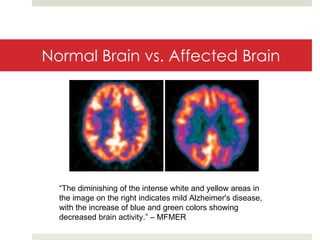
Normal Brain vs. Affected Brain “ The diminishing of the intense white and yellow areas in the image on the right indicates mild Alzheimer's disease, with the increase of blue and green colors showing decreased brain activity.” – MFMER
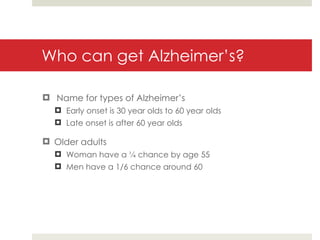
Who can get Alzheimer’s? Name for types of Alzheimer’s Early onset is 30 year olds to 60 year olds Late onset is after 60 year olds Older adults  Woman have a ¼ chance by age 55 Men have a 1/6 chance around 60
Who can get Alzheimer’s? People who don’t keep their brain active and healthy may have a higher chance in getting Alzheimer’s Factors depend on… Genetics Environment Lifestyle factors
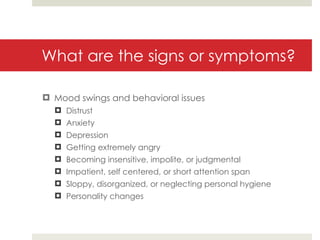
What are the signs or symptoms? Mood swings and behavioral issues Distrust Anxiety Depression Getting extremely angry Becoming insensitive, impolite, or judgmental Impatient, self centered, or short attention span Sloppy, disorganized, or neglecting personal hygiene Personality changes
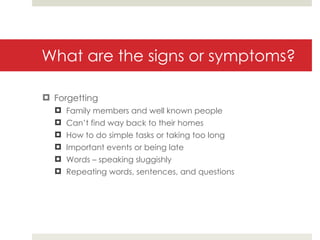
What are the signs or symptoms? Forgetting Family members and well known people Can’t find way back to their homes How to do simple tasks or taking too long Important events or being late Words – speaking sluggishly Repeating words, sentences, and questions
How should we treat people with this disease? Develop good coping skills Make decisions for them Help maintain their mental focus Take things off their hands Bills Errands
How should we treat people with this disease? Strong support Stimulate creativity Keep in touch with them
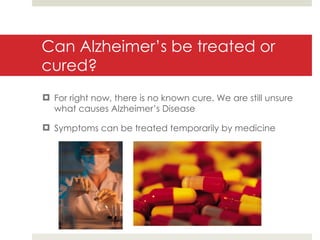
Can Alzheimer’s be treated or cured? For right now, there is no known cure. We are still unsure what causes Alzheimer’s Disease Symptoms can be treated temporarily by medicine
Career as Registered Nurse Administer nursing care to ill, injured, or disabled patients. May advise patients on health maintenance. Alzheimer’s patients are typically cared for by nurses Median $64,700 The need for nurses will increase 22% in about 7 years Master’s Degree needed to advance Related careers Nurse practitioners Advanced practice psychiatric nurse Clinical specialist
High School Career academies High school: River Hill High School Career Academy: Visual Communications You are involved in elements of design and learn to use industry standard software I chose this academy because I’m interested in graphic arts and designing them. I have a lot of creativity and enjoy expressing it.
University of Maryland School of Nursing, Baltimore In state tuition: $6,576 Graduates make up more than 40% of Maryland’s nurse workforce Program requirements Official transcripts from all attended schools Personal résumé 2 recent academic letters of recommendation Overall GPA 3.0 For further information visit website
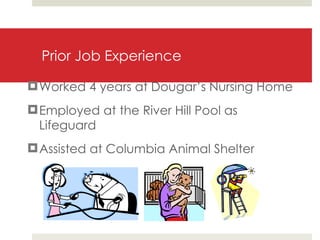
Prior Job Experience  Worked 4 years at Dougar’s Nursing Home Employed at the River Hill Pool as Lifeguard Assisted at Columbia Animal Shelter
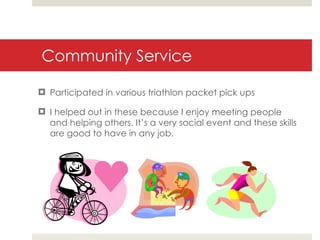
Community Service Participated in various triathlon packet pick ups I helped out in these because I enjoy meeting people and helping others. It’s a very social event and these skills are good to have in any job.
Citing PET scan of affected brain provided by Mayo Foundation for Medical Education and Research All other pictures were taken off of Clip Art All information on University of Maryland School of Nursing can be found on their website nursing.umaryland.edu

LilyHa

  • 1.
    What is Alzheimer’sDisease? Lily Ha B Block November 3, 2011
  • 2.
    Introduction Irreversible braindisease 4 th leading cause of death among older adults Leading cause of dementia Destroys memory, thinking skills, and ability to function About 4.5 million Americans have this disease Expected to increase 70% by 2020 Aging increases risk because people are living longer these days
  • 3.
    Normal Brain vs.Affected Brain “ The diminishing of the intense white and yellow areas in the image on the right indicates mild Alzheimer's disease, with the increase of blue and green colors showing decreased brain activity.” – MFMER
  • 4.
    Who can getAlzheimer’s? Name for types of Alzheimer’s Early onset is 30 year olds to 60 year olds Late onset is after 60 year olds Older adults Woman have a ¼ chance by age 55 Men have a 1/6 chance around 60
  • 5.
    Who can getAlzheimer’s? People who don’t keep their brain active and healthy may have a higher chance in getting Alzheimer’s Factors depend on… Genetics Environment Lifestyle factors
  • 6.
    What are thesigns or symptoms? Mood swings and behavioral issues Distrust Anxiety Depression Getting extremely angry Becoming insensitive, impolite, or judgmental Impatient, self centered, or short attention span Sloppy, disorganized, or neglecting personal hygiene Personality changes
  • 7.
    What are thesigns or symptoms? Forgetting Family members and well known people Can’t find way back to their homes How to do simple tasks or taking too long Important events or being late Words – speaking sluggishly Repeating words, sentences, and questions
  • 8.
    How should wetreat people with this disease? Develop good coping skills Make decisions for them Help maintain their mental focus Take things off their hands Bills Errands
  • 9.
    How should wetreat people with this disease? Strong support Stimulate creativity Keep in touch with them
  • 10.
    Can Alzheimer’s betreated or cured? For right now, there is no known cure. We are still unsure what causes Alzheimer’s Disease Symptoms can be treated temporarily by medicine
  • 11.
    Career as RegisteredNurse Administer nursing care to ill, injured, or disabled patients. May advise patients on health maintenance. Alzheimer’s patients are typically cared for by nurses Median $64,700 The need for nurses will increase 22% in about 7 years Master’s Degree needed to advance Related careers Nurse practitioners Advanced practice psychiatric nurse Clinical specialist
  • 12.
    High School Careeracademies High school: River Hill High School Career Academy: Visual Communications You are involved in elements of design and learn to use industry standard software I chose this academy because I’m interested in graphic arts and designing them. I have a lot of creativity and enjoy expressing it.
  • 13.
    University of MarylandSchool of Nursing, Baltimore In state tuition: $6,576 Graduates make up more than 40% of Maryland’s nurse workforce Program requirements Official transcripts from all attended schools Personal résumé 2 recent academic letters of recommendation Overall GPA 3.0 For further information visit website
  • 14.
    Prior Job Experience Worked 4 years at Dougar’s Nursing Home Employed at the River Hill Pool as Lifeguard Assisted at Columbia Animal Shelter
  • 15.
    Community Service Participatedin various triathlon packet pick ups I helped out in these because I enjoy meeting people and helping others. It’s a very social event and these skills are good to have in any job.
  • 16.
    Citing PET scanof affected brain provided by Mayo Foundation for Medical Education and Research All other pictures were taken off of Clip Art All information on University of Maryland School of Nursing can be found on their website nursing.umaryland.edu